

These articles are focused in the Bible, not history or science as in other parts of this website.
All the Ends of the World Shall Remember
Author & Finisher of Our Faith
Christ in You, the Hope of Glory
End Time Strong Delusion II (Counterfeiter)
Faith Once Delivered to the Saints
Is the New Testament Scripture?
Messiah in the Torah – Genesis 1:1 ‘In the Beginning’
Messiah in the Torah – Genesis 1:2-5 ‘Day 1’ “Let There Be Light”
Messiah in the Torah – Genesis 1:2-5 part 2 ‘In the Beginning Was the Word’
Messiah in the Torah – Genesis 1:6-8 ‘Day 2’ “Dividing of the Waters”
Messiah in the Torah – Genesis 1:9-13 ‘Day 3’ “Trees, plants & seed”
Messiah in the Torah – Genesis 1:14-19 ‘Day 4’ “Sun, moon & stars”
Messiah in the Torah – Genesis 1:20-23 ‘Day 5’ “Living creatures, birds & fish”
Passover & the Feast of Unleavened Bread
Prophecies of Messiah – Genesis 3:15: The Seed of the Woman
Prophecies of Messiah – Genesis 3:15: Crushing the serpent’s head
Prophecies of Messiah – Genesis 4:25: Another Seed
Prophecies of Messiah – Genesis 8:8-11: The Spirit of Messiah
Prophecies of Messiah – Genesis 9:26-27: God shall dwell in the tents of Shem
Prophecies of Messiah – Genesis 12:1-3: The Blessing of Abraham
Prophecies of Messiah – Genesis 12:7: The Promised Land
Prophecies of Messiah – Genesis 14:18: Melchizedek
Prophecies of Messiah – Genesis 17:19: The Seed of Isaac
Prophecies of Messiah – Genesis 21:9-12: Son of the Freewoman
Prophecies of Messiah – Genesis 22:8: The Lamb of God promised
Prophecies of Messiah – Genesis 22:14: Abraham saw His day
Prophecies of Messiah – Genesis 22:18: The Blessing secured
Prophecies of Messiah – Genesis 26:2-5: The Promise passed to Isaac
Prophecies of Messiah – Genesis 28:12 – Jacob’s Ladder
Prophecies of Messiah – Genesis 28:22: Jacob’s Pillar
Prophecies of Messiah – Genesis 35:21: The Tower of Edar
Prophecies of Messiah – Genesis 38:29: Descendant of Pharez
Prophecies of Messiah – Genesis 49:8: King from Judah
Prophecies of Messiah – Genesis 49:10: Shiloh
Prophecies of Messiah – Exodus 3:13-14: I AM
Prophecies of Messiah – Exodus 12:5: A Lamb Without Blemish
Prophecies of Messiah – Exodus 12:13: The Blood of the Lamb Saves from Wrath
Prophecies of Messiah – Exodus 12:46: Not a Bone Broken
Prophecies of Messiah – Exodus 15:2: The LORD will be my Salvation
Prophecies of Messiah – Exodus 15:11: Who is Like God?
Prophecies of Messiah – Exodus 17:6: The Rock of Israel
Prophecies of Messiah – Exodus 17:16: War with Amalek
Prophecies of Messiah – Exodus 33:18-23: The Glory of God
Prophecies of Messiah – Leviticus 16:15-17: Blood of Atonement
Prophecies of Messiah – Leviticus 16:27: Suffering Outside of the Camp
Prophecies of Messiah – Leviticus 16:30: Cleansing of Sin
Prophecies of Messiah – Leviticus 17:11: Blood Atonement
Prophecies of Messiah – Numbers 9:12: Not a Bone Broken
Prophecies of Messiah – Numbers 21:9: Serpent on a Pole
Prophecies of Messiah – Numbers 23:21: The Shout of a King
Seek His Face & The Golden Rule
United We Stand Divided We Fall
Yom Kippur – Ransom From Heaven
Yom Kippur – Under the Shadow of His Wings
Yom Teruah – The Voice of Messiah
Biblical Definitions
Through the study of Biblical definitions (letting the Word interpret the Word – 1 Corinthians 2:13) one will find that the various attributes of God will also be attributed to His Word and consequently to Jesus who is the Word made flesh. This concept is revealed by the Holy Spirit (1 Corinthians 2:13). The Father, The Word/Messiah and His Spirit are one. Therefore, in order for one to walk with God they must be walking in His Word/Jesus by His Spirit.
Deu 10:12 And now, Israel, what doth the LORD thy God require of thee, but to fear the LORD thy God, to walk in all his ways, and to love him, and to serve the LORD thy God with all thy heart and with all thy soul,
Deu 11:22 For if ye shall diligently keep all these commandments which I command you, to do them, to love the LORD your God, to walk in all his ways, and to cleave unto him;
1Jn 2:5 But whoso keepeth his word, in him verily is the love of God perfected: hereby know we that we are in him.
1Jn 2:6 He that saith he abideth in him ought himself also so to walk, even as he walked.
Faith Once Delivered
Musings – Author & Finisher of Our Faith
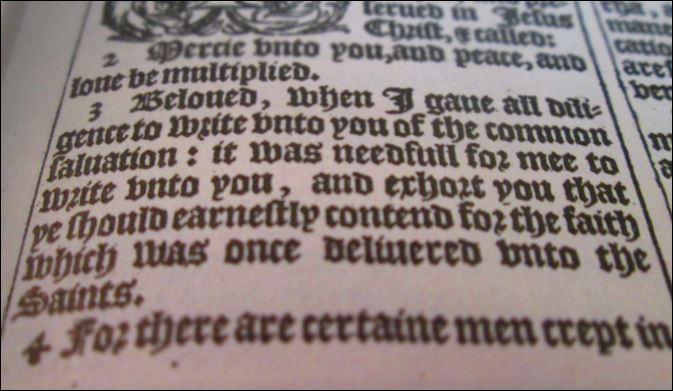
Jud 1:3 Beloved, when I gave all diligence to write unto you of the common salvation, it was needful for me to write unto you, and exhort you that ye should earnestly contend for the faith which was once delivered unto the saints.
Php 1:27 Only let your conversation be as it becometh the gospel of Christ: that whether I come and see you, or else be absent, I may hear of your affairs, that ye stand fast in one spirit, with one mind striving together for the faith of the gospel;
When was this “once for all time” faith delivered? At the time of Adam? Abraham? Moses? Jesus? The Apostles?
The faith delivered to Abraham & Moses was temporary and incomplete (1 Peter 1:10-12; John 3:34; Hebrews 9:10; Romans 16:25-26; Galatians 3:19). The faith once delivered to the saints was brought forth by Jesus Christ (Galatians 4:4; Ephesians 1:10; 2:20; Hebrews 1:1-4; 3:2-6; 12:2). This faith was handed down to the Apostles (Ephesians 2:20; John 16:12-15; 17:20; Acts 2:42; 13:12; Matthew 28:19-20) and then the early church (1 Timothy 3:15; 1 Peter 2:9; Matthew 16:18-19; 18:18; 21:43; 1 Corinthians 11:2; 1 Thessalonians 4:1; 2 Thessalonians 2:15; 3:6; 2 Peter 1:1).
1Ti 3:15 But if I tarry long, that thou mayest know how thou oughtest to behave thyself in the house of God, which is the church of the living God, the pillar and ground of the truth.
I know of many believers who are seeking to return to the faith once delivered to the saints and are seeking to understand their Hebraic roots. This is an honorable endeavor as our Heavenly Father seeks those who will worship Him in Spirit & Truth (John 4:23). However, there is much confusion and deception in the Hebraic roots movement. The true Hebrew root, the Olive tree of Israel, is Christ. The Word made flesh. If one wants to know their roots, one need only turn to the Bible.
Through the Hebrew roots movement and its various interpretations, many are turning to Judaism as this religion is portrayed as the religion of the Bible, but is this true? A look at the writings of Judaism will make it clear that this is not the faith once delivered to the saints. As one studies the early church and the writings of the early Church Fathers, one will see this faith aligns with the writings of the New Testament and sets forth the faith once delivered to the saints.
This page will be dedicated to the teachings of the early church and their interpretations of the Word of God which they profess were handed down to them through the teachings of the Apostles. I also hope to share the differences between what is taught in the Hebrew roots movement (claiming to be the ‘faith once delivered) and what was taught by these early Christians.
Christ did not come to make mankind into 1st century Jews. He came to redeem mankind (2 Corinthians 5:19) and remake them into His image (Romans 8:29; 1 John 3:1-3). Jesus is THE image of God (Hebrews 1:3; 2 Corinthians 4:4-6; Colossians 1:15-16) who is love (1 John 4:8).
Heb 12:2 Looking unto Jesus the author and finisher of our faith; who for the joy that was set before him endured the cross, despising the shame, and is set down at the right hand of the throne of God.
We are not to look to Abraham, Isaac or Jacob, we are not to look to Moses, David, or Elijah, we are not to look to first century Judaism to earnestly contend for the faith once delivered (Jude 1:3)…we are to look to Messiah Jesus, the Word of God made flesh. The root of which we are to seek is not Hebrew, it is Jesus, the Word of God made flesh, the manifestation of God’s love.
Col 2:6 Therefore, as you received Christ Jesus the Lord, walk in Him,
Col 2:7 being rooted and being built up in Him, and being confirmed in the faith, even as you were taught, abounding in it with thanksgiving.
Col 2:8 Watch that there not be one robbing you through philosophy and empty deceit, according to the tradition of men, according to the elements of the world, and not according to Christ.
Eph 3:17 That Christ may dwell in your hearts by faith; that ye, being rooted and grounded in love,
Eph 3:18 May be able to comprehend with all saints what is the breadth, and length, and depth, and height;
Eph 3:19 And to know the love of Christ, which passeth knowledge, that ye might be filled with all the fulness of God.
Eph 3:20 Now unto him that is able to do exceeding abundantly above all that we ask or think, according to the power that worketh in us,
Eph 3:21 Unto him be glory in the church by Christ Jesus throughout all ages, world without end. Amen.
Knowledge of the way in which believers worshiped in the 1st century is not as important as knowledge God (2 Peter 1:2), and the love of Messiah (Ephesians 3:19; 2 Peter 3:18) by His Spirit (2 Corinthians 3:6; Romans 5:5; 8:2-4). Messiah did not come to make mankind into 1st century Jews. He came to redeem mankind (2 Corinthians 5:19) and remake them into His image (Romans 8:29; 1 John 3:1-3). Jesus is THE image of God (Hebrews 1:3; 2 Corinthians 4:4-6; Colossians 1:15-16) who is love (1 John 4:8).
Much edification can be gained by studying believers of the 1st century (Job 8:8; 12:12; Deuteronomy 32:7; Romans 15:4; 1 Corinthians 10:11), but one cannot come to the fullness of God’s will (Ephesians 3:19; 4:13; Colossians 2:9-10) by following man’s understanding of His will at that time. Paul, who had great understanding of religion during the 1st century, did not even claim to have attained the full knowledge of Messiah/the Word (Philippians 3:8-14). Peter admonishes us to continue to grow in His grace and knowledge (2 Peter 3:18). Scripture declares that God has given various gifts and services to the body of Messiah that we might grow unto perfection (Ephesians 4:11-13). If 1st century believers had attained unto God’s perfect will, there would be no need to grow. James also said that we all stumble in many things (James 3:2). This is not the language of one who believes that perfection had been attained.
It is not walking as 1st century Jews which is God’s will for us. It is walking in His love by His Spirit (1 John 4:12-17) as it is done in heaven (Matthew 6:10). It is God working in us, through His Son (Philippians 2:13; Hebrews 13:21). This cannot be done by submission unto man, this can only be done through submitting unto Him (Romans 12:1-2; 1 Peter 1:14). This cannot be done by conforming oneself to man’s understanding (Romans 12:2), this can only be done by being conformed/transformed into the image of Messiah (Romans 8:29) through the work of God’s Spirit (Philippians 3:21).
1Jn 4:12 No man hath seen God at any time. If we love one another, God dwelleth in us, and his love is perfected in us.
1Jn 4:13 Hereby know we that we dwell in him, and he in us, because he hath given us of his Spirit.
1Jn 4:16 And we have known and believed the love that God hath to us. God is love; and he that dwelleth in love dwelleth in God, and God in him.
1Jn 4:17 Herein is our love made perfect, that we may have boldness in the day of judgment: because as he is, so are we in this world.
Musings
Musings – 2012 Election
Musings – 6174: The Kaprekar Constant
Musings – All the Ends of the World Shall Remember
Musings – Author & Finisher of Our Faith
Musings – Christ in You, the Hope of Glory
Musings – Overcome Evil with Good
Musings – Pronouncing the Sacred Name
Musings – Saved by Grace Through Faith
Musings – Seek His Face & The Golden Rule
Musings – Sukkot – Unity in the Love of Messiah
Musings – The Father’s Love Letter
Musings – United We Stand Divided We Fall
Musings – The Universe Is a Symphony of Vibrating Strings
Musings – The Voice of Messiah
Musings – Yom Kippur – Under the Shadow of His Wings
Examinations

The Holy Scriptures admonish believers to examine themselves to consider if they are “in the faith” (2 Corinthians 13:5), to “hold fast that which is good” (1 Thessalonians 5:21), “prove what is that good, and acceptable, and perfect, will of God (Romans 12:2), that we “may be sincere and without offense till the day of Christ, being filled with the fruits of righteousness, which are by Jesus Christ, unto the glory and praise of God” (Philippians 2:10) for we were once in darkness, but now children of light, called to “prove” what is acceptable to the Lord (Ephesians 5:10). We are not to believe every spirit but are to try or examine them (1 John 4:1) as there are “many false prophets” that have gone out in the world.
2Co 13:5 Examine yourselves {πειράζω ‘peirazō’ – put yourself on trial, examine and test yourself}, whether ye be in the faith; prove your own selves {δοκιμάζω ‘dokimazō’ – scrutinize yourself and recognize the judgment}. Know ye not your own selves, how that Jesus Christ is in you, except ye be reprobates?
1Th 5:21 Prove {δοκιμάζω ‘dokimazō’} all things; hold fast that which is good.
Rom 12:2 And be not conformed to this world: but be ye transformed by the renewing of your mind, that ye may prove {δοκιμάζω ‘dokimazō’} what is that good, and acceptable, and perfect, will of God.
Php 1:9 And this I pray, that your love may abound yet more and more in knowledge and in all judgment;
Php 1:10 That ye may approve {δοκιμάζω ‘dokimazō’} things that are excellent; that ye may be sincere and without offence till the day of Christ;
Php 1:11 Being filled with the fruits of righteousness, which are by Jesus Christ, unto the glory and praise of God.
1Jn 4:1 Beloved, believe not every spirit, but try {δοκιμάζω ‘dokimazō’} the spirits whether they are of God: because many false prophets are gone out into the world.
Rom 14:22 Hast thou faith? have it to thyself before God. Happy is he that condemneth not himself in that thing which he alloweth {δοκιμάζω ‘dokimazō’}.
Eph 5:8 For ye were sometimes darkness, but now are ye light in the Lord: walk as children of light:
Eph 5:9 (For the fruit of the Spirit is in all goodness and righteousness and truth;)
Eph 5:10 Proving {δοκιμάζω ‘dokimazō’} what is acceptable unto the Lord.
Scripture declares that he that thinks he stands needs to take heed lest he fall (1 Corinthians 10:12). We don’t stand by our works or knowledge, we stand only by faith (2 Corinthians 1:24) in the Gospel (1 Corinthians 15:1) which is given by the grace of God (Romans 5:2). As a result, we are not to judge each other and the perceived failings of each other as we are all servants of God and He is the Master who makes us stand or fall (Romans 14:4).
In recent years I have been in the process of re-examining (testing, proving) things which I have believed and taught/shared on this website. I have found that in some things, I was in error in my understanding. Through this time of examining and reflection I have grown much, finding out that I was not walking in God’s will in many ways because of believing certain doctrine/information.
Zealousness for God’s truth is great (Revelation 3:19; Titus 2:14), but we must be careful that this zealousness does not turn into carnal envy/zealousness (1 Corinthians 3:3) and become like Paul who killed Christians in his zealousness before coming to the faith (Philippians 3:6). Although we have been given God’s Spirit, we still have sin dwelling in our carnal flesh (Romans 7:11, 17-18).
Carnality is carnality whether or not it is disguised as religion or not. Sadly, many times our zealousness for God can be used by Satan to lead us into persecution of one another in the guise of religious zeal (Acts 22:3-4; Philippians 3:6; Romans 10:2-4). This religious ‘passion’ does not bring forth the righteousness of God (James 1:20). It is ‘devilish’ (James 3:13-18). The love of God does not behave in this manner for love ‘envies’ not (1 Corinthians 13:4).
In my zeal I thought I was pleasing God, I thought I was “altogether like Him”…
Psa 50:19 Thou givest thy mouth to evil, and thy tongue frameth deceit.
Psa 50:20 Thou sittest and speakest against thy brother; thou slanderest thine own mother’s son.
Psa 50:21 These things hast thou done, and I kept silence; thou thoughtest that I was altogether such an one as thyself: but I will reprove thee, and set them in order before thine eyes.
Psa 50:22 Now consider this, ye that forget God, lest I tear you in pieces, and there be none to deliver.
Psa 50:23 Whoso offereth praise glorifieth me: and to him that ordereth his conversation aright will I shew the salvation of God.
Some of the knowledge I was sharing was not the peaceable fruit of the Spirit…it was poison of the adversary.
Jas 3:9 Therewith bless we God, even the Father; and therewith curse we men, which are made after the similitude of God.
Jas 3:10 Out of the same mouth proceedeth blessing and cursing. My brethren, these things ought not so to be.
Jas 3:11 Doth a fountain send forth at the same place sweet water and bitter?
Jas 3:12 Can the fig tree, my brethren, bear olive berries? either a vine, figs? so can no fountain both yield salt water and fresh.
Jas 3:13 Who is a wise man and endued with knowledge among you? let him shew out of a good conversation his works with meekness of wisdom.
Jas 3:14 But if ye have bitter envying and strife in your hearts, glory not, and lie not against the truth.
Jas 3:15 This wisdom descendeth not from above, but is earthly, sensual, devilish.
Jas 3:16 For where envying and strife is, there is confusion and every evil work.
Jas 3:17 But the wisdom that is from above is first pure, then peaceable, gentle, and easy to be intreated, full of mercy and good fruits, without partiality, and without hypocrisy.
Jas 3:18 And the fruit of righteousness is sown in peace of them that make peace.
I was spreading knowledge, not truth. I was dividing the body of Christ, the pillar and ground of truth (1 Timothy 3:15), and in my zeal to serve Him, I was actually persecuting Christ, THE truth (John 1:14, 17; 14:6). Just like Paul I zealously persecuted the church but came to find in reality it was Jesus I was attacking (Acts 9:4-5; 22:5-8; 26:13-18; 1 Timothy 1:4-16).
But (like Paul)…God has shown me mercy.
1Ti 1:13 Who was before a blasphemer, and a persecutor, and injurious: but I obtained mercy, because I did it ignorantly in unbelief.
1Ti 1:14 And the grace of our Lord was exceeding abundant with faith and love which is in Christ Jesus.
1Ti 1:15 This is a faithful saying, and worthy of all acceptation, that Christ Jesus came into the world to save sinners; of whom I am chief.
1Ti 1:16 Howbeit for this cause I obtained mercy, that in me first Jesus Christ might shew forth all longsuffering, for a pattern to them which should hereafter believe on him to life everlasting.
Even though the Lord has “shed abroad” His Spirit in my heart (Romans 5:5), I am still a man who is walking in carnality and as a result can go astray (Romans 7:1-25), corrupting the image of the God of love (1 John 4:7-21) who dwells in my heart (Ephesians 3:17; 2 Corinthians 4:6; John 14:17, 23; Romans 8:9-11; Colossians 1:27; Galatians 2:20; 1 John 4:4,16; Romans 10:8).
The zealousness I had to worship God in Spirit and truth (John 4:24) was corrupted into carnal envy. The Spirit of truth (John 14:17; 15:26; 16:13) will cause us to bear fruit of “goodness and righteousness and truth” (Ephesians 5:19) unto unfeigned love of the brethren (1 Peter 1:22). If we aren’t bearing this fruit, we are more than likely walking in carnal envy.
1Co 1:12 Now this I say, that every one of you saith, I am of Paul; and I of Apollos; and I of Cephas; and I of Christ.
1Co 1:13 Is Christ divided? was Paul crucified for you? or were ye baptized in the name of Paul?
1Co 3:3 For ye are yet carnal: for whereas there is among you envying {ζῆλος ‘zēlos’}, and strife, and divisions, are ye not carnal, and walk as men?
1Co 3:4 For while one saith, I am of Paul; and another, I am of Apollos; are ye not carnal?
The word for “envying” in 1 Corinthians 3:3 is ζῆλος ‘zēlos’ which also means zealousness. Zealousness for God’s truth is great (Revelation 3:19; Titus 2:14), but we must be careful that this zealousness does not turn into carnal envy. Although we have been given God’s Spirit, we still have sin dwelling in our carnal flesh (Romans 7:11, 17-18). Carnality is carnality whether or not it is disguised as religion or not. Sadly, many times our zealousness for God can be used by Satan to lead us into persecution of one another in the guise of religious zeal (Acts 22:3-4; Philippians 3:6; Romans 10:2-4).
This religious ‘passion’ does not bring forth the righteousness of God (James 1:20). It is ‘devilish’ (James 3:13-18).
Jas 1:20 For the wrath of man worketh not the righteousness of God.
Jas 3:13 Who is a wise man and endued with knowledge among you? let him shew out of a good conversation his works with meekness of wisdom.
Jas 3:14 But if ye have bitter envying {ζῆλος ‘zēlos’} and strife in your hearts, glory not, and lie not against the truth.
Jas 3:15 This wisdom descendeth not from above, but is earthly, sensual, devilish.
Jas 3:16 For where envying and strife is, there is confusion and every evil work.
Jas 3:17 But the wisdom that is from above is first pure, then peaceable, gentle, and easy to be intreated, full of mercy and good fruits, without partiality, and without hypocrisy.
Jas 3:18 And the fruit of righteousness is sown in peace of them that make peace.
Love envies not
1Co 13:4 Charity suffereth long, and is kind; charity envieth not; charity vaunteth not itself, is not puffed up,
The love of God does not behave in this manner for love ‘envies’ not (1 Corinthians 13:4).
When we walk in God’s love we realize that we do not have the corner market on truth. As a result we must be patient with one another focusing on faith, hope and love. These three things constitute the armor of God, in specific His breastplate of righteousness (1 Thessalonians 5:8-9). It is in this love that we can stand (Ephesians 6:11-18; Romans 5:1-2).
Knowledge puffs us up and leads to division. Love does not puff us up, love edifies (1 Corinthians 4:4-7; 13:4; Colossians 2:18-19).
1Co 8:1 Now as touching things offered unto idols, we know that we all have knowledge. Knowledge puffeth up, but charity edifieth.
1Co 8:2 And if any man think that he knoweth any thing, he knoweth nothing yet as he ought to know.
1Co 8:3 But if any man love God, the same is known of him.
Eph 6:23 Peace be to the brethren, and love with faith, from God the Father and the Lord Jesus Christ.
Eph 6:24 Grace be with all them that love our Lord Jesus Christ in sincerity. Amen.
United We Stand Divided We Fall
We don’t stand by our works or knowledge, we stand only by faith (2 Corinthians 1:24) in the Gospel (1 Corinthians 15:1) which is given by the grace of God (Romans 5:2). As a result, we are not to judge each other and the perceived failings of each other as we are all servants of God and He is the Master who makes us stand or fall (Romans 14:4). We are called to bear the infirmities (weakness of mind) of our brothers, edifying them in love as Messiah did (Romans 15:1-7).
If we think we are standing by our works or knowledge and that we are somehow better than our fellow believer because we do something or think something that they don’t, we are walking in pride and we will fall and be humbled (Proverbs 16:18).
The accuser of the brethren is always on the lookout for the sins/weaknesses of believers (Psalm 10:8-10). The Defender is there for us, giving us grace and love to cover our weaknesses (Hebrews 4:15-16). We are not called to be on the constant lookout for the sins and weaknesses of our brethren (Romans 14:4; James 4:11-12), we are called to defend and love our brethren as Messiah does (Romans 15:1-3; 14:1; 1 Corinthians 12:22-27; Galatians 6:1-3). Being on the watch for the sins of others is the job of the wicked (Psalm 17:8-15; 64:1-10). Defending against these accusations is the role of the Lord (Psalm 5:5-12; 7:10; 62:1-8; 89:18) and His people (1 Peter 4:8).
Another word in Hebrew for one who watches is שמר ‘shamar’ which means “a close watching of something for guarding or protecting” as in the corrals made by shepherds to protect their flock from predators. A related word in Hebrew is נצר ‘netsar’ which means to “watch over or guard in order to preserve”. נצר ‘netsar’ also means ‘branch,’ speaking of Christ (Isaiah 11:1) and His people (Acts 24:5; John 15:5; Jeremiah 31:6; Isaiah 49:6).
Are we going to stand with Christ Jesus, the Defender (Luke 22:31-32; Romans 8:31-34; Hebrews 2:14-18; 4:15-16; 1 John 2:2) or the devil, the accuser (Revelation 12:11)?
Are we going to “partake” of the leaven of hypocrisy and accusation or are we going to “partake of Christ”?
1Co_10:16 The cup of blessing which we bless, is it not the communion of the blood of Christ? The bread which we break, is it not the communion of the body of Christ?
1Co_10:17 For we being many are one bread, and one body: for we are all partakers of that one bread.
Heb 3:14 For we have become partakers {μέτοχος ‘metochos’} of Christ, if truly we hold the beginning of the assurance firm to the end;
Are we going to stand with Christ Jesus, the Defender (Luke 22:31-32; Romans 8:31-34; Hebrews 2:14-18; 4:15-16; 1 John 2:2) or the devil, the accuser (Revelation 12:11)?
We are called to fix our eyes on Jesus, “partaking” of Him as He “partook” of flesh and blood to defeat the enemy…not to “fix our eyes” on our brethren, observing to accuse.
Heb 2:9 But we see Jesus, who was made a little lower than the angels for the suffering of death, crowned with glory and honour; that he by the grace of God should taste death for every man.
Heb 2:10 For it became him, for whom are all things, and by whom are all things, in bringing many sons unto glory, to make the captain of their salvation perfect through sufferings.
Heb 2:11 For both he that sanctifieth and they who are sanctified are all of one: for which cause he is not ashamed to call them brethren,
Heb 2:12 Saying, I will declare thy name unto my brethren, in the midst of the church will I sing praise unto thee.
Heb 2:13 And again, I will put my trust in him. And again, Behold I and the children which God hath given me.
Heb 2:14 Forasmuch then as the children are partakers of flesh and blood, he also himself likewise took part of the same; that through death he might destroy him that had the power of death, that is, the devil;
Heb 2:15 And deliver them who through fear of death were all their lifetime subject to bondage.
Heb 2:16 For verily he took not on him the nature of angels; but he took on him the seed of Abraham.
Heb 2:17 Wherefore in all things it behoved him to be made like unto his brethren, that he might be a merciful and faithful high priest in things pertaining to God, to make reconciliation for the sins of the people.
Heb 2:18 For in that he himself hath suffered being tempted, he is able to succour them that are tempted.
Rom 8:1 There is therefore now no condemnation to them which are in Christ Jesus, who walk not after the flesh, but after the Spirit.
Rom 8:2 For the law of the Spirit of life in Christ Jesus hath made me free from the law of sin and death.
Rom 8:3 For what the law could not do, in that it was weak through the flesh, God sending his own Son in the likeness of sinful flesh, and for sin, condemned sin in the flesh:
Rom 8:4 That the righteousness of the law might be fulfilled in us, who walk not after the flesh, but after the Spirit.
Rom 8:5 For they that are after the flesh do mind the things of the flesh; but they that are after the Spirit the things of the Spirit.
Rom 8:6 For to be carnally minded is death; but to be spiritually minded is life and peace.
Rom 8:7 Because the carnal mind is enmity against God: for it is not subject to the law of God, neither indeed can be.
Rom 8:8 So then they that are in the flesh cannot please God.
Rom 8:9 But ye are not in the flesh, but in the Spirit, if so be that the Spirit of God dwell in you. Now if any man have not the Spirit of Christ, he is none of his.
Rom 8:10 And if Christ be in you, the body is dead because of sin; but the Spirit is life because of righteousness.
Rom 8:11 But if the Spirit of him that raised up Jesus from the dead dwell in you, he that raised up Christ from the dead shall also quicken your mortal bodies by his Spirit that dwelleth in you.
Rom 8:12 Therefore, brethren, we are debtors, not to the flesh, to live after the flesh.
Rom 8:13 For if ye live after the flesh, ye shall die: but if ye through the Spirit do mortify the deeds of the body, ye shall live.
Rom 8:14 For as many as are led by the Spirit of God, they are the sons of God.
Rom 8:15 For ye have not received the spirit of bondage again to fear; but ye have received the Spirit of adoption, whereby we cry, Abba, Father.
Rom 8:16 The Spirit itself beareth witness with our spirit, that we are the children of God:
Rom 8:17 And if children, then heirs; heirs of God, and joint-heirs with Christ; if so be that we suffer with him, that we may be also glorified together.
Rom 8:18 For I reckon that the sufferings of this present time are not worthy to be compared with the glory which shall be revealed in us.
Rom 8:19 For the earnest expectation of the creature waiteth for the manifestation of the sons of God.
Rom 8:20 For the creature was made subject to vanity, not willingly, but by reason of him who hath subjected the same in hope,
Rom 8:21 Because the creature itself also shall be delivered from the bondage of corruption into the glorious liberty of the children of God.
Rom 8:22 For we know that the whole creation groaneth and travaileth in pain together until now.
Rom 8:23 And not only they, but ourselves also, which have the firstfruits of the Spirit, even we ourselves groan within ourselves, waiting for the adoption, to wit, the redemption of our body.
Rom 8:24 For we are saved by hope: but hope that is seen is not hope: for what a man seeth, why doth he yet hope for?
Rom 8:25 But if we hope for that we see not, then do we with patience wait for it.
Rom 8:26 Likewise the Spirit also helpeth our infirmities: for we know not what we should pray for as we ought: but the Spirit itself maketh intercession for us with groanings which cannot be uttered.
Rom 8:27 And he that searcheth the hearts knoweth what is the mind of the Spirit, because he maketh intercession for the saints according to the will of God.
Rom 8:28 And we know that all things work together for good to them that love God, to them who are the called according to his purpose.
Rom 8:29 For whom he did foreknow, he also did predestinate to be conformed to the image of his Son, that he might be the firstborn among many brethren.
Rom 8:30 Moreover whom he did predestinate, them he also called: and whom he called, them he also justified: and whom he justified, them he also glorified.
Rom 8:31 What shall we then say to these things? If God be for us, who can be against us?
Rom 8:32 He that spared not his own Son, but delivered him up for us all, how shall he not with him also freely give us all things?
Rom 8:33 Who shall lay any thing to the charge of God’s elect? It is God that justifieth.
Rom 8:34 Who is he that condemneth? It is Christ that died, yea rather, that is risen again, who is even at the right hand of God, who also maketh intercession for us.
Rom 8:35 Who shall separate us from the love of Christ? shall tribulation, or distress, or persecution, or famine, or nakedness, or peril, or sword?
Rom 8:36 As it is written, For thy sake we are killed all the day long; we are accounted as sheep for the slaughter.
Rom 8:37 Nay, in all these things we are more than conquerors through him that loved us.
Rom 8:38 For I am persuaded, that neither death, nor life, nor angels, nor principalities, nor powers, nor things present, nor things to come,
Rom 8:39 Nor height, nor depth, nor any other creature, shall be able to separate us from the love of God, which is in Christ Jesus our Lord.
2Co 5:14 For the love of Christ constraineth us; because we thus judge, that if one died for all, then were all dead:
2Co 5:15 And that he died for all, that they which live should not henceforth live unto themselves, but unto him which died for them, and rose again.
2Co 5:16 Wherefore henceforth know we no man after the flesh: yea, though we have known Christ after the flesh, yet now henceforth know we him no more.
2Co 5:17 Therefore if any man be in Christ, he is a new creature: old things are passed away; behold, all things are become new.
2Co 5:18 And all things are of God, who hath reconciled us to himself by Jesus Christ, and hath given to us the ministry of reconciliation;
2Co 5:19 To wit, that God was in Christ, reconciling the world unto himself, not imputing their trespasses unto them; and hath committed unto us the word of reconciliation.
2Co 5:20 Now then we are ambassadors for Christ, as though God did beseech you by us: we pray you in Christ’s stead, be ye reconciled to God.
2Co 5:21 For he hath made him to be sin for us, who knew no sin; that we might be made the righteousness of God in him.
Heb 12:2 Looking unto Jesus the author {ἀρχηγός ‘archēgos”} and finisher {τελειωτής ‘teleiōtēs’} of our faith; who for the joy that was set before him endured the cross, despising the shame, and is set down at the right hand of the throne of God.

Hebrew Roots of Christian Holidays part 1
Hebrew Roots of Christian Holidays part 2
Hebrew Roots of Christian Holidays – Examine Yourself
Hebrew Roots of Christian Holidays – Pagan Christianity?
Hebrew Roots of Christian Holidays – Alexander Hislop
Hebrew Roots of Christian Holidays – Ralph Woodrow
Hebrew Roots of Christian Holidays – Pagan Parallels
Hebrew Roots of Christian Holidays – Church Fathers & Paganism
Hebrew Roots of Christian Holidays – Constantine
Hebrew Roots of Christian Holidays – Origins of Christian Holidays
Hebrew Roots of Christian Holidays – Easter & Paganism?
Hebrew Roots of Christian Holidays – Easter Eggs
Hebrew Roots of Christian Holidays – Easter Lily
Hebrew Roots of Christian Holidays – Easter Bunny
Hebrew Roots of Christian Holidays – Resurrection Celebration
Hebrew Roots of Christian Holidays – Christmas & Paganism?
Hebrew Roots of Christian Holidays – Christmas Trees
Hebrew Roots of Christian Holidays – The Law & Holidays
Hebrew Roots of Christian Holidays – Change in Law
Hebrew Roots of Christian Holidays – The Law of Christ
Hebrew Roots of Christian Holidays – A New Commandment
Hebrew Roots of Christian Holidays – God Changes Times and Seasons
Hebrew Roots of Christian Holidays – Binding & Loosing
Hebrew Roots of Christian Holidays – Establishing the Law
Hebrew Roots of Christian Holidays – Fulfillment of the Law
Hebrew Roots of Christian Holidays – Receiving One Another
Hebrew Roots of Christian Holidays – The Lord’s Day
Hebrew Roots of Christian Holidays – Love Bears All Things
Hebrew Roots of Christian Holidays – History
Christmas – Little Guy in the Eye
YES! Evidence Indicates Jesus Really Was Born Dec. 25th – Kurt Simmons
“Unto You is Born this Day” – Kurt Simmons
John the Baptist Six Months Older than our Lord – Kurt Simmons
The Nativity of Christ & Death of Herod the Great – Kurt Simmons
Star of Bethlehem or Nazareth? – Kurt Simmons
Objections to Christmas and the Dec. 25th Birth of Christ Answered – Kurt Simmons
Refutation of Ernest Martin’s “The Star that Astonished the World” – Kurt Simmons
Dating the Birth of Jesus of Nazareth – Michal E. Hunt
How December 25 Became Christmas – Biblical Archaeology Society
Calculating Christmas: The Story Behind December 25 – William J. Tighe
Christmas – Throwback Christianity
Is Christmas Lawful, or Is It Pagan? – Kurt Simmons
Presbyterian & Puritanial Curmudeons and the War Against Christmas – Kurt Simmons
Christmas Was Never a Pagan Holiday – Marian T. Horvat
Is Christmas Really a Pagan Holiday? – Come Reason Ministries
Christmas: Pagan Festival or Christian Celebration? – Dr. Anthony McRoy

