

Psa 17:8 Keep me as the apple of the eye, hide me under the shadow of thy wings,
The phrase ‘Little Guy in the Eye’ is speaking of a close relationship with God where we appear as a little guy in His Eye or as the ‘apple of His Eye.’
The essence of being a “little guy in the Eye” is love. Walking in close relationship with God who is love (1 John 4:8) and extending that love to our fellow man (1 John 4:12). Its about relationship with the Most High. Each one of us must work out our own salvation with fear and trembling as God works through us according to His good pleasure (Philippians 2:12-13). If we keep focused on Him, He will be able to transform us from glory to glory (2 Corinthians 3:18) until we are formed into the image of His Son (Romans 8:29).
The Holy Scriptures speak of the Word of God being the apple of our eye (Proverbs 7:2). When we look into the “eyes of God” we see ourselves, when He looks into our eyes He sees the Word, Himself. The ultimate goal of walking with God is that at the end of our journey we will look into His eyes and see the Word as well, His image formed in and through us. To accomplish this, our eyes should be on Jesus, the Word made flesh (John 1:1)…the Author and Finisher of our faith (Hebrews 12:2).
Scripture speaks of Jesus as the “Face” of God, His Image (Psalm 44:3; 42:5; Hebrews 1:1-3; John 14:7-9; 2 Corinthians 4:4-6; Colossians 1:12-20; John 17:21-23). To be a little guy in the Eye of God is to look unto the LORD Jesus Christ. For those who read through the articles shared on this website, the focus being on Jesus, I hope, will be readily seen. From all of the Bible being about Him, to all of creation pointing to Him, He is the focus.
The Holy Scriptures admonish us to seek the Face of God at all times (1 Chronicles 16:11). Seeking His Face where we appear as a “little guy” in His Eye will cause us to love others as He loves them…
When we look to God, we see what we are. Evil, despicable, unworthy (Romans 3:10-19,23)…but when we look to Him we see His unending love for us in spite of our sinfulness (Ephesians 2:1-7). When we look to our fellow man, our carnal flesh which is full of hate, immediately wants to focus on their evils and unworthiness (1 Corinthians 3:1-4; Romans 8:7). However, if we remember that we are just as unworthy of God’s love as them and reflect on the fact that God still grants us His unmerited, unending love… will we not be more likely to do the same to them?
He has forgiven us so let us forgive (Matthew 18:23-35; Ephesians 4:32). He shows us mercy so let us show mercy (2 Samuel 22:36; Luke 6:36). He overlooks our lack of understanding and ignorance so let us do the same with others. Even if the other person accepts not our forgiveness, love and understanding we must remember that we have treated God the same in the past, and even still do today as believers.
In seeking His Face, His Light will shine upon us where we can walk in His name (Numbers 6:24-27). If we seek His face continually (1 Chronicles 16:11), His light will reflect from us to others (2 Corinthians 4:6). Scripture likens seeking the Face of the Lord as looking into a mirror (2 Corinthians 3:18; 1 Corinthians 13:12) in which we now see darkly. As a result, we should abide in faith, hope and love. Most importantly, in love. This love is summed up in the Golden Rule (Matthew 7:12; Luke 6:31).
All religions are based upon the Golden rule of treating others the way you want to be treated. Almost everyone in the world follows a religion so why is there so much hate? The problem is that we cannot keep the Golden Rule by our power or understanding. The Golden Rule can only work if we are following by the principle of seeking His Face. We can only truly abide by the Golden Rule if we are treating men as we wish God to treat us. We want forgiveness and mercy and grace from God…this then should be given to others. We must love as He loves us (John 13:34; 15:12).
Christ said that the all of the Law and Prophets hang upon the Golden Rule (Matthew 7:12; 22:40). Paul also says that the entire law is based upon this principle (Galatians 5:14). By applying the concept of seeking His Face, this is seen. A proper fulfillment of the Golden rule depends upon what man is seeking. God or false religion/idols/self. Idolatry and false religion lead to hate (John 15:21-25; Hosea 9:7-8), this is why there is so much hate in the world. If we are not walking in love, we are not walking with God (1 John 4:8). Hatred for our fellow man is indicative that we are not seeking the Face of God as man was created in God’s image (1 John 4:20-21; James 3:9). Hate is indicative that we are walking in the carnal flesh which is at war with God (Romans 8:7; Galatians 5:19-21). Hate in one’s heart reveals a spiritual blindness (1 John 2:9-11) which is caused in many cases by dead religion (John 9:41; 15:21-25; 2 Corinthians 4:4; Isaiah 44:18; 6:9-10; Matthew 13:13-15; 15:7-14). True religion leads to love and purity (James 1:27).
When we seek the Face of God at all times we can overcome the hate for others caused by fear and ignorance (1 John 4:18; Romans 8:15, 31-39; Psalm 118:6; Hebrews 13:6). When we seek the Face of God we can love our enemies and show them mercy as He does (Matthew 5:43-48; Luke 6:27-36; Romans 12:14-21; 1 Peter 3:8-15; Ephesians 2:2-22).
Apple of the Eye – Little Guy in the Eye
The phrase ‘apple of the eye’ is rendered כאישׁון בת־עין ‘k’ishon bat ayin’ in Hebrew. אישון ‘ishon’ means man/ little man, בת ‘bat’ means daughter and עין ‘ayin’ means eye…the little guy/girl in the eye.
From Keil & Delitzsch commentary
“The apple of the eye, which is surrounded by the iris, is called אִישֹׁון, the man (Arabic insân), or in the diminutive and endearing sense of the termination on: the little man of the eye, because a picture in miniature of one’s self is seen, as in a glass, when looking into another person’s eye. בַּת־עַיִן either because it is as if born out of the eye and the eye has, as it were, concentrated itself in it, or rather because the little image which is mirrored in it is, as it were, the little daughter of the eye (here and Lam_2:18). To the Latin pupilla (pupula), Greek κόρη, corresponds most closely בָּבַת עַיִן, Zec_2:12, which does not signify the gate, aperture, sight, but, as בַּת shows, the little boy, or more strictly, the little girl of the eye. It is singular that אִישֹׁון here has the feminine בַּת־עָֽיִן as the expression in apposition to it. The construction might be genitival: “as the little man of the apple of the eye,” inasmuch as the saint knows himself to be so near to God, that, as it were, his image in miniature is mirrored in the great eye of God.”
Being the little guy/girl in the Eye of God is all about walking in close relationship with God who is love (1 John 4:8) and extending that love to our fellow man (1 John 4:12). Its not about religious doctrine, its about relationship with the Most High. Each one of us must work out our own salvation with fear and trembling as God works through us according to His good pleasure (Philippians 2:12-13). If we keep focused on Him and not on the world He will be able to transform us from glory to glory (2 Corinthians 3:18) until we are formed into the image of His Son (Romans 8:29).
Israel is the apple of God’s eye (The Israel of God are those who are in Messiah Jesus)
Deu 32:9 For the LORD’S portion is his people; Jacob is the lot of his inheritance.
Deu 32:10 He found him in a desert land, and in the waste howling wilderness; he led him about, he instructed him, he kept him as the apple of his eye.
Deu 32:11 As an eagle stirreth up her nest, fluttereth over her young, spreadeth abroad her wings, taketh them, beareth them on her wings:
Zion is the apple of God’s Eye. The Church is Zion (Isaiah 28:16; 1 Peter 2:5-10)
Zec 2:7 Deliver thyself, O Zion, that dwellest with the daughter of Babylon.
Zec 2:8 For thus saith the LORD of hosts; After the glory hath he sent me unto the nations which spoiled you: for he that toucheth you toucheth the apple of his eye.
The Word of God (Jesus Christ) is to be the ‘little guy’ in our eye.
Pro 7:2 Keep my commandments, and live; and my law as the apple of thine eye.
When we look into the “eyes of God” we see ourselves, when He looks into our eyes He sees the Word, Himself. The ultimate goal of walking with the LORD is that at the end we will look into His eyes and see the Word as well, His image being formed in and through us. Our eyes should be on Jesus Christ, the Word made flesh…the Author and Finisher of our faith.
We are to look unto the face of God for salvation
Isa 45:22 Look {פנה ‘panah’ – face/presence} unto me, and be ye saved, all the ends of the earth: for I am God, and there is none else.
Heb 12:2 Looking {ἀφοράω ‘aphoraō’ – fix eyes upon} unto Jesus the author and finisher of our faith; who for the joy that was set before him endured the cross, despising the shame, and is set down at the right hand of the throne of God.
The Greek word translated as ‘looking’ in Hebrews 12:2 is ἀφοράω ‘aphoraō’ which literally means to turn the eyes away from other things and fix them on a particular object, in this case Jesus. The only way we can walk in God’s love and be formed into His image is to keep our eyes focused on Christ Jesus.
Disciples/Little Guy in the Eye Connection
A look at the English word pupil connects the concept of the apple of the eye to studying the Word of God.
Webster’s 1828 Dictionary: Pupil
PU’PIL, n. [L. pupilla, dim. of pupa, pupus. See Pup.]
The apple of the eye; a little aperture in the middle of the iris and uvea of the eye, through which the rays of light pass to the crystalline humor, to be painted on the retina.
PU’PIL, n. [L. pupillus, dim. of pupa, pupus. See Pup.]
1. A youth or scholar of either sex under the care of an instructor or tutor.
Walking as His disciples/students is seeking His Face as the apple of His eye/little guy in His eye. The word ‘seek’ comes from דרש ‘d’rash’ which means to study.
Christ commanded His followers to disciple all nations.
Mat 28:18 And Jesus came and spake unto them, saying, All power is given unto me in heaven and in earth.
Mat 28:19 Go ye therefore, and teach all nations, baptizing them in the name of the Father, and of the Son, and of the Holy Ghost:
Mat 28:20 Teaching them to observe all things whatsoever I have commanded you: and, lo, I am with you alway, even unto the end of the world. Amen.
G3100
μαθητεύω
mathēteuō
1) to be a disciple of one
1a) to follow his precepts and instructions
2) to make a disciple
2a) to teach, instruct
The root of this Greek word is:
G3129
μανθάνω
manthanō
This word was used in the Septuagint to translate the following Hebrew words:
G3129
manthano * H502 alaph {This means to be yoked to an older ox – Matthew 11:29}
manthano H3045 yada {This means to know, which is an intimate word used for relations between a man and wife…ie the seed being planted. What is the seed? The Word – Mark 4:14}
manthano H3925 lamad qal,pi {This means to goad one in the right direction Yoke}
manthano H3286 yaga {This word means to weary oneself through hard work (2 Timothy 2:15) and goes back to the root word of עף ‘aph’ meaning the wings of a bird…}
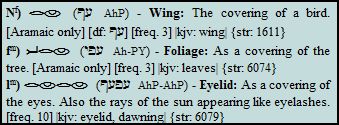
The apple in the eye indicates an intimate relationship with another where you are so near one another that you can see your miniature self in their pupil. The Scriptures admonish us to seek that relationship with the Most High.
1Ch 16:11 Seek the LORD and his strength, seek his face continually.
Psa 27:8 When thou saidst, Seek ye my face; my heart said unto thee, Thy face, LORD, will I seek.
Under the Shadow of His Wings
Being the little guy in His eye is associated with dwelling under the shadow of His wings.
Psa 17:8 Keep me as the apple of the eye, hide me under the shadow of thy wings,
Deu 32:10 He found him in a desert land, and in the waste howling wilderness; he led him about, he instructed him, he kept him as the apple of his eye.
Deu 32:11 As an eagle stirreth up her nest, fluttereth over her young, spreadeth abroad her wings, taketh them, beareth them on her wings:
When the Scriptures speak of abiding in the shadow of His wings it is speaking of an intimate relationship were we dwell in His bosom, seeking His face where we see ourselves as a little guy in His eye.
The other portion of Scripture that speaks of the “apple of His eye” is in Zechariah. Zechariah does not speak of eagles wings but the same concept is spoken of as the LORD will be a wall of fire AROUND us. Here it can be seen that the pillar of fire and cloud in the wilderness is associated with Him bearing us up on eagles wings.
Zec 2:5 For I, saith the LORD, will be unto her a wall of fire round about, and will be the glory in the midst of her.
Zec 2:8 For thus saith the LORD of hosts; After the glory hath he sent me unto the nations which spoiled you: for he that toucheth you toucheth the apple of his eye.
Psa 91:1 He that dwelleth in the secret place of the most High shall abide under the shadow of the Almighty.
Psa 91:2 I will say of the LORD, He is my refuge and my fortress: my God; in him will I trust.
Psa 91:3 Surely he shall deliver thee from the snare of the fowler, and from the noisome pestilence.
Psa 91:4 He shall cover thee with his feathers, and under his wings shalt thou trust: his truth shall be thy shield and buckler.
Psa 91:5 Thou shalt not be afraid for the terror by night; nor for the arrow that flieth by day;
Psa 91:6 Nor for the pestilence that walketh in darkness; nor for the destruction that wasteth at noonday.
Psa 91:7 A thousand shall fall at thy side, and ten thousand at thy right hand; but it shall not come nigh thee.
Psa 91:8 Only with thine eyes shalt thou behold and see the reward of the wicked.
Psa 91:9 Because thou hast made the LORD, which is my refuge, even the most High, thy habitation;
Psa 91:10 There shall no evil befall thee, neither shall any plague come nigh thy dwelling.
Psa 91:11 For he shall give his angels charge over thee, to keep thee in all thy ways.
Psa 91:12 They shall bear thee up in their hands, lest thou dash thy foot against a stone.
Psa 91:13 Thou shalt tread upon the lion and adder: the young lion and the dragon shalt thou trample under feet.
Psa 91:14 Because he hath set his love upon me, therefore will I deliver him: I will set him on high, because he hath known my name.
Psa 91:15 He shall call upon me, and I will answer him: I will be with him in trouble; I will deliver him, and honour him.
Psa 91:16 With long life will I satisfy him, and shew him my salvation (Hebrew: ישׁוּעה ‘yeshua’ the source of the name Jesus).
Making the Most High our habitation; Abiding in the Almighty
Psa 91:9 Because thou hast made the LORD, which is my refuge, even the most High, thy habitation (מעון ‘ma`on’).
מעון ‘ma`on’ comes from the root ין ‘an’ which means the eye.
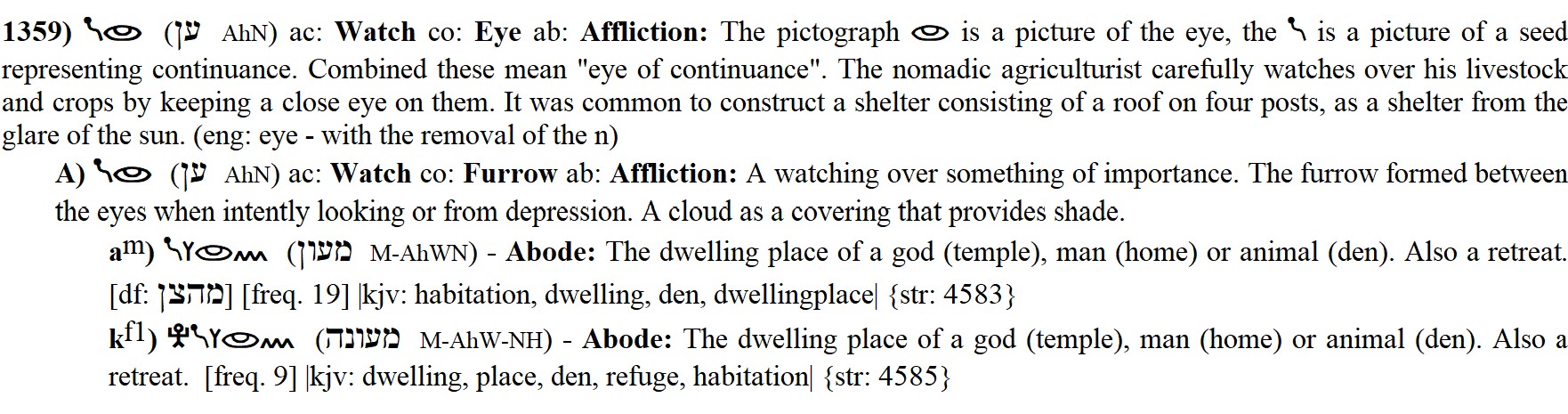
Psa 71:3 Be thou my strong habitation (מעון ‘ma`on’), whereunto I may continually resort: thou hast given commandment to save me; for thou art my rock and my fortress.
Psa 71:4 Deliver me, O my God, out of the hand of the wicked, out of the hand of the unrighteous and cruel man.
Psa 71:5 For thou art my hope, O Lord GOD: thou art my trust from my youth.
Psa 71:6 By thee have I been holden up from the womb: thou art he that took me out of my mother’s bowels: my praise shall be continually of thee.
Psa 71:7 I am as a wonder unto many; but thou art my strong refuge.
From these portions of Scripture in Psalm 71 & 91 we can see that those who abide in the shadow of His wings will be protected from adversity, they will be given eternal life and will see Jesus.
May we all abide under the shadow of His wings and see ourselves as the Little Guy in His Eye, walking closer and closer with Him as each day passes.
The Bosom, the Family and Gathering at the Cross
The word father in Hebrew is associated with love, so too is the word mother. אם ’em’ (mother) is the source of the Latin ‘amare,’ the French ‘amitie’ and the English ‘amity,’ all of which mean love. One of the Hebrew words for love is דד ‘dud/dad’ which means both love and breasts/bosom. Interestingly, the English word ‘baby’ comes from the Hebrew בבה ‘baba’ which is related to the word אבוב ‘aboob’ the root of which is אב ‘av’ which means father but also means a pipe, as in the breast of the mother whose milk flows to give sustenance to the baby. בבה ‘baba’ in Hebrew means the pupil, the apple of one’s eyes. As any parent has held their baby in their arms against their bosom they recognize this is the epitome of love and intimate relationship (apple of the eye/little guy in the eye).
The Hebrew word for family is משפחה ‘mishpocha’ which comes from the root שפח ‘shapach’. שפח ‘shaphach’ is the source of the English word crucifixion from whence all the family of the earth is gathered (John 12:32). The bosom, which represents the love of the family, also links to the crucifixion.
Messiah came from the bosom of the Father.
Joh 1:18 No one has seen God at any time; the only begotten Son, who is in the bosom of the Father, that One declares Him.
He gathers and then carries in His bosom His people, linking to the crucifixion. It is through the work of Christ on the cross that mankind is brought into His family.
Isa 40:10 Behold, the Lord GOD will come with strong hand, and his arm shall rule for him: behold, his reward is with him, and his work before him.
Isa 40:11 He shall feed his flock like a shepherd: he shall gather the lambs with his arm, and carry them in his bosom, and shall gently lead those that are with young.
Eph 2:8 For by grace are ye saved through faith; and that not of yourselves: it is the gift of God:
Eph 2:9 Not of works, lest any man should boast.
Eph 2:10 For we are his workmanship, created in Christ Jesus unto good works, which God hath before ordained that we should walk in them.
Eph 2:11 Wherefore remember, that ye being in time past Gentiles in the flesh, who are called Uncircumcision by that which is called the Circumcision in the flesh made by hands;
Eph 2:12 That at that time ye were without Christ, being aliens from the commonwealth of Israel, and strangers from the covenants of promise, having no hope, and without God in the world:
Eph 2:13 But now in Christ Jesus ye who sometimes were far off are made nigh by the blood of Christ.
Eph 2:14 For he is our peace, who hath made both one, and hath broken down the middle wall of partition between us;
Eph 2:15 Having abolished in his flesh the enmity, even the law of commandments contained in ordinances; for to make in himself of twain one new man, so making peace;
Eph 2:16 And that he might reconcile both unto God in one body by the cross, having slain the enmity thereby:
Eph 2:17 And came and preached peace to you which were afar off, and to them that were nigh.
Eph 2:18 For through him we both have access by one Spirit unto the Father.
Eph 2:19 Now therefore ye are no more strangers and foreigners, but fellowcitizens with the saints, and of the household of God;
Eph 2:20 And are built upon the foundation of the apostles and prophets, Jesus Christ himself being the chief corner stone;
Eph 2:21 In whom all the building fitly framed together groweth unto an holy temple in the Lord:
Eph 2:22 In whom ye also are builded together for an habitation of God through the Spirit.
There are multiple words in Hebrew for love, all linking back to the bosom. The most common is אהב ‘ahav’ which has the meaning of a gift and the expressions and actions of one towards the family. The pictograph meaning displays the gift of the Father to mankind of His only begotten Son. Again linking the bosom, the family and the crucifixion.
Joh 3:16 For God so loved the world that He gave His only begotten Son, that everyone believing into Him should not perish, but have everlasting life.
Joh 15:13 Greater love than this has no one, that anyone should lay down his soul for his friends.

From the root:
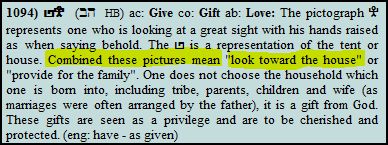
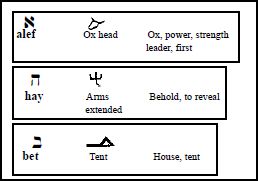
The Pictograph meaning of Love:
The first and last letters spell out the word for Father (אב ‘av’) and the middle letter is a picture of a man with outstretched arms (ה ‘heh’). The Love of the Father is revealed through the Messiah on the tree, gathering all mankind back to their Creator.
Another word for love is חשק ‘chashaq’ which has the meaning of being knit together in love. חשק ‘chashaq’ comes from the root word חש ‘chash’ which points to the bosom, the breastplate in Hebrew is חשן ‘choshen.’ חשק ‘chashaq’ is the word used in reference to the joining together of the Tabernacle, which is a shadow picture of the body of Messiah. It is no surprise that this joining together involved nails, just as in the nails used in the crucifixion (Exodus 38:17, 28; Deuteronomy 7:7; Colossians 2:2, 19; Ephesians 4:15-16).
חשק ‘chashaq’ also can be traced back to the word חק ‘choq.’ חק ‘choq’ is the root of חקק ‘chaqaq’ and חקה ‘chuqah’ which means to inscribe a decree or custom. It is no surprise then that the New Covenant, cut at Calvary is associated with the inscribing of the Word on our hearts which is contained in our bosoms (Jeremiah 31:31).
H2436
חוק / חק / חיק
chêyq / chêq / chôq
BDB Definition:
1) bosom, hollow, bottom, midst
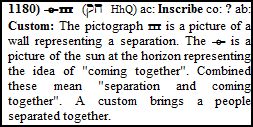
There are two more words in Hebrew which are translated as bosom. One is חצן ‘chatsan’ which comes from חץ ‘chets’ which literally means a tent wall, as in an enclosing. The second is the word צלחת ‘tsalachat’ which also means a bowl, as in the bowls used in the Tabernacle. צלחת ‘tsalachat’ comes from the root צלח ‘tsalach’ which traces back further to צל ‘tsel’ which means a shadow…as under the shadow of His wings, the little guy in His Eye.
Recall that the word in Hebrew for pupil is בבה ‘baba’ which is the source of the English word ‘baby.’ Interestingly, the English word ‘shade’ comes from the Hebrew word שד ‘shad’ which means the breast/bosom. שד ‘shad’ is the root of the word שדי ‘shaddai’ which is translated as ‘the Almighty.’ שד ‘shad’ literally means to return to the door, again linking with the feasts and the Tabernacle mentioned above. THE Door is Christ, into which we we enter in order to abide in His ‘House’ (John10:7) it is through Him that we are covered/hidden. This is the definition of who the Israel of God is (Galatians 6:16)…His hidden ones (Psalm 83:3). It is by the covenant cut in Messiah (Daniel 9:26; Isaiah 42:6) by His sacrifice on the tree that we are covered (1 John 1:7). It is through His Outstretched Arms (wings) that Messiah is calling us (John 3:14; 12:32) and gathering us together as a Shepherd does His flock (John 10:14-16). This is how we enter the Door into the House, this is how we are declared innocent and pure in His eyes. This is how we become His friends and enter into His tents in an intimate relationship.
Finally, the word דוד ‘dod’ means love. דד ‘dod’ literally means the breasts. The letter ‘dalet’ is the picture of a door, or flap of a tent which opens the way inside. The tabernacle consisted of two doors/veils which דד displays. What is the veil of the Tabernacle a picture of? The body/flesh of Messiah.
Heb 10:20 By a new and living way, which he hath consecrated for us, through the veil, that is to say, his flesh;
The above portion of Scripture is in context of the New Covenant which was cut at Calvary where Messiah gathered mankind into His bosom (Isaiah 40:11; Psalm 89:50).
On the cross, Messiah gathered all mankind unto Him under His outstretched Arms as a hen gathers her chicks (John 12:32; Matthew 23:37). Amazingly, the Hebrew word for this spreading forth of the wings of a hen to gather her chicks or an eagle gathering her chicks under her wings is רחף ‘rachaph’ which also comes form the root word חף ‘chaph.’

חף ‘chaph’ – ‘one who enters a tent and is protected by the owner.’ A place of protection. One who is innocent, as in one whose actions are covered.
This is the type of intimate relationship God wants to have with mankind. As a Father or mother holding their children in their bosoms. Messiah declares that we must be humble as children to enter into the Kingdom of Heaven.
See: Daily Tidbits 6/11/26 – Toddler
We are called to work out our salvation with fear and trembling (Philippians 2:12-13), learning to walk in God’s will not our carnality (1 Peter 4:2).
Php 2:12 Wherefore, my beloved, as ye have always obeyed, not as in my presence only, but now much more in my absence, work out your own salvation with fear and trembling.
Php 2:13 For it is God which worketh in you both to will and to do of his good pleasure.
“Toddlers” – Learning to walk
As Christians, we begin as babes consuming the milk of the Word (1 Peter 2:2). As we grow and mature, we learn to walk by faith (2 Corinthians 5:7) but this is a process where we begin as toddlers. Tossed to and fro but growing up into maturity in Him (Ephesians 4:14-15).
Eph 4:11 And he gave some, apostles; and some, prophets; and some, evangelists; and some, pastors and teachers;
Eph 4:12 For the perfecting of the saints, for the work of the ministry, for the edifying of the body of Christ:
Eph 4:13 Till we all come in the unity of the faith, and of the knowledge of the Son of God, unto a perfect man, unto the measure of the stature of the fulness of Christ:
Eph 4:14 That we henceforth be no more children, tossed to and fro, and carried about with every wind of doctrine, by the sleight of men, and cunning craftiness, whereby they lie in wait to deceive;
Eph 4:15 But speaking the truth in love, may grow up into him in all things, which is the head, even Christ:
Going deeper into the etymology of toddler is the Germanic word taltrōną which means to sway or to dangle. This dangling concept points to the bosom where a child breastfeeds.
Toddlers are in the transition from breastfeeding to solid food. Learning to walk and talk. We are to grow in Him, walking worthy of the Lord.
2Pe 3:18 But grow in grace, and in the knowledge of our Lord and Saviour Jesus Christ. To him be glory both now and for ever. Amen.
Col 1:9 For this cause we also, since the day we heard it, do not cease to pray for you, and to desire that ye might be filled with the knowledge of his will in all wisdom and spiritual understanding;
Col 1:10 That ye might walk worthy of the Lord unto all pleasing, being fruitful in every good work, and increasing in the knowledge of God;
Col 1:11 Strengthened with all might, according to his glorious power, unto all patience and longsuffering with joyfulness;
2Pe 3:18 But grow in grace, and in the knowledge of our Lord and Saviour Jesus Christ. To him be glory both now and for ever. Amen.
The word for grace is χάρις ‘charis’ which is used to translate numerous words in the Greek Septuagint. One of the words is גדולה ‘gedulah’ which means to grow in size. We are to grow into the image of Christ, from glory to glory.
2Co 3:18 But we all, with open face beholding as in a glass the glory of the Lord, are changed into the same image from glory to glory, even as by the Spirit of the Lord.
We are to be molded into the image/character of Messiah. Jesus is THE image of God (Hebrews 1:3; 2 Corinthians 4:4-6; Colossians 1:15-16) who is love (1 John 4:8). He revealed God’s name/character to mankind (John 17:6, 26).
Joh 17:6 I revealed Your name to the men whom You gave to Me out of the world. They were Yours, and You gave them to Me; and they have kept Your Word.
Joh 17:26 And I made known to them Your name, and will make it known, that the love with which You loved Me may be in them, and I in them.
Christ came to earth in the very image of Almighty God (2 Corinthians 4:4; Colossians 1:15; Hebrews 1:3), who is love. His life displayed that love and He calls all those who believe in Him to display that love as well. This is the essence of the concept of ‘Christ in us.’ It is through His love that man is formed into His image (Colossians 3:10; Romans 8:29) where there is no longer Jew or Greek, Barbarian or Scythian but Messiah is all and in all (Colossians 3:11).
This is the message of the Gospel. Love. Love is the foundation of God’s grace (Acts 20:24; John 3:16-17; 2 Corinthians 13:14). His Love breaks down the barriers and walls which man has set up to divide (Ephesians 2:1-22; 1 Corinthians 12:13). Love that breaks down the wall of sin which has separated man from God (Isaiah 59:2; John 3:16; 12:32; Isaiah 49:6; Revelation 5:9). This love is revealed in our actions towards our fellow man, not in our intellectual proclamations. All of us see through a glass darkly which keeps us from seeing eye to eye (1 Corinthians 13:12). The only remedy for this is love (1 Corinthians 13:1-13; 1 John 4:7-21). Love and patience towards one another until the Lord returns and His salvation is fully revealed (Isaiah 52:7-10). Love allows man to understand that we can have differences of opinions but ultimately if we abide in love we can dwell in peace and unity (Ephesians 4:2-16, 32; 5:1-2; Colossians 3:9-17).
The true intent of the law/Word of God is not to make men religious but to reform men into the image of their God who is love (1 John 4:8). It is this love that unites us and perfects us. It is the bond of perfection (Colossians 3:14) which sets man free (Galatians 5:13-14). This love is not intended only for a certain group of religious people, but for all mankind. Scripture declares that in the Messiah shall the ‘gentiles trust’ (Matthew 12:21; Romans 15:8-12; Isaiah 11:10). For Jesus is the true Light which enlightens every man (John 1:9; 12:44-46; Isaiah 49:6), sent to restore all of mankind back to God (Isaiah 45:22; Romans 3:29; John 1:12; 3:15-17).
Messiah “imitated” God, He was the express image of the Father.
Heb 1:2 in these last days He spoke to us in the Son, whom He appointed heir of all; through whom He indeed made the ages;
Heb 1:3 who being the shining splendor of His glory, and the express image of His essence, and upholding all things by the Word of His power, having made purification of our sins through Himself, He sat down on the right of the Majesty on high, Psa. 110:1
Joh 14:7 If you had known Me, you would have known My Father also; and from now on you do know Him, and have seen Him.
Joh 14:8 And Philip said to Him, Lord, show us the Father, and it is enough for us.
Joh 14:9 Jesus said to him, Am I so long a time with you, and you have not known Me, Philip? The one seeing Me has seen the Father! And how do you say, Show us the Father?
Joh 14:10 Do you not believe that I am in the Father and the Father is in Me? The Words which I speak to you I do not speak from Myself, but the Father who abides in Me, He does the works.
Joh 14:11 Believe Me that I am in the Father, and the Father is in Me; but if not, believe Me because of the works themselves.
Christ manifested the image of the Father because of what He did (His works). He imitated the Father in order to reveal Him to the world.
Joh 5:19 Then Jesus answered and said to them, Truly, truly, I say to you, The Son is not able to do anything from Himself, except what He may see the Father doing; for whatever that One does, these things also the Son does likewise.
Joh 5:20 For the Father loves the Son and shows to Him all things which He does. And He will show Him greater works than these in order that you may marvel.
So too, we are to imitate God by what we do (our works) by walking in Love.
Eph 5:1 Then become imitators of God, as beloved children,
Eph 5:2 and walk in love, even as Christ also loved us and gave Himself for us, an offering and a sacrifice to God for an odor of a sweet smell.
1Jn 2:5 But whoever keeps His Word, truly in this one the love of God has been perfected. By this we know that we are in Him.
1Jn 2:6 The one claiming to rest in Him ought so to walk himself as that One walked.
1Jn 5:1 Everyone believing that Jesus is the Christ has been generated from God. And everyone who loves Him who begets also loves the one who has been born of Him.
1Jn 5:2 By this we know that we love the children of God: when we love God and keep His commandments.
1Jn 5:3 For this is the love of God, that we keep His commandments; and His commandments are not heavy.
1Jn 4:11 Beloved, if God so loved us, we also ought to love one another.
1Jn 4:12 No one has seen God at any time. If we love one another, God abides in us, and His love having been perfected is in us.
1Jn 4:13 By this we know that we abide in Him, and He in us, because of His Spirit He has given to us.
Grow – increase
Christ said that the world would know we are His disciples by our love. He did not say they would know us by our understanding of doctrine/theology.
Joh_13:35 By this shall all men know that ye are my disciples, if ye have love one to another.
1Jn 3:10 In this the children of God are manifest, and the children of the devil: whosoever doeth not righteousness is not of God, neither he that loveth not his brother.
1Jn 3:11 For this is the message that ye heard from the beginning, that we should love one another.
When the Lord returns, He will judge us according to our service in love (Matthew 25:31-46). Serving in love is the true path to ‘theology’ or knowing God (Jeremiah 22:16). Scripture declares that love of one’s fellow man is equated with love of God (1 John 4:11-12, 20-21) and is the fulfillment and purpose of His Word (Matthew 22:39-40; Romans 13:8-10; Galatians 6:2). It does not say love of one’s fellow religious counterpart, but of one’s fellow MAN (Galatians 6:10; 1 Thessalonians 5:15; 3 John 1:11), even our enemies (Luke 6:35). This love is manifested in service to one another (Galatians 5:13-14; 6:2; John 13:35; 1 John 3:16-19), in particular the poor and weak amongst us.
The work of the Holy Spirit in the process of purification is to lead us to love (1 Peter 1:22). The goal of the Torah/Word is to lead us to love (1 Timothy 1:5; Galatians 5:14; 6:2). Love is the fruit which reveals that we are growing in maturity in Messiah (2 Peter 1:5-8). Love is the bond of perfectness (Colossians 3:14).
Bosom & Faith
Num 11:12 I, have I conceived all this people? I, have I begotten it, that You say to me, Carry it in your bosom as the foster father (אמן ‘aman’) bears the suckling, to the land which You have sworn to its fathers?
Num 11:12 Have I conceived all this people? have I begotten them, that thou shouldest say unto me, Carry them in thy bosom, as a nursing father (אמן ‘aman’) beareth the sucking child, unto the land which thou swarest unto their fathers?
The word used above for foster father/nursing father is אמן ‘aman’ which means faith. Faith comes from the same root as truth (etymology) in Hebrew מן ‘man.’
Faith and Truth are related
Faith (אמונה ’emunah’) and Truth (אמת ’emet’) come from the same root word in Hebrew.
Ancient Hebrew Definition
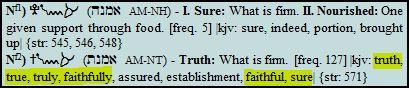
אמונה ’emunah’ comes from the 3 letter root אמן ‘aman’
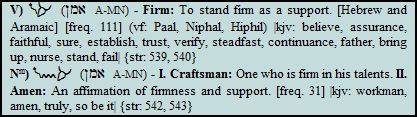
‘אמן ‘aman’ means truly, a sure foundation and support. This is why Messiah is spoken of as the ‘Amen’ (Revelation 3:14). He is the firm foundation represented by the Tree of Life/the Word. The other tree in midst the Garden was the tree of knowledge which represents unfaithfulness/lawlessness. Man must choose between the two. The choice that one makes determines which seed/tree he will be a part of. Interestingly, the parent root for the word ‘emunah’ is מן which means ‘the blood continues.’ It is the word used in Genesis 1 for ‘kind’ or species. Recall that this is the origin of the word ‘etymology’ as well.
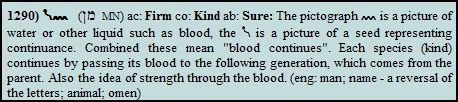
Faith is Biblically defined as walking in Truth who is the Word/Messiah. Faith traces back to the Garden of Eden and the two trees in the midst of the Garden. The Tree of Life which represents truth/faith and the tree of knowledge which represents unfaithfulness/lawlessness and man’s own will as to what is good or evil.
The English word faith comes from the Old French word ‘foi’ which means faith, belief, trust which traces back further to the Latin word ‘fides’ which has the same meaning. ‘Fides’ traces back to the Hebrew word בטח ’batach.’ ‘Batach’ is also the source for the English word ‘trust.’ בטח ’batach’ means to cling to someone or something. It is pictured in the natural realm in a melon which clings to the vine. Here again the picture of the Tree of Life and the tree of knowledge is seen. Man can have faith in God and cling to Him or man can choose his own way and cling to the tree of knowledge. This concept of clinging to the vine is discussed in more detail in the Biblical definition of the Olive tree and the word אב ‘av’ (Father).
Seeking His Face & the Golden Rule
The Holy Scriptures admonish us to seek the Face of God at all times (1 Chronicles 16:11). Seeking His Face where we appear as a “little guy” in His Eye will cause us to love others as He loves them…
In seeking His Face, His Light will shine upon us where we can walk in His name (Numbers 6:24-27). If we seek His face continually (1 Chronicles 16:11), His light will reflect from us to others (2 Corinthians 4:6). Scripture likens seeking the Face of the Lord as looking into a mirror (2 Corinthians 3:18; 1 Corinthians 13:12) in which we now see darkly. As a result, we should abide in faith, hope and love. Most importantly, in love. This love is summed up in the Golden Rule (Matthew 7:12; Luke 6:31).
When we seek the Face of God at all times we can overcome the hate for others caused by fear and ignorance (1 John 4:18; Romans 8:15, 31-39; Psalm 118:6; Hebrews 13:6). When we seek the Face of God we can love our enemies and show them mercy as He does (Matthew 5:43-48; Luke 6:27-36; Romans 12:14-21; 1 Peter 3:8-15; Ephesians 2:2-22).
This is the essence of being a “little guy in the Eye”. Love. Walking in close relationship with God who is love (1 John 4:8) and extending that love to our fellow man (1 John 4:12). Each one of us must work out our own salvation with fear and trembling as God works through us according to His good pleasure (Philippians 2:12-13). If we keep focused on Him He will be able to transform us from glory to glory (2 Corinthians 3:18) until we are formed into the image of His Son (Romans 8:29).
Joh 17:21 That they all may be one; as thou, Father, art in me, and I in thee, that they also may be one in us: that the world may believe that thou hast sent me.
Joh 17:22 And the glory which thou gavest me I have given them; that they may be one, even as we are one:
Joh 17:23 I in them, and thou in me, that they may be made perfect in one; and that the world may know that thou hast sent me, and hast loved them, as thou hast loved me.
I pray that this article has been a blessing (Ephesians 1:3, 17; 1 Corinthians 12:8; Colossians 1:9-10) and was edifying (Ephesians 4:12, 29), and that God is glorified therein (Colossians 3:17; Revelation 7:12; Galatians 1:24; John 17:9-10; 2 Thessalonians 1:12). Most importantly, I pray for all of us to grow in the grace and knowledge of the Lord Jesus Christ (2 Peter 3:18; Philippians 1:9; John 17:3) and above all to know the love of God in Christ which surpasses knowledge (Ephesians 3:19).



Very nice blog you have heree