
Summary Bulletpoints:
The three wise monkeys are a shadow of the gates of the mind. The eye, the ear, and the mouth are doors — שעערים ‘shaarim’— through which either the Word or the adversary enters. Scripture calls us to turn the eye from vanity, to bridle the tongue, and to take every thought captive to Messiah, the Image of God. Man without Him slides toward the beast, the ape of God, the mimic who copies the form and misses the life. We are called to guard the gates, look unto Jesus and be the little guy/girl in His Eye.
The three monkeys picture the gates of the mind: eye, ear, and mouth. שעער (shaar) is a gate. What you let through those doors becomes what you are (Proverbs 23:7). The eye, the ear, and the mouth are gates. Knowledge in Hebrew is the door of the eye. Guard the door or the thief comes in.
See no evil is Psalm 119:37 — turn away mine eyes from beholding vanity. Hear no evil is Luke 8:18 — take heed how ye hear. Speak no evil is Psalm 141:3 — set a watch, O LORD, before my mouth.
The ape is the mimic. קוף (qof) is the monkey and the letter that drops below the line: the image copied but not the life.
Time itself is marked. עת (et) pictures “see the cross.” תקופה (tequfah) is the sun at the turning of the year, the same root-family as קוף (qof), the ape and the letter that descends below the line.
The sun on the horizon is a daily and yearly shadow of Messiah: death at the going down, resurrection at the rising. It is a picture of God’s mark. The monkey sits in that word-picture as the counterfeit of the mark.
Babel is בלל (balal), to mix. The tree of knowledge mixed good and evil. The mark of the beast is the mixed image — part man, part beast. The mark of God is His Word and His Image, unmixed. The Midrash says some who built Babel were turned into apes. Pride that tried to climb to heaven became bestial.
Entertainment beguiles. Amuse traces to leading the mind away. נשא (nasha) is the serpent’s beguilement in Genesis 3:13.
Satan is called the ape of God. He copies the form but cannot create the Word. Man without Messiah slides toward the beast.
Evil communications corrupt good manners (1 Corinthians 15:33). The household you live in trains the mouth. Homilia is companionship. Who you sit with trains who you become (Proverbs 13:20).
Taming is δαμάζω (damazō): to break in, bring into the house, put under a master. James 3:7 says mankind has tamed every kind of beast. No man can tame the tongue. Enculturation is the modern form of that taming. An ape learns signs only after it is brought into a human household. Language is received in relationship. So is the Word.
Slander and gluttony are linked together. The accuser is the eater of the chewed morsel. A fat heart is a shut eye and a heavy ear (Isaiah 6:10). Satyr, שעיר (sa‘ir), is Esau’s hairiness and the “devils” of Leviticus 17:7. Pan’s grotto sat at Caesarea Philippi. There Messiah declared the gates of hell would not prevail. The chimpanzee’s scientific name still wears Pan. The counterfeit shepherd of the wild is named over the ape.
Evolution and transhumanism preach a counterfeit ascent: mix, evolve, become as gods. Scripture preaches another change: from the image of the earthy to the image of the heavenly (1 Corinthians 15:49). The tree of knowledge versus the tree of Life.
The remedy is not a wooden proverb. It is the renewing of the mind (Romans 12:2) and every thought taken captive to Christ (2 Corinthians 10:5). Looking unto Jesus, the Author and Finisher of the faith….

The “Three Wise Monkeys” parable of “see no evil, hear no evil, speak no evil” displays fascinating shadows of Messiah when one looks at monkeys and apes. The ape displays a picture of carnal man which Scripture describes as a “beast.” Carnal man walking in the spirit of disobedience, the “Ape god,” Satan. This is not to say apes and monkeys are completely evil or that carnal man is a beast and not a man, however. This parable pictures the corrupted image of God in mankind which leads to destruction and the call of man to be redeemed and transformed through Christ Jesus, the Image of God.
The Holy Scriptures admonish us to avoid evil. We are called to see no evil, hear no evil and speak no evil.
Psa 141:3 Set a watch, O LORD, before my mouth; keep the door of my lips.
Psa 141:4 Incline not my heart to any evil thing, to practise wicked works with men that work iniquity: and let me not eat of their dainties.
Psa 101:3 I will set no wicked thing before mine eyes: I hate the work of them that turn aside; it shall not cleave to me.
Psa 119:37 Turn my eyes from seeing vanity; in Your way give me life.
Psa 39:1 To the chief Musician, even to Jeduthun, A Psalm of David. I said, I will take heed to my ways, that I sin not with my tongue: I will keep my mouth with a bridle, while the wicked is before me.
Luk 8:11 And this is the parable: The seed is the Word of God.
Luk 8:12 And those by the roadside are those who hear, then the Devil comes and takes away the Word from their heart, lest believing they may be saved.
Luk 8:13 And those on the rock are those who, when they hear, receive the Word with joy; and these have no root, who believe for a time, and in time of trial draw back.
Luk 8:14 And those falling in the thorn bushes, these are those hearing, but under cares and riches and pleasures of life, moving along, they are choked, and do not bear to maturity.
Luk 8:15 And those in the good ground, these are the ones who in a right and good heart, hearing the Word, they hold it and bear fruit in patience.
Luk 8:16 But no one lighting a lamp covers it with a vessel, or puts it underneath a couch, but sets it on a lampstand, that those coming in may see the light.
Luk 8:17 For nothing is hidden which will not be revealed, nor secret which will not be known and come to be revealed.
Luk 8:18 Then observe how you hear; for whoever may have, it will be given to him; and whoever may not have, even what he seems to have will be taken from him.
Isa 33:14 The sinners of Zion are afraid; terror has seized profane ones; who of us shall tarry with consuming fire? Who of us shall tarry with everlasting burnings?
Isa 33:15 He who walks righteously and speaks uprightly; he who despises the gain of oppressions, who shakes his hands free from taking the bribe, who stops his ear from hearing of blood, and shuts his eyes from looking at evil.
1Co 15:33 Be not deceived: evil communications (ὁμιλία ‘homilia’) corrupt good manners (ἦθος ‘ethos’).
Evil communications corrupt our character. Ethos comes from the Greek word ἦθος ‘ethos’ or ἔθος ‘ethos’ both of which have the meaning of “character, moral nature, habitual disposition, custom.”
ὁμιλία
homilia
hom-il-ee’-ah
From G3658; companionship (“homily”), that is, (by implication) intercourse: – communication.
Intercourse comes from the Old French word ‘entercours’ which means “exchange, commerce, communication.” It means an exchange between two parties. ‘Entercours’ comes from the Latin ‘intercurrere’ which means to run between, to intervene.
Pro 13:20 He that walketh with wise men shall be wise: but a companion of fools shall be destroyed.
We are to keep our minds upon God
Isa 26:3 Thou wilt keep him in perfect peace, whose mind is stayed on thee: because he trusteth in thee.
Isa 26:4 Trust ye in the LORD for ever: for in the LORD JEHOVAH is everlasting strength:
We are to focus on the good, the beautiful as God guards our hearts as a sentinel at the gates of our hearts and minds.
Php 4:6 Be careful for nothing; but in every thing by prayer and supplication with thanksgiving let your requests be made known unto God.
Php 4:7 And the peace of God, which passeth all understanding, shall keep (φρουρέω ‘phroureo’) your hearts and minds through Christ Jesus.
Php 4:8 Finally, brethren, whatsoever things are true, whatsoever things are honest, whatsoever things are just, whatsoever things are pure, whatsoever things are lovely, whatsoever things are of good report; if there be any virtue, and if there be any praise, think on these things.
φρουρέω
phroureō
froo-reh’-o
From a compound of G4253 and G3708; to be a watcher in advance, that is, to mount guard as a sentinel (post spies at gates); figuratively to hem in, protect: – keep (with a garrison).
Prove, test, examine, discern all things
1Th 5:21 Prove (δοκιμάζω ‘dokimazo’) all things; hold fast that which is good.
1Th 5:22 Abstain from all appearance of evil.
δοκιμάζω
dokimazō
Thayer Definition:
- to test, examine, prove, scrutinise (to see whether a thing is genuine or not), as metals
- to recognise as genuine after examination, to approve, deem worthy
Eph 5:1 Be ye therefore followers of God, as dear children;
Eph 5:2 And walk in love, as Christ also hath loved us, and hath given himself for us an offering and a sacrifice to God for a sweetsmelling savour.
Eph 5:3 But fornication, and all uncleanness, or covetousness, let it not be once named among you, as becometh saints;
Eph 5:4 Neither filthiness, nor foolish talking, nor jesting, which are not convenient: but rather giving of thanks.
Eph 5:5 For this ye know, that no whoremonger, nor unclean person, nor covetous man, who is an idolater, hath any inheritance in the kingdom of Christ and of God.
Eph 5:6 Let no man deceive you with vain words: for because of these things cometh the wrath of God upon the children of disobedience.
Eph 5:7 Be not ye therefore partakers with them.
Eph 5:8 For ye were sometimes darkness, but now are ye light in the Lord: walk as children of light:
Eph 5:9 (For the fruit of the Spirit is in all goodness and righteousness and truth;)
Eph 5:10 Proving what is acceptable unto the Lord.
Eph 5:11 And have no fellowship with the unfruitful works of darkness, but rather reprove them.
Eph 5:12 For it is a shame even to speak of those things which are done of them in secret.
Eph 5:13 But all things that are reproved are made manifest by the light: for whatsoever doth make manifest is light.
Test all things, take all thoughts captive to Christ
2Co 10:3 For though we walk in the flesh, we do not war after the flesh:
2Co 10:4 (For the weapons of our warfare are not carnal, but mighty through God to the pulling down of strong holds;)
2Co 10:5 Casting down imaginations, and every high thing that exalteth itself against the knowledge of God, and bringing into captivity every thought to the obedience of Christ;
Rom 8:5 For they that are after the flesh do mind the things of the flesh; but they that are after the Spirit the things of the Spirit.
Rom 8:6 For to be carnally minded is death; but to be spiritually minded is life and peace.
Rom 8:7 Because the carnal mind is enmity against God: for it is not subject to the law of God, neither indeed can be.
Rom 8:8 So then they that are in the flesh cannot please God.
Gates of Understanding
We become what we think
Pro 23:7 For as he thinketh (שער ‘shaar’) in his heart, so is he: Eat and drink, saith he to thee; but his heart is not with thee.
The word for think in Proverbs 23:7 is שער ‘shaar’ which means a gate or door.

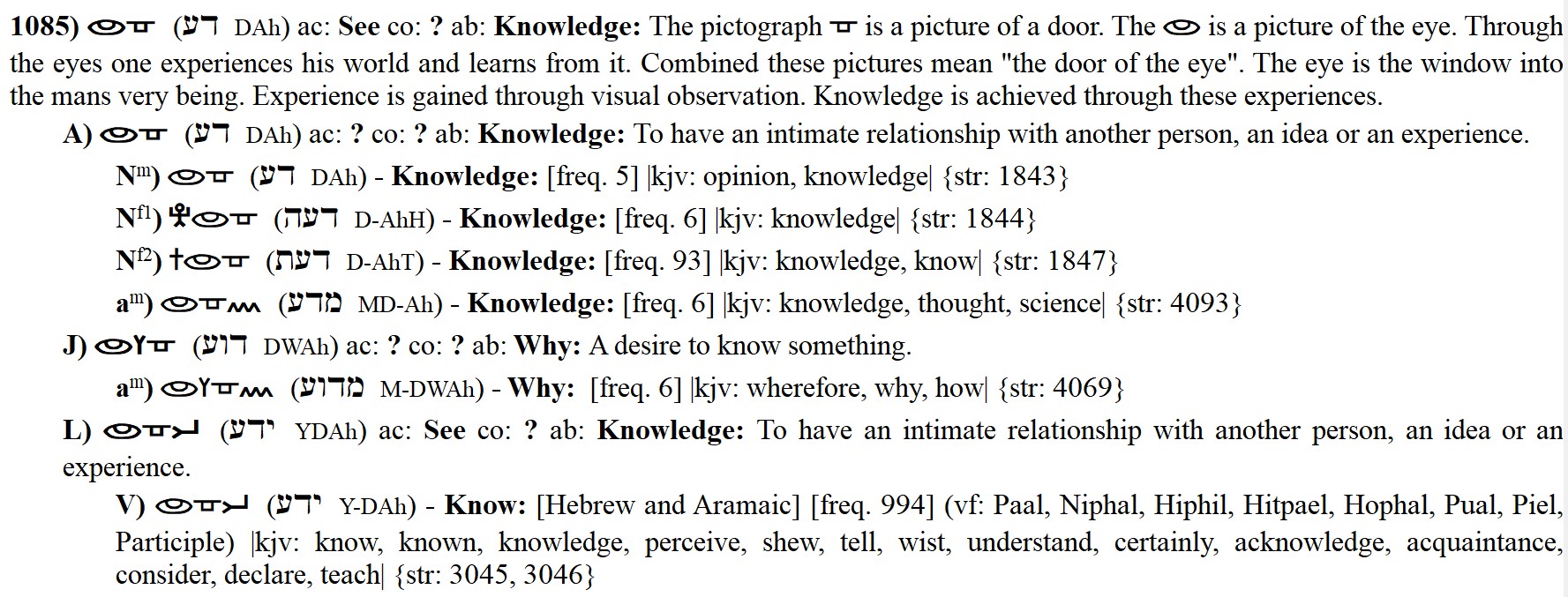
Our eyes, ears and mouths are like gates or doors to our mind. Knowledge in Hebrew is דע ‘da’ which means “the door of the eye.”
Psa 141:3 Set a watch, O LORD, before my mouth; keep the door of my lips.
Psa 141:4 Incline not my heart to any evil thing, to practise wicked works with men that work iniquity: and let me not eat of their dainties.
Mic 7:5 Trust ye not in a friend, put ye not confidence in a guide: keep the doors of thy mouth from her that lieth in thy bosom.
Pro 4:20 My son, attend to my words; incline thine ear unto my sayings.
Pro 4:21 Let them not depart from thine eyes; keep them in the midst of thine heart.
Pro 4:22 For they are life unto those that find them, and health to all their flesh.
Pro 4:23 Keep thy heart with all diligence; for out of it are the issues of life.
“There is also another gate, more beautiful than these, but difficult to guard, that of the eyes; and for this reason it is set above, open and possessing beauty… Strong laws are needed here.” (John Chrysostom – On Vainglory and the Education of Children section 12).
“Therefore the eye is a lamp not only to the body, but even before the body, to the soul. For this reason it is established as in a royal place, having obtained the upper region, and sitting enthroned above the other senses.” (John Chrysostom – Homilies on the Gospel of John).
“For us to guard our senses from pleasures, our mind must reign like a king, and have fearsome thoughts armed like soldiers to protect the gates of the senses and to stay on guard there, to prevent the enemies from entering.” (St. Nicodemos the Hagiorite -A Handbook of Spiritual Counsel quoting St. Isidore of Pelusium)
Eschew Evil
1Pe 3:8 Finally, be ye all of one mind, having compassion one of another, love as brethren, be pitiful, be courteous:
1Pe 3:9 Not rendering evil for evil, or railing for railing: but contrariwise blessing; knowing that ye are thereunto called, that ye should inherit a blessing.
1Pe 3:10 For he that will love life, and see good days, let him refrain his tongue from evil, and his lips that they speak no guile:
1Pe 3:11 Let him eschew (ἐκκλίνω ‘ekklino’) evil, and do good; let him seek peace, and ensue it.
1Pe 3:12 For the eyes of the Lord are over the righteous, and his ears are open unto their prayers: but the face of the Lord is against them that do evil.
To eschew is to avoid
Rom 16:17 Now I beseech you, brethren, mark them which cause divisions and offences contrary to the doctrine which ye have learned; and avoid (ἐκκλίνω ‘ekklino’) them.
ἐκκλίνω ‘ekklino’ is also translated at “gone out of the way.” The wicked “eschew” God.
Rom 3:11 There is none that understandeth, there is none that seeketh after God.
Rom 3:12 They are all gone out of the way (ἐκκλίνω ‘ekklino’), they are together become unprofitable; there is none that doeth good, no, not one.
Rom 3:13 Their throat is an open sepulchre; with their tongues they have used deceit; the poison of asps is under their lips:
Rom 3:14 Whose mouth is full of cursing and bitterness:
Rom 3:15 Their feet are swift to shed blood:
Rom 3:16 Destruction and misery are in their ways:
Rom 3:17 And the way of peace have they not known:
Rom 3:18 There is no fear of God before their eyes
They have become filthy
Psa 14:3 They are all gone aside, they are all together become filthy: there is none that doeth good, no, not one.
There are beasts within the Church as well.
2Pe 2:10 But chiefly them that walk after the flesh in the lust of uncleanness, and despise government. Presumptuous are they, selfwilled, they are not afraid to speak evil of dignities.
2Pe 2:11 Whereas angels, which are greater in power and might, bring not railing accusation against them before the Lord.
2Pe 2:12 But these, as natural brute beasts, made to be taken and destroyed, speak evil of the things that they understand not; and shall utterly perish in their own corruption;
2Pe 2:13 And shall receive the reward of unrighteousness, as they that count it pleasure to riot in the day time. Spots they are and blemishes, sporting themselves with their own deceivings while they feast with you;
2Pe 2:14 Having eyes full of adultery, and that cannot cease from sin; beguiling unstable souls: an heart they have exercised with covetous practices; cursed children:
2Pe 2:15 Which have forsaken the right way, and are gone astray, following the way of Balaam the son of Bosor, who loved the wages of unrighteousness;
2Pe 2:16 But was rebuked for his iniquity: the dumb ass speaking with man’s voice forbad the madness of the prophet.
2Pe 2:17 These are wells without water, clouds that are carried with a tempest; to whom the mist of darkness is reserved for ever.
2Pe 2:18 For when they speak great swelling words of vanity, they allure through the lusts of the flesh, through much wantonness, those that were clean escaped from them who live in error.
2Pe 2:19 While they promise them liberty, they themselves are the servants of corruption: for of whom a man is overcome, of the same is he brought in bondage.
2Pe 2:20 For if after they have escaped the pollutions of the world through the knowledge of the Lord and Saviour Jesus Christ, they are again entangled therein, and overcome, the latter end is worse with them than the beginning.
2Pe 2:21 For it had been better for them not to have known the way of righteousness, than, after they have known it, to turn from the holy commandment delivered unto them.
2Pe 2:22 But it is happened unto them according to the true proverb, The dog is turned to his own vomit again; and the sow that was washed to her wallowing in the mire.
All have gone astray, the remedy to the beast nature is Christ.
Eph 2:2 Wherein in time past ye walked according to the course of this world, according to the prince of the power of the air, the spirit that now worketh in the children of disobedience:
Eph 2:3 Among whom also we all had our conversation in times past in the lusts of our flesh, fulfilling the desires of the flesh and of the mind; and were by nature the children of wrath, even as others.
Eph 2:4 But God, who is rich in mercy, for his great love wherewith he loved us,
Eph 2:5 Even when we were dead in sins, hath quickened us together with Christ, (by grace ye are saved;)
Isa 53:6 All we like sheep have gone astray; we have turned every one to his own way; and the LORD hath laid on him the iniquity of us all.
1Pe 2:1 Wherefore laying aside all malice, and all guile, and hypocrisies, and envies, and all evil speakings,
1Pe 2:2 As newborn babes, desire the sincere milk of the word, that ye may grow thereby:
1Pe 2:3 If so be ye have tasted that the Lord is gracious.
1Pe 2:4 To whom coming, as unto a living stone, disallowed indeed of men, but chosen of God, and precious,
1Pe 2:5 Ye also, as lively stones, are built up a spiritual house, an holy priesthood, to offer up spiritual sacrifices, acceptable to God by Jesus Christ.
1Pe 2:6 Wherefore also it is contained in the scripture, Behold, I lay in Sion a chief corner stone, elect, precious: and he that believeth on him shall not be confounded.
1Pe 2:7 Unto you therefore which believe he is precious: but unto them which be disobedient, the stone which the builders disallowed, the same is made the head of the corner,
1Pe 2:8 And a stone of stumbling, and a rock of offence, even to them which stumble at the word, being disobedient: whereunto also they were appointed.
1Pe 2:9 But ye are a chosen generation, a royal priesthood, an holy nation, a peculiar people; that ye should shew forth the praises of him who hath called you out of darkness into his marvellous light:
1Pe 2:10 Which in time past were not a people, but are now the people of God: which had not obtained mercy, but now have obtained mercy.
1Pe 2:11 Dearly beloved, I beseech you as strangers and pilgrims, abstain from fleshly lusts, which war against the soul;
1Pe 2:12 Having your conversation honest among the Gentiles: that, whereas they speak against you as evildoers, they may by your good works, which they shall behold, glorify God in the day of visitation.
1Pe 2:13 Submit yourselves to every ordinance of man for the Lord’s sake: whether it be to the king, as supreme;
1Pe 2:14 Or unto governors, as unto them that are sent by him for the punishment of evildoers, and for the praise of them that do well.
1Pe 2:15 For so is the will of God, that with well doing ye may put to silence the ignorance of foolish men:
1Pe 2:16 As free, and not using your liberty for a cloke of maliciousness, but as the servants of God.
1Pe 2:17 Honour all men. Love the brotherhood. Fear God. Honour the king.
1Pe 2:18 Servants, be subject to your masters with all fear; not only to the good and gentle, but also to the froward.
1Pe 2:19 For this is thankworthy, if a man for conscience toward God endure grief, suffering wrongfully.
1Pe 2:20 For what glory is it, if, when ye be buffeted for your faults, ye shall take it patiently? but if, when ye do well, and suffer for it, ye take it patiently, this is acceptable with God.
1Pe 2:21 For even hereunto were ye called: because Christ also suffered for us, leaving us an example, that ye should follow his steps:
1Pe 2:22 Who did no sin, neither was guile found in his mouth:
1Pe 2:23 Who, when he was reviled, reviled not again; when he suffered, he threatened not; but committed himself to him that judgeth righteously:
1Pe 2:24 Who his own self bare our sins in his own body on the tree, that we, being dead to sins, should live unto righteousness: by whose stripes ye were healed.
1Pe 2:25 For ye were as sheep going astray; but are now returned unto the Shepherd and Bishop of your souls.
Three Wise Monkeys

The “see no evil, hear no evil, speak no evil” monkeys, called the Three Wise Monkeys originate from Japan. In Japanese they’re called the three monkeys, sanzaru (三ざる). The Japanese word for monkey (saru or zaru) sounds like the negative verb ending -zaru, which creates a pun on “don’t see, don’t hear, don’t speak.” Saru also has an older meaning of “to leave” or “to go away,” which some interpret as “let evil go away.” In other words “eschew” evil.
Mizaru (見ざる): Covers his eyes — “see no evil.”
Kikazaru (聞かざる): Covers his ears — “hear no evil.”
Iwazaru (言わざる): Covers his mouth — “speak no evil.”
In the Shinto religion, Sarutahiko Ōkami (猿田彦大神) is a kami (a spirit of deities of heaven and earth) who is portrayed as a monkey. In some traditions he was regarded as a sun god or “the god who illuminates the sky and earth.” In Japanese Koshin belief, the three wise monkeys were the attendants of Sarutahiko, protecting people from evil.
This connection between monkeys and the sun is seen in the Hebrew word קופ ‘qof’ which means monkey but is also a picture of the sun at the horizon.
Monkeys, Apes & ק ‘qof’
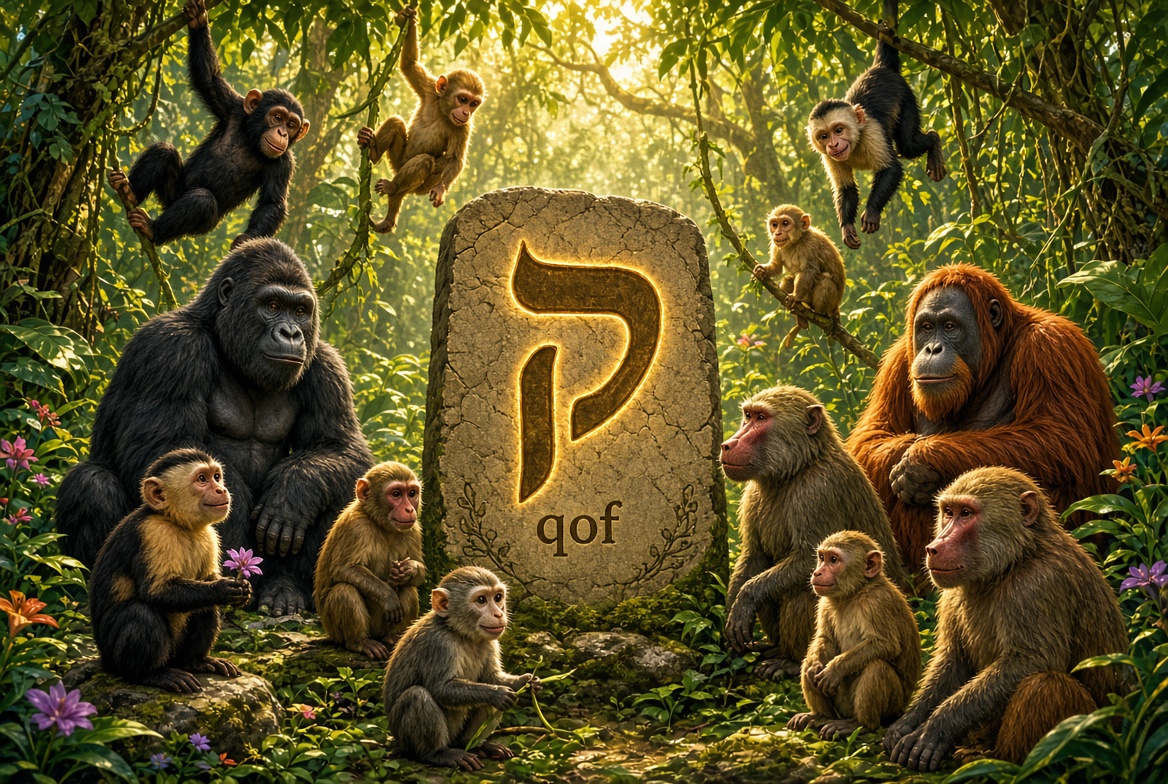
The Hebrew word for monkey/ape is קופ ‘qof’ which also has the meaning of the sun at the horizon. The sun at the horizon is intimately linked to the Biblical calendar (time) which was designed to be a shadow picture of the Messiah, the Promised Seed who would redeem mankind from sin and reconcile them to the Father. The heathens worshiped the sun, forbidden by the Most High (Deuteronomy 4:15-20; 17:3). They took creation, which was supposed to glorify the Creator and point mankind to Him, and worshiped the creation (Romans 1:19-32) leading to their degradation (“de-evolution”).
The monkey is very similar in form to the human being but is a beast who follows its carnal desires. Mankind who has turned away from their Creator and who serves only their carnal desires are spoken of as beasts as well (Proverbs 12:1; Psalm 92:6; 94:8; Jeremiah 10:8, 14-16, 21; Romans 16:18).
The Hebrew word for monkey is קוף ‘qof.’ The Hebrew letter קוף ‘qof’ pictures the sunset and gives the imagery of a mark. Some believe the letter קוף ‘qof’ may have depicted a monkey with its tail hanging down.
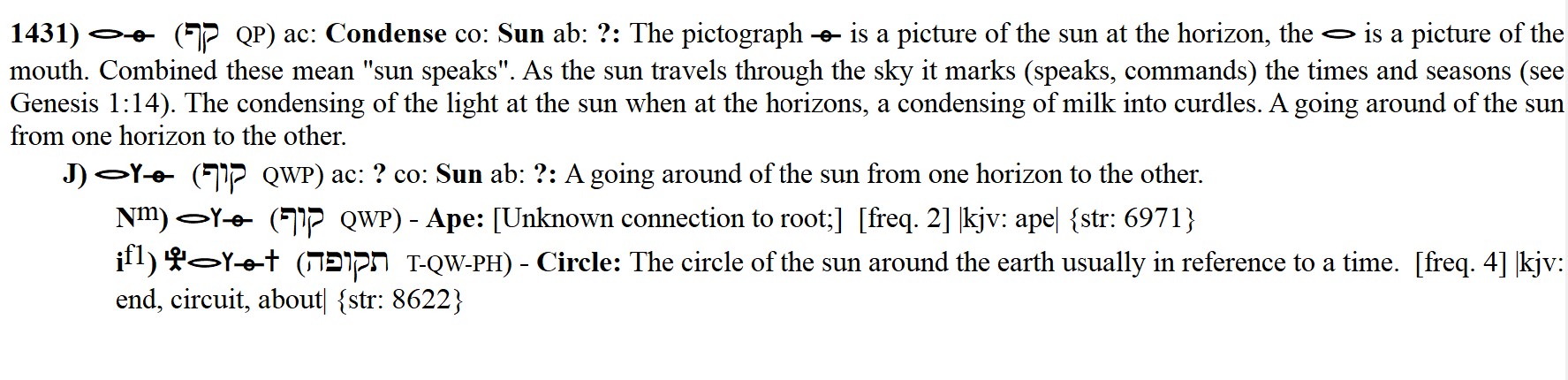
קף ‘qaf’ literally means the ‘sun speaks.’ The sun “speaks or commands” the times and seasons. What is the message? The Gospel.
The word for ‘equinox’ in Hebrew is תקופה ‘tequfah’ which has the following pictograph meaning. The cross (ת) reveals (ה) the sun on the horizon (קוף). The letter ק ‘qof’ spelled קוף in Hebrew is pictographically displayed as the sun rising on the horizon. So then the word תקופה ‘tequfah’ has embedded within itself the point of the equinox. It is at the cross of the horizon which is exactly East. As the sun moves through its course in the sky it will rise directly East at the spring and fall equinoxes, making a cross in the sky each year.
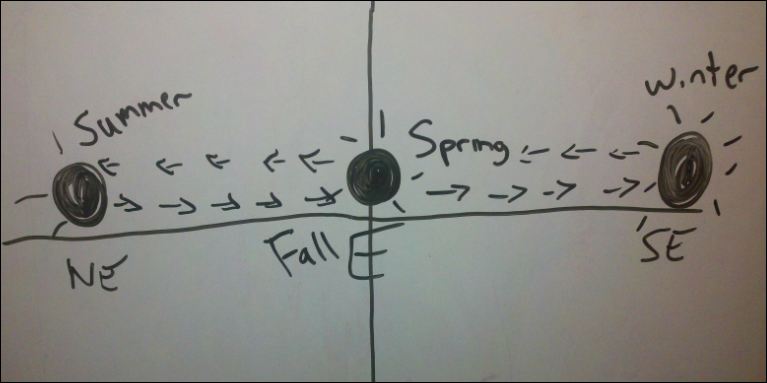
The Hebrew word for time further displays this “cross” imagery as the Hebrew word for time which is עת ‘et.’ Pictographically עת ‘et’ means to see ע the cross ת.
The movement of the sun throughout the year is a ‘macrocosm’ of the daily movement of the sun. This daily and yearly movement of the sun portrays the “Word of the Cross” (1 Corinthians 1:18). The morning rising of the sun which corresponds with Spring portrays the birth and re-birth of the Messiah from the dead. The mid-day sun which corresponds with Summer portrays the lifting up of the Messiah on the cross (John 3:14; 12:32) and later His exaltation (Philippians 2:7-9). The setting of the sun corresponds with Autumn in which the light of the world (John 9:4-5; 11:9) fades away into darkness which is displayed by nighttime and Winter portraying the Savior’s death.
עת

The are multiple words for time in Hebrew, the most used is עת ‘et’ which pictographically means to ‘see the cross’, and in ancient Hebrew thinking meant to ‘see the mark.’ What is this ‘mark’? It is the sun setting (death) and rising (resurrection) above the horizon.

עת ‘et’ corresponds to the Greek word καιρός ‘kairos’ (time) through comparing Daniel 7:25 & Revelation 12:6, 14.
In the Septuagint, καιρός ‘kairos’ is used to translate numerous words related to time but one of which is very interesting, the word תר ‘tor’ due to its relation to the concept of ‘the mark.’
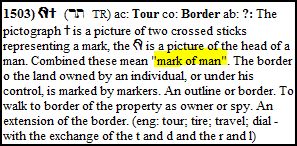
From this root we get תאר ta’ar and תואר to’ar. These words mean form, outline or border.
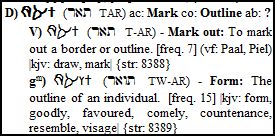
תואר ‘toar’ is from the same root תר ‘tor’ as תורה ‘torah.’

Gen 1:14 And God said, Let luminaries be in the expanse of the heavens, to divide between the day and the night. And let them be for signs {אות ‘oht’} and for seasons, and for days and years.
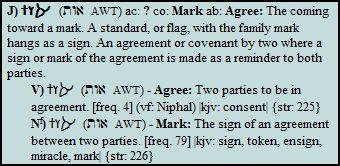
The signs of the heavens are a mark/reminder of the covenant with His people.
Jer 33:25 So says Jehovah, If My covenant is not with day and night, and if I have not appointed the ordinances of the heavens and earth,
Jer 33:26 then I also will reject the seed of Jacob, and My servant David, not to take of his seed to be rulers over the seed of Abraham, Isaac and Jacob. For I will bring back their captivity and have pity on them.
He has numbered & named the stars
Isa 40:26 Lift up your eyes on high and look: Who has created these? Who brings out their host by number? By greatness of vigor, and might of power, He calls them all by names; not one is lacking.
Psa 147:4 He appoints the number {מספר ‘mispar’} of the stars; He calls to them all by names.
The Hebrew word for number here is מספר ‘mispar’ from the root ספר ‘saphar’ which means a record/scroll. Brown Driver Briggs Hebrew dictionary defines מספר ‘mispar’ as a number or tale. A tale is an account telling a story. This is what the number of the stars does. It tells the story of the Gospel.
Rom 10:17 Then faith is of hearing, and hearing through the Word of God.
Rom 10:18 But I say, Did they not hear? Yes, rather, “into all the earth their voice went out, and to the ends of the world their words.”
In Romans 10, Paul is referring back to Psalm 19 which is speaking of the path of the sun and its orbit {תקופה ‘tequfah’}.
Psa 19:1 To the chief musician. A Psalm of David. The heavens are recounting the glory of God, and the expanse proclaiming His handiwork.
Psa 19:2 Day by day they pour forth speech, and night to night reveals knowledge.
Psa 19:3 There is no speech, nor are there words where their voice is not heard.
Psa 19:4 Their measuring line has gone out through all the earth, and their words to the end of the world; in them He has set up a dwelling-place for the sun,
Psa 19:5 and he comes forth like a bridegroom from his canopy. He rejoices like a hero to run a race;
Psa 19:6 his going forth from the end of the heavens, and his orbit to their ends; and nothing is hidden from his heat.
Time is linked to the sun.
The Hebrew words used in reference to time further reveal that time is linked to the movement of the heavenly bodies.
For more on this see: Daily Tidbits 2/28 – Sun & Time
The word for hour is related to the sun

This comes from the root שע ‘sha’ ‘which is a picture of a shepherd watching over his flock. שע ‘sha’ is also the root of the word ישועה ‘yeshuah’ which is the source of the name Jesus.
Perhaps this is why the sun god was portrayed with an ‘all seeing eye’ as well as being related to the triangle/pyramid, which is in the same shape as the ancient Hebrew letter ד ‘dalet’, which is the origin of the Greek letter Δ ‘delta.’ ד ‘dalet’ has the numerical value of 4 which relates to the 4th dimension of time, of which the sun is intimately connected. Further connecting to the Messiah, the letter ד ‘dalet’ means a ‘door.’
Joh 10:7 Then Jesus again said to them, Truly, truly, I say to you that I am the door of the sheep.
The sun at the horizon is connected with the mark of God.
Rom 1:4 And declared (ὁρίζω ‘horizo’) to be the Son of God with power, according to the spirit of holiness, by the resurrection from the dead:
G3724
ὁρίζω
horizō
hor-id’-zo
From G3725; to mark out or bound (“horizon”), that is, (figuratively) to appoint, decree, specify: – declare, determine, limit, ordain.
Jay P. Green Literal Version
Rom 1:4 who was marked out the Son of God in power, according to the Spirit of holiness, by the resurrection of the dead, Jesus Christ our Lord;
It is through the resurrection that we will be formed into His image.
1Jn 3:1 See what manner of love the Father has given us, that we may be called children of God. For this reason the world does not know us, because it did not know Him.
1Jn 3:2 Beloved, now we are the children of God, and it was not yet revealed what we shall be. But we know that if He is revealed, we shall be like Him, because we shall see Him as He is.
At the resurrection (twinkling of an eye) we shall be changed into His image.
1Co 15:51 Behold, I shew you a mystery; We shall not all sleep, but we shall all be changed,
1Co 15:52 In a moment, in the twinkling of an eye, at the last trump: for the trumpet shall sound, and the dead shall be raised incorruptible, and we shall be changed.
This concept of “change” is yet another connection to the sun as it traces back to the Hebrew word שנה ‘shanah’ which means to change or repeat as in the cycle of the sun during the year.
The sun, the eye, and the Son are all linked through the English etymology of the word ‘sun’.
The English proper noun sun developed from Old English ‘sunne’ (around 725, attested in Beowulf), and may be related to south (more on this below on the section on directions). Cognates to English ‘sun’ appear in other Germanic languages, including Old Frisian ‘sunne,’ ‘sonne’ (“sun”), Old Saxon ‘sunna,’ Middle Dutch ‘sonne,’ modern Dutch ‘zon,’ Old High German ‘sunna,’ modern German ‘Sonne,’ Old Norse ‘sunna,’ and Gothic ‘sunnō.’ All Germanic terms for the Sun stem from Proto-Germanic *’sunnōn.’
The word ‘sun’ also traces back to the Latin word ‘sol.’

The English word ‘son’ has similar etymological roots to ‘sun’. Interestingly, it traces back the Old Irish meaning to give birth, as has been discussed above in connection with the blinking of the eye, awakening and the rising of the sun in the morning.

The sun is further connected to the eye through the Hebrew word for the eyelashes.
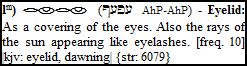
Each blink/twinkling (1 Corinthians 15:52) of our eyes is a picture of the resurrection where we are gathered together to our Lord. The root of the word עפעף ‘aphaph’ is עף ‘aph’ which is a picture of a bird covering its chicks with its wings (Deuteronomy 32:10-11; Psalm 91:1-9). Each day when the sun rises it is a picture of the resurrection as well (Malachi 4:2). In Hebrew the word for dawn is שחר ‘shachar’ from the root שח ‘shach’ which means the pit. When the sun sets it is a picture of death/going into the pit, when it arises it is a picture of resurrection. When man awakens, his eyes are opened from darkness and sleep which is a picture of death (Job 14:13-15; Daniel 12:2-3; John 11:11-14) .
1Co 15:52 In a moment, in the twinkling of an eye, at the last trump: for the trumpet shall sound, and the dead shall be raised incorruptible, and we shall be changed.
1Co 15:53 For this corruptible must put on incorruption, and this mortal must put on immortality.
The word ‘twinkling’ here is from the Greek:
G4493
ῥιπή
rhipē
Thayer Definition:
1) a throw, stroke, beat
2) a moment of time
This word is used in the Septuagint to translate the Hebrew word שחק ‘shachaq’ which means to beat/pound/pulverize to powder (Genesis 3:19) and comes from the root שק ‘shaq’ which means the ‘pit’. שק ‘shaq’ is the root of the word שקר ‘shaqar’ which means the ‘dawn’. Again, the imagery of the blinking/twinkling of the eyes showing the picture of the resurrection of the dead.
The 2nd coming of Messiah and the resurrection of the dead is pictured by the rising of the sun each morning.
Psa 110:3 Your people shall have willingness in the day of Your might; in the majesties of holiness; from the womb of the dawn, to You is the dew of Your youth.
Psa 30:4 Sing praises to Jehovah, O saints of His; and give thanks to the memory of His holiness.
Psa 30:5 For His anger is only a moment; in His favor is life. Weeping may endure in the evening (Tribulation period), but joy comes in the morning (2nd coming & resurrection).
Two eyes (2 births), first the natural & then the spiritual. The Hebrew word for blink is פתע ‘patah’ from the root פת ‘pat’.
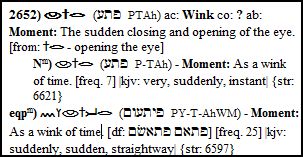
The root word comes from פת ‘pat’ which is the word for a woman’s privy. This links to the first birth, blinking/awakening (picture of resurrection) is linked to the 2nd birth.
Another amazing link to the 2nd birth/birth of the manchild of Revelation 12 is seen Isaiah 8.
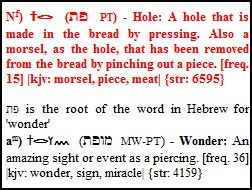
Isa 8:18 Behold, I and the children (Messiah & His Body) whom Jehovah has given to me are for signs and wonders (מופת ‘mophat’) in Israel from Jehovah of Hosts, who dwells in Mount Zion.
The meaning of ὁρίζω ‘horizo,’ from whence comes horizon, corresponds to the Hebrew word תר ‘tor.’
The word תורה ‘torah’ comes from the root word תר ‘tar’ which means an image or outline. The Torah/Word is the Image of God (Hebrews 1:3; 2 Corinthians 4:4; Colossians 1:15).

All things in His Word are a shadow pointing back to Messiah (Hebrews 8:5; 9:24; 10:1; Colossians 2:16-17) who is the Image of God (Hebrews 1:3; 2 Corinthians 4:4; Colossians 1:15-16).
The Torah = the Entire Bible. The Scriptures define the Prophets as the Torah (1 Corinthians 14:21) & the Psalms as Torah (John 10:34; 12:34; 15:25). Messiah further elaborates His Word as everything that comes out of His mouth (Matthew 4:4). This includes creation, as creation came forth from His Word (Psalm 33:6; Hebrews 11:3; John 1:1-3) who became flesh and dwelt among us (Colossians 1:12-17; Hebrews 1:1-3, 8-12).
It is interesting to note that the Greek word μορφή ‘morphe’ is used in the Septuagint to translate both the Hebrew words תואר ‘to’ar’ which means image, that comes from the same root תר as תורה ‘torah.’ μορφή ‘morphe’ is also used to translate the Hebrew word צלם ‘tselem’ which means shadow.
μορφή ‘morphē’ is also used to translate the word תמונה ‘temunah’ which means image and תּבנית ‘tabnı̂yth’ which is translated as pattern, likeness, form and similitude.
Php 2:6 who subsisting in the form (μορφη ‘morphe’) of God, thought it not robbery to be equal with God,
Jesus is THE image of God (Hebrews 1:3; 2 Corinthians 4:4-6; Colossians 1:15-16) who is love (1 John 4:8).
Heb 1:1 God, who at sundry times and in divers manners spake in time past unto the fathers by the prophets,
Heb 1:2 Hath in these last days spoken unto us by his Son, whom he hath appointed heir of all things, by whom also he made the worlds;
Heb 1:3 Who being the brightness of his glory, and the express image of his person, and upholding all things by the word of his power, when he had by himself purged our sins, sat down on the right hand of the Majesty on high;
Col 1:15 Who is the image of the invisible God, the firstborn of every creature:
Col 1:16 For by him were all things created, that are in heaven, and that are in earth, visible and invisible, whether they be thrones, or dominions, or principalities, or powers: all things were created by him, and for him:
Col 1:17 And he is before all things, and by him all things consist.
2Co 4:4 In whom the god of this world hath blinded the minds of them which believe not, lest the light of the glorious gospel of Christ, who is the image of God, should shine unto them.
Joh 1:18 No man hath seen God at any time; the only begotten Son, which is in the bosom of the Father, he hath declared (ἐξηγέομαι ‘exēgeomai’) him.
ἐξηγέομαι ‘exēgeomai’ means to make known:
G1834
ἐξηγέομαι
exēgeomai
Thayer Definition:
- to lead out, be leader, go before
- metaphorically, to draw out in narrative, unfold a teaching
2a) to recount, rehearse
2b) to unfold, declare
2b1) the things relating to God
2b2) used in Greek writing of the interpretation of things sacred and divine, oracles, dreams, etc.
Part of Speech: verb
A Related Word by Thayer’s/Strong’s Number: from G1537 and G2233
The word mark comes from the Hebrew word Tav

Eze 9:4 And Jehovah said to him, Pass through in the midst of the city, in the midst of Jerusalem, and mark (tavah) a mark (tav) on the foreheads of the men who are groaning and are mourning over all the abominations that are done in her midst.
The above verse is speaking of the mark of God which is put on the righteous. The mark of the beast is a direct counterfeit of this mark.
The root word for mark is a picture of an ox plowing toward a mark. In ancient Hebrew thought, God was seen as the strong ox that we are yoked with in covenant relationship. The word for mark is a picture of walking with your God toward your mark/goal (Philippians 3:14). Walking with Christ (Mat 11:29) towards the Kingdom of Heaven or walking with the adversary towards hell. This is what Paul was alluding to in his letter to the Corinthians.
2Co 6:14 Do not be unequally yoked with unbelievers. For what partnership does righteousness have with lawlessness? And what fellowship does light have with darkness?
2Co 6:15 And what agreement does Christ have with Belial? Or what part does a believer have with an unbeliever?
2Co 6:16 And what agreement does a temple of God have with idols? For you are a temple of the living God, even as God said, “I will” dwell in them and “walk among them, and I will be their God, and they shall be My people.” Lev. 26:12; Ezek. 37:27
2Co 6:17 Because of this, “come out from among them” “and be separated,” says the Lord, “and do not touch the unclean thing,” and I will receive you. Isa. 52:11
2Co 6:18 “And I will be a Father to you, and you will be sons” and daughters to Me, says the Lord Almighty. 2 Sam. 7:8, 14; Isa. 43:6
The letter ת ‘tav’ in pictograph form is two crossed sticks which has the meaning of a covenant. We can choose the covenant of Life in Christ Jesus (Isaiah 42:6; 49:8; Zechariah 9:11; Jeremiah 31:31; Matthew 26:28) or we can choose the covenant of death (Isaiah 28:15) which promises deliverance from death (ie the tree of knowledge) but in reality leads to hell.
The sun makes a cross in the sky, or mark, as it traverses the sky each year.
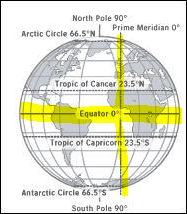
As the sun moves through its course in the sky it will rise directly East at the spring and fall equinoxes, making a cross in the sky each year.
The Cross and Baptism
Mat 28:19 Go ye therefore, and teach all nations, baptizing them in the name of the Father, and of the Son, and of the Holy Ghost:
It is said that the sign of the cross was the mark of those baptized in Christ. This is seen in section 21 of The Apostolic Tradition of Hippolytus of Rome as well as with St. John of Damascus:
“The holy cross was given to us as a sign on our forehead, just as circumcision was given to Israel: for by it we believers are separated and distinguished from unbelievers.” {An Exposition of the Orthodox Faith, 4:11. St. John of Damascus, “Concerning the Cross and Faith,”}
Rom 6:3 Know ye not, that so many of us as were baptized into Jesus Christ were baptized into his death?
Rom 6:4 Therefore we are buried with him by baptism into death: that like as Christ was raised up from the dead by the glory of the Father, even so we also should walk in newness of life.
Rom 6:5 For if we have been planted together in the likeness of his death, we shall be also in the likeness of his resurrection:
Rom 6:6 Knowing this, that our old man is crucified with him, that the body of sin might be destroyed, that henceforth we should not serve sin.
Rom 6:7 For he that is dead is freed from sin.
Rom 6:8 Now if we be dead with Christ, we believe that we shall also live with him:
Rom 6:9 Knowing that Christ being raised from the dead dieth no more; death hath no more dominion over him.
Rom 6:10 For in that he died, he died unto sin once: but in that he liveth, he liveth unto God.
Rom 6:11 Likewise reckon ye also yourselves to be dead indeed unto sin, but alive unto God through Jesus Christ our Lord.
Gal 3:26 For ye are all the children of God by faith in Christ Jesus.
Gal 3:27 For as many of you as have been baptized into Christ have put on Christ.
Initially the sign of the cross started on the forehead, hearkening back to the Prophet Ezekiel.
Eze 9:4 And the LORD said unto him, Go through the midst of the city, through the midst of Jerusalem, and set a mark (תו והתוית ‘vheetviyta tav’) upon the foreheads of the men that sigh and that cry for all the abominations that be done in the midst thereof.
The phrase תו והתוית ‘vheetviyta tav’ can be translated “cross a cross.” This is what the sign of the cross is.
The sign of the cross declares to the world the victory of Christ and our victory in Him.
Rom 8:35 Who shall separate us from the love of Christ? shall tribulation, or distress, or persecution, or famine, or nakedness, or peril, or sword?
Rom 8:36 As it is written, For thy sake we are killed all the day long; we are accounted as sheep for the slaughter.
Rom 8:37 Nay, in all these things we are more than conquerors through him that loved us.
Rom 8:38 For I am persuaded, that neither death, nor life, nor angels, nor principalities, nor powers, nor things present, nor things to come,
Rom 8:39 Nor height, nor depth, nor any other creature, shall be able to separate us from the love of God, which is in Christ Jesus our Lord.
2Sa_19:2 And the victory {תּשׁעה / תּשׁוּעה ‘teshû‛âh’} that day was turned into mourning unto all the people: for the people heard say that day how the king was grieved for his son.
תּשׁוּעה ‘teshû‛âh’ comes from the word ישע ‘yasha’ which means salvation. Pointing to the name of Jesus. The sign of the cross reveals the name/character of God.
The cross reveals God’s name/character of love revealed through the life of Christ. The Hebrew word for name is שם ‘shem’ which literally means one’s breathe or character. What is the character of the Almighty? Love (1 John 4:8). The Hebrew word for love is אהב ‘ahav’ which is consists of the letters אב ‘av’ which means father and the middle letter ה ‘heh’ which has the meaning of revelation. The Father revealed. In ancient Hebrew, the letter ה ‘heh’ was depicted as a man with outstretched arms, like unto Messiah on the cross. How was the love of the Father revealed? Through the giving of His only begotten Son on the cross as an atonement for the sins of mankind (John 3:16).
Joh 17:6 I have manifested thy name unto the men which thou gavest me out of the world: thine they were, and thou gavest them me; and they have kept thy word.
Jesus is THE image of God (Hebrews 1:3; 2 Corinthians 4:4-6; Colossians 1:15-16) who is love (1 John 4:8). He revealed God’s name/character to mankind (John 17:6).
Mankind was created in God’s image
Gen 1:26 And God said, Let us make man in our image, after our likeness: and let them have dominion over the fish of the sea, and over the fowl of the air, and over the cattle, and over all the earth, and over every creeping thing that creepeth upon the earth.
Gen 1:27 So God created man in his own image, in the image of God created he him; male and female created he them.
Gen 5:1 This is the book of the generations of Adam. In the day that God created man, in the likeness of God made he him;
Gen 9:6 Whoso sheddeth man’s blood, by man shall his blood be shed: for in the image of God made he man.
1Co 11:7 For a man indeed ought not to cover his head, forasmuch as he is the image and glory of God: but the woman is the glory of the man.
Jas 3:8 But the tongue can no man tame; it is an unruly evil, full of deadly poison.
Jas 3:9 Therewith bless we God, even the Father; and therewith curse we men, which are made after the similitude of God.
Jas 3:10 Out of the same mouth proceedeth blessing and cursing. My brethren, these things ought not so to be.
Jas 3:11 Doth a fountain send forth at the same place sweet water and bitter?
Jas 3:12 Can the fig tree, my brethren, bear olive berries? either a vine, figs? so can no fountain both yield salt water and fresh.
Jas 3:13 Who is a wise man and endued with knowledge among you? let him shew out of a good conversation his works with meekness of wisdom.
Jas 3:14 But if ye have bitter envying and strife in your hearts, glory not, and lie not against the truth.
Jas 3:15 This wisdom descendeth not from above, but is earthly, sensual, devilish.
Jas 3:16 For where envying and strife is, there is confusion and every evil work.
Jas 3:17 But the wisdom that is from above is first pure, then peaceable, gentle, and easy to be intreated, full of mercy and good fruits, without partiality, and without hypocrisy.
Jas 3:18 And the fruit of righteousness is sown in peace of them that make peace.
Man was created in God’s image (Genesis 1:26-27) but that image was corrupted when Adam sinned. From there man took up the image of Adam which still pointed back to God, but in a corrupted form (Genesis 5:1; 1 Corinthians 15:45-49). Christ came to earth in the very image of Almighty God (2 Corinthians 4:4; Colossians 1:15; Hebrews 1:3), who is love. His life displayed that love and He calls all those who believe in Him to display that love as well. This is the essence of the concept of ‘Christ in us.’ It is through His love that man is formed into His image (Colossians 3:10; Romans 8:29) where there is no longer Jew or Greek, Barbarian or Scythian but Christ is all and in all (Colossians 3:11).
Monkeys look similar to man but are beasts. In ancient thought, monkeys were pictures of unregenerate man (beasts). The image we become is the mark we take. The image of God or the image of the beast.
2Co 4:3 But if our gospel be hid, it is hid to them that are lost:
2Co 4:4 In whom the god of this world hath blinded the minds of them which believe not, lest the light of the glorious gospel of Christ, who is the image of God, should shine unto them.
2Co 4:5 For we preach not ourselves, but Christ Jesus the Lord; and ourselves your servants for Jesus’ sake.
2Co 4:6 For God, who commanded the light to shine out of darkness, hath shined in our hearts, to give the light of the knowledge of the glory of God in the face of Jesus Christ.
Hos 14:7 They who live under his shadow shall return; they shall live like the grain, and blossom like the vine; their memorial shall be as the wine of Lebanon.
Hos 14:8 Ephraim shall say, What is it to me any more with idols? I answered him, and I regarded him. I am as a green cypress tree; your fruit is found from Me.
Hos 14:9 Who is wise and discerns these things? Who is discerning and knows them? For the ways of Jehovah are right, and the righteous shall walk in them; but transgressors shall stumble in them.
The word for image in Hebrew is צל ‘tsel’ which means a shadow cast by an object forming an image. This is also seen in the concept of being under the shadow of His wings, which also pictures dwelling under the branches of the Tree of Life. The counterfeit, of course, is the tree of knowledge and the shadow/image it casts.
The word צל ‘tsel’ is the combination of the letter צ ‘tsadi’ which is the picture of a hunter, a man lying on his side with a spear or bow or a man with a fishing pole. The ל ‘lamed’ is a the picture of a staff held by a shepherd which represents authority. Herein lies a beautiful picture of the current study. The shepherd who hunts. The Messiah, the Good Shepherd, holds out a ‘fishing pole’ whose bait is the fruit of the tree of Life. The idol/worthless shepherd lies in wait as a lion seeking whom he may devour.
We can have the mark of God and be in His image by walking in His Torah and Messiah living through us (Galatians 2:20), or we can have the mark of the beast and be in the image of Satan by walking in his “torah” which is lawlessness (Ephesians 2:2-3; Isaiah 30:8-11; 1 Peter 2:8). In reality, this “torah” is the concept of ‘do what thou wilt shall be the whole of the law,’ (Romans 7:25) the ability of man to decide what is good or evil, right or wrong instead of relying on the Word of God to define the two.
We can choose the tree of life or the tree of knowledge. The Light of the Word or the false light which is in reality darkness (Matthew 6:23).
Messiah came to redeem mankind (2 Corinthians 5:19) and remake them into His image (Romans 8:29; 1 John 3:1-3).
In Aramaic the word ‘predestinate’ means ‘mark’
Lamsa Aramaic Translation
Rom 8:29 He knew them in advance and he marked (Gk predestined) them with the likeness of the image of his Son that he might be the first-born among many brethren.
Again the connection to the mark and the image. The image of the Son vs. the image of the beast.
Eph 1:4 According as he hath chosen us in him before the foundation of the world, that we should be holy and without blame before him in love:
Eph 1:5 Having predestinated {Aramaic – ‘marked’} us unto the adoption of children by Jesus Christ to himself, according to the good pleasure of his will,
Rom 8:29 He knew them in advance and he marked them with the likeness of the image of his Son that he might be the first-born among many brethren.
Rom 8:30 Moreover, those he did mark in advance, he has called, and those he has called, he has declared righteous, and those he has declared righteous, he has glorified.
1Co 15:49 And as we have borne the image of the earthy, we shall also bear the image of the heavenly.
2Co 3:18 But we all, with open face beholding as in a glass the glory of the Lord, are changed into the same image from glory to glory, even as by the Spirit of the Lord.
Psa 17:15 As for me, I will behold thy face in righteousness: I shall be satisfied, when I awake, with thy likeness.
Rom 8:28 And we know that all things work together for good to them that love God, to them who are the called according to his purpose.
Rom 8:29 For whom he did foreknow, he also did predestinate to be conformed to the image of his Son, that he might be the firstborn among many brethren.
Gal 3:26 For ye are all the children of God by faith in Christ Jesus.
Gal 3:27 For as many of you as have been baptized into Christ have put on Christ.
Gal 3:28 There is neither Jew nor Greek, there is neither bond nor free, there is neither male nor female: for ye are all one in Christ Jesus.
Gal 3:29 And if ye be Christ’s, then are ye Abraham’s seed, and heirs according to the promise.
Heb 13:20 Now the God of peace, that brought again from the dead our Lord Jesus, that great shepherd of the sheep, through the blood of the everlasting covenant,
Heb 13:21 Make you perfect in every good work to do his will, working in you that which is wellpleasing in his sight, through Jesus Christ; to whom be glory for ever and ever. Amen.
The LORD is the God of all, who loves all (John 3:16) and desires that all come to salvation (2 Peter 3:9; 1 Timothy 2:4) through Jesus who is the revelation of His name/memorial/character/image. If believers are called by His name/image (2 Chronicles 7:14; Isaiah 43:7; Daniel 9:19; Revelation 14:1), should we not do the same (Micah 4:5; Zechariah 10:12; Colossians 3:17; 2:6)?
Apes & the Sun

Ancient Egyptians associated baboons (especially the hamadryas baboon) with greeting or adoring the rising sun based on observation of the animals’ natural dawn behavior. In the wild, baboons face the rising sun early in the morning to warm themselves. They stretch and raise their arms and produce loud vocalizations. In essence they display the concept of worshiping the sun.
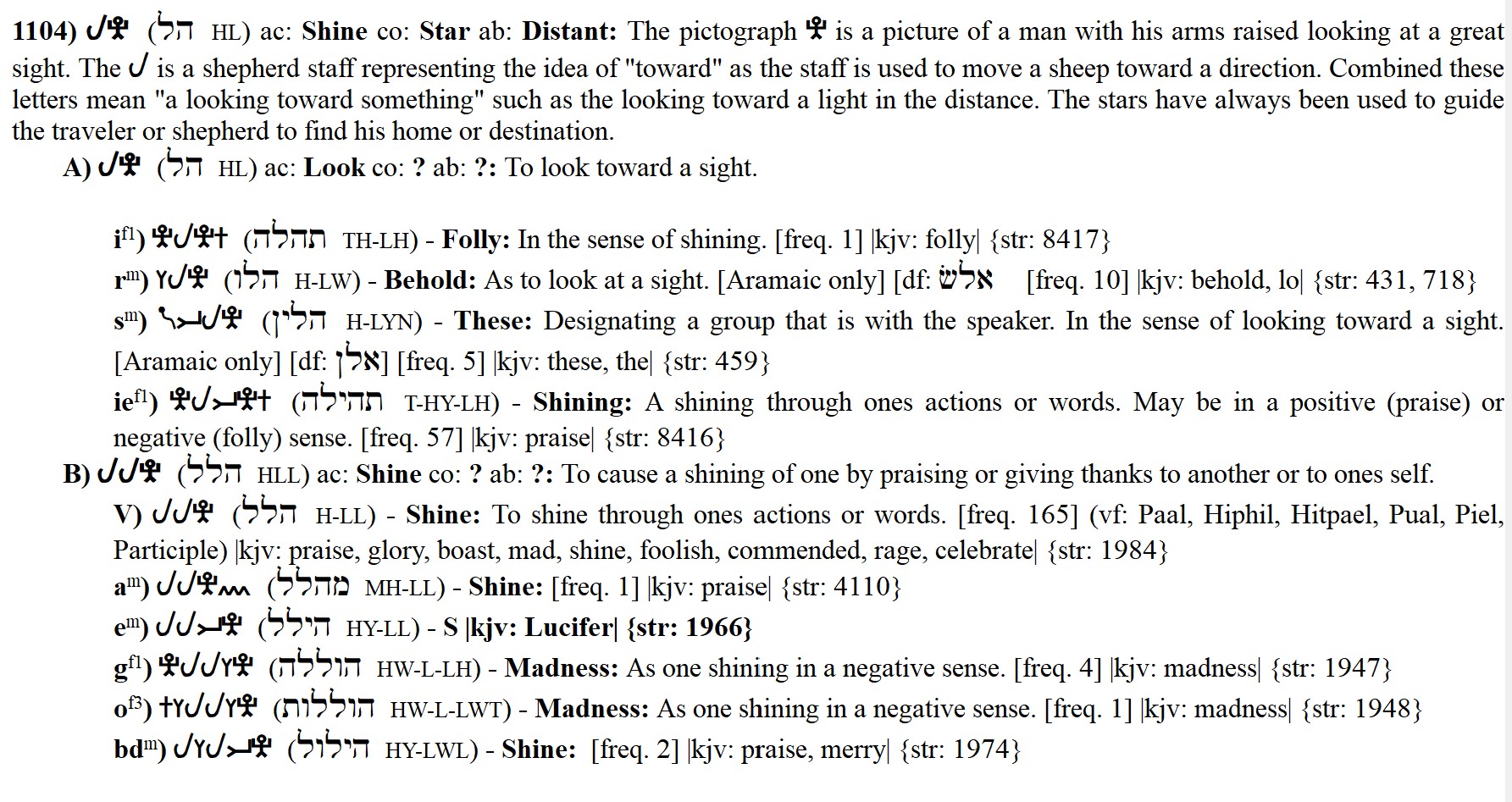
The literal meaning of praise is to raise up the hands.
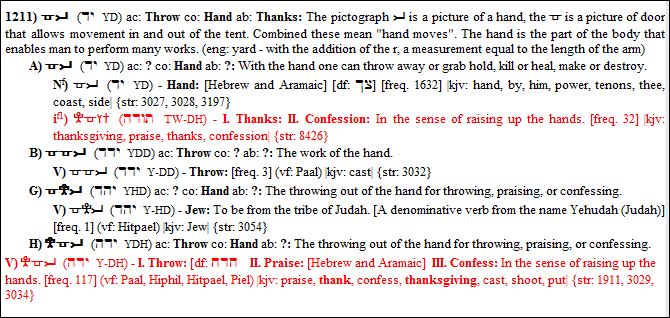
Hallelujah comes from the word הלל ‘halel’ which consists of the letter ה ‘heh’ which pictures a man outstretched arms and the letter ל ‘lamed’ which is a picture of a shepherd’s staff.
Egyptians interpreted this combination of hand raising and “praise” vocalizations as worship or greeting of the sun god Ra. The raised-arm stance closely matched the human Egyptian gesture of adoration, henu.
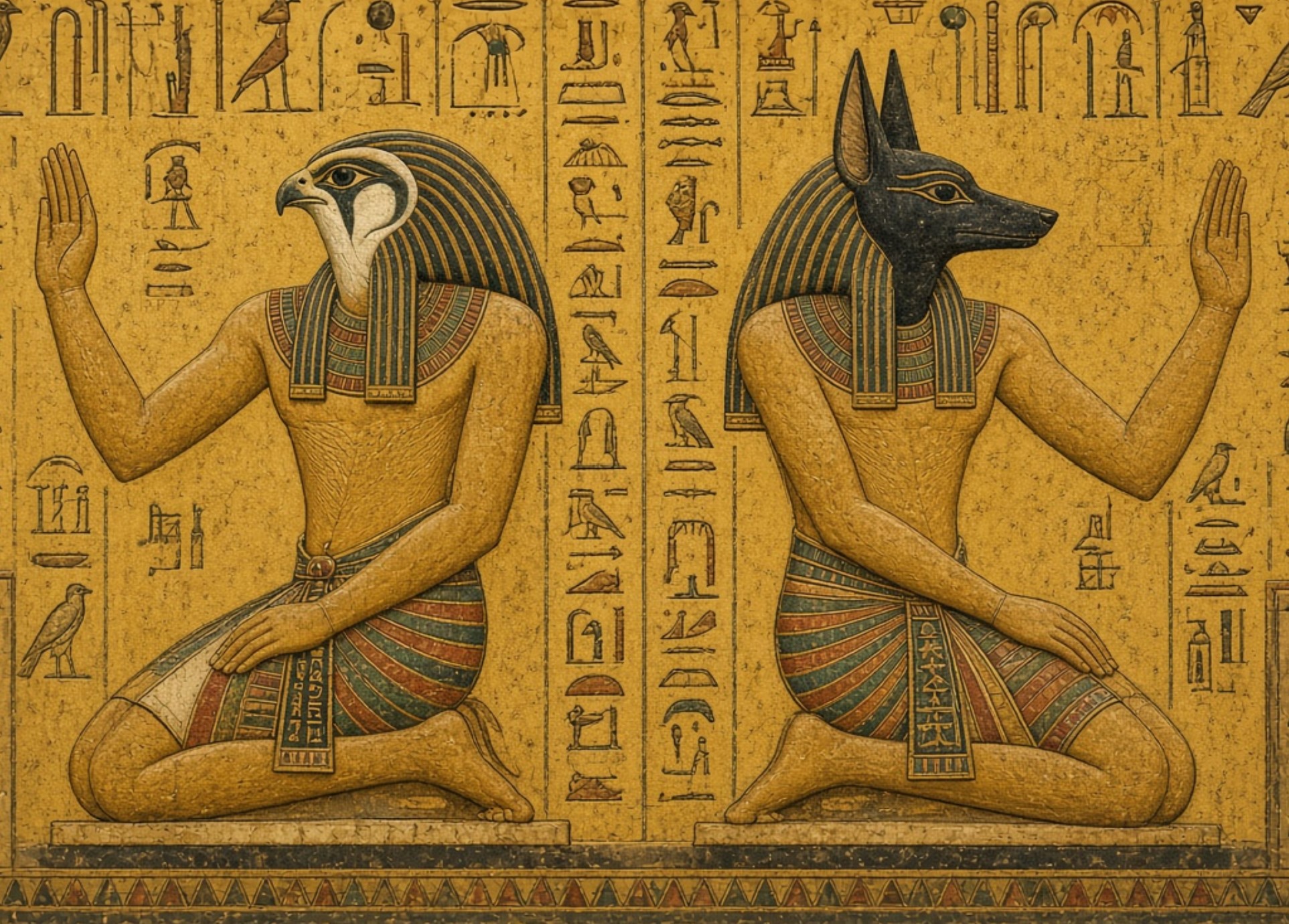
“Texts from the Karnak temple complex near Luxor describe baboons as “announcing” Ra while “they dance for him, jump gaily for him, sing praises for him, and shout out for him.” In te Velde’s view, people probably thought baboons were sacred because they seemed to communicate directly with Ra. The Egyptians saw the jubilance and inscrutable language of baboons as evidence of religious knowledge, he surmised.
“The Pyramid Texts call the baboon the oldest or most beloved son of Ra.”
“The Book of the Dead includes the declaration: “I have sung and praised the Sun-disc. I have joined the baboons, and I am one of them.” {Mysteries of Ancient Egypt’s Sacred Baboons Revealed}
Monkeys and apes are linked to the sun throughout different cultures. In Hinduism, as a child, the monkey god Hanuman mistakes the rising sun for a ripe fruit and leaps into the sky to swallow it. Indra strikes him with a thunderbolt, breaking his jaw which the origin of his name (hanu “jaw”). The gods then bless him with powers.
Later, Hanuman chooses the sun god Surya as his guru and learns the scriptures by flying alongside the moving sun. Further displaying the monkey, sun connection in Hinduism is Sugriva, who is described as a son of the sun. He commands an army of “golden monkeys.”
Man Beasts
Scripture compares the carnal man unto a beast.
Ecc 3:18 I said in mine heart concerning the estate of the sons of men, that God might manifest them, and that they might see that they themselves are beasts.
Ecc 3:19 For that which befalleth the sons of men befalleth beasts; even one thing befalleth them: as the one dieth, so dieth the other; yea, they have all one breath; so that a man hath no preeminence above a beast: for all is vanity.
Ecc 3:20 All go unto one place; all are of the dust, and all turn to dust again.
The Hebrew word for beast is בער ‘ba`ar’ which has the meaning of one who consumes. A fire consumes and destroys. Cattle consume the pasture. A person without understanding is “consumed” by their base instinct, acting like a brute beast as opposed to a rational being made in the image of God.

Psa 92:5 O LORD, how great are thy works! and thy thoughts are very deep.
Psa 92:6 A brutish man knoweth not; neither doth a fool understand this.
Psa 94:7 Yet they say, The LORD shall not see, neither shall the God of Jacob regard it.
Psa 94:8 Understand, ye brutish among the people: and ye fools, when will ye be wise?
Psa 94:9 He that planted the ear, shall he not hear? he that formed the eye, shall he not see?
Psa 94:10 He that chastiseth the heathen, shall not he correct? he that teacheth man knowledge, shall not he know?
Psa 94:11 The LORD knoweth the thoughts of man, that they are vanity.
Psa 94:12 Blessed is the man whom thou chastenest, O LORD, and teachest him out of thy law;
Psa 94:13 That thou mayest give him rest from the days of adversity, until the pit be digged for the wicked.
The way of the world leads to beastly foolishness.
Jer 10:2 Thus saith the LORD, Learn not the way of the heathen, and be not dismayed at the signs of heaven; for the heathen are dismayed at them.
Jer 10:3 For the customs of the people are vain: for one cutteth a tree out of the forest, the work of the hands of the workman, with the axe.
Jer 10:8 But they are altogether brutish (בער ‘baar’ beastly) and foolish (כסל ‘kasal’): the stock is a doctrine of vanities.
Jer 10:14 Every man is brutish in his knowledge: every founder is confounded by the graven image: for his molten image is falsehood, and there is no breath in them.
Jer 10:15 They are vanity, and the work of errors: in the time of their visitation they shall perish.
Jer 10:16 The portion of Jacob is not like them: for he is the former of all things; and Israel is the rod of his inheritance: The LORD of hosts is his name.
Brutish, yet religious
Jer 10:21 For the pastors are become brutish, and have not sought the LORD: therefore they shall not prosper, and all their flocks shall be scattered.
Brutish and Foolish
Psa 92:5 O LORD, how great are thy works! and thy thoughts are very deep.
Psa 92:6 A brutish man knoweth not; neither doth a fool understand this.
Psa 49:10 For he seeth that wise men die, likewise the fool and the brutish person perish, and leave their wealth to others.
Psa 49:11 Their inward thought is, that their houses shall continue for ever, and their dwelling places to all generations; they call their lands after their own names.
Psa 49:12 Nevertheless man being in honour abideth not: he is like the beasts that perish.
Psa 49:13 This their way is their folly: yet their posterity approve their sayings. Selah.
Psa 49:14 Like sheep they are laid in the grave; death shall feed on them; and the upright shall have dominion over them in the morning; and their beauty shall consume in the grave from their dwelling.
Psa 49:15 But God will redeem my soul from the power of the grave: for he shall receive me. Selah.
Psa 49:16 Be not thou afraid when one is made rich, when the glory of his house is increased;
Psa 49:17 For when he dieth he shall carry nothing away: his glory shall not descend after him.
Psa 49:18 Though while he lived he blessed his soul: and men will praise thee, when thou doest well to thyself.
Psa 49:19 He shall go to the generation of his fathers; they shall never see light.
Psa 49:20 Man that is in honour, and understandeth not, is like the beasts that perish.
Psa 73:22 So foolish (בער ‘baar’ – beastly) was I, and ignorant: I was as a beast before thee.
Pro 12:1 Whoso loveth instruction loveth knowledge: but he that hateth reproof is brutish.
Septuagint
Pro 12:1 He that loves instruction loves sense, but he that hates reproofs is a fool (αφρων ‘aphron’).
ἄφρων
aphrōn
af’-rone
From G1 (as a negative particle) and G5424; properly mindless, that is, stupid, (by implication) ignorant, (specifically) egotistic, (practically) rash, or (morally) unbelieving: – fool (-ish), unwise.
Eph 5:15 See then that ye walk circumspectly, not as fools, but as wise,
Eph 5:16 Redeeming the time, because the days are evil.
Eph 5:17 Wherefore be ye not unwise (αφρων ‘aphron’), but understanding what the will of the Lord is.
The remedy to the beast nature is walking with God as a little guy in His Eye.
Job 35:11 Who teacheth us more than the beasts of the earth, and maketh us wiser than the fowls of heaven?
Psa 32:8 I will instruct thee and teach thee in the way which thou shalt go: I will guide thee with mine eye.
Psa 32:9 Be ye not as the horse, or as the mule, which have no understanding: whose mouth must be held in with bit and bridle, lest they come near unto thee.
Psa 32:10 Many sorrows shall be to the wicked: but he that trusteth in the LORD, mercy shall compass him about.
Psa 32:11 Be glad in the LORD, and rejoice, ye righteous: and shout for joy, all ye that are upright in heart.
We must put on the mind of Christ
1Co 2:13 Which things also we speak, not in the words which man’s wisdom teacheth, but which the Holy Ghost teacheth; comparing spiritual things with spiritual.
1Co 2:14 But the natural man receiveth not the things of the Spirit of God: for they are foolishness unto him: neither can he know them, because they are spiritually discerned.
1Co 2:15 But he that is spiritual judgeth all things, yet he himself is judged of no man.
1Co 2:16 For who hath known the mind of the Lord, that he may instruct him? But we have the mind of Christ.
In 1st Corinthians 2:16, Paul quots Isaiah speaking of the Spirit of the Lord.
Isa 40:13 Who hath directed the Spirit of the LORD, or being his counsellor hath taught him?
Gal 5:16 This I say then, Walk in the Spirit, and ye shall not fulfil the lust of the flesh.
Gal 5:17 For the flesh lusteth against the Spirit, and the Spirit against the flesh: and these are contrary the one to the other: so that ye cannot do the things that ye would.
Gal 5:18 But if ye be led of the Spirit, ye are not under the law.
Gal 5:19 Now the works of the flesh are manifest, which are these; Adultery, fornication, uncleanness, lasciviousness,
Gal 5:20 Idolatry, witchcraft, hatred, variance, emulations, wrath, strife, seditions, heresies,
Gal 5:21 Envyings, murders, drunkenness, revellings, and such like: of the which I tell you before, as I have also told you in time past, that they which do such things shall not inherit the kingdom of God.
Gal 5:22 But the fruit of the Spirit is love, joy, peace, longsuffering, gentleness, goodness, faith,
Gal 5:23 Meekness, temperance: against such there is no law.
Gal 5:24 And they that are Christ’s have crucified the flesh with the affections and lusts.
Gal 5:25 If we live in the Spirit, let us also walk in the Spirit.
Rom 8:1 There is therefore now no condemnation to them which are in Christ Jesus, who walk not after the flesh, but after the Spirit.
Rom 8:2 For the law of the Spirit of life in Christ Jesus hath made me free from the law of sin and death.
Rom 8:3 For what the law could not do, in that it was weak through the flesh, God sending his own Son in the likeness of sinful flesh, and for sin, condemned sin in the flesh:
Rom 8:4 That the righteousness of the law might be fulfilled in us, who walk not after the flesh, but after the Spirit.
Rom 8:5 For they that are after the flesh do mind the things of the flesh; but they that are after the Spirit the things of the Spirit.
Rom 8:6 For to be carnally minded is death; but to be spiritually minded is life and peace.
Rom 8:7 Because the carnal mind is enmity against God: for it is not subject to the law of God, neither indeed can be.
Rom 8:8 So then they that are in the flesh cannot please God.
Rom 8:9 But ye are not in the flesh, but in the Spirit, if so be that the Spirit of God dwell in you. Now if any man have not the Spirit of Christ, he is none of his.
Rom 8:10 And if Christ be in you, the body is dead because of sin; but the Spirit is life because of righteousness.
Rom 8:11 But if the Spirit of him that raised up Jesus from the dead dwell in you, he that raised up Christ from the dead shall also quicken your mortal bodies by his Spirit that dwelleth in you.
Rom 8:12 Therefore, brethren, we are debtors, not to the flesh, to live after the flesh.
Rom 8:13 For if ye live after the flesh, ye shall die: but if ye through the Spirit do mortify the deeds of the body, ye shall live.
Rom 8:14 For as many as are led by the Spirit of God, they are the sons of God.
Phi 2:5 Let this mind be in you, which was also in Christ Jesus:
Phi 2:6 Who, being in the form of God, thought it not robbery to be equal with God:
Phi 2:7 But made himself of no reputation, and took upon him the form of a servant, and was made in the likeness of men:
Phi 2:8 And being found in fashion as a man, he humbled himself, and became obedient unto death, even the death of the cross.
1Pe 4:1 Forasmuch then as Christ hath suffered for us in the flesh, arm yourselves likewise with the same mind: for he that hath suffered in the flesh hath ceased from sin;
1Pe 4:2 That he no longer should live the rest of his time in the flesh to the lusts of men, but to the will of God.
1Pe 4:3 For the time past of our life may suffice us to have wrought the will of the Gentiles, when we walked in lasciviousness, lusts, excess of wine, revellings, banquetings, and abominable idolatries:
1Pe 4:4 Wherein they think it strange that ye run not with them to the same excess of riot, speaking evil of you:
1Pe 4:5 Who shall give account to him that is ready to judge the quick and the dead.
1Pe 4:6 For for this cause was the gospel preached also to them that are dead, that they might be judged according to men in the flesh, but live according to God in the spirit.
1Pe 2:23 Who, when he was reviled, reviled not again; when he suffered, he threatened not; but committed himself to him that judgeth righteously:
1Pe 2:24 Who his own self bare our sins in his own body on the tree, that we, being dead to sins, should live unto righteousness: by whose stripes ye were healed.
1Pe 2:25 For ye were as sheep going astray; but are now returned unto the Shepherd and Bishop of your souls.
Luk 22:42 Saying, Father, if thou be willing, remove this cup from me: nevertheless not my will, but thine, be done.
The monkey/ape depicts man in his beastly nature who imitates the serpent, the most subtle of the beasts (Genesis 3:1). This “beastly man” imagery is seen in the etymology of the gorilla. Gorilla comes from the Greek word Γόριλλαι ‘Gorillai’ which comes from Periplus written by Hanno the Navigator who described encountering “savage people, the greater part of whom were women, whose bodies were hairy.” When gorillas were “discovered” in 1847 by American missionary Thomas Savage, he applied this word to them.
Entertainment
The word entertainment comes from the Latin word ‘tenere’ which means to hold or keep. Entertainment is designed to hold one’s attention. It is related to the word amusement which comes from the Old French ‘amuser’ which means means to cause to muse. To think. It originally meant to distract or to beguile, to delude, or occupy someone’s attention.” On a deeper level it is believed to mean to fool, to tease or to entrap. Muser traces back to the Latin word mūsum which means snout or muzzle. The idea is that of one standing with their mouth open, staring idly or stupidly.
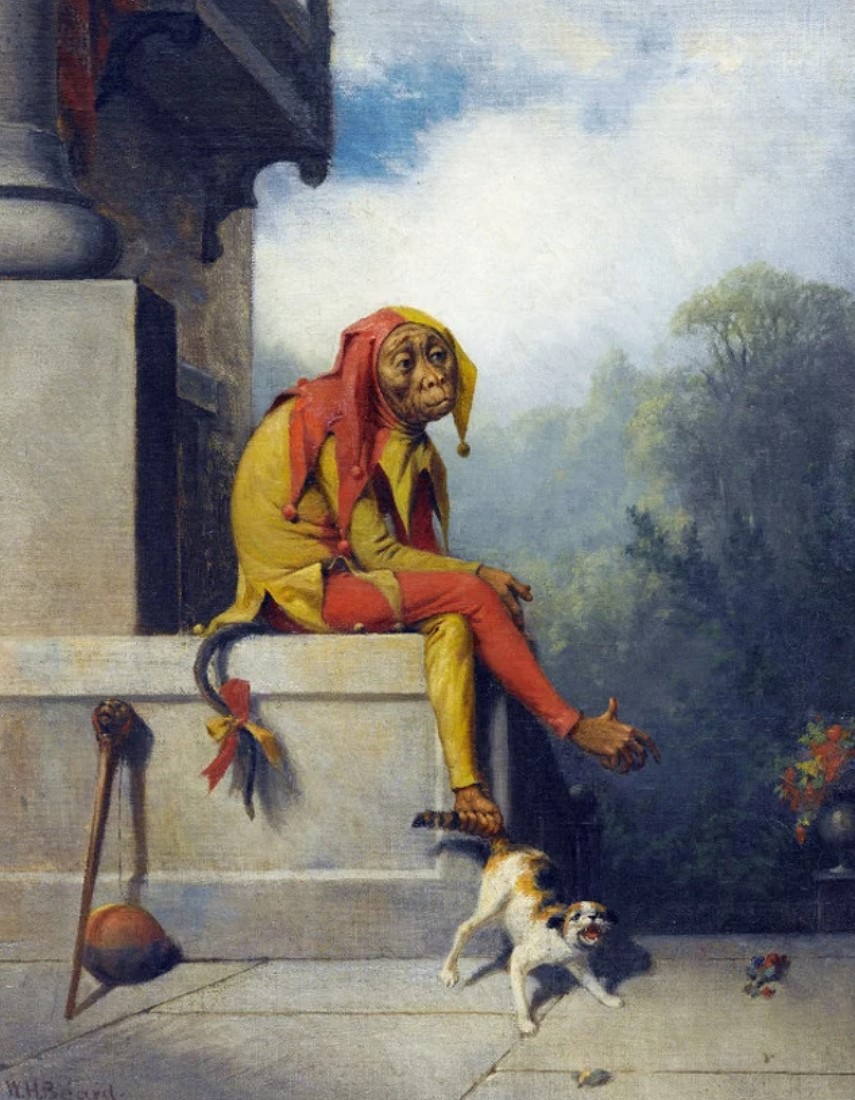
In ancient times in Mesopotamia, Egypt, Greek and Rome, monkeys were kept as pets on leashes for entertainment. In Medieval times they were trained to perform acts like the “organ grinder monkey.” In modern times this is seen in circuses where monkeys and apes are trained to perform. They were animal versions of jesters and fools.
Pro 13:20 He that walketh with wise men shall be wise: but a companion of fools (כְּסִיל ‘kesiyl’) shall be destroyed.
כְּסִיל
kesı̂yl
kes-eel’
From H3688; properly fat, that is, (figuratively) stupid or silly: – fool (-ish).
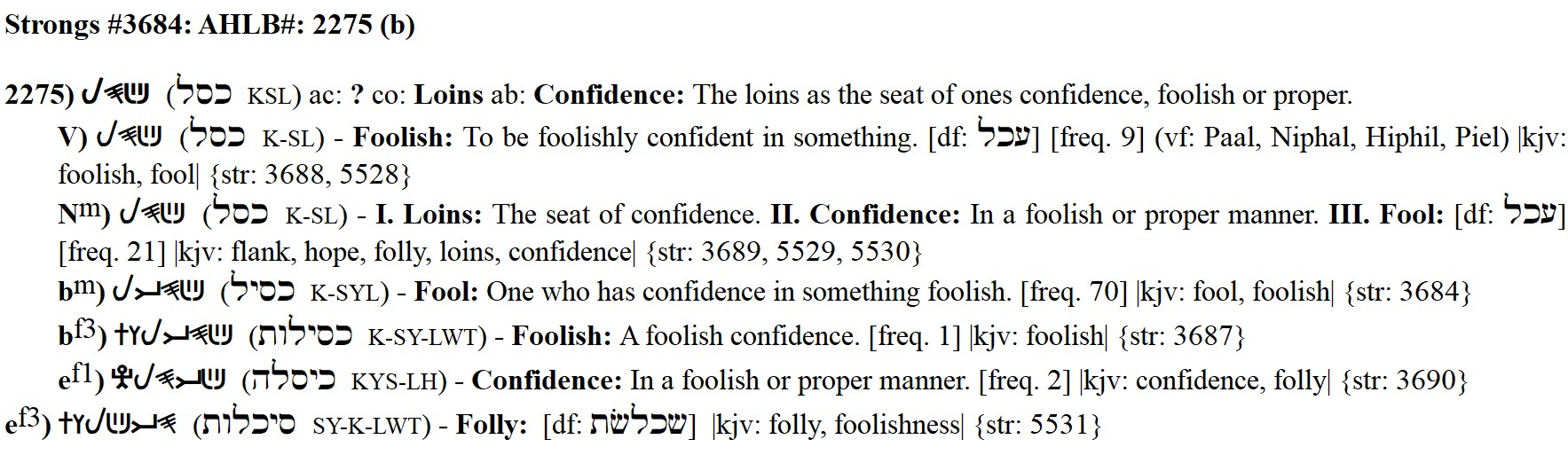
The Hebrew word in Proverbs 13:20 is כסל ‘kasal’ which means foolish. It also means fat as in the loins or flanks (fatty area of the body – Leviticus 3:4, 10, 15; Job 15:27). It literally means the loins, the seat of confidence. The loins support the body and enable a person to stand upright, to “gird up their loins” for action.
Our hope, our confidence is the Lord.
Pro 3:26 For the LORD shall be thy confidence (כסל ‘kesel’), and shall keep thy foot from being taken.
Psa 78:7 That they might set their hope (כסל ‘kesel’) in God, and not forget the works of God, but keep his commandments:
Psa 78:8 And might not be as their fathers, a stubborn and rebellious generation; a generation that set not their heart aright, and whose spirit was not stedfast with God.
We stand in God and His grace by faith.
Rom 14:4 Who art thou that judgest another man’s servant? to his own master he standeth or falleth. Yea, he shall be holden up: for God is able to make him stand.
Rom 5:1 Therefore being justified by faith, we have peace with God through our Lord Jesus Christ:
Rom 5:2 By whom also we have access by faith into this grace wherein we stand, and rejoice in hope of the glory of God.
2Co 1:24 Not for that we have dominion over your faith, but are helpers of your joy: for by faith ye stand.
Scripture declares that he that thinks he stands needs to take heed lest he fall (1 Corinthians 10:12). We don’t stand by our works or knowledge, we stand only by faith (2 Corinthians 1:24) in the Gospel (1 Corinthians 15:1) which is given by the grace of God (Romans 5:2). As a result, we are not to judge each other and the perceived failings of each other as we are all servants of God and He is the Master who makes us stand or fall (Romans 14:4).
Some entertainment is fine. Enjoying beauty and life does not make one a fool. Being consumed by entertainment does.
Eph 6:11 Put on all the armor of God, for you to be able to stand against the wiles of the Devil,
Eph 6:12 because wrestling against flesh and blood is not to us, but against the rulers, against the authorities, against the world’s rulers, of the darkness of this age, against the spiritual powers of evil in the heavenlies.
Eph 6:13 Because of this, take up all of the armor of God that you may be able to resist in the evil day, and having worked out all things, to stand.
Eph 6:14 Then stand firm, “having girded your loins about with truth” and having put “on the breastplate of righteousness,” Isa. 11:5; 59:17
Eph 6:15 and having shod the feet with the preparation of the “gospel of peace.” Isa. 52:7
Eph 6:16 Above all, taking up the shield of faith, with which you will be able to quench all the darts of the evil one being kindled.
Eph 6:17 Also, take “the helmet of salvation,” and the sword of the Spirit which is the Word of God; Isa. 59:17 LXX-Isa. 11:4; MT-Isa. 49:2; LXX and MT-Hos. 6:5
Eph 6:18 through all prayer and petition, praying at all times in the Spirit, and watching to this same thing with all perseverance and petition concerning all the saints.
We are to gird up the loins of our mind in hope and obedience, not conformed to the old carnal nature.
1Pe 1:13 Wherefore gird up the loins of your mind, be sober, and hope to the end for the grace that is to be brought unto you at the revelation of Jesus Christ;
1Pe 1:14 As obedient children, not fashioning yourselves according to the former lusts in your ignorance:
1Pe 1:15 But as he which hath called you is holy, so be ye holy in all manner of conversation;
1Pe 1:16 Because it is written, Be ye holy; for I am holy.
We are to “renew” our minds. We must avoid evil entering the gates of our minds.
Rom 12:1 I beseech you therefore, brethren, by the mercies of God, that ye present your bodies a living sacrifice, holy, acceptable unto God, which is your reasonable service.
Rom 12:2 And be not conformed to this world: but be ye transformed by the renewing of your mind, that ye may prove what is that good, and acceptable, and perfect, will of God.
Rom 12:3 For I say, through the grace given unto me, to every man that is among you, not to think of himself more highly than he ought to think; but to think soberly, according as God hath dealt to every man the measure of faith.
We reap what we sow. We become what we consume, what enters our gates.
Gal 6:7 Be not deceived; God is not mocked: for whatsoever a man soweth, that shall he also reap.
Gal 6:8 For he that soweth to his flesh shall of the flesh reap corruption; but he that soweth to the Spirit shall of the Spirit reap life everlasting.
The carnal man has false confidence coming from the loins. It leads to obesity and sexual immorality. Their god is their belly (Philippians 3:19). Paul uses the word κοιλία ‘koilia’ which means the belly or womb pointing to the carnal man filling their belly leading to obesity and filling the “womb” with sexual immorality.
Php 3:19 Whose end is destruction, whose God is their belly (κοιλία ‘koilia’), and whose glory is in their shame, who mind earthly things.)
G2836
κοιλία
koilia
koy-lee’-ah
From κοῖλος koilos (“hollow”); a cavity, that is, (specifically) the abdomen; by implication the matrix; figuratively the heart: – belly, womb.
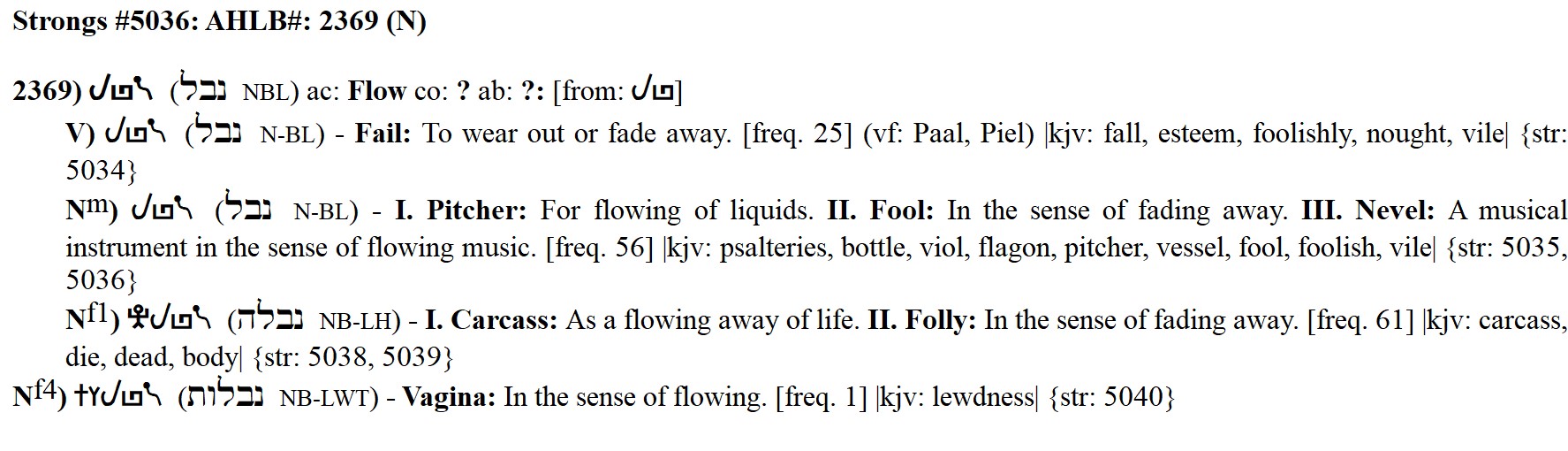
Further displaying this concept is the Hebrew word נבל ‘naval’ which means a fool. It is the root of the word נבלות ‘navlut’ speaking of a women’s privy. Notice also נבל ‘naval’ is used in connection with music. This is interesting to note as the god of music Pan is linked to this parable of apes. More on this later.
Abundant Life
The abundant life of a culture can lead to false confidence, foolishness, obesity and sexual immorality. It leads to “ape like” promiscuity and beastly natures. Filling the mind (gates) with entertainment and corruption.
The Holy Scriptures warn that prosperity without the fear of the Lord leads to forgetfulness and folly (Deuteronomy 8:11–14; Proverbs 30:8–9; Hosea 13:6), to waxing fat (Deuteronomy 31:20; 32:13-15). A “fat heart” is a lawless heart (Psalm 119:69-70; Jeremiah 5:23-29) without understanding (Isaiah 6:10; Matthew 13:10-16), like a beast (Psalm 92:4-6; 49:10-13).
When a society experiences extended peace, prosperity, and freedom from immediate threat, several tendencies often appear. Easier access to food and a reduction in hard work for that food leads to obesity. A sense of invulnerability or entitlement weakens self restraint (temperance) leading to sexual immorality.
Abundance without the Word leads to rebellion and waxing fat
Deu 31:20 And I shall bring them into the land flowing with milk and honey, which I have sworn to their fathers. And you shall eat and be satisfied, and become fat, and shall turn to other gods; and they shall serve them, and despise Me, and break My covenant.
Deu 32:13 He made him ride on the high places of the earth, so that he might eat the increase of the fields. And He made him suck honey out of the rock, and oil out of the flinty rock;
Deu 32:14 butter from cows, and milk from the flock, with fat from lambs, and rams of the sons of Bashan, and he goats, with the fat of the kidneys of wheat, and of the blood of the grape you shall drink wine.
Deu 32:15 But Jeshurun grew fat, and kicked; you grew fat, thick {עבה ‘‛âbâh’} and sated. And he abandoned God who made him, and fell away from the Rock of his salvation.
Thick comes from the word:
H5666
עבה
‛âbâh
BDB Definition:
1) to be thick, be fat, be gross
1a) (Qal) to be fat, be thick, be gross
The root of this word means ‘darkness inside’:

What happens to those who become abundant in fleshly goods but not in spiritual goods? They become darkened inside.
Mat 6:19 Do not treasure up for you treasures on the earth, where moth and rust cause to perish, and where thieves dig through and steal.
Mat 6:20 But treasure up for you treasures in Heaven, where neither moth nor rust cause to perish, and where thieves do not dig through and steal.
Mat 6:21 For where your treasure is, there your heart will be also.
Mat 6:22 The lamp of the body is the eye. Then if your eye is sound, all your body is light.
Mat 6:23 But if your eye is evil, all your body is dark. If, then, the light in you is darkness, how great is the darkness!
Mat 6:24 No one is able to serve two lords; for either he will hate the one, and he will love the other; or he will cleave to the one, and he will despise the other. You are not able to serve God and wealth.
Deu 32:15 But Jeshurun grew fat, and kicked; you grew fat, thick and sated {כּשׂה ‘kâśâh’}. And he abandoned God who made him, and fell away from the Rock of his salvation.
The word ‘sated’ comes from the Hebrew:
H3780
כּשׂה
kâśâh
BDB Definition:
1) (Qal) to become sated, be gorged with food


Physical abundance without spiritual abundance leads to idolatry
Deu 32:15 But Jeshurun grew fat, and kicked; you grew fat, thick and sated. And he abandoned God who made him, and fell away from the Rock of his salvation.
Deu 32:16 With strange gods they moved Him to jealousy; and with idols they provoked Him to anger.
Deu 32:17 They sacrificed to demons who were not God, to gods whom they did not know, new ones who came lately. Your fathers had not dreaded them.
Deu 32:18 You forgot the Rock that brought you into being and ceased to care for God who formed you.
Neh 9:25 And they seized strong cities and a rich land, and occupied houses full of all goods, wells already dug, vineyards and oliveyards and fruit trees in abundance. And they ate, and were filled, and became fat, and lived luxuriously in Your great goodness.
Neh 9:26 But they were disobedient, and rebelled against You, and cast Your Law behind their backs. And they killed Your prophets who testified against them, to turn them to You. And they worked great blasphemies.
A fat heart is a lawless heart
Psa 119:69 The proud have forged a lie against me; I will keep Your Precepts with all my heart.
Psa 119:70 Their heart is like fat, without feeling; I delight in Your Law.
Jer 5:23 But to this people there is a revolting and a rebellious heart; they have turned and are gone.
Jer 5:24 And they do not say in their heart, Let us now fear Jehovah our God who gives both the former and the latter rain in its season; He keeps for us the appointed weeks of the harvest.
Jer 5:25 Your iniquities have turned away these things, and your sins have withheld good from you.
Jer 5:26 For among My people are found wicked ones. They lie in wait, as one who sets snares. They set a trap, they catch men.
Jer 5:27 Like a cage full of birds, so their houses are full of treachery. On account of this they have become great and grown rich.
Jer 5:28 They have become fat; they shine. Yes, they pass over the deeds of the evil; they do not judge the cause of the orphan, that they may prosper. And they do not vindicate the right of the needy.
Jer 5:29 Shall I not visit for these things, declares Jehovah? Shall not My soul be avenged on such a nation as this?
Isa 6:10 Make the heart of this people fat, and make his ears heavy, and shut his eyes, that he not see with his eyes, and hear with his ears, and understand with his heart, and turn back, and one heals him.
Mat 13:10 And coming near, the disciples said to Him, Why do You speak to them in parables?
Mat 13:11 And answering, He said to them, Because it has been given to you to know the mysteries of the kingdom of Heaven, but it has not been given to those.
Mat 13:12 For whoever has, to him will be given, and he will have overabundance. But whoever does not have, even what he has will be taken from him.
Mat 13:13 Because of this, I speak to them in parables, because seeing they do not see, and hearing they do not hear, nor do they understand.
Mat 13:14 And the prophecy of Isaiah is fulfilled on them, which says, “In hearing you will hear and in no way understand, and seeing you will see yet in no way perceive.
Mat 13:15 For the heart of this people has grown fat, and they heard heavily with the ears, and they have closed their eyes, that they not see with the eyes, or hear with the ears, and understand with the heart, and be converted, and I heal them.” Isa. 6:9, 10
Mat 13:16 But your eyes are blessed because they see; and your ears because they hear.
Stiff neck is associated with being fat
Deu 31:27 For I have known your rebellion and your stiff neck. Behold, while I am yet alive with you this day, you have been rebellious against Jehovah. And how much more after my death!
Job 15:24 Distress and pain terrify him; they shall overpower him, as a king ready for the attack;
Job 15:25 because he stretched out his hand against God; and he acts mighty against the Almighty.
Job 15:26 He runs at Him with a stiff neck, with the thick layers of his shields,
Job 15:27 because he has covered his face with fat; yea, he has put fat on his loins.
Stiff necked, uncircumcised heart
Eze 3:7 But the house of Israel is not willing to listen to you, for they are not willing to listen to Me, for all the house of Israel are strong of forehead and hard of heart.
Eze 2:3 And He said to me, Son of man, I am sending you to the sons of Israel, to the nations, the rebelling ones who have rebelled against Me. They and their fathers have transgressed against Me to this day.
Eze 2:4 And the sons are stiff of face and hard of heart. I am sending you to them. And you shall say to them, So says the Lord Jehovah.
Deu 10:16 And you shall circumcise the foreskin of your heart, and you shall not harden your neck any more.
Deu 30:6 And Jehovah your God will circumcise your heart, and the heart of your seed, to love Jehovah your God with all your heart, and with all your soul, that you may live.
Deu 30:7 And Jehovah your God will put all these curses on your enemies, and on those that hate you, who have persecuted you.
Deu 30:8 And you shall return and obey the voice of Jehovah, and do all His commandments which I am commanding you today.
The word for stiff necked comes from:

Isa 5:24 So, as the tongue of fire devours the stubble, and the flame burns up the chaff; their root shall be like rottenness, and their blossoms shall go up like dust, because they have rejected the Law of Jehovah of Hosts; and despised the Word of the Holy One of Israel.
The Fat shepherds
Eze 34:1 And the Word of Jehovah was to me, saying,
Eze 34:2 Son of man, prophesy against the shepherds of Israel. Prophesy and say to them, to the shepherds, So says the Lord Jehovah: Woe to the shepherds of Israel who are feeding themselves! Should not the shepherds feed the flock?
Eze 34:3 You eat the fat and clothe yourselves with the wool, you sacrifice the fat ones, and you do not feed the flock.
Eze 34:4 You have not made the weak strong; and you have not healed the sick, and you have not bound up the broken. And the banished have not been brought back, and you have not sought the lost, but you rule them with force and with harshness.
Eze 34:5 And they were scattered for lack of a shepherd. And they became food to all the beasts of the field when they were scattered.
Eze 34:6 My sheep strayed through all the mountains and on every high hill. And My sheep were scattered on all the face of the earth, and none searched, and none sought for them.
Eze 34:7 For this reason, shepherds, hear the Word of Jehovah:
Eze 34:8 As I live, declares the Lord Jehovah, surely because My sheep became a prey, and My sheep became food for all the beasts of the field, from not having a shepherd, and because My shepherds did not search for My sheep, but the shepherds fed themselves and did not feed the flock,
Eze 34:9 so, O shepherds, hear the Word of Jehovah:
Eze 34:10 So says the Lord Jehovah: Behold, I am against the shepherds, and I will require My sheep from their hand and cause them to cease from pasturing the sheep. And the shepherds shall no longer feed themselves, for I will deliver My sheep from their mouth, and they will not be food to devour.
Eze 34:11 For so says the Lord Jehovah: Behold, I Myself will search for My sheep, and seek them out.
Eze 34:12 As a shepherd seeks his flock in the day that he is among his scattered sheep, so I will seek out My sheep and will deliver them from all the places where they were scattered in a day of cloud, and thick cloud.
Eze 34:13 And I will bring them out from the peoples, and gather them from the lands, and I will bring them to their land and feed them on the mountains of Israel, by the ravines, and in all the dwelling places of the land.
Eze 34:14 I, even I, will feed them in a good pasture, and on the high mountains of Israel their fold shall be. They shall lie there in a good fold, and they shall feed in a fat pasture, all the mountains of Israel.
Eze 34:15 I will feed My sheep, and I will make them lie down, declares the Lord Jehovah.
Eze 34:16 I will seek the lost, and I will return the banished. And I will bind up the broken, and I will make the weak strong. But I will destroy the fat and the strong, I will feed them with judgment.
Eze 34:17 And you, My flock, so says the Lord Jehovah: Behold, I judge between lamb and lamb, between rams and he goats.
Eze 34:18 Is it a small thing to you to have fed on the good pasture, but you must trample the rest of your pastures with your feet? And have you drunk of the clear waters, but the rest you must foul with your feet?
Eze 34:19 And My sheep, what your feet have trampled, they must feed on, and they drink what your feet have fouled.
Eze 34:20 So the Lord Jehovah says this to them: Behold, I, even I, will even judge between the fat lamb and the lean lamb.
Eze 34:21 Because you have thrust with side and with shoulder, and have pushed all the weak with your horns until you have scattered them to the outside.
Eze 34:22 I also will save My flock, and they shall no longer be for a prey. And I will judge between lamb and lamb.
Eze 34:23 And I will raise up over them one Shepherd. And He shall feed them. My servant David, He shall feed them, and He shall be their Shepherd.
Eze 34:24 And I, Jehovah, will be their God, and My servant David shall be a ruler among them. I, Jehovah, have spoken.
Eze 34:25 And I will cut a covenant of peace with them and make evil beasts cease out of the land. And they shall live in the wilderness securely and sleep in the forests.
Eze 34:26 And I will make them and the places around My hill a blessing. And I will bring down the shower in its season, there shall be showers of blessing.
Eze 34:27 And the tree of the field shall give its fruit, and the earth shall yield its increase. And they shall be securely on their land. And they shall know that I am Jehovah when I have broken the staffs of their yoke, and have rescued them from the hand of those who enslaved them.
Eze 34:28 And they shall not any more be a prey to the nations, and the beast of the land shall not eat them. But they shall live securely, and no one shall terrify them.
Eze 34:29 And I will raise up for them a noted planting place, and they shall not any more be of those gathered by famine in the land. And they shall not any more bear the shame of the nations.
Eze 34:30 And they shall know that I, Jehovah their God, am with them, and they are My people, the house of Israel, declares the Lord Jehovah.
Eze 34:31 And you, My sheep, the sheep of My pasture, you are men. I am your God, declares the Lord Jehovah.
Hos 13:4 Yet I am Jehovah, your God from the land of Egypt; and you shall know no other gods than Me. For there is no Savior besides Me.
Hos 13:5 I have known you in the wilderness, in the land of great dryness.
Hos 13:6 According to their pasture, so they were filled. They were filled, and their heart was lifted up. On account of this they have forgotten Me.
Hos 13:7 Now I am as a lion to them; I will watch by the way like a leopard.
Hos 13:8 I will meet them like a bereaved bear, and I will tear the lining of their heart; and as a lion, I will devour them there; the beast of the field shall tear them.
Hos 13:9 O Israel, you are destroyed, but your help is in Me.
Abundance leads to lukewarmness
Rev 3:14 And to the angel of the assembly of Laodicea, write: These things says the Amen, the faithful and true Witness, the Head of the creation of God:
Rev 3:15 I know your works, that you are neither cold nor hot. I would that you were cold, or hot.
Rev 3:16 So, because you are lukewarm, and neither cold nor hot, I am about to vomit you out of My mouth.
Rev 3:17 Because you say, I am rich, and I am made rich, and I have need of nothing, and do not know that you are wretched and miserable and poor and blind and naked.
Rev 3:18 I advise you to buy from Me gold having been fired by fire, that you may be rich; and white garments, that you may be clothed, and your shame and nakedness may not be revealed. And anoint your eyes with eye salve, that you may see.
Rev 3:19 I, as many “as I love, I rebuke and I chasten.” Be zealous, then, and repent. Prov. 3:12
Rev 3:20 Behold, I stand at the door and knock: If anyone hears My voice and opens the door, I will enter to him, and I will dine with him, and he with Me.
Rev 3:21 The one overcoming, I will give to him to sit with Me in My throne, as I also overcame and sat with My Father in His throne.
Rev 3:22 The one who has an ear, hear what the Spirit says to the assemblies.
We need to hunger for His righteousness
Mat 5:6 Blessed are they who hunger and thirst after righteousness! For they shall be filled.
Luk 6:21 Blessed are those hungering now, for you will be filled. Blessed are those weeping now, for you will laugh.
Luk 6:22 Blessed are you when men hate you, and when they cut you off, and will reproach you, and will cast out your name as evil, on account of the Son of Man;
Luk 6:23 rejoice in that day, and leap for joy; for, behold, your reward is much in Heaven! For their fathers did according to these things to the prophets.
Luk 6:24 But woe to you, rich ones, for you have your comfort!
Luk 6:25 Woe to you, those having been filled, for you will hunger! Woe to you, those laughing now, for you will mourn and lament!
Luk 6:26 Woe to you when all men speak well of you, for their fathers did according to these things to the false prophets.
Seared with a hot iron
1Ti 4:1 But the Spirit expressly says that in latter times some will depart from the faith, cleaving to deceiving spirits and teachings of demons,
1Ti 4:2 in lying speakers in hypocrisy, being seared in their own conscience,
1Ti 4:3 forbidding to marry, saying to abstain from foods, which God created for partaking with thanksgiving by the believers and those knowing the truth.
1Ti 4:4 Because every creature of God is good, and nothing to be thrust away, but having been received with thanksgiving;
1Ti 4:5 for through God’s Word and supplication it is sanctified.
1Ti 4:2 Speaking lies in hypocrisy; having their conscience seared {καυτηριάζω ‘kautēriazō’} with a hot iron;
G2743
καυτηριάζω
kautēriazō
Thayer Definition:
1) to mark by branding, to brand, branded with their own consciences
1a) whose souls are branded with the marks of sin
1b) who carry about with them the perpetual consciousness of sin
2) seared
3) in a medical sense, to cauterise, remover by cautery
Part of Speech: verb
A Related Word by Thayer’s/Strong’s Number: from a derivative of G2545
Judging others is a result of a hardened heart
Rom 2:1 Therefore, O man, you are without excuse, everyone who judges, for in that in which you judge the other, you condemn yourself; for you, those judging, practice the same things.
Rom 2:2 But we know that the judgment of God is according to truth on those that practice such things.
Rom 2:3 And, O man, the one judging those practicing such things, and doing them, do you think that you will escape the judgment of God?
Rom 2:4 Or do you despise the riches of His kindness, and the forbearance and the long-suffering, not knowing that the kindness of God leads you to repentance?
Rom 2:5 But according to your hardness and your impenitent heart, do you treasure up to yourself wrath in a day of wrath, and revelation of a righteous judgment of God?
The Hebrew word Satan means an accuser.
H7854
שׂטן
śâṭân
BDB Definition:
1) adversary, one who withstands
The “categorizer.”
Rev 12:10 And I heard a great voice saying in Heaven, Now has come the salvation and power and the kingdom of our God, and the authority of His Christ, because the accuser {κατηγορία ‘katēgoria’} of our brothers is thrown down, the one accusing them before our God day and night.
The Greek word here is κατηγορία ‘katēgoria’ which pictures one who examines another in order to accuse or judge them. The English word ‘category’ comes from this word. To categorize or “label” someone is to accuse them.
This character of the accuser is also seen in the Greek word διάβολος ‘diabolos’ which is also translated as devil. διάβολος ‘diabolos’ is sometimes translated as “False accuser” as well.
2Ti 3:3 Without natural affection, trucebreakers, false accusers {διάβολος ‘diabolos’}, incontinent, fierce, despisers of those that are good,
Slanderers also could be translated as devils
1Ti 3:11 Even so must their wives be grave, not slanderers {διάβολος ‘diabolos’}, sober, faithful in all things.
Accusing others is associated with being gluttonous. In Aramaic the word for devil is אכל קרצא ‘akel qartsa’ which is translated as accuser, literally an “eater of a chewed morsel/slander.”
accuser; calumniator.
The Aramaic root word for this means gluttonous, consume, accuse
Gal 5:14 For the whole Law is fulfilled in one word, in this: “You shall love your neighbor as yourself.” Lev. 19:18
Gal 5:15 But if you bite and devour one another, be careful that you are not consumed by one another.
Pro 18:8 The words of a slanderer are greedily swallowed; yea, they go down into the innermost chambers of the belly.
Amongst believers this is one of the greatest weaknesses prevalent today. It is because we have an overabundance. Our lives are too easy so we find it necessary to put our noses into the lives of others. We like to ‘spy’ into the lives of others.
Walking to and fro
1Pe 5:8 Be sober, be vigilant; because your adversary the devil, as a roaring lion, walketh about, seeking whom he may devour:
The Hebrew word for slander, spying and feet are all from the same root

Job 1:7 And Jehovah said to Satan, From where have you come? And Satan answered Jehovah and said, From going to and fro in the earth, and from walking up and down in it.
Another Hebrew word for slander is associated with trading and merchandise. Ezekiel 28 describes the adversary as a trader. Notice that the Hebrew word for talebearer comes from this same Hebrew root.
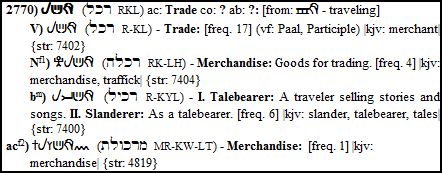
Exo 23:1 Thou shalt not raise a false report: put not thine hand with the wicked to be an unrighteous witness.
Psa 50:20 Thou sittest and speakest against thy brother; thou slanderest thine own mother’s son.
Psa 50:21 These things hast thou done, and I kept silence; thou thoughtest that I was altogether such an one as thyself: but I will reprove thee, and set them in order before thine eyes.
Psa 50:22 Now consider this, ye that forget God, lest I tear you in pieces, and there be none to deliver.
Psa 101:5 Whoso privily slandereth his neighbour, him will I cut off: him that hath an high look and a proud heart will not I suffer.
Pro 11:9 An hypocrite with his mouth destroyeth his neighbour: but through knowledge shall the just be delivered.
Pro 11:12 One despising his friend lacks heart, but an understanding man remains silent.
Pro 12:6 The words of the wicked lie in wait for blood, but the mouth of the upright shall deliver them.
Tit 3:2 To speak evil of no man, to be no brawlers, but gentle, shewing all meekness unto all men.
Jas 4:11 Speak not evil one of another, brethren. He that speaketh evil of his brother, and judgeth his brother, speaketh evil of the law, and judgeth the law: but if thou judge the law, thou art not a doer of the law, but a judge.
Psa 15:1 A Psalm of David. O Jehovah, who shall dwell in Your tabernacle? Who shall live in Your holy mountain?
Psa 15:2 He who walks uprightly and works righteousness, and speaks the truth in his heart.
Psa 15:3 He does not backbite with his tongue, nor does evil to his friend, nor lifts up a reproach against his neighbor.
Monkeying Around
The verb “monkey” first appeared around 1859 in the sense of “to mock or mimic” as a monkey does. They were used in entertainment to mimic man in a mocking way. By the late 1800s it meant to “play foolish tricks.” The word ‘trick’ comes from the Old North French word ‘trique’ which means deceit, treachery or to cheat. By the 1500s ‘trick’ expanded to mean something clever or a feat or skill meant to amuse or surprise. This imagery points to Satan who mimics (counterfeits) God and deceives mankind into sin (Genesis 3:13) through beguilement of the mind. Recall that entertainment is associated with holding the mind’s attention, to amuse. Amuse gives the sense of beguiling.
Gen 3:13 And the LORD God said unto the woman, What is this that thou hast done? And the woman said, The serpent beguiled (נשא ‘nasha’) me, and I did eat.
H5377
נָשָׁא
nâshâ’
naw-shaw’
A primitive root; to lead astray, that is, (mentally) to delude, or (morally) to seduce: – beguile, deceive, X greatly, X utterly.
Going back further, ‘trique’ (trick), traces back to the Latin word ‘tricae,’ which means “trifles, nonsense, tangles, impediments, subterfuges, wiles.” In Norse mythology, Loki was the trickster and the “tangler.” More on Loki below.
Chimpanzee

The chimpanzee gets its name from the Bantu language which is said to mean “mock-man.” The scientific name of the chimpanzee is Pan troglodyte. Pan comes from the Greek god Pan and troglodyte means “cave dweller.” In Latin, the name for the chimpanzee is ‘Simia Paniscus’ which mean “Little Pan ape.” The Pan-ape connection will be seen in more detail throughout this study.
Baboons

The word ‘baboon’ comes from the Middle English ‘babewyn/baboin’ which previously had the meaning of a grotesque architectural figure or gargoyle-like decoration. The use of gargoyles on buildings, particularly churches, traces back to the Rouen legend. According to the story, a dragon/serpent called La Gargouille haunted the marshes, devouring people and cattle. St. Romanus of Rouen subdued it with the sign of the cross, led it into the city, and had it burned but the head and neck would not burn. The head and neck was then mounted on a wall to ward off evil. They were placed on churches, to drain water but symbolically to represent the wicked who are outside of the Kingdom of God as the inside of the church is to represent the Kingdom.
“However, gargoyles also serve a theological purpose: they show that evil is cast out and away from a consecrated place — like a church or cathedral or a basilica — and they are never represented inside a church (save in statuary or stained glass windows where Satan is trod underfoot by the likes of St. Michael or St. George). This ‘outside and away’ motif is a type of physical representation of an exorcism: devils may never enter the House of God and must always be thrust far away.” (Kevin Di Camillo – Gargoyles, Buttresses and the Art of Building Heavenward)
Going back to the Middle English word ‘babewyn/baboin’ (baboon) is its derivation, the Old French ‘babouin’ which meant ape but earlier meant a simpleton or a fool. The word ‘Babouin’ traces back to the root ‘baboue’ which meant grimace, or a muzzle. It gave the sense of a “badly raised child” then later a “gaping figure” which is where the grotesque gargoyle connection derives. Later it was used for the baboon which has a large muzzle.
The word traces back further to the “bab” sound. A baby’s “ba-ba” sound imitates the speech of its parents. Its the source of the word ‘babble’ which means to talk without sense. In essence, ‘baboue’ is the face made when the lips make the sound “bab.”
All this etymology is given to bring forth the connection to the Tower of Babel. The tower was named Babel as it was a play on words with the confounding of the languages.
Gen 11:9 Therefore is the name of it called Babel (בבל ‘babel’); because the LORD did there confound (בלל ‘balal’) the language of all the earth: and from thence did the LORD scatter them abroad upon the face of all the earth.
H1101
בּלל
bâlal
BDB Definition:
- to mix, mingle, confuse, confound
1a) (Qal)
1a1) to mingle, confuse
1a2) to mix
1a3) to give provender, feed (animals)
1b) (Hithpoel) to mix oneself (among others)
1c) (Hiphil) to fade away
Babel is the epitome of the tree of knowledge. It is a mixture. Notice בלל ‘balal’ has the meaning of mix or confuse.

This is what the the mark of the beast is. Α counterfeit (Isaiah 14:14), a mixture of good and evil. The Mark of God is His Word, His Image. The mark of the beast is his ‘word’, his image. The Tree of Life vs. the tree of knowledge of good and evil. It is the mark of a beast and a number of a man. Man/beast (Genesis 3:1). Part man, part beast (angel/god Psalm 8:5 & Genesis 3:1). A mixture.
This is the definition of Babel of which we are admonished to come out of (Revelation 18:4). Babel means mixture in Hebrew. To the Sumerians Babel meant Gate of God or Gate to God. This points to a false ladder to heaven, a counterfeit of what was seen by Jacob and referenced by Christ Jesus. This is where Jacob anointed the pillar. The word Messiah, or anointed one, further explains this concept. The Hebrew word for Messiah is משיח ‘moshiach’ from משח ‘mashach’ which is referring to oil being smeared onto the heads of individuals who are selected as authority figures. The word Babel comes from the root בל ‘bal’ which is also the root for בלל which means to mix, mingle, to anoint.
The third word translated from Hebrew into the English word anoint is יסך ‘yasak’ which comes from the root צק which means an image, as in molten metal poured into a mold to form a cast object. Here, in the word anoint, is seen the message of this parable. There are two anointed ones/messiahs/christs that man can choose from, just as there were two trees in the Garden to choose from. Which Messiah one chooses determines what image that person will be formed into. Which image one is formed into determines eternity. We can be formed into the image of Christ Jesus unto eternal life, or formed into the image of the beast unto eternal damnation.
Interestingly, in Jewish legends the builders of the Tower of Babel were transformed into monkeys as punishment for their rebellion (Sanhedrin 109a).
“Rabbi Yirmeya bar Elazar says: They divided into three factions; one said: Let us ascend to the top of the tower and dwell there. And one said: Let us ascend to the top of the tower and engage in idol worship. And one said: Let us ascend to the top of the tower and wage war. With regard to that faction that said: Let us ascend to the top of the tower and dwell there, God dispersed them. And that faction that said: Let us ascend to the top of the tower and wage war, became apes, and spirits, and demons, and female demons. And with regard to that faction that said: Let us ascend to the top of the tower and engage in idol worship, it is written: “Because there the Lord confounded the language of all the earth” (Genesis 11:9).
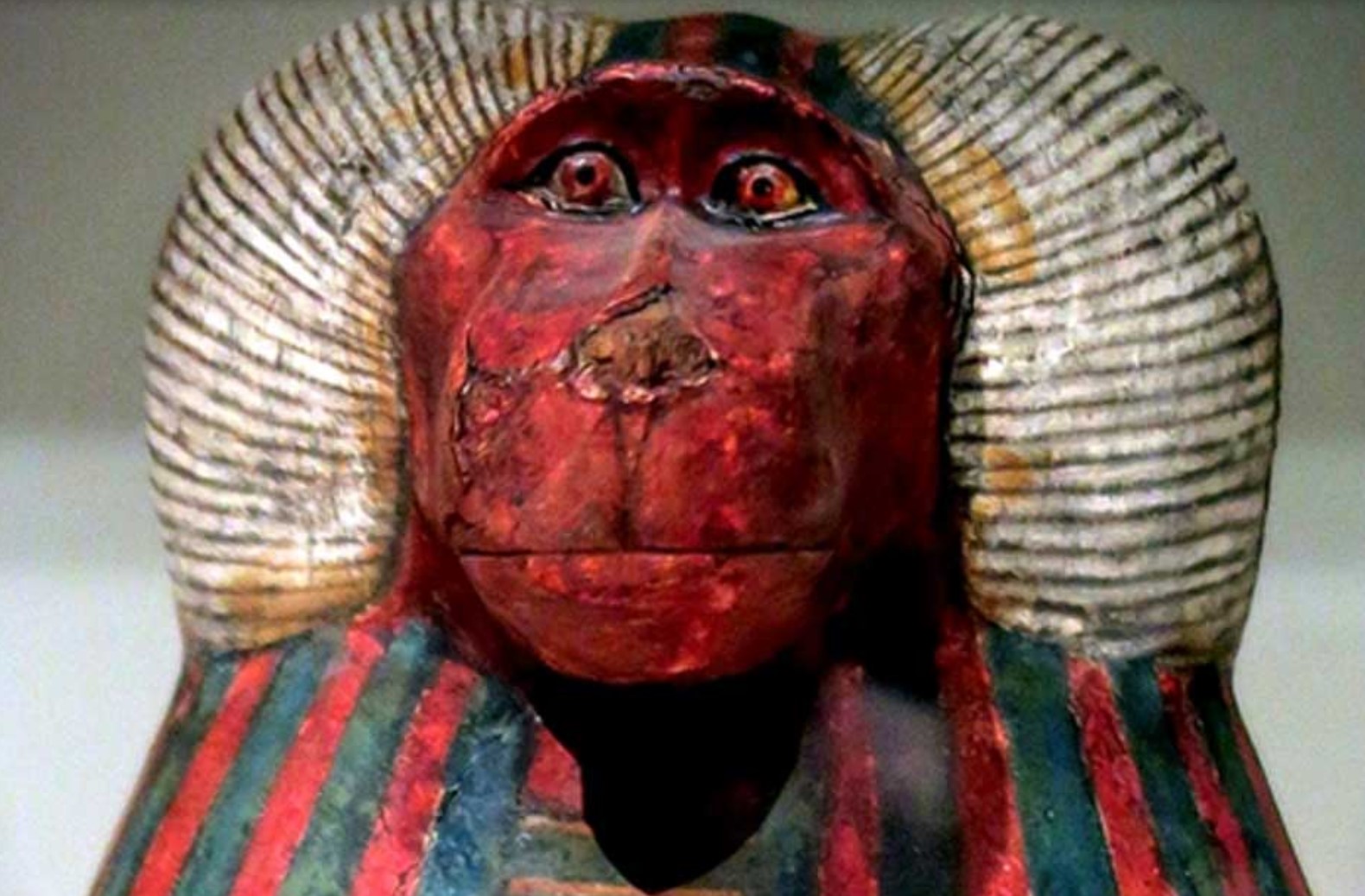
Going further to tie in these concepts of the baboon, Babel and gates is the Egyptian god Babi. In Egypt, the baboon god was named Babi. Babi represented the alpha baboon displaying dominance, aggression, appetite and sex. In the Egyptian mysteries, after one’s heart was weighed against Maat and found wicked, Babi stands by a lake of fire and eats the unjust dead (in particular their entrails). Babi was also depicted with a bolt to “sky’s door.” The “door-bolt” of the sky was the phallus of Babi. In order to get to heaven one must have that bolt to open the gate.
Babbling, Prattling
Going further with the concept of babbling or “prattling” is Hebrew word אוֹב ‘ov.’
Strongs H178
אוֹב
‘ôb
obe
From the same as H1 (apparently through the idea of prattling a father’s name); properly a mumble, that is, a water skin (from its hollow sound); hence a necromancer (ventriloquist, as from a jar): – bottle, familiar spirit.

The root of אוֹב ‘ov’ is אב ‘av’ which means father or the “strength of the house.”
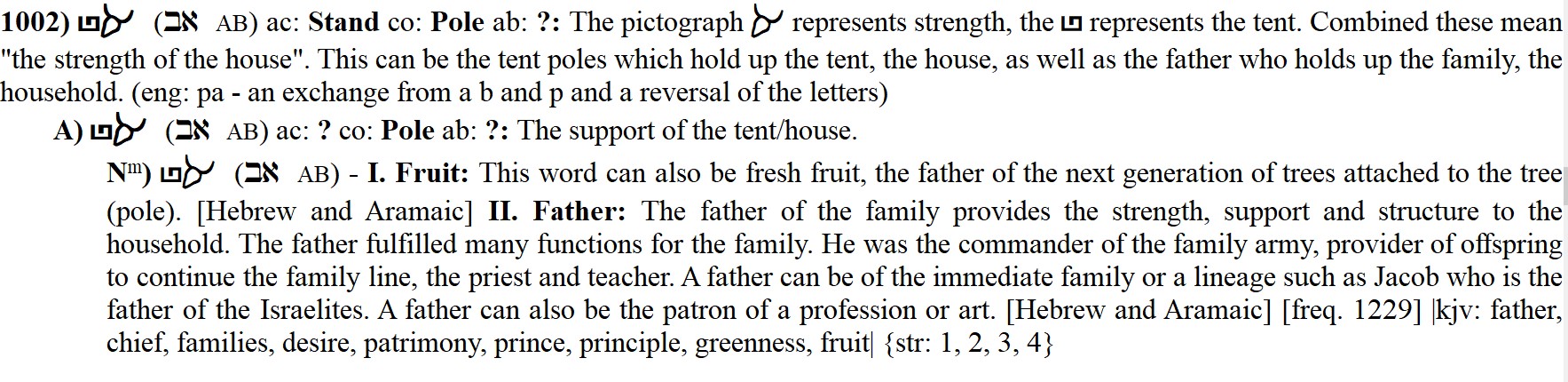
Brown-Driver-Briggs’ Hebrew Definitions connects the necromancer to the word אב ‘av’ (father) through the apparent “idea of prattling a father’s name.”
H178
אוב
‘ôb
BDB Definition:
- water skin bottle
- necromancer
1b) necromancer, one who evokes the dead
1c) ghost, spirit of a dead one
1d) practice of necromancy - one that has a familiar spirit
Part of Speech: noun masculine
A Related Word by BDB/Strong’s Number: from the same as H1 (apparently through the idea of prattling a father’s name)
Spirit & wineskins are linked in the Scriptures
Job 32:18 For I am full of words; the spirit inside me pressed on me;
Job 32:19 behold my belly is like wine that has no vent; it bursts like new wineskins.
Job 32:20 I will speak so that I may be relieved; I will open my lips and answer.
אב = Father. ו = a nail, which is used in Hebrew as a connector. Hence, אוב ‘ohv,’ means connection to a father. Which Father depends upon which spirit resides within you, or which wine is residing in your wineskin. This is why the word אוב ‘ohv’ can have a positive or negative meaning. A bottle or a familiar spirit/medium.
Picture of the Crucifixion
The literal, concrete meaning of אב ‘av’ (father) is a pole. As in the pole that holds up the tent/house. Adding the ו ‘vav’ to the pole is a picture of Messiah being nailed (ו ‘vav’ pictures a nail) to the pole.
Psa 119:83 For I am like a wineskin in the smoke; I do not forget Your Statutes.
Treasury of Scripture Knowledge
Psa 119:83
like a bottle in the smoke: As the bottles in the East are made of skin, it is evident that one of these hung up in the smoke must soon be parched, shrivelled up, lose all its strength, and become unsightly and useless. Thus the Psalmist appeared to himself to have become useless and despicable, through the exhausted state of his body and mind, by long bodily afflictions and mental distress. Psa_22:15, Psa_102:3-4; Job_30:30
Psalm 119:83 links to Psalm 22 which describes the crucifixion.
Psa 22:14 I am poured out like waters, and all My bones are spread apart; My heart is like wax; it is melted in the midst of My bowels.
Psa 22:15 My strength is dried up like a potsherd; and My tongue clings to My jaws;
In the Septuagint, the word ἐγγαστρίμυθος ‘engastrimythos’ is used to translate the Hebrew word אוֹב ‘ov.’ ἐγγαστρίμυθος ‘engastrimythos’ is a compound word of ἐν ‘en’ which means in, γαστήρ ‘gaster’ which means the belly, womb, inward parts and μῦθος ‘mythos’ which means speech or utterance.
One who speaks from the belly, a “belly diviner.” The English word ventriloquist matches this word. Ventriloquist comes from the Latin ‘venter’ meaning the belly, abdomen or womb and ‘loqui’ meaning to speak.
This “belly divination” is comparable to the oracle of Delphi. Delphi was called the ὀμφαλὸς γῆς ‘omphalos ges’ (the navel of the earth). In the Greek myths, Apollo killed a dragon/serpent named Python who guarded Delphi. The priestess of Apollo was said to speak the words of Apollo after breathing the vapors of the dead Python’s breath. According to Greek myth, Pan taught Apollo the secret of prophecy. More on Pan below.
This concept is seen in Isaiah 8:19 in which אוב ‘ohv’ is translated as εγγαστριμυθους ‘eggastrimythous’ in the Septuagint.
Isa 8:19 And when they shall say unto you, Seek unto them that have familiar spirits (אוב ‘ohv’), and unto wizards that peep, and that mutter: should not a people seek unto their God? for the living to the dead?
Septuagint
Isa 8:19 And if they should say to you, Seek those who have in them a divining spirit, and them that speak out of the earth, them that speak vain words (κενόδοξος ‘kenodoxos’), who speak out of their belly: shall not a nation diligently seek to their God? why do they seek to the dead concerning the living?
κενόδοξος ‘kenodoxos’ is translated in the New Testament as “vain glory.” Vain glory is akin to the Hebrew word כְּסִיל ‘kesiyl’ mentioned earlier in reference to the foolishness of the wicked. It is the opposite of the nature of Christ who humbled Himself, taking on the form of man, that we might become glorified with Him (Philippians 2:3-11; Romans 14:8-11; James 4:6-10).
Mat 23:12 And whosoever shall exalt himself shall be abased; and he that shall humble himself shall be exalted.
G2755
κενόδοξος
kenodoxos
Thayer Definition:
- glorying without reason, conceited, vain glorious, eager for empty glory
Gal 5:14 For all the law is fulfilled in one word, even in this; Thou shalt love thy neighbour as thyself.
Gal 5:15 But if ye bite and devour one another, take heed that ye be not consumed one of another.
Gal 5:16 This I say then, Walk in the Spirit, and ye shall not fulfil the lust of the flesh.
Gal 5:17 For the flesh lusteth against the Spirit, and the Spirit against the flesh: and these are contrary the one to the other: so that ye cannot do the things that ye would.
Gal 5:18 But if ye be led of the Spirit, ye are not under the law.
Gal 5:19 Now the works of the flesh are manifest, which are these; Adultery, fornication, uncleanness, lasciviousness,
Gal 5:20 Idolatry, witchcraft, hatred, variance, emulations, wrath, strife, seditions, heresies,
Gal 5:21 Envyings, murders, drunkenness, revellings, and such like: of the which I tell you before, as I have also told you in time past, that they which do such things shall not inherit the kingdom of God.
Gal 5:22 But the fruit of the Spirit is love, joy, peace, longsuffering, gentleness, goodness, faith,
Gal 5:23 Meekness, temperance: against such there is no law.
Gal 5:24 And they that are Christ’s have crucified the flesh with the affections and lusts.
Gal 5:25 If we live in the Spirit, let us also walk in the Spirit.
Gal 5:26 Let us not be desirous of vain glory (κενοδοξία ‘kenodoxia’), provoking one another, envying one another.
Php 2:3 Let nothing be done through strife or vainglory (κενοδοξία ‘kenodoxia’); but in lowliness of mind let each esteem other better than themselves.
Php 2:4 Look not every man on his own things, but every man also on the things of others.
Php 2:5 Let this mind be in you, which was also in Christ Jesus:
Php 2:6 Who, being in the form of God, thought it not robbery to be equal with God:
Php 2:7 But made himself of no reputation, and took upon him the form of a servant, and was made in the likeness of men:
Php 2:8 And being found in fashion as a man, he humbled himself, and became obedient unto death, even the death of the cross.
Php 2:9 Wherefore God also hath highly exalted him, and given him a name which is above every name:
Php 2:10 That at the name of Jesus every knee should bow, of things in heaven, and things in earth, and things under the earth;
Php 2:11 And that every tongue should confess that Jesus Christ is Lord, to the glory of God the Father.
This Python spirit of divination was seen in the Book of Acts and was described as soothsaying.
Act 16:16 And it came to pass, as we went to prayer, a certain damsel possessed with a spirit of divination (Πύθων ‘Python’) met us, which brought her masters much gain by soothsaying (μαντεύομαι ‘manteuomai’):
Act 16:17 The same followed Paul and us, and cried, saying, These men are the servants of the most high God, which shew unto us the way of salvation.
Act 16:18 And this did she many days. But Paul, being grieved, turned and said to the spirit, I command thee in the name of Jesus Christ to come out of her. And he came out the same hour.
G4436
Πύθων
Puthōn
Thayer Definition:
- in Greek mythology the name of the Pythian serpent or dragon that dwelt in the region of Pytho at the foot of Parnassus in Phocis, and was said to have guarded the oracle at Delphi and been slain by Apollo
- a spirit of divination
This soothsaying of the Python spirit in the Greek is μαντεύομαι ‘manteuomai.’
G3132
μαντεύομαι
manteuomai
mant-yoo’-om-ahee
From a derivative of G3105 (meaning a prophet, as supposed to rave through inspiration); to divine, that is, utter spells (under pretence of foretelling): – by soothsaying.
μαντεύομαι ‘manteuomai’ is used in the Septuagint to translate the Hebrew word קָסַם ‘qasam.’
H7080
קָסַם
qâsam
kaw-sam’
A primitive root; properly to distribute, that is, determine by lot or magical scroll; by implication to divine: – divine (-r, -ation), prudent, soothsayer, use [divination].
The woman of Endor divined (קָסַם ‘qasam) through the use of an אוב ‘ov.’
1Sa 28:8 And Saul disguised himself, and put on other raiment, and he went, and two men with him, and they came to the woman by night: and he said, I pray thee, divine (קָסַם ‘qasam) unto me by the familiar spirit (אוב ‘ov), and bring me him up, whom I shall name unto thee.
Balaam was called a קָסַם ‘qasam’ (Joshua 13:22). Peter links the “beast man” to Balaam.
2Pe 2:10 But chiefly them that walk after the flesh in the lust of uncleanness, and despise government. Presumptuous are they, selfwilled, they are not afraid to speak evil of dignities.
2Pe 2:11 Whereas angels, which are greater in power and might, bring not railing accusation against them before the Lord.
2Pe 2:12 But these, as natural brute beasts, made to be taken and destroyed, speak evil of the things that they understand not; and shall utterly perish in their own corruption;
2Pe 2:13 And shall receive the reward of unrighteousness, as they that count it pleasure to riot in the day time. Spots they are and blemishes, sporting themselves with their own deceivings while they feast with you;
2Pe 2:14 Having eyes full of adultery, and that cannot cease from sin; beguiling unstable souls: an heart they have exercised with covetous practices; cursed children:
2Pe 2:15 Which have forsaken the right way, and are gone astray, following the way of Balaam the son of Bosor, who loved the wages of unrighteousness;
2Pe 2:16 But was rebuked for his iniquity: the dumb ass speaking with man’s voice forbad the madness (παραφρονία ‘paraphronia’) of the prophet.
G3913
παραφρονία
paraphronia
par-af-ron-ee’-ah
From G3912; insanity, that is, foolhardiness: – madness.
G3912
παραφρονέω
paraphroneō
par-af-ron-eh’-o
From G3844 and G5426; to misthink, that is, be insane (silly): – as a fool.
παραφρονέω ‘paraphroneo’ comes from παρά ‘para’ which means beside, amiss, off to the side and φρονέω ‘phroneo’ which means to exercise the mind, to entertain a thought, to interest oneself in something, to savour.
Rom 8:5 For they that are after the flesh do mind (φρονέω ‘phroneo’) the things of the flesh; but they that are after the Spirit the things of the Spirit.
φρονέω ‘phroneo’ comes from the root φρήν ‘phren’ which means the midriff, the heart.
μαντεύομαι ‘manteuomai’ (soothsayer) comes from the root μαίνομαι ‘mainomai’ which is where the word maniac comes from. A maniac is one who is gone mad. The word mad has both the sense of craziness/foolishness or mania and anger. The etymology of mad traces back to the Germanic ‘ga-maidaz’ which means a change for the worse, something abnormal and the verb ‘gamaijan’ which means to injure, cripple, to make foolish. This passed down in Old English as ‘ġemǣdan’ which means to make insane or foolish and then in the Middle English mad took on the sense of “beside oneself with passion, enraged.”
In the book of Hosea, this mad concept of rage/hate and mania/craziness is seen. Hosea depicts spiritual madness due to hatred.
Septuagint
Hos 9:7 The days of vengeance are come, the days of thy recompense are come; and Israel shall be afflicted as the prophet that is mad, as a man deranged: by reason of the multitude of thine iniquities thy madness (μανία ‘mania’) has abounded.
μανία ‘mania’ comes from the same Greek root (μαίνομαι ‘mainomai’) as μαντεύομαι ‘manteuomai’ (soothsayer).
G3130
μανία
mania
man-ee’-ah
From G3105; craziness: – [+ make] X mad.
G3105
μαίνομαι
mainomai
μανία ‘mania’ is used to translate the word מַשְׂטֵמָה ‘mastemah’ which means hatred.
Hos 9:7 The days of visitation are come, the days of recompence are come; Israel shall know it: the prophet is a fool, the spiritual man is mad, for the multitude of thine iniquity, and the great hatred (מַשְׂטֵמָה ‘mastemah’).
Hos 9:8 The watchman of Ephraim was with my God: but the prophet is a snare of a fowler in all his ways, and hatred (מַשְׂטֵמָה ‘mastemah’) in the house of his God.
This hatred and spiritual madness is seen in the crucifixion of Christ.
Joh 15:23 He that hateth me hateth my Father also.
Joh 15:24 If I had not done among them the works which none other man did, they had not had sin: but now have they both seen and hated both me and my Father.
Joh 15:25 But this cometh to pass, that the word might be fulfilled that is written in their law, They hated me without a cause.
H4895
מַשְׂטֵמָה
maśṭêmâh
mas-tay-maw’
From the same as H7850; enmity: – hatred
מַשְׂטֵמָה ‘mastemah’ comes from the root שֹׁטֵט ‘shotet.’
H7850
שֹׁטֵט
shôṭêṭ
sho-tate’
Active participle of an otherwise unused root meaning (properly to pierce; but only as a denominative from H7752) to flog; a goad: – scourge.
During the time of the Second Temple, מַשְׂטֵמָה ‘mastema,’ became a moniker for Satan. In the Book of Jubilees this is seen.
For example, in Jubilees 10, Mastema is described as the “chief of the spirits” of the rebellious Watchers of Genesis 6. In chapter 11, Mastema sends the birds that eat the seed that Jesus mentions (Mark 4:4,15). In Jubilees 48, Mastema helps the Egyptian sorcerers perform their magic. These are but a few examples.
The book of Jubilees links Mastema the accuser to Belial/Beliar and Satan.
Jubilees 1:9-10
Let Thy mercy, O Lord, be lifted up upon Thy people, and create in them an upright spirit, 9 and let not the spirit of Beliar 10 rule over them to accuse them before Thee, and to ensnare them from all the paths of righteousness, so that they may perish from before Thy face.
Jubilees 10:7-11
7. And the Lord our God bade us to bind all. 8. And the chief of the spirits, Mastêmâ, came and said: “Lord, Creator, let some of them remain before me, and let them hearken to my voice, and do all that I shall say unto them; for if some of them are not left to me, I shall not be able to execute the power of my will on the sons of men; for these are for corruption and leading astray before my judgment, for great is the wickedness of the sons of men.” 9. And He said: “Let the tenth part of them remain before him, and let nine parts descend into the place of condemnation.” 10. And one of us He commanded that we should teach Noah all their medicines; for He knew that they would not walk in uprightness, nor strive in righteousness. 11. And we did according to all His words: all the malignant evil ones we bound in the place of condemnation, and a tenth part of them we left that they might be subject before Satan on the earth.
The Hebrew word הלל ‘halal’ is also used for madness in Jeremiah 25:16.
Jer 25:16 And they shall drink, and be moved, and be mad (הלל ‘halal’), because of the sword that I will send among them.
הלל ‘halal’ comes from the root הל which means to “look toward something.” הלל ‘halal’ means to shine or praise when looking toward God. When one looks towards anything else it is madness and folly.
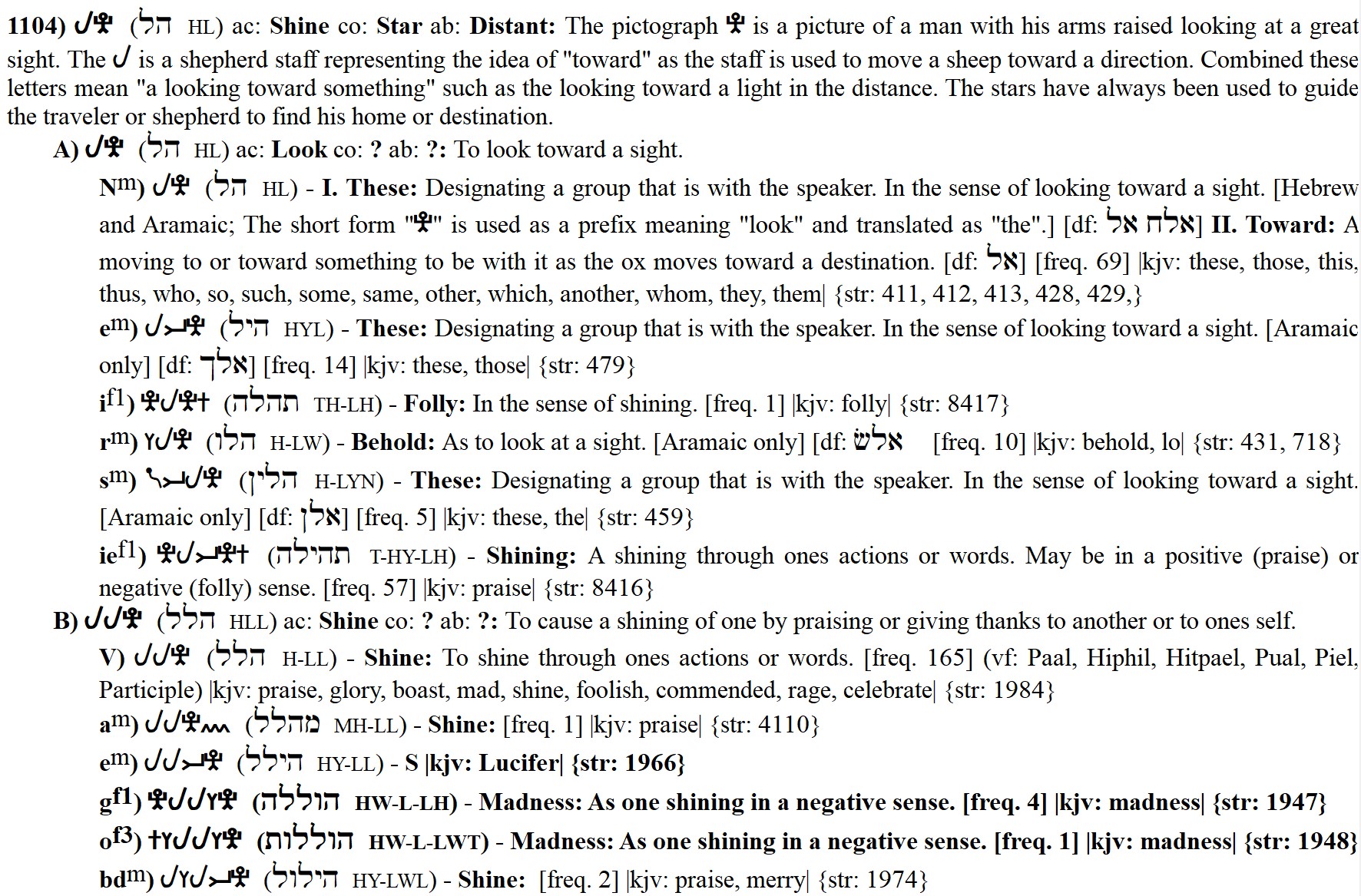
Isa 14:12 How art thou fallen from heaven, O Lucifer (הילל ‘heylel’), son of the morning! how art thou cut down to the ground, which didst weaken the nations!
Isa 14:13 For thou hast said in thine heart, I will ascend into heaven, I will exalt my throne above the stars of God: I will sit also upon the mount of the congregation, in the sides of the north:
Isa 14:14 I will ascend above the heights of the clouds; I will be like the most High.
In the Greek, הילל ‘heylel,’ is translated as ἑωσφόρος ‘heosphoros.’
Isa 14:12 πῶς ἐξέπεσεν ἐκ τοῦ οὐρανοῦ ὁ ἑωσφόρος ὁ πρωὶ ἀνατέλλων; συνετρίβη εἰς τὴν γῆν ὁ ἀποστέλλων πρὸς πάντα τὰ ἔθνη.
ἑωσφόρος ‘heosphoros’ means the “dawn bringer” pointing to the star Venus. In the Greek processions (parades to honor gods/goddesses) the ἑωσφόρος ‘heosphoros’ walked at the front of the procession as the parade would begin when Venus first appeared. The parade would end when Venus appeared in the evening.
Cynocephali
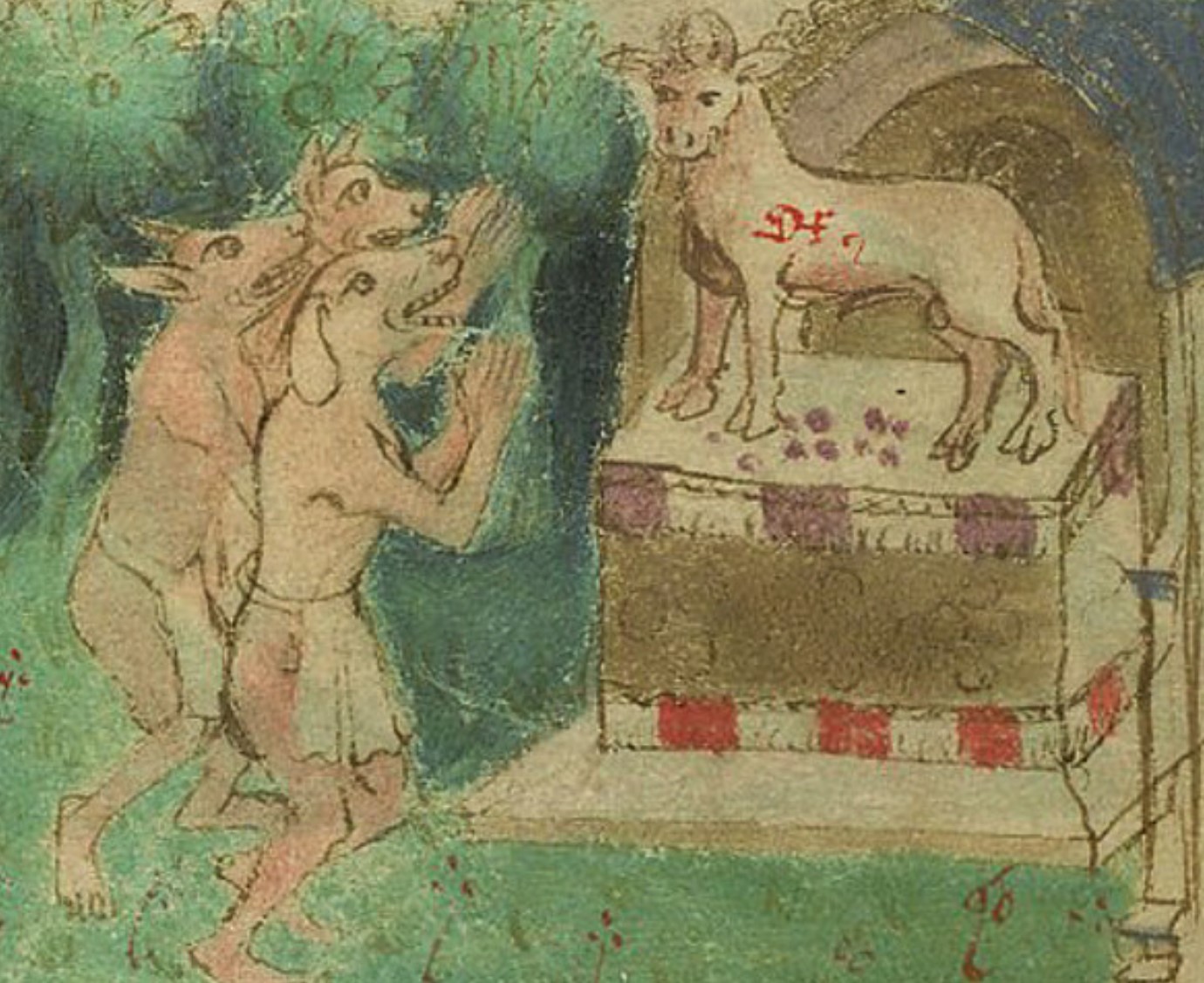
The Greek word for baboon is κυνοκέφαλος ‘kynokephalos’ which means “dog headed.” κύων ‘kyon’ is dog and κεφαλή ‘kephale’ means head. The Latin word for baboon, cynocephalus, comes from the Greek. κυνοκέφαλος ‘kynokephalos’ referred to both the baboon and the “mythological” dog headed peoples of ancient times.
In ancient and medieval times, Cynocephali, were mentioned as one of the “monstrous races” that inhabited the edges of the known world.
Herodotus mentioned dog-headed people as well as Pliny the Elder. They were said to live like animals but possessed human traits. St. Augustine spoke of them and said that if they exist they must be rational beings descended from Adam and capable of salvation. St. Christopher is the most well known example of this.
“What shall I say of the Cynocephali, whose dog-like head and barking proclaim them beasts rather than men? But we are not bound to believe all we hear of these monstrosities. But whoever is anywhere born a man, that is, a rational, mortal animal, no matter what unusual appearance he presents in color, movement, sound, nor how peculiar he is in some power, part, or quality of his nature, no Christian can doubt that he springs from that one protoplast.” (St. Augustine – City of God, Book XVI, Chapter 8)
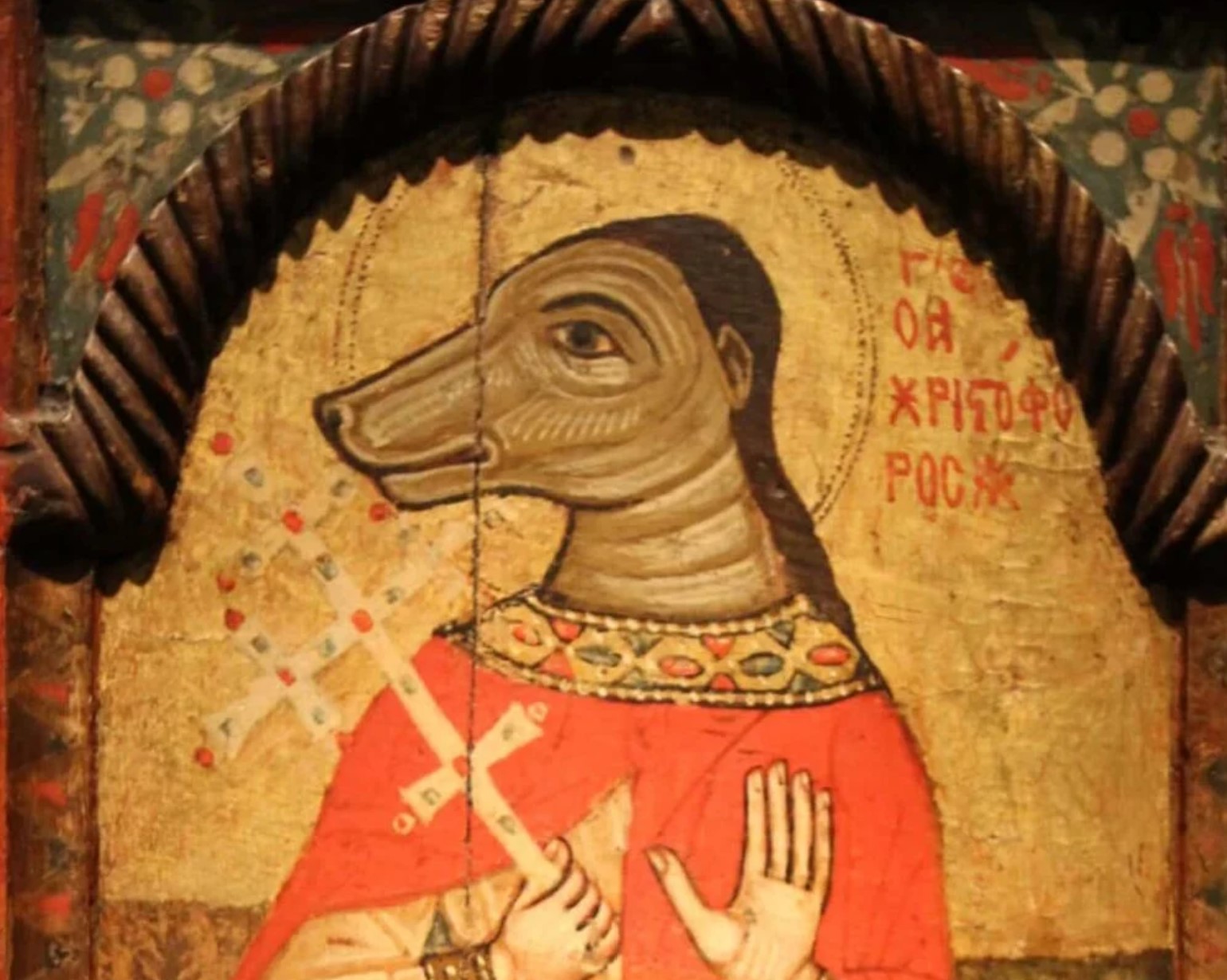
St. Christopher was called a cynocephali (dog-head) who converted to Christ. In the Golden Legend, he was a dog-headed Canaanite giant named Reprobus which means a reprobate. After conversion he becomes Christopher (Christ bearer) displaying the transformation from a beast to a man redeemed.
“Once upon a time, a thief and robber—and a giant—known as Christopher (or Reprobus as he was originally named) was a fierce man who dedicated his life to seeking out the most powerful prince to serve. At first, he believed this was the devil—a being feared by men—but, he eventually came to believe that Christ was the greatest of all princes. After being instructed in the Christian Faith by a hermit, he was baptized and given the name Christophorus.
The hermit who had instructed Christopher gave him the task of carrying travelers across a local river—a job easily done because of his great size and strength. One day, he began to help a child to cross the river, carrying the boy on his shoulders, when he began to feel a weight so great that he was bowed down by it. Once they reached the other side, the child said to Christopher: “Don’t be surprised, Christopher! You were not only carrying the whole world, you had him who created the world upon your shoulders! I am Christ your King, to whom you render service by doing the work you do here.”
According to the legend, Christopher went on to bring many to Christ. He was eventually martyred during the reign of the Emperor Decius, sometime between 249 and 251.” {What we know about St. Christopher is everything we need to know: Here’s his story}
Canaanite connection
St. Christopher was called κυνοκέφαλος ‘kynokephalos’ (“dog-headed”) in the Greek which got translated into ‘canineus’ (“dog-like”) in the Latin. Later, ‘canineus’ was copied into texts as ‘Cananeus’ which means Canaanite. Interestingly, Scripture links Canaanites with dogs.
In Matthew 15:21-28 Jesus speaks to a Canaanite woman about not throwing the children’s bread to the little dogs. She answers that even the dogs eat the crumbs. He praises her faith and heals her daughter. Its a beautiful example of the carnal man putting faith in Christ even though the world (religion) would say they are not worthy. The Canaanite nations were cursed (Genesis 9:25) and the enemies of God’s covenant people. Yet, through faith, they become healed.
Mat 15:21 Then Jesus went thence, and departed into the coasts of Tyre and Sidon.
Mat 15:22 And, behold, a woman of Canaan came out of the same coasts, and cried unto him, saying, Have mercy on me, O Lord, thou Son of David; my daughter is grievously vexed with a devil.
Mat 15:23 But he answered her not a word. And his disciples came and besought him, saying, Send her away; for she crieth after us.
Mat 15:24 But he answered and said, I am not sent but unto the lost sheep of the house of Israel.
Mat 15:25 Then came she and worshipped him, saying, Lord, help me.
Mat 15:26 But he answered and said, It is not meet to take the children’s bread, and to cast it to dogs.
Mat 15:27 And she said, Truth, Lord: yet the dogs eat of the crumbs which fall from their masters’ table.
Mat 15:28 Then Jesus answered and said unto her, O woman, great is thy faith: be it unto thee even as thou wilt. And her daughter was made whole from that very hour.
Believers turning back into beasts/dogs
In the book of Susanna a story of wicked elders of Judah who tried to seduce and then bore false witness against her is seen. The prophet Daniel exposed their evil and declared them to be the seed of Canaan.
Dan 13:56 So he put him aside, and commanded to bring the other, and said unto him, O thou seed of Chanaan, and not of Juda, beauty hath deceived thee, and lust hath perverted thine heart.
The people who worship God can become like beasts/dogs (Psalm 73:22; 32:9; Hosea 4:16).
Isa 56:10 His watchmen are blind: they are all ignorant, they are all dumb dogs, they cannot bark; sleeping, lying down, loving to slumber.
Isa 56:11 Yea, they are greedy dogs which can never have enough, and they are shepherds that cannot understand: they all look to their own way, every one for his gain, from his quarter.
Jews who rejected Christ and believers who Judaized were likened to dogs
Php 3:2 Beware of dogs, beware of evil workers, beware of the concision.
Php 3:3 For we are the circumcision, which worship God in the spirit, and rejoice in Christ Jesus, and have no confidence in the flesh.
Jews who accepted Christ but turned back to evil were likened to dogs
2Pe 2:20 For if after they have escaped the pollutions of the world through the knowledge of the Lord and Saviour Jesus Christ, they are again entangled therein, and overcome, the latter end is worse with them than the beginning.
2Pe 2:21 For it had been better for them not to have known the way of righteousness, than, after they have known it, to turn from the holy commandment delivered unto them.
2Pe 2:22 But it is happened unto them according to the true proverb, The dog is turned to his own vomit again; and the sow that was washed to her wallowing in the mire.
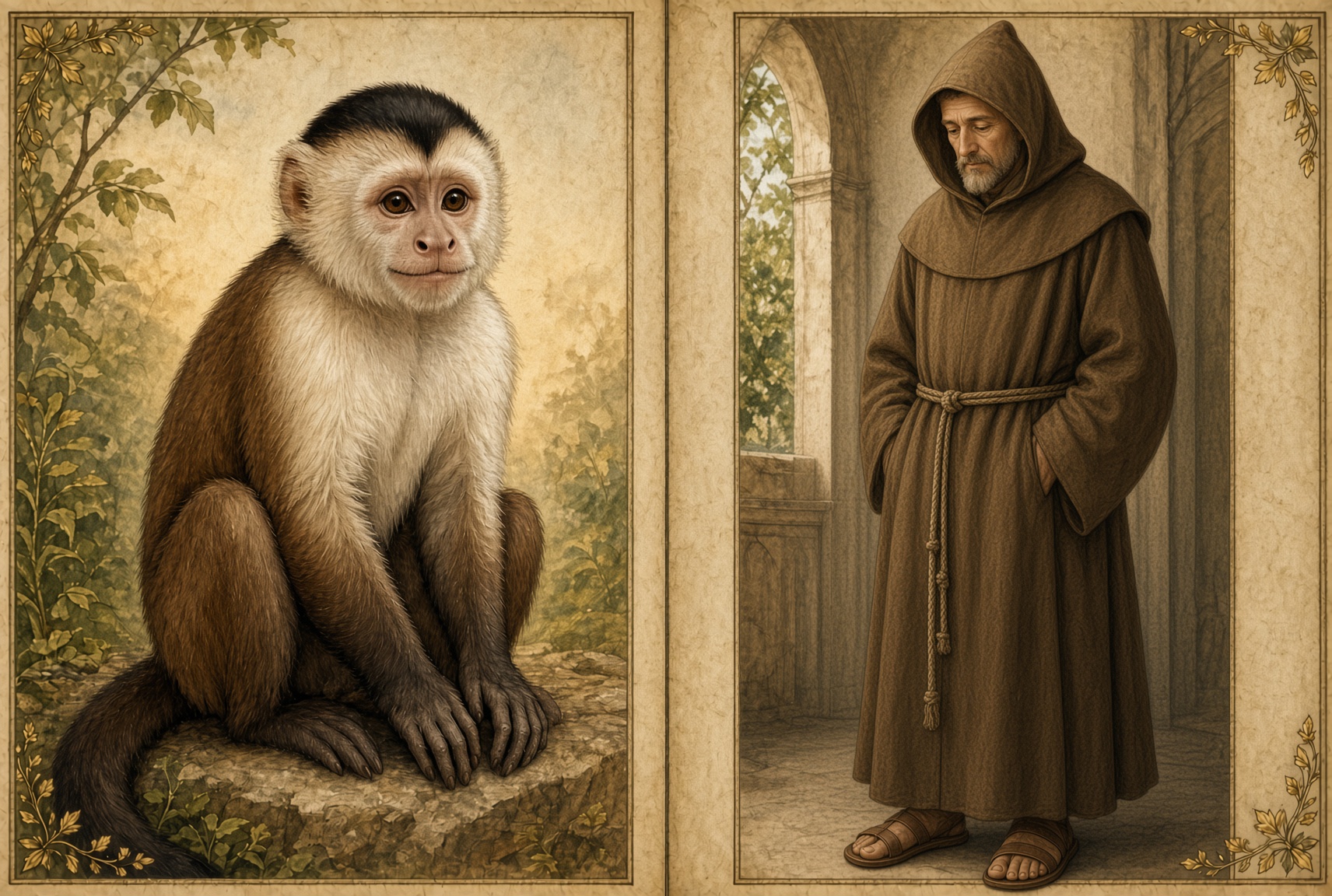
Interestingly, the word monkey is connected with corrupt friars who were mocked in medieval times due to their wickedness. Some etymologists see the word monkey as an English diminutive of monk as certain monkeys like the capuchin resemble monks/friars. Capuchin monkeys were so named because of their dark “hoods” and lighter faces which resembled the brown habit and pointed cowls of friars.
Isidore of Seville derived simius (ape) from similitudo (likeness). The ape was named for its likeness to mankind. Satan was called ‘Simia Dei’ (the ape of God) as he counterfeits God’s likeness. A wicked priest or monk would be a servant of the Ape of God.
2Co 11:13 For such are false apostles, deceitful workers, transforming themselves into the apostles of Christ.
2Co 11:14 And no marvel; for Satan himself is transformed into an angel of light.
2Co 11:15 Therefore it is no great thing if his ministers also be transformed as the ministers of righteousness; whose end shall be according to their works.
This concept is further seen in the grotesque priests on the walls of cathedrals associating them with gargoyles mentioned earlier.
Simia

The main Latin word for ape or monkey is simia. It derives from ‘simus’ which means “snub nosed.” The Latin borrowed from the Greek word σῑμός ‘simos’ which also mean snub nosed.
In Hebrew, one with a flat nose is חרם ‘charam.’ A person with a flat nose could not become offer sacrifcies as a priest.
Lev 21:18 For whatsoever man he be that hath a blemish, he shall not approach: a blind man, or a lame, or he that hath a flat nose (חרם ‘charam’ ), or any thing superfluous,
Adam Clarke in his commentary on Leviticus 21:18 specifically compares the flat nose (חרם ‘charam’ ) to that of an ape.
Adam Clarke’s Commentary
Leviticus 21:18
“A blind man – That is, in one eye; for he that was utterly blind could not possibly be employed in such a service. A flat nose, like that of an ape; so the best versions. Any thing superfluous, such as six fingers, six toes, etc.”
חרם ‘charam’ has numerous meanings of things dedicated or consecrated or cursed and destroyed. The picture is of a net (Habakkuk 1:15) used to separate unto holiness or destruction. The net is an instrument that catches, confines, and separates. This separation unto holiness or destruction is the meaning of חרם ‘charam’
Mic 4:13 Arise and thresh, O daughter of Zion: for I will make thine horn iron, and I will make thy hoofs brass: and thou shalt beat in pieces many people: and I will consecrate (חרם ‘charam’ ) their gain unto the LORD, and their substance unto the Lord of the whole earth.
Lev 27:28 Notwithstanding no devoted thing, that a man shall devote unto the LORD of all that he hath, both of man and beast, and of the field of his possession, shall be sold or redeemed: every devoted (חרם ‘charam’ ) thing is most holy unto the LORD.
Christ used this imagery in speaking of good and bad people and the judgment of the end.
Mat 13:47 Again, the kingdom of heaven is like unto a net, that was cast into the sea, and gathered of every kind:
Mat 13:48 Which, when it was full, they drew to shore, and sat down, and gathered the good into vessels, but cast the bad away.
Mat 13:49 So shall it be at the end of the world: the angels shall come forth, and sever the wicked from among the just,
Mat 13:50 And shall cast them into the furnace of fire: there shall be wailing and gnashing of teeth.
The Hebrew חרם ‘charam’ is rendered in the Septuagint as κολοβόρριν ‘kolobórrin’ from the word κολοβός ‘kolobos’ which means docked, mutilated, truncated or cut short and ῥίς ‘ris’/ ῥῖν ‘rin’ which means nose.
Septuagint
Lev 21:18 No man who has a blemish on him shall draw nigh; a man blind, lame, with his nose disfigured, or his ears cut,
πᾶς ἄνθρωπος ᾧ ἂν ᾖ ἐν αὐτῷ μῶμος οὐ προσελεύσεται· ἄνθρωπος χωλὸς ἢ τυφλὸς ἢ κολοβόρριν ἢ ὠτότμητος
κολοβόρριν ‘kolobórrin’ is related to the Greek word κολλυβιστής ‘kollybistes’ which means a moneychanger. Corrupt moneychangers who would clip off the edges of a coin with shears and keep the scraps to melt down and use later. Gold and silver coins were worth their weight so the coins they clipped and exchanged were worth less. The coin still bore the image inscribed but it was corrupted.
G2855
κολλυβιστής
kollubistēs
kol-loo-bis-tace’
From a presumed derivative of κόλλυβος kollubos (a small coin; probably akin to G2854); a coin dealer: – (money-) changer.
The Greek word in John 2:14 for money changer is κερματιστής ‘kermatistēs’ which comes from κερμα ‘kerma’ which means small pieces of money or coins. κέρμα ‘kerma’ comes from the word κείρω ‘keirō ‘ which has the meaning of shearing sheep. This word would trace back to the Hebrew word גּזע ‘geza.’
גּזע ‘geza’ from the root גז ‘gez’ is the Hebrew word for race. Biblically, race is not defined by color or bloodlines. Race is defined by what nature you are. You are either in Christ or you are not (Romans 8:9). It matters not what color your skin is, or what economic status you have. You are either for Him or against Him (Luke 11:23). You are either the seed of the woman or the seed of the serpent. You either worship God or mammon. The word for color in Hebrew, צבע ‘tseva,’ has the same meaning as being baptized and becoming anew. You are either sprinkled by the blood of Christ (Isaiah 52:15; Hebrew 10:22) or you are still covered in the garments of sinful flesh. Interestingly, one of the words for money in Hebrew (Exodus 21:30; 30:16) is כפר ‘kopher’ which has the meaning of atonement/covering.
It was for the zeal of His house that Messiah cast out the corrupt moneychangers of His day. What is His house? His body (Hebrews 3:6). Those who are of the ‘race/גּזע ‘geza‛’ of Messiah are those who abide in Him, the Olive tree.
1Pe 2:9 But you are “an elect race,” “a royal priesthood,” “a holy nation,” “a people for possession,” so that “you may openly speak of the virtues” of the One who has called you out of darkness into His marvelous light; LXX-Ex. 23:22; MT-Ex. 19:5, 6
Those who are of ‘race’ of the beast abide in evil, the tree of knowledge of good and evil. The “beast man” bears the image of God but is corrupted through sin.
In Hebrew the word for race is גזע ‘geza,’ which means the stock/root of a tree. Who is the root of Israel? Christ Jesus
Rom 11:16 For if the firstfruit (1Cor 15:52 -Messiah) be holy, the lump is also holy: and if the root (Isa 6:13; Gal 3:16 – Messiah) be holy, so are the branches (Joh 15:5).
Isa 11:1 And there shall come forth a rod out of the stem (H1503 גּזע geza‛) of Jesse, and a Branch {H5342 נצר netser*} shall grow (parah -bear fruit) out of his roots:
The other root spoken of in Scripture is the root of the serpent
Isa 14:29 Do not rejoice, O Philistia, all of you, for the rod of your striking is broken, because a viper comes forth from the root of a snake, and his fruit shall be a fiery flying serpent.
κολλυβιστης ‘kollubistēs’ comes from the root word κολλαω ‘kollaō’ which means glue or to join one’s self to. This word ‘κολλαω’ is used to translate the Hebrew word נצר ‘natsar’ in the Septuagint. נצר ‘natsar’ is the word from whence ‘Nazarene’ comes.
Again we see the two seeds, two tree, two tables…
נצר ‘netser’ (Nazarenes) is the original name of Christians.
Act 24:5 For we have found this man a pestilent fellow, and a mover of sedition among all the Jews throughout the world, and a ringleader of the sect of the Nazarenes:
Theory of Evolution and Racism
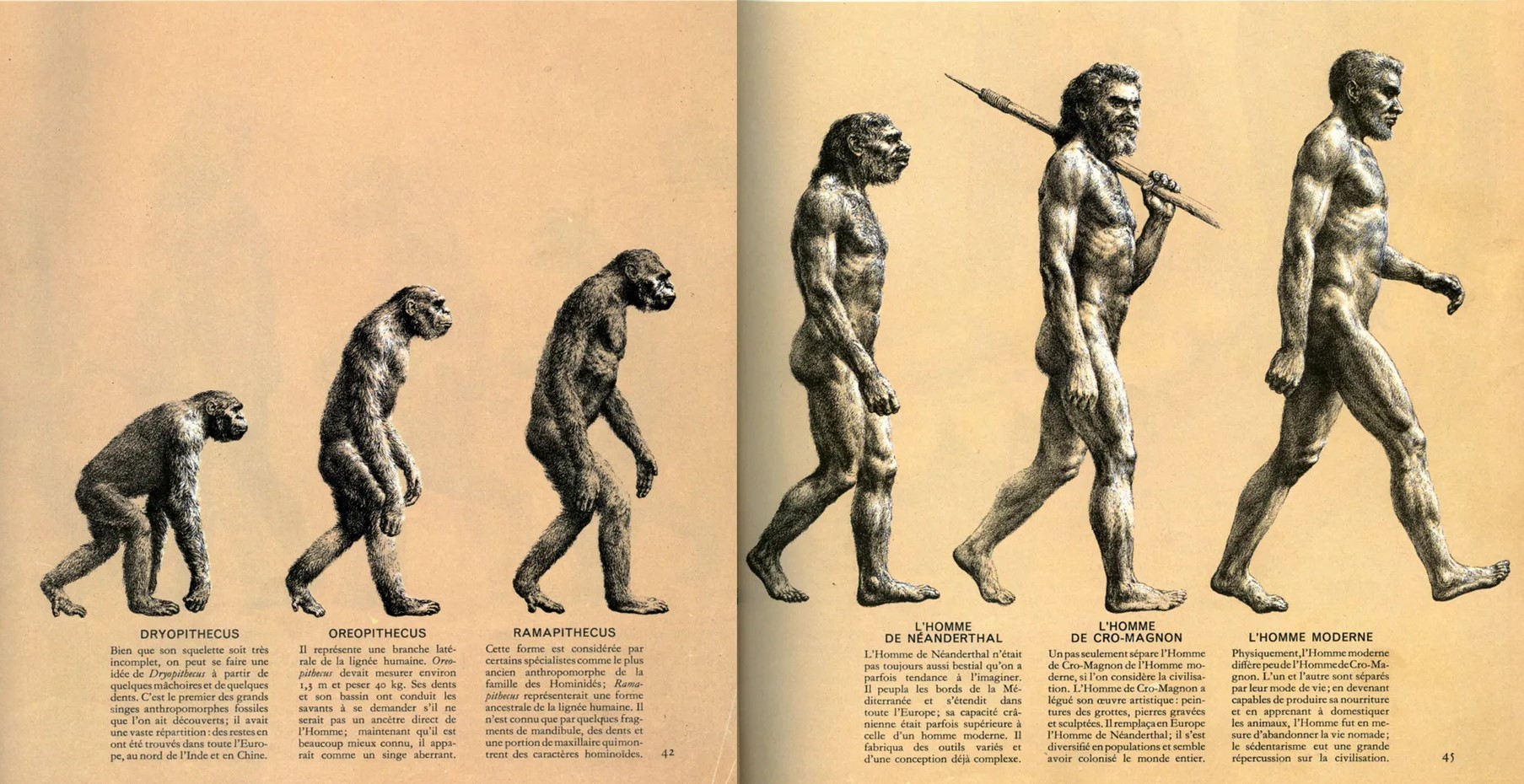
In the 19th and early 20th centuries, many scientists, writers, and public figures who accepted Darwinian evolution applied it in hierarchical, racist ways. They arranged human populations on an evolutionary “ladder,” with Northern Europeans at the top (most “evolved”) and darker-skinned peoples (Africans, Australian Aboriginals, etc.) nearer the bottom, closer to apes or “lower” forms.
Popular illustrations, museum displays, textbooks, and scientific writings of the era often showed progressive sequences that visually linked Black people or other non-European groups to apes or “missing links.”
Figures associated with this thinking included some of Darwin’s contemporaries and followers like Ernst Haeckel who “ranked” the races as well as Thomas Huxley, and later American and European eugenicists.
Darwin himself expressed hierarchical views about races in The Descent of Man, though he also opposed slavery. Darwin said that all humans came from a single species (monogenism) and shared a common origin but he ranked the races on a civilizational and intellectual scale and treated the differences as products of natural selection and evolutionary divergence. He saw Europeans (“civilized race”) as standing “at the summit of civilization” and saw other groups (“savage races”) as less advanced.
“At some future period, not very distant as measured by centuries, the civilised races of man will almost certainly exterminate and replace throughout the world the savage races. At the same time the anthropomorphous apes… will no doubt be exterminated. The break between man and his nearest allies will then be wider, for it will intervene between man in a more civilised state, as we may hope, even than the Caucasian, and some ape as low as a baboon, instead of as now between the negro or Australian and the gorilla.” (The Descent of Man – Chapter VI)
The word evolution traces back to the Hebrew word בלל ‘balal’ which is translated in the Bible as mingle, confound, anoint or mix. This is the root of the word בבל ‘babel,’ from whence comes Babylon, the land Abraham left to go to the promised land. The root word of בלל ‘balal’ is בל ‘bal’ which has the sense of something flowing away which leads to emptiness or nothingness. The theory of evolution points back to nothingness and a big bang but leads one away from God. The fool, in Hebrew נבל ‘naval,’ says there is no God. נבל ‘naval’ comes from the same Hebrew root word בל ‘bal.’
Psa 14:1 The fool hath said in his heart, There is no God. They are corrupt, they have done abominable works, there is none that doeth good.
Idolatry in the Hebrew has the same sense of worthlessness or nothingness. Ultimately, idolatry and the theory of evolution trace back to the Garden of Eden and the tree of the knowledge of good and evil. The word evolution comes from the Latin word ‘evolvere’ which literally means the “unrolling of a book.” In the beginning, its meaning was in reference to the “growth to maturity of a living thing” and wasn’t used in reference to Darwin and Lyell’s theory until the 1800s. Since then the word has come to mean the “development by natural processes to a higher state.” The serpent deceived Eve with a “higher state” saying ye shall be as gods if you eat of the tree of knowledge of good and evil.
Evolve, as mentioned before, traces back further to the Hebrew word בלל ‘balal’ which is translated in the Bible as anoint. The word messiah, or christ, means anointed. There are three words translated as anointed in the Bible. The first is משיח ‘mashiach’ which comes from the root משח ‘mashach’ which is referring to oil being smeared onto the heads of individuals who are selected as authority figures (kings & priests). The word Babel comes from the root בל ‘bal’ which is also the root for בלל ‘balal’ which means to mix, mingle, to anoint. The third word translated from Hebrew into the English word anoint is יסך ‘yasak’ which comes from the root צק ‘tsaq’ which means an image, as in molten metal poured into a mold to form a cast object.
There are two anointed ones or christs that man can choose from, just as there were two trees in the Garden to choose from. Which Messiah one chooses determines what image that person will be formed into. Which image one is formed into determines eternity. Man can be formed into the image of Jesus Christ unto eternal life, or formed into the image of the beast unto eternal damnation.

The Theory of Evolution proposed by Charles Darwin was published in 1859 but did not gain popular acceptance until the time period of Progressivism. This came to a head at the Scopes Monkey Trial.

The Scopes monkey trial occurred in 1925 where Tennessee teacher John Scopes was prosecuted for teaching evolution to his students. The prosecution was led by former Presidential nominee, William Jennings Bryan. He died a few days after the trial and the decision was later overturned. This case became a national spectacle with the advent of the radio as it was the first trial broadcasted on the airwaves. Soon the entire country was inundated with news about the trial with it being dubbed the “Trial of the Century.”
William Jennings Bryan was a devout Christian who won the Democratic nomination for President in 1896, 1900 and 1908. His strong faith was ridiculed during these elections for being a zealot. Bryan was campaigning against evolution being taught in schools at the time.
At this point in history, the theory of evolution was becoming more and more accepted in the mainstream but the Bible, and the Biblical worldview were still being taught in schools as the dominant view in America. This trial revealed the change in the culture of the “old way” of the Bible versus the “new way” of evolution.
In 1782, Congress approved the use of the Bible in school functions. “The Congress of the United States recommends and approves the Holy Bible for use in all schools.” The Bible was the basis of education in the early years of the United States. The first textbook was the New England Primer which was used between 1760 and 1843 which is based entirely on the Bible. The McGuffey readers where then used from that time to 1960 when the Bible was banned from schools. The McGuffey readers went out of use in the 60’s due to its references to the Bible.
The McGuffey Reader was written by William Holmes McGuffey who Abraham Lincoln called the ‘Schoolmaster of the Nation.’ McGuffey said:
“The Christian religion is the religion of our country. From it are derived our notions on the character of God, on the great moral Governor of the universe. On its doctrines are founded the peculiarities of our free institutions. From no source has the author drawn more conspicuously than from the sacred Scriptures. From all these extracts from the Bible I make no apology.”
Noah Webster, who contributed to the American educational system more than any other man, based his writings upon the Bible. In the preface to his book, History of the United States, he wrote:
“The brief exposition of the constitution of the United States, will unfold to young persons the principles of republican government; and it is the sincere desire of the writer that our citizens should early understand that the genuine source of correct republican principles is the Bible, particularly the New Testament or the Christian religion.”
In the trial, William Jennings Bryan represented defending the “old ways” of teaching the Bible to children to raise them up in the way they should go (Proverbs 22:6). Bryan’s death and the Scopes monkey trial is a pivotal point in the history of American education as the theory of evolution would begin being taught to Americans, eventually becoming the predominant doctrine in science.
Evolution puts forth the claim that apes and humans are related and evolved from a common ancestor, this is clearly a fallacy yet can be used to teach the spiritual message of this “Three Wise Monkeys” parable.
Man did not evolve from apes but unregenerate man does live like an ape (beast) until they come to repentance towards God. Man has not and does not evolve but is currently in a “de-evolved” state, the fallen state of man due to the corruption of sin. The Word of God promises however that through faith in Christ, mankind can be restored to their original state before the Fall (Romans 8:19-29).
It could even be said that the monkey to man to “god” evolution thought is actually founded in truth, not through natural evolution but the true “evolution “ of being formed into the image of Christ through the Holy Spirit (Romans 8:29; 2 Corinthians 3:18; 1 Corinthians 15:49; Colossian 3:10). The false path leads to the mark of the beast (Ephesians 2:1-3).
Adam was created in the image of God ) but sin corrupted him into an “ape” (beast). Seth was made in his image (Genesis 5:2). Perhaps this is why it’s prophesied that Messiah destroys the sons of Seth (Numbers 24:17). Man (“Seth”) (Cain was already of the wicked one – 1 John 3:12) starts as an “ape” but through the work of God through Christ we are transformed (“evolve”) into men in God’s image (1 Corithinans 15:42-50)…the restoration of all things (Acts 3:21).
Rom 8:1 There is therefore now no condemnation to them which are in Christ Jesus, who walk not after the flesh, but after the Spirit.
Rom 8:2 For the law of the Spirit of life in Christ Jesus hath made me free from the law of sin and death.
Rom 8:3 For what the law could not do, in that it was weak through the flesh, God sending his own Son in the likeness of sinful flesh, and for sin, condemned sin in the flesh:
Rom 8:4 That the righteousness of the law might be fulfilled in us, who walk not after the flesh, but after the Spirit.
Rom 8:5 For they that are after the flesh do mind the things of the flesh; but they that are after the Spirit the things of the Spirit.
Rom 8:6 For to be carnally minded is death; but to be spiritually minded is life and peace.
Rom 8:7 Because the carnal mind is enmity against God: for it is not subject to the law of God, neither indeed can be.
Rom 8:8 So then they that are in the flesh cannot please God.
Rom 8:9 But ye are not in the flesh, but in the Spirit, if so be that the Spirit of God dwell in you. Now if any man have not the Spirit of Christ, he is none of his.
Rom 8:10 And if Christ be in you, the body is dead because of sin; but the Spirit is life because of righteousness.
Rom 8:11 But if the Spirit of him that raised up Jesus from the dead dwell in you, he that raised up Christ from the dead shall also quicken your mortal bodies by his Spirit that dwelleth in you.
Rom 8:12 Therefore, brethren, we are debtors, not to the flesh, to live after the flesh.
Rom 8:13 For if ye live after the flesh, ye shall die: but if ye through the Spirit do mortify the deeds of the body, ye shall live.
Rom 8:14 For as many as are led by the Spirit of God, they are the sons of God.
Rom 8:15 For ye have not received the spirit of bondage again to fear; but ye have received the Spirit of adoption, whereby we cry, Abba, Father.
Rom 8:16 The Spirit itself beareth witness with our spirit, that we are the children of God:
Rom 8:17 And if children, then heirs; heirs of God, and joint-heirs with Christ; if so be that we suffer with him, that we may be also glorified together.
Rom 8:18 For I reckon that the sufferings of this present time are not worthy to be compared with the glory which shall be revealed in us.
Rom 8:19 For the earnest expectation of the creature waiteth for the manifestation of the sons of God.
Rom 8:20 For the creature was made subject to vanity, not willingly, but by reason of him who hath subjected the same in hope,
Rom 8:21 Because the creature itself also shall be delivered from the bondage of corruption into the glorious liberty of the children of God.
Rom 8:22 For we know that the whole creation groaneth and travaileth in pain together until now.
Rom 8:23 And not only they, but ourselves also, which have the firstfruits of the Spirit, even we ourselves groan within ourselves, waiting for the adoption, to wit, the redemption of our body.
Transhumanism
Evolution culminates in the doctrine of Transhumanism where man “evolves” from primate to man to “godhood” via technology. It is a satanic counterfeit of the true path of theosis (Romans 8:29; 2 Corinthians 3:18; Colossians 3:10; 1 John 3:2; Philippians 3:21; 1 Corinthians 15:49). This false path of evolution is the same promise the serpent gave Eve in the Garden, “ye shall be as gods.”
Paul warned of ‘science’ that leads away from God and His Word.
1Ti 6:20 O Timothy, keep that which is committed to thy trust, avoiding profane and vain babblings, and oppositions of science falsely so called:
1Ti 6:21 Which some professing have erred concerning the faith. Grace be with thee. Amen.
Science/knowledge is at the foundation of the choice between the tree of Life and the tree of knowledge.
The word science means knowledge. Today the word science connotes the idea of the study of nature. All of science points to Christ Jesus, the tree of Life. Everything we experience in our existence is a shadow picture of Him. False science attempts to corrupt His image by explaining nature and creation as an evolutionary process devoid of the LORD God.
The Holy Scriptures state that Christ Jesus is all and in all (Colossians 3:11), this is because He is the Creator (Ephesians 3:9; 1 Corinthians 8:6; John 1:1-3; Colossians 1:12-17; Hebrews 1:1-12).
The English word science comes from the Latin word ‘scientia’ which means “to know”. This corresponds to דע ‘dah,’ from whence both ידע ‘yada’ and דעת ‘daat’ come, both of which mean knowledge.
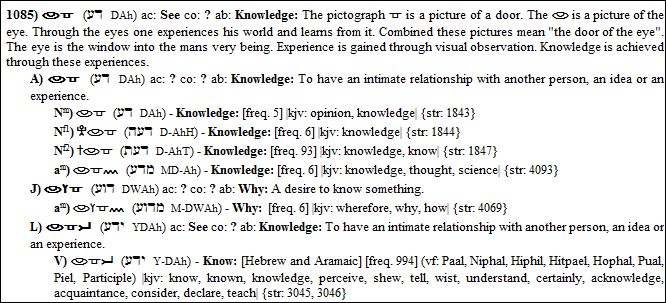
In Hebrew, knowledge literally means the door of the eye, or to “see the door”. Who is the Door? The Messiah.
Joh 10:7 Then Jesus again said to them, Truly, truly, I say to you that I am the door of the sheep.
The shadows of the Word and His Creation are there to lead us to the Door/His Eye, that we might know Him intimately, as the little guy in His Eye, abiding under the SHADOW of His Wings (Psalm 17:8; 36:7-9; 63:7; 91:5; Deuteronomy 32:10-11).
When we seek His Face, who is Messiah (Hebrews 1:3; 2 Corinthians 4:4; Colossians 1:15), we will find Him.
Jer 29:13 And you shall seek and find Me when you search for Me with all your heart.
Notice that Christ Jesus links seeking Him with knocking on a door. Studying science is a form of that knocking, whether one knows it or not.
Mat 7:7 Ask, and it will be given to you; seek, and you will find; knock, and it will be opened to you.
Mat 7:8 For each one that asks receives, and the one that seeks finds; and to the one knocking, it will be opened.
All the treasures of science (knowledge) are in Christ:
Col 2:3 in whom are hidden all the treasures of wisdom and of knowledge.
Jesus is the Wisdom of God.
1Co 1:24 But unto them which are called, both Jews and Greeks, Christ the power of God, and the wisdom of God.
1Co 1:30 But of him are ye in Christ Jesus, who of God is made unto us wisdom, and righteousness, and sanctification, and redemption:
The universe was created through Wisdom
Pro 3:19 The LORD by wisdom hath founded the earth; by understanding hath he established the heavens.
Jer 10:12 He hath made the earth by his power, he hath established the world by his wisdom, and hath stretched out the heavens by his discretion.
Jer 51:15 He hath made the earth by his power, he hath established the world by his wisdom, and hath stretched out the heaven by his understanding.
The universe was created through the Word
Psa 33:6 By the word of the LORD were the heavens made; and all the host of them by the breath of his mouth.
Heb 11:3 By faith we understand the ages to have been framed by the Word of God, so that the things seen should not come into being out of things that appear.
2Pe 3:5 For this is hidden from them by their willing it so, that heavens were of old, and earth by water, and through water, having subsisted by the Word of God,
Joh 1:1 In the beginning was the Word, and the Word was with God, and the Word was God.
Joh 1:2 He was in the beginning with God.
Joh 1:3 All things came into being through Him, and without Him not even one thing came into being that has come into being.
The universe was created through Messiah Jesus who is the Word/Wisdom of God.
Col 1:15 Who is the image of the invisible God, the firstborn of every creature:
Col 1:16 For by him were all things created, that are in heaven, and that are in earth, visible and invisible, whether they be thrones, or dominions, or principalities, or powers: all things were created by him, and for him:
Col 1:17 And he is before all things, and by him all things consist.
Pro 16:4 The LORD hath made all things for himself: yea, even the wicked for the day of evil.
The adversary, who is the great counterfeiter, seeks to apply these shadow pictures embedded in creation to himself. Nature is the foundation of the Mysteries. The adversary knows that God has embedded His Image in all of creation. The desire of the adversary is to be like God (Isaiah 14:14) so he takes those shadow pictures and corrupts them.
Albert Pike speaks of Nature being the great Bible ever open before mankind. (Morals & Dogma pg 25, 64, 75, 357-359, 374, 401 etc.) Nature/Creation is at the core of the understanding of the mark. The mark of God, which is His Image, is revealed throughout creation in types and shadows. The mark of the beast, which is his counterfeit image, is a corrupted version of the Image of God. They are corrupted interpretations of the shadow pictures in nature.
In Hebrew, the word for nature is טבע ‘teva’:
This word pictographically can represent ‘to see, good’. The letter ע-ayin is a pictograph of the eye which means to see and the letters ט-tet ב-bet spell טב ‘tov’ which means good.
Gen 1:31 And God saw everything that He had made and behold, it was very good. And there was evening, and there was morning the sixth day.
It is the corruption of Nature/Creation which leads to the mark of the beast.
The flood of the days of Noah came upon the earth due to corruption of creation, in particular man (Genesis 6:11-12). As seen above, nature (טבע) means ‘to see the good.’ Why did the Sons of God take the daughters of man? Because they were good (tovah – Genesis 6:2 commonly translated as ‘fair’). They rebelled against the Most High just as the serpent did and they re-enacted what the serpent did in the Garden. They took that which was good and corrupted it. They mixed the seed.
So too in the end, it is the corruption of creation that brings judgment.
Isa 24:5 And the earth is profaned under those living in it, because they transgress laws and violate a statute, and break the everlasting covenant.
Isa 24:6 On account of this a curse has devoured the land; and they who live in it are held guilty. For this those living in the land are consumed, and few men are left.
Rev 11:18 And the nations were full of wrath; and Your wrath came, and the time of the judging of the dead, and to give the reward to Your slaves, to the prophets, and to the saints, and to the ones fearing Your name, to the small and to the great, and to destroy those destroying the earth.
This corruption is linked to the tree of knowledge of good and evil and ‘another Jesus’.
2Co 11:2 For I am jealous over you with a jealousy of God. For I have promised you to one Man, to present you a pure virgin to Christ.
2Co 11:3 But I fear lest by any means, as the serpent deceived Eve in his craftiness, so your thoughts should be corrupted from the purity which is due to Christ.
2Co 11:4 For if, indeed, the one coming proclaims another Jesus, whom we have not proclaimed, or if you receive another spirit which you have not received, or another gospel which you never accepted, you might well endure these.
Gen 3:6 And the woman saw that the tree was good for food, and that it was pleasant to the eyes, and the tree was desirable to make one wise. And she took of its fruit and ate; and she also gave to her husband with her, and he ate.
1Jn 2:16 because all that which is in the world: the lust of the flesh, and the lust of the eyes, and the pride of life, is not of the Father, but is of the world.
The lust of the flesh which corresponds to the tree of knowledge is not of the Father. This refers to the tares mentioned above. The fruit of which comes from the adversary who sowed his seed while men (Adam) slept.
This partaking of the tree of knowledge brought forth the carnal body of sin that dies. Through Messiah we become new creatures who will be clothed in immortality. It is the old man, the carnal body that is spoken of as being corrupted.
Eph 4:22 For you have put off the old man, as regards the former behavior, having been corrupted according to the deceitful lusts,
Eph 4:23 and to be renewed in the spirit of your mind,
Eph 4:24 and to put on the new man, which according to God was created in righteousness and true holiness.
Eph 4:25 Therefore, putting off the false, “speak truth each with his neighbor,” because we are members of one another. Zech. 8:16
The word for false in verse 25 is ‘pseudos’ which means a lie, something false…a counterfeit. The tree of knowledge was a counterfeit of the tree of life, the fruit of which brings forth falsehood and ultimately death. This is because it comes from the father of lies (John 8:44) with the power of death (Hebrews 2:14).
Science is based upon the study of nature which in recent times has been explained with an evolutionary worldview. This is a corruption of the Image of God as He is the Creator of all which we see. To say that this universe came about through evolutionary means is to blaspheme Him. This corrupt view opens the door to corrupting creation even further through genetic manipulation and the altering of creation in an attempt to help speed up the evolutionary process through the use of concept of ‘survival of the fittest.’
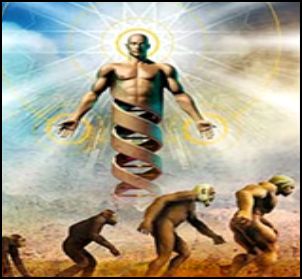
“Biologist Julian Huxley, appears to have been the first to use the actual word “transhumanism”. Writing in 1957, he defined transhumanism as “man remaining man, but transcending himself, by realizing new possibilities of and for his human nature.”
“Transhumanist philosophers argue that there not only exists a perfectionist ethical imperative for humans to strive for progress and improvement of the human condition but that it is possible and desirable for humanity to enter a transhuman phase of existence, in which humans are in control of their own evolution. In such a phase, natural evolution would be replaced with deliberate change.”
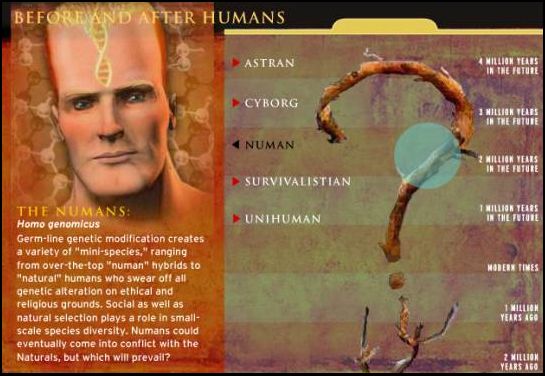
The evolution of man being linked to scientific advancements is further seen at MIT (Massachusetts Institute of Technology) At MIT building 50 there is a building depicting man becoming ‘god’ through the agency of technology.
http://realphysics.blogspot.com/2008/02/you-shall-be-as-gods.html
“The symbolic figure of the scientist stands between two great jars containing beneficent and maleficent gases, or constructive and destructive possibilities. the group below represents diplomats and officers at the council table of the world. In the upper section of the panel a figure of Hygeia is depicted placing a crown on the head of the scientist.
Animal figures symbolic of the dogs of war lurk beside the evil gases, while in the background may be seen the figure of Famine. The large figure standing in the shadow of the tree of knowledge represents Nature.
At the foot of the panel two children support an inscription from Genesis: “Ye shall be as gods, knowing good and evil.”
The phrase, “et eritis sicut dii scientes bonumet malum,” comes from the Latin Vulgate translation of Genesis 3:5
Gen 3:5 scit enim Deus quod in quocumque die comederitis ex eo aperientur oculi vestri et eritis sicut dii scientes bonum et malum
Gen 3:5 for God knows that in the day you eat of it, even your eyes shall be opened, and you shall be as God, knowing good and evil.
Eye of the Needle
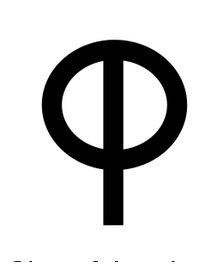
1Ti 6:9 But they that will be rich fall into temptation and a snare, and into many foolish and hurtful lusts, which drown men in destruction and perdition.
1Ti 6:10 For the love of money is the root of all evil: which while some coveted after, they have erred from the faith, and pierced themselves through with many sorrows.
Further connecting the moneychanger aspect in this ape parable is the eye of a needle. The Phoenician letter ק ‘qof’ may have depicted a sewing needle, specifically the eye of the needle. Recall that קופ ‘qof’ was also believed to have been pictured by a monkey.
Jesus connected the rich with the eye of the needle imagery.
Luk 18:24 And when Jesus saw that he was very sorrowful, he said, How hardly shall they that have riches enter into the kingdom of God!
Luk 18:25 For it is easier for a camel to go through a needle’s eye, than for a rich man to enter into the kingdom of God.
The rich who do not understand are like beasts
Psa 49:20 Man that is in honour (יְקָר ‘yeqar’), and understandeth not, is like the beasts that perish.
H3366
יְקָר
yeqâr
yek-awr’
From H3365; value, that is, (concretely) wealth; abstractly costliness, dignity: – honour, precious (things), price.
Peter warns of filthy lucre
1Pe 5:2 Feed the flock of God which is among you, taking the oversight thereof, not by constraint, but willingly; not for filthy lucre, but of a ready mind;
1Pe 5:3 Neither as being lords over God’s heritage, but being ensamples to the flock.
1Pe 5:4 And when the chief Shepherd shall appear, ye shall receive a crown of glory that fadeth not away.
Paul warns of corrupted minds led away with the love of money
1Ti 6:3 If any man teach otherwise, and consent not to wholesome words, even the words of our Lord Jesus Christ, and to the doctrine which is according to godliness;
1Ti 6:4 He is proud, knowing nothing, but doting about questions and strifes of words, whereof cometh envy, strife, railings, evil surmisings,
1Ti 6:5 Perverse disputings of men of corrupt minds, and destitute of the truth, supposing that gain is godliness: from such withdraw thyself.
1Ti 6:6 But godliness with contentment is great gain.
1Ti 6:7 For we brought nothing into this world, and it is certain we can carry nothing out.
1Ti 6:8 And having food and raiment let us be therewith content.
1Ti 6:9 But they that will be rich fall into temptation and a snare, and into many foolish and hurtful lusts, which drown men in destruction and perdition.
1Ti 6:10 For the love of money is the root of all evil: which while some coveted after, they have erred from the faith, and pierced themselves through with many sorrows.
Mammon
Luk 16:13 No servant is able to serve two lords; for either he will hate the one, and he will love the other; or he will cling to one, and he will despise the other. You are unable to serve God and mammon.
Luk 16:14 And being lovers of money, the Pharisees also heard all these things; and they derided Him.
Luk 16:15 And He said to them, You are those justifying yourselves before men, but God knows your hearts; for the thing highly prized among men is a hateful thing before God.
Mat 6:19 Lay not up for yourselves treasures upon earth, where moth and rust doth corrupt, and where thieves break through and steal:
Mat 6:20 But lay up for yourselves treasures in heaven, where neither moth nor rust doth corrupt, and where thieves do not break through nor steal:
Mat 6:21 For where your treasure is, there will your heart be also.
Mat 6:22 The light of the body is the eye: if therefore thine eye be single, thy whole body shall be full of light.
Mat 6:23 But if thine eye be evil, thy whole body shall be full of darkness. If therefore the light that is in thee be darkness, how great is that darkness!
Mat 6:24 No man can serve two masters: for either he will hate the one, and love the other; or else he will hold to the one, and despise the other. Ye cannot serve God and mammon.
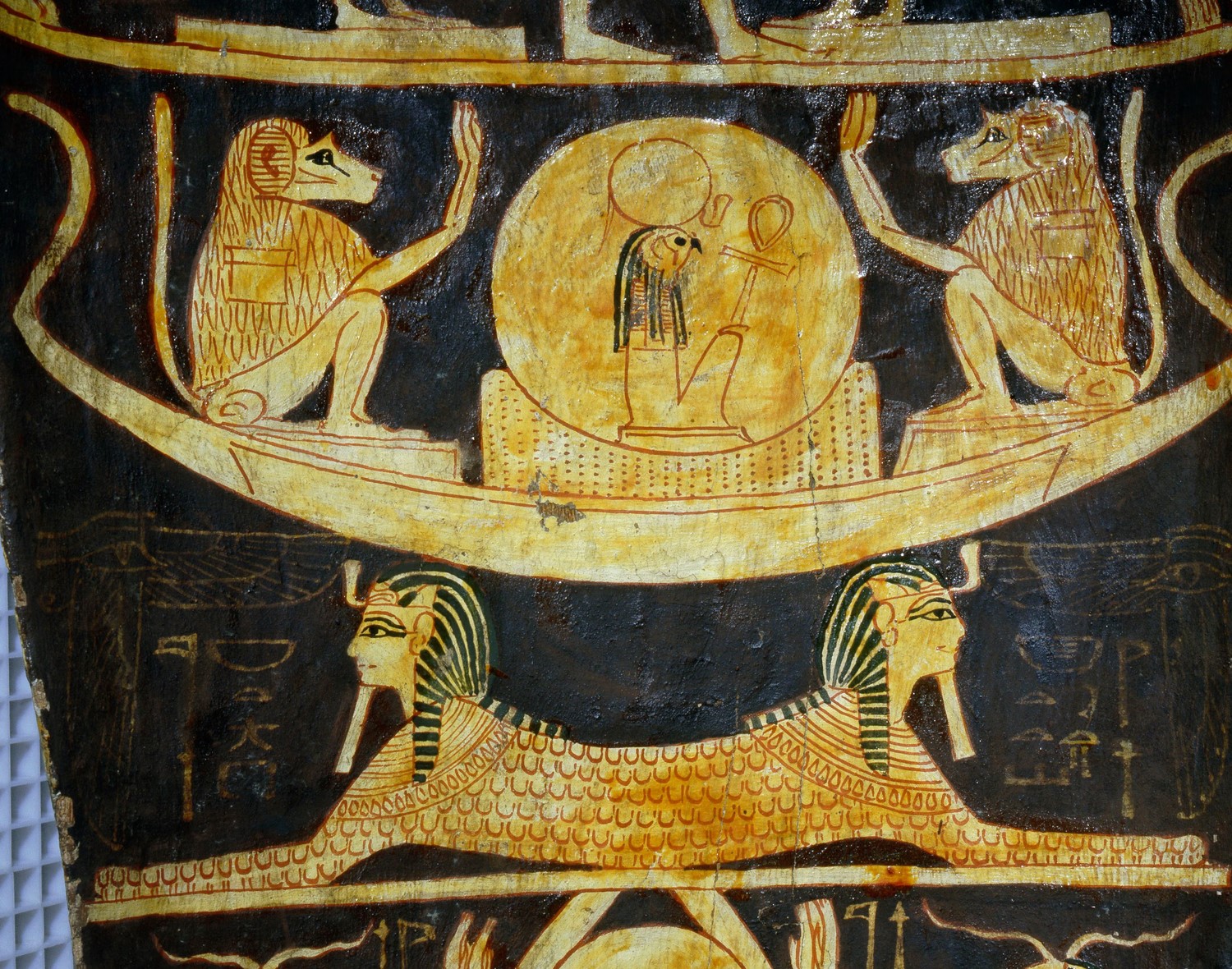
In the Egyptians myths, baboons appear as guardians and recorders in the Weighing of the Heart judgment scene in the afterlife, and attendants of Thoth.
Thoth was the lord of writing, numbers, the moon’s measure, and the weighing of the heart. Scribes poured a drop of ink to him before work. He recorded years, offerings, and the verdict in the Hall of Truth. Temple and state economy ran on those same scribes: grain tallies, tax lists, rations, audits. Accounting historians treat the Egyptian scribe as the early accountant; Thoth is the patron of that office.
The Greeks identified Hermes with Thoth. The Romans identifed Mercury with Hermes. Mercury was the “god of merchants.” The Greek Magical Papyri from Egypt show Hermes with a caduceus and purse or a baboon in Hermes’ winged cap.
“The prayers addressed to Hermes concern wealth and prosper-ity, not attempts to compel affection, and the spell includes a request to force people to “open up their hands” and dispense gifts. The instructions for fashioning a wooden figurine of an animal dressed like Hermes also allude to commerce.
Take a piece of olive wood and make a small dog-faced baboon sitting down, wearing the winged helmet of Hermes and a box on its back, and inscribe the name of Hermes on the papyrus and put it in the box. Write in myrrh ink, praying for what you do or what you wish, and after putting a lid on, burn incense and place it where you wish in the middle of the workshop” (Philip F. Venticinque – Wealth, Profit, and Social Capital in the Greek Magical Papyri)
Hermes’ Caduceus is the origin of the dollar symbol.
“The word dollar is derived from the German taler. The name taler was first given to silver coins made in 1519. This metal was mined in Joachimsthal (Joachim’s valley, or thaler), in what was Bohemia. The obverse of one thaler showed the crucified Christ. On the reverse was the image of a serpent, hanging from a cross.” (Secret Symbols of the Dollar Bill – David Ovason pg 3)
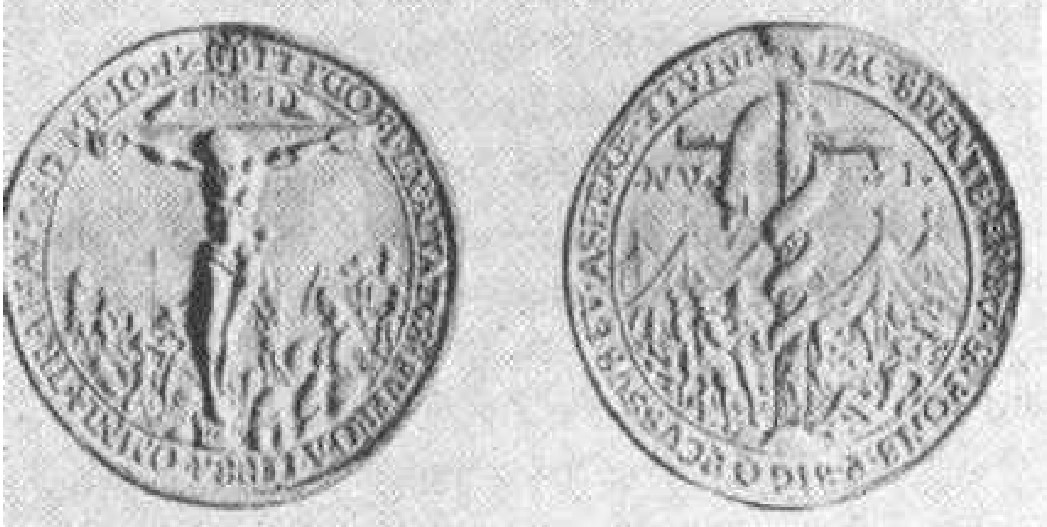
Hermes was the “trickster” of Greek mythology in a similar way as Loki in the Norse myths and Hanuman (monkey god) in Hinduism.
The number 666 is the number of the name of the beast. It points back to the false Christ of the mysteries. The Greek letters χξς (666); have the literal meaning of a serpent in a tree, pointing back to the tree of knowledge of good and evil.
The First and last letters of χξς are the the first and last letters of Christos Χριστός. The middle letter is the Greek letter for Serpent ξ because it looks like a serpent. Hence, serpent Messiah.
The Greek alphabet comes from the Phoenician alphabet which, in essence, is the same as Paleo Hebrew. χξς would be rendered in Phoenician as:
χ = which is a picture of crossed sticks
ξ=  which is a picture of a thorn or branch
ς= Stigma means a mark and like the letter ξ was used to represent a coiled serpent.
Hence, the pictograph meaning of the χξς (666) is a serpent on the branch of a tree. It is the equivalent of the tree of knowledge of good and evil.
The pictographic meaning of these letters is head,covenant/cross, thorn, nail. The mark of God, spoken of in Ezekiel 9, is the word TAV which means a cross. Is the mark of the beast a direct counterfeit of that word, which refers to the crucifixion? The antichrist is a counterfeit of the Messiah…the mark of the beast is the counterfeit of the mark of God.
Strong’s Concordance #5516 “Chi Xi Stigma [khee xee stig-ma]; 22nd, 14th and obsolete letter (4742 as a cross) of the Greek alphabet (intermediate between the 5th and 6th letters) used as numbers; denoting respectively 600, 60 and 6; 666 as a numeral:
The 22nd, 14th and 6th letters of the Hebrew alphabet spell תנו ‘tanu’

This word means ‘his dragon’.
Sun worship
1Ki 10:14 And the weight of the gold that came to Solomon in one year was six hundred and sixty six talents of gold,


The phrase shesh ma’ot sheesheem vashash kekar (666 talents) acronomically add up to 666 as well. Acronomically this phrase this teaches that 666 is the “sun Yahweh.” The Scriptures refer to the sun as a descriptive tool for the LORD (Malachi 4:2; Psalm 84:11; Psalm 19:4-5; Isaiah 9:2; 49:6; 60:1-3; John 8:12) . The adversary counterfeited this idea and this is why we see sun worship prevalent in all the pagan mystery religions.
Psa 84:11 For Jehovah God is a sun and shield; Jehovah will give grace and glory; He will withhold nothing good from those who walk in integrity.
Mal 4:2 But to you who fear My name, the Sun of Righteousness shall rise up, and healing will be on His wings. And you shall go out and frisk like calves of the stall.
The adversary counterfeits the Most High
Isa 14:14 I will rise over the heights of the clouds; I will be compared (דמה ‘damah’) to the Most High.
The adversary wants to appear just like God. This is a key to understanding what the mark of the beast is and who the antichrist is. The word used by Isaiah is דמה ‘damah’ meaning the resemblance of a son to his father which is passed down through blood (DNA).
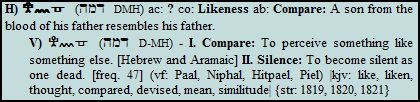
DNA is further linked to the sun through the equinoxes (tequphot). The word for ‘equinox’ in Hebrew is tequphah. It literally means the mark of the sun. At the Spring tequfah the sun is at 23 degrees in the Tropic of Cancer. At the Autumn tequfah the sun is at 23 degrees in the Tropic of Capricorn. 23 +23 = 46. 46 is the number of chromosomes in the human body that stores our DNA. The chromosome is also in the shape of a cross…
There are multiple words for time in Hebrew, the most used is עת (et) which pictographically means to ‘see the cross’, and in ancient Hebrew thinking meant to ‘see the mark.’ What is this ‘mark’? It is the sun setting (death) and rising (resurrection) above the horizon.
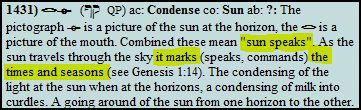
עת corresponds to the Greek word καιρός (kairos) through comparing Daniel 7:25 & Revelation 12:6, 14.
In the Septuagint, kairos is used to translate numerous words but one of which is very interesting. The word ‘tor’ due to its relation to the concept of ‘the mark.’
From this root we get ta’ar and to’ar. These words mean form, outline or border.
‘Toar’ is from the same root ‘tor’ as Torah
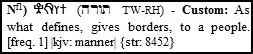
Simia Dei – Ape of God

In Medieval times, the devil was often referred to as “simia Dei” which means “God’s ape” or the “Ape of God” because Satan mimics or counterfeits God.
The adversary appears as an angel of light, a counterfeit of the True Light.
2Co 11:13 For such ones are false apostles, deceitful workers transforming themselves into apostles of Christ.
2Co 11:14 And did not Satan marvelously transform himself into an angel of light?
2Co 11:15 It is not a great thing, then, if also his ministers transform themselves as ministers of righteousness, whose end will be according to their works.
Appearing as a lamb, but speaking as a dragon
Rev 13:11 And I saw another beast coming up out of the earth. And it had two horns like a lamb, but spoke like a dragon.
The word for serpent (נחש ‘nachash’) and the word for messiah (משיח ‘mashiach’) both have a numerical value of 358. The word for lion in Job 10:16 (שחל ‘shachal’) also has the numerical value of 358. Messiah is spoken of as the lion of the tribe of Judah (Revelation 5:5), the adversary is spoken of as a roaring lion by Peter (1 Peter 5:8). Christ is spoken of as the bright and morning star (2 Peter 2:19; Revelation 2:28; 22:16) and so the adversary counterfeits this with the name of ‘Lucifer’ (Isaiah 14:12). The picture of the adversary as the counterfeit of the Messiah is seen over and over again in Scripture.
For more on Lucifer as the counterfeit Christ see: Daily Tidbits 6/23/26 – Fireflies
This concept of satan as a counterfeiter is seen all throughout Scripture, especially in the Book of Revelation:
Father, Son , Spirit
Dragon, Beast, False Prophet
All Power unto the Son Heb 1:8; Rev 6:2
Power unto the beast Rev 13:2
Keys of death and hades Rev 1:18
Keys to bottomless pit Rev 9:1
Who is like unto the Word Isa 40:18
Who is like unto the beast Rev 13:4
A lamb as it had been slain Rev 13:8
One of the heads wounded Rev 13:3
Who was and is and is to come Rev 1:4
Beast was, is not and is to come Rev 17:8
Wrath of Lamb Rev 6:16
Wrath of devil Rev 12:12
God’s seal Rev 7:2
Beasts mark Rev 13:16
Name of God Rev 14:1
Name of beast Rev 13:17
Tribes of Israel Rev 1:4
Tribes of earth Rev 1:7
Armies of heaven Rev 19:14
Armies of earth Rev 19:19
War against satan and his people Rev 12:7; 16:14; 19:11
War against Messiah and His people Rev 12:17; 17:14; 20:8
Supper of Lamb Rev 19:9
Supper of birds Rev 19:17-20
Lamb’s bride Rev 21:9-10
Harlot of Babylon Rev 17:1, 5
Apostles of Lamb Rev 21:14
False Apostles Rev 2:2
Jerusalem Rev 11:2; 14:20
Babylon Rev 14:8; 16:19
Ruler of heaven and earth and sea
Beast out of sea, out of earth
Satan seeks to be like God
Isa 14:12 How art thou fallen from heaven, O Lucifer, son of the morning! how art thou cut down to the ground, which didst weaken the nations!
Isa 14:13 For thou hast said in thine heart, I will ascend into heaven, I will exalt my throne above the stars of God: I will sit also upon the mount of the congregation, in the sides of the north:
Isa 14:14 I will ascend above the heights of the clouds; I will be like the most High.
However, Satan has no true creative power of his own. Because he is a fallen creature, he can only mimic, parody, or counterfeit what God has already done. Just as apes can imitate human actions, the devil imitates God but then twists them into deceptive and corrupted versions leading man away from their Creator.
“By whom is to be interpreted the sense of the passages which make for heresies? By the devil, of course, to whom pertain those wiles which pervert the truth, and who, by the mystic rites of his idols, vies even with the essential portions of the sacraments of God. He, too, baptizes some—that is, his own believers and faithful followers; he promises the putting away of sins by a layer (of his own); and if my memory still serves me, Mithra there, (in the kingdom of Satan,) sets his marks on the foreheads of his soldiers; celebrates also the oblation of bread, and introduces an image of a resurrection, and before a sword wreathes a crown.” (Tertullian – Against Heresies Chapter 40).
“The enemy, by his power, always imitates the forms of virtue and righteousness, not for the purpose of truly promoting its exercise, but for deception and hypocrisy… he is outwardly dyed with the colours of immortality… and is ‘transformed into an angel of light.’” (Methodius – Banquet of the Ten Virgins 10.5)
The Footnote for this quote of Methodius in the Ante Nicene Fathers says “Diabolus simia Dei, an idea very common to the Fathers. He is the malignant caricature of the Most High, exulting in the deformity which he gives to his copies.”
“Hence the holy Fathers call him Ape of God” {The Devil’s Tabernacle: The Pagan Oracles in Early Modern Thought}
Mimic

The Greek word for ape is πίθηκος ‘pithekos’ which refers to one who imitates (mimic, trickster) from the word πιθηκίζω ‘pithekizo’ which means “to ape” or “imitate like a monkey.”
πίθηκος ‘pithekos’ was later used as a nickname for a trickster, a “jackanapes.” Jackanapes were tamed monkeys/apes who were used for entertainment.
The Trickster
In Classical Greek, a trickster was called a πίθηκος ‘pithekos.’ In Norse mythology, Loke was the trickster. His name came from the Old Norse ‘luk’ meaning to “lock” involving loops, knots and tangles. Some linguists believed the Hebrew letter ק ‘qof’ (monkey/ape) had the meaning of a knot.
Loki was the trickster, the one who tangles and catches in nets. It was said he invented fishnets. Recall that the Hebrew word חרם ‘charam’ is translated as flat nose, connecting back to Simia which is Latin for ape or monkey. חרם ‘charam’ also means a net.

According to excorcist Chad Ripperger, the demon Loki’s original job was to foster religious vocations but in his rebellion he instead lures people into worldly entanglements, metaphorically “fishing” for men while trapping souls in a web of deception. He is the “ape” version of an apostle, fishers of men (Luk 5:10; Matthew 4:19-20). As mentioned before, Loki is closely akin to the Hindu god Hanuman, the monkey god.
Both Loki and Hanuman were shapshifters.
2Co 11:13 For such are false apostles, deceitful workers, transforming (μετασχηματίζω ‘metaschēmatizō’) themselves into the apostles of Christ.
2Co 11:14 And no marvel; for Satan himself is transformed into an angel of light.
2Co 11:15 Therefore it is no great thing if his ministers also be transformed as the ministers of righteousness; whose end shall be according to their works.
G3345
μετασχηματίζω
metaschēmatizō
met-askh-ay-mat-id’-zo
From G3326 and a derivative of G4976; to transfigure or disguise; figuratively to apply (by accommodation): – transfer, transform (self).
Smooth Flatterer
πιθηκισμός ‘pithekismos’ comes from πιθηκίζω ‘pithekizo’ which meant one who flatters. Philoxenus so that πίθηκος ‘pithekos’ comes from the word πείθω ‘peitho’ which means to persuade. πείθω ‘peitho’ means to persuade, to obey, to trust or have confidence in. It is used in both good and bad senses. Being persuaded by God leads to trust and confidence in Him, obedience to His Word. Persuasian by the “ape God” leads to false confidence and foolishness. See the above section on entertainment and the Hebrew word כְּסִיל ‘kesiyl.’
Another Greek word for small ape or monkey is πίθων ‘pithon.’ πίθων ‘pithon’ was used metaphorically for a flatterer. Satan is the “smooth” flatterer personified in Proverbs as the adulterous woman.
Pro 6:23 For the commandment is a lamp; and the law is light; and reproofs of instruction are the way of life:
Pro 6:24 To keep thee from the evil woman, from the flattery of the tongue of a strange woman.
Pro 5:3 For the lips of a strange woman drop as an honeycomb, and her mouth is smoother than oil:
Pro 5:4 But her end is bitter as wormwood, sharp as a twoedged sword.
Pro 5:5 Her feet go down to death; her steps take hold on hell.
Pro 2:16 To deliver thee from the strange woman, even from the stranger which flattereth with her words;
Pro 7:1 My son, keep my words, and lay up my commandments with thee.
Pro 7:2 Keep my commandments, and live; and my law as the apple of thine eye.
Pro 7:3 Bind them upon thy fingers, write them upon the table of thine heart.
Pro 7:4 Say unto wisdom, Thou art my sister; and call understanding thy kinswoman:
Pro 7:5 That they may keep thee from the strange woman, from the stranger which flattereth with her words.
The Pharisees who persuaded (Matthew 27:20 – πείθω ‘peitho’ ) the crowd to choose Barabbas over Jesus personified this character.
Luk 20:20 And they watched him, and sent forth spies, which should feign themselves just men, that they might take hold of his words, that so they might deliver him unto the power and authority of the governor.
Luk 20:21 And they asked him, saying, Master, we know that thou sayest and teachest rightly, neither acceptest thou the person of any, but teachest the way of God truly:
Luk 20:22 Is it lawful for us to give tribute unto Caesar, or no?
Mat 22:15 Then went the Pharisees, and took counsel how they might entangle him in his talk.
Mat 22:16 And they sent out unto him their disciples with the Herodians, saying, Master, we know that thou art true, and teachest the way of God in truth, neither carest thou for any man: for thou regardest not the person of men.
Mat 22:17 Tell us therefore, What thinkest thou? Is it lawful to give tribute unto Caesar, or not?
Mat 22:18 But Jesus perceived their wickedness, and said, Why tempt ye me, ye hypocrites?
Christ called them hypocrites, clothing themselves in false righteousness but inwardly wicked.
Mat 23:28 So you also indeed outwardly appear righteous to men, but within are full of hypocrisy (ὑπόκρισις ‘hupokrisis’) and lawlessness.
An hypocrite is an actor, or one hiding the true self with a false exterior. This is personified in the jackanapes who were used for entertainment in olden times.
ὑπόκρισις ‘hupokrisis’ is used in the Septuagint to translate the Hebrew word חנף ‘chaneph,’ which means filthiness, one who is profane.
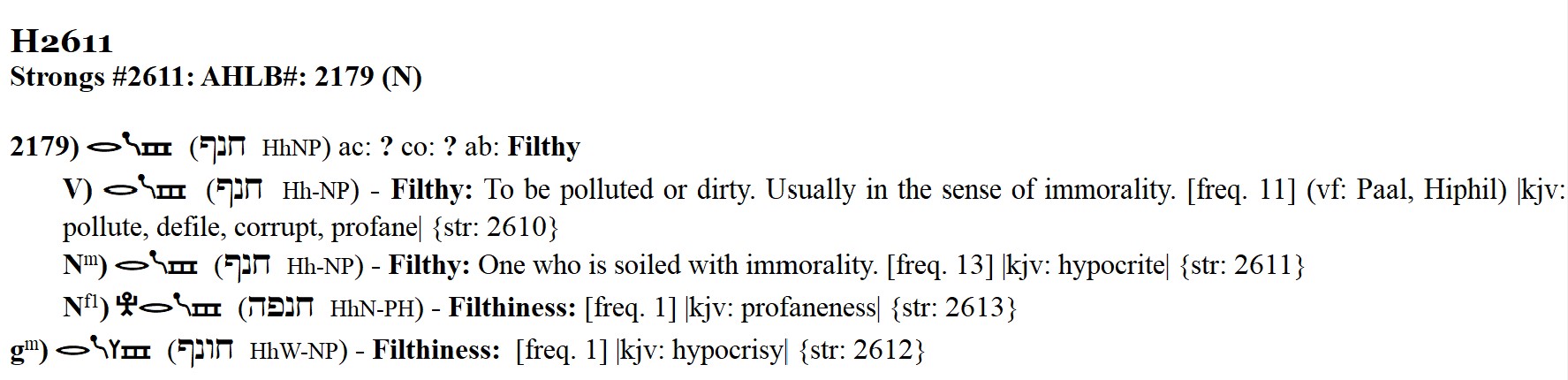
Isa 9:16 For this people’s leaders led them astray, and its guided ones are swallowed up.
Isa 9:17 For this the Lord shall not rejoice over their young men, nor have pity on their orphans and widows; for everyone is a hypocrite ( חנף ‘chaneph’) and an evildoer; and every mouth speaks foolishness. In all this His anger does not turn away, but His hand is still stretched out.
2Pe 2:1 But there were false prophets also among the people, even as there shall be false teachers among you, who privily shall bring in damnable heresies, even denying the Lord that bought them, and bring upon themselves swift destruction.
2Pe 2:2 And many shall follow their pernicious ways; by reason of whom the way of truth shall be evil spoken of.
2Pe 2:3 And through covetousness shall they with feigned words make merchandise of you: whose judgment now of a long time lingereth not, and their damnation slumbereth not.
Satan is the “smooth” flatterer seen in Genesis 3.
In Genesis 3 another “smooth” connection is seen where satan is called subtle (ערום ‘arum’). Later Adam and Eve realize they are naked (ערם ‘erom’). Here we see bare skin and subtlety linked together.
Gen 3:1 Now the serpent was more subtil (ערום ‘arum’) than any beast of the field which the LORD God had made. And he said unto the woman, Yea, hath God said, Ye shall not eat of every tree of the garden?
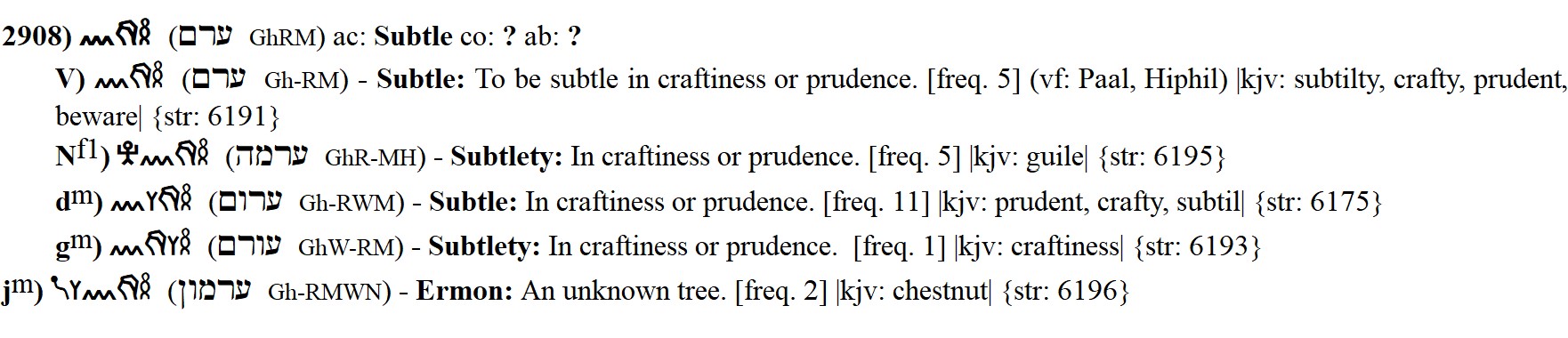
Pro 13:16 Every prudent {ערוּם ‘ârûm’} man dealeth with knowledge: but a fool layeth open his folly.
Gen 3:7 And the eyes of them both were opened, and they knew that they were naked (ערם ‘erom’); and they sewed fig leaves together, and made themselves aprons.
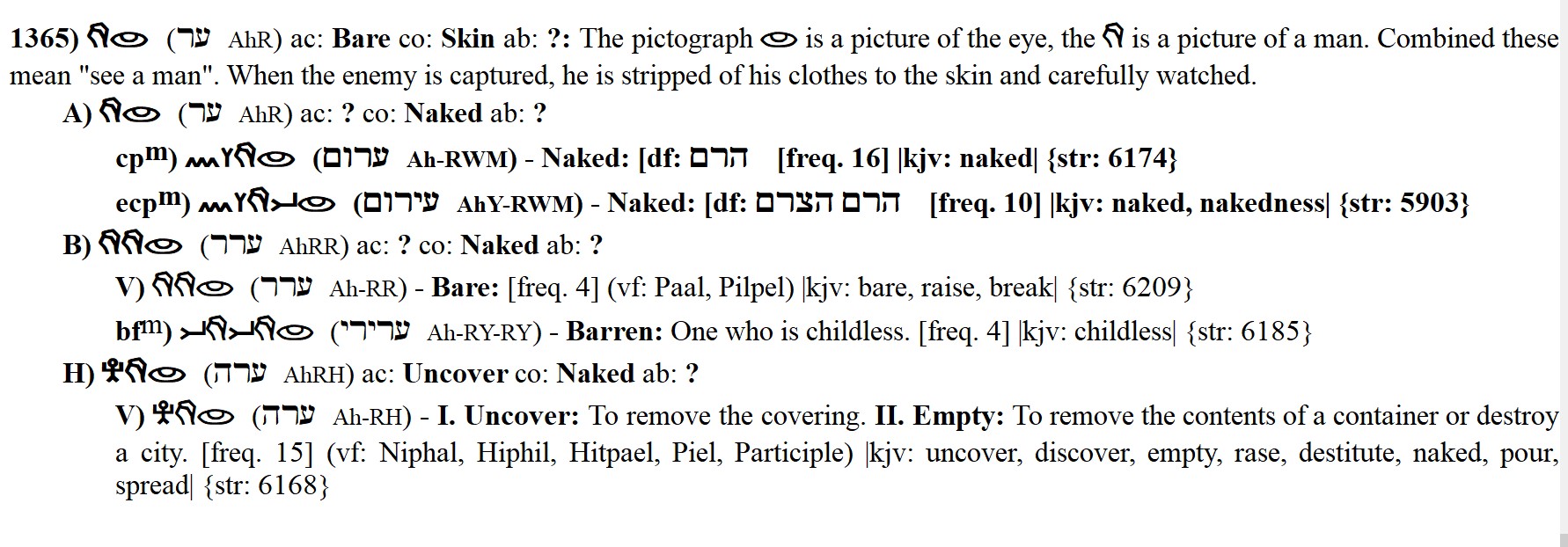
Sphinx

Historian Philostorgius in Ecclesiastical History 3.11, wrote that the sphinx is a kind of ape with a bare chest but the rest of the body is hairy like other apes. He said the animal was very wild and crafty.
“The sphinx is also a kind of ape; for I write having seen it myself. The rest of its body is hairy like the other apes, but its chest is bare all the way to the neck. It has the breasts of a woman, with a certain short, red, millet-like rash [or pimples] running all around the bare part of the body, and fitting very prettily with the human-like color in the middle. Its face is rather rounded and tends toward a female form. Its voice is fairly human, except that it is not divided into articulate sounds, but is like rapid, meaningless mutterings uttered in anger or fear. When the voice becomes sharp it also becomes louder. This animal is extremely savage and wild [or crafty/subtle], and is not easily tamed.”
The Sphinx comes from the Greek word Σφίγξ ‘Sphinx’ which means “the strangler.” The Greek mythological Sphinx would strangle travelers who failed to answer her riddles at Thebes. This is what the serpent did in the Garden, he asked a riddle to Eve which led to their death and the exposing of their nakedness. One of the Hebrew words for neck is ערף ‘araph’ which comes from the root ער ‘ar’ which means naked as the neck is exposed skin. The back of the neck is called the “nape.” In Arabic, ‘qaf’ has the meaning of nape.
The Hebrew word חנק ‘chanaq’ means to strangle. The word נק ‘naq’ means innocence, pictured as in a babe suckling. חנק ‘chanaq’ also means to hang.
Christ hung on the tree to bear the curse, redeeming mankind back to innocence.
Gal 3:13 Christ hath redeemed us from the curse of the law, being made a curse for us: for it is written, Cursed is every one that hangeth on a tree:
The primary word for neck in Hebrew is צואר ‘tsoar’ which pictures pressing and is connected to oil being pressed which causes the face to shine and to light lamps. The Hebrew word for noon is צוהר ‘tsohar’ as it the part of the day when the sun shines brightest.
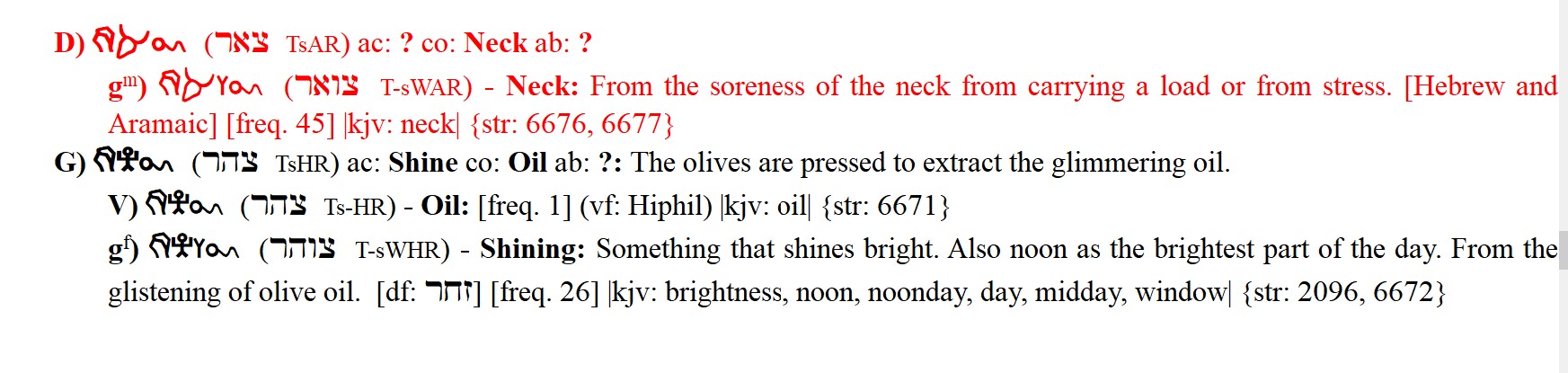
Further connecting the Sphinx is the equinoxes (תקופה ‘tequfah’). Recall that תקופה ‘tequfah’ links back to the Hebrew word for monkey which is קוף ‘qof.’ The Hebrew letter קוף ‘qof’ pictures the sunset and gives the imagery of a mark. The תקופה ‘tequfah’ is the sun at the horizon during the equinoxes, displaying the picture of the cross.
The Great Sphinx of Giza faces due east. On the vernal and autumnal equinox, the sun rises due east at that latitude. Therefore, the Sphinx’s gaze is directed precisely at the point of sunrise on the equinoxes. The Sphinx was called Hor-em-akhet, “Horus in the Horizon.”
“The Sphinx was an equinoctial marker, with its gaze directed precisely at the point of sunrise on the vernal equinox.” (Fingerprints of the Gods pg 442)
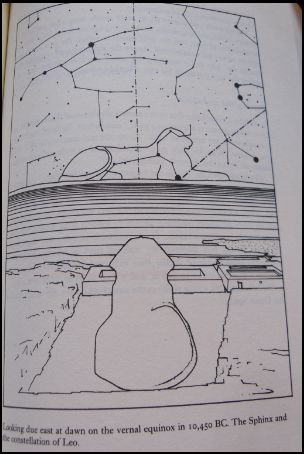
Fingerprints of the Gods pg 454
The Great Sphinx is linked to the false “riddle” of the serpent in Genesis 3 and the false promise of “ye shall be as gods.”
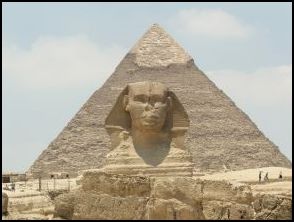
“The sphinx is therefore the mystery of Nature, the embodiment of the secret doctrine, and all who cannot solve her riddle perish. To pass the sphinx is to attain personal immortality.” (Manly P. Hall – Secret Teachings of All Ages pg 108)
Although the Great Pyramid, as Ignatius Donnelly has demonstrated, is patterned after an antediluvian type of architecture, examples of which are to be found in nearly every part of the world, the Sphinx (Hu) is typically Egyptian. The stele between its paws states the Sphinx is an image of the Sun God, Harmackis, which was evidently made in the similitude of the Pharaoh during whose reign it was chiseled.” (Manly P. Hall – Secret Teachings of All Ages pg 113)
“To the Egyptians, the Sphinx was the symbol of strength and intelligence. It was portrayed as androgynous to signify that they recognized the initiates and gods as partaking of both the positive and negative creative powers. Gerald Massey writes: “This is the secret of the Sphinx. The orthodox sphinx of Egypt is masculine in front and feminine behind. So is the image of Sut-Typhon, a type of horn and tail, male in front and female behind. The Pharaohs, who wore the tail of the Lioness or Cow behind them, were male in front and female behind. Like the Gods they included the dual totality of Being in one person, born of the Mother, but of both sexes as the Child.” (Manly P. Hall – Secret Teachings of All Ages pg 116)
Isa 14:12 How art thou fallen from heaven, O Lucifer, son of the morning! how art thou cut down to the ground, which didst weaken the nations!
The Targum is,
“how art thou fallen from on high, who was shining among the sons of men, as the star Venus among the stars.”
Keil & Delitzsch commentary on Isaiah 14:12:
(Note: It is singular, however, that among the Semitic nations the morning star is not personified as a male (Heōsphoros or Phōsphoros), but as a female (Astarte, see at Isa_17:8), and that it is called Nâghâh, Ashtoreth, Zuhara, but never by a name derived from hâlal; whilst the moon is regarded as a male deity (Sin), and in Arabic hilâl signifies the new moon, which might be called ben- shacar (son of the dawn), from the fact that, from the time when it passes out of the invisibility of its first phase, it is seen at sunrise, and is as it were born out of the dawn.)*
Asherah- Tree of knowledge

International Standard Bible Encyclopedia
Ashtoreth
The moon goddess of the Phoenicians, representing the passive principle in nature, their principal female deity; frequently associated with the name of Baal, the sun-god, their chief male deity (Jdg_10:6; 1Sa_7:4; 1Sa_12:10). These names often occur in the plural (Ashtaroth, Baalim), probably as indicating either different statues or different modifications of the deities. This deity is spoken of as Ashtoreth of the Zidonians. She was the Ishtar of the Accadians and the Astarte of the Greeks (Jer_44:17; 1Ki_11:5, 1Ki_11:33; 2Ki_23:13). There was a temple of this goddess among the Philistines in the time of Saul (1Sa_31:10). Under the name of Ishtar, she was one of the great deities of the Assyrians. The Phoenicians called her Astarte. Solomon introduced the worship of this idol (1Ki_11:33). Jezebel’s 400 priests were probably employed in its service (1Ki_18:19). It was called the “queen of heaven” (Jer_44:25).
John Gill commentary on Amos 5:26
the star of your god {hexagram/Talisman of Saturn/seal of Solomon/star of David}, which ye made to yourselves; or the star “your god” (q); meaning the same with Chiun or Saturn; perhaps the same with the star that fell from the air or sky*, mentioned by Sanchoniatho (r); which Astarte, the wife of Chronus or Saturn, is said to take and consecrate in Tyre; this they made for themselves, and worshipped as a deity.
ISBE (International Standard Bible Encyclopedia)
In Assyrian asirtu, which appears also under the forms asrātu, esrēti (plural) and asru, had the further signification of “sanctuary.” Originally Asirtu, the wife of Asir, and asirtu, “sanctuary,” seem to have had no connection with one another, but the identity in the pronunciation of the two words caused them to be identified in signification, and as the tree-trunk or cone of stone which symbolized Asherah was regarded as a Beth-el or “house of the deity*,” wherein the goddess was immanent, the word Asirtu, Asherah, came to denote the symbol of the goddess. The trunk of the tree was often provided with branches, and assumed the form of the tree of life*. It was as a trunk, however, that it was forbidden to be erected by the side of “the altar of Yahweh” (Deu_16:21; see Jdg_6:25, Jdg_6:28, Jdg_6:30; 2Ki_23:6). Accordingly the symbol made for Asherah by his mother was “cut down” by Asa (1Ki_15:13). So, too, we hear of Asherim or symbols of the goddess being set up on the high places under the shade of a green tree (Jer_17:2; see 2Ki_17:10). Manasseh introduced one into the temple at Jerusalem (2Ki_21:3, 2Ki_21:7).
Exo 23:24 You shall not bow down to their gods, and you shall not serve them. And you shall not do according to their works. But tearing you shall tear them down, and smashing you shall smash their pillars.
H4676 מצּבה matstsêbâh
BDB Definition:
1) pillar, mastaba, stump
1a) pillar
1a1) as monument, personal memorial
1a2) with an altar
1b) (Hophal) stock, stump (of tree)*
This is the word used in Genesis referring to the stone that Jacob anointed and proclaimed as Bethel.
Gen 28:18 And Jacob rose up early in the morning, and took the stone that he had put for his pillows, and set it up for a pillar{H4678 matstsebeth}, and poured oil upon the top of it.
Gen 28:19 And he called the name of that place Bethel {house of God}:: but the name of that city was called Luz at the first.
Gen 35:14 And Jacob set up a pillar(H4678 matstsebeth) in the place where he talked with him, even a pillar of stone: and he poured a drink offering thereon, and he poured oil thereon {This is a strong reference to the Messiah, which means anointed one.}.
Gen 35:15 And Jacob called the name of the place where God spake with him, Bethel{ בּית־אל beytḣ’el house of God}
Messiah is the image of God
2Co 4:4 in whom the god of this age has blinded the thoughts of the unbelieving, so that the brightness of the gospel of the glory of Christ who is the image of God, should not dawn on them.
The congregation of believers are to be the “image” of Messiah
Rom 8:29 because whom He foreknew, He also predestinated to be conformed to the image of His Son, for Him to be the First-born among many brothers.
2Co 3:18 But we all with our face having been unveiled, having beheld the glory of the Lord in a mirror, are being changed into the same image from glory to glory, as from the Lord Spirit.
Here we see that the pillar that Jacob anointed is to be the house of God. His house are His people (Hebrews 3:6). His body. Pictured by the menorah, the tree of Life. The counterfeit is a pillar/Asherah which is called Bethel. The antichrist’s house are his people. His body. Pictured by the Asherah, the tree of knowledge.
Our “star,” Greek ” aster,” Latin stella, is akin*. Her worship was most licentious and abominable; closely connected with that of (See ASHERAH, “THE GROVE”. Ashtoreh is the goddess, asherah “the grove,” the image or the symbol of the goddess, of wood;* asher, yashar, “to be straight,” a straight stem of a tree living, or fixed upright (1Ki_18:19; 2Ki_21:7; 2Ki_23:6; 2Ki_23:13-14; 2Ki_23:15; Jdg_6:25; Jdg_6:30). The “bringing out the asherah from the house of the Lord,” and the “cutting down,” suit such a symbol, not a grace in our sense. The active and passive powers of nature, generative and receptive, suggested the male and female deities, Baal and Ashtoreh. {This is seen further in the principle ‘as above, so below’ which is discussed in connection to the mark of the beast in the study Mark of the Beast 12 – As Above So Below}
Exo 34:11 Take heed for yourself what I am commanding you today. Behold, I am about to drive out from before your face the Amorite, and the Canaanite, and the Hittite, and the Perizzite, and the Hivite, and the Jebusite.
Exo 34:12 Take heed to yourself, that you not cut a covenant with the people of the land to which you are going in, that it not be a snare in your midst.
Exo 34:13 But you shall cut down their altars, break their pillars, and you shall cut off their Asherahs.
Exo 34:14 For you shall not bow to another god, for Jehovah whose name is Jealous, He is a jealous God;*
1Co 10:20 But the things the nations sacrifice, “they sacrifice to demons, and not to God.” Deut. 32:17 But I do not want you to become sharers of demons;
1Co 10:21 you cannot drink the cup of the Lord and a cup of demons; you cannot partake of the table of the Lord, and a table of demons.
1Co 10:22 Or do we provoke the Lord to jealousy? Are we stronger than He? Deut. 32:21
Deu 7:5 But you shall deal with them in this way: you shall break down their altars, and dash in pieces the cult-stones; and you shall cut down their Asherahs; and you will burn their carved images with fire.
Deu 7:6 For you are a holy people to Jehovah your God. Jehovah your God has chosen you to be His own treasure out of all the people on the face of the earth.
John Gill commentary on Deu. 7:5
Deu 7:5 But thus shall ye deal with them,…. The inhabitants of the land of Canaan:
ye shall destroy their altars; on which they sacrificed to their idols:
and break down their images; of their gods, and the statues and pillars erected to the honour of them:
and cut down their groves; sacred to idols, which were usually planted on hills, and about Heathen temples, and under which idols were placed to be worshipped. The Targum of Jonathan calls them trees of their adoration, under which they worshipped; though there was a worship paid to them, not indeed directly to them, or for their sakes, but for the sake of the idols they were sacred to, or were placed under them; soMaimonides (e) says, a tree which at first was planted to be worshipped is forbidden of any use (or profit); and this is the אשרה, or “grove”, spoken of in the law, a tree planted and lopped, of which a graven image is made for an idol; and so the tree that has been worshipped, though the body of it is, not forbidden, all the shoots and leaves, and the branches, and the fruits it produces all the time it is worshipped, are forbidden to be used: though the word here used sometimes seems to signify, not a grove of trees, but some image itself, since we read of it in the temple, 2Ki_21:7,
and burn their graven images with fire; distinguished from their molten images, which may be meant in a preceding clause, and which are particularly mentioned as to be destroyed as well as these, Num_33:52.
(e) Hilchot Obede Cochabim, c. 8. sect. 3, 4. Vid. Misn. Avodah Zarah, c. 3. sect. 7.
Deu 12:3 And you shall break down their altars, and shatter their standing pillars. And you shall burn their Asherahs with fire. And you shall cut down the carved images of their gods, and shall destroy their names out of that place.
Deu 12:4 You shall not do so to Jehovah your God.

The hamadryas baboon gets its name from Ἁμαδρυάς ‘Hamadryas’ which is a combination of ἅμα ‘hama’ meaning together with or at the same time and δρῦς ‘drys’ meaning a tree. In Greek mythology, a hamadryas was a wood nymph, fabled to die with her tree. The baboon was named after the nymph because its long silver mane looked like a nymph’s cloak or “woodland spirit.” Interestingly, the King Cobra was once called hamadryas further connecting the Genesis 3 imagery.
Some butterflies are named hamadryas as well. The metamorphosis of the caterpillar into a butterfly is a perfect representation of the carnal man resurrecting into ‘Spirit man.’
The Hebrew word for butterfly is פרפר ‘parpar’ which means “fruit fruit” further displaying this metamorphosis (born again) picture. μεταμορφόω ‘metamorphoō’ means to be transformed or transfigured into another image. The image {μορφή ‘morphe’} that we are to be transformed into depends upon which tree we seek, the tree of life or the tree of knowledge.
Atum
In Egyptian myth, Atum was the “creator.” His name came from the verb ‘tm’ which means to complete or to finish. This corresponds with the Hebrew word תם ‘tam,’ which means complete, whole, perfect. Atum was “the Complete One,” the self-created being who both begins and will one day end the cosmos. He was a corrupted version of the LORD.
Deu 18:13 Thou shalt be perfect (תמים ‘tamiym’) with the LORD thy God.
Mat 5:48 Be ye therefore perfect, even as your Father which is in heaven is perfect.
“Swiss Egyptologist Edouard Naville had this to say about Atum: ‘there can be no doubt that the lion or the sphinx is a form of Atum…’ “ (Graham Hancock & Robert Bauval – Message of the Sphinx pg 155)
“Atum, the primordial creator god, was regarded by the ancient Egyptians as being primarily leonine or sphinx-like in form.” (Graham Hancock & Robert Bauval – Message of the Sphinx pg 155)
“…one of the most enduring titles by which the Sphinx was known to the ancient Egyptians was Shesheph-ankh Atum (literally ‘living image of Atum’)…” Graham Hancock & Robert Bauval – Message of the Sphinx pg 155
Satyrs & Pan

The concept of satyrs is linked with apes through the scientific naming of orangutans. Satyr became a scientific label for apes and also a name for the mythic goat-man.
Greek and Roman writes described satyrs as hairy, tailed and lascivious woodland beings.
The Orangutan was so named by the Malays as it meant “person of the forest.” The orangutan was named ‘satyrus indicus’ by Nicolaes Tulp in the 1600s. Later they were called Simia satyrus (monkey/ape satyr).
Plants & Animals of the Bible
“Ape. King Solomon brought apes from tropical and semi-tropical regions of the ancient world to Israel. Solomon’s zoo probably contained a variety of apes, monkeys, and baboons (1Ki_10:22; 2Ch_9:21). Some commentators suggest that Isaiah’s reference to the “satyrs” who “dance” and “cry to [their] fellow [s]” (Isa_13:21; Isa_34:14), (KJV) would fit the dog-faced baboon honored by the Egyptians.”
The satyr is further linked to the ape through the writings of Strabo (Geography Book 17) spoke of the κῆπος ‘kepos’ which is described as a having a face like a satyr and a body “between a panther and a bear.” It is believed that he was speaking of a monkey/ape of Egypt. Pliny speaks of the cepus in Rome in Pompey’s games, who had human-like hind feet and hand-like forefeet (Natural History 8.70).
In Latin, the κῆβος ‘kebos’ was called cephus. Cephus is a homonym of Cephas, the name given to Peter by Jesus. These words are not etymologically related but in the parable of apes it has some fascinating connections.
Joh_1:42 And he brought him to Jesus. And when Jesus beheld him, he said, Thou art Simon the son of Jona: thou shalt be called Cephas (Κηφᾶς ‘Kephas), which is by interpretation, A stone (πέτρα ‘petra).
The Aramaic כֵּיפָא ‘kayfa’ is related to the Hebrew כף ‘kayf’ meaning a “hollow rock” (Job 30:6; Jeremiah 4:29). Jeff Benner defines this word כף as as “open palm.” The כ ‘kaf’ is the picture of the palm of the hand, the פ ‘peh’ is a picture of an open mouth. Combined these mean palm open. כפה ‘kafah’ means to tame or to “bend the will of an animal.” This is interesting to note in light of this parable as Peter was named Peter after declaring Jesus was the Son of God (Matthew 16:18). Cephas is the Aramaic of Peter. Here is seen the picture of beastly man “tamed.”
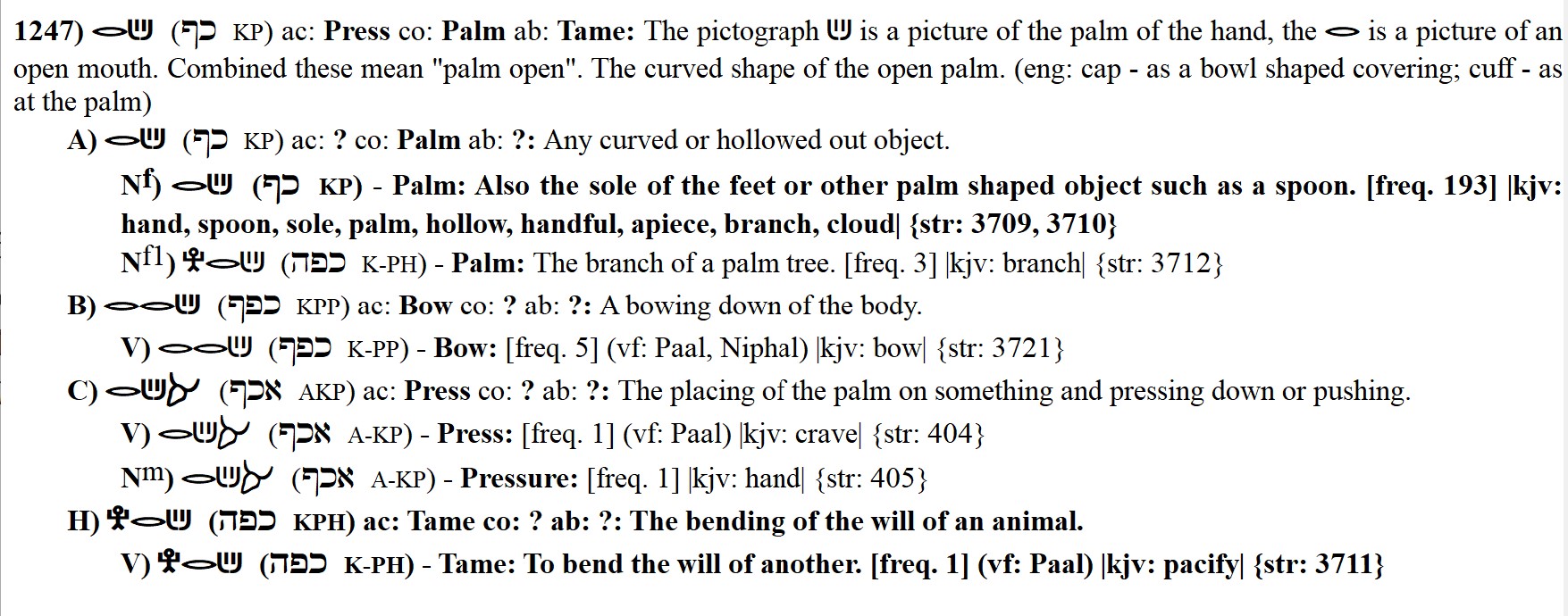
Mat 16:13 When Jesus came into the coasts of Caesarea Philippi, he asked his disciples, saying, Whom do men say that I the Son of man am?
Mat 16:14 And they said, Some say that thou art John the Baptist: some, Elias; and others, Jeremias, or one of the prophets.
Mat 16:15 He saith unto them, But whom say ye that I am?
Mat 16:16 And Simon Peter answered and said, Thou art the Christ, the Son of the living God.
Mat 16:17 And Jesus answered and said unto him, Blessed art thou, Simon Barjona: for flesh and blood hath not revealed it unto thee, but my Father which is in heaven.
Mat 16:18 And I say also unto thee, That thou art Peter (Πέτρος ‘Petros’), and upon this rock (πέτρα ‘petra’) I will build my church; and the gates of hell shall not prevail against it.
Mat 16:19 And I will give unto thee the keys of the kingdom of heaven: and whatsoever thou shalt bind on earth shall be bound in heaven: and whatsoever thou shalt loose on earth shall be loosed in heaven.
This event occurred at Caesarea Philippi which was formerly called Paneas/Panias. It was the cult center dedicated to the god Pan. The scientific name of the chimpanzee is Pan troglodyte. Pan comes from the Greek god Pan and troglodyte means “cave dweller.” In Latin, the name for the chimpanzee is ‘Simia Paniscus’ which mean “Little Pan ape.” The Bonobo has a similar name in Latin, Pan paniscus (“the small Pan), the “pygmy chimpanzee.”
Philostorgius in his Church History spoke of various apes which were a mixtures (bear-apes, lion-apes, dog-headed apes etc.). He also spoke of one who was like the god Pan. Philostorgius was the historian who also linked the ape with the sphinx mentioned above.
“such is also the one called Pan, which has the head of a goat-face and is goat-horned, and from the flanks downward is goat-legged, but in its belly and chest and hands is purely an ape.”
Pan was the god of wild nature, shepherds, rustic music, and uncontrolled lust. Satyrs were his natural companions and, in some traditions, his offspring or lesser counterparts. In the Middle Ages, Christian art gave the features of Pan (horns, goat legs, cloven hooves etc.) to the Devil.
Christ declared war on the enemy at the grotto of Pan. Eusebius spoke of the overthrow of the demonic kingdom by Christ as the “death of Pan.” In Greek, Pan is the name of the satyr like god but is also the word for “all.” The death of Pan declares the death or overthrown of all the pagan gods/demons.
“But it is important to observe the time at which he says that the death of the daemon took place. For it was the time of Tiberius, in which our Saviour, making His sojourn among men, is recorded to have been ridding human life from daemons of every kind: and of them some fell upon their knees and besought Him not to deliver them into the abyss, and others not to send them into the swine.” (Eusebius of Caesarea – Preparation for the Gospel 5.17.13-14)
Eusebius was referencing Plutarch in “On the Obsolescence of Oracles 17.”
“In the reign of Tiberius, a ship off Paxi hears a voice call the Egyptian pilot Thamus three times. It tells him: when he reaches Palodes, announce that the great Pan is dead (Πὰν ὁ μέγας τέθνηκε). In a dead calm he shouts it from the stern. A great cry of lamentation answers from the shore. The news reaches Rome; Tiberius has scholars identify this Pan as the son of Hermes and Penelope.”
Herod the Great & Esau
The grotto of Pan where Christ declared the gates of hell would not prevail against His church had a temple built to Augustus near it by Herod the Great.
Herod the Great was an Edomite. Around 104-125 BC, John Hyrcanus conquered Idumea and forced them to convert to Judaism. From that point they were considered Jews.
“Hyrcanus… permitted them to remain in the country if they would circumcise their genitals and observe the laws of the Jews. And they, out of attachment to their ancestral land, submitted to circumcision and to making their manner of life the same as that of the Jews. And from that time onward they have been Jews.” (Josephus – Antiquities of the Jews Antiquities 13.257–258)
Edom comes from Esau, the “hairy” one.
Gen 36:8 Thus dwelt Esau in mount Seir: Esau is Edom.
Gen 25:25 And the first came out red, all over like an hairy (שׂער ‘sa`ir’) garment; and they called his name Esau.
Gen 27:11 And Jacob said to Rebekah his mother, Behold, Esau my brother is a hairy (שׂער 'sa`ir”) man, and I am a smooth man:
שׂער ‘sa`ir’ means hairy in Hebrew, it is also the word translated as satyr (Isaiah 34:14).
Isa 34:14 The wild beasts of the desert shall also meet with the wild beasts of the island, and the satyr (שׂער ‘sa`ir’) shall cry to his fellow; the screech owl also shall rest there, and find for herself a place of rest.
H8163
שָׂעִר שָׂעִיר
śâ‛ı̂yr śâ‛ir
saw-eer’, saw-eer’
From H8175; shaggy; as noun, a he goat; by analogy a faun: – devil, goat, hairy, kid, rough, satyr.
שׂער ‘sa`ir’ is translated as devils in Leviticus 17:7
Lev 17:7 And they shall no more offer their sacrifices unto devils (שׂער ‘sa`ir’), after whom they have gone a whoring. This shall be a statute for ever unto them throughout their generations.
Esau was a carnal man who despised his birthright (Genesis 25:31-34), he was a profane person.
Heb 12:16 Lest there be any fornicator, or profane person (βέβηλος ‘bebelos’), as Esau, who for one morsel of meat sold his birthright.
βέβηλος ‘bebelos’ is the word Paul used in reference to those who teach “false science.”
1Ti 6:20 O Timothy, keep that which is committed to thy trust, avoiding profane (βέβηλος ‘bebelos’) and vain babblings (κενοφωνία ‘kenophonia’), and oppositions of science falsely so called:
κενοφωνία ‘kenophonia’ is a combination of the words κενός ‘kenos’ which means empty or vain and φωνή ‘phone’ which means voice or sound. Ape calls are sounds (φωνή ‘phone’) without meaning. Philostorgius spoke of the “sphinx-ape” as having a voice almost human but not divided into articulate sounds.
Taming & Enculturation
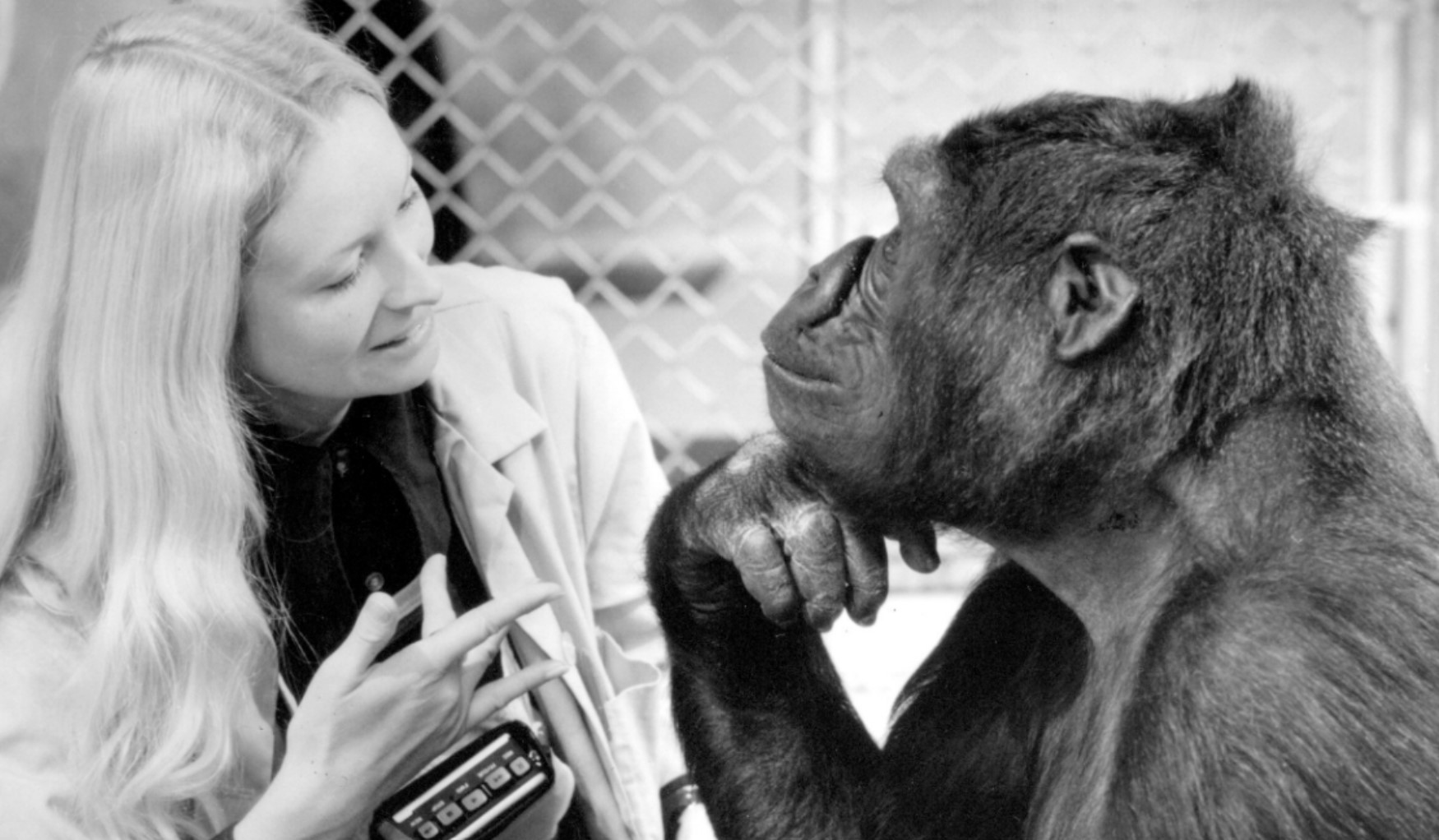
Apes and monkeys can be tamed just as with any animal.
Jas 3:7 For every kind of beasts, and of birds, and of serpents, and of things in the sea, is tamed (δαμάζω ‘damazo’), and hath been tamed (δαμάζω ‘damazo’) of mankind:
δαμάζω ‘damazo’ is related to the Greek word δάμαλις ‘damalis’ which is describing a heifer old enough to take the yoke. Taking the yoke in Hebrew is associated with learning and the ability to be lead by another.
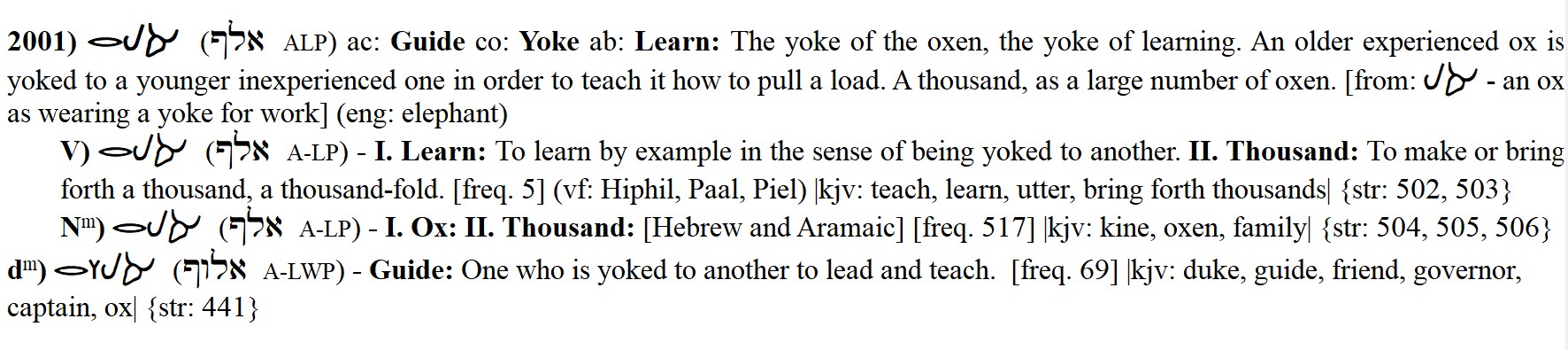
אלף ‘aleph’ comes from the root אל ‘el’ which means God. Man tamed is one who is yoked with God.
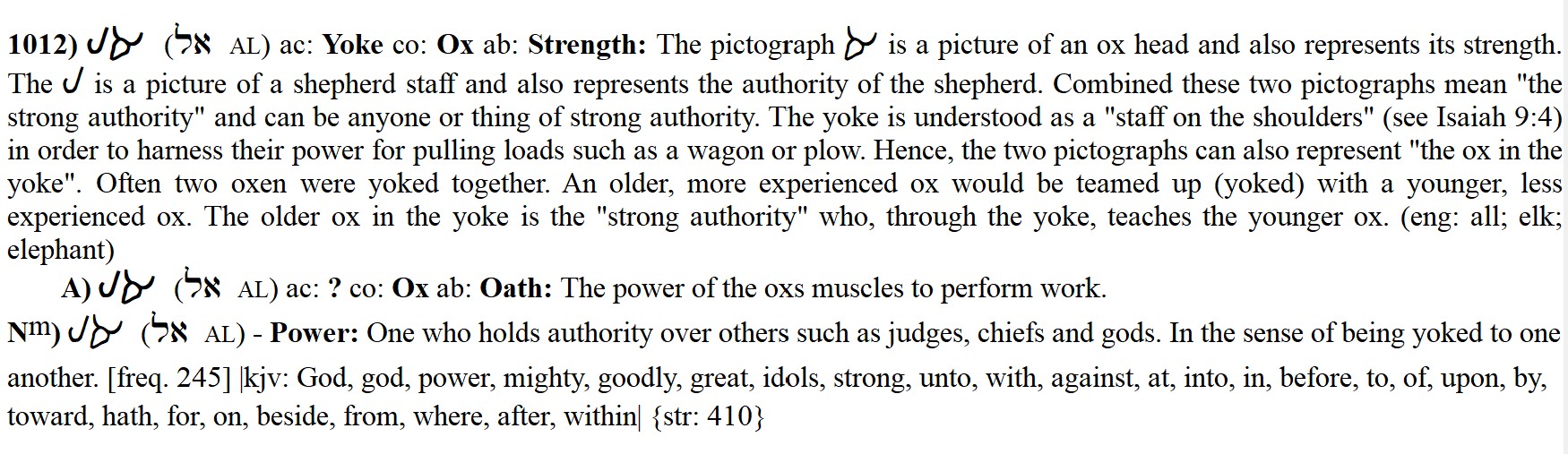
Mat 11:28 Come unto me, all ye that labour and are heavy laden, and I will give you rest.
Mat 11:29 Take my yoke upon you, and learn of me; for I am meek and lowly in heart: and ye shall find rest unto your souls.
Mat 11:30 For my yoke is easy, and my burden is light.
Being yoked wtih Jesus is connected with being His friend and His disciple. To be yoked, to walk with the Messiah is to be His disciple. A disciple in Hebrew is לימוד ‘limmud’ which is associated with an yoked ox.
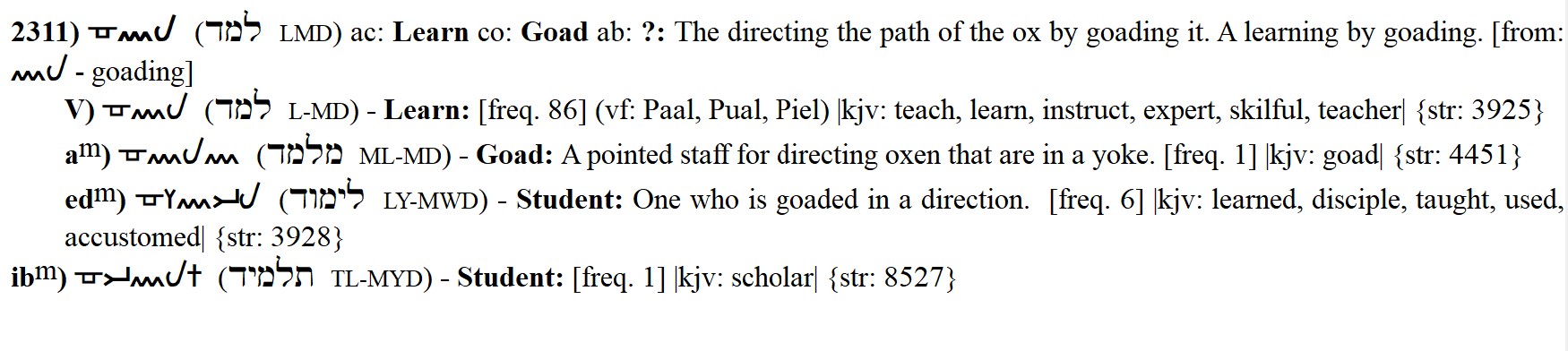
Joh 15:14 You are My friends if you do whatever I command you.
The English word tame and the Greek δαμάζω ‘damazo’ (tame) trace back to the Proto-Indo-European word demh₂
which means “to tame, domesticate, force, bind.” The Latin word ‘domo’ (I tame) and ‘dominus’ (lord/master of the house) trace back to this same root.
Every animal can be tamed. However, with apes it requires prolonged, personal relationship. An ape needs constant presence, rewards and correction. Researchers call this taming/training enculturation. In essence, the ape must live like a human before they act like a human. Some even learn sign language and can communicate with humans in a basic way.
Mankind is made in God’s image (Genesis 1:26-27) but is also a beast (Ecclesiastes 3:18). It is man’s capacity to reason that separates them from the beasts. The English word reason traces back to the Latin word ‘ratio’ which means to reckon, count, to think. Ratio is used in the Latin Vulgate to translate the Greek word λόγος ‘logos’ which means reason, proportion, word.
Joh 1:1 In the beginning was the Word (λόγος ‘logos’), and the Word (λόγος ‘logos’) was with God, and the Word was God.
What separates man from beast is their ability to receive the λόγος ‘logos.’ Tamed apes are able to learn sign language and communicate in human language but have never shown the ability to receive the λόγος ‘logos.’
Researchers who have trained apes have found that apes who were trained like other animals never attain the level of tameness that apes who are enculturated do. They still behave like animals. Enculturated apes are raised from infancy inside a human home and are treated like humans. It is these apes that became famous for their ability to communicate with people and live more like a human and less like an animal.
So too, for humans to overcome their sin nature/beast nature they must be born again and live in the home of God as members of the family. We must be yoked with Him and live every moment with Him or we regress into our old beast nature.
Eph 2:1 And you hath he quickened, who were dead in trespasses and sins;
Eph 2:2 Wherein in time past ye walked according to the course of this world, according to the prince of the power of the air, the spirit that now worketh in the children of disobedience:
Eph 2:3 Among whom also we all had our conversation in times past in the lusts of our flesh, fulfilling the desires of the flesh and of the mind; and were by nature the children of wrath, even as others.
Eph 2:4 But God, who is rich in mercy, for his great love wherewith he loved us,
Eph 2:5 Even when we were dead in sins, hath quickened us together with Christ, (by grace ye are saved;)
Eph 2:6 And hath raised us up together, and made us sit together in heavenly places in Christ Jesus:
Eph 2:7 That in the ages to come he might shew the exceeding riches of his grace in his kindness toward us through Christ Jesus.
Eph 2:8 For by grace are ye saved through faith; and that not of yourselves: it is the gift of God:
Eph 2:9 Not of works, lest any man should boast.
Eph 2:10 For we are his workmanship, created in Christ Jesus unto good works, which God hath before ordained that we should walk in them.
Eph 2:11 Wherefore remember, that ye being in time past Gentiles in the flesh, who are called Uncircumcision by that which is called the Circumcision in the flesh made by hands;
Eph 2:12 That at that time ye were without Christ, being aliens from the commonwealth of Israel, and strangers from the covenants of promise, having no hope, and without God in the world:
Eph 2:13 But now in Christ Jesus ye who sometimes were far off are made nigh by the blood of Christ.
Eph 2:14 For he is our peace, who hath made both one, and hath broken down the middle wall of partition between us;
Eph 2:15 Having abolished in his flesh the enmity, even the law of commandments contained in ordinances; for to make in himself of twain one new man, so making peace;
Eph 2:16 And that he might reconcile both unto God in one body by the cross, having slain the enmity thereby:
Eph 2:17 And came and preached peace to you which were afar off, and to them that were nigh.
Eph 2:18 For through him we both have access by one Spirit unto the Father.
Eph 2:19 Now therefore ye are no more strangers and foreigners, but fellowcitizens with the saints, and of the household of God;
Eph 2:20 And are built upon the foundation of the apostles and prophets, Jesus Christ himself being the chief corner stone;
Eph 2:21 In whom all the building fitly framed together groweth unto an holy temple in the Lord:
Eph 2:22 In whom ye also are builded together for an habitation of God through the Spirit.
Heb 12:1 Wherefore seeing we also are compassed about with so great a cloud of witnesses, let us lay aside every weight, and the sin which doth so easily beset us, and let us run with patience the race that is set before us,
Heb 12:2 Looking unto Jesus the author and finisher of our faith; who for the joy that was set before him endured the cross, despising the shame, and is set down at the right hand of the throne of God.
We must fix our eyes on Jesus or we will fall. Being a disciple is being a pupil.
Webster’s 1828 Dictionary: Pupil
PU’PIL, n. [L. pupilla, dim. of pupa, pupus. See Pup.]
The apple of the eye; a little aperture in the middle of the iris and uvea of the eye, through which the rays of light pass to the crystalline humor, to be painted on the retina.
PU’PIL, n. [L. pupillus, dim. of pupa, pupus. See Pup.]
- A youth or scholar of either sex under the care of an instructor or tutor.
Walking as His disciples/students is seeking His Face as the apple of His eye/little guy in His eye.
Being a little guy/girl in the Eye of God is all about walking in close relationship with God who is love (1 John 4:8) and extending that love to our fellow man (1 John 4:12). Each one of us must work out our own salvation with fear and trembling as God works through us according to His good pleasure (Philippians 2:12-13). If we keep focused on Him, He will transform us from glory to glory (2 Corinthians 3:18) until we are formed into the image of His Son (Romans 8:29).
Related Articles:
Daily Tidbits 3/19 – Tequfah/Equinox
Daily Tidbits 3/22 – Tequfah & the Mark
Mark of the Beast 12 – As Above So Below
Mark of the Beast 13 – Ye Shall Be As Gods
Daily Tidbits 6/23/26 – Fireflies
End Time Strong Delusion II (Counterfeiter)
littleguyintheeye@gmail.com