

In this Tidbit we explore the Old English name for July — Līða se æfterra, the “later mildness” — and how it reveals the gentle, supple, navigable nature of the month that points us straight to Christ. From the linden tree (with its heart-shaped leaves shadowing the law written on our hearts in the New Covenant) to the Sun of Righteousness who arises with healing in His wings, we see the beautiful shadow pictures of Jesus in creation and language. At the same time this month shows Roman counterfeits — Quintilis renamed for Julius and tied to Jupiter/Jove, the Julian star, Venus/Tammuz associations — the attempt to steal the glory belonging only to the true Light of the world, the Good Shepherd who calms the storm and leads us beside still waters.
Etymology of July: In Old English, July was called Līða se æfterra (“later mildness”), following June (Ǣrra Līða). Līða means gentle, mild, supple, and “navigable” — perfect calm weather for sailing (linked to the Proto-Indo-European root for the flexible linden tree).
Linden Tree Symbolism: The linden (lime/teil tree) grows by rivers and pictures the Tree of Life (Psalm 1:3; Revelation 22:2). Its heart-shaped leaves beautifully symbolize God’s law written on the heart under the New Covenant (Jeremiah 31:31-34; Hebrews 8:10; 10:16).
Sun as Shadow Picture of Messiah: The Hebrew word for sun (shemesh) comes from shem (“name”). July highlights the Sun of Righteousness arising with healing (Malachi 4:2) and Jesus as the true Light of the world (John 8:12; 9:5; 12:35-36; Isaiah 60:1-3).
Placidity & the Good Shepherd: Līða evokes stillness and calm — directly connected to Jesus calming the storm (“Peace, be still”) and the Good Shepherd leading beside still waters (Psalm 23:2; Mark 4:39; Isaiah 40:11).
Oaks, Acorns & Crowns: The same root connects linden/oak imagery to believers as “oaks of righteousness” (Isaiah 61:3). The acorn (qeren = horn/crown) points to sacrifice (ram caught in thicket) and the crowns of life believers will receive.
Pagan Counterfeits Exposed: Roman Quintilis (fifth month) was renamed Julius after Caesar, tied to Jupiter (false sky father, counterfeit of Yahweh).
The “Julian star” (comet of 44 BC) was used to deify Caesar — a clear counterfeit of the Star out of Jacob (Numbers 24:17).
Pagan associations with Freya/Frigg and Venus contrast sharply with biblical meekness and true grace.
Grace & the Number Five: July as the fifth month ties into grace (chen), the fifth rib (Eve from Adam), and the hand — all pointing to God’s unmerited favor and the cross.
Overall Theme: July’s natural mildness and ancient symbols beautifully point to the gentleness, light, and life found in Messiah — while history reveals the enemy’s consistent attempt to counterfeit and obscure the true Light.

The month of July was formerly called in the Old English ‘Līða se æfterra’ (Litha se aefterra) which meant “later “mildness” as it came after Ǣrra Līða (earlier/former Līða) or June. This time period was referred as Līða ‘litha’ as it was considered the mildest, gentlest part of the year. It was the time of year with calm, warm weather (not extreme) temperatures and was good for sailing. In some years an extra leap month was added to keep the calendar aligned with the seasons where Þriliða ‘threeleethuh’ (Third Līða) was added in between.
Līða has the meaning of mild, gentle, soft, supple, flexible or graceful. Līða was related to līðan ‘lithan’ which means “to sail, travel, or go gently.’ The Venerable Bede in De temporum ratione said ““Līða means ‘gentle’ or ‘navigable’, because in both these months the calm breezes are gentle and they were wont to sail upon the smooth sea.”
We see the sense of Līða in the Greek word γαλήνη ‘galene’ referring to Jesus calming the storm in Mark 4:39.
Mar 4:39 And he arose, and rebuked the wind, and said unto the sea, Peace, be still. And the wind ceased, and there was a great calm.
This miracle by Christ points to Him being the LORD.
Mar 4:41 And they feared exceedingly, and said one to another, What manner of man is this, that even the wind and the sea obey him?
Psa 107:28 Then they cry unto the LORD in their trouble, and he bringeth them out of their distresses.
Psa 107:29 He maketh the storm a calm, so that the waves thereof are still.
Līða has the sense of placidity. Stillness, peaceful skies and waters, warm, gentle sun…
Mal 4:2 But unto you that fear my name shall the Sun of righteousness arise with healing (מַרְפֵּא ‘marpe’) in his wings; and ye shall go forth, and grow up as calves of the stall.
H4832
מַרְפֵּא
marpê’
mar-pay’
From H7495; properly curative, that is, literally (concretely) a medicine, or (abstractly) a cure; figuratively (concretely) deliverance, or (abstractly) placidity: – ([in-]) cure (-able), healing (-lth), remedy, sound, wholesome, yielding.
The sun is a shadow picture pointing to Messiah.
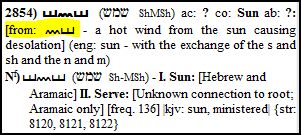
The sun, שמש ‘shemesh’, comes from the root word שם ‘shem’ which means ‘name.’ His Name = His Word (Revelation 19:13). As the sun moves through it courses, it teaches the Gospel.
In the Scriptures, the sun is likened to The LORD Jesus.
Mal 4:2 But to you who fear My name, the Sun of Righteousness shall rise up, and healing will be on His wings. And you shall go out and frisk like calves of the stall.
Psa 84:11 For Jehovah God is a sun and shield; Jehovah will give grace and glory; He will withhold nothing good from those who walk in integrity.
Psa 19:4 Their line is gone out through all the earth, and their words to the end of the world. In them hath he set a tabernacle for the sun,
Psa 19:5 Which is as a bridegroom coming out of his chamber, and rejoiceth as a strong man to run a race.
Mat 9:15 And Jesus said to them, Can the sons of the bridechamber mourn as long as the bridegroom is with them? But the days will come when the bridegroom will have been taken from them, and then they will fast.
Isa 9:2 The people who walk in darkness have seen a great light. The ones who dwell in the land of the shadow of death, light has shone on them.
Isa 49:6 And He said, It is too little that You should be My servant to raise up the tribes of Jacob, and to restore the preserved ones of Israel; I will also give You for a light of the nations, that You may be My salvation to the end of the earth.
Isa 60:1 Arise, shine; for your light has come, and the glory of Jehovah has risen on you!
Isa 60:2 For behold, the darkness shall cover the earth, and gross darkness the peoples. But Jehovah shall rise on you, and His glory shall be seen on you.
Isa 60:3 And nations shall walk to your light, and kings to the brightness of your dawning.
Joh 8:12 Then Jesus again spoke to them, saying, I am the Light of the world. The one following Me will in no way walk in the darkness, but will have the light of life.
The sun is the greater light {מאור ‘ma’or’} which rules the day. Messiah applies this to Himself.
Joh 11:9 Jesus answered, Are there not twelve hours in the day? If anyone walks in the day, he does not stumble because he sees the light of the world.
Joh 12:35 Then Jesus said to them, Yet a little while the Light is with you. Walk while you have the Light, that darkness not overtake you. And the one walking in the darkness does not know where he is going.
Joh 12:36 While you have the Light, believe into the Light, that you may become sons of Light. Jesus spoke these things, and going away He was hidden from them.
Joh 9:4 It behooves Me to work the works of Him who sent Me while it is day. Night comes when no one is able to work.
Joh 9:5 While I am in the world, I am the Light of the world.
Linden Tree

Līða traces back further to the Latin ‘lentus’ which means “pliant, flexible, slow.” This word traces back further to the Proto-Indo-European lentéh₂ which means a linden tree which is soft, flexible and easy to work with. The German ‘lind’ which means gentle, mild or soft furthers this connection.
The English word ‘linden’ is speaking of a tree by rivers of waters. The (linden) tree by the rivers of waters is a picture of the tree of life:
Psa 1:2 But his delight is only in the Law of Jehovah, and he meditates in His Law day and night.
Psa 1:3 And he shall be like a tree planted by the rivulets of waters, which will give its fruit in its seasons, and its leaf will not wither, and all which he does will prosper.
Rev 22:2 In the midst of its street and of the river, from here and from there, was a tree of life producing twelve fruits: according to one month each yielding its fruit. And the leaves of the tree were for healing of the nations.
Rev 22:3 And every curse will no longer be. And the throne of God and the Lamb will be in it; and His slaves will serve Him.
Linden trees have heart shaped leaves, further connecting to the law of God.
Psa 40:7 Then said I, Lo, I come: in the volume of the book it is written of me,
Psa 40:8 I delight to do thy will, O my God: yea, thy law is within my heart.
The New Covenant is God’s law/Torah written upon our hearts (Jeremiah 31:31-34; Hebrews 8:8-13), His character of love (John 13:34-35; 15:10-12; 1 John 4:21; James 2:8; Romans 13:8-10; Galatians 5:14), His Spirit dwelling within us (John 14:15-18; 1 John 3:22-24), God working in us (Philippians 2:13), transforming us into the image of Jesus Christ (Hebrews 13:21; Ephesians 3:17-20; Colossians 3:10; Romans 8:29; 1 John 4:8).
Heb 10:7 Then said I, Lo, I come (in the volume of the book it is written of me,) to do thy will, O God.
Heb 10:8 Above when he said, Sacrifice and offering and burnt offerings and offering for sin thou wouldest not, neither hadst pleasure therein; which are offered by the law;
Heb 10:9 Then said he, Lo, I come to do thy will, O God. He taketh away the first, that he may establish the second.
Papyrus sheets were glued together to form scrolls in ancient times from tree bark such as lime/linden (Latin ‘liber’). Jesus is the Word made flesh, when we are recreated in His image we will be living epistles…walking scrolls just as He was.
2Co 3:3 Forasmuch as ye are manifestly declared to be the epistle of Christ ministered by us, written not with ink, but with the Spirit of the living God; not in tables of stone, but in fleshy tables of the heart.
The word for letter in 2 Corinthians 3:3 is the Greek word ἐπιστολή ‘epistole’ (Epistle) which comes from the Hebrew word אגרת ‘egeret.’ In Hebrew ‘agar’ אגר means to gather and the letter ת tav means the cross/covenant. 2 Corinthians 3:3 describes the New covenant (Jeremiah 31:31; Hebrews 8:8; 10:16; Ezekiel 11:16-20; 36:26). Interestingly, אגר ‘agar’ comes from the root גר which literally means a ‘walking man.’ It is translated as a sojourner, traveler, and as a stranger (Genesis 17:8; 47:9; Leviticus 25:23; Psalm 39:12; 1 Peter 2:11; 1:17; Hebrews 11:9, 13-16; 13:14).
2Co 3:3 it having been made plain that you are Christ’s letter, served by us, not having been inscribed by ink, but by the Spirit of the living God, not in tablets of stone, but in fleshly tablets of the heart.
The word in Hebrew for tablet is לוח ‘luach’

The Linden tree in Scripture:
The following passage of Scripture is speaking of the remnant of Israel, the olive tree who are in the image and likeness of Messiah.
Isa 6:13 But yet in it shall be a tenth, and it shall return, and shall be eaten: as a teil tree (אלה ‘elah’ – linden), and as an oak, whose substance is in them, when they cast their leaves: so the holy seed shall be the substance thereof.
Treasury of Scripture Knowledge
teil tree: The teil-tree is the linden or lime-tree, a species very common in Palestine; the leaf of which resembles that of the laurel, and its flower that of the olive. But the original ailah which our translators render the oak (but here distinguished from allon the oak)
Keil & Delitszch speak of the linen and oak as ‘fitting symbols of Israel, on account of their peculiar facility for springing up again from the root (like the beech and nut, for example), even when they had been completely felled.’
“The root-stump was the remnant that had survived the judgment, and this remnant would become a seed, out of which a new Israel would spring up after the old had been destroyed (Matthew 3:10). Thus in a few weighty words is the way sketched out, which God would henceforth take with His people. The passage contains an outline of the history of Israel to the end of time. Israel as a nation was indestructible, by virtue of the promise of God; but the mass of the people were doomed to destruction through the judicial sentence of God, and only a remnant, which would be converted, would perpetuate the nationality of Israel, and inherit the glorious future. This law of a blessing sunk in the depths of the curse actually inflicted, still prevails in the history of the Jews.
The way of salvation is open to all. Individuals find it, and give us a presentiment of what might be and is to be; but the great mass are hopelessly lost, and only when they have been swept away will a holy seed, saved by the covenant-keeping God, grow up into a new and holy Israel, which, according to Isa_27:6, will fill the earth with its fruits, or, as the apostle expresses it in Rom_11:12, become “the riches of the Gentiles.”
The word for teil tree/linden tree in Hebrew is אלה ‘elah’ which comes from the root אל ‘el’ which is commonly translated as God.

Scrolls were held together by lime/linden trees. This is seen in creation as well. It is Christ who is holding all things together (Colossians 1:17).
Col 1:17 And he is before all things, and by him all things consist.
Jay P. Green Interlinear
Col 1:17 And He is before all things, and all things have subsisted (συνέστηκε ‘sunisteke’) in Him.
G4921
συνιστάω / συνιστάνω / συνίστημι
sunistaō / sunistanō / sunistēmi
Thayer Definition:
1) to place together, to set in the same place,to bring or band together
1a) to stand with (or near)
2) to set one with another
2a) by way of presenting or introducing him
2b) to comprehend
3) to put together by way of composition or combination, to teach by combining and comparing
3a) to show, prove, establish, exhibit
4) to put together, unite parts into one whole
4a) to be composed of, consist
Part of Speech: verb
A Related Word by Thayer’s/Strong’s Number: from G4862 and G2476 (including its collat. forms)
Liber
In Latin Liber means a book, bark of a tree, treatise, letter from Latin, in original sense: tree bark. Liber is also a rare name for phloem
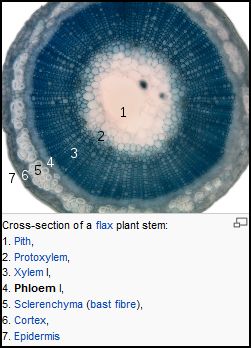
Phloem
“A tissue in vascular plants that conducts food from the leaves and other photosynthetic tissues to other plant parts.”
In vascular plants, phloem is the living tissue that carries organic nutrients (known as photosynthate), particularly sucrose, a sugar, to all parts of the plant where needed. In trees, the phloem is the innermost layer of the bark, hence the name, derived from the Greek word φλόος (phloos) “bark”. The phloem is concerned mainly with the transport of soluble organic material made during photosynthesis. This is called translocation.
Interestingly, when looking at the cross section of a tree from the the tilia genus (such as the linden tree mentioned above), it is seen that it is divided into 7 sections…just like the Menorah

Interestingly, flax has this same division.
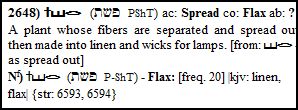
The word in Hebrew for flax links to the menorah as well. Flax was made into linen which then became wicks for lamps. Connecting flax to the current topic further, the root word for linden comes from ‘li’ which in the Indo-European language means flax. This would make *len (linden) an extension of the flax root meaning ‘flexible as threads made of flax,’ then of rope or cord made of other materials, like the inner bark of the linden.
The Menorah = the Word = the Tree of Life = the Olive Tree = the Body of Messiah…

Isa 8:18 Behold, I and the children whom the LORD hath given me are for signs and for wonders in Israel from the LORD of hosts, which dwelleth in mount Zion.
Interestingly, the Latin liber has the meaning of book but also freedom and children. Liber (book) refers to the inner bark of a tree used for writing tablets, symbolizing “freedom from restraint.” Liber (children) comes from the Proto-Italic ‘leibero’ linked to “free-born” child.
The linden tree was the most sacred and culturally significant trees in pre-Christian Germany. It was the “Tree of Justice, Truth and Peace.” Germanic tribes held judicial assemblies and legal proceedings under linden trees. Today this is still known as Gerichtslinde (‘judgment linden”) in German tradition.
We see this in the Scriptures as well under oaks, which are the same Hebrew word as the linden/teil tree.

On multiple occasions, God would appear to man under or by oak trees (Genesis 18:1-2; Judges 6:11-12, 19-20). It was also under an oak that Joshua set up a stone as a witness of God’s Word (Joshua 24:26-27).
As a result of the oak being connected to God, oaks became used for idolatrous purposes. Jacob hid his families’ idols under an oak by Shechem (Genesis 35:4) and later Israel would commit idolatry under oaks like their neighbors (Isaiah 1:28; Ezekiel 6:13; Hosea 4:13). The oak was sacred to the pagan gods Zeus and Thor and was linked to the pagan tree of life in Baltic and Norse mythology as well as in Druidism. The word druid traces back to the oak as it was a symbol of “strong knowledge.” Degenerate man corrupted the shadow picture of Messiah embedded within the oak tree and turned it into an idol.
Perhaps the most important reference to the oak tree in connection to Messiah is seen in Isaiah 6:13.
Isa 6:13 But yet in it shall be a tenth, and it shall return, and shall be eaten: as a teil tree, and as an oak, whose substance is in them, when they cast their leaves: so the holy seed shall be the substance thereof.
Here, the prophet Isaiah connects the Messiah and His body to an oak tree. The word substance in this verse comes from the Hebrew word מצבת ‘matsevet’ which literally means the stock or root of a tree. This word is also translated as pillar, as in the pillar which Jacob set up when he proclaimed the place upon which the ladder to heaven appeared to him as Bethel, the house of God (Genesis 28:10-22; 35:14-15). The living house of God is His people (Matthew 16:18; 1 Timothy 3:15-16; Hebrews 3:1-6; 1 Peter 2:4-5; Ephesians 2:11-22).
Christ is the Holy Seed, the Root of the tree of Israel.
מצבת ‘matsevet’ also means an image, corrupted into the idols of the heathen. Jesus is the true image of God.
2Co 4:4 in whom the god of this age has blinded the thoughts of the unbelieving, so that the brightness of the gospel of the glory of Christ who is the image of God, should not dawn on them.
The congregation of believers are to be the “image” of Messiah
Rom 8:29 because whom He foreknew, He also predestinated to be conformed to the image of His Son, for Him to be the First-born among many brothers.
2Co 3:18 But we all with our face having been unveiled, having beheld the glory of the Lord in a mirror, are being changed into the same image from glory to glory, as from the Lord Spirit.
Believers are specifically spoken of as “oaks” by the prophet Isaiah.
Isa 61:3 To appoint unto them that mourn in Zion, to give unto them beauty for ashes, the oil of joy for mourning, the garment of praise for the spirit of heaviness; that they might be called trees {איל -ayil – oaks} of righteousness, the planting of the LORD, that he might be glorified.
The seed of the oak tree is the acorn which continues the shadow picture theme of God the King. The word acorn comes from the Latin word ‘cornu’ which means a horn. ‘Cornu’ traces back further to the Hebrew word קרן ‘qeren’ which also means horn (Deuteronomy 33:17). The English word crown comes from this same Hebrew word as the ancient crown of a king consisted of the horns of an animal such as a ram (1 Samuel 2:10). Interestingly the Hebrew word for ram is one and the same as the Hebrew word for oak, איל ‘ayal.’ It is through the horns {קרן ‘qeren’} of the ram that Abraham found a substitute for sacrifice, saving Isaac (Genesis 22:13). Genesis 22 is one of the greatest pictures of the crucifixion of Jesus in all of Scripture and declares that He is God.
Believers receive the crown of life (James 1:12; Revelation 2:10), a crown of glory that does not fade away (1 Peter 5:4), a kingdom from the King (Matthew 25:34) after we’ve fought the good fight and ran the race.
2Ti 4:7 I have fought a good fight, I have finished my course, I have kept the faith:
2Ti 4:8 Henceforth there is laid up for me a crown of righteousness, which the Lord, the righteous judge, shall give me at that day: and not to me only, but unto all them also that love his appearing.
1Co 9:24 Know ye not that they which run in a race run all, but one receiveth the prize? So run, that ye may obtain.
1Co 9:25 And every man that striveth for the mastery is temperate in all things. Now they do it to obtain a corruptible crown; but we an incorruptible.
Recall that the linden tree has a leaf which resembles the laurel. The corruptible crown Paul alludes to was the laurel. Herein lies the theme of this study. The truth versus the counterfeit. The seed of the woman versus the seed of the serpent.

In Norse culture, the linded was sacred to the goddess Freya (Frigg/Frigga), the goddess of love, beauty, fertility, war and truth. Its heart-shaped leaves symbolized love, tenderness, and the “heart” of the community. Linden flowers and wood were used in love charms and rituals.
Freya/Frigga is strongly linked to Venus. Friday is named after Freya from the Old English Frīġedæġ (“Frigg’s day” or “Freya’s day”) corresponding with the Latin ‘dies Veneris’ (“Venus’s day”). This is still seen today in the French ‘vendredi’ and Spanish ‘viernes.’ Freya and Venus were both goddesses of love, beauty, fertility, sex, and desire.
Līða also has the meaning of supple. Supple means something that is “flexible, pliant, easily bent, not rigid.” from the Latin ‘supplex’ meaning flexible, limber, pliant, something able to bend easily without breaking or resisting. It’s seen in a “supple” branch that bends out of your way as you walk through the woods allowing you to move through more easily.
Mat 12:17 That it might be fulfilled which was spoken by Esaias the prophet, saying,
Mat 12:18 Behold my servant, whom I have chosen; my beloved, in whom my soul is well pleased: I will put my spirit upon him, and he shall shew judgment to the Gentiles.
Mat 12:19 He shall not strive, nor cry; neither shall any man hear his voice in the streets.
Mat 12:20 A bruised reed shall he not break, and smoking flax shall he not quench, till he send forth judgment unto victory.
Mat 12:21 And in his name shall the Gentiles trust.
Isa 42:1 Behold my servant, whom I uphold; mine elect, in whom my soul delighteth; I have put my spirit upon him: he shall bring forth judgment to the Gentiles.
Isa 42:2 He shall not cry, nor lift up, nor cause his voice to be heard in the street.
Isa 42:3 A bruised reed shall he not break, and the smoking flax shall he not quench: he shall bring forth judgment unto truth.
Isa 42:4 He shall not fail nor be discouraged, till he have set judgment in the earth: and the isles shall wait for his law.
John Gill – Isaiah 42:3
and the smoking flax shall he not quench; or, “the wick of a candle; (h)” which just going out, has some heat, a little light, smokes, and is offensive; so the persons intended by it are fired or lighted by the divine word; have some heat of affection in them to spiritual things, but have but little light; into the corruption of nature into the glories of Christ’s person; into the doctrines of the Gospel; into the everlasting love of God, and the covenant of grace; and but little light of joy and comfort, and this almost gone, and seemingly ready to go out; and yet Christ will not extinguish it, or suffer it to be extinct; he does not discourage small beginnings of grace, or despise the day of small things; he blows up their light into a flame; he increases their spiritual light and knowledge; supplies them with the oil of grace; trims, snuffs, and causes their lamps to burn brighter. The Targum is,
“the meek, who are like to a bruised reed, shall not be broken; and the poor, who are as obscure as flax (or a lamp ready to go out), shall not be extinct:”
The Latin ‘supplex’ comes from ‘sub’ meaning “under, from below” and ‘plicare’ which means “to fold, bend or twist.” Literally, something folded or bent under referring to the posture of someone humbly kneeling or bowing in supplication.
This corresponds with the Hebrew word עָנָו ‘anav’ or עָנָוָה ‘anavah’ which means“gentle, humble, meek, lowly.”
Zec 9:9 Rejoice greatly, O daughter of Zion; shout, O daughter of Jerusalem: behold, thy King cometh unto thee: he is just, and having salvation; lowly (עָנִי ‘aniy’), and riding upon an ass, and upon a colt the foal of an ass.
The Greek equivalent is πρᾷος ‘praos.’ This is the word used for the meek in Matthew 5:5 who shall inherit the earth.
Mat 5:5 Blessed are the meek (πρᾷος ‘praos’): for they shall inherit the earth.
This is the word used in reference to Christ.
Mat 11:28 Come unto me, all ye that labour and are heavy laden, and I will give you rest.
Mat 11:29 Take my yoke upon you, and learn of me; for I am meek (πρᾷος ‘praos’) and lowly in heart: and ye shall find rest unto your souls.
Mat 11:30 For my yoke is easy, and my burden is light.
Another Hebrew word which gives the sense of Līða is נח ‘nach.’ It points to the Good Shepherd.
Psa 23:1 A Psalm of David. The LORD is my shepherd; I shall not want.
Psa 23:2 He maketh me to lie down in green pastures: he leadeth me beside the still (מנוחה ‘menuchah’) waters.

The Good Shepherd delivers us from the counterfeit/false shepherds
Joh 10:1 Verily, verily, I say unto you, He that entereth not by the door into the sheepfold, but climbeth up some other way, the same is a thief and a robber.
Joh 10:2 But he that entereth in by the door is the shepherd of the sheep.
Joh 10:3 To him the porter openeth; and the sheep hear his voice: and he calleth his own sheep by name, and leadeth them out.
Joh 10:4 And when he putteth forth his own sheep, he goeth before them, and the sheep follow him: for they know his voice.
Joh 10:5 And a stranger will they not follow, but will flee from him: for they know not the voice of strangers.
Joh 10:6 This parable spake Jesus unto them: but they understood not what things they were which he spake unto them.
Joh 10:7 Then said Jesus unto them again, Verily, verily, I say unto you, I am the door of the sheep.
Joh 10:8 All that ever came before me are thieves and robbers: but the sheep did not hear them.
Joh 10:9 I am the door: by me if any man enter in, he shall be saved, and shall go in and out, and find pasture.
Joh 10:10 The thief cometh not, but for to steal, and to kill, and to destroy: I am come that they might have life, and that they might have it more abundantly.
Joh 10:11 I am the good shepherd: the good shepherd giveth his life for the sheep.
Joh 10:12 But he that is an hireling, and not the shepherd, whose own the sheep are not, seeth the wolf coming, and leaveth the sheep, and fleeth: and the wolf catcheth them, and scattereth the sheep.
Joh 10:13 The hireling fleeth, because he is an hireling, and careth not for the sheep.
Joh 10:14 I am the good shepherd, and know my sheep, and am known of mine.
Joh 10:15 As the Father knoweth me, even so know I the Father: and I lay down my life for the sheep.
Joh 10:16 And other sheep I have, which are not of this fold: them also I must bring, and they shall hear my voice; and there shall be one fold, and one shepherd.
Joh 10:17 Therefore doth my Father love me, because I lay down my life, that I might take it again.
Joh 10:18 No man taketh it from me, but I lay it down of myself. I have power to lay it down, and I have power to take it again. This commandment have I received of my Father.
Continuing with the gentle Shepherd theme is the Hebrew word נחל ‘nachal.’
Isa 40:11 He shall feed his flock like a shepherd: he shall gather the lambs with his arm, and carry them in his bosom, and shall gently lead (נחל ‘nachal’) those that are with young.

Līða also has the sense of grace, or gracious. The root līð- (“soft, supple, yielding”) implies a gracious yielding. Old English līða / līðe means “gentle, mild, soft, gracious.”
Gen 6:8 But Noah (נח ‘Noach’) found grace (חן ‘chen’) in the eyes of the LORD.

It is interesting to note that this month is strongly connected to freedom.
Daily Tidbits 7/4/26 – Independence Day
This is seen in חנם ‘chinnam’ which comes from the root חן ‘chen.’

חן ‘chen’ is connected to the number 5 which was the old Roman name of the month of July, Quintilis which means five.
The number 5 is strongly associated with grace in the Scriptures. The Hebrew word for five is חמש ‘chamesh’ which is the picture of a hand. The fifth letter of the Hebrew alphabet is ה ‘heh’ which is a picture of a man with outstretched hands, as in the Messiah on the cross. This grace, hand, cross connection is seen in more detail in the study: Messiah in the Torah – Genesis 1:20-23 (Day 5).
Quintilis
July was originally called Quintilus. The early Roman calendar began in March (Martius), the start of the military/campaigning season. Quintilis was so named as the Latin for five is quinque. Quintilus means the fifth, as in the fifth month. Julius Caesar was born in Quintilus. After his death, Mark Antony suggested the month be renamed for Julius which was agreed upon by the Roman Senate as a part of his “deification.” Januarius (January) was named after Janus, Februarius (February) was named after februa which were purification rites, Martius (March) was named after Mars, Aprilis (April) was named after Venus, Maius (May) was named after Maia, Junius (June) was named after Juno. Julius (July) was then named after the new “deified” Julius Caesar.
Julius

Iūlius was the family name of Julius Caesar. It meant pertaining to or descended from Jove. Jove was and older form of Iuppiter (Jupiter) the chief Roman god.
Jove traced back further to the Proto-Indo-European root dyeu which meant “to shine,” hence “sky, heaven, god.” This was the same source of the name Zeus who was the Greek equivalent to the Roman Jupiter. Here we see in Julius Caesar’s name a false son of God.
Jupiter (Iuppiter) is a compound for Iov-pater which means Father Jove. Pater means father and Iov meant sky, heaven, daylight. Sky Father.
Jove pronunciation
Some believe that Jove (Iove) was pronounced as Yahweh as Classical Latin had no letter “J”. Jove was Iove. I before a vowel was pronounced like the English Y. O could be prounced ‘ah’ as in “cost” and V was pronounced like the English W. Combined the name would have been Yoway or possibly Yaway.
Wilhelm Gesenius wrote in his Hebrew lexicon that the name YHWH might be “of the same origin as Jovis [Jove], Jupiter, possibly transferred from Egyptians or Phoenicians to the Hebrews.” Jupiter was transliterated into Greek as Ιαβε ‘Iave’ or Ιαου ‘Iaou.’ The Greek historian Diodorus Siculus Roman Jupiter as Ιαβε ‘Iave’ (‘Yahve’).
However, in Classical Latin Jove (Iove) was not the name it was Iovis, a shortened form of Iupiter. During the renaissance English writers started using Jove for Iovis.
Either way, Jupiter as the Sky Father does display the counterfeit Yahweh imagery.
Jupiter was the equivalent of Zeus the “Sky father, the Thunder god”. This is seen in the Scriptures in Baal.
Baal Hadad (Lord Hadad) was also the “storm god” of the Canaanites/Phoenicians. Hadad came from the Semitic root חדד ‘chadad’ which means to thunder to make a loud noise. Baal Hadad was the son of the Most High God El. Baal Hadad was shortened to Baal during Biblical times.
Baal was the god of thunder and storm. He was depicted ridings on the clouds, wielding lightning bolts and his voice as thunder. The Lord declares Himself in this same imagery in the book of Psalms which displays He is the True God.
Psa 29:3 The voice of the LORD is upon the waters: the God of glory thundereth: the LORD is upon many waters.
Psa 29:7 The voice of the LORD divideth the flames of fire.
Psa 18:6 In my distress I called upon the LORD, and cried unto my God: he heard my voice out of his temple, and my cry came before him, even into his ears.
Psa 18:7 Then the earth shook and trembled; the foundations also of the hills moved and were shaken, because he was wroth.
Psa 18:8 There went up a smoke out of his nostrils, and fire out of his mouth devoured: coals were kindled by it.
Psa 18:9 He bowed the heavens also, and came down: and darkness was under his feet.
Psa 18:10 And he rode upon a cherub, and did fly: yea, he did fly upon the wings of the wind.
Psa 18:11 He made darkness his secret place; his pavilion round about him were dark waters and thick clouds of the skies.
Psa 18:12 At the brightness that was before him his thick clouds passed, hail stones and coals of fire.
Psa 18:13 The LORD also thundered in the heavens, and the Highest gave his voice; hail stones and coals of fire.
Psa 18:14 Yea, he sent out his arrows, and scattered them; and he shot out lightnings, and discomfited them.
Psa 18:15 Then the channels of waters were seen, and the foundations of the world were discovered at thy rebuke, O LORD, at the blast of the breath of thy nostrils.
For more on the Bible and Ancient Near East parallels see:
https://intertextual.bible/group/ancient-near-east
All of these pagan god names and attributes are counterfeits of the true God. Pagan gods display aspects and characteristics of the Lord which point mankind to their Creator but at the same time hold them in bondage to Satan, the “great counterfeiter.” Satan takes partial truths (power, light, life, victory, heavenly rule) and twists them into idols that point toward the Creator while leading people away into bondage.
Zeus is a name which derives from the true God. Ζευς ‘Zeus’ comes from Greek word ζην ‘zen’ meaning to live and Δια ‘Dia’ from δυι ‘dui’ meaning through. ‘To live through.’ This is the definition of God (Acts 17:28; John 1:1-9) which was corrupted by the heathen into the name of a false god.”
The Letter of Aristeas written in the 2nd century BC has the author saying the following to Ptolemy in reference to the translating of the TaNaKH into Greek {Septuagint}
“Since the law which we wish not only to transcribe but also to translate belongs to the whole Jewish race, what justification shall we be able to find for our embassy while such vast numbers of them remain in a state of slavery in your kingdom? In the perfection and wealth of your clemency release those who are held in such miserable bondage, since as I have been at pains to discover, the God who gave them their law is the God who maintains your kingdom. They worship the same God – the Lord and Creator of the Universe, as all other men, as we ourselves, O king, though we call him by different names, such as Zeus or Dis. This name was very appropriately bestowed upon him by our first ancestors, in order to signify that He through whom all things are endowed with life and come into being, is necessarily the ruler and lord of the Universe. Set all mankind an example of magnanimity by releasing those who are held in bondage.” {Letter of Aristeas 15-16}
Aristeas is deriving the above meaning of Ζευς ‘Zeus’ from ζην ‘zen’ meaning to live and Δια ‘Dia’ from δυι ‘dui’ meaning through. To live through. Paul alludes to this on Mars Hill.
Act 17:23 For as I passed by, and beheld your devotions, I found an altar with this inscription, TO THE UNKNOWN GOD. Whom therefore ye ignorantly worship, him declare I unto you.
Act 17:28 For in him we live, and move, and have our being; as certain also of your own poets have said, For we are also his offspring.
Morgan Peter Kavenaugh in his book, “The Origin of Language and Myths” came to the same conclusion. “I have shown elsewhere that the English word God, the German Gott, the Persian Bhoda and the Hindustani Khuda are all derived from the same root as that which appears in Celtic Aeddon or Guydion, the Germanin Odin, Woden or Goutan and the Indian Buddha or Gotama””
Dyḗus is the source of Zeus, the thunder god. Dyaus Pita (Vedic) sky father and Tyr/Tiw (Germanic) sky/war god. The Latin ‘dies’ (day), Diana (divine, heavenly, godlike) the Old English ‘dæg’ (day) and the English divine and deity come from this word. The Sanskrit ‘dyaus’ (sky) and ‘deva’ (god), the Lithuanian ‘dievas’ (god), Irish ‘dia’ (god) and Welsh ‘duw’ (god) all comes from Dyḗus.
For more on this see: Daily Tidbits 3/8 – God
Jupiter/Zeus was the sky and thunder god, ruler of the gods, associated with law, order, justice, and the state. His symbols include the thunderbolt, eagle, and oak tree.
Peak thunderstorm season is from June to August. Recall Līða (June/July) was described as the time of calm, gentle, navigable seas and quiet skies. This peaceful season is interrupted by short thunderstorms. The oak tree is strongly linked to Līða mentioned above. The eagle is a picture of the true God.
The LORD God is likened unto an eagle
Deu 32:11 As the eagle stirs up its nest; it hovers over its young; it spreads out its wings and takes it, and bears it on its wing.
Deu 32:12 Jehovah alone led him, and there was no strange god with him.
Exo 19:4 You have seen what I did to Egypt; and I bore you on wings of eagles and brought you to Me.
Exo 19:5 And now if listening you will listen to My voice, and will keep My covenant, you shall become a special treasure to Me above all the nations, for all the earth is Mine.
Exo 19:6 And you shall become a kingdom of priests for Me, a holy nation. These are the words which you shall speak to the sons of Israel.
Being born on eagle’s wings is linked to salvation and resurrection
Isa 40:31 but the ones waiting for Jehovah shall renew power; they shall go up with wings as the eagles; they shall run and not be weary; they shall walk and not be faint!
Psa 84:7 They go from strength to strength, being seen in Zion before God.
Zec 10:12 And I will make them strong in Jehovah, and they shall walk up and down in His name, says Jehovah.
2Co 4:16 Because of this, we do not faint, but if indeed our outward man is being decayed, yet the inward man is being renewed day by day.
2Co 4:17 For the lightness of our present affliction works out for us an eternal weight of glory, surpassing moment by surpassing moment;
2Co 4:18 we not considering the things seen, but the things not being seen; for the things being seen are not lasting, but the things not being seen are everlasting.
Rev 12:14 And two wings of the great eagle were given to the woman, that she might fly into the wilderness, to her place, where she is nourished there a time, and times, and half a time, away from the serpent’s face.
Rev 12:15 And the serpent threw water out of his mouth like a river after the woman, that he might cause her to be carried off by the river.
Rev 12:16 And the earth helped the woman, and the earth opened its mouth and swallowed the river which the dragon threw out of his mouth.
Rev 12:17 And the dragon was enraged over the woman, and went away to make war with the rest of her seed, those keeping the commandments of God, and having the testimony of Jesus Christ.
Julius Caesar’s “deification”
Before his deification, Caesar had already made claim to divine origins but it was after his death that he was “officially” seen as a god.
After his death in 44 BC there was widespread mourning and the people gave him “divine-style” honors with altars and sacrifices. His body was cremated in the Roman Forum. During the funeral games a bright comet, known as the Julian star (Sidus Iulium ) appeared in the sky and was visible for seven days. It was a sign to the Romans that Julius Caesar’s soul had ascended to the heavens and he became a god. In 42 BC, the Roman Senate made his “deification” official naming him “Divus Iulius” (the divine Julius). Afterwards a temple was decreed on the site of Caesar’s cremation and dedicated by Augustus.
Augustus (Octavian) was Caesar’s great nephew and adopted heir. He was young, relatively unknown, and physically in a weak position at first. Mark Antony was Caesar’s trusted lieutenant, consul, and the senior military figure. He had immediate control in Rome and expected to be the natural successor.
After the assassination in March 44 BC, there was a power struggle. Mark Antony was Caesar’s trusted friend and senior military figure, he had immediate control after Caesar’s assassination and was thought to become his successor. Augustus (Octavian) was Caesar’s great nephew and adopted heir. He was young, relatively unknown, and physically in a weak position at first. After the comet, the Roman people spontaneously interpreted it as Caesar’s soul rising to the gods and led to massive support for Octavian (Augustus) who was hosting the games in honor of Julius. Octavian had now become the “Son of the Divine,” leading him to become Augustus the first emperor of Rome.
Octavian became Augustus (“the revered one”) after defeating Mark Antony at the Battle of Actium in 31 B.C. He gained supreme power and began the Roman Empire.
Julian star

The “Julian star” was a bright comet that appeared in the skies over Rome in July 44 BC, shortly after Julius Caesar’s assassination on the Ides of March (March 15, 44 BC). The star was visibile for seven consecutive days, moving towards the constellation Lyra. In the Denderah Zodiac, Lyra was originally pictured as an eagle, the symbol of Jupiter.
Bullinger: “LYRA. (#Ps 65:1) The brightest star Vega = He shall be exalted. In the Zodiac of Denderah = Fent—kar = the serpent ruled. Originally an eagle, from confusion between Hebrew nesher, and shir (song or music).”
In Greek mythology, Lyra represents the lyre of Orpheus. After Orpheus was killed, his lyre was placed in the sky by Zeus (or Apollo). Ancient depictions often showed Lyra as an eagle (or vulture) carrying the lyre — which is why some older names for it were Vultur Cadens (“Falling Vulture”) or Aquila Cadens (“Falling Eagle”).
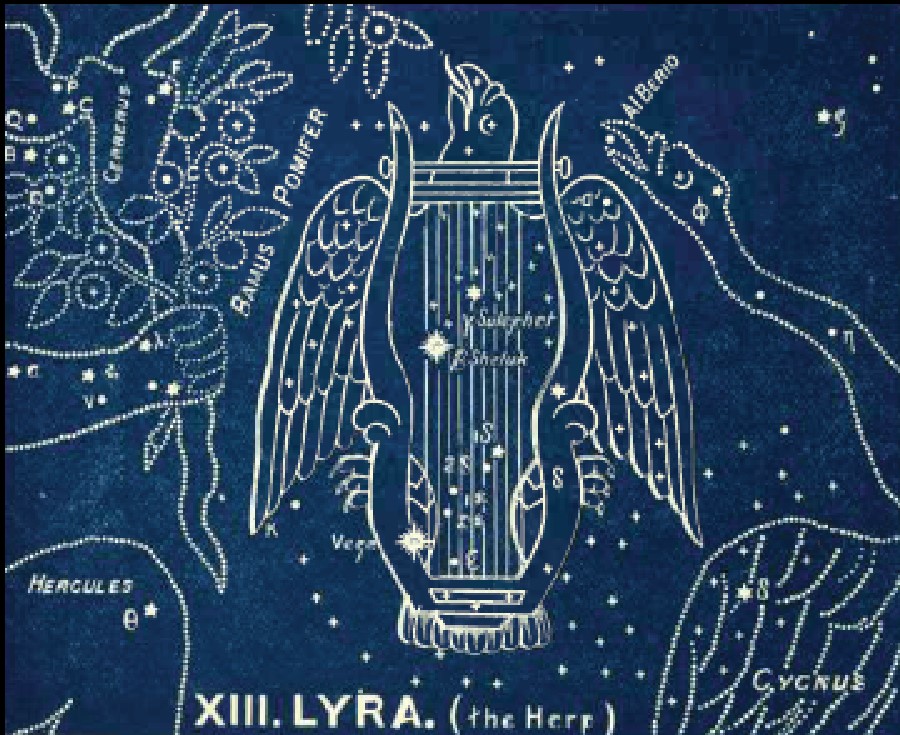
The Gospel in the Stars – E.W. Bullinger
“THE HARP
In connection with this shooting of the Almighty’s arrows against His enemies, when His right hand shall find them out and His wrath swallow them up, so that their fruit shall be destroyed from the earth and their seed from among the children of men, the twenty-first Psalm introduces a special celebration of God’s exalted strength in the matter, and represents all His holy ones as singing and praising His power. So also in the Apocalyptic visions of the destruction of the destroyers of the earth, the four-and-twenty elders in heaven fell upon their faces and worshipped God, saying, ” We give Thee thanks, O Lord God, the Almighty, who art and who wast, because Thou hast taken to Thee Thy great power, and hast reigned” i.e. entered on Thy dominion. Accordingly, also, the first Decan of Sagittarius is the constellation of Lyra, the Lyre, the Harp, marked by one of the brightest stars in the northern heavens.
THE LYRE OF ORPHEUS
The harp is the oldest of stringed instruments of music. The ancients ascribed its invention to the gods. We find it named along with the organ, or shepherd’s pipe, three hundred years before Adam died (Gen. 4:21), and find a specimen of song to be sung to it dating back to the same period (Gen. 4:23, 24). The most renowned performer on the harp or lyre in the classic myths is Orpheus, often identified with Apollo. He is called the father of songs and the particular helper of the Argonauts, the noble ones seeking for the Golden Fleece. He is not mentioned by this name by Hesiod or Homer, and subsequent writers place him far anterior to Hesiod and Homer, and mention all poets and singers as his children or the children of Apollo, to whom he stands in close relation. His art is everywhere associated with religion, prayer, prophecy, and all sacred services, teachings, and anticipations, especially with the joyous element in holy things. At the instance of Apollo and the Muses, it is said, God himself placed the Harp of Orpheus among the stars, where it has ever since been gladdening the celestial sphere with brightness and with song.
The placing of that harp as the first Decan of Sagittarius connects pre-eminent gladness, joy, delight, and praise with the action of this great Archer with his bow and arrows. There is but one such sign in all the ancient constellations, and that is associated with the going forth of this double-natured Bowman aiming his arrows at the Scorpion’s heart. It marks him in this particular attitude and act as the achiever of what is the sublimest glory of God and the sublimest joy of heaven.
People often smile and jest at the fabled power of the lyre of Orpheus, at which the rivers for the time forgot to flow, the wild beasts lost their savageness, the trees and rocks on Olympus moved from their places to listen, the ship of the Argonauts glided smoothly into the sea, the mountains became entranced, the dragon that guarded the Golden Fleece sank into sleep, the sufferers in the under-world for the moment lost their pains, and all the potencies of hell yielded homage. But when we connect that lyre with the action of this glorious Archer, and take that action in its true prophetic significance, as the inventors of these signs intended them, these smiles and jests subside, and a scene of glorious achievement opens to our view, which has been the burden of all the songs and prayers and hopes and joyful anticipations of an enthralled and suffering word from the time that Adam was driven out of Eden up till then.
That glorious Archer, as he appears in this sign, answers to the Lamb as John beheld Him, standing, having seven horns and seven eyes — all the fulness of regal, intellectual, and spiritual power and almightiness — and in the act of lifting the titledeed of the alienated inheritance to take possession again of all that sin has disponed away. Heaven contemplated that act with awe, and grew breathless as it gazed, and a thrill went through the universal heart of living things. A new song broke forth from the living ones and elders around the throne of Deity, and rolled sublime through all the heavenly spheres, till afar in the depths of space the voices of angelic myriads took it up, and every creature in heaven, and on earth, and under the earth, and upon the sea, and all things in these realms, were heard singing, and saying, ” To Him that sitteth upon the throne, and to the Lamb, be the blessing, and the honor, and the glory, and the dominion for the ages of the ages!” And this is the true lyre of Orpheus —the joy and gladness and jubilation of the universe at the fulfilment of the burden of all sacred hope and prayer embodied in the word’s, ” Thy kingdom come. Thy will be done on earth as it is in heaven!” We thus observe a depth, a splendor, a volume, a pathos, a universality of sacred ardor and poetic outpouring, as just as it is tremendous, and to which all the extravagances of the mythic records do not reach halfway.
With a wonderful appropriateness, then, which could hardly have come from the unaided powers of man, did the framers of these constellations select the brightest star in the northern heavens to represent this harp, and give to it the name of Vega, which signifies He shall be exalted, The warrior triumphant — the very name from which our own word victory has come — a name which the Apostle uses in its primeval and true connection where he challenges Death and Hades, triumphs over them, and cries his glad thanks “to God who giveth us the victory through our Lord Jesus Christ.”
In some of the old uranographies this constellation is marked by the figure of an eagle or hawk, the enemy of the serpent, who darts forth upon his prey from the heavenly heights with great suddenness and power; and this eagle is in the attitude of triumph, much as the Mexican eagle is presented victoriously grasping the serpent in its claws. It is the same idea, the triumphant overwhelming of the enemy. From this many of the modern atlases represent the figure of this constellation by an eagle holding the harp, or a harp placed over an eagle, expressing triumphant song springing from the eagle — that is, from the vanquisher and destroyer of the serpent. Whatever the variations of the figure, the same idea is retained, showing the true intention in the marking of this constellation, and the tenacity with which the original thought has clung to it in all ages and in all nations. It is the sign of the Serpent ruled, the Enemy destroyed, the triumphant fulfilment of the sublimest of hopes and sacred promises.”
Mazzaroth – Frances Rolleston


Mazzaroth – Frances Rolleston
“The two birds of atonement – one killed, the other let go free – also typify the death, resurrection, and ascension of Him who, coming down from heaven, should return thither. With these correspond the constellations Aquila, the wounded and falling eagle, and the eagle of Lyra, risen and triumphing. The slain bird was to be killed over water from a running stream: so the falling eagle is over the water flowing from the urn of Aquarius. Aquila, the wounded, Vega, the triumphant, in Lyra, and Cygnus, the wild swan going and returning, are among the most remarkable of the stars in our sky, and the first to be recognized by learners: would it not be well again to connect with them the death, resurrection, ascension, and coming again of the great object of prophecy, of Him who is equally the subject of the types of the Levitical Law and the emblems of ancient astronomy?”
All of this is shared to display this Julian comet as a counterfeit of the Star of Jacob which heralded the birth of Christ.
Num 24:17 I shall see him, but not now: I shall behold him, but not nigh: there shall come a Star out of Jacob, and a Sceptre shall rise out of Israel, and shall smite the corners of Moab, and destroy all the children of Sheth.
The Julian star served as a false fulfillment of the Star out of Jacob. Origen alluded to this in Contra Celsum (Against Celsus).
“It has been observed that, on the occurrence of great events, and of mighty changes in terrestrial things, such stars are wont to appear, indicating either the removal of dynasties or the breaking out of wars… But we have read in the Treatise on Comets by Chæremon the Stoic, that on some occasions also, when good was to happen, comets made their appearance…
If, then, at the commencement of new dynasties, or on the occasion of other important events, there arises a comet so called, or any similar celestial body, why should it be matter of wonder that at the birth of Him who was to introduce a new doctrine to the human race… a star should have arisen?
Now I would say, that with respect to comets there is no prophecy in circulation to the effect that such and such a comet was to arise in connection with a particular kingdom or a particular time; but with respect to the appearance of a star at the birth of Jesus there is a prophecy of Balaam recorded by Moses to this effect: ‘There shall arise a star out of Jacob, and a man shall rise up out of Israel.’” (Origen – Contra Celsum (Against Celsus), Book I, Chapters 58–60)
Cain Connection
Cain was the original “counterfeit Christ.” In Genesis 4:1, the Bible says in the Hebrew קניתי אישׁ את־יהוה ‘qaniytiy iysh et Yahweh’ “I have gotten a man, Yahweh”
In the margin note of original 1611 King James Versions of Genesis 3:15 it reads “I have gotten a man, the LORD” or “even the LORD.” John Calvin in his commentary and Matthew Poole in his annotations speak of this interpretation.
The ancients saw Cain in this manner.
Targum Jonathan on Genesis 4:1
וְאָדָם יְדַע יַת חַוָה אִיתְּתֵיהּ דַהֲוָה חֲמֵידַת לְמַלְאָכָא וְאַעֲדִיאַת וִילֵידַת יַת קַיִן וַאֲמָרַת קָנִיתִי לְגַבְרָא יַת מַלְאָכָא דַיְיָ
And Adam knew Hava his wife, who had desired the Angel; and she conceived, and bare Kain; and she said, I have acquired a man, the Angel of the Lord.
Targum Neofiti“And Adam knew his wife Eve, and she conceived and bore Cain, and she said, ‘I have gotten a man from the Memra of the Lord.’”
Midrash Aggadah, Genesis 4:1:2
And she said, “I have acquired a man with the Lord.” She said, “In the past, I and my husband would form [it] and the Holy One, blessed be He, would join with us in its formation. For the limbs would be because of me and because of my husband and the soul would be from God. Hence, let us call him, Cain, since I acquired (kaniti) a man with the Lord — this child was created [only] between Him and I.”
The Targumists interpreted the Hebrew as intimating that Eve thought that Cain would be the fulfillment of the promised Seed. This has been the story of all of history. The battle between the seeds.
Gen 3:15 And I will put enmity between thee and the woman, and between thy seed and her seed; it shall bruise thy head, and thou shalt bruise his heel.
The Apostle John speaks of Cain being from the wicked one (1 John 3:12). The phrase “of that wicked one” ἐκ τοῦ πονηροῦ ‘ek tou ponērou’ means “from/out of” or “belonging to.” Cain slew his brother just as satan was a murderer from the beginning (John 8:44).
1Jn 3:1 Behold, what manner of love the Father hath bestowed upon us, that we should be called the sons of God: therefore the world knoweth us not, because it knew him not.
1Jn 3:2 Beloved, now are we the sons of God, and it doth not yet appear what we shall be: but we know that, when he shall appear, we shall be like him; for we shall see him as he is.
1Jn 3:3 And every man that hath this hope in him purifieth himself, even as he is pure.
1Jn 3:4 Whosoever committeth sin transgresseth also the law: for sin is the transgression of the law.
1Jn 3:5 And ye know that he was manifested to take away our sins; and in him is no sin.
1Jn 3:6 Whosoever abideth in him sinneth not: whosoever sinneth hath not seen him, neither known him.
1Jn 3:7 Little children, let no man deceive you: he that doeth righteousness is righteous, even as he is righteous.
1Jn 3:8 He that committeth sin is of the devil; for the devil sinneth from the beginning. For this purpose the Son of God was manifested, that he might destroy the works of the devil.
1Jn 3:9 Whosoever is born of God doth not commit sin; for his seed remaineth in him: and he cannot sin, because he is born of God.
1Jn 3:10 In this the children of God are manifest, and the children of the devil: whosoever doeth not righteousness is not of God, neither he that loveth not his brother.
1Jn 3:11 For this is the message that ye heard from the beginning, that we should love one another.
1Jn 3:12 Not as Cain, who was of that wicked one, and slew his brother. And wherefore slew he him? Because his own works were evil, and his brother’s righteous.
The Way of Cain
The way of Cain is the beast nature, the nature that comes from the beast in the beginning. This beast nature is spoken of throughout the Scriptures speaking of the way of carnal man (Proverbs 12:1; Psalm 49:10-20; 92:6; 94:8-13; Jeremiah 10:8, 14-16, 21).
Gen 3:1 Now the serpent was more subtil than any beast of the field which the LORD God had made. And he said unto the woman, Yea, hath God said, Ye shall not eat of every tree of the garden?
Jud 1:10 But these speak evil of those things which they know not: but what they know naturally, as brute beasts, in those things they corrupt themselves.
Jud 1:11 Woe unto them! for they have gone in the way of Cain, and ran greedily after the error of Balaam for reward, and perished in the gainsaying of Core.
The way of Cain is linked to the error of Balaam. The”Julian star” which was used to “prove” the deification of Julius Caesar could be seen as a counterfeit of the Star that Balaam prophesied in reference to Christ.
Num 24:17 I shall see him, but not now: I shall behold him, but not nigh: there shall come a Star out of Jacob, and a Sceptre shall rise out of Israel, and shall smite the corners of Moab, and destroy all the children of Sheth.
Interestingly, the name Cain (קין ‘qayin) is used in Balaam’s prophecy. It refers to the Kenite which is used only one other time in Scripture speaking of the slaying of Sisera in which Scripture refers to the stars fighting against him.
Jdg 5:20 They fought from heaven; the stars in their courses fought against Sisera.
H7014
קין
qayin
Total KJV Occurrences: 19
cain, 17
Gen_4:1-3 (3), Gen_4:5-6 (3), Gen_4:8-9 (3), Gen_4:13, Gen_4:15-17 (4), Gen_4:24-25 (2), Jos_15:57
kenite, 2
Num_24:22, Jdg_4:11
In the 1st century, many Jews associated comets or bright stars with the fulfillment of Balaam’s prophecy. Josephus and other sources note that unusual celestial signs fueled messianic fervor during the lead-up to the Jewish Revolt (66–73 AD).
Early Christians sometimes contrasted the true Star (Christ, the Star of Balaam and the Bright Morning Star of Revelation 22:16) with pagan counterfeit stars, including the Julian Star.
Some patristic writers or later commentators used the Julian Star as an example of a false celestial sign used to deify a man (Caesar), in contrast to the true star that heralded the Messiah.
The Julian Star helped launch the Augustan “golden age” (pax Augusta), which providentially prepared the world for the birth of Christ (as some Church Fathers like Eusebius and Orosius argued).
Tammuz
The Jewish month of Tammuz coincides with this time period (June-July). Tammuz which portrays the same theme of July. A counterfeit Christ.
For more on this see: Daily Tidbits 6/15/26 – 4th Month Tammuz
Venus
Caesar claimed descent from Venus (through Aeneas/Iulus) and was called a “son of God” in the imperial cult. Caesar made claim to his descent from Venus in 69 BC during the funeral for his aunt Julia.
“The family of my aunt Julia is descended by her mother from the kings, and on her father’s side is akin to the immortal Gods; for the Marcii Reges go back to Ancus Marcius, and the Julii, the family of which ours is a branch, to Venus. Our stock therefore has at once the sanctity of kings, whose power is supreme among mortal men, and the claim to reverence which attaches to the Gods, who hold sway over kings themselves.” (Suetonius – Life of Julius Caesar 6)
Caesar issued coins with the head of Venus and had the Temple of Venus Genetrix (Venus the Mother) built to remind the people of his divine ancestry. When he died and the “Julian Star” appeared it was said that Venus lifted Caesar’s soul and transformed it into a star.
“He [Jupiter] had barely finished, when gentle Venus stood in the midst of the Senate, seen by no one, and took up the newly freed spirit of her Caesar from his body, and preventing it from vanishing into the air, carried it towards the glorious stars. As she carried it, she felt it glow and take fire, and loosed it from her breast: it climbed higher than the moon, and drawing behind it a fiery tail, shone as a star.” {Ovid – Metamorphoses – Book 15}
As mentioned in previous tidbits, Venus is linked to Christ and the counterfeit Christ. Christ is the bright and morning star (Revelation 22:16), the dayspring (Luke 1:78), the daystar (2 Peter 1:19). All of these have connections to Venus.
Luk 1:76 And thou, child, shalt be called the prophet of the Highest: for thou shalt go before the face of the Lord to prepare his ways;
Luk 1:77 To give knowledge of salvation unto his people by the remission of their sins,
Luk 1:78 Through the tender mercy of our God; whereby the dayspring (ἀνατολή ‘anatole’) from on high hath visited us,
Luk 1:79 To give light to them that sit in darkness and in the shadow of death, to guide our feet into the way of peace.
The word dayspring in Luke 1:78 is ἀνατολή ‘anatole’ which means the dawn or east.
ἀνατολή ‘anatolē’ is also used in the Septuagint to translate the Hebrew words מזרח ‘mizrach’ and קדם ‘qedem’ which mean the rising sun in the East as well as נגה ‘nogah’ which means shining and also is the Hebrew word for Venus. Interestingly, ἀνατολή ‘anatole’ is also used to translate the Hebrew word צמח ‘tsemach’ which means a branch, used specifically in reference to Messiah.
צמח ‘tsemach,’ the BRANCH, is used 5 times in Scripture {Isaiah 4:2; Jeremiah 23:5-6; 33:15-16; Zechariah 3:8-10; 6:12-13}. Venus is linked to the number five as its rotation through the skies makes a pentagon shape. From a fixed location over an eight year period (8 is the number of resurrection), the planet Venus travels a unique celestial pathway that exactly portrays a pentagram. Recall that this month was originally Quintillus (the fifth month).
The Gospel is connected with flesh. The word gospel in the Bible comes from the Hebrew word בשר ‘basar’ which means good news but also flesh as when good news is brought a feast with meat is prepared.
Where is the first reference to flesh? The union of Adam and Eve…a picture of Jesus and His Bride becoming one is the fulfillment of the Good News. Interestingly, July has become a common time to get married in modern times.
Gen 2:21 And Jehovah God caused a deep sleep to fall on the man, and he slept. And He took one of his ribs, and closed up the flesh underneath.
Gen 2:22 And Jehovah God formed the rib which He had taken from the man into a woman, and brought her to the man.
Gen 2:23 And the man said, This now at last is bone from my bones, and flesh from my flesh. For this shall be called Woman, because this has been taken out of man.
Gen 2:24 Therefore, a man shall leave his father and his mother, and shall cleave to his wife and they shall become one flesh
Eph 5:30 For we are members of His body, of His flesh, and of His bones.
Eph 5:31 “For this, a man shall leave his father and mother, and shall be joined to his wife, and the two shall be one flesh.” Gen. 2:24
Eph 5:32 The mystery is great, but I speak as to Christ and as to the assembly.
The rib of Adam from whence his bride came out is linked to the number 5 which connects to the 5th day of creation and life.
חמשׁ ‘chamesh’ is used to translate multiple terms in Hebrew. It is used for the number five/fifty, the hand, to be armed and the side of the body (fifth rib).
The ‘fifth rib’
H2570
חמשׁ
chômesh
This word is used in the following verses: 2Samuel 2:23; 3:27; 4:6; 20:10
According to tradition, Messiah was wounded in the side (‘the fifth rib’), the Shroud of Turin also shows the wound from the spear in the fifth rib.
Joh 19:34 But one of the soldiers pierced His side with a lance, and at once blood and water came out.
Adam’s bride came forth from his rib/side (Genesis 2:22) which is a picture of Messiah’s bride ‘coming forth’ when He offered Himself as an atonement to bring us back to God. Interestingly, the year of Jubilee, which occurs every 50 (חמשים ‘chamashim’) years (Leviticus 25:10-13) began on the Day of Atonement. The great trumpet (Isaiah 27:13) will be blown and those resurrected in the 1st resurrection will receive their inheritance in the land. This is interesting because the shofar is in the Fibonacci sequence which the pattern the Most High uses in His creation of life (5th day of creation). The Fibonacci sequence is encoded with the number 5.
Venus and its associations with Lucifer, the counterfeit Christ is see in more detail in : Daily Tidbits 6/23/26 – Fireflies
Related studies:
Daily Tidbits 6/23/26 – Fireflies
Daily Tidbits 6/15/26 – 4th Month Tammuz
Daily Tidbits 6/7/26 – The Feast of the Cathedral of Holy Etchmiadzin
Daily Tidbits 2/17 – Cupid & the Heart
Daily Tidbits 6/22/26 – Summer
Messiah in the Torah – Genesis 1:20-23 ‘Day 5’ “Living creatures, birds & fish”
Shadows of Messiah – Astronomy
littleguyintheeye@gmail.com



