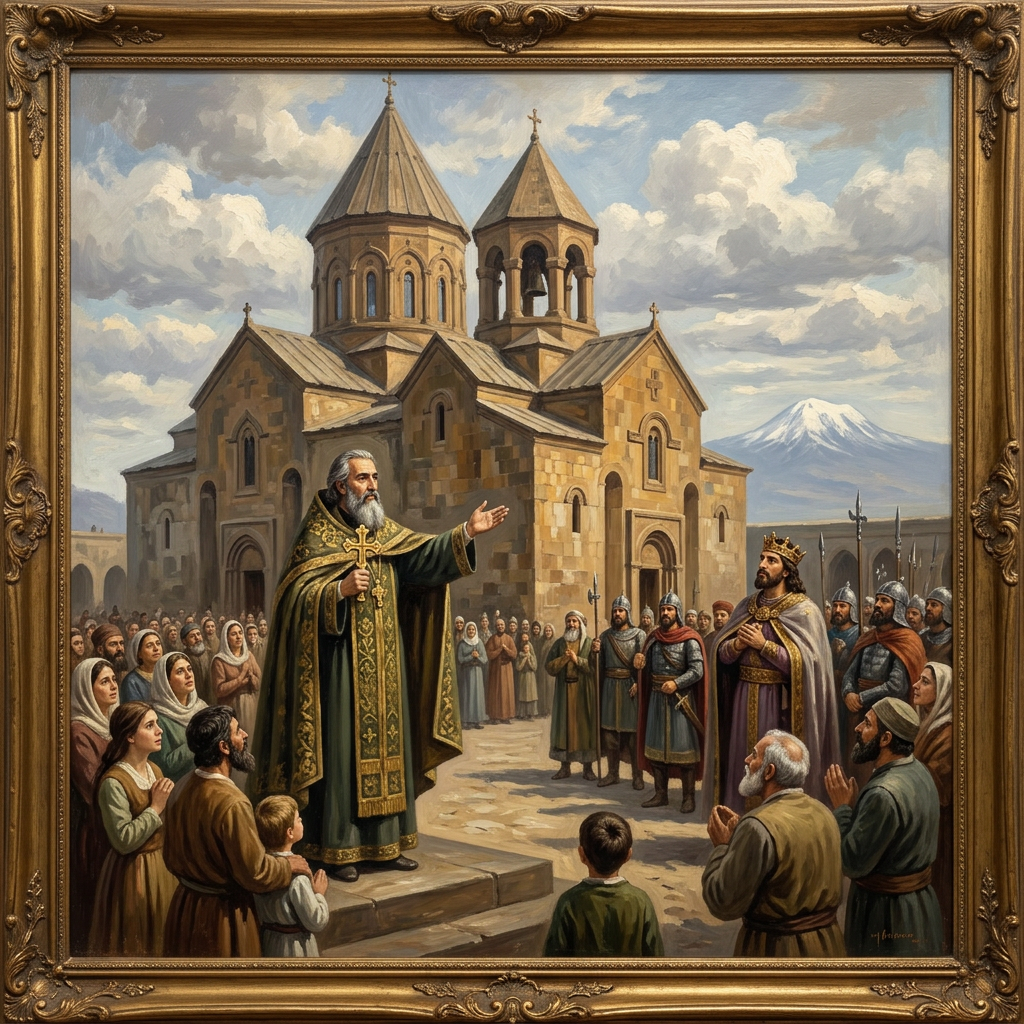

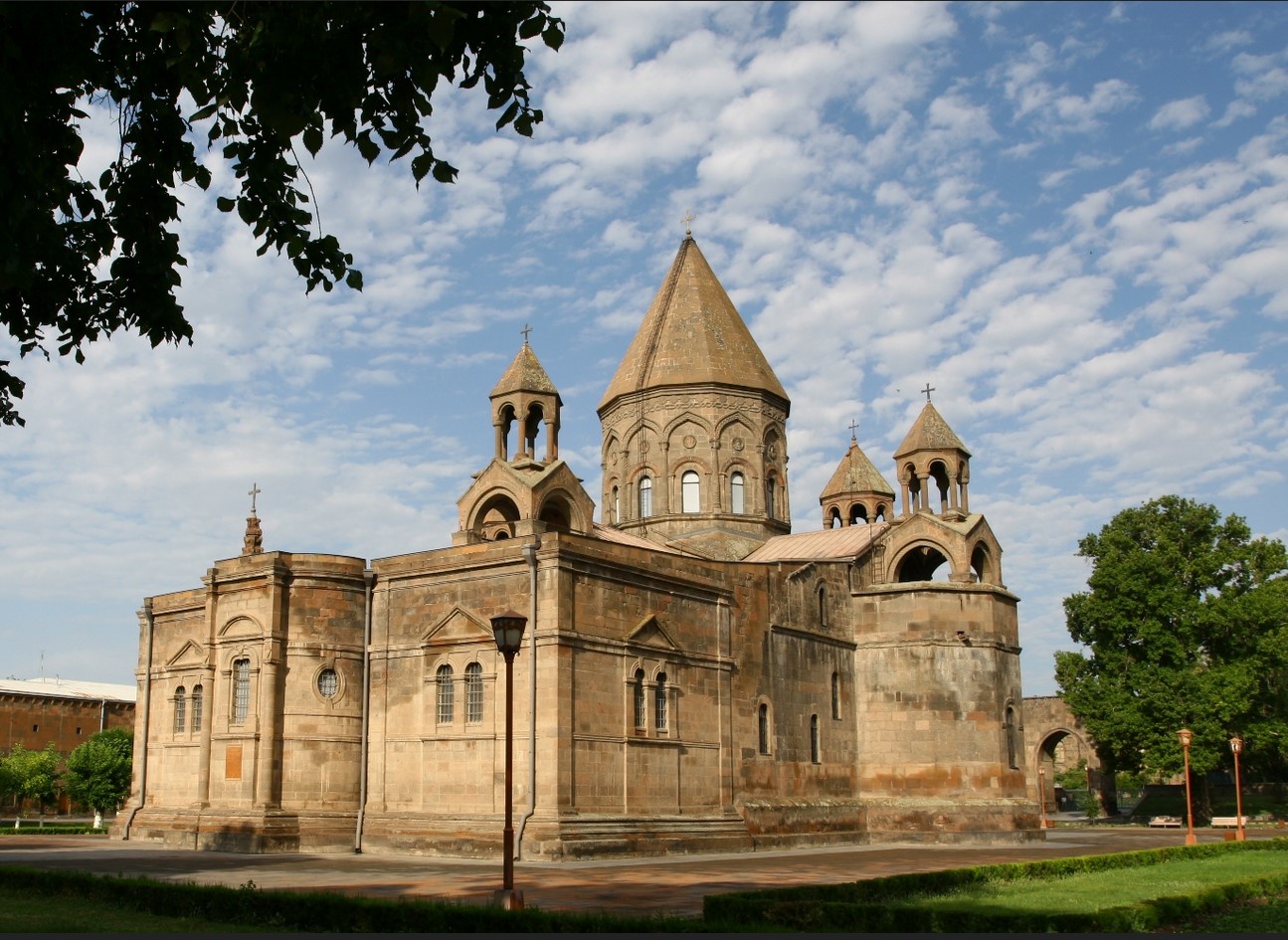
The Feast of the Cathedral of Holy Etchmiadzin is celebrated by the Armenian Church 64 days after Easter, during which a hymn, written by the 8th century Catholicos Sahak III, retelling St. Gregory’s vision, is sung. In 2026, June 7th is 64 days after Easter. Today, I’d like to share the story of Gregory and the building of the Etchmiadzin Cathedral.
The Cathedral of Etchmiadzin is considered to be the oldest cathedral in the world with Armenia being considered the first Christian nation in the world. Christ told Peter that He would build His church and the gates of hell would not prevail against it (Matthew 16:18). The story of the Cathedral of Etchmiadzin displays this promise of the Church taking dominion over Satan’s kingdom.
In the History of the Armenians by Agathangelos, the story of Gregory the Illuminator and the building of the Cathedral of Etchmiadzin is recorded. While imprisoned, Gregory was shown a vision of Jesus descending from heaven with a golden hammer and striking the earth to show where the cathedral should be built.
In Armenian, “Etchmiadzin” means “the descent of the Only-Begotten.” The Cathedral was built on top of the temple of Vagharshapat displaying Christ’s victory of Satan. The Cathedral of Etchmiadzin displays the gates of hell being defeated by the Church.
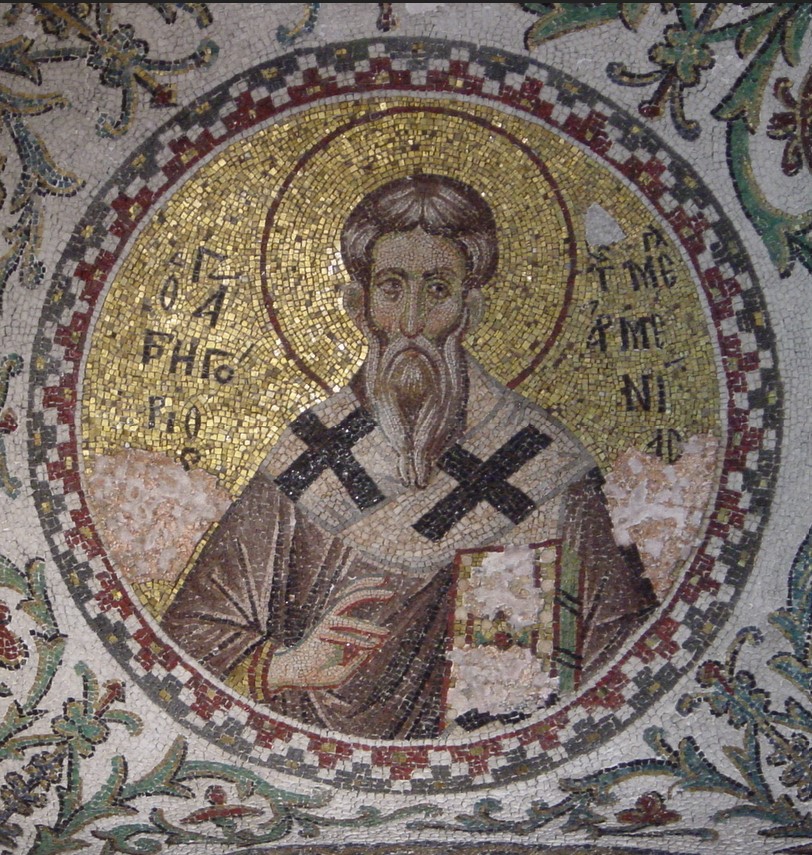
Gregory the Illuminator was the son of Anak the Parthian who assassinated the Armenian king Khosrov II when Gregory was an infant. As a result, Anak’s family was massacred but Gregory was rescued and taken to Caesarea in Cappadocia. It is said he was rescued by his Christian nurse Sophia. Christianity had already spread to Armenia by the early church. Tradition says that Thaddeus and Bartholomew preached there shortly after the resurrection of Christ. Some traditions claim they were martyred there.
As an adult, Gregory returned to Armenia and entered the service of King Tiridates III, the son of King Khosrov II who was killed by Gregory’s father. Gregory refused to participate in pagan sacrifices to the goddess Anahit, proclaiming his Christian faith. Gregory endured severe torture and was eventually thrown into a deep pit prison filled with poisonous snakes and scorpions called Khor Virap which was known as the pit of oblivion after Tiridates found out his father killed his father. Gregory remained in this pit for 13 to 15 years where he survived by the mercy of a pious Christian widow who lowered food to him. During this time period the King persecuted the Christians of Armenia and was struck with madness. It is said he behaved as a wild animal like King Nebuchadnezzar (Daniel 4:33). Some say he behaved as a werewolf, others a wild boar.
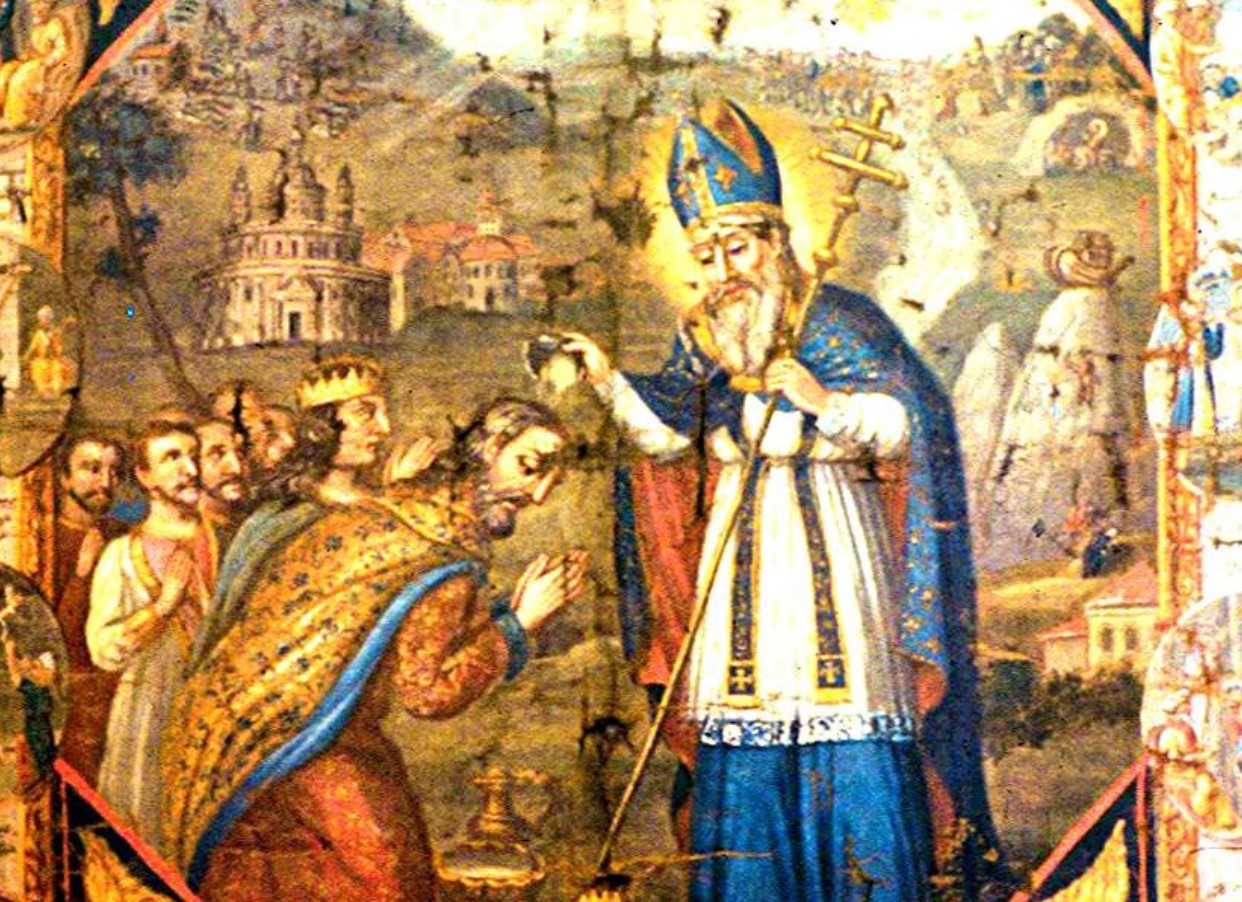
The story goes that King Tiridates’s sister Khosrovidukht, had a vision revealing that only Gregory could heal the king. Gregory was brought out of the pit and healed the king. Tiridates then converted to Christianity, along with his court. His family was baptized by Gregory and a mass conversion occurred in Armenia. Armenia became the first nation to adopt Christianity as the state religion around 301 A.D.
Tiridates and Gregory went through Armenia destroying pagan temples and then destroyed the temple to Vahagn at Ashtishat where the Cathedral of Etchmiadzin was built in fulfillment of the vision he was given in the pit.
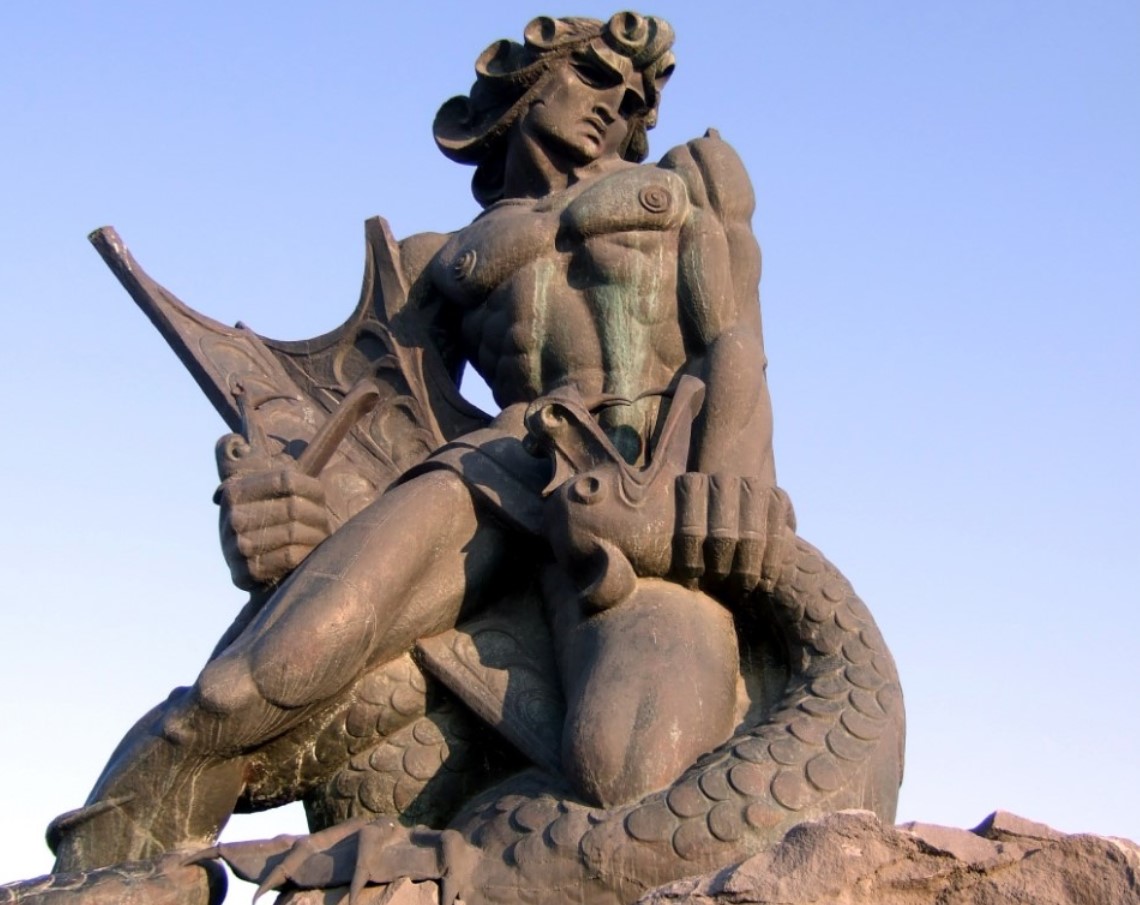
Vahagn (Vahakn) was a warrior god in Zoroastrianism. He was the god of thunder, storm, war and dragon slaying. He is equated with Hercules and Thor. This is interesting to note as Gregory’s vision in the pit was of Jesus descending from heaven with a golden hammer, reminiscent of Thor’s Mjölnir. This displays the victory of Christ over the pagan god Thor, Hercules and Vahagn. Pagan gods display aspects and characteristics of the Lord which point mankind to their Creator but at the same time hold them in bondage to Satan, the great counterfeiter.
Vahagn and Thor were both warriors and protectors. Both were dragon slayers. Vahagn was called Vishapakagh which means “Dragon Reaper,” Thor fights Jörmungandr, the Midgard Serpent during Ragnarök. Hercules was described in a similar fashion.
Baal was also the god of thunder and storm. He was depicted ridings on the clouds, wielding lightning bolts and his voice as thunder. The Lord declares Himself in this same imagery in the book of Psalms which displays He is the True God.
Psa 29:3 The voice of the LORD is upon the waters: the God of glory thundereth: the LORD is upon many waters.
Psa 29:7 The voice of the LORD divideth the flames of fire.
Psa 18:6 In my distress I called upon the LORD, and cried unto my God: he heard my voice out of his temple, and my cry came before him, even into his ears.
Psa 18:7 Then the earth shook and trembled; the foundations also of the hills moved and were shaken, because he was wroth.
Psa 18:8 There went up a smoke out of his nostrils, and fire out of his mouth devoured: coals were kindled by it.
Psa 18:9 He bowed the heavens also, and came down: and darkness was under his feet.
Psa 18:10 And he rode upon a cherub, and did fly: yea, he did fly upon the wings of the wind.
Psa 18:11 He made darkness his secret place; his pavilion round about him were dark waters and thick clouds of the skies.
Psa 18:12 At the brightness that was before him his thick clouds passed, hail stones and coals of fire.
Psa 18:13 The LORD also thundered in the heavens, and the Highest gave his voice; hail stones and coals of fire.
Psa 18:14 Yea, he sent out his arrows, and scattered them; and he shot out lightnings, and discomfited them.
Psa 18:15 Then the channels of waters were seen, and the foundations of the world were discovered at thy rebuke, O LORD, at the blast of the breath of thy nostrils.
For more on the Bible and Ancient Near East parallels see:
https://intertextual.bible/group/ancient-near-east
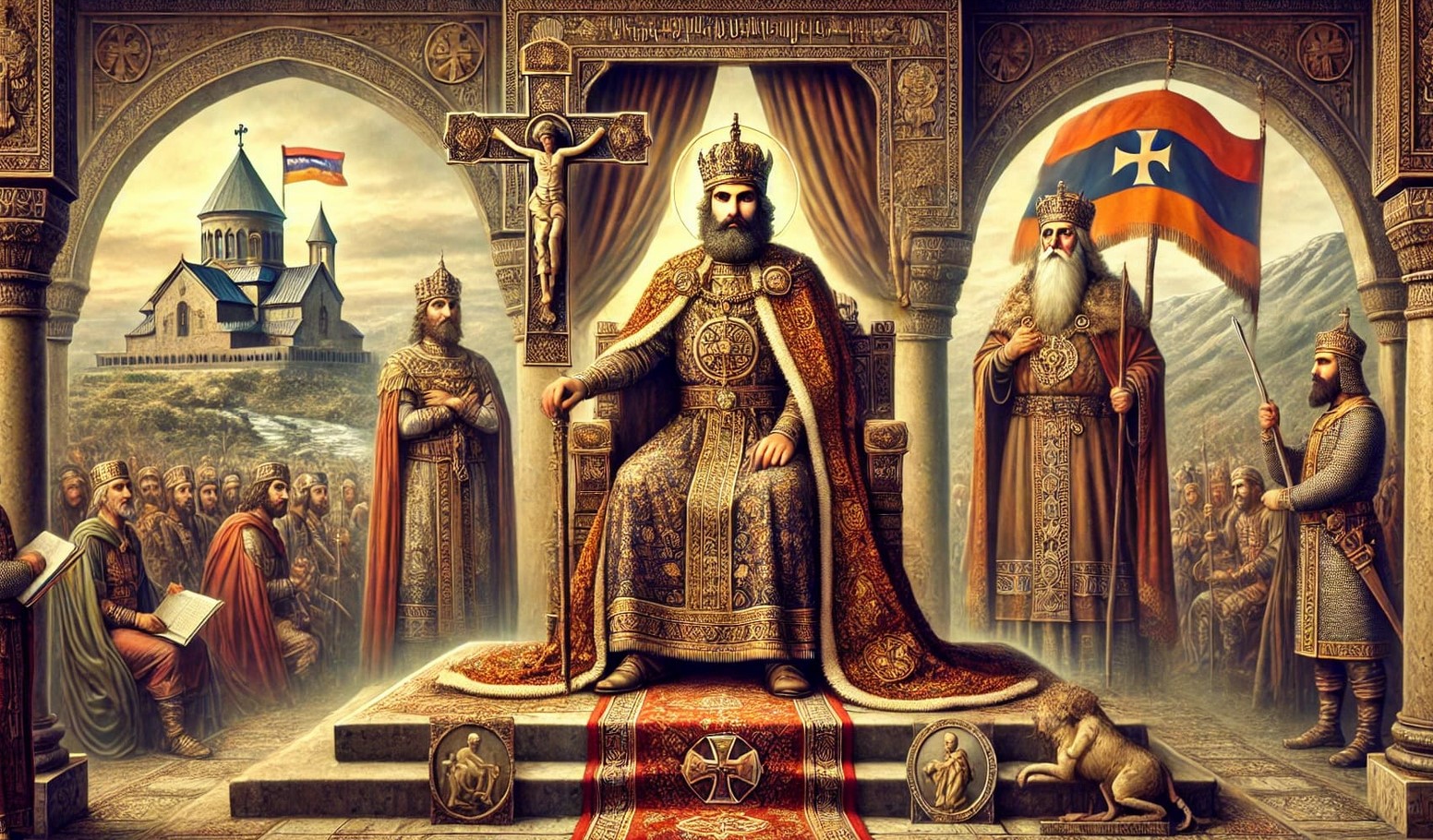
King Tiridates III the Great
After his conversion to Christianity, Tiridates made Armenia the first state to proclaim Christ in an official capacity. The same zeal he had in persecuting Christians before his conversion was used against Zoroastrianism after his healing. Constantine’s conversion and the Edict of Milan occurred shortly thereafter leading to the spread of Christianity throughout the world.
Tiradates name means created by Tir. Tir was a Zoroastrian god associated with rainfall and fertility. He rode on a white horse and did battle with the demon who rode a black horse. Tir (Tishtrya) was associated with the star Sirius, called Tishtar in Modern Persian. Sirius is the brightest star in the constellation of Canis Major, the Great Dog. In Biblical times, the dog was the companion of the shepherd who clung to him in love, whose job was to help guard the sheep (Job 30:1). Who is the Shepherd? The Messiah (Psalm 23:1; 80:1; Ezekiel 34:11; 37:24; John 10:11-14) . The name of the Messiah יהושוע ‘Yehoshua’ comes from the root meaning to keep watch over the flock. The root of יהושוע ‘Yehoshua’ is שע.

Joshua/Yehoshua (the Shepherd) and Caleb (כלב = dog) were the two faithful spies who fully followed the LORD (Numbers 14:24; 32:12; Deuteronomy 1:36). They did not fear the giant sons of Anak (Numbers 13:33). Caleb took the land of Anak (Joshua 15:14; Judges 1:20). It is interesting to note that Gregory’s father was named Anak. Anak comes from the Middle Iranian word ‘anāg’ which means evil or wicked.
Mount Ararat
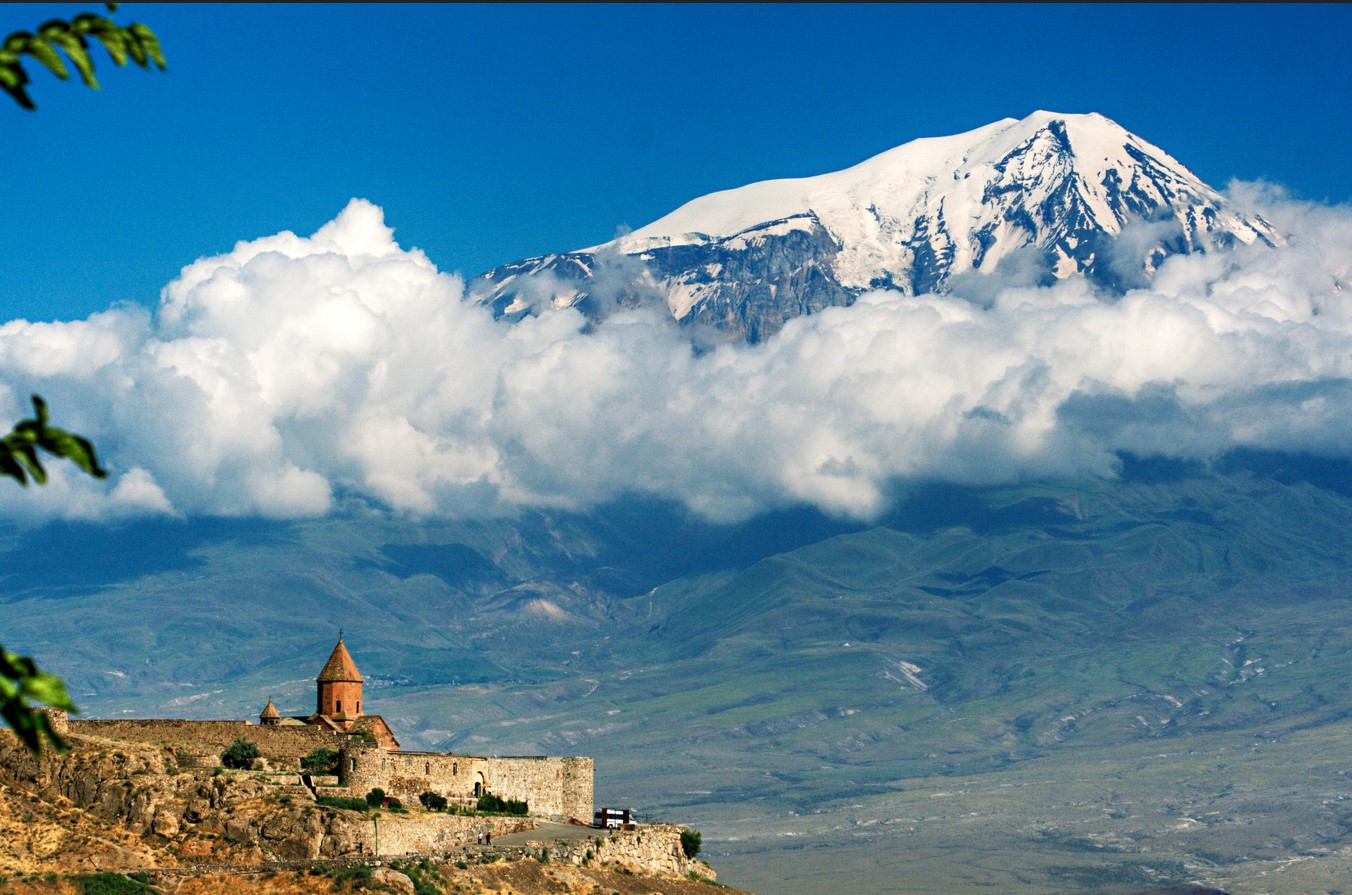
Mount Ararat is located in Armenia. In Etchmiadzin Cathedral is a reliquary with a wooden fragmen said to be from Noah’s Ark. It is said to have been obtained by St. Jacob of Nisibis (Mar Jacob) while climbing Mt. Ararat looking for Noah’s Ark, through the help of an angel.
The pit where Gregory had his vision, Khor Virap, is located in the plains of Ararat. The image above shows the Khor Virap Monastery at the base of Mount Ararat. God destroyed the corruption of the earth caused by the fallen angels and Nephilim through the Flood and saved Noah to begin again. At Ararat, where Noah’s ark rested, God established the first Cathedral and Christian nation on the ruins of a pagan Temple. Gregory the Illuminator was given his vision in Khor Virap which literally means “bottommost pit.” He was in hell but God delivered him.
Psa 86:13 For great is thy mercy toward me: and thou hast delivered my soul from the lowest hell.
Psa 56:13 For thou hast delivered my soul from death: wilt not thou deliver my feet from falling, that I may walk before God in the light of the living?
Armenians call their land Zion of Ararat pointing to the renewal of the earth and mankind after Noah’s Flood and the renewal after the cross. Peter and Paul link these concepts as well.
1Pe 3:20 to disobeying ones, when once the long-suffering of God waited in the days of Noah, an ark having been prepared, into which a few, that is, eight souls, were saved through water.
1Pe 3:21 Which antitype now also saves us, baptism (not a putting away of the filth of the flesh, but the answer of a good conscience toward God through the resurrection of Jesus Christ;
1Co 10:1 And I do not want you to be ignorant, brothers, that our fathers were all under the cloud, and all passed through the Sea.
1Co 10:2 And all were baptized to Moses in the cloud, and in the Sea,
1Co 10:3 and all ate the same spiritual food.
1Co 10:4 And all drank the same spiritual drink; for they drank of the spiritual rock following, and that Rock was Christ.
All die through baptism, by faith we come out a new creation
Rom 6:3 Know ye not, that so many of us as were baptized into Jesus Christ were baptized into his death?
Rom 6:4 Therefore we are buried with him by baptism into death: that like as Christ was raised up from the dead by the glory of the Father, even so we also should walk in newness of life.
Gal 3:27 For as many of you as have been baptized into Christ have put on Christ.
Through the Flood of Noah, mankind was “reborn” overcoming the enemy. Through the work of the cross and baptism into the death of Christ, we are “reborn” overcoming death.
Gates of Hell
Mat 16:11 How is it that ye do not understand that I spake it not to you concerning bread, that ye should beware of the leaven of the Pharisees and of the Sadducees?
Mat 16:12 Then understood they how that he bade them not beware of the leaven of bread, but of the doctrine of the Pharisees and of the Sadducees.
Mat 16:13 When Jesus came into the coasts of Caesarea Philippi, he asked his disciples, saying, Whom do men say that I the Son of man am?
Mat 16:14 And they said, Some say that thou art John the Baptist: some, Elias; and others, Jeremias, or one of the prophets.
Mat 16:15 He saith unto them, But whom say ye that I am?
Mat 16:16 And Simon Peter answered and said, Thou art the Christ, the Son of the living God.
Mat 16:17 And Jesus answered and said unto him, Blessed art thou, Simon Barjona: for flesh and blood hath not revealed it unto thee, but my Father which is in heaven.
Mat 16:18 And I say also unto thee, That thou art Peter, and upon this rock I will build my church; and the gates of hell shall not prevail against it.
Mat 16:19 And I will give unto thee the keys of the kingdom of heaven: and whatsoever thou shalt bind on earth shall be bound in heaven: and whatsoever thou shalt loose on earth shall be loosed in heaven.
Adam lost dominion to Satan in the beginning. The war began between mankind and Satan (Genesis 3:15). This war was won by Christ. The Messiah came to destroy the works of the devil (1 John 3:8) which began at the tree of knowledge which was a corruption of God’s creation resulting in death. Christ destroyed these works by openly triumphing over them in it, ie the cross which was a symbol of death and the sun-gods, tracing back to the tree of knowledge. This symbol has now become a symbol of the Lord’s triumph.
This warfare was declared by Messiah at the ‘homefield’ of the adversary where He said that the gates of hell would not prevail against His people and whatever is loosed is loosed and whatever is bound is bound.
According to the book of Enoch chapter 7, the fallen angels descended upon Mt. Hermon. Caesarea Philippi is located at the foothills of Mount Hermon. This area was known as Baal Hermon during Old Testament times (Judges 3:3; 1 Chronicles 5:23).
Earnest Martin – “We now come to Mount Hermon. Damascus also had a “high place” as its own “holy place” and it was a legitimate “holy mount.” The people of Damascus had their own “holy mountain.” It was the highest of the mountains from the Euphrates in the north all the way south to Egypt and down to the center part of the Sinai Peninsula. That mountain was “Mount Hermon.” It was the greatest of the sacred mountains of the Middle East. It was considered the most holy mountain of the early Hittites, of all the Gentiles of Palestine and even by the Greeks and Romans (see Encyclopaedia Britannica, vol.5, p.876). Even in the Greek and Roman periods Mount Hermon’s sanctity was recognized as the central worship of all the Gods of the world (no matter who they were).
Look at this fact. At the bottom of Mount Hermon on the southwest side was a place called Panias by the Greeks after the time of Alexander the Great (it is the modern day, Banias) which was Caesarea Philippi in New Testament times.
Panias was named after the ‘god’ Pan.
Mount Hermon, to the ancients, was called the “Gateway to Heaven.” Here the reports of antiquity claim divine emissaries as inter-dimensional beings could be seen moving from one dimension to another. It we take their testimony literally, they could see beings, that they called angels or “Watchers”, appear out of nowhere and disappear as though they were walking through a “star-gate.” Here on this mount called Hermon these “Watchers” entered the environment of this planet earth and then returned back to the heavens.”
Mat 16:13 And coming into the parts of Caesarea of Philip, Jesus questioned His disciples, saying, Whom do men say Me the Son of Man to be?
Mat 16:14 And they said, Some say John the Baptist, and others Elijah, and others Jeremiah, or one of the prophets.
Mat 16:15 He said to them, But you, whom do you say Me to be?
Mat 16:16 And answering, Simon Peter said, You are the Christ, the Son of the living God.
Mat 16:17 And answering, Jesus said to him, Blessed are you, Simon, son of Jonah, for flesh and blood did not reveal it to you, but My Father in Heaven.
Mat 16:18 And I also say to you that you are Peter, and on this rock I will build My assembly, and the gates of Hades will not prevail against her.
How do we overcome the gates of hell? Just as Peter did. By holding fast to the testimony of Christ Jesus.
Rev 12:11 And they overcame him because of the blood of the Lamb, and because of the Word of their testimony. And they did not love their soul even until death.
Mount Hermon: Gate of the Fallen Angels – J. R. Church
“According to the Encyclopedia Britannica, Hermon means “Forbidden Place.” Jerome (4th-century translator of the Latin Vulgate Bible) interpreted Hermon as “anathema.” Mount Hermon was the port of entry for a group of wicked angels, who corrupted the human race in the days of Noah. Moses wrote: “The sons of God saw the daughters of men that they were fair; and they took them wives of all which they chose …. There were giants in the earth in those days, and also after that, when the sons of God came in unto the daughters of men, and they bare children to them, the same became mighty men which were of old, men of renown” (Gen. 6:1-4).
We have discussed these “Nephilim” in previous issues, but in this article, I want to add some things that you may not have heard before. For example, there is a rabbinical remark about this story in an ancient Jewish commentary, in which two rabbis add the following insight:
“Rabbi Jose says, following a tradition, that these [Nephilim] were Uzza and Azazel, whom, God deprived of their supernal sanctity. How, it may be asked, can they exist in this world? Rabbi Hiya answers, that they were of a class of spirits referred to in the words, ‘and birds which fly on the earth’ (Gen 1:20), and these, as we have said, appear to men in the form of human beings. If it is asked, how can they transform themselves? The answer is, that they do, in fact, transform themselves into all kinds of shapes, because when they come down from heaven they become as concrete as air and take human shape. These are Uzza and Azazel, who rebelled in heaven, and were cast down by God, and became corporeal on the earth and remained on it, not being able to divest themselves of their earthly form. Subsequently, they went astray after women, and up to this day they exist and teach men the arts of magic. They begat children whom they called Anakim (giants), while the Nephilim themselves were called ‘sons of God’” (Zohar, vol. 1, p. 186).
Note that one rabbi alluded to a class of spirits described as “birds” in Genesis 1:20. Perhaps this was the origin of the story that angels had bird-like wings. To this day, white Doves are symbolic of good, while black crows are typical of evil. It should also be noted that birds seem to have a reptilian connection. The Phoenix was depicted as an eagle in the West, but in the East, it was a winged dragon. From ancient lore, Satan was thought to be somewhat of a gargoyle with bat-like wings.
The Book of Enoch
The apocryphal Book of Enoch enlarges upon the story of the Nephilim. First, let me give you a little background on this mysterious book. Scholars have traced its origin back past the first century:
“In the early literature of the church there is a whole chain of evidences to this effect. Nearly all of the church [leaders] knew of an apocryphal Book of Enoch. Among the Apostolic [leaders], the Epistle of Barnabas refers to such a work. From that time on to about the seventh-century, Christian literature produces ample proof of the constant use and high standing of this book. The early theologians Justin Martyr, Clemens of Alexandria, Origen, Irenaeus, Tertullian, Eusebius, Jerome, Hilary, Epiphanius, Augustine, and others refer to and use it … following the example of Jude, whose citation is taken from Enoch 1:9. They all, with possibly the one dissenting voice of Tertullian, deny the canonicity of this book, and properly regard it as apocryphal; some going even so far as to deny the canonicity of Jude because he had dared to quote an apocryphal work” (George H. Schodde, Nov. 21, 1881, General Introduction to the Book of Enoch).
The following is quoted from the Book of Enoch:
“And it came to pass, after the children of men had increased in those days, beautiful and comely daughters were born to them.
“And the angels, the sons of the heavens, saw and lusted after them, and said one to another: ‘Behold, we will choose for ourselves wives from among the children of men, and will beget for ourselves children.’
“And they descended on Ardîs, which is the summit of Mount Hermon; and they called it Mount Hermon, because they had sworn on it and bound themselves mutually by a curse” (Enoch 6:1-6).
Of all places on this planet where angels could have descended, it was on the northern border of the Promised Land. Perhaps knowing something about God’s future plans to give territory to Abraham’s descendants, these angels plotted their strategy to introduce “the seed of the serpent” into the human race. Also, Mount Hermon lay in the territory where Ham and his family migrated after God’s judgment at the Tower of Babel. According to Genesis 10:6, Ham had four sons: “And the sons of Ham; Cush, and Mizraim, and Phut, and Canaan” (Gen. 10:6).
Canaan settled in the area of Mount Hermon and southward into the territory that was to become Abraham’s Promised Land. This is why the Promised Land was called “Canaan” in the days of Moses and Joshua. Mizraim continued to move southward into Egypt. Coincidentally, Mount Hermon has three peaks, and Ham’s family encountered another set of “three peaks” that had been built before the Flood (those being three great pyramids). Evidently, Mizraim was fascinated by the pyramids and developed a system of worship based on those ancient structures. Cush and Phut continued the family migration southward and settled in Ethiopia and parts of Southern Africa.
To this day, Mount Hermon is still the place where evil continually rains down upon Israel. It is the area of the Syrians, and Hezbollah. The Book of Enoch continues:
“And they took unto themselves wives, and each chose for himself one, and they began to go in to them, and mixed with them, and taught them charms and conjurations, and made them acquainted with the cutting of roots and of woods. And they became pregnant and brought forth great giants whose stature was three thousand ells. These devoured all the acquisitions of mankind till men were unable to sustain themselves. And the giants turned themselves against mankind in order to devour them” (Enoch 7:1-4).
It seems that these fallen angels (the Nephilim) contaminated almost all life on earth. We do not know how many people were contaminated, but we are told that at least Noah’s family remained genetically pure. For that reason, God destroyed the world with a Flood. Had it not been for Noah and his three sons, those fallen angels might have brought an end to all life on the planet. Noah, Shem, Ham and Japheth helped save the animals and repopulate the earth.
God Judged the Angels
Both Peter and Jude added further insight about these fallen angels. Peter said, “God spared not the angels that sinned, but cast them down to hell, and delivered them into chains of darkness, to be reserved unto judgment; and spared not the old world, but saved Noah the eighth person, a preacher of righteousness, bringing in the flood upon the world of the ungodly” (II Peter 2:4,5).
Jude put it this way: “The angels which kept not their first estate, but left their own habitation, he hath reserved in everlasting chains under darkness unto the judgment of the great day” (Jude 6).
Both passages tell of severe punishment upon the Nephilim. Yet, Moses said that “sons of God” reappeared after the Flood (Gen. 6:4). How can this be? Well, the Book of Enoch only mentioned 200 angels, and Satan was not among them. Bear in mind, Satan’s forces were much larger then a mere 200. Perhaps the original group of Nephilim were scouts for a much larger force of demonic angels who, under the leadership of Satan, came to earth after the Flood. It seems to me that the Tower of Babel (meaning “Gate to God”) may have been built in an effort to contact these dark forces and forge a defense against the threat of another judgment. As noted in the Zohar (above) Rabbi Hiya said, “… to this day they exist and teach men the arts of magic.”
As noted above, Genesis 6:4 adds, “… and after that” — meaning that more Nephilim returned to this area after the Flood and established what Joshua called the “land of giants.” Moses and Joshua conquered those giants, of whom, Og was king. Moses wrote that Og’s bed was almost 15 feet long! (Deut. 3:11-13). Og reigned in Mount Hermon. Joshua wrote:
“And the coast of Og king of Bashan, which was of the remnant of the giants, that dwelt at Ashtaroth and at Edrei,
“And reigned in mount Hermon, and in Salcah, and in all Bashan, unto the border of the Geshurites and the Maachathites, and half Gilead, the border of Sihon king of Heshbon.
“Them did Moses the servant of the LORD and the children of Israel smite” (Joshua 12:4-6).
The tribe of Dan moved to this area during the days of the Judges, and adopted the Canaanite worship of these angels. It was an ancient idolatry that opposed the worship of Jehovah. In fact, Baal and Ashtaroth were Canaanite deities, whose origin was Mount Hermon! The book of Judges even calls Mount Hermon “Baalhermon,” saying:
“Namely, five lords of the Philistines, and all the Canaanites, and the Sidonians, and the Hivites that dwelt in mount Lebanon, from mount Baalhermon unto the entering in of Hamath” (Judges 3:3).
Furthermore, the fallen angels living on and around Mount Hermon adopted a biblical name for the mountain. They had the audacity to plagiarize a name that God had given to Mount Moriah — Mount Sion! Moses wrote:
“And they possessed his [Sihon’s] land, and the land of Og king of Bashan, two kings of the Amorites, which were on this side Jordan toward the sun rising; From Aroer, which is by the bank of the river Arnon, even unto Mount Sion, which is Hermon” (Deut. 4:47,48).
Sion means “lofty,” whereas, Zion means “stronghold.” It is evident that Satan was pushing for a counterfeit of God’s plan for man’s redemption. The devil was determined to replace the “seed” of the woman with the “seed” of the serpent.
In a book entitled, The Gods of the Lodge, author Reginald C. Haupt, Jr., described what he found during his trip to Mount Hermon:
“In the excavations of Baalbek, renamed Heliopolis by the Greeks, temples were uncovered honoring Baal and Bachus. The same is true of the site at Sidon. The Temple there is named the Temple of Baal of Sidon. But by far, of greater importance was the temple of Baal found on Mt. Hermon. Perhaps it would be more meaningful to you if I [Reginald Haupt] quote direct from my source. In the 1982 edition of the Thompson Chain Reference Bible (Fourth Improved Edition), the archaeological supplement was provided by G. Fredrick Owen, D.D., Ed.D. Dr. Owen wrote on page 376 of his supplement the following:
“Mount Hermon, the ‘chief’ of the mountains of Palestine is five miles wide and twenty miles long. It has three peaks, the tallest of which is 9,166 feet above the Mediterranean Sea. For centuries before Abraham’s time, the mountain had been venerated in connection with Baal.
“Baal worship was the leading religion of Canaan. On most of the high peaks of the country were shrines known as ‘high places,’ the higher the holier. Here groves were planted and shrines erected for worship. Since Mount Hermon towered above all the other mountains in the region, it was the chief high place, the shrine of shrines. Canaanites looked to Mount Hermon much as the Moslems face Mecca when they pray.
“During the summer of 1934, Dr. Stewart Crawford and this writer [Reginald Haupt] led a small expedition, in which we studied the ancient Baal shrines surrounding Mount Hermon. We located many ruins and in each case the shrine was so oriented that when the priests and the devotees were at the altar, they faced the chief Baal sanctuary, or Quibla, located on the highest of the three peaks of Hermon.
“We then ascended the mountain and found the ruined temple of Baal, constructed of Herodian masonry, which dated it to just previous to and during the early Christian era. In a low place near the northwest corner of the temple, we excavated and found loads of ash and burnt bone, which had been dumped there as a refuse from sacrifices” (Reginald C. Haupt, Jr., The Gods of the Lodge, p. 126).
During the ministry of Jesus, He and His disciples visited Caesarea Philippi (see cover photo) where the Jordan River springs forth from the slopes of Mount Hermon. In the cover photo, one can see the grotto and cave where Baal worship was in full swing. While observing these shrines, Jesus posed the question: “Whom do men say that I the Son of man am?” (Matt. 16:13). Jesus was standing in the territory of His great enemy, Satan, and his idolatrous Nephilim. It was the area out of which the Antichrist would arise.”
littleguyintheeye@gmail.com


