
May takes its name from Maia, the great one, the mother. Ovid said it belonged to the elders, the maiores, while June belonged to the young men. John wrote to the fathers who had known Him from the beginning, and to the young men in whom the Word abides and who have overcome. The darkness is past, and the true light now shines. May stands in the middle of that turning, binding spring to summer.
The Hebrew word for mother is em. It means to bind two things together. The Arm of the Lord was revealed when He stretched out His arms on the cross and gathered a people to His bosom. Family is a joining. The same root is the origin of the word for crucifixion. He humbled Himself and took the form of a servant, and the name above every name was given. The fifth month is the rib, the side opened so the bride could come forth. The letter heh is a man with his arms stretched out. When the Son of Man is lifted up, you will know that I AM. Through the cross, Jesus reveals the love of the Father and opens the way for humanity to be brought into the family of God.
The month of May was named after the Greek goddess Maia. The meaning of Maia is large or great, from the Latin word ‘maius.’ Maia also traces back to the Greek word μαῖα ‘maia’ which was a term given to older women and is related to the word μήτηρ ‘meter’ which means mother.
The Roman Poet Ovid said the month of May was named for the ‘maiores’ which is the Latin word for elders. June was said to have come from the Latin word ‘iuniores’ which means young men {Fasti VI.88}.
1Jn 2:14 I have written unto you, fathers, because ye have known him that is from the beginning. I have written unto you, young men, because ye are strong, and the word of God abideth in you, and ye have overcome the wicked one.
This portion of Scripture follows John’s declaration of the true Light which overcomes the darkness. This is another theme of May, the ‘midpoint’ between Spring and Summer (light) which declares Winter (darkness) is over.
1Jn 2:8 Again, a new commandment I write unto you, which thing is true in him and in you: because the darkness is past, and the true light now shineth.
Mother
May is linked to the Greek word μήτηρ ‘meter’ which means mother. This is further seen in the Etymology research of Isaac Mozeson who says that the word ‘May’ traces back to the Hebrew word אם ‘em’ which means mother.
אם ‘em’ means to bind two things together. This is interesting to note as May was considered to ‘bind’ or connect Spring and Summer together. In Celtic cultures, May 1st was considered the beginning of Summer.

This Hebrew word אם ‘em’ also means an arm. How was the Arm of the Lord revealed? Through the cross (Isaiah 53:1) when all of mankind was gathered (John 12:32) to His bosom (Isaiah 40:10-11).
The love of a mother who “holds the family together” is an integral part in revealing God’s nature to mankind. The Hebrew word for family is משפחה ‘mishpochah’ which means to be joined together. משפחה ‘mishpochah’ comes from the root word ספח ‘saphach’ which has the same meaning of a joining together of two things and is the origin of the English word ‘crucifixion.’ Again, this is where Messiah joined together mankind into the family of God (Ephesians 3:15). The Hebrew word for maidservant or womanservant is שיפחה ‘shiphchah’ which is a cognate of משפחה ‘mishpochah.’ The loving service of a mother to her family reveals the love of God as Messiah humbled Himself to become a servant, revealing God’s love.
Php 2:5 Let this mind be in you, which was also in Christ Jesus:
Php 2:6 Who, being in the form of God, thought it not robbery to be equal with God:
Php 2:7 But made himself of no reputation, and took upon him the form of a servant, and was made in the likeness of men:
Php 2:8 And being found in fashion as a man, he humbled himself, and became obedient unto death, even the death of the cross.
Php 2:9 Wherefore God also hath highly exalted him, and given him a name which is above every name:
Php 2:10 That at the name of Jesus every knee should bow, of things in heaven, and things in earth, and things under the earth;
Php 2:11 And that every tongue should confess that Jesus Christ is Lord, to the glory of God the Father.
Beltane
In Celtic cultures, May 1st was considered the beginning of Summer. In Gaelic, the month of May is known as ‘Mí Bhealtaine’ or ‘Bealtaine.’ May 1st in particular was called ‘Beltane.’
Beltane is considered a cross-quarter day which marks the midpoint of the sun’s progression between the Spring equinox and the Summer solstice. The cross imagery is significant as it is Messiah’s work on the cross that gathers all mankind together, that ‘binds’ them to the Father as glue {אם ‘em’}.
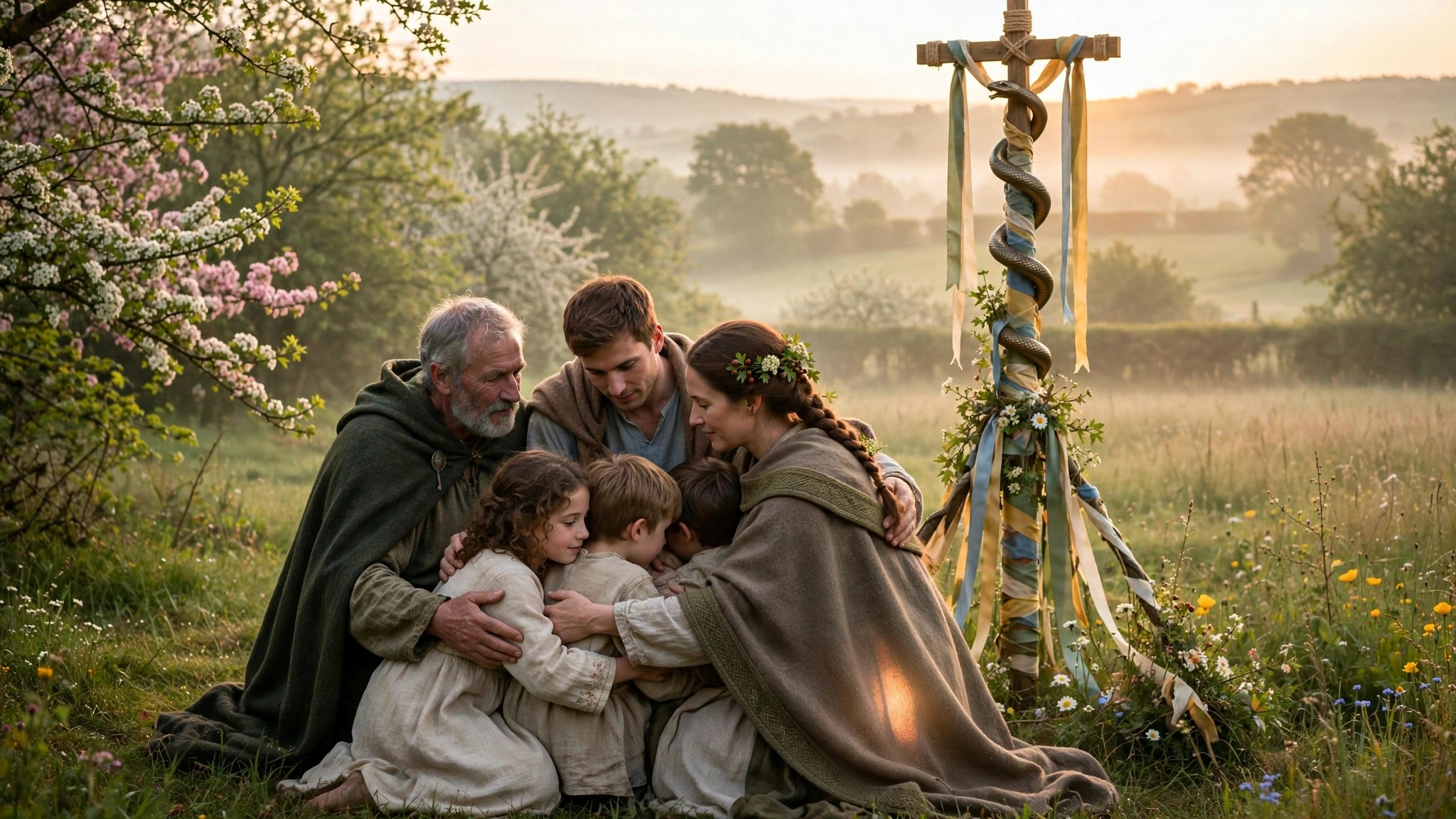
Beltane is celebrated with the symbol of the May Pole, which depicts the crucifixion (serpent on a pole).
Joh 3:14 And even as Moses lifted up the serpent in the wilderness, so must the Son of Man be lifted up,
Num 21:7 And the people came in to Moses and said, We have sinned, for we have spoken against Jehovah, and against you. Pray to Jehovah, and He shall turn the serpent away from us. And Moses prayed on behalf of the people.
Num 21:8 And Jehovah spoke to Moses, Make yourself a fiery serpent, and set it on a pole; and it shall be that when anyone is bitten, when he sees it, he shall live.
Num 21:9 And Moses made a serpent of bronze and put it on a pole; and it happened, if a serpent had bitten any man, when he looked to the bronze serpent, he lived.
The word ‘Beltane’ comes from the Hebrew word בעל ‘baal’ which means husband or master.
Isaac Mozeson also traces the word ‘May’ back to the Old Norse word ‘maer’ which means a girl. The corresponding word in Hebrew is נערה ‘na’arah’ which he gives as the origin of the English word ‘marry.’ בעל ‘baal’ also means marriage, as in a yoke that binds two people together.

5th Month
May is the 5th month of the year which is significant as it connects to the aforementioned themes. The number 5 points back to the joining (marriage) of Adam and Eve (the mother of all living – Genesis 3:20) in the Garden of Eden.
Gen 2:21 And Jehovah God caused a deep sleep to fall on the man, and he slept. And He took one of his ribs, and closed up the flesh underneath.
Gen 2:22 And Jehovah God formed the rib which He had taken from the man into a woman, and brought her to the man.
Gen 2:23 And the man said, This now at last is bone from my bones, and flesh from my flesh. For this shall be called Woman, because this has been taken out of man.
Gen 2:24 Therefore, a man shall leave his father and his mother, and shall cleave to his wife and they shall become one flesh
Eph 5:30 For we are members of His body, of His flesh, and of His bones.
Eph 5:31 “For this, a man shall leave his father and mother, and shall be joined to his wife, and the two shall be one flesh.” Gen. 2:24
Eph 5:32 The mystery is great, but I speak as to Christ and as to the assembly.
The rib of Adam from whence his bride came out is linked to the number 5 which connects to the 5th day of creation and life.
חמש ‘chamesh’ is used to translate multiple terms in Hebrew. It is used for the number five/fifty, the hand, to be armed and the side of the body (fifth rib).
The ‘fifth rib’
H2570
חמשׁ
chômesh
This word is used in the following verses:
fifth, 4
2Sa_2:23, 2Sa_3:27, 2Sa_4:6, 2Sa_20:10
Messiah was wounded in the side (‘the fifth rib’).
Joh 19:34 But one of the soldiers pierced His side with a lance, and at once blood and water came out.
Adam’s bride came forth from his rib/side (Genesis 2:22) which is a picture of Messiah’s bride ‘coming forth’ when He offered Himself as an atonement to bring us back to God. Interestingly, the year of Jubilee, which occurs every 50 (חמשים ‘chamashim’) years (Leviticus 25:10-13) began on the Day of Atonement. The great trumpet (Isaiah 27:13) will be blown and those resurrected in the 1st resurrection will receive their inheritance in the land.
The Hebrew letter ה ‘heh’ is equivalent to the number 5 and links to the current study.
The pictograph of the letter ה ‘heh’ is of a man with his arms stretched out. It was through the cross, where Messiah had is arms stretched out, that He revealed that He is “I AM“. In Genesis 22:7, the LORD God literally told Abraham that He would provide Himself as the lamb for sacrifice. In John 8:28, Jesus declared that we would see that He is the “I AM” on the cross.
Joh 8:28 Then Jesus said to them, When you lift up the Son of Man, then you will know that I AM; and from Myself I do nothing; but as My Father taught Me, these things I speak.
Joh 12:32 And I, if I be lifted up from the earth, I will draw all to Myself (John 8:28 Messiah states this is how they will know He is ‘I AM’).
littleguyintheeye@gmail.com