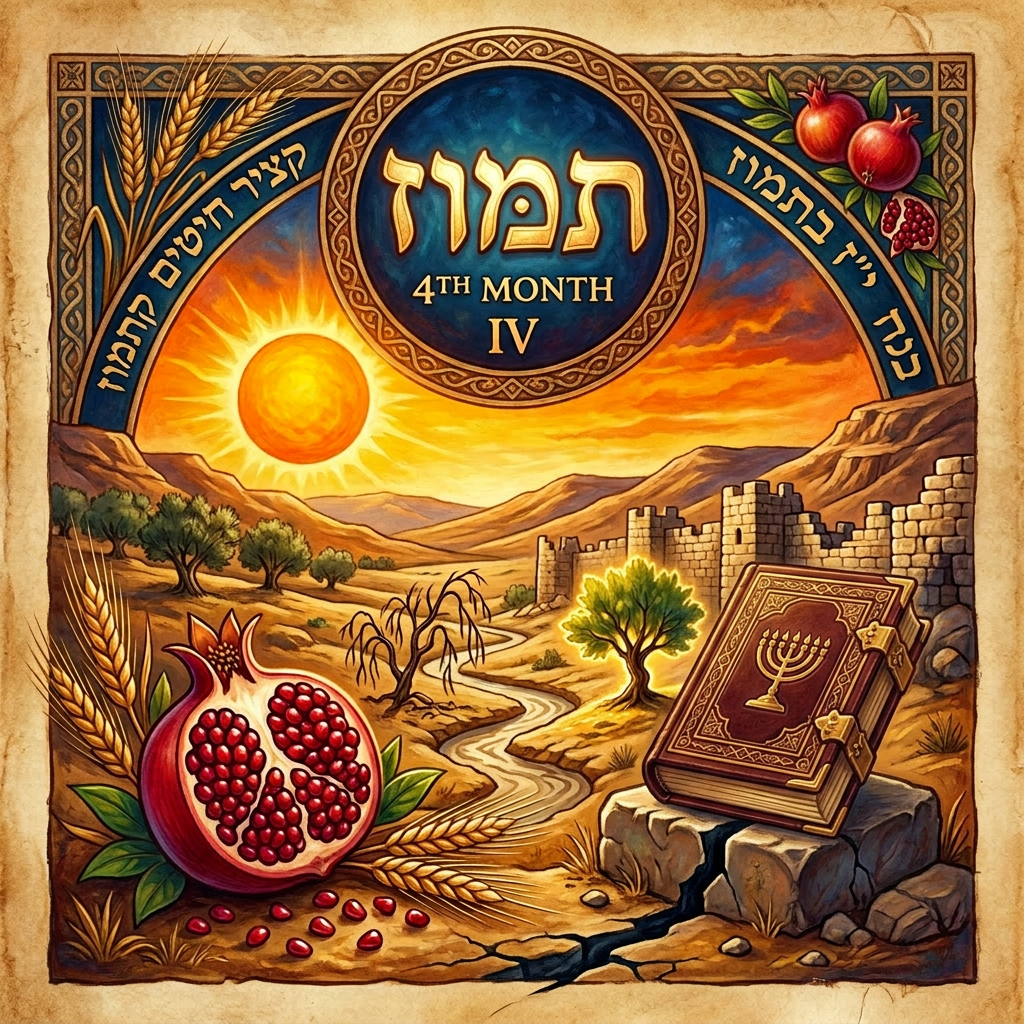

In the 4th Hebrew month of Tammuz, we see the theme of the True Master, the genuine Door, and the dying-rising Son. The name itself comes from ancient Hebrew roots — tam (complete, mature) + az (strength) — yet it was hijacked in Babylon and turned into a counterfeit of the Messiah. Tammuz/Dumuzi, the “son who rises,” the shepherd-god, the sun, is Satan’s imitation of Christ Jesus — the True Rabbi, the Good Shepherd, the Door of the sheep.
From the letter dalet (door) to the summer solstice, the cross that divides space and time, the weeping for Tammuz at the Temple door in Ezekiel 8, and the golden calf on the 17th of Tammuz — everything points to the battle between true worship and the abominations of the counterfeiter. This month calls us to discern the real from the fake and fix our eyes on the One who truly rose.
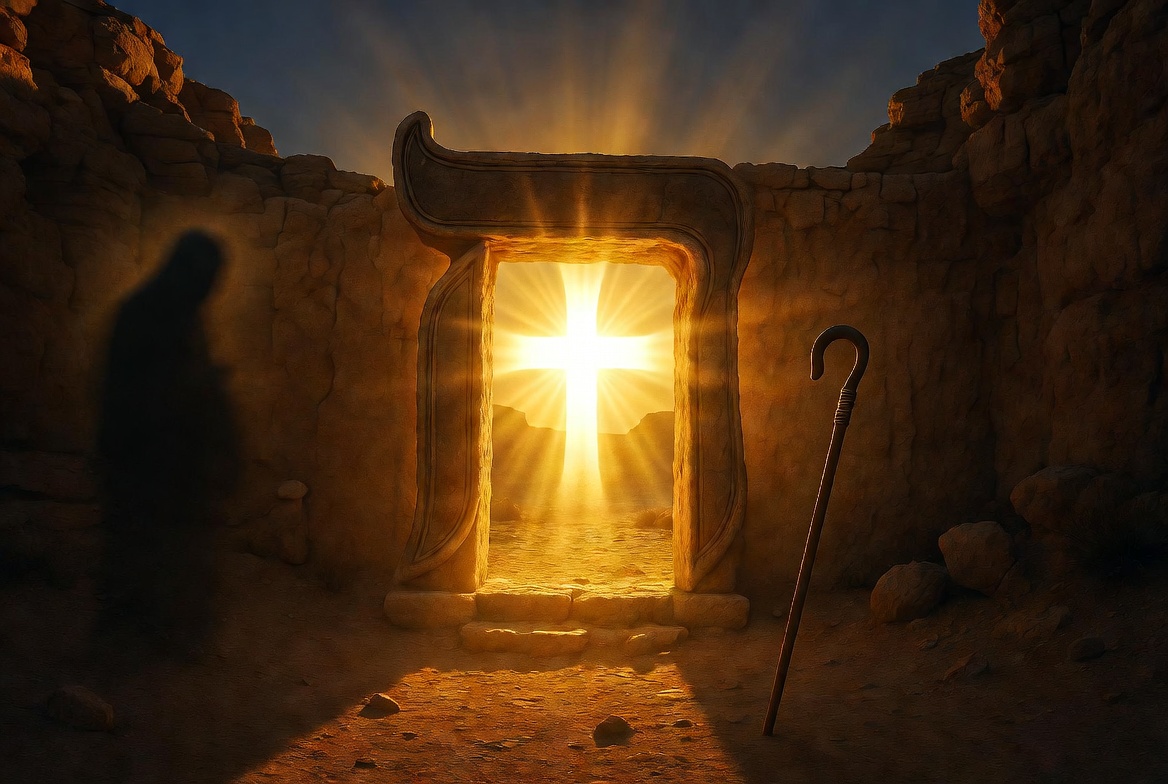
The number four in Hebrew is ארבע ‘arba`’ from רבע ‘rava’ which has the meaning of four sides of a square.

From the root:

רבע ‘rava’ goes back further to the root רב ‘rav’ which means master, lord or one in authority. It is the source of the word ‘rabbi’ (John 1:38).
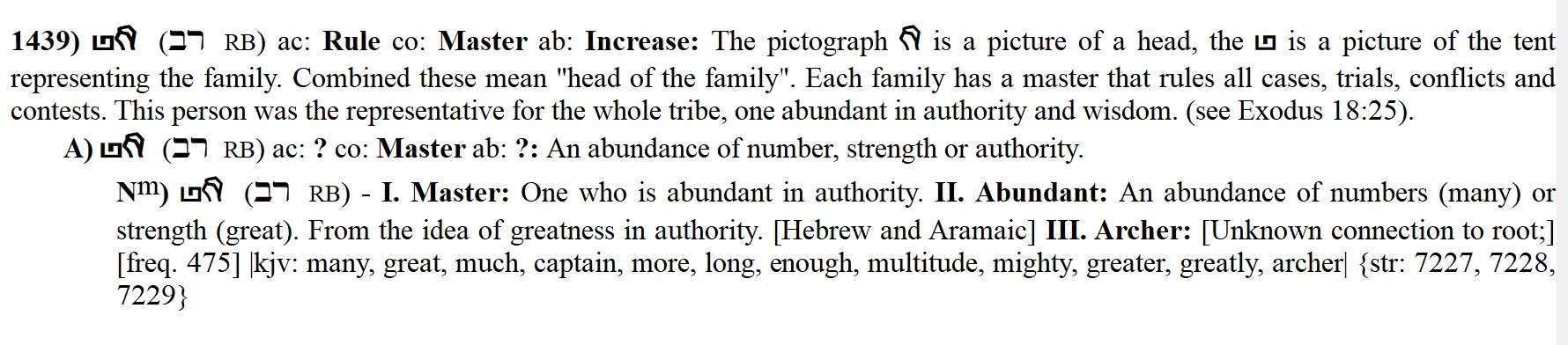
Christ is THE Rabbi, the True Master. The theme of this month is about who the true Master is.
Mat 23:7 And greetings in the markets, and to be called of men, Rabbi, Rabbi.
Mat 23:8 But be not ye called Rabbi: for one is your Master, even Christ; and all ye are brethren.
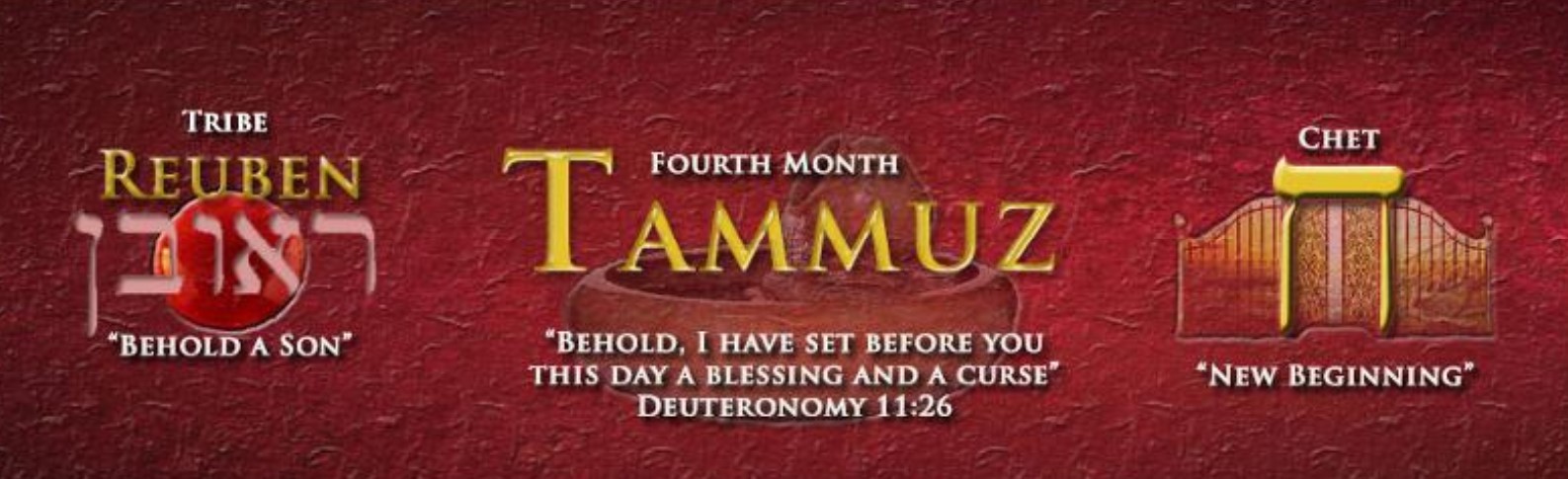
The name of the fourth month in the Jewish calendar is Tammuz which Israel adopted after their exile in Babylon. Tammuz, Nisan, Iyyar, Kislev and Adar were all adopted for names of months while Israel was in Babylon. All of these names trace back to Ancient Hebrew, yet at the same time were corrupted in meaning through the Mysteries.
The name of Tammuz
תמוז ‘Tammuz’ is a combination of two Hebrew words, תם ‘tam’ which means complete or maturity, and עז ‘az’ which is speaking of strength or a weapon but also harvesting crops. Tammuz or Dumuzi was the corn/grain god and was alternatively called Shamash which means the sun.
In Sumerian, Dumuzi, comes from ‘dumu’ meaning son or child and ‘zid’ meaning true, righteous, faithful or flawless. In Akkadian, ‘du’ means son and ‘zi’ means life. Here in his name is seen the true/right/good son. The flawless young one, the son of life. Some say the name means the son who rises. In Sumeria, Dumuzi/Dumuzid was also considered a “shepherd-god.”
All of these names point to Christ Jesus. Tammuz is the counterfeit. Satan is the counterfeiter.
2Co 11:14 And did not Satan marvelously transform himself into an angel of light?
Isa 14:12 How art thou fallen from heaven, O Lucifer, son of the morning! how art thou cut down to the ground, which didst weaken the nations!
Isa 14:13 For thou hast said in thine heart, I will ascend into heaven, I will exalt my throne above the stars of God: I will sit also upon the mount of the congregation, in the sides of the north:
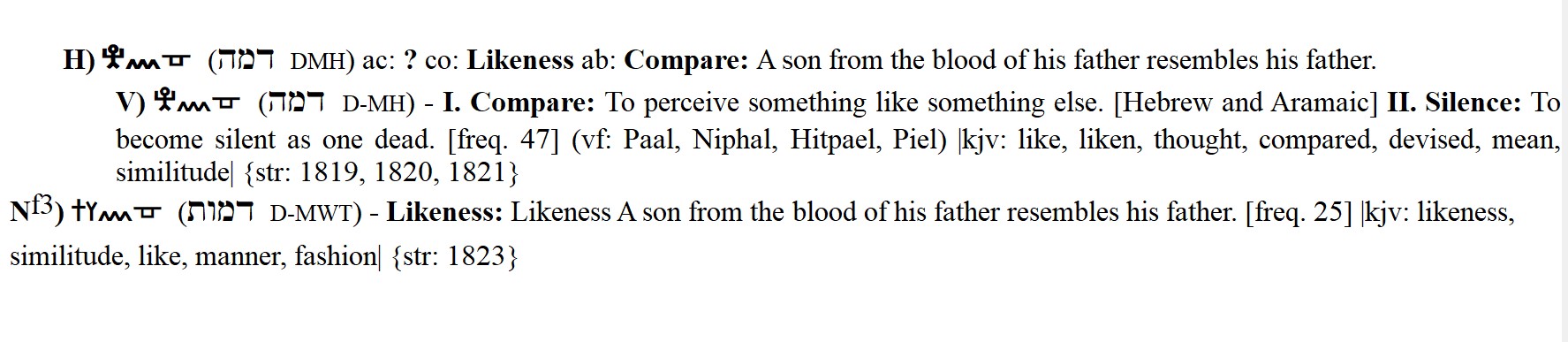
Isa 14:14 I will ascend above the heights of the clouds; I will be like (דָּמָה ‘damah’) the most High.
Isa 14:15 Yet thou shalt be brought down to hell, to the sides of the pit.
דָּמָה ‘damah’ has the meaning of resemblance, as in a son the father.
H1819
דָּמָה
dâmâh
daw-maw’
A primitive root; to compare; by implication to resemble, liken, consider: – compare, devise, (be) like (-n), mean, think, use similitudes.
Justin Martyr – Dialogue with Trypho Chapter 69
“Be well assured, then, Trypho,” I continued, “that I am established in the knowledge of and faith in the Scriptures by those counterfeits which he who is called the devil is said to have performed among the Greeks; just as some were wrought by the Magi in Egypt, and others by the false prophets in Elijah’s days.
For when they tell that Bacchus, son of Jupiter, was begotten by [Jupiter’s] intercourse with Semele, and that he was the discoverer of the vine; and when they relate that, being torn in pieces and having died, he rose again and ascended to heaven; and when they introduce wine into his mysteries, do I not perceive that [the devil] has imitated the prophecy announced by the patriarch Jacob, and recorded by Moses? …
And when he [the devil] brings forward Asculapius as the raiser of the dead and healer of all diseases, may I not say that in this matter likewise he has imitated the prophecies about Christ?”
Affliction
Beginning with the summer solstice came a time of mourning in the Ancient Near East, as in the Aegean: the Babylonians marked the decline in daylight hours and the onset of killing summer heat and drought with a six-day “funeral” for the god.
These mourning ceremonies were observed by Israel at the very door of the Temple.
Eze 8:14 Then he brought me to the door of the gate of the LORD’S house which was toward the north; and, behold, there sat women weeping for Tammuz.
Eze 8:15 Then said he unto me, Hast thou seen this, O son of man? turn thee yet again, and thou shalt see greater abominations than these.
Eze 8:16 And he brought me into the inner court of the LORD’S house, and, behold, at the door of the temple of the LORD, between the porch and the altar, were about five and twenty men, with their backs toward the temple of the LORD, and their faces toward the east; and they worshipped the sun toward the east.
Eze 8:17 Then he said unto me, Hast thou seen this, O son of man? Is it a light thing to the house of Judah that they commit the abominations which they commit here? for they have filled the land with violence, and have returned to provoke me to anger: and, lo, they put the branch to their nose.
It is believed that the sin of the golden calf happened on the 17th day of Tammuz, one of the reasons for the fast in Biblical times on this day (Zechariah 8:19). The golden calf was a counterfeit of the true. The golden calf was a type of counterfeit worship. Worshiping God through an idol.
Exo 32:5 And when Aaron saw it, he built an altar before it; and Aaron made proclamation, and said, To morrow is a feast to the LORD.
It is also believed that both temples were breached by Babylon and later by Rome (Ta’anit 4:5). It is also believed that King Manasseh set up an idol to Asherah (consort of Tammuz) during this time period (2 Kings 21:7). The fast on the 17th begins “three weeks” of mourning in Judaism leading up to Tisha B’Av (9th of Av/5th month).
The Door
The 4th Hebrew letter is ד ‘dalet.’ This word has the meaning of a door. Interestingly in light of the theme of the fourth month it also has the meaning of someone brought low.
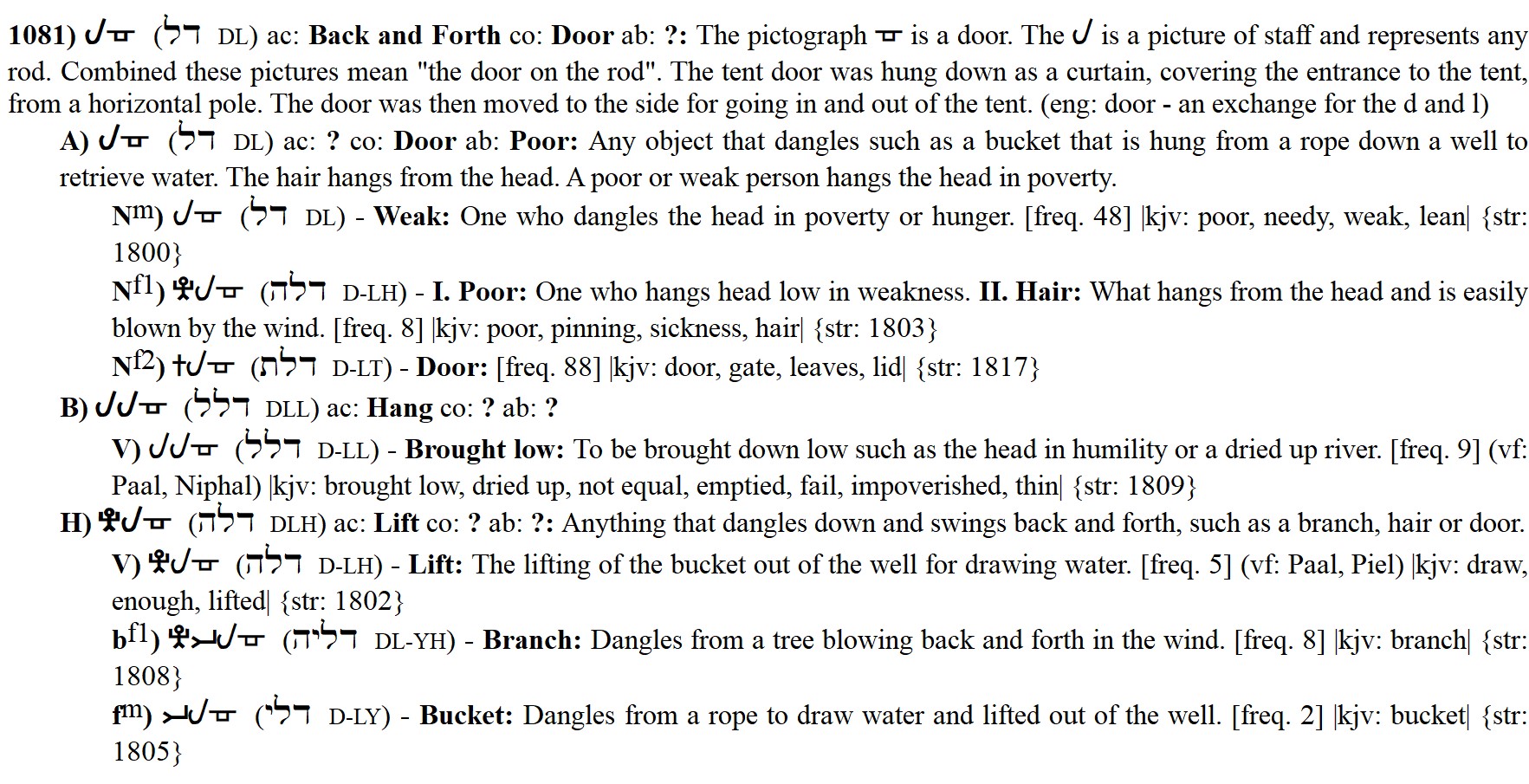
The Hebrew word for the number four (ארבע ‘arba`’) connects to Master or Lord as mentioned before. רבע ‘rava’ goes back further to the root רב ‘rav’ which means master, lord or one in authority.
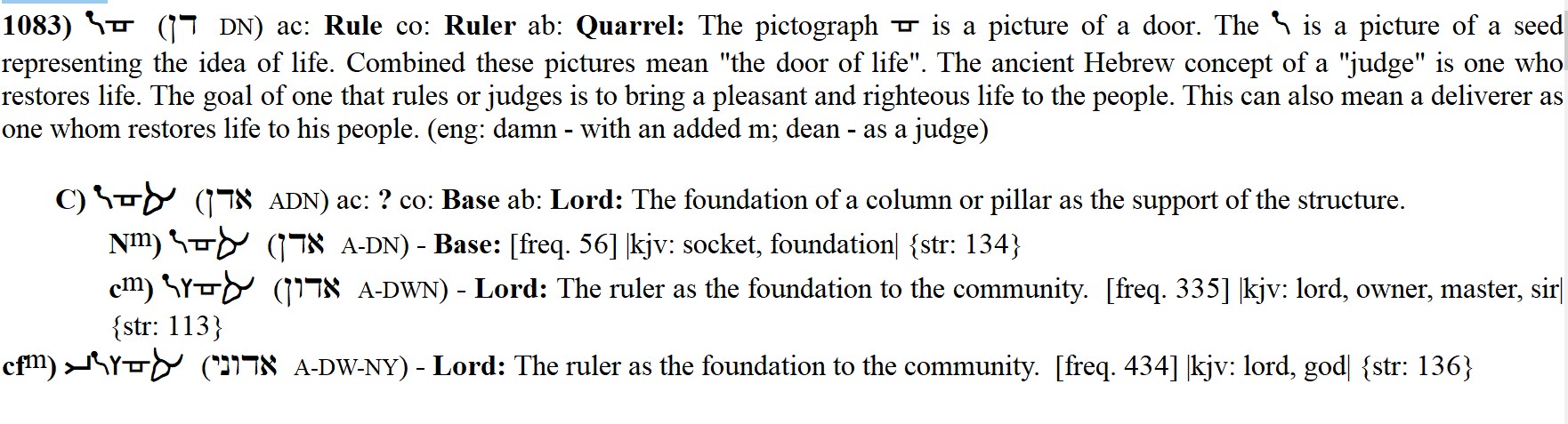
Interestingly, the word for Lord in Hebrew ( אדוני ‘Adonai),’ connects to the door. אדוני ‘Adonai comes from the root דן which means a ruler as in the “door of life.”
In Jewish thought, the fourth month of Tammuz is associated with the letter ח ‘chet’ which, in the square script, looks like an open door. The name Tammuz is broken down into תם ‘tam’ which means complete and see the ‘vav’ and ‘zayin’ combining together to make the letter ‘chet’.
Further connecting Tammuz and doors is the weeping for Tammuz mentioned by Ezekiel mentioned before:
Eze 8:14 Then he brought me to the door of the gate of the LORD’S house which was toward the north; and, behold, there sat women weeping for Tammuz.
The fourth month occurs during June in which the Summer Solstice occurs. The sun played an important part in the Biblical Calendar for the reckoning of time.
The Hebrew letter ד ‘dalet’ is equivalent with the Greek letter Δ ‘delta.’ Δ ‘delta’ is used in mathematics in reference to change over time (Δt). It comes from the Greek word διαφορά ‘diaphora’ meaning difference or change. The fourth dimension is time.
The are multiple words for time in Hebrew, the most used is עת ‘et’ which pictographically means to ‘see the cross’, and in ancient Hebrew thinking meant to ‘see the mark.’ What is this ‘mark’? It is the sun setting (death) and rising (resurrection) above the horizon. Tammuz is considered one of the “dying” and “rising” gods of the heathen mysteries.
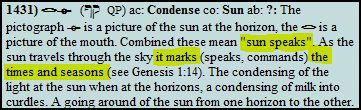
More on קף ‘qaf’ and it’s relation to time below.
עת ‘et’ corresponds to the Greek word καιρός ‘kairos’ through comparing Daniel 7:25 & Revelation 12:6, 14.
In the Septuagint, καιρός ‘kairos’ is used to translate numerous words but one of which is very interesting. The word תר ‘tor’ due to its relation to the concept of ‘the mark.’
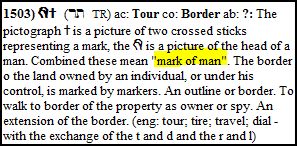
From this root we get תאר ta’ar andתואר to’ar. These words mean form, outline or border.
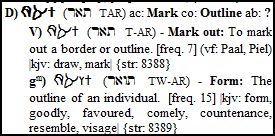
תואר ‘toar’ is from the same root תר‘tor’ as תורה ‘torah‘
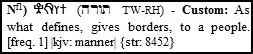
The word for hour is related to the sun

This comes from the root ‘שע’ ‘sha’ which is a picture of a shepherd watching over his flock. שע ‘sha’ is also the root of the word Yeshua, the Hebrew name of Jesus.
This is why the sun gods are portrayed with an ‘all seeing eye’ as well as being related to the triangle/pyramid, which is in the same shape as the ancient Hebrew letter dalet, which is the origin of the Greek letter delta. Dalet has the numerical value of 4 which relates to the 4th dimension of time, of which the sun is intimately connected. Further connecting to the Messiah, the letter dalet means a ‘door.’
Joh 10:7 Then Jesus again said to them, Truly, truly, I say to you that I am the door of the sheep.
For more on this subject see:
Daily Tidbits 2/28 – Sun & Time
In Greek, the “god” of time was χρόνος ‘Chronos,’ who was equivalent with Saturn in Roman mythology. Some link Saturn with Tammuz as the Babylonians were said to call the planet Saturn the “star of Tammuz.”
“Velikovsky equates Tammuz with Osiris and Kronos/Saturn as planetary deities whose “death” (disappearance or transformation after a cosmic catastrophe/Deluge) was mourned. The wailing for Tammuz (Ezekiel 8) and Osirian mysteries are seen as reactions to Saturn’s changed appearance or invisibility behind clouds/volcanic dust.”
In this view, Tammuz/Saturn represents a former “golden age” ruler who descends to the underworld and returns diminished — tying into themes of cycles, death/rebirth, and lamentation. {The Worship of Saturn}
The Cross
The cross is strongly connected to the number 4 as a cross divides space into four quadrants (four cardinal directions). In science, some interpret the cross as a structure of four dimensions (4 directions + center point). Cathedrals with cruciform plans (cross-shaped) emphasize this. The love of God was revealed in the cross, described by Paul in four “directions.”
Eph 3:17 That Christ may dwell in your hearts by faith; that ye, being rooted and grounded in love,
Eph 3:18 May be able to comprehend with all saints what is the breadth, and length, and depth, and height;
Eph 3:19 And to know the love of Christ, which passeth knowledge, that ye might be filled with all the fulness of God.
Cathedrals
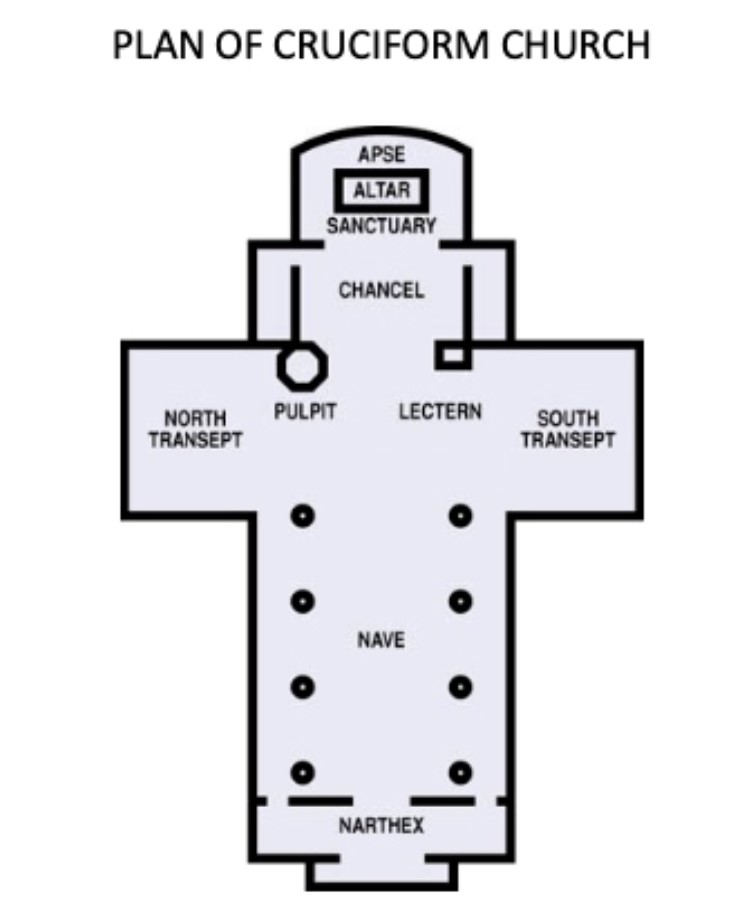
The first Cathedral built was the Holy Cathedral of Etchmiadzin. It was built with the cruciform plan. As seen in the tidbit on the Cathedral of Etchmiadzin, the plan of this building was given to Gregory the Illuminator by Jesus in a vision. This parallels the building of the Temple of Solomon which was given to David by God (1 Chronicles 28:11-19).
The Cathedral of Etchmiadzin was built on top of the ruins of the pagan temple of Vagharshapat displaying Christ’s victory of the pagan gods. The temple of Solomon was built in a similar fashion to pagan temples, displaying the same concept.
Solomon partnered with Hiram the King of Tyre to build the Temple (1 Kings 5:1-12; 7:13-14). Hiram also built the Temple to Melcart which was very similar in design to the Temple of Solomon. The temple at Ain Dora is even more similar to the Temple of Solomon.
In his article “The New ‘Ain Dara Temple: Closest Solomonic Parallel” John Monson writes that “the Hittite temple in ‘Ain Dara, northern Syria, is the most significant parallel to Solomon’s Temple ever discovered.” It is contemporaneous in date, similar in size, and shares many of the same features. It was dedicated to the goddess Ishtar, who would’ve been represented inside by a statue of the goddess. Gregory K. Beale writes that in nearby Assyria, “Ashurbanipal II (883-859 B.C.) ‘created an icon of the goddess Ishtar . . . from the finest stones, fine gold . . . (thus) making her great divinity resplendent,’ and he ‘set up in (the temple) her dais [throne platform] (with the icon) for eternity.’ The resplendent glory of the image was to reflect the luminescent glory of the goddess herself. Accordingly, the light of the deity was to shine out from the temple into the faces of humanity.”

Of course, Solomon’s Temple (like the Tabernacle) was built to house the Ark of the Covenant, which was considered to be Yahweh’s throne, though he himself was never depicted.

Monson continues in his article: “Built on a large raised platform, the [‘Ain Dara] temple consists of three rooms: a niche-like portico, or porch; an antechamber; and a main hall, which housed the innermost shrine.” This innermost shrine was analogous to the Holy of Holies in Solomon’s temple, while ‘Ain Dara’s main hall was similar to Solomon’s Holy Place (minus the antechamber), in which most of the Temple furniture (menorahs, etc.) were kept. Both temples had a portico, each flanked by two columns.
Other similarly-constructed temples existed in the Near East, such as the Late Bronze Age (1550–1200 B.C.E.) temple at Hazor in northern Israel, and the eighth-century B.C. temple at Tell Ta‘yinat, in northern Syria. According to Monson, “Today we know of at least two dozen excavated temples that may be compared to Solomon’s Temple. Most of them are of the long-room type and come from the area north of the Israelite heartland. The Bible itself tells us that Solomon’s Temple design was mediated through Hiram of Tyre and other artisans from Phoenicia, the coastal region north of Israel (1 Kings 5, 7:13–37).”
Once again, we see (like the Israelite Tabernacle) that Solomon’s temple to Yahweh was heavily influenced in its overall layout by those of its neighboring cultures (although in the case of Solomon’s temple, God himself did not give the specific dimensions). We have no biblical evidence that God disapproved of this architectural influence from Tyre/Phonecia, as long as the Israelites worshiped him alone. And as mentioned in last week’s discussion of the Tabernacle, God himself based its design on Egyptian models.
The cherubim are a class of angelic beings mentioned in the Bible, and in various ancient Near Eastern cultures. They are identified in the Bible first as guardians of the tree of life (Genesis 3:24), or simply as being in Eden (Ez. 28:13-14). In later passages they are depicted as guardians of the throne of God (Ex. 25:17-22; 1 Kings 6:23-28; Ex. 26:31; Ez. 1:26, Ps. 80:1, 99:1; Is. 37:16; Dan. 3:55), or are described as being modes of transport for God Himself (2 Sam. 22:11; Ps. 18:10; Ez. 10:18-19).
As noted in some of the passages above, both two-dimensional and three-dimensional images of cherubim adorned the Tabernacle and Solomon’s Temple: on the lid of the Ark of the Covenant, on the entrance to the Holy of Holies, standing on either side of the Ark itself, and on the interior walls of the Temple.
The image of cherubim as throne guardians was widespread throughout the rest of the Near East during the time of ancient Israel, but it was most common in Syria and Northern Mesopotamia between 2000 and 700 B.C. (Solomon built his temple to Yahweh in 960 B.C.).
I’d like to focus on an idea that I recently read about in The Temple and the Church’s Mission by G. K. Beale, and secondly in an article entitled “Jerusalem as Eden,” by Lawrence E. Stager (Biblical Archaeology Review, May/June 2000). The idea is this: that the motifs and symbolism of Israel’s temple, like the temples of its pagan neighbors, were based on the idea of a primeval garden. If this is the case (and it seems to be, at least in part), then it is another way in which Israel borrowed artistic and theological concepts from its neighbors in order to show the truths of Yahweh.
As Beale puts it, “It is apparent that Israel intentionally alluded to facets of the pagan religion surrounding them (e.g., Egyptian, Canaanite and Babylonian) in order to affirm that what the pagans thought was true of their gods was true only of Israel’s God” (p. 29).
The idea of a primeval garden from which God ruled over the earth was common to several cultures surrounding ancient Israel. A central part of these cosmologies was the idea of the garden being located on a cosmic mountain where the deity dwelled. From this mountain flowed the primordial waters of life, which watered the garden and the earth (see Genesis 2:10-14). Examples of garden imagery in the temples of Israel’s neighbors include a temple created by Ramses III of Egypt, who created “gardens” inside his god’s temple. In the temple of Isis on the island of Philae, colorful foliage forms the capitals of the ten pillars. We recognize several sorts of tropical vegetation: lotuses, papyri, palm trees. The huge, beautifully painted pillars symbolize the first plants, trees and flowers of the earth which began to grow on the Primeval Mound (symbolized by the temple floor). In the ceiling (the sky), are images of the Day Boat and the Night Boat, and of the vultures of Upper and Lower Egypt.
Another example of garden imagery is a mural in the Babylonian palace at Mari, located on the banks of the Euphrates in modern Syria. It depicts the installation of King Zimri-Um into office. According to Stager, “The setting for the ceremony is a paradise garden with date palms and stylized papyrus stalks. Guarding the garden and the palace are winged sphinxes, griffins and bulls. At the outer edges of the scene, two goddesses of high rank stand with upraised arms– a gesture of protection for all within the garden precincts” (p. 39). In addition, he mentions “near the city of Assur, archaeologists have discovered a garden temple associated with the akitu festival. Row after row of tree pits filled the courtyards of the sanctuary” (p. 43). Stager mentions several examples of Near Eastern kings (including Solomon) who built literal gardens near their temples or palaces and filled them with all kinds of trees and plants from near and far. These lush gardens reinforced the idea of kings as the representatives of their gods on earth, with each king tending the garden or dwelling place of the god.
Inside Solomon’s Temple itself, the entry portico was flanked by two tree-like columns which were capped with lily-shaped capitals, each interlaced with two rows of pomegranates (1 Kings 7). The olive wood folding doors at the entrance to the temple and to the Holy of Holies, like the walls of the central hall (Holy Place), were decorated with carvings of cherubim, palm trees, and rosettes (open flowers), all of which were covered in gold (1 Kings 6). As mentioned in last week’s post, cherubim were mythic/spiritual beings in Near Eastern cosmology who guarded both the throne of God and the Tree of Life in the Garden of Eden. In the main hall (Holy Place), there was one main lampstand (menorah) flanked by ten additional smaller lampstands. Beale speculates that the main lampstand represented the Edenic Tree of Life. God’s instructions for its construction (Ex. 25:31-36) call for it to look somewhat like a small, flowering tree with seven protruding branches from a central trunk. The overall effect of the entire grouping of lampstands suggest a forest of trees. In fact, when describing the later destruction of the temple by enemies, the writer of Psalm 74:5-7 stated “They behaved like men wielding axes to cut through a thicket of trees.”
Like the garden of Eden, Solomon’s Temple suggested that God could metaphorically step out of the Holy of Holies into the Holy Place, just as he had stepped down from his throne and walked in the Garden of Eden with Adam. In this sense (according to Beale and others), Eden was the first “temple” and Adam was the first priest who, like Moses, met face to face with God. In conclusion, I agree with Beale’s thoughts on the significance of the parallels with Solomon’s Temple and those of his neighbors:
This resemblance of pagan temples to Israel’s temple probably was due, at least in part, to a refracted and marred understanding of the true conception of the temple that was present from the very beginning of human history. As history unfolded, God’s special revelation about the temple continued only with the faithful remnant of humanity. The recollection of the true temple by those outside God’s covenant community probably continued, but its memory became dim over time. Nevertheless… some temples were designed that still retained features corresponding to God’s own view. God’s people, on the other hand, continued building temples that represented the pristine view of the true cult (Beale, p. 29).
The New ‘Ain Dara Temple: Closest Solomonic Parallel
The Temple of Melqart was so similar to the Temple of Solomon that some researchers actually think that the design for Solomon’s temple came from the Temple of Melqart. The Holy Scriptures, however, declare that God Himself designed Solomon’s Temple (1 Chronicles 28:12-13, 19).
Solomon’s Temple Copy of Phoenician Temple of Melqart in Tyre
“After studying records about Solomon’s Temple and Melqart’s Temple, one finds a lot in common between the two. It would not be a far-fetched suggestion to say that Solomon’s Temple of Jerusalem was a copy of Melqart’s Temple of Tyre. Because of the splendor it occupied in their mind, it is understandable that the Phoenician builders must have used Melqart’s Temple as a prototype for designing and building Solomon’s Temple.”
The kings and prophets of Israel worshiped God at the Temple which Scripture declares He designed. This design had a “pagan parallel” in Tyre and was built by men of Tyre who may have actually built the “pagan parallel” (1 Kings 7:13-15, 40).
Josephus wrote that King Hiram, who helped Solomon build the Temple, also built the temple of Heracles (Melqart) and Ashtart
He also went and cut down materials of timber out of the mountain called Lebanon, for the roof of temples; and when he had pulled down the ancient temples, he both built the temple of Heracles and that of `Ashtart; and he was the first to celebrate the awakening (egersis) of Heracles in the month Peritius (Antiquities 8.5.3).
For more on this see:
Cross Counterfeit
The cross has been one of the greatest counterfeits in history. The Hebrew letter Tav (ת) — pictured as two crossed sticks is the ancient mark of covenant and protection (Ezekiel 9:4). The mark of God. While the true cross represents Messiah’s victory, covenant blood, and the revelation of God’s Name and Arm, the adversary has used the cross symbol throughout the mystery religions (from Egypt and India to Bacchus and Tammuz) as a mark of initiation and allegiance. This contrasts the Word of the Cross (the power of God) with the empty, symbolic cross of the beast — a counterfeit covenant with death.
Satan seeks to be like God, he is a counterfeiter. The use of the cross in the mysteries was a perfect display of his desired usurpation. The cross points to the death and victory of Christ.
Col 2:15 having stripped the rulers and the authorities, He made a show of them in public, triumphing over them in it.
2Co 5:21 For He made the One who knew no sin to be sin for us, that we might become the righteousness of God in Him.
The word mark comes from the Hebrew word Tav
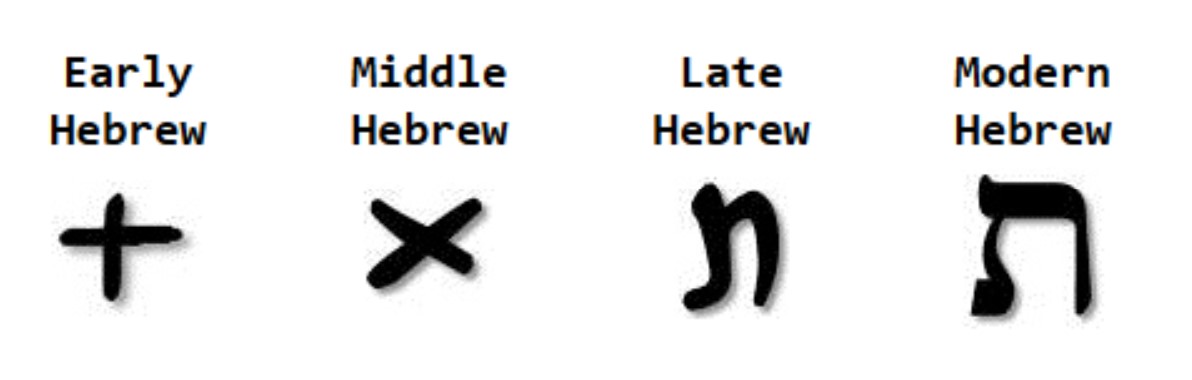
God allowed the heathen nations to worship the host of heaven because the sun, moon & stars point to Christ Jesus (Deuteronomy 4:19). He prepared their hearts so that when the set time would come (Galatians 4:4), they would be ready to see the true Savior of the world (Isaiah 49:6; 52:10).
Psa 74:4 Thine enemies roar in the midst of thy congregations; they set up their ensigns for signs.
This is seen in more detail in:
Mark of the Beast 5 – The Cross
Mark of the Beast 8 – Solomon & Freemasonry
Mark of the Beast 10 – The Holy Grail
Cross and the 4th dimension
Entrance into God’s tent is only through the door (John 14:6). Christ is that door (John 10:7).
Joh 10:1 Verily, verily, I say unto you, He that entereth not by the door into the sheepfold, but climbeth up some other way, the same is a thief and a robber.
Joh 10:2 But he that entereth in by the door is the shepherd of the sheep.
Joh 10:3 To him the porter openeth; and the sheep hear his voice: and he calleth his own sheep by name, and leadeth them out.
Joh 10:4 And when he putteth forth his own sheep, he goeth before them, and the sheep follow him: for they know his voice.
Joh 10:5 And a stranger will they not follow, but will flee from him: for they know not the voice of strangers.
Joh 10:6 This parable spake Jesus unto them: but they understood not what things they were which he spake unto them.
Joh 10:7 Then said Jesus unto them again, Verily, verily, I say unto you, I am the door of the sheep.
Joh 10:8 All that ever came before me are thieves and robbers: but the sheep did not hear them.
Joh 10:9 I am the door: by me if any man enter in, he shall be saved, and shall go in and out, and find pasture.
Joh 10:10 The thief cometh not, but for to steal, and to kill, and to destroy: I am come that they might have life, and that they might have it more abundantly.
Joh 10:11 I am the good shepherd: the good shepherd giveth his life for the sheep.
Joh 10:12 But he that is an hireling, and not the shepherd, whose own the sheep are not, seeth the wolf coming, and leaveth the sheep, and fleeth: and the wolf catcheth them, and scattereth the sheep.
Joh 10:13 The hireling fleeth, because he is an hireling, and careth not for the sheep.
Joh 10:14 I am the good shepherd, and know my sheep, and am known of mine.
Joh 10:15 As the Father knoweth me, even so know I the Father: and I lay down my life for the sheep.
Joh 10:16 And other sheep I have, which are not of this fold: them also I must bring, and they shall hear my voice; and there shall be one fold, and one shepherd.
Joh 10:17 Therefore doth my Father love me, because I lay down my life, that I might take it again.
Joh 10:18 No man taketh it from me, but I lay it down of myself. I have power to lay it down, and I have power to take it again. This commandment have I received of my Father.
Messiah lays down His life for His sheep. In this portion of Scripture, Messiah likens Himself to the ‘door’. Through His sacrifice, Messiah has opened up the door to eternity. He has pierced the veil that delivers us from death and allows us to enter in the Kingdom of Light. He has ‘pierced the fabric’ of time-space…
What is the Hebrew word for Love?

From the root:
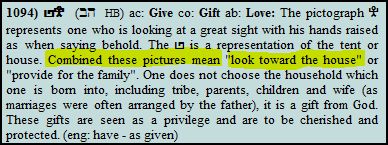
The Pictograph meaning of Love
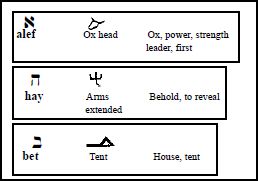
The first and last letters spell out the word for Father אב ‘av’ and the middle letter ה ‘heh’ is a picture of a man with outstretched arms. The Love of the Father is revealed through the Messiah on the tree, gathering all mankind back to their Creator.
For more on this subject see:
Daily Tidbits 2/18 – Love & the 4th Dimension
Shadows of Messiah – Shadows & the 4th Dimension
littleguyintheeye@gmail.com


