

This Daily Tidbit explores the profound truth that God Himself is the source and author of all beauty. Through Hebrew and Greek word studies, Scripture, and reflections from the Church Fathers, we discover that His beauty is inseparable from His love and character. Creation, the senses, awe, grace, and Christ all point us back to the One who is Beauty itself—and invite us to be transformed by it.
God’s name and character are described as naiym—pleasant and beautiful (Psalm 135:3); His beauty is rooted in the fact that He is love.
Creation itself is a reflection of God’s Word and artistry; He is the Great Artist (yatsar) and Great Poet (poiēma).
True beauty inspires holy awe (yafah—the hand-over-mouth response of being stunned) and places eternity in our hearts (Ecclesiastes 3:11).
Beauty engages all five senses, drawing us to taste, see, hear, smell, and touch the goodness of the Lord.
Christ is the perfect embodiment of divine beauty—“fairer than the children of men” (Psalm 45:2)—and grace itself is a form of beauty that transforms us.
Counterfeit beauty (Satan’s former radiance, false teachers, outward appearance without inward holiness) is exposed and contrasted with authentic beauty that flows from love and truth.
God beautifies His people with salvation and is conforming us into the image of His Son so that we, and all creation, reflect His glory once more.

Psa 135:3 Praise the LORD; for the LORD is good: sing praises unto his name; for it is pleasant {נעים ‘naiym’ beautiful}.
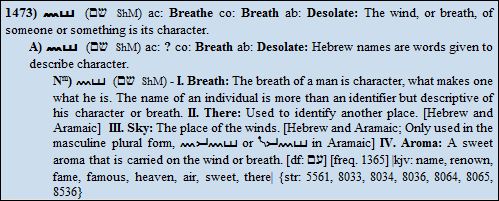
נעים ‘naiym’ means sweet, pleasant or beautiful. נעים ‘naiym’ is used in reference to the name of God in Psalm 135:3. In Hebrew, the word for name means one’s character.
Rev 19:13 And he was clothed with a vesture dipped in blood: and his name is called The Word of God.
God (and His Word which reveals His character) is love (1 John 4:8, 16). Creation, which came forth from His Word (Psalm 33:6), is a reflection of God’s Word and His love. The beauty found in nature points to His Word/love. He is the source of all beauty (Psalm 27:4; 90:17; 45:2; Zechariah 9:17).
“As love increases in you, so beauty increases; for love itself is the beauty of the soul.” (St. Augustine of Hippo – Homily on the First Epistle of John Tractate 9, section 9)
Psa 27:4 One thing have I desired of the LORD, that will I seek after; that I may dwell in the house of the LORD all the days of my life, to behold the beauty of the LORD, and to enquire in his temple.
The LORD is the Great Artist, the Maker of all things (Psalm 95:6). The English word ‘artist’ comes form the Hebrew word יצר ‘yatsar’ which means to create or form, as a potter molding clay. God is the former of all things (Jeremiah 10:16; 51:19). In Greek, the word for make or workmanship is ποίημα ‘poiēma’ which is the source of our English word ‘poem’ (Romans 1:20, 23; Ephesians 2:10). God is the Great Artist, He is the Great Poet. He is the source of all beauty (Psalm 27:4; 90:17; 45:2; Zechariah 9:17). He is the Author of beauty (Wisdom 13:3).
Wis_13:3 With whose beauty if they being delighted took them to be gods; let them know how much better the Lord of them is: for the first author (γενεσιάρχης ‘genesiarches’) of beauty hath created them.
γενεσιάρχης ‘genesiarches’ is a combination of γένεσις ‘genesis’ which means origin, beginning and άρχή ‘arche’ which means beginning, ruler, source. God is the source of all beauty.
Wis 13:3 With whose beauty if they being delighted took them to be gods; let them know how much better the Lord of them is: for the first author of beauty hath created them.
Wis 13:4 But if they were astonished at their power and virtue, let them understand by them, how much mightier he is that made them.
Wis 13:5 For by the greatness and beauty of the creatures proportionably the maker of them is seen.
Wis 13:6 But yet for this they are the less to be blamed: for they peradventure err, seeking God, and desirous to find him.
Wis 13:7 For being conversant in his works they search him diligently, and believe their sight: because the things are beautiful that are seen.
“I venture to affirm that, to one who has cleansed all the powers of his being from every form of vice, the Beauty which is essential, the source of every beauty and every good, will become visible… the God of the Universe is the only absolute, and primal, and unrivalled Beauty and Goodness.” (St. Gregory of Nyssa – On Virginity ch 11)
“From this Beautiful comes being to all existing things… and the Beautiful is origin of all things, as a creating Cause… This, the one Good and Beautiful, is uniquely Cause of all the many things beautiful and good.” (Pseudo-Dionysisus the Areopagite – The Divine Names ch 4)
Beauty and Awe
Psa 96:6 Honour and majesty are before him: strength and beauty are in his sanctuary.
Psa 96:7 Give unto the LORD, O ye kindreds of the people, give unto the LORD glory and strength.
Psa 96:8 Give unto the LORD the glory due unto his name: bring an offering, and come into his courts.
Psa 96:9 O worship the LORD in the beauty of holiness: fear before him, all the earth.
Psa 33:8 Let all the earth fear the LORD: let all the inhabitants of the world stand in awe of him.
Psa 33:9 For he spake, and it was done; he commanded, and it stood fast.
The Beautiful and awe inspiring God
“Through the grandeur and beauty of the creatures, we may by analogy, contemplate their Author.” Richard Rohr
One of the words for beauty in Hebrew is יפה ‘yafah.’ The word pictures something that is breathtaking or perhaps awe-inspiring. יפה ‘yafah’ consists of the letters י ‘yod’ which means a hand, פ ‘peh’ which means the mouth, and ה ‘heh’ which means something revealed. Here in this word is the natural inclination of man to cover his hand with his mouth in amazement at a beautiful or miraculous thing (Job 21:5). Covering the mouth is a sign of silence (Judges 18:19) which occurs when one sees something “breathtaking” or awe-inspiring (Psalm 33:8). This gesture is also used in reference to astonishment.
Job 21:5 Mark me, and be astonished (שׁמם ‘shamem’), and lay your hand upon your mouth.
H8074
שׁמם
shâmêm
BDB Definition:
1) to be desolate, be appalled, stun, stupefy
1a) (Qal)
1a1) to be desolated, be deflowered, be deserted, be appalled
1a2) to be appalled, be awestruck
Exo 15:11 Who is like unto thee, O LORD, among the gods? who is like thee, glorious (אדר ‘adar’) in holiness, fearful in praises, doing wonders?
אדר ‘adar’ has the meaning of majestic, goodly, comely, beautiful.
Scripture speaks of Christ Jesus as יפה ‘yafah.’
Psa 45:2 Thou art fairer {יפה ‘yafah’} than the children of men: grace is poured into thy lips: therefore God hath blessed thee for ever.
Zec 9:16 And the LORD their God shall save them in that day as the flock of his people: for they shall be as the stones of a crown, lifted up as an ensign upon his land.
Zec 9:17 For how great is his goodness, and how great is his beauty {יפה ‘yafah’} ! corn shall make the young men cheerful, and new wine the maids.
Ecc 3:11 He hath made every thing beautiful (יפה ‘yafeh’) in his time: also he hath set the world {עלם ‘olam’ – eternity) in their heart, so that no man can find out the work that God maketh from the beginning to the end.
Beauty brings forth “eternity in our hearts”…the beauty of creation leads us to the Creator, the Eternal One.
All the ends of the world shall REMEMBER and turn to Him
“Love inscribes the beauty of the divine loveliness [to tēs theias hōraiotētos kallos] into the memory of those who have already been graced with the equality of honor with God… and in this way they unforgettably possess the desire of the soul which inscribes and imprints into its guiding part the undefiled beauty of divine love.”(Maximus the Confessor)
Psa 22:27 All the ends of the world shall remember and turn unto the LORD: and all the kindreds of the nations shall worship before thee.
Psa 22:28 For the kingdom is the LORD’S: and he is the governor among the nations.
Deep in mankind’s conscious is Eternity, God’s beauty. Consciousness means to know or to be aware. In Christ is all the treasures of knowledge (Colossians 2:3) and the awareness/knowledge of God (2 Corinthians 4:6) and the love that surpasses knowledge/awareness (Ephesians 3:19).
Rom 2:14 For when the Gentiles, which have not the law, do by nature the things contained in the law, these, having not the law, are a law unto themselves:
Rom 2:15 Which shew the work of the law written in their hearts, their conscience also bearing witness, and their thoughts the mean while accusing or else excusing one another;)
His book, our thoughts
Psa 139:13 For thou hast possessed my reins: thou hast covered me in my mother’s womb.
Psa 139:14 I will praise thee; for I am fearfully and wonderfully made: marvellous are thy works; and that my soul knoweth right well.
Psa 139:15 My substance was not hid from thee, when I was made in secret, and curiously wrought in the lowest parts of the earth.
Psa 139:16 Thine eyes did see my substance, yet being unperfect; and in thy book all my members were written, which in continuance (יםים ‘yamiym’) were fashioned (יצר ‘yatsar’), when as yet there was none of them.
Psalm 139:16 seems to allude to this “memory” formed in us when we are made in the womb. “Continuance” is translated from the Hebrew יםים ‘yamiym’ which is the plural for days (יום ‘yom’) from the root ים ‘yam’ which means the sea as the sun sets in the West, where the sea is at in Israel.
In Ecclesiastes 3:11 “the world” is עלם ‘olam’ which means beyond the field of vision of time or space. Literally, beyond the horizon pointing to the sea in this context.
“Fashioned” in Psalm 139:16 comes from the word יצר ‘yatsar’ which pictures clay being pressed into shape but is also translated as “imagination” and mind” as in the forming of thought. In the womb, God is fashioning our bodies but also our minds. He is the potter, we are the clay (Isaiah 64:8). In ancient Near Eastern cultures, signatures were impressed into wet clay using stamps or seals.
The word signature comes from the Latin ‘signatura’ which means to mark with a stamp or sign. God makes mankind from the dust/clay (Genesis 2:7), marking Him with His image, His signature/name.
Scripture declares that God has put ‘eternity’ into the hearts of man (Ecclesiastes 3:11). The Sacred Name יהוה ‘Yahweh’ basically means the Eternal One (Psalm 135:13). The Great I AM, who was and is and is to come. What also is eternal? The love of God (John 17:24).
Joh 17:21 That they all may be one; as thou, Father, art in me, and I in thee, that they also may be one in us: that the world may believe that thou hast sent me.
Joh 17:22 And the glory which thou gavest me I have given them; that they may be one, even as we are one:
Joh 17:23 I in them, and thou in me, that they may be made perfect in one; and that the world may know that thou hast sent me, and hast loved them, as thou hast loved me.
Joh 17:24 Father, I will that they also, whom thou hast given me, be with me where I am; that they may behold my glory, which thou hast given me: for thou lovedst me before the foundation of the world.
Joh 17:25 O righteous Father, the world hath not known thee: but I have known thee, and these have known that thou hast sent me.
Joh 17:26 And I have declared unto them thy name, and will declare it: that the love wherewith thou hast loved me may be in them, and I in them.
Joh 13:35 By this shall all men know that ye are my disciples, if ye have love one to another.
The return of mankind to the Father is associated with coming to know and glorify His Name, His Memorial.
Jer 16:19 O LORD, my strength, and my fortress, and my refuge in the day of affliction, the Gentiles shall come unto thee from the ends of the earth, and shall say, Surely our fathers have inherited lies, vanity, and things wherein there is no profit.
Jer 16:20 Shall a man make gods unto himself, and they are no gods?
Jer 16:21 Therefore, behold, I will this once cause them to know, I will cause them to know mine hand and my might; and they shall know that my name is The LORD.
Psa 66:4 All the earth shall worship thee, and shall sing unto thee; they shall sing to thy name. Selah.
Psa 86:9 All nations whom thou hast made shall come and worship before thee, O Lord; and shall glorify thy name.
This will be done through the Christ, the revelation of God’s love.
Isa 49:5 And now, saith the LORD that formed me from the womb to be his servant, to bring Jacob again to him, Though Israel be not gathered, yet shall I be glorious in the eyes of the LORD, and my God shall be my strength.
Isa 49:6 And he said, It is a light thing that thou shouldest be my servant to raise up the tribes of Jacob, and to restore the preserved of Israel: I will also give thee for a light to the Gentiles, that thou mayest be my salvation unto the end of the earth.
Isa 49:6 And he said, It is a light thing that thou shouldest be my servant to raise up the tribes of Jacob, and to restore the preserved of Israel: I will also give thee for a light to the Gentiles, that thou mayest be my salvation unto the end of the earth.
Isa 49:7 Thus saith the LORD, the Redeemer of Israel, and his Holy One, to him whom man despiseth, to him whom the nation abhorreth, to a servant of rulers, Kings shall see and arise, princes also shall worship, because of the LORD that is faithful, and the Holy One of Israel, and he shall choose thee.
Isa 49:8 Thus saith the LORD, In an acceptable time have I heard thee, and in a day of salvation have I helped thee: and I will preserve thee, and give thee for a covenant of the people, to establish the earth, to cause to inherit the desolate heritages;
Isa 49:9 That thou mayest say to the prisoners, Go forth; to them that are in darkness, Shew yourselves. They shall feed in the ways, and their pastures shall be in all high places.
Isa 49:10 They shall not hunger nor thirst; neither shall the heat nor sun smite them: for he that hath mercy on them shall lead them, even by the springs of water shall he guide them.
Isa 49:11 And I will make all my mountains a way, and my highways shall be exalted.
Isa 49:12 Behold, these shall come from far: and, lo, these from the north and from the west; and these from the land of Sinim.
Isa 49:13 Sing, O heavens; and be joyful, O earth; and break forth into singing, O mountains: for the LORD hath comforted his people, and will have mercy upon his afflicted.
ALL nations shall turn to Him and every knee shall bow, confessing that Jesus is Lord (Isaiah 45:22-25; Romans 14:9-13; Philippians 2:1-16). Through Him (Romans 10:9-10), all nations can praise and confess the name of God (Romans 15:8-12) and become His children (Matthew 10:32; 1 John 4:15).
Psa 65:2 O thou that hearest prayer, unto thee shall all flesh come.
Psa 66:4 All the earth shall worship thee, and shall sing unto thee; they shall sing to thy name. Selah.
Psa 86:9 All nations whom thou hast made shall come and worship before thee, O Lord; and shall glorify thy name.
Isa 49:6 And he said, It is a light thing that thou shouldest be my servant to raise up the tribes of Jacob, and to restore the preserved of Israel: I will also give thee for a light to the Gentiles, that thou mayest be my salvation unto the end of the earth.
Joh 12:32 And I, if I be lifted up from the earth, will draw all men unto me.
Isa 45:23 I have sworn by myself, the word is gone out of my mouth in righteousness, and shall not return, That unto me every knee shall bow, every tongue shall swear.
Isa 45:24 Surely, shall one say, in the LORD have I righteousness and strength: even to him shall men come; and all that are incensed against him shall be ashamed.
Isa 45:25 In the LORD shall all the seed of Israel be justified, and shall glory.
Php 2:10 That at the name of Jesus every knee should bow, of things in heaven, and things in earth, and things under the earth;
Php 2:11 And that every tongue should confess that Jesus Christ is Lord, to the glory of God the Father.
Php 2:12 Wherefore, my beloved, as ye have always obeyed, not as in my presence only, but now much more in my absence, work out your own salvation with fear and trembling.
Rom 14:11 For it is written, As I live, saith the Lord, every knee shall bow to me, and every tongue shall confess to God.
Rom 14:12 So then every one of us shall give account of himself to God.
Rom 14:13 Let us not therefore judge one another any more: but judge this rather, that no man put a stumblingblock or an occasion to fall in his brother’s way.
For more on this see: All the Ends of the World Shall Remember
Beauty Etymology
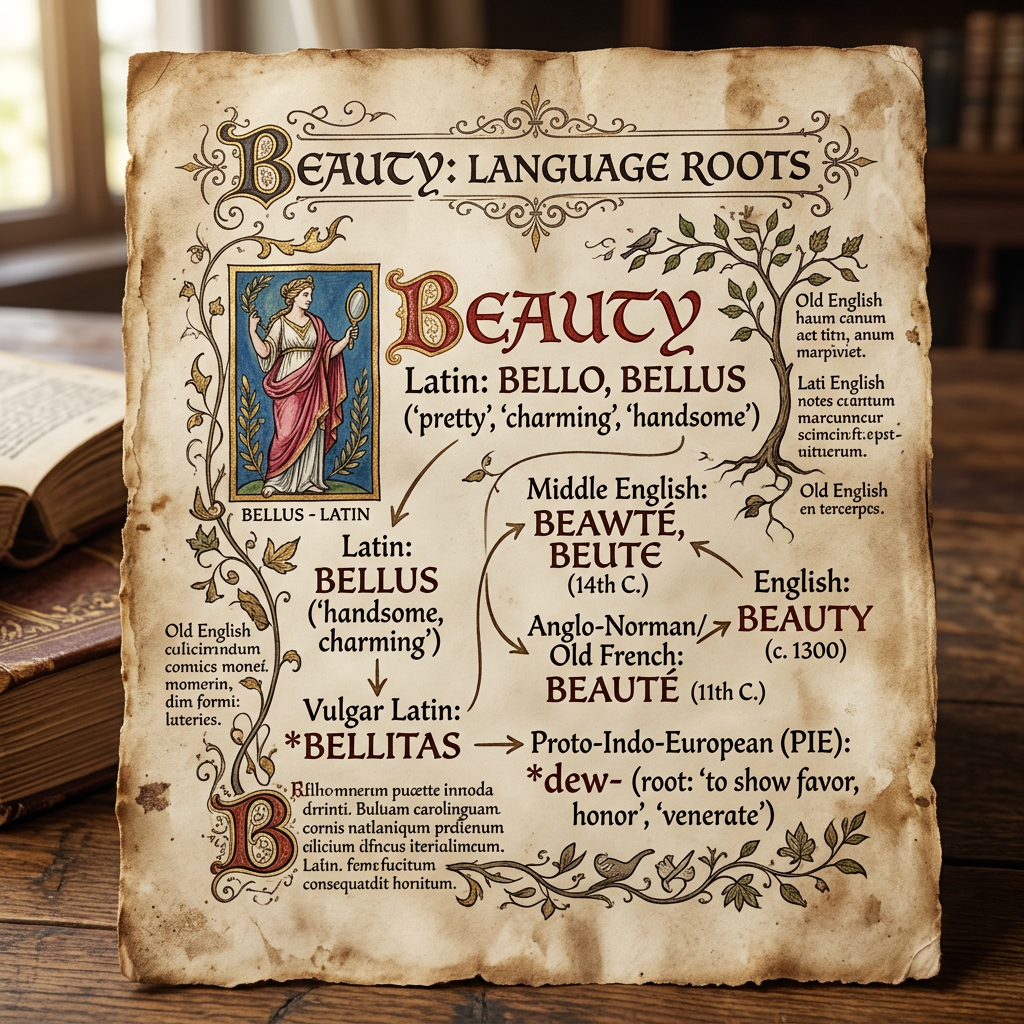
The English word ‘beauty’ traces back to the Latin word bellitātem which means “state of being that is pleasing to the senses.” The five senses in Ancient Greek comes from Aristotle’s in De Anima. The word for sense of perception is αισθησις ‘aisthesis’ (plural αισθήσεις ‘aistheseis’). The English word ‘aesthetics,’ which means the philosophy of beauty, comes from this word αισθησις ‘aisthesis.’ Aesthetics comes from German philosopher Alexander Gottlieb Baumgarten in his work Aesthetica which he taught on the “science of sensory cognition.” Aesthetics soon after passed down with the meaning of judgment on beauty and fine art.
Our senses were given to us to lead us to God. We are called to hear His voice (John 10:16,27; Matthew 4:4), as He touches our hearts (1 Samuel 10:26), tasting and seeing that the Lord is good (Psalm 34:8). His breath (רוח ‘ruach’ – smell) is our life (Genesis 2:7; Acts 17:25), saving our souls through the cross with a sweetsmelling savour (Ephesians 5:2).
St. Augustine associates salvation with falling in love with the Beauty that is God. God drawing man to Himself through our senses.
“Late have I loved you, O Beauty so ancient and so new, late have I loved you!
You were within me, but I was outside, and it was there that I searched for you.
In my unloveliness I plunged into the lovely things which you created.
You were with me, but I was not with you.
Created things kept me from you; yet if they had not been in you they would have not been at all.
You called, you shouted, and you broke through my deafness.
You flashed, you shone, and you dispelled my blindness.
You breathed your fragrance on me; I drew in breath and now I pant for you.
I have tasted you, now I hunger and thirst for more.
You touched me, and I burned for your peace.” (Augustine, Confessions 10.27.38)
Taste
Psa 34:8 O taste and see that the LORD is good: blessed is the man that trusteth in him.
Psa 119:103 How sweet are thy words unto my taste! yea, sweeter than honey to my mouth!
Psa 19:8 The statutes of the LORD are right, rejoicing the heart: the commandment of the LORD is pure, enlightening the eyes.
Psa 19:9 The fear of the LORD is clean, enduring for ever: the judgments of the LORD are true and righteous altogether.
Psa 19:10 More to be desired are they than gold, yea, than much fine gold: sweeter also than honey and the honeycomb.
1Pe 2:2 As newborn babes, desire the sincere milk of the word, that ye may grow thereby:
1Pe 2:3 If so be ye have tasted that the Lord is gracious.
Jer 15:16 Thy words were found, and I did eat them; and thy word was unto me the joy and rejoicing of mine heart: for I am called by thy name, O LORD God of hosts.
Col 3:16 Let the word of Christ dwell in you richly in all wisdom; teaching and admonishing one another in psalms and hymns and spiritual songs, singing with grace (χάρις ‘cháris’) in your hearts to the Lord.
χάρις ‘cháris’ has the meaning of grace, favor, goodwill, charm, beauty, kindness, gratitude.
Psa 147:1 Praise ye the LORD: for it is good to sing praises unto our God; for it is pleasant; and praise is comely (נאוה ‘naveh’ – beautiful).
Smell
Smelling is breathing, one of the Hebrew words for smell is ווה ‘ruach’ which means Spirit. As we breathe we smell. Smell is associated with understanding and judgment (Exodus 5:21).
Isa 11:3 And shall make him of quick understanding (ווה ‘ruach’) in the fear of the LORD: and he shall not judge after the sight of his eyes, neither reprove after the hearing of his ears:
The main Biblical Hebrew word related to the act or sense of smelling is ריח ‘reyach’ which is a cognate of ווה ‘ruach.’ This word is usually translated as savour.
Eph 5:2 And walk in love, as Christ also hath loved us, and hath given himself for us an offering and a sacrifice to God for a sweetsmelling savour.
2Co 2:14 Now thanks be unto God, which always causeth us to triumph in Christ, and maketh manifest the savour of his knowledge by us in every place.
2Co 2:15 For we are unto God a sweet savour of Christ, in them that are saved, and in them that perish:
2Co 2:16 To the one we are the savour of death unto death; and to the other the savour of life unto life. And who is sufficient for these things?
Sight
Psa 119:18 Open thou mine eyes, that I may behold wondrous things out of thy law.
Act 26:18 To open their eyes, and to turn them from darkness to light, and from the power of Satan unto God, that they may receive forgiveness of sins, and inheritance among them which are sanctified by faith that is in me.
Psa 19:8 The statutes of the LORD are right, rejoicing the heart: the commandment of the LORD is pure, enlightening the eyes.
Hearing
Joh 10:27 My sheep hear my voice, and I know them, and they follow me:
Psa 85:8 I will hear what God the LORD will speak: for he will speak peace unto his people, and to his saints: but let them not turn again to folly.
Rev 3:20 Behold, I stand at the door, and knock: if any man hear my voice, and open the door, I will come in to him, and will sup with him, and he with me.
Touch
Act 17:26 And hath made of one blood all nations of men for to dwell on all the face of the earth, and hath determined the times before appointed, and the bounds of their habitation;
Act 17:27 That they should seek the Lord, if haply they might feel after (ψηλαφάω ‘pselaphao’) him, and find him, though he be not far from every one of us:
Act 17:28 For in him we live, and move, and have our being; as certain also of your own poets have said, For we are also his offspring.
1Jn 1:1 That which was from the beginning, which we have heard, which we have seen with our eyes, which we have looked upon, and our hands have handled (ψηλαφάω ‘pselaphao’), of the Word of life;
1Jn 1:2 (For the life was manifested, and we have seen it, and bear witness, and shew unto you that eternal life, which was with the Father, and was manifested unto us;)
God touches our hearts
1Sa 10:26 And Saul also went home to Gibeah; and there went with him a band of men, whose hearts God had touched.
Jer 1:9 Then the LORD put forth his hand, and touched my mouth. And the LORD said unto me, Behold, I have put my words in thy mouth.
Senses
The Hebrew word for sense is חוּשׁ ‘choosh.’ This word is translated in the Scriptures as hasten but can also mean “to feel, or enjoy with the senses.”
H2363
חוּשׁ
chûsh
BDB Definition:
- to haste, make haste, hurry
1a) (Qal) to make haste
1b) (Hiphil)
1b1) to show haste, act quickly, hasten, come quickly
1b2) to enjoy, be excited
Part of Speech: verb
A Related Word by BDB/Strong’s Number: a primitive root
Ecc 2:25 For who can eat, or who else can hasten (חוּשׁ ‘chush’) hereunto, more than I?
In the Septuagint חוּשׁ ‘chush’ is translated by the Greek word πίνω ‘pino’ which means to drink.
Ecc 2:25 For who shall eat, or who shall drink (πίνω ‘pino’), without him?
Thayer’s definition connects drinking with spiritually receiving into the soul.
G4095
πίνω / πίω / πόω
pinō / piō / poō
Thayer Definition:
- to drink
- figuratively, to receive into the soul what serves to refresh strengthen, nourish it unto life eternal
1Co 10:2 And were all baptized unto Moses in the cloud and in the sea;
1Co 10:3 And did all eat the same spiritual meat;
1Co 10:4 And did all drink the same spiritual drink: for they drank of that spiritual Rock that followed them: and that Rock was Christ.
Mat 20:22 But Jesus answered and said, Ye know not what ye ask. Are ye able to drink of the cup that I shall drink of, and to be baptized with the baptism that I am baptized with? They say unto him, We are able.
Mat 20:23 And he saith unto them, Ye shall drink indeed of my cup, and be baptized with the baptism that I am baptized with: but to sit on my right hand, and on my left, is not mine to give, but it shall be given to them for whom it is prepared of my Father.
Joh 6:53 Then Jesus said unto them, Verily, verily, I say unto you, Except ye eat the flesh of the Son of man, and drink his blood, ye have no life in you.
Joh 6:53 Then Jesus said unto them, Verily, verily, I say unto you, Except ye eat the flesh of the Son of man, and drink his blood, ye have no life in you.
Joh 6:54 Whoso eateth my flesh, and drinketh my blood, hath eternal life; and I will raise him up at the last day.
Joh 6:55 For my flesh is meat indeed, and my blood is drink indeed.
Joh 6:56 He that eateth my flesh, and drinketh my blood, dwelleth in me, and I in him.
Joh 6:57 As the living Father hath sent me, and I live by the Father: so he that eateth me, even he shall live by me.
Joh 6:58 This is that bread which came down from heaven: not as your fathers did eat manna, and are dead: he that eateth of this bread shall live for ever.
Joh 18:11 Then said Jesus unto Peter, Put up thy sword into the sheath: the cup which my Father hath given me, shall I not drink it?
Joh 7:37 In the last day, that great day of the feast, Jesus stood and cried, saying, If any man thirst, let him come unto me, and drink.
Joh 7:38 He that believeth on me, as the scripture hath said, out of his belly shall flow rivers of living water.
1Co 12:13 For by one Spirit are we all baptized into one body, whether we be Jews or Gentiles, whether we be bond or free; and have been all made to drink into one Spirit.
1Co 12:14 For the body is not one member, but many.
Going back to the English etymology of beautiful… As mentioned before, The English word ‘beauty’ traces back to the Latin word bellitātem which means “state of being pleasing to the senses.” Bellitatem derives from the word ‘bellus’ which means beautiful of pretty. It is believed that bellus traces back further to a Proto-Indo-European word ‘deu’ which means “show favor, revere,” Beauty points us to reverence, points us to God.
The English word ‘beauty’ traces back to the Latin word ‘bellus’ which means beautiful or pretty. ‘Bellus’ connects back to two Hebrew words, יפה ‘yafa’ and צבי ‘tsevi,’ both of which means beautiful.
Jesus the Beautiful One
Isa 33:17 Thine eyes shall see the king in his beauty (יפי ‘yofi’): they shall behold the land that is very far off.
Scripture speaks of Christ Jesus as יפה ‘yafah.’
Psa 45:2 Thou art fairer {יפה ‘yafah’} than the children of men: grace is poured into thy lips: therefore God hath blessed thee for ever.
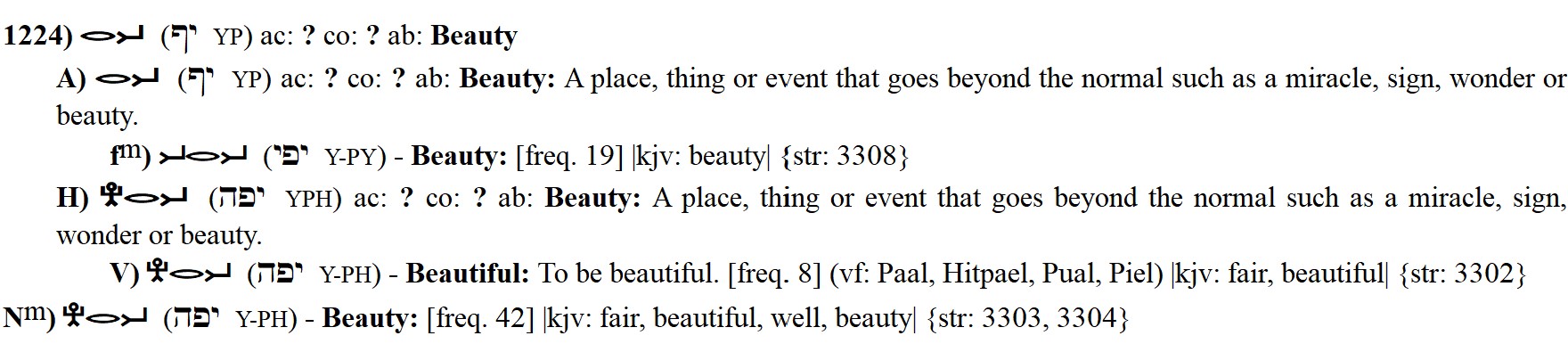
Psa 45:3 Gird thy sword upon thy thigh, O most mighty, with thy glory (הוד ‘hod’) and thy majesty (הדר ‘hadar’).
הוֹד ‘hod’ means splendor, glory, majesty, honor but also beauty.
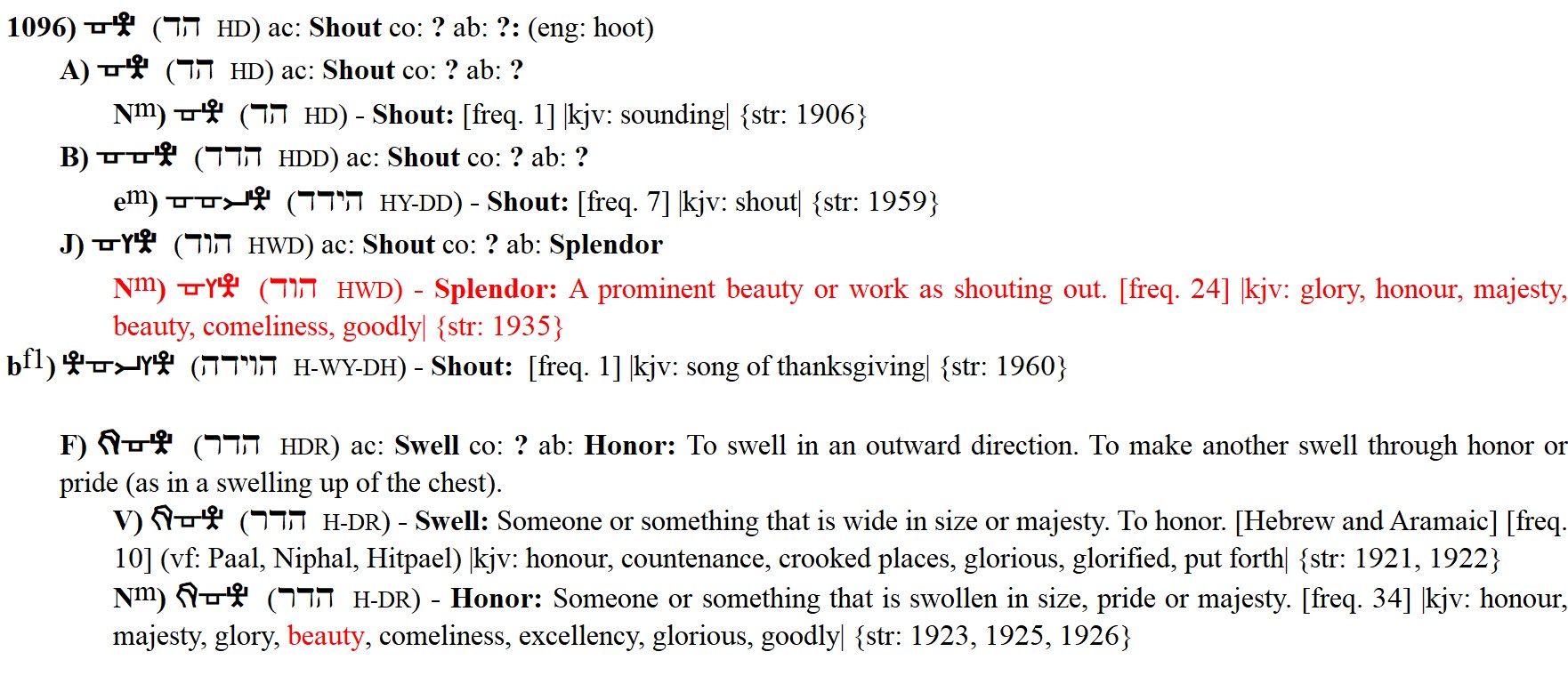
הדר ‘hadar’ means something that grows in majesty, glory, beauty.

We are to grow in the grace of God (2 Peter 3:18). Grace is beauty.
Psa 45:2 Thou art fairer than the children of men: grace (חן ‘chen’) is poured into thy lips: therefore God hath blessed thee for ever.
We are saved by Grace
Eph 2:8 For by grace (χάρις ‘cháris’) are ye saved through faith; and that not of yourselves: it is the gift of God:
Recall that χάρις ‘cháris’ has the meaning of grace, favor, goodwill, charm, beauty, kindness, gratitude. The beauty of God brings salvation.
Psa 149:4 For the LORD taketh pleasure in his people: he will beautify the meek with salvation.
The Grace of God is the Gospel
Act_20:24 But none of these things move me, neither count I my life dear unto myself, so that I might finish my course with joy, and the ministry, which I have received of the Lord Jesus, to testify the gospel of the grace of God.
The Grace of God is the Word
Act_20:32 And now, brethren, I commend you to God, and to the word of his grace, which is able to build you up, and to give you an inheritance among all them which are sanctified.
The Grace of God is His Gift
Rom_5:15 But not as the offence, so also is the free gift. For if through the offence of one many be dead, much more the grace of God, and the gift by grace, which is by one man, Jesus Christ, hath abounded unto many.
Eph_2:8 For by grace are ye saved through faith; and that not of yourselves: it is the gift of God:
Jesus is the Gift of God.
Joh 3:16 For God so loved the world, that he gave his only begotten Son, that whosoever believeth in him should not perish, but have everlasting life.
Joh 3:17 For God sent not his Son into the world to condemn the world; but that the world through him might be saved.
The Grace of God comes through Jesus
1Co_1:4 I thank my God always on your behalf, for the grace of God which is given you by Jesus Christ;
2Co_13:14 The grace of the Lord Jesus Christ, and the love of God, and the communion of the Holy Ghost, be with you all. Amen. The second epistle to the Corinthians was written from Philippi, a city of Macedonia, by Titus and Lucas.
Jesus is the Grace of God that brings salvation to the world
Tit_2:11 For the grace of God that bringeth salvation hath appeared to all men,
The Scriptures admonish us to grow in the grace and knowledge of the Lord.
2Pe 3:18 But grow in grace, and in the knowledge of our Lord and Saviour Jesus Christ. To him be glory both now and for ever. Amen.
The word for grace is χάρις ‘charis’ which is used to translate numerous words in the Greek Septuagint. One of the words is גדולה ‘gedulah’ which means to grow in size. We are to grow/mature into the image of Messiah, from glory to glory.
2Co 3:18 But we all, with open face beholding as in a glass the glory of the Lord, are changed into the same image from glory to glory, even as by the Spirit of the Lord.
We are to be molded into the image/character of Messiah. Jesus is THE image of God (Hebrews 1:3; 2 Corinthians 4:4-6; Colossians 1:15-16) who is love (1 John 4:8). He revealed God’s name/character to mankind (John 17:6, 26).
Joh 17:6 I revealed Your name to the men whom You gave to Me out of the world. They were Yours, and You gave them to Me; and they have kept Your Word.
Joh 17:26 And I made known to them Your name, and will make it known, that the love with which You loved Me may be in them, and I in them.
Interestingly, the English word ‘grace‘ traces back to the Hebrew word חרות ‘charot’ which is also the origin of the English word ‘character.’ חרות ‘charot’ means to engrave or chisel, as in the engraving of the Ten Commandments (Exodus 32:16).
Exo 32:16 And the tables were the work of God, and the writing was the writing of God, graven{חרות ‘charot} upon the tables.
In Greek, the word χαρακτήρ ‘charakter’ means to stamp or carve out. This word is used in only one verse of Scripture, translated as ‘express image’ (Hebrews 1:3). The connection to חרות ‘charot’ is easy to see in this case. The connection to grace is a little harder but no less significant. חרות ‘charot’ also has the meaning of freedom in the sense that stone chiseled from the rock is ‘set free.’ Grace and freedom are synonymous. The Hebrew word חנם ‘chinam’ means freedom and comes from the root word חן ‘chen’ which means grace.
We are to grow in His grace and knowledge. We are not called to grow in knowledge about Him, but knowledge of Him.
2Pe 3:18 But grow in grace, and in the knowledge of our Lord and Saviour Jesus Christ. To him be glory both now and for ever. Amen.
Joh 17:3 And this is everlasting life, that they may know You, the only true God, and Jesus Christ, whom You have sent.
Eph 3:17 that through faith Christ may dwell in your hearts, having been rooted and founded in love,
Eph 3:18 that you may be given strength to grasp, with all the saints, what is the breadth and length and depth and height,
Eph 3:19 and to know the surpassing knowledge and love of Christ, that you may be filled to all the fullness of God.
1Jn 5:20 And we know that the Son of God is come, and hath given us an understanding, that we may know him that is true, and we are in him that is true, even in his Son Jesus Christ. This is the true God, and eternal life.
Christ came to earth in the very image of Almighty God (2 Corinthians 4:4; Colossians 1:15; Hebrews 1:3), who is love. His life displayed that love and He calls all those who believe in Him to display that love as well. This is the essence of the concept of ‘Christ in us.’ It is through His love that man is formed into His image (Colossians 3:10; Romans 8:29) where there is no longer Jew or Greek, Barbarian or Scythian but Messiah is all and in all (Colossians 3:11).
This is the message of the Gospel. Love. Love is the foundation of God’s grace (Acts 20:24; John 3:16-17; 2 Corinthians 13:14).
2Co_13:14 The grace of the Lord Jesus Christ, and the love of God, and the communion of the Holy Ghost, be with you all. Amen.

The second word for beauty is צבי ‘tsevi’ which literally means a deer or gazelle as the deer/gazelle personifies gracefulness and beauty. Scripture likens Messiah to a צבי ‘tsevi.’
Son 2:8 The voice of my beloved! behold, he cometh leaping upon the mountains, skipping upon the hills.
Son 2:9 My beloved is like a roe {צבי ‘tsevi’} or a young hart: behold, he standeth behind our wall, he looketh forth at the windows, shewing himself through the lattice. (Remember the lattice, this will be spoken of later)
Isa 4:2 In that day shall the branch of the LORD be beautiful {צבי ‘tsevi’} and glorious, and the fruit of the earth shall be excellent and comely for them that are escaped of Israel.
Psa 50:2 Out of Zion {the glorious land צבי ‘tsevi’ Ezekiel 20:6; Jeremiah 3:9; Daniel 8:9; 11:16, 41, 45} , the perfection of beauty, God hath shined.
In that day we shall see His beauty. In that day, at the resurrection, we shall see His beauty when we will be resurrected into His Image (1 Corinthians 15:49; 2 Corinthians 3:18; Psalm 17:15; Romans 8:28-30; Galatians 3:26-29; Hebrews 13:21).
Isa 33:14 The sinners in Zion are afraid; fearfulness hath surprised the hypocrites. Who among us shall dwell with the devouring fire? who among us shall dwell with everlasting burnings?
Isa 33:15 He that walketh righteously, and speaketh uprightly; he that despiseth the gain of oppressions, that shaketh his hands from holding of bribes, that stoppeth his ears from hearing of blood, and shutteth his eyes from seeing evil;
Isa 33:16 He shall dwell on high: his place of defence shall be the munitions of rocks: bread shall be given him; his waters shall be sure.
Isa 33:17 Thine eyes shall see the king in his beauty: they shall behold the land that is very far off.
The Oracles/Word of God is to be in our mouth (1 Peter 4:11) which are beautiful (Psalm 19:10; 119:103; 135:3).
Psa 90:17 And let the beauty of the LORD our God be upon us: and establish thou the work of our hands upon us; yea, the work of our hands establish thou it.
God’s beauty on His people
Isa_28:5 In that day shall the LORD of hosts be for a crown of glory, and for a diadem of beauty, unto the residue of his people,
Isa_61:3 To appoint unto them that mourn in Zion, to give unto them beauty for ashes, the oil of joy for mourning, the garment of praise for the spirit of heaviness; that they might be called trees of righteousness, the planting of the LORD, that he might be glorified.
The Beautiful Gospel
Rom 10:15 And how shall they preach, except they be sent? as it is written, How beautiful are the feet of them that preach the gospel of peace, and bring glad tidings of good things!
Isa 52:7 How beautiful upon the mountains are the feet of him that bringeth good tidings, that publisheth peace; that bringeth good tidings of good, that publisheth salvation; that saith unto Zion, Thy God reigneth!
Isa 61:1 The Spirit of the Lord GOD is upon me; because the LORD hath anointed me to preach good tidings unto the meek; he hath sent me to bind up the brokenhearted, to proclaim liberty to the captives, and the opening of the prison to them that are bound;
Isa 61:2 To proclaim the acceptable year of the LORD, and the day of vengeance of our God; to comfort all that mourn;
Isa 61:3 To appoint unto them that mourn in Zion, to give unto them beauty for ashes, the oil of joy for mourning, the garment of praise for the spirit of heaviness; that they might be called trees of righteousness, the planting of the LORD, that he might be glorified.
Beauty & Time

Rom 10:15 And how shall they preach, except they be sent? as it is written, How beautiful (ὡραῖος ‘horaios’) are the feet of them that preach the gospel of peace, and bring glad tidings of good things!
G5611
ὡραῖος
hōraios
Thayer Definition:
- blooming, beautiful (used of the human body)
Part of Speech: adjective
A Related Word by Thayer’s/Strong’s Number: from G5610
From root:
G5610
ὥρα
hōra
Thayer Definition:
- a certain definite time or season fixed by natural law and returning with the revolving year
1a) of the seasons of the year, spring, summer, autumn, winter - the daytime (bounded by the rising and setting of the sun), a day
- a twelfth part of the day-time, an hour, (the twelve hours of the day are reckoned from the rising to the setting of the sun)
- any definite time, point of time, moment
Part of Speech: noun feminine
A Related Word by Thayer’s/Strong’s Number: apparently a primary word
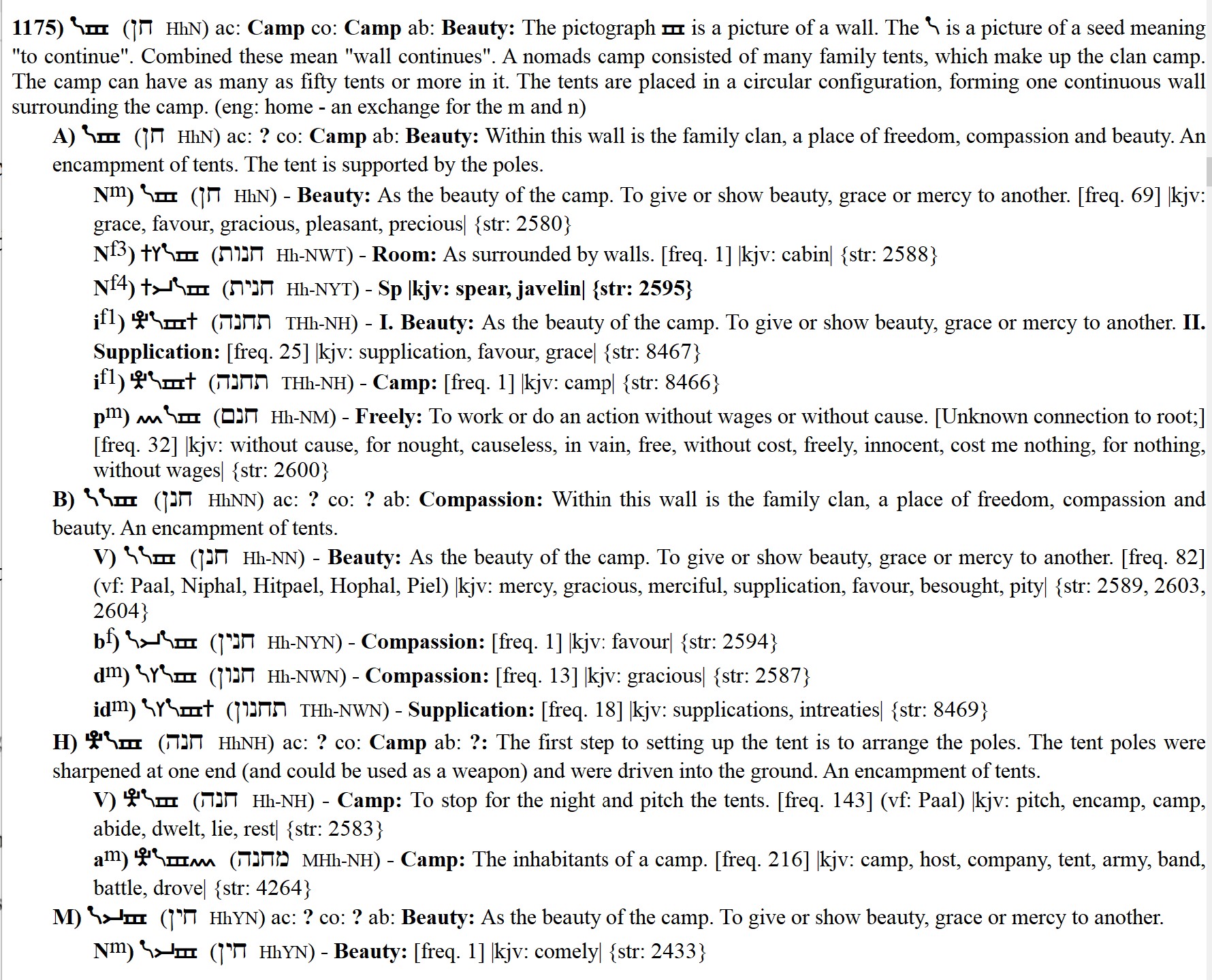
ὥρα ‘hora’ is the source of the English word hour. The Hebrew word for “hour” (שעה ‘sha’ah’) shares a root with “salvation” (ישועה ‘yeshuah’ — source of the name Jesus) and pictures a shepherd tending sheep.
On the cross, the Scriptures mark significant occurrences on the 3rd (Mark 15:25), 6th (Matthew 27:45) and 9th hours (Matthew 27:46). These were the ‘quarter’ marks of the day, which is divided up into 12 (John 11:9). This is a ‘macro’ scale of the quarter hours on the clock when the Cambridge chimes ring forth. Interestingly, the first mechanical clocks were made in the 13th century to ring out the ‘Canonical Hours’ of prayer, which occurred at the 3rd, 6th, and 9th hours of the day. The word clock actually derives from the Medieval Latin word ‘clocca’ which means bell, as in the bells rung to mark the hours of prayer.
Bells are linked to beauty as they were a part of the beautiful garments of the Levitical priests (Exodus 28:33-35).
Exo 28:2 And thou shalt make holy garments for Aaron thy brother for glory and for beauty.
“The prescription that twelve bells be attached to the [robe] of the high priest… was a symbol of the twelve apostles… and through their voice it is that all the earth has been filled with the glory and grace of God and of His Christ.” (Justin Martyr – Dialogue with Trypho, ch. 42)
Christ spoke of the day having 12 hours (John 11:9), which is only ‘technically’ true at the Spring and Autumnal equinoxes. The Equinoxes/Tequfahs depict in the sky into the image of the cross. The year, which is divided into 12 months, is further divided into quarters (seasons).
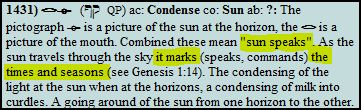
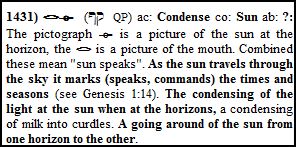
As the sun moves through its course in the sky it will rise directly East at the spring and fall equinoxes, making a cross in the sky each year. The word for ‘equinox’ in Hebrew is תקופה ‘tequfah’ which has the following pictograph meaning. The cross (ת) reveals (ה) the sun on the horizon (קוף). The letter ק ‘qof’ spelled קוף in Hebrew is pictographically displayed as the sun rising on the horizon. So then the word תקופה ‘tequfah’ has embedded within itself the point of the equinox. It is at the cross of the horizon which is exactly East. As the sun moves through its course in the sky it will rise directly East at the spring and fall equinoxes, making a cross in the sky each year.
The Hebrew word for hour is שעה ‘sha’ah’ which is a cognate of the word ישועה ‘yeshuah’ which means salvation. ישועה ‘yeshuah’ is the source of the name Jesus. The name Jesus comes from the Hebrew יהושׁע or יהושׁוּע ‘Yehoshua’ or Yahushua’ . The shortened form in Hebrew is ישׁוּע ‘Yeshua.’ Both שעה ‘sha’ah,’ which means hour and ישועה ‘yeshuah,’ which means salvation come from the root word שע which pictures a shepherd tending to his flock.
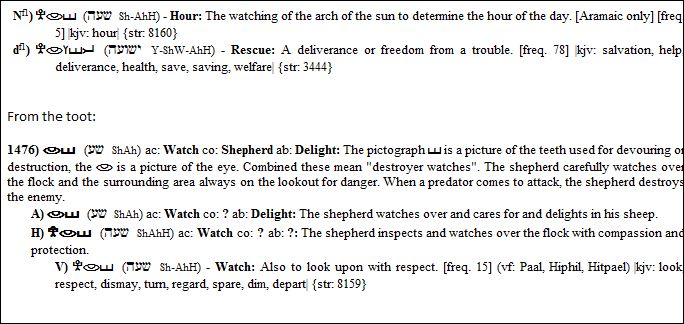
Quarter Hour
Scripture declares that the heavens were measured by a span (Isaiah 40:12).
Isa 40:12 He who has measured in His hand the waters and the heavens by a span meted out; and enclosed in the measure the dust of the earth, and weighed in the balance the mountains, and the hills in the scales,
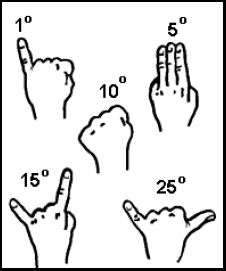
The Hebrew word translated as ‘span’ literally means the spreading out of the hand for the use of measuring.
The hand has been used for thousands of years to measure degrees in the heavens/expanse. Each person’s hand will measure the same distances when the arm is stretched out, no matter how large your hand, or what your age.
You can tell how long until the sun will set by measuring its distance from the horizon. The sun moves about 15 degrees across the sky in an hour. Moving 15 degrees an hour for 24 hours would equal 360 degrees, or a full day from sunset to sunset. This measuring of the hours points us to Messiah who describes Himself as the Light of the world (John 8:12; 9:5; 12:46).
Joh 11:9 Jesus answered, Are there not twelve hours in the day? If anyone walks in the day, he does not stumble because he sees the light of the world.
Messiah is the light of the world, the Right Hand of the Father.
Isa 48:13 Mine hand also hath laid the foundation of the earth, and my right hand hath spanned the heavens: when I call unto them, they stand up together.
Joh 8:12 Then spake Jesus again unto them, saying, I am the light of the world: he that followeth me shall not walk in darkness, but shall have the light of life.
Joh 9:5 As long as I am in the world, I am the light of the world.
Psa 118:14 The LORD is my strength and song, and is become my salvation.
Psa 118:15 The voice of rejoicing and salvation is in the tabernacles of the righteous: the right hand of the LORD doeth valiantly.
Psa 118:16 The right hand of the LORD is exalted: the right hand of the LORD doeth valiantly.
Act 5:31 Him hath God exalted with his right hand to be a Prince and a Saviour, for to give repentance to Israel, and forgiveness of sins.
The Hebrew word ידי ‘yadi,’ which means “my hand,” is equivalent to the number 24, the number of hours in a day. Yet another connection to the hand and time is the ‘hour hand’ of the clock. When the first mechanical clocks were made to ring bells signifying the hours of prayer, the hour ‘hand’ was first introduced.
Isa 40:10 Behold, the Lord Jehovah will come with strength, and His arm {Isaiah 53 – His Arm is the Lamb} rules for Him. Behold, His reward is with Him, and His wage before Him.
Clock ‘hands’ move ‘clockwise’ in imitation of sundials which have a gnomon which casts a shadow marking the time that moves in a ‘clockwise’ direction. The word ‘gnomon’ is a Greek/Latin word which means ‘one who discerns’ from the word γνῶσις ‘gnosis’ which means to know or knowledge. It is interesting to note that the knowledge of the Most High is linked to the Messiah and light in the Scriptures.
2Co_4:6 For God, who commanded the light to shine out of darkness, hath shined in our hearts, to give the light of the knowledge of the glory of God in the face of Jesus Christ.
Luk 1:77 To give knowledge of salvation unto his people by the remission of their sins,
Luk 1:78 Through the tender mercy of our God; whereby the dayspring from on high hath visited us,
Luk 1:79 To give light to them that sit in darkness and in the shadow of death, to guide our feet into the way of peace.
Knowing the Father and the Son is associated with resurrection life.
1Pe 1:23 Being born again, not of corruptible seed, but of incorruptible, by the word of God, which liveth and abideth for ever.
Joh 17:3 And this is everlasting life, that they may know You, the only true God, and Jesus Christ, whom You have sent.
1Jn 5:20 And we know that the Son of God is come, and hath given us an understanding, that we may know him that is true, and we are in him that is true, even in his Son Jesus Christ. This is the true God, and eternal life.
The Hebrew words for ‘know’ and ‘knowledge are ידע ‘yada’ and דעת ‘da’at,’ both of which come from the root word דע ‘dah.’ דע ‘dah’ literally means to ‘see the door.’ Recall that Messiah speaks of Himself as the ‘door’ in the portion of Scripture in which He describes Himself as the Good Shepherd (John 10:7-18).
Messiah is the Good Shepherd of Israel (which consists of 12 tribes…depicted on the clock by 12 hours) (Psalm 95:7; 100:1-5; 74:1-2; 78:51-52; 79:13). In Revelation 21, the city of the saints, the bride of Messiah is divided into 12 sections, foursquare (quartered).
Ecc 3:11 He hath made every thing beautiful in his time (עת ‘et’ ): also he hath set the world {עלם ‘olam’ – eternity) in their heart, so that no man can find out the work that God maketh from the beginning to the end.
The are multiple words for time in Hebrew, the most used is עת ‘et’ which pictographically means to ‘see the cross’, and in ancient Hebrew thinking meant to ‘see the mark.’ What is this ‘mark’? It is the sun setting (death) and rising (resurrection) above the horizon.
At sunrise the sky appears red
This word comes from דם ‘dam’ meaning blood.
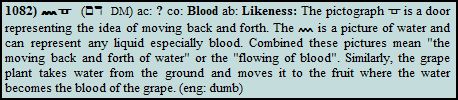
דם ‘dam’ literally means waters from the door, as in the living waters that come forth from the Temple, or the living waters of blood that come forth from the heart. The sun moving through the zodiac is also a picture of this. Psalm 19 speaks of the sun following the path of the zodiac and coming forth from ‘his canopy’ representing the Temple. A healthy heart pumps on average 72 times a minute, the sun moves a degree through the ecliptic every 72 years. It seems that the beating of the human heart corresponds with the movement of the sun through the ecliptic.
“The ‘circle’ traced by the earth’s axis around the north ecliptic pole is not smooth but wavy, as the moon’s gravitational pull causes the earth to ‘nod’ about once every 18 years (currently 18.6 years), a movement known as nutation. The circle therefore contains about 1440 waves, since 18 x 1440 = 25,920. Note that the average human heartbeat is equal to 72 beats a minute, and on average we breathe about 18 times a minute. 72 years (= 6+60+6 or 6×12) is said to be the ‘ideal’ lifespan of a human being, during which time the sun moves through one degree of the zodiac in the precessional cycle. A human breathes 72 times in 4 minutes, the time required for the earth to turn 1 degree on its axis. In 24 hours (86,400 seconds) we breathe 18 x 1440 = 25,920 times, equal to the number of years in the precessional cycle.” Patterns in Nature
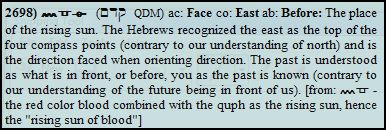
According to the National Geographic’s ‘Incredible Human Machine’ it takes 72 muscles for man to speak. The Hebrew word for time, עת ‘et,’ means to see the mark. What is the mark? It is when the sun rises directly east (קדם ‘qedem’ ‘sun of blood’) at the time of the תקופה ‘tequphah’ which literally means the ‘sun speaks.’
According to Ecclesiastes 1:5-6, the sun moves upon the wind again linking to the blood which flows through the human body and the living waters which flow forth from the throne of God.
The path of the sun through the zodiac comes from the following Hebrew word:
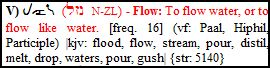
According to the Revelation 22:1-2, the river of life that comes forth from the throne of God, is linked to 12 fruits of the tree of life.
The word for the constellations/zodiac in Hebrew is מזרות ‘mazzaroth’ which traces back to the Hebrew word נזר ‘nazar.’
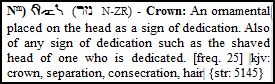
What was on the crown of the High Priest? The sacred name of God (Exodus 29:6; 39:30) According to Josephus (Wars of the Jews Book 5 Chapter 5 Section 7) the sacred name consisted of 4 vowels which are pronounced with our breath. The Hebrew word for ‘name,’ is שם ‘shem’ which means breath/wind. It is the root for the word שמים ‘shamayim’ which means heaven. שם ‘shem’ is also the root of the word שמש ‘shemesh’ which means the sun. Every breath we take we are proclaiming His Name. Each breath we take brings oxygen into our lungs which brings life to our blood and to our cells.
For more on the Shadows of Messiah in the Clock see: Shadows of Messiah – Clock Chimes
Beauty and the Fibonacci Pattern
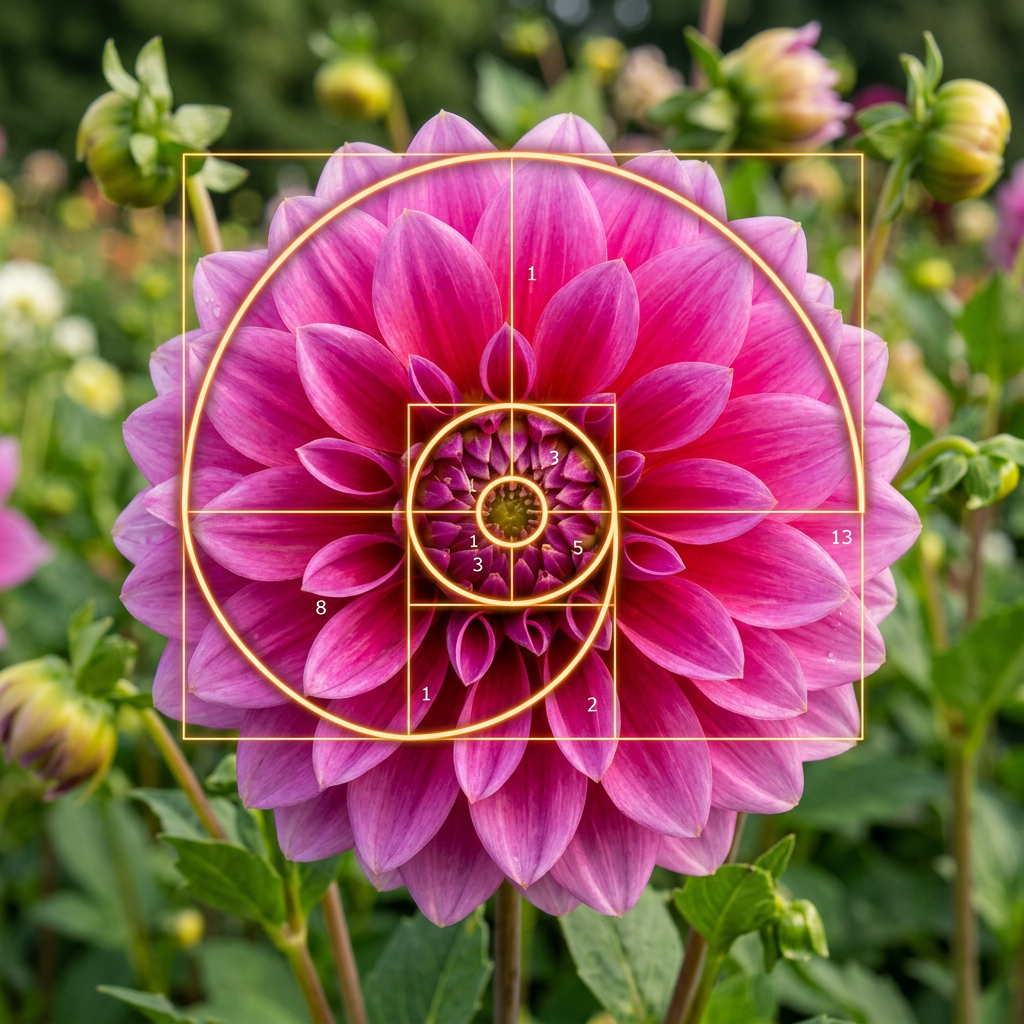
The Fibonacci pattern is seen throughout God’s handiwork. The Fibonacci Spiral also known as the Golden ratio or the Divine Proportion, points directly to Christ Jesus.
The Fibonacci numbers are “nature’s numbering system”. They appear everywhere in nature, from the leaf arrangement in plants, to the pattern of the florets of a flower, the bracts of a pinecone, or the scales of a pineapple and the rose. The Fibonacci numbers are, in many cases, applicable to the growth of virtually every living thing, including DNA, a single cell, a grain of wheat, a hive of bees, and even all of mankind.
The Fibonacci pattern is seen in the fingerprint of the hand of man, who was created in God’s image (1 John 4:20-21; James 3:9). The Fibonacci pattern is seen throughout creation as God’s “fingerprint”.
All that we experience in this life was created to lead us to our Creator (Romans 1:19-20; Psalm 33:6-9; 150:6; Isaiah 40:26; 41:20; 45:5-8). All that we see, hear, touch, taste and feel was created so that we might see the Most High and be drawn to Him. Just as the personality of an artist can be see through his paintings or the heart of an author can be seen through his writings, so too the creation allow us to see the Creator.
He is the Great Artist, the Maker of all things. The English word ‘artist’ comes form the Hebrew word יצר ‘yatsar’ which means to create or form, as a potter molding clay. The Lord is the former {יצר ‘yatsar’} of all things (Jeremiah 10:16; 51:19). As a result, all of His works are embedded with His image. When one is molding clay, one’s fingerprint is embedded within the clay. So too, when God molded creation, He left His “Fingerprint” embedded throughout…
The Holy Scriptures state that Christ Jesus is all and in all (Colossians 3:11), this is because He is the Creator (Ephesians 3:9; 1 Corinthians 8:6; John 1:1-3; Colossians 1:12-17; Hebrews 1:1-12). All things are a shadow pointing back to Messiah (Hebrews 8:5; 9:24; 10:1; Colossians 2:16-17) who is the Image of God (Hebrews 1:3; 2 Corinthians 4:4; Colossians 1:15-16).
In the beginning, the Spirit of God hovered over the waters (Genesis 1:2). The word for hover in this verse is רחף ‘rachaph’ which pictures a bird overshadowing her nest. The Almighty then said “let there be light” from whence all matter came forth, creating a shadow of His image over all of creation.
In the beginning, the Word/Voice of the Most High acted upon the waters and brought forth Light. The Hebrew phrase קול יהוה ‘qol Yahweh’ (Voice of the LORD) has the numerical equivalent of 162. The Fibonacci spiral is displayed as the number 1.618 (Golden ration), rounded to 1.62.
The phrase אור יהוה ‘ohr Yahweh’ (light of the LORD) has the numerical value of 233. 233 is the 13th Fibonacci number. The Light of the Lord is equivalent with the Word of the Lord from whence came creation.
Here then, the Fibonacci pattern is seen embedded throughout the beginning of creation.
Both Light, {אור ‘ohr’} and Word {דבר ‘davar’} have the meaning of order.
Light comes from the following root word:

Word comes from the following root word:

Cosmos comes from the Greek word κόσμος ‘kosmos’ which means the universe, world and order but also means the ‘circle of the earth.’ This circle can be rendered as the Hebrew word דר ‘dar’ which means order as well and is the root of the word דבר ‘davar’ (Word).
The universe is a “single spoken sentence”. This sentence was “let there be light“.
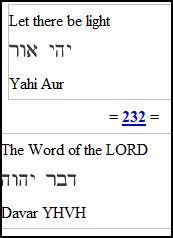
The cosmos/universe points directly the Word who is Messiah. Traditionally, the cosmos has been used synonymously with the Greek word αἰών’aion’ which means the world or universe. The equivalent word to αἰών ‘aion’ in Hebrew is עלם ‘olam.’ Pictographically, this word means to see {ע ‘eye’} the shepherd who leads {לם shepherd leading to the waters}. The Good Shepherd is our Maker.
Psa 95:6 O come, let us worship and bow down: let us kneel before the LORD our maker.
Psa 95:7 For he is our God; and we are the people of his pasture, and the sheep of his hand. To day if ye will hear his voice,
Isa 40:10 Behold, the Lord GOD will come with strong hand, and his arm shall rule for him: behold, his reward is with him, and his work before him.
Isa 40:11 He shall feed his flock like a shepherd: he shall gather the lambs with his arm, and carry them in his bosom, and shall gently lead those that are with young.
Isa 40:12 Who hath measured the waters in the hollow of his hand, and meted out heaven with the span, and comprehended the dust of the earth in a measure, and weighed the mountains in scales, and the hills in a balance?
Isa 40:13 Who hath directed the Spirit of the LORD, or being his counsellor hath taught him?
Isa 40:14 With whom took he counsel, and who instructed him, and taught him in the path of judgment, and taught him knowledge, and shewed to him the way of understanding?
Isa 40:21 Have ye not known? have ye not heard? hath it not been told you from the beginning? have ye not understood from the foundations of the earth?
Isa 40:22 It is he that sitteth upon the circle of the earth, and the inhabitants thereof are as grasshoppers; that stretcheth out the heavens as a curtain, and spreadeth them out as a tent to dwell in:
Isa 40:26 Lift up your eyes on high, and behold who hath created these things, that bringeth out their host by number: he calleth them all by names by the greatness of his might, for that he is strong in power; not one faileth.
5 is the number of grace, it is the 5th Fibonacci number. 8 is the 6th Fibonacci number and is seen in the numerical value of the Hebrew word for love, אהב ‘ahav.’13 is the numerical value of אהבה ‘ahavah’ (love), 13 is the 7th Fibonacci number. 13 is also the value of the Hebrew word אחד ‘echad’ which means one, or unity.
Psa 133:1 A Song of degrees of David. Behold, how good and how pleasant it is for brethren to dwell together in unity!
The 8th Fibonacci number is 21 which is equal to the Hebrew word יטב ‘yatav’ which means good or beautiful.
Fibonacci sequence and multiplying
The Fibonacci sequence and the golden ratio are deeply connected to our perception of beauty through mathematics, nature, art, and human aesthetics.
The Fibonacci sequence is: 0, 1, 1, 2, 3, 5, 8, 13, 21, 34, 55, 89, 144, 233, …
Each number is the sum of the two before it. As the sequence progresses, the ratio of consecutive terms (e.g., 8/5 = 1.6, 13/8 = 1.625, 21/13 ≈ 1.615) approaches φ (phi) ≈ 1.6180339887, known as the golden ratio (or golden section/divine proportion).
Fibonacci numbers grow by a simple rule of addition that quickly becomes multiplicative:
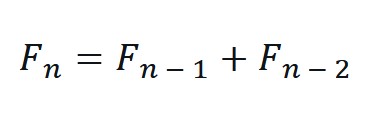
In other words, the sequence itself “multiplies” by continually drawing on what has already been produced.
Ecc 3:11 He hath made every thing beautiful in his time (עת ‘et’ ): also he hath set the world {עלם ‘olam’ – eternity) in their heart, so that no man can find out the work that God maketh from the beginning to the end.
One of the words for multiply in Hebrew is עתר ‘atar’ which comes from the root עת ‘et.’
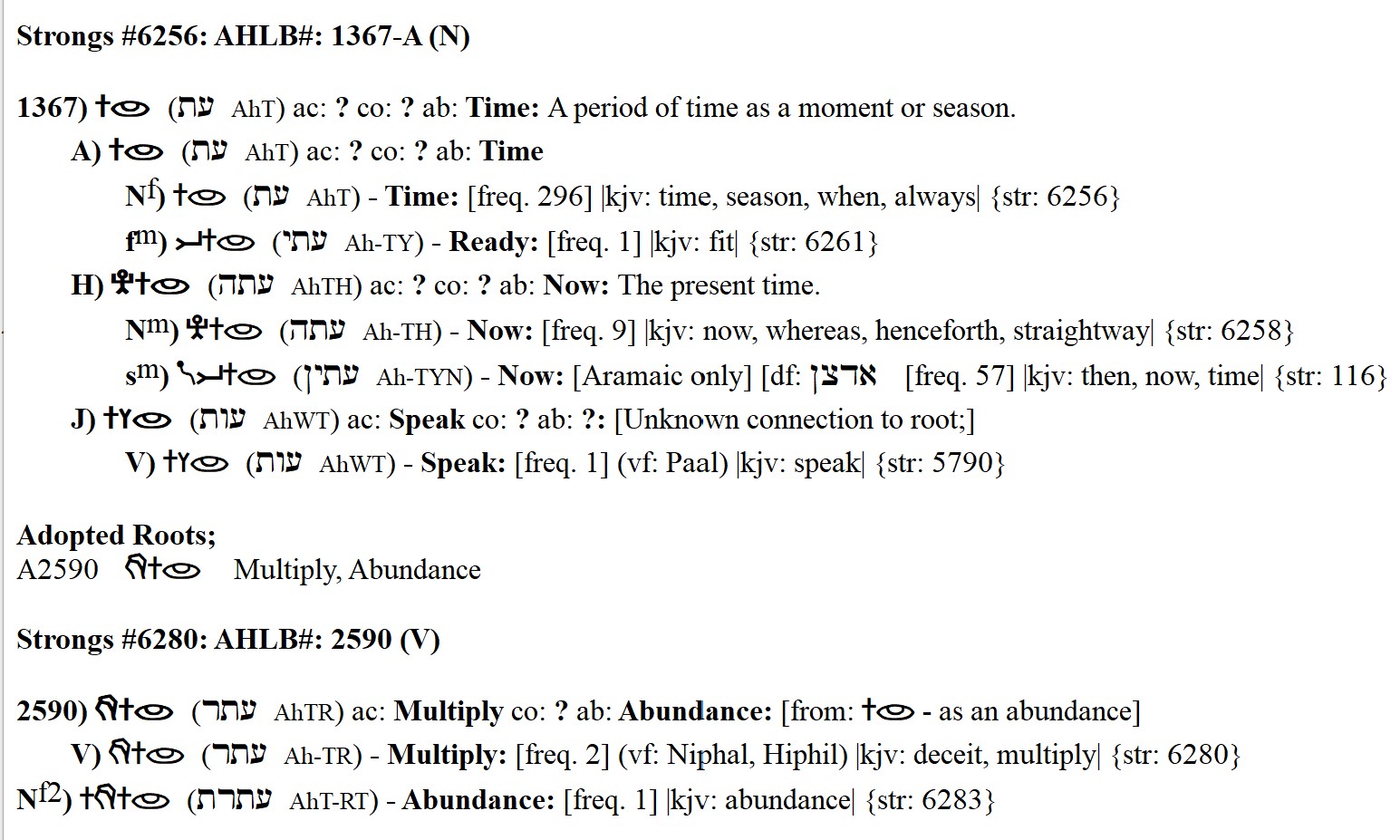
עת ‘et’ pictographically means “see the cross.” It is through the cross of Christ that we see beauty multiplied.
Heb 2:10 For it became him, for whom are all things, and by whom are all things, in bringing many sons unto glory, to make the captain of their salvation perfect through sufferings.
Heb 2:11 For both he that sanctifieth and they who are sanctified are all of one: for which cause he is not ashamed to call them brethren,
Heb 2:12 Saying, I will declare thy name unto my brethren, in the midst of the church will I sing praise unto thee.
Heb 2:13 And again, I will put my trust in him. And again, Behold I and the children which God hath given me.
In Hebrews 2:13, Paul quotes the prophet Isaiah. More on this in the section on Zion, the perfection of beauty.
Isa 8:18 Behold, I and the children whom the LORD hath given me are for signs and for wonders in Israel from the LORD of hosts, which dwelleth in mount Zion.
Through Christ’s work on the cross, multiplication in beauty was manifest
Act_12:24 But the word of God grew and multiplied.
Act_9:31 Then had the churches rest throughout all Judaea and Galilee and Samaria, and were edified; and walking in the fear of the Lord, and in the comfort of the Holy Ghost, were multiplied.
1Pe_1:2 Elect according to the foreknowledge of God the Father, through sanctification of the Spirit, unto obedience and sprinkling of the blood of Jesus Christ: Grace unto you, and peace, be multiplied.
We are to grow in the grace of God, we are to multiply
2Pe_1:2 Grace and peace be multiplied unto you through the knowledge of God, and of Jesus our Lord,
Jud_1:2 Mercy unto you, and peace, and love, be multiplied.
G4129
πληθύνω
plēthunō
Thayer Definition:
- to increase, to multiply
1a) to be increased, (be multiplied) multiply - to be increased, to multiply
Part of Speech: verb
A Related Word by Thayer’s/Strong’s Number: from another form of G4128
The promise to Abraham
Heb 6:13 For when God made promise to Abraham, because he could swear by no greater, he sware by himself,
Heb 6:14 Saying, Surely blessing I will bless thee, and multiplying I will multiply thee.
Heb 6:13 For when God made promise to Abraham, because he could swear by no greater, he sware by himself,
Heb 6:14 Saying, Surely blessing I will bless thee, and multiplying I will multiply thee.
Heb 6:15 And so, after he had patiently endured, he obtained the promise.
The Gospel is the promise to Abraham revealed through the Word.
1Pe 1:25 But the word of the Lord endureth for ever. And this is the word which by the gospel is preached unto you.
Psa 68:11 Jehovah gave the Word; the bearers (בסר ‘basar’ – gospel) of it were a great army.
Act 10:34 And opening his mouth, Peter said, Truly I see that God is not a respecter of faces,
Act 10:35 but in every nation the one fearing Him and working righteousness is acceptable to Him.
Act 10:36 The Word which He sent to the sons of Israel, preaching the gospel of peace through Jesus Christ, this One is Lord of all.
Eph 1:13 in whom also you, hearing the Word of Truth, the gospel of your salvation, in whom also believing you were sealed with the Holy Spirit of promise,
The Gospel is the promise to the fathers.
Act 13:32 And we preach the gospel to you, the promise made to the fathers,
Gal 3:8 And the Scripture foreseeing that God would justify the nations by faith, preached the gospel before to Abraham: “All the nations will be blessed” “in you.” Gen. 12:3
The promise to Abraham is the Gospel/good news
Rom 4:13 For the promise was not through Law to Abraham, or to his seed, for him to be the heir of the world, but through a righteousness of faith.
Gal 3:16 Now to Abraham and his seed were the promises made. He saith not, And to seeds, as of many; but as of one, And to thy seed, which is Christ.
The Promise = the Word
Deu 6:3 Hear, then, O Israel, and take heed to do it, that it may be well with you, that you may increase greatly, as Jehovah the God of your fathers has promised {דבר ‘davar’ – Word} you, in the land flowing with milk and honey.
There are different aspects to the promise to Abraham, all of which can be used to display different aspects of the Gospel and shadow pictures of Messiah.
He was promised a Seed (Genesis 15:4). This Seed is referring to Messiah (Galatians 3:17) and is also described as the Word (Luke 8:11). Shadow pictures of Life (Biology)
His seed was to be as the stars (Genesis 15:5; 22:17) – Shadow pictures in the skies (Astronomy)
His seed was to be as the sand/dust (Genesis 13:16; 22:17) – Shadow pictures in the earth (Geology)
His seed was to overcome the gate of their enemies (Genesis 22:17; Matthew 16:18) – Exposing the beast and overcoming it by the blood of the Lamb and the Word of our testimony (Revelation 12:11).
All families were to be blessed in him (Genesis 12:3) – Shadow pictures in people (Psychology)
All nations were to be blessed in him (Genesis 17:4-7; 22:18) – Shadow pictures in nations/history
He was promised the promised land (Genesis 13:14-17; 15:18-21; 17:8) – the Kingdom. (Psalm 145:10-13; Acts 28:23; Matthew 4:23, 9:35; 24:14; Mark 1:1, 14-15; 16:15)
The account of Abraham’s life culminates in Genesis 24 where a wife is found for his son Isaac, a picture of Messiah and His bride being joined together at His return.
The promise is the Word (Psalm 105:42) – Biblical studies & Etymology/Language.
Zion the Beautiful Land
Psa 50:2 Out of Zion, the perfection of beauty, God hath shined.
Psa 50:3 Our God shall come, and shall not keep silence: a fire shall devour before him, and it shall be very tempestuous round about him.
Psa 50:4 He shall call to the heavens from above, and to the earth, that he may judge his people.
Psa 50:5 Gather my saints together unto me; those that have made a covenant with me by sacrifice.
Psa 50:6 And the heavens shall declare his righteousness: for God is judge himself. Selah.
Psa 50:23 Whoso offereth praise glorifieth me: and to him that ordereth his conversation aright will I shew the salvation of God.
Psa 14:7 Oh that the salvation of Israel were come out of Zion! when the LORD bringeth back the captivity of his people, Jacob shall rejoice, and Israel shall be glad.
Psa 53:6 Oh that the salvation of Israel were come out of Zion! When God bringeth back the captivity of his people, Jacob shall rejoice, and Israel shall be glad.
In that day we shall see His beauty. In that day, at the resurrection, we shall see His beauty when we will be resurrected into His Image (1 Corinthians 15:49; 2 Corinthians 3:18; Psalm 17:15; Romans 8:28-30; Galatians 3:26-29; Hebrews 13:21).
Isa 33:17 Thine eyes shall see the king in his beauty: they shall behold the land that is very far off.
Heb 11:13 These all died in faith, not having received the promises, but having seen them afar off, and were persuaded of them, and embraced them, and confessed that they were strangers and pilgrims on the earth.
Heb 11:14 For they that say such things declare plainly that they seek a country.
Heb 11:15 And truly, if they had been mindful of that country from whence they came out, they might have had opportunity to have returned.
Heb 11:16 But now they desire a better country, that is, an heavenly: wherefore God is not ashamed to be called their God: for he hath prepared for them a city.
Heb 12:22 But ye are come unto mount Sion, and unto the city of the living God, the heavenly Jerusalem, and to an innumerable company of angels,
Heb 12:23 To the general assembly and church of the firstborn, which are written in heaven, and to God the Judge of all, and to the spirits of just men made perfect,
Heb 12:24 And to Jesus the mediator of the new covenant, and to the blood of sprinkling, that speaketh better things than that of Abel.
Zion is equivalent with heavenly Jerusalem
Heb 12:22 But ye are come unto mount Sion, and unto the city of the living God, the heavenly Jerusalem, and to an innumerable company of angels,
Heb 12:23 To the general assembly and church of the firstborn, which are written in heaven, and to God the Judge of all, and to the spirits of just men made perfect,
Heb 12:24 And to Jesus the mediator of the new covenant, and to the blood of sprinkling, that speaketh better things than that of Abel.
God dwells in Zion
Psa 9:11 Sing praises to the LORD, which dwelleth in Zion: declare among the people his doings.
Jesus is the King of Zion
Psa 2:6 Yet have I set my king upon my holy hill of Zion.
Zion is the city of the Great King
Psa 48:2 Beautiful for situation, the joy of the whole earth, is mount Zion, on the sides of the north, the city of the great King.
Zion comes out of Babylon
Zec 2:7 Deliver thyself, O Zion, that dwellest with the daughter of Babylon.
The Church is Zion
Isa 28:16 So, the Lord Jehovah says this: Behold, I place in Zion a Stone for a foundation, a tried Stone, a precious Cornerstone, a sure Foundation; he who believes shall not hasten.
Rev 21:14 And the wall of the city had twelve foundations, and in them the names of the twelve apostles of the Lamb.
Zion is the little guy in the Eye
Zec 2:7 Deliver thyself, O Zion, that dwellest with the daughter of Babylon.
Zec 2:8 For thus saith the LORD of hosts; After the glory hath he sent me unto the nations which spoiled you: for he that toucheth you toucheth the apple of his eye. (little guy in the Eye – Psalm 17:8; Deuteronomy 32:9-10)
There is true Zion and there is false Zion. True Zion points the way to Messiah Jesus. False Zion points the way to the antichrist. (Matthew 7:13). See Mark of the Beast 11 – Zionism
Zion is a picture of nomads (Psalm 39:12; 1 Peter 2:11) walking in the desert towards a mark.
Zion = The bride in the wilderness (Revelation 12:14). In the desert is where dragons reside (Deuteronomy 8:15). This is the place of warfare between the seeds (Genesis 3:15; Luke 10:19). It is only through abiding under the shadow of His Wings (Psalm 91) that we can overcome these enemies and enter the Kingdom.
Zion comes out of Babylon (Zechariah 2:7) which is linked to the wilderness as it will be a habitation of unclean creatures of the desert (Isaiah 34:13; Revelation 18:2).
Zion is the city of the great King. Who is this King? Jesus.
Psa_48:2 Beautiful for situation, the joy of the whole earth, is mount Zion, on the sides of the north, the city of the great King.
Psa 149:2 Let Israel rejoice in him that made him: let the children of Zion be joyful in their King.
Psa 2:6 Yet have I set my king upon my holy hill of Zion.
Psa 2:7 I will declare the decree: the LORD hath said unto me, Thou art my Son; this day have I begotten thee.
Psa 2:12 Kiss the Son, lest he be angry, and ye perish from the way, when his wrath is kindled but a little. Blessed are all they that put their trust in him.
Act 13:33 God hath fulfilled the same unto us their children, in that he hath raised up Jesus again; as it is also written in the second psalm, Thou art my Son, this day have I begotten thee.
Heb 1:1 God, who at sundry times and in divers manners spake in time past unto the fathers by the prophets,
Heb 1:2 Hath in these last days spoken unto us by his Son, whom he hath appointed heir of all things, by whom also he made the worlds;
Heb 1:3 Who being the brightness of his glory, and the express image of his person, and upholding all things by the word of his power, when he had by himself purged our sins, sat down on the right hand of the Majesty on high;
Heb 1:4 Being made so much better than the angels, as he hath by inheritance obtained a more excellent name than they.
Heb 1:5 For unto which of the angels said he at any time, Thou art my Son, this day have I begotten thee? And again, I will be to him a Father, and he shall be to me a Son?
The Gospel proclaims this Son, this King.
Isa 52:7 How beautiful upon the mountains are the feet of him that bringeth good tidings, that publisheth peace; that bringeth good tidings of good, that publisheth salvation; that saith unto Zion, Thy God reigneth!
Jesus is the LORD, the King of Israel
Isa 44:6 Thus saith the LORD the King of Israel, and his redeemer the LORD of hosts; I am the first, and I am the last; and beside me there is no God.
Zec_9:9 Rejoice greatly, O daughter of Zion; shout, O daughter of Jerusalem: behold, thy King cometh unto thee: he is just, and having salvation; lowly, and riding upon an ass, and upon a colt the foal of an ass.
Mat 21:5 Tell ye the daughter of Sion, Behold, thy King cometh unto thee, meek, and sitting upon an ass, and a colt the foal of an ass.
Mat 25:34 Then shall the King say unto them on his right hand, Come, ye blessed of my Father, inherit the kingdom prepared for you from the foundation of the world:
Far off – Eternity
Ecc 3:11 He hath made every thing beautiful in his time: also he hath set the world (עלם ‘olam’) in their heart, so that no man can find out the work that God maketh from the beginning to the end.
Beauty – Good
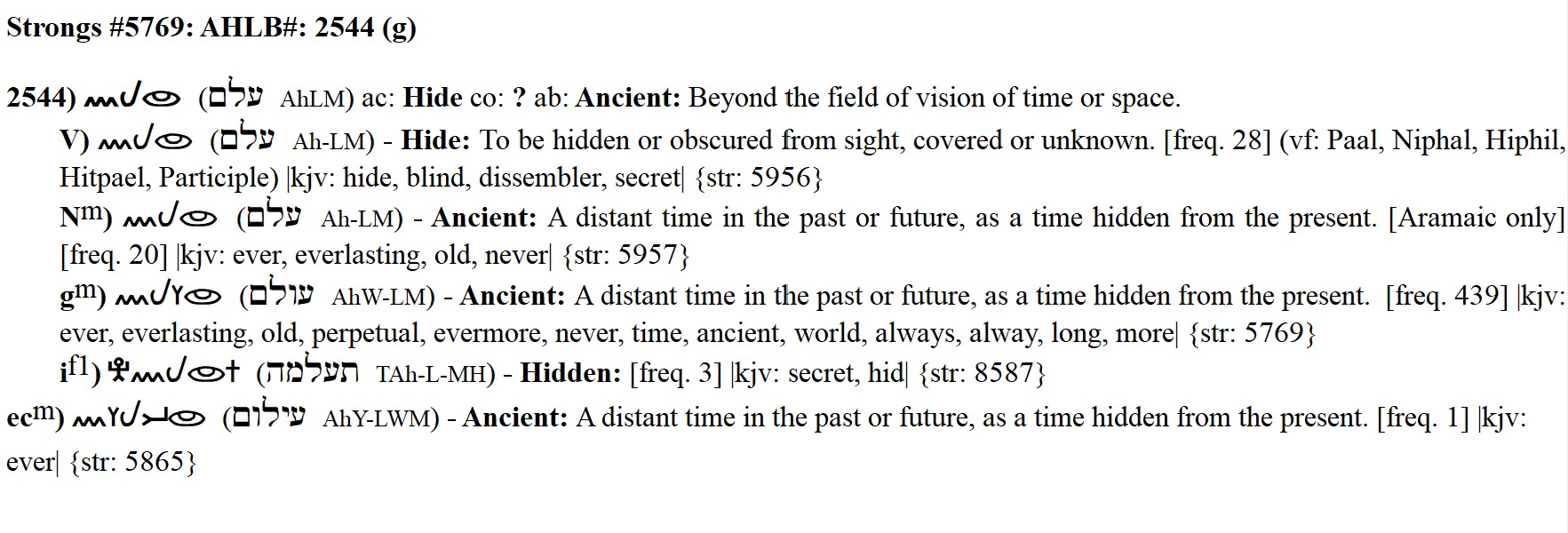
As mentioned before, the word beauty traces back to the Latin ‘bellitatem’ which means a “state of being pleasing to the senses” which comes from ‘bellus’ which means “pretty, handsome, charming, agreeable.” Bellus is thought to be a diminutive form of an archaic Latin word duenos (duenelos) which means good. The Latin word ‘bonus,’ which also means good, is said to come from duenos as well. In ancient thought, the beautiful and the good overlapped. That which was good was beautiful, that which was evil was ugly. Bellus (beauty) is something delightful to the senses. Good and beautiful.
In Greek this concept was displayed by the word καλοκἀγαθία ‘kalokagathia,’ which meant a union of both beauty in form and good in character or function. καλοκἀγαθία ‘kalokagathia is a combination of the words καλὸς ‘kalos’ which means beautiful and ἀγαθός ‘agathos’ which means good.
G2570
καλός
kalos
Thayer Definition:
- beautiful, handsome, excellent, eminent, choice, surpassing, precious, useful, suitable, commendable, admirable
1a) beautiful to look at, shapely, magnificent
1b) good, excellent in its nature and characteristics, and therefore well adapted to its ends
1b1) genuine, approved
1b2) precious
1b3) joined to names of men designated by their office, competent, able, such as one ought to be
1b4) praiseworthy, noble
1c) beautiful by reason of purity of heart and life, and hence praiseworthy
1c1) morally good, noble
1d) honourable, conferring honour
1e) affecting the mind agreeably, comforting and confirming
Part of Speech: adjective
A Related Word by Thayer’s/Strong’s Number: of uncertain affinity
Joh 10:11 I am the good (καλός ‘kalos’) shepherd: the good shepherd giveth his life for the sheep.
In Hebrew, the word for good is טוֹב ‘tov.’ This word also has the sense of beauty.
Gen 6:2 That the sons of God saw the daughters of men that they were fair (טוֹב ‘tov); and they took them wives of all which they chose.
Joh 10:11 I am the good (καλός ‘kalos’) shepherd: the good shepherd giveth his life for the sheep.
In Hebrew, the word for good is טוֹב ‘tov.’ This word also has the sense of beauty.
Gen 6:2 That the sons of God saw the daughters of men that they were fair (טוֹב ‘tov); and they took them wives of all which they chose.
1Sa 16:12 And he sent, and brought him in. Now he was ruddy, and withal of a beautiful (יפה ‘yapheh’) countenance, and goodly (טוֹב ‘tov) to look to. And the LORD said, Arise, anoint him: for this is he.
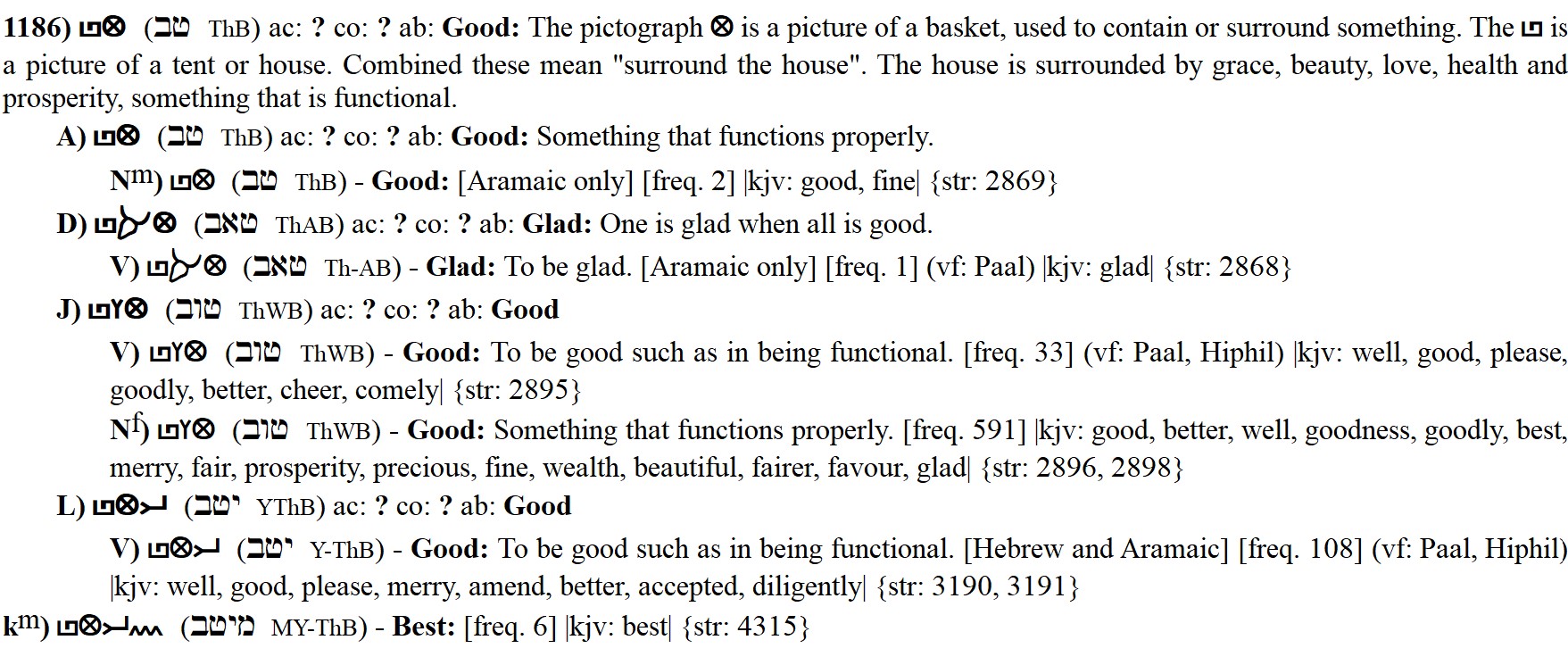
Mat 19:17 And he said unto him, Why callest thou me good? there is none good but one, that is, God: but if thou wilt enter into life, keep the commandments.
The glory of God is beautiful/good
Exo 33:18 And he said, I beseech thee, shew me thy glory.
Exo 33:19 And he said, I will make all my goodness (טוֹב ‘tuv) pass before thee, and I will proclaim the name of the LORD before thee; and will be gracious to whom I will be gracious, and will shew mercy on whom I will shew mercy.
Exo 33:20 And he said, Thou canst not see my face: for there shall no man see me, and live.
Exo 33:21 And the LORD said, Behold, there is a place by me, and thou shalt stand upon a rock:
Exo 33:22 And it shall come to pass, while my glory passeth by, that I will put thee in a clift of the rock, and will cover thee with my hand while I pass by:
Exo 33:23 And I will take away mine hand, and thou shalt see my back parts: but my face shall not be seen.
In this portion of Scripture, THE LORD God proclaims to Moses that no man can see His Face and live. Yet, one of the promises to Abraham is that He would be seen (Genesis 22:14).
Messiah Jesus declared that no man has seen or heard God at any time (John 5:37), the presence/face of God is revealed to mankind through Himself (John 14:7-9). In Deuteronomy 34:10 and Exodus 33:11, Moses is described as knowing God face to face and in Numbers 12:8 it is said Moses looked upon the similitude or form {תּמנה ‘temunah’} of God. The only way to reconcile these Scriptures with Exodus 33:19-23 is the fact that the Scriptures describe Jesus as the image/similitude of the Father.
Psa 44:3 For they did not inherit the land with their own sword; yea, their own arm did not save them. But it was Your right hand and Your arm and the light of Your face, because You favored them.
Psa 44:4 You are He, my King, O God; command deliverances (ישועה ‘yeshuah’) for Jacob.
2Co 4:4 In whom the god of this world hath blinded the minds of them which believe not, lest the light of the glorious gospel of Christ, who is the image of God, should shine unto them.
2Co 4:6 For God, who commanded the light to shine out of darkness, hath shined in our hearts, to give the light of the knowledge of the glory of God in the face of Jesus Christ.
Jesus is the Presence/Face of God
KJV
Psa 42:5 Why art thou cast down, O my soul? and why art thou disquieted in me? hope thou in God: for I shall yet praise him for the help of his countenance.
Psa 42:5 (42:6) מה־תשׁתוחחי נפשׁי ותהמי עלי הוחילי לאלהים כי־עוד אודנו ישׁועותפניו׃
ישועות פניו ‘yeshuot panav’ literally means the Salvation of His Face.
Isa 63:9 In all their affliction, He was not a foe; and the Angel of his Face saved them. In His love and in His pity He redeemed them. And He bore them up, and lifted them up all the days of old.
Heb 1:3 Who being the brightness of his glory, and the express image of his person, and upholding all things by the word of his power, when he had by himself purged our sins, sat down on the right hand of the Majesty on high;
Col 1:12 giving thanks to the Father, who has made us fit for a share of the inheritance of the saints in light,
Col 1:13 who delivered us out of the authority of darkness, and translated us into the kingdom of the Son of His love,
Col 1:14 in whom we have redemption through His blood, the remission of sins;
Col 1:15 who is the image of the invisible God, the First-born of all creation.
Col 1:16 For all things were created in Him, the things in the heavens, and the things on the earth, the visible and the invisible; whether thrones, or lordships, or rulers, or authorities, all things have been created through Him and for Him.
Col 1:17 And He is before all things, and all things have subsisted in Him.
Col 1:18 And He is the Head of the body, the assembly, who is the Beginning, the First-born out of the dead, that He be preeminent in all things;
Col 1:19 because all the fullness was pleased to dwell in Him,
Col 1:20 and through Him making peace by the blood of His cross, to reconcile all things to Himself; through Him, whether the things on the earth, or the things in the heavens.
Exodus 33:22 declares that Moses saw the Glory of God. The Glory of God is Messiah Jesus.
Exo 33:22 And it shall come to pass, while my glory passeth by, that I will put thee in a clift of the rock, and will cover thee with my hand while I pass by:
Rev 21:23 And the city had no need of the sun, neither of the moon, to shine in it: for the glory of God did lighten it, and the Lamb is the light thereof.
Isa 40:5 And the glory of the LORD shall be revealed, and all flesh shall see it together: for the mouth of the LORD hath spoken it.
Isa 60:1 Arise, shine; for thy light is come, and the glory of the LORD is risen upon thee.
Isa 60:2 For, behold, the darkness shall cover the earth, and gross darkness the people: but the LORD shall arise upon thee, and his glory shall be seen upon thee.
Isa 60:3 And the Gentiles shall come to thy light, and kings to the brightness of thy rising.
Luk 1:78 Through the tender mercy of our God; whereby the dayspring from on high hath visited us,
Luk 1:79 To give light to them that sit in darkness and in the shadow of death, to guide our feet into the way of peace.
Mat 4:13 And leaving Nazareth, he came and dwelt in Capernaum, which is upon the sea coast, in the borders of Zabulon and Nephthalim:
Mat 4:14 That it might be fulfilled which was spoken by Esaias the prophet, saying,
Mat 4:15 The land of Zabulon, and the land of Nephthalim, by the way of the sea, beyond Jordan, Galilee of the Gentiles;
Mat 4:16 The people which sat in darkness saw great light; and to them which sat in the region and shadow of death light is sprung up.
Joh 1:9 That was the true Light, which lighteth every man that cometh into the world.
Joh 3:19 And this is the condemnation, that light is come into the world, and men loved darkness rather than light, because their deeds were evil.
The Holy Spirit made Luke associate the Glory of God with the Salvation of God.
Luk 3:3 And he came into the neighborhood of the Jordan proclaiming a baptism of repentance for remission of sins,
Luk 3:4 as it has been written in the scroll of the Words of Isaiah the prophet, saying: “The voice of one crying in the wilderness, Prepare the way of the Lord, make His paths straight.
Luk 3:5 Every valley shall be filled up, and every mountain and hill shall be made low; and the crooked places shall be made into straight, and the rough into smooth ways;”
Luk 3:6 “and all flesh shall see the salvation of God.” Isaiah 40:3-5
Isa 40:5 And the glory of Jehovah shall be revealed, and all flesh shall see it together, for the mouth of Jehovah has spoken.
Good and Evil – Beautiful and Ugly
In Hebrew the word for good (טוֹב ‘tov) also means beautiful. The word for evil is רַע ‘ra.’ Interestingtly, רַע ‘ra’ is also the Hebrew word for shepherd (רַע ‘ra’). רַע ‘ra’ (good sense) is translated as neighbor, friend, another, fellow, companion, other, brother, husband, lover. The sense is one who loves and cares for another.
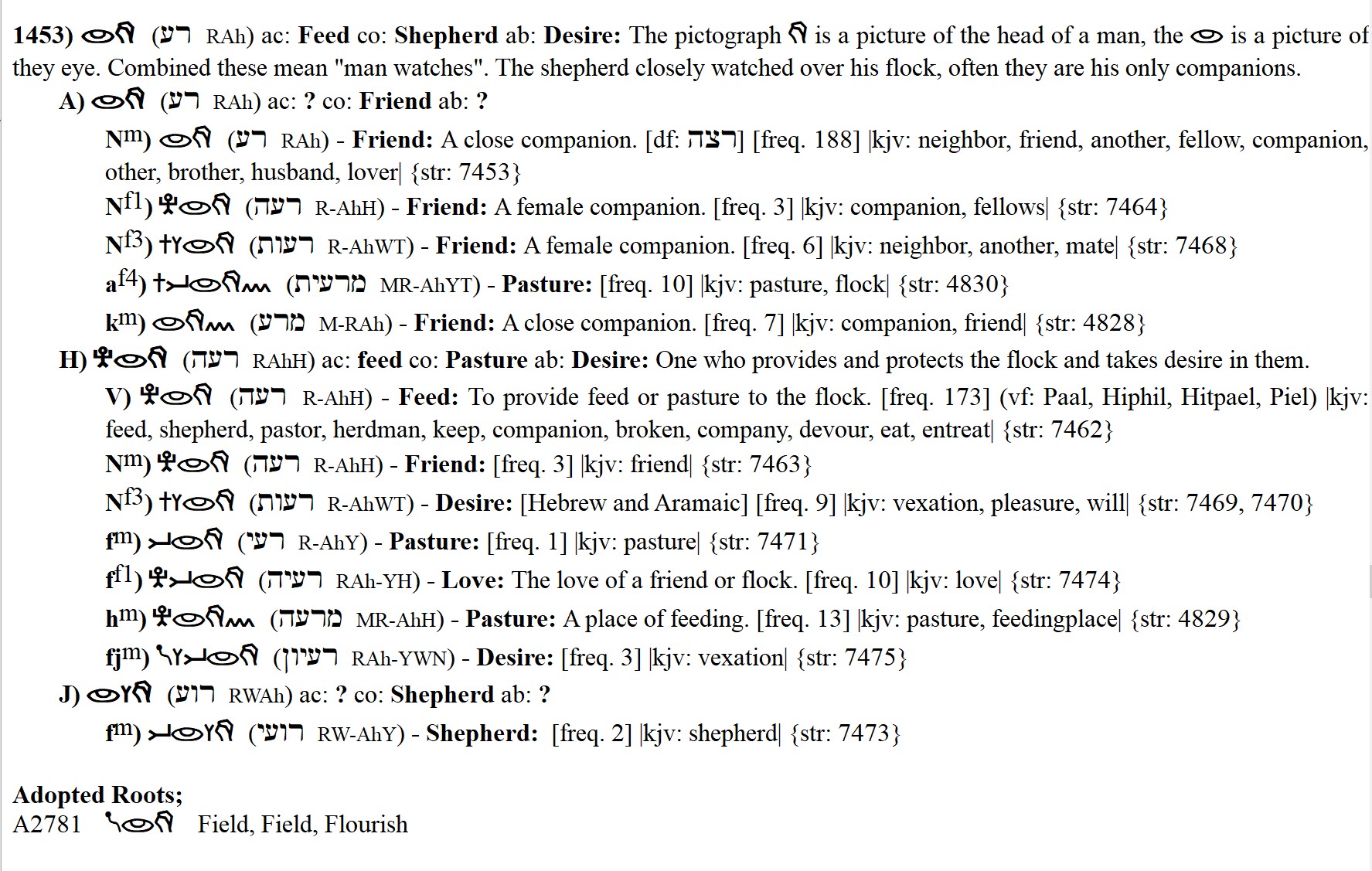
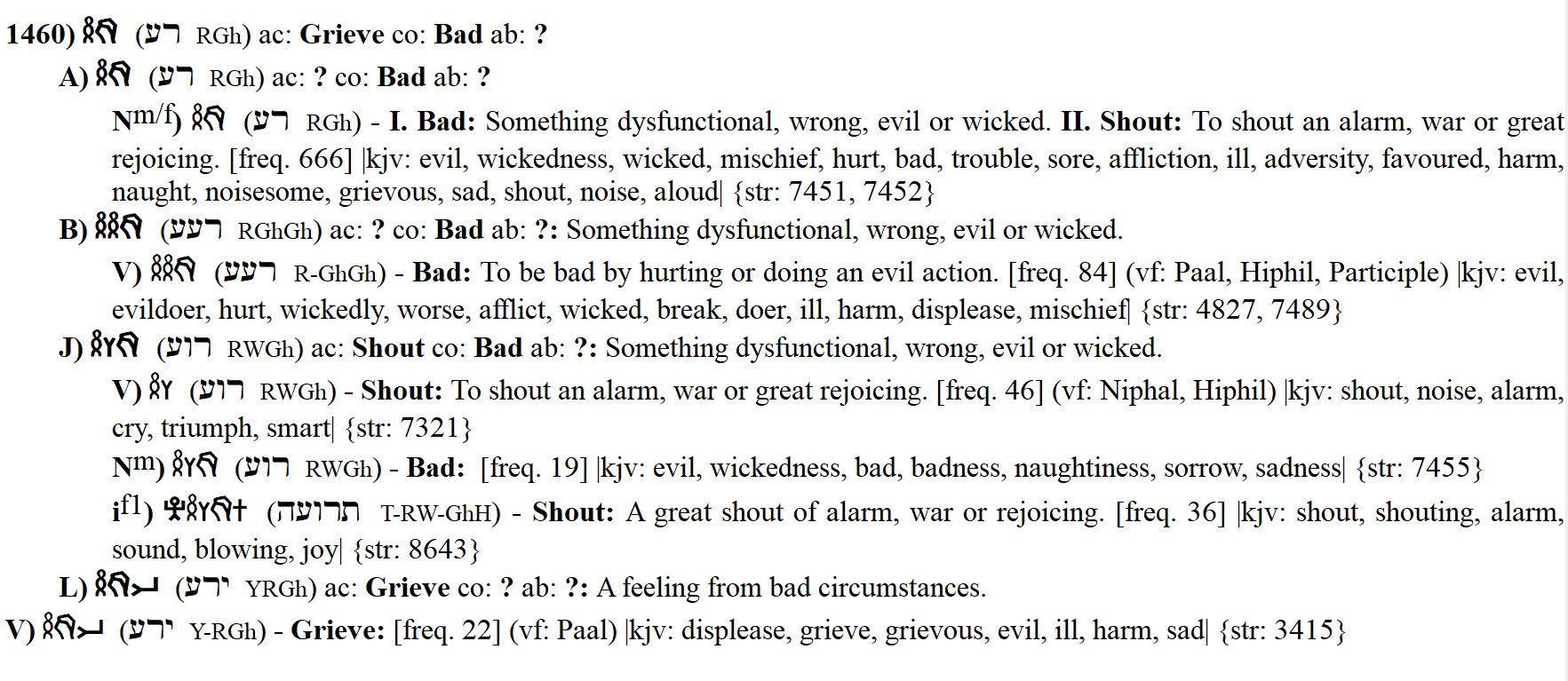
How is רַע ‘ra’ both evil and good? The difference is in the letter ע ‘ayin.’ The letter ע ‘ayin’ pictures an eye which points to perception and knowledge. The counterpart is ‘ghayin’ which is a picture of a twisted rope picturing something twisted, dark, wicked or bent. ‘ghayin’ passed down through time as the letter ע ‘ayin’ but the meaning of the words that originally had ‘ghayin’ reveal this “mystery.” Scholars of ancient Semitic scripts note that an original distinct letter, often called ghayin, existed in early Northwest Semitic. Over time this letter was absorbed into the single Hebrew letter ע (ayin). In Arabic the distinction is still preserved (ع ʿayn vs. غ ghayn).
“While the Modern Hebrew alphabet consists of twenty-two letters, the evidence suggests that there were additional letters in the original Semitic and Hebrew alphabet. One of the ancient Semitic languages of Canaan was Ugarit. This ancient language is almost identical to the Hebrew language of the Bible but, instead of consisting of twenty-two letters it has twenty-eight letters. One of the major differences between Ugarit and Hebrew is the additional letter ghayin (), which does not exist in Hebrew. Evidence, such as will be presented here, suggest that the letter “ghayin” did originally exist within the Hebrew text of the Bible, but at some point, in the ancient past, the letter ghayin began to be written with the letter ayin (, ע in the modern Hebrew).
One Word – Two Meanings
The strongest evidence for the missing ghayin can be found in the two different meanings of one Hebrew word. As an example, the Hebrew word רע (ra) can mean “friend” or “bad”. In the ancient past, the Hebrew word , written as רע in the modern Hebrew alphabet and identified in Strong’s Dictionary as #7453, meant “friend” and the Hebrew word , also written as רע in the modern Hebrew alphabet and identified in Strong’s Dictionary as #7451, meant “bad.” Below are a few other examples of Hebrew words that are spelled with an ayin that have more than one meaning.
Greek Transliterations of the ghayin
Additional evidence to the existence of the letter ghayin is the Greek transliteration of Hebrew names. When the Hebrew Bible was translated into Greek about 2,000 years ago, the translator transliterated the Hebrew names into Greek. An example of transliterating a name into another language can be seen in the Hebrew name אדם, which is transliterated into the Roman letters as “Adam.”
When we examine Hebrew names that contain the Hebrew letter ayin, we find two different methods of transliterating the letter. Table 1 below contains Hebrew names where the ayin is not transliterated (the Hebrew letter ayin is silent and is represented by an apostrophe in the English transliateration). Table 2 contains Hebrew names where the ayin is transliterated with the Greek letter Gamma (Γ or γ).
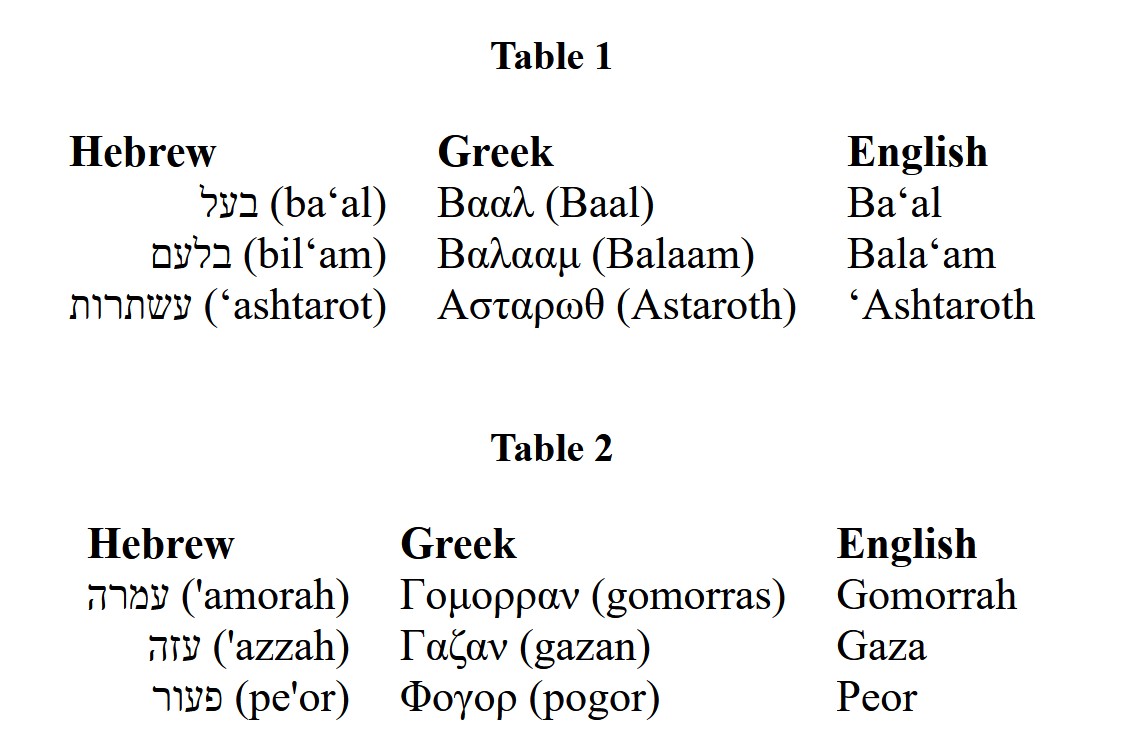
“While one word with two meanings may not seem strange to us as the English language is filled with words with more than one meaning, this is a very rare occurrence in Hebrew and when it does occur, it suggests that they were originally two different words.” {Changes in the Hebrew Alphabet – Jeff Benner}
The picture here is that ע ‘ayin’ is the eye that rightly discerns the beauty of God versus the (‘evil eye’) ‘ghayin’ which has a distorted perception. The beauty the corrupt desire is evil.
Psa 141:4 Incline not my heart to any evil thing, to practise wicked works with men that work iniquity: and let me not eat of their dainties (מנעם ‘manam). מנעם 'manam comes from the root נעם ‘na`am’ which means sweet, pleasant, beauty.

To the twisted perception, reality is bent to see evil as good.
Isa 5:20 Woe unto them that call evil good, and good evil; that put darkness for light, and light for darkness; that put bitter for sweet, and sweet for bitter!
Isa 5:21 Woe unto them that are wise in their own eyes, and prudent in their own sight!
This twisted perception occurs with pride. הדר ‘hadar,’ mentioned earlier in reference to Christ means beauty also means pride. Lucifer fell from heaven because of his pride and beauty (Ezekiel 28:12-17). Pride causes one to reject God and replace Him…
It is the path of Satan who was full of beauty but pride leads to evil. The pride of life leads to the lust of the flesh and eyes. Eating the “beautiful” fruit of the tree of knowledge of good and evil. Perception gets distorted leading one to follow the idol shepherd thinking they are serving God.
Our heart is with our treasure. A treasure something good and desirous. What we treasure reveals what is in our hearts.
Luk 12:34 For where your treasure is, there will your heart be also.
Mat 6:21 For where your treasure is, there will your heart be also.
Mat 6:22 The light of the body is the eye: if therefore thine eye be single, thy whole body shall be full of light.
Mat 6:23 But if thine eye be evil, thy whole body shall be full of darkness. If therefore the light that is in thee be darkness, how great is that darkness!
Mat 6:24 No man can serve two masters: for either he will hate the one, and love the other; or else he will hold to the one, and despise the other. Ye cannot serve God and mammon.
1Jn 2:14 I have written unto you, fathers, because ye have known him that is from the beginning. I have written unto you, young men, because ye are strong, and the word of God abideth in you, and ye have overcome the wicked one.
1Jn 2:15 Love not the world, neither the things that are in the world. If any man love the world, the love of the Father is not in him.
1Jn 2:16 For all that is in the world, the lust of the flesh, and the lust of the eyes, and the pride of life, is not of the Father, but is of the world.
1Jn 2:17 And the world passeth away, and the lust thereof: but he that doeth the will of God abideth for ever.
Joh 16:2 They shall put you out of the synagogues: yea, the time cometh, that whosoever killeth you will think that he doeth God service.
Joh 16:3 And these things will they do unto you, because they have not known the Father, nor me.
Isa 65:2 I have spread out my hands all the day unto a rebellious people, which walketh in a way that was not good, after their own thoughts;
Isa 65:3 A people that provoketh me to anger continually to my face; that sacrificeth in gardens, and burneth incense upon altars of brick;
Isa 65:4 Which remain among the graves, and lodge in the monuments, which eat swine’s flesh, and broth of abominable things is in their vessels;
Isa 65:5 Which say, Stand by thyself, come not near to me; for I am holier than thou. These are a smoke in my nose, a fire that burneth all the day.
Isa 66:1 Thus saith the LORD, The heaven is my throne, and the earth is my footstool: where is the house that ye build unto me? and where is the place of my rest?
Isa 66:2 For all those things hath mine hand made, and all those things have been, saith the LORD: but to this man will I look, even to him that is poor and of a contrite spirit, and trembleth at my word.
Isa 66:3 He that killeth an ox is as if he slew a man; he that sacrificeth a lamb, as if he cut off a dog’s neck; he that offereth an oblation, as if he offered swine’s blood; he that burneth incense, as if he blessed an idol. Yea, they have chosen their own ways, and their soul delighteth in their abominations.
Isa 66:4 I also will choose their delusions, and will bring their fears upon them; because when I called, none did answer; when I spake, they did not hear: but they did evil before mine eyes, and chose that in which I delighted not.
Isa 66:5 Hear the word of the LORD, ye that tremble at his word; Your brethren that hated you, that cast you out for my name’s sake, said, Let the LORD be glorified: but he shall appear to your joy, and they shall be ashamed.
Rom 10:1 Brethren, my heart’s desire and prayer to God for Israel is, that they might be saved.
Rom 10:2 For I bear them record that they have a zeal of God, but not according to knowledge.
Rom 10:3 For they being ignorant of God’s righteousness, and going about to establish their own righteousness, have not submitted themselves unto the righteousness of God.
Rom 10:4 For Christ is the end of the law for righteousness to every one that believeth.
The good – beautiful (καλός ‘kalos’) Shepherd
Joh 10:11 I am the good shepherd: the good shepherd giveth his life for the sheep.
Joh 10:12 But he that is an hireling, and not the shepherd, whose own the sheep are not, seeth the wolf coming, and leaveth the sheep, and fleeth: and the wolf catcheth them, and scattereth the sheep.
Joh 10:13 The hireling fleeth, because he is an hireling, and careth not for the sheep.
Joh 10:14 I am the good shepherd, and know my sheep, and am known of mine.
The evil-ugly shepherds
Joh 10:12 But he that is an hireling, and not the shepherd, whose own the sheep are not, seeth the wolf coming, and leaveth the sheep, and fleeth: and the wolf catcheth them, and scattereth the sheep.
Joh 10:13 The hireling fleeth, because he is an hireling, and careth not for the sheep.
Zec 11:15 And the LORD said unto me, Take unto thee yet the instruments of a foolish shepherd.
Zec 11:16 For, lo, I will raise up a shepherd in the land, which shall not visit those that be cut off, neither shall seek the young one, nor heal that that is broken, nor feed that that standeth still: but he shall eat the flesh of the fat, and tear their claws in pieces.
Zec 11:17 Woe to the idol shepherd that leaveth the flock! the sword shall be upon his arm, and upon his right eye: his arm shall be clean dried up, and his right eye shall be utterly darkened.
Eze 34:1 And the word of the LORD came unto me, saying,
Eze 34:2 Son of man, prophesy against the shepherds of Israel, prophesy, and say unto them, Thus saith the Lord GOD unto the shepherds; Woe be to the shepherds of Israel that do feed themselves! should not the shepherds feed the flocks?
Eze 34:3 Ye eat the fat, and ye clothe you with the wool, ye kill them that are fed: but ye feed not the flock.
Eze 34:4 The diseased have ye not strengthened, neither have ye healed that which was sick, neither have ye bound up that which was broken, neither have ye brought again that which was driven away, neither have ye sought that which was lost; but with force and with cruelty have ye ruled them.
Eze 34:5 And they were scattered, because there is no shepherd: and they became meat to all the beasts of the field, when they were scattered.
Eze 34:6 My sheep wandered through all the mountains, and upon every high hill: yea, my flock was scattered upon all the face of the earth, and none did search or seek after them.
Eze 34:7 Therefore, ye shepherds, hear the word of the LORD;
Eze 34:8 As I live, saith the Lord GOD, surely because my flock became a prey, and my flock became meat to every beast of the field, because there was no shepherd, neither did my shepherds search for my flock, but the shepherds fed themselves, and fed not my flock;
Eze 34:9 Therefore, O ye shepherds, hear the word of the LORD;
Eze 34:10 Thus saith the Lord GOD; Behold, I am against the shepherds; and I will require my flock at their hand, and cause them to cease from feeding the flock; neither shall the shepherds feed themselves any more; for I will deliver my flock from their mouth, that they may not be meat for them.
Eze 34:11 For thus saith the Lord GOD; Behold, I, even I, will both search my sheep, and seek them out.
Eze 34:12 As a shepherd seeketh out his flock in the day that he is among his sheep that are scattered; so will I seek out my sheep, and will deliver them out of all places where they have been scattered in the cloudy and dark day.
Eze 34:13 And I will bring them out from the people, and gather them from the countries, and will bring them to their own land, and feed them upon the mountains of Israel by the rivers, and in all the inhabited places of the country.
Eze 34:14 I will feed them in a good pasture, and upon the high mountains of Israel shall their fold be: there shall they lie in a good fold, and in a fat pasture shall they feed upon the mountains of Israel.
Eze 34:15 I will feed my flock, and I will cause them to lie down, saith the Lord GOD.
Eze 34:16 I will seek that which was lost, and bring again that which was driven away, and will bind up that which was broken, and will strengthen that which was sick: but I will destroy the fat and the strong; I will feed them with judgment.
Eze 34:17 And as for you, O my flock, thus saith the Lord GOD; Behold, I judge between cattle and cattle, between the rams and the he goats.
Eze 34:18 Seemeth it a small thing unto you to have eaten up the good pasture, but ye must tread down with your feet the residue of your pastures? and to have drunk of the deep waters, but ye must foul the residue with your feet?
Eze 34:19 And as for my flock, they eat that which ye have trodden with your feet; and they drink that which ye have fouled with your feet.
Eze 34:20 Therefore thus saith the Lord GOD unto them; Behold, I, even I, will judge between the fat cattle and between the lean cattle.
Eze 34:21 Because ye have thrust with side and with shoulder, and pushed all the diseased with your horns, till ye have scattered them abroad;
Eze 34:22 Therefore will I save my flock, and they shall no more be a prey; and I will judge between cattle and cattle.
Eze 34:23 And I will set up one shepherd over them, and he shall feed them, even my servant David; he shall feed them, and he shall be their shepherd.
Eze 34:24 And I the LORD will be their God, and my servant David a prince among them; I the LORD have spoken it.
Eze 34:25 And I will make with them a covenant of peace, and will cause the evil beasts to cease out of the land: and they shall dwell safely in the wilderness, and sleep in the woods.
Eze 34:26 And I will make them and the places round about my hill a blessing; and I will cause the shower to come down in his season; there shall be showers of blessing.
Eze 34:27 And the tree of the field shall yield her fruit, and the earth shall yield her increase, and they shall be safe in their land, and shall know that I am the LORD, when I have broken the bands of their yoke, and delivered them out of the hand of those that served themselves of them.
Eze 34:28 And they shall no more be a prey to the heathen, neither shall the beast of the land devour them; but they shall dwell safely, and none shall make them afraid.
Eze 34:29 And I will raise up for them a plant of renown, and they shall be no more consumed with hunger in the land, neither bear the shame of the heathen any more.
Eze 34:30 Thus shall they know that I the LORD their God am with them, and that they, even the house of Israel, are my people, saith the Lord GOD.
Eze 34:31 And ye my flock, the flock of my pasture, are men, and I am your God, saith the Lord GOD.
Jer 23:1 Woe be unto the pastors that destroy and scatter the sheep of my pasture! saith the LORD.
Jer 23:2 Therefore thus saith the LORD God of Israel against the pastors that feed my people; Ye have scattered my flock, and driven them away, and have not visited them: behold, I will visit upon you the evil of your doings, saith the LORD.
Jer 23:3 And I will gather the remnant of my flock out of all countries whither I have driven them, and will bring them again to their folds; and they shall be fruitful and increase.
Jer 23:4 And I will set up shepherds over them which shall feed them: and they shall fear no more, nor be dismayed, neither shall they be lacking, saith the LORD.
Jer 23:5 Behold, the days come, saith the LORD, that I will raise unto David a righteous Branch, and a King shall reign and prosper, and shall execute judgment and justice in the earth.
Jer 23:6 In his days Judah shall be saved, and Israel shall dwell safely: and this is his name whereby he shall be called, THE LORD OUR RIGHTEOUSNESS.
Jer 23:7 Therefore, behold, the days come, saith the LORD, that they shall no more say, The LORD liveth, which brought up the children of Israel out of the land of Egypt;
Jer 23:8 But, The LORD liveth, which brought up and which led the seed of the house of Israel out of the north country, and from all countries whither I had driven them; and they shall dwell in their own land.
Satan was the beautiful one but fell due to his ugliness within.
Eze 28:17 Thine heart was lifted up because of thy beauty (יפי ‘yophi’), thou hast corrupted thy wisdom by reason of thy brightness (יפעה ‘yiph`ah’): I will cast thee to the ground, I will lay thee before kings, that they may behold thee.
Eze 28:11 Moreover the word of the LORD came unto me, saying,
Eze 28:12 Son of man, take up a lamentation upon the king of Tyrus, and say unto him, Thus saith the Lord GOD; Thou sealest up the sum, full of wisdom, and perfect in beauty.
Eze 28:13 Thou hast been in Eden the garden of God; every precious stone was thy covering, the sardius, topaz, and the diamond, the beryl, the onyx, and the jasper, the sapphire, the emerald, and the carbuncle, and gold: the workmanship of thy tabrets and of thy pipes was prepared in thee in the day that thou wast created.
Eze 28:14 Thou art the anointed cherub that covereth; and I have set thee so: thou wast upon the holy mountain of God; thou hast walked up and down in the midst of the stones of fire.
Eze 28:15 Thou wast perfect in thy ways from the day that thou wast created, till iniquity was found in thee.
Eze 28:16 By the multitude of thy merchandise they have filled the midst of thee with violence, and thou hast sinned: therefore I will cast thee as profane out of the mountain of God: and I will destroy thee, O covering cherub, from the midst of the stones of fire.
Eze 28:17 Thine heart was lifted up because of thy beauty, thou hast corrupted thy wisdom by reason of thy brightness: I will cast thee to the ground, I will lay thee before kings, that they may behold thee.
Eze 28:18 Thou hast defiled thy sanctuaries by the multitude of thine iniquities, by the iniquity of thy traffick; therefore will I bring forth a fire from the midst of thee, it shall devour thee, and I will bring thee to ashes upon the earth in the sight of all them that behold thee.
Eze 28:19 All they that know thee among the people shall be astonished at thee: thou shalt be a terror, and never shalt thou be any more.
Satan appears as an angel of light, his servants do as well. Wolves in sheep’s clothing. They appear beautiful but inwardly are evil, ugly. Their fruit reveals them.
2Co 11:13 For such are false apostles, deceitful workers, transforming themselves into the apostles of Christ.
2Co 11:14 And no marvel; for Satan himself is transformed into an angel of light.
2Co 11:15 Therefore it is no great thing if his ministers also be transformed as the ministers of righteousness; whose end shall be according to their works.
Mat 23:25 Woe unto you, scribes and Pharisees, hypocrites! for ye make clean the outside of the cup and of the platter, but within they are full of extortion and excess.
Mat 23:26 Thou blind Pharisee, cleanse first that which is within the cup and platter, that the outside of them may be clean also.
Mat 23:27 Woe unto you, scribes and Pharisees, hypocrites! for ye are like unto whited sepulchres, which indeed appear beautiful outward, but are within full of dead men’s bones, and of all uncleanness.
Mat 23:28 Even so ye also outwardly appear righteous unto men, but within ye are full of hypocrisy and iniquity.
Mat 7:15 Beware of false prophets, which come to you in sheep’s clothing, but inwardly they are ravening wolves.
Mat 7:16 Ye shall know them by their fruits. Do men gather grapes of thorns, or figs of thistles?
Mat 7:17 Even so every good tree bringeth forth good fruit; but a corrupt tree bringeth forth evil fruit.
Mat 7:18 A good tree cannot bring forth evil fruit, neither can a corrupt tree bring forth good fruit.
Mat 7:19 Every tree that bringeth not forth good fruit is hewn down, and cast into the fire.
Mat 7:20 Wherefore by their fruits ye shall know them.
Beautiful – Good Creation

Gen 1:31 And God saw every thing that he had made, and, behold, it was very good (טוב ‘tov’). And the evening and the morning were the sixth day.
Recall that טוב ‘tov’ also has the meaning of beautiful. God saw that everything He made was very beautiful.
The beauty of creation leads one to God but distorted perception leads one to idolatry.
Rom 1:18 For the wrath of God is revealed from heaven against all ungodliness and unrighteousness of men, who hold the truth in unrighteousness;
Rom 1:19 Because that which may be known of God is manifest in them; for God hath shewed it unto them.
Rom 1:20 For the invisible things of him from the creation of the world are clearly seen, being understood by the things that are made, even his eternal power and Godhead; so that they are without excuse:
Rom 1:21 Because that, when they knew God, they glorified him not as God, neither were thankful; but became vain in their imaginations, and their foolish heart was darkened.
Rom 1:22 Professing themselves to be wise, they became fools,
Rom 1:23 And changed the glory of the uncorruptible God into an image made like to corruptible man, and to birds, and fourfooted beasts, and creeping things.
Rom 1:24 Wherefore God also gave them up to uncleanness through the lusts of their own hearts, to dishonour their own bodies between themselves:
Rom 1:25 Who changed the truth of God into a lie, and worshipped and served the creature more than the Creator, who is blessed for ever. Amen.
Rom 1:26 For this cause God gave them up unto vile affections: for even their women did change the natural use into that which is against nature:
Rom 1:27 And likewise also the men, leaving the natural use of the woman, burned in their lust one toward another; men with men working that which is unseemly, and receiving in themselves that recompence of their error which was meet.
Rom 1:28 And even as they did not like to retain God in their knowledge, God gave them over to a reprobate mind, to do those things which are not convenient;
Rom 1:29 Being filled with all unrighteousness, fornication, wickedness, covetousness, maliciousness; full of envy, murder, debate, deceit, malignity; whisperers,
Rom 1:30 Backbiters, haters of God, despiteful, proud, boasters, inventors of evil things, disobedient to parents,
Rom 1:31 Without understanding, covenantbreakers, without natural affection, implacable, unmerciful:
Rom 1:32 Who knowing the judgment of God, that they which commit such things are worthy of death, not only do the same, but have pleasure in them that do them.
Wis 13:1 Surely vain are all men by nature, who are ignorant of God, and could not out of the good things that are seen know him that is: neither by considering the works did they acknowledge the workmaster;
Wis 13:2 But deemed either fire, or wind, or the swift air, or the circle of the stars, or the violent water, or the lights of heaven, to be the gods which govern the world.
Wis 13:3 With whose beauty if they being delighted took them to be gods; let them know how much better the Lord of them is: for the first author of beauty hath created them.
Wis 13:4 But if they were astonished at their power and virtue, let them understand by them, how much mightier he is that made them.
Wis 13:5 For by the greatness and beauty of the creatures proportionably the maker of them is seen.
Wis 13:6 But yet for this they are the less to be blamed: for they peradventure err, seeking God, and desirous to find him.
Wis 13:7 For being conversant in his works they search him diligently, and believe their sight: because the things are beautiful that are seen.
Wis 13:8 Howbeit neither are they to be pardoned.
Wis 13:9 For if they were able to know so much, that they could aim at the world; how did they not sooner find out the Lord thereof?
Wis 13:10 But miserable are they, and in dead things is their hope, who call them gods, which are the works of men’s hands, gold and silver, to shew art in, and resemblances of beasts, or a stone good for nothing, the work of an ancient hand.
Isa 40:25 To whom then will ye liken me, or shall I be equal? saith the Holy One.
Isa 40:26 Lift up your eyes on high, and behold who hath created these things, that bringeth out their host by number: he calleth them all by names by the greatness of his might, for that he is strong in power; not one faileth.
Jer 10:10 But the LORD is the true God, he is the living God, and an everlasting king: at his wrath the earth shall tremble, and the nations shall not be able to abide his indignation.
Jer 10:11 Thus shall ye say unto them, The gods that have not made the heavens and the earth, even they shall perish from the earth, and from under these heavens.
Jer 10:12 He hath made the earth by his power, he hath established the world by his wisdom, and hath stretched out the heavens by his discretion.
Act 14:12 And they called Barnabas, Jupiter; and Paul, Mercurius, because he was the chief speaker.
Act 14:13 Then the priest of Jupiter, which was before their city, brought oxen and garlands unto the gates, and would have done sacrifice with the people.
Act 14:14 Which when the apostles, Barnabas and Paul, heard of, they rent their clothes, and ran in among the people, crying out,
Act 14:15 And saying, Sirs, why do ye these things? We also are men of like passions with you, and preach unto you that ye should turn from these vanities unto the living God, which made heaven, and earth, and the sea, and all things that are therein:
Act 14:16 Who in times past suffered all nations to walk in their own ways.
Act 14:17 Nevertheless he left not himself without witness, in that he did good, and gave us rain from heaven, and fruitful seasons, filling our hearts with food and gladness.
Act 17:22 Then Paul stood in the midst of Mars’ hill, and said, Ye men of Athens, I perceive that in all things ye are too superstitious.
Act 17:23 For as I passed by, and beheld your devotions, I found an altar with this inscription, TO THE UNKNOWN GOD. Whom therefore ye ignorantly worship, him declare I unto you.
Act 17:24 God that made the world and all things therein, seeing that he is Lord of heaven and earth, dwelleth not in temples made with hands;
Act 17:25 Neither is worshipped with men’s hands, as though he needed any thing, seeing he giveth to all life, and breath, and all things;
Act 17:26 And hath made of one blood all nations of men for to dwell on all the face of the earth, and hath determined the times before appointed, and the bounds of their habitation;
Act 17:27 That they should seek the Lord, if haply they might feel after him, and find him, though he be not far from every one of us:
Act 17:28 For in him we live, and move, and have our being; as certain also of your own poets have said, For we are also his offspring.
Act 17:29 Forasmuch then as we are the offspring of God, we ought not to think that the Godhead is like unto gold, or silver, or stone, graven by art and man’s device.
Act 17:30 And the times of this ignorance God winked at; but now commandeth all men every where to repent:
Act 17:31 Because he hath appointed a day, in the which he will judge the world in righteousness by that man whom he hath ordained; whereof he hath given assurance unto all men, in that he hath raised him from the dead.
God planted “good seed,” an enemy brought in evil. He brought sin into the world with the deception of it being beautiful and delightful to the senses.
Gen 3:1 Now the serpent was more subtil than any beast of the field which the LORD God had made. And he said unto the woman, Yea, hath God said, Ye shall not eat of every tree of the garden?
Gen 3:2 And the woman said unto the serpent, We may eat of the fruit of the trees of the garden:
Gen 3:3 But of the fruit of the tree which is in the midst of the garden, God hath said, Ye shall not eat of it, neither shall ye touch it, lest ye die.
Gen 3:4 And the serpent said unto the woman, Ye shall not surely die:
Gen 3:5 For God doth know that in the day ye eat thereof, then your eyes shall be opened, and ye shall be as gods, knowing good and evil.
Gen 3:6 And when the woman saw that the tree was good for food, and that it was pleasant to the eyes, and a tree to be desired (חמד ‘chamad’) to make one wise, she took of the fruit thereof, and did eat, and gave also unto her husband with her; and he did eat.
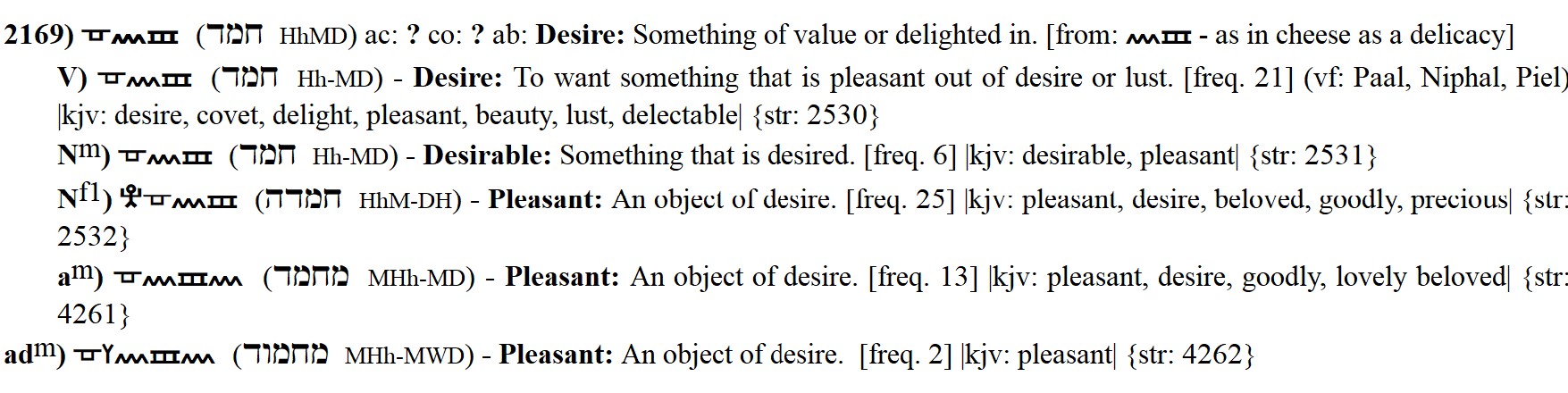
Mat 13:24 Another parable put he forth unto them, saying, The kingdom of heaven is likened unto a man which sowed good seed in his field:
Mat 13:25 But while men slept, his enemy came and sowed tares among the wheat, and went his way.
Mat 13:26 But when the blade was sprung up, and brought forth fruit, then appeared the tares also.
Mat 13:27 So the servants of the householder came and said unto him, Sir, didst not thou sow good seed in thy field? from whence then hath it tares?
Mat 13:28 He said unto them, An enemy hath done this. The servants said unto him, Wilt thou then that we go and gather them up?
Mat 13:29 But he said, Nay; lest while ye gather up the tares, ye root up also the wheat with them.
Mat 13:30 Let both grow together until the harvest: and in the time of harvest I will say to the reapers, Gather ye together first the tares, and bind them in bundles to burn them: but gather the wheat into my barn.
God’s Signature
The English word signature comes from the Latin word ‘signatura’ which means a “signature, a rescript, the matrix of a seal.” Signatura comes from ‘signatus’ which is the past participle of ‘signare’ which means “to mark with a stamp, sign.” Signature is related to the word sign. Sign comes from the Latin ‘signum’ which means an “identifying mark, token, indication, symbol; proof; military standard, ensign; a signal, an omen; sign in the heavens, constellation,” a “standard that one follows.”
In Edenics, sign is believed to trace back to the Hebrew word ציון ‘tsiyon’ (Zion).
Psa 50:2 Out of Zion, the perfection of beauty, God hath shined.
This ציון ‘tsiyon’ beauty connection is further seen in the Arabic word زَيْن ‘zayn’ which means beauty and grace.
Isa 49:14 But Zion said, The LORD hath forsaken me, and my Lord hath forgotten me.
Isa 49:15 Can a woman forget her sucking child, that she should not have compassion on the son of her womb? yea, they may forget, yet will I not forget thee.
Isa 49:16 Behold, I have graven thee upon the palms of my hands; thy walls are continually before me.
Isa 49:17 Thy children shall make haste; thy destroyers and they that made thee waste shall go forth of thee.
Isa 49:18 Lift up thine eyes round about, and behold: all these gather themselves together, and come to thee. As I live, saith the LORD, thou shalt surely clothe thee with them all, as with an ornament, and bind them on thee, as a bride doeth.
Psa 149:4 For the LORD taketh pleasure in his people: he will beautify the meek with salvation (יְשׁוּעָה ‘yeshuah’ – source of the name Jesus).
Psa 90:17 And let the beauty of the LORD our God be upon us: and establish thou the work of our hands upon us; yea, the work of our hands establish thou it.
Isa 61:10 I will greatly rejoice in the LORD, my soul shall be joyful in my God; for he hath clothed me with the garments of salvation, he hath covered me with the robe of righteousness, as a bridegroom decketh himself with ornaments, and as a bride adorneth herself with her jewels.
In Modern Greek, the word for signature is υπογραφή ‘ypografí’ which means “under-writing.” γράφη ‘graphe’ means a writing, drawing or record.
2Ti 3:16 All scripture (γραφή ‘graphe’) is given by inspiration of God, and is profitable for doctrine, for reproof, for correction, for instruction in righteousness:
Psa 33:6 By the word of the LORD were the heavens made; and all the host of them by the breath of his mouth.
In Ancient Greek, artists would use the phrase ἐποίησεν ‘epoisen’ meaning “made it,” or ἔγραψεν ‘egrapsen’ “wrote it.”
Heb 11:3 Through faith we understand that the worlds were framed by the word of God, so that things which are seen were not made of things which do appear.
The formula for providing a signature was typically “[Name] made (ἐποίεσεν and sometimes ἔγραφσεν) [it].” {The Meaning of Ancient Greek and Roman Artisan Signatures}
God created the universe through His Word, embedding His signature in types and shadows. See Shadows of Messiah
Signet rings were also used as “signatures”
On of the Hebrew word for signet ring is טבּעת ‘taba`at’ which comes from the root טבע ‘taba.’

The natural world (nature/creation) points to Messiah. The natural realm is given so that we can understand the spiritual.
1Co 15:46 But not the spiritual first, but the natural; afterward the spiritual.
Nature comes from the Hebrew word:
This word pictographically can represent ‘to see, good’. The letter ע-ayin is a pictograph of the eye which means to see and the letters ט-tet ב-bet spell טב ‘tov’ which means good.
Gen 1:31 And God saw everything that He had made and behold, it was very good. And there was evening, and there was morning the sixth day.
The earth’s creation is linked to a seal
Job 38:14 It is turned as clay to the seal; and they stand as a garment.
The Septuagint connects this verse to the creation of mankind
Job 38:14 Or didst thou take clay of the ground, and form a living creature, and set it with the power of speech upon the earth?
Connecting back to “nature” is the word ψυχικός ‘psuchikos’
1Co 15:46 But not the spiritual first, but the natural (ψυχικός ‘psuchikos’); afterward the spiritual.
G5591
ψυχικός
psuchikos
Thayer Definition:
- of or belonging to breath
1a) having the nature and characteristics of the breath
1a1) the principal of animal life, which men have in common with the brutes
1b) governed by breath
1b1) the sensuous nature with its subjection to appetite and passion
Part of Speech: adjective
A Related Word by Thayer’s/Strong’s Number: from G5590
Septuagint
Gen 2:7 καὶ ἔπλασεν ὁ θεὸς τὸν ἄνθρωπον χοῦν ἀπὸ τῆς γῆς καὶ ἐνεφύσησεν εἰς τὸ πρόσωπον αὐτοῦ πνοὴν ζωῆς, καὶ ἐγένετο ὁ ἄνθρωπος εἰς ψυχὴν ζῶσαν.
Gen 2:7 And God formed the man of dust of the earth, and breathed upon his face the breath of life, and the man became a living soul (ψυχὴν ‘psuchen’).
Adam was formed from the clay bearing the seal/image or signature of God.
Gen 1:27 So God created man in his own image, in the image of God created he him; male and female created he them.
Isa 64:8 But now, O LORD, thou art our father; we are the clay, and thou our potter; and we all are the work of thy hand.
There is a fascinating “storyline” in the Scriptures based upon this imagery of God.
One of the roles of the Messiah is to dash the enemies of God in pieces as a potsherd.
Psa 2:9 Thou shalt break them with a rod of iron; thou shalt dash them in pieces like a potter’s vessel.
Rev 2:27 And he shall rule them with a rod of iron; as the vessels of a potter shall they be broken to shivers: even as I received of my Father.
This was the fate of rebellious Israel. Scriptures applies Psalm 2, in part, to rebellious Israel (Acts 4:23-28).
Jer 18:1 The word which came to Jeremiah from the LORD, saying,
Jer 18:2 Arise, and go down to the potter’s house, and there I will cause thee to hear my words.
Jer 18:3 Then I went down to the potter’s house, and, behold, he wrought a work on the wheels.
Jer 18:4 And the vessel that he made of clay was marred in the hand of the potter: so he made it again another vessel, as seemed good to the potter to make it.
Jer 18:5 Then the word of the LORD came to me, saying,
Jer 18:6 O house of Israel, cannot I do with you as this potter? saith the LORD. Behold, as the clay is in the potter’s hand, so are ye in mine hand, O house of Israel.
Messiah came to cause mankind to be “broken” that we might be saved.
Luk 2:34 And Simeon blessed them and said to His mother Mary, Behold, this One is set for the fall and rising up of many in Israel, and for a sign spoken against;
All must be broken as all are enemies of God (Psalm 68:21).
Psa 68:21 But God shall wound the head of his enemies, and the hairy scalp of such an one as goeth on still in his trespasses.
Mat 21:44 And whosoever shall fall on this stone shall be broken: but on whomsoever it shall fall, it will grind him to powder.
To escape destruction, one must be born again.
Joh 3:3 Jesus answered and said unto him, Verily, verily, I say unto thee, Except a man be born again, he cannot see the kingdom of God.
Joh 3:4 Nicodemus saith unto him, How can a man be born when he is old? can he enter the second time into his mother’s womb, and be born?
Joh 3:5 Jesus answered, Verily, verily, I say unto thee, Except a man be born of water and of the Spirit, he cannot enter into the kingdom of God.
Joh 3:6 That which is born of the flesh is flesh; and that which is born of the Spirit is spirit.
We must become a “new lump” (1 Corinthians 5:7) {φύραμα ‘phurama’ mixing of a solid and liquid}
1Co 5:7 Purge out therefore the old leaven, that ye may be a new lump, as ye are unleavened. For even Christ our passover is sacrificed for us:
Jer 18:1 The word which came to Jeremiah from the LORD, saying,
Jer 18:2 Arise, and go down to the potter’s house, and there I will cause thee to hear my words.
Jer 18:3 Then I went down to the potter’s house, and, behold, he wrought a work on the wheels.
Jer 18:4 And the vessel that he made of clay was marred in the hand of the potter: so he made it again another vessel, as seemed good to the potter to make it.
Jer 18:5 Then the word of the LORD came to me, saying,
Jer 18:6 O house of Israel, cannot I do with you as this potter? saith the LORD. Behold, as the clay is in the potter’s hand, so are ye in mine hand, O house of Israel.
1Co 5:7 Purge out therefore the old leaven, that ye may be a new lump, as ye are unleavened. For even Christ our passover is sacrificed for us:
Our broken bodies carry the message of God’s Word/Will. The Hebrew word for “will” is רצון ‘ratson’ which literally pictures broken potsherds which carried written messages (the will/desire of the “sender” Matthew 10:40; Mark 9:37; John 20:21).
2Co 4:6 For God, who commanded the light to shine out of darkness, hath shined in our hearts, to give the light of the knowledge of the glory of God in the face of Jesus Christ.
2Co 4:7 But we have this treasure in earthen vessels, that the excellency of the power may be of God, and not of us.
2Co 4:8 We are troubled on every side, yet not distressed; we are perplexed, but not in despair;
2Co 4:9 Persecuted, but not forsaken; cast down, but not destroyed;
2Co 4:10 Always bearing about in the body the dying of the Lord Jesus, that the life also of Jesus might be made manifest in our body.
2Co 4:11 For we which live are alway delivered unto death for Jesus’ sake, that the life also of Jesus might be made manifest in our mortal flesh.
The beauty of God’s creation was tarnished by sin just as the image of God in man was corrupted by sin. The manifestation of the sons of God reverses the curse revealing the pure beauty of God.
Rom 8:14 For as many as are led by the Spirit of God, they are the sons of God.
Rom 8:15 For ye have not received the spirit of bondage again to fear; but ye have received the Spirit of adoption, whereby we cry, Abba, Father.
Rom 8:16 The Spirit itself beareth witness with our spirit, that we are the children of God:
Rom 8:17 And if children, then heirs; heirs of God, and joint-heirs with Christ; if so be that we suffer with him, that we may be also glorified together.
Rom 8:18 For I reckon that the sufferings of this present time are not worthy to be compared with the glory which shall be revealed in us.
Rom 8:19 For the earnest expectation of the creature waiteth for the manifestation of the sons of God.
Rom 8:20 For the creature was made subject to vanity, not willingly, but by reason of him who hath subjected the same in hope,
Rom 8:21 Because the creature itself also shall be delivered from the bondage of corruption into the glorious liberty of the children of God.
Rom 8:22 For we know that the whole creation groaneth and travaileth in pain together until now.
Rom 8:23 And not only they, but ourselves also, which have the firstfruits of the Spirit, even we ourselves groan within ourselves, waiting for the adoption, to wit, the redemption of our body.
In Greek, the word for workmanship is ποίημα ‘poiēma’ which is the source of our English word ‘poem’ (Romans 1:20, 23; Ephesians 2:10). God is the Great Artist, He is the Great Poet. He created man in His Image (Genesis 1:26-27)…could this be why we see art and poetry as beauty. He is the source of all beauty (Psalm 27:4; 90:17; 45:2; Zechariah 9:17).
He is the Great Artist, creating a beautiful, glorious “sculpture” of His body.
Eph 2:10 For we are his workmanship (ποίημα ‘poiēma’ ), created in Christ Jesus unto good works, which God hath before ordained that we should walk in them.
He desires our beauty
Psa 45:11 So shall the king greatly desire thy beauty: for he is thy Lord; and worship thou him.
Psa 45:6 Thy throne, O God, is for ever and ever: the sceptre of thy kingdom is a right sceptre.
Psa 45:7 Thou lovest righteousness, and hatest wickedness: therefore God, thy God, hath anointed thee with the oil of gladness above thy fellows.
Psa 45:8 All thy garments smell of myrrh, and aloes, and cassia, out of the ivory palaces, whereby they have made thee glad.
Psa 45:9 Kings’ daughters were among thy honourable women: upon thy right hand did stand the queen in gold of Ophir.
Psa 45:10 Hearken, O daughter, and consider, and incline thine ear; forget also thine own people, and thy father’s house;
Psa 45:11 So shall the king greatly desire thy beauty: for he is thy Lord; and worship thou him.
Psa 45:12 And the daughter of Tyre shall be there with a gift; even the rich among the people shall intreat thy favour.
Psa 45:13 The king’s daughter is all glorious within: her clothing is of wrought gold.
Psa 45:14 She shall be brought unto the king in raiment of needlework: the virgins her companions that follow her shall be brought unto thee.
Psa 45:15 With gladness and rejoicing shall they be brought: they shall enter into the king’s palace.
Psa 45:16 Instead of thy fathers shall be thy children, whom thou mayest make princes in all the earth.
Psa 45:17 I will make thy name to be remembered in all generations: therefore shall the people praise thee for ever and ever.
“Stroke” by “stroke” He is forming us into His image.
2Co 3:18 But we all, with open face beholding as in a glass the glory of the Lord, are changed into the same image from glory to glory, even as by the Spirit of the Lord.
Rom 8:1 There is therefore now no condemnation to them which are in Christ Jesus, who walk not after the flesh, but after the Spirit.
Rom 8:2 For the law of the Spirit of life in Christ Jesus hath made me free from the law of sin and death.
Rom 8:3 For what the law could not do, in that it was weak through the flesh, God sending his own Son in the likeness of sinful flesh, and for sin, condemned sin in the flesh:
Rom 8:4 That the righteousness of the law might be fulfilled in us, who walk not after the flesh, but after the Spirit.
The Meaning of Ancient Greek and Roman Artisan Signatures
“Art historian Elizabeth Bartman has worked extensively with miniature statuettes, noting small-scale pieces of sculpture in antiquity often bear signatures on the base, plinth, or statue itself. Prizing both the copy and the original, the statue and the statuette, may be due in part to how people in antiquity conceptualized the artist. As Bartman remarks,
To the ancients, a sculptor was an artisan rather than an artiste. It is not surprising, therefore, that patrons and sculptors could applaud the technical execution of the work — what was called its techne — while paying little homage to the original artist responsible for conceiving the image … to the ancients, it would seem, a miniature copy was a copy, and a copy was simply a statue.”
τέχνη ‘techne’ means art, skill, craft, trade, or technical skill/workmanship. The related noun τεχνίτης ‘technites’ (craftsman/artisan) is used in reference to God building the heavenly city of Zion.
Heb 11:10 For he looked for a city which hath foundations, whose builder (τεχνίτης ‘technites’) and maker is God.
Zion, the people of God
Heb 3:1 Wherefore, holy brethren, partakers of the heavenly calling, consider the Apostle and High Priest of our profession, Christ Jesus;
Heb 3:2 Who was faithful to him that appointed him, as also Moses was faithful in all his house.
Heb 3:3 For this man was counted worthy of more glory than Moses, inasmuch as he who hath builded the house hath more honour than the house.
Heb 3:4 For every house is builded by some man; but he that built all things is God.
Heb 3:5 And Moses verily was faithful in all his house, as a servant, for a testimony of those things which were to be spoken after;
Heb 3:6 But Christ as a son over his own house; whose house are we, if we hold fast the confidence and the rejoicing of the hope firm unto the end.
Isa 8:18 Behold, I and the children whom the LORD hath given me are for signs and for wonders in Israel from the LORD of hosts, which dwelleth in mount Zion.
In the Septuagint, σημεια ‘semeia’ is used to translated signs (אות ‘oht’) in Isaiah 8:18. This word was used in Ancient Greece “to stamp with a sign or mark, to seal.” The Latin Vulgate uses the word ‘signum.’
Isa 8:18 ecce ego et pueri quos mihi dedit Dominus in signum et in portentum Israhelis a Domino exercituum qui habitat in monte Sion.
Recall, the English word signature comes from this word signum/signare.
Christ the Character of God, the Icon of God
Heb 1:3 Who being the brightness of his glory, and the express image (χαρακτήρ ‘charakter’) of his person, and upholding all things by the word of his power, when he had by himself purged our sins, sat down on the right hand of the Majesty on high;
G5481
χαρακτήρ
charaktēr
khar-ak-tar’
From the same as G5482; a graver (the tool or the person), that is, (by implication) engraving ([“character”], the figure stamped, that is, an exact copy or [figuratively] representation): – express image.
The English word character also has the meaning of a the moral qualities of an individual, the “mark” of a person. χαρακτήρ ‘charakter’ means an “engraved or stamped mark.’ It referred to a distinctive mark left on a coin, seal, or tablet, something that identifies and authenticates the object. One’s moral character is the set of qualities that are “engraved” into a person’s soul through their choices and actions.
2Co 4:4 In whom the god of this world hath blinded the minds of them which believe not, lest the light of the glorious gospel of Christ, who is the image (εἰκών ‘eikon’) of God, should shine unto them.
G1504
εἰκών
eikōn
Thayer Definition:
- an image, figure, likeness
1a) an image of the things (the heavenly things)
1a1) used of the moral likeness of renewed men to God
1a2) the image of the Son of God, into which true Christians are transformed, is likeness not only to the heavenly body, but also to the most holy and blessed state of mind, which Christ possesses
1b) the image of one
1b1) one in whom the likeness of any one is seen
1b2) applied to man on account of his power of command
1b3) to Christ on account of his divine nature and absolute moral excellence
Part of Speech: noun feminine
A Related Word by Thayer’s/Strong’s Number: from G1503
Col 1:15 Who is the image (εἰκών ‘eikon’) of the invisible God, the firstborn of every creature:
Col 1:16 For by him were all things created, that are in heaven, and that are in earth, visible and invisible, whether they be thrones, or dominions, or principalities, or powers: all things were created by him, and for him:
Col 1:17 And he is before all things, and by him all things consist.
Col 1:18 And he is the head of the body, the church: who is the beginning, the firstborn from the dead; that in all things he might have the preeminence.
Col 1:19 For it pleased the Father that in him should all fulness dwell;
Col 1:20 And, having made peace through the blood of his cross, by him to reconcile all things unto himself; by him, I say, whether they be things in earth, or things in heaven.
Rom 8:29 For whom he did foreknow, he also did predestinate to be conformed to the image (εἰκών ‘eikon’) of his Son, that he might be the firstborn among many brethren.
Col 3:10 And have put on the new man, which is renewed in knowledge after the image (εἰκών ‘eikon’) of him that created him:
We are being transformed into His image
2Co 3:18 But we all, with open face beholding as in a glass the glory of the Lord, are changed into the same image (εἰκών ‘eikon’) from glory to glory, even as by the Spirit of the Lord.
“Human nature is also a mirror… it was not beautiful until it drew near to Beauty and was transformed by the image of the divine loveliness… When I look at my beloved’s face, the beauty of his form is reflected in me.” (Gregory of Nyssa – Homilies on the Song of Songs)
We are called to leave the corrupted image and be transformed
Rom 12:2 And be not conformed (συσχηματίζω ‘suschematizo’) to this world: but be ye transformed by the renewing of your mind, that ye may prove what is that good, and acceptable, and perfect, will of God.
G4964
συσχηματίζω
suschēmatizō
soos-khay-mat-id’-zo
From G4862 and a derivative of G4976; to fashion alike, that is, conform to the same pattern (figuratively): – conform to, fashion self according to.
The Beautiful Love Letter of God
Joh 20:30 And many other signs (σημεῖα ‘semeia’) truly did Jesus in the presence of his disciples, which are not written in this book:
Joh 20:31 But these are written (γράφω ‘grapho’), that ye might believe that Jesus is the Christ, the Son of God; and that believing ye might have life through his name.
The word letter comes from the Latin ‘littera’ which means letters of the alphabet but also “written document” or “epistle.” The Greek equivalent of ‘littera’ is γράμμα ‘gramma.’ γράμμα ‘gramma’ comes from the word γράφω ‘grapho’ which means to “scratch, draw, write.” γράφω ‘grapho comes from γράφη ‘graphe’ which means a writing, drawing or record. Both words are used of the Scriptures.
The Holy Scriptures, the Holy Letters
2Ti 3:15 And that from a child thou hast known the holy scriptures (γράμμα ‘gramma’) , which are able to make thee wise unto salvation through faith which is in Christ Jesus.
2Ti 3:16 All scripture (γραφή ‘graphe’) is given by inspiration of God, and is profitable for doctrine, for reproof, for correction, for instruction in righteousness:
2Co 3:2 Ye are our epistle written in our hearts, known and read of all men:
2Co 3:3 Forasmuch as ye are manifestly declared to be the epistle of Christ ministered by us, written not with ink, but with the Spirit of the living God; not in tables of stone, but in fleshy tables of the heart.
2Co 3:4 And such trust have we through Christ to God-ward:
2Co 3:5 Not that we are sufficient of ourselves to think any thing as of ourselves; but our sufficiency is of God;
2Co 3:6 Who also hath made us able ministers of the new testament; not of the letter, but of the spirit: for the letter killeth, but the spirit giveth life.
The love of God in Christ makes us beautiful
Eph 5:25 Husbands, love your wives, even as Christ also loved the church, and gave himself for it;
Eph 5:26 That he might sanctify and cleanse it with the washing of water by the word,
Eph 5:27 That he might present it to himself a glorious church, not having spot, or wrinkle, or any such thing; but that it should be holy and without blemish.
“As love increases in you, so beauty increases; for love itself is the beauty of the soul.” (St. Augustine of Hippo – Homily on the First Epistle of John Tractate 9, section 9)
Jesus is THE image of God (Hebrews 1:3; 2 Corinthians 4:4-6; Colossians 1:15-16) who is love (1 John 4:8).
Messiah came to earth in the very image of Almighty God (2 Corinthians 4:4; Colossians 1:15; Hebrews 1:3), who is love. His life displayed that love and He calls all those who believe in Him to display that love as well. This is the essence of the concept of ‘Christ in us.’ It is through His love that man is formed into His image (Colossians 3:10; Romans 8:29) where there is no longer Jew or Greek, Barbarian or Scythian but Messiah is all and in all (Colossians 3:11).
This is the message of the Gospel. Love. Love that breaks down the barriers and walls which man has set up to divide (Ephesians 2:1-22; 1 Corinthians 12:13). Love that breaks down the wall of sin which has separated man from God (Isaiah 59:2; John 3:16; 12:32; Isaiah 49:6; Revelation 5:9). This love is revealed in our actions towards our fellow man, not in our intellectual proclamations.
All of us see through a glass darkly which keeps us from seeing eye to eye (1 Corinthians 13:12). The only remedy for this is love (1 Corinthians 13:1-13; 1 John 4:7-21). Love and patience towards one another until the Lord returns and His salvation is fully revealed (Isaiah 52:7-10). Love allows man to understand that we can have differences of opinions but ultimately if we abide in love we can dwell in peace and unity (Ephesians 4:2-16, 32; 5:1-2; Colossians 3:9-17).
The true intent of the law/Word of God is not to make men religious but to reform men into the image of their God who is love (1 John 4:8). It is this love that unites us and perfects us. It is the bond of perfection (Colossians 3:14) which sets man free (Galatians 5:13-14). This love is not intended only for a certain group of religious people, but for all mankind. Scripture declares that in the Messiah shall the ‘gentiles trust’ (Matthew 12:21; Romans 15:8-12; Isaiah 11:10). For Jesus is the true Light which enlightens every man (John 1:9; 12:44-46; Isaiah 49:6), sent to restore all of mankind back to God (Isaiah 45:22; Romans 3:29; John 1:12; 3:15-17).
The message of Jesus is universal. It transcends religions, ethnic or cultural barriers. It is a message of love and reconciliation back to God. The message of victory over death which entered into the world when Adam and Eve partook of the fruit of the tree of knowledge (Romans 5:12-21; 1 Corinthians 15:45-48; 55-56. This message of forgiveness and restoration is not just for Israel, but whosoever shall believe in the Lord Jesus.
The Hebrew word for name is שם ‘shem’ which literally means one’s breathe or character. What is the character of the Almighty? Love (1 John 4:8).
The Hebrew word for love is אהב ‘ahav’ which is consists of the letters אב ‘av’ which means father and the middle letter ה ‘heh’ which has the meaning of revelation. The Father revealed. In ancient Hebrew, the letter ה ‘heh’ was depicted as a man with outstretched arms, like unto Messiah on the cross. How was the love of the Father revealed? Through the giving of His only begotten Son on the cross as an atonement for the sins of mankind (John 3:16).
Further connecting the Name of God to His character of love and the revelation of this love at Calvary is seen in the ancient pictograph meanings of the Sacred Name.
The pictographs of יהוה (yod heh vav heh – Yahweh) speak of Him being revealed through the nails in His Hands.

It is God’s name/character of love that is written in the heads of His redeemed people (Revelation 22:4). The prophet Ezekiel was shown that His mark is depicted in the letter ת ‘tav’ which was written in ancient times as the image of the cross (Ezekiel 9:4).
The word תורה ‘torah’ also pictographically displays Messiah on the cross, revealing the love of God.
ת – cross
ו – nail
ר – head, leader
ה – man with outstretched arms
Jesus’ declaration of God’s love was manifest on the cross.
Psa 22:22 I will declare thy name unto my brethren: in the midst of the congregation will I praise thee.
Heb 2:10 For it became him, for whom are all things, and by whom are all things, in bringing many sons unto glory, to make the captain of their salvation perfect through sufferings.
Heb 2:11 For both he that sanctifieth and they who are sanctified are all of one: for which cause he is not ashamed to call them brethren,
Heb 2:12 Saying, I will declare thy name unto my brethren, in the midst of the church will I sing praise unto thee.
John 3:15 That whosoever believeth in him should not perish, but have eternal life.
John 3:16 For God so loved the world, that he gave his only begotten Son, that whosoever believeth in him should not perish, but have everlasting life.
John 3:17 For God sent not his Son into the world to condemn the world; but that the world through him might be saved.
Jesus did not play religion. He reached out the sick, the blind, the deaf, the adulterer, the sinner and the tax-collector. Those who knew they needed Him (Matthew 9:12; Mark 2:17; Luke 9:11). Those who saw how helpless they were without Him. This is what true religion is (James 1:26-27; Proverbs 21:3; Isaiah 1:17; Hosea 6:6; Micah 6:8; Matthew 9:13; Mark 12:33). Not doctrine, but acts of love towards one another (John 13:35; 1 John 3:17; 4:12, 20-21).
This concept of love is found in every religion, it is the commonality which points back to Jesus who is the epitome of God’s love (John 3:16; 1 John 4:8-16). It is not doctrine which leads others to the truth. It is the love of God within us. ‘Christ in you, the hope of glory’ (Colossians 1:27).
Colossians 3:10 And have put on the new man, which is renewed in knowledge after the image of him that created him:
Colossians 3:11 Where there is neither Greek nor Jew, circumcision nor uncircumcision, Barbarian, Scythian, bond nor free: but Christ is all, and in all.
Colossians 3:12 Put on therefore, as the elect of God, holy and beloved, bowels of mercies, kindness, humbleness of mind, meekness, longsuffering;
Colossians 3:13 Forbearing one another, and forgiving one another, if any man have a quarrel against any: even as Christ forgave you, so also do ye.
Colossians 3:14 And above all these things put on charity, which is the bond of perfectness.
Colossians 3:15 And let the peace of God rule in your hearts, to the which also ye are called in one body; and be ye thankful.
Colossians 3:16 Let the word of Christ dwell in you richly in all wisdom; teaching and admonishing one another in psalms and hymns and spiritual songs, singing with grace in your hearts to the Lord.
Colossians 3:17 And whatsoever ye do in word or deed, do all in the name of the Lord Jesus, giving thanks to God and the Father by him.
Scripture declares that love of one’s fellow man is equated with love of God (1 John 4:11-12, 20-21) and is the fulfillment and purpose of His Word (Matthew 22:39-40; Romans 13:8-10; Galatians 6:2). It does not say love of one’s fellow religious counterpart, but of one’s fellow MAN (Galatians 6:10; 1 Thessalonians 5:15; 3 John 1:11), even our enemies (Luke 6:35).
Man was created in God’s image (Genesis 1:26-27) but that image was corrupted when Adam sinned. From there man took up the image of Adam which still pointed back to God, but in a corrupted form (Genesis 5:1; 1 Corinthians 15:45-49). Christ came to earth in the very image of Almighty God (2 Corinthians 4:4; Colossians 1:15; Hebrews 1:3), who is love. His life displayed that love and He calls all those who believe in Him to display that love as well. This is the essence of the concept of ‘Christ in us.’ It is through His love that man is formed into His image (Colossians 3:10; Romans 8:29) where there is no longer Jew or Greek, Barbarian or Scythian but Christ is all and in all (Colossians 3:11).
This is the message of the Gospel. Love. Love that breaks down the barriers and walls which man has set up to divide (Ephesians 2:1-22; 1 Corinthians 12:13). Love that breaks down the wall of sin which has separated man from God (Isaiah 59:2; John 3:16; 12:32; Isaiah 49:6; Revelation 5:9). This love is revealed in our actions towards our fellow man, not in our intellectual proclamations. All of us see through a glass darkly which keeps us from seeing eye to eye (1 Corinthians 13:12). The only remedy for this is love (1 Corinthians 13:1-13; 1 John 4:7-21), love and patience towards one another until the Lord returns and His salvation is fully revealed (Isaiah 52:7-10). Love allows man to understand that we can have differences of opinions but ultimately if we abide in love we can dwell in peace and unity (Ephesians 4:2-16, 32; 5:1-2; Colossians 3:9-17).
Eph 4:1 I therefore, the prisoner of the Lord, beseech you that ye walk worthy of the vocation wherewith ye are called,
Eph 4:2 With all lowliness and meekness, with longsuffering, forbearing one another in love;
Eph 4:3 Endeavouring to keep the unity of the Spirit in the bond of peace.
Eph 4:4 There is one body, and one Spirit, even as ye are called in one hope of your calling;
Eph 4:5 One Lord, one faith, one baptism,
Eph 4:6 One God and Father of all, who is above all, and through all, and in you all.
“Hope always draws the soul from the beauty which is seen to what is beyond, always kindles the desire for the hidden through what is constantly perceived. Therefore, the ardent lover of beauty, although receiving what is always visible as an image of what he desires, yet longs to be filled with the very stamp of the archetype.”
““You alone are truly beautiful — not only beautiful, but the very essence of the Beautiful, existing forever as such… you whose name is love of humankind… Since, then, you have risen upon us… you have rightly… been named the kinsman of the one who desires you.”
“Nothing so much as love brings together those who have been sundered and produces in them an effective union of will and purpose… Love is distinguished by the beauty of recognizing the equal value of all men… Love is born in a man when his soul’s powers… are concentrated and unified around the divine. Those who… engrave His beauty on their memory possess an ineradicable longing for divine love, for such love is always imprinting this beauty on their intellect.”
“Ask the beauty of the earth, ask the beauty of the sea, ask the beauty of the air… ask all these things, and they will answer you: ‘Look, and see — we are beautiful.’ Their beauty is their confession. Who made these beautiful changeable things if not the unchanging Beauty?” (St. Augustine)
Beauty & The Cross
Augustine spoke of Christ’s sacrifice on the cross as bringing us beauty
“He hung deformed upon the cross, but His deformity was our beauty (sed deformitas illius pulchritudo nostra erat).”
“The deformity of Christ forms you. If He had not wished to be deformed, you would not have received back the form that you lost.” (Sermon 27.6; cf. Sermon 44)
“Beautiful in heaven, beautiful on earth; beautiful in the womb, beautiful in his parents’ arms; beautiful in his miracles, beautiful under the scourge; beautiful when inviting to life, beautiful in despising death; beautiful in laying down his life, beautiful in taking it up again; beautiful on the cross, beautiful in the sepulchre, beautiful in heaven.” (Enarrationes in Psalmos 44.3)
“How magnificent is the beauty of this sight! … The form and shape of the Cross is a sight more beautiful than all other forms and shapes.” (St. Theodore the Studite)
Related Studies:
Daily Tidbits 5/8 – Grow in Grace
Daily Tidbits 5/7 – Fibonacci Fingerprint
Daily Tidbits 5/10 – Saved by Grace through Faith
Daily Tidbits 6/10/26 – Sign of the Cross
Daily Tidbits 6/26/26 – Eternity in their Hearts
Christ in You, the Hope of Glory
Shadows of Messiah – Clock Chimes
Daily Tidbits 5/8 – Grow in Grace
littleguyintheeye@gmail.com



