

In studying the Shadows of Messiah, we see that Christ the Creator has left His imprint on all creation and human culture — including the customs of the heathen. These distorted but recognizable echoes of truth point to the true Light, yet they are often mixed with counterfeits from the great deceiver. We are not called to syncretize or blend beliefs, but to discern the pure shadows, come out of Babylon’s mixture, and be transformed into the image of Christ.
Christ in All Things — All creation bears shadows, types, and parables of Messiah (Colossians 1:16-17; John 1:1-3), including cultures that never knew the Torah of Moses.
Etymology of Syncretism — From Greek syn- (together) + kerannynai (to mix/blend) — a blending that often points back to Babel’s root בָּלַל (balal) = mixture, confusion, confound.
Babel as the Archetype of Mixture — The Tower of Babel and Mystery Babylon represent the tree of knowledge — a counterfeit blend of good and evil, a false gate/ladder to heaven (Genesis 11; Revelation 18:4).
Shadows vs. Counterfeits — Pagan customs contain echoes of truth (general revelation), but Satan mimics and perverts them; we must reject the mixture and hold to the pure Word.
Paul’s Approach in Athens — God winked at past ignorance but now calls all to repent; the Unknown God points to the true Creator (Acts 17).
Call to Discernment — Recognize the Light (John 1:9), be transformed into Christ’s image (Romans 8:29), and come out of Babylon without blending religions.
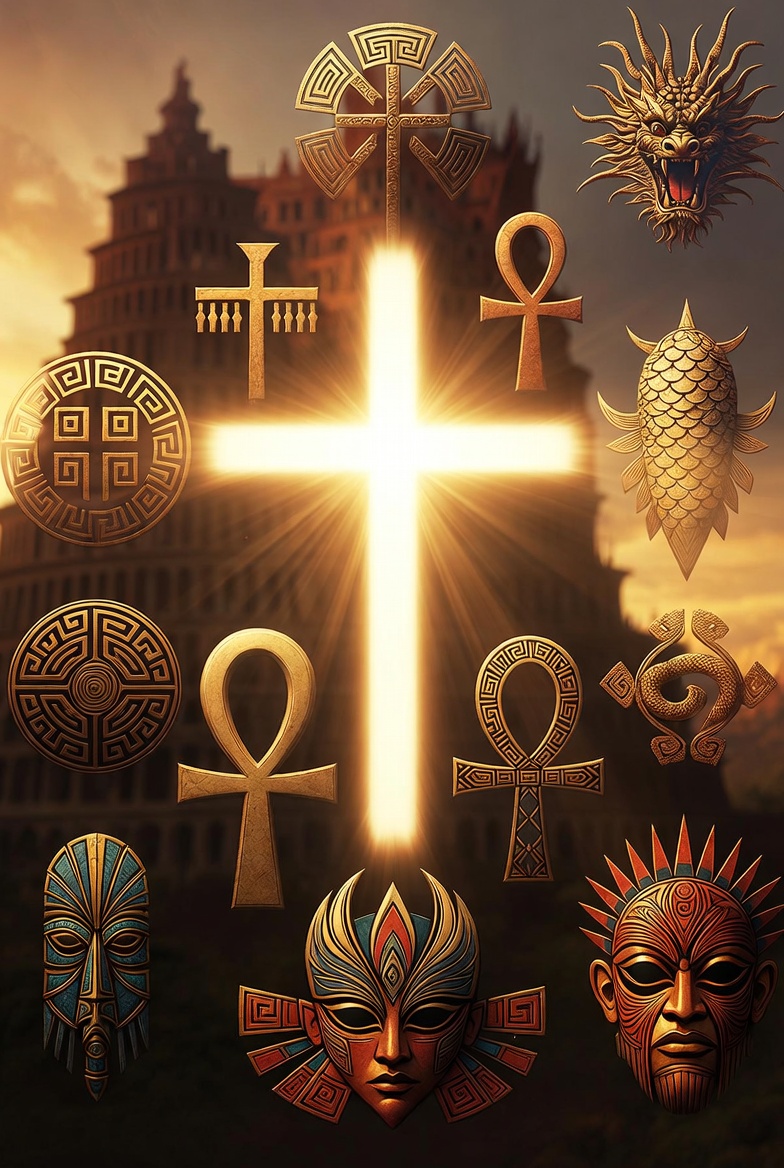
In studying shadows of Messiah, one sees that Christ is the Creator (John 1:1-3; Colossians 1:16-71). All of creation bears His imprint (types, shadows, parables). This includes all of human culture, including the customs of the heathen.
The whole world is full of shadows of Messiah because He made it and sustains it (Colossians 1). Humanity’s cultures bear distorted but recognizable echoes of the truth of the Word. We are not to syncretize, but to recognize the true Light (John 1:9) and be transformed into His image (Romans 8:29; 2 Corinthians 3:18).
All of creation and consequently human culture and religion reveals shadows of Messiah. Yet, mixed within some of these customs and beliefs are counterfeits. Images of the counterfeiter Satan, who seeks to be as God/Christ. He seeks to mimic God and deceive man into worship of himself.
“A person who is a good and true Christian should realize that truth belongs to his Lord. Wherever it is found, gathering and acknowledging it even in pagan literature, but rejecting superstitious vanities and deploring and avoiding those who ‘though they knew God did not glorify Him as God’.” {Augustine – On Christian Teaching II.75}
Synchretism
‘Synchretism’ comes from the Latin syncretismus which comes from the Greek συγκρητισμός ‘synkretismos.’ συγκρητισμός ‘synkretismos’ is a combination of σύν ‘syn’ which means together or with, and κεραννύναι ‘kerannynai’ which means to mix or blend.
Mixture points to Babylon (Babel)
Babel is the epitome of the tree of knowledge. It is a mixture. It comes from the root בלל .

This is what the the mark of the beast is. Α counterfeit of the Lord (Isaiah 14:14). A mixture of good and evil. The Mark of God is His Word, His Image. The mark of the beast is his ‘word’, his image. The Tree of Life vs. the tree of knowledge of good and evil.
This is the definition of Babel of which we are admonished to come out of (Revelation 18:4). Babel = mixture in Hebrew. To the Sumerians Babel meant Gate of God or Gate to God. This points to a false ladder to heaven seen by Jacob and referenced by Messiah Jesus. The is where Jacob anointed the pillar. The word Messiah, or anointed one, further explains this concept. The Hebrew word for Messiah is משיח ‘moshiach’ from משח ‘mashach’ which is referring to oil being smeared onto the heads of individuals who are selected as authority figures. The word Babel comes from the root בל ‘bal’ which is also the root for בלל ‘balal’ which means to mix, mingle, to anoint.
Another word translated from Hebrew into the English word anoint is יסך ‘yasak’ which comes from the root צק ‘tsaq’ which means an image, as in molten metal poured into a mold to form a cast object. Here, in the word anoint, is seen the message of the Bible. There are two anointed ones/messiahs/christs that man can choose from, just as there were two trees in the Garden to choose from. Which Messiah one chooses determines what image that person will be formed into. Which image one is formed into determines eternity. Formed into the image of Christ Jesus unto eternal life, or formed into the image of the beast unto eternal damnation.
The two trees also point to the parable for which this section is based upon, the tares and the wheat. The good seed represents the Tree of Life, the tares represent the tree of knowledge.
Mat 13:37 And answering, He said to them, The One sowing the good seed is the Son of Man.
Mat 13:38 And the field is the world; and the good seed, these are the sons of the kingdom; but the darnel are the sons of the evil one.
Mat 13:39 And the hostile one who sowed them is the Devil, and the harvest is the end of the age, and the angels are the reapers.
Mat 13:40 Then as the darnel is gathered and is consumed in the fire, so it will be in the completion of this age.
Mat 13:41 The Son of Man will send forth His angels, and they will gather out of His kingdom all the offenses, and those who practice lawlessness.
Mat 13:42 And they will throw them into the furnace of fire; there will be weeping and gnashing of the teeth.
Mat 13:43 Then the righteous will shine out like the sun in the kingdom of their Father. The one having ears to hear, let him hear.
Cretes
Some believe συγκρητισμός ‘synkretismos’ is a combination of σύν ‘syn’ which means together or with and krētizein which means the Cretes/Cretans.
Tit 1:12 One of themselves, even a prophet of their own, said, The Cretians are alway liars, evil beasts, slow bellies.
George Haydock Catholic Bible Commentary
Titus 1:12
One of them, a prophet of their own.[9] He does not mean a true prophet, but as the pretended prophets of Baal were called prophets. St. Paul understands Epimenides, a poet of Crete, who by some pagan authors was thought to know things to come; but Aristotle says, he knew only things past, not to come. The ill character he gave of the Cretians was, that they were always liars, evil beasts, slothful bellies, addicted to idleness and sensual pleasures.
Vincent Word Studies
One of themselves (τις ἐξ αὐτῶν)
Ἁυτῶν refers to the gainsayers, Tit_1:9, Tit_1:10. Τις refers to Epimenides, contemporary with Solon, and born in Crete b.c. 659. A legend relates that, going by his father’s order in search of a sheep, he lay down in a cave, where he fell asleep and slept for fifty years. He then appeared with long hair and a flowing beard, and with an astonishing knowledge of medicine and natural history. It was said that he had the power of sending his soul out of his body and recalling it at pleasure, and that he had familiar intercourse with the gods and possessed the power of prophecy. He was sent for to Athens at the request of the inhabitants, in order to pave the way for the legislation of Solon by purifications and propitiatory sacrifices, intended to allay the feuds and party discussions which prevailed in the city. In return for his services he refused the Athenians’ offers of wealth and public honors, and asked only a branch of the sacred olive, and a decree of perpetual friendship between Athens and his native city. He is said to have lived to the age of 157 years, and divine honors were paid him by the Cretans after his death. He composed a Theogony, and poems concerning religious mysteries. He wrote also a poem on the Argonautic Expedition, and other works. Jerome mentions his treatise On Oracles and Responses, from which the quotation in this verse is supposed to have been taken. According to Diogenes Laertius (i. 10) Epimenides, in order to remove a pestilence from Athens, turned some sheep loose at the Areopagus, and wherever they lay down sacrificed to the proper God: whence, he says, there are still to be found, in different demes of the Athenians, anonymous altars. Comp. Act_17:22, Act_17:23.
Robertson Word Pictures
Titus 1:12
A prophet of their own (idios autōn prophētēs). “Their own prophet.” Self-styled “prophet” (or poet), and so accepted by the Cretans and by Cicero and Apuleius, that is Epimenides who was born in Crete at Cnossos. It is a hexameter line and Callimachus quoted the first part of it in a Hymn to Zeus. It is said that Epimenides suggested to the Athenians the erection of statues to “unknown gods” (Act_17:23).
Paul used this “Unknown God” understanding of Epimenides to teach of the true God.
Act 17:23 For as I passed by, and beheld your devotions, I found an altar with this inscription, TO THE UNKNOWN GOD. Whom therefore ye ignorantly worship, him declare I unto you.
Eternity in Their Hearts – Don Richardson pg 22
“Was the God whom Paul proclaimed really a foreign god as the philosopher’s surmised? Not at all! By Paul’s reasoning, Yahweh, the Judeo-Christian God, was anticipated by Epimenides’ altar. He was therefore a God who had already intervened in the history of Athens.”
God allotted to the heathen their false worship (Deuteronomy 4:19; Romans 1:18-23). They knew God but corrupted Him into a false image (Romans 1:21). God allowed them to walk in their own ways (Acts 14:16-17), yet He was still there (Psalm 19:3; Romans 1:19-20).
Act 14:16 Who in times past suffered all nations to walk in their own ways.
Act 14:17 Nevertheless he left not himself without witness, in that he did good, and gave us rain from heaven, and fruitful seasons, filling our hearts with food and gladness.
Paul speaks of the religion of the heathen as “god fearing” and yet they were not walking in truth. God overlooked/winked at their ignorance but calls them to repentance in Christ (Acts 17:22-31).
Act 17:22 Then Paul stood in the midst of Mars’ hill, and said, Ye men of Athens, I perceive that in all things ye are too superstitious {δεισιδαιμονέστερος ‘deisidaimonesteros’ – literally one who fears gods}.
Act 17:23 For as I passed by, and beheld your devotions, I found an altar with this inscription, TO THE UNKNOWN GOD. Whom therefore ye ignorantly worship, him declare I unto you.
Act 17:24 God that made the world and all things therein, seeing that he is Lord of heaven and earth, dwelleth not in temples made with hands;
Act 17:25 Neither is worshipped with men’s hands, as though he needed any thing, seeing he giveth to all life, and breath, and all things;
Act 17:26 And hath made of one blood all nations of men for to dwell on all the face of the earth, and hath determined the times before appointed, and the bounds of their habitation;
Act 17:27 That they should seek the Lord, if haply they might feel after him, and find him, though he be not far from every one of us:
Act 17:28 For in him we live, and move, and have our being; as certain also of your own poets have said, For we are also his offspring.
Act 17:29 Forasmuch then as we are the offspring of God, we ought not to think that the Godhead is like unto gold, or silver, or stone, graven by art and man’s device.
Act 17:30 And the times of this ignorance God winked at; but now commandeth all men every where to repent:
Act 17:31 Because he hath appointed a day, in the which he will judge the world in righteousness by that man whom he hath ordained; whereof he hath given assurance unto all men, in that he hath raised him from the dead.
Paul speaks of those who knew God but worshiped creation in Romans 1. In Romans 2 he warns believers not to judge but to see how the goodness of God leads to repentance. The heathen had “general revelation.” The Jews had “special revelation.” All have fallen short (Romans 3:23). All must repent and receive the grace of God given through Christ.
Rom 2:1 Therefore thou art inexcusable, O man, whosoever thou art that judgest: for wherein thou judgest another, thou condemnest thyself; for thou that judgest doest the same things.
Rom 2:2 But we are sure that the judgment of God is according to truth against them which commit such things.
Rom 2:3 And thinkest thou this, O man, that judgest them which do such things, and doest the same, that thou shalt escape the judgment of God?
Rom 2:4 Or despisest thou the riches of his goodness and forbearance and longsuffering; not knowing that the goodness of God leadeth thee to repentance?
Rom 2:5 But after thy hardness and impenitent heart treasurest up unto thyself wrath against the day of wrath and revelation of the righteous judgment of God;
Rom 2:6 Who will render to every man according to his deeds:
Rom 2:7 To them who by patient continuance in well doing seek for glory and honour and immortality, eternal life:
Rom 2:8 But unto them that are contentious, and do not obey the truth, but obey unrighteousness, indignation and wrath,
Rom 2:9 Tribulation and anguish, upon every soul of man that doeth evil, of the Jew first, and also of the Gentile;
Rom 2:10 But glory, honour, and peace, to every man that worketh good, to the Jew first, and also to the Gentile:
Rom 2:11 For there is no respect of persons with God.
Rom 2:12 For as many as have sinned without law shall also perish without law: and as many as have sinned in the law shall be judged by the law;
Rom 2:13 (For not the hearers of the law are just before God, but the doers of the law shall be justified.
Rom 2:14 For when the Gentiles, which have not the law, do by nature the things contained in the law, these, having not the law, are a law unto themselves:
Rom 2:15 Which shew the work of the law written in their hearts, their conscience also bearing witness, and their thoughts the mean while accusing or else excusing one another;)
Rom 2:16 In the day when God shall judge the secrets of men by Jesus Christ according to my gospel.
Rom 2:17 Behold, thou art called a Jew, and restest in the law, and makest thy boast of God,
Rom 2:18 And knowest his will, and approvest the things that are more excellent, being instructed out of the law;
Rom 2:19 And art confident that thou thyself art a guide of the blind, a light of them which are in darkness,
Rom 2:20 An instructor of the foolish, a teacher of babes, which hast the form of knowledge and of the truth in the law.
Rom 2:21 Thou therefore which teachest another, teachest thou not thyself? thou that preachest a man should not steal, dost thou steal?
Rom 2:22 Thou that sayest a man should not commit adultery, dost thou commit adultery? thou that abhorrest idols, dost thou commit sacrilege?
Rom 2:23 Thou that makest thy boast of the law, through breaking the law dishonourest thou God?
Rom 2:24 For the name of God is blasphemed among the Gentiles through you, as it is written.
Rom 2:25 For circumcision verily profiteth, if thou keep the law: but if thou be a breaker of the law, thy circumcision is made uncircumcision.
Rom 2:26 Therefore if the uncircumcision keep the righteousness of the law, shall not his uncircumcision be counted for circumcision?
Rom 2:27 And shall not uncircumcision which is by nature, if it fulfil the law, judge thee, who by the letter and circumcision dost transgress the law?
Rom 2:28 For he is not a Jew, which is one outwardly; neither is that circumcision, which is outward in the flesh:
Rom 2:29 But he is a Jew, which is one inwardly; and circumcision is that of the heart, in the spirit, and not in the letter; whose praise is not of men, but of God.
Tit 2:11 For the grace of God that bringeth salvation hath appeared to all men,
Tit 2:12 Teaching us that, denying ungodliness and worldly lusts, we should live soberly, righteously, and godly, in this present world;
Tit 2:13 Looking for that blessed hope, and the glorious appearing of the great God and our Saviour Jesus Christ;
Tit 2:14 Who gave himself for us, that he might redeem us from all iniquity, and purify unto himself a peculiar people, zealous of good works.
The Earth is the Lord’s and the Fullness Thereof
Psa 24:1 A Psalm of David. The earth is the LORD’S, and the fulness thereof; the world, and they that dwell therein.
Deu 10:14 Behold, the heaven and the heaven of heavens is the LORD’S thy God, the earth also, with all that therein is.
1Co 10:26 For the earth is the Lord’s, and the fulness thereof.
All of creation points to Christ, yet we are not to syncretize with the false and offer it to God.
1Co 10:1 Moreover, brethren, I would not that ye should be ignorant, how that all our fathers were under the cloud, and all passed through the sea;
1Co 10:2 And were all baptized unto Moses in the cloud and in the sea;
1Co 10:3 And did all eat the same spiritual meat;
1Co 10:4 And did all drink the same spiritual drink: for they drank of that spiritual Rock that followed them: and that Rock was Christ.
1Co 10:5 But with many of them God was not well pleased: for they were overthrown in the wilderness.
1Co 10:6 Now these things were our examples, to the intent we should not lust after evil things, as they also lusted.
1Co 10:7 Neither be ye idolaters, as were some of them; as it is written, The people sat down to eat and drink, and rose up to play.
1Co 10:8 Neither let us commit fornication, as some of them committed, and fell in one day three and twenty thousand.
1Co 10:9 Neither let us tempt Christ, as some of them also tempted, and were destroyed of serpents.
1Co 10:10 Neither murmur ye, as some of them also murmured, and were destroyed of the destroyer.
1Co 10:11 Now all these things happened unto them for ensamples: and they are written for our admonition, upon whom the ends of the world are come.
1Co 10:12 Wherefore let him that thinketh he standeth take heed lest he fall.
1Co 10:13 There hath no temptation taken you but such as is common to man: but God is faithful, who will not suffer you to be tempted above that ye are able; but will with the temptation also make a way to escape, that ye may be able to bear it.
1Co 10:14 Wherefore, my dearly beloved, flee from idolatry.
1Co 10:15 I speak as to wise men; judge ye what I say.
1Co 10:16 The cup of blessing which we bless, is it not the communion of the blood of Christ? The bread which we break, is it not the communion of the body of Christ?
1Co 10:17 For we being many are one bread, and one body: for we are all partakers of that one bread.
1Co 10:18 Behold Israel after the flesh: are not they which eat of the sacrifices partakers of the altar?
1Co 10:19 What say I then? that the idol is any thing, or that which is offered in sacrifice to idols is any thing?
1Co 10:20 But I say, that the things which the Gentiles sacrifice, they sacrifice to devils, and not to God: and I would not that ye should have fellowship with devils.
1Co 10:21 Ye cannot drink the cup of the Lord, and the cup of devils: ye cannot be partakers of the Lord’s table, and of the table of devils.
1Co 10:22 Do we provoke the Lord to jealousy? are we stronger than he?
1Co 10:23 All things are lawful for me, but all things are not expedient: all things are lawful for me, but all things edify not.
1Co 10:24 Let no man seek his own, but every man another’s wealth.
1Co 10:25 Whatsoever is sold in the shambles, that eat, asking no question for conscience sake:
1Co 10:26 For the earth is the Lord’s, and the fulness thereof.
1Co 10:27 If any of them that believe not bid you to a feast, and ye be disposed to go; whatsoever is set before you, eat, asking no question for conscience sake.
1Co 10:28 But if any man say unto you, This is offered in sacrifice unto idols, eat not for his sake that shewed it, and for conscience sake: for the earth is the Lord’s, and the fulness thereof:
1Co 10:29 Conscience, I say, not thine own, but of the other: for why is my liberty judged of another man’s conscience?
1Co 10:30 For if I by grace be a partaker, why am I evil spoken of for that for which I give thanks?
1Co 10:31 Whether therefore ye eat, or drink, or whatsoever ye do, do all to the glory of God.
1Co 10:32 Give none offence, neither to the Jews, nor to the Gentiles, nor to the church of God:
1Co 10:33 Even as I please all men in all things, not seeking mine own profit, but the profit of many, that they may be saved.
Idolatry is nothing, yet we are to take heed lest our understanding of this causes a stumbling block to others.
1Co 8:1 Now as touching things offered unto idols, we know that we all have knowledge. Knowledge puffeth up, but charity edifieth.
1Co 8:2 And if any man think that he knoweth any thing, he knoweth nothing yet as he ought to know.
1Co 8:3 But if any man love God, the same is known of him.
1Co 8:4 As concerning therefore the eating of those things that are offered in sacrifice unto idols, we know that an idol is nothing in the world, and that there is none other God but one.
1Co 8:5 For though there be that are called gods, whether in heaven or in earth, (as there be gods many, and lords many,)
1Co 8:6 But to us there is but one God, the Father, of whom are all things, and we in him; and one Lord Jesus Christ, by whom are all things, and we by him.
1Co 8:7 Howbeit there is not in every man that knowledge: for some with conscience of the idol unto this hour eat it as a thing offered unto an idol; and their conscience being weak is defiled.
1Co 8:8 But meat commendeth us not to God: for neither, if we eat, are we the better; neither, if we eat not, are we the worse.
1Co 8:9 But take heed lest by any means this liberty of yours become a stumblingblock to them that are weak.
1Co 8:10 For if any man see thee which hast knowledge sit at meat in the idol’s temple, shall not the conscience of him which is weak be emboldened to eat those things which are offered to idols;
1Co 8:11 And through thy knowledge shall the weak brother perish, for whom Christ died?
1Co 8:12 But when ye sin so against the brethren, and wound their weak conscience, ye sin against Christ.
1Co 8:13 Wherefore, if meat make my brother to offend, I will eat no flesh while the world standeth, lest I make my brother to offend.
We are not to worship the LORD as the heathen worship their gods(Jeremiah 10:2; Leviticus 18:3; 20:23; Deuteronomy 12:30-32; 13:1-5; 18:9; Ezekiel 20:32; 2 Corinthians 6:14-18; 1 Corinthians 10:6-7; Ephesians 4:17-18), however discernment and wisdom must be applied to this principle lest we become enchained by perverted hearts.
Tit 1:14 Not giving heed to Jewish fables, and commandments of men, that turn from the truth.
Tit 1:15 Unto the pure all things are pure: but unto them that are defiled and unbelieving is nothing pure; but even their mind and conscience is defiled.
Tit 1:16 They profess that they know God; but in works they deny him, being abominable, and disobedient, and unto every good work reprobate.
The Devouring Lion
1Pe 5:8 Be sober, be vigilant; because your adversary the devil, as a roaring lion, walketh about, seeking whom he may devour:
The Bible says Satan is a roaring lion, seeking to devour. However, he can only do so by permission from God (Luke 22:31-32; Job 1:8-12; 2:3-6; 42:10-11). In context of the subject of syncretism, he can deceive man into embracing things displeasing to God but also deceive man into becoming so superstitious about perceived idolatry that they can lose their love for their fellow man and become judgmental to the point of their own damnation (Romans 2).
“To all my brothers and sisters in Christ who feel that finding Babylonian origins for present-day customs or practices is of great importance, my advice is to move cautiously in this area, lest we major on minors. If there are things in our lives or churches that are indeed pagan or displeasing to the Lord, they should be dealt with, of course. But in attempting to defuse the confusion of Babylon, we must guard against creating a new “Babylon” of our own making.” {Babylon Connection – Ralph Woodrow pg 32}
When it comes to “pagan parallels” we must use wisdom and discernment lest our desire to walk in the fear of the LORD ends up being superstition.
“To believe there is connection when there is none, is only superstition…by mixing facts and fables together, nearly anything can be made to appear “pagan.” {Babylon Connection? – Ralph Woodrow pg 109}
One of these ways Satan devours is by imitating God and leading man astray. This is seen in 1 Kings 13 where the man of God is sent to deliver a message to King Jeroboam. He was given specific instructions not to eat or drink or to return again by the way in which he came (1 Kings 13:9, 16-17). The man of God was deceived by another prophet with a lying message. This led to the man of God being devoured by a lion. Afterwards the prophet who lied showed remorse, like Judas Iscariot (Matthew 27:4-5) who performed his evil by the influence of Satan (John 13:27).
1Ki 13:11 Now there dwelt an old prophet in Bethel; and his sons came and told him all the works that the man of God had done that day in Bethel: the words which he had spoken unto the king, them they told also to their father.
1Ki 13:12 And their father said unto them, What way went he? For his sons had seen what way the man of God went, which came from Judah.
1Ki 13:13 And he said unto his sons, Saddle me the ass. So they saddled him the ass: and he rode thereon,
1Ki 13:14 And went after the man of God, and found him sitting under an oak: and he said unto him, Art thou the man of God that camest from Judah? And he said, I am.
1Ki 13:15 Then he said unto him, Come home with me, and eat bread.
1Ki 13:16 And he said, I may not return with thee, nor go in with thee: neither will I eat bread nor drink water with thee in this place:
1Ki 13:17 For it was said to me by the word of the LORD, Thou shalt eat no bread nor drink water there, nor turn again to go by the way that thou camest.
1Ki 13:18 He said unto him, I am a prophet also as thou art; and an angel spake unto me by the word of the LORD, saying, Bring him back with thee into thine house, that he may eat bread and drink water. But he lied unto him.
1Ki 13:19 So he went back with him, and did eat bread in his house, and drank water.
1Ki 13:20 And it came to pass, as they sat at the table, that the word of the LORD came unto the prophet that brought him back:
1Ki 13:21 And he cried unto the man of God that came from Judah, saying, Thus saith the LORD, Forasmuch as thou hast disobeyed the mouth of the LORD, and hast not kept the commandment which the LORD thy God commanded thee,
1Ki 13:22 But camest back, and hast eaten bread and drunk water in the place, of the which the LORD did say to thee, Eat no bread, and drink no water; thy carcase shall not come unto the sepulchre of thy fathers.
1Ki 13:23 And it came to pass, after he had eaten bread, and after he had drunk, that he saddled for him the ass, to wit, for the prophet whom he had brought back.
1Ki 13:24 And when he was gone, a lion met him by the way, and slew him: and his carcase was cast in the way, and the ass stood by it, the lion also stood by the carcase.
1Ki 13:25 And, behold, men passed by, and saw the carcase cast in the way, and the lion standing by the carcase: and they came and told it in the city where the old prophet dwelt.
1Ki 13:26 And when the prophet that brought him back from the way heard thereof, he said, It is the man of God, who was disobedient unto the word of the LORD: therefore the LORD hath delivered him unto the lion, which hath torn him, and slain him, according to the word of the LORD, which he spake unto him.
1Ki 13:27 And he spake to his sons, saying, Saddle me the ass. And they saddled him.
1Ki 13:28 And he went and found his carcase cast in the way, and the ass and the lion standing by the carcase: the lion had not eaten the carcase, nor torn the ass.
1Ki 13:29 And the prophet took up the carcase of the man of God, and laid it upon the ass, and brought it back: and the old prophet came to the city, to mourn and to bury him.
1Ki 13:30 And he laid his carcase in his own grave; and they mourned over him, saying, Alas, my brother!
1Ki 13:31 And it came to pass, after he had buried him, that he spake to his sons, saying, When I am dead, then bury me in the sepulchre wherein the man of God is buried; lay my bones beside his bones:
George Haydock Catholic Bible Commentary
1 Kings 13:31
Bones. Septuagint add, “that my bones may be saved along with his.” The conduct and faith of this man would lead us to conclude that he had done wrong, without any malicious design, ver. 18. (Haydock)
Keil & Delitszch
The conduct of the old prophet at Bethel appears so strange, that Josephus and the Chald., and most of the Rabbins and of the earlier commentators both Catholic and Protestant, have regarded him as a false prophet, who tried to lay a trap for the prophet from Judah, in order to counteract the effect of his prophecy upon the king and the people. But this assumption cannot be reconciled with either the divine revelation which came to him at the table, announcing to the Judaean prophet the punishment of his transgression of the commandment of God, and was so speedily fulfilled (1Ki_13:20-24); or with the honour which he paid to the dead man after this punishment had fallen upon him, by burying him in his own grave; and still less with his confirmation of his declaration concerning the altar at Bethel (1Ki_13:29-32). We must therefore follow Ephr. Syr., Theodor., Hengstenberg, and others, and regard the old prophet as a true prophet, who with good intentions, and not “under the influence of human envy” (Thenius), but impelled by the desire to enter into a closer relation to the man of God from Judah and to strengthen himself through his prophetic gifts, urged him to enter his house. The fact that he made use of sinful means in order to make more sure of securing the end desired, namely, of the false pretence that he had been directed by an angel to do this, may be explained, as Hengstenberg suggests (Dissert. vol. ii. p. 149), on the ground that when Jeroboam introduced his innovations, he had sinned by keeping silence, and that the appearance of the Judaean prophet had brought him to a consciousness of this sin, so that he had been seized with shame on account of his fall, and was anxious to restore himself to honour in his own eyes and those of others by intercourse with this witness to the truth. But however little the lie itself can be excused or justified, we must not attribute to him alone the consequences by which the lie was followed in the case of the Judaean prophet. For whilst he chose reprehensible means of accomplishing what appeared to be a good end, namely, to raise himself again by intercourse with a true prophet, and had no wish to injure the other in any way, the Judaean prophet allowed himself to be seduced to a transgression of the clear and definite prohibition of God simply by the sensual desire for bodily invigoration by meat and drink, and had failed to consider that the divine revelation which he had received could not be repealed by a pretended revelation from an angel, because the word of God does not contradict itself. He was therefore obliged to listen to a true revelation from God from the moth of the man whose pretended revelation from an angel he had too carelessly believed, namely, to the announcement of punishment for his disobedience towards the commandment of God, which punishment he immediately afterwards endured, “for the destruction of the flesh, but for the preservation of the spirit: 1Co_15:5” (Berleb. Bible). That the punishment fell upon him alone and not upon the old prophet of Bethel also, and that for apparently a smaller crime, may be accounted for “not so much from the fact that the old prophet had lied with a good intention (this might hold good of the other also), as from the fact that it was needful to deal strictly with the man who had just received a great and holy commission from the Lord” (O. v. Gerlach). It is true that no bodily punishment fell upon the old prophet, but this punishment he received instead, that with his lie he was put to shame, and that his conscience must have accused him of having occasioned the death of the man of God from Judah. He was thereby to be cured of his weakness, that he might give honour to the truth of the testimony of God. “Thus did the wondrous providence of God know how to direct all things most gloriously, so that the bodily destruction of the one contributed to the spiritual and eternal preservation of the soul of the other” (Berleb. Bible). – Concerning the design of these marvellous events, H. Witsius has the following remarks in his Miscell. ss. i. p. 118 (ed. nov. 1736): “So many wondrous events all occurring in one result caused the prophecy against the altar at Bethel to be preserved in the mouths and memories of all, and the mission of this prophet to become far more illustrious. Thus, although the falsehood of the old man of Bethel brought disgrace upon himself, it injured no one but the man of God whose credulity was too great; and, under the overruling providence of God, it contributed in the most signal manner to the confirmation and publication of the truth.”
Heresies come from the false one, yet they are used to establish the truth.
2Pe 2:1 But there were false prophets also among the people, even as there shall be false teachers among you, who privily shall bring in damnable heresies, even denying the Lord that bought them, and bring upon themselves swift destruction.
1Co 11:19 For there must be also heresies among you, that they which are approved may be made manifest among you.
1Jn 2:19 They went out from us, but they were not of us; for if they had been of us, they would no doubt have continued with us: but they went out, that they might be made manifest that they were not all of us.
2Co 13:5 Examine yourselves, whether ye be in the faith; prove your own selves. Know ye not your own selves, how that Jesus Christ is in you, except ye be reprobates?
2Co 13:6 But I trust that ye shall know that we are not reprobates.
2Co 13:7 Now I pray to God that ye do no evil; not that we should appear approved, but that ye should do that which is honest, though we be as reprobates.
2Co 13:8 For we can do nothing against the truth, but for the truth.
God calls believers out of heresies, out of Babylon.
2Co 6:14 Be ye not unequally yoked together with unbelievers: for what fellowship hath righteousness with unrighteousness? and what communion hath light with darkness?
2Co 6:15 And what concord hath Christ with Belial? or what part hath he that believeth with an infidel?
2Co 6:16 And what agreement hath the temple of God with idols? for ye are the temple of the living God; as God hath said, I will dwell in them, and walk in them; and I will be their God, and they shall be my people.
2Co 6:17 Wherefore come out from among them, and be ye separate, saith the Lord, and touch not the unclean thing; and I will receive you,
2Co 6:18 And will be a Father unto you, and ye shall be my sons and daughters, saith the Lord Almighty.
Rev 18:4 And I heard another voice from heaven, saying, Come out of her, my people, that ye be not partakers of her sins, and that ye receive not of her plagues.
We are not to follow cunningly devised fables that turn away from the truth.
2Ti 4:2 Preach the word; be instant in season, out of season; reprove, rebuke, exhort with all longsuffering and doctrine.
2Ti 4:3 For the time will come when they will not endure sound doctrine; but after their own lusts shall they heap to themselves teachers, having itching ears;
2Ti 4:4 And they shall turn away their ears from the truth, and shall be turned unto fables.
2Pe 1:16 For we have not followed cunningly devised (σοφίζω ‘sophizo’) fables, when we made known unto you the power and coming of our Lord Jesus Christ, but were eyewitnesses of his majesty.
1Ti 1:4 Neither give heed to fables and endless genealogies, which minister questions, rather than godly edifying which is in faith: so do.
G4679
σοφίζω
sophizō
sof-id’-zo
From G4680; to render wise; in a sinister acceptation, to form “sophisms”, that is, continue plausible error: – cunningly devised, make wise.
It is the Word of God that renders one wise unto salvation.
2Ti 3:15 And that from a child thou hast known the holy scriptures, which are able to make thee wise (σοφίζω ‘sophizo’) unto salvation through faith which is in Christ Jesus.
We must beware of philosophy that leads one away from Christ, from the will of God.
Col 2:8 Beware lest any man spoil you through philosophy and vain deceit, after the tradition of men, after the rudiments of the world, and not after Christ.
2Pe 3:17 Ye therefore, beloved, seeing ye know these things before, beware lest ye also, being led away with the error of the wicked, fall from your own stedfastness.
2Pe 3:18 But grow in grace, and in the knowledge of our Lord and Saviour Jesus Christ. To him be glory both now and for ever. Amen.
Col 2:2 That their hearts might be comforted, being knit together in love, and unto all riches of the full assurance of understanding, to the acknowledgement of the mystery of God, and of the Father, and of Christ;
Col 2:3 In whom are hid all the treasures of wisdom and knowledge.
Col 2:4 And this I say, lest any man should beguile you with enticing words.
Col 2:5 For though I be absent in the flesh, yet am I with you in the spirit, joying and beholding your order, and the stedfastness of your faith in Christ.
Col 2:6 As ye have therefore received Christ Jesus the Lord, so walk ye in him:
Col 2:7 Rooted and built up in him, and stablished in the faith, as ye have been taught, abounding therein with thanksgiving.
Col 2:8 Beware lest any man spoil you through philosophy and vain deceit, after the tradition of men, after the rudiments of the world, and not after Christ.
Col 2:9 For in him dwelleth all the fulness of the Godhead bodily.
Col 2:10 And ye are complete in him, which is the head of all principality and power:
Col 2:11 In whom also ye are circumcised with the circumcision made without hands, in putting off the body of the sins of the flesh by the circumcision of Christ:
Col 2:12 Buried with him in baptism, wherein also ye are risen with him through the faith of the operation of God, who hath raised him from the dead.
Col 2:13 And you, being dead in your sins and the uncircumcision of your flesh, hath he quickened together with him, having forgiven you all trespasses;
Col 2:14 Blotting out the handwriting of ordinances that was against us, which was contrary to us, and took it out of the way, nailing it to his cross;
Col 2:15 And having spoiled principalities and powers, he made a shew of them openly, triumphing over them in it.
Col 2:16 Let no man therefore judge you in meat, or in drink, or in respect of an holyday, or of the new moon, or of the sabbath days:
Col 2:17 Which are a shadow of things to come; but the body is of Christ.
Col 2:18 Let no man beguile you of your reward in a voluntary humility and worshipping of angels, intruding into those things which he hath not seen, vainly puffed up by his fleshly mind,
Col 2:19 And not holding the Head, from which all the body by joints and bands having nourishment ministered, and knit together, increaseth with the increase of God.
Col 2:20 Wherefore if ye be dead with Christ from the rudiments of the world, why, as though living in the world, are ye subject to ordinances,
Col 2:21 (Touch not; taste not; handle not;
Col 2:22 Which all are to perish with the using;) after the commandments and doctrines of men?
Col 2:23 Which things have indeed a shew of wisdom in will worship, and humility, and neglecting of the body; not in any honour to the satisfying of the flesh.
There has been a battle since the beginning in regards to types, shadows, and symbols and who and what they mean. In the beginning all things were good (Genesis 1:31). After the fall, sin entered the world (Romans 5:21) and brought forth corruption. Jesus has conquered the devil, sin and death….that which was a symbol of evil in the past has in many cases been “redeemed.” God is the Creator of everything so any object from nature that pagans used in their worship is just a corruption of something God has created. In all of creation there are shadows that point to Christ, hence all of these corrupted pagan symbols ultimately point to Him. This is not to say that we are to embrace the worship of the heathen, this is to show that Christ overcame the way of the heathen at the cross, beginning the restitution of all things.
Act 3:21 Whom the heaven must receive until the times of restitution of all things, which God hath spoken by the mouth of all his holy prophets since the world began.
Restitution comes from the Hebrew word שלם ‘shalam’ which means completion, peace.

Eph 2:1 And you hath he quickened, who were dead in trespasses and sins;
Eph 2:2 Wherein in time past ye walked according to the course of this world, according to the prince of the power of the air, the spirit that now worketh in the children of disobedience:
Eph 2:3 Among whom also we all had our conversation in times past in the lusts of our flesh, fulfilling the desires of the flesh and of the mind; and were by nature the children of wrath, even as others.
Eph 2:4 But God, who is rich in mercy, for his great love wherewith he loved us,
Eph 2:5 Even when we were dead in sins, hath quickened us together with Christ, (by grace ye are saved;)
Eph 2:6 And hath raised us up together, and made us sit together in heavenly places in Christ Jesus:
Eph 2:7 That in the ages to come he might shew the exceeding riches of his grace in his kindness toward us through Christ Jesus.
Eph 2:8 For by grace are ye saved through faith; and that not of yourselves: it is the gift of God:
Eph 2:9 Not of works, lest any man should boast.
Eph 2:10 For we are his workmanship, created in Christ Jesus unto good works, which God hath before ordained that we should walk in them.
Eph 2:11 Wherefore remember, that ye being in time past Gentiles in the flesh, who are called Uncircumcision by that which is called the Circumcision in the flesh made by hands;
Eph 2:12 That at that time ye were without Christ, being aliens from the commonwealth of Israel, and strangers from the covenants of promise, having no hope, and without God in the world:
Eph 2:13 But now in Christ Jesus ye who sometimes were far off are made nigh by the blood of Christ.
Eph 2:14 For he is our peace, who hath made both one, and hath broken down the middle wall of partition between us;
Eph 2:15 Having abolished in his flesh the enmity, even the law of commandments contained in ordinances; for to make in himself of twain one new man, so making peace;
Eph 2:16 And that he might reconcile both unto God in one body by the cross, having slain the enmity thereby:
Eph 2:17 And came and preached peace to you which were afar off, and to them that were nigh.
Eph 2:18 For through him we both have access by one Spirit unto the Father.
Eph 2:19 Now therefore ye are no more strangers and foreigners, but fellowcitizens with the saints, and of the household of God;
Eph 2:20 And are built upon the foundation of the apostles and prophets, Jesus Christ himself being the chief corner stone;
Eph 2:21 In whom all the building fitly framed together groweth unto an holy temple in the Lord:
Eph 2:22 In whom ye also are builded together for an habitation of God through the Spirit.
All religions have some truth which is a gift of grace to all of mankind to draw us back to the Most High (2 Peter 3:9; 1 Timothy 2:4; 4:10).
Shadows of Messiah are seen in all creation which includes man and his holidays. Man was created in the image of God (Genesis 1:26-27). Hence, more than any other part of creation, shadow pictures of Messiah are seen in relation to mankind.
One aspect of man is his religions and religious ceremonies and holidays. As I’ve studied ancient history and religions, a repeating theme is seen. Truth mixed with error. All religions of the world have some truth which traces back to the Holy Scriptures and ultimately the Tree of Life. However, they are mixed with error that reveals that they are producing fruit from the tree of knowledge which is a counterfeit of the Tree of Life. No matter how far removed from the truth a particular religion is, there is still some truth within. A glimmer of light which calls man to His Creator, through Messiah.
“The Savior deals differently with each individual according to his needs…He becomes all things for all people, while always remaining by nature what He is.” Cyril of Jerusalem
All religions have some truth which is a gift of grace to all of mankind to draw us back to the Most High (2 Peter 3:9; 1 Timothy 2:4; 4:10).
The true intent of the law/Word of God is not to make men religious but to reform men into the image of their God who is love (1 John 4:8).
1Jn 4:7 Beloved, let us love one another: for love is of God; and every one that loveth is born of God, and knoweth God.
1Jn 4:8 He that loveth not knoweth not God; for God is love.
Do all of man’s concepts of God point to the Creator? Yes and no. Man has allowed idolatrous ideas of God that get between them and the Creator, yet if one is truly seeking God they are seeking the LORD as there is only one God.
1Ti 2:5 For there is one God, and one mediator between God and men, the man Christ Jesus;
1Co 8:5 For though there be that are called gods, whether in heaven or in earth, (as there be gods many, and lords many,)
1Co 8:6 But to us there is but one God, the Father, of whom are all things, and we in him; and one Lord Jesus Christ, by whom are all things, and we by him.
All religions point to Messiah, albeit they corrupt His Image. Judaism, Islam, Hinduism, Buddhism, the ‘Mythologies’ etc., all have shadows of Messiah. It is not our job to convert one another to each others religions and our conceived perceptions of God (Matthew 23:15). It is our job to seek God’s face and it is through the Holy Spirit that we will be led into truth (John 16:13; 1 John 2:27; 1 Corinthians 2:10). All religions have some truth which is a gift of grace to all of mankind to draw us back to the Most High (2 Peter 3:9; 1 Timothy 2:4; 4:10). As Christians, our job is to walk in truth and be living epistles of the Word (2 Corinthians 3:3). It is through love that mankind will know the truth, not through our doctrine (John 13:35).
The work of the Holy Spirit in the process of purification is to lead us to love (1 Peter 1:22). The goal of the Word of God is to lead us to love (1 Timothy 1:5; Galatians 5:14; 6:2). Love is the fruit which reveals that we are growing in maturity in Messiah (2 Peter 1:5-8). Love is the bond of perfectness (Colossians 3:14). If the writings of other religions have truth and lead the followers thereof into this love then the people of these religions should not be hated but encouraged to continue growing in truth. Ultimately, this will lead them to Jesus as He is the Truth.
Joh 14:6 Jesus saith unto him, I am the way, the truth, and the life: no man cometh unto the Father, but by me.
Eph 4:21 If so be that ye have heard him, and have been taught by him, as the truth is in Jesus:
The Holy Scriptures admonish us to seek the Face of God at all times (1 Chronicles 16:11). Seeking His Face where we appear as a “little guy” in His Eye will cause us to love others as He loves them…
When we look to God, we see what we are. Evil, despicable, unworthy (Romans 3:10-19,23)…but when we look to Him we see His unending love for us in spite of our sinfulness (Ephesians 2:1-7). When we look to our fellow man, our carnal flesh which is full of hate immediately wants to focus on their evils and unworthiness (1 Corinthians 3:1-4; Romans 8:7). However, if we remember that we are just as unworthy of God’s love as them, yet God still grants us His unmerited, unending love, will we not be more likely to do the same to them?
He has forgiven us so let us forgive (Matthew 18:23-35; Ephesians 4:32). He shows us mercy so let us show mercy (2 Samuel 22:36; Luke 6:36). He overlooks our lack of understanding and ignorance so let us do the same with others. Even if the other person accepts not our forgiveness, love and understanding we must remember that we have treated God the same in the past, and even still do today as believers.
In seeking His Face, His Light will shine upon us where we can walk in His name (Numbers 6:24-27). If we seek His face continually (1 Chronicles 16:11), His light will reflect from us to others (2 Corinthians 4:6). Scripture likens seeking the Face of the Lord as looking into a mirror (2 Corinthians 3:18; 1 Corinthians 13:12) in which we now see darkly. As a result, we should abide in faith, hope and love. Most importantly, in love. This love is summed up in the Golden Rule (Matthew 7:12; Luke 6:31).
All religions are based upon this Golden rule of love. Almost everyone in the world follows a religion so why is there so much hate? The problem is that we cannot keep the golden rule by our power or understanding. The Golden rule can only work if we are following by the principle of seeking God’s Face. We can only truly abide by the Golden Rule if we are treating men as we wish God to treat us. We want forgiveness and mercy and grace from God…this then should be given to others. We must love as He loves us (John 13:34; 15:12).
All religions are seeking the Most High. The problem is that religion makes an idol out of the Most High and many times the adversary uses religion to steal worship. This is why all religions have some truth and a lot of their doctrines trace back to the Scriptures (Psalm 22:27). We all came from Adam and then from Noah. Truth permeates through all cultures. Doctrine is not God. God is beyond our attempts to explain Him (Job 11:7; 5:9; 37:23; Psalm 145:3; Isaiah 40:28; Romans 11:33). He is the Word, therefore, the Scriptures are our sole source of ultimate truth, not our our interpretations of the text.
If theology (study of God) & religion leads one to grow in the grace and knowledge of Christ, the image of God who is love, causing one to love God and love their neighbor more then this is great. However, if theology & religion leads one away from love (even in the slightest) then this is at best dung/worthlessness and at worst complete wickedness. If theologians and religious leaders lead us in the former then we should respect and walk with them…if they lead us away from love and teach us to hate others then we should reject them completely.
Christ came to save, not condemn (1 Timothy 1:15; Matthew 9:13; 18:11; Mark 2:17; John 3:17; 12:47). He came to serve in love (John 13:13-17; Ephesians 5:2; 1 Peter 3:18; Philippians 2:5-8), patiently (Romans 15:5; Revelation 1:9) and meekly (Matthew 11:29-30; 2 Corinthians 10:1; 1 Peter 2:23) (not angrily frustratingly forcing His will on others – Matthew 15:14).
In Matthew 15:14, Messiah says to let the Pharisees (representative of believers bound by the religious spirit) alone. In Greek, the word ‘let them alone’ is ἀφίημι ‘aphiēmi’ which also means to forgive (Matthew 6:12, 14-15; 9:6; 18:21 etc). We shouldn’t try to force other believers to see as we see or to follow Messiah as we follow Him. If we can’t come to agreement on an issue, ‘let them alone.’ If they are truly following Him, He will guide them to the truth. If they are walking in blindness they will fall into the ditch where He will be to lift them up (Psalm 37:24; 40:1-2; 50:15; 145:14). He led people to the truth in love, gently and meekly (Ephesians 4:15; Isaiah 42:1-4; Matthew 12:16-20). Hence, we are to work out our own salvation with meekness and fear (Philippians 2:12), preferring others over ourselves (Romans 12:10) and seeking to edify them in love (1 Corinthians 8:1).
The Lord is transforming us from glory to glory by His own power (2 Corinthians 3:18), not by our religious doctrines and movements. It is His job to perfect us and recreate us in His image, not ours (Psalm 57:2; 18:32; 138:8; Ephesians 4:4-13).
Messiah said that the world would know we are His disciples by our love. He did not say they would know us by our understanding of doctrine/theology.
Joh_13:35 By this shall all men know that ye are my disciples, if ye have love one to another.
1Jn 3:10 In this the children of God are manifest, and the children of the devil: whosoever doeth not righteousness is not of God, neither he that loveth not his brother.
1Jn 3:11 For this is the message that ye heard from the beginning, that we should love one another.
When the Lord returns, He will judge us according to our service in love (Matthew 25:31-46). Serving in love is the true path to ‘theology’ or knowing God (Jeremiah 22:16). Scripture declares that love of one’s fellow man is equated with love of God (1 John 4:11-12, 20-21) and is the fulfillment and purpose of His Word (Matthew 22:39-40; Romans 13:8-10; Galatians 6:2). It does not say love of one’s fellow religious counterpart, but of one’s fellow MAN (Galatians 6:10; 1 Thessalonians 5:15; 3 John 1:11), even our enemies (Luke 6:35). This love is manifested in service to one another (Galatians 5:13-14; 6:2; John 13:35; 1 John 3:16-19), in particular the poor and weak amongst us.
Man was created in God’s image (Genesis 1:26-27) but that image was corrupted when Adam sinned. From there man took up the image of Adam which still pointed back to God, but in a corrupted form (Genesis 5:1; 1 Corinthians 15:45-49). Messiah came to earth in the very image of Almighty God (2 Corinthians 4:4; Colossians 1:15; Hebrews 1:3), who is love. His life displayed that love and He calls all those who believe in Him to display that love as well. This is the essence of the concept of ‘Christ in us.’ It is through His love that man is formed into His image (Colossians 3:10; Romans 8:29) where there is no longer Jew or Greek, Barbarian or Scythian but Messiah is all and in all (Colossians 3:11).
This is the message of the Gospel. Love. Love that breaks down the barriers and walls which man has set up to divide (Ephesians 2:1-22; 1 Corinthians 12:13). Love that breaks down the wall of sin which has separated man from God (Isaiah 59:2; John 3:16; 12:32; Isaiah 49:6; Revelation 5:9). This love is revealed in our actions towards our fellow man, not in our intellectual proclamations. All of us see through a glass darkly which keeps us from seeing eye to eye (1 Corinthians 13:12). The only remedy for this is love (1 Corinthians 13:1-13; 1 John 4:7-21). Love and patience towards one another until the Lord returns and His salvation is fully revealed (Isaiah 52:7-10). Love allows man to understand that we can have differences of opinions but ultimately if we abide in love we can dwell in peace and unity (Ephesians 4:2-16, 32; 5:1-2; Colossians 3:9-17).
Eph 4:1 I therefore, the prisoner of the Lord, beseech you that ye walk worthy of the vocation wherewith ye are called,
Eph 4:2 With all lowliness and meekness, with longsuffering, forbearing one another in love;
Eph 4:3 Endeavouring to keep the unity of the Spirit in the bond of peace.
Eph 4:4 There is one body, and one Spirit, even as ye are called in one hope of your calling;
Eph 4:5 One Lord, one faith, one baptism,
Eph 4:6 One God and Father of all, who is above all, and through all, and in you all.
The true intent of the law/Word of God is not to make men religious but to reform men into the image of their God who is love (1 John 4:8). It is this love that unites us and perfects us. It is the bond of perfection (Colossians 3:14) which sets man free (Galatians 5:13-14). This love is not intended only for a certain group of religious people, but for all mankind. Scripture declares that in the Messiah shall the ‘gentiles trust’ (Matthew 12:21; Romans 15:8-12; Isaiah 11:10). For Jesus is the true Light which enlightens every man (John 1:9; 12:44-46; Isaiah 49:6), sent to restore all of mankind back to God (Isaiah 45:22; Romans 3:29; John 1:12; 3:15-17).
The message of Jesus is universal. It transcends religions, ethnic or cultural barriers. It is a message of love and reconciliation back to God. The message of victory over death which entered into the world when Adam and Eve partook of the fruit of the tree of knowledge (Romans 5:12-21; 1 Corinthians 15:45-48; 55-56. This message of forgiveness and restoration is not just for Israel, but whosoever shall believe in the Lord Jesus.
John 3:15 That whosoever believeth in him should not perish, but have eternal life.
John 3:16 For God so loved the world, that he gave his only begotten Son, that whosoever believeth in him should not perish, but have everlasting life.
John 3:17 For God sent not his Son into the world to condemn the world; but that the world through him might be saved.
Jesus did not play religion. He reached out the sick, the blind, the deaf, the adulterer, the sinner and the tax-collector. Those who knew they needed Him (Matthew 9:12; Mark 2:17; Luke 9:11). Those who saw how helpless they were without Him. This is what true religion is (James 1:26-27; Proverbs 21:3; Isaiah 1:17; Hosea 6:6; Micah 6:8; Matthew 9:13; Mark 12:33), not doctrine, but acts of love towards one another (John 13:35; 1 John 3:17; 4:12, 20-21).
This concept of love is found in every religion, it is the commonality which points back to Jesus who is the epitome of God’s love (John 3:16; 1 John 4:8-16). It is not doctrine which leads others to the truth. It is the love of God within us. ‘Christ in you, the hope of glory’ (Colossians 1:27).
Colossians 3:10 And have put on the new man, which is renewed in knowledge after the image of him that created him:
Colossians 3:11 Where there is neither Greek nor Jew, circumcision nor uncircumcision, Barbarian, Scythian, bond nor free: but Christ is all, and in all.
Colossians 3:12 Put on therefore, as the elect of God, holy and beloved, bowels of mercies, kindness, humbleness of mind, meekness, longsuffering;
Colossians 3:13 Forbearing one another, and forgiving one another, if any man have a quarrel against any: even as Christ forgave you, so also do ye.
Colossians 3:14 And above all these things put on charity, which is the bond of perfectness.
Colossians 3:15 And let the peace of God rule in your hearts, to the which also ye are called in one body; and be ye thankful.
Colossians 3:16 Let the word of Christ dwell in you richly in all wisdom; teaching and admonishing one another in psalms and hymns and spiritual songs, singing with grace in your hearts to the Lord.
Colossians 3:17 And whatsoever ye do in word or deed, do all in the name of the Lord Jesus, giving thanks to God and the Father by him.
Scripture declares that love of one’s fellow man is equated with love of God (1 John 4:11-12, 20-21) and is the fulfillment and purpose of His Word (Matthew 22:39-40; Romans 13:8-10; Galatians 6:2). It does not say love of one’s fellow religious counterpart, but of one’s fellow MAN (Galatians 6:10; 1 Thessalonians 5:15; 3 John 1:11), even our enemies (Luke 6:35).
The Scriptures and ancient belief, indicate that the Word equates with the physical manifestation of the Most High in His creation. Whether it be the Word of God, which is His “autobiography”, a physical manifestation of the Eternal or whether it be Jesus who is the Word made flesh.
The Word of God was committed to Israel, who was called to bring forth God’s glory/love to the world. Instead, Israel fell into idolatry and was cast into the nations. Judah was cast into Babylon but by God’s grace was allowed to return to the land with another opportunity to bring forth God’s message of love to the nations. Instead, Judah chose to form a religion which corrupted the message of God’s Word and instead of man being formed into His image, they were to be formed into the image of Judaism.
The fruit which Israel was called to produce was the ‘goodly’ fruit of His Word (Jeremiah 11:16). However, Israel did not produce this fruit but brought forth wicked fruit (Jeremiah 24:2-8). As a result, God brought fire upon this olive tree, breaking the branches thereof (Jeremiah 11:16-17).
The Hebrew word for ‘goodly’ in Jeremiah 11:16 is תאר ‘toar’ which means a shape, form, outline or figure of a thing. תאר ‘toar’ is a cognate of the word תורה ‘torah’ which literally means instruction which defines the border of a people or the ‘image’ of a people. תורה ‘torah’ is most commonly translated as ‘law.’ Here we see that Israel was to produce the fruit of His Law which would bring forth His image to the world. His Image is that of love (1John 4:8, 16; Matthew 22:35-40).
Israel did not bring forth this image of love (Luke 7:36-47; 10:27-37; 18:9-14). Although they were zealous for the law (Acts 21:20; 22:3), in their zealousness they corrupted its true meaning (Romans 10:2). They were outwardly religious, yet inwardly full of wickedness (Luke 11:39; 16:15; 20:47; Matthew 6:2-5, 16; 23:5, 25-27). They separated themselves from the peoples of the world, declaring anyone who didn’t worship God according to their traditions as an unclean heathen (John 4:9; 8:48; Acts 10:28).
By their traditions they had put up a dividing wall between themselves and others (Acts 21:28; Ephesians 2:14-15), preventing them from drawing nearer to God (Luke 11:52) as Israel was the custodians of His Word (Romans 3:2; John 4:22) which reveals His nature to mankind. It was their traditions which corrupted the Word of God (Matthew 15:2-9; Mark 7:3-13; Colossians 2:8) and perverted the message of His love to mankind, which led Jesus Christ to declare them as lawless (Matthew 23:28; John 7:19). It is because of this lack of love (Matthew 5:22; John 15:25) that the Lord was sent to Israel to separate the good trees from the bad (Malachi 3:2-3; 4:1; Matthew 3:10-12; Luke 3:9; John 15:2).
The religion which was set up by the leaders of Israel became known as the tradition of the elders (Matthew 15:3). These traditions were a set of guidelines which the nation was to follow. In and of itself this is not a negative thing but the problem is that the people exalted their traditions above the Word of God. As a result, this religiosity became in reality, lawlessness (John 7:19; Matthew 23:28; Galatians 6:13). The religious leaders of the second Temple were outwardly religious but inwardly were full of lawlessness (Luke 11:39; 16:15; 20:47; Matthew 6:2-5, 16; 23:5, 25-27; John 7:19; Matthew 23:28; Galatians 6:13). Ultimately, this led to their destruction (John 15:25).
Sadly, this same thing religious spirit is seen in many religious believers today. We who have been given a taste of heaven, ought not act in such a manner (Hebrews 6:4). We should be bearing the fruit of love and mercy and forgiveness (John 15:1-10; Galatians 5:22-23; Philippians 1:11), not the thorns and briars of hatred and condemnation (Hebrews 6:8; Luke 13:7-9).
The inheritance was taken away from the bad trees and given to a nation that would produce the fruit of love which the Lord desires (Matthew 21:33-46; Mark 12:1-12; 1 Peter 2:4-9; Galatians 3:1-29). Believers in Christ became a ‘reformed’ Olive tree and were given the call to abide in Him (Hebrews 3:1-6), being formed into His image (Philippians 3:14-15; Ephesians 1:1-6; 1:17-23), bearing forth His fruit (2 Peter 1:5-9), called to bring forth God’s Gospel of love to the world (2 Timothy 1:9-11), revealing His image (2 Thessalonians 1:11-12).
The Greek word for ‘calling is κλῆσις ‘klēsis’ which is used in the Septuagint to translate the Hebrew word קרא ‘qara’ which is associated with manifesting God’s name/image on earth.
Messiah said that the all of the Law and Prophets hang upon the Golden Rule (Matthew 7:12; 22:40). Paul says that the entire law is based upon this principle (Galatians 5:14). By applying the concept of seeking His Face, this is seen. A proper fulfillment of the Golden rule depends upon what man is seeking. God or religion/idols. Idolatry and religion lead to hate (John 15:21-25; Hosea 9:7-8), this is why there is so much hate in the world. If we are not walking in love, we are not walking with God (1 John 4:8).
Hatred for our fellow man is indicative that we are not seeking the Face of God as man was created in God’s image (1 John 4:20-21; James 3:9). Hate is indicative that we are walking in the carnal flesh which is at war with God (Romans 8:7; Galatians 5:19-21). Hate in one’s heart reveals a spiritual blindness (1 John 2:9-11) which is caused in many cases by religion (John 9:41; 15:21-25; 2 Corinthians 4:4; Isaiah 44:18; 6:9-10; Matthew 13:13-15; 15:7-14).
When we seek the Face of God at all times we can overcome the hate for others caused by fear and ignorance (1 John 4:18; Romans 8:15, 31-39; Psalm 118:6; Hebrews 13:6). When we seek the Face of God we can love our enemies and show them mercy as He does (Matthew 5:43-48; Luke 6:27-36; Romans 12:14-21; 1 Peter 3:8-15; Ephesians 2:2-22). When we seek God’s face we can see those of other understandings of God and love them as He does.
This is the essence of being a “little guy in the Eye”. Love. Walking in close relationship with God who is love (1 John 4:8) and extending that love to our fellow man (1 John 4:12). Its not about religion or doctrine, its about relationship with the Most High. Each one of us must work out our own salvation with fear and trembling as God works through us according to His good pleasure (Philippians 2:12-13). If we keep focused on Him and not on religion He will be able to transform us from glory to glory (2 Corinthians 3:18) until we are formed into the image of His Son (Romans 8:29).
Joh 17:21 That they all may be one; as thou, Father, art in me, and I in thee, that they also may be one in us: that the world may believe that thou hast sent me.
Joh 17:22 And the glory which thou gavest me I have given them; that they may be one, even as we are one:
Joh 17:23 I in them, and thou in me, that they may be made perfect in one; and that the world may know that thou hast sent me, and hast loved them, as thou hast loved me.
“The Savior deals differently with each individual according to his needs…He becomes all things for all people, while always remaining by nature what He is.” Cyril of Jerusalem
1Co 9:19 For though I be free from all men, yet have I made myself servant unto all, that I might gain the more.
1Co 9:20 And unto the Jews I became as a Jew, that I might gain the Jews; to them that are under the law, as under the law, that I might gain them that are under the law;
1Co 9:21 To them that are without law, as without law, (being not without law to God, but under the law to Christ,) that I might gain them that are without law.
1Co 9:22 To the weak became I as weak, that I might gain the weak: I am made all things to all men, that I might by all means save some.
1Co 9:23 And this I do for the gospel’s sake, that I might be partaker thereof with you.
1Co 9:24 Know ye not that they which run in a race run all, but one receiveth the prize? So run, that ye may obtain.
1Co 9:25 And every man that striveth for the mastery is temperate in all things. Now they do it to obtain a corruptible crown; but we an incorruptible.
1Co 9:26 I therefore so run, not as uncertainly; so fight I, not as one that beateth the air:
1Co 9:27 But I keep under my body, and bring it into subjection: lest that by any means, when I have preached to others, I myself should be a castaway.
1Co 10:31 Whether therefore ye eat, or drink, or whatsoever ye do, do all to the glory of God.
1Co 10:32 Give none offence, neither to the Jews, nor to the Gentiles, nor to the church of God:
1Co 10:33 Even as I please all men in all things, not seeking mine own profit, but the profit of many, that they may be saved.
Rom 15:2 Let every one of us please his neighbour for his good to edification.
Rom 15:3 For even Christ pleased not himself; but, as it is written, The reproaches of them that reproached thee fell on me.
Christ is the Savior of all
1Ti 4:10 For therefore we both labour and suffer reproach, because we trust in the living God, who is the Saviour of all men, specially of those that believe.
1Ti 2:4 Who will have all men to be saved, and to come unto the knowledge of the truth.
God has put eternity into the hearts of men
Ecc 3:11 He has made everything beautiful in its time. Also, He has set eternity in their heart, without which man cannot find out the work that God makes from the beginning even to the end.
All cultures have stories that trace back to creation, the garden of Eden, the fall of man, the flood and most importantly, redemption and return to the Most High. Many also have stories that trace back to Genesis 6 and the Tower of Babel as well.
ALL flesh seeks God
Psa 65:2 To You who hears prayer, all flesh comes.
Whether is be the ancient Mysteries or Hinduism, Buddhism or the animistic religions…shadows of Messiah are embedded throughout. This displays the wisdom and power of our Creator as well as His unfathomable love for ALL mankind.
Related articles:
Daily Tidbits 1/8/12 – God of All
Daily Tidbits 3/31 – Mixed Multitude of Taberah
Mark of the Beast – the Great Counterfeit
littleguyintheeye@gmail.com


