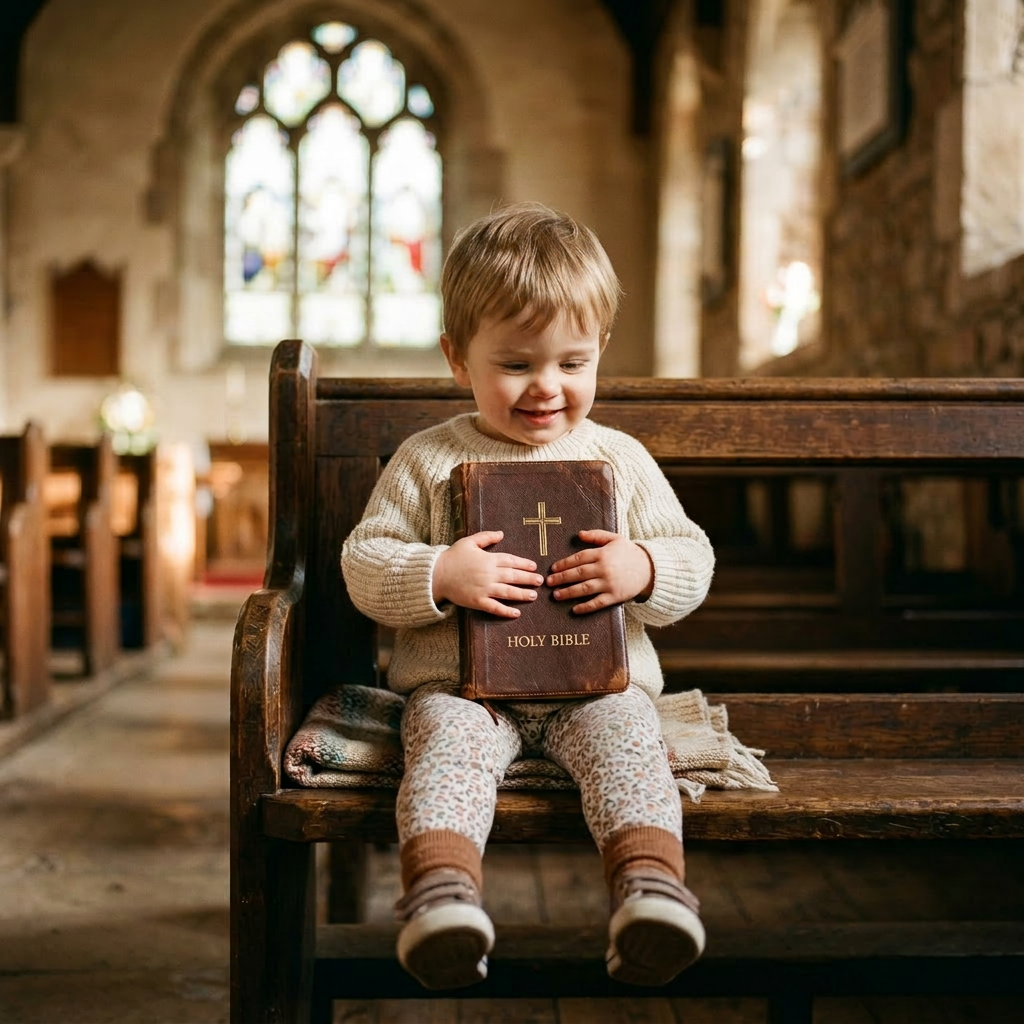

In doing these studies on creation and shadows of Messiah I have found myself much like a toddler. Much like a toddler walking with his/her parent asking “what’s that?”, carefully waiting for the parent to point at an object and define it.
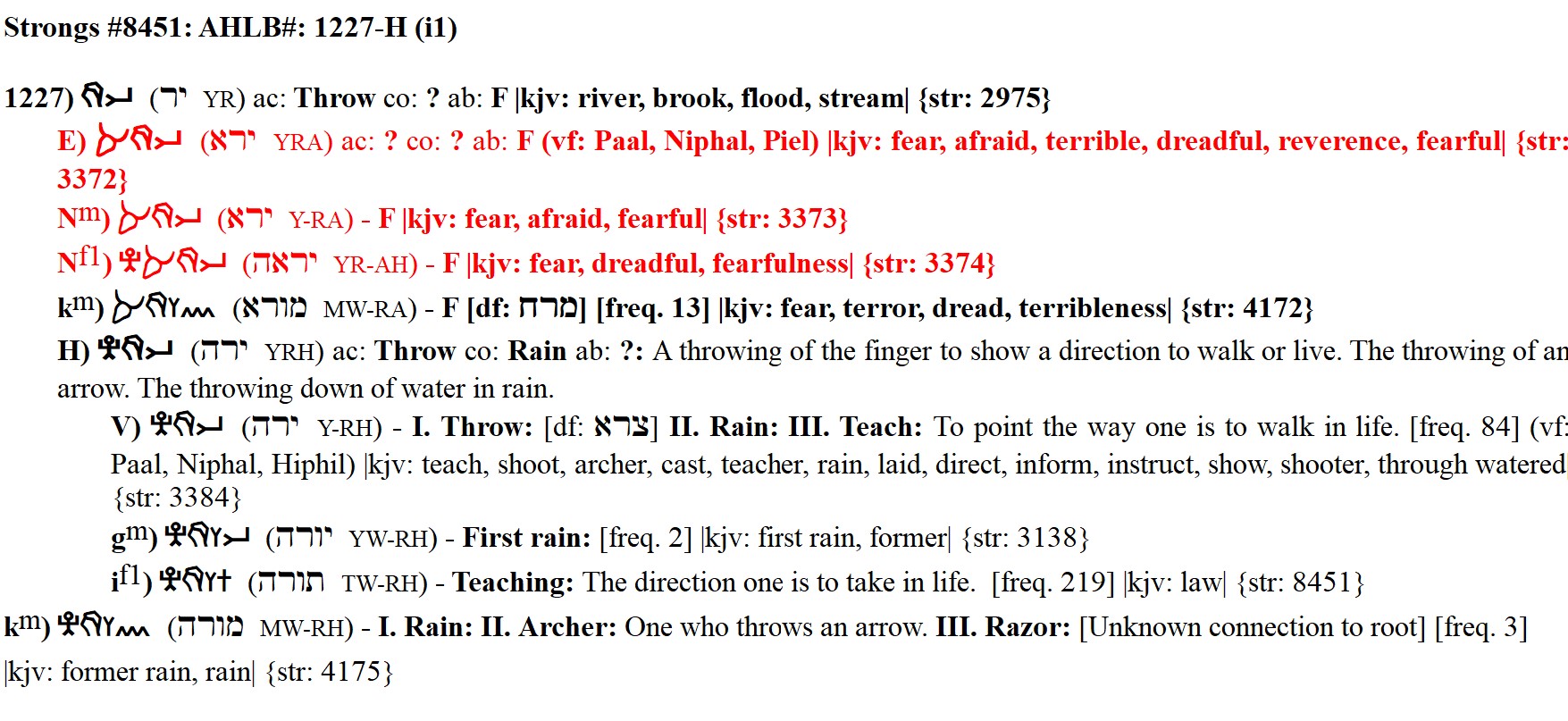
In Hebrew, to teach is יָרָה ‘yarah’ which literally pictures the pointing of the finger. יָרָה ‘yarah’ is a cognate of the Hebrew word תורה ‘torah’ which is usually translated as law but literally means the direction one is to take.
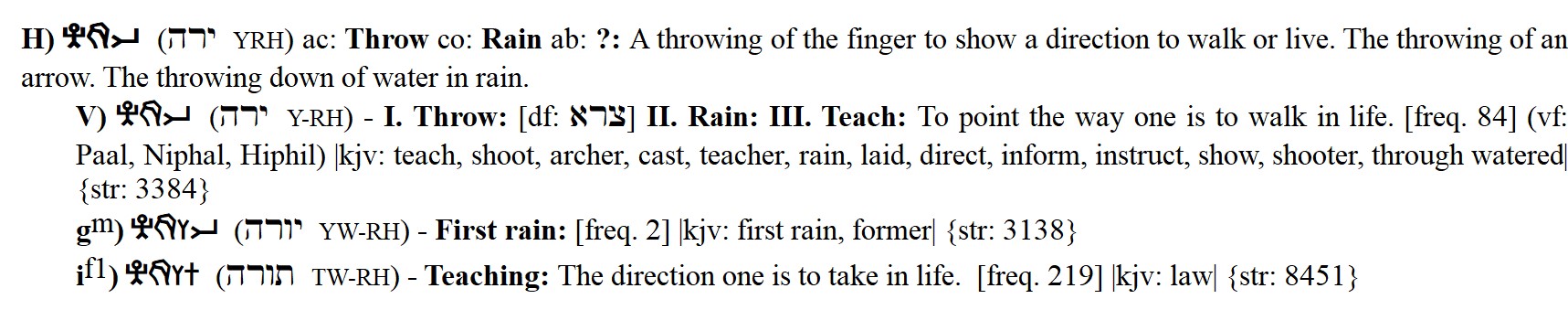
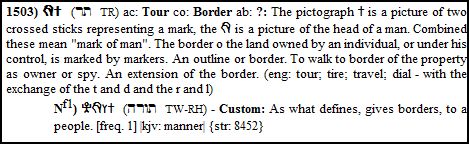
The Torah is an interesting word in that it comes from two roots. The other root word for תורה ‘torah’ is תר ‘tar’ which means an image or outline. The other aspect of being like a toddler in our walk with God is that of being formed into His image. Toddlers mimic their parents and grow up into the image into which they were reared.
The word תורה ‘torah’ comes from the root word תר ‘tar’ which means an image or outline. The Torah/Word is the Image of God (Hebrews 1:3; 2 Corinthians 4:4; Colossians 1:15).
It is interesting to note that the Greek word μορφή ‘morphe’ is used in the Septuagint to translate the Hebrew word תואר ‘to’ar’ which means image, that comes from the same root תר as תורה ‘torah.’ μορφή ‘morphe’ is also used to translate the Hebrew word צלם ‘tselem’ which means shadow.
μορφή ‘morphē’ is also used to translate the word תמונה ‘temunah’ which means image and תּבנית ‘tabnı̂yth’ which is translated as pattern, likeness, form and similitude.
Php 2:6 who subsisting in the form (μορφή ‘morphe’) of God, thought it not robbery to be equal with God,
Jesus is THE image of God (Hebrews 1:3; 2 Corinthians 4:4-6; Colossians 1:15-16) who is love (1 John 4:8).
Heb 1:1 God, who at sundry times and in divers manners spake in time past unto the fathers by the prophets,
Heb 1:2 Hath in these last days spoken unto us by his Son, whom he hath appointed heir of all things, by whom also he made the worlds;
Heb 1:3 Who being the brightness of his glory, and the express image of his person, and upholding all things by the word of his power, when he had by himself purged our sins, sat down on the right hand of the Majesty on high;
Col 1:15 Who is the image of the invisible God, the firstborn of every creature:
Col 1:16 For by him were all things created, that are in heaven, and that are in earth, visible and invisible, whether they be thrones, or dominions, or principalities, or powers: all things were created by him, and for him:
Col 1:17 And he is before all things, and by him all things consist.
2Co 4:4 In whom the god of this world hath blinded the minds of them which believe not, lest the light of the glorious gospel of Christ, who is the image of God, should shine unto them.
Joh 1:18 No man hath seen God at any time; the only begotten Son, which is in the bosom of the Father, he hath declared (ἐξηγέομαι ‘exēgeomai’) him.
ἐξηγέομαι ‘exēgeomai’ -Jesus manifests the image of the Most High
G1834
ἐξηγέομαι
exēgeomai
Thayer Definition:
1) to lead out, be leader, go before
2) metaphorically, to draw out in narrative, unfold a teaching
2a) to recount, rehearse
2b) to unfold, declare
2b1) the things relating to God
2b2) used in Greek writing of the interpretation of things sacred and divine, oracles, dreams, etc.
Part of Speech: verb
A Related Word by Thayer’s/Strong’s Number: from G1537 and G2233
This Greek word was used to translate the following Hebrew words in the Septuagint
G1834
ex egeomai H3034 yadah (to make known)
ex egeomai H3384 yarah hi. (to teach…root of the word torah)
ex egeomai H5608 saphar pi. (record/scroll)
Here it can be seen that Christ, who comes from the bosom of the Father, declares Him. He makes Him known. He made known His teaching, His Torah, when the Scroll of the Torah/Word became flesh and walked among men. This is why Messiah declared to Thomas that when you are looking at Him you are seeing the Father.
Joh 14:9 Jesus saith unto him, Have I been so long time with you, and yet hast thou not known me, Philip? he that hath seen me hath seen the Father; and how sayest thou then, Shew us the Father?
Joh 14:10 Believest thou not that I am in the Father, and the Father in me? the words that I speak unto you I speak not of myself: but the Father that dwelleth in me, he doeth the works.
Joh 14:11 Believe me that I am in the Father, and the Father in me: or else believe me for the very works’ sake.
Joh 14:12 Verily, verily, I say unto you, He that believeth on me, the works that I do shall he do also; and greater works than these shall he do; because I go unto my Father.
Joh 14:13 And whatsoever ye shall ask in my name, that will I do, that the Father may be glorified in the Son.
Joh 14:14 If ye shall ask any thing in my name, I will do it.
Joh 14:15 If ye love me, keep my commandments.
Joh 14:16 And I will pray the Father, and he shall give you another Comforter, that he may abide with you for ever;
Joh 14:17 Even the Spirit of truth; whom the world cannot receive, because it seeth him not, neither knoweth him: but ye know him; for he dwelleth with you, and shall be in you.

The word totter traces back to the Hebrew word דָּדָה ‘dadah’ which means to go slowly or weaver/totter in going. It is related to moving slowly or deliberately because of unsteadiness. דָּדָה ‘dadah’ comes from the root דָּד ‘dad/dud’ meaning beloved but literally two danglers. It points to the bosom and the love of a parent.
There are a number of Hebrew words which have the meaning of love, all of which point back in one form or another to the bosom. This connection between the bosom and love points to Christ Jesus, the manifestation of God’s love (John 3:16). Scripture declares that Messiah came from the bosom of the Father (John 1:18) who gathers (John 12:32) and then carries mankind (the dead) to His bosom (life).
The word father in Hebrew is associated with love, so too is the word mother. אם ‘em’ (mother) is the source of the Latin ‘amare,’ the French ‘amitie’ and the English ‘amity’ which mean love. One of the Hebrew words for love is דד ‘dud/dad’ which means both love and breasts/bosom. Interestingly, the English word ‘baby’ comes from the Hebrew בבה ‘baba’ which is related to the word אבוב ‘aboob’ the root of which is אב ‘av’ which means father but also means a pipe, as in the breast of the mother whose milk flows to give sustenance to the baby. בבה ‘baba’ in Hebrew means the pupil, the apple of one’s eyes. As any parent has held their baby in their arms against their bosom they recognize this is the epitome of love and intimate relationship (apple of the eye/little guy in the eye).
When we hold our children in our arms at the bosom, it is the perfect distance to see our faces in their pupils. This is the relationship our Heavenly Father desires to have with us (Psalm 17:8; Zechariah 2:8; Psalm 27:8). God associates redeeming His people from Egypt as gathering them under the shadow of His Wings where they appeared as the little guy in His Eye (Deuteronomy 32:9-11). This is further linked to a baby in the arms of a parent in Psalm 81.
Psa 81:10 I am Jehovah your God who brought you out from the land of Egypt; open your mouth wide, and I will fill it.
Son 2:6 His left hand is under my head, and His right hand embraces me.
The word toddler has the meaning of one who toddles, a young child learning to walk. It is related to the word totter which means to wobble or shake. To stand or walk with shaky, unsteady steps. The word is related to the Norse ‘totra’ which means to quiver or shake. This is associated with fear and trembling. Recall that the word ירה ‘yarah’ (the pointing of the finger to direct one in the way they should go) is associated with fear.
We are called to work out our salvation with fear and trembling (Philippians 2:12-13), learning to walk in God’s will not our carnality (1 Peter 4:2).
Php 2:12 Wherefore, my beloved, as ye have always obeyed, not as in my presence only, but now much more in my absence, work out your own salvation with fear and trembling.
Php 2:13 For it is God which worketh in you both to will and to do of his good pleasure.
Learning to walk
As Christians, we begin as babes consuming the milk of the Word (1 Peter 2:2). As we grow and mature, we learn to walk by faith (2 Corinthians 5:7) but this is a process where we begin as toddlers. Tossed to and fro but growing up into maturity in Him (Ephesians 4:14-15).
Eph 4:11 And he gave some, apostles; and some, prophets; and some, evangelists; and some, pastors and teachers;
Eph 4:12 For the perfecting of the saints, for the work of the ministry, for the edifying of the body of Christ:
Eph 4:13 Till we all come in the unity of the faith, and of the knowledge of the Son of God, unto a perfect man, unto the measure of the stature of the fulness of Christ:
Eph 4:14 That we henceforth be no more children, tossed to and fro, and carried about with every wind of doctrine, by the sleight of men, and cunning craftiness, whereby they lie in wait to deceive;
Eph 4:15 But speaking the truth in love, may grow up into him in all things, which is the head, even Christ:
Going deeper into the etymology of toddler is the Germanic word taltrōną which means to sway or to dangle. This dangling concept points to the bosom where a child breastfeeds.
Toddlers are in the transition from breastfeeding to solid food. Learning to walk and talk. We are to grow in Him, walking worthy of the Lord.
2Pe 3:18 But grow in grace, and in the knowledge of our Lord and Saviour Jesus Christ. To him be glory both now and for ever. Amen.
Col 1:9 For this cause we also, since the day we heard it, do not cease to pray for you, and to desire that ye might be filled with the knowledge of his will in all wisdom and spiritual understanding;
Col 1:10 That ye might walk worthy of the Lord unto all pleasing, being fruitful in every good work, and increasing in the knowledge of God;
Col 1:11 Strengthened with all might, according to his glorious power, unto all patience and longsuffering with joyfulness;
2Pe 3:18 But grow in grace, and in the knowledge of our Lord and Saviour Jesus Christ. To him be glory both now and for ever. Amen.
The word for grace is χάρις ‘charis’ which is used to translate numerous words in the Greek Septuagint. One of the words is גדולה ‘gedulah’ which means to grow in size. We are to grow into the image of Christ, from glory to glory.
2Co 3:18 But we all, with open face beholding as in a glass the glory of the Lord, are changed into the same image from glory to glory, even as by the Spirit of the Lord.
We are to be molded into the image/character of Messiah. Jesus is THE image of God (Hebrews 1:3; 2 Corinthians 4:4-6; Colossians 1:15-16) who is love (1 John 4:8). He revealed God’s name/character to mankind (John 17:6, 26).
Joh 17:6 I revealed Your name to the men whom You gave to Me out of the world. They were Yours, and You gave them to Me; and they have kept Your Word.
Joh 17:26 And I made known to them Your name, and will make it known, that the love with which You loved Me may be in them, and I in them.
Christ came to earth in the very image of Almighty God (2 Corinthians 4:4; Colossians 1:15; Hebrews 1:3), who is love. His life displayed that love and He calls all those who believe in Him to display that love as well. This is the essence of the concept of ‘Christ in us.’ It is through His love that man is formed into His image (Colossians 3:10; Romans 8:29) where there is no longer Jew or Greek, Barbarian or Scythian but Messiah is all and in all (Colossians 3:11).
This is the message of the Gospel. Love. Love is the foundation of God’s grace (Acts 20:24; John 3:16-17; 2 Corinthians 13:14). His Love breaks down the barriers and walls which man has set up to divide (Ephesians 2:1-22; 1 Corinthians 12:13). Love that breaks down the wall of sin which has separated man from God (Isaiah 59:2; John 3:16; 12:32; Isaiah 49:6; Revelation 5:9). This love is revealed in our actions towards our fellow man, not in our intellectual proclamations. All of us see through a glass darkly which keeps us from seeing eye to eye (1 Corinthians 13:12). The only remedy for this is love (1 Corinthians 13:1-13; 1 John 4:7-21). Love and patience towards one another until the Lord returns and His salvation is fully revealed (Isaiah 52:7-10). Love allows man to understand that we can have differences of opinions but ultimately if we abide in love we can dwell in peace and unity (Ephesians 4:2-16, 32; 5:1-2; Colossians 3:9-17).
The true intent of the law/Word of God is not to make men religious but to reform men into the image of their God who is love (1 John 4:8). It is this love that unites us and perfects us. It is the bond of perfection (Colossians 3:14) which sets man free (Galatians 5:13-14). This love is not intended only for a certain group of religious people, but for all mankind. Scripture declares that in the Messiah shall the ‘gentiles trust’ (Matthew 12:21; Romans 15:8-12; Isaiah 11:10). For Jesus is the true Light which enlightens every man (John 1:9; 12:44-46; Isaiah 49:6), sent to restore all of mankind back to God (Isaiah 45:22; Romans 3:29; John 1:12; 3:15-17).
Messiah “imitated” God, He was the express image of the Father.
Heb 1:2 in these last days He spoke to us in the Son, whom He appointed heir of all; through whom He indeed made the ages;
Heb 1:3 who being the shining splendor of His glory, and the express image of His essence, and upholding all things by the Word of His power, having made purification of our sins through Himself, He sat down on the right of the Majesty on high, Psa. 110:1
Joh 14:7 If you had known Me, you would have known My Father also; and from now on you do know Him, and have seen Him.
Joh 14:8 And Philip said to Him, Lord, show us the Father, and it is enough for us.
Joh 14:9 Jesus said to him, Am I so long a time with you, and you have not known Me, Philip? The one seeing Me has seen the Father! And how do you say, Show us the Father?
Joh 14:10 Do you not believe that I am in the Father and the Father is in Me? The Words which I speak to you I do not speak from Myself, but the Father who abides in Me, He does the works.
Joh 14:11 Believe Me that I am in the Father, and the Father is in Me; but if not, believe Me because of the works themselves.
Christ manifested the image of the Father because of what He did (His works). He imitated the Father in order to reveal Him to the world.
Joh 5:19 Then Jesus answered and said to them, Truly, truly, I say to you, The Son is not able to do anything from Himself, except what He may see the Father doing; for whatever that One does, these things also the Son does likewise.
Joh 5:20 For the Father loves the Son and shows to Him all things which He does. And He will show Him greater works than these in order that you may marvel.
So too, we are to imitate God by what we do (our works) by walking in Love.
Eph 5:1 Then become imitators of God, as beloved children,
Eph 5:2 and walk in love, even as Christ also loved us and gave Himself for us, an offering and a sacrifice to God for an odor of a sweet smell.
1Jn 2:5 But whoever keeps His Word, truly in this one the love of God has been perfected. By this we know that we are in Him.
1Jn 2:6 The one claiming to rest in Him ought so to walk himself as that One walked.
1Jn 5:1 Everyone believing that Jesus is the Christ has been generated from God. And everyone who loves Him who begets also loves the one who has been born of Him.
1Jn 5:2 By this we know that we love the children of God: when we love God and keep His commandments.
1Jn 5:3 For this is the love of God, that we keep His commandments; and His commandments are not heavy.
1Jn 4:11 Beloved, if God so loved us, we also ought to love one another.
1Jn 4:12 No one has seen God at any time. If we love one another, God abides in us, and His love having been perfected is in us.
1Jn 4:13 By this we know that we abide in Him, and He in us, because of His Spirit He has given to us.
Grow – increase
Christ said that the world would know we are His disciples by our love. He did not say they would know us by our understanding of doctrine/theology.
Joh_13:35 By this shall all men know that ye are my disciples, if ye have love one to another.
1Jn 3:10 In this the children of God are manifest, and the children of the devil: whosoever doeth not righteousness is not of God, neither he that loveth not his brother.
1Jn 3:11 For this is the message that ye heard from the beginning, that we should love one another.
When the Lord returns, He will judge us according to our service in love (Matthew 25:31-46). Serving in love is the true path to ‘theology’ or knowing God (Jeremiah 22:16). Scripture declares that love of one’s fellow man is equated with love of God (1 John 4:11-12, 20-21) and is the fulfillment and purpose of His Word (Matthew 22:39-40; Romans 13:8-10; Galatians 6:2). It does not say love of one’s fellow religious counterpart, but of one’s fellow MAN (Galatians 6:10; 1 Thessalonians 5:15; 3 John 1:11), even our enemies (Luke 6:35). This love is manifested in service to one another (Galatians 5:13-14; 6:2; John 13:35; 1 John 3:16-19), in particular the poor and weak amongst us.
The work of the Holy Spirit in the process of purification is to lead us to love (1 Peter 1:22). The goal of the Torah/Word is to lead us to love (1 Timothy 1:5; Galatians 5:14; 6:2). Love is the fruit which reveals that we are growing in maturity in Messiah (2 Peter 1:5-8). Love is the bond of perfectness (Colossians 3:14).
Related Studies:
Daily Tidbits 5/8 – Grow in Grace
Daily Tidbits 5/17 – The Bosom
littleguyintheeye@gmail.com


