
The sign of the cross traces back to the early Church. Tertullian was the earliest who wrote of this tradition, he lived from about 155-220 AD. Basil the Great said that the sign of the cross was a tradition handed down from the Apostles.
St. Basil the Great’s On the Holy Spirit (De Spiritu Sancto), Chapter 27
“Of the beliefs and practices, whether generally accepted or publicly enjoined, which are preserved in the Church, some we possess derived from written teaching; others we have received delivered to us in a mystery by the tradition of the apostles; and both of these in relation to true religion have the same force. And these no one will gainsay—no one, at all events, who is even moderately versed in the institutions of the Church. For were we to attempt to reject such customs as have no written authority, on the ground that the importance they possess is small, we should unintentionally injure the Gospel in its very vitals; or, rather, should make our public definition a mere phrase and nothing more. For instance, to take the first and most general example, who is thence who has taught us in writing to sign with the sign of the cross those who have trusted in the name of our Lord Jesus Christ?”
2Th 2:15 Therefore, brethren, stand fast, and hold the traditions which ye have been taught, whether by word, or our epistle.
Tertullian
At every forward step and movement, at every going in and out, when we put on our clothes and shoes, when we bathe, when we sit at table, when we light the lamps, on couch, on seat, in all the ordinary actions of daily life, we trace upon the forehead the sign.” — De Corona (On the Crown), Chapter 3
“We Christians wear out our foreheads with the sign of the cross.” – Tertullian
Athanasius (296–373 AD), in Life of St. Anthony: He describes Anthony encouraging others to sign themselves with the cross for protection against demonic attacks, noting that “by the sign of the Cross… all magic is stayed, all sorcery confounded…”
Cyril of Jerusalem (313–386 AD)
“Let us not then be ashamed to confess the Crucified. Be the Cross our seal made with boldness by our fingers on our brow and in everything; over the bread we eat, and the cups we drink; in our comings in, and goings out; before our sleep, when we lie down and when we awake; when we are in the way, and when we are still. It is the Sign of the faithful, and the dread of devils: for He triumphed over them in it, having made a show of them openly.” – Catechetical Lectures 13:36
John Chrysostom (c. 347–407 AD)
“When, then, you make the sign of the cross on the forehead, arm yourself with a saintly boldness, and reinstall your soul in its old liberty…”
The Cross and Baptism
Mat 28:19 Go ye therefore, and teach all nations, baptizing them in the name of the Father, and of the Son, and of the Holy Ghost:
It is said that the sign of the cross was the mark of those baptized in Christ. This is seen in section 21 of The Apostolic Tradition of Hippolytus of Rome as well as with St. John of Damascus:
“The holy cross was given to us as a sign on our forehead, just as circumcision was given to Israel: for by it we believers are separated and distinguished from unbelievers.” {An Exposition of the Orthodox Faith, 4:11. St. John of Damascus, “Concerning the Cross and Faith,”}
Rom 6:3 Know ye not, that so many of us as were baptized into Jesus Christ were baptized into his death?
Rom 6:4 Therefore we are buried with him by baptism into death: that like as Christ was raised up from the dead by the glory of the Father, even so we also should walk in newness of life.
Rom 6:5 For if we have been planted together in the likeness of his death, we shall be also in the likeness of his resurrection:
Rom 6:6 Knowing this, that our old man is crucified with him, that the body of sin might be destroyed, that henceforth we should not serve sin.
Rom 6:7 For he that is dead is freed from sin.
Rom 6:8 Now if we be dead with Christ, we believe that we shall also live with him:
Rom 6:9 Knowing that Christ being raised from the dead dieth no more; death hath no more dominion over him.
Rom 6:10 For in that he died, he died unto sin once: but in that he liveth, he liveth unto God.
Rom 6:11 Likewise reckon ye also yourselves to be dead indeed unto sin, but alive unto God through Jesus Christ our Lord.
Gal 3:26 For ye are all the children of God by faith in Christ Jesus.
Gal 3:27 For as many of you as have been baptized into Christ have put on Christ.
Initially the sign of the cross started on the forehead, hearkening back to the Prophet Ezekiel.
Eze 9:4 And the LORD said unto him, Go through the midst of the city, through the midst of Jerusalem, and set a mark (תו והתוית ‘vheetviyta tav’) upon the foreheads of the men that sigh and that cry for all the abominations that be done in the midst thereof.
The phrase תו והתוית ‘vheetviyta tav’ can be translated “cross a cross.” This is what the sign of the cross is.
Keil & Delitzsch commentary on Ezekiel 9:4
“תָּו, the last letter of the Hebrew alphabet, had the form of a cross in the earlier writing. הִתְוָה תָּו, to mark a ת, is therefore the same as to make a mark in the form of a cross….And this was the reason why the תָּו was to be marked upon the forehead, the most visible portion of the body; the early Christians, according to a statement in Origen, looked upon the sign itself as significant, and saw therein a prophetic allusion to the sign of the cross as the distinctive mark of Christians.”
John Gill commentary
the Talmudists say (w) the high priest, was anointed on his forehead in the same form: some think this letter was the mark, because it is the first letter of the word תורה, “the law”;
On the head of the high priest was the Sacred Name of God (Exodus 28:36-38). More on this below.
Jerome, in his translation of the Bible into Latin translates the תו והתוית ‘vheetviyta tav’ as signa thau “sign the tav.” Sign the cross.
Eze 9:4 et dixit Dominus ad eum transi per mediam civitatem in medio Hierusalem et signa thau super frontes virorum gementium et dolentium super cunctis abominationibus quae fiunt in medio eius
The sign of the cross declares to the world the victory of Christ and our victory in Him.
Rom 8:35 Who shall separate us from the love of Christ? shall tribulation, or distress, or persecution, or famine, or nakedness, or peril, or sword?
Rom 8:36 As it is written, For thy sake we are killed all the day long; we are accounted as sheep for the slaughter.
Rom 8:37 Nay, in all these things we are more than conquerors through him that loved us.
Rom 8:38 For I am persuaded, that neither death, nor life, nor angels, nor principalities, nor powers, nor things present, nor things to come,
Rom 8:39 Nor height, nor depth, nor any other creature, shall be able to separate us from the love of God, which is in Christ Jesus our Lord.
2Sa_19:2 And the victory {תּשׁעה / תּשׁוּעה ‘teshû‛âh’} that day was turned into mourning unto all the people: for the people heard say that day how the king was grieved for his son.
תּשׁוּעה ‘teshû‛âh’ comes from the word ישע ‘yasha’ which means salvation. Pointing to the name of Jesus. The sign of the cross reveals the name/character of God.
The cross reveals God’s name/character of love revealed through the life of Christ. The Hebrew word for name is שם ‘shem’ which literally means one’s breathe or character. What is the character of the Almighty? Love (1 John 4:8). The Hebrew word for love is אהב ‘ahav’ which is consists of the letters אב ‘av’ which means father and the middle letter ה ‘heh’ which has the meaning of revelation. The Father revealed. In ancient Hebrew, the letter ה ‘heh’ was depicted as a man with outstretched arms, like unto Messiah on the cross. How was the love of the Father revealed? Through the giving of His only begotten Son on the cross as an atonement for the sins of mankind (John 3:16).
Joh 17:6 I have manifested thy name unto the men which thou gavest me out of the world: thine they were, and thou gavest them me; and they have kept thy word.
Love & the cross
Messiah triumphed over the adversary by His work on the cross.
Col 2:15 And having spoiled principalities and powers, he made a shew of them openly, triumphing over them in it.
Messiah on the cross is the revelation of God’s love.
The Father revealed what true love is when He gave His only begotten Son, who came from His bosom (John 1:18), as an atonement for the sins of mankind. The most common Hebrew word for love אהבה ‘ahavah,’ literally means to give.
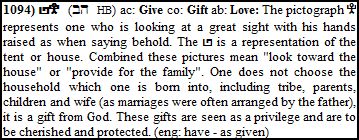
What is the ultimate definition of love? Giving one’s life for another
Joh 3:16 For God so loved the world that He gave His only begotten Son, that everyone believing into Him should not perish, but have everlasting life.
Joh 15:13 Greater love than this has no one, that anyone should lay down his soul for his friends.
The pictograph meaning of אהב ‘ahav’ displays this concept even further.
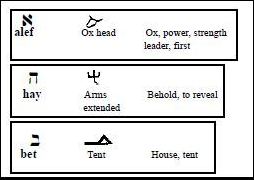
The Sacred Name of God was revealed on the cross.
Joh 8:28 Then Jesus said to them, When you lift up the Son of Man, then you will know that I AM; and from Myself I do nothing; but as My Father taught Me, these things I speak.
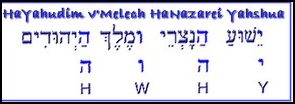
Joh 19:19 And Pilate also wrote a title and put it on the cross. And having been written, it was: JESUS THE NAZARENE, THE KING OF THE JEWS.
Joh 12:32 And I, if I be lifted up from the earth, I will draw all to Myself (John 8:28 Messiah states this is how they will know He is ‘I AM’).
Joh 12:33 But He said this, signifying by what kind of death He was about to die.
Rev 7:3 Saying, Hurt not the earth, neither the sea, nor the trees, till we have sealed the servants of our God in their foreheads.
Rev 14:1 And I looked, and, lo, a Lamb stood on the mount Sion, and with him an hundred forty and four thousand, having his Father’s name written in their foreheads.
Cross & 4
Interestingly, the motion of making the sign of the cross makes an upside down 4. The Hebrew letter ד ‘dalet’ is the fourth letter of the Hebrew alphabet. It has the meaning of a door.
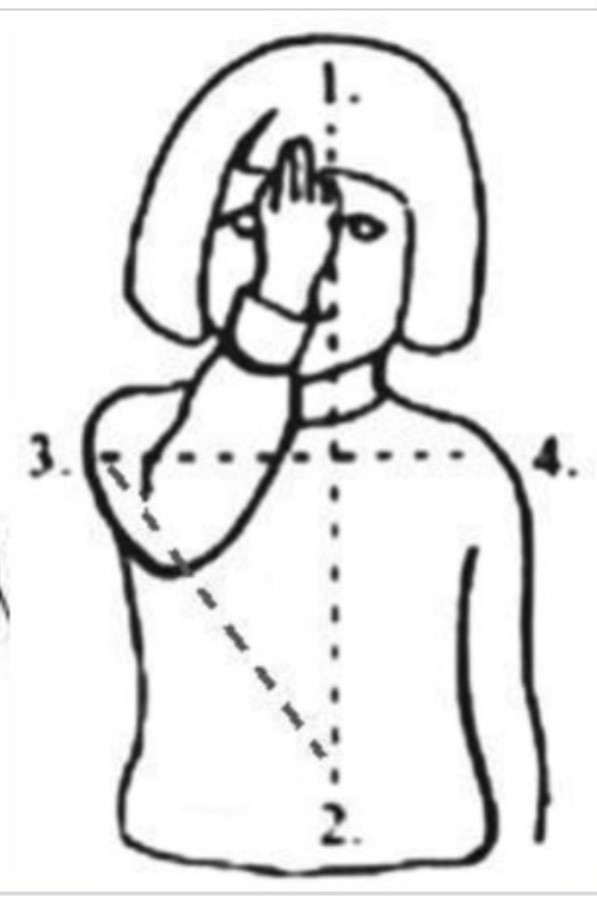
Christ is the door
Joh 10:1 Verily, verily, I say unto you, He that entereth not by the door into the sheepfold, but climbeth up some other way, the same is a thief and a robber.
Joh 10:2 But he that entereth in by the door is the shepherd of the sheep.
Joh 10:7 Then said Jesus unto them again, Verily, verily, I say unto you, I am the door of the sheep.
Joh 10:8 All that ever came before me are thieves and robbers: but the sheep did not hear them.
Joh 10:9 I am the door: by me if any man enter in, he shall be saved, and shall go in and out, and find pasture.
Joh 10:10 The thief cometh not, but for to steal, and to kill, and to destroy: I am come that they might have life, and that they might have it more abundantly.
Joh 10:11 I am the good shepherd: the good shepherd giveth his life for the sheep.
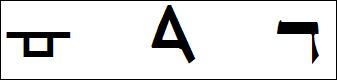
The Hebrew letter ד ‘dalet’ {spelled דלת} is a picture of a tent door. The word is translated as door or gate in the Scriptures. Messiah Jesus is the door/gate from whence man can enter into the garden of the Lord (John 10:7-14). This entrance was made available through His death on the cross (John 10:15-18; Hebrews 10:20). דלת ‘dalet’ comes from the root דל ‘dal’ which means to be poor or low as in the tent door which hung down as a curtain.
Php 2:5 Let this mind be in you, which was also in Christ Jesus:
Php 2:6 Who, being in the form of God, thought it not robbery to be equal with God:
Php 2:7 But made himself of no reputation, and took upon him the form of a servant, and was made in the likeness of men:
Php 2:8 And being found in fashion as a man, he humbled himself, and became obedient unto death, even the death of the cross.
Php 2:9 Wherefore God also hath highly exalted him, and given him a name which is above every name:
Php 2:10 That at the name of Jesus every knee should bow, of things in heaven, and things in earth, and things under the earth;
Php 2:11 And that every tongue should confess that Jesus Christ is Lord, to the glory of God the Father.
Further displaying this connection between דלת ‘dalet’ and Messiah’s sacrifice is the meaning of the letters which spell דלת ‘dalet.’ ד ‘dalet’ is a door, ל ‘lamed’ displays the shepherd and ת ‘tav’ is a picture of a cross. The Good Shepherd died on a cross that the door to heaven might be opened to whosoever would believe in Him.
This cross, four, door connection is seen in more detail in:
Daily Tidbits 2/18 – Love & the 4th Dimension
Shadows of Messiah – Shadows & the 4th Dimension
littleguyintheeye@gmail.com


