

Dictionaries are far more than collections of definitions — they are treasure houses of meaning that point us to Christ, the living Word (Logos). In this Tidbit, we explore how the very words “dictionary,” “lexicon,” “thesaurus,” and “define” carry deep biblical and theological significance.
Christ as the Living Dictionary: Jesus is the Logos — the Word in whom all things hold together and in whom are hidden all the treasures of wisdom and knowledge.
Define = To Set Boundaries: The word “define” comes from the idea of marking limits, which connects to the Hebrew concept of גָּדַר (gadar — to fence/enclose) and the protected Garden of Eden (gan).
Thesaurus = Treasure House: The word “thesaurus” literally means “treasury” or “storehouse,” mirroring how Scripture describes wisdom and Christ Himself as hidden treasure.
Language Points to the Cross: Etymology across Hebrew (Torah), Greek (deiknúō, charaktḗr), and Latin consistently reveals themes of revelation, instruction, and the cross.
Four Layers of Meaning: Dictionaries operate on multiple levels (literal definition → etymological story → moral application → Christ-centered fulfillment), similar to the Christian fourfold sense of Scripture and the Jewish PaRDeS method.
Restoration of Pure Language: Just as language was confused at Babel, God promises to restore a pure language (Zephaniah 3:9), ultimately fulfilled in Christ.

Christ is the Word (λόγος ‘logos’) made flesh (John 1:14)…all words point back to Him. Dictionaries show the meanings of words. Words reveal THE WORD. The study of words and their etymology is a tool for seeing Christ hidden in plain sight across languages and history.
Jesus is not just in the dictionary. He is the “Dictionary.” All things were made through Him, and by Him all things hold together… including language itself (Colossians 1:16-17; Isaiah 57:19).
Christ is the Word, He is the Alpha & Omega (every letter of the Alphabet). Dictionaries show the definitions of words pointing back to the Word made flesh who reveals the true meaning behind all things.
Joh 1:1 In the beginning was the Word, and the Word was with God, and the Word was God.
Joh 1:2 The same was in the beginning with God.
Joh 1:3 All things were made by him; and without him was not any thing made that was made.
In essence, Christ is the living Dictionary of God. He is the one who perfectly reveals or shows the Father.
Heb 1:3 Who being the brightness of his glory, and the express image (χαρακτήρ ‘charakter’) of his person, and upholding all things by the word of his power, when he had by himself purged our sins, sat down on the right hand of the Majesty on high;
G5481
χαρακτήρ
charaktēr
khar-ak-tar’
From the same as G5482; a graver (the tool or the person), that is, (by implication) engraving ([“character”], the figure stamped, that is, an exact copy or [figuratively] representation): – express image.
Letters are characters. Letters are symbols representing sound, a character is a symbol used in writing. All letters are characters but not all characters are letters as characters include anything written (numbers, symbols etc.) In essence, both are writing (or marks) which are used to express meaning.
The English word character also has the meaning of a the moral qualities of an individual, the “mark” of a person. χαρακτήρ ‘charakter’ means an “engraved or stamped mark.’ It referred to a distinctive mark left on a coin, seal, or tablet, something that identifies and authenticates the object. One’s moral character is the set of qualities that are “engraved” into a person’s soul through their choices and actions.
The word letter comes from the Latin ‘littera’ which means letters of the alphabet but also “written document” or “epistle.” The Greek equivalent of ‘littera’ is γράμμα ‘gramma.’ γράμμα ‘gramma’ comes from the word γράφω ‘grapho’ which means to “scratch, draw, write.” γράφω ‘grapho comes from γράφη ‘graphe’ which means a writing, drawing or record. Both words are used of the Scriptures.
The Holy Scriptures, the Holy Letters
2Ti 3:15 And that from a child thou hast known the holy scriptures (γράμμα ‘gramma’) , which are able to make thee wise unto salvation through faith which is in Christ Jesus.
2Ti 3:16 All scripture (γραφή ‘graphe’) is given by inspiration of God, and is profitable for doctrine, for reproof, for correction, for instruction in righteousness:
γραφή ‘graphe’
G1124
γραφή
graphē
Thayer Definition:
- a writing, thing written
Letters -γράμμα ‘gramma’
Joh 7:15 And the Jews marvelled, saying, How knoweth this man letters (γράμμα ‘gramma’), having never learned?
Learning – γράμμα ‘gramma’
Act 26:24 And as he thus spake for himself, Festus said with a loud voice, Paul, thou art beside thyself; much learning (γράμμα ‘gramma’) doth make thee mad.
G1121
γράμμα
gramma
gram’-mah
From G1125; a writing, that is, a letter, note, epistle, book, etc.; plural learning: – bill, learning, letter, scripture, writing, written.
Rom 2:27 And shall not uncircumcision which is by nature, if it fulfil the law, judge thee, who by the letter (γράμμα ‘gramma’) and circumcision dost transgress the law?
Rom 2:28 For he is not a Jew, which is one outwardly; neither is that circumcision, which is outward in the flesh:
Rom 2:29 But he is a Jew, which is one inwardly; and circumcision is that of the heart, in the spirit, and not in the letter (γράμμα ‘gramma’); whose praise is not of men, but of God.
Rom 7:6 But now we are delivered from the law, that being dead wherein we were held; that we should serve in newness of spirit, and not in the oldness of the letter (γράμμα ‘gramma’).
2Co 3:6 Who also hath made us able ministers of the new testament; not of the letter (γράμμα ‘gramma’), but of the spirit: for the letter killeth, but the spirit giveth life.
Luk 23:38 And a superscription also was written over him in letters (γράμμα ‘gramma’) of Greek, and Latin, and Hebrew, THIS IS THE KING OF THE JEWS.
Dictionary
The English word ‘dictionary’ comes from the Latin ‘dictionarium’ which means a “collection of words” a shortening of ‘dictionarius liber’ which means “book of words.”
The Latin ‘dictionarius’ means “of words” from the word ‘dictio’/’diction’ which means “word”. ‘Diction’ means “expression of ideas in words” from the Latin ‘dicere’ which means to “speak, tell, or say”, said to come from the Proto-Indo-European root ‘deik’ which means to “point out”. A cognate is the Sanskrit word ‘dic’ which means to “point out” or “show” and is related to the Greek word δεικνύναι ‘deiknynai’ which means to “prove” and the Latin word ‘digitus’ which means “finger”. The Old English word ‘tæcan ‘ is related as well which means “to teach”. All of these connections point to the Hebrew word תרוה ‘torah’ which has an identical meaning. The תרוה ‘torah’ has the meaning of the instructions/teaching of God.
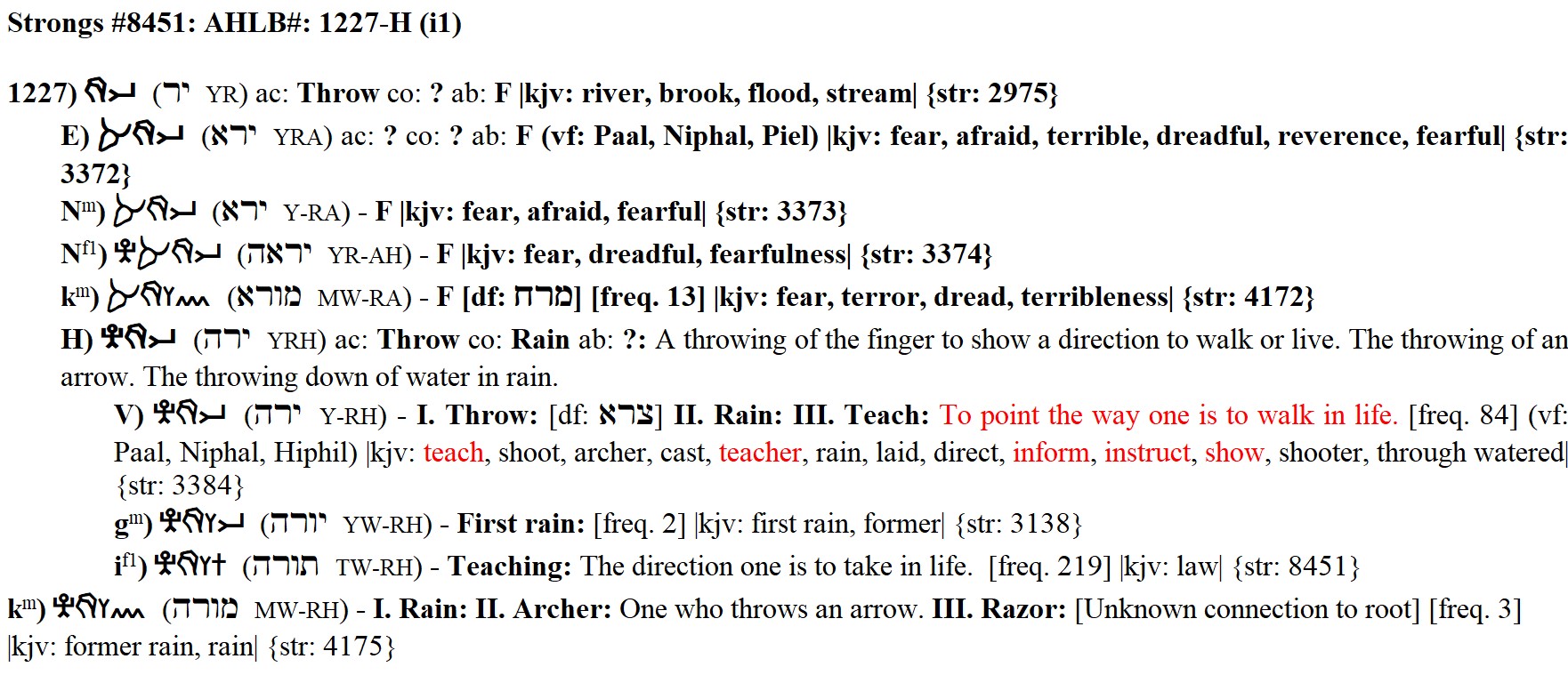
The word תורה ‘torah’ also pictographically displays Christ on the cross, revealing or showing the love of God.
ת – cross
ו – nail
ר – head, leader
ה – man with outstretched arms
Joh 3:14 And as Moses lifted up the serpent in the wilderness, even so must the Son of man be lifted up:
Joh 3:15 That whosoever believeth in him should not perish, but have eternal life.
Num 21:8 And the LORD said unto Moses, Make thee a fiery serpent, and set it upon a pole: and it shall come to pass, that every one that is bitten, when he looketh upon it, shall live.
Num 21:9 And Moses made a serpent of brass, and put it upon a pole, and it came to pass, that if a serpent had bitten any man, when he beheld the serpent of brass, he lived.
Joh 8:28 Then said Jesus unto them, When ye have lifted up the Son of man, then shall ye know that I am he, and that I do nothing of myself; but as my Father hath taught me, I speak these things.
Diction comes from the Latin ‘dictio’ which means a saying, expression, word, manner of speech. It comes from ‘dicere’ which means to say, speak, declare, proclaim. It is said to come from the Proto-Indo-European word ‘deik’ which means to “show, point out, pronounce solemnly.” The Greek word δεικνύναι ‘deiknynai’ (to show, point out) is said to come from ‘deik’ as well.
δεικνύναι ‘deiknynai’ is the 1st person singular, present indicative active of the verb δείκνυμι ‘deiknymi’ which is the classical form of δεικνύω ‘deiknuō.’
Strongs -G1166
δεικνύω
deiknuō
dike-noo’-o
A prolonged form of an obsolete primary of the same meaning; to show (literally or figuratively): – shew.
Thayer – G1166
δεικνύω
deiknuō
Thayer Definition:
- to show, expose to the eyes
- metaphorically
2a) to give evidence or proof of a thing
2b) to show by words or teach
Part of Speech: verb
Joh 5:20 For the Father loveth the Son, and sheweth (δεικνύω ‘deiknuō) him all things that himself doeth: and he will shew (δεικνύω ‘deiknuō) him greater works than these, that ye may marvel.
Joh 14:8 Philip saith unto him, Lord, shew (δεικνύω ‘deiknuō) us the Father, and it sufficeth us.
Joh 14:9 Jesus saith unto him, Have I been so long time with you, and yet hast thou not known me, Philip? he that hath seen me hath seen the Father; and how sayest thou then, Shew us the Father?
Joh 14:10 Believest thou not that I am in the Father, and the Father in me? the words that I speak unto you I speak not of myself: but the Father that dwelleth in me, he doeth the works.
Joh 14:11 Believe me that I am in the Father, and the Father in me: or else believe me for the very works’ sake.
Jas 2:18 Yea, a man may say, Thou hast faith, and I have works: shew (δεικνύω ‘deiknuō) me thy faith without thy works, and I will shew (δεικνύω ‘deiknuō) thee my faith by my works.
In the Septuagint, δεικνύω ‘deiknuō is used primarily to translate ראה ‘ra’ah.’
Deu 4:36 Out of heaven he made thee to hear his voice, that he might instruct thee: and upon earth he shewed (ראה ‘ra’ah’) thee his great fire; and thou heardest his words out of the midst of the fire.
Exo 25:9 And thou shalt make for me according to all things which I shew (δεικνύω ‘deiknuō) thee in the mountain; even the pattern of the tabernacle, and the pattern of all its furniture: so shalt thou make it.
Heb 8:5 Who serve unto the example and shadow of heavenly things, as Moses was admonished of God when he was about to make the tabernacle: for, See, saith he, that thou make all things according to the pattern shewed (δεικνύω ‘deiknuō) to thee in the mount.
H7200
ראה
râ’âh
BDB Definition:
- to see, look at, inspect, perceive, consider
1a) (Qal)
1a1) to see
1a2) to see, perceive
1a3) to see, have vision
1a4) to look at, see, regard, look after, see after, learn about, observe, watch, look upon, look out, find out
1a5) to see, observe, consider, look at, give attention to, discern, distinguish
1a6) to look at, gaze at
1b) (Niphal)
1b1) to appear, present oneself
1b2) to be seen
1b3) to be visible
1c) (Pual) to be seen
1d) (Hiphil)
1d1) to cause to see, show
1d2) to cause to look intently at, behold, cause to gaze at
1e) (Hophal)
1e1) to be caused to see, be shown
1e2) to be exhibited to
1f) (Hithpael) to look at each other, face
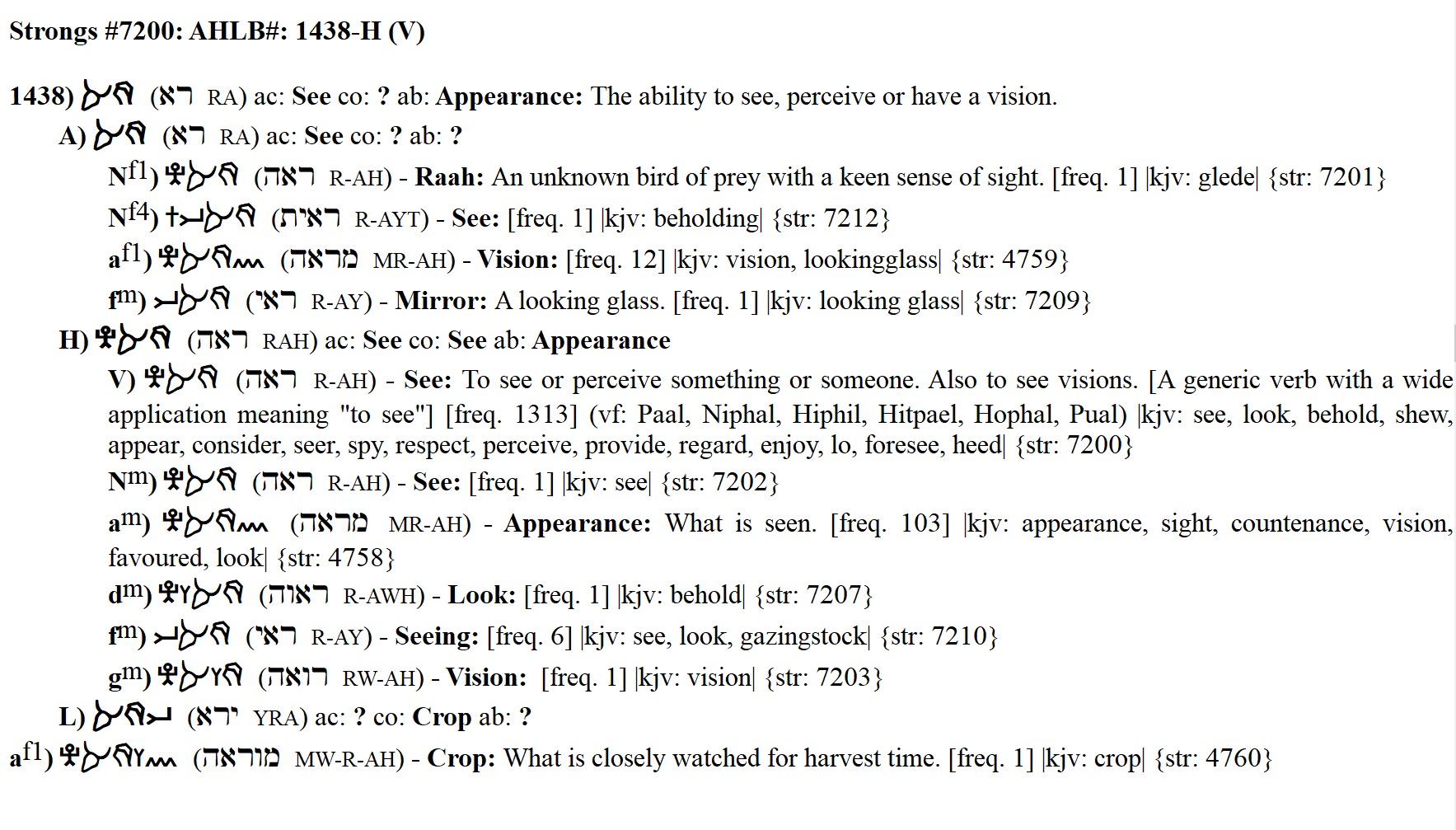
Isaac Mozeson traces the word ‘dictionary’ back to the Hebrew word הגדה ‘hagudah’ which means to show or to tell. This is the word used of the telling or showing of the story of Passover each year to the children.
הגדה ‘hagudah’ comes from the root נגד ‘nagad.’
Exo 13:8 And thou shalt shew (נגד ‘nagad’) thy son in that day, saying, This is done because of that which the LORD did unto me when I came forth out of Egypt.
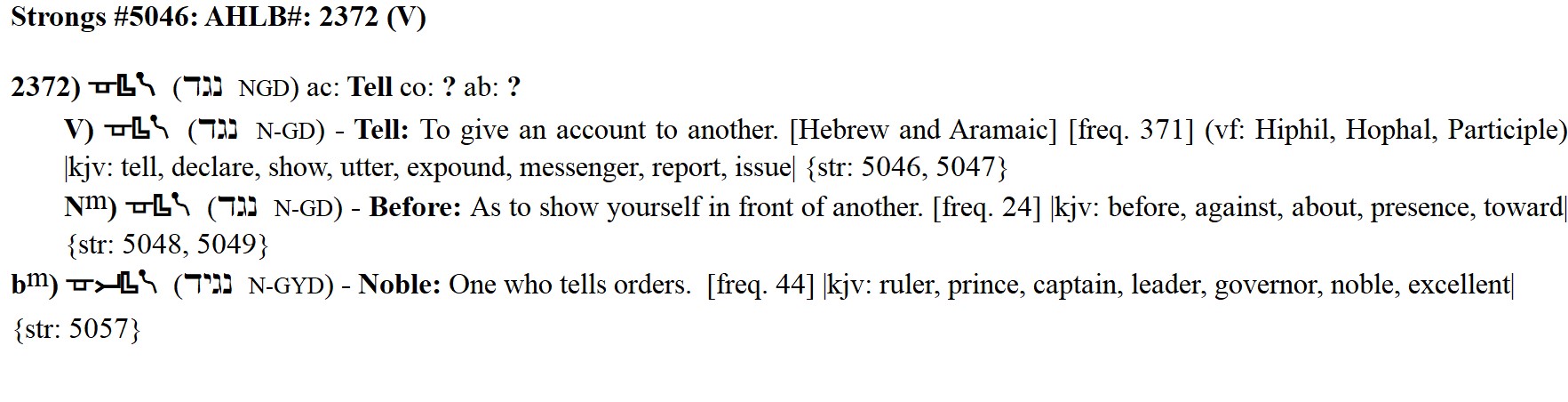
The Christian Passover is seen in the Eucharist which “shows” the Lord’s death.
1Co 11:26 For as often as ye eat this bread, and drink this cup, ye do shew the Lord’s death till he come.
Lexicon
A dictionary reflects the idea of a book that “shows” or “declares” words and their meanings. The English word lexicon is a synonym for dictionary. Lexicons are essentially dictionaries for ancient languages, familiar to those who study the ancient languages of the Bible.
Lexicon comes from the Greek λεξικόν ‘lexicon’ which is short for λεξικὸν βιβλίον ‘lexikòn biblíon’ which means “book of words.” λεξικόν ‘lexicon’ comes from λέξις ‘lexis’ which means “word, speech, utterance” which comes from the word λέγω ‘lego’ which means to say, speak or tell. The Greek word for word (λόγος ‘logos’) comes from λέγω ‘lego’ as well.
Christ is the Word (λόγος ‘logos’) made flesh (John 1:14)…all words point back to Him. In Latin, one of the words for “law” is lex which means that which is gathered/laid down (law). Both the Greek λέγω ‘lego’/ λέξις ‘lexis’ and the Latin ‘lex’ come from the Proto-Indo-European root ‘leg-‘ which means to ” gather, to collect, to pick out.” Together they point to Christ the Logos — the living Word who is both the collection of all wisdom (Colossians 2:3) and the ultimate Law (the Word made flesh).
Col 2:3 In whom are hid all the treasures of wisdom and knowledge.
Etymology
A dictionary is a collection of words. A book that “shows forth” or “declares” meaning. Etymology tells the story of the word. A good dictionary will make use of Etymology. A dictionary with good etymology reveals the “character” of a word. It shows the word’s journey and reveals hidden connections across languages which point to the origin. The Word of God.
All of creation came forth through the Word of God and every language ultimately traces its roots back to Eden. The very word “etymology” flows from the Hebrew אמת ’emet’ (truth), which pictures living waters and points directly to Christ, the Way, the Truth, and the Life. The word Hebrew itself pictographically means “to see the Son with hands on the cross.” Every letter and word in the original tongue declares Him. From the confusion of tongues at Babel to the coming pure language of Zephaniah 3:9, Etymology shows how the Shepherd gathers His sheep through the living waters of His Word — uniting all tongues back to the One who is the Aleph and Tav, the Alpha and Omega.
For more on Etymology see: Shadows of Messiah – Etymology
Four Layers of Interpretation
The dictionary gives the surface meaning of a word, the literal level of interpretation. Etymology tells the story of the word, the typological level. Looking at words in light of the Scriptures to understand how they point to the Gospel or truth is the Moral level of interpretation. The Anagogical level is looking at a word through these first three lenses to see how does this word ultimately point to Christ, the Logos, the Author of all things.
In ancient Christian and Jewish thought, the Scriptures were interpreted in four levels.
In Christian interpretation these are:
Literal
Typology
Moral
Anagogical
St. Augustine is quoted as saying: “The writing which is called the Old Testament lends itself to a four-fold division; namely, according to history, according to etiology, according to analogy, and according to allegory.”
These levels of understanding were remembered by a rhyme:
Litera gesta docet,
Quid credas allegoria,
Moralis quid agas,
Quo tendas anagogia.
The letter shows us what God and our ancestors did;
The allegory shows us where our faith his hid;
The moral meaning gives us the rule of daily life;
The anagogy shows us where we end our strife.
In Jewish thought, these four levels were called PaRDeS. PaRDeS (פַּרְדֵּס) is a Hebrew acronym for Peshat (literal), Remez (hint), Derash (search), and Sod (secret). Meaning “orchard” or “garden,” it points to the Garden of Eden and the paradise of deep communion with God through His Word.
Just as one enters a beautiful enclosed garden, studying the Scriptures at all four levels leads us from the plain meaning into the hidden treasures of wisdom, typology, moral instruction, and intimate fellowship with the Messiah — the true Gardener and Living Word.
The Hebrew word פַּרְדֵּס ‘pardes’ means an orchard or garden. The etymology of this word traces back to the Garden of Eden, Paradise, an enclosure fenced off. Studying the Scriptures is linked to the Garden of Eden.
Paradise: c.1175, “Garden of Eden,” from O.Fr. paradis, from L.L. paradisus, from Gk. paradeisos “park, paradise, Garden of Eden,” from an Iranian source, cf. Avestan pairidaeza “enclosure, park” (Mod. Pers. and Arabic firdaus “garden, paradise”), compound of pairi- “around” + diz “to make, form (a wall).” The first element is cognate with Gk. peri- “around, about” the second is from PIE base *dheigh- “to form, build” The Gk. word, originally used for an orchard or hunting park in Persia, was used in Septuagint to mean “Garden of Eden,” and in New Testament translations of Luke xxiii.43 to mean “heaven” (a sense attested in Eng. from c.1205). Meaning “place like or compared to Paradise” is from c.1300.
The Encyclopedia Mikrait lists pardes as one of the Persian words that entered into Biblical Hebrew. It appears three times in the Tanach: Shir HaShirim 4:13, Kohelet 2:5, and Nechemiah 2:8. In these cases it has the general meaning of “orchard”, compared to the specific sense in Greek of fenced off areas belonging to the king.
The book History of Paradise: THE GARDEN OF EDEN IN MYTH AND TRADITION writes that:
“Then the Septuagint used paradeisos to translate both pardes and the more classic Hebrew word for garden, gan.”
G3857
paradeisos H1588 gan
paradeisos H5731 eden
paradeisos H6508 pardes
For more on the four levels of interpretation see: PaRDeS
The Greek word παράδεισος ‘paradeisos’ comes from the Persian pairidaēza = “enclosed wall, park”
παράδεισος ‘paradeisos’ is used to translate גַּן ‘gan’ (garden) in Genesis 2:8,9, 10, 15, 16
Genesis 2:8 καὶ ἐφύτευσεν κύριος ὁ θεὸς παράδεισον ἐν Εδεμ κατὰ ἀνατολάς
“And the Lord God planted a garden (παράδεισος ‘paradeisos’) in Eden toward the east…”
παράδεισος ‘paradeisos’ is used to translate עֵדֶן ‘eden’ in Isaiah 51:3
Isa 51:3 For the LORD shall comfort Zion: he will comfort all her waste places; and he will make her wilderness like Eden (עֵדֶן ‘eden), and her desert like the garden of the LORD; joy and gladness shall be found therein, thanksgiving, and the voice of melody.
Septuagint
Isa 51:3 And now I will comfort thee, O Sion: and I have comforted all her desert places; and I will make her desert places as a garden (παραδεισον ‘paradeison’), and her western places as the garden (παραδεισον ‘paradeison’) of the Lord; they shall find in her gladness and exultation, thanksgiving and the voice of praise.
παράδεισος ‘paradeisos’ is used to translate פַּרְדֵּס ‘pardes’ in Nehemiah 2:8; Ecclesiastes 2:5 and Song of Solomon 4:13
Define
Dictionaries define words. They state the meaning, boundaries and show forth what a word means. The word define comes from the Latin word ‘definire’ which means “to limit, determine, mark out the boundaries of.”
The word “define” in modern Hebrew is לְהַגְדִּיר ‘lehagdir’ which comes from the root גָּדַר ‘gadar’ which means an enclosure or wall. גָּדֵר ‘gader’ means a fence or enclosure, הִגְדִּיר ‘higdiyr’ to set boundaries, to define, to determine limits.
Jeff Benner speaks of a garden, גַּן ‘gan,’ in the Ancient Hebrew mindset as walled or fenced in. A garden, גַּן ‘gan,’ was by extension a גָּדֵר ‘gader,’ a fenced in enclosure.
““The Hebrew word gan means more than just a garden as we think of it. It is a protected and enclosed area, a place that is cultivated and guarded. The Garden of Eden was not just a beautiful park, it was a sanctuary, a special place set apart where God could dwell with man.”
“In the ancient Hebrew mind, a garden was fenced in or walled off from the surrounding land. The Garden of Eden was God’s first sanctuary, a protected space where He walked with Adam and Eve. The word gan carries the idea of enclosure and protection.”
“The Garden of Eden was the first Temple. Just as the Tabernacle and Temple were enclosed sacred spaces, the Garden was enclosed by God’s presence. When Adam and Eve sinned, they were driven out of this protected enclosure.”
“When man sinned, he was cast out of the gan. The protective enclosure was lost. The rest of the Biblical story is about God’s plan to once again create a place where He can dwell with His people — a new gan.” {Jeff Benner – Ancient Hebrew Research Center}
In ancient and modern Greek, the word for define is ὁρίζω ‘horizo’ which means to “define, to mark out boundaries, to determine, to set limits, to appoint, to fix.” ὁρίζω ‘horizo’ comes from ὅρος ‘horos’ which means to “to set a boundary around something.”
Acts 17:26 — God “determined (ὁρίζω ‘horizo’) the times and the boundaries of their dwelling.”
Romans 1:4 — Christ was “declared (ὁρίζω ‘horizo’) to be the Son of God with power…”
Hebrews 4:7 — God “limits (ὁρίζω ‘horizo’) a certain day…”
G3724
ὁρίζω
horizō
Thayer Definition:
- to define
1a) to mark out the boundaries or limits (of any place or thing)
1b1) that which has been determined, acc. to appointment, decree
1b2) to ordain, determine, appoint
Rom 1:4 And declared (ὁρίζω ‘horizo’) to be the Son of God with power, according to the spirit of holiness, by the resurrection from the dead:
The meaning of this word corresponds to the Hebrew word תר ‘tar’ . It is through the resurrection that we will be fully formed into His image.
1Jn 3:1 See what manner of love the Father has given us, that we may be called children of God. For this reason the world does not know us, because it did not know Him.
1Jn 3:2 Beloved, now we are the children of God, and it was not yet revealed what we shall be. But we know that if He is revealed, we shall be like Him, because we shall see Him as He is.
The Torah is an interesting word in that it comes from two roots. One is תר ‘tar’ which means an image or outline, and the other is יר ‘yar’ which means to teach or pointing in the right direction. The concepts related to the dictionary take on both meanings as well.
תר ‘tar’ is the root of the Hebrew words which mean to mark out תאר t’ar or a form תוא to’ar. The word תור tor/toor means a border or a circle and is the origin of the English word tour. Literally, the Torah is what defines, gives borders to a people. It is the finger of God pointing the direction in which we are to go and marking out the borders in which we should stay in order to walk in His camp.
The word תורה ‘torah’ comes from the root word תר ‘tar’ which means an image or outline. The Torah/Word is the Image of the LORD (Hebrews 1:3; 2 Corinthians 4:4; Colossians 1:15). Jesus Christ is the exact Image (εἰκών / eikōn) of the invisible God — the brightness of His glory and the express representation of His person. In Him, the face, name, and character of the LORD are fully revealed. See: Image of God
תר ‘tar’ is the root of the Hebrew words which mean to mark out תאר t’ar or a form תוא to’ar. The word תור tor/toor means a border or a circle and is the origin of the English word tour. Literally, the Torah is what defines, gives borders to a people. It is the finger of God pointing the direction in which we are to go and marking out the borders in which we should stay in order to walk in His camp. See: Daily Tidbits 6/27/26 – The Law
It is interesting to note that the Greek word μορφή ‘morphe’ is used in the Septuagint to translate the Hebrew word תואר ‘to’ar’ which means image, that comes from the same root תר ‘tar’ as תורה ‘torah.’ μορφή ‘morphe’ is also used to translate the Hebrew word צלם ‘tselem’ which means shadow. Shadows of Messiah
In Linguistics, Morphology is the “study of the structure and form of words in language or a language, including inflection, derivation, and the formation of compounds.” Morphology studies how words are formed and how they relate to one another within a language.
Thesaurus
A Thesaurus lists words in groups of synonyms and related concepts. They help one uncover the true, fuller meaning of a word by comparing similar words. Synonyms let you see the word from multiple angles. For example the word define:
Clarify – make clear
Specify – make exact
Delineate – draw the outline
Circumscribe – draw a line around
Determine – set the limits
By comparing these, you get a much richer, more complete understanding than any single definition. Synonyms help you see what a word includes and what it excludes. They help in forming the definition or boundary of a word.
Synonym comes from the Greek word συνώνυμον ‘synonymon’ which is a combination of σύν ‘syn’ which means “together, with, in common” and ὄνομα ‘onoma’ which means name. “Together-name” or “a name shared with another” — words that have the same or very similar name/meaning.
The Hebrew word for “name,” שם ‘shem,’ speaks of one’s breath or character.
Rev 19:13 And he was clothed with a vesture dipped in blood: and his name is called The Word of God.
Daily Tidbits 5/3 – His Name is the Word
The word Thesaurus comes from the Latin ‘thesaurus’ meaning treasury or storehouse adopted from the Greek θησαυρός ‘thesauros’ which means “treasure, treasury, storehouse, chest.”
Dictionaries and thesaurui are treasure houses of words, protected storehouses where meanings are collected, defined, and preserved.
In the Bible, treasures (θησαυρός ‘thēsauros’) are associated with words.
Mat 12:34 O generation of vipers, how can ye, being evil, speak good things? for out of the abundance of the heart the mouth speaketh.
Mat 12:35 A good man out of the good treasure (θησαυρός ‘thēsauros’) of the heart bringeth forth good things: and an evil man out of the evil treasure bringeth forth evil things.
Mat 12:36 But I say unto you, That every idle word that men shall speak, they shall give account thereof in the day of judgment.
Mat 12:37 For by thy words thou shalt be justified, and by thy words thou shalt be condemned.
Luk 6:43 For a good tree bringeth not forth corrupt fruit; neither doth a corrupt tree bring forth good fruit.
Luk 6:44 For every tree is known by his own fruit. For of thorns men do not gather figs, nor of a bramble bush gather they grapes.
Luk 6:45 A good man out of the good treasure (θησαυρός ‘thēsauros’) of his heart bringeth forth that which is good; and an evil man out of the evil treasure (θησαυρός ‘thēsauros’) of his heart bringeth forth that which is evil: for of the abundance of the heart his mouth speaketh.
Luk 12:34 For where your treasure (θησαυρός ‘thēsauros’) is, there will your heart be also.
Mat 13:52 Then said he unto them, Therefore every scribe which is instructed unto the kingdom of heaven is like unto a man that is an householder, which bringeth forth out of his treasure (θησαυρός ‘thēsauros’) things new and old.
2Co 4:5 For we preach not ourselves, but Christ Jesus the Lord; and ourselves your servants for Jesus’ sake.
2Co 4:6 For God, who commanded the light to shine out of darkness, hath shined in our hearts, to give the light of the knowledge of the glory of God in the face of Jesus Christ.
2Co 4:7 But we have this treasure (θησαυρός ‘thēsauros’) in earthen vessels, that the excellency of the power may be of God, and not of us.
Col 3:16 Let the word of Christ dwell in you richly in all wisdom; teaching and admonishing one another in psalms and hymns and spiritual songs, singing with grace in your hearts to the Lord.
Col 3:17 And whatsoever ye do in word or deed, do all in the name of the Lord Jesus, giving thanks to God and the Father by him.
The Kingdom of Heaven is like a treasure
Mat 13:44 Again, the kingdom of heaven is like unto treasure (θησαυρός ‘thēsauros’) hid in a field; the which when a man hath found, he hideth, and for joy thereof goeth and selleth all that he hath, and buyeth that field.
θησαυρός ‘thēsauros’
G2344
θησαυρός
thēsauros
Thayer Definition:
- the place in which good and precious things are collected and laid up
1a) a casket, coffer, or other receptacle, in which valuables are kept
1b) a treasury
1c) storehouse, repository, magazine - the things laid up in a treasury, collected treasures
Christ is the Treasure
Col 2:2 That their hearts might be comforted, being knit together in love, and unto all riches of the full assurance of understanding, to the acknowledgement of the mystery of God, and of the Father, and of Christ;
Col 2:3 In whom are hid all the treasures (θησαυρός ‘thēsauros’) of wisdom and knowledge.
θησαυρός ‘thēsauros’ is usually used in the Septuagint to translate אוֹצָר ‘otsar.’
Wisdom and Understanding
Pro 2:1 My son, if thou wilt receive my words, and hide my commandments with thee;
Pro 2:2 So that thou incline thine ear unto wisdom, and apply thine heart to understanding;
Pro 2:3 Yea, if thou criest after knowledge, and liftest up thy voice for understanding;
Pro 2:4 If thou seekest her as silver, and searchest for her as for hid treasures (אוֹצָר ‘otsar’);
Pro 2:5 Then shalt thou understand the fear of the LORD, and find the knowledge of God.
Pro 2:6 For the LORD giveth wisdom: out of his mouth cometh knowledge and understanding.
Pro 2:7 He layeth up sound wisdom for the righteous: he is a buckler to them that walk uprightly.
Pro 3:13 Happy is the man that findeth wisdom, and the man that getteth understanding.
Pro 3:14 For the merchandise of it is better than the merchandise of silver, and the gain thereof than fine gold.
Pro 3:15 She is more precious than rubies: and all the things thou canst desire are not to be compared unto her.
Pro 3:16 Length of days is in her right hand; and in her left hand riches and honour.
Pro 3:17 Her ways are ways of pleasantness, and all her paths are peace.
Pro 3:18 She is a tree of life to them that lay hold upon her: and happy is every one that retaineth her.
Pro 3:19 The LORD by wisdom hath founded the earth; by understanding hath he established the heavens.
God created the world through Wisdom (Proverbs 3:19; Jeremiah 10:12; 51:15; through His Word (Psalm 33:6; Hebrews 11:3; 2 Peter 3:5; John 1:1-3) through Christ (Colossians 1:15-17; Hebrews 1:2-3; Revelation 4:11; Ephesians 3:9).
Those who love Wisdom will be filled with treasures
Pro 8:21 That I may cause those that love me to inherit substance; and I will fill their treasures (אוֹצָר ‘otsar’).
Septuagint
Pro 8:21 that I may divide substance to them that love me, and may fill their treasures (θησαυρους ‘thesaurous’) with good things. (8:21A) If I declare to you the things that daily happen, I will remember also to recount the things of old.
Psa 90:12 So teach us to number our days, so that we may bring a heart of wisdom.
Psalm 90:12 literally says make us to know the number or time of our days that wisdom may enter our hearts. Who is Wisdom? The Messiah. (1 Corinthians 1:24, 30).
For more on Christ being Wisdom see: Wisdom
Man’s days are a shadow picture which points to Messiah (1 Chronicles 29:15; Job 8:8-9; Psalm 102:11; 144:4)
For more on this see: Daily Tidbits 6/8/26 – Calendar Dates
Fear of the Lord/Salvation
Isa 33:5 The LORD is exalted; for he dwelleth on high: he hath filled Zion with judgment and righteousness.
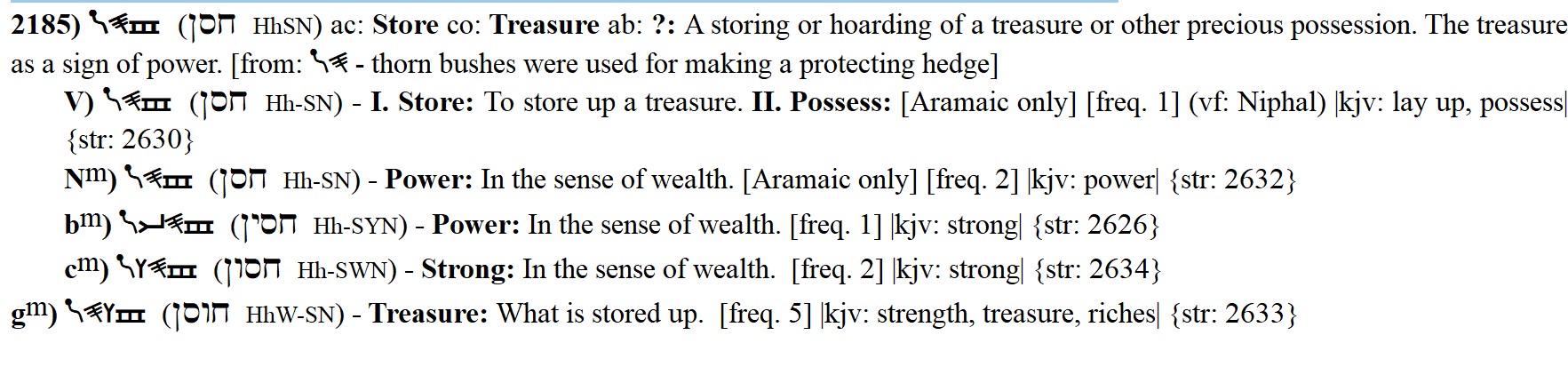
Isa 33:6 And wisdom and knowledge shall be the stability (אמונה ’emunah’) of thy times, and strength (חסן ‘chosen’ – treasure) of salvation (ישועה ‘yeshua’ – source of the name Jesus): the fear of the LORD is his treasure (אוֹצָר ‘otsar’).
Septuagint
Isa 33:6 They shall be delivered up to the law: our salvation is our treasure: there are wisdom and knowledge and piety toward the Lord; these are the treasures of righteousness.
חסן ‘chosen’ displays the treasury, Garden hedge imagery
Noah Webster
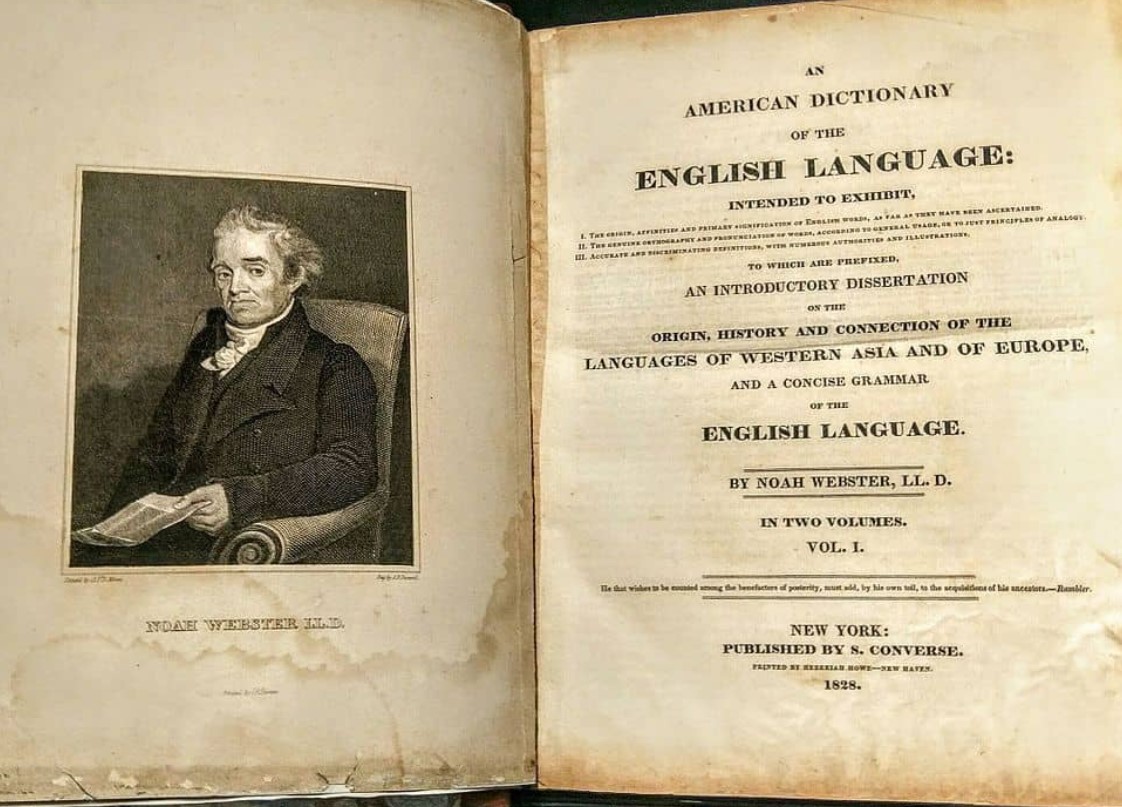
Noah Webster’s 1828 Dictionary is considered the foundation of American English. He compiled over 70,000 words with detailed etymologies and Biblical references.
Webster believed a dictionary should not only define words but also shape character and preserve truth. He wrote in the preface:“The Christian religion must be the basis of any government intended to secure the rights and privileges of a free people.”
Webster traced words back to their roots (often Hebrew, Greek, Latin) because he believed understanding the origin revealed the true nature of a concept.
“The etymology of words, or the knowledge of their origin, is of great importance in ascertaining their true meaning.”
He saw language as a “common treasure.”
“Language is the common property of a nation… It is a treasure which every individual has a right to use, but which no one has a right to corrupt.”
“The purity of language is one of the greatest blessings a nation can enjoy.”
American Minute with Bill Federer – APR. 14- Webster’s Dictionary was Bible-based
“Noah Webster first published his American Dictionary of the English Language on APRIL 14, 1828.
In order to evaluate the etymology of words, he learned 26 languages, including Old English, German, Greek, Latin, Italian, Spanish, French, Hebrew, Arabic, and Sanskrit.
Taking over two decades to complete, Webster’s Dictionary provided over 30,000 new definitions, standardized spelling and gave American English its identity.
Noah Webster wrote in the Preface of his 1828 Dictionary:
“To that great and benevolent Being…who has borne me and my manuscripts in safety across the Atlantic, and given me strength and resolution to bring the work to a close, I would present the tribute of my most grateful acknowledgments.”
Using the King James Version, Webster’s 1828 American Dictionary contained the greatest number of Biblical definitions given in any reference volume.
Noah Webster wrote:
“The Bible should be the standard of language as well as of faith.”
Webster’s 1828 Dictionary defined “FAITH” as:
“That firm belief of God’s testimony, and of the truth of the Gospel, which influences the will, and leads to an entire reliance on Christ for salvation.
‘Being justified by faith’ Rom.v.;
‘Without faith it is impossible to please God’ Heb.xi.;
‘For we walk by faith, not by sight’ 2Cor.v.;
‘With the heart man believeth to righteousness’ Rom.x.;
‘Your faith is spoken of throughout the whole world’ Rom.i.;
‘Hast thou faith? Have it to thyself before God’ Rom.xiv.;
‘Children in whom is no faith’ Deut.xxxii.”
Webster’s 1828 Dictionary defined “LAW OF NATURE” as:
“Rule or conduct arising out of the natural relations of human beings established by the Creator, and existing prior to any positive precept.
Thus it is a Law of Nature, that one man should not injure another, and murder and fraud would be crimes, independent of any prohibition from a supreme power…
A rule of direction; a directory; as reason and natural conscience.
‘These, having not the law, are a law to themselves.’ Rom.ii.”
Webster’s 1828 Dictionary defined “RELIGION” as:
“A belief in the being and perfections of God, in the revelation of His will to man, in man’s obligation to obey His commands, in a state of reward and punishment, and in man’s accountableness to God…
The practice of moral duties without a belief in a divine lawgiver, and without reference to his will or commands, is not religion.”
Webster’s 1828 Dictionary defined “PROVIDENCE” as:
“The care and superintendence which God exercises over his creatures… Some persons admit a general providence, but deny a particular providence, not considering that a general providence consists of particulars.
A belief in divine providence is a source of great consolation to good men. By divine providence is understood God himself.”
Webster’s 1828 Dictionary defined “PROPERTY” as:
“The exclusive right of possessing, enjoying and disposing of a thing; ownership. In the beginning of the world, the Creator gave to man dominion over the earth…
It is one of the greatest blessings of civil society that the property of citizens is well secured.”
Regarding “PROPERTY,” Noah Webster wrote in the preface of his Dictionary, republished 1841:
“Let the people have property and they will have power – a power that will forever be exerted to prevent a restriction of the press, and abolition of trial by jury, or the abridgement of any other privilege.”
Noah Webster had served as a soldier in the Revolutionary War.
In 1781, Webster received his Master’s Degree from Yale, with his dissertation:
“On the universal diffuse of literature as introductory to the universal diffusion of Christianity.”
Related studies:
Shadows of Messiah – Etymology
Daily Tidbits 6/27/26 – The Law
littleguyintheeye@gmail.com


