

The Hebrew word תורה (Torah) reveals the very heart and mind of God — His will, His instruction, and His love letter to mankind. Far from a rigid legal code, the Torah is the divine blueprint that marks out the borders of His people, points the way of life, and finds its perfect fulfillment in Jesus Christ, the living Word made flesh.
The Torah is an interesting word in that it comes from two roots. One is תר ‘tar’ which means an image or outline, and the other is יר ‘yar’ which means to teach or pointing in the right direction. This study explores the deep biblical meaning of Torah, its connection to the heart (lev), its role in forming Messiah’s character in us, and how the entire Scriptures point to the One whose name is called The Word of God.
Torah as God’s Heart: The Torah reveals the very heart and mind of God. It is His will, His character of love, and the divine blueprint that points the way of life.
Fulfillment in Messiah: Jesus is the living Torah — the Word made flesh (John 1:14). He is the perfect embodiment of God’s Torah. His name is called “The Word of God” (Revelation 19:13), and the nations wait for “His law” which is fulfilled in His name/character.
New Covenant Reality: The true Torah is God’s law written on the heart (Jeremiah 31:31-34) by the Holy Spirit, producing the fruit of love and transforming believers into the image of Christ (who is love — 1 John 4:8).
Purpose of Torah: Not to make men religious or to bring perfection through the letter (which kills), but to reform humanity into the image of a loving God. It is the “perfect law of liberty” when written on the heart by the Spirit.
Torah = Love: The true intent of the Torah is love — love for God and neighbor. This love is the bond of perfection that sets us free and unites Jew and Gentile in Messiah.
Jesus is the Torah: He is the living Word/Torah. Believing in Him and abiding in His love fulfills the heart of all instruction. His Name is the Word…the Word is the Torah (Isaiah 5:24)…His Name is the Torah…Jesus is the Word…Jesus is the Torah. This is not to say Jesus is the law of Moses however, this is to say Jesus is the Word of God, the Image of God.
The Word of God is perfect (Psalm 19:7; James 1:25), but cannot bring man to perfection because man is not perfect (Hebrews 7:19; 10:1). The Word of God is the ‘perfect law of liberty’ but men who have tried to walk in this perfect law have never seen true liberty because of the sin which dwells within man enslaves Him (Romans 7:14-25; 9:31-32). It is only through the law of liberty being implanted into the heart of man that a change can occur which leads to perfection (Ezekiel 11:19-20; Romans 2:28-29; Colossians 2:11-13; 2 Corinthians 3:3, 6, 17-18).
It is through this ‘circumcision of the heart’ that the true intent of the law can be revealed in the lives of believers. The true intent of the law of God is not to make men religious but to reform men into the image of their God who is love (1 John 4:8). It is this love that unites us and perfects us. It is the bond of perfection (Colossians 3:14) which sets man free (Galatians 5:13-14).
2Co 3:6 Who also hath made us able ministers of the new testament; not of the letter, but of the spirit: for the letter killeth, but the spirit giveth life.
Joh 6:63 It is the Spirit that gives life. The flesh does not profit, nothing! The Words which I speak to you are spirit and are life.
Rom 8:2 For the law of the Spirit of life in Christ Jesus hath made me free from the law of sin and death.
1Co_9:20 And unto the Jews I became as a Jew, that I might gain the Jews; to them that are under the law, as under the law, that I might gain them that are under the law;
1Co_9:21 To them that are without law, as without law, (being not without law to God, but under the law to Christ,) that I might gain them that are without law.
Gal_5:18 But if ye be led of the Spirit, ye are not under the law.
“The vital relationship which the Christian has to the Bible is not that he worships the letter, but that the Holy Spirit makes the words of the Bible spirit and life to him.” –Oswald Chambers, in The Psychology of Redemption from The Quotable Oswald Chambers.
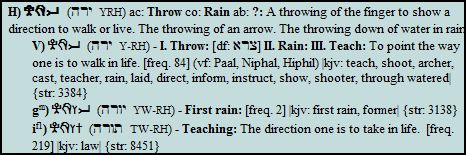
תר ‘tar’ is the root of the Hebrew words which mean to mark out תאר t’ar or a form תוא to’ar. The word תור tor/toor means a border or a circle and is the origin of the English word tour. Literally, the Torah is what defines, gives borders to a people. It is the finger of God pointing the direction in which we are to go and marking out the borders in which we should stay in order to walk in His camp.
Isaiah prophesied that the Messiah would come with His law.
Isa 42:4 He shall not fail nor be discouraged, till he have set judgment in the earth: and the isles shall wait for his law.
Matthew applies this prophecy of Isaiah to Jesus Christ.
Mat 12:18 Behold my servant, whom I have chosen; my beloved, in whom my soul is well pleased: I will put my spirit upon him, and he shall shew judgment to the Gentiles.
Mat 12:19 He shall not strive, nor cry; neither shall any man hear his voice in the streets.
Mat 12:20 A bruised reed shall he not break, and smoking flax shall he not quench, till he send forth judgment unto victory.
Mat 12:21 And in his name shall the Gentiles trust.
Isa 51:4 Hear Me, My people; yea, give ear to Me, My nation. For a law shall go out from Me, and My justice I will make rest as light to peoples.
Isa 51:5 My righteousness is near; My salvation went out; and My arms shall judge peoples; coastlands shall wait on Me, and they shall hope on My arm.
Jas 4:12 There is one lawgiver, who is able to save and to destroy: who art thou that judgest another?
Isaiah prophecies that the nations would wait for the law of Messiah. Matthew references this prophesy but says the nations shall wait for His name. The “name” of Jesus is the Word of God (Revelation 19:13), His character.
The New Covenant is God’s law/Torah written upon our hearts (Jeremiah 31:31-34; Hebrews 8:8-13), His character of love (John 13:34-35; 15:10-12; 1 John 4:21; James 2:8; Romans 13:8-10; Galatians 5:14), His Spirit dwelling within us (John 14:15-18; 1 John 3:22-24), God working in us (Philippians 2:13), transforming us into the image of Jesus Christ (Hebrews 13:21; Ephesians 3:17-20; Colossians 3:10; Romans 8:29; 1 John 4:8).
Messiah came to earth in the very image of Almighty God (2 Corinthians 4:4; Colossians 1:15; Hebrews 1:3), who is love. His life displayed that love and He calls all those who believe in Him to display that love as well. This is the essence of the concept of ‘Christ in us.’ It is through His love that man is formed into His image (Colossians 3:10; Romans 8:29) where there is no longer Jew or Greek, Barbarian or Scythian but Christ is all and in all (Colossians 3:11). This is the true essence of what the Torah is.
The true intent of the law/Word of God is not to make men religious but to reform men into the image of their God who is love (1 John 4:8). It is this love that unites us and perfects us. It is the bond of perfection (Colossians 3:14) which sets man free (Galatians 5:13-14). This love is not intended only for a certain group of religious people, but for all mankind. Scripture declares that in the Messiah shall the ‘gentiles trust’ (Matthew 12:21; Romans 15:8-12; Isaiah 11:10). For Jesus is the true Light which enlightens every man (John 1:9; 12:44-46; Isaiah 49:6), sent to restore all of mankind back to God (Isaiah 45:22; Romans 3:29; John 1:12; 3:15-17).
The fruit which Israel was called to produce was the ‘goodly’ fruit of His Word (Jeremiah 11:16). However, Israel did not produce this fruit but brought forth wicked fruit (Jeremiah 24:2-8). As a result, God brought fire upon this olive tree, breaking the branches thereof (Jeremiah 11:16-17).
The Hebrew word for ‘goodly’ in Jeremiah 11:16 is תאר ‘toar’ which means a shape, form, outline or figure of a thing. תאר ‘toar’ is a cognate of the word תורה ‘torah’ which literally means instruction which defines the border of a people or the ‘image’ of a people. תורה ‘torah’ is most commonly translated as ‘law.’ Here we see that Israel was to produce the fruit of His Law which would bring forth His image to the world. His Image is that of love (1 John 4:8, 16; Matthew 22:35-40).
Mat 12:18 Behold my servant, whom I have chosen; my beloved, in whom my soul is well pleased: I will put my spirit upon him, and he shall shew judgment to the Gentiles.
Mat 12:19 He shall not strive, nor cry; neither shall any man hear his voice in the streets.
Mat 12:20 A bruised reed shall he not break, and smoking flax shall he not quench, till he send forth judgment unto victory.
Mat 12:21 And in his name shall the Gentiles trust.
Isa 42:1 Behold my servant, whom I uphold; mine elect, in whom my soul delighteth; I have put my spirit upon him: he shall bring forth judgment to the Gentiles.
Isa 42:2 He shall not cry, nor lift up, nor cause his voice to be heard in the street.
Isa 42:3 A bruised reed shall he not break, and the smoking flax shall he not quench: he shall bring forth judgment unto truth.
Isa 42:4 He shall not fail nor be discouraged, till he have set judgment in the earth: and the isles shall wait for his law.
Rev 19:13 And he was clothed with a vesture dipped in blood: and his name is called The Word of God.
Joh 1:14 And the Word was made flesh, and dwelt among us, (and we beheld his glory, the glory as of the only begotten of the Father,) full of grace and truth.
His Name is the Word…the Word is the Torah (Isaiah 5:24)…His Name is the Torah…Jesus is the Word…Jesus is the Torah. This is not to say Jesus is the law of Moses however, this is to say Jesus is the Word of God, the Image of God.
The Hebrew word for name is שם ‘shem’ which literally means one’s breathe or character. What is the character of the Almighty? Love (1 John 4:8).
The Hebrew word for love is אהב ‘ahav’ which is consists of the letters אב ‘av’ which means father and the middle letter ה ‘heh’ which has the meaning of revelation. The Father revealed. In ancient Hebrew, the letter ה ‘heh’ was depicted as a man with outstretched arms, like unto Messiah on the cross. How was the love of the Father revealed? Through the giving of His only begotten Son on the cross as an atonement for the sins of mankind (John 3:16).
The Word of God is the Lord’s Torah, His “Love Letter”
The true intent of the Torah/Word of God is not to make men religious but to reform men into the image of their God who is love (1 John 4:8). It is this love that unites us and perfects us. It is the bond of perfection (Colossians 3:14) which sets man free (Galatians 5:13-14). This love is not intended only for a certain group of religious people, but for all mankind. Scripture declares that in the Messiah shall the ‘gentiles trust’ (Matthew 12:21; Romans 15:8-12; Isaiah 11:10). For Jesus is the true Light which enlightens every man (John 1:9; 12:44-46; Isaiah 49:6), sent to restore all of mankind back to God (Isaiah 45:22; Romans 3:29; John 1:12; 3:15-17).
Jesus is THE image of God (Hebrews 1:3; 2 Corinthians 4:4-6; Colossians 1:15-16) who is love (1 John 4:8). He revealed God’s name/character to mankind (John 17:6).
The Hebrew word תורה ‘torah’ is commonly translated as ‘law’ but is more properly defined as God’s will or heart/mind, His message to mankind…His ‘love letter.’
The first letter of the Torah is ב ‘bet,’ the last letter of the Torah is ל ‘lamed,’ the last letter of the TaNaKH is also ל ‘lamed.’ Both forwards בל ‘bal’ and in reverse לב ‘lev’ the word for heart is seen.
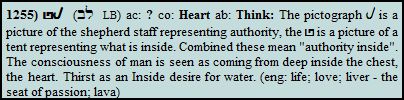
H1079
בּל (Aramaic)
bâl
BDB Definition:
1) mind, heart
The Torah/TaNaKH is the ‘heart’ of God which He desires to form in our heart (Psalm 119:32; Isaiah 51:7; Philippians 2:8).
Psa 119:32 I will run the way of thy commandments, when thou shalt enlarge my heart.
Isa 51:7 Hearken unto me, ye that know righteousness, the people in whose heart is my law; fear ye not the reproach of men, neither be ye afraid of their revilings.
Php 2:5 Let this mind be in you, which was also in Christ Jesus:
Php 2:13 For it is God which worketh in you both to will and to do of his good pleasure.
This concept can be applied to the entire Scriptures as well. The first letter of the TaNaKH ב ‘bet’ and the last letter of the New Testament Scriptures ן ‘nun.’
בן ‘ben’ = Son

Reversed is נב ‘nav’ = Fruit/Prophecy

Here it can be seen that the Torah/TaNaKH is the heart/mind of God. When combined with the New Testament the Son/ Fruit /Prophecy of His Mind/Heart is brought forth.
The Word is likened to seed (Luke 8:11). The fruit is the actions and words that come forth from man who is born again by the Word (1Peter 1:23; 1John 3:0; James 1:18, 21).
The Fruit of the Spirit
Gal 5:22 But the fruit of the Spirit is love, joy, peace, longsuffering, gentleness, goodness, faith,
Gal 5:23 Meekness, temperance: against such there is no law.
There are 9 fruit of the Spirit, which correspond to 9 gifts of the Spirit
1Co 12:6 And there are diversities of operations, but it is the same God which worketh all in all.
1Co 12:7 But the manifestation of the Spirit is given to every man to profit withal.
1Co 12:8 For to one is given by the Spirit the word of wisdom (1); to another the word of knowledge (2) by the same Spirit;
1Co 12:9 To another faith (3) by the same Spirit; to another the gifts of healing (4) by the same Spirit;
1Co 12:10 To another the working of miracles (5); to another prophecy (6); to another discerning of spirits (7); to another divers kinds of tongues (8); to another the interpretation of tongues (9):
1Co 12:11 But all these worketh that one and the selfsame Spirit, dividing to every man severally as he will.
The Hebrew word for nine is תשע ‘tesha’ which comes from the root שע meaning the shepherd.

This is also the root of the word ישועה ‘yeshuah’ from whence comes the name of our Savior.
The numerical value of תורה ‘torah’ is 611 which is equivalent with יהוה אלהים צבאות ‘Yahweh Elohim Tsevaot’ (Lord God of Hosts). Scripture declares this is the ‘name’ of God.
Jer_15:16 Thy words were found, and I did eat them; and thy word was unto me the joy and rejoicing of mine heart: for I am called by thy name, O LORD God of hosts.
Jer_32:18 Thou shewest lovingkindness unto thousands, and recompensest the iniquity of the fathers into the bosom of their children after them: the Great, the Mighty God, the LORD of hosts, is his name,
Amo_4:13 For, lo, he that formeth the mountains, and createth the wind, and declareth unto man what is his thought, that maketh the morning darkness, and treadeth upon the high places of the earth, The LORD, The God of hosts, is his name.
HIS NAME
Mat 12:18 Behold my servant, whom I have chosen; my beloved, in whom my soul is well pleased: I will put my spirit upon him, and he shall shew judgment to the Gentiles.
Mat 12:19 He shall not strive, nor cry; neither shall any man hear his voice in the streets.
Mat 12:20 A bruised reed shall he not break, and smoking flax shall he not quench, till he send forth judgment unto victory.
Mat 12:21 And in his name shall the Gentiles trust.
Isa 42:1 Behold my servant, whom I uphold; mine elect, in whom my soul delighteth; I have put my spirit upon him: he shall bring forth judgment to the Gentiles.
Isa 42:2 He shall not cry, nor lift up, nor cause his voice to be heard in the street.
Isa 42:3 A bruised reed shall he not break, and the smoking flax shall he not quench: he shall bring forth judgment unto truth.
Isa 42:4 He shall not fail nor be discouraged, till he have set judgment in the earth: and the isles shall wait for his law.
Rev 19:13 And he was clothed with a vesture dipped in blood: and his name is called The Word of God.
Joh 1:14 And the Word was made flesh, and dwelt among us, (and we beheld his glory, the glory as of the only begotten of the Father,) full of grace and truth.
His Name is the Word…the Word is the Torah…His Name is the Torah…Jesus is the Word…Jesus is the Torah. This is not to say Jesus is the law of Moses. This is to say Jesus is the perfect image of God’s will. He is the true Torah. The law of Moses was a shadow.
Isa 5:24 Therefore as the fire devoureth the stubble, and the flame consumeth the chaff, so their root shall be as rottenness, and their blossom shall go up as dust: because they have cast away the law of the LORD of hosts, and despised the word of the Holy One of Israel.
The Hebrew word for name is שם ‘shem’ which literally means one’s breathe or character. What is the character of the Almighty? Love (1 John 4:8).
The Hebrew word for love is אהב ‘ahav’ which is consists of the letters אב ‘av’ which means father and the middle letter ה ‘heh’ which has the meaning of revelation. The Father revealed. In ancient Hebrew, the letter ה ‘heh’ was depicted as a man with outstretched arms, like unto Messiah on the cross. How was the love of the Father revealed? Through the giving of His only begotten Son on the cross as an atonement for the sins of mankind (John 3:16).
Further connecting the Name of God to His character of love and the revelation of this love at Calvary is seen in the ancient pictograph meanings of the Sacred Name.
The pictographs of יהוה speak of Him being revealed through the nails in His Hands.
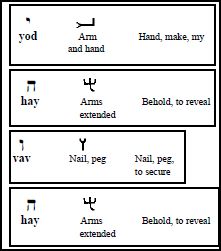
It is God’s name/character of love that is written in the heads of His redeemed people (Revelation 22:4). The prophet Ezekiel was shown that His mark is depicted in the letter ת ‘tav’ which was written in ancient times as the image of the cross (Ezekiel 9:4).
The word תורה ‘torah’ also pictographically displays Messiah on the cross, revealing the love of God.
ת – cross
ו – nail
ר – head, leader
ה – man with outstretched arms
Jesus’ declaration of God’s love was manifest on the cross.
Psa 22:22 I will declare thy name unto my brethren: in the midst of the congregation will I praise thee.
Heb 2:10 For it became him, for whom are all things, and by whom are all things, in bringing many sons unto glory, to make the captain of their salvation perfect through sufferings.
Heb 2:11 For both he that sanctifieth and they who are sanctified are all of one: for which cause he is not ashamed to call them brethren,
Heb 2:12 Saying, I will declare thy name unto my brethren, in the midst of the church will I sing praise unto thee.
The English word love is related Etymologically to the Hebrew word לב ‘lev’ which means the heart. Scripture declares that out of the abundance of the heart, the mouth speaks (Matthew 12:34-35). If one reads this portion of Scripture, it is seen that the subject of blasphemy is directly related to the words which one speaks dependent upon the state of their heart (Matthew 12:24-37). Messiah declares that the origin of blasphemy comes from the heart (Mark 7:20-23). What is the remedy to overcome this? The Love of God (Colossians 3:8-14). We are to sanctify the name of God in our hearts (1 Peter 3:15) by abiding in His love (Romans 11:16; John 15:1-10).
The Torah is an interesting word in that it comes from two roots. One is תר ‘tar’ which means an image or outline, and the other is יר ‘yar’ which means to teach or pointing in the right direction.
Exo 24:12 And Jehovah said to Moses, Come up to Me to the mountain, and be there. And I will give to you the tablets of stone, and the Law, and the commandments which I have written, to teach them.
Both Law and Teach in the above verse come from the same root word
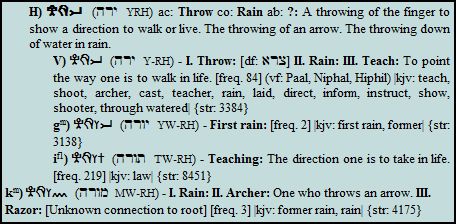
The other root is תר ‘tar.’

תר ‘tar’ is the root of the Hebrew words which mean to mark out תאר t’ar or a form תוא to’ar. The word תור tor/toor means a border or a circle and is the origin of the English word tour. Literally, the Torah is what defines, gives borders to a people. It is the finger of God pointing the direction in which we are to go and marking out the borders in which we should stay in order to walk in His camp.

The Torah = the Word
Num 15:29 Ye shall have one law for him that sinneth through ignorance, both for him that is born among the children of Israel, and for the stranger that sojourneth among them.
Num 15:30 But the soul that doeth ought presumptuously, whether he be born in the land, or a stranger, the same reproacheth the LORD; and that soul shall be cut off from among his people.
Num 15:31 Because he hath despised the word of the LORD, and hath broken his commandment, that soul shall utterly be cut off; his iniquity shall be upon him.
Deu 5:2 The LORD our God made a covenant with us in Horeb.
Deu 5:3 The LORD made not this covenant with our fathers, but with us, even us, who are all of us here alive this day.
Deu 5:4 The LORD talked with you face to face in the mount out of the midst of the fire,
Deu 5:5 (I stood between the LORD and you at that time, to shew you the word of the LORD: for ye were afraid by reason of the fire, and went not up into the mount;) saying,
Isa 1:10 Hear the word of the LORD, ye rulers of Sodom; give ear unto the law of our God, ye people of Gomorrah.
Isa 5:24 Therefore as the fire devoureth the stubble, and the flame consumeth the chaff, so their root shall be as rottenness, and their blossom shall go up as dust: because they have cast away the law of the LORD of hosts, and despised the word of the Holy One of Israel.
Isa 2:2 And it shall come to pass in the last days, that the mountain of the LORD’S house shall be established in the top of the mountains, and shall be exalted above the hills; and all nations shall flow unto it.
Isa 2:3 And many people shall go and say, Come ye, and let us go up to the mountain of the LORD, to the house of the God of Jacob; and he will teach us of his ways, and we will walk in his paths: for out of Zion shall go forth the law, and the word of the LORD from Jerusalem.
Mic 4:2 And many nations shall come, and say, Come, and let us go up to the mountain of the LORD, and to the house of the God of Jacob; and he will teach us of his ways, and we will walk in his paths: for the law shall go forth of Zion, and the word of the LORD from Jerusalem.JESUS IS THE WORD MADE FLESH
Joh 1:1 In the beginning was the Word, and the Word was with God, and the Word was God.
Joh 1:2 The same was in the beginning with God.
Joh 1:3 All things were made by him; and without him was not any thing made that was made.
Joh 1:14 And the Word was made flesh, and dwelt among us, (and we beheld his glory, the glory as of the only begotten of the Father,) full of grace and truth.
Psa 33:6 By the word of the LORD were the heavens made; and all the host of them by the breath of his mouth.
1Jo 1:1 That which was from the beginning, which we have heard, which we have seen with our eyes, which we have looked upon, and our hands have handled, of the Word of life;
1Jo 1:2 (For the life was manifested, and we have seen it, and bear witness, and shew unto you that eternal life, which was with the Father, and was manifested unto us;)
One cannot believe/follow God’s Torah without believing in His Son.
Believing in the Messiah is the most important commandment in the Word. The Messiah said that the work of God is to believe on Him (John 6:29), the Apostle John later said His commandment is to believe in Christ (1 John 3:23) for knowing the Father & the Son is eternal life (John 17:3). The greatest commandments in the Torah are love God and love our fellow man from which all the commandments hang (Matthew 22:35-40). When we believe in Messiah and know Him, we walk in this love (1 John 2:4; 5:2-3) for He is love (1 John 4:8-20). We can do nothing unless we abide in Him, hence belief in Him is indeed the most important command for it encompasses the two great commandments (John 15:1-10).
The Holy Scriptures equate Jesus with the Torah:
Deu 30:11 For this commandment which I command thee this day, it is not hidden from thee, neither is it far off.
Deu 30:12 It (הוא=he) is not in heaven, that thou shouldest say, Who shall go up for us to heaven, and bring it unto us, that we may hear it, and do it?
Deu 30:13 Neither is it beyond the sea, that thou shouldest say, Who shall go over the sea for us, and bring it unto us, that we may hear it, and do it?
Deu 30:14 But the word is very nigh unto thee, in thy mouth, and in thy heart, that thou mayest do it.
Deu 30:15 See, I have set before thee this day life and good, and death and evil;
Deu 30:16 In that I command thee this day to love the LORD thy God, to walk in his ways, and to keep his commandments and his statutes and his judgments, that thou mayest live and multiply: and the LORD thy God shall bless thee in the land whither thou goest to possess it.
Rom 10:6 But the righteousness which is of faith speaketh on this wise, Say not in thine heart, Who shall ascend into heaven? (that is, to bring Christ down from above:)
Rom 10:7 Or, Who shall descend into the deep? (that is, to bring up Christ again from the dead.)
Rom 10:8 But what saith it? The word is nigh thee, even in thy mouth, and in thy heart: that is, the word of faith, which we preach;
Psa 40:6 Sacrifice and offering thou didst not desire; mine ears hast thou opened: burnt offering and sin offering hast thou not required.
Psa 40:7 Then said I, Lo, I come: in the volume of the book it is written of me,
Psa 40:8 I delight to do thy will, O my God: yea, thy law is within my heart.
Heb 10:5 Wherefore when he cometh into the world, he saith, Sacrifice and offering thou wouldest not, but a body hast thou prepared me:
Heb 10:6 In burnt offerings and sacrifices for sin thou hast had no pleasure.
Heb 10:7 Then said I, Lo, I come (in the volume of the book it is written of me,) to do thy will, O God.
The Torah is all about Messiah.
Joh 1:45 Philip finds Nathanael and said to him, We have found the One of whom Moses wrote in the Law and the Prophets, Jesus the son of Joseph, from Nazareth.
Joh 5:39 You search the Scriptures, for you think in them you have everlasting life. And they are the ones witnessing concerning Me.
Joh 5:46 For if you were believing Moses, you would then believe Me; for that one wrote concerning Me.
Joh 5:47 But if you do not believe his writings, how will you believe My Words?
Psa 40:7 Then I said, Lo, I come, in the roll of the Book it is written of Me;
Jesus & the Apostles taught from the TaNaKH
Luk 24:27 And beginning from Moses, and from all the prophets, He explained to them the things about Himself in all the Scriptures.
Luk 24:44 And He said to them, These are the Words which I spoke to you yet being with you, that all the things must be fulfilled having been written in the Law of Moses, and the Prophets, and the Psalms, concerning Me.
Luk 24:45 Then He opened up their mind to understand the Scriptures,*
*Notice, the Scriptures are a sealed book (Isaiah 29:10-11), it is only through the Spirit of the Messiah that our eyes are opened, this is a concept seen where the Spirit of God hovers over the waters and commands Light to come forth out of darkness (Genesis 1:2-3; John 3:19; Colossians 1:13)
Act 26:22 Then obtaining help from God, I stand until this day, witnessing both to small and to great, saying nothing else than what the prophets and Moses also said was going to happen:
Act 28:23 And having appointed him a day, more came to him in the lodging, to whom he expounded, earnestly testifying the kingdom of God and persuading them the things concerning Jesus, both from the Law of Moses and the Prophets, from morning until evening.*
*At this point the New Testament Scriptures had not yet been completely compiled. Paul was teaching Messiah from the TaNaKH
1Co 15:3 For I delivered to you in the first place what I also received, that Christ died for our sins, according to the Scriptures,
1Co 15:4 and that He was buried, and that He was raised the third day, according to the Scriptures,*
*At the point of this Epistle, the New Testament Scriptures were not completely compiled. Paul was speaking of the TaNaKH
2Ti 3:15 and that from a babe you know the Holy Scriptures, those being able to make you wise to salvation through belief in Christ Jesus.
Messiah in the Torah
Here we see the precedent set that the Torah is used to exhort believers, but most importantly, to teach them about Messiah
Act 13:14 But going through from Perga, they came to Antioch-Pisidia, and going into the synagogue on the day of the sabbaths, they sat down.
Act 13:15 And after the reading of the Law, and of the Prophets, the synagogue rulers sent to them, saying, Men, brothers, if there is a word of exhortation to the people, speak.
Act 13:16 And rising up, and signaling with his hand, Paul said, Men, Israelites, and the ones fearing God, listen.
Act 13:17 The God of this people Israel chose out our fathers, and exalted the people in their stay in the land of Egypt. And with a high arm, He led them out of it.
Act 13:18 And as forty years time passed, He tenderly bore them in the wilderness. Deut. 1:31
Act 13:19 And He pulled down seven nations in Canaan land, and gave their land to them as an inheritance. Deut. 7:1
Act 13:20 And after these things, as four hundred and fifty years passed, He gave judges until Samuel the prophet.
Act 13:21 And from there they asked for a king. And God gave Saul the son of Kish to them, a man of the tribe of Benjamin, for forty years.
Act 13:22 And removing him, He raised up to them David for a king, to whom He also said, witnessing, “I found David” the son of Jesse “to be a man according to My own heart, who will do all My will.” 1 Samuel 13:14; Psa. 89:20; LXX-Isa. 44:28
Act 13:23 Of the seed of this one, according to promise, God raised up to Israel a Savior, Jesus;
Act 13:24 John going before to proclaim before the face of His entrance a baptism of repentance to all the people of Israel.
Act 13:25 And as John fulfilled the course, he said, Whom do you suppose me to be? I am not He, but, behold, “He comes after me, of whom I am not worthy to loosen the sandal of His feet.” John 1:27
Act 13:26 Men, brothers, sons of the race of Abraham, and the ones among you fearing God, to you the Word of this salvation was sent.
Act 13:27 For those dwelling in Jerusalem, and their rulers, not having known this One, and the voices of the prophets being read throughout every sabbath, condemning Him, they fulfilled the Scriptures.
Act 13:28 And finding not one cause of death, they asked Pilate to do away with Him.
Act 13:29 And when they finished all the things having been written concerning Him, taking Him down from the tree, they laid Him in a tomb.
Act 13:30 But God raised Him from the dead;
Act 13:31 who appeared for many days to those coming up with Him from Galilee to Jerusalem, who are witnesses of Him to the people.
Act 13:32 And we preach the gospel to you, the promise made to the fathers,**
**The Gospel being spoken of was written in the TaNaKH
(1 Peter 1:25; Psalm 68:11; Acts 10:34-36; Romans 1:1-4; Ephesians 1:13; Colossians 1:5-6)
The Gospel is the promise to Abraham (Galatians 3:8, 16; Romans 4:13), the promise =the Word (Deuteronomy 6:3 דבר ‘dabar’=Word/Promise) the promise = the Messiah (Jeremiah 33:14-16) the promise = eternal life (1 John 2:25; Genesis 17:8)
Act 13:33 that this God has fulfilled to us, their children, raising up Jesus; as also it has been written in the second Psalm, “You are My Son, today I have begotten You.” Psa. 2:7
Act 13:34 And that He raised Him from the dead, no more being about to return to corruption, so He has said, “I will give You” “the holy things of faithful David.” Isa. 55:3
Act 13:35 So He also said in another, “You will not give Your Holy One to see corruption.” LXX-Psa. 15:10; MT-Psa. 16:10
Act 13:36 For having served his own generation by the counsel of God, David truly fell asleep and was added to his fathers and saw corruption. 1 Kg. 2:10
Act 13:37 But He whom God raised up, this One did not see corruption.
Act 13:38 Then let it be known to you, men, brothers, that through this One remission of sin is announced to you.
Act 13:39 And everyone believing in this One is justified from all things which you could not be justified by the Law of Moses.
Act 13:40 Then watch that the thing spoken in the Prophets may not come on you:
Act 13:41 “Behold, you despisers,” “and marvel,” “and perish, because I work a work in your days,” a work which you would “in no way believe if anyone declares it to you.” Hab. 1:5
Act 13:42 But the Jews having gone out of the synagogue, the nations begged that these words be spoken to them on the next sabbath.
The Messiah is revealed from the TaNaKH in a step by step method (Isaiah 28:10). The Torah is designed to lead us in the paths of righteousness which are used to bring forth the Truth and to separate our incorrect notions about the Word.
Psa 23:3 He restores my soul; He guides me in paths* of righteousness for His name’s sake.
H4570
ma‛gâl / ma‛gâlâh
BDB Definition:
1) entrenchment, track מעגּלה / מעגּל
This word comes from the root עגּל ‘agal’ which means round or a bullock as in a bullock circling around in play. מעגל ‘ma’gal’ literally means the trench made from the wheels of carts that are pulled by oxen to tread grain, thus making trenches or ruts. This is what the meaning of being a disciple is all about. The yoke of the oxen, the yoke of learning. An older experienced ox is yoked to a younger inexperienced one in order to teach it how to pull a load…Learning through being yoked to the Master (Mtt 11:29)
Act 9:22 But Saul was more filled with power, and he confounded the Jews living in Damascus, proving* that this One is the Christ.
*G4822
συμβιβάζω
sumbibazō
Thayer Definition:
1) to cause to coalesce, to join together, put together
1a) to unite or knit together: in affection
2) to put together in one’s mind
2a) to compare
2b) to gather, conclude, consider
3) to cause a person to unite with one in a conclusion or come to the same opinion, to prove, demonstrate
3a) to teach, instruct, one
Part of Speech: verb
A Related Word by Thayer’s/Strong’s Number: from G4862 and bibazo (to force, causative [by reduplication] of the base of G939)<–stepping with the foot
The meaning of the above where Paul proves Messiah from the Scriptures is by joining together Scriptures step by step, knitting together the meaning.
Paul’s custom was to go into synagogues on the Sabbath days, when the Torah portions were read and to show Messiah to those in the synagogue in that Torah portion.
Act 17:2 And according to Paul’s custom, he went in to them and reasoned with them from the Scriptures on three sabbaths,
Act 17:3 opening and setting forth that the Christ must have suffered, and to have risen from the dead, and that this is the Christ, Jesus, whom I announce to you.
Act 17:4 And some of them were persuaded and joined themselves to Paul and Silas, both a great multitude of the worshiping Greeks, and not a few of the leading women.
Act 28:23 And having appointed him a day, more came to him in the lodging, to whom he expounded, earnestly testifying the kingdom of God and persuading them the things concerning Jesus, both from the Law of Moses and the Prophets, from morning until evening.
Messiah Jesus taught that the TaNaKH was written about Himself. His custom was to teach in the synagogues each sabbath as well.
Luk 4:16 And He came to Nazareth where He was brought up. And as was His custom, He went in on the day of the sabbaths, into the synagogue, and He stood up to read.
“The motto of all true servants of God must be, ‘We preach Christ; and him crucified.’ A sermon without Christ in it is like a loaf of bread without any flour in it.
No Christ in your sermon, sir? Then go home, and never preach again until you have something worth preaching.” {Charles Spurgeon}
The Torah portions (and every other exposition/commentary of Scripture) is naught without Jesus as the focus.
Php 3:8 Yea doubtless, and I count all things but loss for the excellency of the knowledge of Christ Jesus my Lord: for whom I have suffered the loss of all things, and do count them but dung, that I may win Christ,
Php 3:9 And be found in him, not having mine own righteousness, which is of the law, but that which is through the faith of Christ, the righteousness which is of God by faith:
Php 3:10 That I may know him, and the power of his resurrection, and the fellowship of his sufferings, being made conformable unto his death;
Php 3:11 If by any means I might attain unto the resurrection of the dead.
A lot of religious denominations/movements go down the wrong path when they take their eyes of of Jesus and get focused on other things (even if they are Biblically based). Our Bible interpretations/discussions are not always negative but are dung in comparison to knowing Him. However, dung is spread upon ground as manure to help seed grow. Our Bible interpretations/discussions/sermons should help the Seed/Word (who is Messiah) grow in our hearts otherwise they are worthless.
The Hebrew word for dung is פרש ‘parash’ which is the root of the word פרשה ‘parsha’ (as in the Torah parshot/portion) as a ‘parsha’ is a “spreading” out of an event/Scripture portion as dung is spread in a field. Scripture alludes to the meeting together of believers whose focus is not on Messiah {ie. the Name/Character of God} (Malachi 2:3) and calls these feasts dung. The purpose of the feasts/sabbaths is to reveal Messiah (Colossians 2:17).
If our interpretations and discussions of the Word don’t draw one closer to Messiah (the Word made flesh) then they are fruit from the tree of knowledge of good and evil which is the origin of idolatry.
Interestingly, in Deuteronomy 29:17, the word idol has a footnote in the 1611 KJV of “dungy gods”. This is because the word in Hebrew is גללול ‘gillul’ which is speaking of dung. Perhaps this is why in 2 Kings 10:27 we see the house of Baal being made into a “draught house” by Jehu.
Further connecting this dung-idolatry-tree of knowledge concept is the Hebrew word צפוע ‘tsephua’ which means dung. The root of this word is צפע ‘tsepha’ which is translated as ‘cockatrice/adder’ in Scripture as the tongue “issues” out of the mouth of a serpent as dung “issues” out via excretion. In the beginning the “issue” out of the mouth of the serpent was to lead man away from their Creator, who is Messiah (Ephesians 3:9; 1 Corinthians 8:6; John 1:1-3; Colossians 1:12-17; Hebrews 1:1-12).
When we discuss the Scriptures are we bringing forth the poison of the serpent (Psalm 58:3-4; 140:3; Romans 3:13; James 3:8) or are we issuing forth the life giving oracles of God (1 Peter 4:11)?
1Pe 4:11 If any man speak, let him speak as the oracles of God; if any man minister, let him do it as of the ability which God giveth: that God in all things may be glorified through Jesus Christ, to whom be praise and dominion for ever and ever. Amen.
When we meet to discuss the Scriptures are we using the Word to bring forth accusations and condemnations of our fellow man or are we using the Word to edify one another, speaking the truth in love? Are we meeting together to divide His house or are we meeting together to stand in His grace, mercy and forgiveness?
The Lord Jesus warned believers of those who did not bring forth fruit after their “field” was given dung that their “tree” would be cut down (Luke 13:8-9). The “vineyard” that rejects Messiah Jesus and does not bring forth the fruit of His Word/Spirit will be destroyed (Matthew 21:33-43). This was also the warning of John the Baptist (Luke 3:8-9) {“Elijah message“}. Yet, if we seek His Face at all times (1 Chronicles 16:11) we will see Jesus (Hebrews 1:3; 2 Corinthians 4:4-6) and we will not be unfruitful (2 Peter 1:4-9).
Why is the Spirit not moving amongst His people as it did in days of old? Perhaps its because of all the ‘dung’ in our temples. We need to bury this dung (Deuteronomy 23:13-14) as Jacob buried the idols of his family (Genesis 35:2) if we want Him to walk amongst us.
Deu 23:13 And thou shalt have a paddle upon thy weapon; and it shall be, when thou wilt ease thyself abroad, thou shalt dig therewith, and shalt turn back and cover that which cometh from thee:
Deu 23:14 For the LORD thy God walketh in the midst of thy camp, to deliver thee, and to give up thine enemies before thee; therefore shall thy camp be holy: that he see no unclean thing in thee, and turn away from thee.
Torah = the Bible
All of God’s teaching is considered Torah…ALL of the Scriptures.
The Torah of Moses and the Torah of the LORD are synonymous terms
Luk 2:22 And when the days of her cleansing according to the Law of Moses were fulfilled, they took Him up to Jerusalem to present Him to the Lord,
Luk 2:23 as it has been written in the Law of the Lord: Every male opening a womb shall be called holy to the Lord; Ex. 13:2
Paul spoke of the Prophets as Torah
1Co 14:21 It has been written in the Law, “By other languages” and “by other lips” “I will speak to this people,” “and even so they will not hear” Me, says the Lord.
This is referring to Isaiah 28:11-12
Isa 28:11 For with stammering lip and other languages, He will speak to this people;
Isa 28:12 to whom He said, This is the rest; cause the weary to rest. Also, This is the repose. But they willed not to hear.
Jesus spoke of the Psalm as Torah
Joh 10:34 Jesus answered them, Has it not been written in your Law, “I said, you are gods”?
This is referring to Psalm 82:6
Psa 82:6 I have said, You are gods, and all of you are sons of the Most High.
The Author of the Scripture is the Holy Spirit
2Ti 3:15 and that from a babe you know the Holy Scriptures, those being able to make you wise to salvation through belief in Christ Jesus.
2Ti 3:16 All Scripture is God-breathed and profitable for doctrine, for reproof, for correction, for instruction in righteousness,
2Ti 3:17 so that the man of God may be perfected, being fully furnished for every good work.
Psalms
Heb 3:7 Because of this, even as the Holy Spirit says, “Today, if you hear His voice,
This is referring to Psalm 95:7
Mat 22:43 He said to them, Then how does David in Spirit call Him Lord, saying,
Mat 22:44 “The Lord said to my Lord, Sit off My right until I should put Your hostile ones as a footstool for Your feet?”
Messiah is referring to Psalm 110.
Peter stated that the Holy Spirit was speaking through David as well.
Act 1:16 Men, brothers, it was necessary for this Scripture to be fulfilled which the Holy Spirit spoke before through David’s mouth concerning Judas, the one having become guide to those seizing Jesus;
Act 1:17 for he was numbered with us, and obtained a portion of this ministry.
Act 1:18 Indeed, then, this one bought a field out of the reward of unrighteousness; and falling headlong, he burst in the middle, and poured out all his bowels.
Act 1:19 And it became known to all those living in Jerusalem, so as that field to be called in their own dialect, Akeldama, that is, Field of Blood.
Act 1:20 For it has been written in the scroll of Psalms, Let his estate become forsaken, and he not be living in it. And, “Let another take his overseership.” LXX-Psa. 68:26; Psa. 108:8; MT-Psa. 69:25; Psa. 109:8
2Pe 1:21 for prophecy was not at any time borne by the will of man, but being borne along by the Holy Spirit, holy men of God spoke.
Book of Isaiah
Act 28:25 And disagreeing with one another, they were let go, Paul saying one word: Well did the Holy Spirit speak through the prophet Isaiah to our fathers,
Book of Jeremiah
Heb 10:15 And the Holy Spirit witnesses to us also. For after having said before,
Heb 10:16 “This is the covenant which I will covenant to them after those days, says the Lord: Giving My Laws on their hearts, and I will write them on their minds;”
Heb 10:17 also He adds, “I will not at all still remember their sins” and their lawlessnesses. MT-Jer. 31:33, 34
The Word comes forth from the Prophets
Dan 9:10 We have not obeyed the voice of the Lord our God, to walk in His laws which he set before us by His servants the prophets.
2Ki 17:13 And Jehovah testified against Israel, and against Judah, by the hand of all His prophets, and every seer, saying, Turn back from your evil ways, and keep My commands, My statutes, according to all the Law that I commanded your fathers, and that I sent to you by the hand of My servants the prophets.
Ezr 9:10 And now, O our God, what shall we say after this? For we have forsaken Your commandments
Ezr 9:11 which You have commanded by Your servants the prophets, saying, The land into which you go, to possess it, it is an unclean land with the impurity of the people of the lands, with their abominations with which they have filled it, from mouth to mouth with their uncleanness.
Zec 7:11 But they refused to listen, and gave a stubborn shoulder, and they made their ears heavy from hearing.
Zec 7:12 And they made their heart adamant from hearing the Law and the Words which Jehovah of Hosts has sent by the former prophets through His Spirit. And great wrath was from Jehovah of Hosts.
The Prophets spoke through the Spirit of Christ
1Pe 1:9 Receiving the end of your faith, even the salvation of your souls.
1Pe 1:10 Of which salvation the prophets have enquired and searched diligently, who prophesied of the grace that should come unto you:
1Pe 1:11 Searching what, or what manner of time the Spirit of Christ which was in them did signify, when it testified beforehand the sufferings of Christ, and the glory that should follow.
1Pe 1:12 Unto whom it was revealed, that not unto themselves, but unto us they did minister the things, which are now reported unto you by them that have preached the gospel unto you with the Holy Ghost sent down from heaven; which things the angels desire to look into.
1Pe 1:13 Wherefore gird up the loins of your mind, be sober, and hope to the end for the grace that is to be brought unto you at the revelation of Jesus Christ;
1Pe 1:14 As obedient children, not fashioning yourselves according to the former lusts in your ignorance:
1Pe 1:15 But as he which hath called you is holy, so be ye holy in all manner of conversation;
1Pe 1:16 Because it is written, Be ye holy; for I am holy.
Rev 19:10 And I fell at his feet to worship him. And he said unto me, See thou do it not: I am thy fellowservant, and of thy brethren that have the testimony of Jesus: worship God: for the testimony of Jesus is the spirit of prophecy.
Christ’s Law=the Law of the LORD
1Co 9:21 To them that are without law, as without law, (being not without law to God, but under the law to Christ,) that I might gain them that are without law.
Gal 6:2 Bear ye one another’s burdens, and so fulfil the law of Christ.
Joh 7:16 Jesus answered them, and said, My doctrine is not mine, but his that sent me.
Isa 42:1 Behold My Servant; I will uphold Him; My Elect in whom My soul delights! I have put My Spirit on Him; He shall bring forth justice to the nations.
Isa 42:2 He shall not cry, nor lift up, nor cause His voice to be heard in the street.
Isa 42:3 A bruised reed He shall not break, and a smoking wick He shall not quench; He shall bring forth justice to truth.
Isa 42:4 He shall not fail nor be crushed until He has set justice in the earth; and the coasts shall wait for His Law.
Isa 51:4 Hear Me, My people; yea, give ear to Me, My nation. For a law shall go out from Me, and My justice I will make rest as light to peoples.
Isa 51:5 My righteousness is near; My salvation went out; and My arms shall judge peoples; coastlands shall wait on Me, and they shall hope on My arm.
Jas 4:12 There is one lawgiver, who is able to save and to destroy: who art thou that judgest another?
Isa 33:22 For the LORD is our judge, the LORD is our lawgiver, the LORD is our king; he will save us.
Christ’s Words are the Words of the Father
Joh 14:24 The one who does not love Me does not keep My Words. And the Word which you hear is not Mine but of the Father who sent Me.
Joh 7:16 Jesus answered them, and said, My doctrine is not mine, but his that sent me.
Joh 7:17 If any man will do his will, he shall know of the doctrine, whether it be of God, or whether I speak of myself.
Joh 12:48 He that rejecteth me, and receiveth not my words, hath one that judgeth him: the word that I have spoken, the same shall judge him in the last day.
Joh 12:49 For I have not spoken of myself; but the Father which sent me, he gave me a commandment, what I should say, and what I should speak.
Joh 5:30 I can of mine own self do nothing: as I hear, I judge: and my judgment is just; because I seek not mine own will, but the will of the Father which hath sent me.
The Gospels
1Pe 1:10 About which salvation the prophets sought out and searched out, prophesying concerning the grace for you,
1Pe 1:11 searching for what, or what sort of time the Spirit of Christ made clear within them; testifying beforehand of the sufferings belonging to Christ, and the glories after these.
1Pe 1:12 To whom it was revealed that not to themselves, but to us they ministered the same things, which now were announced to you by those having preached the gospel to you in the Holy Spirit sent from Heaven; into which things angels long to look into.
WORD OF God
1Th 2:13 For this cause also thank we God without ceasing, because, when ye received the word of God which ye heard of us, ye received it not as the word of men, but as it is in truth, the word of God, which effectually worketh also in you that believe.
The New Testament is Torah
The following is an excerpt from Mark of the Beast 10 – The Holy Grail. I have noticed many believers today who are denying the inerrancy of Scripture, especially the letters of Paul and even sometimes the New Testament altogether. Ultimately, nobody can come to believe the words of Scripture without being shown from above so this short study may not do much good in convincing those who deny parts of or the totality of Scripture. My hope is to show that the Word itself proclaims that it is the Word of God.
Is the New Testament Scripture, And If So, Can It Contain Errors?
There is much controversy in relation to this question, especially among those who are claiming to return to their Hebrew or Jewish roots. Even among those who claim that the New Testament is Scripture, there is still the claim that the Greek manuscripts are corrupted with copyist errors and can’t be trusted. Others claim that the New Testament was originally in Hebrew so the Greek text we have today can’t be relied upon. Many claim that the original manuscripts were inspired but errors have crept into subsequent copies through the centuries, while yet others point to the differences between the Textus Receptus (the text of the KJV) and the Westcott and Hort Text (text for the new versions) as reasoning behind their doubts. Yet these same people claim that the Hebrew manuscripts of the TaNaKH/Old Testament are perfect. Is this true?
I have a copy of the Dead Sea Scrolls Bible which contains hundreds of variations to the Masoretic text. Which one should be believed? Certainly not some text that was buried or hidden for thousands of years. The Almighty is not some conniving deceiver who allows mankind to have a corrupt Bible for thousands of years and only finally reveal the truth in the 19th or 20th century. We must use equal weights and measures. We can’t put doubt upon the New Testament because a hidden text (Westcott & Hort) was found after thousands of years which disagrees with the Received Text and out of the same mouth claim that the TaNaKH/Old Testament is error free when the Dead Sea Scrolls don’t agree with it.
Man can argue until kingdom come about the validity of the Scriptures. Whether they be fully inspired by the Most High or only partially inspired and mixed with the ideas of man or whether the manuscripts we have today match the originals or not. I personally believe WHOLEHEARTEDLY that the Holy Scriptures were written by the Holy Spirit and are perfect and without error just as the Word claims. We can’t rely on the scholarship of man or trust that such and such a man is able to be trusted because he has some papers on the wall that say he has a PhD. or THD etc. All that paper signifies is that man is well versed in the doctrine of man.
The Scriptures state that the wisdom of the world is foolishness in the eyes of the Most High.
1Co 1:19 For it has been written, “I will destroy the wisdom of the wise, and I will set aside the understanding of the understanding ones.” Isa. 29:14
1Co 1:20 Where is the wise? Where the scribe? Where the lawyer of this world? Did God not make the wisdom of this world foolish?
We come to believe in the Messiah by faith. It is not by intellectual reasonings of man. The same can be said of the Word. One either believes it by faith or one doesn’t. Do not let seminary professors put seeds of doubt into your heart about the Word. This is a part of the strong delusion in the end. Men will be deceived because they don’t have a love for the truth. What is the truth? His Word.
Joh 17:17 Sanctify them in Your Truth; Your Word is Truth.
Dan 10:21 But I will tell you what is written in the Scripture of Truth. And no one makes himself strong with me in these things except Michael your ruler.
I have decided to share this information because I am running more and more into people who are denying the inspiration of Scripture. I truly believe this is part of the strong delusion of the end. The foundation is being set up, and has been so for the past 150 years especially. See the study on the Mark of the Beast: Holy Grail mentioned above for more information on this. Do not be surprised to hear of lost manuscripts being found which are supposed to be original manuscripts or texts found hidden under Solomon or Herod’s Temple which contradict the Bible we have today, especially the New Testament. This has been planned for a long time. First the Bible we have today must be discredited and doubt must be cast upon its infallibility. Then ‘original’ autographs can be revealed to the world which will change everything. Then the words of Jeremiah will be fulfilled.
Jer 8:8 How do you say, We are wise, and the Law of Jehovah is with us? Behold, the lying pen of the scribes has certainly worked deceit.
Jeremiah speaks of corrupted text by wicked scribes. This is certainly not the Bible we have today but corrupted manuscripts which are ‘ancient’ and will be believed upon by many. This began with the texts that Westcott and Hort have brought into the mainstream in the 1800′s. Again, see the Holy Grail study for more information.
This has been satan’s plan since the beginning. ‘Hath God said?’ He wants to put doubt upon the Word of God because the Messiah is the Word made flesh (John 1:1). Doubt the Word, means to doubt the Messiah. Change the Word, change the Messiah. What you then get is the counterfeit of the tree of Life. The tree of knowledge of good and evil… However, the Scriptures clearly state that THE LORD does not change.
I trust in the Word, and it is to that Word that I will turn to see what it says in regard to the New Testament.
The Scriptures state that spiritual things are to be compared with spiritual things. We can not come to the truth by looking at commentaries or articles of man. We can not come to truth by sermons or books produced by men. We can only come to truth by the Word.
1Co 2:13 Which things we also speak, not in words taught in human wisdom, but in Words taught of the Holy Spirit, comparing spiritual things with spiritual things.
We are to compare Scripture with Scripture to get the Truth. If one defines a word or concept in the Bible by their own ideas then that person will be led astray no matter how sincere they are. We must go to the Scripture for it is our sole source of Truth.
What is Spiritual? The Torah/Word.
Rom 7:14 For we know that the Law is spiritual, but I am fleshly, having been sold under sin.
Joh 6:63 It is the Spirit that gives life. The flesh does not profit, nothing! The Words which I speak to you are spirit and are life.
We must compare Scripture with Scripture to gain correct understanding.
According to 2 Peter 1:21, no Scripture can be properly interpreted by itself without other Scriptural support:
2Pe 1:20 knowing this first, that every prophecy of Scripture did not come into being of its own interpretation;
In order to understand the words of the Scriptures, we have to see how that word is used in the text. We can’t rely on preconceived notions about what words mean or we can get entrapped in doctrines and beliefs that are not supported by the Scriptures. The Scriptures are our sole source for Truth.
The Scriptures are defined as that which is inspired by God or that which is ‘God-breathed.’
2Ti 3:16 All scripture is given by inspiration of God, and is profitable for doctrine, for reproof, for correction, for instruction in righteousness:
2Ti 3:17 That the man of God may be perfect, throughly furnished unto all good works.
His Word is His Torah
Isa 1:10 Hear the word of the LORD, ye rulers of Sodom; give ear unto the law of our God, ye people of Gomorrah.
Isa 5:24 Therefore as the fire devoureth the stubble, and the flame consumeth the chaff, so their root shall be as rottenness, and their blossom shall go up as dust: because they have cast away the law of the LORD of hosts, and despised the word of the Holy One of Israel.
Isa 2:2 And it shall come to pass in the last days, that the mountain of the LORD’S house shall be established in the top of the mountains, and shall be exalted above the hills; and all nations shall flow unto it.
Isa 2:3 And many people shall go and say, Come ye, and let us go up to the mountain of the LORD, to the house of the God of Jacob; and he will teach us of his ways, and we will walk in his paths: for out of Zion shall go forth the law, and the word of the LORD from Jerusalem.
The ‘Law’ is His instructions/teachings.
H8451 תּרה / תּורה tôrâh
BDB Definition:
1) law, direction, instruction
Exo 24:12 And Jehovah said to Moses, Come up to Me to the mountain, and be there. And I will give to you the tablets of stone, and the Law, and the commandments which I have written, to teach them.
Both Law and Teach in the above verse come from the same root word
All of God’s teaching is considered Torah…ALL of the Scriptures.
Paul spoke of the Prophets as Torah
1Co 14:21 It has been written in the Law, “By other languages” and “by other lips” “I will speak to this people,” “and even so they will not hear” Me, says the Lord.
This is referring to Isaiah 28:11-12
Isa 28:11 For with stammering lip and other languages, He will speak to this people;
Isa 28:12 to whom He said, This is the rest; cause the weary to rest. Also, This is the repose. But they willed not to hear.Jesus spoke of the Psalm as Torah
Joh 10:34 Jesus answered them, Has it not been written in your Law, “I said, you are gods”?
This is referring to Psalm 82:6
Psa 82:6 I have said, You are gods, and all of you are sons of the Most High.
So the entire TaNaKH is defined as Torah by the New Testament writings. The New Testament, which is the teaching of God is considered Torah as well.
The Author of the Scripture is the Holy Spirit
2Ti 3:15 and that from a babe you know the Holy Scriptures, those being able to make you wise to salvation through belief in Christ Jesus.
2Ti 3:16 All Scripture is God-breathed and profitable for doctrine, for reproof, for correction, for instruction in righteousness,
2Ti 3:17 so that the man of God may be perfected, being fully furnished for every good work.
Psalms
Heb 3:7 Because of this, even as the Holy Spirit says, “Today, if you hear His voice,
This is referring to Psalm 95:7
Mat 22:43 He said to them, Then how does David in Spirit call Him Lord, saying,
Mat 22:44 “The Lord said to my Lord, Sit off My right until I should put Your hostile ones as a footstool for Your feet?”
Messiah is referring to Psalm 110
Peter stated that the Holy Spirit was speaking through David as well.
Act 1:16 Men, brothers, it was necessary for this Scripture to be fulfilled which the Holy Spirit spoke before through David’s mouth concerning Judas, the one having become guide to those seizing Jesus;
Act 1:17 for he was numbered with us, and obtained a portion of this ministry.
Act 1:18 Indeed, then, this one bought a field out of the reward of unrighteousness; and falling headlong, he burst in the middle, and poured out all his bowels.
Act 1:19 And it became known to all those living in Jerusalem, so as that field to be called in their own dialect, Akeldama, that is, Field of Blood.
Act 1:20 For it has been written in the scroll of Psalms, Let his estate become forsaken, and he not be living in it. And, “Let another take his overseership.” LXX-Psa. 68:26; Psa. 108:8; MT-Psa. 69:25; Psa. 109:8
2Pe 1:21 for prophecy was not at any time borne by the will of man, but being borne along by the Holy Spirit, holy men of God spoke.
Book of Isaiah
Act 28:25 And disagreeing with one another, they were let go, Paul saying one word: Well did the Holy Spirit speak through the prophet Isaiah to our fathers,
Book of Jeremiah
Heb 10:15 And the Holy Spirit witnesses to us also. For after having said before,
Heb 10:16 “This is the covenant which I will covenant to them after those days, says the Lord: Giving My Laws on their hearts, and I will write them on their minds;”
Heb 10:17 also He adds, “I will not at all still remember their sins” and their lawlessnesses. MT-Jer. 31:33, 34
The Word comes forth from the Prophets
Dan 9:10 We have not obeyed the voice of the Lord our God, to walk in His laws which he set before us by His servants the prophets.
2Ki 17:13 And Jehovah testified against Israel, and against Judah, by the hand of all His prophets, and every seer, saying, Turn back from your evil ways, and keep My commands, My statutes, according to all the Law that I commanded your fathers, and that I sent to you by the hand of My servants the prophets.
Ezr 9:10 And now, O our God, what shall we say after this? For we have forsaken Your commandments
Ezr 9:11 which You have commanded by Your servants the prophets, saying, The land into which you go, to possess it, it is an unclean land with the impurity of the people of the lands, with their abominations with which they have filled it, from mouth to mouth with their uncleanness.
Zec 7:11 But they refused to listen, and gave a stubborn shoulder, and they made their ears heavy from hearing.
Zec 7:12 And they made their heart adamant from hearing the Law and the Words which Jehovah of Hosts has sent by the former prophets through His Spirit. And great wrath was from Jehovah of Hosts.
The Testimony of Jesus is the Spirit of prophecy, hence the Testimony of Jesus (the New Testament) is the Word.
Rev 19:10 And I fell at his feet to worship him. And he said unto me, See thou do it not: I am thy fellowservant, and of thy brethren that have the testimony of Jesus: worship God: for the testimony of Jesus is the spirit of prophecy.
The Words of the Prophets and The Gospels come forth from the Spirit of Messiah
1Pe 1:10 About which salvation the prophets sought out and searched out, prophesying concerning the grace for you,
1Pe 1:11 searching for what, or what sort of time the Spirit of Christ made clear within them; testifying beforehand of the sufferings belonging to Christ, and the glories after these.
1Pe 1:12 To whom it was revealed that not to themselves, but to us they ministered the same things, which now were announced to you by those having preached the gospel to you in the Holy Spirit sent from Heaven; into which things angels long to look into.
Paul equates the Gospel as the WORD OF God
1Th 2:9 For, brothers, you remember our labor and toil, night and day, working in order not to put a burden on any one of you, we proclaimed to you the gospel of God.
1Th 2:13 For this cause also thank we God without ceasing, because, when ye received the word of God which ye heard of us, ye received it not as the word of men, but as it is in truth, the word of God, which effectually worketh also in you that believe.
Isaiah prophesied that the disciples of Messiah would bind up or complete the Word.
Isa 8:16 Bind up the Testimony, seal the Law among My disciples.
The Word was delivered to the Apostles
Luk 1:1 Since many took in hand to draw up an account concerning the matters having been borne out among us,
Luk 1:2 as those from the beginning delivered to us, becoming eye-witnesses and ministers of the Word,
Messiah said He would send scribes that would be persecuted by unbelieving Jews. This is because they were scribes writing the TaNaKH as well as the New Testament.
Mat 23:34 Because of this, behold, I send to you prophets and wise ones and scribes. And some of them you will kill and crucify, and some of them you will flog in your synagogues and will persecute from city to city;
Mat 13:52 And He said to them, Because of this, every scribe schooled to the kingdom of Heaven is like a man, a master of a house, who puts forth out of his treasure new and old.
The Scriptures allude that Peter was in charge of putting the New Testament Scriptures together before his death.
2Pe 1:12 For this reason I will not neglect to cause you to remember always concerning these things, though you know and have been confirmed in the present truth.
2Pe 1:13 But I deem it right, so long as I am in this tabernacle, to stir you up by a reminder,
2Pe 1:14 knowing that the putting off of my tabernacle is soon, as indeed our Lord Jesus Christ made clear to me.
2Pe 1:15 And I will also be diligent to cause you always to have memory of these things after my departure.
2Pe 1:16 For we have not followed cunningly devised fables, when we made known unto you the power and coming of our Lord Jesus Christ, but were eyewitnesses of his majesty.
2Pe 1:17 For he received from God the Father honour and glory, when there came such a voice to him from the excellent glory, This is my beloved Son, in whom I am well pleased.
2Pe 1:18 And this voice which came from heaven we heard, when we were with him in the holy mount.
2Pe 1:19 We have also a more sure word of prophecy; whereunto ye do well that ye take heed, as unto a light that shineth in a dark place, until the day dawn, and the day star arise in your hearts:
2Pe 1:20 Knowing this first, that no prophecy of the scripture is of any private interpretation.
2Pe 1:21 For the prophecy came not in old time by the will of man: but holy men of God spake as they were moved by the Holy Ghost.
2Pe 3:1 This second epistle, beloved, I now write unto you; in both which I stir up your pure minds by way of remembrance:
2Pe 3:2 That ye may be mindful of the words which were spoken before by the holy prophets, and of the commandment of us the apostles of the Lord and Saviour:
The apostle John finalized the Scriptures
Rev 22:18 For I testify together with everyone hearing the Words of the prophecy of this Book, if anyone adds to these things, God will add upon him the plagues having been written in this Book.
Rev 22:19 And if anyone takes away from the Words of the Book of this prophecy, God will take away his part from the Book of Life, and out of the holy city, and of the things having been written in this Book.
The Bible defines Paul’s writings as Scripture
2Pe 3:15 And account that the longsuffering of our Lord is salvation; even as our beloved brother Paul also according to the wisdom given unto him hath written unto you;
2Pe 3:16 As also in all his epistles, speaking in them of these things; in which are some things hard to be understood, which they that are unlearned and unstable wrest, as they do also the other scriptures, unto their own destruction. {As also the OTHER Scripture…Peter spoke of Paul’s writings as Scripture.}
2Pe 3:17 Ye therefore, beloved, seeing ye know these things before, beware lest ye also, being led away with the error of the wicked (lawless), fall from your own stedfastness.
Paul quotes the Messiah’s words as Scripture. Paul believed the New Testament is Scripture and quotes from the Gospels.
1Ti 5:18 For the Scripture says, “You shall not muzzle an ox treading out grain {Deu. 25:4) ,” and, the laborer is worthy of his pay. (Matthew 10:10)
Mat 10:10 nor provision bag for the road, nor two tunics, nor sandals, nor staves. For the worker is worthy of his food.
Luk 10:7 And remain in the same house, eating and drinking the things shared by them; for the laborer is worthy of his hire. Do not move from house to house.
Messiah states that His Words are Scripture
Joh 18:9 (that the Word might be fulfilled which He said, “Of those whom You gave to Me, I lost not one of them).”
This is referring to John 17:12
Joh 17:12 While I was with them in the world, I kept them in Your name; I guarded those whom You gave to Me, and not one of them was lost, except the son of perdition, that the Scripture might be fulfilled.
Paul defined the Gospel as the Word
The Gospel = the Word
Rom 10:9 Because if you confess the Lord Jesus with your mouth, and believe in your heart that God raised Him from the dead, you will be saved.
Rom 10:10 For with the heart one believes unto righteousness, and with the mouth one confesses unto salvation.
Rom 10:11 For the Scripture says, “Everyone believing on Him will not be put to shame.” Isa. 28:16
Rom 10:12 For there is no difference both of Jew and of Greek, for the same Lord of all is rich toward all the ones calling on Him.
Rom 10:13 For everyone, “whoever may call on the name of the Lord will be saved.” Joel 2:32
Rom 10:14 How then may they call on One into whom they have not believed? And how may they believe One of whom they have not heard? And how may they hear without preaching?
Rom 10:15 And how may they preach if they are not sent? Even as it has been written, “How beautiful” “the feet of those preaching the gospel of peace, of those preaching the gospel of good things.” Isa. 52:7
Rom 10:16 But not all obeyed the gospel, for Isaiah says, “Lord, who has believed our report?” Isa. 53:1
Rom 10:17 Then faith is of hearing, and hearing through the Word of God.
The New Testament was written so that man might believe in Messiah and have life in His Name.
Joh 20:31 But these have been written that you may believe that Jesus is the Christ, the Son of God, and that believing you may have life in His name.
Messiah stated that it is through the Word given to the Apostles that following generations would believe.
Joh 17:20 And I do not pray concerning these only, but also concerning those who will believe in Me through their word;
Hopefully I have shared enough Scripture to prove my point. The Bible defines the New Testament as Scripture. Since the Bible defines the New Testament as Scripture then the claims that the Scriptures make about itself can be applied to the New Testament.
GIVEN BY the Lord
Psa 68:11 The Lord gave the word: great was the company of those that published it.
INSPIRED BY HIM
2Ti 3:16 All scripture is given by inspiration of God, and is profitable for doctrine, for reproof, for correction, for instruction in righteousness:
2Ti 3:17 That the man of God may be perfect, throughly furnished unto all good works.
TRUTH
Joh 17:17 Sanctify them through thy truth: thy word is truth.
Dan 10:21 But I will shew thee that which is noted in the scripture of truth:
The Scripture are the truth, therefore there can be no error in them as no lie is of the truth.
1Jn 2:21 I have not written unto you because ye know not the truth, but because ye know it, and that no lie is of the truth.
1Jn 2:27 But the anointing which ye have received of him abideth in you, and ye need not that any man teach you: but as the same anointing teacheth you of all things, and is truth, and is no lie, and even as it hath taught you, ye shall abide in him.
PURE
Psa 119:140 Thy word is very pure: therefore thy servant loveth it.
Pro 30:5 Every word of God is pure: he is a shield unto them that put their trust in him.
Psa 18:30 As for God, His way is perfect; the Word of Jehovah is purified; He is a shield to all who seek refuge in Him.
The word for pure in Hebrew is צרף ‘tsaraph’ which has the meaning of purifying metals. Any impurity is gone.
The Scripture is pure, it can’t be defiled or corrupted by ‘copyist errors.’
PRESERVED
Psa 12:6 The words of the LORD are pure words: as silver tried in a furnace of earth, purified seven times.
Psa 12:7 Thou shalt keep them, O LORD, thou shalt preserve them from this generation for ever.
The Scriptures claim that God guards and protects His Word. If there are errors in the text then this verse is not believable. How then can we believe that He will preserve us?
Isa 49:8 So says Jehovah: In a favorable time I have answered You, and in a day of salvation I have helped You. And I will preserve You, and give You for a covenant of the people; to establish the earth, to cause to inherit the desolated inheritances;
HOLY
Rom 1:2 (Which he had promised afore by his prophets in the holy scriptures,)
2Ti 3:15 And that from a child thou hast known the holy scriptures, which are able to make thee wise unto salvation through faith which is in Christ Jesus.
NOT TO BE ALTERED
Rev 22:18 For I testify unto every man that heareth the words of the prophecy of this book, If any man shall add unto these things, God shall add unto him the plagues that are written in this book:
Deu 12:32 What thing soever I command you, observe to do it: thou shalt not add thereto, nor diminish from it.
Deu 4:2 Ye shall not add unto the word which I command you, neither shall ye diminish ought from it, that ye may keep the commandments of the LORD your God which I command you.
Pro 30:6 Add thou not unto his words, lest he reprove thee, and thou be found a liar.
CAN’T BE BROKEN
Joh 10:35 If he called them gods, unto whom the word of God came, and the scripture cannot be broken;
Mat 5:18 Truly I say to you, Until the heaven and the earth pass away, in no way shall one iota or one point pass away from the Law until all comes to pass.
ETERNAL
Isa 40:8 The grass withereth, the flower fadeth: but the word of our God shall stand for ever.
Luk 21:33 Heaven and earth shall pass away: but my words shall not pass away.
Mat 24:35 Heaven and earth shall pass away, but my words shall not pass away.
1Pe 1:25 But the word of the Lord endureth for ever. And this is the word which by the gospel is preached unto you.
Psa 119:89 LAMED. For ever, O LORD, thy word is settled in heaven
SPIRIT & LIFE
Joh 6:63 It is the spirit that quickeneth; the flesh profiteth nothing: the words that I speak unto you, they are spirit, and they are life.
QUICK POWERFUL SHARP
Heb 4:12 For the word of God is quick, and powerful, and sharper than any twoedged sword, piercing even to the dividing asunder of soul and spirit, and of the joints and marrow, and is a discerner of the thoughts and intents of the heart.
PERFECT
Psa 19:7 The law of the LORD is perfect, converting the soul: the testimony of the LORD is sure, making wise the simple.
The TaNaKH can not be understood without the revelation of the New Testament
2Co 3:1 Do we begin again to commend ourselves? Or do we, as some, need commendatory letters to you, or commendatory ones from you?
2Co 3:2 You are our letter, having been inscribed in our hearts, being known and being read by all men,
2Co 3:3 it having been made plain that you are Christ’s letter, served by us, not having been inscribed by ink, but by the Spirit of the living God, not in tablets of stone, but in fleshly tablets of the heart.
2Co 3:4 And we have such confidence through Christ toward God;
2Co 3:5 not that we are sufficient of ourselves to reason out anything as being out of ourselves, but our sufficiency is of God,
2Co 3:6 who also made us able ministers of a new covenant, not of letter, but of Spirit. For the letter kills, but the Spirit makes alive.
2Co 3:7 But if the ministry of death having been engraved in letters in stone was with glory, so as that the sons of Israel could not gaze into “the face of Moses” because of the glory of his face, which was to cease, Ex. 34:34
2Co 3:8 how much rather the ministry of the Spirit will be in glory!
2Co 3:9 For if the ministry of condemnation was glory, much rather the ministry of righteousness abounds in glory.
2Co 3:10 For even that which has been made glorious has not been made glorious in this respect, because of the surpassing glory.
2Co 3:11 For if the thing done away was through glory, much rather the thing remaining is in glory.
2Co 3:12 Then having such hope, we use much boldness.
2Co 3:13 And not as “Moses, who put a veil over his face,” for the sons of Israel not to gaze at the end of the thing being done away. Ex. 34:35
2Co 3:14 But their thoughts were hardened, for until the present time the same veil remains on the reading of the Old Covenant, not being unveiled, that it is being done away in Christ.
2Co 3:15 But until today, when Moses is being read, a veil lies on their heart.
2Co 3:16 But whenever it turns to the Lord, the veil is taken away. Ex. 34:34
2Co 3:17 And the Lord is the Spirit; and where the Spirit of the Lord is, there is freedom.
2Co 3:18 But we all with our face having been unveiled, having beheld the glory of the Lord in a mirror, are being changed into the same image from glory to glory, as from the Lord Spirit.
In closing, I want to say to all those who believe the Bible to hold onto this faith. You came to believe His Word by faith and you can only continue therein by faith. Do not let some professed expert who has a paper on the wall deceive you. Do not let some man with a suit and tie and Dr. in front of his name deceive you. Do not let some man with a tallit and long beard deceive you. His Word is from Heaven. It is eternal, it is perfect and it became flesh to save us from damnation. Hold on to this faith and be not pulled into the strong delusion.
Purpose of the Torah
The law was designed to lead us to Him (Hebrews 10:1), revealing our sins (Romans 7:7) and condemning us (Romans 7:5-23; 1 Corinthians 15:56) that we might turn to Him by faith and receive His gift of grace unto salvation (Romans 5:20; 7:24-25; 1 Corinthians 15:57). Through faith in Him, we receive His Spirit (Galatians 3:5, 14) to work through us (Philippians 2:13; Ephesians 3:20; Hebrews 13:21) and guide us (John 16:13; 14:26; 1 Corinthians 2:10-13) that we might walk by the Spirit of the law unto life, becoming His righteousness (2 Corinthians 5:21; Philippians 3:9). If we walk in the letter of the law by our own power (works of the law) we will die (Galatians 3:10; 2:16).
We can only be pleasing to Him, and hear Him say ‘well done good and faithful servant,’ (Matthew 25:21-23) if Christ is living through us, the hope of Glory (Psalm 147:11; 33:18; 1 Peter 1:1, 13; Jude 1:21). Messiah always did the will of the Father, the things which were pleasing to Him (Luke 3:22; Matthew 12:18; 17:5; John 5:30; 8:29; Psalm 40:7-8). We are to submit our lives to Him (Romans 6:13) that He might live through us (John 17:21-23), just as the Father lived through Him (John 14:10; 15:1-10; 2 Corinthians 5:19).
If Christ in us is the only way we can please Him, where is the boasting (Romans 3:27)? Where is the uplifting of self over another? If we are boasting because of our works, we are making Messiah of none effect and are bringing ourselves into condemnation (Galatians 3:10). He alone is to be exalted (Isaiah 2:11, 17), we are to bend the knee in the same manner as everyone else (sinner and saint alike) (Isaiah 45:23; Romans 14:11; Philippians 2:10). Our knowledge of doctrine and the performance thereof, if gained and performed properly, comes from Him, not by our own strength/righteousness/worthiness (Philippians 2:5-13).
Our only boasting should be that we know Him (Jeremiah 9:23; 1 Corinthians 1:31), yet even that only comes through His grace (Galatians 1:15; John 6:37-44), not our worthiness (Romans 3:23). We are only made worthy through His work (Colossians 1:22; John 17:19; Acts 26:18), and God working in us to present us blameless and sanctified in His sight (Philippians 2:13; Jude 1:24; Ephesians 5:26-27; Philippians 1:6; 1 Thessalonians 5:23).
The letter of the law kills us that we might come to Messiah Jesus (the Torah/Word made flesh) to receive life.
2Co 3:6 Who also hath made us able ministers of the new testament; not of the letter, but of the spirit: for the letter killeth, but the spirit giveth life.
Joh 6:63 It is the Spirit that gives life. The flesh does not profit, nothing! The Words which I speak to you are spirit and are life.
Rom 8:2 For the law of the Spirit of life in Christ Jesus hath made me free from the law of sin and death.
The Torah shows all of us that we are sinners deserving of hell.
Rom 3:19 Now we know that what things soever the law saith, it saith to them who are under the law: that every mouth may be stopped, and all the world may become guilty before God.
Rom 3:20 Therefore by the deeds of the law there shall no flesh be justified in his sight: for by the law is the knowledge of sin.
Rom 3:21 But now the righteousness of God without the law is manifested, being witnessed by the law and the prophets;
Rom 3:22 Even the righteousness of God which is by faith of Jesus Christ unto all and upon all them that believe: for there is no difference:
Rom 3:23 For all have sinned, and come short of the glory of God;
Rom 3:24 Being justified freely by his grace through the redemption that is in Christ Jesus:
The Torah is a schoolmaster that points us to Jesus.
Gal 3:21 Is the law then against the promises of God? God forbid: for if there had been a law given which could have given life, verily righteousness should have been by the law.
Gal 3:22 But the scripture hath concluded all under sin, that the promise by faith of Jesus Christ might be given to them that believe.
Gal 3:23 But before faith came, we were kept under the law, shut up unto the faith which should afterwards be revealed.
Gal 3:24 Wherefore the law was our schoolmaster to bring us unto Christ, that we might be justified by faith.
The TORAH points us to MESSIAH JESUS, MESSIAH JESUS POINTS US TO THE TORAH
“I cannot spare the law one moment, no more than I can spare Christ: seeing I now want it as much, to keep me to Christ, as I ever wanted it to bring me to him…Indeed each is continually sending me to the other,the law to Christ, and Christ to the law. On the one hand, the height and depth of the law constrain me to fly to the love of God in Christ; on the other, the love of God in Christ endears the law to me above gold or precious stones; seeing I know every part of it is a gracious promise, which my Lord will fulfill in its season.” John Wesley
Joh 14:15 If ye love me, keep my commandments.
Joh 14:20 At that day ye shall know that I am in my Father, and ye in me, and I in you.
Joh 14:21 He that hath my commandments, and keepeth them, he it is that loveth me: and he that loveth me shall be loved of my Father, and I will love him, and will manifest myself to him.
Joh 15:1 I am the true vine, and my Father is the husbandman.
Joh 15:2 Every branch in me that beareth not fruit he taketh away: and every branch that beareth fruit, he purgeth it, that it may bring forth more fruit.
Joh 15:3 Now ye are clean through the word which I have spoken unto you.
Joh 15:4 Abide in me, and I in you. As the branch cannot bear fruit of itself, except it abide in the vine; no more can ye, except ye abide in me.
Joh 15:5 I am the vine, ye are the branches: He that abideth in me, and I in him, the same bringeth forth much fruit: for without me ye can do nothing.
Joh 15:6 If a man abide not in me, he is cast forth as a branch, and is withered; and men gather them, and cast them into the fire, and they are burned.
Joh 15:7 If ye abide in me, and my words abide in you, ye shall ask what ye will, and it shall be done unto you.
Joh 15:8 Herein is my Father glorified, that ye bear much fruit; so shall ye be my disciples.
Joh 15:9 As the Father hath loved me, so have I loved you: continue ye in my love.
Joh 15:10 If ye keep my commandments, ye shall abide in my love; even as I have kept my Father’s commandments, and abide in his love.
1Jn 2:3 And hereby we do know that we know him, if we keep his commandments.
1Jn 2:4 He that saith, I know him, and keepeth not his commandments, is a liar, and the truth is not in him.
1Jn 2:5 But whoso keepeth his word, in him verily is the love of God perfected: hereby know we that we are in him.
1Jn 2:6 He that saith he abideth in him ought himself also so to walk, even as he walked.
What is the main purpose of obedience? To glorify God
Rom 16:26 But now is made manifest, and by the scriptures of the prophets, according to the commandment of the everlasting God, made known to all nations for the obedience of faith:
Rom 16:27 To God only wise, be glory through Jesus Christ for ever. Amen. <Written to the Romans from Corinthus, and sent by Phebe servant of the church at Cenchrea.>
When we glorify God, He gives us a life of love, peace, and blessing.
Deu 4:1 Now therefore hearken, O Israel, unto the statutes and unto the judgments, which I teach you, for to do them, that ye may live, and go in and possess the land which the LORD God of your fathers giveth you.
Deu 4:4 But ye that did cleave unto the LORD your God are alive every one of you this day.
Deu 5:33 Ye shall walk in all the ways which the LORD your God hath commanded you, that ye may live, and that it may be well with you, and that ye may prolong your days in the land which ye shall possess.
Deu 6:24 And the LORD commanded us to do all these statutes, to fear the LORD our God, for our good always, that he might preserve us alive, as it is at this day.
Deu 8:1 All the commandments which I command thee this day shall ye observe to do, that ye may live, and multiply, and go in and possess the land which the LORD sware unto your fathers.
Deu 8:2 And thou shalt remember all the way which the LORD thy God led thee these forty years in the wilderness, to humble thee, and to prove thee, to know what was in thine heart, whether thou wouldest keep his commandments, or no.
Deu 8:3 And he humbled thee, and suffered thee to hunger, and fed thee with manna, which thou knewest not, neither did thy fathers know; that he might make thee know that man doth not live by bread only, but by every word that proceedeth out of the mouth of the LORD doth man live.
Deu 30:19 I call heaven and earth to record this day against you, that I have set before you life and death, blessing and cursing: therefore choose life, that both thou and thy seed may live:
Deu 30:20 That thou mayest love the LORD thy God, and that thou mayest obey his voice, and that thou mayest cleave unto him: for he is thy life, and the length of thy days: that thou mayest dwell in the land which the LORD sware unto thy fathers, to Abraham, to Isaac, and to Jacob, to give them.
Lev 26:3 If ye walk in my statutes, and keep my commandments, and do them;
Lev 26:4 Then I will give you rain in due season, and the land shall yield her increase, and the trees of the field shall yield their fruit.
Lev 26:5 And your threshing shall reach unto the vintage, and the vintage shall reach unto the sowing time: and ye shall eat your bread to the full, and dwell in your land safely.
Lev 26:6 And I will give peace in the land, and ye shall lie down, and none shall make you afraid: and I will rid evil beasts out of the land, neither shall the sword go through your land.
Lev 26:7 And ye shall chase your enemies, and they shall fall before you by the sword.
Lev 26:8 And five of you shall chase an hundred, and an hundred of you shall put ten thousand to flight: and your enemies shall fall before you by the sword.
Lev 26:9 For I will have respect unto you, and make you fruitful, and multiply you, and establish my covenant with you.
Lev 26:10 And ye shall eat old store, and bring forth the old because of the new.
Lev 26:11 And I will set my tabernacle among you: and my soul shall not abhor you.
Lev 26:12 And I will walk among you, and will be your God, and ye shall be my people.
Lev 26:13 I am the LORD your God, which brought you forth out of the land of Egypt, that ye should not be their bondmen; and I have broken the bands of your yoke, and made you go upright.
Eze 20:11 And I gave them my statutes, and shewed them my judgments, which if a man do, he shall even live in them.
Eze 20:12 Moreover also I gave them my sabbaths, to be a sign between me and them, that they might know that I am the LORD that sanctify them.
Eze 20:13 But the house of Israel rebelled against me in the wilderness: they walked not in my statutes, and they despised my judgments, which if a man do, he shall even live in them; and my sabbaths they greatly polluted: then I said, I would pour out my fury upon them in the wilderness, to consume them.
Eze 20:21 Notwithstanding the children rebelled against me: they walked not in my statutes, neither kept my judgments to do them, which if a man do, he shall even live in them; they polluted my sabbaths: then I said, I would pour out my fury upon them, to accomplish my anger against them in the wilderness.
Eze 20:24 Because they had not executed my judgments, but had despised my statutes, and had polluted my sabbaths, and their eyes were after their fathers’ idols.
Eze 20:25 Wherefore I gave them also statutes that were not good, and judgments whereby they should not live;
Purposes for the Torah (Ron Moseley “Yeshua”)
1) Teaches believers how to serve, worship and please God
Psa 19:7 The law of the LORD is perfect, converting the soul: the testimony of the LORD is sure, making wise the simple.
Psa 19:8 The statutes of the LORD are right, rejoicing the heart: the commandment of the LORD is pure, enlightening the eyes.
Psa 19:9 The fear of the LORD is clean, enduring for ever: the judgments of the LORD are true and righteous altogether.
Act 18:13 Saying, This fellow persuadeth men to worship God contrary to the law.
2) Instructs believers how to treat their fellow man
Lev 19:18 Thou shalt not avenge, nor bear any grudge against the children of thy people, but thou shalt love thy neighbour as thyself: I am the LORD.
Gal 5:14 For all the law is fulfilled in one word, even in this; Thou shalt love thy neighbour as thyself.
Gal 6:2 Bear ye one another’s burdens, and so fulfil the law of Christ.
3) Teaches believers how to be happy and prosperous by letting God reign in your life
Jos 1:8 This book of the law shall not depart out of thy mouth; but thou shalt meditate therein day and night, that thou mayest observe to do according to all that is written therein: for then thou shalt make thy way prosperous, and then thou shalt have good success.
Psa 1:1 Blessed is the man that walketh not in the counsel of the ungodly, nor standeth in the way of sinners, nor sitteth in the seat of the scornful.
Psa 1:2 But his delight is in the law of the LORD; and in his law doth he meditate day and night.
Psa 1:3 And he shall be like a tree planted by the rivers of water, that bringeth forth his fruit in his season; his leaf also shall not wither; and whatsoever he doeth shall prosper.
Luk 12:31 But rather seek ye the kingdom of God; and all these things shall be added unto you.
4) Torah measures man’s deeds toward both God and his fellow man
1Ti 1:8 But we know that the law is good, if a man use it lawfully;
1Ti 1:9 Knowing this, that the law is not made for a righteous man, but for the lawless and disobedient, for the ungodly and for sinners, for unholy and profane, for murderers of fathers and murderers of mothers, for manslayers,
1Ti 1:10 For whoremongers, for them that defile themselves with mankind, for menstealers, for liars, for perjured persons, and if there be any other thing that is contrary to sound doctrine;
2Ti 2:5 And if a man also strive for masteries, yet is he not crowned, except he strive lawfully.
1Co 6:1 Dare any of you, having a matter against another, go to law before the unjust, and not before the saints?
1Co 6:2 Do ye not know that the saints shall judge the world? and if the world shall be judged by you, are ye unworthy to judge the smallest matters?
1Co 6:3 Know ye not that we shall judge angels? how much more things that pertain to this life?
1Co 6:4 If then ye have judgments of things pertaining to this life, set them to judge who are least esteemed in the church.
1Co 6:5 I speak to your shame. Is it so, that there is not a wise man among you? no, not one that shall be able to judge between his brethren?
1Co 6:6 But brother goeth to law with brother, and that before the unbelievers.
1Co 6:7 Now therefore there is utterly a fault among you, because ye go to law one with another. Why do ye not rather take wrong? why do ye not rather suffer yourselves to be defrauded?
1Co 6:8 Nay, ye do wrong, and defraud, and that your brethren.
1Co 6:9 Know ye not that the unrighteous shall not inherit the kingdom of God? Be not deceived: neither fornicators, nor idolaters, nor adulterers, nor effeminate, nor abusers of themselves with mankind,
1Co 6:10 Nor thieves, nor covetous, nor drunkards, nor revilers, nor extortioners, shall inherit the kingdom of God.
1Co 6:11 And such were some of you: but ye are washed, but ye are sanctified, but ye are justified in the name of the Lord Jesus, and by the Spirit of our God.
1Co 6:12 All things are lawful unto me, but all things are not expedient: all things are lawful for me, but I will not be brought under the power of any.
1Co 3:13 Every man’s work shall be made manifest: for the day shall declare it, because it shall be revealed by fire; and the fire shall try every man’s work of what sort it is.
Rom 2:12 For as many as have sinned without law shall also perish without law: and as many as have sinned in the law shall be judged by the law;
Rom 2:13 (For not the hearers of the law are just before God, but the doers of the law shall be justified.
Rev 20:12 And I saw the dead, small and great, stand before God; and the books were opened: and another book was opened, which is the book of life: and the dead were judged out of those things which were written in the books, according to their works.
Rev 20:13 And the sea gave up the dead which were in it; and death and hell delivered up the dead which were in them: and they were judged every man according to their works.
5) The Law of Moses is a schoolmaster that leads us to Jesus
Gal 3:21 Is the law then against the promises of God? God forbid: for if there had been a law given which could have given life, verily righteousness should have been by the law.
Gal 3:22 But the scripture hath concluded all under sin, that the promise by faith of Jesus Christ might be given to them that believe.
Gal 3:23 But before faith came, we were kept under the law, shut up unto the faith which should afterwards be revealed.
Gal 3:24 Wherefore the law was our schoolmaster to bring us unto Christ, that we might be justified by faith.
Rom 3:19 Now we know that what things soever the law saith, it saith to them who are under the law: that every mouth may be stopped, and all the world may become guilty before God.
Rom 3:20 Therefore by the deeds of the law there shall no flesh be justified in his sight: for by the law is the knowledge of sin.
Rom 3:21 But now the righteousness of God without the law is manifested, being witnessed by the law and the prophets;
Rom 3:22 Even the righteousness of God which is by faith of Jesus Christ unto all and upon all them that believe: for there is no difference:
Rom 3:23 For all have sinned, and come short of the glory of God;
Rom 3:24 Being justified freely by his grace through the redemption that is in Christ Jesus:
6) The Torah gives knowledge about and reveals sin
Rom 4:15 Because the law worketh wrath: for where no law is, there is no transgression.
Rom 7:7 What shall we say then? Is the law sin? God forbid. Nay, I had not known sin, but by the law: for I had not known lust, except the law had said, Thou shalt not covet.
Rom 7:8 But sin, taking occasion by the commandment, wrought in me all manner of concupiscence. For without the law sin was dead.
Luk 20:47 Which devour widows’ houses, and for a shew make long prayers: the same shall receive greater damnation.
7) The Torah reveals the good, holy, just and perfect nature of God and serves as the standard of His will for man
Rom 2:17 Behold, thou art called a Jew, and restest in the law, and makest thy boast of God,
Rom 2:18 And knowest his will, and approvest the things that are more excellent, being instructed out of the law;
Rom 7:12 Wherefore the law is holy, and the commandment holy, and just, and good.
2Pe 1:4 Whereby are given unto us exceeding great and precious promises: that by these ye might be partakers of the divine nature, having escaped the corruption that is in the world through lust.
8) The Torah is to be established or accomplished through faith, the Torah of faith
Rom 3:27 Where is boasting then? It is excluded. By what law? of works? Nay: but by the law of faith.
Rom 3:31 Do we then make void the law through faith? God forbid: yea, we establish the law.
9) The Torah is written in our hearts by the indwelling of the Spirit
Rom 7:6 But now we are delivered from the law, that being dead wherein we were held; that we should serve in newness of spirit, and not in the oldness of the letter.
Rom 7:7 What shall we say then? Is the law sin? God forbid. Nay, I had not known sin, but by the law: for I had not known lust, except the law had said, Thou shalt not covet.
Rom 7:8 But sin, taking occasion by the commandment, wrought in me all manner of concupiscence. For without the law sin was dead.
Rom 7:9 For I was alive without the law once: but when the commandment came, sin revived, and I died.
Rom 7:10 And the commandment, which was ordained to life, I found to be unto death.
Rom 7:11 For sin, taking occasion by the commandment, deceived me, and by it slew me.
Rom 7:12 Wherefore the law is holy, and the commandment holy, and just, and good.
Rom 7:13 Was then that which is good made death unto me? God forbid. But sin, that it might appear sin, working death in me by that which is good; that sin by the commandment might become exceeding sinful.
Rom 7:14 For we know that the law is spiritual: but I am carnal, sold under sin.
Rom 7:15 For that which I do I allow not: for what I would, that do I not; but what I hate, that do I.
Rom 7:16 If then I do that which I would not, I consent unto the law that it is good.
Rom 7:17 Now then it is no more I that do it, but sin that dwelleth in me.
Rom 7:18 For I know that in me (that is, in my flesh,) dwelleth no good thing: for to will is present with me; but how to perform that which is good I find not.
Rom 7:19 For the good that I would I do not: but the evil which I would not, that I do.
Rom 7:20 Now if I do that I would not, it is no more I that do it, but sin that dwelleth in me.
Rom 7:21 I find then a law, that, when I would do good, evil is present with me.
Rom 7:22 For I delight in the law of God after the inward man:
Rom 7:23 But I see another law in my members, warring against the law of my mind, and bringing me into captivity to the law of sin which is in my members.
Rom 7:24 O wretched man that I am! who shall deliver me from the body of this death?
Rom 7:25 I thank God through Jesus Christ our Lord. So then with the mind I myself serve the law of God; but with the flesh the law of sin.
Believe=obey
Deu 4:39 Know therefore this day, and consider it in thine heart, that the LORD he is God in heaven above, and upon the earth beneath: there is none else.
Deu 4:40 Thou shalt keep therefore his statutes, and his commandments, which I command thee this day, that it may go well with thee, and with thy children after thee, and that thou mayest prolong thy days upon the earth, which the LORD thy God giveth thee, for ever.
Deu 26:16 This day the LORD thy God hath commanded thee to do these statutes and judgments: thou shalt therefore keep and do them with all thine heart, and with all thy soul.
Deu 26:17 Thou hast avouched the LORD this day to be thy God, and to walk in his ways, and to keep his statutes, and his commandments, and his judgments, and to hearken unto his voice:
Deu 26:18 And the LORD hath avouched thee this day to be his peculiar people, as he hath promised thee, and that thou shouldest keep all his commandments;
Deu 27:9 And Moses and the priests the Levites spake unto all Israel, saying, Take heed, and hearken, O Israel; this day thou art become the people of the LORD thy God.
Deu 27:10 Thou shalt therefore obey the voice of the LORD thy God, and do his commandments and his statutes, which I command thee this day.
One Torah for all.
The Scriptures declare that there is one Torah for all
Exo 12:49 One law shall be to him that is homeborn, and unto the stranger that sojourneth among you.
Num 15:15 One ordinance shall be both for you of the congregation, and also for the stranger that sojourneth with you, an ordinance for ever in your generations: as ye are, so shall the stranger be before the LORD.
Num 15:16 One law and one manner shall be for you, and for the stranger that sojourneth with you.
Num 15:29 Ye shall have one law for him that sinneth through ignorance, both for him that is born among the children of Israel, and for the stranger that sojourneth among them.
Lev 19:33 And if a stranger sojourn with thee in your land, ye shall not vex him.
Lev 19:34 But the stranger that dwelleth with you shall be unto you as one born among you, and thou shalt love him as thyself; for ye were strangers in the land of Egypt: I am the LORD your God.
Lev 24:22 Ye shall have one manner of law, as well for the stranger, as for one of your own country: for I am the LORD your God.
Gal 3:28 There is neither Jew nor Greek, there is neither bond nor free, there is neither male nor female: for ye are all one in Christ Jesus.
Col 3:11 Where there is neither Greek nor Jew, circumcision nor uncircumcision, Barbarian, Scythian, bond nor free: but Christ is all, and in all.
1Co 12:13 For by one Spirit are we all baptized into one body, whether we be Jews or Gentiles, whether we be bond or free; and have been all made to drink into one Spirit.
Eph 4:5 One Lord, one faith, one baptism,
Jos 8:33 And all Israel, and its elders, and authorities, and its judges were standing on this side, the alien as well as the native, and on that of the ark, before the priests, the Levites, who bore the ark of the covenant of Jehovah, half of them in front of Mount Gerizim, and half of them in front of Mount Ebal, as Moses the servant of Jehovah had commanded at the first, that they should bless the people of Israel.
Jos 8:34 And afterward he read all the Words of the Law, the blessing and the curse, according to all that was written in the book of the Law.
Jos 8:35 There was not a word of all that Moses commanded which Joshua did not read before all the assembly of Israel, and the women, and the little ones, and the aliens that walked among them.
Eph 4:3 being eager to keep the unity of the Spirit in the bond of peace.
Eph 4:4 There is one body and one Spirit, even as you also were called in one hope of your calling;
Eph 4:5 one Lord, one faith, one baptism,
Eph 4:6 one God and Father of all, the One above all and through all and in you all.
Gentiles and the Torah
Deu 31:11 when all Israel comes in to see the face of Jehovah in the place which He chooses, you shall proclaim this Law before all Israel, in their ears.
Deu 31:12 Assemble the people, men and women, and the little ones, and your alien who is within your gates, so that they may hear, and so that they may learn, and may fear Jehovah your God, and take heed to do all the Words of this Law;
All nations will keep Torah
Isa 2:2 And it shall be in the last days, the mountain of the house of Jehovah shall be established in the top of the mountains, and shall be exalted above the hills; and all nations shall flow into it.
Isa 2:3 And many people shall go and say, Come and let us go up to the mount of Jehovah, to the house of the God of Jacob. And He will teach from His ways, and we will walk in His paths. For out of Zion the Law will go forth, and the Word of Jehovah from Jerusalem.
Isa 2:4 And He shall judge among the nations and shall rebuke many people. And they shall beat their swords into plowshares, and their spears into pruning hooks. Nation shall not lift up sword against nation, nor shall they learn war any more.
GENTILE
H1471 goy Gentile, heathen, nation, people. SPEAKING OF ISRAEL GEN 17:4 (ABRAM) GEN 35:11 (JACOB) GEN 48:19 (EPHRAIM)
Gen 17:4 As for Me, behold, My covenant is with you, and you shall be a father of many nations.
Gen 35:11 And God said to him, I am God Almighty; be fruitful and multiply. A nation and a company of nations(could be translated at church of gentiles) shall be from you. And kings shall go forth from your loins.
Gen 48:19 And his father refused and said, I know, my son, I know. He also shall be a people, and he shall become great. But his younger brother shall become greater than he, and his seed shall become the fullness of the nations.
The gentiles will wait/hope for Jesus’ Torah
Isa 42:1 Behold my servant, whom I uphold; mine elect, in whom my soul delighteth; I have put my spirit upon him: he shall bring forth judgment to the Gentiles.
Isa 42:2 He shall not cry, nor lift up, nor cause his voice to be heard in the street.
Isa 42:3 A bruised reed shall he not break, and the smoking flax shall he not quench: he shall bring forth judgment unto truth.
Isa 42:4 He shall not fail nor be discouraged, till he have set judgment in the earth: and the isles shall wait* for his law.
*wait is translated from the hebrew word H3176 יחל ‘yachal’ which means to wait, hope, trust
The isles will wait for His Torah/Name/Word
Mat 12:18 Behold my servant, whom I have chosen; my beloved, in whom my soul is well pleased: I will put my spirit upon him, and he shall shew judgment to the Gentiles.
Mat 12:19 He shall not strive, nor cry; neither shall any man hear his voice in the streets.
Mat 12:20 A bruised reed shall he not break, and smoking flax shall he not quench, till he send forth judgment unto victory.
Mat 12:21 And in his name shall the Gentiles trust.
His Name is His Word
Rev 19:13 And he was clothed with a vesture dipped in blood: and his name is called The Word of God.
The Word is the Torah
Isa 1:10 Hear the word of the LORD, ye rulers of Sodom; give ear unto the law of our God, ye people of Gomorrah.
Isa 5:24 Therefore as the fire devoureth the stubble, and the flame consumeth the chaff, so their root shall be as rottenness, and their blossom shall go up as dust: because they have cast away the law of the LORD of hosts, and despised the word of the Holy One of Israel.
There is One Lawgiver
Jas 4:12 There is one lawgiver, who is able to save and to destroy: who art thou that judgest another?
Isa 33:22 For the LORD is our judge, the LORD is our lawgiver, the LORD is our king; he will save us.
Christ’s Words are the Words of the Father
Joh 14:24 The one who does not love Me does not keep My Words. And the Word which you hear is not Mine but of the Father who sent Me.
Joh 7:16 Jesus answered them, and said, My doctrine is not mine, but his that sent me.
Joh 7:17 If any man will do his will, he shall know of the doctrine, whether it be of God, or whether I speak of myself.
Joh 12:48 He that rejecteth me, and receiveth not my words, hath one that judgeth him: the word that I have spoken, the same shall judge him in the last day.
Joh 12:49 For I have not spoken of myself; but the Father which sent me, he gave me a commandment, what I should say, and what I should speak.
Joh 5:30 I can of mine own self do nothing: as I hear, I judge: and my judgment is just; because I seek not mine own will, but the will of the Father which hath sent me.
Christ’s Law=the Law of the LORD
1Co 9:21 To them that are without law, as without law, (being not without law to God, but under the law to Christ,) that I might gain them that are without law.
Gal 6:2 Bear ye one another’s burdens, and so fulfil the law of Christ.
Joh 7:16 Jesus answered them, and said, My doctrine is not mine, but his that sent me.
Isa 42:1 Behold My Servant; I will uphold Him; My Elect in whom My soul delights! I have put My Spirit on Him; He shall bring forth justice to the nations.
Isa 42:2 He shall not cry, nor lift up, nor cause His voice to be heard in the street.
Isa 42:3 A bruised reed He shall not break, and a smoking wick He shall not quench; He shall bring forth justice to truth.
Isa 42:4 He shall not fail nor be crushed until He has set justice in the earth; and the coasts shall wait for His Law.
Isa 51:4 Hear Me, My people; yea, give ear to Me, My nation. For a law shall go out from Me, and My justice I will make rest as light to peoples.
Isa 51:5 My righteousness is near; My salvation went out; and My arms shall judge peoples; coastlands shall wait on Me, and they shall hope on My arm.
The New Covenant is the Torah upon our hearts
Jer 31:31 Behold, the days come, saith the LORD, that I will make a new covenant with the house of Israel, and with the house of Judah:
Jer 31:32 Not according to the covenant that I made with their fathers in the day that I took them by the hand to bring them out of the land of Egypt; which my covenant they brake, although I was an husband unto them, saith the LORD:
Jer 31:33 But this shall be the covenant that I will make with the house of Israel; After those days, saith the LORD, I will put my law in their inward parts, and write it in their hearts; and will be their God, and they shall be my people.
Heb 8:8 For finding fault with them, he saith, Behold, the days come, saith the Lord, when I will make a new covenant with the house of Israel and with the house of Judah:
Heb 8:9 Not according to the covenant that I made with their fathers in the day when I took them by the hand to lead them out of the land of Egypt; because they continued not in my covenant, and I regarded them not, saith the Lord.
Heb 8:10 For this is the covenant that I will make with the house of Israel after those days, saith the Lord; I will put my laws into their mind, and write them in their hearts: and I will be to them a God, and they shall be to me a people:
2Co 3:6 Who also hath made us able ministers of the new testament; not of the letter, but of the spirit: for the letter killeth, but the spirit giveth life.
Rom 7:22 For I delight in the law of God after the inward man:
Rom 7:23 But I see another law in my members, warring against the law of my mind, and bringing me into captivity to the law of sin which is in my members.
Rom 7:24 O wretched man that I am! who shall deliver me from the body of this death?
Rom 7:25 I thank God through Jesus Christ our Lord. So then with the mind I myself serve the law of God; but with the flesh the law of sin.
Let us be hearers and doers
Jam 4:11 Speak not evil one of another, brethren. He that speaketh evil of his brother, and judgeth his brother, speaketh evil of the law, and judgeth the law: but if thou judge the law, thou art not a doer of the law, but a judge.
Jam 4:12 There is one lawgiver, who is able to save and to destroy: who art thou that judgest another?
Rom 2:13 (For not the hearers of the law are just before God, but the doers of the law shall be justified.
Luk 8:21 And he answered and said unto them, My mother and my brethren are these which hear the word of God, and do it.
Luk 11:27 And it came to pass, as he spake these things, a certain woman of the company lifted up her voice, and said unto him, Blessed is the womb that bare thee, and the paps which thou hast sucked.
Luk 11:28 But he said, Yea rather, blessed are they that hear the word of God, and keep it.
LAW IS LIBERTY
Psa 119:44 So shall I keep thy law continually for ever and ever.
Psa 119:45 And I will walk at liberty: for I seek thy precepts.
Jas 1:25 But whoso looketh into the perfect law of liberty, and continueth therein, he being not a forgetful hearer, but a doer of the work, this man shall be blessed in his deed.
LOVE IS FULFILLING THE LAW
Joh 13:34 A new commandment I give unto you, That ye love one another; as I have loved you, that ye also love one another.
Joh 13:35 By this shall all men know that ye are my disciples, if ye have love one to another.
Joh 14:15 If ye love me, keep my commandments.
Joh 14:21 He that hath my commandments, and keepeth them, he it is that loveth me:
1Jo 5:3 For this is the love of God, that we keep his commandments: and his commandments are not grievous.
2Jo 1:6 And this is love, that we walk after his commandments.
1Jo 2:3 And hereby we do know that we know him, if we keep his commandments.
1Jo 2:4 He that saith, I know him, and keepeth not his commandments, is a liar, and the truth is not in him.
1Jo 2:5 But whoso keepeth his word, in him verily is the love of God perfected: hereby know we that we are in him.
1Jo 2:6 He that saith he abideth in him ought himself also so to walk, even as he walked.
Rom 13:10 Love worketh no ill to his neighbour: therefore love is the fulfilling of the law.
Sir 2:16 They that fear the Lord will seek that which is well, pleasing unto him; and they that love him shall be filled with the law.
Sir 32:15 He that seeketh the law shall be filled therewith: but the hypocrite will be offended thereat.
Sir 33:2 A wise man hateth not the law; but he that is an hypocrite therein is as a ship in a storm.
LAW IS FOR OUR GOOD
Deu 6:24 And the LORD commanded us to do all these statutes, to fear the LORD our God, for our good always, that he might preserve us alive, as it is at this day.
Deu 10:13 To keep the commandments of the LORD, and his statutes, which I command thee this day for thy good?
Jer 32:39 And I will give them one heart, and one way, that they may fear me for ever, for the good of them, and of their children after them:
THE LAW AND THE TESTIMONY…..TORAH AND FAITH
Isa 8:16 Bind up the testimony, seal the law among my disciples.
Isa 8:20 To the law and to the testimony: if they speak not according to this word, it is because there is no light in them.
Rev 12:17 And the dragon was wroth with the woman, and went to make war with the remnant of her seed, which keep the commandments of God, and have the testimony of Jesus Christ.
Rev 14:12 Here is the patience of the saints: here are they that keep the commandments of God, and the faith of Jesus.
Rev 22:14 “Blessed are those doing His commands, so that the authority shall be theirs unto the tree of life, and to enter through the gates into the city.
Psa 19:7 The law of the LORD is perfect, converting the soul: the testimony of the LORD is sure, making wise the simple.
The Torah is the Image of God
The word תורה ‘torah’ comes from the root word תר ‘tar’ which means an image or outline. The Torah/Word is the Image of the LORD (Hebrews 1:3; 2 Corinthians 4:4; Colossians 1:15).
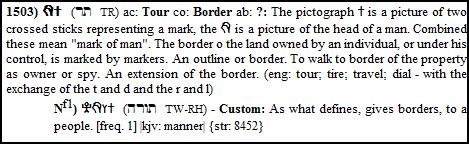
All things in His Word are a shadow pointing back to Messiah (Hebrews 8:5; 9:24; 10:1; Colossians 2:16-17) who is the Image of God (Hebrews 1:3; 2 Corinthians 4:4; Colossians 1:15-16).
The Torah = the Entire Bible. The Scriptures define the Prophets as the Torah (1 Corinthians 14:21) & the Psalms as Torah (John 10:34; 12:34; 15:25). Messiah further elaborates His Word as everything that comes out of His mouth (Matthew 4:4). This includes creation, as creation came forth from His Word (Psalm 33:6; Hebrews 11:3; John 1:1-3) who became flesh and dwelt among us (Colossians 1:12-17; Hebrews 1:1-3, 8-12).
It is interesting to note that the Greek word μορφή ‘morphe’ is used in the Septuagint to translate both the Hebrew words תואר ‘to’ar’ which means image, that comes from the same root תר as תורה ‘torah.’ μορφή ‘morphe’ is also used to translate the Hebrew word צלם ‘tselem’ which means shadow.
Php 2:6 who subsisting in the form (μορφη ‘morphe’) of God, thought it not robbery to be equal with God,
Jesus is THE image of God (Hebrews 1:3; 2 Corinthians 4:4-6; Colossians 1:15-16) who is love (1 John 4:8).
Heb 1:1 God, who at sundry times and in divers manners spake in time past unto the fathers by the prophets,
Heb 1:2 Hath in these last days spoken unto us by his Son, whom he hath appointed heir of all things, by whom also he made the worlds;
Heb 1:3 Who being the brightness of his glory, and the express image of his person, and upholding all things by the word of his power, when he had by himself purged our sins, sat down on the right hand of the Majesty on high;
Col 1:15 Who is the image of the invisible God, the firstborn of every creature:
Col 1:16 For by him were all things created, that are in heaven, and that are in earth, visible and invisible, whether they be thrones, or dominions, or principalities, or powers: all things were created by him, and for him:
Col 1:17 And he is before all things, and by him all things consist.
2Co 4:4 In whom the god of this world hath blinded the minds of them which believe not, lest the light of the glorious gospel of Christ, who is the image of God, should shine unto them.
Joh 1:18 No man hath seen God at any time; the only begotten Son, which is in the bosom of the Father, he hath declared* him.
*manifests the image of the Most High
G1834
ἐξηγέομαι
exēgeomai
Thayer Definition:
1) to lead out, be leader, go before
2) metaphorically, to draw out in narrative, unfold a teaching
2a) to recount, rehearse
2b) to unfold, declare
2b1) the things relating to God
2b2) used in Greek writing of the interpretation of things sacred and divine, oracles, dreams, etc.
Part of Speech: verb
A Related Word by Thayer’s/Strong’s Number: from G1537 and G2233
This Greek word was used to translate the following Hebrew words in the Septuagint
G1834
ex egeomai H3034 yadah (to make known)
ex egeomai H3384 yarah hi. (to teach…root of the word torah)
ex egeomai H5608 saphar pi. (record/scroll)
Here it can be seen that Messiah, who comes from the bosom of the Father, declares Him. He makes Him known. He made known His teaching, His Torah, when the Scroll of the Torah became flesh and walked among men. This is why Messiah declared to Thomas that when you are looking at Him you are seeing the Father.
Joh 14:6 Jesus said to him, I am the Way, and the Truth, and the Life. No one comes to the Father except through Me.
Joh 14:7 If you had known Me, you would have known My Father also; and from now on you do know Him, and have seen Him.
Joh 14:8 And Philip said to Him, Lord, show us the Father, and it is enough for us.
Joh 14:9 Jesus said to him, Am I so long a time with you, and you have not known Me, Philip? The one seeing Me has seen the Father! And how do you say, Show us the Father?
Joh 14:10 Do you not believe that I am in the Father and the Father is in Me? The Words which I speak to you I do not speak from Myself, but the Father who abides in Me, He does the works.
Joh 14:11 Believe Me that I am in the Father, and the Father is in Me; but if not, believe Me because of the works themselves.
Heb 9:26 since He must often have suffered from the foundation of the world. But now once for all, at the completion of the ages, He has been manifested* for putting away of sin through the sacrifice of Himself.
*G5319
φανερόω
phaneroō
Thayer Definition:
1) to make manifest or visible or known what has been hidden or unknown, to manifest, whether by words, or deeds, or in any other way
1a) make actual and visible, realised
1b) to make known by teaching
1c) to become manifest, be made known
1d) of a person
1d1) expose to view, make manifest, to show one’s self, appear
1e) to become known, to be plainly recognised, thoroughly understood
1e1) who and what one is
Part of Speech: verb
A Related Word by Thayer’s/Strong’s Number: from G5318
1Jn 3:5 And you know that that One was revealed that He might take away our sins, and sin is not in Him.
Joh 6:46 Not that any man hath seen the Father, save he which is of God, he hath seen the Father.
1Jo 4:12 No man hath seen God at any time. If we love one another, God dwelleth in us, and his love is perfected in us.
Exo 33:20 And he said, Thou canst not see my face: for there shall no man see me, and live.
1Ti 1:17 Now unto the King eternal, immortal, invisible, the only wise God, be honour and glory for ever and ever. Amen.
1Ti 6:16 Who only hath immortality, dwelling in the light which no man can approach unto; whom no man hath seen, nor can see: to whom be honour and power everlasting. Amen.
Php 2:6 who subsisting in the form (G3444) of God, thought it not robbery to be equal with God,
G3444
morphe H2122 ziv
morphe H6754 tselem
morphe H8389 toar
morphe H8403 tavnit
morphe H8544 temunah
His name {שם ‘shem’} is His character which is His Word.
Rev 19:13 And he was clothed with a vesture dipped in blood: and his name is called The Word of God.
Mankind was created in God’s image
Gen 1:26 And God said, Let us make man in our image, after our likeness: and let them have dominion over the fish of the sea, and over the fowl of the air, and over the cattle, and over all the earth, and over every creeping thing that creepeth upon the earth.
Gen 1:27 So God created man in his own image, in the image of God created he him; male and female created he them.
Gen 5:1 This is the book of the generations of Adam. In the day that God created man, in the likeness of God made he him;
Gen 9:6 Whoso sheddeth man’s blood, by man shall his blood be shed: for in the image of God made he man.
1Co 11:7 For a man indeed ought not to cover his head, forasmuch as he is the image and glory of God: but the woman is the glory of the man.
Jas 3:8 But the tongue can no man tame; it is an unruly evil, full of deadly poison.
Jas 3:9 Therewith bless we God, even the Father; and therewith curse we men, which are made after the similitude of God.
Jas 3:10 Out of the same mouth proceedeth blessing and cursing. My brethren, these things ought not so to be.
Jas 3:11 Doth a fountain send forth at the same place sweet water and bitter?
Jas 3:12 Can the fig tree, my brethren, bear olive berries? either a vine, figs? so can no fountain both yield salt water and fresh.
Jas 3:13 Who is a wise man and endued with knowledge among you? let him shew out of a good conversation his works with meekness of wisdom.
Jas 3:14 But if ye have bitter envying and strife in your hearts, glory not, and lie not against the truth.
Jas 3:15 This wisdom descendeth not from above, but is earthly, sensual, devilish.
Jas 3:16 For where envying and strife is, there is confusion and every evil work.
Jas 3:17 But the wisdom that is from above is first pure, then peaceable, gentle, and easy to be intreated, full of mercy and good fruits, without partiality, and without hypocrisy.
Jas 3:18 And the fruit of righteousness is sown in peace of them that make peace.
Man was created in God’s image (Genesis 1:26-27) but that image was corrupted when Adam sinned. From there man took up the image of Adam which still pointed back to God, but in a corrupted form (Genesis 5:1; 1 Corinthians 15:45-49). Messiah came to earth in the very image of Almighty God (2 Corinthians 4:4; Colossians 1:15; Hebrews 1:3), who is love. His life displayed that love and He calls all those who believe in Him to display that love as well. This is the essence of the concept of ‘Christ in us.’ It is through His love that man is formed into His image (Colossians 3:10; Romans 8:29) where there is no longer Jew or Greek, Barbarian or Scythian but Messiah is all and in all (Colossians 3:11).
This is the message of the Gospel. Love. Love that breaks down the barriers and walls which man has set up to divide (Ephesians 2:1-22; 1 Corinthians 12:13). Love that breaks down the wall of sin which has separated man from God (Isaiah 59:2; John 3:16; 12:32; Isaiah 49:6; Revelation 5:9). This love is revealed in our actions towards our fellow man, not in our intellectual proclamations. All of us see through a glass darkly which keeps us from seeing eye to eye (1 Corinthians 13:12). The only remedy for this is love (1 Corinthians 13:1-13; 1 John 4:7-21). Love and patience towards one another until the Lord returns and His salvation is fully revealed (Isaiah 52:7-10). Love allows man to understand that we can have differences of opinions but ultimately if we abide in love we can dwell in peace and unity (Ephesians 4:2-16, 32; 5:1-2; Colossians 3:9-17).
Eph 4:1 I therefore, the prisoner of the Lord, beseech you that ye walk worthy of the vocation wherewith ye are called,
Eph 4:2 With all lowliness and meekness, with longsuffering, forbearing one another in love;
Eph 4:3 Endeavouring to keep the unity of the Spirit in the bond of peace.
Eph 4:4 There is one body, and one Spirit, even as ye are called in one hope of your calling;
Eph 4:5 One Lord, one faith, one baptism,
Eph 4:6 One God and Father of all, who is above all, and through all, and in you all.
The true intent of the law/Word of God is not to make men religious but to reform men into the image of their God who is love (1 John 4:8). It is this love that unites us and perfects us. It is the bond of perfection (Colossians 3:14) which sets man free (Galatians 5:13-14). This love is not intended only for a certain group of religious people, but for all mankind. Scripture declares that in the Messiah shall the ‘gentiles trust’ (Matthew 12:21; Romans 15:8-12; Isaiah 11:10). For Jesus is the true Light which enlightens every man (John 1:9; 12:44-46; Isaiah 49:6), sent to restore all of mankind back to God (Isaiah 45:22; Romans 3:29; John 1:12; 3:15-17).
The message of Jesus is universal. It transcends religions, ethnic or cultural barriers. It is a message of love and reconciliation back to God. The message of victory over death which entered into the world when Adam and Eve partook of the fruit of the tree of knowledge (Romans 5:12-21; 1 Corinthians 15:45-48; 55-56. This message of forgiveness and restoration is not just for Israel, but whosoever shall believe in the Lord Jesus .
Jesus did not play religion. He reached out the sick, the blind, the deaf, the adulterer, the sinner and the tax-collector. Those who knew they needed Him (Matthew 9:12; Mark 2:17; Luke 9:11). Those who saw how helpless they were without Him. This is what true religion is (James 1:26-27; Proverbs 21:3; Isaiah 1:17; Hosea 6:6; Micah 6:8; Matthew 9:13; Mark 12:33). Not doctrine, but acts of love towards one another (John 13:35; 1 John 3:17; 4:12, 20-21).
This concept of love is found in every religion, it is the commonality which points back to Jesus who is the epitome of God’s love (John 3:16; 1 John 4:8-16). It is not doctrine which leads others to the truth. It is the love of God within us. ‘Christ in you, the hope of glory’ (Colossians 1:27).
Scripture declares that love of one’s fellow man is equated with love of God (1 John 4:11-12, 20-21) and is the fulfillment and purpose of His Word (Matthew 22:39-40; Romans 13:8-10; Galatians 6:2). It does not say love of one’s fellow religious counterpart, but of one’s fellow MAN (Galatians 6:10; 1 Thessalonians 5:15; 3 John 1:11), even our enemies (Luke 6:35).
The Gospel is all about dying to our carnal natures that we might be reformed into His Image.
Gal 4:19 My little children, of whom I travail in birth again until Christ be formed in you,
Rom 8:29 For whom he did foreknow, he also did predestinate to be conformed to the image of his Son, that he might be the firstborn among many brethren.
Rom 13:14 But put ye on the Lord Jesus Christ, and make not provision for the flesh, to fulfil the lusts thereof.
Eph 4:24 And that ye put on the new man, which after God is created in righteousness and true holiness.
Php 2:5 Let this mind be in you, which was also in Christ Jesus:
Col 1:27 To whom God would make known what is the riches of the glory of this mystery among the Gentiles; which is Christ in you, the hope of glory:
Col 3:10 And have put on the new man, which is renewed in knowledge after the image of him that created him:
1Jn 3:1 Behold, what manner of love the Father hath bestowed upon us, that we should be called the sons of God: therefore the world knoweth us not, because it knew him not.
1Jn 3:2 Beloved, now are we the sons of God, and it doth not yet appear what we shall be: but we know that, when he shall appear, we shall be like him; for we shall see him as he is.
1Jn 3:3 And every man that hath this hope in him purifieth himself, even as he is pure.
The Torah is His Mark
The word mark comes from the Hebrew word תו ‘tav.’

Eze 9:4 And Jehovah said to him, Pass through in the midst of the city, in the midst of Jerusalem, and mark (תוה ‘tavah’) a mark (תו ‘tav’) on the foreheads of the men who are groaning and are mourning over all the abominations that are done in her midst.
The above verse is speaking of the mark of God which is put on the righteous. The mark of the beast is a direct counterfeit of this mark.
The root word for mark is a picture of an ox plowing toward a mark. In ancient Hebrew thought, Godwas seen as the strong ox that we are yoked with in covenant relationship. The word for mark is a picture of walking with your God toward your mark/goal (Philippians 3:14). Walking with Messiah (Mat 11:29) towards the Kingdom of Heaven or walking with the adversary towards sheol. This is what Paul was alluding to in his letter to the Corinthians.
2Co 6:14 Do not be unequally yoked with unbelievers. For what partnership does righteousness have with lawlessness? And what fellowship does light have with darkness?
2Co 6:15 And what agreement does Christ have with Belial? Or what part does a believer have with an unbeliever?
2Co 6:16 And what agreement does a temple of God have with idols? For you are a temple of the living God, even as God said, “I will” dwell in them and “walk among them, and I will be their God, and they shall be My people.” Lev. 26:12; Ezek. 37:27
2Co 6:17 Because of this, “come out from among them” “and be separated,” says the Lord, “and do not touch the unclean thing,” and I will receive you. Isa. 52:11
2Co 6:18 “And I will be a Father to you, and you will be sons” and daughters to Me, says the Lord Almighty. 2 Sam. 7:8, 14; Isa. 43:6
The letter ת ‘tav’ in pictograph form is two crossed sticks which has the meaning of a covenant. We can choose the covenant of Life in Messiah Jesus (Isaiah 42:6; 49:8; Zechariah 9:11; Jeremiah 31:31; Matthew 26:28) or we can choose the covenant of death (Isaiah 28:15) which promises deliverance from death (ie the tree of life) but in reality leads to hell.
This root is related to את & תא
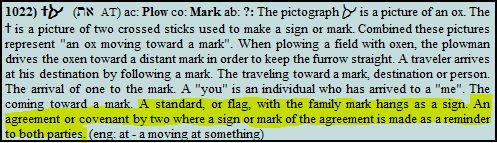
This is the root for the word sign. This is significant because the Torah is a sign on the hand and the forehead (Deuteronomy 6:8). The mark of God is His Torah. The mark of the beast is lawlessness for the beast is the man of sin (2 Thessalonians 2:3; Psalm 130:3; Jeremiah 2:22; Job 10:14) . Again, the mark of the beast is a direct counterfeit of God’s mark/signs.
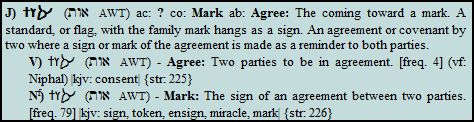
תא ‘tav aleph’ is related to the word תו ‘tav’ and את ‘aleph tav’ and means a mark/boundary.

תא tav aleph relates to the word תר ‘tar’ which means the ‘mark of man’ or the border/outline.
תר which means the ‘mark of man’ or the border/outline.
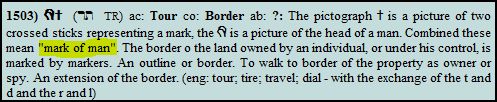
From this root we get ta’ar and to’ar. These words mean form, outline or border. This is an important connection to see in that the mark of the beast versus the mark of God ultimately reflects whose image/form you are in.

This connection between the mark and the image/form/outline/shadow picture of The LORD Jesus versus the antichrist is further seen in that the word Torah comes from this same root.

We can choose the tree of life or the tree of knowledge. The Light of the Word or the false light which is in reality darkness (Matthew 6:23).
We can have the mark of God and be in His image by walking in His Torah and letting Messiah live through us (Galatians 2:20), or we can have the mark of the beast and be in the image of satan by walking in his torah which is lawlessness (Ephesians 2:2-3; Isaiah 30:8-11; 1 Peter 2:8). In reality, this ‘torah’ is the concept of ‘do what thou wilt shall be the whole of the law.’ The ability of man to decide what is good or evil, right or wrong instead of relying on the Word to define the two.
The word for image in Hebrew is צל ‘tsel’ which means a shadow cast by an object forming an image. This is also seen in the concept of being under the shadow of His wings, which for the current study represents dwelling under the branches of the Tree of Life. The counterfeit, of course, is the tree of knowledge and the shadow/image it casts. The word צל ‘tsel’ is the combination of the letter צ ‘tsadi’ which is the picture of a hunter, a man lying on his side with a spear or bow or a man with a fishing pole. The ל ‘lamed’ is a the picture of a staff held by a shepherd which represents authority. Herein lies a beautiful picture of the current study. The shepherd who hunts. The Messiah, the Good Shepherd, holds out a ‘fishing pole’ whose bait is the fruit of the tree of Life. The idol/worthless shepherd lies in wait as a lion seeking whom he may devour.
The word translated as mark in Revelation is used only one other time in Scripture referring to man engraving an image to represent the Almighty.
Act 17:29 Then being offspring of God, we ought not to suppose that the Godhead is like gold or silver or stone, engraved by art and the imagination of man.
This is the essence of the mark of the beast…it is a counterfeit worship of God. This is what the golden calf was. Making a golden calf and calling it God. This is who the antichrist will be. A counterfeit Jesus. Who was Messiah? He was the Word made flesh (John 1:14).
The Golden Rule
Mat 7:12 Therefore all things whatsoever ye would that men should do to you, do ye even so to them: for this is the law and the prophets.
Luk 6:31 And as ye would that men should do to you, do ye also to them likewise.
The Holy Scriptures admonish us to seek the Face of God at all times (1 Chronicles 16:11). Seeking His Face will cause us to love others as He loves them…
1Ch 16:11 Seek the LORD and his strength, seek his face continually.
When we look to God, we see what we are. Evil, despicable, unworthy (Romans 3:10-19,23)…
Rom 3:10 As it is written, There is none righteous, no, not one:
Rom 3:11 There is none that understandeth, there is none that seeketh after God.
Rom 3:12 They are all gone out of the way, they are together become unprofitable; there is none that doeth good, no, not one.
Rom 3:13 Their throat is an open sepulchre; with their tongues they have used deceit; the poison of asps is under their lips:
Rom 3:14 Whose mouth is full of cursing and bitterness:
Rom 3:15 Their feet are swift to shed blood:
Rom 3:16 Destruction and misery are in their ways:
Rom 3:17 And the way of peace have they not known:
Rom 3:18 There is no fear of God before their eyes.
Rom 3:19 Now we know that what things soever the law saith, it saith to them who are under the law: that every mouth may be stopped, and all the world may become guilty before God.
Rom 3:20 Therefore by the deeds of the law there shall no flesh be justified in his sight: for by the law is the knowledge of sin.
Rom 3:21 But now the righteousness of God without the law is manifested, being witnessed by the law and the prophets;
Rom 3:22 Even the righteousness of God which is by faith of Jesus Christ unto all and upon all them that believe: for there is no difference:
Rom 3:23 For all have sinned, and come short of the glory of God;
…but when we look to Him we see His unending love for us in spite of our sinfulness (Ephesians 2:1-7).
Eph 2:1 And you hath he quickened, who were dead in trespasses and sins;
Eph 2:2 Wherein in time past ye walked according to the course of this world, according to the prince of the power of the air, the spirit that now worketh in the children of disobedience:
Eph 2:3 Among whom also we all had our conversation in times past in the lusts of our flesh, fulfilling the desires of the flesh and of the mind; and were by nature the children of wrath, even as others.
Eph 2:4 But God, who is rich in mercy, for his great love wherewith he loved us,
Eph 2:5 Even when we were dead in sins, hath quickened us together with Christ, (by grace ye are saved;)
Eph 2:6 And hath raised us up together, and made us sit together in heavenly places in Christ Jesus:
Eph 2:7 That in the ages to come he might shew the exceeding riches of his grace in his kindness toward us through Christ Jesus.
When we look to our fellow man, our carnal flesh, which is full of hate, immediately wants to focus on their evils and unworthiness (1 Corinthians 3:1-4; Romans 8:7).
1Co 3:1 And I, brethren, could not speak unto you as unto spiritual, but as unto carnal, even as unto babes in Christ.
1Co 3:2 I have fed you with milk, and not with meat: for hitherto ye were not able to bear it, neither yet now are ye able.
1Co 3:3 For ye are yet carnal: for whereas there is among you envying, and strife, and divisions, are ye not carnal, and walk as men?
1Co 3:4 For while one saith, I am of Paul; and another, I am of Apollos; are ye not carnal?
Rom 8:7 Because the carnal mind is enmity against God: for it is not subject to the law of God, neither indeed can be.
However, if we remember that we are just as unworthy of God’s love as them, yet God still grants us His unmerited, unending love, will we not be more likely to do the same to them?
He has forgiven us so let us forgive (Matthew 18:23-35; Ephesians 4:32).
Mat 18:23 Therefore is the kingdom of heaven likened unto a certain king, which would take account of his servants.
Mat 18:24 And when he had begun to reckon, one was brought unto him, which owed him ten thousand talents.
Mat 18:25 But forasmuch as he had not to pay, his lord commanded him to be sold, and his wife, and children, and all that he had, and payment to be made.
Mat 18:26 The servant therefore fell down, and worshipped him, saying, Lord, have patience with me, and I will pay thee all.
Mat 18:27 Then the lord of that servant was moved with compassion, and loosed him, and forgave him the debt.
Mat 18:28 But the same servant went out, and found one of his fellowservants, which owed him an hundred pence: and he laid hands on him, and took him by the throat, saying, Pay me that thou owest.
Mat 18:29 And his fellowservant fell down at his feet, and besought him, saying, Have patience with me, and I will pay thee all.
Mat 18:30 And he would not: but went and cast him into prison, till he should pay the debt.
Mat 18:31 So when his fellowservants saw what was done, they were very sorry, and came and told unto their lord all that was done.
Mat 18:32 Then his lord, after that he had called him, said unto him, O thou wicked servant, I forgave thee all that debt, because thou desiredst me:
Mat 18:33 Shouldest not thou also have had compassion on thy fellowservant, even as I had pity on thee?
Mat 18:34 And his lord was wroth, and delivered him to the tormentors, till he should pay all that was due unto him.
Mat 18:35 So likewise shall my heavenly Father do also unto you, if ye from your hearts forgive not every one his brother their trespasses.
Eph 4:32 And be ye kind one to another, tenderhearted, forgiving one another, even as God for Christ’s sake hath forgiven you.
He shows us mercy so let us show mercy (2 Samuel 22:36; Luke 6:36).
2Sa 22:36 Thou hast also given me the shield of thy salvation: and thy gentleness hath made me great.
Luk 6:36 Be ye therefore merciful, as your Father also is merciful.
He overlooks our lack of understanding and ignorance so let us do the same with others. Even if the other person accepts not our forgiveness, love and understanding we must remember that we have treated God the same in the past, and even still do today as believers.
In seeking His Face, His Light will shine upon us where we can walk in His Name (Numbers 6:24-27).
Num 6:24 The LORD bless thee, and keep thee:
Num 6:25 The LORD make his face shine upon thee, and be gracious unto thee:
Num 6:26 The LORD lift up his countenance upon thee, and give thee peace.
Num 6:27 And they shall put my name upon the children of Israel; and I will bless them.
If we seek His face continually (1 Chronicles 16:11), His light will reflect from us to others (2 Corinthians 4:6). Scripture likens seeking the Face of the Lord as looking into a mirror (2 Corinthians 3:18; 1 Corinthians 13:12) in which we now see darkly.
1Ch 16:11 Seek the LORD and his strength, seek his face continually.
2Co 4:6 For God, who commanded the light to shine out of darkness, hath shined in our hearts, to give the light of the knowledge of the glory of God in the face of Jesus Christ.
2Co 3:18 But we all, with open face beholding as in a glass the glory of the Lord, are changed into the same image from glory to glory, even as by the Spirit of the Lord.
1Co 13:12 For now we see through a glass, darkly; but then face to face: now I know in part; but then shall I know even as also I am known.
1Co 13:13 And now abideth faith, hope, charity, these three; but the greatest of these is charity.
As a result, we should abide in faith, hope and love. Most importantly, in love. This love is summed up in the Golden Rule (Matthew 7:12; Luke 6:31).
Mat 7:12 Therefore all things whatsoever ye would that men should do to you, do ye even so to them: for this is the law and the prophets.
Luk 6:31 And as ye would that men should do to you, do ye also to them likewise.
All religions are based upon the Golden rule of treating others the way you want to be treated. Almost everyone in the world follows a religion so why is there so much hate? The problem is that we cannot keep the Golden Rule by our power or understanding. The Golden Rule can only work if we are following by the principle of seeking His Face. We can only truly abide by the Golden Rule if we are treating men as we wish God to treat us. We want forgiveness and mercy and grace from God…this then should be given to others. We must love as He loves us (John 13:34; 15:12).
Joh 13:34 A new commandment I give unto you, That ye love one another; as I have loved you, that ye also love one another.
Joh 13:35 By this shall all men know that ye are my disciples, if ye have love one to another.
Joh 15:12 This is my commandment, That ye love one another, as I have loved you.
Messiah said that the all of the Law and Prophets hang upon the Golden Rule (Matthew 7:12; 22:40).
Mat 7:12 Therefore all things whatsoever ye would that men should do to you, do ye even so to them: for this is the law and the prophets.
Mat 22:37 Jesus said unto him, Thou shalt love the Lord thy God with all thy heart, and with all thy soul, and with all thy mind.
Mat 22:38 This is the first and great commandment.
Mat 22:39 And the second is like unto it, Thou shalt love thy neighbour as thyself.
Mat 22:40 On these two commandments hang all the law and the prophets.
Paul says that the entire law is based upon this principle (Galatians 5:14).
Gal 5:14 For all the law is fulfilled in one word, even in this; Thou shalt love thy neighbour as thyself.
By applying the concept of seeking His Face, this is seen. A proper fulfillment of the Golden rule depends upon what man is seeking. God or religion/idols. Idolatry and religion lead to hate (John 15:21-25; Hosea 9:7-8), this is why there is so much hate in the world.
Joh 15:21 But all these things will they do unto you for my name’s sake, because they know not him that sent me.
Joh 15:22 If I had not come and spoken unto them, they had not had sin: but now they have no cloke for their sin.
Joh 15:23 He that hateth me hateth my Father also.
Joh 15:24 If I had not done among them the works which none other man did, they had not had sin: but now have they both seen and hated both me and my Father.
Joh 15:25 But this cometh to pass, that the word might be fulfilled that is written in their law, They hated me without a cause.
Hos 9:7 The days of visitation are come, the days of recompence are come; Israel shall know it: the prophet is a fool, the spiritual man is mad, for the multitude of thine iniquity, and the great hatred.
Hos 9:8 The watchman of Ephraim was with my God: but the prophet is a snare of a fowler in all his ways, and hatred in the house of his God.
If we are not walking in love, we are not walking with God (1 John 4:8).
1Jn 4:8 He that loveth not knoweth not God; for God is love.
Hatred for our fellow man is indicative that we are not seeking the Face of God as man was created in God’s image (1 John 4:20-21; James 3:9).
1Jn 4:20 If a man say, I love God, and hateth his brother, he is a liar: for he that loveth not his brother whom he hath seen, how can he love God whom he hath not seen?
1Jn 4:21 And this commandment have we from him, That he who loveth God love his brother also.
Jas 3:8 But the tongue can no man tame; it is an unruly evil, full of deadly poison.
Jas 3:9 Therewith bless we God, even the Father; and therewith curse we men, which are made after the similitude of God.
Jas 3:10 Out of the same mouth proceedeth blessing and cursing. My brethren, these things ought not so to be.
Hate is indicative that we are walking in the carnal flesh which is at war with God (Romans 8:7; Galatians 5:19-21).
Rom 8:7 Because the carnal mind is enmity against God: for it is not subject to the law of God, neither indeed can be.
Rom 8:8 So then they that are in the flesh cannot please God.
Gal 5:19 Now the works of the flesh are manifest, which are these; Adultery, fornication, uncleanness, lasciviousness,
Gal 5:20 Idolatry, witchcraft, hatred, variance, emulations, wrath, strife, seditions, heresies,
Gal 5:21 Envyings, murders, drunkenness, revellings, and such like: of the which I tell you before, as I have also told you in time past, that they which do such things shall not inherit the kingdom of God.
Hate in one’s heart reveals a spiritual blindness (1 John 2:9-11) which is caused in many cases by religion (John 9:41; 15:21-25; 2 Corinthians 4:4; Isaiah 44:18; 6:9-10; Matthew 13:13-15; 15:7-14).
1Jn 2:9 He that saith he is in the light, and hateth his brother, is in darkness even until now.
1Jn 2:10 He that loveth his brother abideth in the light, and there is none occasion of stumbling in him.
1Jn 2:11 But he that hateth his brother is in darkness, and walketh in darkness, and knoweth not whither he goeth, because that darkness hath blinded his eyes.
Joh 9:41 Jesus said unto them, If ye were blind, ye should have no sin: but now ye say, We see; therefore your sin remaineth.
Joh 15:21 But all these things will they do unto you for my name’s sake, because they know not him that sent me.
Joh 15:22 If I had not come and spoken unto them, they had not had sin: but now they have no cloke for their sin.
Joh 15:23 He that hateth me hateth my Father also.
Joh 15:24 If I had not done among them the works which none other man did, they had not had sin: but now have they both seen and hated both me and my Father.
Joh 15:25 But this cometh to pass, that the word might be fulfilled that is written in their law, They hated me without a cause.
2Co 4:3 But if our gospel be hid, it is hid to them that are lost:
2Co 4:4 In whom the god of this world hath blinded the minds of them which believe not, lest the light of the glorious gospel of Christ, who is the image of God, should shine unto them.
Isa 44:18 They have not known nor understood: for he hath shut their eyes, that they cannot see; and their hearts, that they cannot understand.
Isa 6:9 And he said, Go, and tell this people, Hear ye indeed, but understand not; and see ye indeed, but perceive not.
Isa 6:10 Make the heart of this people fat, and make their ears heavy, and shut their eyes; lest they see with their eyes, and hear with their ears, and understand with their heart, and convert, and be healed.
Mat 13:13 Therefore speak I to them in parables: because they seeing see not; and hearing they hear not, neither do they understand.
Mat 13:14 And in them is fulfilled the prophecy of Esaias, which saith, By hearing ye shall hear, and shall not understand; and seeing ye shall see, and shall not perceive:
Mat 13:15 For this people’s heart is waxed gross, and their ears are dull of hearing, and their eyes they have closed; lest at any time they should see with their eyes, and hear with their ears, and should understand with their heart, and should be converted, and I should heal them.
Mat 15:7 Ye hypocrites, well did Esaias prophesy of you, saying,
Mat 15:8 This people draweth nigh unto me with their mouth, and honoureth me with their lips; but their heart is far from me.
Mat 15:9 But in vain they do worship me, teaching for doctrines the commandments of men.
Mat 15:10 And he called the multitude, and said unto them, Hear, and understand:
Mat 15:11 Not that which goeth into the mouth defileth a man; but that which cometh out of the mouth, this defileth a man.
Mat 15:12 Then came his disciples, and said unto him, Knowest thou that the Pharisees were offended, after they heard this saying?
Mat 15:13 But he answered and said, Every plant, which my heavenly Father hath not planted, shall be rooted up.
Mat 15:14 Let them alone: they be blind leaders of the blind. And if the blind lead the blind, both shall fall into the ditch.
When we seek the Face of God at all times we can overcome the hate for others caused by fear and ignorance (1 John 4:18; Romans 8:15, 31-39; Psalm 118:6; Hebrews 13:6).
1Jn 4:18 There is no fear in love; but perfect love casteth out fear: because fear hath torment. He that feareth is not made perfect in love.
Rom 8:15 For ye have not received the spirit of bondage again to fear; but ye have received the Spirit of adoption, whereby we cry, Abba, Father.
Rom 8:31 What shall we then say to these things? If God be for us, who can be against us?
Rom 8:32 He that spared not his own Son, but delivered him up for us all, how shall he not with him also freely give us all things?
Rom 8:33 Who shall lay any thing to the charge of God’s elect? It is God that justifieth.
Rom 8:34 Who is he that condemneth? It is Christ that died, yea rather, that is risen again, who is even at the right hand of God, who also maketh intercession for us.
Rom 8:35 Who shall separate us from the love of Christ? shall tribulation, or distress, or persecution, or famine, or nakedness, or peril, or sword?
Rom 8:36 As it is written, For thy sake we are killed all the day long; we are accounted as sheep for the slaughter.
Rom 8:37 Nay, in all these things we are more than conquerors through him that loved us.
Rom 8:38 For I am persuaded, that neither death, nor life, nor angels, nor principalities, nor powers, nor things present, nor things to come,
Rom 8:39 Nor height, nor depth, nor any other creature, shall be able to separate us from the love of God, which is in Christ Jesus our Lord.
Psa 118:6 The LORD is on my side; I will not fear: what can man do unto me?
Heb 13:6 So that we may boldly say, The Lord is my helper, and I will not fear what man shall do unto me.
When we seek the Face of God we can love our enemies and show them mercy as He does (Matthew 5:43-48; Luke 6:27-36; Romans 12:14-21; 1 Peter 3:8-15; Ephesians 2:2-22).
Mat 5:43 Ye have heard that it hath been said, Thou shalt love thy neighbour, and hate thine enemy.
Mat 5:44 But I say unto you, Love your enemies, bless them that curse you, do good to them that hate you, and pray for them which despitefully use you, and persecute you;
Mat 5:45 That ye may be the children of your Father which is in heaven: for he maketh his sun to rise on the evil and on the good, and sendeth rain on the just and on the unjust.
Mat 5:46 For if ye love them which love you, what reward have ye? do not even the publicans the same?
Mat 5:47 And if ye salute your brethren only, what do ye more than others? do not even the publicans so?
Mat 5:48 Be ye therefore perfect, even as your Father which is in heaven is perfect.
Luk 6:27 But I say unto you which hear, Love your enemies, do good to them which hate you,
Luk 6:28 Bless them that curse you, and pray for them which despitefully use you.
Luk 6:29 And unto him that smiteth thee on the one cheek offer also the other; and him that taketh away thy cloke forbid not to take thy coat also.
Luk 6:30 Give to every man that asketh of thee; and of him that taketh away thy goods ask them not again.
Luk 6:31 And as ye would that men should do to you, do ye also to them likewise.
Luk 6:32 For if ye love them which love you, what thank have ye? for sinners also love those that love them.
Luk 6:33 And if ye do good to them which do good to you, what thank have ye? for sinners also do even the same.
Luk 6:34 And if ye lend to them of whom ye hope to receive, what thank have ye? for sinners also lend to sinners, to receive as much again.
Luk 6:35 But love ye your enemies, and do good, and lend, hoping for nothing again; and your reward shall be great, and ye shall be the children of the Highest: for he is kind unto the unthankful and to the evil.
Luk 6:36 Be ye therefore merciful, as your Father also is merciful.
Rom 12:14 Bless them which persecute you: bless, and curse not.
Rom 12:15 Rejoice with them that do rejoice, and weep with them that weep.
Rom 12:16 Be of the same mind one toward another. Mind not high things, but condescend to men of low estate. Be not wise in your own conceits.
Rom 12:17 Recompense to no man evil for evil. Provide things honest in the sight of all men.
Rom 12:18 If it be possible, as much as lieth in you, live peaceably with all men.
Rom 12:19 Dearly beloved, avenge not yourselves, but rather give place unto wrath: for it is written, Vengeance is mine; I will repay, saith the Lord.
Rom 12:20 Therefore if thine enemy hunger, feed him; if he thirst, give him drink: for in so doing thou shalt heap coals of fire on his head.
Rom 12:21 Be not overcome of evil, but overcome evil with good.
1Pe 3:8 Finally, be ye all of one mind, having compassion one of another, love as brethren, be pitiful, be courteous:
1Pe 3:9 Not rendering evil for evil, or railing for railing: but contrariwise blessing; knowing that ye are thereunto called, that ye should inherit a blessing.
1Pe 3:10 For he that will love life, and see good days, let him refrain his tongue from evil, and his lips that they speak no guile:
1Pe 3:11 Let him eschew evil, and do good; let him seek peace, and ensue it.
1Pe 3:12 For the eyes of the Lord are over the righteous, and his ears are open unto their prayers: but the face of the Lord is against them that do evil.
1Pe 3:13 And who is he that will harm you, if ye be followers of that which is good?
1Pe 3:14 But and if ye suffer for righteousness’ sake, happy are ye: and be not afraid of their terror, neither be troubled;
1Pe 3:15 But sanctify the Lord God in your hearts: and be ready always to give an answer to every man that asketh you a reason of the hope that is in you with meekness and fear:
Eph 2:2 Wherein in time past ye walked according to the course of this world, according to the prince of the power of the air, the spirit that now worketh in the children of disobedience:
Eph 2:3 Among whom also we all had our conversation in times past in the lusts of our flesh, fulfilling the desires of the flesh and of the mind; and were by nature the children of wrath, even as others.
Eph 2:4 But God, who is rich in mercy, for his great love wherewith he loved us,
Eph 2:5 Even when we were dead in sins, hath quickened us together with Christ, (by grace ye are saved;)
Eph 2:6 And hath raised us up together, and made us sit together in heavenly places in Christ Jesus:
Eph 2:7 That in the ages to come he might shew the exceeding riches of his grace in his kindness toward us through Christ Jesus.
Eph 2:8 For by grace are ye saved through faith; and that not of yourselves: it is the gift of God:
Eph 2:9 Not of works, lest any man should boast.
Eph 2:10 For we are his workmanship, created in Christ Jesus unto good works, which God hath before ordained that we should walk in them.
Eph 2:11 Wherefore remember, that ye being in time past Gentiles in the flesh, who are called Uncircumcision by that which is called the Circumcision in the flesh made by hands;
Eph 2:12 That at that time ye were without Christ, being aliens from the commonwealth of Israel, and strangers from the covenants of promise, having no hope, and without God in the world:
Eph 2:13 But now in Christ Jesus ye who sometimes were far off are made nigh by the blood of Christ.
Eph 2:14 For he is our peace, who hath made both one, and hath broken down the middle wall of partition between us;
Eph 2:15 Having abolished in his flesh the enmity, even the law of commandments contained in ordinances; for to make in himself of twain one new man, so making peace;
Eph 2:16 And that he might reconcile both unto God in one body by the cross, having slain the enmity thereby:
Eph 2:17 And came and preached peace to you which were afar off, and to them that were nigh.
Eph 2:18 For through him we both have access by one Spirit unto the Father.
Eph 2:19 Now therefore ye are no more strangers and foreigners, but fellowcitizens with the saints, and of the household of God;
Eph 2:20 And are built upon the foundation of the apostles and prophets, Jesus Christ himself being the chief corner stone;
Eph 2:21 In whom all the building fitly framed together groweth unto an holy temple in the Lord:
Eph 2:22 In whom ye also are builded together for an habitation of God through the Spirit.
This is the essence of being a “little guy in the Eye”. Love. Walking in close relationship with God who is love (1 John 4:8) and extending that love to our fellow man (1 John 4:12). Its not about religion or doctrine, its about relationship with the Most High. Each one of us must work out our own salvation with fear and trembling as God works through us according to His good pleasure (Philippians 2:12-13). If we keep focused on Him and not on religion He will be able to transform us from glory to glory (2 Corinthians 3:18) until we are formed into the image of His Son (Romans 8:29).
Joh 17:21 That they all may be one; as thou, Father, art in me, and I in thee, that they also may be one in us: that the world may believe that thou hast sent me.
Joh 17:22 And the glory which thou gavest me I have given them; that they may be one, even as we are one:
Joh 17:23 I in them, and thou in me, that they may be made perfect in one; and that the world may know that thou hast sent me, and hast loved them, as thou hast loved me.
Spirit of the Torah
2Co 3:6 Who also hath made us able ministers of the new testament; not of the letter, but of the spirit: for the letter killeth, but the spirit giveth life.
Joh 6:63 It is the Spirit that gives life. The flesh does not profit, nothing! The Words which I speak to you are spirit and are life.
Rom 8:2 For the law of the Spirit of life in Christ Jesus hath made me free from the law of sin and death.
The Spirit of the Torah is the Spirit of Messiah within us.
1Pe 1:11 Searching what, or what manner of time the Spirit of Christ which was in them did signify, when it testified beforehand the sufferings of Christ, and the glory that should follow.
Rom 8:9 But you are not in flesh, but in Spirit, since the Spirit of God dwells in you. But if anyone has not the Spirit of Christ, this one is not His.
Lam 4:20 The breath of our nostrils, the anointed of Jehovah, was captured in their pits; of whom we said, In His shadow we will live among the nations.
Messiah=Holy Spirit=Spirit of Father
Luk 21:12 But before all these things, they will lay their hands on you, and will persecute you, delivering you into the synagogues and prisons, being led away before kings and governors on account of My name.
Luk 21:13 But it will return to you for a testimony.
Luk 21:14 Then put into your hearts not to premeditate to make a defense.
Luk 21:15 For I will give you a mouth and wisdom which all those opposing you will not be able to withstand or contradict.
Luk 12:11 But when they bring you in before synagogues and rulers and the authorities, do not be anxious how or what you shall reply, or what you should say;
Luk 12:12 for the Holy Spirit will teach you in the same hour what you ought to say.
Mar 13:11 But whenever they lead you away, delivering you, do not be anxious beforehand, what you should say, nor meditate. But whatever may be given to you in that hour, speak that. For you are not those speaking, but the Holy Spirit.
Mat 10:19 But when they deliver you up, do not be anxious how or what you should say, for it is given to you in that hour what you should say.
Mat 10:20 For you are not the ones speaking, but the Spirit of your Father who speaks in you.
The Messiah is the Word
Joh 1:1 In the beginning was the Word, and the Word was with God, and the Word was God.
The Spirit = The Word
Act 10:44 As Peter was yet speaking these words, the Holy Spirit fell on all those hearing the Word.
Act 10:45 And the faithful of the circumcision were amazed, as many as came with Peter, because the gift of the Holy Spirit was poured out on the nations also.
Act 11:1 And the apostles and the brothers who were throughout Judea heard that the nations also received the Word of God.
The Word is the Torah
Isa 5:24 Therefore as the fire devoureth the stubble, and the flame consumeth the chaff, so their root shall be as rottenness, and their blossom shall go up as dust: because they have cast away the law of the LORD of hosts, and despised the word of the Holy One of Israel.
Isa 2:2 And it shall come to pass in the last days, that the mountain of the LORD’S house shall be established in the top of the mountains, and shall be exalted above the hills; and all nations shall flow unto it.
Isa 2:3 And many people shall go and say, Come ye, and let us go up to the mountain of the LORD, to the house of the God of Jacob; and he will teach us of his ways, and we will walk in his paths: for out of Zion shall go forth the law, and the word of the LORD from Jerusalem.
Mic 4:2 And many nations shall come, and say, Come, and let us go up to the mountain of the LORD, and to the house of the God of Jacob; and he will teach us of his ways, and we will walk in his paths: for the law shall go forth of Zion, and the word of the LORD from Jerusalem.
Christ in You, the Hope of Glory
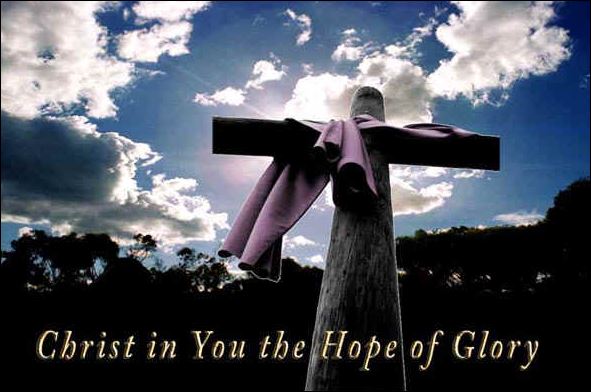
Col 1:27 To whom God would make known what is the riches of the glory of this mystery among the Gentiles; which is Christ in you, the hope of glory:
Col 1:28 Whom we preach, warning every man, and teaching every man in all wisdom; that we may present every man perfect in Christ Jesus:
Col 1:29 Whereunto I also labour, striving according to his working, which worketh in me mightily.
Christ in us is our hope of glory (Colossians 1:27; 1 Timothy 1:1; 1 Peter 1:3), not our works or knowledge (1 Peter 1:18-21).
Col 1:27 To whom God would make known what is the riches of the glory of this mystery among the Gentiles; which is Christ in you, the hope of glory:
1Ti 1:1 Paul, an apostle of Jesus Christ by the commandment of God our Saviour, and Lord Jesus Christ, which is our hope;
1Pe 1:3 Blessed be the God and Father of our Lord Jesus Christ, which according to his abundant mercy hath begotten us again unto a lively hope by the resurrection of Jesus Christ from the dead,
1Pe 1:18 Forasmuch as ye know that ye were not redeemed with corruptible things, as silver and gold, from your vain conversation received by tradition from your fathers;
1Pe 1:19 But with the precious blood of Christ, as of a lamb without blemish and without spot:
1Pe 1:20 Who verily was foreordained before the foundation of the world, but was manifest in these last times for you,
1Pe 1:21 Who by him do believe in God, that raised him up from the dead, and gave him glory; that your faith and hope might be in God.
Christ in us (Colossians 1:27) is His Word in us (Psalm 119:49-50, 81, 144; 52:9; Colossians 3:16; 1 John 2:14; Hebrews 8:10;), His Spirit in us (Ezekiel 36:26; Romans 8:9-11; John 15:26; 14:16-18).
Col 1:27 To whom God would make known what is the riches of the glory of this mystery among the Gentiles; which is Christ in you, the hope of glory:
Psa 119:49 ZAIN. Remember the word unto thy servant, upon which thou hast caused me to hope.
Psa 119:50 This is my comfort in my affliction: for thy word hath quickened me.
Psa 119:81 CAPH. My soul fainteth for thy salvation: but I hope in thy word.
Psa 119:144 The righteousness of thy testimonies is everlasting: give me understanding, and I shall live.
Psa 52:9 I will praise thee for ever, because thou hast done it: and I will wait on thy name; for it is good before thy saints.
Col 3:16 Let the word of Christ dwell in you richly in all wisdom; teaching and admonishing one another in psalms and hymns and spiritual songs, singing with grace in your hearts to the Lord.
1Jn 2:14 I have written unto you, fathers, because ye have known him that is from the beginning. I have written unto you, young men, because ye are strong, and the word of God abideth in you, and ye have overcome the wicked one.
Eze 36:26 A new heart also will I give you, and a new spirit will I put within you: and I will take away the stony heart out of your flesh, and I will give you an heart of flesh.
Eze 36:27 And I will put my spirit within you, and cause you to walk in my statutes, and ye shall keep my judgments, and do them.
Rom 8:9 But ye are not in the flesh, but in the Spirit, if so be that the Spirit of God dwell in you. Now if any man have not the Spirit of Christ, he is none of his.
Rom 8:10 And if Christ be in you, the body is dead because of sin; but the Spirit is life because of righteousness.
Rom 8:11 But if the Spirit of him that raised up Jesus from the dead dwell in you, he that raised up Christ from the dead shall also quicken your mortal bodies by his Spirit that dwelleth in you.
Joh 15:26 But when the Comforter is come, whom I will send unto you from the Father, even the Spirit of truth, which proceedeth from the Father, he shall testify of me:
Joh 14:16 And I will pray the Father, and he shall give you another Comforter, that he may abide with you for ever;
Joh 14:17 Even the Spirit of truth; whom the world cannot receive, because it seeth him not, neither knoweth him: but ye know him; for he dwelleth with you, and shall be in you.
Joh 14:18 I will not leave you comfortless: I will come to you.
It is Christ dwelling in us that gives us hope, it is this hope that purifies us (1 John 3:2-3), and saves us (Romans 8:24) not our works or knowledge (Psalm 143:2; 146:3; Jeremiah 17:5; Romans 3:20, 28; Titus 3:5; Acts 13:39; Galatians 2:16; 3:10-11).
1Jn 3:2 Beloved, now are we the sons of God, and it doth not yet appear what we shall be: but we know that, when he shall appear, we shall be like him; for we shall see him as he is.
1Jn 3:3 And every man that hath this hope in him purifieth himself, even as he is pure.
Rom 8:24 For we are saved by hope: but hope that is seen is not hope: for what a man seeth, why doth he yet hope for?
Psa 143:2 And enter not into judgment with thy servant: for in thy sight shall no man living be justified.
Jer 17:5 Thus saith the LORD; Cursed be the man that trusteth in man, and maketh flesh his arm, and whose heart departeth from the LORD.
Rom 3:20 Therefore by the deeds of the law there shall no flesh be justified in his sight: for by the law is the knowledge of sin.
Rom 3:28 Therefore we conclude that a man is justified by faith without the deeds of the law.
Tit 3:5 Not by works of righteousness which we have done, but according to his mercy he saved us, by the washing of regeneration, and renewing of the Holy Ghost;
Tit 3:6 Which he shed on us abundantly through Jesus Christ our Saviour;
Tit 3:7 That being justified by his grace, we should be made heirs according to the hope of eternal life.
Act 13:39 And by him all that believe are justified from all things, from which ye could not be justified by the law of Moses.
Gal 2:16 Knowing that a man is not justified by the works of the law, but by the faith of Jesus Christ, even we have believed in Jesus Christ, that we might be justified by the faith of Christ, and not by the works of the law: for by the works of the law shall no flesh be justified.
Gal 3:10 For as many as are of the works of the law are under the curse: for it is written, Cursed is every one that continueth not in all things which are written in the book of the law to do them.
Gal 3:11 But that no man is justified by the law in the sight of God, it is evident: for, The just shall live by faith.
Good works are the effect of salvation (Christ/Word dwelling in us), Him dwelling in us is the cause (John 15:1-10; 1 John 3:9-10; Hosea 14:8; Galatians 2:20; Philippians 1:11). Why then do we judge and condemn others who are standing in the same hope?
Joh 15:1 I am the true vine, and my Father is the husbandman.
Joh 15:2 Every branch in me that beareth not fruit he taketh away: and every branch that beareth fruit, he purgeth it, that it may bring forth more fruit.
Joh 15:3 Now ye are clean through the word which I have spoken unto you.
Joh 15:4 Abide in me, and I in you. As the branch cannot bear fruit of itself, except it abide in the vine; no more can ye, except ye abide in me.
Joh 15:5 I am the vine, ye are the branches: He that abideth in me, and I in him, the same bringeth forth much fruit: for without me ye can do nothing.
Joh 15:6 If a man abide not in me, he is cast forth as a branch, and is withered; and men gather them, and cast them into the fire, and they are burned.
Joh 15:7 If ye abide in me, and my words abide in you, ye shall ask what ye will, and it shall be done unto you.
Joh 15:8 Herein is my Father glorified, that ye bear much fruit; so shall ye be my disciples.
Joh 15:9 As the Father hath loved me, so have I loved you: continue ye in my love.
Joh 15:10 If ye keep my commandments, ye shall abide in my love; even as I have kept my Father’s commandments, and abide in his love.
1Jn 3:9 Whosoever is born of God doth not commit sin; for his seed remaineth in him: and he cannot sin, because he is born of God.
1Jn 3:10 In this the children of God are manifest, and the children of the devil: whosoever doeth not righteousness is not of God, neither he that loveth not his brother.
Hos 14:8 Ephraim shall say, What have I to do any more with idols? I have heard him, and observed him: I am like a green fir tree. From me is thy fruit found.
Gal 2:20 I am crucified with Christ: nevertheless I live; yet not I, but Christ liveth in me: and the life which I now live in the flesh I live by the faith of the Son of God, who loved me, and gave himself for me.
Gal 2:21 I do not frustrate the grace of God: for if righteousness come by the law, then Christ is dead in vain.
Php 1:11 Being filled with the fruits of righteousness, which are by Jesus Christ, unto the glory and praise of God.
It is God working through us, according to His will that brings us to where we are (Philippians 2:13; Hebrews 13:20-21).
Php 2:13 For it is God which worketh in you both to will and to do of his good pleasure.
Heb 13:20 Now the God of peace, that brought again from the dead our Lord Jesus, that great shepherd of the sheep, through the blood of the everlasting covenant,
Heb 13:21 Make you perfect in every good work to do his will, working in you that which is wellpleasing in his sight, through Jesus Christ; to whom be glory for ever and ever. Amen.
If we judge our fellow believer in whom God is working through, we are judging Him (James 4:11-12).
Jas 4:11 Speak not evil one of another, brethren. He that speaketh evil of his brother, and judgeth his brother, speaketh evil of the law, and judgeth the law: but if thou judge the law, thou art not a doer of the law, but a judge.
Jas 4:12 There is one lawgiver, who is able to save and to destroy: who art thou that judgest another?
Rebuke/correction/admonishment should be done to edify in peace (Romans 14:19) and love (1 Corinthians 8:1), not condemn and cut off others (James 3:14-18).
Rom 14:19 Let us therefore follow after the things which make for peace, and things wherewith one may edify another.
1Co 8:1 Now as touching things offered unto idols, we know that we all have knowledge. Knowledge puffeth up, but charity edifieth.
1Co 8:2 And if any man think that he knoweth any thing, he knoweth nothing yet as he ought to know.
1Co 8:3 But if any man love God, the same is known of him.
Jas 3:14 But if ye have bitter envying and strife in your hearts, glory not, and lie not against the truth.
Jas 3:15 This wisdom descendeth not from above, but is earthly, sensual, devilish.
Jas 3:16 For where envying and strife is, there is confusion and every evil work.
Jas 3:17 But the wisdom that is from above is first pure, then peaceable, gentle, and easy to be intreated, full of mercy and good fruits, without partiality, and without hypocrisy.
Jas 3:18 And the fruit of righteousness is sown in peace of them that make peace.
We are to be faithful to Him, following what the Spirit has taught us and convicted us of (John 16:8).
Joh 16:8 And when he is come, he will reprove {ἐλέγχω ‘elegchō’ convict} the world of sin, and of righteousness, and of judgment:
We can’t force our convictions on others but must be tolerant of their understanding (1 Corinthians 13:7) as the Lord has been patient and tolerant with us.
1Co 13:7 Beareth all things, believeth all things, hopeth all things, endureth all things.
Toleration is from the Latin ‘tolerationem’ which is a “noun of action from past participle stem of tolerare” which means forbearance. We must recall that while we were yet sinners and enemies of God (Romans 5:8-10; Ephesians 2:1-6; Colossians 1:20-21) He showed us His great forbearance in sending His Son to bring reconciliation between Himself and us (Romans 2:4; 3:25).
Rom 5:8 But God commendeth his love toward us, in that, while we were yet sinners, Christ died for us.
Rom 5:9 Much more then, being now justified by his blood, we shall be saved from wrath through him.
Rom 5:10 For if, when we were enemies, we were reconciled to God by the death of his Son, much more, being reconciled, we shall be saved by his life.
Eph 2:1 And you hath he quickened, who were dead in trespasses and sins;
Eph 2:2 Wherein in time past ye walked according to the course of this world, according to the prince of the power of the air, the spirit that now worketh in the children of disobedience:
Eph 2:3 Among whom also we all had our conversation in times past in the lusts of our flesh, fulfilling the desires of the flesh and of the mind; and were by nature the children of wrath, even as others.
Eph 2:4 But God, who is rich in mercy, for his great love wherewith he loved us,
Eph 2:5 Even when we were dead in sins, hath quickened us together with Christ, (by grace ye are saved;)
Eph 2:6 And hath raised us up together, and made us sit together in heavenly places in Christ Jesus:
Col 1:20 And, having made peace through the blood of his cross, by him to reconcile all things unto himself; by him, I say, whether they be things in earth, or things in heaven.
Col 1:21 And you, that were sometime alienated and enemies in your mind by wicked works, yet now hath he reconciled
Rom 2:1 Therefore thou art inexcusable, O man, whosoever thou art that judgest: for wherein thou judgest another, thou condemnest thyself; for thou that judgest doest the same things.
Rom 2:2 But we are sure that the judgment of God is according to truth against them which commit such things.
Rom 2:3 And thinkest thou this, O man, that judgest them which do such things, and doest the same, that thou shalt escape the judgment of God?
Rom 2:4 Or despisest thou the riches of his goodness and forbearance and longsuffering; not knowing that the goodness of God leadeth thee to repentance?
Rom 3:20 Therefore by the deeds of the law there shall no flesh be justified in his sight: for by the law is the knowledge of sin.
Rom 3:21 But now the righteousness of God without the law is manifested, being witnessed by the law and the prophets;
Rom 3:22 Even the righteousness of God which is by faith of Jesus Christ unto all and upon all them that believe: for there is no difference:
Rom 3:23 For all have sinned, and come short of the glory of God;
Rom 3:24 Being justified freely by his grace through the redemption that is in Christ Jesus:
Rom 3:25 Whom God hath set forth to be a propitiation through faith in his blood, to declare his righteousness for the remission of sins that are past, through the forbearance of God;
As a result, we are also to be “tolerant” to others who are overtaken in sin and extend His goodness to them (Romans 2:1-4). We are to seek to restore one overtaken in a fault, bearing one another’s burdens and so fulfilling the law of Christ (Galatians 6:1-3).
Gal 6:1 Brethren, if a man be overtaken in a fault, ye which are spiritual, restore such an one in the spirit of meekness; considering thyself, lest thou also be tempted.
Gal 6:2 Bear ye one another’s burdens, and so fulfil the law of Christ.
Gal 6:3 For if a man think himself to be something, when he is nothing, he deceiveth himself.
We must never tolerate sin (Psalm 97:10; Proverbs 8:13; Amos 5:15), yet we must never be intolerant to the sinner (Leviticus 19:17; 1 John 2:9-29).
Psa 97:10 Ye that love the LORD, hate evil: he preserveth the souls of his saints; he delivereth them out of the hand of the wicked.
Pro 8:13 The fear of the LORD is to hate evil: pride, and arrogancy, and the evil way, and the froward mouth, do I hate.
Amo 5:14 Seek good, and not evil, that ye may live: and so the LORD, the God of hosts, shall be with you, as ye have spoken.
Amo 5:15 Hate the evil, and love the good, and establish judgment in the gate: it may be that the LORD God of hosts will be gracious unto the remnant of Joseph.
Lev 19:17 Thou shalt not hate thy brother in thine heart: thou shalt in any wise rebuke thy neighbour, and not suffer sin upon him.
1Jn 2:9 He that saith he is in the light, and hateth his brother, is in darkness even until now.
1Jn 2:10 He that loveth his brother abideth in the light, and there is none occasion of stumbling in him.
1Jn 2:11 But he that hateth his brother is in darkness, and walketh in darkness, and knoweth not whither he goeth, because that darkness hath blinded his eyes.
1Jn 2:12 I write unto you, little children, because your sins are forgiven you for his name’s sake.
1Jn 2:13 I write unto you, fathers, because ye have known him that is from the beginning. I write unto you, young men, because ye have overcome the wicked one. I write unto you, little children, because ye have known the Father.
1Jn 2:14 I have written unto you, fathers, because ye have known him that is from the beginning. I have written unto you, young men, because ye are strong, and the word of God abideth in you, and ye have overcome the wicked one.
1Jn 2:15 Love not the world, neither the things that are in the world. If any man love the world, the love of the Father is not in him.
1Jn 2:16 For all that is in the world, the lust of the flesh, and the lust of the eyes, and the pride of life, is not of the Father, but is of the world.
1Jn 2:17 And the world passeth away, and the lust thereof: but he that doeth the will of God abideth for ever.
1Jn 2:18 Little children, it is the last time: and as ye have heard that antichrist shall come, even now are there many antichrists; whereby we know that it is the last time.
1Jn 2:19 They went out from us, but they were not of us; for if they had been of us, they would no doubt have continued with us: but they went out, that they might be made manifest that they were not all of us.
1Jn 2:20 But ye have an unction from the Holy One, and ye know all things.
1Jn 2:21 I have not written unto you because ye know not the truth, but because ye know it, and that no lie is of the truth.
1Jn 2:22 Who is a liar but he that denieth that Jesus is the Christ? He is antichrist, that denieth the Father and the Son.
1Jn 2:23 Whosoever denieth the Son, the same hath not the Father: (but) he that acknowledgeth the Son hath the Father also.
1Jn 2:24 Let that therefore abide in you, which ye have heard from the beginning. If that which ye have heard from the beginning shall remain in you, ye also shall continue in the Son, and in the Father.
1Jn 2:25 And this is the promise that he hath promised us, even eternal life.
1Jn 2:26 These things have I written unto you concerning them that seduce you.
1Jn 2:27 But the anointing which ye have received of him abideth in you, and ye need not that any man teach you: but as the same anointing teacheth you of all things, and is truth, and is no lie, and even as it hath taught you, ye shall abide in him.
1Jn 2:28 And now, little children, abide in him; that, when he shall appear, we may have confidence, and not be ashamed before him at his coming.
1Jn 2:29 If ye know that he is righteous, ye know that every one that doeth righteousness is born of him.
Tolerance comes from the Latin word ‘tolerantia’ which means to “bear” which compares with the Greek word στέγω ‘stego’ (bears) of which love performs (1 Corinthians 13:7). Love “beareth” all things, yet love does not rejoice in iniquity (1 Corinthians 13:6).
1Co 13:4 Charity suffereth long, and is kind; charity envieth not; charity vaunteth not itself, is not puffed up,
1Co 13:5 Doth not behave itself unseemly, seeketh not her own, is not easily provoked, thinketh no evil;
1Co 13:6 Rejoiceth not in iniquity, but rejoiceth in the truth;
1Co 13:7 Beareth all things, believeth all things, hopeth all things, endureth all things.
‘Tolerantia’ traces back to the Hebrew word תלה ‘talah’ which means to lift up and hang as in the Messiah being lifted up (Deuteronomy 21:23; Galatians 3:13) that mankind might be reconciled to the Father while we were yet in our sins (Romans 5:8).
Deu 21:22 And if a man have committed a sin worthy of death, and he be to be put to death, and thou hang him on a tree:
Deu 21:23 His body shall not remain all night upon the tree, but thou shalt in any wise bury him that day; (for he that is hanged is accursed of God;) that thy land be not defiled, which the LORD thy God giveth thee for an inheritance.
Gal 3:13 Christ hath redeemed us from the curse of the law, being made a curse for us: for it is written, Cursed is every one that hangeth on a tree:
Rom 5:8 But God commendeth his love toward us, in that, while we were yet sinners, Christ died for us.
Messiah is the epitome of toleration. He who was without sin (Hebrews 4:15; 1 Peter 2:22; 1 John 3:5) tolerated the presence of sinners and bear their burdens/sins that we might become the righteousness of God in Him (2 Corinthians 5:18-21).
Heb 4:15 For we have not an high priest which cannot be touched with the feeling of our infirmities; but was in all points tempted like as we are, yet without sin.
1Pe 2:22 Who did no sin, neither was guile found in his mouth:
1Jn 3:5 And ye know that he was manifested to take away our sins; and in him is no sin.
2Co 5:18 And all things are of God, who hath reconciled us to himself by Jesus Christ, and hath given to us the ministry of reconciliation;
2Co 5:19 To wit, that God was in Christ, reconciling the world unto himself, not imputing their trespasses unto them; and hath committed unto us the word of reconciliation.
2Co 5:20 Now then we are ambassadors for Christ, as though God did beseech you by us: we pray you in Christ’s stead, be ye reconciled to God.
2Co 5:21 For he hath made him to be sin for us, who knew no sin; that we might be made the righteousness of God in him.
As a result, we are to carry this same “toleration”, the ministry of reconciliation, hating the sin of the world, yet never hating the sinner (1 John 2:9-29).
Works of the law/religion does not bring Messiah into our hearts (Galatians 3:2-5), faith does (Galatians 2:16). The law was designed to lead us to Him (Hebrews 10:1), revealing our sins (Romans 7:7) and condemning us (Romans 7:5-23; 1 Corinthians 15:56) that we might turn to Him by faith and receive His gift of grace unto salvation (Romans 5:20; 7:24-25; 1 Corinthians 15:57).
Gal 3:2 This only would I learn of you, Received ye the Spirit by the works of the law, or by the hearing of faith?
Gal 3:3 Are ye so foolish? having begun in the Spirit, are ye now made perfect by the flesh?
Gal 3:4 Have ye suffered so many things in vain? if it be yet in vain.
Gal 3:5 He therefore that ministereth to you the Spirit, and worketh miracles among you, doeth he it by the works of the law, or by the hearing of faith?
Gal 2:16 Knowing that a man is not justified by the works of the law, but by the faith of Jesus Christ, even we have believed in Jesus Christ, that we might be justified by the faith of Christ, and not by the works of the law: for by the works of the law shall no flesh be justified.
Heb 10:1 For the law having a shadow of good things to come, and not the very image of the things, can never with those sacrifices which they offered year by year continually make the comers thereunto perfect.
Rom 7:7 What shall we say then? Is the law sin? God forbid. Nay, I had not known sin, but by the law: for I had not known lust, except the law had said, Thou shalt not covet.
Rom 7:5 For when we were in the flesh, the motions of sins, which were by the law, did work in our members to bring forth fruit unto death.
Rom 7:6 But now we are delivered from the law, that being dead wherein we were held; that we should serve in newness of spirit, and not in the oldness of the letter.
Rom 7:7 What shall we say then? Is the law sin? God forbid. Nay, I had not known sin, but by the law: for I had not known lust, except the law had said, Thou shalt not covet.
Rom 7:8 But sin, taking occasion by the commandment, wrought in me all manner of concupiscence. For without the law sin was dead.
Rom 7:9 For I was alive without the law once: but when the commandment came, sin revived, and I died.
Rom 7:10 And the commandment, which was ordained to life, I found to be unto death.
Rom 7:11 For sin, taking occasion by the commandment, deceived me, and by it slew me.
Rom 7:12 Wherefore the law is holy, and the commandment holy, and just, and good.
Rom 7:13 Was then that which is good made death unto me? God forbid. But sin, that it might appear sin, working death in me by that which is good; that sin by the commandment might become exceeding sinful.
Rom 7:14 For we know that the law is spiritual: but I am carnal, sold under sin.
Rom 7:15 For that which I do I allow not: for what I would, that do I not; but what I hate, that do I.
Rom 7:16 If then I do that which I would not, I consent unto the law that it is good.
Rom 7:17 Now then it is no more I that do it, but sin that dwelleth in me.
Rom 7:18 For I know that in me (that is, in my flesh,) dwelleth no good thing: for to will is present with me; but how to perform that which is good I find not.
Rom 7:19 For the good that I would I do not: but the evil which I would not, that I do.
Rom 7:20 Now if I do that I would not, it is no more I that do it, but sin that dwelleth in me.
Rom 7:21 I find then a law, that, when I would do good, evil is present with me.
Rom 7:22 For I delight in the law of God after the inward man:
Rom 7:23 But I see another law in my members, warring against the law of my mind, and bringing me into captivity to the law of sin which is in my members.
1Co 15:56 The sting of death is sin; and the strength of sin is the law.
Rom 5:20 Moreover the law entered, that the offence might abound. But where sin abounded, grace did much more abound:
Rom 5:21 That as sin hath reigned unto death, even so might grace reign through righteousness unto eternal life by Jesus Christ our Lord.
Rom 7:24 O wretched man that I am! who shall deliver me from the body of this death?
Rom 7:25 I thank God through Jesus Christ our Lord. So then with the mind I myself serve the law of God; but with the flesh the law of sin.
1Co 15:55 O death, where is thy sting? O grave, where is thy victory?
1Co 15:56 The sting of death is sin; and the strength of sin is the law.
1Co 15:57 But thanks be to God, which giveth us the victory through our Lord Jesus Christ.
Through faith in Him, we receive His Spirit (Galatians 3:5, 14) to work through us (Philippians 2:13; Ephesians 3:20; Hebrews 13:21) and guide us (John 16:13; 14:26; 1 Corinthians 2:10-13) that we might walk by the Spirit of the law unto life, becoming His righteousness (2 Corinthians 5:21; Philippians 3:9).
Gal 3:5 He therefore that ministereth to you the Spirit, and worketh miracles among you, doeth he it by the works of the law, or by the hearing of faith?
Gal 3:13 Christ hath redeemed us from the curse of the law, being made a curse for us: for it is written, Cursed is every one that hangeth on a tree:
Gal 3:14 That the blessing of Abraham might come on the Gentiles through Jesus Christ; that we might receive the promise of the Spirit through faith.
Php 2:13 For it is God which worketh in you both to will and to do of his good pleasure.
Eph 3:20 Now unto him that is able to do exceeding abundantly above all that we ask or think, according to the power that worketh in us,
Heb 13:20 Now the God of peace, that brought again from the dead our Lord Jesus, that great shepherd of the sheep, through the blood of the everlasting covenant,
Heb 13:21 Make you perfect in every good work to do his will, working in you that which is wellpleasing in his sight, through Jesus Christ; to whom be glory for ever and ever. Amen.
Joh 16:13 Howbeit when he, the Spirit of truth, is come, he will guide you into all truth: for he shall not speak of himself; but whatsoever he shall hear, that shall he speak: and he will shew you things to come.
Joh 14:26 But the Comforter, which is the Holy Ghost, whom the Father will send in my name, he shall teach you all things, and bring all things to your remembrance, whatsoever I have said unto you.
1Co 2:10 But God hath revealed them unto us by his Spirit: for the Spirit searcheth all things, yea, the deep things of God.
1Co 2:11 For what man knoweth the things of a man, save the spirit of man which is in him? even so the things of God knoweth no man, but the Spirit of God.
1Co 2:12 Now we have received, not the spirit of the world, but the spirit which is of God; that we might know the things that are freely given to us of God.
1Co 2:13 Which things also we speak, not in the words which man’s wisdom teacheth, but which the Holy Ghost teacheth; comparing spiritual things with spiritual.
2Co 5:21 For he hath made him to be sin for us, who knew no sin; that we might be made the righteousness of God in him.
Php 3:9 And be found in him, not having mine own righteousness, which is of the law, but that which is through the faith of Christ, the righteousness which is of God by faith:
If we walk in the letter of the law by our own power (works of the law) we will die (Galatians 3:10; 2:16).
Gal 3:10 For as many as are of the works of the law are under the curse: for it is written, Cursed is every one that continueth not in all things which are written in the book of the law to do them.
Gal 3:11 But that no man is justified by the law in the sight of God, it is evident: for, The just shall live by faith.
Gal 2:16 Knowing that a man is not justified by the works of the law, but by the faith of Jesus Christ, even we have believed in Jesus Christ, that we might be justified by the faith of Christ, and not by the works of the law: for by the works of the law shall no flesh be justified.
We can only be pleasing to Him, and hear Him say ‘well done good and faithful servant,’ (Matthew 25:21-23) if Christ is living through us, the hope of Glory (Psalm 147:11; 33:18; 1 Peter 1:13-14; Jude 1:21).
Mat 25:21 His lord said unto him, Well done, thou good and faithful servant: thou hast been faithful over a few things, I will make thee ruler over many things: enter thou into the joy of thy lord.
Mat 25:22 He also that had received two talents came and said, Lord, thou deliveredst unto me two talents: behold, I have gained two other talents beside them.
Mat 25:23 His lord said unto him, Well done, good and faithful servant; thou hast been faithful over a few things, I will make thee ruler over many things: enter thou into the joy of thy lord.
Psa 147:11 The LORD taketh pleasure in them that fear him, in those that hope in his mercy.
Psa 33:18 Behold, the eye of the LORD is upon them that fear him, upon them that hope in his mercy;
1Pe 1:13 Wherefore gird up the loins of your mind, be sober, and hope to the end for the grace that is to be brought unto you at the revelation of Jesus Christ;
1Pe 1:14 As obedient children, not fashioning yourselves according to the former lusts in your ignorance:
1Pe 1:15 But as he which hath called you is holy, so be ye holy in all manner of conversation;
1Pe 1:16 Because it is written, Be ye holy; for I am holy.
Jud 1:20 But ye, beloved, building up yourselves on your most holy faith, praying in the Holy Ghost,
Jud 1:21 Keep yourselves in the love of God, looking for the mercy of our Lord Jesus Christ unto eternal life.
Messiah always did the will of the Father, the things which were pleasing to Him (Luke 3:22; Matthew 12:18; 17:5; John 5:30; 8:29; Psalm 40:7-8).
Luk 3:22 And the Holy Ghost descended in a bodily shape like a dove upon him, and a voice came from heaven, which said, Thou art my beloved Son; in thee I am well pleased.
Mat 12:18 Behold my servant, whom I have chosen; my beloved, in whom my soul is well pleased: I will put my spirit upon him, and he shall shew judgment to the Gentiles.
Mat 17:5 While he yet spake, behold, a bright cloud overshadowed them: and behold a voice out of the cloud, which said, This is my beloved Son, in whom I am well pleased; hear ye him.
Joh 5:30 I can of mine own self do nothing: as I hear, I judge: and my judgment is just; because I seek not mine own will, but the will of the Father which hath sent me.
Joh 8:29 And he that sent me is with me: the Father hath not left me alone; for I do always those things that please him.
Psa 40:7 Then said I, Lo, I come: in the volume of the book it is written of me,
Psa 40:8 I delight to do thy will, O my God: yea, thy law is within my heart.
We are to submit our lives to Him (Romans 6:13) that He might live through us (John 17:21-23), just as the Father lived through Him (John 14:10; 15:1-10; 2 Corinthians 5:19).
Rom 6:11 Likewise reckon ye also yourselves to be dead indeed unto sin, but alive unto God through Jesus Christ our Lord.
Rom 6:12 Let not sin therefore reign in your mortal body, that ye should obey it in the lusts thereof.
Rom 6:13 Neither yield ye your members as instruments of unrighteousness unto sin: but yield yourselves unto God, as those that are alive from the dead, and your members as instruments of righteousness unto God.
Joh 17:21 That they all may be one; as thou, Father, art in me, and I in thee, that they also may be one in us: that the world may believe that thou hast sent me.
Joh 17:22 And the glory which thou gavest me I have given them; that they may be one, even as we are one:
Joh 17:23 I in them, and thou in me, that they may be made perfect in one; and that the world may know that thou hast sent me, and hast loved them, as thou hast loved me.
Joh 14:10 Believest thou not that I am in the Father, and the Father in me? the words that I speak unto you I speak not of myself: but the Father that dwelleth in me, he doeth the works.
Joh 14:11 Believe me that I am in the Father, and the Father in me: or else believe me for the very works’ sake.
Joh 14:12 Verily, verily, I say unto you, He that believeth on me, the works that I do shall he do also; and greater works than these shall he do; because I go unto my Father.
Joh 15:1 I am the true vine, and my Father is the husbandman.
Joh 15:2 Every branch in me that beareth not fruit he taketh away: and every branch that beareth fruit, he purgeth it, that it may bring forth more fruit.
Joh 15:3 Now ye are clean through the word which I have spoken unto you.
Joh 15:4 Abide in me, and I in you. As the branch cannot bear fruit of itself, except it abide in the vine; no more can ye, except ye abide in me.
Joh 15:5 I am the vine, ye are the branches: He that abideth in me, and I in him, the same bringeth forth much fruit: for without me ye can do nothing.
Joh 15:6 If a man abide not in me, he is cast forth as a branch, and is withered; and men gather them, and cast them into the fire, and they are burned.
Joh 15:7 If ye abide in me, and my words abide in you, ye shall ask what ye will, and it shall be done unto you.
Joh 15:8 Herein is my Father glorified, that ye bear much fruit; so shall ye be my disciples.
Joh 15:9 As the Father hath loved me, so have I loved you: continue ye in my love.
Joh 15:10 If ye keep my commandments, ye shall abide in my love; even as I have kept my Father’s commandments, and abide in his love.
2Co 5:19 To wit, that God was in Christ, reconciling the world unto himself, not imputing their trespasses unto them; and hath committed unto us the word of reconciliation.
If Christ in us is the only way we can please Him, where is the boasting (Romans 3:27)?
Rom 3:27 Where is boasting then? It is excluded. By what law? of works? Nay: but by the law of faith
Where is the uplifting of self over another? If we are boasting because of our works, we are making Messiah of none effect and are bringing ourselves into condemnation (Galatians 3:10).
Gal 3:10 For as many as are of the works of the law are under the curse: for it is written, Cursed is every one that continueth not in all things which are written in the book of the law to do them.
Rom 4:13 For the promise, that he should be the heir of the world, was not to Abraham, or to his seed, through the law, but through the righteousness of faith.
Rom 4:14 For if they which are of the law be heirs, faith is made void, and the promise made of none effect:
Gal 2:21 I do not frustrate the grace of God: for if righteousness come by the law, then Christ is dead in vain.
He alone is to be exalted (Isaiah 2:11, 17), we are to bend the knee in the same manner as everyone else (sinner and saint alike) (Isaiah 45:23; Romans 14:11; Philippians 2:10).
Isa 2:11 The lofty looks of man shall be humbled, and the haughtiness of men shall be bowed down, and the LORD alone shall be exalted in that day.
Isa 2:17 And the loftiness of man shall be bowed down, and the haughtiness of men shall be made low: and the LORD alone shall be exalted in that day.
Isa 45:23 I have sworn by myself, the word is gone out of my mouth in righteousness, and shall not return, That unto me every knee shall bow, every tongue shall swear.
Isa 45:24 Surely, shall one say, in the LORD have I righteousness and strength: even to him shall men come; and all that are incensed against him shall be ashamed.
Isa 45:25 In the LORD shall all the seed of Israel be justified, and shall glory.
Rom 14:11 For it is written, As I live, saith the Lord, every knee shall bow to me, and every tongue shall confess to God.
Php 2:10 That at the name of Jesus every knee should bow, of things in heaven, and things in earth, and things under the earth;
Php 2:11 And that every tongue should confess that Jesus Christ is Lord, to the glory of God the Father.
Our knowledge of doctrine and the performance thereof, if gained and performed properly, comes from Him, not by our own strength/righteousness/worthiness (Philippians 2:5-13).
Php 2:5 Let this mind be in you, which was also in Christ Jesus:
Php 2:6 Who, being in the form of God, thought it not robbery to be equal with God:
Php 2:7 But made himself of no reputation, and took upon him the form of a servant, and was made in the likeness of men:
Php 2:8 And being found in fashion as a man, he humbled himself, and became obedient unto death, even the death of the cross.
Php 2:9 Wherefore God also hath highly exalted him, and given him a name which is above every name:
Php 2:10 That at the name of Jesus every knee should bow, of things in heaven, and things in earth, and things under the earth;
Php 2:11 And that every tongue should confess that Jesus Christ is Lord, to the glory of God the Father.
Php 2:12 Wherefore, my beloved, as ye have always obeyed, not as in my presence only, but now much more in my absence, work out your own salvation with fear and trembling.
Php 2:13 For it is God which worketh in you both to will and to do of his good pleasure.
Our only boasting should be that we know Him (Jeremiah 9:23-24; 1 Corinthians 1:31), yet even that only comes through His grace (Galatians 1:15; John 6:37-44), not our worthiness (Romans 3:23).
Jer 9:23 Thus saith the LORD, Let not the wise man glory in his wisdom, neither let the mighty man glory in his might, let not the rich man glory in his riches:
Jer 9:24 But let him that glorieth glory in this, that he understandeth and knoweth me, that I am the LORD which exercise lovingkindness, judgment, and righteousness, in the earth: for in these things I delight, saith the LORD.
1Co 1:29 That no flesh should glory in his presence.
1Co 1:30 But of him are ye in Christ Jesus, who of God is made unto us wisdom, and righteousness, and sanctification, and redemption:
1Co 1:31 That, according as it is written, He that glorieth, let him glory in the Lord.
Gal 1:15 But when it pleased God, who separated me from my mother’s womb, and called me by his grace,
Gal 1:16 To reveal his Son in me, that I might preach him among the heathen; immediately I conferred not with flesh and blood:
Joh 6:37 All that the Father giveth me shall come to me; and him that cometh to me I will in no wise cast out.
Joh 6:38 For I came down from heaven, not to do mine own will, but the will of him that sent me.
Joh 6:39 And this is the Father’s will which hath sent me, that of all which he hath given me I should lose nothing, but should raise it up again at the last day.
Joh 6:40 And this is the will of him that sent me, that every one which seeth the Son, and believeth on him, may have everlasting life: and I will raise him up at the last day.
Joh 6:41 The Jews then murmured at him, because he said, I am the bread which came down from heaven.
Joh 6:42 And they said, Is not this Jesus, the son of Joseph, whose father and mother we know? how is it then that he saith, I came down from heaven?
Joh 6:43 Jesus therefore answered and said unto them, Murmur not among yourselves.
Joh 6:44 No man can come to me, except the Father which hath sent me draw him: and I will raise him up at the last day.
Rom 3:22 Even the righteousness of God which is by faith of Jesus Christ unto all and upon all them that believe: for there is no difference:
Rom 3:23 For all have sinned, and come short of the glory of God;
We are only made worthy through His work (Colossians 1:22; John 17:19; Acts 26:18), and God working in us to present us blameless and sanctified in His sight (Philippians 2:13; Jude 1:24; Ephesians 5:26-27; Philippians 1:6; 1 Thessalonians 5:23).
Col 1:21 And you, that were sometime alienated and enemies in your mind by wicked works, yet now hath he reconciled
Col 1:22 In the body of his flesh through death, to present you holy and unblameable and unreproveable in his sight:
Joh 17:19 And for their sakes I sanctify myself, that they also might be sanctified through the truth.
Act 26:15 And I said, Who art thou, Lord? And he said, I am Jesus whom thou persecutest.
Act 26:16 But rise, and stand upon thy feet: for I have appeared unto thee for this purpose, to make thee a minister and a witness both of these things which thou hast seen, and of those things in the which I will appear unto thee;
Act 26:17 Delivering thee from the people, and from the Gentiles, unto whom now I send thee,
Act 26:18 To open their eyes, and to turn them from darkness to light, and from the power of Satan unto God, that they may receive forgiveness of sins, and inheritance among them which are sanctified by faith that is in me.
Php 2:13 For it is God which worketh in you both to will and to do of his good pleasure.
Jud 1:24 Now unto him that is able to keep you from falling, and to present you faultless before the presence of his glory with exceeding joy,
Jud 1:25 To the only wise God our Saviour, be glory and majesty, dominion and power, both now and ever. Amen.
Eph 5:26 That he might sanctify and cleanse it with the washing of water by the word,
Eph 5:27 That he might present it to himself a glorious church, not having spot, or wrinkle, or any such thing; but that it should be holy and without blemish.
Php 1:6 Being confident of this very thing, that he which hath begun a good work in you will perform it until the day of Jesus Christ:
1Th 5:23 And the very God of peace sanctify you wholly; and I pray God your whole spirit and soul and body be preserved blameless unto the coming of our Lord Jesus Christ.
1Th 5:24 Faithful is he that calleth you, who also will do it.
Christ came to save, not condemn (1 Timothy 1:15; Matthew 9:13; 18:11; Mark 2:17; John 3:17; 12:47).
1Ti 1:15 This is a faithful saying, and worthy of all acceptation, that Christ Jesus came into the world to save sinners; of whom I am chief.
Mat 9:13 But go ye and learn what that meaneth, I will have mercy, and not sacrifice: for I am not come to call the righteous, but sinners to repentance.
Mat 18:11 For the Son of man is come to save that which was lost.
Mar 2:17 When Jesus heard it, he saith unto them, They that are whole have no need of the physician, but they that are sick: I came not to call the righteous, but sinners to repentance.
Joh 3:17 For God sent not his Son into the world to condemn the world; but that the world through him might be saved.
Joh 12:47 And if any man hear my words, and believe not, I judge him not: for I came not to judge the world, but to save the world.
He came to serve in love (John 13:13-17; Ephesians 5:2; 1 Peter 3:18; Philippians 2:5-8), patiently (Romans 15:5; Revelation 1:9) and meekly (Matthew 11:29-30; 2 Corinthians 10:1; 1 Peter 2:23) (not angrily frustratingly forcing His will on others – Matthew 15:14).
Joh 13:13 Ye call me Master and Lord: and ye say well; for so I am.
Joh 13:14 If I then, your Lord and Master, have washed your feet; ye also ought to wash one another’s feet.
Joh 13:15 For I have given you an example, that ye should do as I have done to you.
Joh 13:16 Verily, verily, I say unto you, The servant is not greater than his lord; neither he that is sent greater than he that sent him.
Joh 13:17 If ye know these things, happy are ye if ye do them.
Eph 5:2 And walk in love, as Christ also hath loved us, and hath given himself for us an offering and a sacrifice to God for a sweetsmelling savour.
1Pe 3:18 For Christ also hath once suffered for sins, the just for the unjust, that he might bring us to God, being put to death in the flesh, but quickened by the Spirit:
Php 2:5 Let this mind be in you, which was also in Christ Jesus:
Php 2:6 Who, being in the form of God, thought it not robbery to be equal with God:
Php 2:7 But made himself of no reputation, and took upon him the form of a servant, and was made in the likeness of men:
Php 2:8 And being found in fashion as a man, he humbled himself, and became obedient unto death, even the death of the cross.
Rom 15:5 Now the God of patience and consolation grant you to be likeminded one toward another according to Christ Jesus:
Rev 1:9 I John, who also am your brother, and companion in tribulation, and in the kingdom and patience of Jesus Christ, was in the isle that is called Patmos, for the word of God, and for the testimony of Jesus Christ.
Mat 11:28 Come unto me, all ye that labour and are heavy laden, and I will give you rest.
Mat 11:29 Take my yoke upon you, and learn of me; for I am meek and lowly in heart: and ye shall find rest unto your souls.
Mat 11:30 For my yoke is easy, and my burden is light.
2Co 10:1 Now I Paul myself beseech you by the meekness and gentleness of Christ, who in presence am base among you, but being absent am bold toward you:
1Pe 2:21 For even hereunto were ye called: because Christ also suffered for us, leaving us an example, that ye should follow his steps:
1Pe 2:22 Who did no sin, neither was guile found in his mouth:
1Pe 2:23 Who, when he was reviled, reviled not again; when he suffered, he threatened not; but committed himself to him that judgeth righteously:
Mat 15:12 Then came his disciples, and said unto him, Knowest thou that the Pharisees were offended, after they heard this saying?
Mat 15:13 But he answered and said, Every plant, which my heavenly Father hath not planted, shall be rooted up.
Mat 15:14 Let them alone: they be blind leaders of the blind. And if the blind lead the blind, both shall fall into the ditch.
In Matthew 15:14, Messiah says to let the Pharisees (representative of believers bound by the religious spirit) alone.
Mat 15:14 Let them alone: they be blind leaders of the blind. And if the blind lead the blind, both shall fall into the ditch.
In Greek, the word ‘let them alone’ is ἀφίημι ‘aphiēmi’ which also means to forgive (Matthew 6:12, 14-15; 9:6; 18:21 etc).
Mat 6:12 And forgive us our debts, as we forgive our debtors.
Mat 6:14 For if ye forgive men their trespasses, your heavenly Father will also forgive you:
Mat 6:15 But if ye forgive not men their trespasses, neither will your Father forgive your trespasses.
Mat 9:6 But that ye may know that the Son of man hath power on earth to forgive sins, (then saith he to the sick of the palsy,) Arise, take up thy bed, and go unto thine house.
Mat 18:21 Then came Peter to him, and said, Lord, how oft shall my brother sin against me, and I forgive him? till seven times?
We shouldn’t try to force other believers to see as we see or to follow Messiah as we follow Him. If we can’t come to agreement on an issue, ‘let them alone.’ If they are truly following Him, He will guide them to the truth. If they are walking in blindness they will fall into the ditch where He will be to lift them up (Psalm 37:24; 40:1-2; 50:15; 145:14).
Psa 37:24 Though he fall, he shall not be utterly cast down: for the LORD upholdeth him with his hand.
Psa 50:15 And call upon me in the day of trouble: I will deliver thee, and thou shalt glorify me.
Psa 145:14 The LORD upholdeth all that fall, and raiseth up all those that be bowed down.
He led people to the truth in love, gently and meekly (Ephesians 4:15; Isaiah 42:1-4; Matthew 12:16-20).
Eph 4:15 But speaking the truth in love, may grow up into him in all things, which is the head, even Christ:
Isa 42:1 Behold my servant, whom I uphold; mine elect, in whom my soul delighteth; I have put my spirit upon him: he shall bring forth judgment to the Gentiles.
Isa 42:2 He shall not cry, nor lift up, nor cause his voice to be heard in the street.
Isa 42:3 A bruised reed shall he not break, and the smoking flax shall he not quench: he shall bring forth judgment unto truth.
Isa 42:4 He shall not fail nor be discouraged, till he have set judgment in the earth: and the isles shall wait for his law.
Mat 12:16 And charged them that they should not make him known:
Mat 12:17 That it might be fulfilled which was spoken by Esaias the prophet, saying,
Mat 12:18 Behold my servant, whom I have chosen; my beloved, in whom my soul is well pleased: I will put my spirit upon him, and he shall shew judgment to the Gentiles.
Mat 12:19 He shall not strive, nor cry; neither shall any man hear his voice in the streets.
Mat 12:20 A bruised reed shall he not break, and smoking flax shall he not quench, till he send forth judgment unto victory.
Hence, we are to work out our own salvation with meekness and fear (Philippians 2:12), preferring others over ourselves (Romans 12:10) and seeking to edify them in love (1 Corinthians 8:1).
Php 2:12 Wherefore, my beloved, as ye have always obeyed, not as in my presence only, but now much more in my absence, work out your own salvation with fear and trembling.
Rom 12:10 Be kindly affectioned one to another with brotherly love; in honour preferring one another;
1Co 8:1 Now as touching things offered unto idols, we know that we all have knowledge. Knowledge puffeth up, but charity edifieth.
Edifying in love prevents us from condemning in pride. Serving in love prevents us from lifting ourselves above another through perceived knowledge and works.
To Christ, everyone He met was filthy, dull in heart, deaf, blind, lame and wicked in comparison. He came to heal, but also let the blind continue in their blindness if that was their will. We cannot judge others and condemn them because they appear to be filthy, dull in heart and blind in comparison to us, lest we be condemned for being the same in comparison to Him (James 4:10-12; Luke 6:37; Matthew 7:1-2; Romans 2:1-2; Romans 14:3-4, 10-16; 1 Corinthians 4:5).
Jas 4:10 Humble yourselves in the sight of the Lord, and he shall lift you up.
Jas 4:11 Speak not evil one of another, brethren. He that speaketh evil of his brother, and judgeth his brother, speaketh evil of the law, and judgeth the law: but if thou judge the law, thou art not a doer of the law, but a judge.
Jas 4:12 There is one lawgiver, who is able to save and to destroy: who art thou that judgest another?
Luk 6:37 Judge not, and ye shall not be judged: condemn not, and ye shall not be condemned: forgive, and ye shall be forgiven:
Mat 7:1 Judge not, that ye be not judged.
Mat 7:2 For with what judgment ye judge, ye shall be judged: and with what measure ye mete, it shall be measured to you again.
Rom 2:1 Therefore thou art inexcusable, O man, whosoever thou art that judgest: for wherein thou judgest another, thou condemnest thyself; for thou that judgest doest the same things.
Rom 2:2 But we are sure that the judgment of God is according to truth against them which commit such things.
Rom 14:3 Let not him that eateth despise him that eateth not; and let not him which eateth not judge him that eateth: for God hath received him.
Rom 14:4 Who art thou that judgest another man’s servant? to his own master he standeth or falleth. Yea, he shall be holden up: for God is able to make him stand.
Rom 14:10 But why dost thou judge thy brother? or why dost thou set at nought thy brother? for we shall all stand before the judgment seat of Christ.
Rom 14:11 For it is written, As I live, saith the Lord, every knee shall bow to me, and every tongue shall confess to God.
Rom 14:12 So then every one of us shall give account of himself to God.
Rom 14:13 Let us not therefore judge one another any more: but judge this rather, that no man put a stumblingblock or an occasion to fall in his brother’s way.
Rom 14:14 I know, and am persuaded by the Lord Jesus, that there is nothing unclean of itself: but to him that esteemeth any thing to be unclean, to him it is unclean.
Rom 14:15 But if thy brother be grieved with thy meat, now walkest thou not charitably. Destroy not him with thy meat, for whom Christ died.
Rom 14:16 Let not then your good be evil spoken of:
1Co 4:1 Let a man so account of us, as of the ministers of Christ, and stewards of the mysteries of God.
1Co 4:2 Moreover it is required in stewards, that a man be found faithful.
1Co 4:3 But with me it is a very small thing that I should be judged of you, or of man’s judgment: yea, I judge not mine own self.
1Co 4:4 For I know nothing by myself; yet am I not hereby justified: but he that judgeth me is the Lord.
1Co 4:5 Therefore judge nothing before the time, until the Lord come, who both will bring to light the hidden things of darkness, and will make manifest the counsels of the hearts: and then shall every man have praise of God.
We are unified by our hope in Him (Ephesians 4:4-6), regardless of our differences (denominations, movements etc).
Eph 4:1 I therefore, the prisoner of the Lord, beseech you that ye walk worthy of the vocation wherewith ye are called,
Eph 4:2 With all lowliness and meekness, with longsuffering, forbearing one another in love;
Eph 4:3 Endeavouring to keep the unity of the Spirit in the bond of peace.
Eph 4:4 There is one body, and one Spirit, even as ye are called in one hope of your calling;
Eph 4:5 One Lord, one faith, one baptism,
Eph 4:6 One God and Father of all, who is above all, and through all, and in you all.
We are unified by His Spirit (1 Corinthians 12:4), Christ dwelling in us (Romans 8:9).
1Co 12:4 Now there are diversities of gifts, but the same Spirit.
Rom 8:9 But ye are not in the flesh, but in the Spirit, if so be that the Spirit of God dwell in you. Now if any man have not the Spirit of Christ, he is none of his.
The saved are unified by the Savior (Hebrews 2:11), not by their works or their perceived superiority to others.
Heb 2:11 For both he that sanctifieth and they who are sanctified are all of one: for which cause he is not ashamed to call them brethren,
When it comes to doctrines, Biblical controversies and the like, we are to be faithful to the guidance of His Spirit (John 16:8, 13), but are not to condemn and cut off those who do not see as we do (Romans 8:1; Luke 6:37).
Joh 16:8 And when he is come, he will reprove the world of sin, and of righteousness, and of judgment:
Joh 16:13 Howbeit when he, the Spirit of truth, is come, he will guide you into all truth: for he shall not speak of himself; but whatsoever he shall hear, that shall he speak: and he will shew you things to come.
Rom 8:1 There is therefore now no condemnation to them which are in Christ Jesus, who walk not after the flesh, but after the Spirit.
Luk 6:37 Judge not, and ye shall not be judged: condemn not, and ye shall not be condemned: forgive, and ye shall be forgiven:
We are to edify in love (Romans 14:19; 1 Corinthians 8:1) and accept when another does not want that edification.
Rom 14:19 Let us therefore follow after the things which make for peace, and things wherewith one may edify another.
1Co 8:1 Now as touching things offered unto idols, we know that we all have knowledge. Knowledge puffeth up, but charity edifieth.
Messiah came as a Physician to those who knew they were sick but did not force His healing upon those who thought they were well (Matthew 9:12; Mark 2:17; John 9:39-41).
Mat 9:12 But when Jesus heard that, he said unto them, They that be whole need not a physician, but they that are sick.
Mar 2:17 When Jesus heard it, he saith unto them, They that are whole have no need of the physician, but they that are sick: I came not to call the righteous, but sinners to repentance.
Joh 9:39 And Jesus said, For judgment I am come into this world, that they which see not might see; and that they which see might be made blind.
Joh 9:40 And some of the Pharisees which were with him heard these words, and said unto him, Are we blind also?
Joh 9:41 Jesus said unto them, If ye were blind, ye should have no sin: but now ye say, We see; therefore your sin remaineth.
We perform His will by Him working through us, not by our power/works (Philippians 2:13; Hebrews 13:21; Mark 16:20; Ephesians 1:11; 2:9-10; 3:20; 1 Corinthians 12:6).
Php 2:12 Wherefore, my beloved, as ye have always obeyed, not as in my presence only, but now much more in my absence, work out your own salvation with fear and trembling.
Php 2:13 For it is God which worketh in you both to will and to do of his good pleasure.
Heb 13:20 Now the God of peace, that brought again from the dead our Lord Jesus, that great shepherd of the sheep, through the blood of the everlasting covenant,
Heb 13:21 Make you perfect in every good work to do his will, working in you that which is wellpleasing in his sight, through Jesus Christ; to whom be glory for ever and ever. Amen.
Mar 16:20 And they went forth, and preached every where, the Lord working with them, and confirming the word with signs following. Amen.
Eph 1:11 In whom also we have obtained an inheritance, being predestinated according to the purpose of him who worketh all things after the counsel of his own will:
Eph 1:12 That we should be to the praise of his glory, who first trusted in Christ.
Eph 2:8 For by grace are ye saved through faith; and that not of yourselves: it is the gift of God:
Eph 2:9 Not of works, lest any man should boast.
Eph 2:10 For we are his workmanship, created in Christ Jesus unto good works, which God hath before ordained that we should walk in them.
1Co 12:6 And there are diversities of operations, but it is the same God which worketh all in all.
Did we receive His Spirit by faith or by works (Galatians 3:2-7)?
Gal 3:1 O foolish Galatians, who hath bewitched you, that ye should not obey the truth, before whose eyes Jesus Christ hath been evidently set forth, crucified among you?
Gal 3:2 This only would I learn of you, Received ye the Spirit by the works of the law, or by the hearing of faith?
Gal 3:3 Are ye so foolish? having begun in the Spirit, are ye now made perfect by the flesh?
Gal 3:4 Have ye suffered so many things in vain? if it be yet in vain.
Gal 3:5 He therefore that ministereth to you the Spirit, and worketh miracles among you, doeth he it by the works of the law, or by the hearing of faith?
Gal 3:6 Even as Abraham believed God, and it was accounted to him for righteousness.
Gal 3:7 Know ye therefore that they which are of faith, the same are the children of Abraham.
Through faith we have an unction/anointing of His Spirit (1 John 2:20), Christ’s Spirit dwells in us (Romans 8:9-10) and we are guided by Him (John 16:13).
1Jn 2:20 But ye have an unction from the Holy One, and ye know all things.
Rom 8:9 But ye are not in the flesh, but in the Spirit, if so be that the Spirit of God dwell in you. Now if any man have not the Spirit of Christ, he is none of his.
Rom 8:10 And if Christ be in you, the body is dead because of sin; but the Spirit is life because of righteousness.
Joh 16:13 Howbeit when he, the Spirit of truth, is come, he will guide you into all truth: for he shall not speak of himself; but whatsoever he shall hear, that shall he speak: and he will shew you things to come.
If we don’t have His Spirit then we don’t belong to Him (Romans 8:9).
Rom 8:9 But ye are not in the flesh, but in the Spirit, if so be that the Spirit of God dwell in you. Now if any man have not the Spirit of Christ, he is none of his.
If we are not doing our works by His Spirit, then we are doing them by our own power (Galatians 3:5) and we are walking in the works of the law, we are denying Him (Romans 9:32-33; 10:3-10; Galatians 2:16-21) and going down the path of destruction (Galatians 3:10).
Gal 3:5 He therefore that ministereth to you the Spirit, and worketh miracles among you, doeth he it by the works of the law, or by the hearing of faith?
Gal 2:21 I do not frustrate the grace of God: for if righteousness come by the law, then Christ is dead in vain.
Rom 9:31 But Israel, which followed after the law of righteousness, hath not attained to the law of righteousness.
Rom 9:32 Wherefore? Because they sought it not by faith, but as it were by the works of the law. For they stumbled at that stumblingstone;
Rom 9:33 As it is written, Behold, I lay in Sion a stumblingstone and rock of offence: and whosoever believeth on him shall not be ashamed.
Rom 10:3 For they being ignorant of God’s righteousness, and going about to establish their own righteousness, have not submitted themselves unto the righteousness of God.
Rom 10:4 For Christ is the end of the law for righteousness to every one that believeth.
Rom 10:5 For Moses describeth the righteousness which is of the law, That the man which doeth those things shall live by them.
Rom 10:6 But the righteousness which is of faith speaketh on this wise, Say not in thine heart, Who shall ascend into heaven? (that is, to bring Christ down from above:)
Rom 10:7 Or, Who shall descend into the deep? (that is, to bring up Christ again from the dead.)
Rom 10:8 But what saith it? The word is nigh thee, even in thy mouth, and in thy heart: that is, the word of faith, which we preach;
Rom 10:9 That if thou shalt confess with thy mouth the Lord Jesus, and shalt believe in thine heart that God hath raised him from the dead, thou shalt be saved.
Rom 10:10 For with the heart man believeth unto righteousness; and with the mouth confession is made unto salvation.
Gal 2:16 Knowing that a man is not justified by the works of the law, but by the faith of Jesus Christ, even we have believed in Jesus Christ, that we might be justified by the faith of Christ, and not by the works of the law: for by the works of the law shall no flesh be justified.
Gal 2:17 But if, while we seek to be justified by Christ, we ourselves also are found sinners, is therefore Christ the minister of sin? God forbid.
Gal 2:18 For if I build again the things which I destroyed, I make myself a transgressor.
Gal 2:19 For I through the law am dead to the law, that I might live unto God.
Gal 2:20 I am crucified with Christ: nevertheless I live; yet not I, but Christ liveth in me: and the life which I now live in the flesh I live by the faith of the Son of God, who loved me, and gave himself for me.
Gal 2:21 I do not frustrate the grace of God: for if righteousness come by the law, then Christ is dead in vain.
Gal 3:10 For as many as are of the works of the law are under the curse: for it is written, Cursed is every one that continueth not in all things which are written in the book of the law to do them.
Gal 3:11 But that no man is justified by the law in the sight of God, it is evident: for, The just shall live by faith.
We are to take up our crosses (Mark 10:21; Luke 14:26-33), dying to the self (Philippians 3:10; Romans 6:4; 1 Corinthians 15:31; Galatians 2:20; 5:24; 6:14-15) that He might live through us (John 11:25; Romans 6:7-18).
Mar 10:21 Then Jesus beholding him loved him, and said unto him, One thing thou lackest: go thy way, sell whatsoever thou hast, and give to the poor, and thou shalt have treasure in heaven: and come, take up the cross, and follow me.
Luk 14:26 If any man come to me, and hate not his father, and mother, and wife, and children, and brethren, and sisters, yea, and his own life also, he cannot be my disciple.
Luk 14:27 And whosoever doth not bear his cross, and come after me, cannot be my disciple.
Luk 14:28 For which of you, intending to build a tower, sitteth not down first, and counteth the cost, whether he have sufficient to finish it?
Luk 14:29 Lest haply, after he hath laid the foundation, and is not able to finish it, all that behold it begin to mock him,
Luk 14:30 Saying, This man began to build, and was not able to finish.
Luk 14:31 Or what king, going to make war against another king, sitteth not down first, and consulteth whether he be able with ten thousand to meet him that cometh against him with twenty thousand?
Luk 14:32 Or else, while the other is yet a great way off, he sendeth an ambassage, and desireth conditions of peace.
Luk 14:33 So likewise, whosoever he be of you that forsaketh not all that he hath, he cannot be my disciple.
Php 3:8 Yea doubtless, and I count all things but loss for the excellency of the knowledge of Christ Jesus my Lord: for whom I have suffered the loss of all things, and do count them but dung, that I may win Christ,
Php 3:9 And be found in him, not having mine own righteousness, which is of the law, but that which is through the faith of Christ, the righteousness which is of God by faith:
Php 3:10 That I may know him, and the power of his resurrection, and the fellowship of his sufferings, being made conformable unto his death;
Php 3:11 If by any means I might attain unto the resurrection of the dead.
Rom 6:3 Know ye not, that so many of us as were baptized into Jesus Christ were baptized into his death?
Rom 6:4 Therefore we are buried with him by baptism into death: that like as Christ was raised up from the dead by the glory of the Father, even so we also should walk in newness of life.
1Co 15:31 I protest by your rejoicing which I have in Christ Jesus our Lord, I die daily.
Gal 2:20 I am crucified with Christ: nevertheless I live; yet not I, but Christ liveth in me: and the life which I now live in the flesh I live by the faith of the Son of God, who loved me, and gave himself for me.
Gal 2:21 I do not frustrate the grace of God: for if righteousness come by the law, then Christ is dead in vain.
Gal 5:24 And they that are Christ’s have crucified the flesh with the affections and lusts.
Gal 5:25 If we live in the Spirit, let us also walk in the Spirit.
Gal 6:14 But God forbid that I should glory, save in the cross of our Lord Jesus Christ, by whom the world is crucified unto me, and I unto the world.
Gal 6:15 For in Christ Jesus neither circumcision availeth any thing, nor uncircumcision, but a new creature.
Gal 6:16 And as many as walk according to this rule, peace be on them, and mercy, and upon the Israel of God.
Joh 11:25 Jesus said unto her, I am the resurrection, and the life: he that believeth in me, though he were dead, yet shall he live:
Rom 6:7 For he that is dead is freed from sin.
Rom 6:8 Now if we be dead with Christ, we believe that we shall also live with him:
Rom 6:9 Knowing that Christ being raised from the dead dieth no more; death hath no more dominion over him.
Rom 6:10 For in that he died, he died unto sin once: but in that he liveth, he liveth unto God.
Rom 6:11 Likewise reckon ye also yourselves to be dead indeed unto sin, but alive unto God through Jesus Christ our Lord.
Rom 6:12 Let not sin therefore reign in your mortal body, that ye should obey it in the lusts thereof.
Rom 6:13 Neither yield ye your members as instruments of unrighteousness unto sin: but yield yourselves unto God, as those that are alive from the dead, and your members as instruments of righteousness unto God.
Rom 6:14 For sin shall not have dominion over you: for ye are not under the law, but under grace.
Rom 6:15 What then? shall we sin, because we are not under the law, but under grace? God forbid.
Rom 6:16 Know ye not, that to whom ye yield yourselves servants to obey, his servants ye are to whom ye obey; whether of sin unto death, or of obedience unto righteousness?
Rom 6:17 But God be thanked, that ye were the servants of sin, but ye have obeyed from the heart that form of doctrine which was delivered you.
Rom 6:18 Being then made free from sin, ye became the servants of righteousness.
If we refuse to die to ourselves and continue to walk by our own power, we will die (Romans 8:13).
Rom 8:13 For if ye live after the flesh, ye shall die: but if ye through the Spirit do mortify the deeds of the body, ye shall live.
If Christ dwells in us, sin is dead and we are new creatures (Romans 6:7-18; Galatians 6:14-15).
Rom 6:7 For he that is dead is freed from sin.
Rom 6:8 Now if we be dead with Christ, we believe that we shall also live with him:
Rom 6:9 Knowing that Christ being raised from the dead dieth no more; death hath no more dominion over him.
Rom 6:10 For in that he died, he died unto sin once: but in that he liveth, he liveth unto God.
Rom 6:11 Likewise reckon ye also yourselves to be dead indeed unto sin, but alive unto God through Jesus Christ our Lord.
Rom 6:12 Let not sin therefore reign in your mortal body, that ye should obey it in the lusts thereof.
Rom 6:13 Neither yield ye your members as instruments of unrighteousness unto sin: but yield yourselves unto God, as those that are alive from the dead, and your members as instruments of righteousness unto God.
Rom 6:14 For sin shall not have dominion over you: for ye are not under the law, but under grace.
Rom 6:15 What then? shall we sin, because we are not under the law, but under grace? God forbid.
Rom 6:16 Know ye not, that to whom ye yield yourselves servants to obey, his servants ye are to whom ye obey; whether of sin unto death, or of obedience unto righteousness?
Rom 6:17 But God be thanked, that ye were the servants of sin, but ye have obeyed from the heart that form of doctrine which was delivered you.
Rom 6:18 Being then made free from sin, ye became the servants of righteousness.
Gal 6:14 But God forbid that I should glory, save in the cross of our Lord Jesus Christ, by whom the world is crucified unto me, and I unto the world.
Gal 6:15 For in Christ Jesus neither circumcision availeth any thing, nor uncircumcision, but a new creature.
Sin is the transgression of the law/Word (1 John 3:4), hence if we walk in Him (the Word made flesh) we will not walk in sin (1 John 3:9-10; 5:18; 2 Timothy 2:19).
1Jn 3:4 Whosoever committeth sin transgresseth also the law: for sin is the transgression of the law.
1Jn 3:9 Whosoever is born of God doth not commit sin; for his seed remaineth in him: and he cannot sin, because he is born of God.
1Jn 3:10 In this the children of God are manifest, and the children of the devil: whosoever doeth not righteousness is not of God, neither he that loveth not his brother.
1Jn 5:18 We know that whosoever is born of God sinneth not; but he that is begotten of God keepeth himself, and that wicked one toucheth him not.
2Ti 2:19 Nevertheless the foundation of God standeth sure, having this seal, The Lord knoweth them that are his. And, Let every one that nameth the name of Christ depart from iniquity.
If we do sin, it is sin dwelling in us (Romans 7:17-25), not Him.
Rom 7:17 Now then it is no more I that do it, but sin that dwelleth in me.
Rom 7:18 For I know that in me (that is, in my flesh,) dwelleth no good thing: for to will is present with me; but how to perform that which is good I find not.
Rom 7:19 For the good that I would I do not: but the evil which I would not, that I do.
Rom 7:20 Now if I do that I would not, it is no more I that do it, but sin that dwelleth in me.
Rom 7:21 I find then a law, that, when I would do good, evil is present with me.
Rom 7:22 For I delight in the law of God after the inward man:
Rom 7:23 But I see another law in my members, warring against the law of my mind, and bringing me into captivity to the law of sin which is in my members.
Rom 7:24 O wretched man that I am! who shall deliver me from the body of this death?
Rom 7:25 I thank God through Jesus Christ our Lord. So then with the mind I myself serve the law of God; but with the flesh the law of sin.
It is the old man which has already died with Him (Romans 6:6; Ephesians 4:22; Colossians 3:9).
Rom 6:6 Knowing this, that our old man is crucified with him, that the body of sin might be destroyed, that henceforth we should not serve sin.
Eph 4:22 That ye put off concerning the former conversation the old man, which is corrupt according to the deceitful lusts;
Eph 4:23 And be renewed in the spirit of your mind;
Eph 4:24 And that ye put on the new man, which after God is created in righteousness and true holiness.
Col 3:9 Lie not one to another, seeing that ye have put off the old man with his deeds;
Col 3:10 And have put on the new man, which is renewed in knowledge after the image of him that created him:
Col 3:11 Where there is neither Greek nor Jew, circumcision nor uncircumcision, Barbarian, Scythian, bond nor free: but Christ is all, and in all.
If we do sin, we have an Advocate with God (1 John 2:1).
1Jn 2:1 My little children, these things write I unto you, that ye sin not. And if any man sin, we have an advocate with the Father, Jesus Christ the righteous:
As believers, we should be walking in the footsteps of this Advocate (1 John 2:2-6), helping others out of sin while considering our own weakness in the flesh (Galatians 6:1-3).
1Jn 2:2 And he is the propitiation for our sins: and not for ours only, but also for the sins of the whole world.
1Jn 2:3 And hereby we do know that we know him, if we keep his commandments.
1Jn 2:4 He that saith, I know him, and keepeth not his commandments, is a liar, and the truth is not in him.
1Jn 2:5 But whoso keepeth his word, in him verily is the love of God perfected: hereby know we that we are in him.
1Jn 2:6 He that saith he abideth in him ought himself also so to walk, even as he walked.
Gal 6:1 Brethren, if a man be overtaken in a fault, ye which are spiritual, restore such an one in the spirit of meekness; considering thyself, lest thou also be tempted.
Gal 6:2 Bear ye one another’s burdens, and so fulfil the law of Christ.
Gal 6:3 For if a man think himself to be something, when he is nothing, he deceiveth himself.
As believers, our job is to walk with the Defender of the brethren, Messiah Jesus (Luke 22:31-32; Romans 8:31-34; Hebrews 2:14-18; 4:15-16; 1 John 2:2), not the accuser (Revelation 12:10).
Luk 22:31 And the Lord said, Simon, Simon, behold, Satan hath desired to have you, that he may sift you as wheat:
Luk 22:32 But I have prayed for thee, that thy faith fail not: and when thou art converted, strengthen thy brethren.
Rom 8:31 What shall we then say to these things? If God be for us, who can be against us?
Rom 8:32 He that spared not his own Son, but delivered him up for us all, how shall he not with him also freely give us all things?
Rom 8:33 Who shall lay any thing to the charge of God’s elect? It is God that justifieth.
Rom 8:34 Who is he that condemneth? It is Christ that died, yea rather, that is risen again, who is even at the right hand of God, who also maketh intercession for us.
Heb 2:14 Forasmuch then as the children are partakers of flesh and blood, he also himself likewise took part of the same; that through death he might destroy him that had the power of death, that is, the devil;
Heb 2:15 And deliver them who through fear of death were all their lifetime subject to bondage.
Heb 2:16 For verily he took not on him the nature of angels; but he took on him the seed of Abraham.
Heb 2:17 Wherefore in all things it behoved him to be made like unto his brethren, that he might be a merciful and faithful high priest in things pertaining to God, to make reconciliation for the sins of the people.
Heb 2:18 For in that he himself hath suffered being tempted, he is able to succour them that are tempted.
Heb 4:15 For we have not an high priest which cannot be touched with the feeling of our infirmities; but was in all points tempted like as we are, yet without sin.
Heb 4:16 Let us therefore come boldly unto the throne of grace, that we may obtain mercy, and find grace to help in time of need.
1Jn 2:2 And he is the propitiation for our sins: and not for ours only, but also for the sins of the whole world.
Rev 12:10 And I heard a loud voice saying in heaven, Now is come salvation, and strength, and the kingdom of our God, and the power of his Christ: for the accuser of our brethren is cast down, which accused them before our God day and night.
Rev 12:11 And they overcame him by the blood of the Lamb, and by the word of their testimony; and they loved not their lives unto the death.
Those who accuse others and slander others are walking in the footsteps of the adversary. In the New Testament, the word for devils is διάβολος ‘diabolos’ which is translated as false accusers (2 Timothy 3:3) and slanderers (1 Timothy 3:11).
2Ti 3:3 Without natural affection, trucebreakers, false accusers {διάβολος ‘diabolos’}, incontinent, fierce, despisers of those that are good,
1Ti 3:11 Even so must their wives be grave, not slanderers {διάβολος ‘diabolos’}, sober, faithful in all things.
Believers are called to walk in the footsteps of Messiah (1 John 2:6; Ephesians 5:1-2).
1Jn 2:6 He that saith he abideth in him ought himself also so to walk, even as he walked.
Eph 5:1 Be ye therefore followers of God, as dear children;
Eph 5:2 And walk in love, as Christ also hath loved us, and hath given himself for us an offering and a sacrifice to God for a sweetsmelling savour.
Putting on the breastplate of righteousness that we might stand together against the devil. Defending one another, loving one another as love covers all sins (Proverbs 10:12; 17:9; 1 Corinthians 13:4; 1 Peter 4:8).
Pro 10:12 Hatred stirreth up strifes: but love covereth all sins.
1Co 13:4 Charity suffereth long, and is kind; charity envieth not; charity vaunteth not itself, is not puffed up,
1Pe 4:8 And above all things have fervent charity among yourselves: for charity shall cover the multitude of sins.
A breastplate is a tool of defense. The breastplate of God is righteousness, faith and love (Ephesians 6:14; 1 Thessalonians 5:8).
Eph 6:13 Wherefore take unto you the whole armour of God, that ye may be able to withstand in the evil day, and having done all, to stand.
Eph 6:14 Stand therefore, having your loins girt about with truth, and having on the breastplate of righteousness;
Eph 6:15 And your feet shod with the preparation of the gospel of peace;
Eph 6:16 Above all, taking the shield of faith, wherewith ye shall be able to quench all the fiery darts of the wicked.
1Th 5:8 But let us, who are of the day, be sober, putting on the breastplate of faith and love; and for an helmet, the hope of salvation.
1Th 5:9 For God hath not appointed us to wrath, but to obtain salvation by our Lord Jesus Christ,
1Th 5:10 Who died for us, that, whether we wake or sleep, we should live together with him.
We are children of light (1 Thessalonians 5:5), called to stand in His love, wearing His breastplate of love (1 Thessalonians 5:8).
1Th 5:4 But ye, brethren, are not in darkness, that that day should overtake you as a thief.
1Th 5:5 Ye are all the children of light, and the children of the day: we are not of the night, nor of darkness.
1Th 5:8 But let us, who are of the day, be sober, putting on the breastplate of faith and love; and for an helmet, the hope of salvation.
We are not appointed to wrath (1 Thessalonians 5:9) for Messiah took our sins upon us that we might live together with Him (1 Thessalonians 5:10).
1Th 5:9 For God hath not appointed us to wrath, but to obtain salvation by our Lord Jesus Christ,
1Th 5:10 Who died for us, that, whether we wake or sleep, we should live together with him.
1Th 5:11 Wherefore comfort yourselves together, and edify one another, even as also ye do.
The accusations of the devil are powerless against us (Romans 8:1, 33-39).
Rom 8:1 There is therefore now no condemnation to them which are in Christ Jesus, who walk not after the flesh, but after the Spirit.
Rom 8:33 Who shall lay any thing to the charge of God’s elect? It is God that justifieth.
Rom 8:34 Who is he that condemneth? It is Christ that died, yea rather, that is risen again, who is even at the right hand of God, who also maketh intercession for us.
Rom 8:35 Who shall separate us from the love of Christ? shall tribulation, or distress, or persecution, or famine, or nakedness, or peril, or sword?
Rom 8:36 As it is written, For thy sake we are killed all the day long; we are accounted as sheep for the slaughter.
Rom 8:37 Nay, in all these things we are more than conquerors through him that loved us.
Rom 8:38 For I am persuaded, that neither death, nor life, nor angels, nor principalities, nor powers, nor things present, nor things to come,
Rom 8:39 Nor height, nor depth, nor any other creature, shall be able to separate us from the love of God, which is in Christ Jesus our Lord.
As a result, we are to edify one another in love (1 Thessalonians 5:11; Romans 14:19), not tear down each other in condemnation (Ephesians 4:1-32).
1Th 5:11 Wherefore comfort yourselves together, and edify one another, even as also ye do.
Rom 14:19 Let us therefore follow after the things which make for peace, and things wherewith one may edify another.
Eph 4:1 I therefore, the prisoner of the Lord, beseech you that ye walk worthy of the vocation wherewith ye are called,
Eph 4:2 With all lowliness and meekness, with longsuffering, forbearing one another in love;
Eph 4:3 Endeavouring to keep the unity of the Spirit in the bond of peace.
Eph 4:4 There is one body, and one Spirit, even as ye are called in one hope of your calling;
Eph 4:5 One Lord, one faith, one baptism,
Eph 4:6 One God and Father of all, who is above all, and through all, and in you all.
Eph 4:7 But unto every one of us is given grace according to the measure of the gift of Christ.
Eph 4:8 Wherefore he saith, When he ascended up on high, he led captivity captive, and gave gifts unto men.
Eph 4:9 (Now that he ascended, what is it but that he also descended first into the lower parts of the earth?
Eph 4:10 He that descended is the same also that ascended up far above all heavens, that he might fill all things.)
Eph 4:11 And he gave some, apostles; and some, prophets; and some, evangelists; and some, pastors and teachers;
Eph 4:12 For the perfecting of the saints, for the work of the ministry, for the edifying of the body of Christ:
Eph 4:13 Till we all come in the unity of the faith, and of the knowledge of the Son of God, unto a perfect man, unto the measure of the stature of the fulness of Christ:
Eph 4:14 That we henceforth be no more children, tossed to and fro, and carried about with every wind of doctrine, by the sleight of men, and cunning craftiness, whereby they lie in wait to deceive;
Eph 4:15 But speaking the truth in love, may grow up into him in all things, which is the head, even Christ:
Eph 4:16 From whom the whole body fitly joined together and compacted by that which every joint supplieth, according to the effectual working in the measure of every part, maketh increase of the body unto the edifying of itself in love.
Eph 4:17 This I say therefore, and testify in the Lord, that ye henceforth walk not as other Gentiles walk, in the vanity of their mind,
Eph 4:18 Having the understanding darkened, being alienated from the life of God through the ignorance that is in them, because of the blindness of their heart:
Eph 4:19 Who being past feeling have given themselves over unto lasciviousness, to work all uncleanness with greediness.
Eph 4:20 But ye have not so learned Christ;
Eph 4:21 If so be that ye have heard him, and have been taught by him, as the truth is in Jesus:
Eph 4:22 That ye put off concerning the former conversation the old man, which is corrupt according to the deceitful lusts;
Eph 4:23 And be renewed in the spirit of your mind;
Eph 4:24 And that ye put on the new man, which after God is created in righteousness and true holiness.
Eph 4:25 Wherefore putting away lying, speak every man truth with his neighbour: for we are members one of another.
Eph 4:26 Be ye angry, and sin not: let not the sun go down upon your wrath:
Eph 4:27 Neither give place to the devil.
Eph 4:28 Let him that stole steal no more: but rather let him labour, working with his hands the thing which is good, that he may have to give to him that needeth.
Eph 4:29 Let no corrupt communication proceed out of your mouth, but that which is good to the use of edifying, that it may minister grace unto the hearers.
Eph 4:30 And grieve not the holy Spirit of God, whereby ye are sealed unto the day of redemption.
Eph 4:31 Let all bitterness, and wrath, and anger, and clamour, and evil speaking, be put away from you, with all malice:
Eph 4:32 And be ye kind one to another, tenderhearted, forgiving one another, even as God for Christ’s sake hath forgiven you.
We are called to forgive one another in love, that the adversary not get an advantage on us.
2Co 2:10 To whom ye forgive any thing, I forgive also: for if I forgave any thing, to whom I forgave it, for your sakes forgave I it in the person of Christ;
2Co 2:11 Lest Satan should get an advantage of us: for we are not ignorant of his devices.
The Lord is transforming us from glory to glory by His own power (2 Corinthians 3:18), not by our religious doctrines and movements.
2Co 3:18 But we all, with open face beholding as in a glass the glory of the Lord, are changed into the same image from glory to glory, even as by the Spirit of the Lord.
It is His job to perfect us and recreate us in His image, not ours (Psalm 57:2; 18:32; 138:8; Ephesians 4:4-13).
Psa 57:2 I will cry unto God most high; unto God that performeth all things for me.
Psa 18:32 It is God that girdeth me with strength, and maketh my way perfect.
Psa 138:8 The LORD will perfect that which concerneth me: thy mercy, O LORD, endureth for ever: forsake not the works of thine own hands.
Eph 4:4 There is one body, and one Spirit, even as ye are called in one hope of your calling;
Eph 4:5 One Lord, one faith, one baptism,
Eph 4:6 One God and Father of all, who is above all, and through all, and in you all.
Eph 4:7 But unto every one of us is given grace according to the measure of the gift of Christ.
Eph 4:8 Wherefore he saith, When he ascended up on high, he led captivity captive, and gave gifts unto men.
Eph 4:9 (Now that he ascended, what is it but that he also descended first into the lower parts of the earth?
Eph 4:10 He that descended is the same also that ascended up far above all heavens, that he might fill all things.)
Eph 4:11 And he gave some, apostles; and some, prophets; and some, evangelists; and some, pastors and teachers;
Eph 4:12 For the perfecting of the saints, for the work of the ministry, for the edifying of the body of Christ:
Eph 4:13 Till we all come in the unity of the faith, and of the knowledge of the Son of God, unto a perfect man, unto the measure of the stature of the fulness of Christ:
It is not our job to overcome the flesh by our own power. Our job is to yield unto Him that He might work through us (Romans 6:7-19).
Rom 6:7 For he that is dead is freed from sin.
Rom 6:8 Now if we be dead with Christ, we believe that we shall also live with him:
Rom 6:9 Knowing that Christ being raised from the dead dieth no more; death hath no more dominion over him.
Rom 6:10 For in that he died, he died unto sin once: but in that he liveth, he liveth unto God.
Rom 6:11 Likewise reckon ye also yourselves to be dead indeed unto sin, but alive unto God through Jesus Christ our Lord.
Rom 6:12 Let not sin therefore reign in your mortal body, that ye should obey it in the lusts thereof.
Rom 6:13 Neither yield ye your members as instruments of unrighteousness unto sin: but yield yourselves unto God, as those that are alive from the dead, and your members as instruments of righteousness unto God.
Rom 6:14 For sin shall not have dominion over you: for ye are not under the law, but under grace.
Rom 6:15 What then? shall we sin, because we are not under the law, but under grace? God forbid.
Rom 6:16 Know ye not, that to whom ye yield yourselves servants to obey, his servants ye are to whom ye obey; whether of sin unto death, or of obedience unto righteousness?
Rom 6:17 But God be thanked, that ye were the servants of sin, but ye have obeyed from the heart that form of doctrine which was delivered you.
Rom 6:18 Being then made free from sin, ye became the servants of righteousness.
Rom 6:19 I speak after the manner of men because of the infirmity of your flesh: for as ye have yielded your members servants to uncleanness and to iniquity unto iniquity; even so now yield your members servants to righteousness unto holiness.
Hence, all praise and glory and honor belongs unto Him (Romans 6:17; Revelation 5:12-13; 7:12).
Rom 6:17 But God be thanked, that ye were the servants of sin, but ye have obeyed from the heart that form of doctrine which was delivered you.
Rev 5:12 Saying with a loud voice, Worthy is the Lamb that was slain to receive power, and riches, and wisdom, and strength, and honour, and glory, and blessing.
Rev 5:13 And every creature which is in heaven, and on the earth, and under the earth, and such as are in the sea, and all that are in them, heard I saying, Blessing, and honour, and glory, and power, be unto him that sitteth upon the throne, and unto the Lamb for ever and ever.
Rev 7:12 Saying, Amen: Blessing, and glory, and wisdom, and thanksgiving, and honour, and power, and might, be unto our God for ever and ever. Amen.
Isa_42:8 I am the LORD: that is my name: and my glory will I not give to another, neither my praise to graven images.
“The moment we glorify ourselves, since there is room for one glory only in the universe, we set ourselves up as rivals to the Most High.” {Charles Spurgeon}
The Torah is the “Father’s Love Letter“.
Christ in You, the Hope of Glory
littleguyintheeye little guy in the eye 05/05/2026 8 Minutes
Col 1:27 To whom God would make known what is the riches of the glory of this mystery among the Gentiles; which is Christ in you, the hope of glory:
Col 1:28 Whom we preach, warning every man, and teaching every man in all wisdom; that we may present every man perfect in Christ Jesus:
Col 1:29 Whereunto I also labour, striving according to his working, which worketh in me mightily.
Christ in us is our hope of glory (Colossians 1:27; 1 Timothy 1:1; 1 Peter 1:3), not our works or knowledge (1 Peter 1:18-21). Christ in us (Colossians 1:27) is His Word in us (Psalm 119:49-50, 81, 144; 52:9; Colossians 3:16; 1 John 2:14; Hebrews 8:10), His Spirit in us (Ezekiel 36:26; Romans 8:9-11; John 15:26; 14:16-18). It is Christ dwelling in us that gives us hope, it is this hope that purifies us (1 John 3:2-3), and saves us (Romans 8:24) not our works or knowledge (Psalm 143:2; 146:3; Jeremiah 17:5; Romans 3:20, 28; Titus 3:5; Acts 13:39; Galatians 2:16; 3:10-11). Good works are the effect of salvation (Christ/Word dwelling in us), Him dwelling in us is the cause (John 15:1-10; 1 John 3:9-10; Hosea 14:8; Galatians 2:20; Philippians 1:11). Why then do we judge and condemn others who are standing in the same hope?
It is God working through us, according to His will that brings us to where we are (Philippians 2:13). If we judge our fellow believer in whom God is working through, we are judging Him (James 4:11-12). Rebuke/correction/admonishment should be done to edify in peace (Romans 14:19) and love (1 Corinthians 8:1), not condemn and cut off others (James 3:14-18). We are to be faithful to Him, following what the Spirit has taught us and convicted us of (John 16:8). We can’t force our convictions on others but must be tolerant of their understanding (1 Corinthians 13:7) as the Lord has been patient and tolerant with us.
Toleration is from the Latin ‘tolerationem’ which is a “noun of action from past participle stem of tolerare” which means forbearance. We must recall that while we were yet sinners and enemies of God (Romans 5:8-10; Ephesians 2:1-6; Colossians 1:20-21) He showed us His great forbearance in sending His Son to bring reconciliation between Himself and us (Romans 2:4; 3:25). As a result, we are also to be “tolerant” to others who are overtaken in sin and extend His goodness to them (Romans 2:1-4). We are to seek to restore one overtaken in a fault, bearing one another’s burdens and so fulfilling the law of Christ (Galatians 6:1-3).
We must never tolerate sin (Psalm 97:10; Proverbs 8:13; Amos 5:15), yet we must never be intolerant to the sinner (Leviticus 19:17; 1 John 2:9-29). Tolerance comes from the Latin word ‘tolerantia’ which means to “bear” which compares with the Greek word στέγω ‘stego’ (bears) of which love performs (1 Corinthians 13:7). Love “beareth” all things, yet love does not rejoice in iniquity (1 Corinthians 13:6).
‘Tolerantia’ traces back to the Hebrew word תלה ‘talah’ which means to lift up and hang as in the Messiah being lifted up (Deuteronomy 21:23; Galatians 3:13) that mankind might be reconciled to the Father while we were yet in our sins (Romans 5:8). Messiah is the epitome of toleration. He who was without sin (Hebrews 4:15; 1 Peter 2:22; 1 John 3:5) tolerated the presence of sinners and bear our burdens/sins that we might become the righteousness of God in Him (2 Corinthians 5:18-21). As a result, we are to carry this same “toleration”, the ministry of reconciliation, hating the sin of the world, yet never hating the sinner (1 John 2:9-29).
Works of the law/religion does not bring Messiah into our hearts (Galatians 3:2-5), faith does (Galatians 2:16). The law was designed to lead us to Him (Hebrews 10:1), revealing our sins (Romans 7:7) and condemning us (Romans 7:5-23; 1 Corinthians 15:56) that we might turn to Him by faith and receive His gift of grace unto salvation (Romans 5:20; 7:24-25; 1 Corinthians 15:57). Through faith in Him, we receive His Spirit (Galatians 3:5, 14) to work through us (Philippians 2:13; Ephesians 3:20; Hebrews 13:21) and guide us (John 16:13; 14:26; 1 Corinthians 2:10-13) that we might walk by the Spirit of the law unto life, becoming His righteousness (2 Corinthians 5:21; Philippians 3:9). If we walk in the letter of the law by our own power (works of the law) we will die (Galatians 3:10; 2:16).
We can only be pleasing to Him, and hear Him say ‘well done good and faithful servant,’ (Matthew 25:21-23) if Christ is living through us, the hope of Glory (Psalm 147:11; 33:18; 1 Peter 1:1, 13; Jude 1:21). Messiah always did the will of the Father, the things which were pleasing to Him (Luke 3:22; Matthew 12:18; 17:5; John 5:30; 8:29; Psalm 40:7-8). We are to submit our lives to Him (Romans 6:13) that He might live through us (John 17:21-23), just as the Father lived through Him (John 14:10; 15:1-10; 2 Corinthians 5:19).
If Christ in us is the only way we can please Him, where is the boasting (Romans 3:27)? Where is the uplifting of self over another? If we are boasting because of our works, we are making Messiah of none effect and are bringing ourselves into condemnation (Galatians 3:10). He alone is to be exalted (Isaiah 2:11, 17), we are to bend the knee in the same manner as everyone else (sinner and saint alike) (Isaiah 45:23; Romans 14:11; Philippians 2:10). Our knowledge of doctrine and the performance thereof, if gained and performed properly, comes from Him, not by our own strength/righteousness/worthiness (Philippians 2:5-13).
Our only boasting should be that we know Him (Jeremiah 9:23; 1 Corinthians 1:31), yet even that only comes through His grace (Galatians 1:15; John 6:37-44), not our worthiness (Romans 3:23). We are only made worthy through His work (Colossians 1:22; John 17:19; Acts 26:18), and God working in us to present us blameless and sanctified in His sight (Philippians 2:13; Jude 1:24; Ephesians 5:26-27; Philippians 1:6; 1 Thessalonians 5:23).
Christ came to save, not condemn (1 Timothy 1:15; Matthew 9:13; 18:11; Mark 2:17; John 3:17; 12:47). He came to serve in love (John 13:13-17; Ephesians 5:2; 1 Peter 3:18; Philippians 2:5-8), patiently (Romans 15:5; Revelation 1:9) and meekly (Matthew 11:29-30; 2 Corinthians 10:1; 1 Peter 2:23) (not angrily frustratingly forcing His will on others – Matthew 15:14). In Matthew 15:14, Messiah says to let the Pharisees (representative of believers bound by the religious spirit) alone.
Mat 15:14 Let them alone: they be blind leaders of the blind. And if the blind lead the blind, both shall fall into the ditch.
In Greek, the word ‘let them alone’ is ἀφίημι ‘aphiēmi’ which also means to forgive (Matthew 6:12, 14-15; 9:6; 18:21 etc). We shouldn’t try to force other believers to see as we see or to follow Messiah as we follow Him. If we can’t come to agreement on an issue, ‘let them alone.’ If they are truly following Him, He will guide them to the truth. If they are walking in blindness they will fall into the ditch where He will be to lift them up (Psalm 37:24; 40:1-2; 50:15; 145:14).
He led people to the truth in love, gently and meekly (Ephesians 4:15; Isaiah 42:1-4; Matthew 12:16-20). Hence, we are to work out our own salvation with meekness and fear (Philippians 2:12), preferring others over ourselves (Romans 12:10) and seeking to edify them in love (1 Corinthians 8:1). Edifying in love prevents us from condemning in pride. Serving in love prevents us from lifting ourselves above another through perceived knowledge and works.
To Christ, everyone He met was filthy, dull in heart, deaf, blind, lame and wicked in comparison. He came to heal, but also let the blind continue in their blindness if that was their will. We cannot judge others and condemn them because they appear to be filthy, dull and heart and blind in comparison to us, lest we be condemned for being the same in comparison to Him (James 4:10-12; Luke 6:37; Matthew 7:1-2; Romans 2:1-2; Romans 14:3-4, 10-16; 1 Corinthians 4:5).
We are unified by our hope in Him (Ephesians 4:4-6), regardless of our differences (denominations, movements etc). We are unified by His Spirit (1 Corinthians 12:4), Christ dwelling in us (Romans 8:9). The saved are unified by the Savior (Hebrews 2:11), not by their works or their perceived superiority to others.
When it comes to doctrines, Biblical controversies and the like, we are to be faithful to the guidance of His Spirit (John 16:8, 13), but are not to condemn and cut off those who do not see as we do (Romans 8:1; Luke 6:37). We are to edify in love (Romans 14:19; 1 Corinthians 8:1) and accept when another does not want that edification. Messiah came as a Physician to those who knew they were sick but did not force His healing upon those who thought they were well (Matthew 9:12; Mark 2:17; John 9:39-41).
We perform His will by Him working through us, not by our power/works/knowledge (Philippians 2:13; Hebrews 13:21; Mark 16:20; Ephesians 1:11; 2:9-10; 3:20; Hebrews 13:21; 1 Corinthians 12:6). Did we receive His Spirit by faith or by works (Galatians 3:2-7)? Through faith we have an unction/anointing of His Spirit (1 John 2:20), Christ’s Spirit dwells in us (Romans 8:9-10) and we are guided by Him (John 16:13). If we don’t have His Spirit then we don’t belong to Him (Romans 8:9). If we are not doing our works by His Spirit, then we are doing them by our own power (Galatians 3:5) and we are walking in the works of the law, we are denying Him (Romans 9:32-33; 10:3-10; Galatians 2:16-21) and going down the path of destruction (Galatians 3:10).
We are to take up our crosses (Mark 10:21; Luke 14:26-33), dying to the self (Philippians 3:10; Romans 6:4; 1 Corinthians 15:31; Galatians 2:20; 5:24; 6:14-15) that He might live through us (John 11:25; Romans 6:7-18). If we refuse to die to ourselves and continue to walk by our own power, we will die (Romans 8:13). If Christ dwells in us, sin is dead and we are new creatures (Romans 6:7-18; Galatians 6:14-15). Sin is the transgression of the law/Word (1 John 3:4), hence if we walk in Him (the Word made flesh) we will not walk in sin (1 John 3:9-10; 5:18; 2 Timothy 2:19). If we do sin, it is sin dwelling in us (Romans 7:17-25), not Him. It is the old man which has already died with Him (Romans 6:6; Ephesians 4:22; Colossians 3:9). If we do sin, we have and Advocate with God (1 John 2:1). As believers, we should be walking in the footsteps of this Advocate (1 John 2:2-6), helping others out of sin while considering our own weakness in the flesh (Galatians 6:1-3).
As believers, our job is to walk with the Defender of the brethren, Messiah Jesus (Luke 22:31-32; Romans 8:31-34; Hebrews 2:14-18; 4:15-16; 1 John 2:2-2), not the accuser (Revelation 12:11). Those who accuse others and slander others are walking in the footsteps of the adversary. In the New Testament, the word for devils is διάβολος ‘diabolos’ which is translated as false accusers (2 Timothy 3:3) and slanderers (1 Timothy 3:11).
Believers are called to walk in the footsteps of Messiah (1 John 2:6; Ephesians 5:1-2). Putting on the breastplate of righteousness that we might stand together against the devil. Defending one another, loving one another as love covers all sins (Proverbs 10:12; 17:9; 1 Corinthians 13:4; 1 Peter 4:8).
A breastplate is a tool of defense. The breastplate of God is righteousness, faith and love (Ephesians 6:14; 1 Thessalonians 5:18). We are children of light (1 Thessalonians 5:5), called to stand in His love, wearing His breastplate of love (1 Thessalonians 5:8). We are not appointed to wrath (1 Thessalonians 5:9) for Messiah took our sins upon us that we might live together with Him (1 Thessalonians 5:10). The accusations of the devil are powerless against us (Romans 8:1, 33-39). As a result, we are to edify one another in love (1 Thessalonians 5:11; Romans 14:19), not tear down each other in condemnation (Ephesians 4:1-32). We are called to forgive one another in love, that the adversary not get an advantage on us (2 Corinthians 2:10-11).
The Lord is transforming us from glory to glory by His own power (2 Corinthians 3:18), not by our religious doctrines and movements. It is His job to perfect us and recreate us in His image, not ours (Psalm 57:2; 18:32; 138:8; Ephesians 4:4-13). It is not our job to overcome the flesh by our own power. Our job is to yield unto Him that He might work through us (Romans 6:7-19). Hence, all praise and glory and honor belongs unto Him (Romans 6:17; Revelation 5:12-13; 7:12; Isaiah 42:8).
“The moment we glorify ourselves, since there is room for one glory only in the universe, we set ourselves up as rivals to the Most High.” {Charles Spurgeon}
Change in the Law

Heb 7:12 For the priesthood being changed, there is made of necessity a change also of the law.
Ancient Jews believed the Torah would be changed by the Messiah. I’m not going to go too in depth on the theology of the change in the law in this article. The purpose of sharing this information is to display that the early Church’s belief, which has extended to today, that the Law of Moses is not applicable to Christians is based upon ancient Hebrew thought, not a “spirit of lawlessness” as some claim.
“The thought of Torah changing in the “Age to Come,” is displayed in the rendering of Deut.17:18, in the סִפְרָא ‘Sifra’ which is the Jewish midrash to Leviticus. Here it is stated that the Lord wrote a copy of the Mishna-Torah for Himself, and that He would not be content with the Mishna-Torah of the fathers. The question is asked:
Why does He say Mishna-Torah? Because it is destined to be changed.
The Targum of Isaiah 12 reads:
Behold, in the Memra of the Lord of my salvation do I trust, and shall not be dismayed; because my strength and my glory is the Terrible One, the Lord: He has spoken by His Memra and become my salvation. And ye shall receive new instruction with joy from the ‘Chosen of Righteousness.’
The Midrash Qohelet on Ecclesiastes 11:8 concurs with this understanding and states:
The Torah which a man learns in this world is but vanity compared with the Torah of Messiah.
According to Jewish thought, God Himself will teach Israel on that great day is portrayed in the Targum on Song of Songs 5:10:
My beloved. Then the congregation of Israel commences to engage in the praise of the Master of the Universe and speaks thus: ‘It is my delight to worship God….who delivers anew every day, new traditions, which He is to make known to His people on that great day….’
It is assumed that in the Age to Come, since we are in the presence of God, and the “Yetzer Hara” [the evil urge] has been defeated, there will be no sin. Therefore, in the “New Torah” that is expounded by God, it is no longer necessary for the people to be bound by the commandments in the Torah of this age. The reference is found in the tractate Niddah 61b, and in the contest speaks of a cloth that is woven of both linen and wool threads. This cloth is prohibited to be worn by the living, however, it is lawful to be used as a burial shroud. This, we are told, is because death bring a release from the Mitzvot of Torah. R. Joseph then states:
“This implies that the commandments will be abolished in the hereafter [Age to Come].”
“The early Rabbis and other Jews of two thousand years ago recognized that there would be changes in the Law of God in the Messianic age, when the New Covenant would be fully in force. Messiah himself was seen as the authoritative interpreter of Torah who would explain the differences between the covenants. Whatever he taught was to be obeyed. Moses had prophesied that, “The LORD your God will raise up for you a prophet like me from among your own brothers. You must listen to him. For this is what you asked of the LORD your God at Horeb on the day of the assembly when you said, ‘Let us not hear the voice of the LORD our God nor see this great fire anymore, or we will die.’
“The LORD said to me: ‘What they say is good. I will raise up for them a prophet like you from among their brothers; I will put my words in his mouth, and he will tell them everything I command him. If anyone does not listen to my words that the prophet speaks in my name, I myself will call him to account.” Deut. 18:15-19
The Talmud says of Messiah, “Come and hear: Unto him ye shall hearken, even if he tells you, ‘Transgress any of all the commandments of the Torah’ as in the case, for instance, of Elijah on Mount Carmel, obey him in every respect in accordance with the needs of the hour!” Yebamot 90b The Torah ends with a reminder of the promise to send Messiah: “Since then, no prophet has risen in Israel like Moses, whom the LORD knew face to face, who did all those miraculous signs and wonders the LORD sent him to do in Egypt –to Pharaoh and to all his officials and to his whole land. For no one has ever shown the mighty power or performed the awesome deeds that Moses did in the sight of all Israel.” Dt. 34:10-12
The implication is that Messiah would be the prophet who would, like Moses, perform miraculous signs and wonders, destroy the power of the oppressor, and redeem Israel. And, like Moses, present God’s Law to the people. In the Dead Sea scrolls from Qumran, especially in the “Rule of the Community”, Messiah is presented as the final interpreter of God’s Torah. e.g. 1QS 3.13 & 4QFlor.1:11-12 To some extent, this same role had also been anticipated in 1 Maccabees, concerning the cleansing of the altar which had been defiled. 1Mac.4:46
Some rabbis expected Torah to change in the days of Messiah. The rabbinic Midrash on Psalms suggests that unclean animals may be declared clean. “Some say that in the time to come all the animals which are unclean in this world God will declare to be clean, as they were in days before Noah. And why did God forbid them? To see who would accept his bidding and who would not; but in the time to come he will permit all that He has forbidden.” Mid. Teh. 146:7 In the Talmud, the Rabbis even say that, “In the days of the Messiah, bastards [i.e. the children of forbidden marriages]…will be pure.” Kid.72b 2Baruch speaks of the inclusion in the covenant community of Gentiles who observe God’s law, and the exclusion of Jews who do not.
Other rabbinic writings refer to a new Torah that is related to the Torah given at Sinai but different in some respects. “The Holy One, blessed be He, will sit in Paradise and give instruction, and all the righteous will sit before him and all the hosts of Heaven will stand on his right and the sun, and stars on His left; and the Holy One, blessed be he, interprets to them the grounds of a new Torah which the Holy One, blessed be He, will give to them by the hand of King Messiah.” Yalqut on Is.26
The Rabbis pondered the relationship of the dead to Torah, since the dead are to be resurrected with the coming of Messiah. cf. Sotah 48b, Gen.Rab.96:5
Once a person has died, is he still obligated to observe all the laws? The Rabbis concluded that those who died were free from the commandments. [Torah prohibits the mixing of wool and linen in the garments worn by the Jewish people. e.g. Dt.22:11-12 This and the other statutes which prohibit the mixing of different kinds of things, i.e. kil’ayim, are symbolic of the separation that God requires of Israel.
“Our Rabbis taught: A garment in which kil’ayim was lost …may be made into a shroud for a corpse. R. Joseph observed: This implies that the commandments will be abolished in the Hereafter….for R. Johanan stated: ‘What is the purport of the Scriptural text, ‘Free among the dead’? As soon as a man dies he is free from the commandments’.” Nid.61b citing Ps. 88:5 [v.6 in English], cf.Shab.151b]
However, freedom from the commandments, either through death or the resurrection, did not mean lawlessness or the freedom to disobey God. Rather, the Rabbis believed that in the days of Messiah, “Man’s deeds will be spontaneously good.” Lev. Rab.18:1 n .5, citing Eccl.12:1
This is much the same as what Paul wrote: “Do you not know brethren – for I am speaking to men who know the law – that the law has authority over a man only as long as he lives?” Rom.7:1 For those of us who are Jewish, our failure to keep the Law of Moses condemns us to God’s judgment of death. In Messiah we are put to death, as the Law requires. Paul then explained that the new life which one receives in the resurrection of Messiah produces righteousness by its very nature, not by any obligation to the Law. It is not the Law which dies, it is the transgressor of the Law who dies.
In Tanakh, there is a basis for these expectations. In promising to make a New Covenant, God said that it would be different from the covenant made at Sinai, but would still have His Law at the center. The text of the New Covenant promise indicates the differences and changes from the Covenant of the Law.
” ‘The time is coming,’ declares the LORD, ‘when I will make a new covenant with the house of Israel and with the house of Judah. It will not be like the covenant I made with their forefathers when I took them by the hand to lead them out of Egypt, because they broke My covenant, though I was a husband to them,’ declares the LORD.
” ‘This is the covenant I will make with the house of Israel after that time,’ declares the LORD. ‘I will put My law in their minds and write it on their hearts. I will be their God, and they will be My people. No longer will a man teach his neighbor, or a man his brother, saying, Know the LORD, because they will all know Me, from the least of them to the greatest,’ declares the LORD. ‘For I will forgive their wickedness and will remember their sins no more.’ ” Jer. 31:31-34
God said that the new covenant would be different from the covenant of the law made at Sinai. His purpose did not change, but Israel broke the covenant of the law made at Sinai, resulting in judgment. Through the new covenant, with its differences, God intends to bring Israel into a righteous relationship with Himself. The nature of the differences between the Covenant of the Law and the new covenant is contained in God’s three prophetic declarations: 1. “I will put My law in their minds and write it on their hearts.” 2. “I will be their God, and they will be my people.” 3. “I will forgive their wickedness and will remember their sins no more.”
1. “I will put My law in their minds and write it on their hearts.”
In the covenant made at Sinai, God had included certain symbolic practices to remind Israel to think about and obey His Law. The mezuzah, tefillin, and tzitzit * symbolize Israel’s submission to God’s Law. They serve as ever-present reminders to keep God’s commandments on our hearts. Dt.6:4-9 As the Lord said of tzitzit, “Speak to the Israelites and say to them: ‘Throughout the generations to come you are to make fringes on the corners of your garments, with a blue thread on each fringe. You will have these fringes to look at that you may remember all the commands of the LORD, that you may obey them and not prostitute yourselves by going after the lusts of your own hearts and eyes.” Num. 15:38-39
The Rabbis say of tefillin, however, that since they are a sign to remind Israel of the commandments of God, they are not worn on Shabbat or the holy days because these days are a sufficient reminder in themselves. cf. Eruvin 96a “The very Sabbath day itself and the very festival itself is intended to serve as an everpresent reminder of God’s Presence and of His commandments….To add the observance of tefillin in the context of its meaning and purpose would not only be superfluous but would imply downgrading the Sabbath.” Hayim Donin, To Be A Jew, Basic Books, 1991, P.146 Unfortunately, although the symbols themselves remind us, as do Shabbat and the festivals, they do not give us the power to keep the commandments, and they cannot produce submission in our hearts. That is why, in the new covenant, God puts His law in our minds and writes it on our hearts. The reminder comes from within.
Where does the power to live righteously come from? From God’s Spirit living within. The Messianic Age, the age of the outpouring of God’s Holy Spirit is characterized by holiness. Israel and the world are transformed, and “In that day there will be upon the bells of horses: ‘Holy unto the Lord;’ and the posts in the Lord’s house shall be like the basins before the altar. Yea, every pot in Jerusalem and in Judah shall be holy unto the Lord of hosts…” Zech.14:20-21 This is the core of God’s second promise in the new covenant He makes with Israel:
2. “I will be their God, and they will be my people.”
God repeats this new covenant promise in Ezekiel 37:27, after first promising: “I will give you a new heart and put a new spirit in you; I will remove from you your heart of stone and give you a heart of flesh. And I will put My Spirit in you and move you to follow My decrees and be careful to keep My laws.” Ezek. 36:26-27 cf 37:1-14 God’s Spirit provides the power to walk in obedience to His commandments. God gives His Spirit to those who enter into the new covenant. His Spirit draws us into close relationship with Him, making us the people He has always wanted us to be.
Abraham, the father of the Jewish people, is a God-given example of the way we should walk before the Lord. cf Is.51:1-2 He left his country, his relatives, and his father’s house to follow God. He believed God for His promise of a supernaturally conceived son. He obediently put that son on the wood as a sacrifice to God, believing in His power to resurrect Isaac to fulfill His promise. In all of this, we see that Abraham trusted, and therefore obeyed, God completely. “Abraham believed God and it was counted to him for righteousness.” Gen.15:6 Faith was the means by which Abraham was considered righteous by God, but it is not the sum and the end of that righteousness. Abraham’s faith produced a very tangible deed when he offered up Isaac. Gen. 22
God considered Abraham righteous because of his faith, the internal decision of his heart. The righteousness of the law is different, as Moses told our ancestors: “And if we are careful to obey all this law before the LORD our God, as He has commanded us, that will be our righteousness.” Deut. 6:25 The Biblical record demonstrates that we did not “obey all this law”. Today, we are not better than our fathers. We need a different source of righteousness. In the new covenant we believe as Abraham did, and we receive from God the same righteousness he received.
3. “I will forgive their wickedness and will remember their sins no more.”
In the new covenant, there is a difference in (a) the means of atonement, (b) the power of that atonement, (c) the priesthood which offers the sacrifice, and (d) the Temple in which the sacrifice is offered. Each of these is regulated by specific commandments in the Covenant of the Law. God is therefore promising to change those specific commandments when He institutes the New Covenant. God indicated in Jer.31:31-34 that there would be all these differences between His New Covenant with Israel and the Covenant of the Law He made with us at Sinai.
How can God’s law change? God created Adam without sin in a world without sin. When Adam chose to sin, however, he changed, the world changed, and so did his relationship with God. God Himself did not change, but His instruction to Adam did, because of Adam’s changed nature and circumstances. Initially God placed Adam in the garden of Eden and gave him the responsibility of taking care of it. cf. Gen.2:15 When Adam rebelled against God, he was excluded from the garden and his responsibility changed.
In the same way, in the days to come, when Israel is a redeemed people, we and our circumstances will have changed. God’s instruction for our relationship with Him will change accordingly, even as it did for Adam. His covenant with Abraham, the foundation for Israel’s relationship with God, remains the same. What are the differences in (a) the means of atonement?
In Torah, God had declared that it is the blood, i.e. the sacrificial death, of an innocent other that brings atonement. Lev.17:11 Vicarious atonement, the death of an innocent other in the place of the guilty, is at the heart of the Covenant of the Law. In that covenant, however, sheep, bulls, and goats were the innocent others who were sacrificed. In the New Covenant, it is Messiah. Can one man atone for the sins of another? Can one man atone for the sins of all Israel? If God had not promised and declared it, there would be no reason to believe it. But He did promise it as His New Covenant way of removing our sin from us.
In Torah, God stipulated that a person who unintentionally killed another was to flee from the blood-avenger to a city of refuge and live there until the death of the High Priest. Num. 35:22-28 The High Priest is called the Anointed One, haCohen haMoshiach. e.g. Lev.4:3,5,16 The death of the High Priest canceled any right of vengeance which the relatives of the one killed might have had. In effect, the death of the High Priest, the Anointed One, brought atonement. In the Talmud, the Rabbis also noted, “It is the death of the [high] priest that procures the atonement.” Mak.11b
God commanded the sacrifice of Abraham’s only son. Gen.22 As Abraham prepared to sacrifice Isaac in obedience to God’s command, he told Isaac that God Himself would provide the lamb for the sacrifice. In response to Abraham’s obedience in offering his only son to be sacrificed, God declared Abraham worthy to be the father of all those from every nation who would be God’s people. On that day, however, God did not provide a lamb in place of Isaac. He provided a ram. The time when God would provide that promised lamb was still in the future. [In the traditional Yom Kippur liturgy, God is asked to remember the binding of Isaac as though it were the equivalent of the atoning sacrifices in the Temple.]
Isaiah the prophet spoke of Messiah as the ultimate atoning lamb: “But he was pierced for our transgressions, he was crushed for our iniquities; the punishment that brought us peace was upon him, and by his wounds we are healed. We all, like sheep, have gone astray, each of us has turned to his own way; and the LORD has laid on him the iniquity of us all. He was oppressed and he was afflicted, but he did not open his mouth; like a lamb that is led to slaughter, and like a sheep that is silent before its shearers, so he did not open his mouth…
“Yet it was the LORD’s will to crush him putting him to grief. If he would render his soul as a guilt offering, he will see his offspring, he will prolong his days, and the good pleasure of the Lord will prosper in his hand. As a result of the anguish of his soul he will see the light of life and be satisfied. By his knowledge the righteous one My servant will justify the many as He will bear their iniquities. Therefore, I will allot him a portion with the great and he will divide the booty with the strong because he poured out his soul to death and was numbered with the transgressors yet he himself bore the sin of many and interceded for the transgressors.” Isa. 53:5-7,10-12
This is a portion which the ancient rabbis as well as the followers of Yeshua understood to be speaking of Messiah. The Lord put Messiah to death as a guilt offering to atone for our sin, transgression, and iniquity. (b) the power of that atonement: The covenant of the Law provided for ongoing sacrifices for ongoing sins. Each sin required another sacrifice. There was no end to the sacrifices because there was no end to the sins. Additionally, atonement could only be made for sins that had already been committed, not for sins that would be committed in the future.
In the New Covenant, the sacrifice of Messiah is not limited to one direction in time. One sacrifice atones for all sins, whether committed before or after that sacrifice is offered. The Messianic sacrifice brings more than atonement. It also brings peace, healing, and being acceptable to God. David spoke prophetically for Messiah, his descendant: “Sacrifice and meal offering you have not desired. My ears you have opened. Burnt offering and sin offering you have not required. Then I said, ‘Behold I come. In the scroll of the book it is written of me: I delight to do your will, O my God. Your law is within my heart.’ ” Ps. 40:6-8
In the Covenant of the Law, God did require burnt offerings and sin offerings. Messiah who comes with God’s law within his heart, comes to do the will of God and, by offering himself, makes all other sacrifices unnecessary in and of themselves. They simply serve to teach of and point to the one sacrifice. (c) the priesthood which offers the sacrifice: A Levitical priest cannot offer this kind of sacrifice. In Tanakh, however, God speaks of other priesthoods. The Levites, after all, were chosen as substitutes for the first-born male of each family, the natural priest of each family. Num.3:41 Before God chose the Levites, they were not the priests of Israel. After they were chosen, there were times when God bypassed the order He had established for them. Eli is a case in point. He was God’s high priest, but he did not raise his children to fear the Lord. God rebuked Eli for his immoral sons, and promised, “I will raise up for myself a faithful priest, who will do according to what is in my heart and mind. I will firmly establish his house, and he will minister before my anointed one always.” 1Sam. 2:35 God chose Samuel to be His priest in the place of the sons of Eli.
Samuel served as God’s high priest in anointing both Saul and then David as King of Israel. The promise that God would raise up “a faithful priest” referred to Samuel, but it looked beyond him to Messiah, a greater priest. Samuel, after all, did not minister before either Saul or David always, literally “all the days”, as God had promised. When Saul turned away from the Lord, Samuel turned away from Saul. And as for David, Samuel died before David ascended the throne.
God had commanded that when the Temple was built, all sacrifices should be offered there by the sons of Aaron. Elijah, who is not identified as a descendant of Aaron, offered sacrifices on Mt. Carmel in his confrontation with the prophets of Baal. God sent fire from heaven to complete the sacrifices and demonstrate that He was the only true God. 1Kings 18 God had chosen Elijah for that purpose.
Long before Elijah, Samuel, Aaron, or even Levi, God had already established a different priesthood. After a successful military rescue operation, Abraham gave a tenth of all the spoils to Melchizedek, “a priest of God Most High.” Gen.14:18-20. Melchizedek, whose name means “king of righteousness”, was also the king of Salem. He was both a king and a priest. Messiah belongs to the same priesthood. “The LORD will extend your mighty scepter from Zion; you will rule in the midst of your enemies. …The Lord has sworn and will not change His mind. You are a priest forever according to the order of Melchizedek.” Ps. 110:2,4 Like Melchizedek, Messiah is both a king and a priest.
In the covenant of the Law, the kings were to come from the tribe of Judah, and the priests from the tribe of Levi. No one could be both, even though all Israel was to be a kingdom of priests to bring the nations to God. Ex.19:6 Zechariah also prophesied of Messiah as a priest and a king. Zech.6:11-13 The Lord told Zechariah to put an ornate crown on Yeshua, the high priest, and seat him on a throne. The Lord said that Yeshua represented Messiah who would be both priest and king.
Messiah is to be a priest like Samuel, doing all that is in God’s heart and mind, and a king like David, a man after God’s own heart. God promised to bring such a priest from the order of Melchizedek because the Levitical priests could not set the people free from sin. They could not set themselves free from sin.
(d) the Temple in which the New Covenant sacrifice is offered: The sacrifice of Messiah cannot be offered within the Temple confines or system. It would defile the Temple altar, rather than bring atonement. cf. 2Kings 23:16 Yet it is this one sacrifice that establishes the New Covenant and atones for all the sins of those who enter into the covenant.
Following the giving of the Ten Commandments, God gave Israel instructions for the altars “in every place” on which they would offer sacrifices to Him. cf. Exod. 20:22-26; vv19-23 in Heb. He did not initially specify one place where sacrifices were to be offered to Him in the land of Israel. There would be many places. Later God designated one particular place.
Where could God receive the sacrifice of Messiah as an offering for sin, presented by a priest of the order of Melchizedek? God encompassed Moses in His glory and showed him the pattern for the Tabernacle he was to make. Ex. 24:15-25:9,40 God supernaturally revealed to David the plan for the Temple. 1Chr. 28:19 In the visions of God, Ezekiel was shown the design of the third Temple.
God commanded that these places of worship and sacrifice be made exactly according to the pattern He revealed from heaven. He was present in their Holy of Holies, but earthly temples are inadequate to fully contain and reveal God’s glory. They are also inadequate for the new covenant sacrifice which brings complete atonement and forgiveness.
The Lord said to Israel, “Heaven is my throne, the earth is my footstool. Where then is the house you could build for me and where is the place that I may rest. For my hand made all these things.” Is. 66:1 God is enthroned in the heavenly temple, which provided the pattern for the sanctuaries on earth. The Lord warned Israel to trust in Him, and not in the Temple. “Do not trust in deceptive words and say, “This is the temple of the LORD, the temple of the LORD, the temple of the LORD!” Jer. 7:4 In the Talmud, R. Joseph taught that this meant the first two temples would be destroyed because of Israel’s sins and a third one built. Naz.32b
The Temple itself could not take away our sins. To the contrary, our sins took away the Temple. A place beyond the reach of our sins was necessary. God spoke of a time of restoration when He would dwell in our midst and Jerusalem would be called “The Throne of the LORD.” “In those days, …men will no longer say, ‘The ark of the covenant of the LORD.’ It will never enter their minds or be remembered; it will not be missed, nor will another one be made.’ ” Jer. 3:16-17
The ark, in the Holy of Holies, was the place where atonement was made for all Israel on Yom Kippur, the Day of Atonement. The fact that there will be no ark and that it will not be missed means that complete and final atonement will already have been made. Messiah, as a priest of the order of Melchizedek, will have entered the heavenly Holy of Holies to offer his own blood to secure our eternal redemption. cf.Heb. 9:11-12″ {DIFFERENCES BETWEEN THE COVENANTS}
THE TORAH OF MOSES AND THE MESSIAH
“The ancient Sages reject on the one hand the idea that the injunctions received from their fathers will cease to be valid, yet on the other hand they sometimes stress that the Messiah will give Israel a new Torah. RaMBaM states in the 8th and 9th of his 13 dogmas that the “Torah which we now have was given to Moses” and “This Torah will not be changed nor will the Creator — may he be blessed — institute any other Torah”. He nevertheless explains in his work “Ordinances of the Kings” that the King anointed as Messiah will “sit on his kingly throne and write for himself a Book of the Law in addition to the Law given to our Fathers” and “He will compel Israel to obey these commandments”. Not even the New Testament speaks of the abrogation of the Torah but rather of its “fulfilment”.
Could this be the same as when the Pesikhta Rabbati says that “The Torah will revert to its original state”? “Pesikhta Rabbati 89,6″
Jesus “fulfilled” the punishment of the Law by his atoning death.
According to the Rabbis the Messiah will be invested with such authority. “Yalqut Isaiah states that, “The Holy One — may he be blessed — will sit (in the Garden of Eden) and draw up a new Torah for Israel, which will be given to them by the Messiah.” Even the fearful thought of “abrogation” appears in the traditions of the Wise: “In the future the commandments will be annulled.’ In the Midrash Mekhilta from the time of the Tannaites — that is, from the first two Christian centuries — we find the statement that, “At the end the Torah will be forgotten.”
R.Shimon Ben Eleazar, who was active from ca. 170–200 AD, declares that, “This is how it will be in the days of the Messiah; there will be no ‘thou shalt’ and ‘thou shalt not’ commandments (zechut ve-hovâh).” Klausner, in his book “The Messianic Idea in Israel”, explains that, “The natural interpretation of this is that in the days of the Messiah, the Torah and the Commandments will lose their significance”.
In so far as we understand redemption history as different eras, as we have seen the Sages above doing, we can interpret mentions of the 2000 years of the Torah and the 2000 years associated with the days of the Messiah as more or less mutually exclusive — which is how Klausner and others have understood it. In practice this means that in the Messianic age there will be Messianic laws.
RaMBaM insists upon the natural character of the Messianic age. He writes:
“Do not entertain the idea that the natural course of this world will change in the days of the Messiah, or that the laws of nature will be suspended then. No. The world will follow its own course.” Hilchoth melachim 12,1
Vayyikra Rabba 9:7 reads:
R. Phinehas, R. Levi, and R. Yochanan said in the name of R.
Menachem; ‘In the time to come, all sacrifices will be
annulled, but that of thanksgiving will not be annulled’
This is indicated by what is written [Jer. 33;11].
Midrash Tehillim on Psalm 146:7 tells us, even the laws of “kashrut” will be abrogated:
The Lord will loose the bonds. What does the verse man by the words ‘Loose the bonds’? Some say that of every animal whose flesh it is forbidden to eat in this world, the Holy One, blessed be He, will declare in the time to come that eating of its flesh is permitted. [Eccles. 1:9 is quoted as the proof text.]
The thought of Torah changing in the “Age to Come,” is again made perfectly clear in the rendering of Deut. 17:18, in Sifra. Here it is stated that the Lord wrote a copy of the Mishna-Torah for Himself, and that He would not be content with the Mishna-Torah of the fathers. The question is asked:
Why does He say Mishna-Torah? Because it is destined to be changed.
THE NEW TORAH
A second school of thought regarding the mutability of the Torah presents us with the concept of an entirely “New Torah” being revealed in the “Age to Come.” This thought is distinguishable from the previous understanding in that: [1] the first school of thought, although considering Torah to be mutable, confines these changes to the context of the Torah that was revealed to Moses at Sinai; [2] the second group states that the changes will go far beyond the mere “reinterpretation” of the Torah revealed at Sinai. They suggest that the very substance of Torah will be changed, and that in the “Age to Come,” the Law of Torah will be of a different fabric than that of the present age. Proponents of this position use the Targumic rendering of the text found in Isa. 12:3. The Masoretic text reads:
Behold God is my salvation, I will trust and will not be
afraid, for the Lord my God is my strength and my song. He
also has become my salvation….With joy you will draw water
out of the wells of salvation.
The Targum reads:
Behold, in the Memra of the Lord of my salvation do I trust,
and shall not be dismayed; because my strength and my glory
is the Terrible One, the Lord: He has spoken by His Memra
and become my salvation. And ye shall receive new
instruction with joy from the ‘Chosen of Righteousness.’
The Midrash Qohelet on Eccles. 11:8 concurs with this understanding and states:
The Torah which a man learns in this world is but vanity compared with the Torah of Messiah.
That God Himself will teach Israel on that great day is portrayed in the Targum on Song of Songs 5:10:
My beloved. Then the congregation of Israel commences to
engage in the praise of the Master of the Universe and
speaks thus: ‘It is my delight to worship God….who
delivers anew every day, new traditions [or decisions],
which He is to make known to His people on that great
day….’
It is assumed that in the Age to Come, since we are in the presence of G*d, and the “Yetzer Hara” [the evil urge] has been defeated, there will be no sin. Therefore, in the “New Torah” that is expounded by G*d, it is no longer necessary for the people to be bound by the commandments in the Torah of this age. The reference is found in the tractate Niddah 61b, and in the contest speaks of a cloth that is woven of both linen and wool threads. This cloth is prohibited to be worn by the living, however, it is lawful to be used as a burial shroud. This, we are told, is because death bring a release from the Mitzvot of Torah. R. Joseph then states:
This implies that the commandments will be abolished in the hereafter [Age to Come].
THE TORAH OF MOSES AND THE MESSIAH
“Tradition assigns to the Messiah a threefold role: kingly, priestly, and prophetic. When speaking of Jacob’s blessing we also mentioned Judah’s “ruler’s staff”, for which Hebrew uses the word me .hoqêq, ‘lawgiver’. In his prophetic role the Messiah will draw up a new Law for the people.
The Messiah’s Torah and the future of the Law
The future of the Law has preoccupied the Rabbis from early times. They sometimes asked, “Torah, whatever will become of you?”61 And further, in the Talmud there is a discussion of the possible ranking of the precepts in order of importance: Nazîr 50.
“Moses was given 613 precepts; of these there are 365 (thou shalt) in accordance with the number of days in the year, and 248 (thou shalt not) according to the number of bones in a man’s body… Came David and cut them down to eleven… Came Isaiah and cut them to six… Came Micah and cut them to three… Isaiah came back and cut them down to two… Came Habakkuk and cut them to one, as it is written (Hab. 2:4), ‘The righteous shall live by faith’.” Makkoth 23-24.
Paul founded his teaching of Justification by Faith partly on these words of Habbakuk when he wrote: “For in the gospel a righteousness from God is revealed, a righteousness that is by faith from first to last, just as it is written: ‘The righteous will live by faith’.” See Rom. 1:17, Gal. 3:11 and Hebr. 10:38.
The ancient Sages reject on the one hand the idea that the injunctions received from their fathers will cease to be valid, yet on the other hand they sometimes stress that the Messiah will give Israel a new Torah. RaMBaM states in the 8th and 9th of his 13 dogmas that the “Torah which we now have was given to Moses” and “This Torah will not be changed nor will the Creator — may he be blessed — institute any other Torah”.
He nevertheless explains in his work “Ordinances of the Kings” that the King annointed as Messiah will “sit on his kingly throne and write for himself a Book of the Law in addition to the Law given to our Fathers” and “He will compel Israel to obey these commandments”.
Not even the NT speaks of the abrogation of the Torah but rather of its “fulfilment”. Could this be the same as when the Pesikhta Rabbati says that “The Torah will revert to its original state”? Jesus “fulfilled” the punishment of the Law by his atoning death. Pesikhta Rabbati 89,6.
According to the Rabbis the Messiah will be invested with such authority. Yalqut Isaiah states that, “The Holy One — may he be blessed — will sit (in the Garden of Eden) and draw up a new Torah for Israel, which will be given to them by the Messiah.”Yalqut Isaiah 26, siman 296.
Even the fearful thought of “abrogation” appears in the traditions of the Wise: “In the future the commandments will be annulled.’ Nida 66b.
In the Midrash Mekhilta from the time of the Tannaites — that is, from the first two Christian centuries — we find the statement that, “At the end the Torah will be forgotten.” Mechilta, Masechet Piska, 2.
R.Shimon Ben Eleazar, who was active from ca. 170–200 AD, declares that, “This is how it will be in the days of the Messiah; there will be no ‘thou shalt’ and ‘thou shalt not’ commandments (zechut ve-hovâh).” Shabbath 130a-b.
Klausner, in his book “The Messianic Idea in Israel”, explains that, “The natural interpretation of this is that in the days of the Messiah, the Torah and the Commandments will lose their significance”. J. Klausner, Ha-ra’ayon ha-meshihi be-Israel, p289.
The concept of the ‘annulment of the Law’, a phrase used by some of the Rabbis, has had serious consequences for both Jews and Christians. Certainly there are differences of emphasis between the teachings of Moses and Christ, but both of them strove to realise the unchanging will of God. The Midrash on Ecclesiastes says that, “The Torah which man learns in this world is but vanity compared with the teaching of the Messiah.” Midrash Qoheleth 71,8.
Referring to Psalm 146:7 the corresponding Midrash says:
” ‘The LORD sets prisoners free’… What does this ‘setting free of prisoners’ mean? There are those who say that in the future the Holy One will make all unclean animals fit for eating.” Midrash Tehilim 146,7.
For ‘prisoners’ the Hebrew OT uses here the word asûrîm, ‘forbidden things’, rather than the normal word asirîm, and this gives rise to a discussion of forbidden foods. We remember how Jesus stresses that “What goes into a man’s mouth does not make him ‘unclean’, but what comes out of his mouth, that is what makes him ‘unclean’ ” and, “In saying this Jesus declared all foods ‘clean’ ” (Matt. 15:11 and Mark 7:19). In actual fact the Old Testament’s regulations concerning food do not particularly refer to the pollution of the body, as Lev. 11:43–4 in the original Hebrew regarding the eating of unclean beasts twice declares: “Do not pollute ‘your souls’, eth naphshotêchem!” In other words, it is not merely a question of health but also an aesthetic matter.
It is true that the whole Jewish exposition of the Torah is intended as a private matter for Israel alone. The Sages frequently repeat that “The Torah was intended only for those who ate manna in the wilderness”. The Jewish understanding of the Torah can be depicted as a series of concentric circles: the innermost rings are the Ten Commandments; then come the 613 precepts — the taryag; next come the ancillary rules, the seyag or ‘hedge’ around the Law; In addition to all this the ‘Law’ signifies the teachings of the Pentateuch and also the exposition given to it by both the Talmudic and the Mediaeval scholars.
The word ‘Torah’, however, means only ‘teaching’, even though the Septuagint, the Greek translation of the OT made ca. 200 BC, translated the Hebrew by the word nomos, ‘law’. Frequently we come across the distinction drawn between the Written and the Oral Law. The scholars themselves do not always consider it necessary to explain the different aspects of the Law because like Paul they are addressing “those who know the Law” (Rom. 7:1). However, in the context of the Messianic Idea the Torah receives a universal significance, made clear by the Prophet Isaiah: ” The Law will go out from Zion, the word of the LORD from Jerusalem”.
The basis of Paul’s interpretation of the Torah
Paul’s interpretation of the Torah arose from the awareness that the teachings of Christ were meant for all nations. In this way he was forced to take a stand as to what were mere ‘commandments of men’ in the Jewish exposition of the Torah. As a profound authority on his own tradition he recognised that the Messiah had the right to give ‘a new interpretation to the Law’ and even to tear down the ‘hedge’. In the Christian camp the claim is sometimes made that Paul’s logic is “capricious”, internally “inconsistent”, and “vacillating”. Eg. E.P. Sanders and Heikki Räisänen in their books.
The Jewish camp, for its part, reckons that Paul’s attitude to the Torah was “completely negative”. Eg. Joseph Klausner, The messianic Idea in Israel, (Hebr.) p287.
One factor which contributes to this Jewish misunderstanding of Paul is the way Rom. 10:4 has been translated into many western languages as “Christ is the end of the Law!” Des Gesetzes Ende, etc.
However, the Greek word translated as ‘end’, telos, means primarily ‘goal’, as in “The end justifies the means”. This same word telos is found in 1.Tim. 1:5, which in the NIV is translated as “The goal of this command is love!”. Jesus made this point perfectly clear in the Sermon on the Mount when he said: “Do not think that I have come to abolish the Law or the Prophets; I have not come to abolish them but to fulfil them” (Matt. 5:17). In this spirit it would be better to translate the verse in Romans regarding Christ that he is the ‘goal’ of the Law. There is nothing negative in that.
What then is the logic of Paul’s interpretation of the Law, and how does his scholarly exposition square up with the teachings of the Old Testament and with the points brought out by the earliest Jewish Messianic Expectation? For the sake of clarity it may be best to divide the answer into a number of basic points.
1. Firstly, we must see that the Bible depicts God as holy and that he demands holiness. Moses on several occasions received the words “Be holy, because I, the LORD your God, am holy” (Lev. 11:44, 19:2, 20:26). Therefore Paul too wrote:
“The wrath of God is being revealed from heaven against all the godlessness and wickedness of men… There will be trouble and distress for every human being who does evil; first for the Jew, and then for the Gentile” (Rom. 1:18 and 2:9).
When a certain pastor once expressed the wish that young people might be burdened with a guilty conscience until the problem of their sin was dealt with, people took offence at him. Nevertheless, he spoke just as Paul had done:
“So then, the Law is holy, and the commandment is holy, righteous and good” (Rom. 7:12). “We know that the Law is good if a man uses it properly” (1 Tim. 1:8).
The Law is also “spiritual” (Rom. 7:14). When God through his Holy Spirit reveals to us our sin, we are forced to say with Paul: “I know that nothing good lives in me”; “So I find this law at work: when I want to do good, evil is right there with me”; “I see another law at work in my members… making me a prisoner” (Rom. 7:18,21,23). Only the person whom God has his hand upon “knows, finds, and sees” his true state.
This is also brought about by the Law, which was given “so that every mouth may be silenced and the whole world held accountable to God” (Rom. 3:19). “So the Law was put in charge to lead us to Christ that we might be justified by faith” (Gal. 3:24). Here we see the logic of Paul’s interpretation of the Law, which every believer inevitably experiences as real.
Modern Judaism’s understanding of Man is quite different from that found in the New Testament. The devout Jew reads every morning in his prayer book, Sidûr, the words: “My God, the soul which thou hast given me is pure.” Israel’s most popular TV Rabbi once stated in his Sabbath morning service that, “In us there is more light than dark, more goodness than bad — the Christians teach otherwise”.
And indeed: Jesus taught that “From within, out of men’s hearts, come evil thoughts, murder, adultery”, the whole gamut of our sinfulness (Matt. 15:11 and Mark 7:21–22). Man is utterly corrupted by inherited sin. That is why he needs forgiveness and atonement for sin. Judaism generally rejects the idea of original sin and claims that the demands of God are not disproportionate. Hence the above-mentioned morning prayer asks:
“Do not let the evil inclination (Heb. yetser ha-Râ) rule over us. Deliver us from evil men and evil companions and let us be joined to good inclinations.”
In other words, evil lies in wait for Man as if it were external to him. Gen. 6, however, contains an account of the generation of Noah which uses just that word yetser: “The LORD saw how great man’s wickedness on the earth had become, and that every inclination of the thoughts of his heart was only evil all the time”. And Proverbs 20:9 asks: “Who can say, ‘I have kept my heart pure; I am clean and without sin’?” It is none other than the holiness of God which leads to the conviction of sin and ultimately to genuine repentance.
2. Secondly, the will of God is manifestly much simpler than the hundreds of ritual and human commandments created by Jewish tradition. Furthermore, differentiating between the true manna eaters and the Gentiles in their relationship to God results in spiritual discrimination. The prophet Amos cried out: ” ‘Are not you Israelites the same to me as the Cushites?’ declares the LORD… Surely the eyes of the Sovereign LORD are on the sinful kingdom” (Amos 9:7–8).
We have already seen the discussion in the Talmud about the possible reduction of the Torah’s 613 precepts to one, “And the righteous will live by faith”. Even Moses hinted at the simple, fundamental intent of the Law in Deut. 10:12:
“And now, O Israel, what does the LORD your God ask of you but to fear the LORD your God, to walk in all his ways, to love him, to serve the LORD your God with all your heart and with all your soul.”
The prophet Micah also emphasised the simplicity of the relationship with God:
“He has showed you, O man, what is good. And what does the LORD require of you? To act justly and to love mercy and to walk humbly with your God” (Mic. 6:8).
Jesus himself showed that the most important things in the Law are “justice, mercy and faithfulness” (Matt. 23:23). Might also Moses have been aware of the human tendency to create human laws, since he twice stressed when giving the Law, “Do not add to what I command you and do not subtract from it” (Deut. 4:2 and 12:32)?
The prophets Isaiah and Jeremiah feared that the commandments of men might become a substitute for the true word of consolation or some kind of false refuge. Rather than the “rule upon rule” attitude “God said, ‘This is the resting place, let the weary rest,’ and ‘This is the place of repose.’ ” But now instead they “will go and fall backwards and be crushed under their burdens” and they will be “snared and captured”. They do indeed approach God “with their lips”, but their “hearts” are far from him, “because their worship for God is made up only of rules taught by men”. But God will yet have it that the “wisdom of the wise will perish, the intelligence of the intelligent will vanish”. Paul too quoted these harsh words of Isaiah. Is. 28:10-13 and 29:13-14. Also 1 Cor. 1:19.
In the same way the Old Testament’s weeping prophet, Jeremiah, who was active before the destruction of the first temple (586 BC), complains that the people trust in an external form of worship, whilst otherwise following “the stubborn inclinations of their evil hearts”: “Do not trust in deceptive words and say, ‘This is the temple of the LORD, the temple of the LORD!’ ” Or,”How can you say ‘We are wise, for we have the law of the LORD,’ when actually the lying pen of the scribes has handled it falsely?… they have rejected the word of the LORD.” The people place their trust in circumcision although “the whole house of Israel is uncircumcised in heart”. Jer. 7:4, 8:8 and 9:24-26
These prophetic rebukes apply equally to every age. How easily a learned religious tradition can become more important than the personal obedience of faith. The Christian too might say, “We have the church, we have the true teaching and we have baptism” — and done in the right way too! Three times Paul employs the same formula: “Circumcision is nothing and uncircumcision is nothing” as such, but rather a) ” the keeping of God’s commandments” b) “faith expressing itself through love” and c) “the new creation”. 1 Cor. 7:19, Gal. 5:6 and 6:15
Paul did not disparage circumcision, but he wanted to get matters into their proper perspective. Following the same Pauline framework it could be said that “child baptism is nothing and adult baptism is nothing”, rather a life lived in accordance with the will of God, faith expressing itself through love, and the renewal of the mind available to us in Christ — and yet through baptism we are united with the death and atoning work of Christ.
Personally, baptism has always for me been something very precious, especially so for one who has buried his only son as a fully fledged disciple of Christ in the soil of Israel. Paul was perfectly consistent in applying his Christ-centred thinking to every area of the Christian life.
3. For Paul the Law was not an end in itself but a “schoolmaster” (AV) to lead us to Christ. The Law shows a man his true spiritual state and in this way gives him a longing for conciliation. Christ is the goal of the Law. He is the end of the legalistic, formal relationship with God and the beginning of a new personal relationship. As the Messiah, Christ has the right to give the Law “new grounds of interpretation”, through which the Torah will “revert to its original state”. However, the Messianic tiqun, the healing of humanity’s “sin impediment”, means that Christ will atone for our sins. In this way he “fulfilled the Law” on our behalf.
Paul speaks of Christ as the goal of the Law “so that there might be righteousness”. He bases this on the words of Deut. chapter 30, which are familiar to every devout Jew, and in which is also found the germ of the vicarious atonement idea. Christ is for him “the end of the Law so that there may be righteousness for everyone who believes”.
“Moses,” he continues, “describes in this way the righteousness that is by the law: ‘The man who does these things will live by them’. But the righteousness that is by faith says: ‘Do not say in your heart, “Who will ascend into heaven?’ ” that is, to bring Christ down, or ‘”Who will descend into the deep?’ ” that is, to bring Christ up from the dead. But what does it say? ‘The word is near you; it is in your mouth and in your heart’, that is, the word of faith which we are proclaiming.” (Rom.10:6-8)
Along with the verse which Paul quotes, the Hebrew text in Deut. 30:12–13 states twice the words “yaaleh lanu” and “yered lanu”, “for us” or “on our behalf”, “pro nobis”! They stress the fact that, “There is no need for you to say ‘Who will go up on our behalf into heaven to fetch it for us and to proclaim it to us, that we might fulfil its requirements?’ It’s not beyond the seas, so you have no need to say ‘Who will cross the ocean on our behalf to fetch it for us and to proclaim it to us that we might fulfil its requirements?’ “
The logic behind these verses, in which we find a nascent OT doctrine of redemption, is that a) in the old covenant the Law was proclaimed to men so that they would fulfil its requirements, but now b) in the new covenant Christ has satisfied all the Law’s demands by going on our behalf down into the deep and rising up to heaven, and we proclaim this completed act. Humanity was unable to carry out God’s holy will, deserving only punishment, but now Christ has atoned for our sins, and justification is connected with the forgiveness of sins.
The best definition of justification is found in Isaiah 53:11 where it is said of Christ that, “my righteous servant will justify many, and he will bear their iniquities”. Luther’s Catechism defines justification with the words: “When in faith we receive Christ our redeemer, God does not hold our sins against us but forgives them for Christ’s sake. He imputes Christ’s purity and holiness to us. In this way God justifies us.” Luther used his favourite expression opus alienum, ‘a deed done by someone else’, to describe this: another has satisfied the demands of the Law, another has suffered for our sins, another has borne our iniquities. This is all brought out by the OT’s pro nobis phrase, so dear to Paul.
4. Nevertheless, this Messianic role includes Paul’s description of Christ’s “ascending” and “descending”, (Grk. anabesetai and katabesetai.) This was also appealed to by Sabbatai Tsvi, even though he forced it to support his “strange deeds” and denial of the Law. Precisely this kind of common derivation attests to the genuineness of the ideas. Even if such thoughts are utterly foreign to the modern reader we cannot set new conditions to the grounds of the Messianic expectation. Paul says in Ephesians:
“What does ‘he ascended’ mean except that he also descended to the lower, earthly regions? He who descended is the very one who ascended higher than all the heavens, in order to fill all tings” (grk. ‘ta panta’, everything ) (4:9–10).
Peter understood this mystery to be that Christ “also went and preached to the spirits in prison”… “For this is the reason the gospel was preached even to those who are now dead” (1. Pet. 3:19 and 4:6). The Apostles’ creed concurs with this when it affirms that Jesus “descended into Hades”.
The Jerusalem Targum says in connection with Deut. ch 30:
“O, would that we had a prophet such as Moses who would ascend into heaven and give us the Torah and proclaim to us its demands!”
Verse 4 chapter 30 promises that God will gather the banished of Israel, even though they be in “the most distant land under the heavens”. Targum Jonathan explains that this will happen “through the efforts of the High Priest Elias, and he will retrieve them from there through the Messiah-King.” Midrash Rabbah rejects the idea that there will come “a second Moses with another Torah from heaven”. Could this be a reaction against the early Christian church seeing in Christ the promised prophet who would be like Moses!
In the context of the Bronze Serpent we discussed the description in the Wisdom of Solomon of the “sign of salvation”, and the passage we quoted terminated with the words: “You lead men down to the gates of Hades and back again”. Proverbs 30:4 asks: “Who has gone up to heaven and come down? Who has gathered up the wind in the hollow of his hands?… Who has established all the ends of the earth? What is his name, and the name of his son? Tell me if you know!” Thus the ‘ascending and descending’ idea is prominent even here in this passage, which speaks of the act of creation and of the Son of God.
This humiliation and exaltation is most beautifully expressed by Paul in his hymn found in the letter to the Philippians:
“Your attitude should be the same as that of Christ Jesus: Who, being in very nature God, did not consider equality with God something to be grasped, but made himself nothing, taking the very nature of a servant, being made in human likeness. And being found in appearance as a man, he humbled himself and became obedient to death — even death on a cross! Therefore God exalted him to the highest place and gave him the name that is above every name, that at the name of Jesus every knee should bow, in heaven and on earth and under the earth, and every tongue confess that Jesus Christ is Lord, to the glory of God the Father” (Phil. 2:5–11)
5. In the synagogues of ancient times the Ten Commandments were read every Sabbath as a kind of foundation to the faith. In ca. 90 AD, however, the Great Council of Jamnia decided to abandon the practice. According to the Talmud someone might mistakenly assume that God gave only these 10 precepts on Sinai. The same council caused the use of the “translation of the Seventy”, the Septuagint, to cease as the synagogue’s official source, because the early Christians relied on it rather than on the Hebrew original to prove Jesus as the Messiah. For the same reason even the emphasis on belief in the resurrection was toned down considerably. We have seen how the Sabbatai Tsvi movement rejected the Ten Commandments, otherwise accepting the Jewish ritual law.
The decisions made at Jamnia were of momentous consequence for the whole subseqent development of Judaism. It thus became more and more a religion of law, and the minutiae of Pharisaic Torah exegesis began to monopolise the position of authority at the expense of the other streams of Jewish thought. Paul, who tells us about himself that he was a member of the strictest sect of the Pharisees, saw this danger. He writes:
“But now, by dying to what once bound us, we have been released from the law so that we serve in the new way of the Spirit, and not in the old way of the written code” (Rom. 7:6).
Originally God justified Abraham on the grounds of his faith. Legal ordinances given some 430 years later to Moses cannot annul this “covenant previously established by God” (Gal. 3:16–19). To this day, Christ as the Messiah still has the answer to the Jewish Torah problem.
The “hedge” around the Law with its traditions and ordinances of men has now been torn down. The Ten Commandments are of course still valid as the irrevocable “words of the Covenant”. The Christian’s protective “hedge” is Christ himself, and so Paul in his letters uses over 160 times the phrase “to be in Christ”. If we stray out of Christ, the “dogs of the Law,” to use Luther’s words will tear us to pieces. In this way the law serves the gospel. Here lay the background and logic of Paul’s Torah teaching.
The strongest testimony against the addition of further human ordinances is however to be found in Moses’ own statement in Deut. 5:23 as he gave the Law: “These are the commandments the LORD proclaimed… and he added nothing more!” In this way these “words of the Covenant”, the Ten Commandments, are sufficient as the expression of the holy will of God. These commandments were not abolished at Calvary.” {THE TORAH OF MOSES AND THE MESSIAH }
THE MESSIAH WHO WILL BREAK DOWN THE HEDGE AROUND THE LAW
“The search for the OT roots of the Christian faith is somewhat reminiscent of diving for pearls in the depths of the ocean. The diver first brings up a great quantity of shells from the sea bed and deposits them on the beach. The bystander sees only these outer casings until the shells are opened, upon which some may reveal a precious pearl hidden inside. Reading the old Jewish literature can be very frustrating since, for the most part, it concerns itself with the exposition of the religious ritual law, which is really of interest only to the Orthodox Jew. The spiritual and psychological dimensions so characteristic of the OT prophets are conspicuous by their almost total absence. Not infrequently, nevertheless, the tightly closed shell may yield up a rare pearl.
Although the Rabbis find ‘mysteries’ in the OT in far greater abundance than that to which the Christian church is accustomed, they still frequently stress the words of Deut. 29:29: “The secret things belong to the LORD our God, but the things revealed belong to us and to our children for ever.”
Mental and spiritual concepts must, by their very nature, be described figuratively. We cannot explain precisely what, for example, ‘faith’, ‘hope’, or ‘love’ is. By the same token, the Messianic mystery has, as it were, created its own secret code, which must be “cracked” before it will be understood. One of the toughest nuts is Gen.38:29 on the son of Judah and Tamar:
” ‘So this is how you have broken out!’ And he was named Perez.”
We have already come across the discussion associated with the name of Perez, regarding the Messiah as the conqueror of death. Ben Parets, “son of Perez” is actually one of the best known cryptic Messiah epithets. In Matthew’s genealogy of Jesus the name appears in the form ‘Phares’: “And Judah begat Phares.” (Matt. 1:3 AV) Therefore Jesus was, in a sense the ‘Son of Perez’.
The ‘Seal of the Midrashim’, R. Tanhuma Bar Abba, speaks again and again of the Messiah in connection with Perez. “He is the final saviour, the Messiah-King.” Tanhuma states that there are sinners who through their falling have sustained great loss, and those who have benefitted from their misdemeanours.
“Thus Judah profited, because from him came forth Perez and Hezron from whom are descended David and the Messiah-King, he who will save Israel. Behold how great the difficulties the Holy One indeed gave until he was to raise up the Messiah-King from Judah, he of whom it is written, “And the spirit of the Lord will be upon him.” Midrash Tanhuma, Bereshit va-Yeshev. Isaiah 61:1-3.
The Midrash Rabbah discusses this verse at greater length. Firstly the half-humorous observation is made that,
“Judah was busy taking a wife, while the Holy One, blessed be He, was creating the light of the Messiah.” Midrash Bereshith Rabbah, par. 85
One of the Rabbinic expository works known as “The Priestly Gift” says of this that, “The last Saviour is the Messiah, the Son of David, who is descended from Judah’s son Perez,” and the Midrash part continues, “This is the Messiah-King; as it is written, ‘A shoot will come up from the stump of Jesse’ and ‘The Lord will extend your mighty sceptre from Zion.’ ” (Is. 11:1 and Ps. 110:2) The Rabbis’ explanation adds: “This is the Messiah, who will soon appear, because it is written of him that,’One who breaks open the way [Heb. porets, from the same root as Peres] will go up before them.’ ” (Micah 2:13)
It is important to take note of the Bible passages mentioned above. They illustrate a method by which weakly founded Messianic prophecies are set in their larger context. We see furthermore that the Targums and Midrashim generally speak of the ‘Messiah-King’, and not so much of some nebulous ‘Messiah concept’.
RaMBaN (R. Moses Ben Nahman), who lived towards the end of the 13th century, describes the birth of Perez as follows:
“He was encircled by a hedge, and he was enclosed within it. That is why it is said ‘So this is how you have broken through the hedge and come out from within it’.” Perez was the first-born, “The first-born through the power of the Most High, as it is written, ‘I will give to him a first-born son’. This was written about the holy person who is to come, David, the King of Israel — long may he live. Those who are wise will understand.” Mikraot Gedoloth, corresponding section.
What would ‘those who are wise’ understand, and what is meant by ‘breaking through the hedge’? Historically this well depicts what happened when Christianity broke out of the Judaic mould, as we can see from the following.
The Rabbis speak a great deal about the ‘hedge of the Law’. Galatians 4:4–5 says that Jesus “was born under law” and “redeemed those under law, that we might receive the full rights of sons.” “It is for freedom,” Paul continues, “that Christ has set us free. Stand firm, then, and do not let yourselves be burdened again by a yoke of slavery”(5:1). “If you are led by the Spirit, you are not under law”(5:18). From being a gift, the Law in Judaism can become an enslaving yoke.
In the Judaism of today there are officially 613 commands and prohibitions. It would appear that the development into a religion of law took place at a very early stage. The prophet Isaiah wrote ca. 700 years before Christ that instead of being the ‘word of repose’ religion had become a demand:
“Do and do, do and do, rule on rule, rule on rule; a little here, a little there — so that they will go and fall backwards, be injured and snared and captured” (28:10–13), and that the fear of God was nothing more than “rules taught by men” (29:13). The Targum of Jonathan explains that God made Man of 248 bones and 365 sinews, the number of days in the solar year (together = 613). In addition to these ‘thou shalt’ and ‘thou shalt not’ commands there was a separate group of ancillary commands which made up the ‘hedge around the Law’. In the shelter of this fold the devout Jew had to live.
Jesus, in his teaching, was forced to speak about this very misapplication. Referring to the words of Isaiah quoted above, he added that:
“They worship me in vain; their teachings are but rules taught by men… Then the disciples came to him and asked, ‘Do you know that the Pharisees were offended when they heard this?’ He replied, ‘Every plant that my heavenly Father has not planted will be pulled up by the roots. Leave them alone’ ” (Matt. 15:8–14).
Thus Jesus truly broke through the hedge of the Law.
Moses, when he instituted the commandments, said to the people,
“Hear now, O Israel, the decrees and laws I am about to teach you… Do not add to what I command you and do not subtract from it!” See Deut. 4:1-2, Proverbs 31:6 and joshua 1:7
Jewish scholars have, of course, tried to give the taryag, the 613 precepts, a foundation in the Pentateuch, but in both these and in the seyag, the ancillary rules, there are elements which the Rabbis themselves would concede have no basis in the written law. Precisely these halakha or traditional precepts are one of modern Israel’s most difficult internal problems.
Paul spoke about this ‘hedge around the Law’ in Ephesians 2:14–15;
“For he himself is our peace, who has made the two one and has DESTROYED THE BARRIER, THE DIVIDING WALL of hostility, by ABOLISHING in his flesh the LAW WITH ITS COMMANDMENTS AND REGULATIONS. His purpose was to create in himself one new man out of the two, thus making peace.”
By this “dividing wall” and “law with its commandments and regulations” we can only understand ‘the hedge around the Law’. Christ, by his sacrificial death, has broken it down. “And they who are wise shall understand”, claimed RaMBaN.
Isaiah 8:14, which the Talmud interprets as signifying “the Messiah, Son of David” Sanhedrin 38a. describes this same ‘breaking through’, which is connected with the Perez illustration: “He will be a sanctuary, a rock of offence and stone of stumbling to both the houses of Israel, a snare and a trap to the inhabitants of Jerusalem.” All of these features are well applicable to Jesus: he was “the first-born through the power of the Most High”, he unintentionally created a breach between the mother and daughter religions, and he became “the stone which the builders rejected”.
Midrash Rabbah attaches the ‘Messiah Ben Phares’ illustration to the prophecy in Micah 2:13: “One who breaks open the way will go up before them… the LORD will be at their head.” RaSHI, Rabbi Shlomo Yitshak (1040–1105), who expounded in his writings the whole Talmud and OT, said of Perez that he is “their saviour, the one who will break open the way”. RaDaQ, Rabbi David Qimhi, declares that “the one who breaks open the way is Elijah, and their king is the Branch, the Son of David”. Micah’s reference to the concept of the ‘one who will break open the way’ is natural since the Hebrew word for this, porets, is derived from the same root as Perez.
The Christian will no doubt understand well this constant reference in much of the Jewish literature to the herald of the Messiah who will prepare the way for him. The Metsudat David, a popular 17th century Jewish exposition of the Prophetic and Historic books, explains the prophecy of Micah as meaning that:
“Elijah will come before the time of salvation to turn the hearts of Israel to their Heavenly Father in order to be a herald of salvation to them… but by the ‘king’ is meant the Messiah-King, and the Lord will come before them all, because at that time he will also give back his Holy Spirit to Zion.” Mikraoth Gedoloth on Micah 2:13
It is amazing to see that in the writings of the most widely recognised Jewish exegetes there are thoughts associated with the name of Perez which can help us to understand the Plan of Salvation and some of Paul’s more difficult teachings. Not infrequently, however, these pearls are buried deep in the ocean of tradition, concealed within a protective shell.” {THE MESSIAH WHO WILL BREAK DOWN THE HEDGE AROUND THE LAW}
The Law of Christ

The Law of Christ
Gen 49:10 The sceptre shall not depart from Judah, nor a lawgiver from between his feet, until Shiloh come; and unto him shall the gathering {יקּהה ‘yiqqahah’} of the people be.
יקּהה ‘yiqqahah’ means gathering or obedience.
Later Moses spoke of a future One to whom God’s people were to obey.
Deu 18:15 The LORD thy God will raise up unto thee a Prophet from the midst of thee, of thy brethren, like unto me; unto him ye shall hearken;
Deu 18:16 According to all that thou desiredst of the LORD thy God in Horeb in the day of the assembly, saying, Let me not hear again the voice of the LORD my God, neither let me see this great fire any more, that I die not.
Deu 18:17 And the LORD said unto me, They have well spoken that which they have spoken.
Deu 18:18 I will raise them up a Prophet from among their brethren, like unto thee, and will put my words in his mouth; and he shall speak unto them all that I shall command him.
Deu 18:19 And it shall come to pass, that whosoever will not hearken unto my words which he shall speak in my name, I will require it of him.
The New Testament Scripture interprets this Prophet as Jesus.
Act 3:20 And he shall send Jesus Christ, which before was preached unto you:
Act 3:21 Whom the heaven must receive until the times of restitution of all things, which God hath spoken by the mouth of all his holy prophets since the world began.
Act 3:22 For Moses truly said unto the fathers, A prophet shall the Lord your God raise up unto you of your brethren, like unto me; him shall ye hear in all things whatsoever he shall say unto you.
Act 3:23 And it shall come to pass, that every soul, which will not hear that prophet, shall be destroyed from among the people.
Act 7:37 This is that Moses, which said unto the children of Israel, A prophet shall the Lord your God raise up unto you of your brethren, like unto me; him shall ye hear.
Isaiah prophesied that the Messiah would come with His law.
Isa 42:4 He shall not fail nor be discouraged, till he have set judgment in the earth: and the isles shall wait for his law.
John Gill commentary
and the isles shall wait for his law; his doctrine or Gospel, the law or doctrine of faith, particularly that of justification by his righteousness, with every other; this the inhabitants of the islands, or distant countries, the Gentiles, should be desirous of hearing, readily embrace and receive, and trust in Christ, made known to them in it. The Septuagint version is, “and in his name shall the Gentiles trust”; and so in Mat_12:20.
Matthew applies this prophecy of Isaiah to Jesus Christ.
Mat 12:18 Behold my servant, whom I have chosen; my beloved, in whom my soul is well pleased: I will put my spirit upon him, and he shall shew judgment to the Gentiles.
Mat 12:19 He shall not strive, nor cry; neither shall any man hear his voice in the streets.
Mat 12:20 A bruised reed shall he not break, and smoking flax shall he not quench, till he send forth judgment unto victory.
Mat 12:21 And in his name shall the Gentiles trust.
Isa 51:4 Hear Me, My people; yea, give ear to Me, My nation. For a law shall go out from Me, and My justice I will make rest as light to peoples.
Isa 51:5 My righteousness is near; My salvation went out; and My arms shall judge peoples; coastlands shall wait on Me, and they shall hope on My arm.
Jas 4:12 There is one lawgiver, who is able to save and to destroy: who art thou that judgest another?
Isaiah prophecies that the nations would wait for the law of Messiah. Matthew references this prophesy but says the nations shall wait for His name. The “name” of Jesus is the Word of God (Revelation 19:13), His character.
“There is no law behind God, because the furthest thing back is God. The moral absolutes rest upon God’s Character. The creation as He originally made it conforms to His character. The moral commands He has given to men are an expression of His character.” {“The God Who Is There” – Francis Shaeffer }
Jesus is THE image/character of God (Hebrews 1:3; 2 Corinthians 4:4-6; Colossians 1:15-16) who is love (1 John 4:8). He revealed God’s name/character to mankind (John 17:6).
The New Covenant is God’s law/Torah written upon our hearts (Jeremiah 31:31-34; Hebrews 8:8-13), His character of love (John 13:34-35; 15:10-12; 1 John 4:21; James 2:8; Romans 13:8-10; Galatians 5:14), His Spirit dwelling within us (John 14:15-18; 1 John 3:22-24), God working in us (Philippians 2:13), transforming us into the image of Jesus Christ (Hebrews 13:21; Ephesians 3:17-20; Colossians 3:10; Romans 8:29; 1 John 4:8).
Messiah came to earth in the very image of Almighty God (2 Corinthians 4:4; Colossians 1:15; Hebrews 1:3), who is love. His life displayed that love and He calls all those who believe in Him to display that love as well. This is the essence of the concept of ‘Christ in us.’ It is through His love that man is formed into His image (Colossians 3:10; Romans 8:29) where there is no longer Jew or Greek, Barbarian or Scythian but Christ is all and in all (Colossians 3:11). This is the true essence of what the Torah is.
The true intent of the law/Word of God is not to make men religious but to reform men into the image of their God who is love (1 John 4:8). It is this love that unites us and perfects us. It is the bond of perfection (Colossians 3:14) which sets man free (Galatians 5:13-14). This love is not intended only for a certain group of religious people, but for all mankind. Scripture declares that in the Messiah shall the ‘gentiles trust’ (Matthew 12:21; Romans 15:8-12; Isaiah 11:10). For Jesus is the true Light which enlightens every man (John 1:9; 12:44-46; Isaiah 49:6), sent to restore all of mankind back to God (Isaiah 45:22; Romans 3:29; John 1:12; 3:15-17).
The fruit which Israel was called to produce was the ‘goodly’ fruit of His Word (Jeremiah 11:16). However, Israel did not produce this fruit but brought forth wicked fruit (Jeremiah 24:2-8). As a result, God brought fire upon this olive tree, breaking the branches thereof (Jeremiah 11:16-17).
The Hebrew word for ‘goodly’ in Jeremiah 11:16 is תאר ‘toar’ which means a shape, form, outline or figure of a thing. תאר ‘toar’ is a cognate of the word תורה ‘torah’ which literally means instruction which defines the border of a people or the ‘image’ of a people. תורה ‘torah’ is most commonly translated as ‘law.’ Here we see that Israel was to produce the fruit of His Law which would bring forth His image to the world. His Image is that of love (1 John 4:8, 16; Matthew 22:35-40).
Mat 12:18 Behold my servant, whom I have chosen; my beloved, in whom my soul is well pleased: I will put my spirit upon him, and he shall shew judgment to the Gentiles.
Mat 12:19 He shall not strive, nor cry; neither shall any man hear his voice in the streets.
Mat 12:20 A bruised reed shall he not break, and smoking flax shall he not quench, till he send forth judgment unto victory.
Mat 12:21 And in his name shall the Gentiles trust.
Isa 42:1 Behold my servant, whom I uphold; mine elect, in whom my soul delighteth; I have put my spirit upon him: he shall bring forth judgment to the Gentiles.
Isa 42:2 He shall not cry, nor lift up, nor cause his voice to be heard in the street.
Isa 42:3 A bruised reed shall he not break, and the smoking flax shall he not quench: he shall bring forth judgment unto truth.
Isa 42:4 He shall not fail nor be discouraged, till he have set judgment in the earth: and the isles shall wait for his law.
Rev 19:13 And he was clothed with a vesture dipped in blood: and his name is called The Word of God.
Joh 1:14 And the Word was made flesh, and dwelt among us, (and we beheld his glory, the glory as of the only begotten of the Father,) full of grace and truth.
His Name is the Word…the Word is the Torah (Isaiah 5:24)…His Name is the Torah…Jesus is the Word…Jesus is the Torah. This is not to say Jesus is the law of Moses however, this is to say Jesus is the Word of God.
The Hebrew word for name is שם ‘shem’ which literally means one’s breathe or character. What is the character of the Almighty? Love (1 John 4:8).
The Hebrew word for love is אהב ‘ahav’ which is consists of the letters אב ‘av’ which means father and the middle letter ה ‘heh’ which has the meaning of revelation. The Father revealed. In ancient Hebrew, the letter ה ‘heh’ was depicted as a man with outstretched arms, like unto Messiah on the cross. How was the love of the Father revealed? Through the giving of His only begotten Son on the cross as an atonement for the sins of mankind (John 3:16).
Further connecting the Name of God to His character of love and the revelation of this love at Calvary is seen in the ancient pictograph meanings of the Sacred Name.
The pictographs of יהוה ‘Yahweh’ speak of Him being revealed through the nails in His Hands.
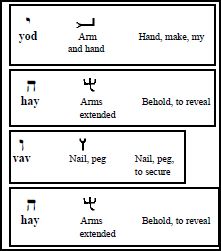
It is God’s name/character of love that is written in the heads of His redeemed people (Revelation 22:4). The prophet Ezekiel was shown that His mark is depicted in the letter ת ‘tav’ which was written in ancient times as the image of the cross (Ezekiel 9:4).
The word תורה ‘torah’ also pictographically displays Messiah on the cross, revealing the love of God.
ת – cross
ו – nail
ר – head, leader
ה – man with outstretched arms
Jesus’ declaration of God’s love was manifest on the cross.
Psa 22:22 I will declare thy name unto my brethren: in the midst of the congregation will I praise thee.
Heb 2:10 For it became him, for whom are all things, and by whom are all things, in bringing many sons unto glory, to make the captain of their salvation perfect through sufferings.
Heb 2:11 For both he that sanctifieth and they who are sanctified are all of one: for which cause he is not ashamed to call them brethren,
Heb 2:12 Saying, I will declare thy name unto my brethren, in the midst of the church will I sing praise unto thee.
Christ laid down His life for mankind, revealing the love of God. In this love for mankind, He fulfilled the law. The New Covenant Torah is for believers to do the same.
Joh 13:34 A new commandment I give unto you, That ye love one another; as I have loved you, that ye also love one another.
Joh 15:12 This is my commandment, That ye love one another, as I have loved you.
Joh 15:13 Greater love hath no man than this, that a man lay down his life for his friends.
Gal_6:2 Bear ye one another’s burdens, and so fulfil the law of Christ.
Gal 5:13 For, brethren, ye have been called unto liberty; only use not liberty for an occasion to the flesh, but by love serve one another.
Gal 5:14 For all the law is fulfilled in one word, even in this; Thou shalt love thy neighbour as thyself.
1Jn 4:21 And this commandment have we from him, That he who loveth God love his brother also.
1Pe 2:21 For even hereunto were ye called: because Christ also suffered for us, leaving us an example, that ye should follow his steps:
1Pe 2:22 Who did no sin, neither was guile found in his mouth:
1Pe 2:23 Who, when he was reviled, reviled not again; when he suffered, he threatened not; but committed himself to him that judgeth righteously:
1Pe 2:24 Who his own self bare our sins in his own body on the tree, that we, being dead to sins, should live unto righteousness: by whose stripes ye were healed.
1Pe 2:25 For ye were as sheep going astray; but are now returned unto the Shepherd and Bishop of your souls.
1Jn 2:1 My little children, these things write I unto you, that ye sin not. And if any man sin, we have an advocate with the Father, Jesus Christ the righteous:
1Jn 2:2 And he is the propitiation for our sins: and not for ours only, but also for the sins of the whole world.
1Jn 2:3 And hereby we do know that we know him, if we keep his commandments.
1Jn 2:4 He that saith, I know him, and keepeth not his commandments, is a liar, and the truth is not in him.
1Jn 2:5 But whoso keepeth his word, in him verily is the love of God perfected: hereby know we that we are in him.
1Jn 2:6 He that saith he abideth in him ought himself also so to walk, even as he walked.
1Jn 2:7 Brethren, I write no new commandment unto you, but an old commandment which ye had from the beginning. The old commandment is the word which ye have heard from the beginning.
1Jn 2:8 Again, a new commandment I write unto you, which thing is true in him and in you: because the darkness is past, and the true light now shineth.
1Jn 2:9 He that saith he is in the light, and hateth his brother, is in darkness even until now.
1Jn 2:10 He that loveth his brother abideth in the light, and there is none occasion of stumbling in him.
Joh 13:13 Ye call me Master and Lord: and ye say well; for so I am.
Joh 13:14 If I then, your Lord and Master, have washed your feet; ye also ought to wash one another’s feet.
Joh 13:15 For I have given you an example, that ye should do as I have done to you.
Joh 13:16 Verily, verily, I say unto you, The servant is not greater than his lord; neither he that is sent greater than he that sent him.
Joh 13:17 If ye know these things, happy are ye if ye do them.
Eph 5:1 Be ye therefore followers of God, as dear children;
Eph 5:2 And walk in love, as Christ also hath loved us, and hath given himself for us an offering and a sacrifice to God for a sweetsmelling savour.
1Jn 3:16 Hereby perceive we the love of God, because he laid down his life for us: and we ought to lay down our lives for the brethren.
1Jn 3:17 But whoso hath this world’s good, and seeth his brother have need, and shutteth up his bowels of compassion from him, how dwelleth the love of God in him?
1Jn 3:18 My little children, let us not love in word, neither in tongue; but in deed and in truth.
1Jn 3:19 And hereby we know that we are of the truth, and shall assure our hearts before him.
1Jn 3:20 For if our heart condemn us, God is greater than our heart, and knoweth all things.
1Jn 3:21 Beloved, if our heart condemn us not, then have we confidence toward God.
1Jn 3:22 And whatsoever we ask, we receive of him, because we keep his commandments, and do those things that are pleasing in his sight.
1Jn 3:23 And this is his commandment, That we should believe on the name of his Son Jesus Christ, and love one another, as he gave us commandment.
1Jn 3:24 And he that keepeth his commandments dwelleth in him, and he in him. And hereby we know that he abideth in us, by the Spirit which he hath given us.
Rom 8:1 There is therefore now no condemnation to them which are in Christ Jesus, who walk not after the flesh, but after the Spirit.
Rom 8:2 For the law of the Spirit of life in Christ Jesus hath made me free from the law of sin and death.
Rom 8:3 For what the law could not do, in that it was weak through the flesh, God sending his own Son in the likeness of sinful flesh, and for sin, condemned sin in the flesh:
Rom 8:4 That the righteousness of the law might be fulfilled in us, who walk not after the flesh, but after the Spirit.
Rom 8:28 And we know that all things work together for good to them that love God, to them who are the called according to his purpose.
Rom 8:29 For whom he did foreknow, he also did predestinate to be conformed to the image of his Son, that he might be the firstborn among many brethren.
Rom 13:8 Owe no man any thing, but to love one another: for he that loveth another hath fulfilled the law.
Rom 13:9 For this, Thou shalt not commit adultery, Thou shalt not kill, Thou shalt not steal, Thou shalt not bear false witness, Thou shalt not covet; and if there be any other commandment, it is briefly comprehended in this saying, namely, Thou shalt love thy neighbour as thyself.
Rom 13:10 Love worketh no ill to his neighbour: therefore love is the fulfilling of the law.
1Ti 1:5 Now the end of the commandment is charity out of a pure heart, and of a good conscience, and of faith unfeigned:
Mar 12:28 And one of the scribes came, and having heard them reasoning together, and perceiving that he had answered them well, asked him, Which is the first commandment of all?
Mar 12:29 And Jesus answered him, The first of all the commandments is, Hear, O Israel; The Lord our God is one Lord:
Mar 12:30 And thou shalt love the Lord thy God with all thy heart, and with all thy soul, and with all thy mind, and with all thy strength: this is the first commandment.
Mar 12:31 And the second is like, namely this, Thou shalt love thy neighbour as thyself. There is none other commandment greater than these.
Mar 12:32 And the scribe said unto him, Well, Master, thou hast said the truth: for there is one God; and there is none other but he:
Mar 12:33 And to love him with all the heart, and with all the understanding, and with all the soul, and with all the strength, and to love his neighbour as himself, is more than all whole burnt offerings and sacrifices.
Mar 12:34 And when Jesus saw that he answered discreetly, he said unto him, Thou art not far from the kingdom of God. And no man after that durst ask him any question.
Luk 10:27 And he answering said, Thou shalt love the Lord thy God with all thy heart, and with all thy soul, and with all thy strength, and with all thy mind; and thy neighbour as thyself.
Luk 10:28 And he said unto him, Thou hast answered right: this do, and thou shalt live.
Luk 10:29 But he, willing to justify himself, said unto Jesus, And who is my neighbour?
Luk 10:30 And Jesus answering said, A certain man went down from Jerusalem to Jericho, and fell among thieves, which stripped him of his raiment, and wounded him, and departed, leaving him half dead.
Luk 10:31 And by chance there came down a certain priest that way: and when he saw him, he passed by on the other side.
Luk 10:32 And likewise a Levite, when he was at the place, came and looked on him, and passed by on the other side.
Luk 10:33 But a certain Samaritan, as he journeyed, came where he was: and when he saw him, he had compassion on him,
Luk 10:34 And went to him, and bound up his wounds, pouring in oil and wine, and set him on his own beast, and brought him to an inn, and took care of him.
Luk 10:35 And on the morrow when he departed, he took out two pence, and gave them to the host, and said unto him, Take care of him; and whatsoever thou spendest more, when I come again, I will repay thee.
Luk 10:36 Which now of these three, thinkest thou, was neighbour unto him that fell among the thieves?
Luk 10:37 And he said, He that shewed mercy on him. Then said Jesus unto him, Go, and do thou likewise.
Christ’s Words are the Words of the Father
Joh 14:24 The one who does not love Me does not keep My Words. And the Word which you hear is not Mine but of the Father who sent Me.
Joh 7:16 Jesus answered them, and said, My doctrine is not mine, but his that sent me.
Joh 7:17 If any man will do his will, he shall know of the doctrine, whether it be of God, or whether I speak of myself.
Joh 12:48 He that rejecteth me, and receiveth not my words, hath one that judgeth him: the word that I have spoken, the same shall judge him in the last day.
Joh 12:49 For I have not spoken of myself; but the Father which sent me, he gave me a commandment, what I should say, and what I should speak.
Joh 5:30 I can of mine own self do nothing: as I hear, I judge: and my judgment is just; because I seek not mine own will, but the will of the Father which hath sent me.
Yet, the law of Christ is not the same as the law of Moses. Paul could not live “without the law” and be under the law of Christ at the same time if the law of Moses (Old Covenant) and law of Christ were the same thing.
1Co 9:19 For though I be free from all men, yet have I made myself servant unto all, that I might gain the more.
1Co 9:20 And unto the Jews I became as a Jew, that I might gain the Jews; to them that are under the law, as under the law, that I might gain them that are under the law;
1Co 9:21 To them that are without law, as without law, (being not without law to God, but under the law to Christ,) that I might gain them that are without law.
1Co 9:22 To the weak became I as weak, that I might gain the weak: I am made all things to all men, that I might by all means save some.
1Co 9:23 And this I do for the gospel’s sake, that I might be partaker thereof with you.
1Co 9:24 Know ye not that they which run in a race run all, but one receiveth the prize? So run, that ye may obtain.
1Co 9:25 And every man that striveth for the mastery is temperate in all things. Now they do it to obtain a corruptible crown; but we an incorruptible.
1Co 9:26 I therefore so run, not as uncertainly; so fight I, not as one that beateth the air:
1Co 9:27 But I keep under my body, and bring it into subjection: lest that by any means, when I have preached to others, I myself should be a castaway.
Rom 7:1 Know ye not, brethren, (for I speak to them that know the law,) how that the law hath dominion over a man as long as he liveth?
Rom 7:2 For the woman which hath an husband is bound by the law to her husband so long as he liveth; but if the husband be dead, she is loosed from the law of her husband.
Rom 7:3 So then if, while her husband liveth, she be married to another man, she shall be called an adulteress: but if her husband be dead, she is free from that law; so that she is no adulteress, though she be married to another man.
Rom 7:4 Wherefore, my brethren, ye also are become dead to the law by the body of Christ; that ye should be married to another, even to him who is raised from the dead, that we should bring forth fruit unto God.
Rom 7:5 For when we were in the flesh, the motions of sins, which were by the law, did work in our members to bring forth fruit unto death.
Rom 7:6 But now we are delivered from the law, that being dead wherein we were held; that we should serve in newness of spirit, and not in the oldness of the letter.
Rom 7:7 What shall we say then? Is the law sin? God forbid. Nay, I had not known sin, but by the law: for I had not known lust, except the law had said, Thou shalt not covet.
Rom 7:8 But sin, taking occasion by the commandment, wrought in me all manner of concupiscence. For without the law sin was dead.
Rom 7:9 For I was alive without the law once: but when the commandment came, sin revived, and I died.
Rom 7:10 And the commandment, which was ordained to life, I found to be unto death.
Rom 7:11 For sin, taking occasion by the commandment, deceived me, and by it slew me.
Rom 7:12 Wherefore the law is holy, and the commandment holy, and just, and good.
Rom 7:13 Was then that which is good made death unto me? God forbid. But sin, that it might appear sin, working death in me by that which is good; that sin by the commandment might become exceeding sinful.
Rom 7:14 For we know that the law is spiritual: but I am carnal, sold under sin.
Rom 7:15 For that which I do I allow not: for what I would, that do I not; but what I hate, that do I.
Rom 7:16 If then I do that which I would not, I consent unto the law that it is good.
Rom 7:17 Now then it is no more I that do it, but sin that dwelleth in me.
Rom 7:18 For I know that in me (that is, in my flesh,) dwelleth no good thing: for to will is present with me; but how to perform that which is good I find not.
Rom 7:19 For the good that I would I do not: but the evil which I would not, that I do.
Rom 7:20 Now if I do that I would not, it is no more I that do it, but sin that dwelleth in me.
Rom 7:21 I find then a law, that, when I would do good, evil is present with me.
Rom 7:22 For I delight in the law of God after the inward man:
Rom 7:23 But I see another law in my members, warring against the law of my mind, and bringing me into captivity to the law of sin which is in my members.
Rom 7:24 O wretched man that I am! who shall deliver me from the body of this death?
Rom 7:25 I thank God through Jesus Christ our Lord. So then with the mind I myself serve the law of God; but with the flesh the law of sin.
Rom 10:1 Brethren, my heart’s desire and prayer to God for Israel is, that they might be saved.
Rom 10:2 For I bear them record that they have a zeal of God, but not according to knowledge.
Rom 10:3 For they being ignorant of God’s righteousness, and going about to establish their own righteousness, have not submitted themselves unto the righteousness of God.
Rom 10:4 For Christ is the end of the law for righteousness to every one that believeth.
Rom 10:5 For Moses describeth the righteousness which is of the law, That the man which doeth those things shall live by them.
Rom 10:6 But the righteousness which is of faith speaketh on this wise, Say not in thine heart, Who shall ascend into heaven? (that is, to bring Christ down from above:)
Rom 10:7 Or, Who shall descend into the deep? (that is, to bring up Christ again from the dead.)
Rom 10:8 But what saith it? The word is nigh thee, even in thy mouth, and in thy heart: that is, the word of faith, which we preach;
Rom 10:9 That if thou shalt confess with thy mouth the Lord Jesus, and shalt believe in thine heart that God hath raised him from the dead, thou shalt be saved.
Rom 10:10 For with the heart man believeth unto righteousness; and with the mouth confession is made unto salvation.
Rom 10:11 For the scripture saith, Whosoever believeth on him shall not be ashamed.
Rom 10:12 For there is no difference between the Jew and the Greek: for the same Lord over all is rich unto all that call upon him.
Rom 10:13 For whosoever shall call upon the name of the Lord shall be saved.
Rom 10:14 How then shall they call on him in whom they have not believed? and how shall they believe in him of whom they have not heard? and how shall they hear without a preacher?
Rom 10:15 And how shall they preach, except they be sent? as it is written, How beautiful are the feet of them that preach the gospel of peace, and bring glad tidings of good things!
Rom 10:16 But they have not all obeyed the gospel. For Esaias saith, Lord, who hath believed our report?
Rom 10:17 So then faith cometh by hearing, and hearing by the word of God.
Rom 10:18 But I say, Have they not heard? Yes verily, their sound went into all the earth, and their words unto the ends of the world.
Rom 10:19 But I say, Did not Israel know? First Moses saith, I will provoke you to jealousy by them that are no people, and by a foolish nation I will anger you.
Rom 10:20 But Esaias is very bold, and saith, I was found of them that sought me not; I was made manifest unto them that asked not after me.
Rom 10:21 But to Israel he saith, All day long I have stretched forth my hands unto a disobedient and gainsaying people.
Gal_6:2 Bear ye one another’s burdens, and so fulfil the law of Christ.
A New Commandment

One of the celebrations amongst Christians during the Easter season is “Maundy Thursday” which remembers the Last Supper and the New Covenant.
The word ‘Maundy’ traces back to the Latin word ‘mandatum’ which means a commandment. Most scholars agree that the name “Maundy” was given to this celebration because of the Latin translation of John 13:34:
“Mandatum novum do vobis ut diligatis invicem sicut dilexi vos” (“A new commandment I give unto you, That ye love one another; as I have loved you”).
Joh 13:14 If I then, your Lord and Master, have washed your feet; ye also ought to wash one another’s feet.
Joh 13:15 For I have given you an example, that ye should do as I have done to you.
Joh 13:34 A new commandment I give unto you, That ye love one another; as I have loved you, that ye also love one another.
Here we see Jesus giving His Torah, prophesied by Moses & Isaiah.
SEE Hebrew Roots of Christian Holidays – The Law of Christ
The New Covenant is the law written on our hearts, a better testament but NOT according to the covenant made with Israel at Sinai.
Heb 8:6 But now hath he obtained a more excellent ministry, by how much also he is the mediator of a better covenant, which was established upon better promises.
Heb 8:7 For if that first covenant had been faultless, then should no place have been sought for the second.
Heb 8:8 For finding fault with them, he saith, Behold, the days come, saith the Lord, when I will make a new covenant with the house of Israel and with the house of Judah:
Heb 8:9 Not according to the covenant that I made with their fathers in the day when I took them by the hand to lead them out of the land of Egypt; because they continued not in my covenant, and I regarded them not, saith the Lord.
Heb 8:10 For this is the covenant that I will make with the house of Israel after those days, saith the Lord; I will put my laws into their mind, and write them in their hearts: and I will be to them a God, and they shall be to me a people:
Heb 8:11 And they shall not teach every man his neighbour, and every man his brother, saying, Know the Lord: for all shall know me, from the least to the greatest.
Heb 8:12 For I will be merciful to their unrighteousness, and their sins and their iniquities will I remember no more.
Heb 8:13 In that he saith, A new covenant, he hath made the first old {παλαιόω ‘palaioō’}. Now that which decayeth {παλαιόω ‘palaioō’} and waxeth old {γηράσκω ‘gēraskō’} is ready to vanish away.
The first covenant was taken away that the second might be established:
Heb 10:1 For the law having a shadow of good things to come, and not the very image of the things, can never with those sacrifices which they offered year by year continually make the comers thereunto perfect.
Heb 10:2 For then would they not have ceased to be offered? because that the worshippers once purged should have had no more conscience of sins.
Heb 10:3 But in those sacrifices there is a remembrance again made of sins every year.
Heb 10:4 For it is not possible that the blood of bulls and of goats should take away sins.
Heb 10:5 Wherefore when he cometh into the world, he saith, Sacrifice and offering thou wouldest not, but a body hast thou prepared me:
Heb 10:6 In burnt offerings and sacrifices for sin thou hast had no pleasure.
Heb 10:7 Then said I, Lo, I come (in the volume of the book it is written of me,) to do thy will, O God.
Heb 10:8 Above when he said, Sacrifice and offering and burnt offerings and offering for sin thou wouldest not, neither hadst pleasure therein; which are offered by the law;
Heb 10:9 Then said he, Lo, I come to do thy will, O God. He taketh away the first, that he may establish the second.
Heb 10:10 By the which will we are sanctified through the offering of the body of Jesus Christ once for all.
Heb 10:11 And every priest standeth daily ministering and offering oftentimes the same sacrifices, which can never take away sins:
Heb 10:12 But this man, after he had offered one sacrifice for sins for ever, sat down on the right hand of God;
Heb 10:13 From henceforth expecting till his enemies be made his footstool.
Heb 10:14 For by one offering he hath perfected for ever them that are sanctified.
Heb 10:15 Whereof the Holy Ghost also is a witness to us: for after that he had said before,
Heb 10:16 This is the covenant that I will make with them after those days, saith the Lord, I will put my laws into their hearts, and in their minds will I write them;
Heb 10:17 And their sins and iniquities will I remember no more.
Heb 10:18 Now where remission of these is, there is no more offering for sin.
Heb 10:19 Having therefore, brethren, boldness to enter into the holiest by the blood of Jesus,
Heb 10:20 By a new and living way, which he hath consecrated for us, through the veil, that is to say, his flesh;
Heb 10:21 And having an high priest over the house of God;
Heb 10:22 Let us draw near with a true heart in full assurance of faith, having our hearts sprinkled from an evil conscience, and our bodies washed with pure water.
Heb 10:23 Let us hold fast the profession of our faith without wavering; (for he is faithful that promised;)
Heb 10:24 And let us consider one another to provoke unto love and to good works:
Heb 10:25 Not forsaking the assembling of ourselves together, as the manner of some is; but exhorting one another: and so much the more, as ye see the day approaching.
Heb 10:26 For if we sin wilfully after that we have received the knowledge of the truth, there remaineth no more sacrifice for sins,
Heb 10:27 But a certain fearful looking for of judgment and fiery indignation, which shall devour the adversaries.
Heb 10:28 He that despised Moses’ law died without mercy under two or three witnesses:
Heb 10:29 Of how much sorer punishment, suppose ye, shall he be thought worthy, who hath trodden under foot the Son of God, and hath counted the blood of the covenant, wherewith he was sanctified, an unholy thing, and hath done despite unto the Spirit of grace?
Heb 10:30 For we know him that hath said, Vengeance belongeth unto me, I will recompense, saith the Lord. And again, The Lord shall judge his people.
Heb 10:31 It is a fearful thing to fall into the hands of the living God.
Heb 10:32 But call to remembrance the former days, in which, after ye were illuminated, ye endured a great fight of afflictions;
Heb 10:33 Partly, whilst ye were made a gazingstock both by reproaches and afflictions; and partly, whilst ye became companions of them that were so used.
Heb 10:34 For ye had compassion of me in my bonds, and took joyfully the spoiling of your goods, knowing in yourselves that ye have in heaven a better and an enduring substance.
Heb 10:35 Cast not away therefore your confidence, which hath great recompence of reward.
Heb 10:36 For ye have need of patience, that, after ye have done the will of God, ye might receive the promise.
Heb 10:37 For yet a little while, and he that shall come will come, and will not tarry.
Heb 10:38 Now the just shall live by faith: but if any man draw back, my soul shall have no pleasure in him.
Heb 10:39 But we are not of them who draw back unto perdition; but of them that believe to the saving of the soul.
Heb 12:24 And to Jesus the mediator of the new covenant, and to the blood of sprinkling, that speaketh better things than that of Abel.
The New Covenant brings a change in the priesthood and a change in the law. The Old Covenant was done away.
2Co 3:2 Ye are our epistle written in our hearts, known and read of all men:
2Co 3:3 Forasmuch as ye are manifestly declared to be the epistle of Christ ministered by us, written not with ink, but with the Spirit of the living God; not in tables of stone, but in fleshy tables of the heart.
2Co 3:4 And such trust have we through Christ to God-ward:
2Co 3:5 Not that we are sufficient of ourselves to think any thing as of ourselves; but our sufficiency is of God;
2Co 3:6 Who also hath made us able ministers of the new testament; not of the letter, but of the spirit: for the letter killeth, but the spirit giveth life.
2Co 3:7 But if the ministration of death, written and engraven in stones, was glorious, so that the children of Israel could not stedfastly behold the face of Moses for the glory of his countenance; which glory was to be done away {καταργέω ‘katargeō’}:
2Co 3:8 How shall not the ministration of the spirit be rather glorious?
2Co 3:9 For if the ministration of condemnation be glory, much more doth the ministration of righteousness exceed in glory.
2Co 3:10 For even that which was made glorious had no glory in this respect, by reason of the glory that excelleth.
2Co 3:11 For if that which is done away was glorious, much more that which remaineth is glorious.
2Co 3:12 Seeing then that we have such hope, we use great plainness of speech:
2Co 3:13 And not as Moses, which put a vail over his face, that the children of Israel could not stedfastly look to the end of that which is abolished {καταργέω ‘katargeō’}:
2Co 3:14 But their minds were blinded: for until this day remaineth the same vail untaken away in the reading of the old testament; which vail is done away in Christ.
2Co 3:15 But even unto this day, when Moses is read, the vail is upon their heart.
2Co 3:16 Nevertheless when it shall turn to the Lord, the vail shall be taken away.
2Co 3:17 Now the Lord is that Spirit: and where the Spirit of the Lord is, there is liberty.
2Co 3:18 But we all, with open face beholding as in a glass the glory of the Lord, are changed into the same image from glory to glory, even as by the Spirit of the Lord.
Heb 7:11 If therefore perfection were by the Levitical priesthood, (for under it the people received the law,) what further need was there that another priest should rise after the order of Melchisedec, and not be called after the order of Aaron?
Heb 7:12 For the priesthood being changed, there is made of necessity a change also of the law.
Heb 7:13 For he of whom these things are spoken pertaineth to another tribe, of which no man gave attendance at the altar.
Heb 7:14 For it is evident that our Lord sprang out of Juda; of which tribe Moses spake nothing concerning priesthood.
Heb 7:15 And it is yet far more evident: for that after the similitude of Melchisedec there ariseth another priest,
Heb 7:16 Who is made, not after the law of a carnal commandment, but after the power of an endless life.
Heb 7:17 For he testifieth, Thou art a priest for ever after the order of Melchisedec.
Heb 7:18 For there is verily a disannulling of the commandment going before for the weakness and unprofitableness thereof.
Heb 7:19 For the law made nothing perfect, but the bringing in of a better hope did; by the which we draw nigh unto God.
Heb 7:20 And inasmuch as not without an oath he was made priest:
Heb 7:21 (For those priests were made without an oath; but this with an oath by him that said unto him, The Lord sware and will not repent, Thou art a priest for ever after the order of Melchisedec:)
Heb 7:22 By so much was Jesus made a surety of a better testament.
Perfection did not come through the Levitical priesthood and the Old Covenant law.
Heb 7:11 If therefore perfection were by the Levitical priesthood, (for under it the people received the law,) what further need was there that another priest should rise after the order of Melchisedec, and not be called after the order of Aaron?
Heb 7:12 For the priesthood being changed, there is made of necessity a change also of the law.
Heb 7:17 For he testifieth, Thou art a priest for ever after the order of Melchisedec.
Heb 7:18 For there is verily a disannulling of the commandment going before for the weakness and unprofitableness thereof.
Heb 7:19 For the law made nothing perfect, but the bringing in of a better hope did; by the which we draw nigh unto God.
1Co 13:10 But when that which is perfect is come, then that which is in part shall be done away {καταργέω ‘katargeō’}.
1Co 13:11 When I was a child, I spake as a child, I understood as a child, I thought as a child: but when I became a man, I put away childish things.
2Co 3:7 But if the ministration of death, written and engraven in stones, was glorious, so that the children of Israel could not stedfastly behold the face of Moses for the glory of his countenance; which glory was to be done away {καταργέω ‘katargeō’}:
2Co 3:11 For if that which is done away {καταργέω ‘katargeō’} was glorious, much more that which remaineth is glorious.
2Co 3:14 But their minds were blinded: for until this day remaineth the same vail untaken away in the reading of the old testament; which vail is done away {καταργέω ‘katargeō’} in Christ.
Recall that the veil is done away through the New Covenant in Christ (Hebrews 10:20).
Either the Old Covenant is done away in Christ, establishing the New Covenant, or the Promise of Christ is “done away” by the continuance of the Old Covenant.
Rom 4:14 For if they which are of the law be heirs, faith is made void, and the promise made of none effect {καταργέω ‘katargeō’}:
Gal 3:17 And this I say, that the covenant, that was confirmed before of God in Christ, the law, which was four hundred and thirty years after, cannot disannul, that it should make the promise of none effect {καταργέω ‘katargeō’}.
Gal 3:18 For if the inheritance be of the law, it is no more of promise: but God gave it to Abraham by promise.
Gal 5:4 Christ is become of no effect {καταργέω ‘katargeō’}
unto you, whosoever of you are justified by the law; ye are fallen from grace.
“Be not deceived with strange doctrines, nor with old fables, which are unprofitable. For if we still live according to the Jewish law, we acknowledge that we have not received grace. For the divinest prophets lived according to Christ Jesus. On this account also they were persecuted, being inspired by His grace to fully convince the unbelieving that there is one God, who has manifested Himself by Jesus Christ His Son, who is His eternal Word, not proceeding forth from silence, and who in all things pleased Him that sent Him.” {The Epistle of Ignatius to the Magnesians}
“Let us not, therefore, be insensible to His kindness. For were He to reward us according to our works, we should cease to be. Therefore, having become His disciples, let us learn to live according to the principles of Christianity. For whosoever is called by any other name besides this, is not of God. Lay aside, therefore, the evil, the old, the sour leaven, and be ye changed into the new leaven, which is Jesus Christ. Be ye salted in Him, lest any one among you should be corrupted, since by your savour ye shall be convicted. It is absurd to profess Christ Jesus, and to Judaize. For Christianity did not embrace Judaism, but Judaism Christianity, that so every tongue which believeth might be gathered together to God.
Let us not, therefore, be insensible to His kindness. For were He to reward us according to our works, we should cease to be. For “if Thou, Lord, shalt mark iniquities, O Lord, who shall stand? ” Let us therefore prove ourselves worthy of that name which we have received. For whosoever is called by any other name besides this, he is not of God; for he has not received the prophecy which speaks thus concerning us: “The people shall be called by a new name, which the Lord shall name them, and shall be a holy people.” This was first fulfilled in Syria; for “the disciples were called Christians at Antioch,” when Paul and Peter were laying the foundations of the Church.
Lay aside, therefore, the evil, the old, the corrupt leaven, and be ye changed into the new leaven of grace. Abide in Christ, that the stranger may not have dominion over you. It is absurd to speak of Jesus Christ with the tongue, and to cherish in the mind a Judaism which has now come to an end. For where there is Christianity there cannot be Judaism. For Christ is one, in whom every nation that believes, and every tongue that confesses, is gathered unto God. And those that were of a stony heart have become the children of Abraham, the friend of God; and in his seed all those have been blessed who were ordained to eternal life in Christ.” {The Epistle of Ignatius to the Magnesians}
“For why should God, the founder of the universe, the Governor of the whole world, the Fashioner of humanity, the Sower of universal nations be believed to have given a law through Moses to one people, and not be said to have assigned it to all nations? For unless He had given it to all by no means would He have habitually permitted even proselytes out of the nations to have access to it. But— as is congruous with the goodness of God, and with His equity, as the Fashioner of mankind— He gave to all nations the selfsame law, which at definite and stated times He enjoined should be observed, when He willed, and through whom He willed, and as He willed.
For in the beginning of the world He gave to Adam himself and Eve a law, that they were not to eat of the fruit of the tree planted in the midst of paradise; but that, if they did contrariwise, by death they were to die. Which law had continued enough for them, had it been kept. For in this law given to Adam we recognise in embryo all the precepts which afterwards sprouted forth when given through Moses; that is, You shall love the Lord your God from your whole heart and out of your whole soul; You shall love your neighbour as yourself; You shall not kill; You shall not commit adultery; You shall not steal; False witness you shall not utter; Honour your father and mother; and, That which is another’s, shall you not covet.
For the primordial law was given to Adam and Eve in paradise, as the womb of all the precepts of God. In short, if they had loved the Lord their God, they would not have contravened His precept; if they had habitually loved their neighbour— that is, themselves — they would not have believed the persuasion of the serpent, and thus would not have committed murder upon themselves, by falling from immortality, by contravening God’s precept; from theft also they would have abstained, if they had not stealthily tasted of the fruit of the tree, nor had been anxious to skulk beneath a tree to escape the view of the Lord their God; nor would they have been made partners with the falsehood-asseverating devil, by believing him that they would be “like God;” and thus they would not have offended God either, as their Father, who had fashioned them from clay of the earth, as out of the womb of a mother; if they had not coveted another’s, they would not have tasted of the unlawful fruit.
Therefore, in this general and primordial law of God, the observance of which, in the case of the tree’s fruit, He had sanctioned, we recognise enclosed all the precepts specially of the posterior Law, which germinated when disclosed at their proper times. For the subsequent superinduction of a law is the work of the same Being who had before premised a precept; since it is His province withal subsequently to train, who had before resolved to form, righteous creatures.
For what wonder if He extends a discipline who institutes it? If He advances who begins? In short, before the Law of Moses, written in stone-tables, I contend that there was a law unwritten, which was habitually understood naturally, and by the fathers was habitually kept. For whence was Noah “found righteous,” if in his case the righteousness of a natural law had not preceded? Whence was Abraham accounted “a friend of God,” if not on the ground of equity and righteousness, (in the observance) of a natural law? Whence was Melchizedek named “priest of the most high God,” if, before the priesthood of the Levitical law, there were not levites who were wont to offer sacrifices to God? For thus, after the above-mentioned patriarchs, was the Law given to Moses, at that (well-known) time after their exode from Egypt, after the interval and spaces of four hundred years. In fact, it was after Abraham’s “four hundred and thirty years” that the Law was given.
Whence we understand that God’s law was anterior even to Moses, and was not first (given) in Horeb, nor in Sinai and in the desert, but was more ancient; (existing) first in paradise, subsequently reformed for the patriarchs, and so again for the Jews, at definite periods: so that we are not to give heed to Moses’ Law as to the primitive law, but as to a subsequent, which at a definite period God has set forth to the Gentiles too and, after repeatedly promising so to do through the prophets, has reformed for the better; and has premonished that it should come to pass that, just as “the law was given through Moses” John 1:17 at a definite time, so it should be believed to have been temporarily observed and kept.
And let us not annul this power which God has, which reforms the law’s precepts answerably to the circumstances of the times, with a view to man’s salvation. In fine, let him who contends that the Sabbath is still to be observed as a balm of salvation, and circumcision on the eighth day because of the threat of death, teach us that, for the time past, righteous men kept the Sabbath, or practised circumcision, and were thus rendered “friends of God.” For if circumcision purges a man since God made Adam uncircumcised, why did He not circumcise him, even after his sinning, if circumcision purges? At all events, in settling him in paradise, He appointed one uncircumcised as colonist of paradise.
Therefore, since God originated Adam uncircumcised, and inobservant of the Sabbath, consequently his offspring also, Abel, offering Him sacrifices, uncircumcised and inobservant of the Sabbath, was by Him commended; while He accepted what he was offering in simplicity of heart, and reprobated the sacrifice of his brother Cain, who was not rightly dividing what he was offering. Noah also, uncircumcised— yes, and inobservant of the Sabbath— God freed from the deluge.
For Enoch, too, most righteous man, uncircumcised and inobservant of the Sabbath, He translated from this world; who did not first taste death, in order that, being a candidate for eternal life, he might by this time show us that we also may, without the burden of the law of Moses, please God. Melchizedek also, “the priest of the most high God,” uncircumcised and inobservant of the Sabbath, was chosen to the priesthood of God. Lot, withal, the brother of Abraham, proves that it was for the merits of righteousness, without observance of the law, that he was freed from the conflagration of the Sodomites.
But Abraham, (you say,) was circumcised. Yes, but he pleased God before his circumcision; nor yet did he observe the Sabbath. For he had “accepted” circumcision; but such as was to be for “a sign” of that time, not for a prerogative title to salvation. In fact, subsequent patriarchs were uncircumcised, like Melchizedek, who, uncircumcised, offered to Abraham himself, already circumcised, on his return from battle, bread and wine.
“But again,” (you say) the son of Moses would upon one occasion have been choked by an angel, if Zipporah, had not circumcised the foreskin of the infant with a pebble; whence, “there is the greatest peril if any fail to circumcise the foreskin of his flesh.” Nay, but if circumcision altogether brought salvation, even Moses himself, in the case of his own son, would not have omitted to circumcise him on the eighth day; whereas it is agreed that Zipporah did it on the journey, at the compulsion of the angel.
Consider we, accordingly, that one single infant’s compulsory circumcision cannot have prescribed to every people, and founded, as it were, a law for keeping this precept. For God, foreseeing that He was about to give this circumcision to the people of Israel for “a sign,” not for salvation, urges the circumcision of the son of Moses, their future leader, for this reason; that, since He had begun, through him, to give the People the precept of circumcision, the people should not despise it, from seeing this example (of neglect) already exhibited conspicuously in their leader’s son.
For circumcision had to be given; but as “a sign,” whence Israel in the last time would have to be distinguished, when, in accordance with their deserts, they should be prohibited from entering the holy city, as we see through the words of the prophets, saying, “Your land is desert; your cities utterly burnt with fire; your country, in your sight, strangers shall eat up; and, deserted and subverted by strange peoples, the daughter of Zion shall be derelict, like a shed in a vineyard, and like a watchhouse in a cucumber-field, and as it were a city which is being stormed.”
Why so? Because the subsequent discourse of the prophet reproaches them, saying, “Sons have I begotten and upraised, but they have reprobated me;” and again, “And if you shall have outstretched hands, I will avert my face from you; and if you shall have multiplied prayers, I will not hear you: for your hands are full of blood;” Isaiah 1:15 and again, “Woe! sinful nation; a people full of sins; wicked sons; you have quite forsaken God, and have provoked unto indignation the Holy One of Israel.” Isaiah 1:4 This, therefore, was God’s foresight—that of giving circumcision to Israel, for a sign whence they might be distinguished when the time should arrive wherein their above-mentioned deserts should prohibit their admission into Jerusalem: which circumstance, because it was to be, used to be announced; and, because we see it accomplished, is recognised by us.
For, as the carnal circumcision, which was temporary, was in wrought for “a sign” in a contumacious people, so the spiritual has been given for salvation to an obedient people; while the prophet Jeremiah says, “Make a renewal for you, and sow not in thorns; be circumcised to God, and circumcise the foreskin of your heart:” and in another place he says, “Behold, days shall come, says the Lord, and I will draw up, for the house of Judah and for the house of Jacob, a new testament; not such as I once gave their fathers in the day wherein I led them out from the land of Egypt.”
Whence we understand that the coming cessation of the former circumcision then given, and the coming procession of a new law (not such as He had already given to the fathers), are announced: just as Isaiah foretold, saying that in the last days the mount of the Lord and the house of God were to be manifest above the tops of the mounts: “And it shall be exalted,” he says, “above the hills; and there shall come over it all nations; and many shall walk, and say, Come, ascend we unto the mount of the Lord, and unto the house of the God of Jacob,” Isaiah 2:2-3 — not of Esau, the former son, but of Jacob, the second; that is, of our “people,” whose “mount” is Christ, “prזcised without concisors’ hands, filling every land,” shown in the book of Daniel. In short, the coming procession of a new law out of this “house of the God of Jacob” Isaiah in the ensuing words announces, saying, “For from Zion shall go out a law, and the word of the Lord out of Jerusalem, and shall judge among the nations,”— that is, among us, who have been called out of the nations—”and they shall join to beat their glaives into ploughs, and their lances into sickles; and nations shall not take up glaive against nation, and they shall no more learn to fight.” Isaiah 2:3-4
Who else, therefore, are understood but we, who, fully taught by the new law, observe these practices—the old law being obliterated, the coming of whose abolition the action itself demonstrates? For the wont of the old law was to avenge itself by the vengeance of the glaive, and to pluck out “eye for eye,” and to inflict retaliatory revenge for injury. But the new law’s wont was to point to clemency, and to convert to tranquillity the pristine ferocity of “glaives” and “lances,” and to remodel the pristine execution of “war” upon the rivals and foes of the law into the pacific actions of “ploughing” and “tilling” the land.
Therefore as we have shown above that the coming cessation of the old law and of the carnal circumcision was declared, so, too, the observance of the new law and the spiritual circumcision has shone out into the voluntary obediences of peace. For “a people,” he says, “whom I knew not has served me; in obedience of the ear it has obeyed me.” Prophets made the announcement. But what is the “people” which was ignorant of God, but ours, who in days bygone knew not God? And who, in the hearing of the ear, gave heed to Him, but we, who, forsaking idols, have been converted to God? For Israel— who had been known to God, and who had by Him been “upraised” in Egypt, and was transported through the Red Sea, and who in the desert, fed forty years with manna, was wrought to the semblance of eternity, and not contaminated with human passions, or fed on this world’s meats, but fed on “angel’s loaves” — the manna— and sufficiently bound to God by His benefits— forgot his Lord and God, saying to Aaron: “Make us gods, to go before us: for that Moses, who ejected us from the land of Egypt, has quite forsaken us; and what has befallen him we know not.” And accordingly we, who “were not the people of God” in days bygone, have been made His people, by accepting the new law above mentioned, and the new circumcision before foretold.
It follows, accordingly, that, in so far as the abolition of carnal circumcision and of the old law is demonstrated as having been consummated at its specific times, so also the observance of the Sabbath is demonstrated to have been temporary.
For the Jews say, that from the beginning God sanctified the seventh day, by resting on it from all His works which He made; and that thence it was, likewise, that Moses said to the People: “Remember the day of the sabbaths, to sanctify it: every servile work you shall not do therein, except what pertains unto life.” Whence we (Christians) understand that we still more ought to observe a sabbath from all “servile work” always, and not only every seventh day, but through all time.
And through this arises the question for us, what sabbath God willed us to keep? For the Scriptures point to a sabbath eternal and a sabbath temporal. For Isaiah the prophet says, ” Your sabbaths my soul hates;” Isaiah 1:13 and in another place he says, ” My sabbaths you have profaned.” Whence we discern that the temporal sabbath is human, and the eternal sabbath is accounted divine; concerning which He predicts through Isaiah: “And there shall be,” He says, “month after month, and day after day, and sabbath after sabbath; and all flesh shall come to adore in Jerusalem, says the Lord;” which we understand to have been fulfilled in the times of Christ, when “all flesh”— that is, every nation— “came to adore in Jerusalem” God the Father, through Jesus Christ His Son, as was predicted through the prophet: “Behold, proselytes through me shall go unto You.” Thus, therefore, before this temporal sabbath, there was withal an eternal sabbath foreshown and foretold; just as before the carnal circumcision there was withal a spiritual circumcision foreshown.
In short, let them teach us, as we have already premised, that Adam observed the sabbath; or that Abel, when offering to God a holy victim, pleased Him by a religious reverence for the sabbath; or that Enoch, when translated, had been a keeper of the sabbath; or that Noah the ark-builder observed, on account of the deluge, an immense sabbath; or that Abraham, in observance of the sabbath, offered Isaac his son; or that Melchizedek in his priesthood received the law of the sabbath.
But the Jews are sure to say, that ever since this precept was given through Moses, the observance has been binding. Manifest accordingly it is, that the precept was not eternal nor spiritual, but temporary, which would one day cease. In short, so true is it that it is not in the exemption from work of the sabbath— that is, of the seventh day— that the celebration of this solemnity is to consist, that Joshua the son of Nun, at the time that he was reducing the city Jericho by war, stated that he had received from God a precept to order the People that priests should carry the ark of the testament of God seven days, making the circuit of the city; and thus, when the seventh day’s circuit had been performed, the walls of the city would spontaneously fall. Joshua 6:1-20 Which was so done; and when the space of the seventh day was finished, just as was predicted, down fell the walls of the city.
Whence it is manifestly shown, that in the number of the seven days there intervened a sabbath-day. For seven days, whencesoever they may have commenced, must necessarily include within them a sabbath-day; on which day not only must the priests have worked, but the city must have been made a prey by the edge of the sword by all the people of Israel. Nor is it doubtful that they “wrought servile work,” when, in obedience to God’s precept, they drove the preys of war. For in the times of the Maccabees, too, they did bravely in fighting on the sabbaths, and routed their foreign foes, and recalled the law of their fathers to the primitive style of life by fighting on the sabbaths. Nor should I think it was any other law which they thus vindicated, than the one in which they remembered the existence of the prescript touching “the day of the sabbaths.”
Whence it is manifest that the force of such precepts was temporary, and respected the necessity of present circumstances; and that it was not with a view to its observance in perpetuity that God formerly gave them such a law.
Therefore, since it is manifest that a sabbath temporal was shown, and a sabbath eternal foretold; a circumcision carnal foretold, and a circumcision spiritual pre-indicated; a law temporal and a law eternal formally declared; sacrifices carnal and sacrifices spiritual foreshown; it follows that, after all these precepts had been given carnally, in time preceding, to the people Israel, there was to supervene a time whereat the precepts of the ancient Law and of the old ceremonies would cease, and the promise of the new law, and the recognition of spiritual sacrifices, and the promise of the New Testament, supervene; while the light from on high would beam upon us who were sitting in darkness, and were being detained in the shadow of death.
And so there is incumbent on us a necessity 1 Corinthians 9:16 binding us, since we have premised that a new law was predicted by the prophets, and that not such as had been already given to their fathers at the time when He led them forth from the land of Egypt, to show and prove, on the one hand, that that old Law has ceased, and on the other, that the promised new law is now in operation.
And, indeed, first we must inquire whether there be expected a giver of the new law, and an heir of the new testament, and a priest of the new sacrifices, and a purger of the new circumcision, and an observer of the eternal sabbath, to suppress the old law, and institute the new testament, and offer the new sacrifices, and repress the ancient ceremonies, and suppress the old circumcision together with its own sabbath, and announce the new kingdom which is not corruptible.
Inquire, I say, we must, whether this giver of the new law, observer of the spiritual sabbath, priest of the eternal sacrifices, eternal ruler of the eternal kingdom, be come or no: that, if he is already come, service may have to be rendered him; if he is not yet come, he may have to be awaited, until by his advent it be manifest that the old Law’s precepts are suppressed, and that the beginnings of the new law ought to arise. And, primarily, we must lay it down that the ancient Law and the prophets could not have ceased, unless He had come who was constantly announced, through the same Law and through the same prophets, as to come.” {Tertullian – An Answer to the Jews}
Binding & Loosing

Jesus took away the authority of the Jews and gave it to Christians.
Mat 16:16 And Simon Peter answered and said, Thou art the Christ, the Son of the living God.
Mat 16:17 And Jesus answered and said unto him, Blessed art thou, Simon Barjona: for flesh and blood hath not revealed it unto thee, but my Father which is in heaven.
Mat 16:18 And I say also unto thee, That thou art Peter, and upon this rock I will build my church; and the gates of hell shall not prevail against it.
Mat 16:19 And I will give unto thee the keys of the kingdom of heaven: and whatsoever thou shalt bind on earth shall be bound in heaven: and whatsoever thou shalt loose on earth shall be loosed in heaven.
Mat 18:17 And if he shall neglect to hear them, tell it unto the church: but if he neglect to hear the church, let him be unto thee as an heathen man and a publican.
Mat 18:18 Verily I say unto you, Whatsoever ye shall bind on earth shall be bound in heaven: and whatsoever ye shall loose on earth shall be loosed in heaven.
Mat 18:19 Again I say unto you, That if two of you shall agree on earth as touching any thing that they shall ask, it shall be done for them of my Father which is in heaven.
Mat 18:20 For where two or three are gathered together in my name, there am I in the midst of them.
Before Jesus asks His disciples who they thought He was and gave the authority to bind and loose to them, He warns them of the doctrine of the Scribes and Pharisees. This is because the doctrine of the Jews was not to be followed or looked to for authority.
Mat 16:12 Then they knew that He did not say to take heed from the leaven of bread, but from the doctrine of the Pharisees and Sadducees.
Mat 21:42 Jesus said to them, Did you never read in the Scriptures, “A Stone which the builders rejected, this One became the Head of the Corner? This was from the Lord, and it is a wonder in our eyes?” Psalm 118:22, 23
Mat 21:43 Because of this I say to you, The kingdom of God will be taken from you, and it will be given to a nation producing the fruits of it.
1Ti 3:15 But if I delay, that you may know how to behave in the house of God, which is the assembly of the living God, the pillar and foundation of the truth.
Paul spoke of believers in Messiah as the “pillar and foundation of truth” (1 Timothy 3:15) which was a phrase applied to the sanhedrin during those days who had the responsibility of interpretation and application of Scripture to the community. I believe Paul using this phrase is another witness that early believers in Messiah believed that authority had transferred from Judah to believers in Messiah because Shiloh had come (Genesis 49:10).
In Colossians 2:16-17 there is another witness that the body of Messiah is given the authority of interpretation and application of the Word. “Let no man judge…but the body of Christ”.
The early church saw the authority to “bind and loose” in light of how to celebrate holidays and what was to be allowed and what was to be forbidden.
On the subject of binding and loosing, J.B. Lightfoot says:
“…the reader sees abundantly enough both the frequency and the common use of this phrase, and the sense of it also; namely, first, that it is used in doctrine, and in judgments, concerning things allowed or not allowed in the law. Secondly, That to bind is the same with to forbid; or to declare forbidden. To think that Christ, when he used the common phrase, was not understood by his hearers in the common and vulgar sense, shall I call it a matter of laughter or of madness?
To this, therefore, do these words amount: When the time was come, wherein the Mosaic law, as to some part of it, was to be abolished and left off; and as to another part of it, was to be continued, and to last for ever: he granted Peter here, and to the rest of the apostles, Mat_18:18, a power to abolish or confirm what they thought good, and as they thought good, being taught this and led by the Holy Spirit: as if he should say, “Whatsoever ye shall bind in the law of Moses, that is, forbid; it shall be forbidden; the Divine authority confirming it; and whatsoever ye shall loose; that is, permit; or shall teach; that it is permitted and lawful; shall be lawful and permitted.”
“For to you, O bishops, it is said: “Whatsoever ye shall bind on earth shall be bound in heaven; and whatsoever ye shall loose on earth shall be loosed in heaven.” {Constitutions of the Holy Apostles Book II}
“The terms binding and loosing, are equivalent to opening and shutting, because formerly the Jews opened the fastenings of their doors by untying it, and they shut or secured their doors by tying or binding it. (Bible de Vence) — Dr. Whitby, a learned Protestant divine, thus expounds this and the preceding verse: “As a suitable return to thy confession, I say also to thee, that thou art by name Peter, i.e. a rock; and upon thee, who art this rock, I will build my making laws to govern my Church.” (Tom. i, p. 143.) Dr. Hammond, another Protestant divine, explains it in the same manner. And p. 92, he says: ” What is here meant by the keys, is best understand by Isaias xxii. 22, where they signified ruling the whole family or house of the king: and this being by Christ accommodated to the Church, denotes the power of governing it.” {Haydock Catholic Bible Commentary}
Isa 22:22 And the key of the house of David will I lay upon his shoulder; so he shall open, and none shall shut; and he shall shut, and none shall open.
John Gill Commentary on Isaiah 22:22
Isaiah 22:22
“And the key of the house of David will I lay upon his shoulder,…. In allusion either to magistrates carrying a key on their shoulder, hanging down from thence, having a hook at one end of it fit for that purpose; or having one embroidered on that part of their garment: or one carried before them by their servants. It regards either the keys of the temple; or rather the key of the king’s house, which it was proper should be delivered to him as treasurer and steward of it; the Targum takes in both,
“and I will give the key of the house of the sanctuary, and the government of the house of David, into his hand.”
In the mystical sense, Christ is said to have this key, Rev_3:7 where the following words are applied to him:
so he shall open, and none shall shut; and he shall shut, and none shall open; all which is expressive of the government of the church being on his shoulders, and of his absolute and uncontrollable power over it; who opens the treasures of his word, of his grace, and of wisdom and knowledge, and communicates them unto, and shuts or hides them from, whom he pleases; who opens and shuts the doors of his church, his house, and lets in, and keeps out, whom he thinks fit; and who also opens and shuts the door of the kingdom of heaven, and introduces into it his own people, and excludes others.”
Adam Clarke commentary on Matthew 18:18
“Οσα εαν δησητε – και οσα εαν λυσητε. Binding and loosing, in this place, and in Mat_16:19, is generally restrained, by Christian interpreters, to matters of discipline and authority. But it is as plain as the sun, by what occurs in numberless places dispersed throughout the Mishna, and from thence commonly used by the later rabbins when they treat of ritual subjects, that binding signified, and was commonly understood by the Jews at that time to be, a declaration that any thing was unlawful to be done; and loosing signified, on the contrary, a declaration that any thing may be lawfully done. Our Savior spoke to his disciples in a language which they understood, so that they were not in the least at a loss to comprehend his meaning; and its being obsolete to us is no manner of reason why we should conclude that it was obscure to them.
“The phrases to bind and to loose were Jewish, and most frequent in their writers. It belonged only to the teachers among the Jews to bind and to loose. When the Jews set any apart to be a preacher, they used these words, ‘Take thou liberty to teach what is Bound and what is Loose.’” Strype’s preface to the Posthumous Remains of Dr. Lightfoot, p. 38.”
Adam Clarke commentary on Matthew 16:19
“That binding and loosing were terms in frequent use among the Jews, and that they meant bidding and forbidding, granting and refusing, declaring lawful or unlawful, etc., Dr. Lightfoot, after having given numerous instances, thus concludes: –
“To these may be added, if need were, the frequent (shall I say?) or infinite use of the phrases, אסור ומותר bound and loosed, which we meet with thousands of times over. But from these allegations the reader sees, abundantly enough, both the frequency and the common use of this phrase, and the sense of it also; namely, first, that it is used in doctrine, and in judgments, concerning things allowed or not allowed in the law. Secondly, that to bind is the same with, to forbid, or to declare forbidden. To think that Christ, when he used the common phrase, was not understood by his hearers in the common and vulgar sense, shall I call it a matter of laughter, or of madness?
To this, therefore, do these words amount: When the time was come wherein the Mosaic law, as to some part of it, was to be abolished, and left off, and, as to another part of it, was to be continued and to last for ever, he granted Peter here, and to the rest of the apostles, Mat_18:18, a power to abolish or confirm what they thought good, and as they thought good; being taught this, and led by the Holy Spirit: as if he should say, Whatsoever ye shall bind in the law of Moses, that is, forbid, it shall be forbidden, the Divine authority confirming it; and whatsoever ye shall loose, that is, permit, or shall teach that it is permitted and lawful, shall be lawful and permitted. Hence they bound, that is forbade, circumcision to the believers; eating of things offered to idols, of things strangled, and of blood, for a time, to the Gentiles; and that which they bound on earth was confirmed in heaven. They loosed, that is, allowed purification to Paul, and to four other brethren, for the shunning of scandal; Act_21:24 and, in a word, by these words of Christ it was committed to them, the Holy Spirit directing, that they should make decrees concerning religion, as to the use or rejection of Mosaic rites and judgments, and that either for a time, or for ever.
“Let the words be applied by way of paraphrase to the matter that was transacted at present with Peter: ‘I am about to build a Gentile Church,’ saith Christ, and to thee, O Peter, do I give the keys of the kingdom of heaven, that thou mayest first open the door of faith to them; but if thou askest by what rule that Church is to be governed, when the Mosaic rule may seem so improper for it, thou shalt be so guided by the Holy Spirit, that whatsoever of the law of Moses thou shalt forbid them shall be forbidden; whatsoever thou grantest them shall be granted; and that under a sanction made in heaven.’ Hence, in that instant, when he should use his keys, that is, when he was now ready to open the gate of the Gospel to the Gentiles, Acts 10, he was taught from heaven that the consorting of the Jew with the Gentile, which before had been bound, was now loosed; and the eating of any creature convenient for food was now loosed, which before had been bound; and he in like manner looses both these.
“Those words of our Savior, Joh_20:23, Whose sins ye remit, they are remitted to them, for the most part are forced to the same sense with these before us, when they carry quite another sense. Here the business is of doctrine only, not of persons; there of persons, not of doctrine. Here of things lawful or unlawful in religion, to be determined by the apostles; there of persons obstinate or not obstinate, to be punished by them, or not to be punished.
“As to doctrine, the apostles were doubly instructed. 1. So long sitting at the feet of their Master, they had imbibed the evangelical doctrine.
“2. The Holy Spirit directing them, they were to determine concerning the legal doctrine and practice, being completely instructed and enabled in both by the Holy Spirit descending upon them. As to the persons, they were endowed with a peculiar gift, so that, the same Spirit directing them, if they would retain and punish the sins of any, a power was delivered into their hands of delivering to Satan, of punishing with diseases, plagues, yea, death itself, which Peter did to Ananias and Sapphira; Paul to Elymas, Hymeneus, and Philetus, etc.”
After all these evidences and proofs of the proper use of these terms, to attempt to press the word, into the service long assigned them by the Church of Rome, would, to use the words of Dr. Lightfoot, be “a matter of laughter or of madness.” No Church can use them in the sense thus imposed upon them, which was done merely to serve secular ends; and least of all can that very Church that thus abuses them.”
Lightfoot commentary on Matthew 18:18
“This power was built upon that noble and most self-sufficient foundation, Joh_16:13; “The Spirit of truth shall lead you into all truth.” There lies an emphasis in those words, “into all truth.” I deny that any one, any where, at any time, was led, or to be led, into all truth, from the ascension of Christ, unto the world’s end, beside the apostles. Every holy man, certainly, is led into all truth necessary to him for salvation: but the apostles were led into all truth necessary both for themselves and the whole church; because they were to deliver a rule of faith and manners to the whole church throughout all ages. Hence, whatsoever they should confirm in the law was to be confirmed; whatsoever they should abolish was to be abolished: since they were endowed, as to all things, with a spirit of infallibility, guiding them by the hand into all truth.”
The Apostles understood that they were given authority to make commandments.
2Pe 3:1 This second epistle, beloved, I now write unto you; in both which I stir up your pure minds by way of remembrance:
2Pe 3:2 That ye may be mindful of the words which were spoken before by the holy prophets, and of the commandment of us the apostles of the Lord and Saviour:
Act 1:2 Until the day in which he was taken up, after that he through the Holy Ghost had given commandments unto the apostles whom he had chosen:
2Th 2:15 Therefore, brethren, stand fast, and hold the traditions which ye have been taught, whether by word, or our epistle.
2Th 3:6 Now we command you, brethren, in the name of our Lord Jesus Christ, that ye withdraw yourselves from every brother that walketh disorderly, and not after the tradition which he received of us.
1Th 4:1 Furthermore then we beseech you, brethren, and exhort you by the Lord Jesus, that as ye have received of us how ye ought to walk and to please God, so ye would abound more and more.
1Th 4:2 For ye know what commandments we gave you by the Lord Jesus.
1Co 11:2 Now I praise you, brethren, that ye remember me in all things, and keep the ordinances, as I delivered them to you.
To reject the word of the apostles is to reject the word of Christ and God (Luke 10:16; 1 Corinthians 14:37; 1 Thessalonians 4:1, 2, 8). The “apostles’ doctrine” is “the doctrine of the Lord” (Acts 2:42; 13:12).
Thus, if we find the early Church writings referencing the doctrine of the Apostles and these things agreeing with the writings of the New Testament we are not to reject them.
“Again we write, again keeping to the apostolic traditions, we remind each other when we come together for prayer; and keeping the feast in common, with one mouth we truly give thanks to the Lord. Thus giving thanks unto him, and being followers of the saints, ‘we shall make our praise in the Lord all the day,’ as the psalmist says. So, when we rightly keep the feast, we shall be counted worthy of that joy which is in heaven” {Festal Letters 2:7 [A.D. 330] – Athanasius}.
“But you are blessed, who by faith are in the Church, dwell upon the foundations of the faith, and have full satisfaction, even the highest degree of faith which remains among you unshaken. For it has come down to you from apostolic tradition, and frequently accursed envy has wished to unsettle it, but has not been able” {Festal Letters 2:29 [A.D. 330] – Athanasius}
The Festal Letters are also called the “Easter letters” which were a series of letters sent by the Bishops of Alexandria which conformed to the decisions of the First Council of Nicaea. In other words, these letters supported the celebration of Pascha (Easter) as being fixed on Sunday as opposed to the 14th of Nisan/Aviv.
If we see Easter and Christmas chronicled by the early Church fathers as being traditions handed down by the Apostles then we are not to reject them.
“At that time [A.D. 150] there flourished in the Church Hegesippus, whom we know from what has gone before, and Dionysius, bishop of Corinth, and another bishop, Pinytus of Crete, and besides these, Philip, and Apollinarius, and Melito, and Musanus, and Modestus, and, finally, Irenaeus. From them has come down to us in writing, the sound and orthodox faith received from tradition.” {Eusebius – Church History 4:21}
“As I said before, the Church, having received this preaching and this faith, although she is disseminated throughout the whole world, yet guarded it, as if she occupied but one house. She likewise believes these things just as if she had but one soul and one and the same heart; and harmoniously she proclaims them and teaches them and hands them down, as if she possessed but one mouth. For, while the languages of the world are diverse, nevertheless, the authority of the tradition is one and the same.” {Irenaeus – Against Heresies 1:10:2 [A.D. 189]}
“It is possible, then, for everyone in every Church, who may wish to know the truth, to contemplate the tradition of the Apostles which has been made known throughout the whole world. And we are in a position to enumerate those who were instituted bishops by the Apostles, and their successors to our own times: men who neither knew nor taught anything like these heretics rave about. For if the Apostles had known hidden mysteries which they taught to the elite secretly and apart from the rest, they would have handed them down especially to those very ones to whom they were committing the self-same Churches. For surely they wished all those and their successors to be perfect and without reproach, to whom they handed on their authority.” {Irenaeus – Against Heresies 3:3:1}
“Well, they preserving the tradition of the blessed doctrine derived directly from the holy apostles, Peter, James, John, and Paul, the sons receiving it from the father (but few were like the fathers), came by God’s will to us also to deposit those ancestral and apostolic seeds. And well I know that they will exult; I do not mean delighted with this tribute, but solely on account of the preservation of the truth, according as they delivered it. For such a sketch as this, will, I think, be agreeable to a soul desirous of preserving from loss the blessed tradition.” {Clement of Alexandria – Miscellanies 1:1 [A.D. 208]}
“Although there are many who believe that they themselves hold to the teachings of Christ, there are yet some among them who think differently from their predecessors. The teaching of the Church has indeed been handed down through an order of succession from the apostles and remains in the churches even to the present time. That alone is to be believed as the truth which is in no way at variance with ecclesiastical and apostolic tradition.” {Origen – The Fundamental Doctrines 1:2 [A.D. 225]}
“But the admonition that he [Cyprian] gives us, ‘that we should go back to the fountain, that is, to apostolic tradition, and thence turn the channel of truth to our times,’ is most excellent, and should be followed without hesitation.” {Augustine – On Baptism, Against the Donatists 5:26[37] [A.D. 400]}
“But in regard to those observances which we carefully attend and which the whole world keeps, and which derive not from Scripture but from Tradition, we are given to understand that they are recommended and ordained to be kept, either by the apostles themselves or by plenary [ecumenical] councils, the authority of which is quite vital in the Church.” {Augustine – Letter to Januarius [A.D. 400]}
In regards to Easter & Christmas, Augustine states:
“Those feasts concerning which we have no express scripture, but only traditions, which are now observed all the world over; we ought to know that the keeping of them was commended unto us, and instituted (or commanded) either by the apostles themselves, or general councils, of which there is a most wholesome use in the church of God; such are the feast of our Lord’s Passion, Resurrection and Ascension into heaven, and the coming down of the Holy Ghost, which are now kept holy with a yearly solemnity.” {Augustine Epistle 118}
“It chiefly behooves us that upon the day of our Lord’s nativity, we should receive the sacrament in remembrance of him that was born upon it, and upon the return of the year to celebrate the very day with a feasting devotion.” {Augustine Epistle 119}
“He was born, according to tradition, upon December the twenty-fifth.” {On the Trinity, 4.5, Post Nicene Fathers 3.74}
“[Paul commands,] ‘Therefore, brethren, stand fast and hold the traditions which you have been taught, whether by word or by our letter’ [2 Thess. 2:15]. From this it is clear that they did not hand down everything by letter, but there is much also that was not written. Like that which was written, the unwritten too is worthy of belief. So let us regard the tradition of the Church also as worthy of belief. Is it a tradition? Seek no further.” {John Chrysostom –
Homilies on Second Thessalonians [A.D. 402]}
Establishing the Law

Rom 3:31 Do we then make void the law {καταργέω ‘katargeō’} through faith? God forbid: yea, we establish the law.
Early Christians, who celebrated Christmas & Easter for example, believed in “establishing the law.”
But he had withal said above: “Are we, then, making void the law through faith? Far be it; but we are establishing the law.” {Tertullian On Modesty }
“Do not in any way forsake the commandments of the Lord; but keep what you have received, neither adding thereto nor taking away therefrom.” {Didache – first century writing attributed to the Apostles}
“And He that was the Lawgiver became Himself the fulfilling of the law; not taking away the law of nature, but abrogating those additional laws that were afterwards introduced, although not all of them neither. For He did not take away the law of nature, but confirmed it. For He that said in the law, “The Lord thy God is one Lord;” the same says in the Gospel, “That they might know Thee, the only true God.” And He that said, “Thou shalt love thy neighbour as thyself,” says in the Gospel, renewing the same precept, “A new commandment I give unto you, that ye love one another.”
He who then forbade murder, does now forbid causeless anger. He that forbade adultery, does now forbid all unlawful lust. He that forbade stealing, now pronounces him most happy who supplies those that are in want out of his own labours. He that forbade hatred, now pronounces him blessed that loves his enemies. He that forbade revenge, now commands long-suffering; not as if just revenge were an unrighteous thing, but because long-suffering is more excellent. Nor did He make laws to root out our natural passions, but only to forbid the excess of them. He who had commanded to honour our parents, was Himself subject to them.
He who had commanded to keep the Sabbath, by resting thereon for the sake of meditating on the laws, has now commanded us to consider of the law of creation, and of providence every day, and to return thanks to God. He abrogated circumcision when He had Himself fulfilled it. For He it was “to whom the inheritance was reserved, who was the expectation of the nations.” He who made a law for swearing rightly, and forbade perjury, has now charged us not to swear at all. He has in several ways changed baptism, sacrifice, the priesthood, and the divine service, which was confined to one place: for instead of daily baptisms, He has given only one, which is that into His death.
Instead of one tribe, He has appointed that out of every nation the best should be ordained for the priesthood; and that not their bodies should be examined for blemishes, but their religion and their lives. Instead of a bloody sacrifice, He has appointed that reasonable and unbloody mystical one of His body and blood, which is performed to represent the death of the Lord by symbols. Instead of the divine service confined to one place, He has commanded and appointed that He should be glorified from sunrising to sunsetting in every place of His dominion.
He did not therefore take away the law from us, but the bonds. For concerning the law Moses says: “Thou shalt meditate on the word which I command thee, sitting in thine house, and rising up, and walking in the way.” And David says: “His delight is in the law of the Lord, and in His law will he meditate day and night.” For everywhere would he have us subject to His laws, but not transgressors of them. For says He: “Blessed are the undefiled in the way, who walk in the law of the Lord. Blessed are they that search out His testimonies; with their whole heart shall they seek Him.”
And again: “Blessed are we, O Israel, because those things that are pleasing to God are known to us.” And the Lord says: “If ye know these things, happy are ye if ye do them.”
Let us therefore follow Christ, that we may inherit His blessings. Let us walk after the law and the prophets by the Gospel. Let us eschew the worshippers of many gods, and the murderers of Christ, and the murderers of the prophets, and the wicked and atheistical heretics. Let us be obedient to Christ as to our King, as having authority to change several constitutions, and having, as a legislator, wisdom to make new constitutions in different circumstances; yet so that everywhere the laws of nature be immutably preserved.” {Apostolic Constitutions}
“Seeing then that the days are evil, and that the Active One himself has the authority, we ought to give heed to ourselves and to seek out the ordinances of the Lord.
For He hath made manifest to us by all the prophets that He wanteth neither sacrifices nor whole burnt offerings nor oblations, saying at one time; What to Me is the multitude of your sacrifices, saith the Lord I am full of whole burnt-offerings, and the fat of lambs and the blood of bulls and of goats desire not, not though ye should come to be seen of Me. or who required these things at your hands? Ye shall continue no more to tread My court. If ye bring fine flour, it is in vain; incense is an abomination to Me; your new moons and your Sabbaths I cannot away with.
It behooves us therefore to investigate deeply concerning the
present, and to search out the things which have power to save us.
Let us therefore flee altogether from all the works of lawlessness,
lest the works of lawlessness overpower us; and let us loathe the
error of the present time, that we may be loved for that which is to
come.
Ye ought therefore to understand. Moreover I ask you this one thing besides, as being one of yourselves and loving you all in particular more than my own soul, to give heed to yourselves now, and not to liken yourselves to certain persons who pile up sin upon sin, saying that our covenant remains to them also.
Ours it is; but they lost it in this way for ever, when Moses had
just received it. For the scripture saith; And Moses was in the
mountain fasting forty days and forty nights, and he received the
covenant from the Lord, even tablets of stone written with the
finger of the hand of the Lord.
But they lost it by turning unto idols. For thus saith the Lord;
Moses, Moses, come down quickly; for thy people whom thou
broughtest out of the land of Egypt hath done unlawfully. And
Moses understood, and threw the two tables from his hands; and their covenant was broken in pieces, that the covenant of the beloved Jesus might be sealed unto our hearts in the hope which springeth from faith in Him.”
“Let us become spiritual, let us become a temple perfect unto God. As far as in us lies, let us exercise ourselves in the fear of God, [and] let us strive to keep His commandments, that we may rejoice in His ordinances.”
“Thou shalt love Him that made thee, thou shalt fear Him that created thee, thou shalt glorify Him that redeemed thee from death; thou shalt be simple in heart and rich in spirit; thou shalt not cleave to those who walk the way of death; thou shalt hate everything that is not pleasing to God; thou shalt hate all hypocrisy; thou shalt never forsake the commandments of the Lord.” {Epistle of Barnabas}
“You never grudged any act of kindness, being “ready to every good work.” Adorned by a thoroughly virtuous and religious life, you did all things in the fear of God. The commandments and ordinances of the Lord were written upon the tablets of your hearts.”
“For this reason righteousness and peace are now far departed from you, inasmuch as every one abandons the fear of God, and is become blind in His faith, neither walks in the laws of His commandments.”
“Let him that has love in Christ fulfill the commandments of Christ.”
“Blessed are we, dearly beloved, if we should be doing the commandments of God in concord of love, to the end that our sins may through love be forgiven us.” {Clement of Rome Epistle to the Corinthians (A.D. 96)}
“And we ought not rather to fear men but God. For this cause, if you do these things, the Lord said, Though you be gathered together with Me in My bosom, and do not My commandments, I will cast you away and will say unto you, Depart from Me, I know you not whence you are, you workers of iniquity.” {Second Clement (A.D. 100)}
“Sir, these commandments are great and beautiful and glorious, and are able to gladden the heart of the man who is able to observe them. But I know not whether these commandments can be kept by a man, for they are very hard.” He answered and said unto me; “If you set it before yourself that they can be kept, you will easily keep them, and they will not be hard; but if it once enter into your heart that they cannot be kept by a man, you will not keep them. But now I say unto you; if you keep them not, but neglect them you shall not have salvation, neither your children nor your household, since you have already pronounced judgment against yourself that these commandments cannot be kept by a man.” {Shepherd of Hermas (A.D. 150) Ante-Nicene Fathers vol.2 pg.29}
“If then,” [he said,] “man is lord of all the creatures of God and masters all things, cannot he also master these commandments?” “Aye” said he, “The man that has the Lord in his heart can master [all things and] all these commandments.” {Shepherd of Hermas (A.D. 150) Ante-Nicene Fathers vol.2 pg. 29}
“Man, Sir,” I say, “is eager to keep the commandments of God, and there is no one that asks not of the Lord that he may be strengthened in His commandments, and be subject to them; but the devil is hard and overmasters them.” “He cannot,” said he, “overmaster the servants of God, who set their hope on Him with their whole heart. The devil can wrestle with them, but he cannot overthrow them. If then you resist him, he will be vanquished and will flee from you disgraced.” {Shepherd of Hermas (A.D. 150) Ante-Nicene Fathers vol.2 pg. 29}
“And I hope, Sir, that I am now able to keep these commandments which you have commanded, the Lord enabling me.” “You shall keep them,” said he, “if your heart be found pure with the Lord; yea, and all shall keep them, as many as shall purify their hearts from the vain desires of this world, and shall live unto God.” {Shepherd of Hermas (A.D. 150) Ante-Nicene Fathers vol.2 pg. 30}
“The teaching of the Lord, with whom not only is the adulterer rejected, but also the man who desires to commit adultery; and not only is the actual murderer held guilty of having killed another to his own damnation, but the man also who is angry with his brother without a cause: who commanded [His disciples] not only not to hate men, but also to love their enemies; and commanded them not only not to swear falsely, but not even to swear at all; and not only not to speak evil of their neighbors, but not even to style any one “Raca” and “fool;” [declaring] that otherwise they were in danger of hell-fire; and not only not to strike, but even, when themselves struck, to present the other cheek [to those that maltreated them]; and not only not to refuse to give up the property of others, but even if their own were taken away, not to demand it back again from those that took it; and not only not to injure their neighbors, nor to do them any evil, but also, when themselves wickedly dealt with, to be long-suffering, and to show kindness towards those [that injured them], and to pray for them, that by means of repentance they might be saved.” {Irenaeus (A.D. 180) Ante-Nicene Fathers vol.1 pg. 408}
“As in the law, therefore, and in the Gospel [likewise], the first and greatest commandment is, to love the Lord God with the whole heart, and then there follows a commandment like to it, to love one’s neighbor as one’s self; the author of the law and the Gospel is shown to be one and the same. For the precepts of an absolutely perfect life, since they are the same in each Testament, have pointed out [to us] the same God, who certainly has promulgated particular laws adapted for each; but the more prominent and the greatest [commandments], without which salvation cannot [be attained], He has exhorted [us to observe] the same in both.” {Irenaeus (A.D. 180) Ante-Nicene Fathers vol.1 pg. 476}
“Why call you me Lord, Lord,” He says, “and do not the things which I say?” For “the people that love with their lips, but have their heart far away from the Lord,” is another people, and trust in another, and have willingly sold themselves to another; but those who perform the commandments of the Lord, in every action “testify,” by doing what He wishes, and consistently naming the Lord’s name; and “testifying” by deed to Him in whom they trust, that they are those “who have crucified the flesh, with the affections and lusts.” “If we live in the Spirit, let us also walk in the Spirit.” {Clement of Alexandria (A.D. 195) Ante-Nicene Fathers vol.2 pg.417}
“The kingdom of God,” He says, “comes not with observation; neither do they say, Lo here! or, lo there! for, behold, the kingdom of God is within you.” Now, who will not interpret the words “within you” to mean in your hand, within your power, if you hear, and do the commandment of God?” {Tertullian (A.D. 198) Ante-Nicene Fathers vol.3 pg. 409}
“But how can we possess immortality, unless we keep those commands of Christ whereby death is driven out and overcome, when He Himself warns us, and says, “If you will enter into life, keep the commandments”? And again: “If you do the things that I command you, henceforth I call you not servants, but friends.” Finally, these persons He calls strong and steadfast; these He declares to be founded in robust security upon the rock, established with immovable and unshaken firmness, in opposition to all the tempests and hurricanes of the world. “Whosoever,” says He, “hears my words, and does them, I will liken him unto a wise man, that built his house upon a rock: the rain descended, the floods came, the winds blew, and beat upon that house; and it fell not: for it was founded upon a rock.”
We ought therefore to stand fast on His words, to learn and do whatever He both taught and did. But how can a man say that he believes in Christ, who does not do what Christ commanded him to do? Or whence shall he attain to the reward of faith, who will not keep the faith of the commandment? He must of necessity waver and wander, and, caught away by a spirit of error, like dust which is shaken by the wind, be blown about; and he will make no advance in his walk towards salvation, because he does not keep the truth of the way of salvation.” {Cyprian (A.D. 250) Ante-Nicene Fathers vol.5 pg. 421}
“…As I have learned also from the memoirs. For He exhorted His disciples to surpass the pharisaic way of living, with the warning, that if they did not, they might be sure they could not be saved; and these words are recorded in the memoirs: ‘Unless your righteousness exceed that of the Scribes and Pharisees, you shall not enter into the kingdom of heaven.’” {Justin Martyr (A.D. 160) Ante-Nicene Fathers vol.1 pg.252}
“For the tradition of the elders themselves, which they pretended to observe from the law, was contrary to the law given by Moses. Wherefore also Isaiah declares: “Your dealers mix the wine with water,” showing that the elders were in the habit of mingling a watered tradition with the simple command of God; that is, they set up a spurious law, and one contrary to the [true] law; as also the Lord made plain, when He said to them, “Why do you transgress the commandment of God, for the sake of your tradition?”
For not only by actual transgression did they set the law of God at naught, mingling the wine with water; but they also set up their own law in opposition to it, which is termed, even to the present day, the pharisaical. In this [law] they suppress certain things, add others, and interpret others, again, as they think proper, which their teachers use, each one in particular; and desiring to uphold these traditions, they were unwilling to be subject to the law of God, which prepares them for the coming of Christ.” {Irenaeus (A.D. 180) Ante-Nicene Fathers vol.1 pg. 475}
“This people honors Me with their lips, but their heart is far from Me: howbeit in vain do they worship Me, teaching the doctrines and the commandments of men.” He does not call the law given by Moses commandments of men, but the traditions of the elders themselves which they had invented, and in upholding which they made the law of God of none effect, and were on this account also not subject to His Word. For this is what Paul says concerning these men: “For they, being ignorant of God’s righteousness, and going about to establish their own righteousness, have not submitted themselves to the righteousness of God.” {Irenaeus (A.D. 180) Ante-Nicene Fathers vol.1 pg. 476}
“As He does Himself declare: “Unless your righteousness shall exceed that of the scribes and Pharisees, you shall not enter into the kingdom of heaven.” For what meant “exceed” (that of the scribes and Pharisees) referred to? In the first place, [we must] believe not only in the Father, but also in His Son now revealed; for He it is who leads man into fellowship and unity with God. In the next place, [we must] not only say, but we must do; for they said, but did not. And [we must] not only abstain from evil deeds, but even from the desires after them. Now He did not teach us these things as being opposed to the law, but as fulfilling the law, and implanting in us the varied righteousness of the law.” {Irenaeus (A.D. 180) Ante-Nicene Fathers vol.1 pg.477}
“And for this reason did the Lord, instead of that [commandment], “You shall not commit adultery,” forbid even concupiscence; and instead of that which runs thus, “You shall not kill,” He prohibited anger; and instead of the law commanding the giving of tithes, [He told us] to share all our possessions with the poor; and not to love our neighbors only, but even our enemies; and not merely to be liberal givers and bestowers, but even that we should present a gratuitous gift to those who take away our goods. For “to him that takes away your coat,” He says, “give to him your cloak also; and from him that takes away your goods, ask them not again; and as you would that men should do unto you, do you unto them:” so that we may not grieve as those who are unwilling to be defrauded, but may rejoice as those who have given willingly, and as rather conferring a favor upon our neighbors than yielding to necessity.
“And if any one,” He says, “shall compel you [to go] a mile, go with him twain;” so that you may not follow him as a slave, but may as a free man go before him, showing yourself in all things kindly disposed and useful to your neighbor, not regarding their evil intentions, but performing your kind offices, assimilating yourself to the Father, “who makes His sun to rise upon the evil and the good, and sends rain upon the just and unjust.” Now all these [precepts], as I have already observed, were not the injunctions of one doing away with the law, but of one fulfilling, extending, and widening it among us.” {Irenaeus (A.D. 180) Ante-Nicene Fathers vol.1 pg. 477}
“Why, then, did the Lord not form the covenant for the fathers? Because “the law was not established for righteous men.” But the righteous fathers had the meaning of the Decalogue written in their hearts and souls, that is, they loved the God who made them, and did no injury to their neighbor.” {Irenaeus (A.D. 180) Ante-Nicene Fathers vol.1 pg.481}
“But if some, through weak-mindedness, wish to observe such institutions as were given by Moses, from which they expect some virtue, but which we believe were appointed by reason of the hardness of the people’s hearts, along with their hope in this Christ, and [wish to perform] the eternal and natural acts of righteousness and piety, yet choose to live with the Christians and the faithful, as I said before, not inducing them either to be circumcised like themselves, or to keep the Sabbath, or to observe any other such ceremonies, then I hold that we ought to join ourselves to such, and associate with them in all things as kinsmen and brethren. But if, Trypho,” I continued, “some of your race (the Jews), who say they believe in this Christ, compel those Gentiles who believe in this Christ to live in all respects according to the law given by Moses, or choose not to associate so intimately with them, I in like manner do not approve of them.”
“And Trypho again inquired, “But if some one, knowing that this is so, after he recognizes that this man is Christ, and has believed in and obeys Him, wishes, however, to observe these [institutions], will he be saved?” I said, “In my opinion, Trypho, such an one will be saved, if he does not strive in every way to persuade other men – I mean those Gentiles who have been circumcised from error by Christ, to observe the same things as himself, telling them that they will not be saved unless they do so. This you did yourself at the commencement of the discourse, when you declared that I would not be saved unless I observe these institutions.” {Justin Martyr (A.D. 160) Ante-Nicene Fathers vol.1 pg.218}
“There will be no other God, O Trypho, nor was there from eternity any other existing” (I thus addressed him), “but He who made and disposed all this universe. Nor do we think that there is one God for us, another for you, but that He alone is God who led your fathers out from Egypt with a strong hand and a high arm. Nor have we trusted in any other (for there is no other), but in Him in whom you also have trusted, the God of Abraham, and of Isaac, and of Jacob. But we do not trust through Moses or through the law; for then we would do the same as yourselves. But now–(for I have read that there shall be a final law, and a covenant, the chiefest of all, which it is now incumbent on all men to observe, as many as are seeking after the inheritance of God.
For the law promulgated on Horeb is now old, and belongs to yourselves alone; but this is for all universally. Now, law placed against law has abrogated that which is before it, and a covenant which comes after in like manner has put an end to the previous one; and an eternal and final law–namely, Christ–has been given to us, and the covenant is trustworthy, after which there shall be no law, no commandment, no ordinance. Have you not read this which Isaiah says: ‘Hearken unto Me, hearken unto Me, my people; and, ye kings, give ear unto Me: for a law shall go forth from Me, and My judgment shah be for a light to the nations. My righteousness approaches swiftly, and My salvation shall go forth, and nations shall trust in Mine arm?’
And by Jeremiah, concerning this same new covenant, He thus speaks: ‘Behold, the days come, saith the Lord, that I will make a new covenant with the house of Israel and with the house of Judah; not according to the covenant which I made with their fathers, in the day that I took them by the hand, to bring them out of the land of Egypt’). If, therefore, God proclaimed a new covenant which was to be instituted, and this for a light of the nations, we see and are persuaded that men approach God, leaving their idols and other unrighteousness, through the name of Him who was crucified, Jesus Christ, and abide by their confession even unto death, and maintain piety.
Moreover, by the works and by the attendant miracles, it is possible for all to understand that He is the new law, and the new covenant, and the expectation of those who out of every people wait for the good things of God. For the true spiritual Israel, and descendants of Judah, Jacob, Isaac, and Abraham (who in uncircumcision was approved of and blessed by God on account of his faith, and called the father of many nations), are we who have been led to God through this crucified Christ, as shall be demonstrated while we proceed.
I also adduced another passage in which Isaiah exclaims: “‘Hear My words, and your soul shall live; and I will make an everlasting covenant with you, even the sure mercies of David. Behold, I have given Him for a witness to the people: nations which know not Thee shall call on Thee; peoples who know not Thee shall escape to Thee, because of thy God, the Holy One of Israel; for He has glorified Thee.’ This same law you have despised, and His new holy covenant you have slighted; and now you neither receive it, nor repent of your evil deeds. ‘For your ears are closed, your eyes are blinded, and the heart is hardened,’ Jeremiah has cried; yet not even then do you listen.
The Lawgiver is present, yet you do not see Him; to the poor the Gospel is preached, the blind see, yet you do not understand. You have now need of a second circumcision, though you glory greatly in the flesh. The new law requires you to keep perpetual sabbath, and you, because you are idle for one day, suppose you are pious, not discerning why this has been commanded you: and if you eat unleavened bread, you say the will of God has been fulfilled.
The Lord our God does not take pleasure in such observances: if there is any perjured person or a thief among you, let him cease to be so; if any adulterer, let him repent; then he has kept the sweet and true sabbaths of God. If any one has impure hands, let him wash and be pure.
I also adduced another passage in which Isaiah exclaims: “‘Hear My words, and your soul shall live; and I will make an everlasting covenant with you, even the sure mercies of David. Behold, I have given Him for a witness to the people: nations which know not Thee shall call on Thee; peoples who know not Thee shall escape to Thee, because of thy God, the Holy One of Israel; for He has glorified Thee.’
This same law you have despised, and His new holy covenant you have slighted; and now you neither receive it, nor repent of your evil deeds. ‘For your ears are closed, your eyes are blinded, and the heart is hardened,’ Jeremiah has cried; yet not even then do you listen. The Lawgiver is present, yet you do not see Him; to the poor the Gospel is preached, the blind see, yet you do not understand. You have now need of a second circumcision, though you glory greatly in the flesh.
The new law requires you to keep perpetual sabbath, and you, because you are idle for one day, suppose you are pious, not discerning why this has been commanded you: and if you eat unleavened bread, you say the will of God has been fulfilled. The Lord our God does not take pleasure in such observances: if there is any perjured person or a thief among you, let him cease to be so; if any adulterer, let him repent; then he has kept the sweet and true sabbaths of God. If any one has impure hands, let him wash and be pure.
“By reason, therefore, of this laver of repentance and knowledge of God, which has been ordained on account of the transgression of God’s people, as Isaiah cries, we have believed, and testify that that very baptism which he announced is alone able to purify those who have repented; and this is the water of life. But the cisterns which you have dug for yourselves are broken and profitless to you. For what is the use of that baptism which cleanses the flesh and body alone? Baptize the soul from wrath and from covetousness, from envy, and from hatred; and, lo! the body is pure.
For this is the symbolic significance of unleavened bread, that you do not commit the old deeds of wicked leaven. But you have understood all things in a carnal sense, and you suppose it to be piety if you do such things, while your souls are filled with deceit, and, in short, with every wickedness. Accordingly, also, after the seven days of eating unleavened bread, God commanded them to mingle new leaven, that is, the performance of other works, and not the imitation of the old and evil works.
And because this is what this new Lawgiver demands of you, I shall again refer to the words which have been quoted by me, and to others also which have been passed over. They are related by Isaiah to the following effect: ‘Hearken to me, and your soul shall live; and I will make with you an everlasting covenant, even the sure mercies of David. Behold, I have given Him for a witness to the people, a leader and commander to the nations. Nations which know not Thee shall call on Thee; and peoples who know not Thee shall escape unto Thee, because of Thy God, the Holy One of Israel, for He has glorified Thee. Seek ye God; and when you find Him, call on Him, so long as He may be nigh you.
Let the wicked forsake his ways, and the unrighteous man his thoughts; and let him return unto the Lord, and he will obtain mercy, because He will abundantly pardon your sins. For my thoughts are not as your thoughts, neither are my ways as your ways; but as far removed as the heavens are from the earth, so far is my way removed from your way, and your thoughts from my thoughts. For as the snow or the rain descends from heaven, and shall not return till it waters the earth, and makes it bring forth and bud, and gives seed to the sower and bread for food, so shall My word be that goeth forth out of My mouth: it shall not return until it shall have accomplished all that I desired, and I shall make My commandments prosperous. For ye shall go out with joy, and be taught with gladness. For the mountains and the hills shall leap while they expect you, and all the trees of the fields shall applaud with their branches: and instead of the thorn shall come up the cypress, and instead of the brier shall come up the myrtle.
And the Lord shall be for a name, and for an everlasting sign, and He shall not fail!’ Of these and such like words written by the prophets, O Trypho,” said I, “some have reference to the first advent of Christ, in which He is preached as inglorious, obscure, and of mortal appearance: but others had reference to His second advent, when He shall appear in glory and above the clouds; and your nation shall see and know Him whom they have pierced, as Hosea, one of the twelve prophets, and Daniel, foretold.” {Justin Martyr Dialogue with Trypho XI Chapter 11, 12, 14}
“And for this reason, indeed, when at this present time the law is read to the Jews, it is like a fable; for they do not possess the explanation of all things pertaining to the advent of the Son of God, which took place in human nature; but when it is read by the Christians, it is a treasure, hid indeed in a field, but brought to light by the cross of Christ, and explained, both enriching the understanding of men, and showing forth the wisdom of God.” {Irenaeus (A.D. 180) Ante-Nicene Fathers vol.1 pg. 496}
Fulfillment of the Law

Rom 10:4 For Christ is the end of the law for righteousness to every one that believeth.
The law was designed to lead us to Christ (Hebrews 10:1), revealing our sins (Romans 7:7; 3:19) and condemning us (Romans 7:5-23; 1 Corinthians 15:56) that we might turn to Him by faith and receive His gift of grace unto salvation (Romans 5:20; 7:24-25; 1 Corinthians 15:57). Through faith in Him, we receive His Spirit (Galatians 3:5, 14) to work through us (Philippians 2:13; Ephesians 3:20; Hebrews 13:21) and guide us (John 16:13; 14:26; 1 Corinthians 2:10-13) that we might walk by the Spirit of the law unto life, becoming His righteousness (2 Corinthians 5:21; Philippians 3:9). If we walk in the letter of the law by our own power (works of the law) we will die (Galatians 3:10; 2:16).
The law was a schoolmaster to lead us to Christ that we might attain justification through faith (Galatians 3:24). After faith is come, we are no longer under the schoolmaster (Galatians 3:25). We are not under the law, we are under grace (Romans 6:14). Whatsoever things the law says, it says to those who are under the law (Romans 3:19) that the world might become guilty before God (Romans 3:19), realizing our bondage to the elements of the world (Galatians 4:3) and our need for redemption through Jesus (Galatians 4:5) and to be led by the Spirit (Galatians 5:18).
We can only be pleasing to Him, and hear Him say ‘well done good and faithful servant,’ (Matthew 25:21-23) if Christ is living through us, the hope of Glory (Psalm 147:11; 33:18; 1 Peter 1:1, 13; Jude 1:21). Messiah always did the will of the Father, the things which were pleasing to Him (Luke 3:22; Matthew 12:18; 17:5; John 5:30; 8:29; Psalm 40:7-8). We are to submit our lives to Him (Romans 6:13) that He might live through us (John 17:21-23), just as the Father lived through Him (John 14:10; 15:1-10; 2 Corinthians 5:19).
If Christ in us is the only way we can please Him, where is the boasting (Romans 3:27)? Where is the uplifting of self over another? If we are boasting because of our works, we are making Messiah of none effect and are bringing ourselves into condemnation (Galatians 3:10). He alone is to be exalted (Isaiah 2:11, 17), we are to bend the knee in the same manner as everyone else (sinner and saint alike) (Isaiah 45:23; Romans 14:11; Philippians 2:10). Our knowledge of doctrine and the performance thereof, if gained and performed properly, comes from Him, not by our own strength/righteousness/worthiness (Philippians 2:5-13).
Our only boasting should be that we know Him (Jeremiah 9:23; 1 Corinthians 1:31), yet even that only comes through His grace (Galatians 1:15; John 6:37-44), not our worthiness (Romans 3:23). We are only made worthy through His work (Colossians 1:22; John 17:19; Acts 26:18), and God working in us to present us blameless and sanctified in His sight (Philippians 2:13; Jude 1:24; Ephesians 5:26-27; Philippians 1:6; 1 Thessalonians 5:23).
The letter of the law kills us that we might come to Christ Jesus (the Word made flesh) to receive life.
2Co 3:6 Who also hath made us able ministers of the new testament; not of the letter, but of the spirit: for the letter killeth, but the spirit giveth life.
Joh 6:63 It is the Spirit that gives life. The flesh does not profit, nothing! The Words which I speak to you are spirit and are life.
Rom 8:2 For the law of the Spirit of life in Christ Jesus hath made me free from the law of sin and death.
Rom 10:4 For Christ is the end {τέλος ‘telos’} of the law for righteousness to every one that believeth.
1Ti 1:5 Now the end {τέλος ‘telos’} of the commandment is charity out of a pure heart, and of a good conscience, and of faith unfeigned:
Mat 5:48 Be ye therefore perfect {τέλειος ‘teleios’}, even as your Father which is in heaven is perfect {τέλειος ‘teleios’}.
Heb 7:19 For the law made nothing perfect {τελειόω ‘teleioō’}, but the bringing in of a better hope did; by the which we draw nigh unto God.
Heb 7:11 If therefore perfection were by the Levitical priesthood, (for under it the people received the law,) what further need was there that another priest should rise after the order of Melchisedec, and not be called after the order of Aaron?
Heb 9:9 Which was a figure for the time then present, in which were offered both gifts and sacrifices, that could not make him that did the service perfect, as pertaining to the conscience;
Act 13:39 And by him all that believe are justified from all things, from which ye could not be justified by the law of Moses.
Rom 3:20 Therefore by the deeds of the law there shall no flesh be justified in his sight: for by the law is the knowledge of sin.
Rom 3:21 But now the righteousness of God without the law is manifested, being witnessed by the law and the prophets;
Rom 8:3 For what the law could not do, in that it was weak through the flesh, God sending his own Son in the likeness of sinful flesh, and for sin, condemned sin in the flesh:
Gal 2:16 Knowing that a man is not justified by the works of the law, but by the faith of Jesus Christ, even we have believed in Jesus Christ, that we might be justified by the faith of Christ, and not by the works of the law: for by the works of the law shall no flesh be justified.
Mat 5:18 For verily I say unto you, Till heaven and earth pass, one jot or one tittle shall in no wise pass from the law, till all be fulfilled.
Here Jesus is saying that the law will pass away when all is fulfilled
Gal 3:19 Wherefore then serveth the law? It was added because of transgressions, till the seed should come to whom the promise was made; and it was ordained by angels in the hand of a mediator.
Rom 8:3 For what the law could not do, in that it was weak through the flesh, God sending his own Son in the likeness of sinful flesh, and for sin, condemned sin in the flesh:
Rom 8:4 That the righteousness of the law might be fulfilled in us, who walk not after the flesh, but after the Spirit.
Jesus said that all things have been fulfilled
Joh 19:28 After this, Jesus knowing that all things were now accomplished {τελέω ‘teleō’ – fulfilled}, that the scripture might be fulfilled, saith, I thirst.
Joh 19:29 Now there was set a vessel full of vinegar: and they filled a spunge with vinegar, and put it upon hyssop, and put it to his mouth.
Joh 19:30 When Jesus therefore had received the vinegar, he said, It is finished: and he bowed his head, and gave up the ghost.
Eph 2:15 Having abolished in his flesh the enmity, even the law of commandments contained in ordinances; for to make in himself of twain one new man, so making peace;
Eph 2:16 And that he might reconcile both unto God in one body by the cross, having slain the enmity thereby:
Eph 2:17 And came and preached peace to you which were afar off, and to them that were nigh.
Eph 2:18 For through him we both have access by one Spirit unto the Father.
Eph 2:19 Now therefore ye are no more strangers and foreigners, but fellowcitizens with the saints, and of the household of God;
Eph 2:20 And are built upon the foundation of the apostles and prophets, Jesus Christ himself being the chief corner stone;
Eph 2:21 In whom all the building fitly framed together groweth unto an holy temple in the Lord:
Eph 2:22 In whom ye also are builded together for an habitation of God through the Spirit.
Col 1:20 And, having made peace through the blood of his cross, by him to reconcile all things unto himself; by him, I say, whether they be things in earth, or things in heaven.
Rom 10:4 For Christ is the end of the law for righteousness to every one that believeth.
“For by His advent He Himself fulfilled all things, and does still fulfil in the Church the new covenant foretold by the law, onwards to the consummation [of all things]. To this effect also Paul, His apostle, says in the Epistle to the Romans…” {Irenaeus Against Heresies Book IV}
“He came not to destroy the law and the prophets, but rather to fulfil them…”Thus Christ did not at all rescind the Sabbath: He kept the law thereof, and both in the former case did a work which was beneficial to the life of His disciples, for He indulged them with the relief of food when they were hungry, and in the present instance cured the withered hand; in each case intimating by facts, “I came not to destroy, the law, but to fulfil it,”…This verity of the gospel then stands unimpaired: “I am not come to destroy the law and the prophets, but rather to fulfil them.” {Tertullian Against Marcion Book IV}
“After that, the Lord, “amplifying the Law,” openly adds the prohibition of anger against a brother to that of murder.” {Tertullian On Prayer}
“Unity, moreover, is everything which is once for all. But for Christ was reserved, as in all other points so in this also, the “fulfilling of the law.” {Tertullian On Exhortation to Chastity }
“After the ancient examples of the patriarchs, let us equally pass on to the ancient documents of the legal Scriptures, that we may treat in order of all our canon. And since there are some who sometimes assert that they have nothing to do with the law (which Christ has not dissolved, but fulfilled), sometimes catch at such parts of the law as they choose; plainly do we too assert that the law has deceased in this sense, that its burdens–according to the sentence of the apostles–which not even the fathers were able to sustain, have wholly ceased: such (parts), however. as relate to righteousness not only permanently remain reserved, but even amplified; in order, to be sure, that our righteousness may be able to redound above the righteousness of the scribes and of the Pharisees….Turning now to the law, which is properly ours–that is, to the Gospel.” {Tertullian On Monogamy}
“And “that the land was fat;” that is, the flesh of our Lord: “fat,” that is, “rich;” for it flows with honey and milk. The parts of the land are marked off for an inheritance and possession to him–that means the doctrine of the Lord. For this is a pleasant rest, as He says Himself: “Come unto me, all ye that labour and are heavy laden,” etc. For they who keep the commandments, and do not disclaim the ordinances of the law, enjoy rest both in them and in the doctrine of our Lord; and that is the meaning of “in the midst of the lots.” As the Lord says, “I am not come to destroy the law and the prophets, but to fulfil them.” For even our Lord, in the fact that He keeps the commandments, does not destroy the law and the prophets, but fulfils them, as He says in the Gospels. “He set his shoulder to toil, and became a husbandman.” This the apostles did. Having received power from God, and having set themselves to labour, they became husbandmen of the Lord, cultivating the earth–that is, the human race–with the preaching of our Lord.”
{Hippolytus – Exegetical Fragments}
And His sending to the scribes and teachers of the existing Scriptures, as to those who knew the true things of the law that then was, is well known. And also that He said, ‘I am not come to destroy the law,’ and yet that He appeared to be destroying it, is the part of one intimating that the things which He destroyed did not belong to the law. And His saying, ‘The heaven and the earth shall pass away, but one jot or one tittle shall not pass from the law,’ intimated that the things which pass away before the heaven and the earth do not belong to the law in reality.
Since, then, while the heaven and the earth still stand, sacrifices have passed away, and kingdoms, and prophecies among those who are born of woman, and such like, as not being ordinances of God; hence therefore He says, ‘Every plant which the heavenly Father has not planted shall be rooted up.’ Wherefore He, being the true Prophet, said, ‘I am the gate of life; he who enters through me enters into life,’ there being no other teaching able to save. Wherefore also He cried, and said, ‘Come unto me, all who labour,’ that is, who are seeking the truth, and not finding it; and again, ‘My sheep hear my voice;’ and elsewhere, ‘Seek and find,’ since the truth does not lie on the surface.
{Clementine Homily III}
The Divine Scriptures Compared to a Net – Origen
“And before our Saviour Jesus Christ this net was not wholly filled; for the net of the law and the prophets had to be completed by Him who says, “Think not that I came to destroy the law and the prophets, I came not to destroy but to fulfil.” And the texture of the net has been completed in the Gospels, and in the words of Christ through the Apostles. On this account, therefore, “the kingdom of heaven is like unto a net that was cast into the sea and gathered of every kind.” And, apart from what has been said, the expression, “gathered from every kind,” may show forth the calling of the Gentiles from every race. And those who attended to the net which was cast into the sea are Jesus Christ, the master of the net, and “the angels who came and ministered unto Him,” who do not draw up the net from the sea, nor carry it to the shore beyond the sea,—namely, to things beyond this life, unless the net be filled full, that is, unless the “fulness of the Gentiles” has come into it.” {Origen Commentary on Matthew Book X}
How Christ Fulfilled and Ended the Old Testament Regime – John Piper
“The glory of Jesus Christ shines more clearly when we see him in his proper relation to the Old Testament. He has a magnificent relation to all that was written. It is not surprising that this is the case, because he is called the Word of God incarnate (John 1:14). Would not the Word of God incarnate be the sum and consummation of the Word of God written? Consider these summary statements and the texts that support them.
1. All the Scriptures bear witness to Christ. Moses wrote about Christ.
John 5:39, 46: You search the Scriptures because you think that in them you have eternal life; and it is they that bear witness about me. . . . If you believed Moses, you would believe me; for he wrote of me.
2. All the Scriptures are about Jesus Christ, even where there is no explicit prediction. That is, there is a fullness of implication in all Scriptures that points to Christ and is satisfied only when he has come and done his work. “The meaning of all the Scriptures is unlocked by the death and resurrection of Jesus.” (Graeme Goldsworthy, Preaching the Whole Bible as Christian Scripture, p. 54)
Luke 24:27: And beginning with Moses and all the Prophets, he interpreted to them in all the Scriptures the things concerning himself.
3. Jesus came to fulfill all that was written in the Law and the Prophets. All of it was pointing to him even where it is not explicitly prophetic. He accomplishes what the Law required.
Matthew 5:17-18: Do not think that I have come to abolish the Law or the Prophets; I have not come to abolish them but to fulfill them. For truly, I say to you, until heaven and earth pass away, not an iota, not a dot, will pass from the Law until all is accomplished.
4. All the promises of God in the Old Testament are fulfilled in Jesus Christ. That is, when you have Christ, sooner or later you will have both Christ himself and all else that God promised through Christ.
2 Corinthians 1:20: For all the promises of God find their Yes in him. That is why it is through him that we utter our Amen to God for his glory.
5. The law was kept perfectly by Christ. And all its penalties against God’s sinful people were poured out on Christ. Therefore, the law is now manifestly not the path to righteousness, Christ is. The ultimate goal of the law is that we would look to Christ, not law-keeping, for our righteousness.
Romans 10:4: For Christ is the end of the law for righteousness to everyone who believes.
Therefore with the coming of Christ virtually everything has changed:
The blood sacrifices ceased because Christ fulfilled all that they were pointing toward. He was the final, unrepeatable sacrifice for sins. Hebrews 9:12: “He entered once for all into the holy places, not by means of the blood of goats and calves but by means of his own blood, thus securing an eternal redemption.”
The priesthood that stood between worshipper and God has ceased. Hebrews 7:23-24: “The former priests were many in number, because they were prevented by death from continuing in office, but he holds his priesthood permanently, because he continues forever.”
The physical temple has ceased to be the geographic center of worship. Now Christ himself is the center of worship. He is the “place,” the “tent,” and the “temple” where we meet God. Therefore Christianity has not geographic center, no Mecca, no Jerusalem. John 4:21-23: “Jesus said to her, ‘Woman, believe me, the hour is coming when neither on this mountain nor in Jerusalem will you worship the Father. . . . But the hour is coming, and is now here, when the true worshipers will worship the Father in spirit and truth.’” John 2:19-21: “Destroy this temple, and in three days I will raise it up. . . . He was speaking about the temple of his body.” Matthew 18:20: “For where two or three are gathered in my name, there am I among them.”
The food laws that set Israel apart from the nations have been fulfilled and ended in Christ. Mark 7:18-19: “[Jesus] said to them, ‘Do you not see that whatever goes into a person from outside cannot defile him . . . (Thus he declared all foods clean).’”
The establishment of civil law on the basis of an ethnically rooted people, who are ruled directly by God, has ceased. The people of God are no longer a unified political body or an ethnic group or a nation-state, but are exiles and sojourners among all ethnic groups and all states. Therefore, God’s will for states is not taken directly from the Old Testament theocratic order, but should now be reestablished from place to place and from time to time by means that correspond to God’s sovereign rule over all peoples, and that correspond to the fact that genuine obedience, rooted as it is in faith in Christ, cannot be coerced by law. The state is therefore grounded in God, but not expressive of God’s immediate rule. Romans 13:1, “Let every person be subject to the governing authorities. For there is no authority except from God, and those that exist have been instituted by God.” John 18:36: “My kingdom is not of this world. If my kingdom were of this world, my servants would have been fighting.”
Let us worship the wonder of Christ who unleashed these massive changes in the world.”
For more on the understanding of the early Church in regards to Christ fulfilling the law see Augustine – Contra Faustum, Book XIX
Following are some pertinent excerpts from Augustine.
“If you allow, in consideration of the authority of the Gospel, that Christ said that He came not to destroy the law and the prophets, but to fulfill them, you should show the same consideration to the authority of the apostle, when he says, “All these things were our examples;” and again of Christ, “He was not yea and nay, but in Him was yea; for all the promises of God are in Him yea;” 2 Corinthians 1:19-20 that is, they are set forth and fulfilled in Him. In this way you will see in the clearest light both what law Christ fulfilled, and how He fulfilled it…It is quite plain, and the New Testament leaves no doubt on the matter, what law and what prophets Christ came not to destroy, but to fulfill.
The law given by Moses is that which by Jesus Christ became grace and truth. John 1:17 The law given by Moses is that of which Christ says, “He wrote of me.” John 5:46 For undoubtedly this is the law which entered that the offense might abound; Romans 5:20…Read what is there said of this law: “The law is holy, and the commandment holy, and just, and good. Was then that which is good made death unto me? God forbid. But sin, that it might appear sin, wrought death in me by that which is good.” Romans 7:12-13 The entrance of the law made the offense abound, not because the law required what was wrong, but because the proud and self-confident incurred additional guilt as transgressors after their acquaintance with the holy, and just, and good commandments of the law; so that, being thus humbled, they might learn that only by grace through faith could they be freed from subjection to the law as transgressors, and be reconciled to the law as righteous.
So the same apostle says: “For before faith came, we were kept under the law, shut up unto the faith which was afterwards revealed. Therefore the law was our schoolmaster in Christ Jesus; but after faith came, we are no longer under a schoolmaster.” That is, we are no longer subject to the penalty of the law, because we are set free by grace. Before we received in humility the grace of the Spirit, the letter was only death to us, for it required obedience which we could not render. Thus Paul also says: “The letter kills, but the spirit gives life.” 2 Corinthians 3:6 Again, he says: “For if a law had been given which could have given life, verily righteousness should have been by the law; but the Scripture has concluded all under sin, that the promise by faith of Jesus Christ might be given to them that believe.” Galatians 3:21-22
And once more: “What the law could not do, in that it was weak through the flesh, God sent His Son in the likeness of sinful flesh, that by sin He might condemn sin in the flesh, that the righteousness of the law might be fulfilled in us, who walk not after the flesh, but after the Spirit.” Romans 8:3-4 Here we see Christ coming not to destroy the law, but to fulfill it. As the law brought the proud under the guilt of transgression, increasing their sin by commandments which they could not obey, so the righteousness of the same law is fulfilled by the grace of the Spirit in those who learn from Christ to be meek and lowly in heart; for Christ came not to destroy the law, but to fulfill it. Moreover, because even for those who are under grace it is difficult in this mortal life perfectly to keep what is written in the law, You shall not covet, Christ, by the sacrifice of His flesh, as our Priest obtains pardon for us. And in this also He fulfills the law; for what we fail in through weakness is supplied by His perfection, who is the Head, while we are His members.
Thus John says: “My little children, these things write I unto you, that you sin not; and if any man sin, we have an Advocate with the Father, Jesus Christ the righteous: He is the propitiation for our sins.” 1 John 2:1-2
Christ also fulfilled the prophecies, because the promises of God were made good in Him. As the apostle says in the verse quoted above, “The promises of God are in Him yea.” Again, he says: “Now I say that Jesus Christ was a minister of the circumcision for the truth of God, to confirm the promises made unto the fathers.” Romans 15:8 Whatever, then, was promised in the prophets, whether expressly or in figure, whether by words or by actions, was fulfilled in Him who came not to destroy the law and the prophets, but to fulfill them.
You do not perceive that if Christians were to continue in the use of acts and observances by which things to come were prefigured, the only meaning would be that the things prefigured had not yet come. Either the thing prefigured has not come, or if it has, the figure becomes superfluous or misleading. Therefore, if Christians do not practise some things enjoined in the Hebrews by the prophets, this, so far from showing, as you think, that Christ did not fulfill the prophets, rather shows that He did. So completely did Christ fulfill what these types prefigured, that it is no longer prefigured. So the Lord Himself says: “The law and the prophets were until John.” Luke 16:16
For the law which shut up transgressors in increased guilt, and to the faith which was afterwards revealed, became grace through Jesus Christ, by whom grace superabounded. Thus the law, which was not fulfilled in the requirement of the letter, was fulfilled in the liberty of grace. In the same way, everything in the law that was prophetic of the Saviour’s advent, whether in words or in typical actions, became truth in Jesus Christ. For “the law was given by Moses, but grace and truth came by Jesus Christ.” John 1:17
At Christ’s advent the kingdom of God began to be preached; for the law and the prophets were until John: the law, that its transgressors might desire salvation; the prophets, that they might foretell the Saviour. No doubt there have been prophets in the Church since the ascension of Christ. Of these prophets Paul says: “God has set some in the Church, first apostles, secondarily prophets, thirdly teachers,” and so on. 1 Corinthians 12:28 It is not of these prophets that it was said, “The law and the prophets were until John,” but of those who prophesied the first coming of Christ, which evidently cannot be prophesied now that it has taken place.
Accordingly, when you ask why a Christian is not circumcised if Christ came not to destroy the law, but to fulfill it, my reply is, that a Christian is not circumcised precisely for this reason, that what was prefigured by circumcision is fulfilled in Christ. Circumcision was the type of the removal of our fleshly nature, which was fulfilled in the resurrection of Christ, and which the sacrament of baptism teaches us to look forward to in our own resurrection. The sacrament of the new life is not wholly discontinued, for our resurrection from the dead is still to come; but this sacrament has been improved by the substitution of baptism for circumcision, because now a pattern of the eternal life which is to come is afforded us in the resurrection of Christ, whereas formerly there was nothing of the kind.
So, when you ask why a Christian does not keep the Sabbath, if Christ came not to destroy the law, but to fulfill it, my reply is, that a Christian does not keep the Sabbath precisely because what was prefigured in the Sabbath is fulfilled in Christ. For we have our Sabbath in Him who said, “Come unto me, all you that labor and are heavy laden, and I will give you rest. Take my yoke upon you, and learn of me; for I am meek and lowly in heart, and you shall find rest unto your souls.” Matthew 11:28-29
When you ask why a Christian does not observe the distinction in food as enjoined in the law, if Christ came not to destroy the law, but to fulfill it, I reply, that a Christian does not observe this distinction precisely because what was thus prefigured is now fulfilled in Christ, who admits into His body, which in His saints He has predestined to eternal life, nothing which in human conduct corresponds to the characteristics of the forbidden animals.
When you ask, again, why a Christian does not offer sacrifices to God of the flesh and blood of slain animals, if Christ came not to destroy the law, but to fulfill it, I reply, that it would be improper for a Christian to offer such sacrifices, now that what was thus prefigured has been fulfilled in Christ’s offering of His own body and blood. When you ask why a Christian does not keep the feast of unleavened bread as the Jews did, if Christ came not to destroy the law, but to fulfill it, I reply, that a Christian does not keep this feast precisely because what was thus prefigured is fulfilled in Christ, who leads us to a new life by purging out the leaven of the old life. 1 Corinthians 5:7
When you ask why a Christian does not keep the feast of the paschal lamb, if Christ came not to destroy the law, but to fulfill it, my reply is, that he does not keep it precisely because what was thus prefigured has been fulfilled in the sufferings of Christ, the Lamb without spot.
When you ask why a Christian does not keep the feasts of the new moon appointed in the law, if Christ came not to destroy the law, but to fulfill it, I reply, that he does not keep them precisely because what was thus prefigured is fulfilled in Christ. For the feast of the new moon prefigured the new creature, of which the apostle says: “If therefore there is any new creature in Christ Jesus, the old things have passed away; behold, all things have become new.” 2 Corinthians 5:17
When you ask why a Christian does not observe the baptisms for various kinds of uncleanness according to the law, if Christ came not to destroy the law, but to fulfill it, I reply, that he does not observe them precisely because they were figures of things to come, which Christ has fulfilled. For He came to bury us with Himself by baptism into death, that as Christ rose again from the dead, so we also should walk in newness of life. Romans 6:4
When you ask why Christians do not keep the feast of tabernacles, if the law is not destroyed, but fulfilled by Christ, I reply that believers are God’s tabernacle, in whom, as they are united and built together in love, God condescends to dwell, so that Christians do not keep this feast precisely because what was thus prefigured is now fulfilled by Christ in His Church.
I touch upon these things merely in passing with the utmost brevity, rather than omit them altogether. The subjects, taken separately, have filled many large volumes, written to prove that these observances were typical of Christ. So it appears that all the things in the Old Testament which you think are not observed by Christians because Christ destroyed the law, are in fact not observed because Christ fulfilled the law. The very intention of the observances was to prefigure Christ.
Now that Christ has come, instead of its being strange or absurd that what was done to prefigure His advent should not be done any more, it is perfectly right and reasonable. The typical observances intended to prefigure the coming of Christ would be observed still, had they not been fulfilled by the coming of Christ; so far is it from being the case that our not observing them now is any proof of their not being fulfilled by Christ’s coming. There can be no religious society, whether the religion be true or false, without some sacrament or visible symbol to serve as a bond of union. The importance of these sacraments cannot be overstated, and only scoffers will treat them lightly. For if piety requires them, it must be impiety to neglect them.
It is true, the ungodly may partake in the visible sacraments of godliness, as we read that Simon Magus received holy baptism. Such are they of whom the apostle says that “they have the form of godliness, but deny the power of it.” 2 Timothy 3:5 The power of godliness is the end of the commandment, that is, love out of a pure heart, and of a good conscience, and of faith unfeigned. 1 Timothy 1:5 So the Apostle Peter, speaking of the sacrament of the ark, in which the family of Noah was saved from the deluge, says, “So by a similar figure baptism also saves you.” And lest they should rest content with the visible sacrament, by which they had the form of godliness, and should deny its power in their lives by profligate conduct, he immediately adds, “Not the putting away of the filth of the flesh, but the answer of a good conscience.” 1 Peter 3:21
Thus the sacraments of the Old Testament, which were celebrated in obedience to the law, were types of Christ who was to come; and when Christ fulfilled them by His advent they were done away, and were done away because they were fulfilled. For Christ came not to destroy, but to fulfill. And now that the righteousness of faith is revealed, and the children of God are called into liberty, and the yoke of bondage which was required for a carnal and stiffnecked people is taken away, other sacraments are instituted, greater in efficacy, more beneficial in their use, easier in performance, and fewer in number.
And if the righteous men of old, who saw in the sacraments of their time the promise of a future revelation of faith, which even then their piety enabled them to discern in the dim light of prophecy, and by which they lived, for the just can live only by faith; Romans 1:17 if, then, these righteous men of old were ready to suffer, as many actually did suffer, all trials and tortures for the sake of those typical sacraments which prefigured things in the future; if we praise the three children and Daniel, because they refused to be defiled by meat from the king’s table, from their regard for the sacrament of their day; if we feel the strongest admiration for the Maccabees, who refused to touch food which Christians lawfully use; 2 Maccabbees vii how much more should a Christian in our day be ready to suffer all things for Christ’s baptism, for Christ’s Eucharist, for Christ’s sacred sign, since these are proofs of the accomplishment of what the former sacraments only pointed forward to in the future!
For what is still promised to the Church, the body of Christ, is both clearly made known, and in the Saviour Himself, the Head of the body, the Mediator between God and men, the man Christ Jesus, has already been accomplished. Is not the promise of eternal life by resurrection from the dead? This we see fulfilled in the flesh of Him of whom it is said, that the Word became flesh and dwelt among us. John 1:14 In former days faith was dim, for the saints and righteous men of those times all believed and hoped for the same things, and all these sacraments and ceremonies pointed to the future; but now we have the revelation of the faith to which the people were shut up under the law; Galatians 3:23 and what is now promised to believers in the judgment is already accomplished in the example of Him who came not to destroy the law and the prophets, but to fulfill them.
It is a question among the students of the sacred Scriptures, whether the faith in Christ before His passion and resurrection, which the righteous men of old learned by revelation or gathered from prophecy, had the same efficacy as faith has now that Christ has suffered and risen; or whether the actual shedding of the blood of the Lamb of God, which was, as He Himself says, for many for the remission of sins, Matthew 26:28 conferred any benefit in the way of purifying or adding to the purity of those who looked forward in faith to the death of Christ, but left the world before it took place; whether, in fact, Christ’s death reached to the dead, so as to effect their liberation. To discuss this question here, or to prove what has been ascertained on the subject, would take too long, besides being foreign from our present purpose.
Meanwhile it is sufficient to prove, in opposition to Faustus’ ignorant cavils, how greatly they mistake who conclude, from the change in signs and sacraments, that there must be a difference in the things which were prefigured in the rites of a prophetic dispensation, and which are declared to be accomplished in the rites of the gospel; or those, on the other hand, who think that as the things are the same, the sacraments which announce their accomplishment should not differ from the sacraments which foretold that accomplishment. For if in language the form of the verb changes in the number of letters and syllables according to the tense, as done signifies the past, and to be done the future, why should not the symbols which declare Christ’s death and resurrection to be accomplished, differ from those which predicted their accomplishment, as we see a difference in the form and sound of the words, past and future, suffered and to suffer, risen and to rise?
For material symbols are nothing else than visible speech, which, though sacred, is changeable and transitory. For while God is eternal, the water of baptism, and all that is material in the sacrament, is transitory: the very word “God,” which must be pronounced in the consecration, is a sound which passes in a moment. The actions and sounds pass away, but their efficacy remains the same, and the spiritual gift thus communicated is eternal.
To say, therefore, that if Christ had not destroyed the law and the prophets, the sacraments of the law and the prophets would continue to be observed in the congregations of the Christian Church, is the same as to say that if Christ had not destroyed the law and the prophets, He would still be predicted as about to be born, to suffer, and to rise again; whereas, in fact, it is proved that He did not destroy, but fulfill those things, because the prophecies of His birth, and passion, and resurrection, which were represented in these ancient sacraments, have ceased, and the sacraments now observed by Christians contain the announcement that He has been born, has suffered, has risen.
He who came not to destroy the law and the prophets, but to fulfill them, by this fulfillment did away with those things which foretold the accomplishment of what is thus shown to be now accomplished. Precisely in the same way, he might substitute for the expressions, “He is to be born, is to suffer, is to rise,” which were in these times appropriate, the expressions, “He has been born, has suffered, has risen,” which are appropriate now that the others are accomplished, and so done away.
Corresponding to this change in words is the change which naturally took place in the substitution of new sacraments instead of those of the Old Testament. In the case of the first Christians, who came to the faith as Jews, it was by degrees that they were brought to change their customs, and to have a clear perception of the truth; and permission was given them by the apostle to preserve their hereditary worship and belief, in which they had been born and brought up; and those who had to do with them were required to make allowance for this reluctance to accept new customs. So the apostle circumcised Timothy, the son of a Jewish mother and a Greek father, when they went among people of this kind; and he himself accommodated his practice to theirs, not hypocritically, but for a wise purpose.
For these practices were harmless in the case of those born and brought up in them, though they were no longer required to prefigure things to come. It would have done more harm to condemn them as hurtful in the case of those to whose time it was intended that they should continue.
Christ, who came to fulfill all these prophecies, found those people trained in their own religion. But in the case of those who had no such training, but were brought to Christ, the corner-stone, from the opposite wall of circumcision, there was no obligation to adopt Jewish customs. If, indeed, like Timothy, they chose to accommodate themselves to the views of those of the circumcision who were still wedded to their old sacraments, they were free to do so. But if they supposed that their hope and salvation depended on these works of the law, they were warned against them as a fatal danger. So the apostle says: “Behold, I Paul say unto you, that if you be circumcised, Christ shall profit you nothing;” Galatians 5:2 that is, if they were circumcised, as they were intending to be, in compliance with some corrupt teachers, who told them that without these works of the law they could not be saved.
For when, chiefly through the preaching of the Apostle Paul, the Gentiles were coming to the faith of Christ, as it was proper that they should come, without being burdened with Jewish observances— for those who were grown up were deterred from the faith by fear of ceremonies to which they were not accustomed, especially of circumcision; and if they who had not been trained from their birth to such observances had been made proselytes in the usual way, it would have implied that the coming of Christ still required to be predicted as a future event—when, then, the Gentiles were admitted without these ceremonies, those of the circumcision who believed, not understanding why the Gentiles were not required to adopt their customs, nor why they themselves were still allowed to retain them, began to disturb the Church with carnal contentions, because the Gentiles were admitted into the people of God without being made proselytes in the usual way by circumcision and the other legal observances.
Some also of the converted Gentiles were bent on these ceremonies, from fear of the Jews among whom they lived. Against these Gentiles the Apostle Paul often wrote, and when Peter was carried away by their hypocrisy, he corrected him with a brotherly rebuke. Galatians 2:14 Afterwards, when the apostles met in council, decreed that these works of the law were not obligatory in the case of the Gentiles, Acts 15:6-11 some Christians of the circumcision were displeased, because they failed to understand that these observances were permissible only in those who had been trained in them before the revelation of faith, to bring to a close the prophetic life in those who were engaged in it before the prophecy was fulfilled, lest by a compulsory abandonment it should seem to be condemned rather than closed; while to lay these things on the Gentiles would imply either that they were not instituted to prefigure Christ, or that Christ was still to be prefigured.
The ancient people of God, before Christ came to fulfill the law and the prophets, were required to observe all these things by which Christ was prefigured. It was freedom to those who understood the meaning of the observance, but it was bondage to those who did not. But the people in those latter times who come to believe in Christ as having already come, and suffered, and risen, in the case of those whom this faith found trained to those sacraments, are neither required to observe them, nor prohibited from doing so; while there is a prohibition in the case of those who were not bound by the ties of custom, or by any necessity, to accommodate themselves to the practice of others, so that it might become manifest that these things were instituted to prefigure Christ, and that after His coming they were to cease, because the promises had been fulfilled.
Some believers of the circumcision who did not understand this were displeased with this tolerant arrangement which the Holy Spirit effected through the apostles, and stubbornly insisted on the Gentiles becoming Jews. These are the people of whom Faustus speaks under the name of Symmachians or Nazareans. Their number is now very small, but the sect still continues.
Do not Christians observe the precept of Scripture “Hear, O Israel; the Lord your God is one God;” “You shall not make unto you an image,” and so on? Do make Christians not observe the precept, “You shall not take the name of the Lord your God in vain?” Do Christians not observe the Sabbath, even in the sense of a true rest? Do Christians not honor their parents, according to the commandment? Do Christians not abstain from fornication, and murder, and theft, and false witness, from coveting their neighbor’s wife, and from coveting his property,— all of which things are written in the law? These moral precepts are distinct from typical sacraments: the former are fulfilled by the aid of divine grace, the latter by the accomplishment of what they promise. Both are fulfilled in Christ, who has ever been the bestower of this grace, which is also now revealed in Him, and who now makes manifest the accomplishment of what He in former times promised; for “the law was given by Moses, but grace and truth came by Jesus Christ.” John 1:17
Again, these things which concern the keeping of a good conscience are fulfilled in the faith which works by love; Galatians 5:6 while types of the future pass away when they are accomplished. But even the types are not destroyed, but fulfilled; for Christ, in bringing to light what the types signified, does not prove them vain or illusory.”
For more on this subject and how the early Church interpreted Christ’s fulfillment of the Law see the study Abolished or Fulfilled?
Love fulfills the Law

If one believes in Christ and is seeking to walk in His Word/Love (according to their understanding) they are walking in obedience although they may be doing so imperfectly (Romans 13:10).
Rom 13:10 Love worketh no ill to his neighbour: therefore love is the fulfilling of the law.
Those who walk in Christ’s love are fulfilling the law.
Rom 13:8 Owe no man any thing, but to love one another: for he that loveth another hath fulfilled the law.
Rom 13:9 For this, Thou shalt not commit adultery, Thou shalt not kill, Thou shalt not steal, Thou shalt not bear false witness, Thou shalt not covet; and if there be any other commandment, it is briefly comprehended in this saying, namely, Thou shalt love thy neighbour as thyself.
Rom 13:10 Love worketh no ill to his neighbour: therefore love is the fulfilling of the law.
Gal 5:14 For all the law is fulfilled in one word, even in this; Thou shalt love thy neighbour as thyself.
Gal 5:15 But if ye bite and devour one another, take heed that ye be not consumed one of another.
Gal 5:16 This I say then, Walk in the Spirit, and ye shall not fulfil the lust of the flesh.
Gal 5:17 For the flesh lusteth against the Spirit, and the Spirit against the flesh: and these are contrary the one to the other: so that ye cannot do the things that ye would.
Gal 5:18 But if ye be led of the Spirit, ye are not under the law.
Gal 5:19 Now the works of the flesh are manifest, which are these; Adultery, fornication, uncleanness, lasciviousness,
Gal 5:20 Idolatry, witchcraft, hatred, variance, emulations, wrath, strife, seditions, heresies,
Gal 5:21 Envyings, murders, drunkenness, revellings, and such like: of the which I tell you before, as I have also told you in time past, that they which do such things shall not inherit the kingdom of God.
Gal 5:22 But the fruit of the Spirit is love, joy, peace, longsuffering, gentleness, goodness, faith,
Gal 5:23 Meekness, temperance: against such there is no law.
Gal 5:24 And they that are Christ’s have crucified the flesh with the affections and lusts.
Gal 5:25 If we live in the Spirit, let us also walk in the Spirit.
Gal 5:26 Let us not be desirous of vain glory, provoking one another, envying one another.
Col 2:6 As ye have therefore received Christ Jesus the Lord, so walk ye in him:
Col 2:7 Rooted and built up in him, and stablished in the faith, as ye have been taught, abounding therein with thanksgiving.
Rom 8:1 There is therefore now no condemnation to them which are in Christ Jesus, who walk not after the flesh, but after the Spirit.
Rom 8:2 For the law of the Spirit of life in Christ Jesus hath made me free from the law of sin and death.
Rom 8:3 For what the law could not do, in that it was weak through the flesh, God sending his own Son in the likeness of sinful flesh, and for sin, condemned sin in the flesh:
Rom 8:4 That the righteousness of the law might be fulfilled in us, who walk not after the flesh, but after the Spirit.
1Jn 3:21 Beloved, if our heart condemn us not, then have we confidence toward God.
1Jn 3:22 And whatsoever we ask, we receive of him, because we keep his commandments, and do those things that are pleasing in his sight.
1Jn 3:23 And this is his commandment, That we should believe on the name of his Son Jesus Christ, and love one another, as he gave us commandment.
1Jn 3:24 And he that keepeth his commandments dwelleth in him, and he in him. And hereby we know that he abideth in us, by the Spirit which he hath given us.
Love Bears All Things

We can’t force our convictions on others so we must be tolerant of their understanding (1 Corinthians 13:7) as the Lord has been patient and tolerant with us. Tolerance comes from the Latin word ‘tolerantia’ which means to “bear” which compares with the Greek word στέγω ‘stego’ (bears) of which love performs (1 Corinthians 13:7). Love “beareth” all things, yet love does not rejoice in iniquity (1 Corinthians 13:6).
Toleration is from the Latin ‘tolerationem’ which is a “noun of action from past participle stem of tolerare” which means forbearance. We must recall that while we were yet sinners and enemies of God (Romans 5:8-10; Ephesians 2:1-6; Colossians 1:20-21) He showed us His great forbearance in sending His Son to bring reconciliation between Himself and us (Romans 2:4; 3:25). As a result, we are also to be “tolerant” to others who are overtaken in sin and error and extend His goodness to them (Romans 2:1-4). We are to seek to restore one overtaken in a fault, bearing one another’s burdens and so fulfilling the law of Christ (Galatians 6:1-3).
‘Tolerantia’ traces back to the Hebrew word תלה ‘talah’ which means to lift up and hang as in the Messiah being lifted up (Deuteronomy 21:23; Galatians 3:13) that mankind might be reconciled to the Father while we were yet in our sins. Messiah is the epitome of toleration. He who was without sin tolerated the presence of sinners and bears their burdens/sins that we might become the righteousness of God in Him (2 Corinthians 5:18-21). As a result, we are to carry this same “toleration”, the ministry of reconciliation, hating the sin of the world, yet never hating the sinner (1 John 2:9-29).
There’s nothing wrong with disagreements with one another as we all see through a glass darkly (1 Corinthians 13:12). The important thing to remember is that love covers a multitude of sins (1 Peter 4:8) and the wisdom from above is “pure, peaceable, gentle, easy to be intreated, full of mercy and good fruits, without partiality, and without hypocrisy…and the fruit of righteousness is sown in peace of them that make peace.” (James 3:17-18).
Tit 3:2 To speak evil of no man, to be no brawlers, but gentle, shewing all meekness unto all men.
Jas 4:11 Speak not evil one of another, brethren. He that speaketh evil of his brother, and judgeth his brother, speaketh evil of the law, and judgeth the law: but if thou judge the law, thou art not a doer of the law, but a judge.
1Pe 3:8 Finally, be ye all of one mind, having compassion one of another, love as brethren, be pitiful, be courteous:
1Pe 3:9 Not rendering evil for evil, or railing for railing: but contrariwise blessing; knowing that ye are thereunto called, that ye should inherit a blessing.
1Pe 3:10 For he that will love life, and see good days, let him refrain his tongue from evil, and his lips that they speak no guile:
1Pe 3:11 Let him eschew evil, and do good; let him seek peace, and ensue it.
We all know IN PART. We all prophecy IN PART. God did it this way so that we would have the common sense to know we need each other.
1Co 13:1 Though I speak with the tongues of men and of angels, and have not charity, I am become as sounding brass, or a tinkling cymbal.
1Co 13:2 And though I have the gift of prophecy, and understand all mysteries, and all knowledge; and though I have all faith, so that I could remove mountains, and have not charity, I am nothing.
1Co 13:3 And though I bestow all my goods to feed the poor, and though I give my body to be burned, and have not charity, it profiteth me nothing.
1Co 13:4 Charity suffereth long, and is kind; charity envieth not; charity vaunteth not itself, is not puffed up,
1Co 13:5 Doth not behave itself unseemly, seeketh not her own, is not easily provoked, thinketh no evil;
1Co 13:6 Rejoiceth not in iniquity, but rejoiceth in the truth;
1Co 13:7 Beareth all things, believeth all things, hopeth all things, endureth all things.
1Co 13:8 Charity never faileth: but whether there be prophecies, they shall fail; whether there be tongues, they shall cease; whether there be knowledge, it shall vanish away.
1Co 13:9 For we know in part, and we prophesy in part.
1Co 13:10 But when that which is perfect is come, then that which is in part shall be done away.
1Co 13:11 When I was a child, I spake as a child, I understood as a child, I thought as a child: but when I became a man, I put away childish things.
1Co 13:12 For now we see through a glass, darkly; but then face to face: now I know in part; but then shall I know even as also I am known.
1Co 13:13 And now abideth faith, hope, charity, these three; but the greatest of these is charity.
1Co 8:2 And if any man think that he knoweth any thing, he knoweth nothing yet as he ought to know.
1Co 8:3 But if any man love God, the same is known of him.
Eph 4:1 I therefore, the prisoner of the Lord, beseech you that ye walk worthy of the vocation wherewith ye are called,
Eph 4:2 With all lowliness and meekness, with longsuffering, forbearing one another in love;
Eph 4:3 Endeavouring to keep the unity of the Spirit in the bond of peace.
Eph 4:4 There is one body, and one Spirit, even as ye are called in one hope of your calling;
Eph 4:5 One Lord, one faith, one baptism,
Eph 4:6 One God and Father of all, who is above all, and through all, and in you all.
Eph 4:7 But unto every one of us is given grace according to the measure of the gift of Christ.
Eph 4:8 Wherefore he saith, When he ascended up on high, he led captivity captive, and gave gifts unto men.
Eph 4:9 (Now that he ascended, what is it but that he also descended first into the lower parts of the earth?
Eph 4:10 He that descended is the same also that ascended up far above all heavens, that he might fill all things.)
Eph 4:11 And he gave some, apostles; and some, prophets; and some, evangelists; and some, pastors and teachers;
Eph 4:12 For the perfecting of the saints, for the work of the ministry, for the edifying of the body of Christ:
Eph 4:13 Till we all come in the unity of the faith, and of the knowledge of the Son of God, unto a perfect man, unto the measure of the stature of the fulness of Christ:
Eph 4:14 That we henceforth be no more children, tossed to and fro, and carried about with every wind of doctrine, by the sleight of men, and cunning craftiness, whereby they lie in wait to deceive;
Eph 4:15 But speaking the truth in love, may grow up into him in all things, which is the head, even Christ:
Eph 4:16 From whom the whole body fitly joined together and compacted by that which every joint supplieth, according to the effectual working in the measure of every part, maketh increase of the body unto the edifying of itself in love.
2Co 13:14 The grace of the Lord Jesus Christ, and the love of God, and the communion of the Holy Ghost, be with you all. Amen.

 Little Guy in the Eye