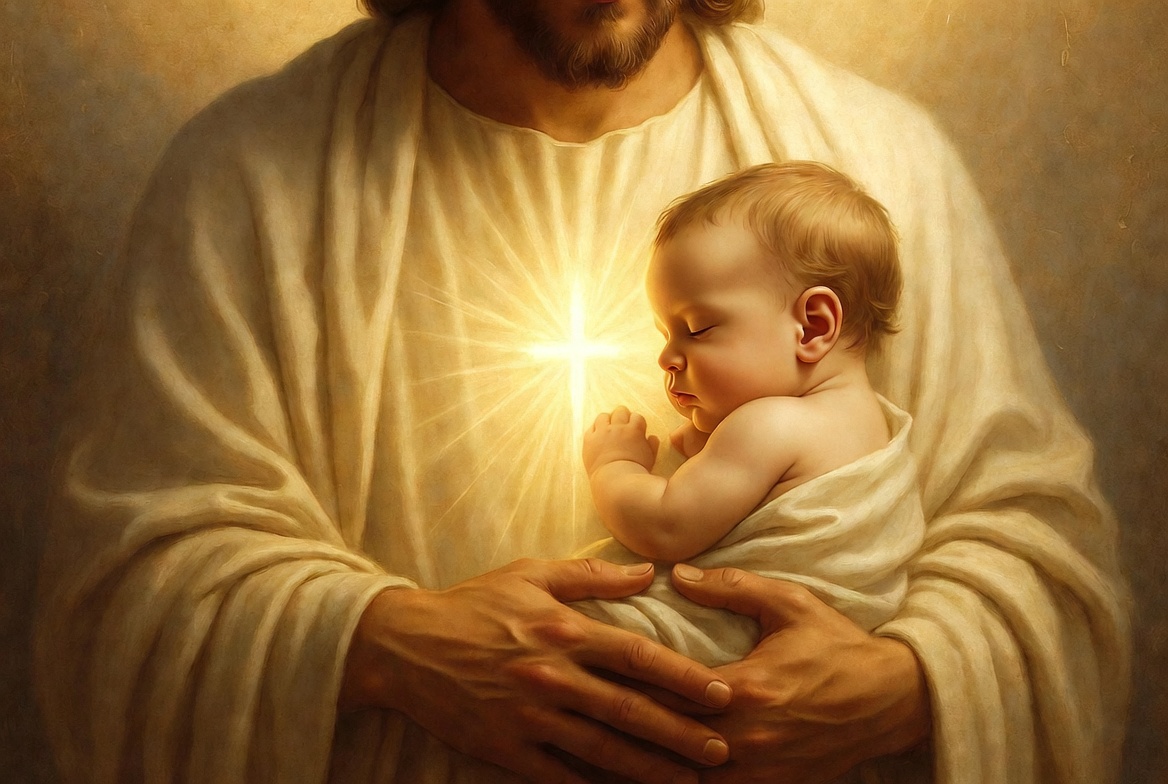

The bosom in Scripture is far more than a physical description—it is a powerful picture of love, intimacy, protection, and family. Messiah came from the bosom of the Father (John 1:18), gathers His sheep, and carries them close to His own (Isaiah 40:11). From Abraham’s bosom to the Hebrew words for love linking back to the chest/heart, the bosom reveals God’s desire to draw us near, covering and sustaining us as a parent holds a child or a shepherd carries a lamb. This tidbit explores how the bosom shadows the love of God revealed in Christ.
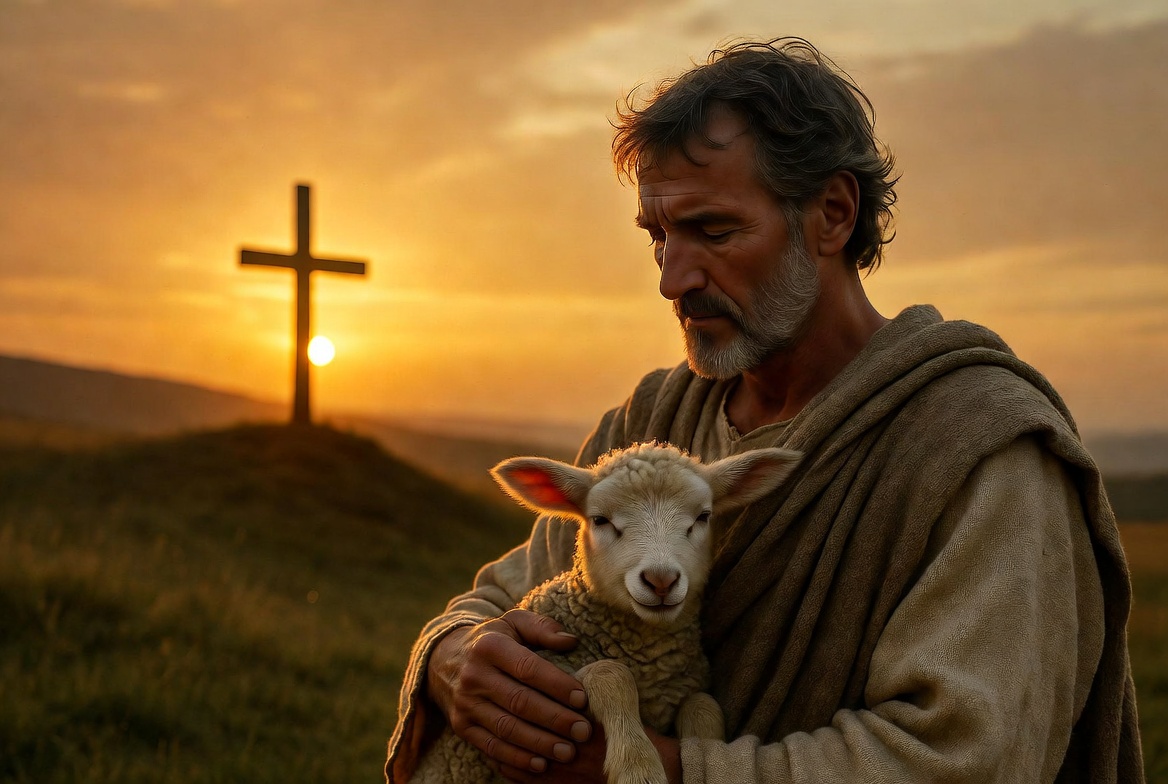
There are a number of Hebrew words which have the meaning of love, all of which point back in one form or another to the bosom. This connection between the bosom and love points to Christ Jesus, the manifestation of God’s love (John 3:16). Scripture declares that Messiah came from the bosom of the Father (John 1:18) who gathers (John 12:32) and then carries mankind (the dead) to His bosom (life).
The word father in Hebrew is associated with love, so too is the word mother. אם ‘em’ (mother) is the source of the Latin ‘amare,’ the French ‘amitie’ and the English ‘amity’ which mean love. One of the Hebrew words for love is דד ‘dud/dad’ which means both love and breasts/bosom. Interestingly, the English word ‘baby’ comes from the Hebrew בבה ‘baba’ which is related to the word אבוב ‘aboob’ the root of which is אב ‘av’ which means father but also means a pipe, as in the breast of the mother whose milk flows to give sustenance to the baby. בבה ‘baba’ in Hebrew means the pupil, the apple of one’s eyes. As any parent has held their baby in their arms against their bosom they recognize this is the epitome of love and intimate relationship (apple of the eye/little guy in the eye).
When we hold our children in our arms at the bosom, it is the perfect distance to see our faces in their pupils. This is the relationship our Heavenly Father desires to have with us (Psalm 17:8; Zechariah 2:8; Psalm 27:8). God associates redeeming His people from Egypt as gathering them under the shadow of His Wings where they appeared as the little guy in His Eye (Deuteronomy 32:9-11). This is further linked to a baby in the arms of a parent in Psalm 81.
Psa 81:10 I am Jehovah your God who brought you out from the land of Egypt; open your mouth wide, and I will fill it.
Son 2:6 His left hand is under my head, and His right hand embraces me.
Mother and father holding their babies in their bosoms is the essence of family. The word family in Hebrew is משפחה ‘mispocha’ the same root as שפח ‘shapach’ which means something that is attached. שפח ‘shaphach’ is the origin of the English word crucifixion where Messiah gave His life to gather all the family of the earth (John 12:32). It is no surprise then that the crucifixion of the Shepherd is associated with gathering His sheep to His bosom in the Word (Isaiah 40:10-11; Psalm 89:50-51; Ephesians 2:8-19; John 10:15-16).
Messiah came from the bosom of the Father.
Joh 1:18 No one has seen God at any time; the only begotten Son, who is in the bosom of the Father, that One declares Him.
He gathers and then carries in His bosom His people, linking to the crucifixion. It is through the work of Messiah on the cross that mankind is brought into His family.
Isa 40:10 Behold, the Lord Jehovah will come with strength, and His arm rules for Him. Behold, His reward is with Him, and His wage before Him.
Isa 40:11 He shall feed His flock like a shepherd; He shall gather lambs with His arm; and carry them in His bosom; those with young He will lead;
Psa 89:50 Remember, O Lord, the reproach of Your servants, my bearing in my bosom the insults of the many peoples
Psa 89:51 with which Your enemies have cursed, O Jehovah; with which they have cursed the footsteps of Your anointed.
Eph 2:8 For by grace you are saved, through faith, and this not of yourselves; it is the gift (gift = love = bosom) of God;
Eph 2:9 not of works, that not anyone should boast;
Eph 2:10 for we are His workmanship, created in Christ Jesus unto good works, which God before prepared that we should walk in them.
Eph 2:11 Because of this, remember that you, the nations, were then in the flesh (those having been called Uncircumcision by those having been called Circumcision in the flesh made by hands)
Eph 2:12 that at that time you were without Christ, alienated from the commonwealth of Israel and strangers of the covenants of promise, having no hope and without God in the world.
Eph 2:13 But now, in Christ Jesus you who then were afar off, came to be near by the blood of Christ.
Eph 2:14 For He is our peace, He making us both one, and breaking down the middle wall of partition,
Eph 2:15 in His flesh causing to cease the enmity, the Law of the commandments in decrees, that He might in Himself create the two into one new man, making peace,
Eph 2:16 and might reconcile both in one body to God through the cross, slaying the enmity in Himself.
Eph 2:17 And coming, He proclaimed “peace to you, the ones afar off, and to the ones near.” Isa. 57:19
Eph 2:18 For through Him we both have access by one Spirit to the Father.
Eph 2:19 So, then, you are no longer strangers and tenants, but you are fellow citizens of the saints and of the family of God,
There are multiple words in Hebrew for love, all linking back to the bosom. The most common is אהב ‘ahav’ which has the meaning of a gift and the expressions and actions of one towards the family. The pictograph meaning displays the gift of the Father to mankind of His only begotten Son. Again linking the bosom, the family and the crucifixion.
Joh 3:16 For God so loved the world that He gave His only begotten Son, that everyone believing into Him should not perish, but have everlasting life.
Joh 15:13 Greater love than this has no one, that anyone should lay down his soul for his friends.

From the root:
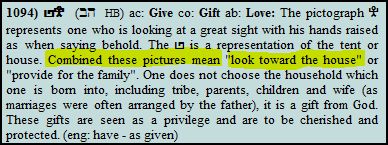
The Pictograph meaning of Love
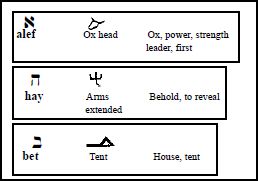
The first and last letters spell out the word for Father (אב ‘ab’) and the middle letter is a picture of a man with outstretched arms. The Love of the Father is revealed through the Messiah on the tree, gathering all mankind back to their Creator.
אב ‘av’ (father) literally pictures a pole, as in the support of a tent. In English, the word ‘pole’ comes from the Old English ‘pal’ which traces back to the Latin ‘palus,’ which literally means a stake. The English word ‘pale’ derives from this word. ‘Pale’ means to fix or fasten and is related to the English word ‘pact.’ A pact is an agreement, treaty, compact which comes from the Latin word ‘pactum’ which means a contract/covenant. A covenant through a pole/stake… Here we see אב ‘av,’ the first word of the Hebrew alphabet pointing to the most important event in human history, the crucifixion of Christ Jesus, and the New Covenant (Isaiah 42:6; Matthew 26:28) in His blood which restores mankind back to the Father.
There are two more words in Hebrew which are translated as bosom. The first is חצן ‘chatsan’ which comes from חץ ‘chets’ which literally means a tent wall, as in an enclosing. This imagery is seen in the above word, אהב ‘ahav.’
Through the sacrifice of Messiah, the gift of God’s love, we become His house.
Eph 2:4 But God, who is rich in mercy, for his great love wherewith he loved us,
Eph 2:5 Even when we were dead in sins, hath quickened us together with Christ, (by grace ye are saved;)
Eph 2:6 And hath raised us up together, and made us sit together in heavenly places in Christ Jesus:
Eph 2:7 That in the ages to come he might shew the exceeding riches of his grace in his kindness toward us through Christ Jesus.
Eph 2:8 For by grace are ye saved through faith; and that not of yourselves: it is the gift of God:
Eph 2:9 Not of works, lest any man should boast.
Eph 2:10 For we are his workmanship, created in Christ Jesus unto good works, which God hath before ordained that we should walk in them.
Eph 2:11 Wherefore remember, that ye being in time past Gentiles in the flesh, who are called Uncircumcision by that which is called the Circumcision in the flesh made by hands;
Eph 2:12 That at that time ye were without Christ, being aliens from the commonwealth of Israel, and strangers from the covenants of promise, having no hope, and without God in the world:
Eph 2:13 But now in Christ Jesus ye who sometimes were far off are made nigh by the blood of Christ.
Eph 2:14 For he is our peace, who hath made both one, and hath broken down the middle wall of partition between us;
Eph 2:15 Having abolished in his flesh the enmity, even the law of commandments contained in ordinances; for to make in himself of twain one new man, so making peace;
Eph 2:16 And that he might reconcile both unto God in one body by the cross, having slain the enmity thereby:
Eph 2:17 And came and preached peace to you which were afar off, and to them that were nigh.
Eph 2:18 For through him we both have access by one Spirit unto the Father.
Eph 2:19 Now therefore ye are no more strangers and foreigners, but fellowcitizens with the saints, and of the household of God;
Eph 2:20 And are built upon the foundation of the apostles and prophets, Jesus Christ himself being the chief corner stone;
Eph 2:21 In whom all the building fitly framed together groweth unto an holy temple in the Lord:
Eph 2:22 In whom ye also are builded together for an habitation of God through the Spirit.
The word צלחת ‘tsalachat’ is also translated as bosom but also means a bowl, as in the bowls/pans used in the Tabernacle. צלחת ‘tsalachat’ comes from צלח ‘tsalach’ which means to advance forward, as in an oxen moving towards its mark. צלח ‘tsalach’ traces back further to צל ‘tsel’ which has the meaning of a bowl but also means a shadow (as in the covering that a bowl makes when held upside down)…as under the shadow of His wings, the little guy in His Eye.
Believers ‘hide’ under the shadow of His wings (Psalm 17:8). Another word for bosom in Hebrew is חב ‘chav’ which also means to hide, the ‘secret place’ of the Most High.
Psa 91:1 He that dwelleth in the secret place of the most High shall abide under the shadow {צל ‘tsel’ } of the Almighty.

This cup, bosom, love connection links to the Hebrew word for bowl which is מקנית ‘maqniyt’ which literally means the “shape of a bowl that holds liquids like a breast that holds milk”. נק ‘naq’ literally means a “child drawn in” as in the bringing in and holding of an infant to the breast to suckle, the picture of innocency. One of the Hebrew words for innocence is נקי ‘naqi’ which comes from this root word.
Another Hebrew word which has the meaning of innocence is חף ‘chaph’ which pictures chicks abiding under the shadow of the wings of their mother. Again, the “little guy in the eye” imagery is seen.

THE LORD is described in this same imagery.
Deu 32:10 He found him in a desert land, and in the waste, a howling wilderness. He encircled him and cared for him; He guarded him as the pupil of His eye.
Mat 23:37 Jerusalem, Jerusalem, the one killing the prophets and stoning those sent to her. How often I desired to gather your children in the way a bird gathers her chicks under her wings! And you did not desire it.
רחף ‘rachaph’ comes from the root:
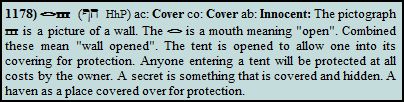
Messiah is the door that we enter in order to abide in His ‘House’ (John10:7) it is through Him that we are covered/hidden. This is the definition of who the Israel of God is (Galatians 6:16)…His hidden ones (Psalm 83:3). It is by the covenant cut in Messiah (Daniel 9:26; Isaiah 42:6) by His sacrifice on the tree that we are covered (1 John 1:7). It is through His Outstretched Arms (wings) that Messiah is calling us (John 3:14; 12:32) and gathering us together as a Shepherd does His flock (John 10:14-16). This is how we enter the Door into the House, this is how we are declared innocent and pure in His eyes. This is how we become His friends and enter into His tents in an intimate relationship.

חף ‘chaph’ is the root for the word חופה ‘chuppah’ which is speaking of a wedding canopy.

Abiding under the shadow of His wings and being in ‘marriage covenant’ with Him through Messiah is one and the same thing.
The canopy as a covering is connected with being the ‘little guy in His eye‘
Zec 2:8 For so says Jehovah of Hosts: He has sent Me after glory, to the nations who plundered you; for he who touches you touches the pupil of His eye.
נק ‘naq’ is also the source of the word נקיק ‘naqiyq’ which means a cleft in the rocks, as in the cleavage of the breast {נקק ‘naqaq’}. The imagery of the cleft of the rock is used in the Scriptures as depicting an intimate relationship with the Almighty (Exodus 33:18-23).
Recall that the word in Hebrew for pupil is בבה ‘baba’ which is the source of the English word ‘baby.’ Interestingly, the English word ‘shade’ comes from the Hebrew word שד ‘shad’ which means the breast/bosom. שד ‘shad’ is the root of the word שדי ‘shaddai’ which is translated as ‘the Almighty.’ שד ‘shad’ pictographically means to return to the door, which Scripture defines as Messiah.
Joh 10:7 Then said Jesus unto them again, Verily, verily, I say unto you, I am the door of the sheep.
The word דד ‘dud/dad’ (love) means two doors or two breasts.
The letter ד ‘dalet’ is the picture of a door, or flap of a tent which opens the way inside. The tabernacle consisted of two doors/veils which דד displays. What is the veil of the Tabernacle a picture of? The body/flesh of Messiah.
Heb 10:20 which He consecrated for us, a new and living way through the veil; that is, His flesh;
The above portion of Scripture is in context of the New Covenant which was cut at Calvary where Messiah gathered mankind into His bosom (Isaiah 40:11; Psalm 89:50).
Another word for love is חשק ‘chashaq’ which has the meaning of being knit together in love. חשק ‘chashaq’ comes from the root word חש ‘chash’ which points to the bosom, the breastplate in Hebrew is חשן ‘choshen.’ חשק ‘chashaq’ is the word used in reference to the joining together of the Tabernacle, which is a shadow picture of the body of Messiah. It is no surprise that this joining together involved nails, just as in the nails used in the crucifixion (Exodus 38:17, 28; Deuteronomy 7:7; Colossians 2:2, 19; Ephesians 4:15-16).
חשק ‘chashaq’ also can be traced back to the word חק ‘choq.’ חק ‘choq’ is the root of חקק ‘chaqaq’ and חקה ‘chuqah’ which means to inscribe a decree or custom. It is no surprise then that the New Covenant, cut at Calvary is associated with the inscribing of the Word on our hearts which is contained in our bosoms (Jeremiah 31:31).
The feasts/appointed times, at which the people of God gathered, are linked to this word חק ‘choq’ and are referred to as חוקים ‘chuqqim’ numerous times in the Word. Interestingly, the English word ‘hug’ traces back to the Hebrew word חג ‘chag’ which is translated as feast but literally means to encircle as in the embrace of two people in a hug.
The feasts revolved around the gathering together of the people to the Tabernacle or tent. The Tabernacle itself was called the אהל מועד ‘ohel mo’ed’ which means tent of meeting/gathering or tabernacle of congregation. מועד ‘moed’ comes from עד ‘ad’ which means to see the door, as in meeting as the door of the Tabernacle. Who is the door where the sheep come unto? The Messiah (John 10:7).
Bosom & Faith
Num 11:12 I, have I conceived all this people? I, have I begotten it, that You say to me, Carry it in your bosom as the foster father (אמן ‘aman’) bears the suckling, to the land which You have sworn to its fathers?
The word used above for foster father/nursing father is אמן ‘aman’ which means faith. Faith and Truth are synonymous as faith (אמונה ’emunah’) and truth (אמת ’emet’) come from the same root מן ‘man and are interchangeable when translating the text.
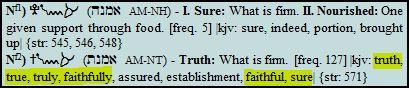
אמונה ’emunah’ comes from the 3 letter root אמן ‘aman.’
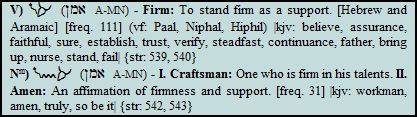
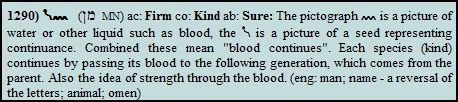
אמן ‘aman’ means truly, a sure foundation and support. This is why Messiah is spoken of as the ‘Amen’ (Revelation 3:14). He is the firm foundation represented by the Tree of Life/the Word. The other tree in midst the Garden was the tree of knowledge which represents unfaithfulness/lawlessness. Man must choose between the two. The choice that one makes determines which seed/tree he will be a part of. Interestingly, the parent root for the word אמן ‘aman’ is מן ‘man’ which means ‘the blood continues.’ It is the word used in Genesis 1 for ‘kind’ or species.
Faith is Biblically defined as walking in Truth who is the Word/Messiah. Faith traces back to the Garden of Eden and the two trees in the midst of the Garden. The Tree of Life which represents truth/faith and the tree of knowledge which represents unfaithfulness/lawlessness and man’s own will as to what is good or evil.
The English word faith comes from the Old French word ‘foi’ which means faith, belief, trust which traces back further to the Latin word ‘fides’ which has the same meaning. ‘Fides’ traces back to the Hebrew word בטח ’batach.’ בטח ‘batach’ is also the source for the English word ‘trust.’ בטח ‘batach’ means to cling to someone or something. It is pictured in the natural realm in a melon which clings to the vine. Here again the picture of the Tree of Life and the tree of knowledge is seen. Man can have faith in God and cling to Him or man can choose his own way and cling to the tree of knowledge. This concept of clinging to the vine is discussed in more detail in the Biblical definition of the Olive tree and the word אב ‘av’ (Father).
Psa 91:1 He that dwelleth in the secret place of the most High shall abide under the shadow of the Almighty.
Psa 91:2 I will say of the LORD, He is my refuge and my fortress: my God; in him will I trust {בטח ‘batach’ }.
Seek His Face
The Holy Scriptures admonish us to seek the Face of God at all times (1 Chronicles 16:11), which this bosom, little guy in the eye concept connects to a baby in the bosom of their parent. Seeking His Face will cause us to love others as He loves them…
This is the essence of being a “little guy in the Eye”. Love. Walking in close relationship with God who is love (1 John 4:8) and extending that love to our fellow man (1 John 4:12). Its not about religion or doctrine, its about relationship with the Most High. Each one of us must work out our own salvation with fear and trembling as God works through us according to His good pleasure (Philippians 2:12-13). If we keep focused on Him and not on religion He will be able to transform us from glory to glory (2 Corinthians 3:18) until we are formed into the image of His Son (Romans 8:29).
The English word love is related etymologically to the Hebrew word לב ‘lev’ which means the heart, which is positioned in the bosom of man. Scripture declares that out of the abundance of the heart, the mouth speaks (Matthew 12:34-35). If one reads this portion of Scripture, it is seen that the subject of blasphemy is directly related to the words which one speaks dependent upon the state of their heart (Matthew 12:24-37). Messiah declares that the origin of blasphemy comes from the heart (Mark 7:20-23). What is the remedy to overcome this? The Love of God (Colossians 3:8-14). We are to sanctify the name of God in our hearts (1 Peter 3:15) by abiding in His love (Romans 11:16; John 15:1-10).
Believing in the Messiah is the most important commandment in the Word. The Messiah said that the work of God is to believe on Him (John 6:29), the Apostle John later said His commandment is to believe in Messiah (1 John 3:23) for knowing the Father & the Son is eternal life (John 17:3). The greatest commandments in the Torah are love God and love our fellow man from which all the commandments hang (Matthew 22:35-40). When we believe in Messiah and know Him, we walk in this love (1 John 2:4; 5:2-3) for He is love (1 John 4:8-20). We can do nothing unless we abide in Him, hence belief in Him is indeed the most important command for it encompasses the two great commandments (John 15:1-10).
Scripture declares that love of one’s fellow man is equated with love of God (1 John 4:11-12, 20-21) and is the fulfillment and purpose of His Word (Matthew 22:39-40; Romans 13:8-10; Galatians 6:2). It does not say love of one’s fellow religious counterpart, but of one’s fellow MAN (Galatians 6:10; 1 Thessalonians 5:15; 3 John 1:11), even our enemies (Luke 6:35).
Jesus is THE image of God (Hebrews 1:3; 2 Corinthians 4:4-6; Colossians 1:15-16) who is love (1 John 4:8).
Messiah came to earth in the very image of Almighty God (2 Corinthians 4:4; Colossians 1:15; Hebrews 1:3), who is love. His life displayed that love and He calls all those who believe in Him to display that love as well. This is the essence of the concept of ‘Christ in us.’ It is through His love that man is formed into His image (Colossians 3:10; Romans 8:29) where there is no longer Jew or Greek, Barbarian or Scythian but Messiah is all and in all (Colossians 3:11).
This is the message of the Gospel. Love. Love that breaks down the barriers and walls which man has set up to divide (Ephesians 2:1-22; 1 Corinthians 12:13). Love that breaks down the wall of sin which has separated man from God (Isaiah 59:2; John 3:16; 12:32; Isaiah 49:6; Revelation 5:9). This love is revealed in our actions towards our fellow man, not in our intellectual proclamations. All of us see through a glass darkly which keeps us from seeing eye to eye (1 Corinthians 13:12). The only remedy for this is love (1 Corinthians 13:1-13; 1 John 4:7-21). Love and patience towards one another until the Lord returns and His salvation is fully revealed (Isaiah 52:7-10). Love allows man to understand that we can have differences of opinions but ultimately if we abide in love we can dwell in peace and unity (Ephesians 4:2-16, 32; 5:1-2; Colossians 3:9-17).
The true intent of the law/Word of God is not to make men religious but to reform men into the image of their God who is love (1 John 4:8). It is this love that unites us and perfects us. It is the bond of perfection (Colossians 3:14) which sets man free (Galatians 5:13-14). This love is not intended only for a certain group of religious people, but for all mankind. Scripture declares that in the Messiah shall the ‘gentiles trust’ (Matthew 12:21; Romans 15:8-12; Isaiah 11:10). For Jesus is the true Light which enlightens every man (John 1:9; 12:44-46; Isaiah 49:6), sent to restore all of mankind back to God (Isaiah 45:22; Romans 3:29; John 1:12; 3:15-17).
The message of Jesus is universal. It transcends religions, ethnic or cultural barriers. It is a message of love and reconciliation back to God. The message of victory over death which entered into the world when Adam and Eve partook of the fruit of the tree of knowledge (Romans 5:12-21; 1 Corinthians 15:45-48; 55-56. This message of forgiveness and restoration is not just for Israel, but whosoever shall believe in the Lord Jesus.
The Hebrew word for name is שם ‘shem’ which literally means one’s breathe or character. What is the character of the Almighty? Love (1 John 4:8).
littleguyintheeye@gmail.com

 Little Guy in the Eye
