

God’s Law is not a cold list of rules but His living Word, will, and blueprint for life. In this tidbit we explore how the Law (Torah) is synonymous with the Word of God, how Christ perfectly fulfills it as the Good Shepherd, and how the New Covenant writes that same Law on our hearts so we may walk in love and be conformed to His image.
Law & Word are one: Scripture repeatedly equates God’s Law (Torah) with His Word — it is His instruction, teaching, and self-revelation.
Christ is the Fulfillment: Jesus is the end (goal and completion) of the Law for righteousness (Romans 10:4); He embodies and fulfills what the old covenant only foreshadowed.
New Covenant Reality: Under the New Covenant, God writes His Law on our hearts and minds (Jeremiah 31:33; Hebrews 8:10), not on tablets of stone.
Christ the Good Shepherd: As the Good Shepherd, Jesus pastures His flock with the Word, leading us beside still waters and restoring our souls.
Love Fulfills the Law: Keeping His commandments flows from love for God and others, and love is the true fulfillment of the Law (Romans 13:8–10; Galatians 5:14).
Conformed to His Image: The goal is to fix our eyes on Jesus so we may be transformed into His likeness and reflect the image of God.

Pro 7:2 Keep my commandments, and live; and my law as the apple of thine eye. (apple of the eye = little guy in the eye)
When we look into the “eyes of the LORD” we see ourselves, when He looks into our eyes He sees the Word, Himself. The ultimate goal of walking with the LORD God is that at the end we will look into His eyes and see the Word as well, His image being formed in and through us. To accomplish this, our eyes should be on Jesus Christ, the Word made flesh (John 1:1)…the Author and Finisher of our faith.
Heb 12:2 Looking {ἀφοράω ‘aphoraō’ – fix eyes upon} unto Jesus the author and finisher of our faith; who for the joy that was set before him endured the cross, despising the shame, and is set down at the right hand of the throne of God.
The Greek word translated as ‘looking’ in Hebrews 12:2 is ἀφοράω ‘aphoraō’ which literally means to turn the eyes away from other things and fix them on a particular object, in this case Jesus. The only way we can walk in God’s love and be the “little guy in His Eye” is to keep our eyes focused on Christ Jesus.
We know God by walking in His Word, His Law through the Holy Spirit.
1Jn 2:3 And hereby we do know that we know him, if we keep his commandments.
1Jn 2:4 He that saith, I know him, and keepeth not his commandments, is a liar, and the truth is not in him.
1Jn 2:5 But whoso keepeth his word, in him verily is the love of God perfected: hereby know we that we are in him.
1Jn 2:6 He that saith he abideth in him ought himself also so to walk, even as he walked.
1Jn 4:12 No one has seen God at any time. If we love one another, God abides in us, and His love having been perfected is in us.
1Jn 4:13 By this we know that we abide in Him, and He in us, because of His Spirit He has given to us.
1Pe 2:21 For even hereunto were ye called: because Christ also suffered for us, leaving us an example, that ye should follow his steps:
1Pe 2:22 Who did no sin, neither was guile found in his mouth:
We come to know Him through the New Covenant in Christ, Christ’s law written on our hearts. Christ is the covenant (Isaiah 42:6; 49:8; Matthew 26:28; Hebrews 13:20).
Isa 49:8 Thus saith the LORD, In an acceptable time have I heard thee, and in a day of salvation have I helped thee: and I will preserve thee, and give thee for a covenant of the people, to establish the earth, to cause to inherit the desolate heritages;
Heb 8:6 But now hath he obtained a more excellent ministry, by how much also he is the mediator of a better covenant, which was established upon better promises.
Heb 8:7 For if that first covenant had been faultless, then should no place have been sought for the second.
Heb 8:8 For finding fault with them, he saith, Behold, the days come, saith the Lord, when I will make a new covenant with the house of Israel and with the house of Judah:
Heb 8:9 Not according to the covenant that I made with their fathers in the day when I took them by the hand to lead them out of the land of Egypt; because they continued not in my covenant, and I regarded them not, saith the Lord.
Heb 8:10 For this is the covenant that I will make with the house of Israel after those days, saith the Lord; I will put my laws into their mind, and write them in their hearts: and I will be to them a God, and they shall be to me a people:
Heb 8:11 And they shall not teach every man his neighbour, and every man his brother, saying, Know the Lord: for all shall know me, from the least to the greatest.
Heb 8:12 For I will be merciful to their unrighteousness, and their sins and their iniquities will I remember no more.
Heb 8:13 In that he saith, A new covenant, he hath made the first old {παλαιόω ‘palaioō’}. Now that which decayeth {παλαιόω ‘palaioō’} and waxeth old {γηράσκω ‘gēraskō’} is ready to vanish away.
Heb 10:7 Then said I, Lo, I come (in the volume of the book it is written of me,) to do thy will, O God.
Heb 10:8 Above when he said, Sacrifice and offering and burnt offerings and offering for sin thou wouldest not, neither hadst pleasure therein; which are offered by the law;
Heb 10:9 Then said he, Lo, I come to do thy will, O God. He taketh away the first, that he may establish the second.
Heb 12:24 And to Jesus the mediator of the new covenant, and to the blood of sprinkling, that speaketh better things than that of Abel.
Heb 13:20 Now the God of peace, that brought again from the dead our Lord Jesus, that great shepherd of the sheep, through the blood of the everlasting covenant,
Jer 24:7 And I will give them an heart to know me, that I am the LORD: and they shall be my people, and I will be their God: for they shall return unto me with their whole heart.
Jer 31:31 Behold, the days come, saith the LORD, that I will make a new covenant with the house of Israel, and with the house of Judah:
Jer 31:32 Not according to the covenant that I made with their fathers in the day that I took them by the hand to bring them out of the land of Egypt; which my covenant they brake, although I was an husband unto them, saith the LORD:
Jer 31:33 But this shall be the covenant that I will make with the house of Israel; After those days, saith the LORD, I will put my law in their inward parts, and write it in their hearts; and will be their God, and they shall be my people.
Jer 31:34 And they shall teach no more every man his neighbour, and every man his brother, saying, Know the LORD: for they shall all know me, from the least of them unto the greatest of them, saith the LORD: for I will forgive their iniquity, and I will remember their sin no more.
Jer 32:39 And I will give them one heart, and one way, that they may fear me for ever, for the good of them, and of their children after them:
Jer 32:40 And I will make an everlasting covenant with them, that I will not turn away from them, to do them good; but I will put my fear in their hearts, that they shall not depart from me.
Eze 11:19 And I will give them one heart, and I will put a new spirit within you; and I will take the stony heart out of their flesh, and will give them an heart of flesh:
Eze 11:20 That they may walk in my statutes, and keep mine ordinances, and do them: and they shall be my people, and I will be their God.
Eze 36:24 For I will take you from among the heathen, and gather you out of all countries, and will bring you into your own land.
Eze 36:25 Then will I sprinkle clean water upon you, and ye shall be clean: from all your filthiness, and from all your idols, will I cleanse you.
Eze 36:26 A new heart also will I give you, and a new spirit will I put within you: and I will take away the stony heart out of your flesh, and I will give you an heart of flesh.
Eze 36:27 And I will put my spirit within you, and cause you to walk in my statutes, and ye shall keep my judgments, and do them.
Eze 36:28 And ye shall dwell in the land that I gave to your fathers; and ye shall be my people, and I will be your God.
The English word law has the meaning of rules, regulations or the legal system. It comes from the Old English ‘lagu’ meaning “ordinance, rule prescribed by authority, regulation; district governed by the same laws.” When an English speaker sees the word law in the Bible the sense of rules and regulations comes to mind. However, this is only part of the story. If one sees the law of God as just a set of rules and regulations the true meaning of the Bible will be missed.
Jesus said if we love Him we will keep His commandments so it is important to understand what this entails in our new covenant relationship with Him.
Joh 14:15 If ye love me, keep my commandments.
Joh 14:21 He that hath my commandments, and keepeth them, he it is that loveth me: and he that loveth me shall be loved of my Father, and I will love him, and will manifest myself to him.
The Old English ‘lagu’ traces back to the Old Norse lǫg ‘lag’ which meant “that which is laid or fixed” or “something set down or established.” Christians are called to walk by faith (Romans 4:12; 2 Corinthians 5:7), establishing the law of God.
Rom 3:31 Do we then make void the law through faith? God forbid: yea, we establish the law.
But he had withal said above: “Are we, then, making void the law through faith? Far be it; but we are establishing the law.” {Tertullian On Modesty }
“Do not in any way forsake the commandments of the Lord; but keep what you have received, neither adding thereto nor taking away therefrom.” {Didache – first century writing attributed to the Apostles}
“And He that was the Lawgiver became Himself the fulfilling of the law; not taking away the law of nature, but abrogating those additional laws that were afterwards introduced, although not all of them neither. For He did not take away the law of nature, but confirmed it. For He that said in the law, “The Lord thy God is one Lord;” the same says in the Gospel, “That they might know Thee, the only true God.” And He that said, “Thou shalt love thy neighbour as thyself,” says in the Gospel, renewing the same precept, “A new commandment I give unto you, that ye love one another.”
“Let us become spiritual, let us become a temple perfect unto God. As far as in us lies, let us exercise ourselves in the fear of God, [and] let us strive to keep His commandments, that we may rejoice in His ordinances.”
“Thou shalt love Him that made thee, thou shalt fear Him that created thee, thou shalt glorify Him that redeemed thee from death; thou shalt be simple in heart and rich in spirit; thou shalt not cleave to those who walk the way of death; thou shalt hate everything that is not pleasing to God; thou shalt hate all hypocrisy; thou shalt never forsake the commandments of the Lord.” {Epistle of Barnabas}
“You never grudged any act of kindness, being “ready to every good work.” Adorned by a thoroughly virtuous and religious life, you did all things in the fear of God. The commandments and ordinances of the Lord were written upon the tablets of your hearts.”
“For this reason righteousness and peace are now far departed from you, inasmuch as every one abandons the fear of God, and is become blind in His faith, neither walks in the laws of His commandments.”
“Let him that has love in Christ fulfill the commandments of Christ.”
“Blessed are we, dearly beloved, if we should be doing the commandments of God in concord of love, to the end that our sins may through love be forgiven us.” {Clement of Rome Epistle to the Corinthians (A.D. 96)}
The Word of God was established from the beginning of creation (John 1:1). The Word and the law of God are synonymous in Scripture (Deuteronomy 5:2-3; Isaiah 1:10;2:3; 5:24). In Hebrew, the word translated as law is תּוֹרָה ‘torah.’ It means the instructions or teachings of God. It is not strictly a legal code but the will of the living God, the Lord pointing us in the direction He desires.
The Hebrew word תורה ‘torah’ reveals the very heart and mind of God — His will, His instruction, and His love letter to mankind. Far from a rigid legal code, the Torah is the divine blueprint that marks out the borders of His people, points the way of life, and finds its perfect fulfillment in Jesus Christ, the living Word made flesh.
The Torah is an interesting word in that it comes from two roots. One is תר ‘tar’ which means an image or outline, and the other is יר ‘yar’ which means to teach or pointing in the right direction.
Exo 24:12 And Jehovah said to Moses, Come up to Me to the mountain, and be there. And I will give to you the tablets of stone, and the Law (תורה ‘torah’), and the commandments which I have written, to teach (ירה ‘yarah’) them.
Both Law and Teach in the above verse come from the same root word

The other root of תורה ‘torah’ is תר ‘tar.’

תר ‘tar’ is the root of the Hebrew words which mean to mark out תאר t’ar or a form תוא to’ar. The word תור ‘toor’ means a border or a circle and is the origin of the English word tour. Literally, the Torah is what defines, gives borders to a people. It is the finger of God pointing the direction in which we are to go and marking out the borders in which we should stay in order to walk in His camp.
The law of God is revealed in Christ (Deuteronomy 30:10-14; Romans 10:4-9; Hebrews 10:1-10). He revealed the way in which we should walk.
1Jn 2:5 But whoso keepeth his word, in him verily is the love of God perfected: hereby know we that we are in him.
1Jn 2:6 He that saith he abideth in him ought himself also so to walk, even as he walked.
Rom 10:4 For Christ is the end (τέλος ‘telos’) of the law for righteousness to every one that believeth.
G5056
τέλος
telos
Thayer Definition:
- end
1a) termination, the limit at which a thing ceases to be (always of the end of some act or state, but not of the end of a period of time)
1b) the end
1b1) the last in any succession or series
1b2) eternal
1c) that by which a thing is finished, its close, issue
1d) the end to which all things relate, the aim, purpose - toll, custom (i.e. indirect tax on goods)
Part of Speech: noun neuter
A Related Word by Thayer’s/Strong’s Number: from a primary tello (to set out for a definite point or goal)
Rom 10:5 For Moses describeth the righteousness which is of the law, That the man which doeth those things shall live by them.
Rom 10:6 But the righteousness which is of faith speaketh on this wise, Say not in thine heart, Who shall ascend into heaven? (that is, to bring Christ down from above:)
Rom 10:7 Or, Who shall descend into the deep? (that is, to bring up Christ again from the dead.)
Rom 10:8 But what saith it? The word is nigh thee, even in thy mouth, and in thy heart: that is, the word of faith, which we preach;
Rom 10:9 That if thou shalt confess with thy mouth the Lord Jesus, and shalt believe in thine heart that God hath raised him from the dead, thou shalt be saved.
Latin & Greek
In Latin, there are multiple words for law. Lex refers to an established law, usually written down. Lex traces back to lego which means to collect, gather or read.
Mos (plural mores) means custom. It shows the cultural sense of the Greek νόμος ‘nomos’ as it speaks of an established custom or tradition.
Ius has the meaning of justice or right. It has the sense of the entire legal order. Ius shows the philosophical or natural law sense of νόμος ‘nomos.’
In Greek the word law is νόμος ‘nomos’ which means “law,” “custom,” “usage,” “ordinance,” or “melody/song” (in a musical sense). νόμος ‘nomos’ comes from νέμω ‘nemo’ which means to distribute, deal out, dispense, allot, or assign.” It also has the sense of pasture/graze. The sense is the apportioning of shares or pastureland for cattle. Dividing out feeding land. This extended later to something assigned to people as a custom or law. This can be seen in the Greek cognate νομάς ‘nomas’ which is the source of the English word nomad. One who wanders looking for “pasture.”
The word οἰκονομία ‘oikonomia’ furthers this concept as it literally means house steward. One who oversees.
Tit 1:7 For a bishop (ἐπίσκοπος ‘episkopos’) must be blameless, as the steward (οἰκονομία ‘oikonomia) of God; not selfwilled, not soon angry, not given to wine, no striker, not given to filthy lucre;
G1985
ἐπίσκοπος
episkopos
Thayer Definition:
- an overseer
Eph 1:10 That in the dispensation (οἰκονομία ‘oikonomia) of the fulness of times he might gather together in one all things in Christ, both which are in heaven, and which are on earth; even in him:
Eph 1:11 In whom also we have obtained an inheritance, being predestinated according to the purpose of him who worketh all things after the counsel of his own will:
Jay P. Green Literal Version
Eph 1:10 for the administration of the fullness of the times to head up all things in Christ, both the things in the heavens, and the things on earth, in Him,
Shepherds in the ancient world were literally overseers of the flock — they watched over, protected, guided, and cared for the sheep.
1Pe 2:25 For ye were as sheep going astray; but are now returned unto the Shepherd (ποιμήν ‘poimen’) and Bishop (ἐπίσκοπος ‘episkopos’) of your souls.
The primary Greek word for shepherd is ποιμήν ‘poimen’ which is the source of the word pastor.
Act 20:28 Take heed therefore unto yourselves, and to all the flock, over the which the Holy Ghost hath made you overseers (ἐπίσκοπος ‘episkopos’), to feed the church of God, which he hath purchased with his own blood.
Joh 10:9 I am the door: by me if any man enter in, he shall be saved, and shall go in and out, and find pasture (νομή ‘nome’).
Joh 10:14 I am the good shepherd, and know my sheep, and am known of mine.
Joh 10:15 As the Father knoweth me, even so know I the Father: and I lay down my life for the sheep.
νομή ‘nome’ (pasture) comes from the same root as νόμος ‘nomos’ (law), νέμω ‘nemo.’
The Church Fathers connect this law-shepherd imagery
“The Law was given to the people through Moses, but it was not able to give life… The Word of God, who is the true Shepherd, came to seek the lost sheep… He Himself is the Law and the fulfillment of the Law, for He is the Word who was with the Father from the beginning.” (Irenaeus of Lyons – Against Heresies, Book 4, ch. 2 & 13)
“The Logos is the Shepherd who pastures His flock with the milk of the Word… He is the true Lawgiver who gives the new law, which is not written on tables of stone but on the hearts of men. As the Good Shepherd, He leads us to the green pastures of truth and righteousness.” (Clement of Alexandria – Paedagogus (The Instructor), Book 1, ch. 9–10)
“The Law of the old covenant was a pedagogue, but the perfect Law is the Logos Himself, who pastures us with His own words and leads us beside the still waters of life.” (Clement of Alexandria – Stromata, Book 2 (on philosophy and the true law as shepherding)
“The Good Shepherd is the Logos who tends the rational flock… He is the Law that governs all things, distributing to each soul its proper nourishment according to its capacity. As the Shepherd, He pastures us on the mountains of contemplation and the plains of moral law.” (Origen – Commentary on John, Book 10 & Homilies on Ezekiel)
“The Law was given by Moses, but grace and truth came by Jesus Christ. He is the true Shepherd who does not drive the flock with the rod of the law but leads them with the voice of love… The old law pastured the body; the new Law, which is Christ Himself, pastures the soul unto eternal life.” (John Chrysostom – Homilies on John, Homily 15)
“The Law was our pedagogue to bring us to Christ. Now that Christ has come, He is our Shepherd and our Law… He pastures us not with external commandments but with Himself, the living Bread and the living Law written in our hearts.” (Augustine of Hippo – On the Spirit and the Letter & Tractates on John, Tractate 46 (on John 10).
Augustine of Hippo also wrote in his Sermons
“The Good Shepherd is the very Word of God made flesh. He is the Law that was from the beginning, the same who spoke through Moses and now feeds us with His own flesh and blood.”
“The Good Shepherd is the very Word of God made flesh. He is the Law that was from the beginning, the same who spoke through Moses and now feeds us with His own flesh and blood.”
“The one Logos is many logoi, and the many logoi are one. As the Good Shepherd, He pastures each created being according to its own logos [rational principle/law], leading all to communion with Himself.” (Maximus the Confessor – Ambiguum 7 )
The picture is that of the Good Shepherd leading His flock in green pastures (Psalm 23:1-6), dwelling in His house (1 Corinthians 3:9, 16; Hebrews 3:3-6; 1 Timothy 3:15).
Jew and Gentile joined together. One flock, one house.
Joh 10:11 I am the good shepherd: the good shepherd giveth his life for the sheep.
Joh 10:14 I am the good shepherd, and know my sheep, and am known of mine.
Joh 10:15 As the Father knoweth me, even so know I the Father: and I lay down my life for the sheep.
Joh 10:16 And other sheep I have, which are not of this fold: them also I must bring, and they shall hear my voice; and there shall be one fold, and one shepherd.
Eph 2:8 For by grace are ye saved through faith; and that not of yourselves: it is the gift of God:
Eph 2:9 Not of works, lest any man should boast.
Eph 2:10 For we are his workmanship, created in Christ Jesus unto good works, which God hath before ordained that we should walk in them.
Eph 2:11 Wherefore remember, that ye being in time past Gentiles in the flesh, who are called Uncircumcision by that which is called the Circumcision in the flesh made by hands;
Eph 2:12 That at that time ye were without Christ, being aliens from the commonwealth of Israel, and strangers from the covenants of promise, having no hope, and without God in the world:
Eph 2:13 But now in Christ Jesus ye who sometimes were far off are made nigh by the blood of Christ.
Eph 2:14 For he is our peace, who hath made both one, and hath broken down the middle wall of partition between us;
Eph 2:15 Having abolished in his flesh the enmity, even the law of commandments contained in ordinances; for to make in himself of twain one new man, so making peace;
Eph 2:16 And that he might reconcile both unto God in one body by the cross, having slain the enmity thereby:
Eph 2:17 And came and preached peace to you which were afar off, and to them that were nigh.
Eph 2:18 For through him we both have access by one Spirit unto the Father.
Eph 2:19 Now therefore ye are no more strangers and foreigners, but fellowcitizens with the saints, and of the household of God;
Eph 2:20 And are built upon the foundation of the apostles and prophets, Jesus Christ himself being the chief corner stone;
Eph 2:21 In whom all the building fitly framed together groweth unto an holy temple in the Lord:
Eph 2:22 In whom ye also are builded together for an habitation of God through the Spirit.
Fulfillment of the Law
Mat 5:17 Think not that I am come to destroy the law, or the prophets: I am not come to destroy, but to fulfil.
Mat 5:18 For verily I say unto you, Till heaven and earth pass, one jot or one tittle shall in no wise pass from the law, till all be fulfilled.
Mat 5:19 Whosoever therefore shall break one of these least commandments, and shall teach men so, he shall be called the least in the kingdom of heaven: but whosoever shall do and teach them, the same shall be called great in the kingdom of heaven.
Mat 5:20 For I say unto you, That except your righteousness shall exceed the righteousness of the scribes and Pharisees, ye shall in no case enter into the kingdom of heaven.
Rom 10:4 For Christ is the end of the law for righteousness to every one that believeth.
The law was designed to lead us to Christ (Hebrews 10:1), revealing our sins (Romans 7:7; 3:19) and condemning us (Romans 7:5-23; 1 Corinthians 15:56) that we might turn to Him by faith and receive His gift of grace unto salvation (Romans 5:20; 7:24-25; 1 Corinthians 15:57). Through faith in Him, we receive His Spirit (Galatians 3:5, 14) to work through us (Philippians 2:13; Ephesians 3:20; Hebrews 13:21) and guide us (John 16:13; 14:26; 1 Corinthians 2:10-13) that we might walk by the Spirit of the law unto life, becoming His righteousness (2 Corinthians 5:21; Philippians 3:9). If we walk in the letter of the law by our own power (works of the law) we will die (Galatians 3:10; 2:16).
The law was a schoolmaster to lead us to Christ that we might attain justification through faith (Galatians 3:24). After faith is come, we are no longer under the schoolmaster (Galatians 3:25). We are not under the law, we are under grace (Romans 6:14). Whatsoever things the law says, it says to those who are under the law (Romans 3:19) that the world might become guilty before God (Romans 3:19), realizing our bondage to the elements of the world (Galatians 4:3) and our need for redemption through Jesus (Galatians 4:5) and to be led by the Spirit (Galatians 5:18).
We can only be pleasing to Him, and hear Him say ‘well done good and faithful servant,’ (Matthew 25:21-23) if Christ is living through us, the hope of Glory (Psalm 147:11; 33:18; 1 Peter 1:1, 13; Jude 1:21). Messiah always did the will of the Father, the things which were pleasing to Him (Luke 3:22; Matthew 12:18; 17:5; John 5:30; 8:29; Psalm 40:7-8). We are to submit our lives to Him (Romans 6:13) that He might live through us (John 17:21-23), just as the Father lived through Him (John 14:10; 15:1-10; 2 Corinthians 5:19).
The letter of the law kills us that we might come to Christ Jesus (the Word made flesh) to receive life.
2Co 3:6 Who also hath made us able ministers of the new testament; not of the letter, but of the spirit: for the letter killeth, but the spirit giveth life.
Joh 6:63 It is the Spirit that gives life. The flesh does not profit, nothing! The Words which I speak to you are spirit and are life.
Rom 8:2 For the law of the Spirit of life in Christ Jesus hath made me free from the law of sin and death.
Rom 10:4 For Christ is the end {τέλος ‘telos’} of the law for righteousness to every one that believeth.
1Ti 1:5 Now the end {τέλος ‘telos’} of the commandment is charity out of a pure heart, and of a good conscience, and of faith unfeigned:
Mat 5:48 Be ye therefore perfect {τέλειος ‘teleios’}, even as your Father which is in heaven is perfect {τέλειος ‘teleios’}.
Heb 7:19 For the law made nothing perfect {τελειόω ‘teleioō’}, but the bringing in of a better hope did; by the which we draw nigh unto God.
Heb 7:11 If therefore perfection were by the Levitical priesthood, (for under it the people received the law,) what further need was there that another priest should rise after the order of Melchisedec, and not be called after the order of Aaron?
Heb 9:9 Which was a figure for the time then present, in which were offered both gifts and sacrifices, that could not make him that did the service perfect, as pertaining to the conscience;
Act 13:39 And by him all that believe are justified from all things, from which ye could not be justified by the law of Moses.
Rom 3:20 Therefore by the deeds of the law there shall no flesh be justified in his sight: for by the law is the knowledge of sin.
Rom 3:21 But now the righteousness of God without the law is manifested, being witnessed by the law and the prophets;
Rom 8:3 For what the law could not do, in that it was weak through the flesh, God sending his own Son in the likeness of sinful flesh, and for sin, condemned sin in the flesh:
Gal 2:16 Knowing that a man is not justified by the works of the law, but by the faith of Jesus Christ, even we have believed in Jesus Christ, that we might be justified by the faith of Christ, and not by the works of the law: for by the works of the law shall no flesh be justified.
Mat 5:18 For verily I say unto you, Till heaven and earth pass, one jot or one tittle shall in no wise pass from the law, till all be fulfilled.
Here Jesus is saying that the law will pass away when all is fulfilled
Gal 3:19 Wherefore then serveth the law? It was added because of transgressions, till the seed should come to whom the promise was made; and it was ordained by angels in the hand of a mediator.
Rom 8:3 For what the law could not do, in that it was weak through the flesh, God sending his own Son in the likeness of sinful flesh, and for sin, condemned sin in the flesh:
Rom 8:4 That the righteousness of the law might be fulfilled in us, who walk not after the flesh, but after the Spirit.
Jesus said that all things have been fulfilled
Joh 19:28 After this, Jesus knowing that all things were now accomplished {τελέω ‘teleō’ – fulfilled}, that the scripture might be fulfilled, saith, I thirst.
Joh 19:29 Now there was set a vessel full of vinegar: and they filled a spunge with vinegar, and put it upon hyssop, and put it to his mouth.
Joh 19:30 When Jesus therefore had received the vinegar, he said, It is finished: and he bowed his head, and gave up the ghost.
Eph 2:15 Having abolished in his flesh the enmity, even the law of commandments contained in ordinances; for to make in himself of twain one new man, so making peace;
Eph 2:16 And that he might reconcile both unto God in one body by the cross, having slain the enmity thereby:
Eph 2:17 And came and preached peace to you which were afar off, and to them that were nigh.
Eph 2:18 For through him we both have access by one Spirit unto the Father.
Eph 2:19 Now therefore ye are no more strangers and foreigners, but fellowcitizens with the saints, and of the household of God;
Eph 2:20 And are built upon the foundation of the apostles and prophets, Jesus Christ himself being the chief corner stone;
Eph 2:21 In whom all the building fitly framed together groweth unto an holy temple in the Lord:
Eph 2:22 In whom ye also are builded together for an habitation of God through the Spirit.
Col 1:20 And, having made peace through the blood of his cross, by him to reconcile all things unto himself; by him, I say, whether they be things in earth, or things in heaven.
Rom 10:4 For Christ is the end of the law for righteousness to every one that believeth.
“For by His advent He Himself fulfilled all things, and does still fulfil in the Church the new covenant foretold by the law, onwards to the consummation [of all things]. To this effect also Paul, His apostle, says in the Epistle to the Romans…” {Irenaeus Against Heresies Book IV}
“He came not to destroy the law and the prophets, but rather to fulfil them…”Thus Christ did not at all rescind the Sabbath: He kept the law thereof, and both in the former case did a work which was beneficial to the life of His disciples, for He indulged them with the relief of food when they were hungry, and in the present instance cured the withered hand; in each case intimating by facts, “I came not to destroy, the law, but to fulfil it,”…This verity of the gospel then stands unimpaired: “I am not come to destroy the law and the prophets, but rather to fulfil them.” {Tertullian Against Marcion Book IV}
“After that, the Lord, “amplifying the Law,” openly adds the prohibition of anger against a brother to that of murder.” {Tertullian On Prayer}
“Unity, moreover, is everything which is once for all. But for Christ was reserved, as in all other points so in this also, the “fulfilling of the law.” {Tertullian On Exhortation to Chastity }
“After the ancient examples of the patriarchs, let us equally pass on to the ancient documents of the legal Scriptures, that we may treat in order of all our canon. And since there are some who sometimes assert that they have nothing to do with the law (which Christ has not dissolved, but fulfilled), sometimes catch at such parts of the law as they choose; plainly do we too assert that the law has deceased in this sense, that its burdens–according to the sentence of the apostles–which not even the fathers were able to sustain, have wholly ceased: such (parts), however. as relate to righteousness not only permanently remain reserved, but even amplified; in order, to be sure, that our righteousness may be able to redound above the righteousness of the scribes and of the Pharisees….Turning now to the law, which is properly ours–that is, to the Gospel.” {Tertullian On Monogamy}
“And “that the land was fat;” that is, the flesh of our Lord: “fat,” that is, “rich;” for it flows with honey and milk. The parts of the land are marked off for an inheritance and possession to him–that means the doctrine of the Lord. For this is a pleasant rest, as He says Himself: “Come unto me, all ye that labour and are heavy laden,” etc. For they who keep the commandments, and do not disclaim the ordinances of the law, enjoy rest both in them and in the doctrine of our Lord; and that is the meaning of “in the midst of the lots.” As the Lord says, “I am not come to destroy the law and the prophets, but to fulfil them.” For even our Lord, in the fact that He keeps the commandments, does not destroy the law and the prophets, but fulfils them, as He says in the Gospels. “He set his shoulder to toil, and became a husbandman.” This the apostles did. Having received power from God, and having set themselves to labour, they became husbandmen of the Lord, cultivating the earth–that is, the human race–with the preaching of our Lord.”
{Hippolytus – Exegetical Fragments}
“And His sending to the scribes and teachers of the existing Scriptures, as to those who knew the true things of the law that then was, is well known. And also that He said, ‘I am not come to destroy the law,’ and yet that He appeared to be destroying it, is the part of one intimating that the things which He destroyed did not belong to the law. And His saying, ‘The heaven and the earth shall pass away, but one jot or one tittle shall not pass from the law,’ intimated that the things which pass away before the heaven and the earth do not belong to the law in reality.”
“Since, then, while the heaven and the earth still stand, sacrifices have passed away, and kingdoms, and prophecies among those who are born of woman, and such like, as not being ordinances of God; hence therefore He says, ‘Every plant which the heavenly Father has not planted shall be rooted up.’ Wherefore He, being the true Prophet, said, ‘I am the gate of life; he who enters through me enters into life,’ there being no other teaching able to save. Wherefore also He cried, and said, ‘Come unto me, all who labour,’ that is, who are seeking the truth, and not finding it; and again, ‘My sheep hear my voice;’ and elsewhere, ‘Seek and find,’ since the truth does not lie on the surface.”{Clementine Homily III}
The Torah is the Bible (Genesis – Revelation)
All of God’s teaching is considered Torah (the law)…ALL of the Scriptures.
The Torah of Moses and the Torah of the LORD are synonymous terms
Luk 2:22 And when the days of her cleansing according to the Law of Moses were fulfilled, they took Him up to Jerusalem to present Him to the Lord,
Luk 2:23 as it has been written in the Law of the Lord: Every male opening a womb shall be called holy to the Lord; Ex. 13:2
Paul spoke of the Prophets as Torah
1Co 14:21 It has been written in the Law, “By other languages” and “by other lips” “I will speak to this people,” “and even so they will not hear” Me, says the Lord.
This is referring to Isaiah 28:11-12
Isa 28:11 For with stammering lip and other languages, He will speak to this people;
Isa 28:12 to whom He said, This is the rest; cause the weary to rest. Also, This is the repose. But they willed not to hear.
Jesus spoke of the Psalms as Torah
Joh 10:34 Jesus answered them, Has it not been written in your Law, “I said, you are gods”?
This is referring to Psalm 82:6
Psa 82:6 I have said, You are gods, and all of you are sons of the Most High.
The Author of the Scripture is the Holy Spirit
2Ti 3:15 and that from a babe you know the Holy Scriptures, those being able to make you wise to salvation through belief in Christ Jesus.
2Ti 3:16 All Scripture is God-breathed and profitable for doctrine, for reproof, for correction, for instruction in righteousness,
2Ti 3:17 so that the man of God may be perfected, being fully furnished for every good work.
Psalms, Hebrews 3:7 refers to Psalm 95:7
Heb 3:7 Because of this, even as the Holy Spirit says, “Today, if you hear His voice,
Messiah is referring to Psalm 110.
Mat 22:43 He said to them, Then how does David in Spirit call Him Lord, saying,
Mat 22:44 “The Lord said to my Lord, Sit off My right until I should put Your hostile ones as a footstool for Your feet?”
Peter stated that the Holy Spirit was speaking through David as well.
Act 1:16 Men, brothers, it was necessary for this Scripture to be fulfilled which the Holy Spirit spoke before through David’s mouth concerning Judas, the one having become guide to those seizing Jesus;
Act 1:17 for he was numbered with us, and obtained a portion of this ministry.
Act 1:18 Indeed, then, this one bought a field out of the reward of unrighteousness; and falling headlong, he burst in the middle, and poured out all his bowels.
Act 1:19 And it became known to all those living in Jerusalem, so as that field to be called in their own dialect, Akeldama, that is, Field of Blood.
Act 1:20 For it has been written in the scroll of Psalms, Let his estate become forsaken, and he not be living in it. And, “Let another take his overseership.” LXX-Psa. 68:26; Psa. 108:8; MT-Psa. 69:25; Psa. 109:8
2Pe 1:21 for prophecy was not at any time borne by the will of man, but being borne along by the Holy Spirit, holy men of God spoke.
Book of Isaiah
Act 28:25 And disagreeing with one another, they were let go, Paul saying one word: Well did the Holy Spirit speak through the prophet Isaiah to our fathers,
Book of Jeremiah
Heb 10:15 And the Holy Spirit witnesses to us also. For after having said before,
Heb 10:16 “This is the covenant which I will covenant to them after those days, says the Lord: Giving My Laws on their hearts, and I will write them on their minds;”
Heb 10:17 also He adds, “I will not at all still remember their sins” and their lawlessnesses. MT-Jer. 31:33, 34
The Word comes forth from the Prophets
Dan 9:10 We have not obeyed the voice of the Lord our God, to walk in His laws which he set before us by His servants the prophets.
2Ki 17:13 And Jehovah testified against Israel, and against Judah, by the hand of all His prophets, and every seer, saying, Turn back from your evil ways, and keep My commands, My statutes, according to all the Law that I commanded your fathers, and that I sent to you by the hand of My servants the prophets.
Ezr 9:10 And now, O our God, what shall we say after this? For we have forsaken Your commandments
Ezr 9:11 which You have commanded by Your servants the prophets, saying, The land into which you go, to possess it, it is an unclean land with the impurity of the people of the lands, with their abominations with which they have filled it, from mouth to mouth with their uncleanness.
Zec 7:11 But they refused to listen, and gave a stubborn shoulder, and they made their ears heavy from hearing.
Zec 7:12 And they made their heart adamant from hearing the Law and the Words which Jehovah of Hosts has sent by the former prophets through His Spirit. And great wrath was from Jehovah of Hosts.
The Prophets spoke through the Spirit of Christ
1Pe 1:9 Receiving the end of your faith, even the salvation of your souls.
1Pe 1:10 Of which salvation the prophets have enquired and searched diligently, who prophesied of the grace that should come unto you:
1Pe 1:11 Searching what, or what manner of time the Spirit of Christ which was in them did signify, when it testified beforehand the sufferings of Christ, and the glory that should follow.
1Pe 1:12 Unto whom it was revealed, that not unto themselves, but unto us they did minister the things, which are now reported unto you by them that have preached the gospel unto you with the Holy Ghost sent down from heaven; which things the angels desire to look into.
1Pe 1:13 Wherefore gird up the loins of your mind, be sober, and hope to the end for the grace that is to be brought unto you at the revelation of Jesus Christ;
1Pe 1:14 As obedient children, not fashioning yourselves according to the former lusts in your ignorance:
1Pe 1:15 But as he which hath called you is holy, so be ye holy in all manner of conversation;
1Pe 1:16 Because it is written, Be ye holy; for I am holy.
Rev 19:10 And I fell at his feet to worship him. And he said unto me, See thou do it not: I am thy fellowservant, and of thy brethren that have the testimony of Jesus: worship God: for the testimony of Jesus is the spirit of prophecy.
Christ’s Law is the Law of the LORD
1Co 9:21 To them that are without law, as without law, (being not without law to God, but under the law to Christ,) that I might gain them that are without law.
Gal 6:2 Bear ye one another’s burdens, and so fulfil the law of Christ.
Joh 7:16 Jesus answered them, and said, My doctrine is not mine, but his that sent me.
Isa 42:1 Behold My Servant; I will uphold Him; My Elect in whom My soul delights! I have put My Spirit on Him; He shall bring forth justice to the nations.
Isa 42:2 He shall not cry, nor lift up, nor cause His voice to be heard in the street.
Isa 42:3 A bruised reed He shall not break, and a smoking wick He shall not quench; He shall bring forth justice to truth.
Isa 42:4 He shall not fail nor be crushed until He has set justice in the earth; and the coasts shall wait for His Law.
Isa 51:4 Hear Me, My people; yea, give ear to Me, My nation. For a law shall go out from Me, and My justice I will make rest as light to peoples.
Isa 51:5 My righteousness is near; My salvation went out; and My arms shall judge peoples; coastlands shall wait on Me, and they shall hope on My arm.
Jas 4:12 There is one lawgiver, who is able to save and to destroy: who art thou that judgest another?
Isa 33:22 For the LORD is our judge, the LORD is our lawgiver, the LORD is our king; he will save us.
Christ’s Words are the Words of the Father
Joh 14:24 The one who does not love Me does not keep My Words. And the Word which you hear is not Mine but of the Father who sent Me.
Joh 7:16 Jesus answered them, and said, My doctrine is not mine, but his that sent me.
Joh 7:17 If any man will do his will, he shall know of the doctrine, whether it be of God, or whether I speak of myself.
Joh 12:48 He that rejecteth me, and receiveth not my words, hath one that judgeth him: the word that I have spoken, the same shall judge him in the last day.
Joh 12:49 For I have not spoken of myself; but the Father which sent me, he gave me a commandment, what I should say, and what I should speak.
Joh 5:30 I can of mine own self do nothing: as I hear, I judge: and my judgment is just; because I seek not mine own will, but the will of the Father which hath sent me.
The Gospels came through the Holy Spirit
1Pe 1:10 About which salvation the prophets sought out and searched out, prophesying concerning the grace for you,
1Pe 1:11 searching for what, or what sort of time the Spirit of Christ made clear within them; testifying beforehand of the sufferings belonging to Christ, and the glories after these.
1Pe 1:12 To whom it was revealed that not to themselves, but to us they ministered the same things, which now were announced to you by those having preached the gospel to you in the Holy Spirit sent from Heaven; into which things angels long to look into.
WORD OF God
1Th 2:13 For this cause also thank we God without ceasing, because, when ye received the word of God which ye heard of us, ye received it not as the word of men, but as it is in truth, the word of God, which effectually worketh also in you that believe.
The Scriptures are defined as that which is inspired by God or that which is ‘God-breathed.’
2Ti 3:16 All scripture is given by inspiration of God, and is profitable for doctrine, for reproof, for correction, for instruction in righteousness:
2Ti 3:17 That the man of God may be perfect, throughly furnished unto all good works.
His Word is His Torah (Law)
Isa 1:10 Hear the word of the LORD, ye rulers of Sodom; give ear unto the law of our God, ye people of Gomorrah.
Isa 5:24 Therefore as the fire devoureth the stubble, and the flame consumeth the chaff, so their root shall be as rottenness, and their blossom shall go up as dust: because they have cast away the law of the LORD of hosts, and despised the word of the Holy One of Israel.
Isa 2:2 And it shall come to pass in the last days, that the mountain of the LORD’S house shall be established in the top of the mountains, and shall be exalted above the hills; and all nations shall flow unto it.
Isa 2:3 And many people shall go and say, Come ye, and let us go up to the mountain of the LORD, to the house of the God of Jacob; and he will teach us of his ways, and we will walk in his paths: for out of Zion shall go forth the law, and the word of the LORD from Jerusalem.
The Word comes forth from the Prophets
Dan 9:10 We have not obeyed the voice of the Lord our God, to walk in His laws which he set before us by His servants the prophets.
2Ki 17:13 And Jehovah testified against Israel, and against Judah, by the hand of all His prophets, and every seer, saying, Turn back from your evil ways, and keep My commands, My statutes, according to all the Law that I commanded your fathers, and that I sent to you by the hand of My servants the prophets.
Ezr 9:10 And now, O our God, what shall we say after this? For we have forsaken Your commandments
Ezr 9:11 which You have commanded by Your servants the prophets, saying, The land into which you go, to possess it, it is an unclean land with the impurity of the people of the lands, with their abominations with which they have filled it, from mouth to mouth with their uncleanness.
Zec 7:11 But they refused to listen, and gave a stubborn shoulder, and they made their ears heavy from hearing.
Zec 7:12 And they made their heart adamant from hearing the Law and the Words which Jehovah of Hosts has sent by the former prophets through His Spirit. And great wrath was from Jehovah of Hosts.
The Testimony of Jesus is the Spirit of prophecy, hence the Testimony of Jesus (the New Testament) is the Word.
Rev 19:10 And I fell at his feet to worship him. And he said unto me, See thou do it not: I am thy fellowservant, and of thy brethren that have the testimony of Jesus: worship God: for the testimony of Jesus is the spirit of prophecy.
The Words of the Prophets and The Gospels come forth from the Spirit of Christ
1Pe 1:10 About which salvation the prophets sought out and searched out, prophesying concerning the grace for you,
1Pe 1:11 searching for what, or what sort of time the Spirit of Christ made clear within them; testifying beforehand of the sufferings belonging to Christ, and the glories after these.
1Pe 1:12 To whom it was revealed that not to themselves, but to us they ministered the same things, which now were announced to you by those having preached the gospel to you in the Holy Spirit sent from Heaven; into which things angels long to look into.
Paul equates the Gospel as the WORD OF God
1Th 2:9 For, brothers, you remember our labor and toil, night and day, working in order not to put a burden on any one of you, we proclaimed to you the gospel of God.
1Th 2:13 For this cause also thank we God without ceasing, because, when ye received the word of God which ye heard of us, ye received it not as the word of men, but as it is in truth, the word of God, which effectually worketh also in you that believe.
Isaiah prophesied that the disciples of Messiah would bind up or complete the Word.
Isa 8:16 Bind up the Testimony, seal the Law among My disciples.
The Word was delivered to the Apostles
Luk 1:1 Since many took in hand to draw up an account concerning the matters having been borne out among us,
Luk 1:2 as those from the beginning delivered to us, becoming eye-witnesses and ministers of the Word,
Christ said He would send scribes that would be persecuted by unbelieving Jews. This is because they were scribes writing the TaNaKH as well as the New Testament.
Mat 23:34 Because of this, behold, I send to you prophets and wise ones and scribes. And some of them you will kill and crucify, and some of them you will flog in your synagogues and will persecute from city to city;
Mat 13:52 And He said to them, Because of this, every scribe schooled to the kingdom of Heaven is like a man, a master of a house, who puts forth out of his treasure new and old.
The Scriptures allude that Peter was in charge of putting the New Testament Scriptures together before his death.
2Pe 1:12 For this reason I will not neglect to cause you to remember always concerning these things, though you know and have been confirmed in the present truth.
2Pe 1:13 But I deem it right, so long as I am in this tabernacle, to stir you up by a reminder,
2Pe 1:14 knowing that the putting off of my tabernacle is soon, as indeed our Lord Jesus Christ made clear to me.
2Pe 1:15 And I will also be diligent to cause you always to have memory of these things after my departure.
2Pe 1:16 For we have not followed cunningly devised fables, when we made known unto you the power and coming of our Lord Jesus Christ, but were eyewitnesses of his majesty.
2Pe 1:17 For he received from God the Father honour and glory, when there came such a voice to him from the excellent glory, This is my beloved Son, in whom I am well pleased.
2Pe 1:18 And this voice which came from heaven we heard, when we were with him in the holy mount.
2Pe 1:19 We have also a more sure word of prophecy; whereunto ye do well that ye take heed, as unto a light that shineth in a dark place, until the day dawn, and the day star arise in your hearts:
2Pe 1:20 Knowing this first, that no prophecy of the scripture is of any private interpretation.
2Pe 1:21 For the prophecy came not in old time by the will of man: but holy men of God spake as they were moved by the Holy Ghost.
2Pe 3:1 This second epistle, beloved, I now write unto you; in both which I stir up your pure minds by way of remembrance:
2Pe 3:2 That ye may be mindful of the words which were spoken before by the holy prophets, and of the commandment of us the apostles of the Lord and Saviour:
The apostle John finalized the Scriptures
Rev 22:18 For I testify together with everyone hearing the Words of the prophecy of this Book, if anyone adds to these things, God will add upon him the plagues having been written in this Book.
Rev 22:19 And if anyone takes away from the Words of the Book of this prophecy, God will take away his part from the Book of Life, and out of the holy city, and of the things having been written in this Book.
The Bible defines Paul’s writings as Scripture
2Pe 3:15 And account that the longsuffering of our Lord is salvation; even as our beloved brother Paul also according to the wisdom given unto him hath written unto you;
2Pe 3:16 As also in all his epistles, speaking in them of these things; in which are some things hard to be understood, which they that are unlearned and unstable wrest, as they do also the other scriptures, unto their own destruction. {As also the OTHER Scripture…Peter spoke of Paul’s writings as Scripture.}
2Pe 3:17 Ye therefore, beloved, seeing ye know these things before, beware lest ye also, being led away with the error of the wicked (lawless), fall from your own stedfastness.
Paul quotes the Messiah’s words as Scripture. Paul believed the New Testament is Scripture and quotes from the Gospels.
1Ti 5:18 For the Scripture says, “You shall not muzzle an ox treading out grain {Deu. 25:4) ,” and, the laborer is worthy of his pay. (Matthew 10:10)
Mat 10:10 nor provision bag for the road, nor two tunics, nor sandals, nor staves. For the worker is worthy of his food.
Luk 10:7 And remain in the same house, eating and drinking the things shared by them; for the laborer is worthy of his hire. Do not move from house to house.
Messiah states that His Words are Scripture
Joh 18:9 (that the Word might be fulfilled which He said, “Of those whom You gave to Me, I lost not one of them).”
This is referring to John 17:12
Joh 17:12 While I was with them in the world, I kept them in Your name; I guarded those whom You gave to Me, and not one of them was lost, except the son of perdition, that the Scripture might be fulfilled.
Paul defined the Gospel as the Word
The Gospel is the Word
Rom 10:9 Because if you confess the Lord Jesus with your mouth, and believe in your heart that God raised Him from the dead, you will be saved.
Rom 10:10 For with the heart one believes unto righteousness, and with the mouth one confesses unto salvation.
Rom 10:11 For the Scripture says, “Everyone believing on Him will not be put to shame.” Isa. 28:16
Rom 10:12 For there is no difference both of Jew and of Greek, for the same Lord of all is rich toward all the ones calling on Him.
Rom 10:13 For everyone, “whoever may call on the name of the Lord will be saved.” Joel 2:32
Rom 10:14 How then may they call on One into whom they have not believed? And how may they believe One of whom they have not heard? And how may they hear without preaching?
Rom 10:15 And how may they preach if they are not sent? Even as it has been written, “How beautiful” “the feet of those preaching the gospel of peace, of those preaching the gospel of good things.” Isa. 52:7
Rom 10:16 But not all obeyed the gospel, for Isaiah says, “Lord, who has believed our report?” Isa. 53:1
Rom 10:17 Then faith is of hearing, and hearing through the Word of God.
The New Testament was written so that man might believe in Messiah and have life in His Name.
Joh 20:31 But these have been written that you may believe that Jesus is the Christ, the Son of God, and that believing you may have life in His name.
Christ stated that it is through the Word given to the Apostles that following generations would believe.
Joh 17:20 And I do not pray concerning these only, but also concerning those who will believe in Me through their word;
Irenaeus calls the Gospel the “new Law” that perfects and replaces the old.
“The apostles, being filled with the Holy Spirit, preached the new Law of liberty… The old Law was a shadow; the new Law is the truth itself, given through the apostles and recorded in their writings.” (Irenaeus of Lyons – Against Heresies, Book 4, ch. 9–13)
“We have the new Law, which is the Gospel… The Law of the Gospel has been given to us by Christ through the apostles, and it is written in their books.” (Tertullian – Against Marcion, Book 4)
“The new Law has been given to us in the Gospel of Christ… The apostles are the new lawgivers, and their epistles are the new commandments.” (Cyprian of Carthage )
“The old Law was given through Moses; the new Law is the Gospel of Christ, which is written not on tables of stone but on the tables of the heart… The writings of the apostles are the books of this new Law.” (Origen – Commentary on Romans and Homilies on Leviticus)
“The Law of the New Testament is the Gospel… When Christ said, ‘A new commandment I give to you,’ He was giving the new Law. This new Law is contained in the writings of the evangelists and apostles.” (John Chrysostom – Homilies on Matthew and Homilies on John)
“The New Testament is the new Law written by the Spirit… The Law of Christ is the Gospel, which the apostles handed down and which is read in the churches.” (Augustine of Hippo – On the Spirit and the Letter and Against Faustus)
The Torah is the Image of God, the Word
The word תורה ‘torah’ comes from the root word תר ‘tar’ which means an image or outline. The Torah/Word is the Image of the LORD (Hebrews 1:3; 2 Corinthians 4:4; Colossians 1:15).
All things in His Word are a shadow pointing back to Messiah (Hebrews 8:5; 9:24; 10:1; Colossians 2:16-17) who is the Image of God (Hebrews 1:3; 2 Corinthians 4:4; Colossians 1:15-16).
The Torah = the Entire Bible. The Scriptures define the Prophets as the Torah (1 Corinthians 14:21) & the Psalms as Torah (John 10:34; 12:34; 15:25). Messiah further elaborates His Word as everything that comes out of His mouth (Matthew 4:4). This includes creation, as creation came forth from His Word (Psalm 33:6; Hebrews 11:3; John 1:1-3) who became flesh and dwelt among us (Colossians 1:12-17; Hebrews 1:1-3, 8-12).
It is interesting to note that the Greek word μορφή ‘morphe’ is used in the Septuagint to translate both the Hebrew words תואר ‘to’ar’ which means image, that comes from the same root תר as תורה ‘torah.’ μορφή ‘morphe’ is also used to translate the Hebrew word צלם ‘tselem’ which means shadow.
Php 2:6 who subsisting in the form (μορφη ‘morphe’) of God, thought it not robbery to be equal with God,
Jesus is THE image of God (Hebrews 1:3; 2 Corinthians 4:4-6; Colossians 1:15-16) who is love (1 John 4:8).
Heb 1:1 God, who at sundry times and in divers manners spake in time past unto the fathers by the prophets,
Heb 1:2 Hath in these last days spoken unto us by his Son, whom he hath appointed heir of all things, by whom also he made the worlds;
Heb 1:3 Who being the brightness of his glory, and the express image of his person, and upholding all things by the word of his power, when he had by himself purged our sins, sat down on the right hand of the Majesty on high;
Col 1:15 Who is the image of the invisible God, the firstborn of every creature:
Col 1:16 For by him were all things created, that are in heaven, and that are in earth, visible and invisible, whether they be thrones, or dominions, or principalities, or powers: all things were created by him, and for him:
Col 1:17 And he is before all things, and by him all things consist.
2Co 4:4 In whom the god of this world hath blinded the minds of them which believe not, lest the light of the glorious gospel of Christ, who is the image of God, should shine unto them.
Joh 1:18 No man hath seen God at any time; the only begotten Son, which is in the bosom of the Father, he hath declared (ἐξηγέομαι ‘ exegeomai’) him.
Christ manifests the image of the Most High
G1834
ἐξηγέομαι
exēgeomai
Thayer Definition:
1) to lead out, be leader, go before
2) metaphorically, to draw out in narrative, unfold a teaching
2a) to recount, rehearse
2b) to unfold, declare
2b1) the things relating to God
2b2) used in Greek writing of the interpretation of things sacred and divine, oracles, dreams, etc.
Part of Speech: verb
A Related Word by Thayer’s/Strong’s Number: from G1537 and G2233
This Greek word was used to translate the following Hebrew words in the Septuagint
G1834
ex egeomai H3034 yadah (to make known)
ex egeomai H3384 yarah hi. (to teach…root of the word torah)
ex egeomai H5608 saphar pi. (record/scroll)
Here it can be seen that Messiah, who comes from the bosom of the Father, declares Him. He makes Him known. He made known His teaching, His Torah, when the Scroll of the Torah became flesh and walked among men. This is why Messiah declared to Thomas that when you are looking at Him you are seeing the Father.
Joh 14:6 Jesus said to him, I am the Way, and the Truth, and the Life. No one comes to the Father except through Me.
Joh 14:7 If you had known Me, you would have known My Father also; and from now on you do know Him, and have seen Him.
Joh 14:8 And Philip said to Him, Lord, show us the Father, and it is enough for us.
Joh 14:9 Jesus said to him, Am I so long a time with you, and you have not known Me, Philip? The one seeing Me has seen the Father! And how do you say, Show us the Father?
Joh 14:10 Do you not believe that I am in the Father and the Father is in Me? The Words which I speak to you I do not speak from Myself, but the Father who abides in Me, He does the works.
Joh 14:11 Believe Me that I am in the Father, and the Father is in Me; but if not, believe Me because of the works themselves.
Heb 9:26 since He must often have suffered from the foundation of the world. But now once for all, at the completion of the ages, He has been manifested (φανερόω ‘phaneroo’) for putting away of sin through the sacrifice of Himself.
G5319
φανερόω
phaneroō
Thayer Definition:
1) to make manifest or visible or known what has been hidden or unknown, to manifest, whether by words, or deeds, or in any other way
1a) make actual and visible, realised
1b) to make known by teaching
1c) to become manifest, be made known
1d) of a person
1d1) expose to view, make manifest, to show one’s self, appear
1e) to become known, to be plainly recognised, thoroughly understood
1e1) who and what one is
Part of Speech: verb
A Related Word by Thayer’s/Strong’s Number: from G5318
1Jn 3:5 And you know that that One was revealed that He might take away our sins, and sin is not in Him.
Joh 6:46 Not that any man hath seen the Father, save he which is of God, he hath seen the Father.
1Jo 4:12 No man hath seen God at any time. If we love one another, God dwelleth in us, and his love is perfected in us.
Exo 33:20 And he said, Thou canst not see my face: for there shall no man see me, and live.
1Ti 1:17 Now unto the King eternal, immortal, invisible, the only wise God, be honour and glory for ever and ever. Amen.
1Ti 6:16 Who only hath immortality, dwelling in the light which no man can approach unto; whom no man hath seen, nor can see: to whom be honour and power everlasting. Amen.
Php 2:6 who subsisting in the form (μορφη ‘morphe’) of God, thought it not robbery to be equal with God,
G3444
morphe H2122 ziv
morphe H6754 tselem
morphe H8389 toar
morphe H8403 tavnit
morphe H8544 temunah
His name {שם ‘shem’} is His character which is His Word.
Daily Tidbits 5/3 – His Name is the Word
Rev 19:13 And he was clothed with a vesture dipped in blood: and his name is called The Word of God.
Mankind was created in God’s image
Gen 1:26 And God said, Let us make man in our image, after our likeness: and let them have dominion over the fish of the sea, and over the fowl of the air, and over the cattle, and over all the earth, and over every creeping thing that creepeth upon the earth.
Gen 1:27 So God created man in his own image, in the image of God created he him; male and female created he them.
Gen 5:1 This is the book of the generations of Adam. In the day that God created man, in the likeness of God made he him;
Gen 9:6 Whoso sheddeth man’s blood, by man shall his blood be shed: for in the image of God made he man.
1Co 11:7 For a man indeed ought not to cover his head, forasmuch as he is the image and glory of God: but the woman is the glory of the man.
Jas 3:8 But the tongue can no man tame; it is an unruly evil, full of deadly poison.
Jas 3:9 Therewith bless we God, even the Father; and therewith curse we men, which are made after the similitude of God.
Jas 3:10 Out of the same mouth proceedeth blessing and cursing. My brethren, these things ought not so to be.
Jas 3:11 Doth a fountain send forth at the same place sweet water and bitter?
Jas 3:12 Can the fig tree, my brethren, bear olive berries? either a vine, figs? so can no fountain both yield salt water and fresh.
Jas 3:13 Who is a wise man and endued with knowledge among you? let him shew out of a good conversation his works with meekness of wisdom.
Jas 3:14 But if ye have bitter envying and strife in your hearts, glory not, and lie not against the truth.
Jas 3:15 This wisdom descendeth not from above, but is earthly, sensual, devilish.
Jas 3:16 For where envying and strife is, there is confusion and every evil work.
Jas 3:17 But the wisdom that is from above is first pure, then peaceable, gentle, and easy to be intreated, full of mercy and good fruits, without partiality, and without hypocrisy.
Jas 3:18 And the fruit of righteousness is sown in peace of them that make peace.
Man was created in God’s image (Genesis 1:26-27) but that image was corrupted when Adam sinned. From there man took up the image of Adam which still pointed back to God, but in a corrupted form (Genesis 5:1; 1 Corinthians 15:45-49). Messiah came to earth in the very image of Almighty God (2 Corinthians 4:4; Colossians 1:15; Hebrews 1:3), who is love. His life displayed that love and He calls all those who believe in Him to display that love as well. This is the essence of the concept of ‘Christ in us.’ It is through His love that man is formed into His image (Colossians 3:10; Romans 8:29) where there is no longer Jew or Greek, Barbarian or Scythian but Messiah is all and in all (Colossians 3:11).
This is the message of the Gospel. Love. Love that breaks down the barriers and walls which man has set up to divide (Ephesians 2:1-22; 1 Corinthians 12:13). Love that breaks down the wall of sin which has separated man from God (Isaiah 59:2; John 3:16; 12:32; Isaiah 49:6; Revelation 5:9). This love is revealed in our actions towards our fellow man, not in our intellectual proclamations. All of us see through a glass darkly which keeps us from seeing eye to eye (1 Corinthians 13:12). The only remedy for this is love (1 Corinthians 13:1-13; 1 John 4:7-21). Love and patience towards one another until the Lord returns and His salvation is fully revealed (Isaiah 52:7-10). Love allows man to understand that we can have differences of opinions but ultimately if we abide in love we can dwell in peace and unity (Ephesians 4:2-16, 32; 5:1-2; Colossians 3:9-17).
Eph 4:1 I therefore, the prisoner of the Lord, beseech you that ye walk worthy of the vocation wherewith ye are called,
Eph 4:2 With all lowliness and meekness, with longsuffering, forbearing one another in love;
Eph 4:3 Endeavouring to keep the unity of the Spirit in the bond of peace.
Eph 4:4 There is one body, and one Spirit, even as ye are called in one hope of your calling;
Eph 4:5 One Lord, one faith, one baptism,
Eph 4:6 One God and Father of all, who is above all, and through all, and in you all.
The true intent of the law/Word of God is not to make men religious but to reform men into the image of their God who is love (1 John 4:8). It is this love that unites us and perfects us. It is the bond of perfection (Colossians 3:14) which sets man free (Galatians 5:13-14). This love is not intended only for a certain group of religious people, but for all mankind. Scripture declares that in the Messiah shall the ‘gentiles trust’ (Matthew 12:21; Romans 15:8-12; Isaiah 11:10). For Jesus is the true Light which enlightens every man (John 1:9; 12:44-46; Isaiah 49:6), sent to restore all of mankind back to God (Isaiah 45:22; Romans 3:29; John 1:12; 3:15-17).
The message of Jesus is universal. It transcends religions, ethnic or cultural barriers. It is a message of love and reconciliation back to God. The message of victory over death which entered into the world when Adam and Eve partook of the fruit of the tree of knowledge (Romans 5:12-21; 1 Corinthians 15:45-48; 55-56. This message of forgiveness and restoration is not just for Israel, but whosoever shall believe in the Lord Jesus .
John 3:15 That whosoever believeth in him should not perish, but have eternal life.
John 3:16 For God so loved the world, that he gave his only begotten Son, that whosoever believeth in him should not perish, but have everlasting life.
John 3:17 For God sent not his Son into the world to condemn the world; but that the world through him might be saved.
Jesus did not play religion. He reached out the sick, the blind, the deaf, the adulterer, the sinner and the tax-collector. Those who knew they needed Him (Matthew 9:12; Mark 2:17; Luke 9:11). Those who saw how helpless they were without Him. This is what true religion is (James 1:26-27; Proverbs 21:3; Isaiah 1:17; Hosea 6:6; Micah 6:8; Matthew 9:13; Mark 12:33). Not doctrine, but acts of love towards one another (John 13:35; 1 John 3:17; 4:12, 20-21).
This concept of love is found in every religion, it is the commonality which points back to Jesus who is the epitome of God’s love (John 3:16; 1 John 4:8-16). It is not doctrine which leads others to the truth. It is the love of God within us. ‘Christ in you, the hope of glory’ (Colossians 1:27).
Colossians 3:10 And have put on the new man, which is renewed in knowledge after the image of him that created him:
Colossians 3:11 Where there is neither Greek nor Jew, circumcision nor uncircumcision, Barbarian, Scythian, bond nor free: but Christ is all, and in all.
Colossians 3:12 Put on therefore, as the elect of God, holy and beloved, bowels of mercies, kindness, humbleness of mind, meekness, longsuffering;
Colossians 3:13 Forbearing one another, and forgiving one another, if any man have a quarrel against any: even as Christ forgave you, so also do ye.
Colossians 3:14 And above all these things put on charity, which is the bond of perfectness.
Colossians 3:15 And let the peace of God rule in your hearts, to the which also ye are called in one body; and be ye thankful.
Colossians 3:16 Let the word of Christ dwell in you richly in all wisdom; teaching and admonishing one another in psalms and hymns and spiritual songs, singing with grace in your hearts to the Lord.
Colossians 3:17 And whatsoever ye do in word or deed, do all in the name of the Lord Jesus, giving thanks to God and the Father by him.
Scripture declares that love of one’s fellow man is equated with love of God (1 John 4:11-12, 20-21) and is the fulfillment and purpose of His Word (Matthew 22:39-40; Romans 13:8-10; Galatians 6:2). It does not say love of one’s fellow religious counterpart, but of one’s fellow MAN (Galatians 6:10; 1 Thessalonians 5:15; 3 John 1:11), even our enemies (Luke 6:35).
The Gospel is all about dying to our carnal natures that we might be reformed into His Image.
Gal 4:19 My little children, of whom I travail in birth again until Christ be formed in you,
Rom 8:29 For whom he did foreknow, he also did predestinate to be conformed to the image of his Son, that he might be the firstborn among many brethren.
Rom 13:14 But put ye on the Lord Jesus Christ, and make not provision for the flesh, to fulfil the lusts thereof.
Eph 4:24 And that ye put on the new man, which after God is created in righteousness and true holiness.
Php 2:5 Let this mind be in you, which was also in Christ Jesus:
Col 1:27 To whom God would make known what is the riches of the glory of this mystery among the Gentiles; which is Christ in you, the hope of glory:
Col 3:10 And have put on the new man, which is renewed in knowledge after the image of him that created him:
1Jn 3:1 Behold, what manner of love the Father hath bestowed upon us, that we should be called the sons of God: therefore the world knoweth us not, because it knew him not.
1Jn 3:2 Beloved, now are we the sons of God, and it doth not yet appear what we shall be: but we know that, when he shall appear, we shall be like him; for we shall see him as he is.
1Jn 3:3 And every man that hath this hope in him purifieth himself, even as he is pure.
The Torah is His Mark
The word mark comes from the Hebrew word תו ‘tav.’

Eze 9:4 And Jehovah said to him, Pass through in the midst of the city, in the midst of Jerusalem, and mark (תוה ‘tavah’) a mark (תו ‘tav’) on the foreheads of the men who are groaning and are mourning over all the abominations that are done in her midst.
The above verse is speaking of the mark of God which is put on the righteous. The mark of the beast is a direct counterfeit of this mark.
The root word for mark is a picture of an ox plowing toward a mark. In ancient Hebrew thought, God was seen as the strong ox that we are yoked with in covenant relationship. The word for mark is a picture of walking with your God toward your mark/goal (Philippians 3:14). Walking with Messiah (Mat 11:29) towards the Kingdom of Heaven or walking with the adversary towards hell. This is what Paul was alluding to in his letter to the Corinthians.
2Co 6:14 Do not be unequally yoked with unbelievers. For what partnership does righteousness have with lawlessness? And what fellowship does light have with darkness?
2Co 6:15 And what agreement does Christ have with Belial? Or what part does a believer have with an unbeliever?
2Co 6:16 And what agreement does a temple of God have with idols? For you are a temple of the living God, even as God said, “I will” dwell in them and “walk among them, and I will be their God, and they shall be My people.” Lev. 26:12; Ezek. 37:27
2Co 6:17 Because of this, “come out from among them” “and be separated,” says the Lord, “and do not touch the unclean thing,” and I will receive you. Isa. 52:11
2Co 6:18 “And I will be a Father to you, and you will be sons” and daughters to Me, says the Lord Almighty. 2 Sam. 7:8, 14; Isa. 43:6
The letter ת ‘tav’ in pictograph form is two crossed sticks which has the meaning of a covenant. We can choose the covenant of Life in Messiah Jesus (Isaiah 42:6; 49:8; Zechariah 9:11; Jeremiah 31:31; Matthew 26:28) or we can choose the covenant of death (Isaiah 28:15) which promises deliverance from death (ie the tree of life) but in reality leads to hell.
This root is related to את & תא
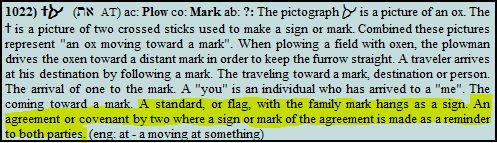
This is the root for the word sign. This is significant because the Torah is a sign on the hand and the forehead (Deuteronomy 6:8). The mark of God is His Torah. The mark of the beast is lawlessness for the beast is the man of sin (2 Thessalonians 2:3; Psalm 130:3; Jeremiah 2:22; Job 10:14) . Again, the mark of the beast is a direct counterfeit of God’s mark/signs.
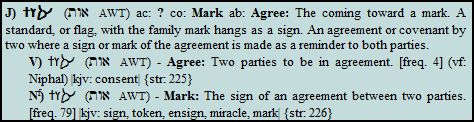
תא ‘tav aleph’ is related to the word תו ‘tav’ and את ‘aleph tav’ and means a mark/boundary.

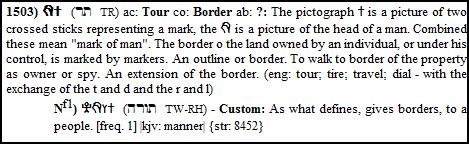
תא tav aleph relates to the word תר ‘tar’ which means the ‘mark of man’ or the border/outline.
תר which means the ‘mark of man’ or the border/outline.
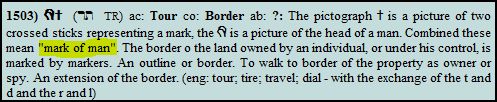
From this root we get ta’ar and to’ar. These words mean form, outline or border. This is an important connection to see in that the mark of the beast versus the mark of God ultimately reflects whose image/form you are in.

This connection between the mark and the image/form/outline/shadow picture of The LORD Jesus versus the antichrist is further seen in that the word Torah comes from this same root.

We can choose the tree of life or the tree of knowledge. The Light of the Word or the false light which is in reality darkness (Matthew 6:23).
We can have the mark of God and be in His image by walking in His Torah and letting Messiah live through us (Galatians 2:20), or we can have the mark of the beast and be in the image of Satan by walking in his torah which is lawlessness (Ephesians 2:2-3; Isaiah 30:8-11; 1 Peter 2:8). In reality, this ‘torah’ is the concept of ‘do what thou wilt shall be the whole of the law.’ The ability of man to decide what is good or evil, right or wrong instead of relying on the Word to define the two.
The word for image in Hebrew is צל ‘tsel’ which means a shadow cast by an object forming an image. This is also seen in the concept of being under the shadow of His wings, which for the current study represents dwelling under the branches of the Tree of Life. The counterfeit, of course, is the tree of knowledge and the shadow/image it casts. The word צל ‘tsel’ is the combination of the letter צ ‘tsadi’ which is the picture of a hunter, a man lying on his side with a spear or bow or a man with a fishing pole. The ל ‘lamed’ is a the picture of a staff held by a shepherd which represents authority. Herein lies a beautiful picture of the current study. The shepherd who hunts. The Messiah, the Good Shepherd, holds out a ‘fishing pole’ whose “bait” is the fruit of the tree of Life. The idol/worthless shepherd lies in wait as a lion seeking whom he may devour.
The word translated as mark in Revelation is used only one other time in Scripture referring to man engraving an image to represent the Almighty.
Act 17:29 Then being offspring of God, we ought not to suppose that the Godhead is like gold or silver or stone, engraved by art and the imagination of man.
This is the essence of the mark of the beast…it is a counterfeit worship of God. This is what the golden calf was. Making a golden calf and calling it God. This is who the antichrist will be. A counterfeit Jesus. Who was Messiah? He was the Word made flesh (John 1:14).
The Law of Christ

The Law of Christ
Gen 49:10 The sceptre shall not depart from Judah, nor a lawgiver from between his feet, until Shiloh come; and unto him shall the gathering {יקּהה ‘yiqqahah’} of the people be.
יקּהה ‘yiqqahah’ means gathering or obedience.
Later Moses spoke of a future One to whom God’s people were to obey.
Deu 18:15 The LORD thy God will raise up unto thee a Prophet from the midst of thee, of thy brethren, like unto me; unto him ye shall hearken;
Deu 18:16 According to all that thou desiredst of the LORD thy God in Horeb in the day of the assembly, saying, Let me not hear again the voice of the LORD my God, neither let me see this great fire any more, that I die not.
Deu 18:17 And the LORD said unto me, They have well spoken that which they have spoken.
Deu 18:18 I will raise them up a Prophet from among their brethren, like unto thee, and will put my words in his mouth; and he shall speak unto them all that I shall command him.
Deu 18:19 And it shall come to pass, that whosoever will not hearken unto my words which he shall speak in my name, I will require it of him.
The New Testament Scripture interprets this Prophet as Jesus.
Act 3:20 And he shall send Jesus Christ, which before was preached unto you:
Act 3:21 Whom the heaven must receive until the times of restitution of all things, which God hath spoken by the mouth of all his holy prophets since the world began.
Act 3:22 For Moses truly said unto the fathers, A prophet shall the Lord your God raise up unto you of your brethren, like unto me; him shall ye hear in all things whatsoever he shall say unto you.
Act 3:23 And it shall come to pass, that every soul, which will not hear that prophet, shall be destroyed from among the people.
Act 7:37 This is that Moses, which said unto the children of Israel, A prophet shall the Lord your God raise up unto you of your brethren, like unto me; him shall ye hear.
Isaiah prophesied that the Messiah would come with His law.
Isa 42:4 He shall not fail nor be discouraged, till he have set judgment in the earth: and the isles shall wait for his law.
John Gill commentary
and the isles shall wait for his law; his doctrine or Gospel, the law or doctrine of faith, particularly that of justification by his righteousness, with every other; this the inhabitants of the islands, or distant countries, the Gentiles, should be desirous of hearing, readily embrace and receive, and trust in Christ, made known to them in it. The Septuagint version is, “and in his name shall the Gentiles trust”; and so in Mat_12:20.
Matthew applies this prophecy of Isaiah to Jesus Christ.
Mat 12:18 Behold my servant, whom I have chosen; my beloved, in whom my soul is well pleased: I will put my spirit upon him, and he shall shew judgment to the Gentiles.
Mat 12:19 He shall not strive, nor cry; neither shall any man hear his voice in the streets.
Mat 12:20 A bruised reed shall he not break, and smoking flax shall he not quench, till he send forth judgment unto victory.
Mat 12:21 And in his name shall the Gentiles trust.
Isa 51:4 Hear Me, My people; yea, give ear to Me, My nation. For a law shall go out from Me, and My justice I will make rest as light to peoples.
Isa 51:5 My righteousness is near; My salvation went out; and My arms shall judge peoples; coastlands shall wait on Me, and they shall hope on My arm.
Jas 4:12 There is one lawgiver, who is able to save and to destroy: who art thou that judgest another?
Isaiah prophecies that the nations would wait for the law of Messiah. Matthew references this prophesy but says the nations shall wait for His name. The “name” of Jesus is the Word of God (Revelation 19:13), His character.
“There is no law behind God, because the furthest thing back is God. The moral absolutes rest upon God’s Character. The creation as He originally made it conforms to His character. The moral commands He has given to men are an expression of His character.” {“The God Who Is There” – Francis Shaeffer }
Jesus is THE image/character of God (Hebrews 1:3; 2 Corinthians 4:4-6; Colossians 1:15-16) who is love (1 John 4:8). He revealed God’s name/character to mankind (John 17:6).
The New Covenant is God’s law/Torah written upon our hearts (Jeremiah 31:31-34; Hebrews 8:8-13), His character of love (John 13:34-35; 15:10-12; 1 John 4:21; James 2:8; Romans 13:8-10; Galatians 5:14), His Spirit dwelling within us (John 14:15-18; 1 John 3:22-24), God working in us (Philippians 2:13), transforming us into the image of Jesus Christ (Hebrews 13:21; Ephesians 3:17-20; Colossians 3:10; Romans 8:29; 1 John 4:8).
Messiah came to earth in the very image of Almighty God (2 Corinthians 4:4; Colossians 1:15; Hebrews 1:3), who is love. His life displayed that love and He calls all those who believe in Him to display that love as well. This is the essence of the concept of ‘Christ in us.’ It is through His love that man is formed into His image (Colossians 3:10; Romans 8:29) where there is no longer Jew or Greek, Barbarian or Scythian but Christ is all and in all (Colossians 3:11). This is the true essence of what the Torah is.
The true intent of the law/Word of God is not to make men religious but to reform men into the image of their God who is love (1 John 4:8). It is this love that unites us and perfects us. It is the bond of perfection (Colossians 3:14) which sets man free (Galatians 5:13-14). This love is not intended only for a certain group of religious people, but for all mankind. Scripture declares that in the Messiah shall the ‘gentiles trust’ (Matthew 12:21; Romans 15:8-12; Isaiah 11:10). For Jesus is the true Light which enlightens every man (John 1:9; 12:44-46; Isaiah 49:6), sent to restore all of mankind back to God (Isaiah 45:22; Romans 3:29; John 1:12; 3:15-17).
The fruit which Israel was called to produce was the ‘goodly’ fruit of His Word (Jeremiah 11:16). However, Israel did not produce this fruit but brought forth wicked fruit (Jeremiah 24:2-8). As a result, God brought fire upon this olive tree, breaking the branches thereof (Jeremiah 11:16-17).
The Hebrew word for ‘goodly’ in Jeremiah 11:16 is תאר ‘toar’ which means a shape, form, outline or figure of a thing. תאר ‘toar’ is a cognate of the word תורה ‘torah’ which literally means instruction which defines the border of a people or the ‘image’ of a people. תורה ‘torah’ is most commonly translated as ‘law.’ Here we see that Israel was to produce the fruit of His Law which would bring forth His image to the world. His Image is that of love (1 John 4:8, 16; Matthew 22:35-40).
Mat 12:18 Behold my servant, whom I have chosen; my beloved, in whom my soul is well pleased: I will put my spirit upon him, and he shall shew judgment to the Gentiles.
Mat 12:19 He shall not strive, nor cry; neither shall any man hear his voice in the streets.
Mat 12:20 A bruised reed shall he not break, and smoking flax shall he not quench, till he send forth judgment unto victory.
Mat 12:21 And in his name shall the Gentiles trust.
Isa 42:1 Behold my servant, whom I uphold; mine elect, in whom my soul delighteth; I have put my spirit upon him: he shall bring forth judgment to the Gentiles.
Isa 42:2 He shall not cry, nor lift up, nor cause his voice to be heard in the street.
Isa 42:3 A bruised reed shall he not break, and the smoking flax shall he not quench: he shall bring forth judgment unto truth.
Isa 42:4 He shall not fail nor be discouraged, till he have set judgment in the earth: and the isles shall wait for his law.
Rev 19:13 And he was clothed with a vesture dipped in blood: and his name is called The Word of God.
Joh 1:14 And the Word was made flesh, and dwelt among us, (and we beheld his glory, the glory as of the only begotten of the Father,) full of grace and truth.
His Name is the Word…the Word is the Torah (Isaiah 5:24)…His Name is the Torah…Jesus is the Word…Jesus is the Torah. This is not to say Jesus is the law of Moses however, this is to say Jesus is the Word of God.
The Hebrew word for name is שם ‘shem’ which literally means one’s breathe or character. What is the character of the Almighty? Love (1 John 4:8).
The Hebrew word for love is אהב ‘ahav’ which is consists of the letters אב ‘av’ which means father and the middle letter ה ‘heh’ which has the meaning of revelation. The Father revealed. In ancient Hebrew, the letter ה ‘heh’ was depicted as a man with outstretched arms, like unto Messiah on the cross. How was the love of the Father revealed? Through the giving of His only begotten Son on the cross as an atonement for the sins of mankind (John 3:16).
Further connecting the Name of God to His character of love and the revelation of this love at Calvary is seen in the ancient pictograph meanings of the Sacred Name.
The pictographs of יהוה ‘Yahweh’ speak of Him being revealed through the nails in His Hands.
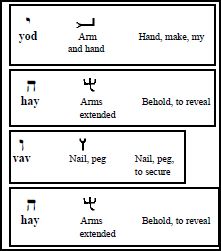
It is God’s name/character of love that is written in the heads of His redeemed people (Revelation 22:4). The prophet Ezekiel was shown that His mark is depicted in the letter ת ‘tav’ which was written in ancient times as the image of the cross (Ezekiel 9:4).
The word תורה ‘torah’ also pictographically displays Messiah on the cross, revealing the love of God.
ת – cross
ו – nail
ר – head, leader
ה – man with outstretched arms
Jesus’ declaration of God’s love was manifest on the cross.
Psa 22:22 I will declare thy name unto my brethren: in the midst of the congregation will I praise thee.
Heb 2:10 For it became him, for whom are all things, and by whom are all things, in bringing many sons unto glory, to make the captain of their salvation perfect through sufferings.
Heb 2:11 For both he that sanctifieth and they who are sanctified are all of one: for which cause he is not ashamed to call them brethren,
Heb 2:12 Saying, I will declare thy name unto my brethren, in the midst of the church will I sing praise unto thee.
Christ laid down His life for mankind, revealing the love of God. In this love for mankind, He fulfilled the law. The New Covenant Torah is for believers to do the same.
Joh 13:34 A new commandment I give unto you, That ye love one another; as I have loved you, that ye also love one another.
Joh 15:12 This is my commandment, That ye love one another, as I have loved you.
Joh 15:13 Greater love hath no man than this, that a man lay down his life for his friends.
Gal_6:2 Bear ye one another’s burdens, and so fulfil the law of Christ.
Gal 5:13 For, brethren, ye have been called unto liberty; only use not liberty for an occasion to the flesh, but by love serve one another.
Gal 5:14 For all the law is fulfilled in one word, even in this; Thou shalt love thy neighbour as thyself.
1Jn 4:21 And this commandment have we from him, That he who loveth God love his brother also.
1Pe 2:21 For even hereunto were ye called: because Christ also suffered for us, leaving us an example, that ye should follow his steps:
1Pe 2:22 Who did no sin, neither was guile found in his mouth:
1Pe 2:23 Who, when he was reviled, reviled not again; when he suffered, he threatened not; but committed himself to him that judgeth righteously:
1Pe 2:24 Who his own self bare our sins in his own body on the tree, that we, being dead to sins, should live unto righteousness: by whose stripes ye were healed.
1Pe 2:25 For ye were as sheep going astray; but are now returned unto the Shepherd and Bishop of your souls.
1Jn 2:1 My little children, these things write I unto you, that ye sin not. And if any man sin, we have an advocate with the Father, Jesus Christ the righteous:
1Jn 2:2 And he is the propitiation for our sins: and not for ours only, but also for the sins of the whole world.
1Jn 2:3 And hereby we do know that we know him, if we keep his commandments.
1Jn 2:4 He that saith, I know him, and keepeth not his commandments, is a liar, and the truth is not in him.
1Jn 2:5 But whoso keepeth his word, in him verily is the love of God perfected: hereby know we that we are in him.
1Jn 2:6 He that saith he abideth in him ought himself also so to walk, even as he walked.
1Jn 2:7 Brethren, I write no new commandment unto you, but an old commandment which ye had from the beginning. The old commandment is the word which ye have heard from the beginning.
1Jn 2:8 Again, a new commandment I write unto you, which thing is true in him and in you: because the darkness is past, and the true light now shineth.
1Jn 2:9 He that saith he is in the light, and hateth his brother, is in darkness even until now.
1Jn 2:10 He that loveth his brother abideth in the light, and there is none occasion of stumbling in him.
Joh 13:13 Ye call me Master and Lord: and ye say well; for so I am.
Joh 13:14 If I then, your Lord and Master, have washed your feet; ye also ought to wash one another’s feet.
Joh 13:15 For I have given you an example, that ye should do as I have done to you.
Joh 13:16 Verily, verily, I say unto you, The servant is not greater than his lord; neither he that is sent greater than he that sent him.
Joh 13:17 If ye know these things, happy are ye if ye do them.
Eph 5:1 Be ye therefore followers of God, as dear children;
Eph 5:2 And walk in love, as Christ also hath loved us, and hath given himself for us an offering and a sacrifice to God for a sweetsmelling savour.
1Jn 3:16 Hereby perceive we the love of God, because he laid down his life for us: and we ought to lay down our lives for the brethren.
1Jn 3:17 But whoso hath this world’s good, and seeth his brother have need, and shutteth up his bowels of compassion from him, how dwelleth the love of God in him?
1Jn 3:18 My little children, let us not love in word, neither in tongue; but in deed and in truth.
1Jn 3:19 And hereby we know that we are of the truth, and shall assure our hearts before him.
1Jn 3:20 For if our heart condemn us, God is greater than our heart, and knoweth all things.
1Jn 3:21 Beloved, if our heart condemn us not, then have we confidence toward God.
1Jn 3:22 And whatsoever we ask, we receive of him, because we keep his commandments, and do those things that are pleasing in his sight.
1Jn 3:23 And this is his commandment, That we should believe on the name of his Son Jesus Christ, and love one another, as he gave us commandment.
1Jn 3:24 And he that keepeth his commandments dwelleth in him, and he in him. And hereby we know that he abideth in us, by the Spirit which he hath given us.
Rom 8:1 There is therefore now no condemnation to them which are in Christ Jesus, who walk not after the flesh, but after the Spirit.
Rom 8:2 For the law of the Spirit of life in Christ Jesus hath made me free from the law of sin and death.
Rom 8:3 For what the law could not do, in that it was weak through the flesh, God sending his own Son in the likeness of sinful flesh, and for sin, condemned sin in the flesh:
Rom 8:4 That the righteousness of the law might be fulfilled in us, who walk not after the flesh, but after the Spirit.
Rom 8:28 And we know that all things work together for good to them that love God, to them who are the called according to his purpose.
Rom 8:29 For whom he did foreknow, he also did predestinate to be conformed to the image of his Son, that he might be the firstborn among many brethren.
Rom 13:8 Owe no man any thing, but to love one another: for he that loveth another hath fulfilled the law.
Rom 13:9 For this, Thou shalt not commit adultery, Thou shalt not kill, Thou shalt not steal, Thou shalt not bear false witness, Thou shalt not covet; and if there be any other commandment, it is briefly comprehended in this saying, namely, Thou shalt love thy neighbour as thyself.
Rom 13:10 Love worketh no ill to his neighbour: therefore love is the fulfilling of the law.
1Ti 1:5 Now the end of the commandment is charity out of a pure heart, and of a good conscience, and of faith unfeigned:
Mar 12:28 And one of the scribes came, and having heard them reasoning together, and perceiving that he had answered them well, asked him, Which is the first commandment of all?
Mar 12:29 And Jesus answered him, The first of all the commandments is, Hear, O Israel; The Lord our God is one Lord:
Mar 12:30 And thou shalt love the Lord thy God with all thy heart, and with all thy soul, and with all thy mind, and with all thy strength: this is the first commandment.
Mar 12:31 And the second is like, namely this, Thou shalt love thy neighbour as thyself. There is none other commandment greater than these.
Mar 12:32 And the scribe said unto him, Well, Master, thou hast said the truth: for there is one God; and there is none other but he:
Mar 12:33 And to love him with all the heart, and with all the understanding, and with all the soul, and with all the strength, and to love his neighbour as himself, is more than all whole burnt offerings and sacrifices.
Mar 12:34 And when Jesus saw that he answered discreetly, he said unto him, Thou art not far from the kingdom of God. And no man after that durst ask him any question.
Luk 10:27 And he answering said, Thou shalt love the Lord thy God with all thy heart, and with all thy soul, and with all thy strength, and with all thy mind; and thy neighbour as thyself.
Luk 10:28 And he said unto him, Thou hast answered right: this do, and thou shalt live.
Luk 10:29 But he, willing to justify himself, said unto Jesus, And who is my neighbour?
Luk 10:30 And Jesus answering said, A certain man went down from Jerusalem to Jericho, and fell among thieves, which stripped him of his raiment, and wounded him, and departed, leaving him half dead.
Luk 10:31 And by chance there came down a certain priest that way: and when he saw him, he passed by on the other side.
Luk 10:32 And likewise a Levite, when he was at the place, came and looked on him, and passed by on the other side.
Luk 10:33 But a certain Samaritan, as he journeyed, came where he was: and when he saw him, he had compassion on him,
Luk 10:34 And went to him, and bound up his wounds, pouring in oil and wine, and set him on his own beast, and brought him to an inn, and took care of him.
Luk 10:35 And on the morrow when he departed, he took out two pence, and gave them to the host, and said unto him, Take care of him; and whatsoever thou spendest more, when I come again, I will repay thee.
Luk 10:36 Which now of these three, thinkest thou, was neighbour unto him that fell among the thieves?
Luk 10:37 And he said, He that shewed mercy on him. Then said Jesus unto him, Go, and do thou likewise.
Christ’s Words are the Words of the Father
Joh 14:24 The one who does not love Me does not keep My Words. And the Word which you hear is not Mine but of the Father who sent Me.
Joh 7:16 Jesus answered them, and said, My doctrine is not mine, but his that sent me.
Joh 7:17 If any man will do his will, he shall know of the doctrine, whether it be of God, or whether I speak of myself.
Joh 12:48 He that rejecteth me, and receiveth not my words, hath one that judgeth him: the word that I have spoken, the same shall judge him in the last day.
Joh 12:49 For I have not spoken of myself; but the Father which sent me, he gave me a commandment, what I should say, and what I should speak.
Joh 5:30 I can of mine own self do nothing: as I hear, I judge: and my judgment is just; because I seek not mine own will, but the will of the Father which hath sent me.
Yet, the law of Christ is not the same as the law of Moses. Paul could not live “without the law” and be under the law of Christ at the same time if the law of Moses (Old Covenant) and law of Christ were the same thing.
1Co 9:19 For though I be free from all men, yet have I made myself servant unto all, that I might gain the more.
1Co 9:20 And unto the Jews I became as a Jew, that I might gain the Jews; to them that are under the law, as under the law, that I might gain them that are under the law;
1Co 9:21 To them that are without law, as without law, (being not without law to God, but under the law to Christ,) that I might gain them that are without law.
1Co 9:22 To the weak became I as weak, that I might gain the weak: I am made all things to all men, that I might by all means save some.
1Co 9:23 And this I do for the gospel’s sake, that I might be partaker thereof with you.
1Co 9:24 Know ye not that they which run in a race run all, but one receiveth the prize? So run, that ye may obtain.
1Co 9:25 And every man that striveth for the mastery is temperate in all things. Now they do it to obtain a corruptible crown; but we an incorruptible.
1Co 9:26 I therefore so run, not as uncertainly; so fight I, not as one that beateth the air:
1Co 9:27 But I keep under my body, and bring it into subjection: lest that by any means, when I have preached to others, I myself should be a castaway.
Rom 7:1 Know ye not, brethren, (for I speak to them that know the law,) how that the law hath dominion over a man as long as he liveth?
Rom 7:2 For the woman which hath an husband is bound by the law to her husband so long as he liveth; but if the husband be dead, she is loosed from the law of her husband.
Rom 7:3 So then if, while her husband liveth, she be married to another man, she shall be called an adulteress: but if her husband be dead, she is free from that law; so that she is no adulteress, though she be married to another man.
Rom 7:4 Wherefore, my brethren, ye also are become dead to the law by the body of Christ; that ye should be married to another, even to him who is raised from the dead, that we should bring forth fruit unto God.
Rom 7:5 For when we were in the flesh, the motions of sins, which were by the law, did work in our members to bring forth fruit unto death.
Rom 7:6 But now we are delivered from the law, that being dead wherein we were held; that we should serve in newness of spirit, and not in the oldness of the letter.
Rom 7:7 What shall we say then? Is the law sin? God forbid. Nay, I had not known sin, but by the law: for I had not known lust, except the law had said, Thou shalt not covet.
Rom 7:8 But sin, taking occasion by the commandment, wrought in me all manner of concupiscence. For without the law sin was dead.
Rom 7:9 For I was alive without the law once: but when the commandment came, sin revived, and I died.
Rom 7:10 And the commandment, which was ordained to life, I found to be unto death.
Rom 7:11 For sin, taking occasion by the commandment, deceived me, and by it slew me.
Rom 7:12 Wherefore the law is holy, and the commandment holy, and just, and good.
Rom 7:13 Was then that which is good made death unto me? God forbid. But sin, that it might appear sin, working death in me by that which is good; that sin by the commandment might become exceeding sinful.
Rom 7:14 For we know that the law is spiritual: but I am carnal, sold under sin.
Rom 7:15 For that which I do I allow not: for what I would, that do I not; but what I hate, that do I.
Rom 7:16 If then I do that which I would not, I consent unto the law that it is good.
Rom 7:17 Now then it is no more I that do it, but sin that dwelleth in me.
Rom 7:18 For I know that in me (that is, in my flesh,) dwelleth no good thing: for to will is present with me; but how to perform that which is good I find not.
Rom 7:19 For the good that I would I do not: but the evil which I would not, that I do.
Rom 7:20 Now if I do that I would not, it is no more I that do it, but sin that dwelleth in me.
Rom 7:21 I find then a law, that, when I would do good, evil is present with me.
Rom 7:22 For I delight in the law of God after the inward man:
Rom 7:23 But I see another law in my members, warring against the law of my mind, and bringing me into captivity to the law of sin which is in my members.
Rom 7:24 O wretched man that I am! who shall deliver me from the body of this death?
Rom 7:25 I thank God through Jesus Christ our Lord. So then with the mind I myself serve the law of God; but with the flesh the law of sin.
Rom 10:1 Brethren, my heart’s desire and prayer to God for Israel is, that they might be saved.
Rom 10:2 For I bear them record that they have a zeal of God, but not according to knowledge.
Rom 10:3 For they being ignorant of God’s righteousness, and going about to establish their own righteousness, have not submitted themselves unto the righteousness of God.
Rom 10:4 For Christ is the end of the law for righteousness to every one that believeth.
Rom 10:5 For Moses describeth the righteousness which is of the law, That the man which doeth those things shall live by them.
Rom 10:6 But the righteousness which is of faith speaketh on this wise, Say not in thine heart, Who shall ascend into heaven? (that is, to bring Christ down from above:)
Rom 10:7 Or, Who shall descend into the deep? (that is, to bring up Christ again from the dead.)
Rom 10:8 But what saith it? The word is nigh thee, even in thy mouth, and in thy heart: that is, the word of faith, which we preach;
Rom 10:9 That if thou shalt confess with thy mouth the Lord Jesus, and shalt believe in thine heart that God hath raised him from the dead, thou shalt be saved.
Rom 10:10 For with the heart man believeth unto righteousness; and with the mouth confession is made unto salvation.
Rom 10:11 For the scripture saith, Whosoever believeth on him shall not be ashamed.
Rom 10:12 For there is no difference between the Jew and the Greek: for the same Lord over all is rich unto all that call upon him.
Rom 10:13 For whosoever shall call upon the name of the Lord shall be saved.
Rom 10:14 How then shall they call on him in whom they have not believed? and how shall they believe in him of whom they have not heard? and how shall they hear without a preacher?
Rom 10:15 And how shall they preach, except they be sent? as it is written, How beautiful are the feet of them that preach the gospel of peace, and bring glad tidings of good things!
Rom 10:16 But they have not all obeyed the gospel. For Esaias saith, Lord, who hath believed our report?
Rom 10:17 So then faith cometh by hearing, and hearing by the word of God.
Rom 10:18 But I say, Have they not heard? Yes verily, their sound went into all the earth, and their words unto the ends of the world.
Rom 10:19 But I say, Did not Israel know? First Moses saith, I will provoke you to jealousy by them that are no people, and by a foolish nation I will anger you.
Rom 10:20 But Esaias is very bold, and saith, I was found of them that sought me not; I was made manifest unto them that asked not after me.
Rom 10:21 But to Israel he saith, All day long I have stretched forth my hands unto a disobedient and gainsaying people.
Gal_6:2 Bear ye one another’s burdens, and so fulfil the law of Christ.
A New Commandment
Joh 13:34 A new commandment I give unto you, That ye love one another; as I have loved you, that ye also love one another.
The New Covenant is the law written on our hearts, a better testament but NOT according to the covenant made with Israel at Sinai.
Heb 8:6 But now hath he obtained a more excellent ministry, by how much also he is the mediator of a better covenant, which was established upon better promises.
Heb 8:7 For if that first covenant had been faultless, then should no place have been sought for the second.
Heb 8:8 For finding fault with them, he saith, Behold, the days come, saith the Lord, when I will make a new covenant with the house of Israel and with the house of Judah:
Heb 8:9 Not according to the covenant that I made with their fathers in the day when I took them by the hand to lead them out of the land of Egypt; because they continued not in my covenant, and I regarded them not, saith the Lord.
Heb 8:10 For this is the covenant that I will make with the house of Israel after those days, saith the Lord; I will put my laws into their mind, and write them in their hearts: and I will be to them a God, and they shall be to me a people:
Heb 8:11 And they shall not teach every man his neighbour, and every man his brother, saying, Know the Lord: for all shall know me, from the least to the greatest.
Heb 8:12 For I will be merciful to their unrighteousness, and their sins and their iniquities will I remember no more.
Heb 8:13 In that he saith, A new covenant, he hath made the first old {παλαιόω ‘palaioō’}. Now that which decayeth {παλαιόω ‘palaioō’} and waxeth old {γηράσκω ‘gēraskō’} is ready to vanish away.
The first covenant was taken away that the second might be established:
Heb 10:1 For the law having a shadow of good things to come, and not the very image of the things, can never with those sacrifices which they offered year by year continually make the comers thereunto perfect.
Heb 10:2 For then would they not have ceased to be offered? because that the worshippers once purged should have had no more conscience of sins.
Heb 10:3 But in those sacrifices there is a remembrance again made of sins every year.
Heb 10:4 For it is not possible that the blood of bulls and of goats should take away sins.
Heb 10:5 Wherefore when he cometh into the world, he saith, Sacrifice and offering thou wouldest not, but a body hast thou prepared me:
Heb 10:6 In burnt offerings and sacrifices for sin thou hast had no pleasure.
Heb 10:7 Then said I, Lo, I come (in the volume of the book it is written of me,) to do thy will, O God.
Heb 10:8 Above when he said, Sacrifice and offering and burnt offerings and offering for sin thou wouldest not, neither hadst pleasure therein; which are offered by the law;
Heb 10:9 Then said he, Lo, I come to do thy will, O God. He taketh away the first, that he may establish the second.
Heb 10:10 By the which will we are sanctified through the offering of the body of Jesus Christ once for all.
Heb 10:11 And every priest standeth daily ministering and offering oftentimes the same sacrifices, which can never take away sins:
Heb 10:12 But this man, after he had offered one sacrifice for sins for ever, sat down on the right hand of God;
Heb 10:13 From henceforth expecting till his enemies be made his footstool.
Heb 10:14 For by one offering he hath perfected for ever them that are sanctified.
Heb 10:15 Whereof the Holy Ghost also is a witness to us: for after that he had said before,
Heb 10:16 This is the covenant that I will make with them after those days, saith the Lord, I will put my laws into their hearts, and in their minds will I write them;
Heb 10:17 And their sins and iniquities will I remember no more.
Heb 10:18 Now where remission of these is, there is no more offering for sin.
Heb 10:19 Having therefore, brethren, boldness to enter into the holiest by the blood of Jesus,
Heb 10:20 By a new and living way, which he hath consecrated for us, through the veil, that is to say, his flesh;
Heb 10:21 And having an high priest over the house of God;
Heb 10:22 Let us draw near with a true heart in full assurance of faith, having our hearts sprinkled from an evil conscience, and our bodies washed with pure water.
Heb 10:23 Let us hold fast the profession of our faith without wavering; (for he is faithful that promised;)
Heb 10:24 And let us consider one another to provoke unto love and to good works:
Heb 10:25 Not forsaking the assembling of ourselves together, as the manner of some is; but exhorting one another: and so much the more, as ye see the day approaching.
Heb 10:26 For if we sin wilfully after that we have received the knowledge of the truth, there remaineth no more sacrifice for sins,
Heb 10:27 But a certain fearful looking for of judgment and fiery indignation, which shall devour the adversaries.
Heb 10:28 He that despised Moses’ law died without mercy under two or three witnesses:
Heb 10:29 Of how much sorer punishment, suppose ye, shall he be thought worthy, who hath trodden under foot the Son of God, and hath counted the blood of the covenant, wherewith he was sanctified, an unholy thing, and hath done despite unto the Spirit of grace?
Heb 10:30 For we know him that hath said, Vengeance belongeth unto me, I will recompense, saith the Lord. And again, The Lord shall judge his people.
Heb 10:31 It is a fearful thing to fall into the hands of the living God.
Heb 10:32 But call to remembrance the former days, in which, after ye were illuminated, ye endured a great fight of afflictions;
Heb 10:33 Partly, whilst ye were made a gazingstock both by reproaches and afflictions; and partly, whilst ye became companions of them that were so used.
Heb 10:34 For ye had compassion of me in my bonds, and took joyfully the spoiling of your goods, knowing in yourselves that ye have in heaven a better and an enduring substance.
Heb 10:35 Cast not away therefore your confidence, which hath great recompence of reward.
Heb 10:36 For ye have need of patience, that, after ye have done the will of God, ye might receive the promise.
Heb 10:37 For yet a little while, and he that shall come will come, and will not tarry.
Heb 10:38 Now the just shall live by faith: but if any man draw back, my soul shall have no pleasure in him.
Heb 10:39 But we are not of them who draw back unto perdition; but of them that believe to the saving of the soul.
Heb 12:24 And to Jesus the mediator of the new covenant, and to the blood of sprinkling, that speaketh better things than that of Abel.
The New Covenant brings a change in the priesthood and a change in the law. The Old Covenant was done away.
2Co 3:2 Ye are our epistle written in our hearts, known and read of all men:
2Co 3:3 Forasmuch as ye are manifestly declared to be the epistle of Christ ministered by us, written not with ink, but with the Spirit of the living God; not in tables of stone, but in fleshy tables of the heart.
2Co 3:4 And such trust have we through Christ to God-ward:
2Co 3:5 Not that we are sufficient of ourselves to think any thing as of ourselves; but our sufficiency is of God;
2Co 3:6 Who also hath made us able ministers of the new testament; not of the letter, but of the spirit: for the letter killeth, but the spirit giveth life.
2Co 3:7 But if the ministration of death, written and engraven in stones, was glorious, so that the children of Israel could not stedfastly behold the face of Moses for the glory of his countenance; which glory was to be done away {καταργέω ‘katargeō’}:
2Co 3:8 How shall not the ministration of the spirit be rather glorious?
2Co 3:9 For if the ministration of condemnation be glory, much more doth the ministration of righteousness exceed in glory.
2Co 3:10 For even that which was made glorious had no glory in this respect, by reason of the glory that excelleth.
2Co 3:11 For if that which is done away was glorious, much more that which remaineth is glorious.
2Co 3:12 Seeing then that we have such hope, we use great plainness of speech:
2Co 3:13 And not as Moses, which put a vail over his face, that the children of Israel could not stedfastly look to the end of that which is abolished {καταργέω ‘katargeō’}:
2Co 3:14 But their minds were blinded: for until this day remaineth the same vail untaken away in the reading of the old testament; which vail is done away in Christ.
2Co 3:15 But even unto this day, when Moses is read, the vail is upon their heart.
2Co 3:16 Nevertheless when it shall turn to the Lord, the vail shall be taken away.
2Co 3:17 Now the Lord is that Spirit: and where the Spirit of the Lord is, there is liberty.
2Co 3:18 But we all, with open face beholding as in a glass the glory of the Lord, are changed into the same image from glory to glory, even as by the Spirit of the Lord.
Heb 7:11 If therefore perfection were by the Levitical priesthood, (for under it the people received the law,) what further need was there that another priest should rise after the order of Melchisedec, and not be called after the order of Aaron?
Heb 7:12 For the priesthood being changed, there is made of necessity a change also of the law.
Heb 7:13 For he of whom these things are spoken pertaineth to another tribe, of which no man gave attendance at the altar.
Heb 7:14 For it is evident that our Lord sprang out of Juda; of which tribe Moses spake nothing concerning priesthood.
Heb 7:15 And it is yet far more evident: for that after the similitude of Melchisedec there ariseth another priest,
Heb 7:16 Who is made, not after the law of a carnal commandment, but after the power of an endless life.
Heb 7:17 For he testifieth, Thou art a priest for ever after the order of Melchisedec.
Heb 7:18 For there is verily a disannulling of the commandment going before for the weakness and unprofitableness thereof.
Heb 7:19 For the law made nothing perfect, but the bringing in of a better hope did; by the which we draw nigh unto God.
Heb 7:20 And inasmuch as not without an oath he was made priest:
Heb 7:21 (For those priests were made without an oath; but this with an oath by him that said unto him, The Lord sware and will not repent, Thou art a priest for ever after the order of Melchisedec:)
Heb 7:22 By so much was Jesus made a surety of a better testament.
Perfection did not come through the Levitical priesthood and the Old Covenant law.
Heb 7:11 If therefore perfection were by the Levitical priesthood, (for under it the people received the law,) what further need was there that another priest should rise after the order of Melchisedec, and not be called after the order of Aaron?
Heb 7:12 For the priesthood being changed, there is made of necessity a change also of the law.
Heb 7:17 For he testifieth, Thou art a priest for ever after the order of Melchisedec.
Heb 7:18 For there is verily a disannulling of the commandment going before for the weakness and unprofitableness thereof.
Heb 7:19 For the law made nothing perfect, but the bringing in of a better hope did; by the which we draw nigh unto God.
1Co 13:10 But when that which is perfect is come, then that which is in part shall be done away {καταργέω ‘katargeō’}.
1Co 13:11 When I was a child, I spake as a child, I understood as a child, I thought as a child: but when I became a man, I put away childish things.
2Co 3:7 But if the ministration of death, written and engraven in stones, was glorious, so that the children of Israel could not stedfastly behold the face of Moses for the glory of his countenance; which glory was to be done away {καταργέω ‘katargeō’}:
2Co 3:11 For if that which is done away {καταργέω ‘katargeō’} was glorious, much more that which remaineth is glorious.
2Co 3:14 But their minds were blinded: for until this day remaineth the same vail untaken away in the reading of the old testament; which vail is done away {καταργέω ‘katargeō’} in Christ.
Recall that the veil is done away through the New Covenant in Christ (Hebrews 10:20).
Either the Old Covenant is done away in Christ, establishing the New Covenant, or the Promise of Christ is “done away” by the continuance of the Old Covenant.
Rom 4:14 For if they which are of the law be heirs, faith is made void, and the promise made of none effect {καταργέω ‘katargeō’}:
Gal 3:17 And this I say, that the covenant, that was confirmed before of God in Christ, the law, which was four hundred and thirty years after, cannot disannul, that it should make the promise of none effect {καταργέω ‘katargeō’}.
Gal 3:18 For if the inheritance be of the law, it is no more of promise: but God gave it to Abraham by promise.
Gal 5:4 Christ is become of no effect {καταργέω ‘katargeō’}
unto you, whosoever of you are justified by the law; ye are fallen from grace.
“Be not deceived with strange doctrines, nor with old fables, which are unprofitable. For if we still live according to the Jewish law, we acknowledge that we have not received grace. For the divinest prophets lived according to Christ Jesus. On this account also they were persecuted, being inspired by His grace to fully convince the unbelieving that there is one God, who has manifested Himself by Jesus Christ His Son, who is His eternal Word, not proceeding forth from silence, and who in all things pleased Him that sent Him.” {The Epistle of Ignatius to the Magnesians}
“Let us not, therefore, be insensible to His kindness. For were He to reward us according to our works, we should cease to be. Therefore, having become His disciples, let us learn to live according to the principles of Christianity. For whosoever is called by any other name besides this, is not of God. Lay aside, therefore, the evil, the old, the sour leaven, and be ye changed into the new leaven, which is Jesus Christ. Be ye salted in Him, lest any one among you should be corrupted, since by your savour ye shall be convicted. It is absurd to profess Christ Jesus, and to Judaize. For Christianity did not embrace Judaism, but Judaism Christianity, that so every tongue which believeth might be gathered together to God.
Let us not, therefore, be insensible to His kindness. For were He to reward us according to our works, we should cease to be. For “if Thou, Lord, shalt mark iniquities, O Lord, who shall stand? ” Let us therefore prove ourselves worthy of that name which we have received. For whosoever is called by any other name besides this, he is not of God; for he has not received the prophecy which speaks thus concerning us: “The people shall be called by a new name, which the Lord shall name them, and shall be a holy people.” This was first fulfilled in Syria; for “the disciples were called Christians at Antioch,” when Paul and Peter were laying the foundations of the Church.
Lay aside, therefore, the evil, the old, the corrupt leaven, and be ye changed into the new leaven of grace. Abide in Christ, that the stranger may not have dominion over you. It is absurd to speak of Jesus Christ with the tongue, and to cherish in the mind a Judaism which has now come to an end. For where there is Christianity there cannot be Judaism. For Christ is one, in whom every nation that believes, and every tongue that confesses, is gathered unto God. And those that were of a stony heart have become the children of Abraham, the friend of God; and in his seed all those have been blessed who were ordained to eternal life in Christ.” {The Epistle of Ignatius to the Magnesians}
“For why should God, the founder of the universe, the Governor of the whole world, the Fashioner of humanity, the Sower of universal nations be believed to have given a law through Moses to one people, and not be said to have assigned it to all nations? For unless He had given it to all by no means would He have habitually permitted even proselytes out of the nations to have access to it. But— as is congruous with the goodness of God, and with His equity, as the Fashioner of mankind— He gave to all nations the selfsame law, which at definite and stated times He enjoined should be observed, when He willed, and through whom He willed, and as He willed.
For in the beginning of the world He gave to Adam himself and Eve a law, that they were not to eat of the fruit of the tree planted in the midst of paradise; but that, if they did contrariwise, by death they were to die. Which law had continued enough for them, had it been kept. For in this law given to Adam we recognise in embryo all the precepts which afterwards sprouted forth when given through Moses; that is, You shall love the Lord your God from your whole heart and out of your whole soul; You shall love your neighbour as yourself; You shall not kill; You shall not commit adultery; You shall not steal; False witness you shall not utter; Honour your father and mother; and, That which is another’s, shall you not covet.
For the primordial law was given to Adam and Eve in paradise, as the womb of all the precepts of God. In short, if they had loved the Lord their God, they would not have contravened His precept; if they had habitually loved their neighbour— that is, themselves — they would not have believed the persuasion of the serpent, and thus would not have committed murder upon themselves, by falling from immortality, by contravening God’s precept; from theft also they would have abstained, if they had not stealthily tasted of the fruit of the tree, nor had been anxious to skulk beneath a tree to escape the view of the Lord their God; nor would they have been made partners with the falsehood-asseverating devil, by believing him that they would be “like God;” and thus they would not have offended God either, as their Father, who had fashioned them from clay of the earth, as out of the womb of a mother; if they had not coveted another’s, they would not have tasted of the unlawful fruit.
Therefore, in this general and primordial law of God, the observance of which, in the case of the tree’s fruit, He had sanctioned, we recognise enclosed all the precepts specially of the posterior Law, which germinated when disclosed at their proper times. For the subsequent superinduction of a law is the work of the same Being who had before premised a precept; since it is His province withal subsequently to train, who had before resolved to form, righteous creatures.
For what wonder if He extends a discipline who institutes it? If He advances who begins? In short, before the Law of Moses, written in stone-tables, I contend that there was a law unwritten, which was habitually understood naturally, and by the fathers was habitually kept. For whence was Noah “found righteous,” if in his case the righteousness of a natural law had not preceded? Whence was Abraham accounted “a friend of God,” if not on the ground of equity and righteousness, (in the observance) of a natural law? Whence was Melchizedek named “priest of the most high God,” if, before the priesthood of the Levitical law, there were not levites who were wont to offer sacrifices to God? For thus, after the above-mentioned patriarchs, was the Law given to Moses, at that (well-known) time after their exode from Egypt, after the interval and spaces of four hundred years. In fact, it was after Abraham’s “four hundred and thirty years” that the Law was given.
Whence we understand that God’s law was anterior even to Moses, and was not first (given) in Horeb, nor in Sinai and in the desert, but was more ancient; (existing) first in paradise, subsequently reformed for the patriarchs, and so again for the Jews, at definite periods: so that we are not to give heed to Moses’ Law as to the primitive law, but as to a subsequent, which at a definite period God has set forth to the Gentiles too and, after repeatedly promising so to do through the prophets, has reformed for the better; and has premonished that it should come to pass that, just as “the law was given through Moses” John 1:17 at a definite time, so it should be believed to have been temporarily observed and kept.
And let us not annul this power which God has, which reforms the law’s precepts answerably to the circumstances of the times, with a view to man’s salvation. In fine, let him who contends that the Sabbath is still to be observed as a balm of salvation, and circumcision on the eighth day because of the threat of death, teach us that, for the time past, righteous men kept the Sabbath, or practised circumcision, and were thus rendered “friends of God.” For if circumcision purges a man since God made Adam uncircumcised, why did He not circumcise him, even after his sinning, if circumcision purges? At all events, in settling him in paradise, He appointed one uncircumcised as colonist of paradise.
Therefore, since God originated Adam uncircumcised, and inobservant of the Sabbath, consequently his offspring also, Abel, offering Him sacrifices, uncircumcised and inobservant of the Sabbath, was by Him commended; while He accepted what he was offering in simplicity of heart, and reprobated the sacrifice of his brother Cain, who was not rightly dividing what he was offering. Noah also, uncircumcised— yes, and inobservant of the Sabbath— God freed from the deluge.
For Enoch, too, most righteous man, uncircumcised and inobservant of the Sabbath, He translated from this world; who did not first taste death, in order that, being a candidate for eternal life, he might by this time show us that we also may, without the burden of the law of Moses, please God. Melchizedek also, “the priest of the most high God,” uncircumcised and inobservant of the Sabbath, was chosen to the priesthood of God. Lot, withal, the brother of Abraham, proves that it was for the merits of righteousness, without observance of the law, that he was freed from the conflagration of the Sodomites.
But Abraham, (you say,) was circumcised. Yes, but he pleased God before his circumcision; nor yet did he observe the Sabbath. For he had “accepted” circumcision; but such as was to be for “a sign” of that time, not for a prerogative title to salvation. In fact, subsequent patriarchs were uncircumcised, like Melchizedek, who, uncircumcised, offered to Abraham himself, already circumcised, on his return from battle, bread and wine.
“But again,” (you say) the son of Moses would upon one occasion have been choked by an angel, if Zipporah, had not circumcised the foreskin of the infant with a pebble; whence, “there is the greatest peril if any fail to circumcise the foreskin of his flesh.” Nay, but if circumcision altogether brought salvation, even Moses himself, in the case of his own son, would not have omitted to circumcise him on the eighth day; whereas it is agreed that Zipporah did it on the journey, at the compulsion of the angel.
Consider we, accordingly, that one single infant’s compulsory circumcision cannot have prescribed to every people, and founded, as it were, a law for keeping this precept. For God, foreseeing that He was about to give this circumcision to the people of Israel for “a sign,” not for salvation, urges the circumcision of the son of Moses, their future leader, for this reason; that, since He had begun, through him, to give the People the precept of circumcision, the people should not despise it, from seeing this example (of neglect) already exhibited conspicuously in their leader’s son.
For circumcision had to be given; but as “a sign,” whence Israel in the last time would have to be distinguished, when, in accordance with their deserts, they should be prohibited from entering the holy city, as we see through the words of the prophets, saying, “Your land is desert; your cities utterly burnt with fire; your country, in your sight, strangers shall eat up; and, deserted and subverted by strange peoples, the daughter of Zion shall be derelict, like a shed in a vineyard, and like a watchhouse in a cucumber-field, and as it were a city which is being stormed.”
Why so? Because the subsequent discourse of the prophet reproaches them, saying, “Sons have I begotten and upraised, but they have reprobated me;” and again, “And if you shall have outstretched hands, I will avert my face from you; and if you shall have multiplied prayers, I will not hear you: for your hands are full of blood;” Isaiah 1:15 and again, “Woe! sinful nation; a people full of sins; wicked sons; you have quite forsaken God, and have provoked unto indignation the Holy One of Israel.” Isaiah 1:4 This, therefore, was God’s foresight—that of giving circumcision to Israel, for a sign whence they might be distinguished when the time should arrive wherein their above-mentioned deserts should prohibit their admission into Jerusalem: which circumstance, because it was to be, used to be announced; and, because we see it accomplished, is recognised by us.
For, as the carnal circumcision, which was temporary, was in wrought for “a sign” in a contumacious people, so the spiritual has been given for salvation to an obedient people; while the prophet Jeremiah says, “Make a renewal for you, and sow not in thorns; be circumcised to God, and circumcise the foreskin of your heart:” and in another place he says, “Behold, days shall come, says the Lord, and I will draw up, for the house of Judah and for the house of Jacob, a new testament; not such as I once gave their fathers in the day wherein I led them out from the land of Egypt.”
Whence we understand that the coming cessation of the former circumcision then given, and the coming procession of a new law (not such as He had already given to the fathers), are announced: just as Isaiah foretold, saying that in the last days the mount of the Lord and the house of God were to be manifest above the tops of the mounts: “And it shall be exalted,” he says, “above the hills; and there shall come over it all nations; and many shall walk, and say, Come, ascend we unto the mount of the Lord, and unto the house of the God of Jacob,” Isaiah 2:2-3 — not of Esau, the former son, but of Jacob, the second; that is, of our “people,” whose “mount” is Christ, “prזcised without concisors’ hands, filling every land,” shown in the book of Daniel. In short, the coming procession of a new law out of this “house of the God of Jacob” Isaiah in the ensuing words announces, saying, “For from Zion shall go out a law, and the word of the Lord out of Jerusalem, and shall judge among the nations,”— that is, among us, who have been called out of the nations—”and they shall join to beat their glaives into ploughs, and their lances into sickles; and nations shall not take up glaive against nation, and they shall no more learn to fight.” Isaiah 2:3-4
Who else, therefore, are understood but we, who, fully taught by the new law, observe these practices—the old law being obliterated, the coming of whose abolition the action itself demonstrates? For the wont of the old law was to avenge itself by the vengeance of the glaive, and to pluck out “eye for eye,” and to inflict retaliatory revenge for injury. But the new law’s wont was to point to clemency, and to convert to tranquillity the pristine ferocity of “glaives” and “lances,” and to remodel the pristine execution of “war” upon the rivals and foes of the law into the pacific actions of “ploughing” and “tilling” the land.
Therefore as we have shown above that the coming cessation of the old law and of the carnal circumcision was declared, so, too, the observance of the new law and the spiritual circumcision has shone out into the voluntary obediences of peace. For “a people,” he says, “whom I knew not has served me; in obedience of the ear it has obeyed me.” Prophets made the announcement. But what is the “people” which was ignorant of God, but ours, who in days bygone knew not God? And who, in the hearing of the ear, gave heed to Him, but we, who, forsaking idols, have been converted to God? For Israel— who had been known to God, and who had by Him been “upraised” in Egypt, and was transported through the Red Sea, and who in the desert, fed forty years with manna, was wrought to the semblance of eternity, and not contaminated with human passions, or fed on this world’s meats, but fed on “angel’s loaves” — the manna— and sufficiently bound to God by His benefits— forgot his Lord and God, saying to Aaron: “Make us gods, to go before us: for that Moses, who ejected us from the land of Egypt, has quite forsaken us; and what has befallen him we know not.” And accordingly we, who “were not the people of God” in days bygone, have been made His people, by accepting the new law above mentioned, and the new circumcision before foretold.
It follows, accordingly, that, in so far as the abolition of carnal circumcision and of the old law is demonstrated as having been consummated at its specific times, so also the observance of the Sabbath is demonstrated to have been temporary.
For the Jews say, that from the beginning God sanctified the seventh day, by resting on it from all His works which He made; and that thence it was, likewise, that Moses said to the People: “Remember the day of the sabbaths, to sanctify it: every servile work you shall not do therein, except what pertains unto life.” Whence we (Christians) understand that we still more ought to observe a sabbath from all “servile work” always, and not only every seventh day, but through all time.
And through this arises the question for us, what sabbath God willed us to keep? For the Scriptures point to a sabbath eternal and a sabbath temporal. For Isaiah the prophet says, ” Your sabbaths my soul hates;” Isaiah 1:13 and in another place he says, ” My sabbaths you have profaned.” Whence we discern that the temporal sabbath is human, and the eternal sabbath is accounted divine; concerning which He predicts through Isaiah: “And there shall be,” He says, “month after month, and day after day, and sabbath after sabbath; and all flesh shall come to adore in Jerusalem, says the Lord;” which we understand to have been fulfilled in the times of Christ, when “all flesh”— that is, every nation— “came to adore in Jerusalem” God the Father, through Jesus Christ His Son, as was predicted through the prophet: “Behold, proselytes through me shall go unto You.” Thus, therefore, before this temporal sabbath, there was withal an eternal sabbath foreshown and foretold; just as before the carnal circumcision there was withal a spiritual circumcision foreshown.
In short, let them teach us, as we have already premised, that Adam observed the sabbath; or that Abel, when offering to God a holy victim, pleased Him by a religious reverence for the sabbath; or that Enoch, when translated, had been a keeper of the sabbath; or that Noah the ark-builder observed, on account of the deluge, an immense sabbath; or that Abraham, in observance of the sabbath, offered Isaac his son; or that Melchizedek in his priesthood received the law of the sabbath.
But the Jews are sure to say, that ever since this precept was given through Moses, the observance has been binding. Manifest accordingly it is, that the precept was not eternal nor spiritual, but temporary, which would one day cease. In short, so true is it that it is not in the exemption from work of the sabbath— that is, of the seventh day— that the celebration of this solemnity is to consist, that Joshua the son of Nun, at the time that he was reducing the city Jericho by war, stated that he had received from God a precept to order the People that priests should carry the ark of the testament of God seven days, making the circuit of the city; and thus, when the seventh day’s circuit had been performed, the walls of the city would spontaneously fall. Joshua 6:1-20 Which was so done; and when the space of the seventh day was finished, just as was predicted, down fell the walls of the city.
Whence it is manifestly shown, that in the number of the seven days there intervened a sabbath-day. For seven days, whencesoever they may have commenced, must necessarily include within them a sabbath-day; on which day not only must the priests have worked, but the city must have been made a prey by the edge of the sword by all the people of Israel. Nor is it doubtful that they “wrought servile work,” when, in obedience to God’s precept, they drove the preys of war. For in the times of the Maccabees, too, they did bravely in fighting on the sabbaths, and routed their foreign foes, and recalled the law of their fathers to the primitive style of life by fighting on the sabbaths. Nor should I think it was any other law which they thus vindicated, than the one in which they remembered the existence of the prescript touching “the day of the sabbaths.”
Whence it is manifest that the force of such precepts was temporary, and respected the necessity of present circumstances; and that it was not with a view to its observance in perpetuity that God formerly gave them such a law.
Therefore, since it is manifest that a sabbath temporal was shown, and a sabbath eternal foretold; a circumcision carnal foretold, and a circumcision spiritual pre-indicated; a law temporal and a law eternal formally declared; sacrifices carnal and sacrifices spiritual foreshown; it follows that, after all these precepts had been given carnally, in time preceding, to the people Israel, there was to supervene a time whereat the precepts of the ancient Law and of the old ceremonies would cease, and the promise of the new law, and the recognition of spiritual sacrifices, and the promise of the New Testament, supervene; while the light from on high would beam upon us who were sitting in darkness, and were being detained in the shadow of death.
And so there is incumbent on us a necessity 1 Corinthians 9:16 binding us, since we have premised that a new law was predicted by the prophets, and that not such as had been already given to their fathers at the time when He led them forth from the land of Egypt, to show and prove, on the one hand, that that old Law has ceased, and on the other, that the promised new law is now in operation.
And, indeed, first we must inquire whether there be expected a giver of the new law, and an heir of the new testament, and a priest of the new sacrifices, and a purger of the new circumcision, and an observer of the eternal sabbath, to suppress the old law, and institute the new testament, and offer the new sacrifices, and repress the ancient ceremonies, and suppress the old circumcision together with its own sabbath, and announce the new kingdom which is not corruptible.
Inquire, I say, we must, whether this giver of the new law, observer of the spiritual sabbath, priest of the eternal sacrifices, eternal ruler of the eternal kingdom, be come or no: that, if he is already come, service may have to be rendered him; if he is not yet come, he may have to be awaited, until by his advent it be manifest that the old Law’s precepts are suppressed, and that the beginnings of the new law ought to arise. And, primarily, we must lay it down that the ancient Law and the prophets could not have ceased, unless He had come who was constantly announced, through the same Law and through the same prophets, as to come.” {Tertullian – An Answer to the Jews}
Fulfillment of the Law

Rom 10:4 For Christ is the end of the law for righteousness to every one that believeth.
The law was designed to lead us to Christ (Hebrews 10:1), revealing our sins (Romans 7:7; 3:19) and condemning us (Romans 7:5-23; 1 Corinthians 15:56) that we might turn to Him by faith and receive His gift of grace unto salvation (Romans 5:20; 7:24-25; 1 Corinthians 15:57). Through faith in Him, we receive His Spirit (Galatians 3:5, 14) to work through us (Philippians 2:13; Ephesians 3:20; Hebrews 13:21) and guide us (John 16:13; 14:26; 1 Corinthians 2:10-13) that we might walk by the Spirit of the law unto life, becoming His righteousness (2 Corinthians 5:21; Philippians 3:9). If we walk in the letter of the law by our own power (works of the law) we will die (Galatians 3:10; 2:16).
The law was a schoolmaster to lead us to Christ that we might attain justification through faith (Galatians 3:24). After faith is come, we are no longer under the schoolmaster (Galatians 3:25). We are not under the law, we are under grace (Romans 6:14). Whatsoever things the law says, it says to those who are under the law (Romans 3:19) that the world might become guilty before God (Romans 3:19), realizing our bondage to the elements of the world (Galatians 4:3) and our need for redemption through Jesus (Galatians 4:5) and to be led by the Spirit (Galatians 5:18).
We can only be pleasing to Him, and hear Him say ‘well done good and faithful servant,’ (Matthew 25:21-23) if Christ is living through us, the hope of Glory (Psalm 147:11; 33:18; 1 Peter 1:1, 13; Jude 1:21). Messiah always did the will of the Father, the things which were pleasing to Him (Luke 3:22; Matthew 12:18; 17:5; John 5:30; 8:29; Psalm 40:7-8). We are to submit our lives to Him (Romans 6:13) that He might live through us (John 17:21-23), just as the Father lived through Him (John 14:10; 15:1-10; 2 Corinthians 5:19).
If Christ in us is the only way we can please Him, where is the boasting (Romans 3:27)? Where is the uplifting of self over another? If we are boasting because of our works, we are making Messiah of none effect and are bringing ourselves into condemnation (Galatians 3:10). He alone is to be exalted (Isaiah 2:11, 17), we are to bend the knee in the same manner as everyone else (sinner and saint alike) (Isaiah 45:23; Romans 14:11; Philippians 2:10). Our knowledge of doctrine and the performance thereof, if gained and performed properly, comes from Him, not by our own strength/righteousness/worthiness (Philippians 2:5-13).
Our only boasting should be that we know Him (Jeremiah 9:23; 1 Corinthians 1:31), yet even that only comes through His grace (Galatians 1:15; John 6:37-44), not our worthiness (Romans 3:23). We are only made worthy through His work (Colossians 1:22; John 17:19; Acts 26:18), and God working in us to present us blameless and sanctified in His sight (Philippians 2:13; Jude 1:24; Ephesians 5:26-27; Philippians 1:6; 1 Thessalonians 5:23).
The letter of the law kills us that we might come to Christ Jesus (the Word made flesh) to receive life.
2Co 3:6 Who also hath made us able ministers of the new testament; not of the letter, but of the spirit: for the letter killeth, but the spirit giveth life.
Joh 6:63 It is the Spirit that gives life. The flesh does not profit, nothing! The Words which I speak to you are spirit and are life.
Rom 8:2 For the law of the Spirit of life in Christ Jesus hath made me free from the law of sin and death.
Rom 10:4 For Christ is the end {τέλος ‘telos’} of the law for righteousness to every one that believeth.
1Ti 1:5 Now the end {τέλος ‘telos’} of the commandment is charity out of a pure heart, and of a good conscience, and of faith unfeigned:
Mat 5:48 Be ye therefore perfect {τέλειος ‘teleios’}, even as your Father which is in heaven is perfect {τέλειος ‘teleios’}.
Heb 7:19 For the law made nothing perfect {τελειόω ‘teleioō’}, but the bringing in of a better hope did; by the which we draw nigh unto God.
Heb 7:11 If therefore perfection were by the Levitical priesthood, (for under it the people received the law,) what further need was there that another priest should rise after the order of Melchisedec, and not be called after the order of Aaron?
Heb 9:9 Which was a figure for the time then present, in which were offered both gifts and sacrifices, that could not make him that did the service perfect, as pertaining to the conscience;
Act 13:39 And by him all that believe are justified from all things, from which ye could not be justified by the law of Moses.
Rom 3:20 Therefore by the deeds of the law there shall no flesh be justified in his sight: for by the law is the knowledge of sin.
Rom 3:21 But now the righteousness of God without the law is manifested, being witnessed by the law and the prophets;
Rom 8:3 For what the law could not do, in that it was weak through the flesh, God sending his own Son in the likeness of sinful flesh, and for sin, condemned sin in the flesh:
Gal 2:16 Knowing that a man is not justified by the works of the law, but by the faith of Jesus Christ, even we have believed in Jesus Christ, that we might be justified by the faith of Christ, and not by the works of the law: for by the works of the law shall no flesh be justified.
Mat 5:18 For verily I say unto you, Till heaven and earth pass, one jot or one tittle shall in no wise pass from the law, till all be fulfilled.
Here Jesus is saying that the law will pass away when all is fulfilled
Gal 3:19 Wherefore then serveth the law? It was added because of transgressions, till the seed should come to whom the promise was made; and it was ordained by angels in the hand of a mediator.
Rom 8:3 For what the law could not do, in that it was weak through the flesh, God sending his own Son in the likeness of sinful flesh, and for sin, condemned sin in the flesh:
Rom 8:4 That the righteousness of the law might be fulfilled in us, who walk not after the flesh, but after the Spirit.
Jesus said that all things have been fulfilled
Joh 19:28 After this, Jesus knowing that all things were now accomplished {τελέω ‘teleō’ – fulfilled}, that the scripture might be fulfilled, saith, I thirst.
Joh 19:29 Now there was set a vessel full of vinegar: and they filled a spunge with vinegar, and put it upon hyssop, and put it to his mouth.
Joh 19:30 When Jesus therefore had received the vinegar, he said, It is finished: and he bowed his head, and gave up the ghost.
Eph 2:15 Having abolished in his flesh the enmity, even the law of commandments contained in ordinances; for to make in himself of twain one new man, so making peace;
Eph 2:16 And that he might reconcile both unto God in one body by the cross, having slain the enmity thereby:
Eph 2:17 And came and preached peace to you which were afar off, and to them that were nigh.
Eph 2:18 For through him we both have access by one Spirit unto the Father.
Eph 2:19 Now therefore ye are no more strangers and foreigners, but fellowcitizens with the saints, and of the household of God;
Eph 2:20 And are built upon the foundation of the apostles and prophets, Jesus Christ himself being the chief corner stone;
Eph 2:21 In whom all the building fitly framed together groweth unto an holy temple in the Lord:
Eph 2:22 In whom ye also are builded together for an habitation of God through the Spirit.
Col 1:20 And, having made peace through the blood of his cross, by him to reconcile all things unto himself; by him, I say, whether they be things in earth, or things in heaven.
Rom 10:4 For Christ is the end of the law for righteousness to every one that believeth.
“For by His advent He Himself fulfilled all things, and does still fulfil in the Church the new covenant foretold by the law, onwards to the consummation [of all things]. To this effect also Paul, His apostle, says in the Epistle to the Romans…” {Irenaeus Against Heresies Book IV}
“He came not to destroy the law and the prophets, but rather to fulfil them…”Thus Christ did not at all rescind the Sabbath: He kept the law thereof, and both in the former case did a work which was beneficial to the life of His disciples, for He indulged them with the relief of food when they were hungry, and in the present instance cured the withered hand; in each case intimating by facts, “I came not to destroy, the law, but to fulfil it,”…This verity of the gospel then stands unimpaired: “I am not come to destroy the law and the prophets, but rather to fulfil them.” {Tertullian Against Marcion Book IV}
“After that, the Lord, “amplifying the Law,” openly adds the prohibition of anger against a brother to that of murder.” {Tertullian On Prayer}
“Unity, moreover, is everything which is once for all. But for Christ was reserved, as in all other points so in this also, the “fulfilling of the law.” {Tertullian On Exhortation to Chastity }
“After the ancient examples of the patriarchs, let us equally pass on to the ancient documents of the legal Scriptures, that we may treat in order of all our canon. And since there are some who sometimes assert that they have nothing to do with the law (which Christ has not dissolved, but fulfilled), sometimes catch at such parts of the law as they choose; plainly do we too assert that the law has deceased in this sense, that its burdens–according to the sentence of the apostles–which not even the fathers were able to sustain, have wholly ceased: such (parts), however. as relate to righteousness not only permanently remain reserved, but even amplified; in order, to be sure, that our righteousness may be able to redound above the righteousness of the scribes and of the Pharisees….Turning now to the law, which is properly ours–that is, to the Gospel.” {Tertullian On Monogamy}
“And “that the land was fat;” that is, the flesh of our Lord: “fat,” that is, “rich;” for it flows with honey and milk. The parts of the land are marked off for an inheritance and possession to him–that means the doctrine of the Lord. For this is a pleasant rest, as He says Himself: “Come unto me, all ye that labour and are heavy laden,” etc. For they who keep the commandments, and do not disclaim the ordinances of the law, enjoy rest both in them and in the doctrine of our Lord; and that is the meaning of “in the midst of the lots.” As the Lord says, “I am not come to destroy the law and the prophets, but to fulfil them.” For even our Lord, in the fact that He keeps the commandments, does not destroy the law and the prophets, but fulfils them, as He says in the Gospels. “He set his shoulder to toil, and became a husbandman.” This the apostles did. Having received power from God, and having set themselves to labour, they became husbandmen of the Lord, cultivating the earth–that is, the human race–with the preaching of our Lord.”
{Hippolytus – Exegetical Fragments}
And His sending to the scribes and teachers of the existing Scriptures, as to those who knew the true things of the law that then was, is well known. And also that He said, ‘I am not come to destroy the law,’ and yet that He appeared to be destroying it, is the part of one intimating that the things which He destroyed did not belong to the law. And His saying, ‘The heaven and the earth shall pass away, but one jot or one tittle shall not pass from the law,’ intimated that the things which pass away before the heaven and the earth do not belong to the law in reality.
Since, then, while the heaven and the earth still stand, sacrifices have passed away, and kingdoms, and prophecies among those who are born of woman, and such like, as not being ordinances of God; hence therefore He says, ‘Every plant which the heavenly Father has not planted shall be rooted up.’ Wherefore He, being the true Prophet, said, ‘I am the gate of life; he who enters through me enters into life,’ there being no other teaching able to save. Wherefore also He cried, and said, ‘Come unto me, all who labour,’ that is, who are seeking the truth, and not finding it; and again, ‘My sheep hear my voice;’ and elsewhere, ‘Seek and find,’ since the truth does not lie on the surface.
{Clementine Homily III}
The Divine Scriptures Compared to a Net – Origen
“And before our Saviour Jesus Christ this net was not wholly filled; for the net of the law and the prophets had to be completed by Him who says, “Think not that I came to destroy the law and the prophets, I came not to destroy but to fulfil.” And the texture of the net has been completed in the Gospels, and in the words of Christ through the Apostles. On this account, therefore, “the kingdom of heaven is like unto a net that was cast into the sea and gathered of every kind.” And, apart from what has been said, the expression, “gathered from every kind,” may show forth the calling of the Gentiles from every race. And those who attended to the net which was cast into the sea are Jesus Christ, the master of the net, and “the angels who came and ministered unto Him,” who do not draw up the net from the sea, nor carry it to the shore beyond the sea,—namely, to things beyond this life, unless the net be filled full, that is, unless the “fulness of the Gentiles” has come into it.” {Origen Commentary on Matthew Book X}
Love fulfills the Law

If one believes in Christ and is seeking to walk in His Word/Love (according to their understanding) they are walking in obedience although they may be doing so imperfectly (Romans 13:10).
Rom 13:10 Love worketh no ill to his neighbour: therefore love is the fulfilling of the law.
Those who walk in Christ’s love are fulfilling the law.
Rom 13:8 Owe no man any thing, but to love one another: for he that loveth another hath fulfilled the law.
Rom 13:9 For this, Thou shalt not commit adultery, Thou shalt not kill, Thou shalt not steal, Thou shalt not bear false witness, Thou shalt not covet; and if there be any other commandment, it is briefly comprehended in this saying, namely, Thou shalt love thy neighbour as thyself.
Rom 13:10 Love worketh no ill to his neighbour: therefore love is the fulfilling of the law.
Gal 5:14 For all the law is fulfilled in one word, even in this; Thou shalt love thy neighbour as thyself.
Gal 5:15 But if ye bite and devour one another, take heed that ye be not consumed one of another.
Gal 5:16 This I say then, Walk in the Spirit, and ye shall not fulfil the lust of the flesh.
Gal 5:17 For the flesh lusteth against the Spirit, and the Spirit against the flesh: and these are contrary the one to the other: so that ye cannot do the things that ye would.
Gal 5:18 But if ye be led of the Spirit, ye are not under the law.
Gal 5:19 Now the works of the flesh are manifest, which are these; Adultery, fornication, uncleanness, lasciviousness,
Gal 5:20 Idolatry, witchcraft, hatred, variance, emulations, wrath, strife, seditions, heresies,
Gal 5:21 Envyings, murders, drunkenness, revellings, and such like: of the which I tell you before, as I have also told you in time past, that they which do such things shall not inherit the kingdom of God.
Gal 5:22 But the fruit of the Spirit is love, joy, peace, longsuffering, gentleness, goodness, faith,
Gal 5:23 Meekness, temperance: against such there is no law.
Gal 5:24 And they that are Christ’s have crucified the flesh with the affections and lusts.
Gal 5:25 If we live in the Spirit, let us also walk in the Spirit.
Gal 5:26 Let us not be desirous of vain glory, provoking one another, envying one another.
Col 2:6 As ye have therefore received Christ Jesus the Lord, so walk ye in him:
Col 2:7 Rooted and built up in him, and stablished in the faith, as ye have been taught, abounding therein with thanksgiving.
Rom 8:1 There is therefore now no condemnation to them which are in Christ Jesus, who walk not after the flesh, but after the Spirit.
Rom 8:2 For the law of the Spirit of life in Christ Jesus hath made me free from the law of sin and death.
Rom 8:3 For what the law could not do, in that it was weak through the flesh, God sending his own Son in the likeness of sinful flesh, and for sin, condemned sin in the flesh:
Rom 8:4 That the righteousness of the law might be fulfilled in us, who walk not after the flesh, but after the Spirit.
1Jn 3:21 Beloved, if our heart condemn us not, then have we confidence toward God.
1Jn 3:22 And whatsoever we ask, we receive of him, because we keep his commandments, and do those things that are pleasing in his sight.
1Jn 3:23 And this is his commandment, That we should believe on the name of his Son Jesus Christ, and love one another, as he gave us commandment.
1Jn 3:24 And he that keepeth his commandments dwelleth in him, and he in him. And hereby we know that he abideth in us, by the Spirit which he hath given us.
Love Bears All Things

We can’t force our convictions on others so we must be tolerant of their understanding (1 Corinthians 13:7) as the Lord has been patient and tolerant with us. Tolerance comes from the Latin word ‘tolerantia’ which means to “bear” which compares with the Greek word στέγω ‘stego’ (bears) of which love performs (1 Corinthians 13:7). Love “beareth” all things, yet love does not rejoice in iniquity (1 Corinthians 13:6).
Toleration is from the Latin ‘tolerationem’ which is a “noun of action from past participle stem of tolerare” which means forbearance. We must recall that while we were yet sinners and enemies of God (Romans 5:8-10; Ephesians 2:1-6; Colossians 1:20-21) He showed us His great forbearance in sending His Son to bring reconciliation between Himself and us (Romans 2:4; 3:25). As a result, we are also to be “tolerant” to others who are overtaken in sin and error and extend His goodness to them (Romans 2:1-4). We are to seek to restore one overtaken in a fault, bearing one another’s burdens and so fulfilling the law of Christ (Galatians 6:1-3).
‘Tolerantia’ traces back to the Hebrew word תלה ‘talah’ which means to lift up and hang as in the Messiah being lifted up (Deuteronomy 21:23; Galatians 3:13) that mankind might be reconciled to the Father while we were yet in our sins. Messiah is the epitome of toleration. He who was without sin tolerated the presence of sinners and bears their burdens/sins that we might become the righteousness of God in Him (2 Corinthians 5:18-21). As a result, we are to carry this same “toleration”, the ministry of reconciliation, hating the sin of the world, yet never hating the sinner (1 John 2:9-29).
There’s nothing wrong with disagreements with one another as we all see through a glass darkly (1 Corinthians 13:12). The important thing to remember is that love covers a multitude of sins (1 Peter 4:8) and the wisdom from above is “pure, peaceable, gentle, easy to be intreated, full of mercy and good fruits, without partiality, and without hypocrisy…and the fruit of righteousness is sown in peace of them that make peace.” (James 3:17-18).
Tit 3:2 To speak evil of no man, to be no brawlers, but gentle, shewing all meekness unto all men.
Jas 4:11 Speak not evil one of another, brethren. He that speaketh evil of his brother, and judgeth his brother, speaketh evil of the law, and judgeth the law: but if thou judge the law, thou art not a doer of the law, but a judge.
1Pe 3:8 Finally, be ye all of one mind, having compassion one of another, love as brethren, be pitiful, be courteous:
1Pe 3:9 Not rendering evil for evil, or railing for railing: but contrariwise blessing; knowing that ye are thereunto called, that ye should inherit a blessing.
1Pe 3:10 For he that will love life, and see good days, let him refrain his tongue from evil, and his lips that they speak no guile:
1Pe 3:11 Let him eschew evil, and do good; let him seek peace, and ensue it.
We all know IN PART. We all prophecy IN PART. God did it this way so that we would have the common sense to know we need each other.
1Co 13:1 Though I speak with the tongues of men and of angels, and have not charity, I am become as sounding brass, or a tinkling cymbal.
1Co 13:2 And though I have the gift of prophecy, and understand all mysteries, and all knowledge; and though I have all faith, so that I could remove mountains, and have not charity, I am nothing.
1Co 13:3 And though I bestow all my goods to feed the poor, and though I give my body to be burned, and have not charity, it profiteth me nothing.
1Co 13:4 Charity suffereth long, and is kind; charity envieth not; charity vaunteth not itself, is not puffed up,
1Co 13:5 Doth not behave itself unseemly, seeketh not her own, is not easily provoked, thinketh no evil;
1Co 13:6 Rejoiceth not in iniquity, but rejoiceth in the truth;
1Co 13:7 Beareth all things, believeth all things, hopeth all things, endureth all things.
1Co 13:8 Charity never faileth: but whether there be prophecies, they shall fail; whether there be tongues, they shall cease; whether there be knowledge, it shall vanish away.
1Co 13:9 For we know in part, and we prophesy in part.
1Co 13:10 But when that which is perfect is come, then that which is in part shall be done away.
1Co 13:11 When I was a child, I spake as a child, I understood as a child, I thought as a child: but when I became a man, I put away childish things.
1Co 13:12 For now we see through a glass, darkly; but then face to face: now I know in part; but then shall I know even as also I am known.
1Co 13:13 And now abideth faith, hope, charity, these three; but the greatest of these is charity.
1Co 8:2 And if any man think that he knoweth any thing, he knoweth nothing yet as he ought to know.
1Co 8:3 But if any man love God, the same is known of him.
Eph 4:1 I therefore, the prisoner of the Lord, beseech you that ye walk worthy of the vocation wherewith ye are called,
Eph 4:2 With all lowliness and meekness, with longsuffering, forbearing one another in love;
Eph 4:3 Endeavouring to keep the unity of the Spirit in the bond of peace.
Eph 4:4 There is one body, and one Spirit, even as ye are called in one hope of your calling;
Eph 4:5 One Lord, one faith, one baptism,
Eph 4:6 One God and Father of all, who is above all, and through all, and in you all.
Eph 4:7 But unto every one of us is given grace according to the measure of the gift of Christ.
Eph 4:8 Wherefore he saith, When he ascended up on high, he led captivity captive, and gave gifts unto men.
Eph 4:9 (Now that he ascended, what is it but that he also descended first into the lower parts of the earth?
Eph 4:10 He that descended is the same also that ascended up far above all heavens, that he might fill all things.)
Eph 4:11 And he gave some, apostles; and some, prophets; and some, evangelists; and some, pastors and teachers;
Eph 4:12 For the perfecting of the saints, for the work of the ministry, for the edifying of the body of Christ:
Eph 4:13 Till we all come in the unity of the faith, and of the knowledge of the Son of God, unto a perfect man, unto the measure of the stature of the fulness of Christ:
Eph 4:14 That we henceforth be no more children, tossed to and fro, and carried about with every wind of doctrine, by the sleight of men, and cunning craftiness, whereby they lie in wait to deceive;
Eph 4:15 But speaking the truth in love, may grow up into him in all things, which is the head, even Christ:
Eph 4:16 From whom the whole body fitly joined together and compacted by that which every joint supplieth, according to the effectual working in the measure of every part, maketh increase of the body unto the edifying of itself in love.
2Co 13:14 The grace of the Lord Jesus Christ, and the love of God, and the communion of the Holy Ghost, be with you all. Amen.
Related Studies:
Hebrew Roots of Christian Holidays – The Law & Holidays
Hebrew Roots of Christian Holidays – Change in Law
Hebrew Roots of Christian Holidays – The Law of Christ
Hebrew Roots of Christian Holidays – A New Commandment
Hebrew Roots of Christian Holidays – God Changes Times and Seasons
Hebrew Roots of Christian Holidays – Binding & Loosing
Hebrew Roots of Christian Holidays – Establishing the Law
Hebrew Roots of Christian Holidays – Fulfillment of the Law
Hebrew Roots of Christian Holidays – Receiving One Another
Hebrew Roots of Christian Holidays – The Lord’s Day
Hebrew Roots of Christian Holidays – Love Bears All Things
Musings – Author & Finisher of Our Faith
littleguyintheeye@gmail.com


