
Webster’s 1828 Dictionary
“Abase
ABA’SE, v.t. [Fr abaisser, from bas, low, or the bottom; W. bais; Latin and Gr. basis; Eng. base; It. Abbassare; Sp. bare, low. See Abash.]
- The literal sense of abase is to lower or depress, to throw or cast down, as used by Bacon, “to abase the eye.”* But the word is seldom used in reference to material things.
- To cast down; to reduce low; to depress; to humble; to degrade; applied to the passions, rank, office, and condition in life.
Those that walk in pride he is able to abase. Dan 4.
Whosoever exalteth himself shall be abased, Mat 23. Job 40. 2 Cor 11.”
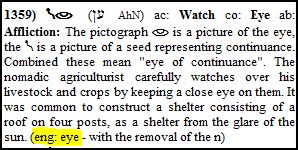
Abase traces back to the Hebrew word ענה ‘anah’ which has this very meaning in relation to the eye.

ענה ‘anah’ comes from the root ען ‘an.’
Isa 53:4 Surely He has borne our sicknesses, and He carried our pain; yet we esteemed Him plagued, smitten by God, and afflicted (ענה ‘anah’).
Isa 53:7 He was oppressed, and He was afflicted (ענה ‘anah’), but He did not open His mouth. He was led as a lamb to the slaughter; and as a ewe before her shearers is dumb, so He opened not His mouth.
ענה ‘anah’ is also translated as ‘afflict’ and is the word used in relation to Yom Kippur. This is interesting in relation to this study and the picture of ‘abase’ meaning the Messiah leaving Heaven to come to earth as Yom Kippur is picture of this very thing.
When He comes a second time He will not be in a state of abasement but in Glory
Isa 31:4 For thus hath the LORD spoken unto me, Like as the lion and the young lion roaring on his prey, when a multitude of shepherds is called forth against him, he will not be afraid of their voice, nor abase (ענה ‘anah’) himself for the noise of them: so shall the LORD of hosts come down to fight for mount Zion, and for the hill thereof.
Psa 18:35 You have also given me the shield of Your salvation; and Your right hand holds me up; and Your condescension (ענוה ‘anavah’) has made me great.
A related word, ענוה ‘anavah,’ also comes from the root ען ‘an.’

2Co 10:1 And I myself, Paul, call on you through the meekness and gentleness of Christ (I, who indeed to look upon, am lowly among you, but being absent am bold toward you);
Abase is also used to translate the Hebrew word שפל ‘shaphel’ which has the meaning of be brought low. In Psalm 113, the Lord humbles Himself to look upon mankind.
Psa 113:1 Praise ye the LORD. Praise, O ye servants of the LORD, praise the name of the LORD.
Psa 113:2 Blessed be the name of the LORD from this time forth and for evermore.
Psa 113:3 From the rising of the sun unto the going down of the same the LORD’S name is to be praised.
Psa 113:4 The LORD is high above all nations, and his glory above the heavens.
Psa 113:5 Who is like unto the LORD our God, who dwelleth on high,
Psa 113:6 Who humbleth (שפל ‘shaphel’) himself to behold the things that are in heaven, and in the earth!
Psa 113:7 He raiseth up the poor out of the dust, and lifteth the needy out of the dunghill;
Psa 113:8 That he may set him with princes, even with the princes of his people.
Psa 113:9 He maketh the barren woman to keep house, and to be a joyful mother of children. Praise ye the LORD.
שפל ‘shaphel’ comes from the root פל.

Christ is our Mediator, interceding on our behalf
1Ti 2:5 For God is one, also there is one Mediator of God and of men, the Man Christ Jesus,
Heb 7:25 And from this He is able to save to the end completely the ones drawing near to God through Him, forever living to intercede on their behalf.
Heb 7:26 For such a High Priest was fitting for us: holy, harmless, undefiled, and separated from sinners, and having become higher than the heavens;
Heb 7:27 who has no need, as do the high priests, to offer sacrifices day by day, first for His own sins, then for those of the people. For He did this once for all, offering up Himself.
Our High Priest suffered (ענה anah) so that He might be able to intercede (פל) on our behalf
Heb 2:5 For unto the angels hath he not put in subjection the world to come, whereof we speak.
Heb 2:6 But one in a certain place testified, saying, What is man, that thou art mindful of him? or the son of man, that thou visitest him?
Heb 2:7 Thou madest him a little lower than the angels; thou crownedst him with glory and honour, and didst set him over the works of thy hands:
Heb 2:8 Thou hast put all things in subjection under his feet. For in that he put all in subjection under him, he left nothing that is not put under him. But now we see not yet all things put under him.
Heb 2:9 But we see Jesus, who was made a little lower than the angels for the suffering of death, crowned with glory and honour; that he by the grace of God should taste death for every man.
Heb 2:10 For it became him, for whom are all things, and by whom are all things, in bringing many sons unto glory, to make the captain of their salvation perfect through sufferings.
Heb 2:11 For both he that sanctifieth and they who are sanctified are all of one: for which cause he is not ashamed to call them brethren,
Heb 2:12 Saying, I will declare thy name unto my brethren, in the midst of the church will I sing praise unto thee.
Heb 2:13 And again, I will put my trust in him. And again, Behold I and the children which God hath given me.
Heb 2:14 Forasmuch then as the children are partakers of flesh and blood, he also himself likewise took part of the same; that through death he might destroy him that had the power of death, that is, the devil;
Heb 2:15 And deliver them who through fear of death were all their lifetime subject to bondage.
Heb 2:16 For verily he took not on him the nature of angels; but he took on him the seed of Abraham.
Heb 2:17 Wherefore in all things it behoved him to be made like unto his brethren, that he might be a merciful and faithful high priest in things pertaining to God, to make reconciliation for the sins of the people.
Heb 2:18 For in that he himself hath suffered being tempted, he is able to succour them that are tempted.
Abase traces back to the Old French word ‘abaissier’ which means to diminish or make lower in value or status. This is what Christ did, the Good Shepherd humbled Himself to “keep an eye” on His flock.
Php 2:5 For think this within you, which mind was also in Christ Jesus,
Php 2:6 who subsisting in the form of God, thought it not robbery to be equal with God,
Php 2:7 but emptied Himself, taking the form of a slave, having become in the likeness of men
Php 2:8 and being found in fashion as a man, He humbled Himself, having become obedient until death, even the death of a cross.
Php 2:9 Because of this also God highly exalted Him and gave Him a name above every name,
Php 2:10 that at the name of Jesus “every knee should bow,” of heavenly ones, and earthly ones, and ones under the earth,
Php 2:11 and “every tongue should confess” that Jesus Christ is “Lord,” to the glory of God the Father. Isa. 45:23
Abase comes from the the Latin word bassus (low, base; base). A cognate of ‘bassus’ is the Greek word βάσις ‘basis.’ This is the origin of the English word ‘base’ which means to step, a pedestal, or a foot. As seen above in Webster’s dictionary ‘basis’ both in Latin & Greek are derivatives of the English word ‘abase.’
G939
βάσις
basis
Thayer Definition:
1) a stepping, walking
2) that with which one steps, the foot
Part of Speech: noun feminine
A Related Word by Thayer’s/Strong’s Number: from baino (to walk)
Christ ‘abased’ Himself by leaving the bosom of the Father (Philippians 2:5-11) to come to earth, which is His footstool which in Latin/Greek is ‘basis’ (Isaiah 66:1) to dwell/walk among men (John 1:14; 1 John 1:1; Leviticus 26:12).
Abase is used to translate the Greek word ταπεινόω ‘tapeinoō’ in the New Testament.
G5013
ταπεινόω
tapeinoō
Thayer Definition:
1) to make low, bring low
1a) to level, reduce to a plain
1b) metaphorically to bring into a humble condition, reduce to meaner circumstances
1b1) to assign a lower rank or place to
1b2) to abase
1b3) to be ranked below others who are honoured or rewarded
1b4) to humble or abase myself by humble living
1c) to lower, depress
1c1) of one’s soul bring down one’s pride
1c2) to have a modest opinion of one’s self
1c3) to behave in an unassuming manner
1c4) devoid of all haughtiness
Part of Speech: verb
A Related Word by Thayer’s/Strong’s Number: from G5011
Php 2:8 and being found in fashion as a man, He humbled (ταπεινόω ‘tapeinoō’ ) Himself, having become obedient until death, even the death of a cross.
We should walk (Greek/Latin ‘basis’) as He walked (1John 2:6)
Mat 23:12 And whoever will exalt himself shall be humbled, and whoever will humble (ταπεινόω ‘tapeinoō’ ) himself shall be exalted.
Jas 4:10 Be humbled (ταπεινόω ‘tapeinoō’ ) before the Lord, and He will exalt you.
1Pe 5:6 Then be humbled (ταπεινόω ‘tapeinoō’ ) under the mighty hand of God, that He may exalt you in time;
1Pe 5:7 “casting all your anxiety onto Him,” because it matters to Him concerning you. LXX-Psa. 54:23; MT-Psa. 55:22
Connecting humbling/abasing of self during prayer
Luk 18:9 And He also spoke this parable to some of those relying on themselves, that they are righteous, and despising the rest:
Luk 18:10 Two men went up into the temple to pray, the one a Pharisee, and the other a tax collector.
Luk 18:11 The Pharisee was standing, praying these things to himself: God, I thank You that I am not as the rest of men, rapacious, unrighteous, adulterers, or even as this tax collector.
Luk 18:12 I fast twice on the sabbath; I tithe all things, as many as I get.
Luk 18:13 And standing at a distance, the tax collector would not even lift up his eyes to Heaven, but smote on his breast, saying, God, be merciful to me, the sinner!
Luk 18:14 I say to you, This one went down to his house having been justified, rather than that one. For everyone exalting himself will be humbled. And the one humbling (tapeinoo) himself will be exalted.
KJV
Luk 18:14 I tell you, this man went down to his house justified rather than the other: for every one that exalteth himself shall be abased (ταπεινόω ‘tapeinoō’ ); and he that humbleth (ταπεινόω ‘tapeinoō’ ) himself shall be exalted.


 Little Guy in the Eye