

Culture is divine cultivation. From the Latin cultūra (“to till, tend, guard, worship”), the word itself points back to Adam’s original calling in the Garden of Eden — to dress and keep the ground. Jesus continued this agricultural language in His parables, showing us that the Seed is the Word, the heart is the soil, and the harvest is the culture we produce. True culture flows from the New Covenant reality where God writes His law on our hearts, forming a people whose “conversation” (citizenship and way of life) is in heaven.
Culture = Cultivation — Rooted in the idea of tilling the soil and tending the soul (cultura animi).
The Seed is the Word — Jesus’ Parable of the Sower shows how the Word grows (or fails to grow) in different hearts.
Breaking Up Fallow Ground — Jeremiah 4:3 calls us to repent and prepare our hearts so the Seed can take root and produce fruit.
Wheat and Tares — Cultures are mixed fields until the final harvest; good seed and counterfeit grow together.
People + Land + Covenant — God chooses a people, gives them land as inheritance, and forms them through covenant instruction (Law fulfilled in Messiah).
Language & Ethos — Our words and customs reveal the worldview we’ve cultivated; the Word renews the mind and transforms culture.
Heavenly Citizenship — Our true politeuma (commonwealth) is in heaven (Philippians 3:20). We live as colonists of the Kingdom while on earth.
Ultimate Hope — All nations will remember and turn to the Lord (Psalm 22:27). Culture, when rightly cultivated, points to Christ — the True Vine and perfect Image of the Father.
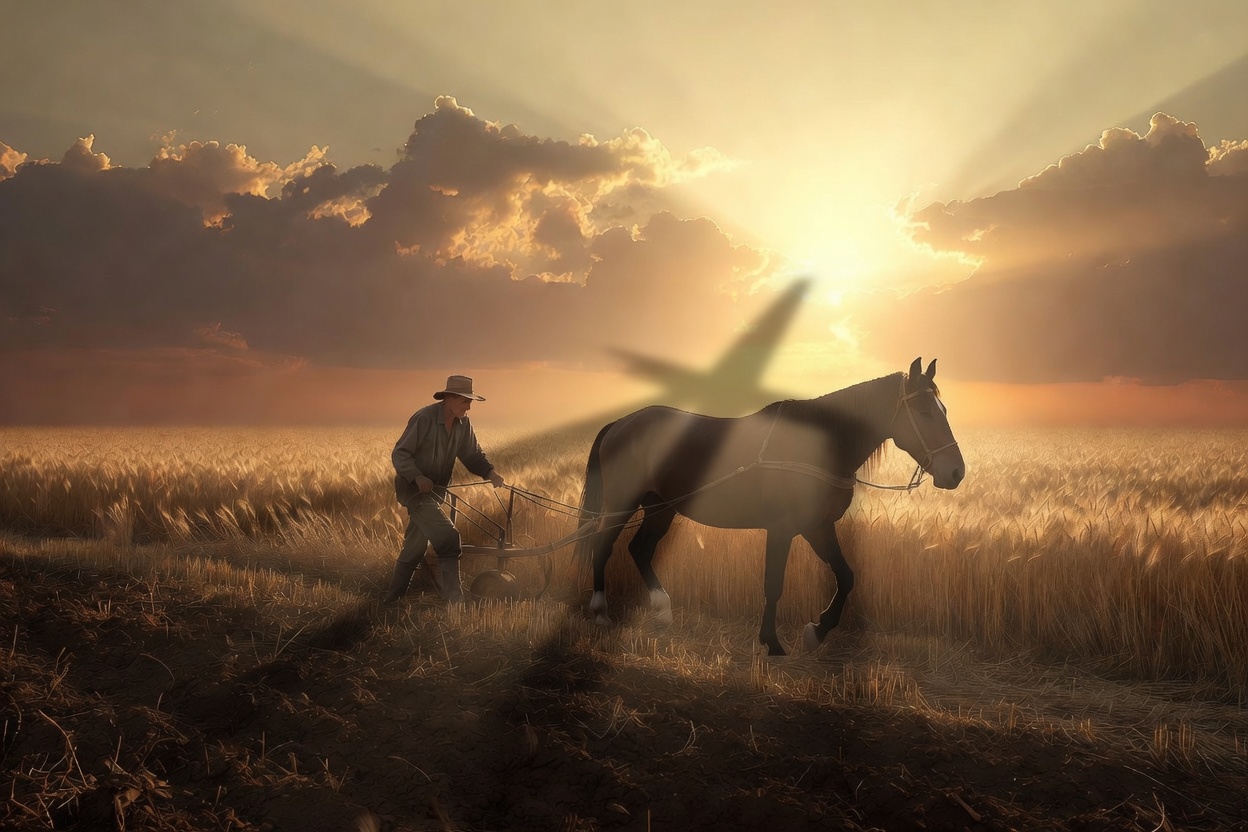
Everything in creation — land, language, customs, and culture — cast shadows of the Messiah, the perfect Image of the Father. All cultures will “remember” and turn to Him.
Psa 22:27 All the ends of the world shall remember and turn unto the LORD: and all the kindreds of the nations shall worship before thee.
Rev 7:9 After this I beheld, and, lo, a great multitude, which no man could number, of all nations, and kindreds, and people, and tongues, stood before the throne, and before the Lamb, clothed with white robes, and palms in their hands;
Rev 7:10 And cried with a loud voice, saying, Salvation to our God which sitteth upon the throne, and unto the Lamb.
Rev 7:11 And all the angels stood round about the throne, and about the elders and the four beasts, and fell before the throne on their faces, and worshipped God,
Rev 7:12 Saying, Amen: Blessing, and glory, and wisdom, and thanksgiving, and honour, and power, and might, be unto our God for ever and ever. Amen.
God has placed eternity in the heart of every person (Ecclesiastes 3:11). This innate awareness of the Eternal, the Divine, and our origin in Him is a universal “primal memory” or longing that no culture or religion can fully erase. It is the reason why, across religion and throughout history, we find echoes of Biblical truth—stories of a supreme Creator, a lost paradise, a coming Redeemer, sacrifice for peace, and a longing to return to the one true God.
Let us fix our eyes on Him (Hebrews 12:2) and be cultivated into His likeness.
Heb 12:2 Looking unto Jesus the author and finisher of our faith; who for the joy that was set before him endured the cross, despising the shame, and is set down at the right hand of the throne of God.
Culture
Culture is the “The beliefs, customs, arts, social institutions, and other products of human work and thought characteristic of a particular society, group, or period” {Merriam-Webster}
The English word culture means the tilling of land or the act of preparing the earth for crops. It comes from the Latin word ‘cultura’ which means “cultivation, agriculture, care, honoring.” Cultura means the cultivation of land, the care, training, or refinement of the mind or soul as well as worship or religious reverence. The English word cult comes from ‘cultura.’ Today it has a negative connotation but originally it was neutral or usually positive.
Cultura comes from the past particle ‘cultus’ of the verb ‘colo’ which means to till, cultivate, tend, guard, inhabit, worship.
These concepts point to Adam in the Garden.
Gen 2:15 And the LORD God took the man, and put him into the garden of Eden to dress it and to keep it.
Parables of Jesus
Jesus taught in parables (Mark 4:2, 34; Matthew 13:34-35; Psalm 78:2), saying the Parable of the Sower was most important.
Mar 4:13 And he said unto them, Know ye not this parable? and how then will ye know all parables?
Luk 8:11 Now the parable is this: The seed is the word of God.
Mar 4:14 The sower soweth the word.
Mar 4:15 And these are they by the way side, where the word is sown; but when they have heard, Satan cometh immediately, and taketh away the word that was sown in their hearts.
Mar 4:16 And these are they likewise which are sown on stony ground; who, when they have heard the word, immediately receive it with gladness;
Mar 4:17 And have no root in themselves, and so endure but for a time: afterward, when affliction or persecution ariseth for the word’s sake, immediately they are offended.
Mar 4:18 And these are they which are sown among thorns; such as hear the word,
Mar 4:19 And the cares of this world, and the deceitfulness of riches, and the lusts of other things entering in, choke the word, and it becometh unfruitful.
Mar 4:20 And these are they which are sown on good ground; such as hear the word, and receive it, and bring forth fruit, some thirtyfold, some sixty, and some an hundred.
1Pe 1:23 Being born again, not of corruptible seed, but of incorruptible, by the word of God, which liveth and abideth for ever.
1Pe 1:24 For all flesh is as grass, and all the glory of man as the flower of grass. The grass withereth, and the flower thereof falleth away:
1Pe 1:25 But the word of the Lord endureth for ever. And this is the word which by the gospel is preached unto you.
The Parable of the Wheat and Tares
In cultures, the good and evil grow together until the final judgment. In the parable of the wheat and tares it is seen that culture is the fruit of what is sown and cultivated. The Seed is the Word, the devil sows counterfeit tares.
Mat 13:36 Then Jesus sent the multitude away, and went into the house: and his disciples came unto him, saying, Declare unto us the parable of the tares of the field.
Mat 13:37 He answered and said unto them, He that soweth the good seed is the Son of man;
Mat 13:38 The field is the world; the good seed are the children of the kingdom; but the tares are the children of the wicked one;
Mat 13:39 The enemy that sowed them is the devil; the harvest is the end of the world; and the reapers are the angels.
Mat 13:40 As therefore the tares are gathered and burned in the fire; so shall it be in the end of this world.
Mat 13:41 The Son of man shall send forth his angels, and they shall gather out of his kingdom all things that offend, and them which do iniquity;
Mat 13:42 And shall cast them into a furnace of fire: there shall be wailing and gnashing of teeth.
Mat 13:43 Then shall the righteous shine forth as the sun in the kingdom of their Father. Who hath ears to hear, let him hear.
Scripture likens the LORD to a farmer, in fact He is the first farmer. He is the source of culture.
Gen 2:8 And the LORD God planted a garden eastward in Eden; and there he put the man whom he had formed.
Gen 2:15 And the LORD God took the man, and put him into the garden of Eden to dress it and to keep it.
Joh 15:1 I am the True Vine, and My Father is the Vinedresser (γεωργός ‘geōrgos’ – husbandman, farmer, tiller of the soil).
Farming is linked with wisdom.
Isa 28:29 This also comes from Jehovah of Hosts, doing wonders in counsel, making sound wisdom great.
The word for farmer is אכר ‘akar’ which means to dig up the ground and plant crops.
A cognate of אכר ‘akar’ is כאר ‘kar’ which literally means to engrave into stone. To make a deep explanation, likened unto a farmer who digs in the soil and plants the seed (the Word). Both words trace back to the root כר ‘kar’ which means to dig.
Pro 25:2 The glory of God is to conceal a thing, but the glory of kings is to search (חקר ‘chaqar’ )out a matter.
The word here for search out is חקר ‘chaqar’ which also comes from the root כר ‘kar’ meaning to dig. The Son of Man plants the seed (the Word). He leaves it up to his servants to work the ground and dig out the treasures.
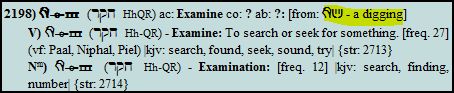
Jesus said that the parable of the sower (the farmer) is the foundation of understanding all His parables and hence, all of the Word (Psalm 78:1-2).
The Word/Torah is likened unto a parable.
Psa 78:1 A Lesson of Asaph. O my people, listen to my law; bow your ears to the words of my mouth.
Psa 78:2 I will open my mouth in a parable; I will pour forth dark sayings of old,
Breaking up the fallow ground
Jer 4:3 For thus saith the LORD to the men of Judah and Jerusalem, Break up (ניר ‘niyr’) your fallow ground (ניר ‘niyr’), and sow not among thorns.
Jer 4:4 Circumcise yourselves to the LORD, and take away the foreskins of your heart, ye men of Judah and inhabitants of Jerusalem: lest my fury come forth like fire, and burn that none can quench it, because of the evil of your doings.
Jer 4:3 כי־כה אמר יהוה לאישׁ יהודה ולירושׁלם נירו לכם ניר ואל־תזרעו אל־קוצים׃
One of the Hebrew words for light (ניר ‘niyr’) is a picture of a farmer breaking up the fallow ground which causes the water beneath to reflect the light of the sun.

In the Scriptures we are admonished to break up our fallow ground (circumcise the heart) in order to receive the seed (Word). If the seed (Word) falls on hard soil (uncircumcised heart) it will not enter the earth (heart) and the birds (devils) will take it away. Rocks (false gods/idols Deuteronomy 32:31) must also be taken out of the ground (heart) lest the seed (Word) sprout and the roots hit the rocks (idols) and cannot grow deep into the ground (heart) where the sun (judgment, false religion) scorches the plant. Thorns (sin/curse) must also be taken out of the ground lest they choke the seed. Good ground (heart) is needed for the seed (Word) to grow and bear fruit (love, joy, peace etc.).
Adam was cursed to work the ground, getting bread from the sweat of his brow. This is associated with breaking up the fallow ground. Plowing in Hebrew is associated with the word אל ‘el’ which also means God. אל ‘el’ literally means the strong authority which was displayed as an oxen in the yoke plowing a field. An older, more experienced ox would be teamed up (yoked) with a younger, less experienced ox. The older ox in the yoke is the “strong authority” who, through the yoke, teaches the younger ox. In Hebrew thought, God is the more experienced ox to whom we are to be yoked with (Matthew 11:29-30).
When Adam took of the fruit of the tree of knowledge of good and evil, he was proclaiming he wanted to be his own god and so was cursed to plow the field with much difficulty, no longer yoked with Almighty God. Poetic justice….
Culture & Language
Culture and language are inseparable. Culture lives in language. Stories, values, beliefs, history, humor, and social norms are passed down primarily through language (oral traditions, literature, songs, proverbs, idioms). Without language, much of a group’s shared identity would be lost. Children acquire culture while learning their mother tongue. They absorb worldview, politeness rules, gender roles, and taboos through everyday speech.
“No two languages are ever sufficiently similar to be considered as representing the same social reality. The worlds in which different societies live are distinct worlds, not merely the same world with different labels attached.”
“Human beings do not live in the objective world alone, but are very much at the mercy of the particular language which has become the medium of expression for their society… The worlds in which different societies live are distinct worlds, not merely the same world with different labels attached.”-Edward Sapir (linguist and anthropologist)
The Sapir-Whorf Hypothesis
Linguists Edward Sapir and Benjamin Lee Whorf teach that language influences (or even shapes) the way we think and perceive the world. Different languages encode reality differently. Speakers of those languages may think and experience the world differently. Culture shapes language, and language reinforces or limits cultural thought patterns. Examples are color perception, time and space perception, gender, politeness and hierarchy.
Culture shapes language. For example, Arabic has many words for camels and their conditions; English has extensive legal/financial terminology; Thai has elaborate terms for rice varieties. Some languages lack a future tense which leads to cultural emphases on present and past.
Agrobiolinguistics
Agrobiolinguistics is a field of study that examines the intersections of agriculture (agro), biology/life sciences (bio), and language (linguistics). It studies how agricultural practices, biological realities, and the natural environment shape language, vocabulary, metaphors, and worldview.
Agrobiolinguistics shows how language encodes and transmits agricultural knowledge, cultural practices, and human relationships with the land. It’s essentially the study of how humans talk about (and through) the cultivated earth.
God has made of one blood all nations, setting the bounds of their habitations (countries/cultures).
Act 17:26 And hath made of one blood all nations of men for to dwell on all the face of the earth, and hath determined the times before appointed, and the bounds of their habitation;
Act 17:27 That they should seek the Lord, if haply they might feel after him, and find him, though he be not far from every one of us:
Act 17:28 For in him we live, and move, and have our being; as certain also of your own poets have said, For we are also his offspring.
Act 17:29 Forasmuch then as we are the offspring of God, we ought not to think that the Godhead is like unto gold, or silver, or stone, graven by art and man’s device.
Act 17:30 And the times of this ignorance God winked at; but now commandeth all men every where to repent:
Act 17:31 Because he hath appointed a day, in the which he will judge the world in righteousness by that man whom he hath ordained; whereof he hath given assurance unto all men, in that he hath raised him from the dead.
Language, Biology, Agriculture are all tied together
Gen 10:5 By these were the isles of the Gentiles divided in their lands (agriculture); every one after his tongue (linguistics), after their families (biology), in their nations.
Mat 4:4 But he answered and said, It is written, Man (biology) shall not live by bread (agriculture) alone, but by every word (linguistics) that proceedeth out of the mouth of God.
The good seed (agriculture), is the Word of God (linguistics), which became flesh (body,biology)
Luk 8:11 And this is the parable: The seed is the Word of God.
Joh 1:1 In the beginning was the Word, and the Word was with God, and the Word was God.
Ethos
Ethos is the character, spirit, or fundamental values that define a person, group, community, culture, or era. It is closely related to culture but emphasizes the inner moral and habitual character rather than external customs.
Ethos comes from the Greek word ἦθος ‘ethos’ or ἔθος ‘ethos’ both of which have the meaning of “character, moral nature, habitual disposition, custom.”
ἔθος ‘ethos’ comes from ἔθω ‘etho’ which means “to be accustomed.” It originally meant a place or habitat but evolved to mean habitual character, moral nature and the customs of a people.
ἔθος ‘ethos’ is used in the New Testament referring to customs and manners. For Israel, their ἔθος ‘ethos’ was tied to the law of God.
Act 6:14 For we have heard him say, that this Jesus of Nazareth shall destroy this place, and shall change the customs (ἔθος ‘ethos’) which Moses delivered us.
Act 21:21 And they are informed of thee, that thou teachest all the Jews which are among the Gentiles to forsake Moses, saying that they ought not to circumcise their children, neither to walk after the customs (ἔθος ‘ethos’).
Act 26:3 Especially because I know thee to be expert in all customs (ἔθος ‘ethos’) and questions which are among the Jews: wherefore I beseech thee to hear me patiently.
Act 28:17 And it came to pass, that after three days Paul called the chief of the Jews together: and when they were come together, he said unto them, Men and brethren, though I have committed nothing against the people, or customs (ἔθος ‘ethos’) of our fathers, yet was I delivered prisoner from Jerusalem into the hands of the Romans.
Act 15:1 And certain men which came down from Judaea taught the brethren, and said, Except ye be circumcised after the manner (ἔθος ‘ethos’) of Moses, ye cannot be saved.
Luk 1:9 According to the custom (ἔθος ‘ethos’) of the priest’s office, his lot was to burn incense when he went into the temple of the Lord.
Luk 2:42 And when he was twelve years old, they went up to Jerusalem after the custom (ἔθος ‘ethos’) of the feast.
Joh 19:40 Then took they the body of Jesus, and wound it in linen clothes with the spices, as the manner (ἔθος ‘ethos’) of the Jews is to bury.
Roman ἔθος ‘ethos’
Act 25:16 To whom I answered, It is not the manner (ἔθος ‘ethos’) of the Romans to deliver any man to die, before that he which is accused have the accusers face to face, and have licence to answer for himself concerning the crime laid against him.
Personal ἔθος ‘ethos’ is seen in Jesus
Luk 22:39 And he came out, and went, as he was wont (ἔθος ‘ethos’), to the mount of Olives; and his disciples also followed him.
In Hebrew, the word for ethos is דֶּרֶךְ ‘derekh’ which means a way, path or manner of life.
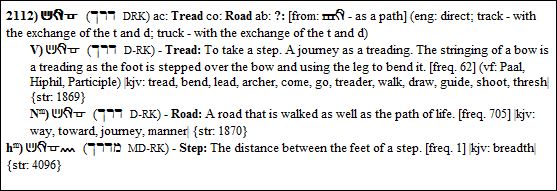
Treading and threshing connects back to the cycles of righteousness and being yoked to Messiah (His disciple)
Archery and shooting is connected to the path/way in that the Torah is likened to a target. To hit the mark it is to stay in the straight paths. The word for sin means to miss the target.
דרך ‘derekh’ comes from the root word רח ‘rach.’

Routine is not a bad thing. This is how we learn and stay in His ways. His cycles of righteousness literally mean ruts of righteousness. Getting in a rut is not a bad thing if your rut is the straight path of the Word. It helps us to stay in His ways because they become “second nature”. It becomes your ethos.
Following are a few more words which comes from the root רח ‘rach’ which associate the Way/Path with the Spirit.
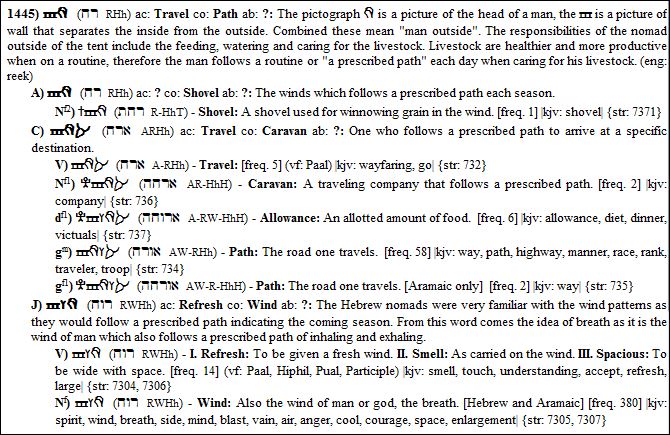
Walking in the Spirit is walking in His paths (the Way). The Way is the Truth. When Jesus spoke of worshiping the Father in Spirit and in Truth this is what He meant. Walking in the Spirit of the Law. Following the Lamb wherever He leads.
For more on this see: Way
The Latin equivalent of ἔθος ‘ethos’ is mōs/mōrēs. Mos (plural mores) means custom. It shows the cultural sense of the Greek νόμος ‘nomos’ as it speaks of an established custom or tradition. Mos/Mores and νόμος ‘nomos’ means law. More on this later.
Εtymology comes from the Greek word ἔτυμος ‘etymos’ which means truth, real or actual. Etymology is the study of the origin of words and their true meaning. Ultimately every word in every language traces back via Etymology to the original language of Eden. Ετυμος ‘etymos’ comes from the Hebrew word אמת ‘emet’ which means truth.
Etymology is one of the most powerful lenses for understanding culture as it reveals the “fossil record” of a people’s collective thought, values, history, and worldview embedded in their language. Words are not arbitrary. They are living artifacts shaped by the culture (cultivation) of a people over time. Every root, prefix, and borrowing tells a story of what that culture prioritized, feared, celebrated, or encountered. Language both reflects culture (what people experience) and shapes it (how they perceive and categorize reality).
Christ is the Logos (the Word) through whom all things were made, etymology often uncovers redemptive shadows or echoes of divine truth in all languages and consequently all cultures. Culture itself is a good example as it comes from the Latin ‘cultura’ which points to Adam in the Garden and God as the first farmer.
Etymology is tool for revelation. Language itself is like a field where the good seed and tares have been sown, yet the shadows of truth remain.
Language change reflects cultural change. When a society shifts what it values, its vocabulary and metaphors shift (or new words are borrowed). Etymology is a tool to get back to the original meaning of a word/concept. It strips away the corruptions that have occurred over time to get back to the root.
Etymology is a cultural memory. It lets us see what a people have cultivated (culture), what character (ethos) has grown from their soil. Ultimately, it leads one back to the Sower of the Seed.
For more on this see: Shadows of Messiah – Etymology
Law & Culture – “Law of the Land”
The concept of the “law of the land” combines laws, customs and traditions which give a framework for cultures. Law of the land refers to actual laws of a culture but also unwritten customs, traditions and morality. It reveals the ethos of a culture. The “law of the land” is the operative ethos or mores of a society, the lived norms that define what is acceptable, expected, or enforced.
Common law is the “law of the land.” Common law is a legal system based primarily on judicial precedents (court decisions) and long-standing customs rather than solely on written statutes or codes. Common law looks to previous cases to “stand by things decided.” It looks to customs and usage, the “common practices of the people.” It grows case by case, adapting to the culture rather than being a strict written code.
In legal history (especially English common law, which influenced much of the West), it often blended lex (enacted law) with mores (customs). A practice could become “law of the land” through long-standing usage if it was accepted by the community.
The “law of the land” is the visible fruit of the seeds sown in a people’s hearts over generations (parables of the Sower and Wheat & Tares). Good seed (the Word) produces a culture aligned with God’s order; tares produce distorted norms that become the default “law.”
What people partake of (eat/consume) is what they become and what they reproduce. Good seed (the Word) produces good fruit, godly character (ethos), godly mores (customs, culture). Tares (or mixture) produces bad or mixed fruit, distorted character and a corrupted or mixed culture.
Luk 6:43 For a good tree bringeth not forth corrupt fruit; neither doth a corrupt tree bring forth good fruit.
Luk 6:44 For every tree is known by his own fruit. For of thorns men do not gather figs, nor of a bramble bush gather they grapes.
Luk 6:45 A good man out of the good treasure of his heart bringeth forth that which is good; and an evil man out of the evil treasure of his heart bringeth forth that which is evil: for of the abundance of the heart his mouth speaketh.
Gen 1:11 And God said, Let the earth bring forth grass, the herb yielding seed, and the fruit tree yielding fruit after his kind, whose seed is in itself, upon the earth: and it was so.
Gen 1:12 And the earth brought forth grass, and herb yielding seed after his kind, and the tree yielding fruit, whose seed was in itself, after his kind: and God saw that it was good.
Country
Land and culture are deeply intertwined. The physical territory people inhabit shapes their customs, values, economy, identity, and worldview, while culture in turn transforms the land through cultivation, settlement, naming, and stewardship.
Country comes from the Middle English ‘contre’ which means “region, district, native land.” This word traces back further to the Latin word ‘contra’ which means “opposite, against, facing,” as one country is the landscape that one is facing as well as the land behind.
Believers are looking for that Heavenly country. Our citizenship is in heaven (Philippians 3:20). We are to live by an heavenly ethos.
Heb 11:1 Now faith is the substance of things hoped for, the evidence of things not seen.
Heb 11:2 For by it the elders obtained a good report.
Heb 11:3 Through faith we understand that the worlds were framed by the word of God, so that things which are seen were not made of things which do appear.
Heb 11:4 By faith Abel offered unto God a more excellent sacrifice than Cain, by which he obtained witness that he was righteous, God testifying of his gifts: and by it he being dead yet speaketh.
Heb 11:5 By faith Enoch was translated that he should not see death; and was not found, because God had translated him: for before his translation he had this testimony, that he pleased God.
Heb 11:6 But without faith it is impossible to please him: for he that cometh to God must believe that he is, and that he is a rewarder of them that diligently seek him.
Heb 11:7 By faith Noah, being warned of God of things not seen as yet, moved with fear, prepared an ark to the saving of his house; by the which he condemned the world, and became heir of the righteousness which is by faith.
Heb 11:8 By faith Abraham, when he was called to go out into a place which he should after receive for an inheritance, obeyed; and he went out, not knowing whither he went.
Heb 11:9 By faith he sojourned in the land of promise, as in a strange country, dwelling in tabernacles with Isaac and Jacob, the heirs with him of the same promise:
Heb 11:10 For he looked for a city which hath foundations, whose builder and maker is God.
Heb 11:11 Through faith also Sara herself received strength to conceive seed, and was delivered of a child when she was past age, because she judged him faithful who had promised.
Heb 11:12 Therefore sprang there even of one, and him as good as dead, so many as the stars of the sky in multitude, and as the sand which is by the sea shore innumerable.
Heb 11:13 These all died in faith, not having received the promises, but having seen them afar off, and were persuaded of them, and embraced them, and confessed that they were strangers and pilgrims on the earth.
Heb 11:14 For they that say such things declare plainly that they seek a country.
Heb 11:15 And truly, if they had been mindful of that country from whence they came out, they might have had opportunity to have returned.
Heb 11:16 But now they desire a better country, that is, an heavenly: wherefore God is not ashamed to be called their God: for he hath prepared for them a city.
The Greek word translated as country in Hebrew 11 is πατρίς ‘patris’
G3968
πατρίς
patris
Thayer Definition:
- one’s native country
1a) one’s fatherland, one’s own country, a fixed abode or home
1b) one’s own native place, i.e. a city
Eph 3:14 For this cause I bow my knees unto the Father of our Lord Jesus Christ,
Eph 3:15 Of whom the whole family in heaven and earth is named,
Php 3:20 For our conversation (πολίτευμα ‘politeuma’) is in heaven; from whence also we look for the Saviour, the Lord Jesus Christ:
G4175
πολίτευμα
politeuma
Thayer Definition:
- the administration of civil affairs or of a commonwealth
- the constitution of a commonwealth, form of government and the laws by which it is administered
- a state, commonwealth
3a) the commonwealth of citizens
πολιτευμα ‘politeuma’ meant citizenship from πολιτης ‘polites’ which means citizen and the suffix μα ‘ma’ which indicates the result or thing itself. It comes from the root πόλις ‘polis’ which means a city or state. The idea is that citizenship came with rights, privileges and responsibilities of being a citizen. By extension, it meant the manner of life or conduct of a citizen.
Conversation in English during the time of the translation of the 1611 King James Version meant behavior, conduct, manner of life or way of living. Conversation came from the Latin ‘conversatio’ which meant frequent association, way of life . Today it has the sense of talking with someone. Here is a good example of words changing over time and the benefit of using etymology to get to the true meaning of things, especially the Holy Bible.
The old ethos
Eph 4:22 That ye put off concerning the former conversation (ἀναστροφή ‘anastrophē’) the old man, which is corrupt according to the deceitful lusts;
The Heavenly Ethos
2Co 1:12 For our rejoicing is this, the testimony of our conscience, that in simplicity and godly sincerity, not with fleshly wisdom, but by the grace of God, we have had our conversation (ἀναστροφή ‘anastrophē’) in the world, and more abundantly to you-ward.
1Pe 1:14 As obedient children, not fashioning yourselves according to the former lusts in your ignorance:
1Pe 1:15 But as he which hath called you is holy, so be ye holy in all manner of conversation (ἀναστροφή ‘anastrophē’);
1Pe 1:16 Because it is written, Be ye holy; for I am holy.
1Pe 3:15 But sanctify the Lord God in your hearts: and be ready always to give an answer to every man that asketh you a reason of the hope that is in you with meekness and fear:
1Pe 3:16 Having a good conscience; that, whereas they speak evil of you, as of evildoers, they may be ashamed that falsely accuse your good conversation (ἀναστροφή ‘anastrophē’) in Christ.
G391
ἀναστροφή
anastrophē
Thayer Definition:
- manner of life, conduct, behaviour, deportment
ἀναστροφή ‘anastrophē’ comes from the Greek word ἀναστρέφω ‘anastrepho’
G390
ἀναστρέφω
anastrepho
an-as-tref’-o
From G303 and G4762; to overturn; also to return; by implication to busy oneself, that is, remain, live: – abide, behave self, have conversation, live, overthrow, pass, return, be used.
Eph 2:2 Wherein in time past ye walked according to the course of this world, according to the prince of the power of the air, the spirit that now worketh in the children of disobedience:
Eph 2:3 Among whom also we all had our conversation (ἀναστρέφω ‘anastrepho’) in times past in the lusts of our flesh, fulfilling the desires of the flesh and of the mind; and were by nature the children of wrath, even as others.
Eph 2:4 But God, who is rich in mercy, for his great love wherewith he loved us,
Eph 2:5 Even when we were dead in sins, hath quickened us together with Christ, (by grace ye are saved;)
Eph 2:6 And hath raised us up together, and made us sit together in heavenly places in Christ Jesus:
Law & Culture
As mentioned before, the Latin equivalent of ἔθος ‘ethos’ is mōs/mōrēs. Mos (plural mores) means custom. It shows the cultural sense of the Greek νόμος ‘nomos’ as it speaks of an established custom or tradition. Mos/Mores and νόμος ‘nomos’ means law.
The law defines the borders of a people, physically and morally. Law traces back to the Hebrew word תורה ‘torah’ which was meant to be the culture or ethos of God’s people. It is more than rules, it is a way of living, thinking and walking.
The New Testament is a covenant where God’s law is written on our hearts. It produces love that fulfills the law (Galatians 5:14; Romans 13:8-10). This creates a new, unified culture in Christ that transcends old divisions (Jew/Gentile). The “ethos” of this new culture is love, unity, and being conformed to the image of Christ.
People – Land – Covenant
The People, the Land and the Covenant are interlinked.
Deu 32:43 Rejoice, O nations, of His people; for He shall avenge the blood of His servants, and shall render vengeance to His foes, and shall have mercy on His land and His people.
The Builder and Maker of our Land is God, not man
Heb 11:8 By faith Abraham, when he was called to go out into a place which he should after receive for an inheritance, obeyed; and he went out, not knowing whither he went.
Heb 11:9 By faith he sojourned in the land of promise, as in a strange country, dwelling in tabernacles with Isaac and Jacob, the heirs with him of the same promise:
Heb 11:10 For he looked for a city which hath foundations, whose builder and maker is God.
Heb 12:28 Wherefore we receiving a kingdom which cannot be moved, let us have grace, whereby we may serve God acceptably with reverence and godly fear:
Heb 13:14 For here have we no continuing city, but we seek one to come.
Zion the people of God
Isa 51:16 And I have put my words in thy mouth, and I have covered thee in the shadow of mine hand, that I may plant the heavens, and lay the foundations of the earth, and say unto Zion, Thou art my people.
Psa 146:10 The LORD shall reign for ever, even thy God, O Zion, unto all generations. Praise ye the LORD.
Psa 149:1 Praise ye the LORD. Sing unto the LORD a new song, and his praise in the congregation of saints.
Psa 149:2 Let Israel rejoice in him that made him: let the children of Zion be joyful in their King.
Psa 149:3 Let them praise his name in the dance: let them sing praises unto him with the timbrel and harp.
Psa 149:4 For the LORD taketh pleasure in his people: he will beautify the meek with salvation.
Zec 9:13 When I have bent Judah for me, filled the bow with Ephraim, and raised up thy sons, O Zion, against thy sons, O Greece, and made thee as the sword of a mighty man.
Isa 60:14 Also the sons of ones afflicting you shall come bowing to you. And all who despised you shall fall at the soles of your feet. And they shall call you, The City of Jehovah, the Zion of the Holy One of Israel.
Rev 21:10 And he carried me in spirit onto a great and high mountain, and showed me the great city, holy Jerusalem, coming down out of Heaven from God,
Isa 66:7 Before she travailed, she brought forth; before her pain came, she was delivered of a man child.
Isa 66:8 Who hath heard such a thing? who hath seen such things? Shall the earth be made to bring forth in one day? or shall a nation be born at once? for as soon as Zion travailed, she brought forth her children
All Nations, All Cultures
All nations and all cultures are invited to join the culture of Heaven through Christ Jesus.
Mat 28:18 And Jesus came and spake unto them, saying, All power is given unto me in heaven and in earth.
Mat 28:19 Go ye therefore, and teach all nations, baptizing them in the name of the Father, and of the Son, and of the Holy Ghost:
Mat 28:20 Teaching them to observe all things whatsoever I have commanded you: and, lo, I am with you alway, even unto the end of the world. Amen.
Luk 24:44 And he said unto them, These are the words which I spake unto you, while I was yet with you, that all things must be fulfilled, which were written in the law of Moses, and in the prophets, and in the psalms, concerning me.
Luk 24:45 Then opened he their understanding, that they might understand the scriptures,
Luk 24:46 And said unto them, Thus it is written, and thus it behoved Christ to suffer, and to rise from the dead the third day:
Luk 24:47 And that repentance and remission of sins should be preached in his name among all nations, beginning at Jerusalem.
Luk 24:48 And ye are witnesses of these things.
Luk 24:49 And, behold, I send the promise of my Father upon you: but tarry ye in the city of Jerusalem, until ye be endued with power from on high.
Rom 16:24 The grace of our Lord Jesus Christ be with you all. Amen.
Rom 16:25 Now to him that is of power to stablish you according to my gospel, and the preaching of Jesus Christ, according to the revelation of the mystery, which was kept secret since the world began,
Rom 16:26 But now is made manifest, and by the scriptures of the prophets, according to the commandment of the everlasting God, made known to all nations for the obedience of faith:
Related studies:
Shadows of Messiah – Etymology
Daily Tidbits 1/5/12 – Etymology
Daily Tidbits 6/27/26 – The Law
Daily Tidbits 6/26/26 – Eternity in their Hearts
Daily Tidbits 5/31 – All the Ends of the World Shall Remember
Daily Tidbits 1/10/12 – Farming
littleguyintheeye@gmail.com


