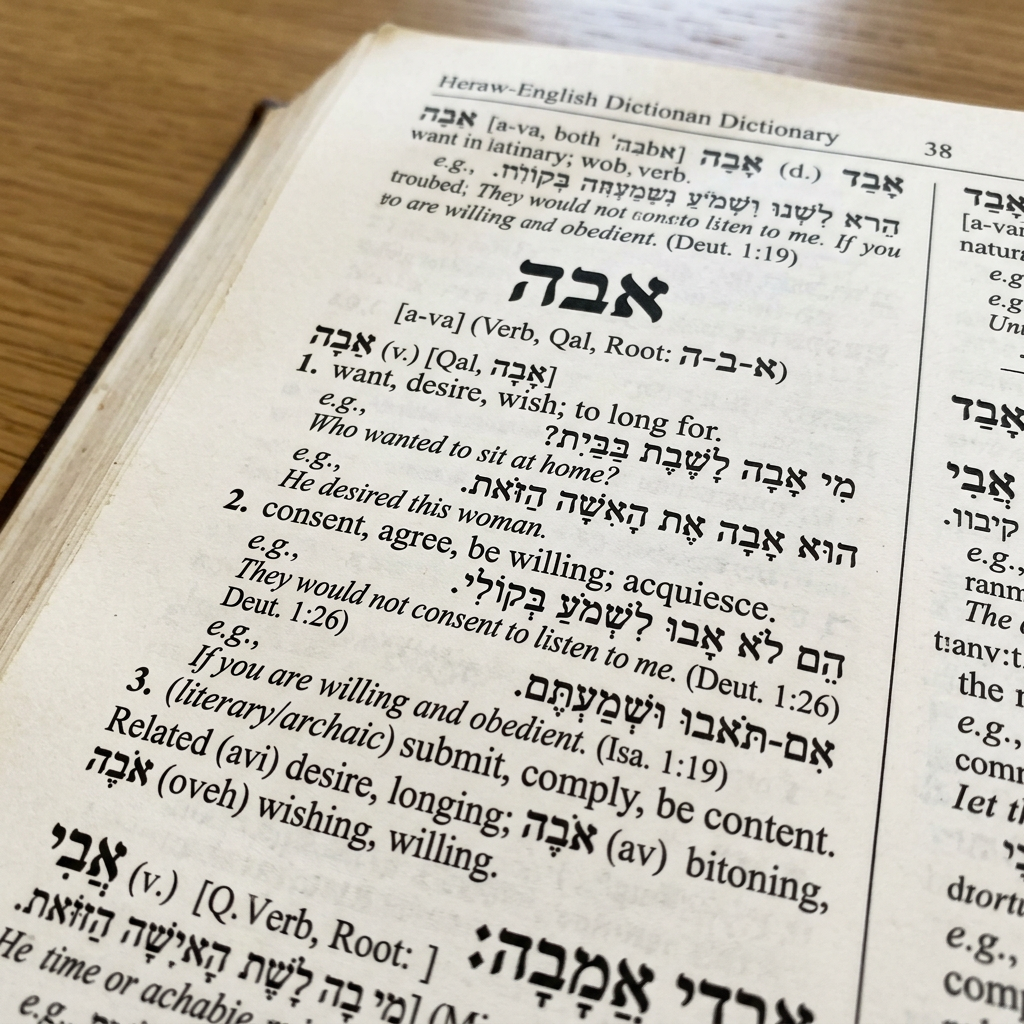

Man is often unwilling, refusing to consent to the Word of God. Only One has ever been truly willing and obedient — Jesus Christ, the Son. Through Him we enter the Promised Land. The desire of the Father is that we look upon Messiah, repent, and be saved — just as Job saw Him and repented in dust and ashes, just as Israel looked upon the serpent on the pole, and just as the Father desires all men to be saved and come to the knowledge of the truth. Desire is linked to the heart, the eyes, the stars (Cepheus the King/Branch), and love (אהב ‘ahav’). To look upon the Father is to look upon the Son.
אבה ‘abah’ means desire or willing from the root אב ‘av’ which means father. The desires of the Father.
H14
אבה
‘âbâh
BDB Definition:
1) to be willing, consent
1a) (Qal)
1a1) to be willing
1a2) to consent, yield to, accept
1a3) to desire
Part of Speech: verb
A Related Word by BDB/Strong’s Number: a primitive root
אבה (abah) has the meaning of consenting and then doing an action. Many times it is used in reference to rebellious man (in particular Israel) not consenting to the Word (Psalm 81:11; Proverbs 1:25, 30; Isaiah 28:12; 30:9, 15; 42:24; Ezekiel 3:7; 20:8 etc.)
Isa 1:19 If you are willing and hear, you shall eat the good of the land
Only one has ever been truly willing (אבה ‘abah’) and obedient in order to have right to eat of the Land. Jesus Christ. Just as the children of Israel were led into the Land by Joshua son of Nun, so too we will only enter the Promised Land through Jesus the Son of God.
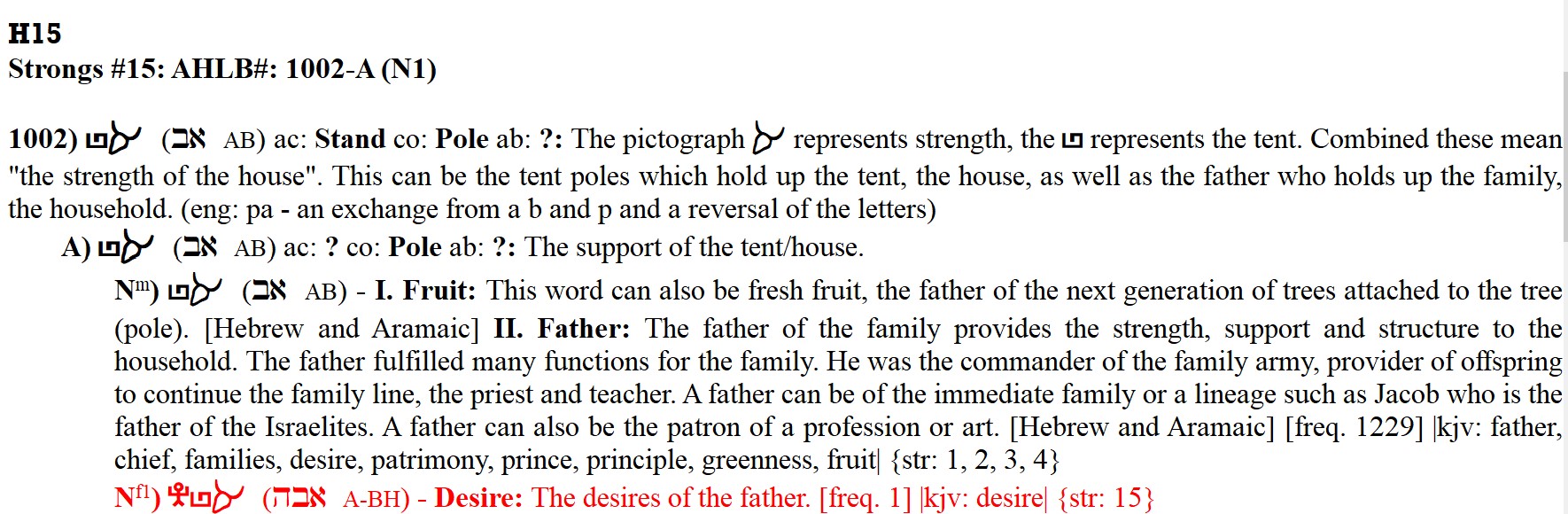
H15
אבה
‘âbeh
BDB Definition:
1) entreat, longing, desire
Part of Speech: noun feminine
A Related Word by BDB/Strong’s Number: from H14
אבה ‘abeh’ is only used 1 time in Scripture. Hebrew words that are only used one time in the Word, in many instances, carry deep significance if further study is applied to them.
This word is used only once in Job 34:36 where Elihu finally speaks up after hearing the discourse between Job and his friends.
Job 34:35 Job has spoken without knowledge, and his words are not with insight.
Job 34:36 Would that (KJV My desire) Job may be tried to the end, because his answers are like men of iniquity.
Job 34:37 For he adds rebellion to his sin; he claps his hands among us, and multiplies his words against God.
The desire of the Father, seen here through the words of Elihu (my God is He) is that man may see his wickedness, no matter how righteous he may seem to himself or the world, that he may repent and his latter end.
When Job saw Him, and saw His righteousness, he repented in dust and ashes.
Job 42:1 And Job answered Jehovah and said:
Job 42:2 I know that You can do all, and no purpose is withheld from You.
Job 42:3 Who is this hiding counsel without knowledge? So I declared, but did not understand things too wonderful for me; yea, I did not know.
Job 42:4 I pray, Listen, and I will speak; I will ask You, and You will make me know.
Job 42:5 I have heard of You by hearing of the ear, but now my eye has seen You;
Job 42:6 Therefore, I despise myself, and I have repented on dust and ashes.
Who did Job see? Jesus Christ. Just as Abraham looked and saw the ram in Genesis 22 (John 8:56) and just as the children of Israel looked upon the serpent on the pole to be healed (Numbers 21:8), so too, when man looks upon Messiah, pictured by the ram and the serpent on the pole (John 3:14) we are healed. That is the desire (אבה ‘abeh’) of the Father.
1Ti 2:3 For this is good and acceptable before God our Savior,
1Ti 2:4 who desires all men to be saved and to come to a full knowledge of truth.
Pictographically, אבה, shows forth the same meaning. אב means ‘father,’ and the letter ה means to look upon or behold something. Combined this words means to behold the Father.
Joh 14:7 If you had known Me, you would have known My Father also; and from now on you do know Him, and have seen Him.
Joh 14:8 And Philip said to Him, Lord, show us the Father, and it is enough for us.
Joh 14:9 Jesus said to him, Am I so long a time with you, and you have not known Me, Philip? The one seeing Me has seen the Father! And how do you say, Show us the Father?
Joh 14:10 Do you not believe that I am in the Father and the Father is in Me? The Words which I speak to you I do not speak from Myself, but the Father who abides in Me, He does the works.
Joh 14:11 Believe Me that I am in the Father, and the Father is in Me; but if not, believe Me because of the works themselves.
Rom 3:4 Let it not be! But let God be true, and every man a liar; even as it has been written, “That You should be justified in Your words, and will overcome in Your being judged.” LXX-Psa. 50:6; MT-Psa. 51:4
Rom 3:5 But if our unrighteousness commends the righteousness of God, what shall we say? Is God unrighteous who lays on wrath? I speak according to man.
Rom 3:6 Let it not be! Otherwise, how will God judge the world?
Rom 3:7 For if in my lie the truth of God abounded to His glory, why am I yet judged as a sinner?
Rom 3:8 And not (as we are wrongly accused, and as some report us to say), Let us do bad things so that good things may come, the judgment of whom is just.
Rom 3:9 What then? Do we excel? Not at all! For we have charged both Jews and Greeks before, all with being under sin;
Rom 3:10 according as it has been written, “There is not a righteous one, not even one!”
Rom 3:11 “There is not one understanding; there is not one seeking God.”
Rom 3:12 All turned away, they became worthless together, not one is doing goodness, not so much as one!” LXX-Psa. 13:1-3
Desire, willing, consent, accept

The English word desire, comes from the Old French desirrer, which means to wish, desire, long for. It’s original sense is linked to looking at the stars. Interestingly, this is also linked to אבה. As mentioned above, אב means father, and the letter ה means to behold or look at something. The pictograph of the letter ה is a man with outstretched arms, looking toward something. That thing, in ancient Hebrew culture, was the North star. This is what the nomads used for guidance and direction. When one looks at the North star what is seen?
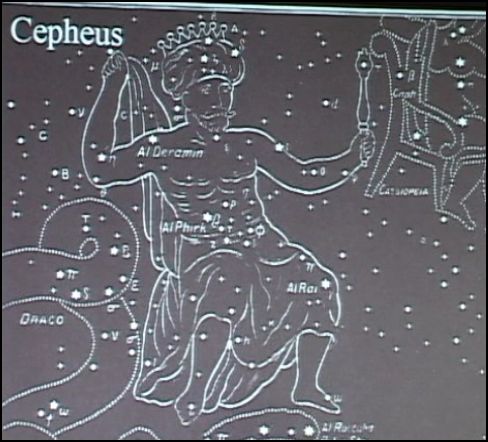 CEPHUS. The king. In the Zodiac of Denderah Pe—ku—hor = this one cometh to rule. Cepheus is Greek from the Hebrew zemah = the Branch. Ethiopian name, Hyh = a king. The brightest star is Al Deramin = coming quickly. The next is Al Phirk = the Redeemer. The next, Al Rai’ = who bruises or breaks. (#Jer 31:1)
Desire is related to the English word ‘consider.’ Consider comes from the Old French considerer, which means to reflect on, study, consider. Again linked to the stars.

Connecting back to the book of Job. God asked the adversary if he had ‘considered’ Job.
Job 1:8 And Jehovah said to Satan, Have you set your heart (KJV consider) on My servant Job because there is none like him in the earth, a perfect and upright man, fearing God and turning away from evil?
This phrase in Hebrew is השמת לבך ‘hasamta leebcha.’ This literally means to set your heart upon. Here we see considering is linked to the heart. Consider means to look upon, referring back to the throne seen above in the stars. The heart is also a picture of the throne of God.
The eyes and the heart are connected in Scripture. Opening of the eyes is linked with a ‘burning heart’
Luk 24:31 And their eyes were opened, and they knew Him. And He became invisible from them.
Luk 24:32 And they said to one another, Was not our heart burning in us as He spoke to us in the highway, and as He opened up to us the Scriptures?
Mat 6:20 But treasure up for you treasures in Heaven, where neither moth nor rust cause to perish, and where thieves do not dig through and steal.
Mat 6:21 For where your treasure is, there your heart will be also.
Mat 6:22 The lamp of the body is the eye. Then if your eye is sound, all your body is light.
Mat 6:23 But if your eye is evil, all your body is dark. If, then, the light in you is darkness, how great is the darkness!
Christ spoke of the living waters coming out of the belly in John 7:37-39, in Greek the word for belly is καρδία ‘kardia’. This Greek word is also used to translate the Hebrew word for heart, which is לב lev.
אבה ‘abah’ is related to אהב ‘ahav’ (love) in that each Hebrew letter is a pictograph that has an individual meaning. When the letters meanings are combined they form words. Love & desire are linked as both Hebrew words are derived from the same Hebrew letters. It is not hard to see that love and desire both come from within (ie the heart) but also are linked through the concept of ‘looking upon God’ mentioned above.