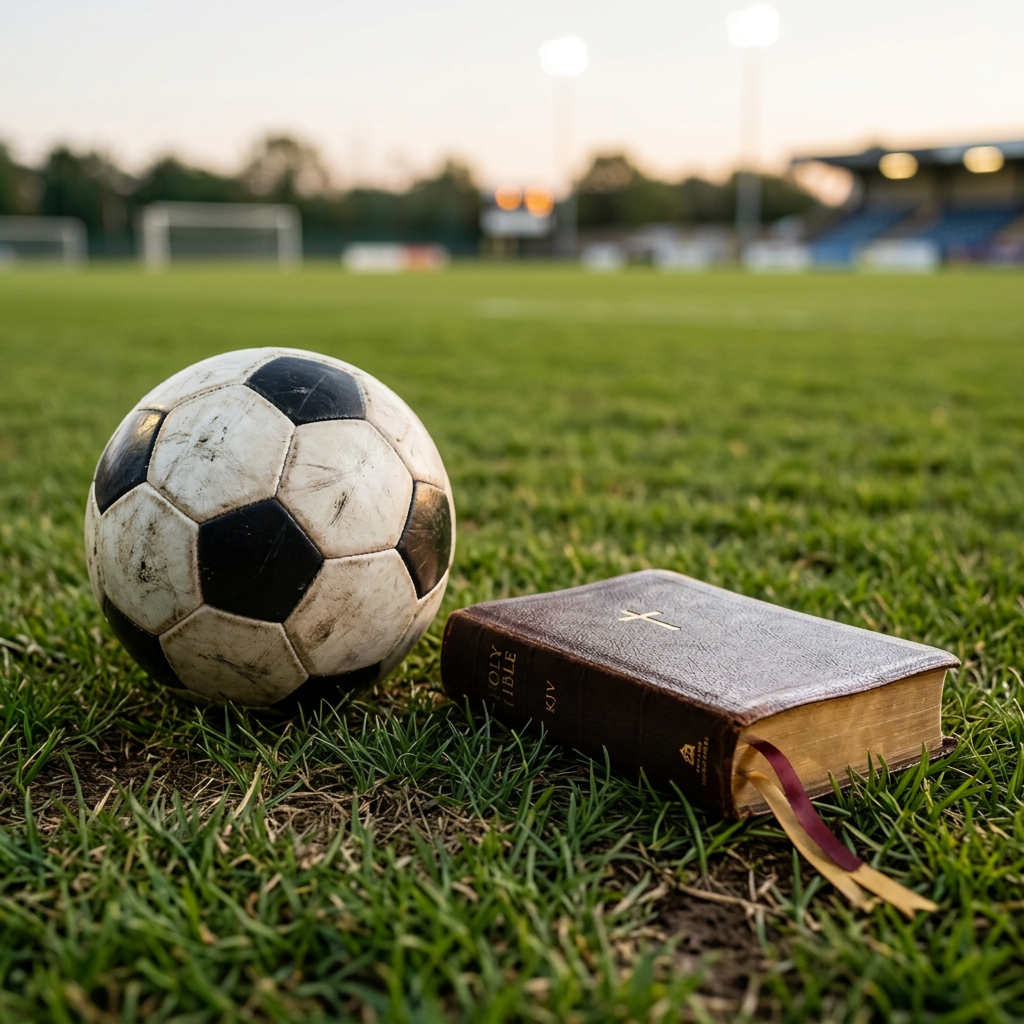

Soccer displays a fascinating shadow of Messiah, especially in light of the 2026 World Cup. The game that unites the world points us to the greater unity we have in Christ.
• The 2026 World Cup has been one of the most watched events in history, with themes of unity (“The Game Unites Us All”), cultural exchange, and even a noticeable return of Christian faith on the world stage.
• From its roots in “Association Football” to the geometry of the ball and the 11 players per side, soccer is filled with pictures of fellowship, joy, beauty, and redemption.
• Hebrew words and Scripture reveal deeper layers: the “Beautiful Game,” laughter/play in redemption, and the ultimate rest found only in the New Covenant through Messiah.
• Just as Paul used the stadium to teach about running the race, soccer reminds us that true unity, liberty, and joy come through the blood of Christ and walking in the Spirit.
Soccer displays a fascinating shadow of Messiah especially in light of the 2026 World Cup. Many videos have gone viral on social media discussing how people are seeing the commonalities in the people of other nations leading to a better understanding of each other and fostering unity. It has also been said that the message of the Christian faith has been featured more in this World Cup than in previous tournaments. The 2026 World Cup has been one of the most watched sporting events in history with numbers estimated to be over 30 billion views.
The World Cup Is The Ultimate Cultural Melting Pot — And It’s Beautiful
From kilts to ranch dressing, World Cup fans embrace cultural exchange
Christianity has made a return to the World Cup
15 amazing God moments from the 2026 World Cup…so far
Amid World Cup, Church in Mexico Reminds Fans That Prayer Is ‘The Path to Unite the World’
World Cup: can big sports events bring us together? Recent history says yes
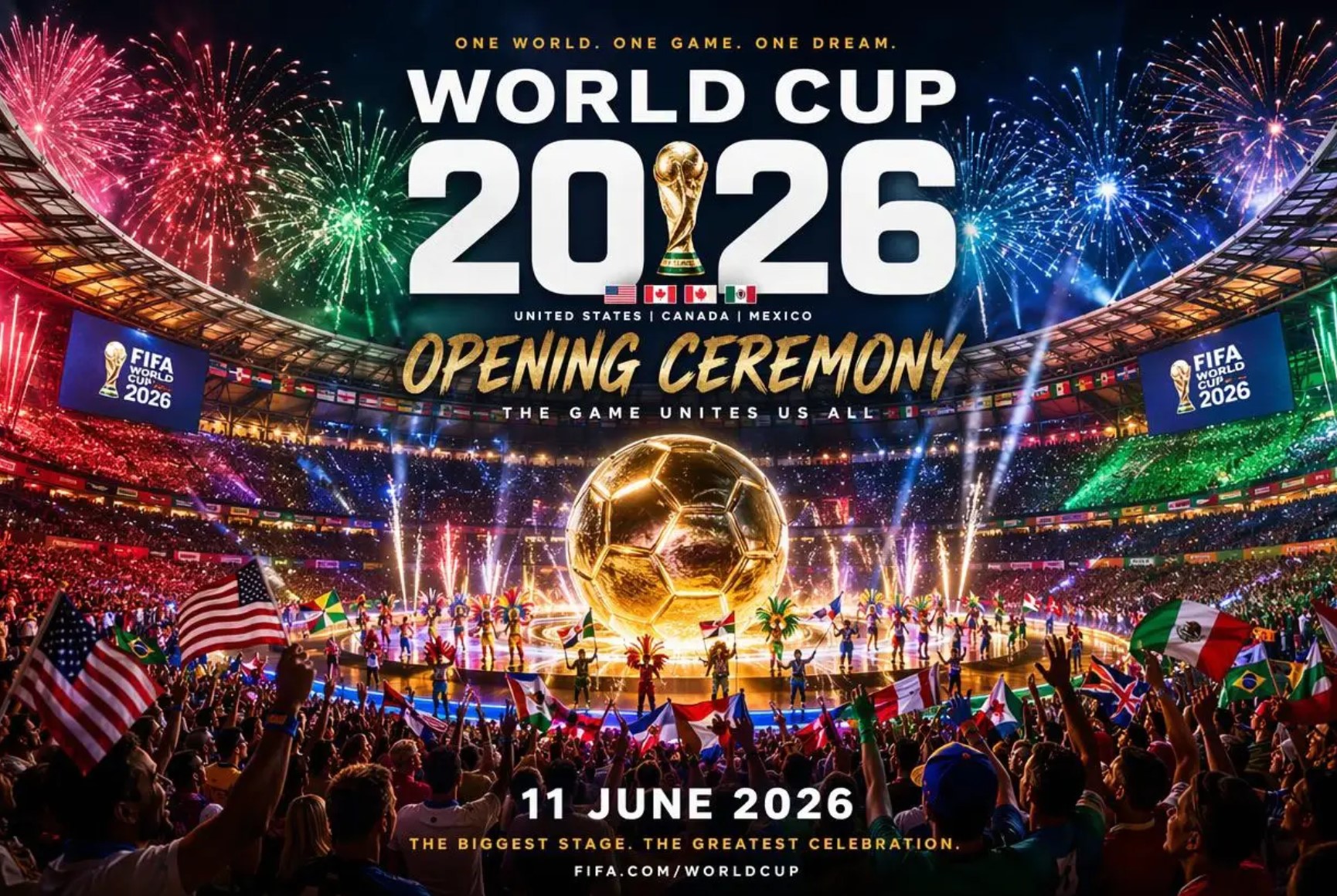
Soccer began with the name Association Football. An association is an organization with rules and a shared goal. The theme of unity is built into the game. The theme of the 2026 World Cup has been unity.
The World Cup 2026 Official Poster said:
“THE GAME UNITES US ALL” along with “ONE WORLD. ONE GAME. ONE DREAM.”
“Football Unites the World” has been one of FIFA’s most prominent global slogans.
Unity is associated with joy and beauty in Scripture. These are the themes of this shadow picture of Messiah found in soccer.
Psa 133:1 A Song of degrees of David. Behold, how good and how pleasant (נעים ‘naiym’ – beauty) it is for brethren to dwell together in unity!
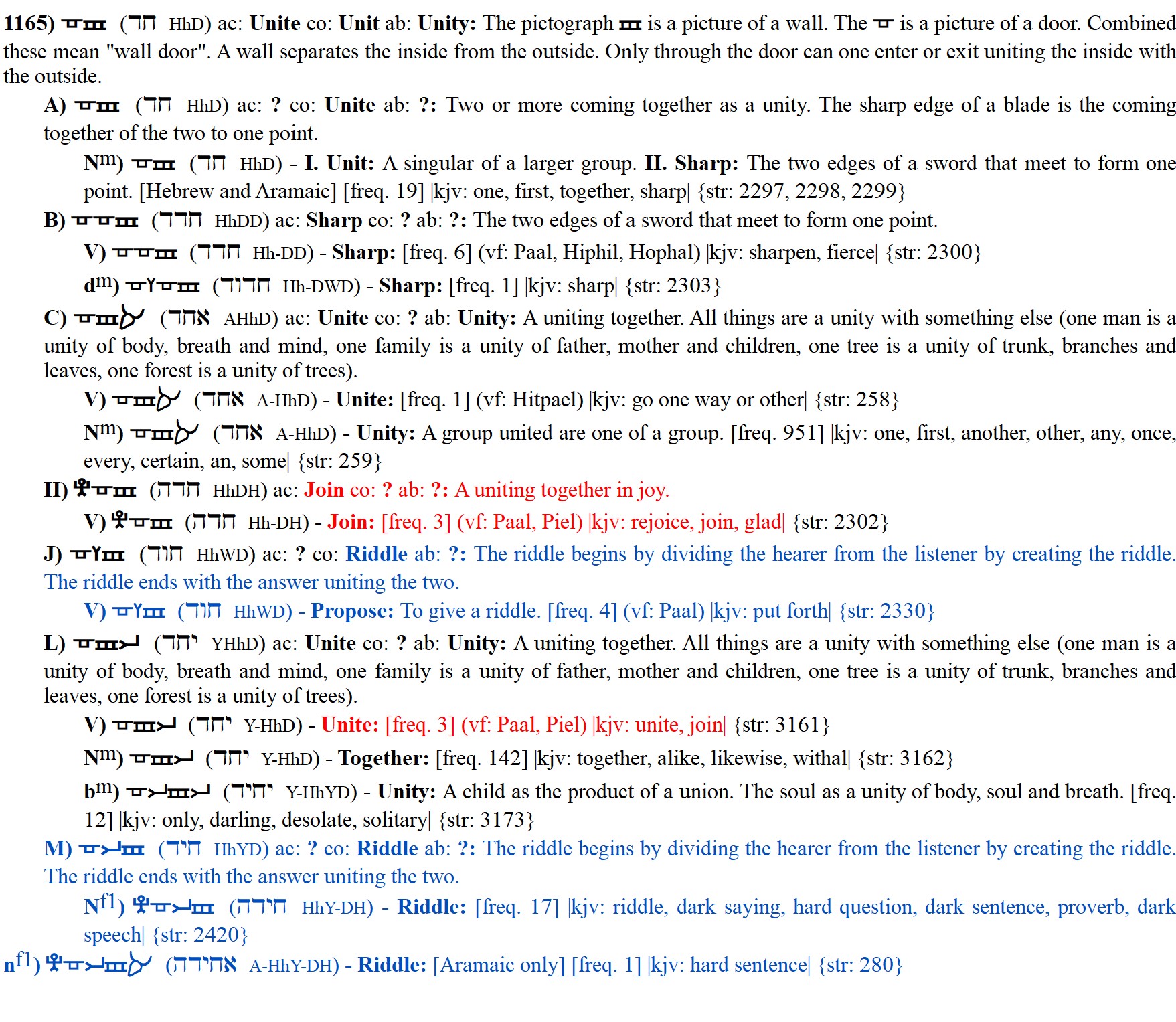
The Hebrew word חדה ‘chadah’ displays the unity and joy concept. חדה ‘chadah’ comes from the root חד ‘chad’ which pictures a unifying through entering a door. The concept of riddle is in the family of חד ‘chad’ words as well which is interesting as the soccer shadow of Messiah is a fascinating “riddle” or parable.
Unity comes only through Messiah and the New Covenant in Him (Psalm 50:5; Isaiah 49:3-9; Hebrews 2:11; 13:20-21; Jeremiah 50:5; Ephesians 2:15; Colossians 1:20; 2:1-11) and walking with Him (1John 1:3-7). It is through Christ that we are unified and sanctified by the body of His flesh through death (Colossians 1:20-22; Romans 7:25) and are delivered from our carnal body of sin and death (Romans 7:14). It is through Christ that we are delivered from this bondage and fear (Hebrews 2:15) unto freedom and joy (Romans 8:15-39).
“Unity in the body of Christ does not rest on uniformity, but on our common ‘blood,’ which is the blood of Christ. We are now members of one family, and that identity cannot be taken from us, no matter how much we disagree or quarrel.” (The Gospel in Human Contexts – Paul Hiebert pg 193)
The Apostle Paul used sports references to teach the Word
1Co 9:24 Do you not know that those running in a stadium indeed all run, but one receives the prize? So run that you may obtain.
1Co 9:25 But everyone striving controls himself in all things. Then those truly that they may receive a corruptible crown, but we an incorruptible.
1Co 9:26 So I run accordingly, as not uncertainly; so I fight, as not beating air;
1Co 9:27 but I buffet my body and lead it captive, lest proclaiming to others I myself might be disapproved.
Sports
Sports are a part of that which is ingrained in man to lead them to the Messiah. Many of the things that man spends his free time/leisure time on in order to be entertained is frivolous and a waste of precious time that our Father has given us. Yet, in most of these things shadows of Messiah can be seen. The word leisure itself points to Messiah. Leisure comes from the word license which means liberty/freedom. How are we made free? Through Christ:
Gal 5:1 Stand fast therefore in the liberty wherewith Christ hath made us free, and be not entangled again with the yoke of bondage.
2Co 3:17 Now the Lord is that Spirit: and where the Spirit of the Lord is, there is liberty.
1Pe 2:16 As free, and not using your liberty for a cloke of maliciousness, but as the servants of God.
His disciples know the truth and are set free
Joh 8:31 Then said Jesus to those Jews which believed on him, If ye continue in my word, then are ye my disciples indeed;
Joh 8:32 And ye shall know the truth, and the truth shall make you free.
Most of man’s leisure time is spent in hobbies, or in entertainment. Most hobbies consist of creating or in games/sports which is a picture of overcoming. Christ is our Creator (Colossians 1:12-17; Hebrews 1:2-3, 8-12; Ephesians 3:9 etc.) and it is through Him that we overcome (1 John 5:4-5). Games and sports picture our heavenly rest.
In modern Hebrew, the word for sports is מִשְׂחָק ‘misḥak’ from the root שׂחק ‘sachaq’ which means to laugh, play, or mock.

שׂחק ‘sachaq’ is used in reference to redemption
Jer 30:18 Thus saith the LORD; Behold, I will bring again the captivity of Jacob’s tents, and have mercy on his dwellingplaces; and the city shall be builded upon her own heap, and the palace shall remain after the manner thereof.
Jer 30:19 And out of them shall proceed thanksgiving and the voice of them that make merry (שׂחק ‘śâchaq’): and I will multiply them, and they shall not be few; I will also glorify them, and they shall not be small.
Jer 31:4 Again I will build thee, and thou shalt be built, O virgin of Israel: thou shalt again be adorned with thy tabrets, and shalt go forth in the dances of them that make merry (שׂחק ‘śâchaq’).
Psa 126:1 A Song of degrees. When the LORD turned again the captivity of Zion, we were like them that dream.
Psa 126:2 Then was our mouth filled with laughter (שׂחק ‘śâchaq’), and our tongue with singing: then said they among the heathen, The LORD hath done great things for them.
The name Isaac comes from שׂחק ‘śâchaq.’ Paul uses Isaac as a picture of believers who are made citizens of heaven.
Gal 4:26 But Jerusalem which is above is free, which is the mother of us all.
Gal 4:27 For it is written, Rejoice, thou barren that bearest not; break forth and cry, thou that travailest not: for the desolate hath many more children than she which hath an husband.
Gal 4:28 Now we, brethren, as Isaac was, are the children of promise.
The English word sport comes from the Old French ‘desport’ which means “pleasure, enjoyment, delight, pastime, or amusement.” The French ‘desporter’ comes from the Latin ‘deportare’ which means to “carry away” or “transport.” Sports are something that “carries the mind away” from everyday matters. It is a type of recreation.
Recreation comes from the Latin ‘recreātiō’ which means “restoration, recovery, refreshment.’ It breaks down to ‘re’ which means “again” or “back” and ‘creare’ “to create or bring forth.” To create again. Recreation is something done for fun which “creates again” or “restores” man. The sabbaths and feasts in the Old Testament were designed for this very thing. To give rest, to restore and unite the people. They were pictures of the ultimate rest found in Christ.
The Greek words ἀναπαύω ‘anapauo’ and ἀνάπαυσις ‘anapausis’ have identical meanings of rest, refresh, cause to cease.
Mat 11:28 Come unto me, all ye that labour and are heavy laden, and I will give you rest (ἀναπαύω ‘anapauo’).
Mat 11:29 Take my yoke upon you, and learn of me; for I am meek and lowly in heart: and ye shall find rest (ἀνάπαυσις ‘anapausis’) unto your souls.
These words are used in reference to the rest of the sabbaths in the Septuagint.
Septuagint
Exo 16:23 And Moses said to them, Is not this the word which the Lord spoke? To-morrow is the sabbath, a holy rest (σάββατα ἀνάπαυσις ‘sabbata anapausis’) to the Lord: bake that ye will bake, and seethe that ye will seethe, and all that is over leave to be laid by for the morrow.
Exo 31:15 Six days thou shalt do works, but the seventh day is the sabbath, a holy rest (ἀνάπαυσις ‘anapausis’) to the Lord; every one who shall do a work on the seventh day shall be put to death.
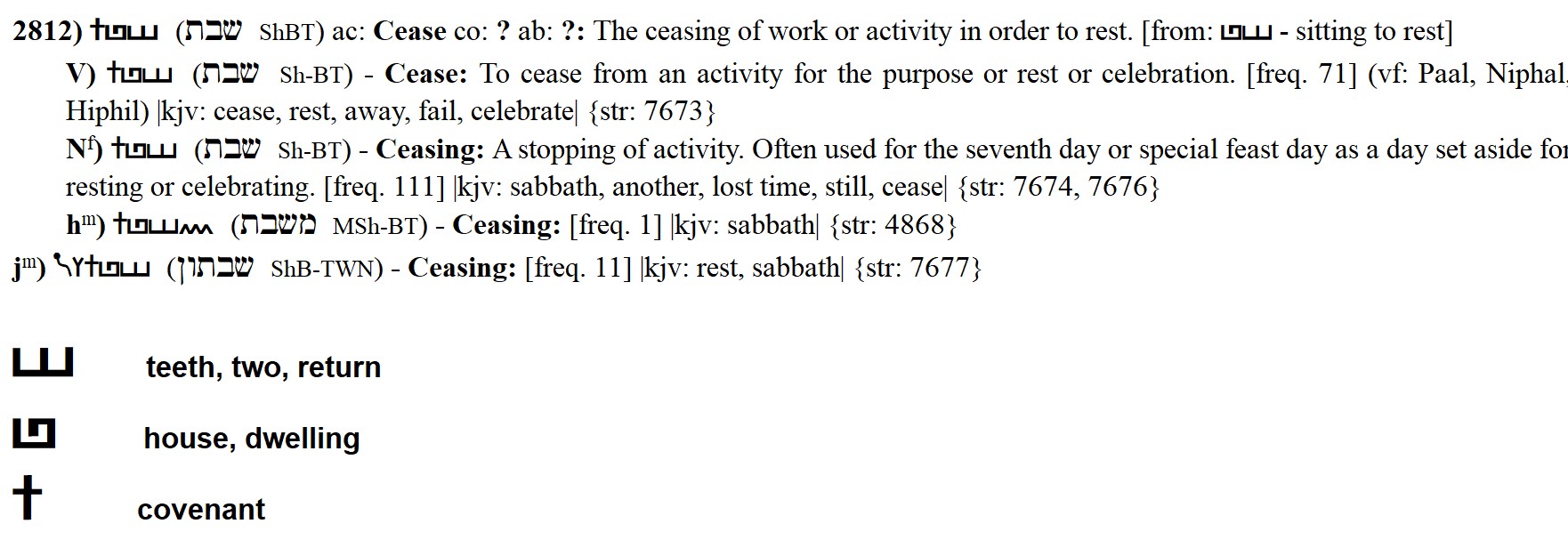
שבת ‘shabbat’ comes from the root word שב ‘shav’ meaning to sit or return to your dwelling. Literally, in the ancient Hebrew pictographs, שבת ‘shabbat’ means to return by the covenant to the house. Recall this is also the meaning of unity (חד ‘chad – unity).

Christ is the door that we enter in order to abide in His ‘House’ (John 10:7) it is through Him that we are covered/hidden. This is the definition of who the Israel of God is (Galatians 6:16)…His hidden ones (Psalm 83:3). It is by the covenant cut in Messiah (Daniel 9:26; Isaiah 42:6) by His sacrifice on the cross that we are covered (1 John 1:7). It is through His Outstretched Arms (wings) that Christ is calling us (John 3:14; 12:32) and gathering us together as a Shepherd does His flock (John 10:14-16). This is how we enter the Door into the House, this is how we are declared innocent and pure in His eyes. This is how we become His friends and enter into His tents in an intimate relationship.
The Hebrew words for Sabbath {שבת ‘shabbat’}, and repentance {תשובה ‘teshuvah’} come from the same Hebrew root שב ‘shav’ which means to return to the house. Redemption has the same concept of returning to a former state. The sabbaths were a reminder of creation (Exodus 20:11) and redemption (Deuteronomy 5;15). Creation was corrupted by sin, it is redeemed through Christ on the cross. When we are born again, we experience this. We are recreated through His redemption.
Going back to the pictographs, the ת ‘tav’ means covenant but also cross. The pictographs of שבת ‘shabbat’ could be interpreted as “sit or dwell at/in the cross.”
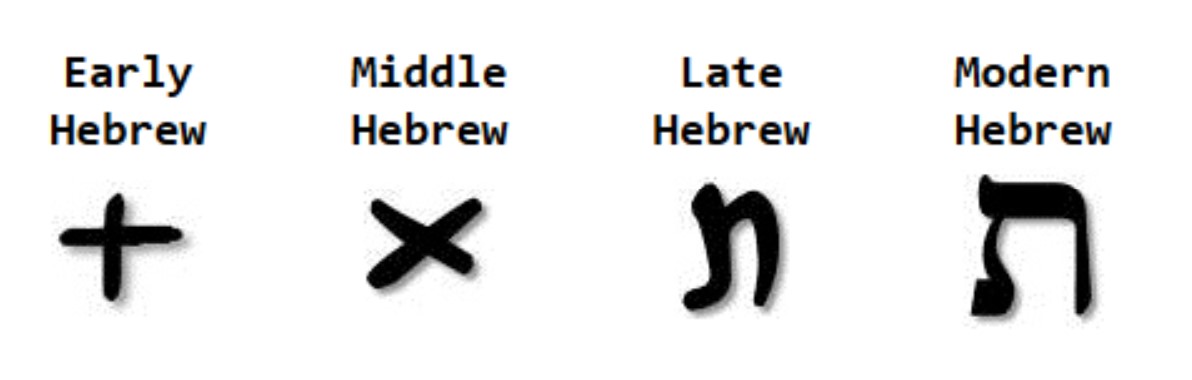
The cross is a symbol of redemption and being born again. Creation and redemption…His sabbath, His rest. Shabbat means to cease, or the ‘loss of time.’ It was at the cross that time stopped.
For more on this see: Daily Tidbits 2/18 – Love & the 4th Dimension & Shadows of Messiah – Shadows & the 4th Dimension
The only way to truly observe the sabbath is by resting in God…ceasing from our own works and trusting in the work of Jesus
Heb 4:8 For if Jesus (Joshua) had given them rest, then would he not afterward have spoken of another day.
Heb 4:9 There remaineth therefore a rest to the people of God.
Heb 4:10 For he that is entered into his rest, he also hath ceased from his own works, as God did from his.
Those who believe in Christ have entered into His rest
Heb 4:3 For we which have believed do enter into rest, as he said, As I have sworn in my wrath, if they shall enter into my rest: although the works were finished from the foundation of the world.
Heb 4:4 For he spake in a certain place of the seventh day on this wise, And God did rest the seventh day from all his works.
Heb 4:5 And in this place again, If they shall enter into my rest.
Heb 4:6 Seeing therefore it remaineth that some must enter therein, and they to whom it was first preached entered not in because of unbelief:
Heb 4:7 Again, he limiteth a certain day, saying in David, To day, after so long a time; as it is said, To day if ye will hear his voice, harden not your hearts.
Heb 4:8 For if Jesus had given them rest, then would he not afterward have spoken of another day.
Heb 4:9 There remaineth therefore a rest to the people of God.
Heb 4:10 For he that is entered into his rest, he also hath ceased from his own works, as God did from his.
Games
The English word game comes from the Old English word ‘gamen’ which meant “game, joy, fun, amusement,” from the Old Norse ‘gaman’ which meant “sport, merriment.” This word traces back further to the Proto-Germanic “gamaną” which means “people together” or “participation/communion.”
True joy and communion comes through the New Covenant in Christ
Luk 22:19 And he took bread, and gave thanks, and brake it, and gave unto them, saying, This is my body which is given for you: this do in remembrance of me.
Luk 22:20 Likewise also the cup after supper, saying, This cup is the new testament in my blood, which is shed for you.
“The chief end of our life is to live in communion with God. To this end the Son of God became incarnate, in order to return us to this divine communion, which was lost by the fall into sin. Through Jesus Christ, the Son of God, we enter into communion with the Father and thus attain our purpose.” – St. Theophan the Recluse
1Jo 1:3 That which we have seen and heard declare we unto you, that ye also may have fellowship with us: and truly our fellowship is with the Father, and with his Son Jesus Christ.

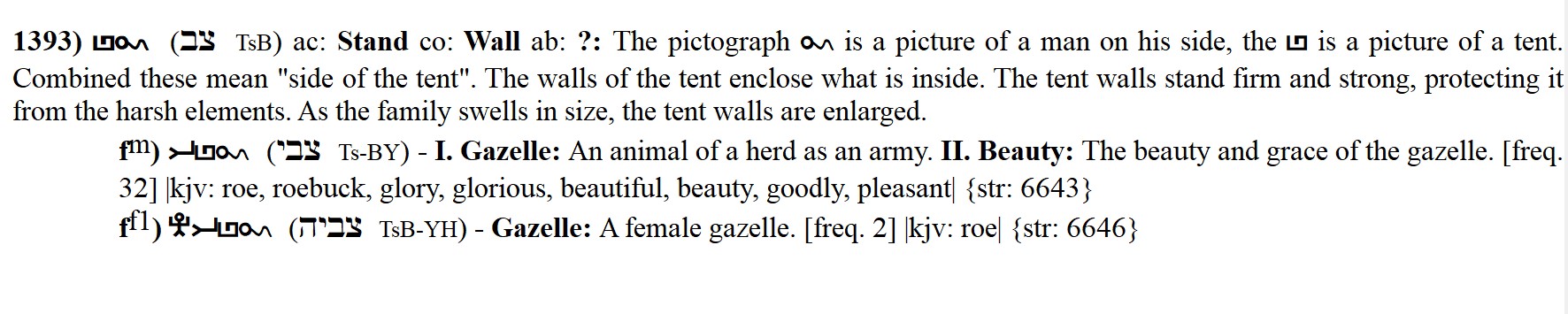
In the 14th century the word game extended to hunting and fishing and then to the animals themselves, “wild game.” Deer are the epitome of wild game. צבי ‘tsevi’ means deer in Hebrew but also beauty. צבי ‘tsevi’ is translated as deer (roe, roebuck) but also glory, beauty, pleasant. צבי ‘tsevi’ comes from the root צב ‘tsav’ which pictures a man on his side and a tent, the “side of the tent.” The walls of the tent enclose what is inside, they stand firm and strong, protecting the family from the elements. As the family grows in size, the tent wall were enlarged.
The English word ‘beauty’ traces back to the Latin word ‘bellus’ which means beautiful or pretty. ‘Bellus’ connects back to two Hebrew words, יפה ‘yafa’ and צבי ‘tsevi,’ both of which means beautiful.
Scripture likens Messiah to a צבי ‘tsevi.’
Son 2:8 The voice of my beloved! behold, he cometh leaping upon the mountains, skipping upon the hills.
Son 2:9 My beloved is like a roe {צבי ‘tsevi’} or a young hart: behold, he standeth behind our wall, he looketh forth at the windows, shewing himself through the lattice. (Remember the lattice, this will be spoken of later)
Isa 4:2 In that day shall the branch of the LORD be beautiful {צבי ‘tsevi’} and glorious, and the fruit of the earth shall be excellent and comely for them that are escaped of Israel.
Psa 50:2 Out of Zion {the glorious land צבי ‘tsevi’ Ezekiel 20:6; Jeremiah 3:9; Daniel 8:9; 11:16, 41, 45} , the perfection of beauty, God hath shined.
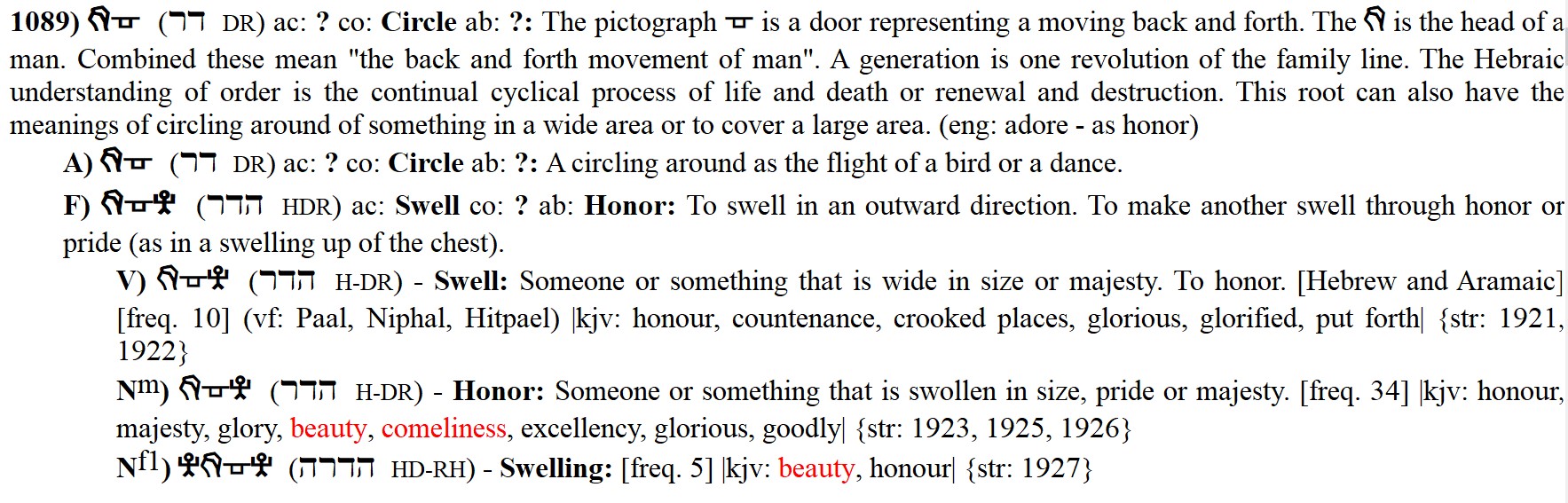
All of these themes related to צבי ‘tsevi’ are similar in meaning to דר ‘dor.’ דר ‘dor’ has the meaning of a circle or ball.
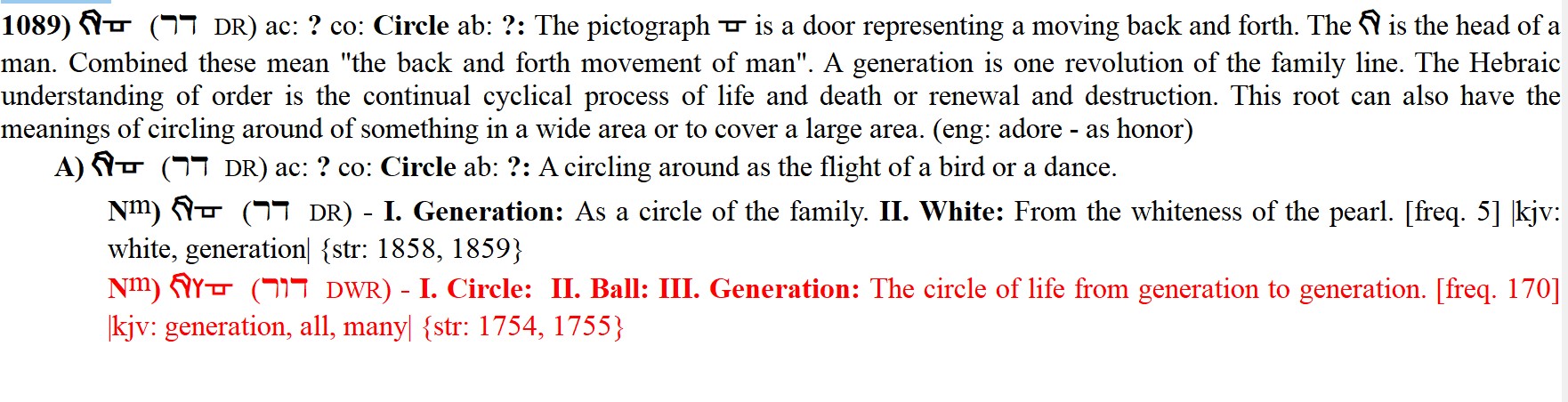
The word הדר ‘hadar’ comes from the root דר ‘dar’ as well. It has the meaning of honor, majesty, beauty and glory. Soccer is known as the “beautiful game.”
Balls

Balls are a near universal feature in games and sports across human history and cultures. Evidence of ball games date back thousands of years on multiple continents, appearing independently in many places.
In Mesoamerica rubber balls were used in a “hip-ball” game with connection to the sun and moon. In Ancient Egypt linen and rag balls have been found in tombs with depictions of stick-and-ball games. Greece and Rome had various ball games using inflated bladder balls.
In China, leather balls were stuffed with hair and feathers to play a game called Cuju (kick ball). FIFA recognizes this as the precursor to soccer.
Circles/balls represent eternity, wholeness, the sun, cycles of life, and unity (no beginning/end). Playing with them enacts joy as a “complete” experience.
The word for ball in Hebrew is כַּדּוּר ‘kador’ (like a circle) from the word דור ‘dor’ (circle) which comes from the root דר ‘dar.’
Dance Ball

A “dance ball” comes from the Old French ‘baller’ which means “a dance, a ball.” Baller traces back to the Latin ‘ballare’ which means to dance. Ballare comes from the Greek word βαλλίζω ‘ballizo’ which means “to dance, to jump about, to throw oneself around.” βαλλίζω ‘ballizo’ comes from the word βάλλω ‘ballo’ which means “to throw, cast, strike.” A dance “ball” and the spherical ball are not etymologically related but conceptually related through the idea of “throwing” or “casting” forth.
The Hebrew word דר ‘dar’ has the meaning of both circle and dance. Dancing is strongly connected to circles and joy. These themes will be seen throughout this article.

גִּילָה ‘giylah’ is a word which connects spinning in a circle and joy. גִּילָה ‘giylah’ comes from the root גל ‘gal’ which means something round. A dancing in a circle.
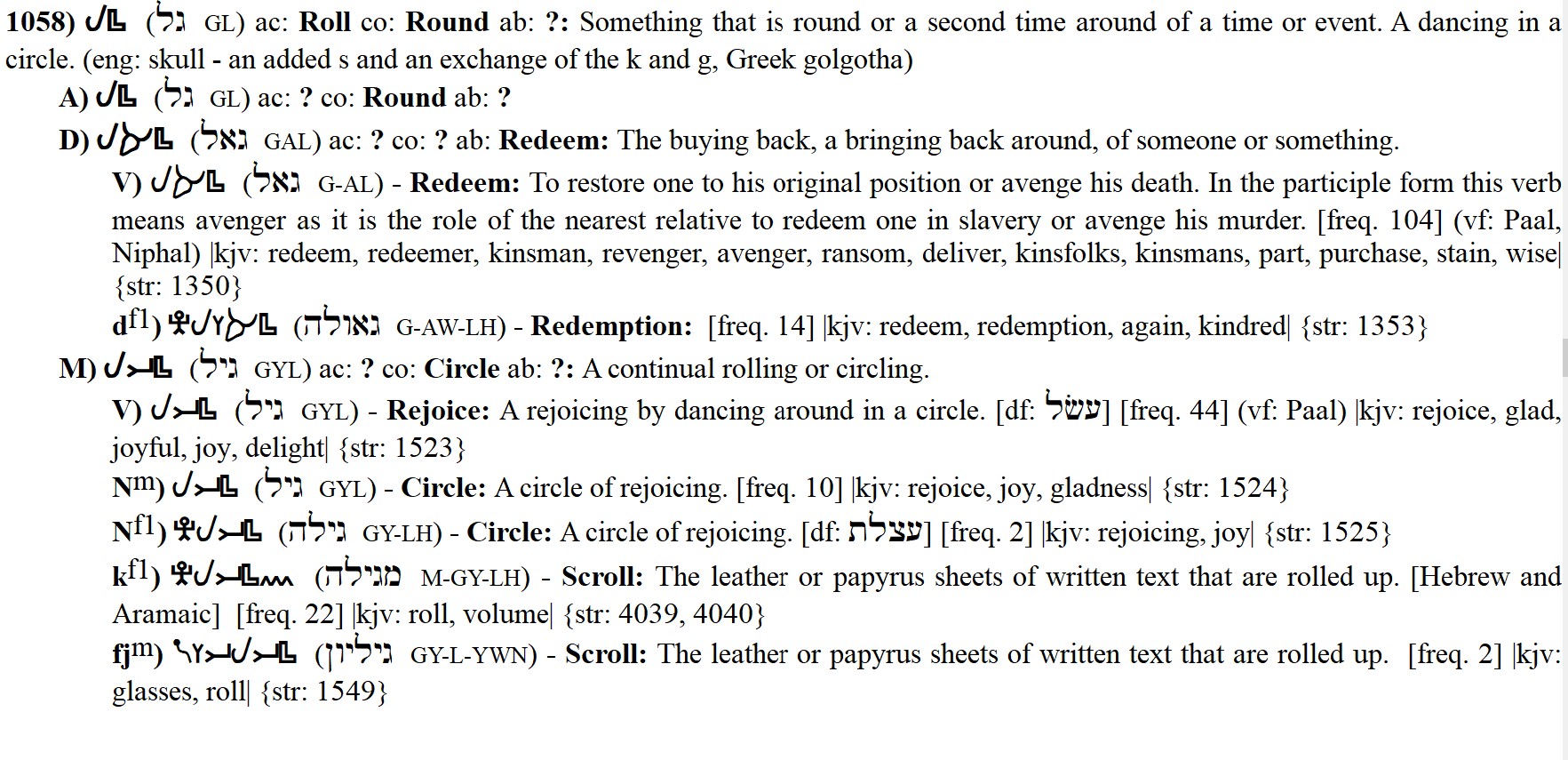
Another Hebrew word which displays this circle dance imagery is חג ‘chag’ which has the meaning of gathering together for a feast.
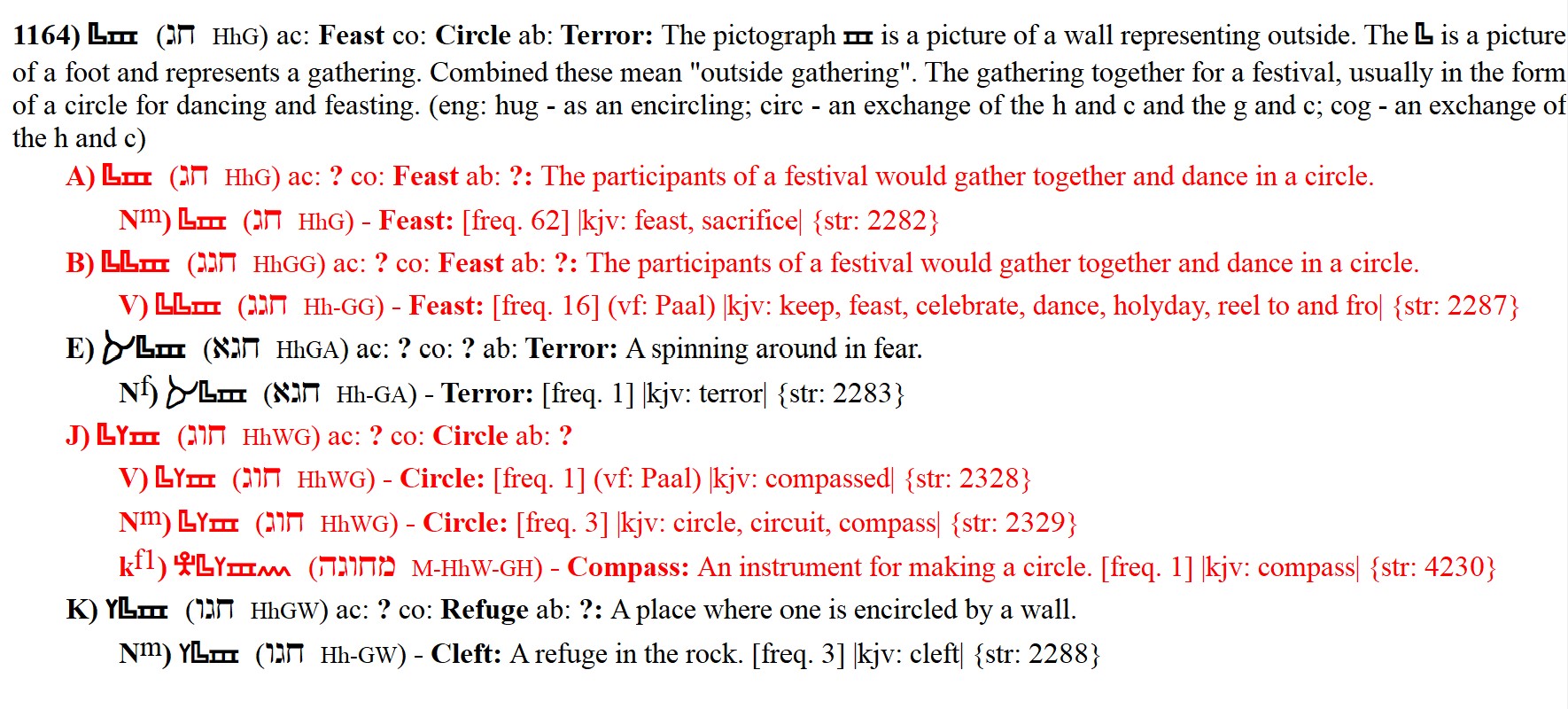
The Feasts of the Lord were called שלוש רגלים ‘shalosh regalim’ which means “three feet.” This refers to Passover, Shavuot and Sukkot.
Exo 23:14 Three times (שלוש רגלים ‘shalosh regalim’ ) thou shalt keep a feast unto me in the year.
Exo 23:14 שׁלשׁ רגלים תחג לי בשׁנה׃
Dancing in joy
Jer 31:11 For the LORD hath redeemed Jacob, and ransomed him from the hand of him that was stronger than he.
Jer 31:12 Therefore they shall come and sing in the height of Zion, and shall flow together to the goodness of the LORD, for wheat, and for wine, and for oil, and for the young of the flock and of the herd: and their soul shall be as a watered garden; and they shall not sorrow any more at all.
Jer 31:13 Then shall the virgin rejoice in the dance, both young men and old together: for I will turn their mourning into joy, and will comfort them, and make them rejoice from their sorrow.
Soccer
Soccer is a British slang term for Association football. In the 1880s, Oxford University students added “er” to sports players. Ruggers for those who played rugby, footers for football players. Association was shortened to “assoccer” which was shortened further to “soccer.”
The Hebrew word for ball is כַּדּוּר ‘kadur.’ A soccer ball is כדורגל ‘kaduregel,’ which literally means ball-foot (football).
Isa 22:18 He will surely violently turn and toss thee like a ball (דור ‘dor’) into a large country: there shalt thou die, and there the chariots of thy glory shall be the shame of thy lord’s house.
Isa 22:19 And I will drive thee from thy station, and from thy state shall he pull thee down.
As mentioned before, דר ‘dor’ has the meaning of a circle or ball.
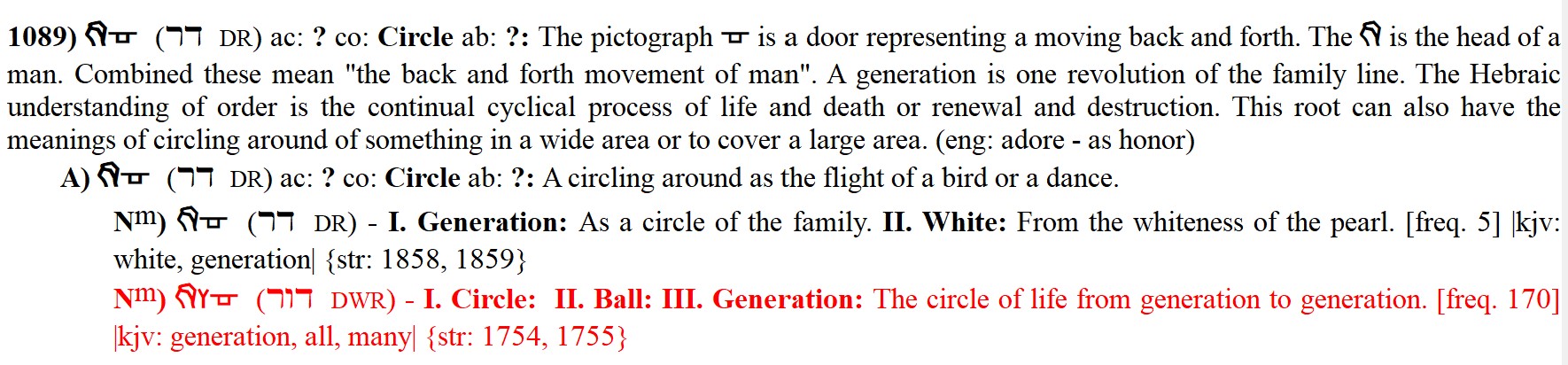
דר ‘dor’ (generation) shares the circular meaning as generations are seen as revolving cycles of family and time, לְדוֹר וָדוֹר l’dor v’dor (from generation to generation).
The Word – דבר ‘davar’
דבר ‘davar’ (word/order) connects to דר ‘dor,’ showing God’s ordering Word structuring generations.

The Hebrew word for ‘word’ is דבר ‘davar’ means order and arrangement as in the arrangement of letters to form words. דבר ‘davar’ comes from the root דר which means a ‘circle.’
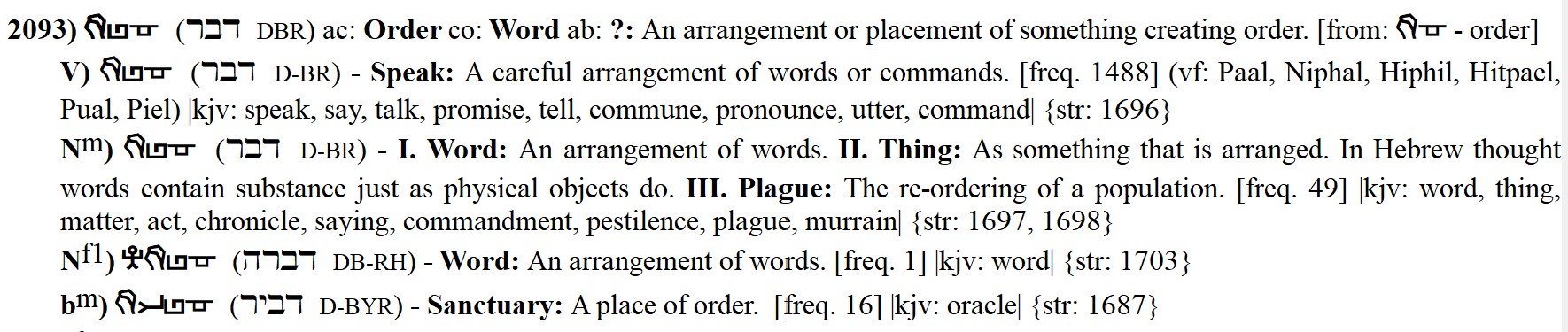
Amazingly, when man speaks the sound that comes forth is in the shape of a circle or ‘pearl.’
The studies of John Stuart Reid reveal that the shape of sound coming from our mouths when we speak is likened unto a ‘pearl.’ A circle.
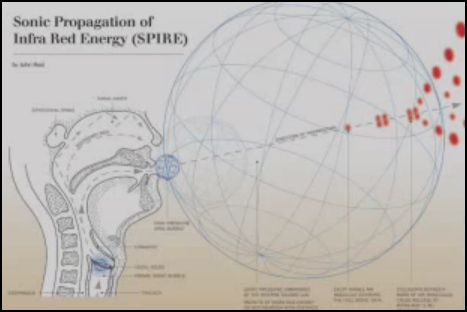
Sound that comes from our mouths is like unto a PEARL.
Mat 7:6 Do not give that which is holy to the dogs, nor throw your pearls before the pigs, that they should not trample them with their feet, and turning they charge you.
The word for pearl in the above verse comes from the following Greek word.
G3135
μαργαρίτης
margaritēs
Thayer Definition:
1) a pearl
2) a proverb, i.e. a word of great value
Part of Speech: noun masculine
A Related Word by Thayer’s/Strong’s Number: from margaros (a pearl-oyster)
The Greek word μαργαρίτης ‘ margaritēs’/μάργαρον ‘margaron,’ meaning a pearl, comes from the Hebrew word is גרעין ‘gariyn’ which means grain, or a seed.
Luk 8:11 And this is the parable: The seed is the Word of God.
The Pearl further connects to the Word in that the word translated as pearl in Ester 1:6 is the Hebrew word דר ‘dar’ which as mentioned above is the root of the word דבר ‘davar’ which means ‘word’ in Hebrew.
Breaking apart the word דבר ‘davar’ further displays this word – pearl connection. דר ‘dar’ is a pearl or circle. The inside letter ב ‘bet’ means a house or body. דבר ‘davar’ then can mean the pearls that come forth from the house/body…this is exactly what our words are.
Further connecting the pearl/circle {דר ‘dar’} is the camp of Israel in the wilderness. The word דר ‘dar’ also means a generation as in the “circle of a family”. In ancient times a family camp was in the form of a circle as in the camp of Israel in the wilderness. The family of Israel is linked to the pearl. In the book of Revelation as there are 12 gates named after Israel made of pearl in the New Jerusalem (Revelation 21:14-21).
Beautiful Game
Soccer is known as the “Beautiful Game.” It was popularized by Brazilian soccer player Pelé, who used it in his 1977 autobiography My Life and the Beautiful Game.
Recall that הדר ‘hadar’ which comes from the root דר ‘dar’ (ball, circle), means beauty.
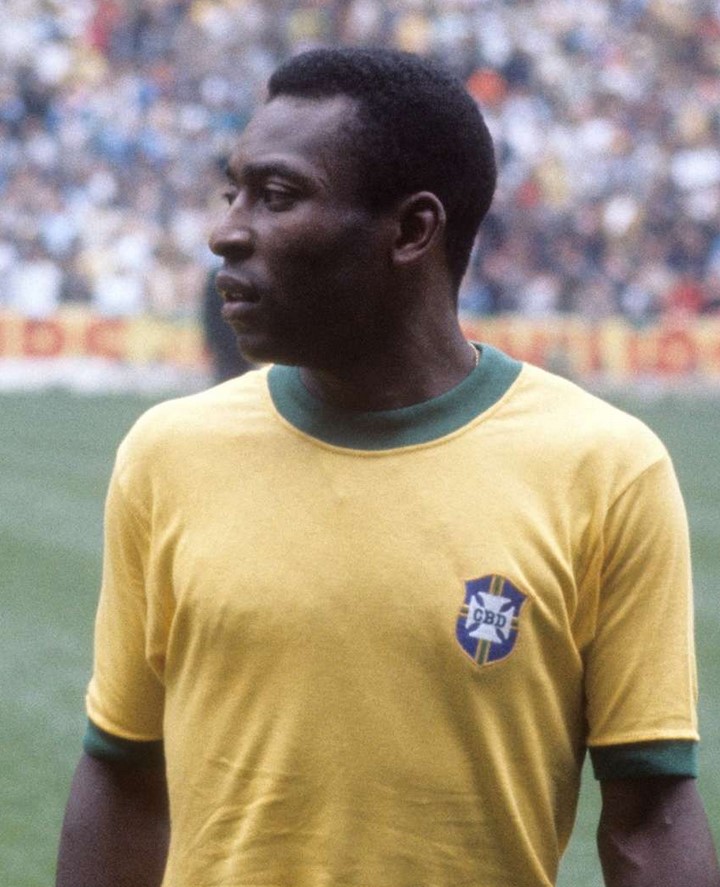
Pelé was named Edson Arantes do Nascimento. The origin of his nickname Pelé is unknown even to Pelé himself. Pelé said he had “no idea” what it meant originally, and neither did his school friends. In Hebrew, the word פֶּלֶא ‘pele’ means wonder, miracle, marvel, extraordinary thing.
This word, פֶּלֶא ‘pele,’ is used of Jesus Christ
Isa 9:6 For unto us a child is born, unto us a son is given: and the government shall be upon his shoulder: and his name shall be called Wonderful (פֶּלֶא ‘pele’), Counsellor, The mighty God, The everlasting Father, The Prince of Peace.
Pelé was long considered the greatest soccer player of all time until Lionel Messi.
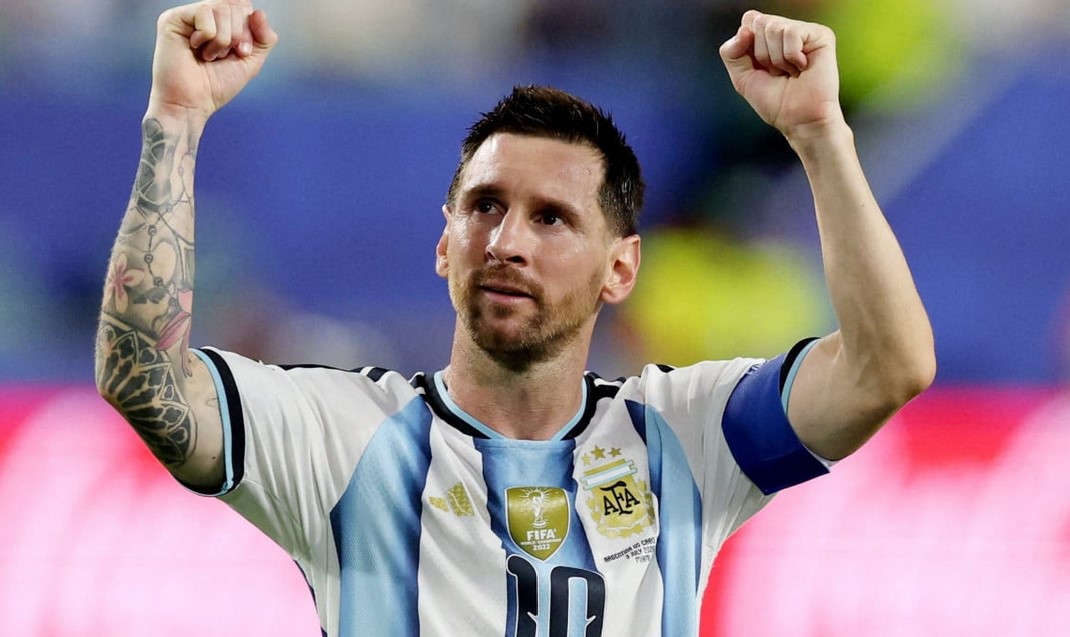
Lionel means “little lion” and Messi is a shortened form of Messias which comes from the Greek Μεσσήνη ‘Messene’ which means “in the middle.” However, due to the similiarity to the Spanish and Portuguese word for Messiah (mesias) he is called El Mesías (The Messiah).
Argentina has a strong Catholic culture but also has an almost religious fervor for soccer. In the past, Argentinians gave Diego Armando Maradona similar nicknames called him El Dios (the God), San Diego (Saint Diego) and El Pibe de Oro (The Golden Boy). Messi has also been called Dios (D10S – a play on his jersey number). Both brought Argentina World Cup victories and were spoken of in religious symbols.
Jesus Christ is the true Lion, the true Messiah.
Pele and Messi are mentioned as they are considered the greatest soccer players of all time and both have names which point people directly to Christ Jesus. This is yet another connection between soccer and Christ.
הדר ‘hadar’ also means pride. Lucifer fell from heaven because of his pride and beauty (Ezekiel 28:12-17). Pride causes one to reject God and replace Him…
Fans
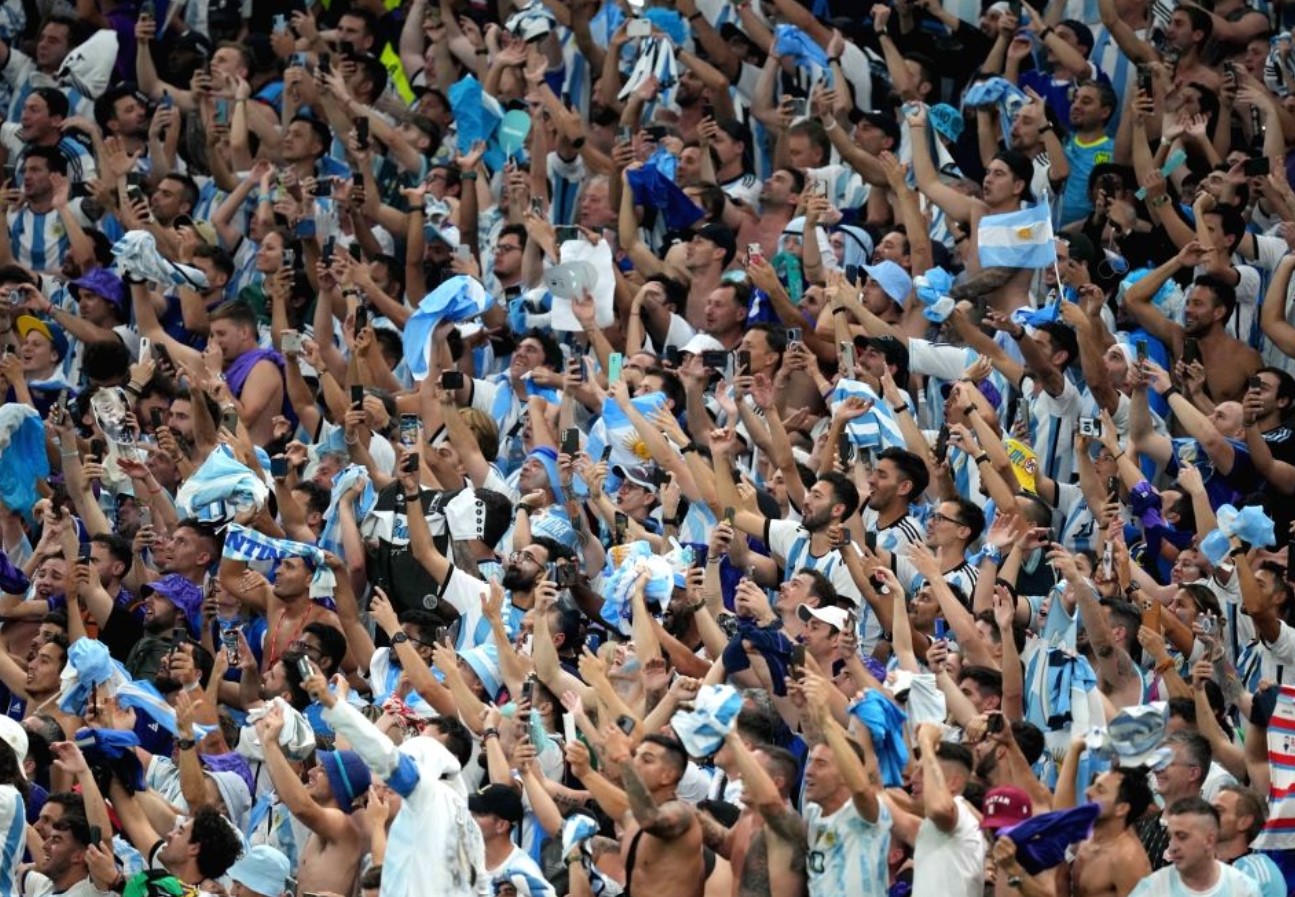
Fan is a shortening of the word fanatic. Fanatic comes from the Latin word ‘fanaticus’ which means “pertaining to a temple” or “inspired by a deity.” By the 16th century the word fanatic had lost its temple meaning and meant “excessively enthusiastic or zealous person” especially in regards to religion. In the 19th century the word began to be used in reference to people passionate about sports.
Man was made for worship and devotion. If one does not give it to God, it will be given to something or someone else. In the Latin Vulgate, ‘fanum’ (temple) is used for pagan temples while ‘templum’ is used for the true Temple. The Church Fathers used ‘fanatici’ to describe pagan priests and devotees.
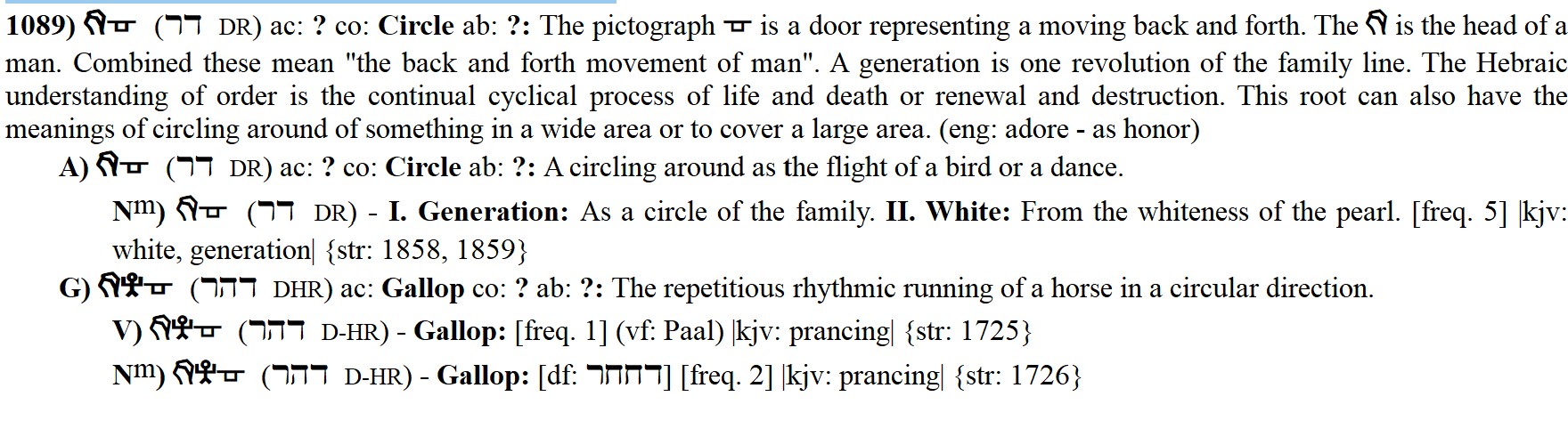
Isaac Mozeson in his work on Edenics, traces the English word ‘fanatic’ (fan) to the Hebrew word דהר ‘dahar.’ דהר ‘dahar’ has the meaning of a horse galloping or prancing. The connection to ‘fanaticus’ is seen in the galloping of a horse in a “wild, unstoppable motion.” Charging with zeal like a fanatic.
דהר ‘dahar’ comes from the root דר ‘dar’ (circle, ball).
Further connecting horses to this soccer game theme is horseplay. Horseplay came into the English in the 1500s related to rough play due to its comparison with the rough play of horses. “Horsing around” in modern day comes from this idea.
Horses are known for their rough play. They neck wrestle, mock bite, nip, rear up and hit each other with their front legs and chase each other. They also buck and gallop and leap when happy. This points to the Hebrew word for horse.
The word for horse in Hebrew is סוס ‘sus’ which is related to joy.
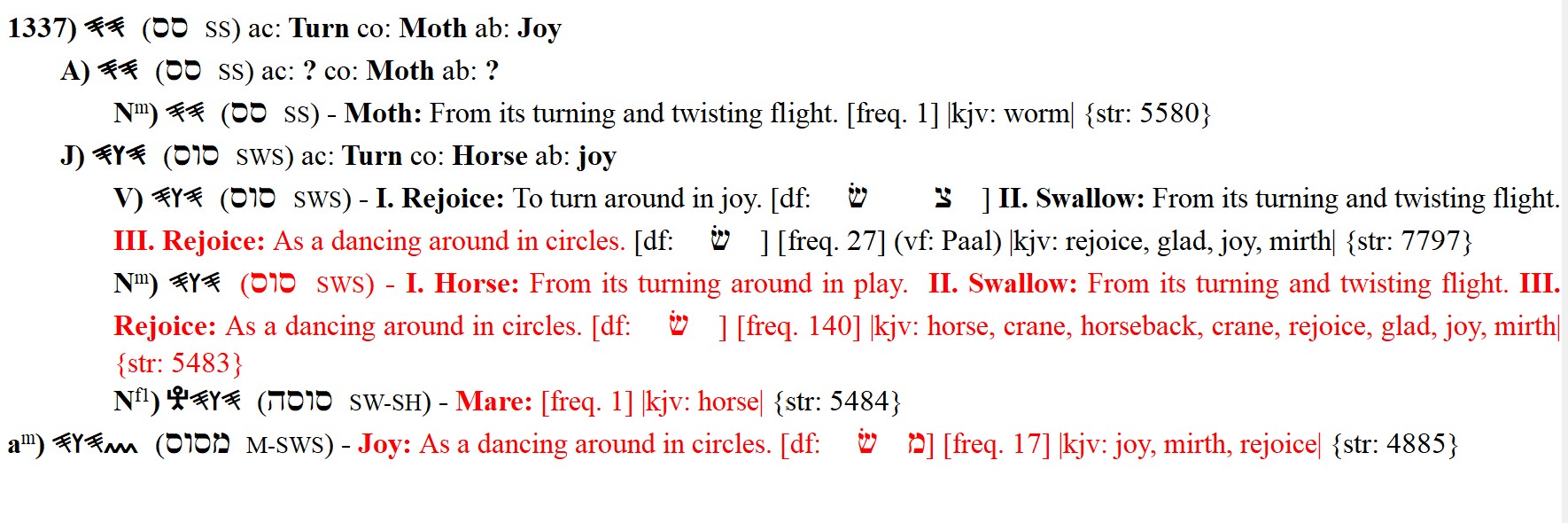
The Hebrew word for horse is סוס ‘sus’ literally means to rejoice as in a horse which turns around in play. We shall rejoice in the salvation of the Most High (Isaiah 12:3) when He returns with a shout (צהל ‘tsahal’) – literally the shouting of joy or the neighing of a horse) on a white horse (Revelation 19:11).
This is when we are made free, which is another connection to the horse as חופש ‘chophesh’ is translated as horse but also means free, as in a horse running free.
The English word ‘horse’ comes from the Hebrew word חרש ‘choresh’ which means to plow. Being yoked with Messiah, is where true freedom lies.
Mat 11:28 Come unto me, all ye that labour and are heavy laden, and I will give you rest.
Mat 11:29 Take my yoke upon you, and learn of me; for I am meek and lowly in heart: and ye shall find rest unto your souls.
Mat 11:30 For my yoke is easy, and my burden is light.
The return of the Lord with a shout is connected to the Feast of Trumpets (Yom Teruah).

רע ‘ra’ is the sound of a roaring crowd. It can be used in positive or negative senses. It was used at the worship of the golden calf (Exodus 32:17-18).
Israel shouted (רע ‘ra’ ) when bringing the ark of the covenant into battle (1 Samuel 4:5). The horse hears the roar of the battle and laughs (Job 39:19-25).
Horses and Feast of Trumpets
The word in Hebrew for the neighing of a horse is צהל ‘tsahal’ which means the shouting of a voice as in joy or singing or neighing. Teruah is described as the ‘joyful’ sound (Psalm 98:4). Resurrection and rejoicing are another main theme of Yom Teruah (Psalm 98:4, 6, 9; 89:15; Isaiah 44:21-23; 61:10 Zechariah 9:9). The Voice of Messiah is likened unto a shofar (Revelation 1:10) which gathers in the exiles (Isaiah 27:13).
סוס ‘soos’ (horse, joy) is related to the Hebrew word שוש ‘soos’ which also means to rejoice. This connection can be seen in Isaiah 35:1 where the dry land (dead) rejoices (סוס ‘soos’) when the desert blooms (resurrection). For the connection to Yom Teruah see then entire chapter of Isaiah 35, specifically verses 4 & 10 where Isaiah speaks of the Coming King and the rejoicing of the redeemed.
שוש ‘soos’ comes from שש ‘shesh’ which means white, as in the two front teeth. שש ‘shesh’ is also the word for linen, as in the white linen garments given to the righteous who are resurrected (Isaiah 61:10-11; Revelation 19:14).
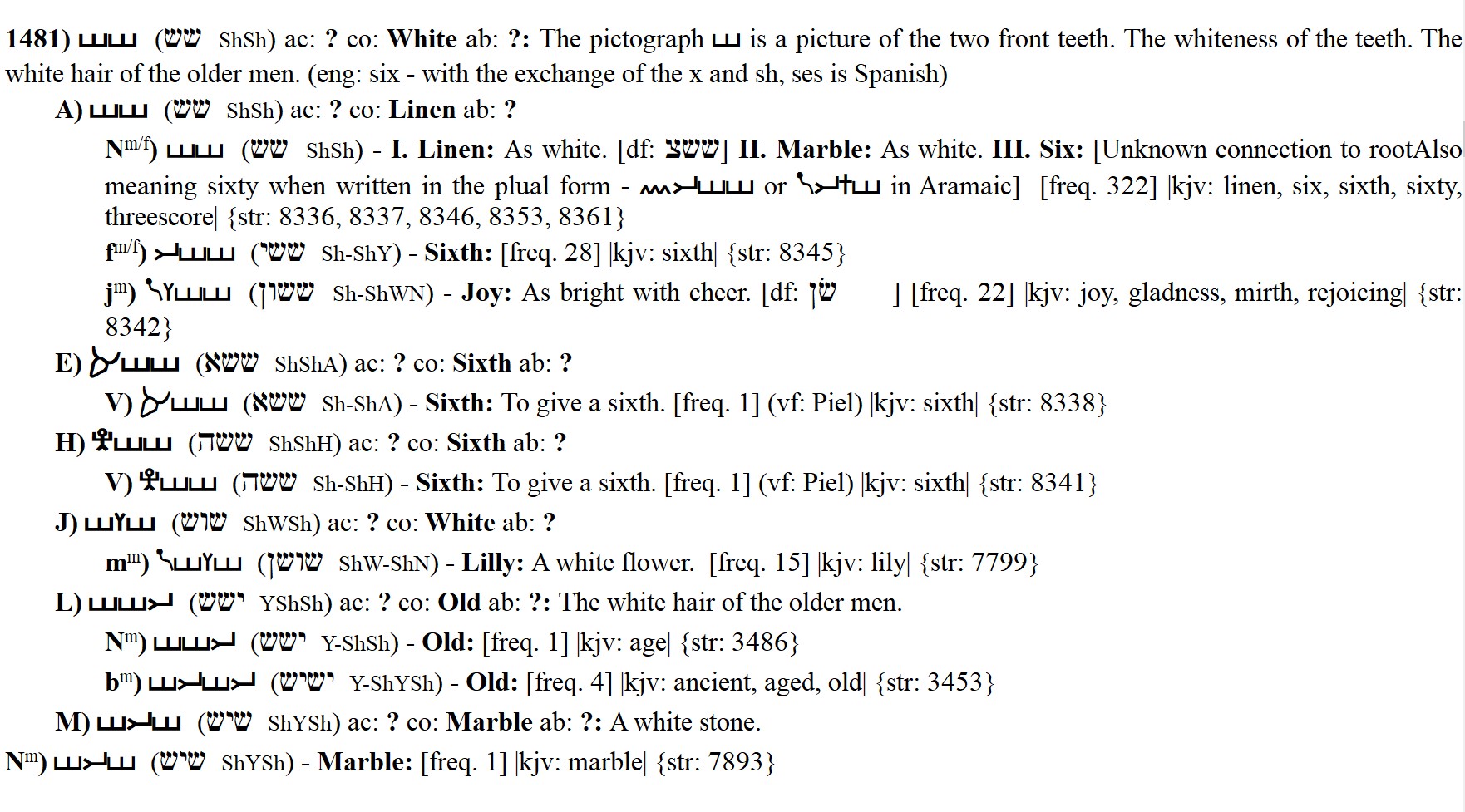
White is the color of resurrection. שש ‘shesh’ means the number six as well as the color white. The linen garments {שש ‘shesh’} designed for the priests were a shadow picture of the resurrected believers who are clothed in white, likened unto snow (hexagonal formation).
The Hebrew word for fine linen that the priests wore (Exodus 28:5, 8, 15 etc.) is שש ‘shesh’ which also means six and white.
The garments of the priest were worn to display that iniquity was not upon them (Exodus 28:43). The white linen is the righteousness of the saints (Revelation 19:7-9). What is Righteousness? It is the Word/Messiah. Righteousness came forth from Messiah’s work on the cross (Daniel 9:24; Romans 5:19; 1 Corinthians 1:30; 2 Corinthians 5:21).
Rom 5:17 For if by one man’s offence death reigned by one; much more they which receive abundance of grace and of the gift of righteousness shall reign in life by one, Jesus Christ.)
Rom 5:18 Therefore as by the offence of one judgment came upon all men to condemnation; even so by the righteousness of one the free gift came upon all men unto justification of life.
Rom 5:19 For as by one man’s disobedience many were made sinners, so by the obedience of one shall many be made righteous.
2Co 5:21 For he hath made him to be sin for us, who knew no sin; that we might be made the righteousness of God in him.
His body is clothed in garments of righteousness
Isa 61:10 I will greatly rejoice {שׂושׂ אשׂישׂ ‘sos asiys’} in the LORD, my soul shall be joyful {גּיל ‘giyl’} in my God; for he hath clothed me with the garments of salvation, he hath covered me with the robe of righteousness, as a bridegroom decketh himself with ornaments, and as a bride adorneth herself with her jewels.
Rom 13:14 But put ye on the Lord Jesus Christ, and make not provision for the flesh, to fulfil the lusts thereof.
Gal 3:27 For as many of you as have been baptized into Christ have put on Christ.
Rev 19:8 And to her was granted that she should be arrayed in fine linen, clean and white: for the fine linen is the righteousness of saints.
Rev 19:11 And I saw Heaven being opened. And, behold! A white horse, and He sitting on it having been called Faithful and True. And He judges and wars in righteousness.
Rev 19:12 And His eyes were as a flame of fire, and on His head many diadems, having a name that had been written, which no one knows except Himself;
Rev 19:13 and having been clothed in a garment which had been dipped in blood. And His name is called The Word of God.
Rev 19:14 And the armies in Heaven followed Him on white horses, being dressed in fine linen, white and pure.
Rev 19:15 And out of His mouth goes forth a sharp sword, that with it He might smite the nations. And He will shepherd them with an iron rod. And He treads the winepress of the wine of the anger and of the wrath of God Almighty.
Rev 19:16 And He has on His garment and on His thigh a name having been written: KING OF KINGS AND LORD OF LORDS.
The shofar sound is associated with joy
Psa 89:15 Blessed is the people knowing the joyful sound; O Jehovah, they shall walk in the light of Your face.
Psa 98:5 Sing praise to Jehovah with the lyre; with the lyre and the voice of a song.
Psa 98:6 With trumpets and the sound of a horn, make a joyful noise before Jehovah the King.
Scripture declares that believers find pleasure/joy in their King, the Son.
Psa 149:2 Let Israel rejoice in him that made him: let the children of Zion be joyful in their King.
Zec 9:9 Rejoice greatly, O daughter of Zion; shout, O daughter of Jerusalem: behold, thy King cometh unto thee: he is just, and having salvation; lowly, and riding upon an ass, and upon a colt the foal of an ass.
Isa 12:2 Behold, God is my salvation; I will trust, and not be afraid: for the LORD JEHOVAH is my strength and my song; he also is become my salvation {ישׁוּעה ‘yeshuah’ – source of the name Jesus}.
Isa 12:3 Therefore with joy shall ye draw water out of the wells of salvation {ישׁוּעה ‘yeshuah’}.
Isa 25:9 And it shall be said in that day, Lo, this is our God; we have waited for him, and he will save us: this is the LORD; we have waited for him, we will be glad and rejoice in his salvation {ישׁוּעה ‘yeshuah’}
1Jo 1:1 That which was from the beginning, which we have heard, which we have seen with our eyes, which we have looked upon, and our hands have handled, of the Word of life;
1Jo 1:2 (For the life was manifested, and we have seen it, and bear witness, and shew unto you that eternal life, which was with the Father, and was manifested unto us;)
1Jo 1:3 That which we have seen and heard declare we unto you, that ye also may have fellowship with us: and truly our fellowship is with the Father, and with his Son Jesus Christ.
1Jo 1:4 And these things write we unto you, that your joy may be full.
Cheer

The English word cheer traces back to the Latin ‘cara’ which means face and the Greek κάρα ‘kara’ which means head or face. The original meaning had to do with the expression on the face. By the 16th to 17th centuries it mean “shout of encouragement or joy.”
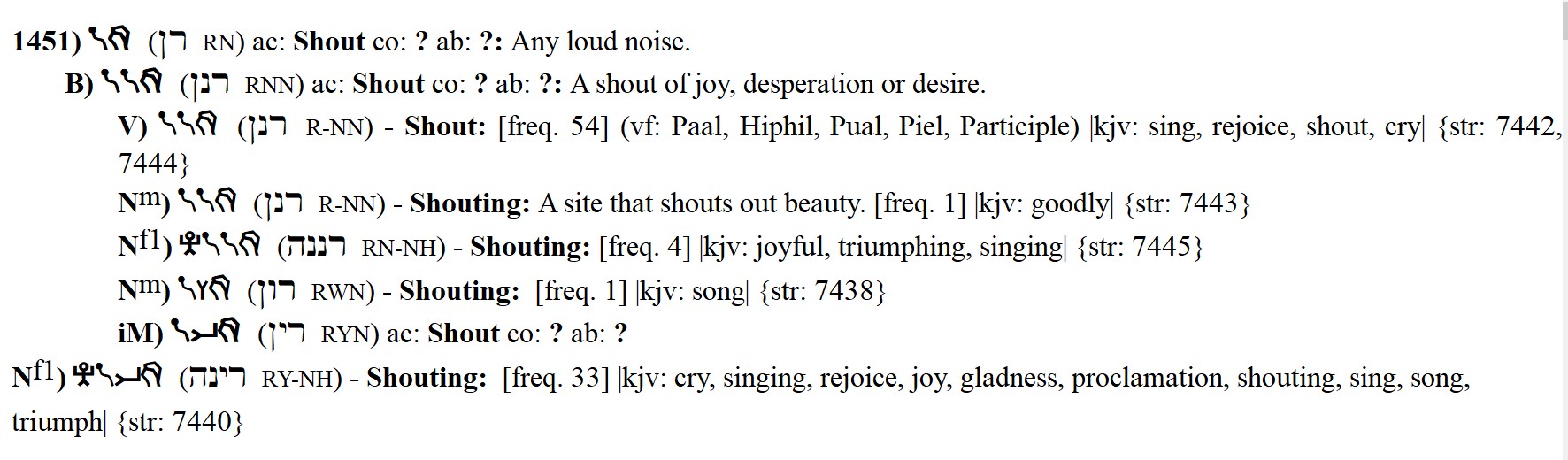
In Hebrew, רִנָּה ‘rinnah’ is a joyful shout, a “cheer” of the crowd.
Psa 126:1 A Song of degrees. When the LORD turned again the captivity of Zion, we were like them that dream.
Psa 126:2 Then was our mouth filled with laughter, and our tongue with singing (רִנָּה ‘rinnah’): then said they among the heathen, The LORD hath done great things for them.
Isa 35:10 And the ransomed of the LORD shall return, and come to Zion with songs (רִנָּה ‘rinnah’) and everlasting joy (שׂשׂן ‘sason’) upon their heads: they shall obtain joy (שׂשׂן ‘sason’) and gladness (שמחה ‘simchah’), and sorrow and sighing shall flee away.
Psa 95:1 O come, let us sing (רנן ‘ranan’) unto the LORD: let us make a joyful noise (רוע ‘rua’) to the rock of our salvation.
Psa 95:2 Let us come before his presence with thanksgiving, and make a joyful noise (רוע ‘rua’) unto him with psalms.
Another Hebrew for cheer is שמחה ‘simchah’ from שמח ‘samach.’

H8057
שׂמחה
śimchâh
BDB Definition:
- joy, mirth, gladness
1a) mirth, gladness, joy, gaiety, pleasure
1b) joy (of God)
1c) glad result, happy issue
Part of Speech: noun feminine
A Related Word by BDB/Strong’s Number: from H8056
Joy and dancing
Psa 30:11 Thou hast turned for me my mourning into dancing: thou hast put off my sackcloth, and girded me with gladness (שמחה ‘simchah’);
Psa 30:12 To the end that my glory may sing praise to thee, and not be silent. O LORD my God, I will give thanks unto thee for ever.
Psa 149:1 Praise ye the LORD. Sing unto the LORD a new song, and his praise in the congregation of saints.
Psa 149:2 Let Israel rejoice (שמח ‘samach’) in him that made him: let the children of Zion be joyful (גיל ‘giyl’ – spin around) in their King.
Psa 149:3 Let them praise his name in the dance (מחל ‘machol’ – dance in a circle): let them sing praises unto him with the timbrel and harp.
Psa 149:4 For the LORD taketh pleasure in his people: he will beautify the meek with salvation.
The English word cheer traces back to the Latin ‘cara’ which means face and the Greek κάρα ‘kara’ which means head or face. The original meaning had to do with the expression on the face. By the 16th to 17th centuries it mean “shout of encouragement or joy.”
The Greek κάρα ‘kara’ is phonetically and conceptually related to the word χαρά ‘chara’ which means joy, delight, gladness. κάρα ‘kara’ is the face or head that shows joy. χαρά ‘chara’ is the inner joy that lights up the face. χαρά ‘chara’ comes from the root χαίρω ‘chairo.’
Rom 14:17 For the kingdom of God is not meat and drink; but righteousness, and peace, and joy (χαρά ‘chara’) in the Holy Ghost.
Gal 5:22 But the fruit of the Spirit is love, joy (χαρά ‘chara’), peace, longsuffering, gentleness, goodness, faith,
Gal 5:23 Meekness, temperance: against such there is no law.
1Pe 1:8 Whom having not seen, ye love; in whom, though now ye see him not, yet believing, ye rejoice with joy (χαρά ‘chara’) unspeakable and full of glory:
Php 4:4 Rejoice (χαίρω ‘chairo’) in the Lord alway: and again I say, Rejoice.
Rom 5:11 And not only so, but we also joy {καυχάομαι ‘kauchaomai’} in God through our Lord Jesus Christ, by whom we have now received the atonement.
Raising the arms in joy
Hab 3:18 Yet I will rejoice {עלז ‘alaz} in the LORD, I will joy in the God of my salvation.

Raising the arms in joy is displayed in three Hebrew words {עלץ ‘alats,’ עלס ‘alas,’ עלז ‘alaz’} which are translated rejoice, joy, triumph.
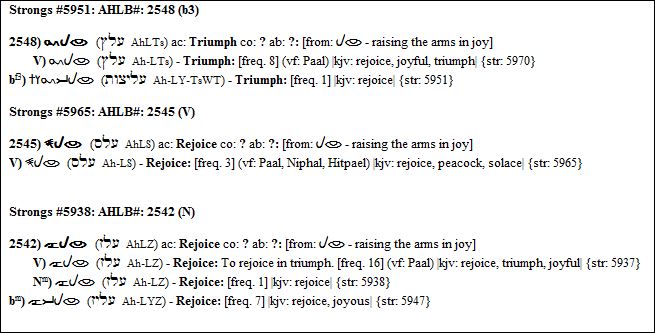
All three words come from the root word על ‘al’ which means to raise the arms (in joy). על ‘al’ is the yoke/cross lifted up, pointing to the cross on the shoulder of Messiah in which His outstretched arms brought forth victory.
Gen 22:3 And Abraham started up early {שכם ‘sheckem’ – shoulder} in the morning and saddled his ass, and he took two of his youths with him, and his son Isaac. And he split wood for a burnt offering, and rose up and went to the place which God had said to him.
This is the portion of Scripture which brings forth an incredible prophecy of the Son of God who would Himself the lamb.
Gen 22:8 And Abraham said, My son, God will provide himself a lamb for a burnt offering: so they went both of them together.
Scripture declares this promise was fulfilled in Jesus.
Joh 1:29 The next day John seeth Jesus coming unto him, and saith, Behold the Lamb of God, which taketh away the sin of the world.
Joh 1:30 This is he of whom I said, After me cometh a man which is preferred before me: for he was before me.
Joh 1:31 And I knew him not: but that he should be made manifest to Israel, therefore am I come baptizing with water.
Joh 1:32 And John bare record, saying, I saw the Spirit descending from heaven like a dove, and it abode upon him.
Joh 1:33 And I knew him not: but he that sent me to baptize with water, the same said unto me, Upon whom thou shalt see the Spirit descending, and remaining on him, the same is he which baptizeth with the Holy Ghost.
Joh 1:34 And I saw, and bare record that this is the Son of God.
Joh 1:35 Again the next day after John stood, and two of his disciples;
Joh 1:36 And looking upon Jesus as he walked, he saith, Behold the Lamb of God!
The binding of Isaac was a prophetic foreshadow of the crucifixion of Christ Jesus.
Heb 11:16 But now they desire a better country, that is, an heavenly: wherefore God is not ashamed to be called their God: for he hath prepared for them a city.
Heb 11:17 By faith Abraham, when he was tried, offered up Isaac: and he that had received the promises offered up his only begotten son,
Heb 11:18 Of whom it was said, That in Isaac shall thy seed be called:
Heb 11:19 Accounting that God was able to raise him up, even from the dead; from whence also he received him in a figure.
Gen 22:14 And Abraham called the name of that place Jehovahjireh: as it is said to this day, In the mount of the LORD it shall be seen.
Jesus declared that Abraham saw His day. This was a declaration that He was God who would provide Himself a lamb for the sacrifice.
Joh 8:56 Your father Abraham rejoiced to see my day: and he saw it, and was glad.
Joh 8:57 Then said the Jews unto him, Thou art not yet fifty years old, and hast thou seen Abraham?
Joh 8:58 Jesus said unto them, Verily, verily, I say unto you, Before Abraham was, I am.
Gen 22:14 ויקרא אברהם שׁם־המקום ההוא יהוה יראה אשׁר יאמר היום בהר יהוה יראה׃
Literally, in/on the mountain God will be seen.

Abraham calls the place “Jehovah Jireh” (Jehovah will be seen) יראה ‘yireh’ is in the Kal stem, 3rd person masculine singular future tense. The LORD did indeed show Himself as the Lamb when Jesus hung on the cross providing salvation to mankind.
עלץ ‘alats,’ עלס ‘alas,’ עלז ‘alaz’ display the physical picture of the Hebrew word HALLELUJAH!
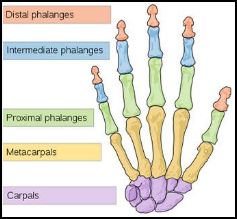
The word HalleluYah is used 27 times (23 times in the TaNaKH and 4 times in the New Testament) in the Bible corresponding to the 27 bones in the human hand. This will be spoken of in more detail later.
The literal meaning of praise is to raise up the hands.
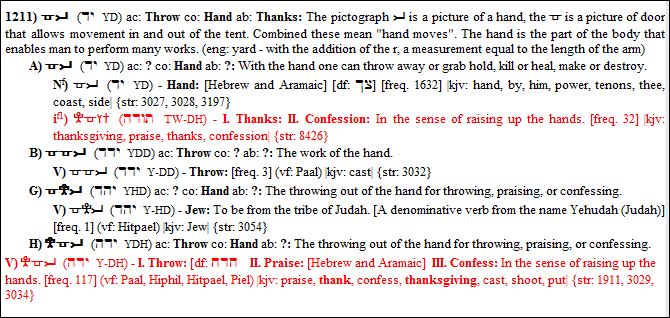
Hallelujah comes from the word הלל ‘halel’ which consists of the letter ה ‘heh’ which pictures a man outstretched arms and the letter ל ‘lamed’ which is a picture of a shepherd’s staff. Again, the imagery of man with arms lifted up is seen. This word is translated at praise, glory, boast, mad, shine, foolish, rage, and celebrate.

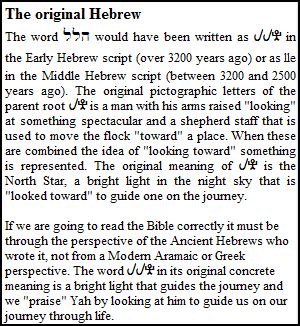
Here we see that הלל ‘halel’ is speaking of a journey to a destination. This is pictured in the game of soccer when a goal is scored.
Praise is depicted physically by the raising of the arms.
The Messiah, the Word, is likened to the Arm of the LORD (Isaiah 53:1). The bones of the human arm and hand are a picture of the Word. The Messiah is specifically described as the ‘Hand’ of God (Psalm 118:14-16; Isaiah 48:13; Acts 5:31 etc.). The human hand consists of 27 bones which correspond to the 27 books of the New Testament. These bones are divided into 3 parts. 5 metacarpal bones of the palm corresponding to the Gospels & Revelation. 14 bones of the fingers corresponding to the epistles of Paul and 8 bones in the wrist corresponding to the epistles of the other Apostles…
The hand is connected to the three bones of the Arm (Isaiah 40:10; 63:5-8; Psalm 44:3; Deuteronomy 33:2 etc.) which correspond to the Torah, Prophets & Writings. The arm connects to the shoulder of which we are yoked to the Most High (Matthew 11:30), walking in one consent (Zephaniah 3:9).
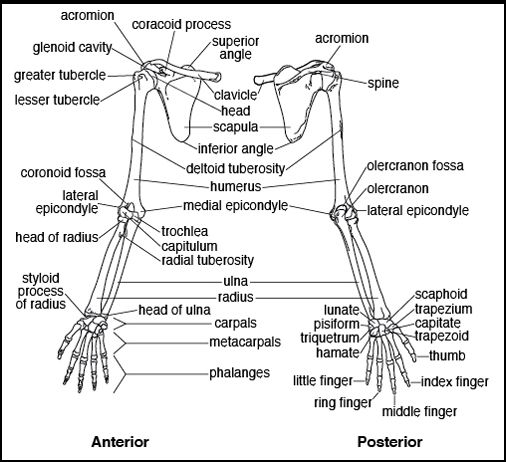
In short, the 27 bones of the hand connect to 3 bones in the arm which equals 30. 30 bones in each arm and hand add up to 60. This is amazing as the arms connect to the shoulders which consist of the 2 shoulder bones themselves that are connected to 2 clavicles and 2 scapulas which = 6. 60+6= 66…the exact number of books in the Biblical canon.
The Hebrew word for shoulder is שכם ‘shekhem’ which is also linked to the resurrection as the word literally means to rise early and place a load on the shoulders in order to depart.
Gen 22:3 And Abraham started up early { שכם ‘shekhem’} in the morning and saddled his ass, and he took two of his youths with him, and his son Isaac. And he split wood for a burnt offering, and rose up and went to the place which God had said to him.
Rev 22:16 I, Jesus, sent My angel to testify these things to you over the assemblies. I am the Root and Offspring of David, the bright and morning Star.
Rev 3:7 And to the angel of the assembly in Philadelphia, write: These things says the Holy One, the True One, the One having “the key of David,” “the One opening, and no one shuts; and shuts, and no one opens:” Isa. 22:22
Isa 22:22 And the key of the house of David I will lay on his shoulder, so that he opens, and no one shuts; and he shuts, and no one opens.
The English word ‘clavicle’ or ‘collarbone’ comes from the Latin word ‘clavicula’ which means a key. In the days of Messiah, keys were shaped like the modern day letter F.
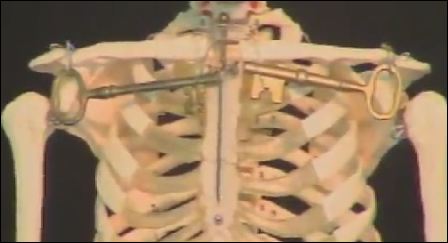
F is the 6th letter in the English alphabet corresponding to the Hebrew letter ו ‘vav’. ‘Vav’ is the nail.The Hebrew letter ו ‘vav’ {spelled וו} is the picture of a tent peg, nail or hook (Exodus 26:32, 37; 27:10-11, 27 etc). Messiah Jesus is likened to a tent peg/nail who holds the key of David (Isaiah 22:22-23; Revelation 3:7).The letter ו ‘vav’ is also used as a conjunction (“and”) in the Hebrew language, connecting one thing to another as a tent peg is used to connect or attach the tent to the ground. Christ Jesus is the one who connects mankind together (John 12:32), and most importantly connects mankind to God (1 Timothy 2:5).
Isa 22:22 And the key of the house of David I will lay on his shoulder, so that he opens, and no one shuts; and he shuts, and no one opens.
Isa 22:23 And I will drive him as a nail in a sure place; and he shall be for a throne of glory to his father’s house.
The muscle that hangs off of the clavicle is the deltoid
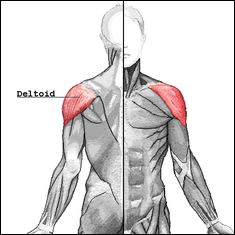
The deltoid is called so because it is in the shape of the Greek letter Δ ’delta’ (triangle). The Greek letter Δ ’delta’ comes from the Hebrew letter ד ‘dalet’ which means a door.
The key (clavicle) to the house of David. דוד ‘david’ in Hebrew is 2 ‘dalets’ and 1 ‘vav.’ 2 ‘deltoids’ and a nail/key.
The English word shoulder comes from the Hebrew word סבל ‘saval’ which means to bear a burden. This too points to Messiah.
Mat 11:29 Take My yoke upon you and learn from Me, because I am meek and lowly in heart, “and you will find rest to your souls.” Jer. 6:16
Mat 11:30 For My yoke is easy, and My burden is light.
The word for yoke in Matthew 11:29-30 is ζυγός ‘zugos’ which is used to translate multiple words in Hebrew. One is סבל ‘saval,’ mentioned above. ζυγός ‘zugos’ is also used to translate שכם ‘shekhem’ which means shoulder. In Matthew 11:29-30, ζυγός ‘zugos’ is referring to a yoke that a beast of burden carries while plowing a field. In Hebrew this is the word על ‘al.’ על ‘al’ also means to rise up, such as in the smoke of a burnt offering (Genesis 22:2).
על ‘al’ means to ‘see the staff.’ As seen in a previous study on the lamb, the letter ל ‘lamed’ in Hebrew is speaking of the goad or staff of the Shepherd. The value of this letter is 30. The word למד ‘lamed’ means to teach or make disciples. ל ‘lamed’ is also the 12th letter of the Hebrew alphabet, linking to the twelve tribes of Israel, His flock.
The Hebrew word יהודה ‘yehudah’ or Jew also has the numerical value of 30.
יהודה ‘yehudah’ comes from the Hebrew root ידה ‘yadah’ which means to raise the hands in confession, giving thanks or praise. Recall that the arms display the number 66, the number of books in the Bible. The Word.
It is interesting to note that in Song of Songs 5:6, ‘my beloved’ has a numerical value of 30 as well. This word in Hebrew is דוד ‘dod’ which means the bosom. דוד is also the spelling for David, mentioned above.
Isa 40:10 Behold, the Lord Jehovah will come with strength, and His arm {Isaiah 53 – His Arm is the Lamb} rules for Him. Behold, His reward is with Him, and His wage before Him.
Isa 40:11 He shall feed His flock like a shepherd; He shall gather lambs with His arm; and carry them in His bosom; those with young He will lead;
The Letter ה ‘heh’
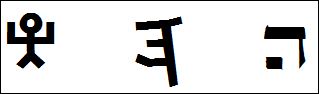
The Hebrew letter ה ‘heh’ {spelled הה} is the picture of a person looking at a great sight causing that person to take a deep breath or exhale. The ‘roar’ of a crowd with raised arms pictures this perfectly.
This word is used in Ezekiel 30:2 translated as ‘woe.’ היה ‘hayah’ which means to exist comes from this root word as our existence is dependent upon our breath. היה ‘hayah’ is the Hebrew source for “I AM” or “I Exist” (Exodus 3:14). Messiah Jesus is “I AM” (John 8:24, 28, 56-58; 13:18-19; 18:7-9; Mark 14:61-62).
The Letter ‘heh’ is linked to breath, and therefore to life. The pronunciation of the letter heh is the exhaling of breath. This is where life comes from (Genesis 2:7; 7:22). This breath comes from Messiah (Psalm 33:6; John 1:2-4; Lamentations 4:20).
The pictograph of the letter ה ‘heh’ is of a man with his arms stretched out. It was through the cross, where Messiah had is arms stretched out, that He revealed that He is “I AM”. In Genesis 22:7, God literally told Abraham that He would provide Himself as the lamb for sacrifice. In John 8:28, Jesus declared that we would see that He is the “I AM” on the cross.
Joh 8:28 Then Jesus said to them, When you lift up the Son of Man, then you will know that I AM; and from Myself I do nothing; but as My Father taught Me, these things I speak.
Hab 3:18 Yet I will rejoice in the LORD, I will joy in the God of my salvation.
Zep 3:14 Sing, O daughter of Zion; shout, O Israel; be glad and rejoice with all the heart, O daughter of Jerusalem.
Zep 3:15 The LORD hath taken away thy judgments, he hath cast out thine enemy: the king of Israel, even the LORD, is in the midst of thee: thou shalt not see evil any more.
Zep 3:16 In that day it shall be said to Jerusalem, Fear thou not: and to Zion, Let not thine hands be slack.
Zep 3:17 The LORD thy God in the midst of thee is mighty; he will save, he will rejoice over thee with joy; he will rest in his love, he will joy over thee with singing.
Psa 28:7 The LORD is my strength and my shield; my heart trusted in him, and I am helped: therefore my heart greatly rejoiceth; and with my song will I praise him.
1Sa 2:1 And Hannah prayed, and said, My heart rejoiceth in the LORD, mine horn is exalted in the LORD: my mouth is enlarged over mine enemies; because I rejoice in thy salvation.
Geometry
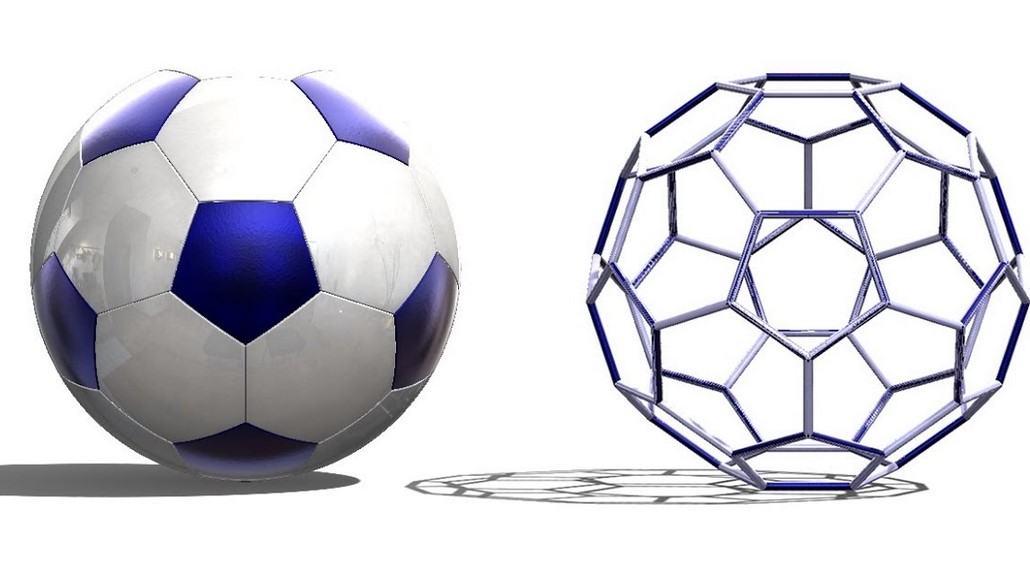
Einstein’s Theory of Relativity led scientists to depict the universe as a torus, others as a soccer ball. The soccer ball is a seen as a ‘dodecahedron’ which is also depicted as the shape of the universe. The Poincaré Dodecahedral Space has been proposed as the shape of the Universe. It is in the shape of a dodecahedron. In his theory, the universe is finite, positively curved 3-manifold without boundaries, space “wraps around” on itself.

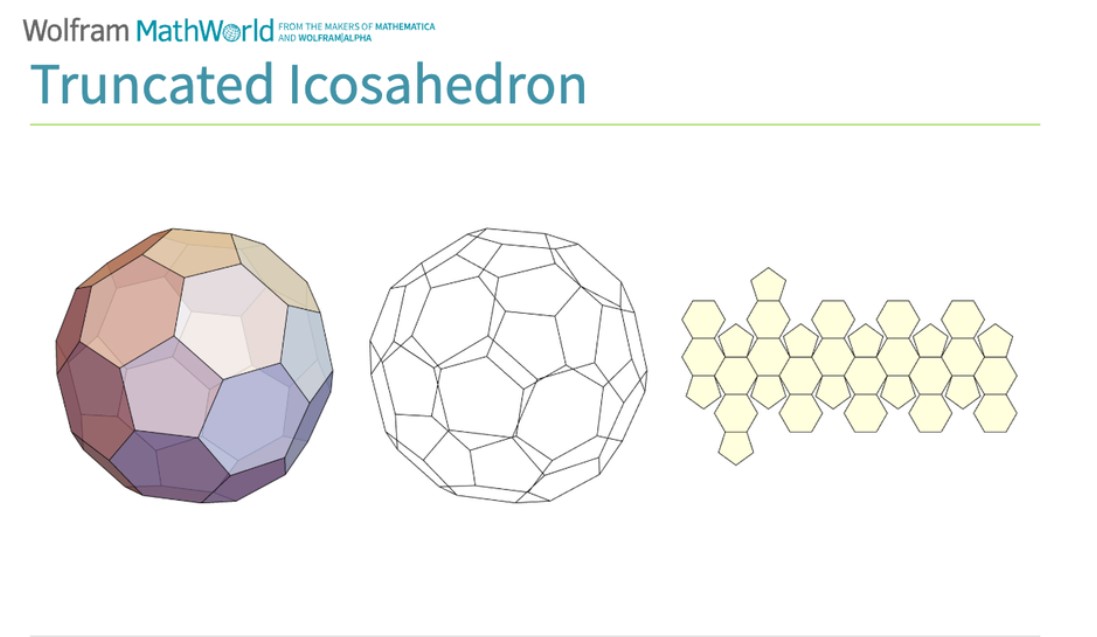
A dodecahedron has 12 pentagonal faces. The soccer ball “starts” as a regular icosahedron (20 triangular faces). The corners of the triangles are cut off making 20 hexagons and creating 12 pentagons making it a truncated icosahedron. Because of the 12 pentagons is still considered a dodecahedron. The 12 pentagons give the ball its curvature in spherical shape in the same way the 12 pentagons give the dodecahedron its volume.
The soccer ball is one of the “Perfect 5” Platonic Solids. Robert Moon at the University of Chicago demonstrated that the entire Periodic Table of Elements is based on the geometry of Platonic solids. Literally everything in the physical world is based on these same five forms.
Archimedean Solids are similar to Platonic Solids but have more than one type of polygon. The Truncated Icosahedron is the most famous of the Archimedean Solids. Both Platonic Solids and Archimedean Solids are Polyhedrons which are 3D shapes with flat polygonal faces, straight edges and corners (vertices). The soccer ball is the truncated icosahedron, an Archimedean solid. It has 32 faces (12 pentagons + 20 hexagons), 90 edges, and 60 vertices.
Pope Leo describes the truth of the Gospel as a multifaceted polyhedron.
“In this same vein, I too have reaffirmed that the Church “does not claim to possess a monopoly on truth,” [17] because truth is not a territory to be defended, but a good to be shared…What matters most is not occupying positions of power or defending cultural strongholds, but initiating good processes and enabling them to mature. In this way, the truth of the Gospel is not imposed from above, but grows over time within the concrete interweaving of lives, communities and cultures. This is not a truth that fears diversity, but instead welcomes and guides it. It does not eliminate conflicts, but transforms them, reuniting that which history tends to scatter. This concept can also be illustrated by the image of a multifaceted polyhedron, [19] in which the one truth of the Gospel is reflected from different angles.” {Pope Leo XIV’s encyclical Magnifica Humanitas}
Buckminsterfullerene – Bucky Balls
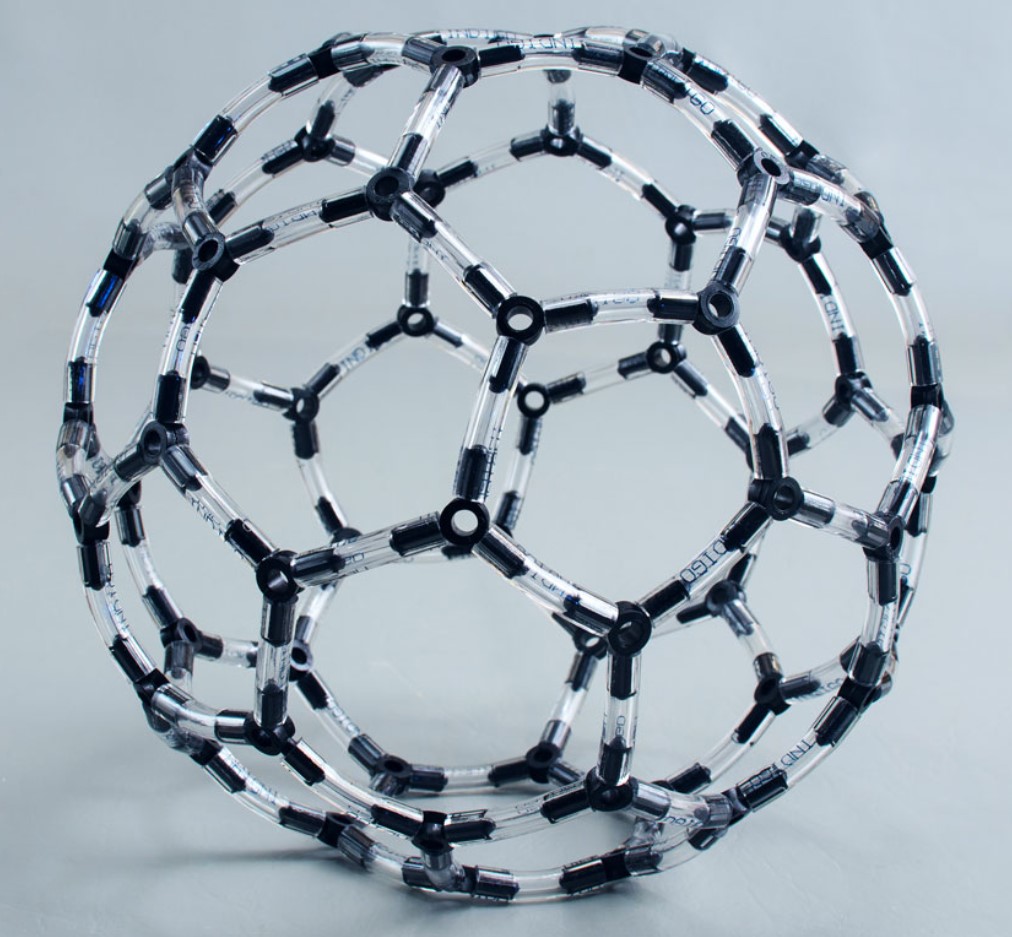
Buckyballs (C₆₀ Fullerenes) — Perfect Molecular Unity60 carbon atoms arranged exactly like the soccer ball: every atom is in an identical environment (one pentagon + two hexagons), creating absolute symmetry and extraordinary stability.
The structure is so harmonious that it occurs naturally in space and soot. Chemists describe it as “beautiful” and “the roundest, most symmetrical large molecule.”
“Buckminsterfullerene is a beautiful thing, with absolute symmetry. Every carbon is bound to three others, at the vertex of one pentagon and two hexagons. A nuclear magnetic resonance spectrum of the molecule reveals a single band.” {The story of buckyballs}
Bucky balls, named after Buckminster Fuller, consist of 60 points on the surface of a spherical shape where the distance from any point to its nearest neighboring three points on the sphere is identical for all points. Note that the surface consists of twelve phi-based pentagons, each one of which is connected to five of the twenty hexagons.
The coordinates of the 60 vertices of a Bucky ball centered on the origin of a 3D axis are all based on phi!
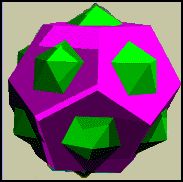
If this shape is rotated 180 degree and combined with the original, the edges of these two icosa-dodeca meet in a match to form a nest of full—or “great”—circles and 120 right triangles. This is the Universal Grid which Buckminster Fuller proposed to map the surface of a sphere.
In biology, this is the geometry of a cell membrane—the primary shape of biology. In geology, this is the Earth Grid. Earth’s major mountain ranges, mid-ocean ridges, continental faults, tectonic plates, and other geophysical features align along this global grid.
Now, imagine adding a 13th point at the center of the Icosahedron, and attaching it to all the other vertex points with flexible, stretchable rubber bands. With this, you can turn this rigid geometric form inside out. Then, the center becomes the periphery, and edge becomes core. Turning outside and inside out. 12 + 1 = 13 is the geometric key to unlock this topological transformation of spacetime through a higher dimension.
To the mathematician and physicist, this is the “torus”—the geometry of magnetism.
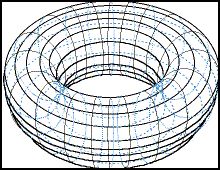
Thus, 12 + 1 = 13 is a geometric key to unlock 3-D space and open into higher dimension geometries. Turning inside out—in-folding—is a convenient, universal way to store information (“in-form”) in fractal packages. This turning in trick of time, space and geometry has many important applications in biology, physiology and psychology.
In water, this universal flowform is the shape of fluid in motion within a container. And since living water is water in motion, and since every living body is a water body, we are each encoded with and attuned to this rolling rhythmic geometry.
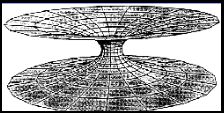
In math, this infolded space has negative curvature—space turning and folding and curling in on itself.
In physics, Einstein’s Theory of Relativity taught us that spacetime has a negative curvature- folded inward on itself. In biology, this is the shape of a red blood cell, full of hemoglobin, rich in magnetic iron.
In physics, Albert Einstein’s Theory of Relativity taught us that spacetime has a negative curvature—folded inward on itself.
Geodesic Domes
Buckyballs named after Buckminster Fuller because of the resemblance to his geodesic domes. The structure is incredibly stable due to its symmetry and the way the pentagons introduce curvature (hexagons alone would form a flat sheet like graphite).
Geodesic domes are hemispherical (or near-spherical) structures made of a network of triangular elements that approximate a sphere. They are lightweight yet exceptionally strong, distributing stress evenly across the lattice.
Geodesic domes stem from geodesics, the shortest paths between two points on a sphere (great circles). Fuller triangulated spherical surfaces for stability.
They are built by projecting and subdividing a Platonic solid (usually the icosahedron, with 20 triangular faces) onto a sphere.
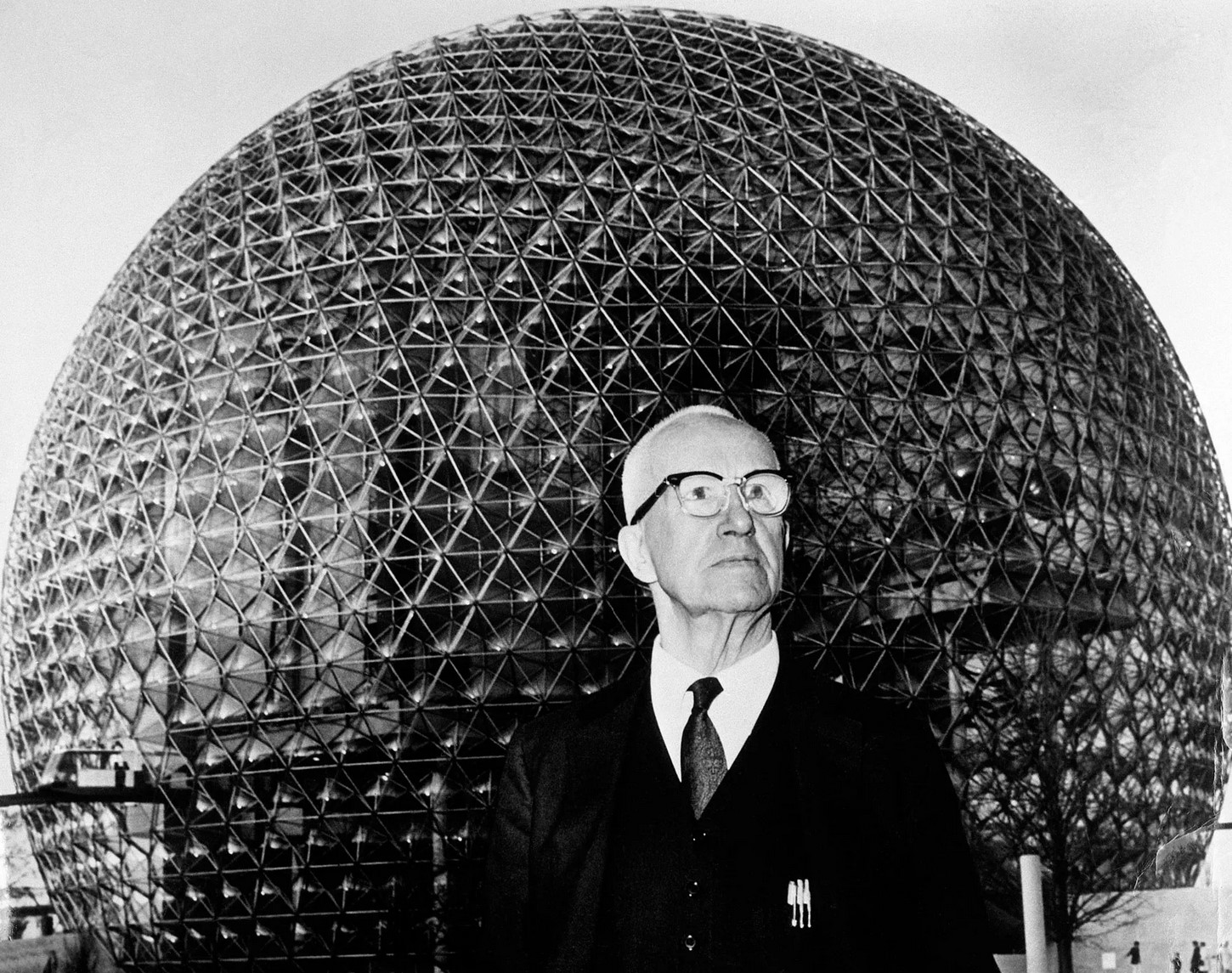
Triangles (the strongest shape) distribute stress evenly across the entire structure. The whole dome acts as one unified system, far stronger than traditional buildings.
Buckminster Fuller’s philosophy explicitly tied this to global unity: “Spaceship Earth,” doing more with less, and seeing humanity as one interconnected crew on a shared planet. His domes were meant to embody efficiency, harmony with nature, and a better unified future for mankind.
Euler’s Formula
The soccer ball exemplifies Euler’s formula (V − E + F = 2) and principles of spherical polyhedra, topology, and symmetry.
For any convex polyhedron (a 3D shape with flat polygonal faces, straight edges, and vertices, like a cube or soccer ball), the number of vertices (V), edges (E), and faces (F) satisfies:V − E + F = 2
Euler’s formula is a bridge between geometry, topology, and chemistry. It predicts that any closed fullerene-like structure needs exactly 12 pentagons. The Archimedean solids (especially the truncated icosahedron) give nature a perfect, highly symmetric template that appears at both macroscopic (soccer balls) and molecular scales (buckyballs).
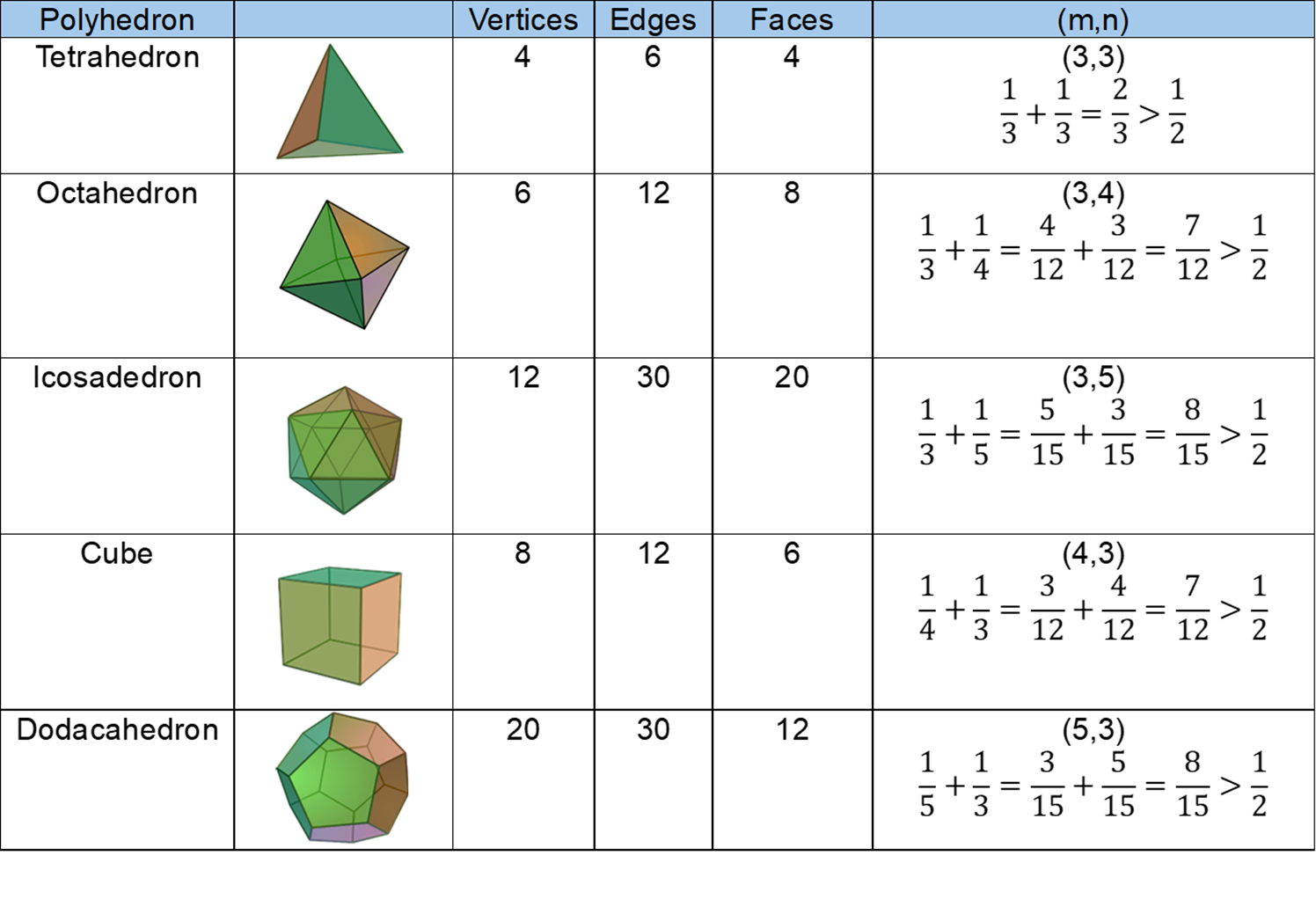
Soccer ball (truncated icosahedron): 60 vertices, 90 edges, 32 faces (12 pentagons + 20 hexagons) → 60 − 90 + 32 = 2.
“Although a soccer ball can be put together in many different ways, there is one design so ubiquitous that it has become iconic. This standard soccer ball is stitched or glued together from 32 polygons, 12 of them five-sided and 20 six-sided, arranged in such a way that every pentagon is surrounded by hexagons.”
…”soccer ball is approximately a sphere made of polygons, or what mathematicians call a spherical polyhedron. The places where the polygons come together—the vertices and edges of the polyhedron—trace out a map on the sphere, which is called a graph.” {The Topology and Combinatorics of Soccer Balls}
Graph Theory
Euler’s formula in graph theory refers to Euler’s polyhedral formula, which generalizes to planar graphs. It is one of the foundational results in the field. Euler’s formula connects Archimedean solids and buckyballs.
Graph theory is a branch of mathematics that studies graphs, which are mathematical structures used to model pairwise relations between objects. Graph theory is the math of networks and connections. In other words, it is a set of dots (vertices) connected by lines (edges).
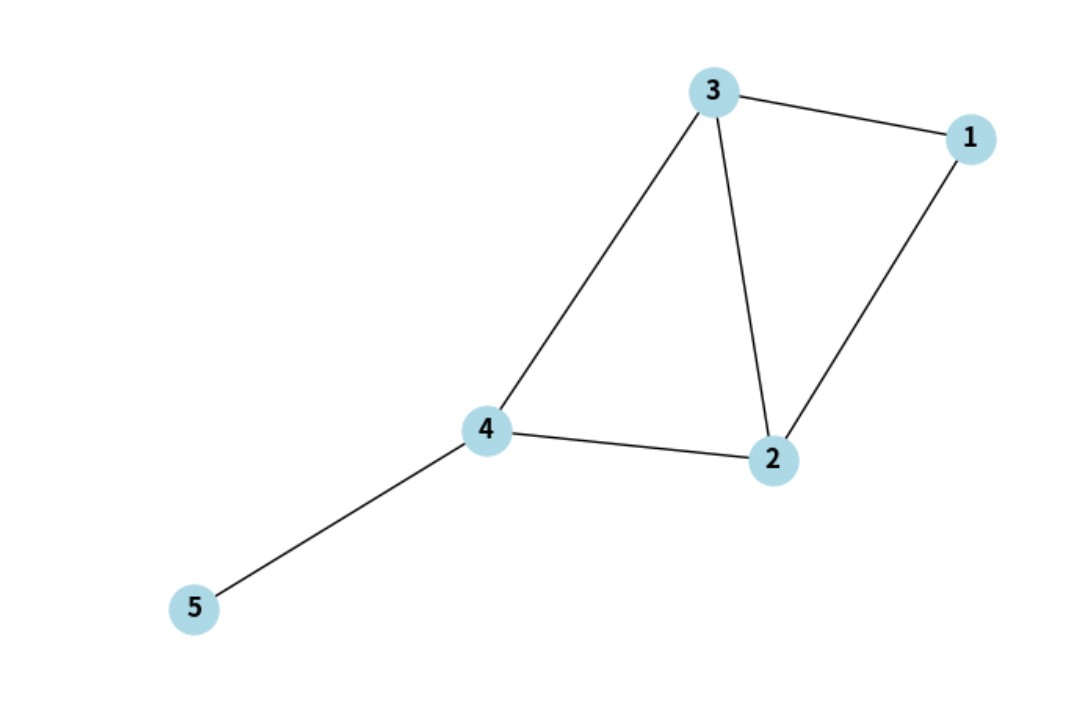
In graph theory, the soccer ball corresponds to the truncated icosahedral graph:
Vertices = points (nodes)
Edges = lines connecting them
Faces = the cycles (pentagons and hexagons) that enclose regions
The soccer ball graph is 3-regular (each vertex has degree 3) and polyhedral, so it obeys Euler’s formula. This makes it a key example in studying fullerene molecules (buckyballs like C₆₀ have the same structure).
The word “graph” comes from the Greek word γράφειν ‘graphein’ which means “to scratch,” “to carve,” or “to draw lines” (as with a stylus on wax tablets or clay). This evolved into “to write” or “to express by written characters.” Related words are γραφή ‘graphe’ which mean “writing,” “drawing,” or “written record” and γραφός ‘graphos’ which means “writing” or “writer.”
γράφω ‘grapho comes from γράφη ‘graphe’ which means a writing, drawing or record. Both words are used of the Scriptures.
The Holy Scriptures, the Holy Letters
2Ti 3:15 And that from a child thou hast known the holy scriptures (γράμμα ‘gramma’) , which are able to make thee wise unto salvation through faith which is in Christ Jesus.
2Ti 3:16 All scripture (γραφή ‘graphe’) is given by inspiration of God, and is profitable for doctrine, for reproof, for correction, for instruction in righteousness:
γραφή ‘graphe’
G1124
γραφή
graphē
Thayer Definition:
- a writing, thing written
Letters -γράμμα ‘gramma’
Joh 7:15 And the Jews marvelled, saying, How knoweth this man letters (γράμμα ‘gramma’), having never learned?
Learning – γράμμα ‘gramma’
Act 26:24 And as he thus spake for himself, Festus said with a loud voice, Paul, thou art beside thyself; much learning (γράμμα ‘gramma’) doth make thee mad.
G1121
γράμμα
gramma
gram’-mah
From G1125; a writing, that is, a letter, note, epistle, book, etc.; plural learning: – bill, learning, letter, scripture, writing, written.
Rom 2:27 And shall not uncircumcision which is by nature, if it fulfil the law, judge thee, who by the letter (γράμμα ‘gramma’) and circumcision dost transgress the law?
Rom 2:28 For he is not a Jew, which is one outwardly; neither is that circumcision, which is outward in the flesh:
Rom 2:29 But he is a Jew, which is one inwardly; and circumcision is that of the heart, in the spirit, and not in the letter (γράμμα ‘gramma’); whose praise is not of men, but of God.
Rom 7:6 But now we are delivered from the law, that being dead wherein we were held; that we should serve in newness of spirit, and not in the oldness of the letter (γράμμα ‘gramma’).
2Co 3:6 Who also hath made us able ministers of the new testament; not of the letter (γράμμα ‘gramma’), but of the spirit: for the letter killeth, but the spirit giveth life.
Luk 23:38 And a superscription also was written over him in letters (γράμμα ‘gramma’) of Greek, and Latin, and Hebrew, THIS IS THE KING OF THE JEWS.
Maps
The earth itself can be viewed as a vast “map” divided into regions (continents, nations, soils). Mathematically, any such division on a plane/sphere is a planar graph. In Modern Hebrew, the Earth (globe) is often called כדור הארץ ‘kadur ha’regel’ (“ball of the Earth”).
Graph theory has deep and historic connections to maps. In fact, some of the earliest and most famous problems in graph theory came directly from cartography (map-making). Euler’s formula in graph theory became a cornerstone of topology and graph theory in the 19th–20th centuries.
For a connected planar graph (or polyhedron), Euler’s formula states:V−E+F=2V – E + F = 2V – E + F = 2
V = vertices (points/nodes)
E = edges (connections/lines)
F = faces (regions, including the outer infinite face)
This is a foundational result in topology and graph theory. Euler developed it while solving the Seven Bridges of Königsberg problem (1736), essentially founding graph theory by modeling land masses as vertices and bridges as edges. It reveals deep invariants in structure, how networks hold together regardless of specific shape.
This is a graph theory problem: Each country/region = a vertex.
Shared border = an edge connecting two vertices.
The Four Color Theorem (and the earlier Five Color Theorem) were developed specifically to solve the map coloring problem in graph theory.
Four Color Theorem & Five Color Theorem
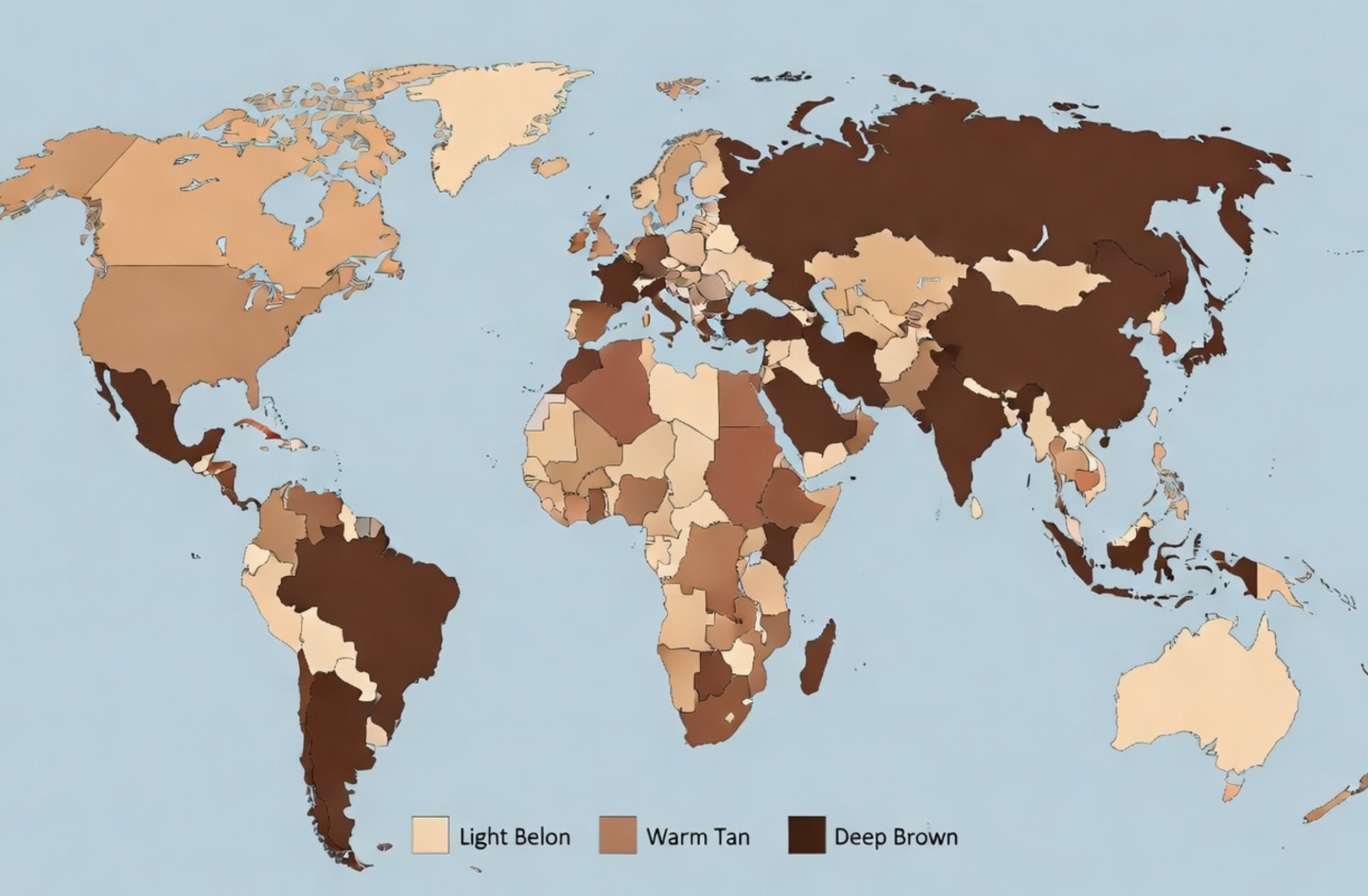
Every map can be converted into a planar graph (each country = vertex, shared border = edge). The Four Color Theorem says the chromatic number of any planar graph is at most 4. This was one of the biggest problems in graph theory for over a century. It was one of the first major theorems proved with heavy computer assistance and is a cornerstone of planar graph theory.
This is a foundational result in topology and graph theory. Euler developed his formula while solving the Seven Bridges of Königsberg problem (1736), essentially founding graph theory by modeling land masses as vertices and bridges as edges. It reveals deep invariants in structure, how networks hold together regardless of specific shape.
The soccer ball (truncated icosahedron) is a polyhedral graph that is planar when projected. It can be colored with just 3 or 4 colors in various ways, beautifully illustrating the theorem. While the Four Color Theorem (that 4 colors suffice) is famous for requiring a massive computer proof in 1976, the Five Color Theorem has a short, elegant human proof that relies heavily on Euler’s formula. Euler’s formula (V − E + F = 2) for planar graphs/maps is the key tool.
It easily proves the Five Color Theorem: Any planar map can be colored with at most 5 colors so no two adjacent regions have the same color.
4 Colors
Just as the Four Color Theorem shows that only 4 colors are needed to properly color any map (no matter how complex the divisions), humanity’s visible diversity (skin tones) corresponds to 4 main soil colors. Soil colors (white/red/yellow/brown) arise from the same “earth” (אדמה ‘adamah’).
Skin tones correspond to these foundational soil colors. All soil colors come from the same earth. All skin tones come from the same first man formed from that earth.
Man is linked to the earth in the word for man (adam), and the word for ground (adamah).
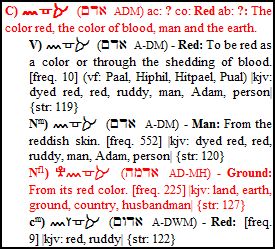
Adam/adamah comes from the root:
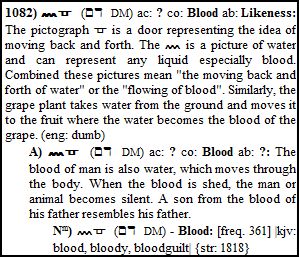
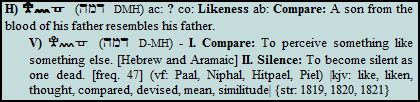
From one blood all mankind comes forth. In Adam, all the colors of the dust dwelled.
Act 17:26 And hath made of one blood all nations of men for to dwell on all the face of the earth, and hath determined the times before appointed, and the bounds of their habitation;
Act 17:27 That they should seek the Lord, if haply they might feel after him, and find him, though he be not far from every one of us:
Act 17:28 For in him we live, and move, and have our being; as certain also of your own poets have said, For we are also his offspring.
In Christ, the divisions are transcended. The “fifth color” is seen.
The Four Color Theorem says any planar map (division of the plane into regions) can be colored with at most 4 colors so that no two regions sharing a border have the same color. The Five Color Theorem (easier proof using Euler’s formula) shows that 5 always works.
In the actual proofs and drawings, one of those colors is often assigned to the infinite outer face (the unbounded region surrounding the entire map). So in a sense, the “fifth” color can be thought of as belonging to what is outside the finite regions — the background or encompassing space.
The four colors are sufficient for all the finite, bounded regions of the planar map (the “world” as divided nations, peoples, visible diversity). The outer infinite face is the unbounded region surrounding everything. In many proofs and illustrations, it can be treated as needing its own color or as the encompassing background that holds all the regions together.
The fifth outer “color” is that which is outside the map, transcendent, heavenly. It encompasses and unifies the entire creation without being limited to the earthly divisions. This points to Christ and the new creation/birth from above (baptism, resurrection on the third day, the one new humanity where outward distinctions like color no longer define ultimate identity — Galatians 3:28, Colossians 3:11).
Gal 3:26 For ye are all the children of God by faith in Christ Jesus.
Gal 3:27 For as many of you as have been baptized into Christ have put on Christ.
Gal 3:28 There is neither Jew nor Greek, there is neither bond nor free, there is neither male nor female: for ye are all one in Christ Jesus.
In the Last Adam (1 Corinthians 15:47), there is no difference in color, race, etc.
Col 3:10 and having put on the new, having been renewed in full knowledge according to the image of the One creating him,
Col 3:11 where there is no Greek and Jew, circumcision and uncircumcision, foreigner, Scythian, slave or freeman, but Christ is all things and in all.
Col 3:12 Therefore, as elect ones of God, holy and beloved, put on a heart of compassions, kindness, humility, meekness, long-suffering,
Rom 10:12 For there is no difference both of Jew and of Greek, for the same Lord of all is rich toward all the ones calling on Him.
In map coloring, we “color” regions so adjacent ones are distinct. In the spiritual picture, baptism “immerses” people into one body while preserving individual identity within the unified whole. The “colors” (diversity) remain, but they are now part of one harmonious map/body.
Interestingly, the word for color in Hebrew is צבע ‘tseva’ from the same root as צבי ‘tsevi’ (deer, beauty – game) mentioned earlier.
1Pe 3:21 Which antitype now also saves us, baptism (not a putting away of the filth of the flesh, but the answer of a good conscience toward God through the resurrection of Jesus Christ;
G908
βάπτισμα
baptisma
Thayer Definition:
1) immersion, submersion
G907
βαπτίζω
baptizō
Thayer Definition:
1) to dip repeatedly, to immerse, to submerge (of vessels sunk)
2) to cleanse by dipping or submerging, to wash, to make clean with water, to wash one’s self, bathe
3) to overwhelm
Part of Speech: verb
A Related Word by Thayer’s/Strong’s Number: from a derivative of G911
G911
βάπτω
baptō
Thayer Definition:
1) to dip, dip in, immerse
2) to dip into dye, to dye, colour
Baptism is a picture of a woman taking linen and dipping it into a colored dye where the linen or cloth becomes that color after being dipped into the water. The act of dipping something into water so that it becomes new.
H2881
ṭâbal
BDB Definition:
1) to dip, dip into, plunge
1a) (Qal)
1a1) to dip in or into
1a2) to dip oneself
1b) (Niphal) to be dipped
Part of Speech: verb
A Related Word by BDB/Strong’s Number: a primitive root טבל
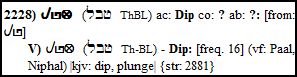
Interestingly, the word טבל tabal (baptise/immerse) is a homophone of the Hebrew word for world תבל (tabal).

The act of baptism is an outward showing of putting off the old body of sins, and putting on the new body of Christ
Rom 6:3 Know ye not, that so many of us as were baptized into Jesus Christ were baptized into his death?
Rom 6:4 Therefore we are buried with him by baptism into death: that like as Christ was raised up from the dead by the glory of the Father, even so we also should walk in newness of life.
Gal 3:27 For as many of you as have been baptized into Christ have put on Christ.
Garments of Salvation
Gal 3:27 For as many of you as have been baptized into Christ have put on Christ.
1Jn 3:2 Beloved, now we are the children of God, and it was not yet revealed what we shall be. But we know that if He is revealed, we shall be like Him, because we shall see Him as He is.
Isa 61:9 And their seed shall be known among the nations, and their offspring among the peoples; all who see them shall acknowledge them, that they are the seed that Jehovah has blessed.
Isa 61:10 Rejoicing I will rejoice in Jehovah. My soul shall be joyful in my God. For He clothed me with garments of salvation (יֶשַׁע ‘yesha’ – source of the name Jesus); He put on me the robe of righteousness, even as a bridegroom dons as a priest his head-dress, and as a bride wears her ornaments.
Isa 61:11 For as the earth comes out with her buds, and as a garden causes that which is sown to grow, so the Lord Jehovah will make righteousness and praise to grow before all the nations.
Psa 132:16 And I will clothe her priests with salvation (יֶשַׁע ‘yesha’); and her saints shall surely shout.
Psa 132:9 Let thy priests be clothed with righteousness; and let thy saints shout for joy.
Garments of righteousness = garments of salvation (Yeshuah). What is our righteousness? Christ Jesus (Jeremiah 23:6) This is discussed in more detail in Genesis 1:9-10 which is a picture of baptism/resurrection (Galatians 3:27).
Messiah in the Torah – Genesis 1:9-13 ‘Day 3’ “Trees, plants & seed”
The English word color comes from the Latin word ‘color’ meaning “color, hue, tint, complexion, outward appearance.” The Latin ‘color’ is said to come from the Proto-Indo-European word ‘kel’ meaning “to cover, conceal.” The idea being is that color “covers” or conceals the surface of something.
Christians have an “outer color” or skin tone but the “color” of Christ is hidden within them. It is only by our fruits that we are known (Matthew 7:20). Christians are His “hidden” ones (Psalm 83:3). We wear the “jersey color” of Christ.
Psa 83:3 They have taken crafty counsel against thy people, and consulted against thy hidden ones.
Col 3:2 Set your affection on things above, not on things on the earth.
Col 3:3 For ye are dead, and your life is hid with Christ in God.
Col 3:4 When Christ, who is our life, shall appear, then shall ye also appear with him in glory.
Psa 91:1 He that dwelleth in the secret place of the most High shall abide under the shadow of the Almighty.
Psa 91:4 He shall cover thee with his feathers, and under his wings shalt thou trust: his truth shall be thy shield and buckler.
Psa 17:7 Shew thy marvellous lovingkindness, O thou that savest by thy right hand them which put their trust in thee from those that rise up against them.
Psa 17:8 Keep me as the apple of the eye, hide me under the shadow of thy wings,
Pigment, as in skin color, comes from the Latin word ‘pingere’ which means “to paint, to color, to tattoo, to embroider.” Pingere comes from the Proto-Indo-European root ‘peig’ or ‘peik’ meaning “to cut, to mark, to color.
The word mark comes from the Hebrew word Tav

Eze 9:4 And Jehovah said to him, Pass through in the midst of the city, in the midst of Jerusalem, and mark (tavah) a mark (tav) on the foreheads of the men who are groaning and are mourning over all the abominations that are done in her midst.
The above verse is speaking of the mark of God which is put on the righteous.
The root word for mark is a picture of an ox plowing toward a mark. In ancient Hebrew thought, God was seen as the strong ox that we are yoked with in covenant relationship. The word for mark is a picture of walking with your God toward your mark/goal (Philippians 3:14). Walking with Messiah (Mat 11:29) towards the Kingdom of Heaven or walking with the adversary towards hell. This is what Paul was alluding to in his letter to the Corinthians.
2Co 6:14 Do not be unequally yoked with unbelievers. For what partnership does righteousness have with lawlessness? And what fellowship does light have with darkness?
2Co 6:15 And what agreement does Christ have with Belial? Or what part does a believer have with an unbeliever?
2Co 6:16 And what agreement does a temple of God have with idols? For you are a temple of the living God, even as God said, “I will” dwell in them and “walk among them, and I will be their God, and they shall be My people.” Lev. 26:12; Ezek. 37:27
2Co 6:17 Because of this, “come out from among them” “and be separated,” says the Lord, “and do not touch the unclean thing,” and I will receive you. Isa. 52:11
2Co 6:18 “And I will be a Father to you, and you will be sons” and daughters to Me, says the Lord Almighty. 2 Sam. 7:8, 14; Isa. 43:6
The letter ת ‘tav’ in pictograph form is two crossed sticks which has the meaning of a covenant. We can choose the covenant of Life in Messiah Jesus(Isaiah 42:6; 49:8; Zechariah 9:11; Jeremiah 31:31; Matthew 26:28) or we can choose the covenant of death (Isaiah 28:15) which promises deliverance from death (ie the tree of life) but in reality leads to hell.
The Cross and Baptism
Mat 28:19 Go ye therefore, and teach all nations, baptizing them in the name of the Father, and of the Son, and of the Holy Ghost:
It is said that the sign of the cross was the mark of those baptized in Christ. This is seen in section 21 of The Apostolic Tradition of Hippolytus of Rome as well as with St. John of Damascus:
“The holy cross was given to us as a sign on our forehead, just as circumcision was given to Israel: for by it we believers are separated and distinguished from unbelievers.” {An Exposition of the Orthodox Faith, 4:11. St. John of Damascus, “Concerning the Cross and Faith,”}
Rom 6:3 Know ye not, that so many of us as were baptized into Jesus Christ were baptized into his death?
Rom 6:4 Therefore we are buried with him by baptism into death: that like as Christ was raised up from the dead by the glory of the Father, even so we also should walk in newness of life.
Rom 6:5 For if we have been planted together in the likeness of his death, we shall be also in the likeness of his resurrection:
Initially the sign of the cross started on the forehead, hearkening back to the Prophet Ezekiel.
Eze 9:4 And the LORD said unto him, Go through the midst of the city, through the midst of Jerusalem, and set a mark (תו והתוית ‘vheetviyta tav’) upon the foreheads of the men that sigh and that cry for all the abominations that be done in the midst thereof.
The phrase תו והתוית ‘vheetviyta tav’ can be translated “cross a cross.” This is what the sign of the cross is.
The sign of the cross declares to the world the victory of Christ and our victory in Him.
Rom 8:35 Who shall separate us from the love of Christ? shall tribulation, or distress, or persecution, or famine, or nakedness, or peril, or sword?
Rom 8:36 As it is written, For thy sake we are killed all the day long; we are accounted as sheep for the slaughter.
Rom 8:37 Nay, in all these things we are more than conquerors through him that loved us.
Rom 8:38 For I am persuaded, that neither death, nor life, nor angels, nor principalities, nor powers, nor things present, nor things to come,
Rom 8:39 Nor height, nor depth, nor any other creature, shall be able to separate us from the love of God, which is in Christ Jesus our Lord.
2Sa_19:2 And the victory {תּשׁעה / תּשׁוּעה ‘teshû‛âh’} that day was turned into mourning unto all the people: for the people heard say that day how the king was grieved for his son.
תּשׁוּעה ‘teshû‛âh’ comes from the word ישע ‘yasha’ which means salvation. Pointing to the name of Jesus. The sign of the cross reveals the name/character of God.
The cross reveals God’s name/character of love revealed through the life of Christ. The Hebrew word for name is שם ‘shem’ which literally means one’s breathe or character. What is the character of the Almighty? Love (1 John 4:8). The Hebrew word for love is אהב ‘ahav’ which is consists of the letters אב ‘av’ which means father and the middle letter ה ‘heh’ which has the meaning of revelation. The Father revealed. In ancient Hebrew, the letter ה ‘heh’ was depicted as a man with outstretched arms, like unto Messiah on the cross. How was the love of the Father revealed? Through the giving of His only begotten Son on the cross as an atonement for the sins of mankind (John 3:16).
Joh 17:6 I have manifested thy name unto the men which thou gavest me out of the world: thine they were, and thou gavest them me; and they have kept thy word.
Love & the cross
Messiah triumphed over the adversary by His work on the cross.
Col 2:15 And having spoiled principalities and powers, he made a shew of them openly, triumphing over them in it.
Messiah on the cross is the revelation of God’s love.
The Father revealed what true love is when He gave His only begotten Son, who came from His bosom (John 1:18), as an atonement for the sins of mankind. The most common Hebrew word for love אהבה ‘ahavah,’ literally means to give.
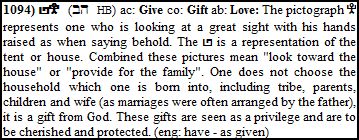
What is the ultimate definition of love? Giving one’s life for another
Joh 3:16 For God so loved the world that He gave His only begotten Son, that everyone believing into Him should not perish, but have everlasting life.
Joh 15:13 Greater love than this has no one, that anyone should lay down his soul for his friends.
The pictograph meaning of אהב ‘ahav’ displays this concept even further.
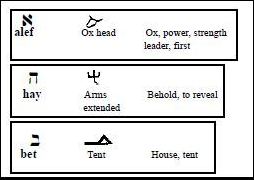
The Sacred Name of God was revealed on the cross.
Joh 8:28 Then Jesus said to them, When you lift up the Son of Man, then you will know that I AM; and from Myself I do nothing; but as My Father taught Me, these things I speak.
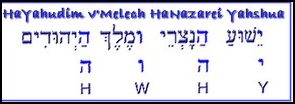
Joh 19:19 And Pilate also wrote a title and put it on the cross. And having been written, it was: JESUS THE NAZARENE, THE KING OF THE JEWS.
Joh 12:32 And I, if I be lifted up from the earth, I will draw all to Myself (John 8:28 Messiah states this is how they will know He is ‘I AM’).
Joh 12:33 But He said this, signifying by what kind of death He was about to die.
Rev 7:3 Saying, Hurt not the earth, neither the sea, nor the trees, till we have sealed the servants of our God in their foreheads.
Rev 14:1 And I looked, and, lo, a Lamb stood on the mount Sion, and with him an hundred forty and four thousand, having his Father’s name written in their foreheads.
Dymaxion Map
The Dymaxion Map (also called the Fuller Projection or Dymaxion Airocean World Map), is one of Buckminster Fuller’s most visionary creations. It ties directly into the geodesic domes, buckyballs (C₆₀), and soccer-ball geometry. Buckminster Fuller developed this polyhedral map projection in the 1940s. It projects the Earth’s surface onto the 20 triangular faces of an icosahedron (one of the Platonic solids), which can then be unfolded into a flat, two-dimensional net.
It presents the world as one island in one ocean , all continents connected without artificial divisions.
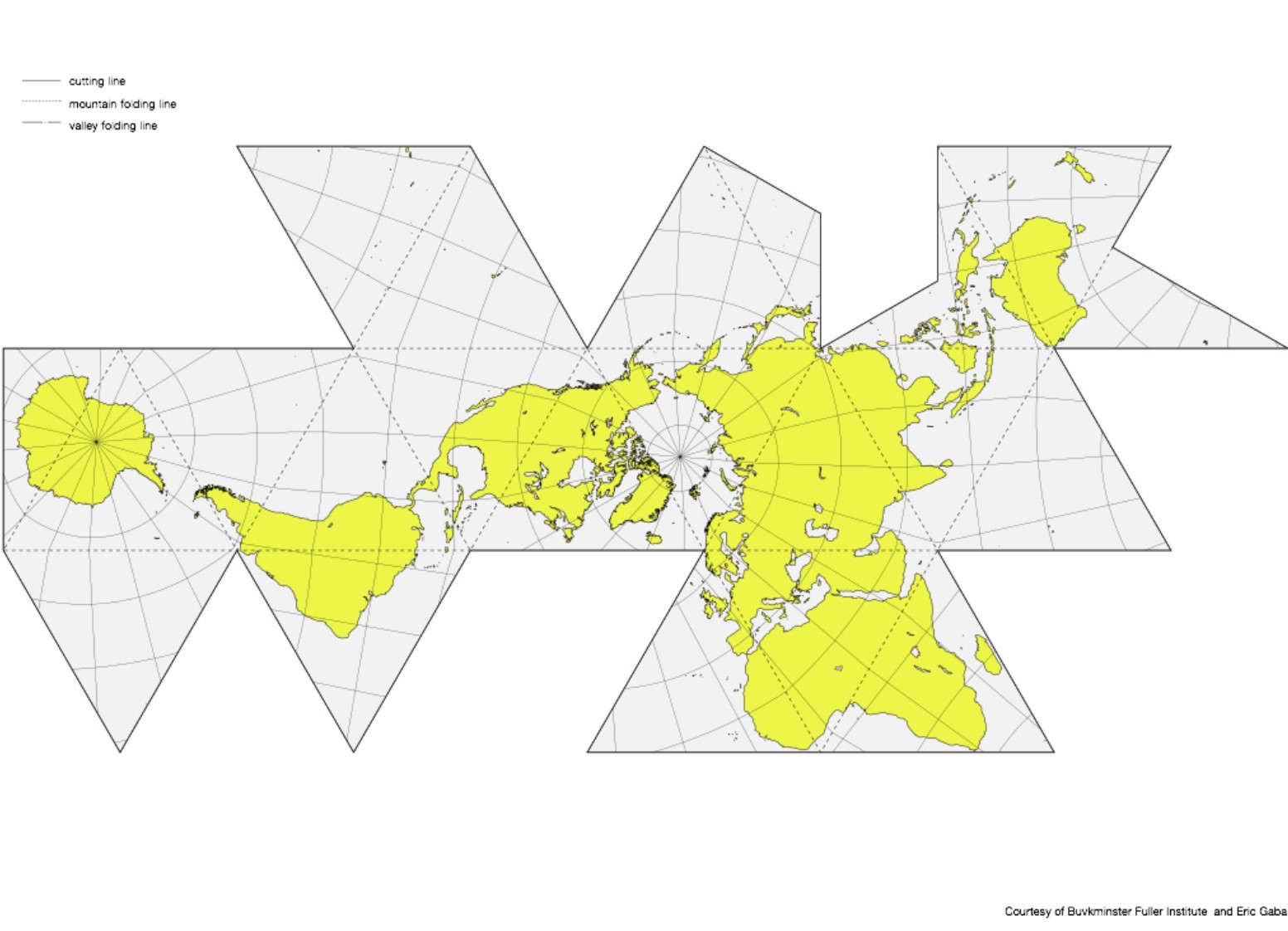
The Dymaxion Map is built on the same icosahedral foundation as Fuller’s geodesic domes. The Buckminster Map was designed to give the idea of “one world, one ocean,” following Fuller’s “one crew on Spaceship Earth” philosophy. Fuller created a “World Game” (World Peace Game) that was to be “played” on the Dymaxion Map. He envisioned players competing to ““Make the world work for 100% of humanity, in the shortest possible time, through spontaneous cooperation, without ecological offense or the disadvantage of anyone.”
Geometry & Unity
The soccer ball (truncated icosahedron), buckyballs, geodesic domes, and Euler’s formula all beautifully illustrate unity, harmony, and the integration of diverse elements into a single, stable whole. This are all “Shadows of Messiah” displaying creation’s patterns which point to Christ as the unifier who holds all things together (Colossians 1:17) and reconciles diverse parts into “one new man” (Ephesians 2:15).
12 pentagons + 20 hexagons (different shapes, different “natures”) combine perfectly to close into a sphere.
No two pentagons touch each other; they are isolated and surrounded by hexagons. This precise arrangement (from Euler’s formula) creates curvature and stability.
This is a classic shadow of unity through diversity: distinct elements (like nations, tribes, or Jew/Gentile) integrated without losing identity, forming something complete and strong. In typology, it echoes the body of Messiah (many members, one body—1 Corinthians 12).
דור ‘dor’ conveys circular motion, revolution, or encircling , or dwell (as in surrounding a central space). דור ‘dor’ has the meaning of a circle or ball as in the soccer ball. דור ‘dor’ also means generation, age, period or habitation. Phrases like לְדוֹר וָדוֹר ‘l’dor v’dor’ (“from generation to generation”) display passing the covenant or truth in a continuous circle.
Eph 2:7 That in the ages to come he might shew the exceeding riches of his grace in his kindness toward us through Christ Jesus.
Eph 2:11 Wherefore remember, that ye being in time past Gentiles in the flesh, who are called Uncircumcision by that which is called the Circumcision in the flesh made by hands;
Eph 2:12 That at that time ye were without Christ, being aliens from the commonwealth of Israel, and strangers from the covenants of promise, having no hope, and without God in the world:
Eph 2:13 But now in Christ Jesus ye who sometimes were far off are made nigh by the blood of Christ.
Eph 2:14 For he is our peace, who hath made both one, and hath broken down the middle wall of partition between us;
Eph 2:15 Having abolished in his flesh the enmity, even the law of commandments contained in ordinances; for to make in himself of twain one new man, so making peace;
Eph 2:16 And that he might reconcile both unto God in one body by the cross, having slain the enmity thereby:
Eph 2:17 And came and preached peace to you which were afar off, and to them that were nigh.
Eph 2:18 For through him we both have access by one Spirit unto the Father.
Eph 2:19 Now therefore ye are no more strangers and foreigners, but fellowcitizens with the saints, and of the household of God;
Eph 2:20 And are built upon the foundation of the apostles and prophets, Jesus Christ himself being the chief corner stone;
Eph 2:21 In whom all the building fitly framed together groweth unto an holy temple in the Lord:
Eph 2:22 In whom ye also are builded together for an habitation of God through the Spirit.
Gal 3:26 For ye are all the children of God by faith in Christ Jesus.
Gal 3:27 For as many of you as have been baptized into Christ have put on Christ.
Gal 3:28 There is neither Jew nor Greek, there is neither bond nor free, there is neither male nor female: for ye are all one in Christ Jesus.
Gal 3:29 And if ye be Christ’s, then are ye Abraham’s seed, and heirs according to the promise.
Eph 3:14 For this cause I bow my knees unto the Father of our Lord Jesus Christ,
Eph 3:15 Of whom the whole family in heaven and earth is named,
Pentagons & Hexagons
The soccer ball is covered in pentagons and hexagons. The hexagram is a symbol of Jews, the pentagram a symbol of gentiles (Vitruvian Man).
Col 3:10 And have put on the new man, which is renewed in knowledge after the image of him that created him:
Col 3:11 Where there is neither Greek nor Jew, circumcision nor uncircumcision, Barbarian, Scythian, bond nor free: but Christ is all, and in all.
Rom 10:11 For the scripture saith, Whosoever believeth on him shall not be ashamed.
Rom 10:12 For there is no difference between the Jew and the Greek: for the same Lord over all is rich unto all that call upon him.
Rom 10:13 For whosoever shall call upon the name of the Lord shall be saved.
1Co 12:12 For as the body is one, and hath many members, and all the members of that one body, being many, are one body: so also is Christ.
1Co 12:13 For by one Spirit are we all baptized into one body, whether we be Jews or Gentiles, whether we be bond or free; and have been all made to drink into one Spirit.
1Co 12:14 For the body is not one member, but many.
Eph 2:13 But now in Christ Jesus ye who sometimes were far off are made nigh by the blood of Christ.
Eph 2:14 For he is our peace, who hath made both one, and hath broken down the middle wall of partition between us;
Eph 2:15 Having abolished in his flesh the enmity, even the law of commandments contained in ordinances; for to make in himself of twain one new man, so making peace;
Eph 2:16 And that he might reconcile both unto God in one body by the cross, having slain the enmity thereby:
22 Players
Each soccer team has 11 players with a total of 22 on the field.
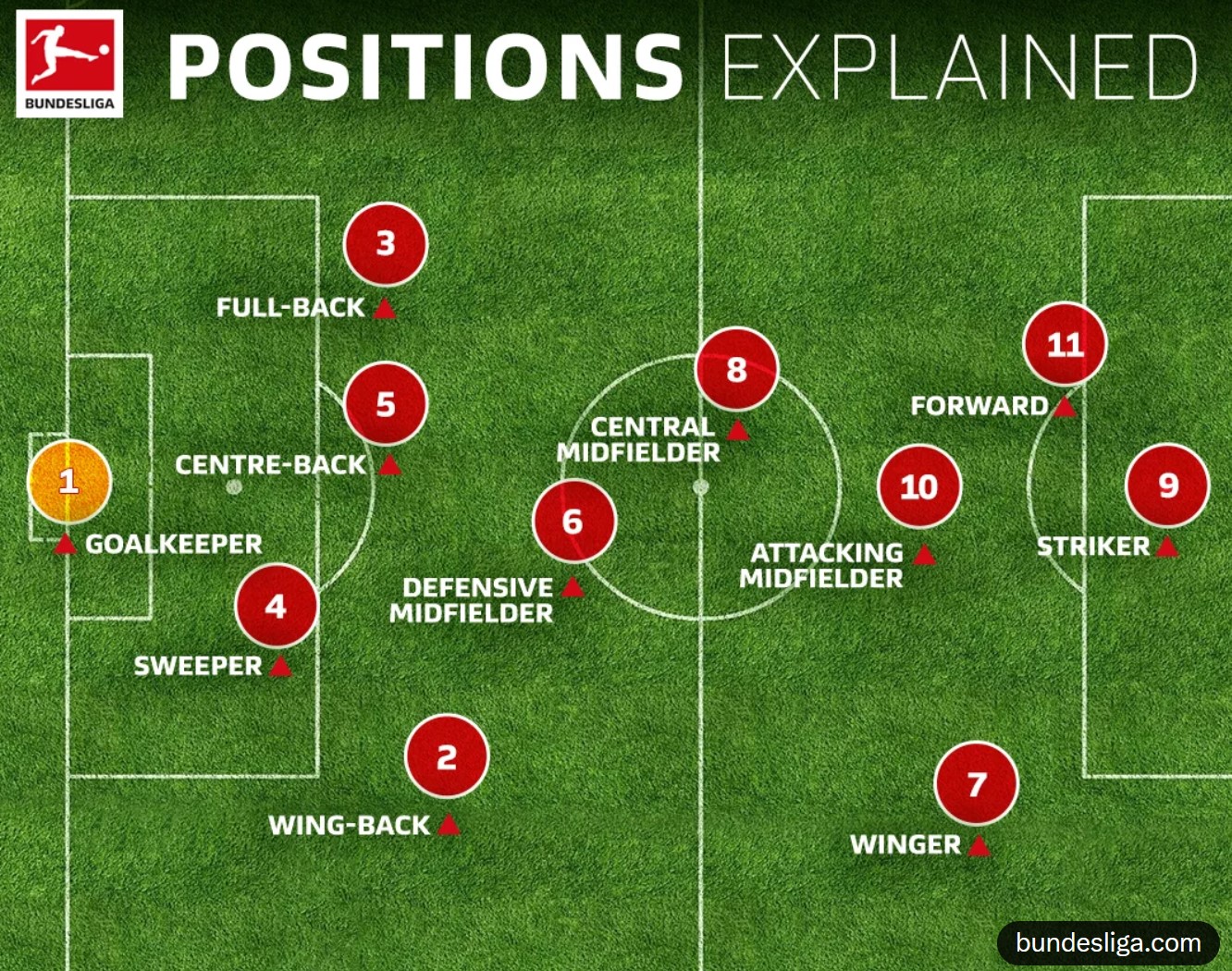
This points to the 22 letters of the Hebrew alphabet.
Isa 8:18 Behold, I and the children {Messiah and His body} whom Jehovah has given to me are for signs and wonders in Israel from Jehovah of Hosts, who dwells in Mount Zion.
The word for signs above it אות ‘oht’ which is the same word in Hebrew word a ‘letter’.
Letters form words. Words form books. THE Book, the Bible was written to lead us to the goal of salvation. 22 players on the soccer field work together to score goals.
Joh 20:31 But these are written, that ye might believe that Jesus is the Christ, the Son of God; and that believing ye might have life through his name.
Goal
Php 3:14 I press toward the mark for the prize of the high calling of God in Christ Jesus.
The word for mark in this verse is σκοπός’ skopos’ which means goal or ‘end one has in view.’ Paul uses this ‘prize’ imagery in sporting events to teach the Gospel.
1Co 9:24 Do you not know that those running in a stadium indeed all run, but one receives the prize? So run that you may obtain.
1Co 9:25 But everyone striving controls himself in all things. Then those truly that they may receive a corruptible crown, but we an incorruptible.
Being transformed into the image of Messiah (the One who manifested God’s presence) is the goal/mark and high calling (Romans 10:4).
Php 3:14 I press toward the mark (σκοπός ‘skopos’) for the prize of the high calling of God in Christ Jesus.
Php 3:15 Let us therefore, as many as be perfect, be thus minded: and if in any thing ye be otherwise minded, God shall reveal even this unto you.
Php 3:16 Nevertheless, whereto we have already attained, let us walk by the same rule, let us mind the same thing.
G4649
σκοπός
skopos
Thayer Definition:
- an observer, a watchman
- the distant mark looked at, the goal or end one has in view
Part of Speech: noun masculine
A Related Word by Thayer’s/Strong’s Number: from skeptomai (to peer about [“skeptic”], perhaps akin to G4626 through the idea of concealment, compare G4629)
G4649
σκοπός
skopos
skop-os’
(“scope”); From σκέπτομαι skeptomai (to peer about [“skeptic”]; perhaps akin to G4626 through the idea of concealment; compare G4629); a watch (sentry or scout), that is, (by implication) a goal: – mark.
Vincent Word Studies
Philippians 3:14
Toward the goal (kata skopon). “Down upon the goal,” who is Jesus himself to whom we must continually look as we run (Heb_12:2). The word means a watchman, then the goal or mark. Only here in N.T.
Unto the prize (eis to brabeion). Late word (Menander and inscriptions) from brabeus (umpire who awards the prize). In N.T. only here and 1Co_9:24.
Of the high calling (tēs anō klēseōs). Literally, “of the upward calling.” The goal continually moves forward as we press on, but yet never out of sight.
The Greek word ἐκβάλλω ‘ekballo’ comes from βάλλω ‘ballo’ (mentioned above in the section about the dance ball) means to cast out, to send out but also “to cause a thing to move straight on its intended goal.”
This word is used in connection with words (22 letters) coming out of our heart. In parable form this displays the 22 soccer players kicking the ball towards the goal. A dance “ball” and the spherical ball are not etymologically related but conceptually related through the idea of “throwing” or “casting” forth.
Mat 12:35 A good man out of the good treasure of the heart bringeth forth (ἐκβάλλω ‘ekballo’) good things: and an evil man out of the evil treasure bringeth forth evil things.
Mat 12:36 But I say unto you, That every idle word that men shall speak, they shall give account thereof in the day of judgment.
Mat 13:52 Then said he unto them, Therefore every scribe which is instructed unto the kingdom of heaven is like unto a man that is an householder, which bringeth forth (ἐκβάλλω ‘ekballo’) out of his treasure things new and old.
World Cup
The FIFA World Cup is called the “World Cup” because it is a global championship tournament whose prize is literally a trophy in the shape of a cup. It features two figures holding up a globe, symbolizing the world coming together. Again, the Jew and Gentile theme of uniting in Christ is seen. Chalices have been used for centuries as a symbol of honor, victory and shared celebration. The cup shape is said to evoke “receiving a shared blessing.”
Psa 116:13 I will take the cup of salvation (ישועה ‘yeshuah’ – source of the name Jesus), and call upon the name of the LORD.
Mat 26:26 And as they were eating, Jesus took bread, and blessed it, and brake it, and gave it to the disciples, and said, Take, eat; this is my body.
Mat 26:27 And he took the cup, and gave thanks, and gave it to them, saying, Drink ye all of it;
Mat 26:28 For this is my blood of the new testament, which is shed for many for the remission of sins.
1Co 9:24 Do you not know that those running in a stadium indeed all run, but one receives the prize (βραβειον ‘brabeion’)? So run that you may obtain.
1Co 9:25 But everyone striving controls himself in all things. Then those truly that they may receive a corruptible crown, but we an incorruptible.
The Greek word translated as ‘prize’ is βραβειον ‘brabeion’ which means prize, or goal obtained by a victor. Victory in Hebrew is ישע ‘yesha’ which is the source of the name Jesus.
1Co_15:57 But thanks be to God, which giveth us the victory through our Lord Jesus Christ.
It is Messiah who gives us victory over the sin, death and the devil in the ancient war which began in the Garden.
1Co_15:54 So when this corruptible shall have put on incorruption, and this mortal shall have put on immortality, then shall be brought to pass the saying that is written, Death is swallowed up in victory.
1Co_15:55 O death, where is thy sting? O grave, where is thy victory?
1Co_15:57 But thanks be to God, which giveth us the victory through our Lord Jesus Christ.
1Jn_3:8 He that committeth sin is of the devil; for the devil sinneth from the beginning. For this purpose the Son of God was manifested, that he might destroy the works of the devil.
Heb_2:14 Forasmuch then as the children are partakers of flesh and blood, he also himself likewise took part of the same; that through death he might destroy him that had the power of death, that is, the devil;
This victory/salvation came forth through the love of God which was manifested in the sacrifice of His Son on the cross.
1Jn_4:9 In this was manifested the love of God toward us, because that God sent his only begotten Son into the world, that we might live through him.
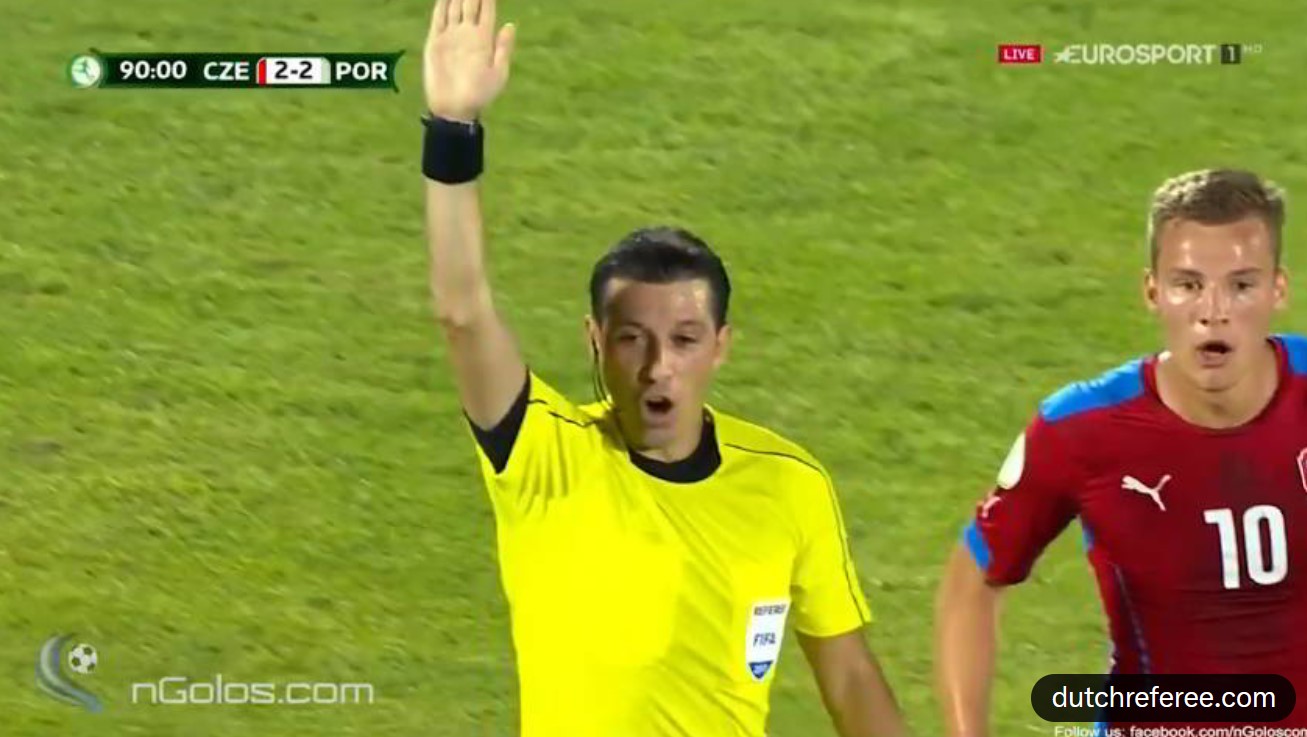
In Soccer when a goal is scored the referre raises one arm…
The name of Jesus {יהושׁוּע ‘Yehoshua’/ישׁוּע ‘Yeshua’} has the meaning of victory. It is through the Right Hand/Arm of God that victory comes.
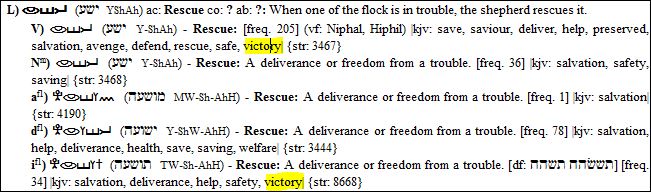
Psa_98:1 A Psalm. O sing unto the LORD a new song; for he hath done marvellous things: his right hand, and his holy arm, hath gotten him the victory {ישׁע ‘yasha’}.
Rev 12:11 And they overcame {νικάω ‘nikaō’} him because of the blood of the Lamb, and because of the Word of their testimony. And they did not love their soul even until death.
νικάω ‘nikaō is the source of the name Nike. The first World Cup trophy had this Nike imagery.
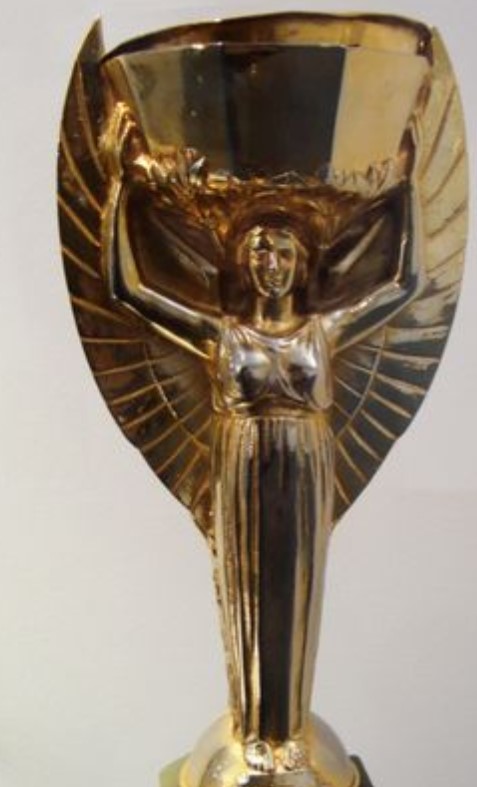
νικάω ‘nikaō’ means to conquer, to be victorious, it is used to translate the word נצח ‘netsach’ in the Septuagint.
Isa_25:8 He will swallow up death in victory {נצח ‘netsach’}; and the Lord GOD will wipe away tears from off all faces; and the rebuke of his people shall he take away from off all the earth: for the LORD hath spoken it.
It is through Christ that mankind can be victorious over death and rejoice in salvation.
1Pe 1:6 Wherein ye greatly rejoice, though now for a season, if need be, ye are in heaviness through manifold temptations:
1Pe 1:7 That the trial of your faith, being much more precious than of gold that perisheth, though it be tried with fire, might be found unto praise and honour and glory at the appearing of Jesus Christ:
1Pe 1:8 Whom having not seen, ye love; in whom, though now ye see him not, yet believing, ye rejoice with joy unspeakable and full of glory:
1Pe 1:9 Receiving the end of your faith, even the salvation of your souls.
Psa 118:14 The LORD is my strength and song, and is become my salvation.
Psa 118:15 The voice of rejoicing and salvation is in the tabernacles of the righteous: the right hand of the LORD doeth valiantly.
Psa 118:16 The right hand of the LORD is exalted: the right hand of the LORD doeth valiantly.
Psa 118:17 I shall not die, but live, and declare the works of the LORD.
Psa 118:18 The LORD hath chastened me sore: but he hath not given me over unto death.
Psa 118:19 Open to me the gates of righteousness: I will go into them, and I will praise the LORD:
Psa 118:20 This gate of the LORD, into which the righteous shall enter.
Psa 118:21 I will praise thee: for thou hast heard me, and art become my salvation.
Psa 118:22 The stone which the builders refused is become the head stone of the corner.
Psa 118:23 This is the LORD’S doing; it is marvellous in our eyes.
Psa 118:24 This is the day which the LORD hath made; we will rejoice and be glad in it.
Psa 118:25 Save now, I beseech thee, O LORD: O LORD, I beseech thee, send now prosperity.
Psa 118:26 Blessed be he that cometh in the name of the LORD: we have blessed you out of the house of the LORD.
Psa 118:27 God is the LORD, which hath shewed us light: bind the sacrifice with cords, even unto the horns of the altar.
Psa 118:28 Thou art my God, and I will praise thee: thou art my God, I will exalt thee.
Psa 118:29 O give thanks unto the LORD; for he is good: for his mercy endureth for ever.
Clathrin
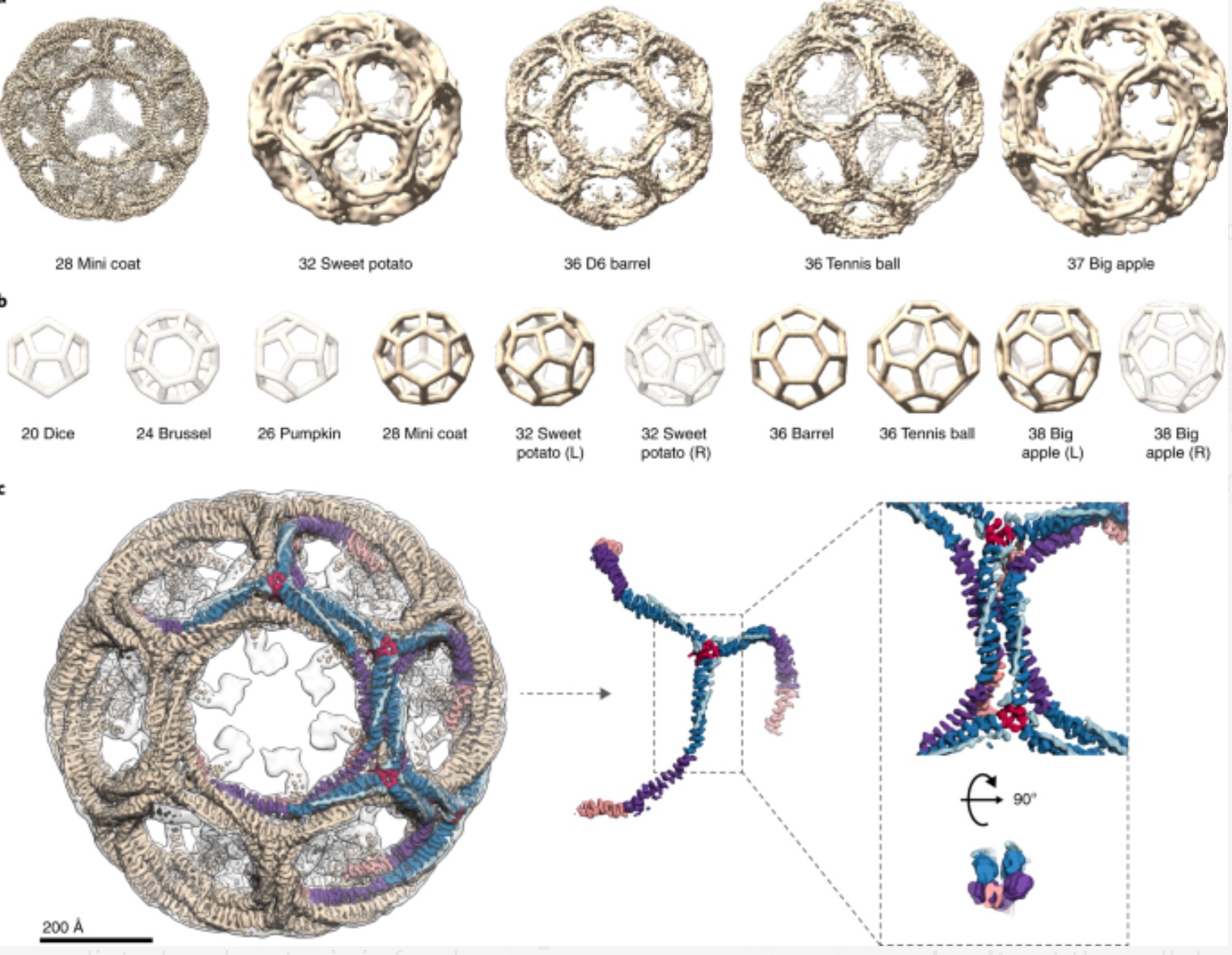
Clathrin is virtually every cell in our bodies. It is a protein in our cells that acts like a molecular basket or cage. It is the cell’s “packaging and delivery system.” It helps wrap up and transport materials inside the cell. Clathrin proteins assemble on the inside of the cell membrane forming a “soccer-ball-shaped cage,” a lattice of pentagons and hexagons. Through this lattice they deliver the materials into the right place in our cells.
They were discovered in the 1960s-70s and named after the Latin word ‘clathratus’ meaning lattice or barred.
This lattice imagery is connected with the coming of Christ, shown in parable form in the Song of Solomon.
Son 2:9 My beloved is like a roe or a young hart: behold, he standeth behind our wall, he looketh forth at the windows, shewing himself through the lattice (חרך ‘cherek’).
Brown-Driver-Briggs H2762
חרך
cherek
BDB Definition:
- lattice, other opening through which one may look
Part of Speech: noun masculine plural
A Related Word by BDB/Strong’s Number: from H2760
H2762
חֶרֶךְ
cherek
kheh’-rek
From H2760; properly a net, that is, (by analogy) lattice: – lattice.
H2760
חָרַךְ
chârak
khaw-rak’
A primitive root; to braid (that is, to entangle or snare) or catch (game) in a net: – roast.
This word connects back to the “game” etymology mentioned before.
This word displays imagery of the cross. חָרַךְ ‘charak’ literally displays a grill, a lattice of crossed sticks. The altar at the Temple had a grating or lattice on which the sacrifices were placed (Exodus 27:4; 38:4). Christ died on two crossed sticks, fulfilling the sacrifices of the Old Testament (John 1:29; Hebrews 9:26; 10:1-14; Ephesians 5:2).
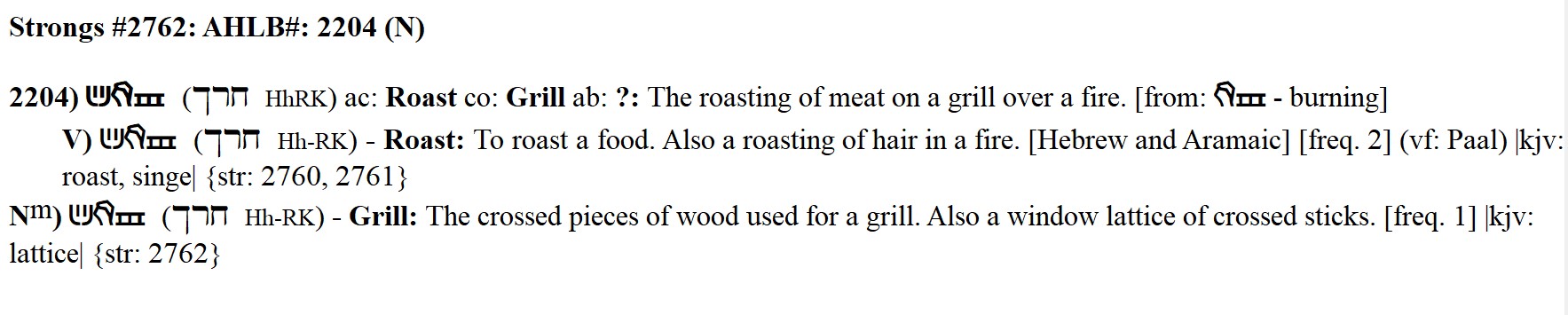
A soccer ball is a lattice, a network of pentagons and hexagons that cross and interlock to form a sphere. In graph theory, the soccer ball is a polyhedral graph, a lattice of vertices and edges.
Related Articles:
Shadows of Messiah – Shadows & the 4th Dimension
Daily Tidbits 2/18 – Love & the 4th Dimension
Daily Tidbits 5/7 – Fibonacci Fingerprint
Musings – The Voice of Messiah
Daily Tidbits 4/7 – The Mark of God
Messiah in the Torah – Genesis 1:9-13 ‘Day 3’ “Trees, plants & seed”
Shadows of Messiah – Touchdown
Musings – Sukkot – Unity in the Love of Messiah
Daily Tidbits 1/21/12 – Unity & His Glory
littleguyintheeye@gmail.com


