

God loves the world so much that He has already been at work in every heart and every culture, drawing people to Himself through His Son.
Joh 3:16 For God so loved the world, that he gave his only begotten Son, that whosoever believeth in him should not perish, but have everlasting life.
Joh 3:17 For God sent not his Son into the world to condemn the world; but that the world through him might be saved.
Rev 13:8 And all that dwell upon the earth shall worship him, whose names are not written in the book of life of the Lamb slain from the foundation of the world.
God has placed eternity in the heart of every person (Ecclesiastes 3:11). This innate awareness of the Eternal, the Divine, and our origin in Him is a universal “primal memory” or longing that no culture or religion can fully erase. It is the reason why, across religion and throughout history, we find echoes of Biblical truth—stories of a supreme Creator, a lost paradise, a coming Redeemer, sacrifice for peace, and a longing to return to the one true God.
These are not accidents. They are redemptive analogies—God-planted bridges in every culture that prepare hearts to receive the Gospel of Jesus Christ. The Golden Rule of love is embedded in virtually every religion because it is the heartbeat of the God who is love. All the ends of the earth will remember and turn to Him (Psalm 22:27). Every knee will bow and every tongue confess that Jesus Christ is Lord (Philippians 2:10-11). God meets us where we are—through general revelation, cultural and “seeds of the Word,” so that no one is left without a witness.
This is the beautiful message of Eternity in Their Hearts: the world is already prepared for the Gospel. Christians are to lovingly point people to the fulfillment of what they already sense deep inside—the Lamb of God who takes away the sin of the world.
Ecc 3:11 He hath made every thing beautiful in his time: also he hath set the world (עלם ‘olam’) in their heart, so that no man can find out the work that God maketh from the beginning to the end.
Septuagint
Ecc 3:11 All the things which he has made are beautiful in his time: he has also set the whole world (αἰών ‘aion’) in their heart, that man might not find out the work which God has wrought from the beginning even to the end.
G165
αἰών
aiōn
Thayer Definition:
- for ever, an unbroken age, perpetuity of time, eternity
- the worlds, universe
- period of time, age
Ecc 3:11 He hath made every thing beautiful in his time: also he hath set the world (עלם ‘olam’) in their heart, so that no man can find out the work that God maketh from the beginning to the end.
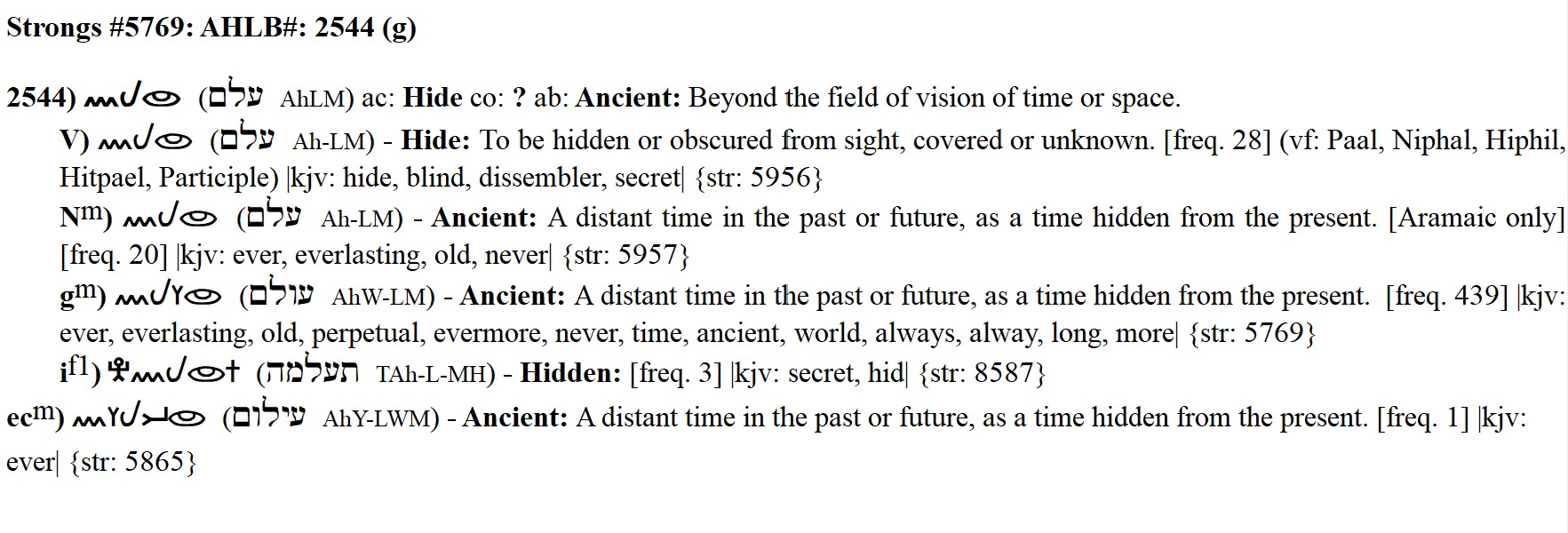
עלם ‘olam’ can be speaking of eternity, the ancient times (Genesis & the Garden) as well as God Himself (Micah 5:2; Psalm 90:2; 1 Timothy 1:17).
Seeds of the Word
Early Church Fathers recognized this eternity in the hearts of men: Justin Martyr, Origen, and Augustine spoke of “seeds of the Word” (λογοὶ σπερματικοί ‘logoi spermatikoi’) already present in pagan cultures.
Joh 1:1 In the beginning was the Word (λόγος ‘logos’), and the Word was with God, and the Word was God.
Joh 1:2 The same was in the beginning with God.
Joh 1:3 All things were made by him; and without him was not any thing made that was made.
Joh 1:4 In him was life; and the life was the light of men.
Creation came forth from the λόγος ‘logos.’ Hence, all of creation is embedded with the λόγος ‘logos.’
Col 1:15 Who is the image of the invisible God, the firstborn of every creature:
Col 1:16 For by him were all things created, that are in heaven, and that are in earth, visible and invisible, whether they be thrones, or dominions, or principalities, or powers: all things were created by him, and for him:
Col 1:17 And he is before all things, and by him all things consist.
The λόγος ‘logos is the visible signature of the invisible.
Rom 1:20 For the invisible things of him from the creation of the world are clearly seen, being understood by the things that are made, even his eternal power and Godhead; so that they are without excuse:
The Church Fathers saw this concept of the seed of the Word planted in man and their cultures.
“For each man spoke well in proportion to the share he had of the spermatic Word {του σπερματικου λόγου ‘tou spermatikou logou’}… For all the writers were able to see realities darkly through the sowing of the implanted word that was in them.” (Justin Martyr – Second Apology, ch. 8, 13)
“For as the sun is one and the same in the whole world, so also the light of the true Sun, the Word of God, who is one and the same with the Father, illuminates all who are able to receive Him… There is one and the same God, who from the beginning even to the end, by means of the various dispensations, gives to mankind the salutary counsel… He sowed the seeds of truth in all, that each one, according to his capacity, might participate in the truth.” (Irenaeus of Lyons – Against Heresies, Book 4, ch. 6)
“The Word of God is the seed of the Father, sown in the world… Philosophy was a schoolmaster to bring the Hellenic mind to Christ… For there is one river of truth, but many streams flow from it. The seeds of truth scattered in all the different philosophical systems are gathered together in the one truth, the Christian philosophy.” (Clement of Alexandria – Stromata (Miscellanies), Book 1, ch. 5 & 7)
“The Lord is the sower who sows the good seeds in all souls… The seminal principles [spermatikoi logoi] are sown by the one Husbandman, the Logos, in different soils.” (Clement of Alexandria – Stromata (Miscellanies), Book 6)
“The Logos is in each creature as its own principle [logos], and yet He is one… There are as many logoi as there are creatures, but all these logoi are contained in the one great Logos… He is the first-born of all creation, containing in Himself the logoi of all things.” (Origen – Commentary on John, Book 1 )
“Just as the one sun sends forth many rays, so the one Logos sends forth many logoi into the world… These seminal reasons [spermatikoi logoi] are the causes and principles according to which each thing exists and develops.”(Origen – De Principiis “On First Principles”)
All the ends of the world shall REMEMBER and turn to Him
Psa 22:27 All the ends of the world shall remember and turn unto the LORD: and all the kindreds of the nations shall worship before thee.
Psa 22:28 For the kingdom is the LORD’S: and he is the governor among the nations.
Anamensis
ἀνά ‘ana’ means “up,” “again,” “back,” “anew,” or “re-” (as in repetition or return). μνήσις ‘mnesis’ from μιμνήσκω ‘mimnesko’ which means to remember,” “to call to mind,” or “to recollect.”
“…something like an original memory of the Good and True (both are identical) has been implanted in us, that there is an inner ontological tendency within man, who is created in the likeness of God, toward the divine.”
….This anamnesis of the origin, which results from the godlike constitution of our being, is not a conceptually articulated knowing…”
“This anamnesis of the origin, which results from the godlike constitution of our being, is not a conceptually articulated knowing, a store of retrievable contents. It is, so to speak, an inner sense, a capacity to recall, so that the one whom it addresses, if he is not turned in on himself, hears its echo from within.”- {Joseph Ratzinger – Conscience and Truth}
Rom 2:14 For when the Gentiles, which have not the law, do by nature the things contained in the law, these, having not the law, are a law unto themselves:
Rom 2:15 Which shew the work of the law written in their hearts, their conscience also bearing witness, and their thoughts the mean while accusing or else excusing one another;)
Consciousness means to know or to be aware. In Christ is all the treasures of knowledge (Colossians 2:3) and the awareness/knowledge of God (2 Corinthians 4:6) and the love that surpasses knowledge/awareness (Ephesians 3:19). Deep in mankind’s conscious is Eternity.
His book, our thoughts
Psa 139:13 For thou hast possessed my reins: thou hast covered me in my mother’s womb.
Psa 139:14 I will praise thee; for I am fearfully and wonderfully made: marvellous are thy works; and that my soul knoweth right well.
Psa 139:15 My substance was not hid from thee, when I was made in secret, and curiously wrought in the lowest parts of the earth.
Psa 139:16 Thine eyes did see my substance, yet being unperfect; and in thy book all my members were written, which in continuance (יםים ‘yamiym’) were fashioned (יצר ‘yatsar’), when as yet there was none of them.
Psalm 139:16 seems to allude to this “memory” formed in us when we are made in the womb. “Continuance” is translated from the Hebrew יםים ‘yamiym’ which is the plural for days (יום ‘yom’) from the root ים ‘yam’ which means the sea as the sun sets in the West, where the sea is at in Israel.
In Ecclesiastes 3:11 “the world” is עלם ‘olam’ which means beyond the field of vision of time or space. Literally, beyond the horizon pointing to the sea in this context.
“Fashioned” in Psalm 139:16 comes from the word יצר ‘yatsar’ which pictures clay being pressed into shape but is also translated as “imagination” and mind” as in the forming of thought. In the womb, God is fashioning our bodies but also our minds. He is the potter, we are the clay (Isaiah 64:8). In ancient Near Eastern cultures, signatures were impressed into wet clay using stamps or seals.
The word signature comes from the Latin ‘signatura’ which means to mark with a stamp or sign. God makes mankind from the dust/clay (Genesis 2:7), marking Him with His image, His signature/name.
Scripture declares that God has put ‘eternity’ into the hearts of man (Ecclesiastes 3:11). The Sacred Name יהוה ‘Yahweh’ basically means the Eternal One (Psalm 135:13). The Great I AM, who was and is and is to come. What also is eternal? The love of God (John 17:24).
Joh 17:21 That they all may be one; as thou, Father, art in me, and I in thee, that they also may be one in us: that the world may believe that thou hast sent me.
Joh 17:22 And the glory which thou gavest me I have given them; that they may be one, even as we are one:
Joh 17:23 I in them, and thou in me, that they may be made perfect in one; and that the world may know that thou hast sent me, and hast loved them, as thou hast loved me.
Joh 17:24 Father, I will that they also, whom thou hast given me, be with me where I am; that they may behold my glory, which thou hast given me: for thou lovedst me before the foundation of the world.
Joh 17:25 O righteous Father, the world hath not known thee: but I have known thee, and these have known that thou hast sent me.
Joh 17:26 And I have declared unto them thy name, and will declare it: that the love wherewith thou hast loved me may be in them, and I in them.
Joh 13:35 By this shall all men know that ye are my disciples, if ye have love one to another.
The return of mankind to the Father is associated with coming to know and glorify His Name, His Memorial.
Jer 16:19 O LORD, my strength, and my fortress, and my refuge in the day of affliction, the Gentiles shall come unto thee from the ends of the earth, and shall say, Surely our fathers have inherited lies, vanity, and things wherein there is no profit.
Jer 16:20 Shall a man make gods unto himself, and they are no gods?
Jer 16:21 Therefore, behold, I will this once cause them to know, I will cause them to know mine hand and my might; and they shall know that my name is The LORD.
Psa 66:4 All the earth shall worship thee, and shall sing unto thee; they shall sing to thy name. Selah.
Psa 86:9 All nations whom thou hast made shall come and worship before thee, O Lord; and shall glorify thy name.
This will be done through the Christ, the revelation of God’s love.
Isa 49:5 And now, saith the LORD that formed me from the womb to be his servant, to bring Jacob again to him, Though Israel be not gathered, yet shall I be glorious in the eyes of the LORD, and my God shall be my strength.
Isa 49:6 And he said, It is a light thing that thou shouldest be my servant to raise up the tribes of Jacob, and to restore the preserved of Israel: I will also give thee for a light to the Gentiles, that thou mayest be my salvation unto the end of the earth.
Isa 49:6 And he said, It is a light thing that thou shouldest be my servant to raise up the tribes of Jacob, and to restore the preserved of Israel: I will also give thee for a light to the Gentiles, that thou mayest be my salvation unto the end of the earth.
Isa 49:7 Thus saith the LORD, the Redeemer of Israel, and his Holy One, to him whom man despiseth, to him whom the nation abhorreth, to a servant of rulers, Kings shall see and arise, princes also shall worship, because of the LORD that is faithful, and the Holy One of Israel, and he shall choose thee.
Isa 49:8 Thus saith the LORD, In an acceptable time have I heard thee, and in a day of salvation have I helped thee: and I will preserve thee, and give thee for a covenant of the people, to establish the earth, to cause to inherit the desolate heritages;
Isa 49:9 That thou mayest say to the prisoners, Go forth; to them that are in darkness, Shew yourselves. They shall feed in the ways, and their pastures shall be in all high places.
Isa 49:10 They shall not hunger nor thirst; neither shall the heat nor sun smite them: for he that hath mercy on them shall lead them, even by the springs of water shall he guide them.
Isa 49:11 And I will make all my mountains a way, and my highways shall be exalted.
Isa 49:12 Behold, these shall come from far: and, lo, these from the north and from the west; and these from the land of Sinim.
Isa 49:13 Sing, O heavens; and be joyful, O earth; and break forth into singing, O mountains: for the LORD hath comforted his people, and will have mercy upon his afflicted.
ALL nations shall turn to Him and every knee shall bow, confessing that Jesus is Lord (Isaiah 45:22-25; Romans 14:9-13; Philippians 2:1-16). Through Him (Romans 10:9-10), all nations can praise and confess the name of God (Romans 15:8-12) and become His children (Matthew 10:32; 1 John 4:15).
Psa 65:2 O thou that hearest prayer, unto thee shall all flesh come.
Psa 66:4 All the earth shall worship thee, and shall sing unto thee; they shall sing to thy name. Selah.
Psa 86:9 All nations whom thou hast made shall come and worship before thee, O Lord; and shall glorify thy name.
Isa 49:6 And he said, It is a light thing that thou shouldest be my servant to raise up the tribes of Jacob, and to restore the preserved of Israel: I will also give thee for a light to the Gentiles, that thou mayest be my salvation unto the end of the earth.
Joh 12:32 And I, if I be lifted up from the earth, will draw all men unto me.
Isa 45:23 I have sworn by myself, the word is gone out of my mouth in righteousness, and shall not return, That unto me every knee shall bow, every tongue shall swear.
Isa 45:24 Surely, shall one say, in the LORD have I righteousness and strength: even to him shall men come; and all that are incensed against him shall be ashamed.
Isa 45:25 In the LORD shall all the seed of Israel be justified, and shall glory.
Php 2:10 That at the name of Jesus every knee should bow, of things in heaven, and things in earth, and things under the earth;
Php 2:11 And that every tongue should confess that Jesus Christ is Lord, to the glory of God the Father.
Php 2:12 Wherefore, my beloved, as ye have always obeyed, not as in my presence only, but now much more in my absence, work out your own salvation with fear and trembling.
Rom 14:11 For it is written, As I live, saith the Lord, every knee shall bow to me, and every tongue shall confess to God.
Rom 14:12 So then every one of us shall give account of himself to God.
Rom 14:13 Let us not therefore judge one another any more: but judge this rather, that no man put a stumblingblock or an occasion to fall in his brother’s way.
For more on this see: All the Ends of the World Shall Remember
The Golden Rule – Love Written on Every Heart
Mat 7:12 Therefore all things whatsoever ye would that men should do to you, do ye even so to them: for this is the law and the prophets.
Luk 6:31 And as ye would that men should do to you, do ye also to them likewise.
All religions are based upon some form of the ‘Golden Rule’ which the Messiah defines as the epitome of the Word of God (Matthew 7:12; Luke 6:31). The Golden Rule of love is the fulfillment of the law (Romans 13:9; Galatians 5:14; 1 Timothy 1:5). The Word/Law of God is His name/character (Revelation 19:13; Matthew 12:21=Isaiah 42:4).
All religions have some truth which is a gift of grace to all of mankind to draw us back to the Most High (2 Peter 3:9; 1 Timothy 2:4; 4:10). This is why they are able to “remember” the Lord and return to Him. Conversion is Biblical defined as turning, or pointing a person back to God. This is done through love, as God is love. This love is revealed in Christ who is the pathway back to God. He is the One who will lead them through His Spirit. He alone can lead man to God (Acts 3:19-20; John 6:37, 44-45; 10:27-29) . Our job is to walk in truth and be living epistles of the Word (2 Corinthians 3:3), letting His love shine forth in our lives (1 John 2:6; Ephesians 5:2). It is through this love that mankind will know the truth, not through our doctrine (John 13:35).
The Holy Scriptures declare that there is only One God (1 Timothy 2:5; Isaiah 44:6; Romans 3:29-30; 10:12; 1 Corinthians 8:6; Ephesians 4:6). Therefore, if a person is seeking God they are seeking Him. It matters not if they are deceived by religious doctrine. Has not everyone been deceived in the past (Revelation 12:9; 2 Corinthians 4:4)? Do we still not see through a glass darkly (1 Corinthians 13:12)? Scripture declares that if we think we know somewhat, we do not yet know as we ought to (1 Corinthians 8:2) and are declared as fools (Proverbs 26:12).
If we who have been given His word have not all the truth, why then do we judge others when they have not been given this honor (Matthew 13:11; 1 Corinthians 4:7) and are merely trying to seek God just as we are? Do we condemn others with hate for not seeing the God of love in the same way we do? Does this not blaspheme His name (Romans 2:24)?
Did not God call us and shed His love upon us when we were yet sinners (Ephesians 2:5; Romans 5:8)? When we were yet deceived heathens (Ephesians 2:2, 11-12)? If then He loved us and called us while we were yet deceived, does He not desire to call others who are yet in sin? Scripture declares He desires all to be reconciled back to Him and come to salvation (2 Peter 3:9; 1 Timothy 2:4).
Mat 7:12 Therefore all things whatsoever ye would that men should do to you, do ye even so to them: for this is the law and the prophets.
Mat 7:13 Enter ye in at the strait gate: for wide is the gate, and broad is the way, that leadeth to destruction, and many there be which go in thereat:
Mat 7:14 Because strait is the gate, and narrow is the way, which leadeth unto life, and few there be that find it.
Mat 7:15 Beware of false prophets, which come to you in sheep’s clothing, but inwardly they are ravening wolves.
Mat 7:16 Ye shall know them by their fruits. Do men gather grapes of thorns, or figs of thistles?
Mat 7:17 Even so every good tree bringeth forth good fruit; but a corrupt tree bringeth forth evil fruit.
Mat 7:18 A good tree cannot bring forth evil fruit, neither can a corrupt tree bring forth good fruit.
Mat 7:19 Every tree that bringeth not forth good fruit is hewn down, and cast into the fire.
Mat 7:20 Wherefore by their fruits ye shall know them.
Mat 7:21 Not every one that saith unto me, Lord, Lord, shall enter into the kingdom of heaven; but he that doeth the will of my Father which is in heaven.
Mat 7:22 Many will say to me in that day, Lord, Lord, have we not prophesied in thy name? and in thy name have cast out devils? and in thy name done many wonderful works?
Mat 7:23 And then will I profess unto them, I never knew you: depart from me, ye that work iniquity.
Mat 5:43 Ye have heard that it hath been said, Thou shalt love thy neighbour, and hate thine enemy.
Mat 5:44 But I say unto you, Love your enemies, bless them that curse you, do good to them that hate you, and pray for them which despitefully use you, and persecute you;
Mat 5:45 That ye may be the children of your Father which is in heaven: for he maketh his sun to rise on the evil and on the good, and sendeth rain on the just and on the unjust.
Mat 5:46 For if ye love them which love you, what reward have ye? do not even the publicans the same?
Mat 5:47 And if ye salute your brethren only, what do ye more than others? do not even the publicans so?
Mat 5:48 Be ye therefore perfect, even as your Father which is in heaven is perfect.
2Th 3:5 And the Lord direct your hearts into the love of God, and into the patient waiting for Christ.
Mic 6:8 He hath shewed thee, O man, what is good; and what doth the LORD require of thee, but to do justly, and to love mercy, and to walk humbly with thy God?
The fruit which Israel was called to produce was the ‘goodly’ fruit of His Word (Jeremiah 11:16). However, Israel did not produce this fruit but brought forth wicked fruit (Jeremiah 24:2-8). As a result, God brought fire upon this olive tree, breaking the branches thereof (Jeremiah 11:16-17). The Hebrew word for ‘goodly’ in Jeremiah 11:16 is תאר ‘toar’ which means a shape, form, outline or figure of a thing. תאר ‘toar’ is a cognate of the word תורה ‘torah’ which literally means instruction which defines the border of a people or the ‘image’ of a people. תורה ‘torah’ is most commonly translated as ‘law.’ Here we see that Israel was to produce the fruit of His Law which would bring forth His image to the world. His Image is that of love (1John 4:8, 16; Matthew 22:35-40).
Israel did not bring forth this image of love (Luke 7:36-47; 10:27-37; 18:9-14). Although they were zealous for the law (Acts 21:20; 22:3), in their zealousness they corrupted its true meaning (Romans 10:2). They were outwardly religious, yet inwardly full of wickedness (Luke 11:39; 16:15; 20:47; Matthew 6:2-5, 16; 23:5, 25-27). They separated themselves from the peoples of the world, declaring anyone who didn’t worship God according to their traditions was an unclean heathen (John 4:9; 8:48; Acts 10:28).
By their traditions they had put up a dividing wall between themselves and others (Acts 21:28; Ephesians 2:14-15), preventing them from drawing nearer to God (Luke 11:52) as Israel was the custodians of His Word (Romans 3:2; John 4:22) which reveals His nature to man. It was these traditions which corrupted the Word of God (Matthew 15:2-9; Mark 7:3-13; Colossians 2:8) and perverted the message of His love to mankind, which led the Messiah to declare them as lawless (Matthew 23:28; John 7:19). It is because of this lack of love (Matthew 5:22; John 15:25) that the Lord was sent to Israel to separate the good trees from the bad (Malachi 3:2-3; 4:1; Matthew 3:10-12; Luke 3:9; John 15:2).
The religion which was set up by the leaders of Israel became known as the tradition of the elders (Matthew 15:3). A set of guidelines which the nation was to follow. In and of itself this is not a negative thing but the problem is that the people exalted their traditions above the Word of God. As a result, this religiosity became in reality, lawlessness (John 7:19; Matthew 23:28; Galatians 6:13). The religious leaders of the second Temple were outwardly religious but inwardly were full of lawlessness (Luke 11:39; 16:15; 20:47; Matthew 6:2-5, 16; 23:5, 25-27; John 7:19; Matthew 23:28; Galatians 6:13).
Sadly, this same thing religious spirit is seen in most religious believers today.
Luk 6:31 And as ye would that men should do to you, do ye also to them likewise.
Luk 6:32 For if ye love them which love you, what thank have ye? for sinners also love those that love them.
Luk 6:33 And if ye do good to them which do good to you, what thank have ye? for sinners also do even the same.
Luk 6:34 And if ye lend to them of whom ye hope to receive, what thank have ye? for sinners also lend to sinners, to receive as much again.
Luk 6:35 But love ye your enemies, and do good, and lend, hoping for nothing again; and your reward shall be great, and ye shall be the children of the Highest: for he is kind unto the unthankful and to the evil.
Luk 6:36 Be ye therefore merciful, as your Father also is merciful.
Luk 6:37 Judge not, and ye shall not be judged: condemn not, and ye shall not be condemned: forgive, and ye shall be forgiven:
We all see through a glass darkly, the remedy is love.
1Co 13:1 Though I speak with the tongues of men and of angels, and have not charity, I am become as sounding brass, or a tinkling cymbal.
1Co 13:2 And though I have the gift of prophecy, and understand all mysteries, and all knowledge; and though I have all faith, so that I could remove mountains, and have not charity, I am nothing.
1Co 13:3 And though I bestow all my goods to feed the poor, and though I give my body to be burned, and have not charity, it profiteth me nothing.
1Co 13:4 Charity suffereth long, and is kind; charity envieth not; charity vaunteth not itself, is not puffed up,
1Co 13:5 Doth not behave itself unseemly, seeketh not her own, is not easily provoked, thinketh no evil;
1Co 13:6 Rejoiceth not in iniquity, but rejoiceth in the truth;
1Co 13:7 Beareth all things, believeth all things, hopeth all things, endureth all things.
1Co 13:8 Charity never faileth: but whether there be prophecies, they shall fail; whether there be tongues, they shall cease; whether there be knowledge, it shall vanish away.
1Co 13:9 For we know in part, and we prophesy in part.
1Co 13:10 But when that which is perfect is come, then that which is in part shall be done away.
1Co 13:11 When I was a child, I spake as a child, I understood as a child, I thought as a child: but when I became a man, I put away childish things.
1Co 13:12 For now we see through a glass, darkly; but then face to face: now I know in part; but then shall I know even as also I am known.
1Co 13:13 And now abideth faith, hope, charity, these three; but the greatest of these is charity.
We are called to do good to all
Gal 6:10 As we have therefore opportunity, let us do good unto all men, especially unto them who are of the household of faith.
Col 4:5 Walk in wisdom toward them that are without, redeeming the time.
Col 4:6 Let your speech be alway with grace, seasoned with salt, that ye may know how ye ought to answer every man.
Tit 2:14 Who gave himself for us, that he might redeem us from all iniquity, and purify unto himself a peculiar people, zealous of good works.
Tit 2:15 These things speak, and exhort, and rebuke with all authority. Let no man despise thee.
Psa 37:3 Trust in the LORD, and do good; so shalt thou dwell in the land, and verily thou shalt be fed.
Psa 37:27 Depart from evil, and do good; and dwell for evermore.
Heb 12:14 Follow peace with all men, and holiness, without which no man shall see the Lord:
The true intent of the law/Word of God is not to make men religious but to reform men into the image of their God who is love (1 John 4:8). It is this love that unites us and perfects us. It is the bond of perfection (Colossians 3:14) which sets man free (Galatians 5:13-14). This love is not intended only for a certain group of religious people, but for all mankind. Scripture declares that in the Messiah shall the ‘gentiles trust’ (Matthew 12:21; Romans 15:8-12; Isaiah 11:10). For Jesus is the true Light which enlightens every man (John 1:9; 12:44-46; Isaiah 49:6), sent to restore ALL of mankind back to God (Isaiah 45:22; Romans 3:29; John 1:12; 3:15-17).
The message of Jesus is universal. It transcends religions, ethnic or cultural barriers. It is a message of love and reconciliation back to God. The message of victory over death which entered into the world when Adam and Eve partook of the fruit of the tree of knowledge (Romans 5:12-21; 1 Corinthians 15:45-48; 55-56). This message of forgiveness and restoration is not just for Israel, but whosoever shall believe in the Lord Jesus.
John 3:15 That whosoever believeth in him should not perish, but have eternal life.
John 3:16 For God so loved the world, that he gave his only begotten Son, that whosoever believeth in him should not perish, but have everlasting life.
John 3:17 For God sent not his Son into the world to condemn the world; but that the world through him might be saved.
Jesus did not play religion. He reached out the sick, the blind, the deaf, the adulterer, the sinner and the tax-collector. Those who knew they needed Him (Matthew 9:12; Mark 2:17; Luke 9:11). Those who saw how helpless they were without Him. This is what true religion is (James 1:26-27; Proverbs 21:3; Isaiah 1:17; Hosea 6:6; Micah 6:8; Matthew 9:13; Mark 12:33). Not doctrine, but acts of love towards one another (John 13:35; 1 John 3:17; 4:12, 20-21).
This concept of love is found in every religion, it is the commonality which points back to Jesus who is the epitome of God’s love (John 3:16; 1 John 4:8-16). It is not doctrine which leads others to the truth. It is the love of God within us. ‘Christ in you, the hope of glory‘ (Colossians 1:27).
Colossians 3:10 And have put on the new man, which is renewed in knowledge after the image of him that created him:
Colossians 3:11 Where there is neither Greek nor Jew, circumcision nor uncircumcision, Barbarian, Scythian, bond nor free: but Christ is all, and in all.
Colossians 3:12 Put on therefore, as the elect of God, holy and beloved, bowels of mercies, kindness, humbleness of mind, meekness, longsuffering;
Colossians 3:13 Forbearing one another, and forgiving one another, if any man have a quarrel against any: even as Christ forgave you, so also do ye.
Colossians 3:14 And above all these things put on charity, which is the bond of perfectness.
Colossians 3:15 And let the peace of God rule in your hearts, to the which also ye are called in one body; and be ye thankful.
Colossians 3:16 Let the word of Christ dwell in you richly in all wisdom; teaching and admonishing one another in psalms and hymns and spiritual songs, singing with grace in your hearts to the Lord.
Colossians 3:17 And whatsoever ye do in word or deed, do all in the name of the Lord Jesus, giving thanks to God and the Father by him.
Scripture declares that love of one’s fellow man is equated with love of God (1 John 4:11-12, 20-21) and is the fulfillment and purpose of His Word (Matthew 22:39-40; Romans 13:8-10; Galatians 6:2). It does not say love of one’s fellow religious counterpart, but of one’s fellow MAN (Galatians 6:10; 1 Thessalonians 5:15; 3 John 1:11), even our enemies (Luke 6:35).
Man was created in God’s image (Genesis 1:26-27) but that image was corrupted when Adam sinned. From there man took up the image of Adam which still pointed back to God, but in a corrupted form (Genesis 5:1; 1 Corinthians 15:45-49). Christ came to earth in the very image of Almighty God (2 Corinthians 4:4; Colossians 1:15; Hebrews 1:3), who is love. His life displayed that love and He calls all those who believe in Him to display that love as well. This is the essence of the concept of ‘Christ in us.’ It is through His love that man is formed into His image (Colossians 3:10; Romans 8:29) where there is no longer Jew or Greek, Barbarian or Scythian but Messiah is all and in all (Colossians 3:11).
This is the message of the Gospel. Love. Love that breaks down the barriers and walls which man has set up to divide (Ephesians 2:1-22; 1 Corinthians 12:13). Love that breaks down the wall of sin which has separated man from God (Isaiah 59:2; John 3:16; 12:32; Isaiah 49:6; Revelation 5:9). This love is revealed in our actions towards our fellow man, not in our intellectual proclamations. All of us see through a glass darkly which keeps us from seeing eye to eye (1 Corinthians 13:12). The only remedy for this is love (1 Corinthians 13:1-13; 1 John 4:7-21). Love and patience towards one another until the Lord returns and His salvation is fully revealed (Isaiah 52:7-10). Love allows man to understand that we can have differences of opinions but ultimately if we abide in love we can dwell in peace and unity (Ephesians 4:2-16, 32; 5:1-2; Colossians 3:9-17).
Eph 4:1 I therefore, the prisoner of the Lord, beseech you that ye walk worthy of the vocation wherewith ye are called,
Eph 4:2 With all lowliness and meekness, with longsuffering, forbearing one another in love;
Eph 4:3 Endeavouring to keep the unity of the Spirit in the bond of peace.
Eph 4:4 There is one body, and one Spirit, even as ye are called in one hope of your calling;
Eph 4:5 One Lord, one faith, one baptism,
Eph 4:6 One God and Father of all, who is above all, and through all, and in you all.
The LORD is the God of all, who loves all (John 3:16) and desires that all come to salvation (2 Peter 3:9; 1 Timothy 2:4) through Jesus who is the revelation of His name/memorial/character. If believers are called by His name (2 Chronicles 7:14; Isaiah 43:7; Daniel 9:19; Revelation 14:1), should we not do the same (Micah 4:5; Zechariah 10:12; Colossians 3:17; 2:6)?
Christ said that the all of the Law and Prophets hang upon the Golden Rule (Matthew 7:12; 22:40). Paul says that the entire law is based upon this principle (Galatians 5:14). By applying the concept of seeking His Face, this is seen. A proper fulfillment of the Golden rule depends upon what man is seeking. God or religion/idols. Idolatry and religion lead to hate (John 15:21-25; Hosea 9:7-8), this is why there is so much hate in the world. If we are not walking in love, we are not walking with God (1 John 4:8). Hatred for our fellow man is indicative that we are not seeking the Face of God as man was created in God’s image (1 John 4:20-21; James 3:9). Hate is indicative that we are walking in the carnal flesh which is at war with God (Romans 8:7; Galatians 5:19-21). Hate in one’s heart reveals a spiritual blindness (1 John 2:9-11) which is caused in many cases by religion (John 9:41; 15:21-25; 2 Corinthians 4:4; Isaiah 44:18; 6:9-10; Matthew 13:13-15; 15:7-14).
When we seek the Face of God at all times we can overcome the hate for others caused by fear and ignorance (1 John 4:18; Romans 8:15, 31-39; Psalm 118:6; Hebrews 13:6). When we seek the Face of God we can love our enemies and show them mercy as He does (Matthew 5:43-48; Luke 6:27-36; Romans 12:14-21; 1 Peter 3:8-15; Ephesians 2:2-22).
For more on the Golden Rule see: Seek His Face & The Golden Rule
God meets us
“The Savior deals differently with each individual according to his needs…He becomes all things for all people, while always remaining by nature what He is.” Cyril of Jerusalem
Paul, walking by the Spirit, became “all things to all men” (1 Corinthians 9:19-27; 10:31-33) and said Christ did not seek to please Himself, but to edify others (Romans 15:2-3).
1Co 9:19 For though I be free from all men, yet have I made myself servant unto all, that I might gain the more.
1Co 9:20 And unto the Jews I became as a Jew, that I might gain the Jews; to them that are under the law, as under the law, that I might gain them that are under the law;
1Co 9:21 To them that are without law, as without law, (being not without law to God, but under the law to Christ,) that I might gain them that are without law.
1Co 9:22 To the weak became I as weak, that I might gain the weak: I am made all things to all men, that I might by all means save some.
1Co 9:23 And this I do for the gospel’s sake, that I might be partaker thereof with you.
1Co 9:24 Know ye not that they which run in a race run all, but one receiveth the prize? So run, that ye may obtain.
1Co 9:25 And every man that striveth for the mastery is temperate in all things. Now they do it to obtain a corruptible crown; but we an incorruptible.
1Co 9:26 I therefore so run, not as uncertainly; so fight I, not as one that beateth the air:
1Co 9:27 But I keep under my body, and bring it into subjection: lest that by any means, when I have preached to others, I myself should be a castaway.
1Co 10:31 Whether therefore ye eat, or drink, or whatsoever ye do, do all to the glory of God.
1Co 10:32 Give none offence, neither to the Jews, nor to the Gentiles, nor to the church of God:
1Co 10:33 Even as I please all men in all things, not seeking mine own profit, but the profit of many, that they may be saved.
Rom 15:2 Let every one of us please his neighbour for his good to edification.
Rom 15:3 For even Christ pleased not himself; but, as it is written, The reproaches of them that reproached thee fell on me.
Christ met people where they were at. He was born into a carpenter’s family (Mark 6:3), He used parables from farming (sower, mustard seed) fishing (net, fishers of men) shepherding, baking (leaven), and commerce. His teaching met people in their daily contexts while revealing the truth of the Kingdom.
Joh 16:12 I have yet many things to say unto you, but ye cannot bear them now.
Mar 4:33 And with many such parables spake he the word unto them, as they were able to hear it.
1Co 3:1 And I, brethren, could not speak unto you as unto spiritual, but as unto carnal, even as unto babes in Christ.
1Co 3:2 I have fed you with milk, and not with meat: for hitherto ye were not able to bear it, neither yet now are ye able.
Heb 5:11 Of whom we have many things to say, and hard to be uttered, seeing ye are dull of hearing.
Heb 5:12 For when for the time ye ought to be teachers, ye have need that one teach you again which be the first principles of the oracles of God; and are become such as have need of milk, and not of strong meat.
Heb 5:13 For every one that useth milk is unskilful in the word of righteousness: for he is a babe.
Heb 5:14 But strong meat belongeth to them that are of full age, even those who by reason of use have their senses exercised to discern both good and evil.
Christ humbles Himself to meet us where we are at.
Php 2:1 If there be therefore any consolation in Christ, if any comfort of love, if any fellowship of the Spirit, if any bowels and mercies,
Php 2:2 Fulfil ye my joy, that ye be likeminded, having the same love, being of one accord, of one mind.
Php 2:3 Let nothing be done through strife or vainglory; but in lowliness of mind let each esteem other better than themselves.
Php 2:4 Look not every man on his own things, but every man also on the things of others.
Php 2:5 Let this mind be in you, which was also in Christ Jesus:
Php 2:6 Who, being in the form of God, thought it not robbery to be equal with God:
Php 2:7 But made himself of no reputation, and took upon him the form of a servant, and was made in the likeness of men:
Php 2:8 And being found in fashion as a man, he humbled himself, and became obedient unto death, even the death of the cross.
Php 2:9 Wherefore God also hath highly exalted him, and given him a name which is above every name:
Php 2:10 That at the name of Jesus every knee should bow, of things in heaven, and things in earth, and things under the earth;
Php 2:11 And that every tongue should confess that Jesus Christ is Lord, to the glory of God the Father.
Php 2:12 Wherefore, my beloved, as ye have always obeyed, not as in my presence only, but now much more in my absence, work out your own salvation with fear and trembling.
Php 2:13 For it is God which worketh in you both to will and to do of his good pleasure.
Php 2:14 Do all things without murmurings and disputings:
Php 2:15 That ye may be blameless and harmless, the sons of God, without rebuke, in the midst of a crooked and perverse nation, among whom ye shine as lights in the world;
Php 2:16 Holding forth the word of life; that I may rejoice in the day of Christ, that I have not run in vain, neither laboured in vain.
Heb 12:2 Looking unto Jesus the author and finisher of our faith; who for the joy that was set before him endured the cross, despising the shame, and is set down at the right hand of the throne of God.
Related articles:
Seek His Face & The Golden Rule
Daily Tidbits 5/31 – All the Ends of the World Shall Remember
Christ in You, the Hope of Glory
littleguyintheeye@gmail.com


