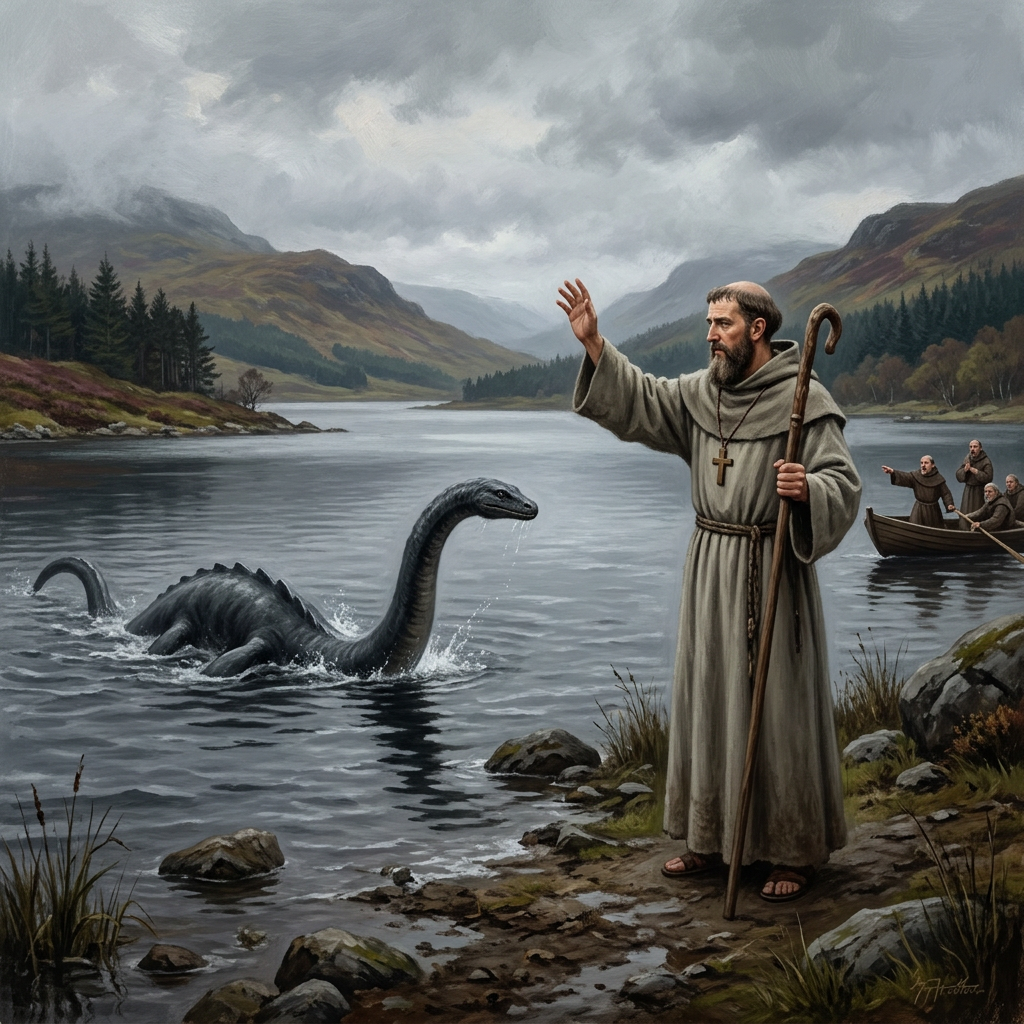

On this date, St. Columba is remembered. He was called “Colum Cille”, the Dove of the Church. He died on this day in 597 A.D. He is considered the Patron saint of Ireland along with St. Patrick and St. Brigid. He’s remembered as one of the 12 apostles of Ireland.
St. Columba & the Loch Ness Monster
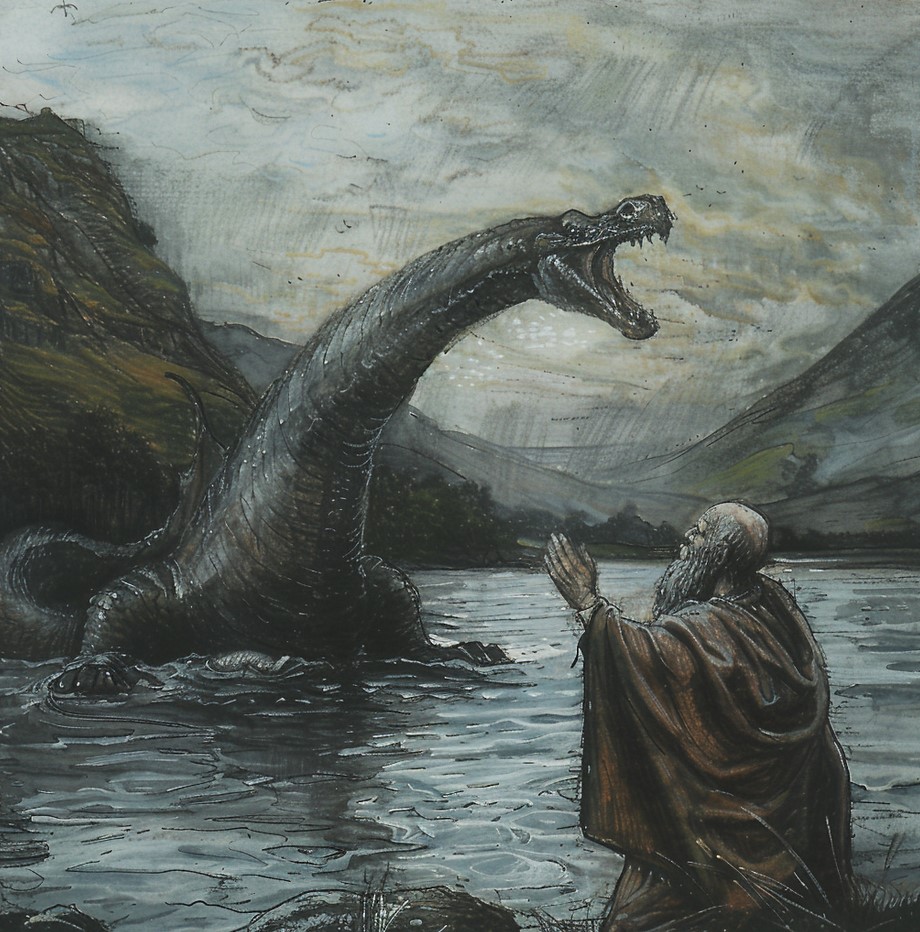
In 565 AD, while preaching the Gospel to the Picts in Scotland, Columba encountered the creature now known as the Loch Ness Monster. The story of his encounter is earliest written account of the creature seen in St. Adamnan’s book, The Life of Saint Columba. According to the story, the locals were burying a man who had been swimming in the river and was killed by the creature.
“When Columba got the gist of the story from the assembled mourners, he laid his staff across the dead man’s chest and, miraculously, the man stood up, hale and hearty.
Against common sense, Columba ordered Br. Lugne Mocumin, one of his fellow monks, to swim across the loch and bring back a small boat known as a coble which was moored on the opposite shore.
Without hesitation, Lugne stripped off his tunic and immediately jumped into the water. The monster, alerted by Lugne’s splashing around, surfaced and raced towards the hapless monk, eager for a bite. The monster roared a might roar, darting towards the swimming monk with its mouth wide open, as Lugne was in the middle of the stream.
Everyone on the shore cried out hoping to warn the monk of his impending doom. However, Columba was unmoved. Instead, the saint stepped forward boldly to the edge of the loch and, making the sign of the cross while invoking the Name of the Lord, spoke in a commanding voice.
“You will go no further!” he demanded of the monster. “Do not touch the man! Leave at once!”
Even though the monster was no more than a spear’s length away from the swimming monk, at the sound of the saint’s words, it stopped and immediately fled the scene terrified. As Adamnan described it, the monster moved “more quickly than if it had been pulled back with ropes.”
The monster quickly absconded to the depths of the loch behind him, allowing Br. Lugne to paddled the boat back unharmed. Everyone, including Nessie, was astonished. If the heathens at the funeral weren’t sufficiently impressed with Columba bringing their friend back to life, they were thoroughly impressed with how the monster obeyed the saint. They all gave glory to the God of the Christians. The Picts converted on the spot, being baptized in the very waters of River Ness.” { St. Columba and the Loch Ness Monster}
The Loch Ness Monster
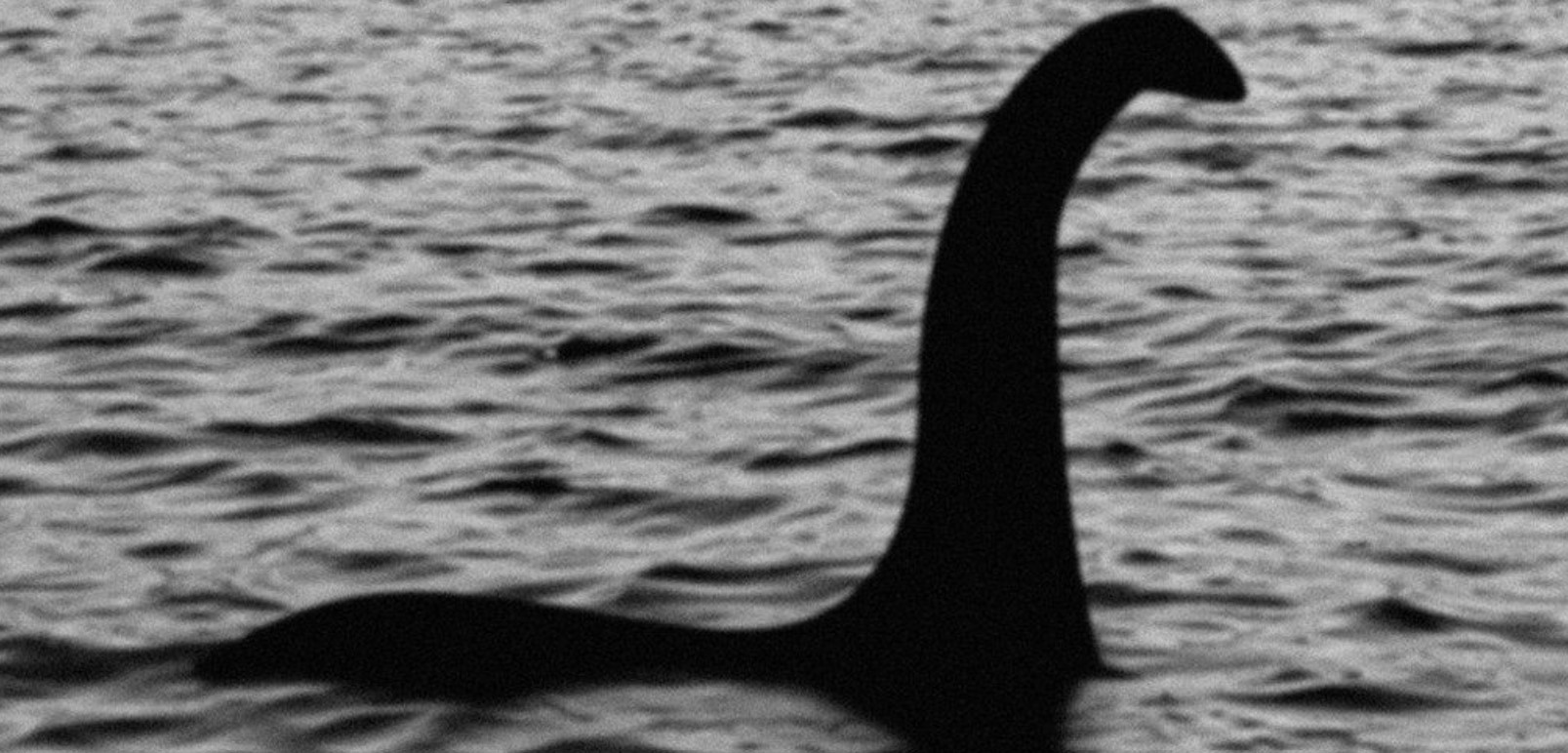
Loch in Scottish Gaelic means lake and Ness comes from the River Ness, which is the location of the story about Columba. In Old Celtic the word ness means “roaring one.” Here in the name of this creature is a picture of Satan, the roaring one pictured by leviathan/sea monsters.
1Pe 5:8 Be sober, be vigilant; because your adversary the devil, as a roaring lion, walketh about, seeking whom he may devour:
God defeats the sea monster
Isa 51:9 Awake, awake, put on strength, O arm of the LORD; awake, as in the ancient days, in the generations of old. Art thou not it that hath cut Rahab, and wounded the dragon?
Jay P. Green Literal Version
Isa 51:9 Awake! Awake! Arm of Jehovah, put on strength. Awake, as in days of old, everlasting generations. Was it not You cutting in pieces Rahab, and piercing the sea monster?
Isa 27:1 In that day the LORD with his sore and great and strong sword shall punish leviathan the piercing serpent, even leviathan that crooked serpent; and he shall slay the dragon that is in the sea.
Pharoah was a picture of Satan, the proud sea monster
Eze 29:3 Speak, and say, Thus saith the Lord GOD; Behold, I am against thee, Pharaoh king of Egypt, the great dragon that lieth in the midst of his rivers, which hath said, My river is mine own, and I have made it for myself.
Eze 32:2 Son of man, lift up a lament over Pharaoh, king of Egypt, and say to him, You were like a young lion of the nations, and you were like the monster in the seas. And you burst forth in your rivers and stirred up the waters with your feet and fouled their rivers.
Rahab
Job 9:13 If God will not withdraw his anger, the proud (רהב ‘rahab’) helpers do stoop under him.
H7293
רהב
rahab
BDB Definition:
1) pride, blusterer
1a) storm, arrogance (but only as names)
1a1) mythical sea monster
1a2) emblematic name of Egypt
Part of Speech: noun masculine
A Related Word by BDB/Strong’s Number: from H7292, bluster(-er)
John Gill commentary
the proud helpers do stoop under him; or “the helpers of pride” (n), or helpers of proud men; proud, wicked, and ungodly men, who combine together and help one another against God, his people, cause and interest; men of power, rule and government, as Aben Ezra explains it; civil magistrates, men in authority, who, instead of being terrors to evil doers, encourage them, and help them forward in their wickedness; but though both those that help, and those that are helped, may continue for a while, and be supported, yet they shall sooner or later fall under the mighty hand of God, his power and wrath, and be crushed by it. Some regard may be had either to the giants, the men of the old world, who filled the earth with violence, and were swept away with the flood, Gen_6:13; or rather to the builders of Babel, who helped one another to build a tower to make them a name, and secure themselves, and in opposition to God; but he being angry with them, made them desist, and they bowed under him, Gen_11:4. Some render it, “the helpers of Rahab”; that is, of Egypt (o), Rahab being a name of Egypt, Psa_87:4. The devils are meant, whose sin was pride, and by which they fell, and which they have endeavoured to promote and cherish among men; but these proud spirits are cast out of heaven and into hell, where they are reserved in chains of darkness to the great judgment, Jud_1:6; and are obliged, whether they will or not, to stoop to the Lord, and even to the son of God in human nature, which their proud stomachs cannot well bear; but are forced to it, the anger of God lying upon them, and his wrath, which will never be withdrawn from them.
(m) אלוה לא ישיב אפו “Deus non revocabit furorem suum”, Pagninus, Beza. (n) עזרי רהב “adjutores superbiae”, Montanus, Vatablus, Drusius, Junius & Tremellius, Schmidt, Michaelis. (o) So Jarchi.
Keil & Delitzsch on Job 9:13
…from Psa_89:11; Isa_51:9, it is evident that Rahab properly denotes a sea-monster, which has become the symbol of Egypt, like tannîn and leviathan elsewhere. This signification of the word is also supported by Job_26:12, where the lxx actually translate κητος, as here with remarkable freedom, ὑπ ̓ ἀυτοῦ ἐκάμφθησαν κήτη τὰ ὑπ ̓ οὐρανόν. It is not clear whether these ”sea-monsters” denote rebels cast down into the sea beneath the sky, or chained upon the sky; but at any rate the consciousness of a distinct mythological meaning in רהב עזרי is expressed by this translation (as also in the still freer translation of Jerome, et sub quo curvantur qui portant orbem); probably a myth connected with such names of the constellations as Κῆτος and Πρίστις (Ewald, Hirz., Schlottm.). The poesy of the book of Job even in other places does not spurn mythological allusions; and the phrase before us reminds one of the Hindu myth of Indras’ victory over the dark demon Vritras, who tries to delay the descent of rain, and over his helpers. In Vritras, as in רהב, there is the idea of hostile resistance.”
Job 26:12 With His power He quiets the sea, and by His understanding He shatters pride (רהב ‘rahab’).
Keil & Delitzsch commentary on Job 26:12
רַהַב, which here also is translated by the lxx τὸ κῆτος, has been discussed already on Job_9:13. It is not meant of the turbulence of the sea, to which מָחַץ is not appropriate, but of a sea monster, which, like the crocodile and the dragon, are become an emblem of Pharaoh and his power, as Isa_51:9. has applied this primary passage: the writer of the book of Job purposely abstains from such references to the history of Israel. Without doubt, רהב denotes a demoniacal monster, like the demons that shall be destroyed at the end of the world, one of which is called by the Persians akomano, evil thought, another taromaiti, pride. This view is supported by Job_26:13, where one is not at liberty to determine the meaning by Isa_51:9, and to understand נָחָשׁ בָּרִחַ, like תַּנִּין in that passage, of Egypt.
Leviathan
Psa 74:12 For God is my King of old, who works salvation in the midst of the land.
Psa 74:13 You broke the sea by Your strength; You burst the heads of sea-monsters in the waters.
Psa 74:14 You cracked open the heads of leviathan; You gave him to be food for the people of the wilderness.
Psa 104:25 This is the sea, great and wide on both hands; there are creeping things even without number; living things, small and great.
Yam
Job 26:12 He divideth the sea (ים ‘yam’) with his power, and by his understanding he smiteth through the proud.
Job 26:13 By his spirit he hath garnished the heavens; his hand hath formed the crooked serpent.
In Hebrew, ים ‘yam,’ means the sea but also terror.
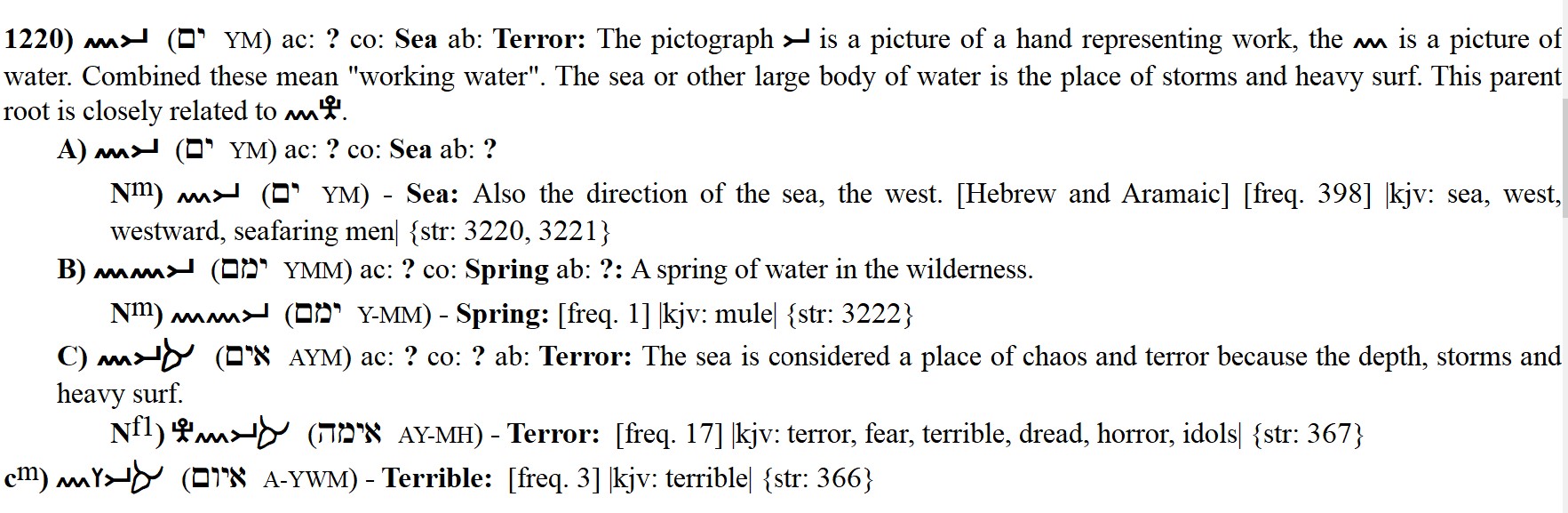
Gen 36:24 And these are the children of Zibeon; both Ajah, and Anah: this was that Anah that found the mules (ים ‘yem’) in the wilderness, as he fed the asses of Zibeon his father.
In Genesis 36 verse 24 and odd addition of information is given about Anah. He is said to have found mules (ים yem) in the wilderness. The word for mules is ים ‘yam’ which is translated in the Targum as terror. In the book of Jasher chapter 36 verse 29-35 it is told of 120 great and terrible animals that came out from the wilderness at the other side of the sea and came to the place where the mules were. These animals were in the shape of men from the middle down and in the shape of different beasts from the middle up. The animals attacked Anah so he fled to the city and related to his sons and brothers what happened to him.
In Loch Ness and the River Ness it is said that “kelpies” and “water-horses” dwell in the waters.
Hab 3:8 Was the LORD displeased against the rivers? was thine anger against the rivers? was thy wrath against the sea (ים ‘yam’), that thou didst ride upon thine horses and thy chariots of salvation?
In the JPS footnotes on Habakkuk 3:8 it is written “Neharim=floods & Yam=Sea were marine monsters vanquished by the LORD in hoary antiquity. On Yam see Ps 74:13; Job 7:12 Being called both Yam & Nahar figures in early Canaanite literature.
Psa 74:13 You broke the sea (ים ‘yam’) by Your strength; You burst the heads of sea-monsters (תנין ‘taniyn’) in the waters.
Psa 74:14 You cracked open the heads of leviathan; You gave him to be food for the people of the wilderness.
Job 7:12 Am I a sea (ים ‘yam’), or a sea-monster (תנין ‘taniyn’), that You set a watch over me?
Jonah & St. Columba
In Gaelic, Columba (Colum) means a dove. In Hebrew, Jonah means a dove.
Did a fish, whale, or something else swallow the prophet Jonah? Historian Bill Cooper recently helped answer this question in his 2012 book The Authenticity of the Book of Jonah.1 The main clue Dr. Cooper followed was simply the then-common Greek word the Lord Jesus used in Matthew 12:40 for Jonah’s monster, transliterated kêtos. What was the ketos? Dr. Henry Morris wrote, “It could have been…a large whale-shark, or possibly some now-extinct marine reptile.”2
Although knowing the animal’s exact identity is not necessary to understand the Jonah passages, its proper identification would add an element of historicity to the prophet’s traumatic experiences. Jonah 1:17, referenced as 2:1 in the Hebrew Bible, uses the Hebrew word dag to refer to a broad range of sea creatures. It had “great” (gadôl) size—large enough to swallow a whole man.
The second century B.C. saw the Hebrew Old Testament translated into the Greek Old Testament, commonly called the Septuagint. There, dag gadôl (“great fish”) translates into kêtei megalô, meaning a “mega-sized ketos.”3
Jesus said, “For as Jonah was three days and three nights in the belly of the [ketos], so will the Son of Man be three days and three nights in the heart of the earth.”4 Was Jonah swallowed by a now-extinct marine reptile? Ancient writers—including New Testament authors—used specific words for specific creatures.5 Why did Matthew’s gospel not use the common words for fish, shark, or whale?
Cooper identified an array of sources from outside the Bible that pinpoint the ketos as a sea dragon. A ponderous weight of historical evidence shows those who best knew the Mediterranean Sea consistently used ketos to mean “a sea serpent.” Cooper wrote, “The ketos—the dog-headed sea-dragon—appears in accounts from ca. 700 B.C. and all the way up to ca. A.D. 500.”1
These and other ancient authors and historians mentioned the ketos:1
Homer (9th–8th century B.C.)Euripides (ca. 480-406 B.C.)Aristophanes (448-380 B.C.)Lychophron (285-247 B.C.)Marcus Terentius Varro (116-27 B.C.)Diodorus Siculus (ca. 60 B.C.–A.D. 30)Manilius (1st century A.D.)Pausanias (2nd century A.D.)Claudius Aelianus in his De Natura Animalium (ca. A.D. 175-235)Oppian of Apamea (ca. A.D. 200)Eustathius (ca. A.D. 300-377)Hesychius (5th century A.D.)Johannes Moschus (6th century A.D.)
As if it were needed, additional visual art evidence identifies the ketos as a sea serpent. Artists in Rome, Africa, Turkey, Asia, and England painted, carved, and modeled the ketos with consistent anatomy. Again and again, they depicted its dog-like head with prominent teeth and plume-like flaps or frills above the head and neck. They also consistently rendered its huge body as slender and often coiled.
The Authenticity of the Book of Jonah describes a first-century painting from a Roman catacomb showing Jonah being thrown to a sea monster. This ketos had a dog-like head and a flexible neck. Numerous artifacts show a similar animal, including tile mosaics, wood, stone, ivory carvings, and even coins. The ketos looked like nothing common today, but that does not mean marine reptiles were not common in the past. After all, both the books of Job and Psalms refer to the large sea reptile leviathan.
History and archaeology indicate that the Lord Jesus’ audience might have understood exactly the kind of creature to which He referred—the ketos, the sea serpent that swallowed Jonah.”
Jesus fulfilled the sign of Jonah overcoming the serpent who held the power of death
Heb 2:14 Forasmuch then as the children are partakers of flesh and blood, he also himself likewise took part of the same; that through death he might destroy him that had the power of death, that is, the devil;
Heb 2:15 And deliver them who through fear of death were all their lifetime subject to bondage.
“Death” swallowed Jonah, Christ “swallowed” death
1Co 15:54 So when this corruptible shall have put on incorruption, and this mortal shall have put on immortality, then shall be brought to pass the saying that is written, Death is swallowed up in victory.
1Co 15:55 O death, where is thy sting? O grave, where is thy victory?
1Co 15:56 The sting of death is sin; and the strength of sin is the law.
1Co 15:57 But thanks be to God, which giveth us the victory through our Lord Jesus Christ.
Messiah & the Cross
Salvation is associated with the defeat of the dragon.
Psa 74:12 For God is my King of old, who works salvation {Hebrew ישועה ‘yeshuah’} in the midst of the land.
Psa 74:13 You broke the sea by Your strength; You burst the heads of sea-monsters in the waters.
Psa 74:14 You cracked open the heads of leviathan; You gave him to be food for the people of the wilderness.
Psa 74:15 You divided the fountain and the torrent; You dried up mighty rivers.
Psa 91:13 You shall tread on the lion and adder; the young lion and the serpent You shall trample under foot.
Psa 91:14 Because He has set His love on Me, therefore I will deliver Him; I will set Him on high because He has known My name.
Psa 91:15 He shall call on Me and I will answer Him; I will be with Him in distress; I will rescue Him and honor Him.
Psa 91:16 I will satisfy him with length of days, and will make Him see My salvation.
Isa 27:1 In that day Jehovah shall visit the sea monster, the darting serpent, with His great and fierce and strong sword; even on the sea monster, the twisting serpent; and He shall slay the monster that is in the sea.
The adversary held over mankind the fear of death until Messiah came.
Heb 2:14 Since, then, the children have partaken of flesh and blood, in like manner He Himself also shared the same things, that through death He might cause to cease the one having the power of death, that is, the devil;
Heb 2:15 and might set these free, as many as by fear of death were subject to slavery through all the lifetime to live.
Death is overcome by Messiah who became the serpent on the tree. The last enemy is death of which we are not to fear for Messiah has overcome the world.
Isa 12:2 Behold, God is my salvation; I will trust, and not be afraid: for the Jah Jehovah is my strength and my song; he also is become my salvation.
Mat 10:28 And fear not them which kill the body, but are not able to kill the soul: but rather fear him which is able to destroy both soul and body in hell.
Mat 10:29 Are not two sparrows sold for a farthing? and one of them shall not fall on the ground without your Father.
Mat 10:30 But the very hairs of your head are all numbered.
Mat 10:31 Fear ye not therefore, ye are of more value than many sparrows.
Joh 16:33 I have spoken these things to you that you may have peace in Me. You have distress in the world; but be encouraged, I have overcome the world.
Col 2:15 having stripped the rulers and the authorities, He made a show of them in public, triumphing over them in it.
2Co 5:21 For He made the One who knew no sin to be sin for us, that we might become the righteousness of God in Him.
The crucifixion of the Messiah is likened unto the brazen serpent in the wilderness
Joh 3:14 And even as Moses lifted up the serpent in the wilderness, so must the Son of Man be lifted up,
Num 21:7 And the people came in to Moses and said, We have sinned, for we have spoken against Jehovah, and against you. Pray to Jehovah, and He shall turn the serpent away from us. And Moses prayed on behalf of the people.
Num 21:8 And Jehovah spoke to Moses, Make yourself a fiery serpent, and set it on a pole; and it shall be that when anyone is bitten, when he sees it, he shall live.
Num 21:9 And Moses made a serpent of bronze and put it on a pole; and it happened, if a serpent had bitten any man, when he looked to the bronze serpent, he lived.
Nehushtan
2Ki 18:4 he took away the high places, and broke in pieces the pillars, and cut down the Asherah, and beat to bits the bronze serpent that Moses made (for in those days it was that the sons of Israel burned sacrifices to it) and called it Nehushtan. (נחש ‘nachash’=divine תן ‘tan’=dragon, serpent) They called it the divine dragon…the same thing has happened to the image of the cross. The Messiah being crucified which brought forgiveness, and life has been changed into an image to be worshiped just as the brazen serpent was.
The Cross & 666
Strong’s Concordance #5516 “Chi Xi Stigma [khee xee stig-ma]; 22nd, 14th and obsolete letter (4742 as a cross) of the Greek alphabet (intermediate between the 5th and 6th letters) used as numbers; denoting respectively 600, 60 and 6; 666 as a numeral: -Six hundred three score and six.” [Interestingly, the 22nd, 14th and 6th letters of the Hebrew Alphabet (Tau, Nun, Waw) spell tanu, “his dragon”].
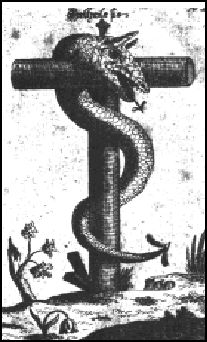
Col 2:15 having stripped the rulers and the authorities, He made a show of them in public, triumphing over them in it (The cross).
The Messiah became sin/the curse in order to deliver mankind (Galatians 3:13; 2 Corinthians 5:21).
The Greek alphabet comes from the Phoenician alphabet which, in essence, is the same as Paleo Hebrew. χξς would be rendered in Phoenician as:
χ = which is a picture of crossed sticks
ξ=  which is a picture of a thorn or branch
ς= Stigma means a mark and like the letter ξ was used to represent a coiled serpent.
Hence, the pictograph meaning of the χξς is a serpent on the branch of a tree. It is the equivalent of the tree of knowledge of good and evil.
Messiah took upon Himself the punishment of sin which began at the tree of knowledge of good and evil so that mankind might live. He overcame the beast that dwells in the waters.
littleguyintheeye@gmail.com
Daily Tidbits 1/23 – Alligator/Crocodile
Daily Tidbits 1/27 – Yin Yang & Oroboros

 Little Guy in the Eye