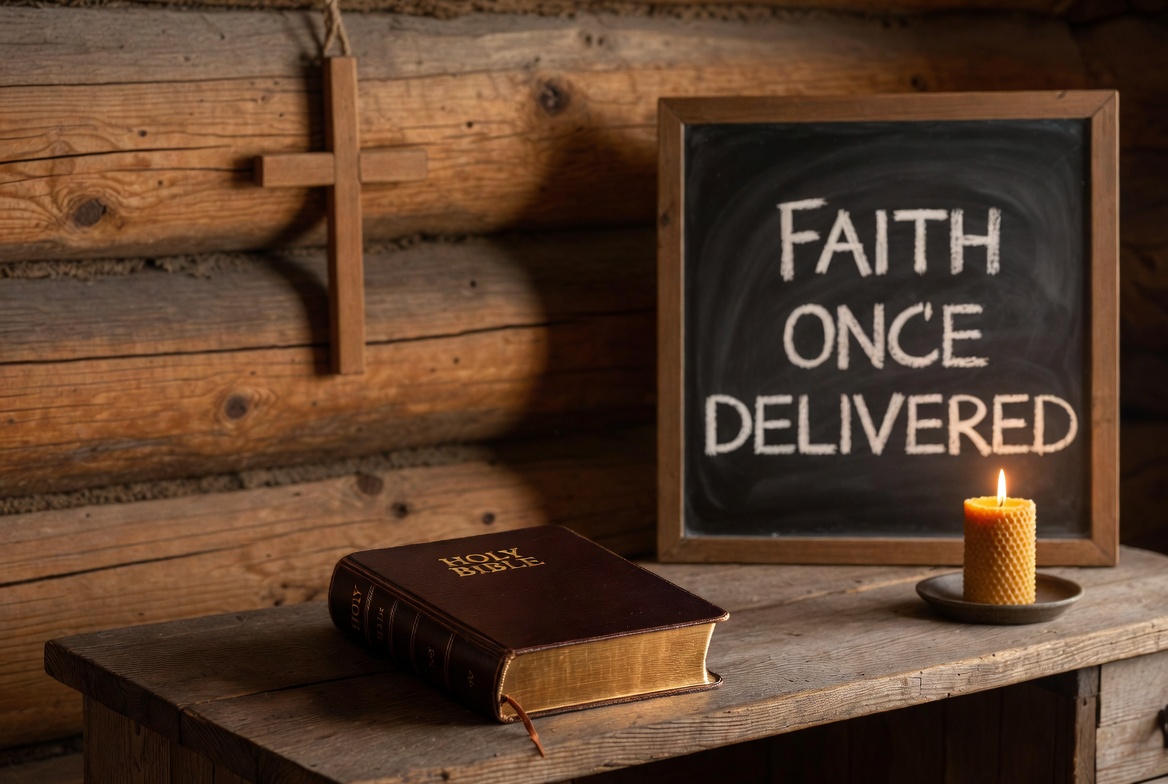

“The faith once delivered to the saints (Jude 1:3) is the pure, apostolic gospel handed down by the early church. We are called to earnestly contend for this original faith, rooted in Christ Jesus, the Author and Finisher of our faith. It is a call to return to the simplicity and power of the early church: walking in obedience, sound doctrine, and intimate relationship with Christ.”
The Bible admonishes us to earnestly contend for the faith once delivered to the saints. Many Christians, such as myself, see the problems in modern day Christianity and assume that this faith has been corrupted. Some, such as Seventh Day Adventitss, Jehovah Witnesses and Torah Observant/Hebrew roots/Messianics leave the church entirely and follow a “new” doctrine thinking they are restoring this apostolic faith.
We are to fight and contend for the faith that was delivered to the saints. This is the faith that has been handed down since the creation of the world, through Abraham (Gen 18:19), Isaac, Jacob and Israel through the written Torah given through Moses. This faith was passed down through the prophets and fully manifested when Jesus came upon the earth. Jesus is the Author & Finisher of our faith. The faith once delivered to the saints finds its culmination in Jesus Christ and Christianity.
Jud 1:3 Having made all haste to write to you about the common salvation, beloved, I had need to write to you to exhort you to contend earnestly for the faith once delivered to the saints.
Murdock -Aramaic Translation
Jud 1:3 My beloved, while I take all pains to write to you of our common life, it is needful for me to write to you, exhorting you to
Etheridge – Aramaic Translation
Jud 1:3 My beloved, while giving all diligence to write to you concerning our common salvation, it is needful for me to write to you, exhorting you (in particular) to do battle [D’aguno tebadun.] for the faith which was once delivered to the saints.
Martin Luther said the following
“If I profess with the loudest voice and clearest exposition every portion of the truth of God except precisely that little point which the world and the Devil are at that moment attacking, I am not confessing Christ, however boldly I may be professing Christ. Where the battle rages, there the loyalty of the soldier is proved, and to be steady on all the battlefield besides, is mere flight and disgrace.”
We are to fight and contend for the faith that was delivered to the saints. This is the faith that has been handed down since the creation of the world, through Abraham (Gen 18:19), Isaac, Jacob and Israel through the written Torah given through Moses. This faith was passed down through the prophets and fully manifested when Jesus came upon the earth. Jesus is the Author & Finisher of our faith.
Returning to the faith once delivered to the saints is a part of the Elijah message that is proclaimed before the return of the Messiah. Returning the hearts of the fathers to the children and the children to the fathers. Returning to the old paths wherein is the good way spoken of by the prophet Jeremiah.
Jud 1:3 Beloved, when I gave all diligence to write unto you of the common {κοινός ‘koinos’} salvation, it was needful for me to write unto you, and exhort you that ye should earnestly contend for the faith which was once {ἅπαξ ‘hapax’} delivered unto the saints.
The faith delivered to Abraham & Moses was temporary and incomplete (1 Peter 1:10-12; John 3:34; Hebrews 9:10; Romans 16:25-26; Galatians 3:19). The faith once delivered to the saints was brought forth by Jesus Christ (Galatians 4:4; Ephesians 1:10; 2:20; Hebrews 1:1-4; 3:2-6; 12:2). This faith was handed down to the Apostles (Ephesians 2:20; John 16:12-15; 17:20; Acts 2:42; 13:12; Matthew 28:19-20) and then the early church (1 Timothy 3:15; 1 Peter 2:9; Matthew 16:18-19; 18:18; 21:43; 1 Corinthians 11:2; 1 Thessalonians 4:1; 2 Thessalonians 2:15; 3:6; 2 Peter 1:1).
1Ti 3:15 But if I tarry long, that thou mayest know how thou oughtest to behave thyself in the house of God, which is the church of the living God, the pillar and ground of the truth.
We are not to look to Abraham, Isaac or Jacob, we are not to look to Moses, David, or Elijah, we are not to look to first century Judaism to earnestly contend for the faith…we are to look to Christ Jesus, the Word of God made flesh.
I know of many believers (I am/was one) who are seeking to return to the faith once delivered to the saints and are seeking to understand their Hebraic roots. This is an honorable endeavor as our Heavenly Father seeks those who will worship Him in Spirit & Truth (John 4:23). However, there is much confusion and deception in the Hebraic roots movement. The true Hebrew root, the Olive tree of Israel, is Christ. The Word made flesh. If one wants to know their roots, one need only turn to the Bible.
Heb 12:2 Looking unto Jesus the author {ἀρχηγός ‘archēgos”} and finisher {τελειωτής ‘teleiōtēs’} of our faith; who for the joy that was set before him endured the cross, despising the shame, and is set down at the right hand of the throne of God.
The root of which we are to seek is not ‘Hebrew,’ it is Him.
Col 2:6 Therefore, as you received Christ Jesus the Lord, walk in Him,
Col 2:7 being rooted and being built up in Him, and being confirmed in the faith, even as you were taught, abounding in it with thanksgiving.
Col 2:8 Watch that there not be one robbing you through philosophy and empty deceit, according to the tradition of men, according to the elements of the world, and not according to Christ.
Eph 3:17 That Christ may dwell in your hearts by faith; that ye, being rooted and grounded in love,
Eph 3:18 May be able to comprehend with all saints what is the breadth, and length, and depth, and height;
Eph 3:19 And to know the love of Christ, which passeth knowledge, that ye might be filled with all the fulness of God.
Eph 3:20 Now unto him that is able to do exceeding abundantly above all that we ask or think, according to the power that worketh in us,
Eph 3:21 Unto him be glory in the church by Christ Jesus throughout all ages, world without end. Amen.
Originally, this study was focused upon looking at how believers in Messiah worshiped in the 1st century. I have come to believe that knowledge of the way in which believers worshiped in the 1st century is not as important as knowledge of how to walk in the Word (2 Peter 1:2; 3:18) by His Spirit (2 Corinthians 3:6; Romans 8:2-4). Messiah did not come to make mankind into 1st century Jews. He came to redeem mankind (2 Corinthians 5:19) and remake them into His image (Romans 8:29; 1 John 3:1-3). Jesus is THE image of God (Hebrews 1:3; 2 Corinthians 4:4-6; Colossians 1:15-16) who is love (1 John 4:8).
Much edification can be gained by studying believers of the 1st century (Job 8:8; 12:12; Deuteronomy 32:7; Romans 15:4; 1 Corinthians 10:11), but one cannot come to the fullness of God’s will by following man’s understanding of His will at that time. Paul, who had great understanding of religion during the 1st century, did not even claim to have attained the full knowledge of Messiah/the Word (Philippians 3:8-14). Peter admonishes us to continue to grow in His grace and knowledge (2 Peter 3:18). Scripture declares that God has given various gifts and services to the body of Messiah that we might grow unto perfection (Ephesians 4:11-13). If 1st century believers had attained unto God’s perfect will, there would be no need to grow. James also said that we all stumble in many things (James 3:2). This is not the language of one who believes that perfection had been attained.
It is not walking as 1st century Jews which is God’s will for us. It is walking in His love by His Spirit (1 John 4:12-17).
With that being said, following is some history on how believers worshiped in the 1st Century for the edification of the reader.
1st Century Worship
Synagogue
The Hebrew qehal is translated variously in the Greek Septuagint as sunagoge and ekklesia. These Greek terms are subsequently translated in English Bible versions as synagogue, church, assembly, congregation, etc. The perceived distinction between the terms synagogue and church is due only to centuries of polarization of Jews and Christians.
G4864 συναγωγή sunagōgē is always translated in the KJV as synagogue except 2 places. James 2:2; Acts 13:43
Jas 2:1 My brothers, do not with partiality have the faith of our Lord Jesus Christ, the Lord of glory.
Jas 2:2 For if a gold-fingered man in splendid clothing comes into your synagogue (KJV assembly), and a poor one in shabby clothing also comes in;
Jas 2:3 and you look on the one wearing the splendid clothing, and say to him, You sit here comfortably; and to the poor one you say, You stand there, or, Sit here under my footstool;
Jas 2:4 did you not also make a difference among yourselves and become judges with evil thoughts?
The early believers met at synagogues
Luk 4:16 And he came to Nazareth, where he had been brought up: and, as his custom was, he went into the synagogue on the sabbath day, and stood up for to read.
Act 13:13 Now when Paul and his company loosed from Paphos, they came to Perga in Pamphylia: and John departing from them returned to Jerusalem.
Act 13:14 But when they departed from Perga, they came to Antioch in Pisidia, and went into the synagogue on the sabbath day, and sat down.
Act 13:42 And when the Jews were gone out of the synagogue, the Gentiles besought that these words might be preached to them the next sabbath.
Act 13:43 And the synagogue being broken up, many of the Jews and of the devout proselytes followed Paul and Barnabas, who speaking to them persuaded them to continue in the grace of God.
Act 17:1 Now when they had passed through Amphipolis and Apollonia, they came to Thessalonica, where was a synagogue of the Jews:
Act 17:2 And Paul, as his manner was, went in unto them, and three sabbath days reasoned with them out of the scriptures,
Act 18:4 And he reasoned in the synagogue every sabbath, and persuaded the Jews and the Greeks.
Act 18:7 And he departed thence, and entered into a certain man’s house, named Justus, one that worshipped God, whose house joined hard to the synagogue.
Act 18:8 And Crispus, the chief ruler of the synagogue, believed on the Lord with all his house; and many of the Corinthians hearing believed, and were baptized.
After the unbelieving Jews began to persecute the believers in Messiah and kick them out of their synagogues, believers began to meet in houses.
Mat 18:20 For where two or three are gathered together in my name, there am I in the midst of them.
Phm 1:2 And to our beloved Apphia, and Archippus our fellowsoldier, and to the church in thy house:
Rom 16:3 Greet Priscilla and Aquila my helpers in Christ Jesus:
Rom 16:4 Who have for my life laid down their own necks: unto whom not only I give thanks, but also all the churches of the Gentiles.
Rom 16:5 Likewise greet the church that is in their house. Salute my wellbeloved Epaenetus, who is the firstfruits of Achaia unto Christ.
1Co 16:19 The churches of Asia salute you. Aquila and Priscilla salute you much in the Lord, with the church that is in their house.
Col 4:15 Salute the brethren which are in Laodicea, and Nymphas, and the church which is in his house.
The Sacred Space
Christians borrowed this idea from the pagans in the second and third centuries. The burial places of the martyrs were regarded as “sacred.” In the fourth century, church buildings were erected on these burial places, thus creating “sacred” buildings.
The building/place where believers meet, whether it has a roof or is outdoors is not as important as how we use that time together. The early believers continued to worship together as did the believers in the synagogues. It was the same structure where God was the main focus through prayer and study of His Word.
Torah and Prophets read each week at the synagogue.
Act 15:21 For Moses of old time hath in every city them that preach him, being read in the synagogues every sabbath day.
Act 13:15 And after the reading of the law and the prophets the rulers of the synagogue sent unto them, saying, Ye men and brethren, if ye have any word of exhortation for the people, say on.
Fausset Dictionary
Synagogues in the strict and later sense are not mentioned until after the desecration of the temple by Antiochus Epiphanes. The want of the temple in the Babylonian captivity familiarized the exiles with the idea of spiritual worship independent of locality. The elders often met and sat before the prophet, Ezekiel to hear Jehovah’s word (Eze_8:1; Eze_11:15-16; Eze_14:1; Eze_20:1); in Eze_33:31 the people also sit before him to hear. Periodic meetings for hearing the law and the prophets read were customary thenceforth on the return (Ezr_8:15; Neh_8:2; Neh_9:1; Zec_7:5; Act_15:21). When the Jews could not afford to build a synagogue they built “an oratory” (proseuchee) by a running stream or the seashore (Act_16:13). The synagogue was the means of rekindling the Jewish devotion and patriotism which shone so brightly in the Maccabean struggle with Antiochus.
The synagogue required no priest to minister; this and the reading of the Old Testament prepared the way for the gospel. Sometimes a wealthy Jew or a proselyte built the synagogue (Luk_7:5). The kibleh or “direction” was toward Jerusalem. The structure, though essentially different from the temple (for it had neither altar nor sacrifice), resembled in some degree that of the temple: the ark at the far end contained the law in both; the lid was called the kopereth or “mercy-seat”; a veil hung before it. Here were “the chief seats” sought by the Pharisees and the rich (Mat_23:6; Jam_2:2-3). In the middle was a raised platform on which several could be together, with a pulpit in the middle for the reader to stand in when reading and to sit when teaching. A low partition separated men on one side from women on the other. Besides the ark for “the law” (torah) there was a chest for the haphtaroth or “roll of the prophets”. In the synagogue a college of elders was presided over by the chief or ruler of the synagogue (Luk_7:3; Luk_8:41; Luk_8:49).
The elders were called parnasiym, “pastors,” “shepherds” (Eph_4:11; 1Pe_5:1), ruling over the flock (1Ti_5:17; Heb_13:7); they with the ruler managed the affairs of the synagogue and had the power of excommunication. The officiating minister was delegate (sheliach, answering to the term apostle, “sent”) of the congregation, the forerunner of “the angel (messenger sent) of the church” (Rev_1:20; Rev_2:1). The qualifications required were similar to those of a bishop or presbyter; he must be of full age, father of a family, apt to teach (1Ti_3:1-7; Tit_1:6-9). The chazzan or “minister” (Luk_4:16-20, where Christ by rising indicated that as a member of the synagogue at Nazareth. He desired to undertake the office of maptir or “reader of the lesson from the prophets”, and was at once permitted owing to His fame) answered to our deacon or subdeacon; besides getting the building ready for service he acted as schoolmaster during the week.
There were also the ten batlaniym or “men of leisure”, permanently making up a congregation (ten being the minimum (minyan “quoram”) to constitute a congregation), that no single worshipper might be disappointed; also acting as alms collectors. Three were archisunagogai, “chiefs of the synagogue”; then also the “angel” or “bishop” who prayed publicly and caused the law to be read and sometimes preached; and three deacons for alms; the interpreter of the old Hebrew Testament, who paraphrased it; also the theological schoolmaster and his interpreter (Lightfoot, Horae. 4:70). The government of the church evidently came from the synagogue not from the Aaronic priesthood. So also did the worship; with the addition of the new doctrines, the gifts of the Spirit, and the supper of the Lord; fixed liturgical forms, creeds, as the shema, “Hear O Israel,” etc. (Deu_6:4), and “prayers”, the kadish, shemoneh ‘esreh, berachoth; (compare brief creeds, 1Ti_3:16; 2Ti_1:13, the “Lord’s prayer” (Luke 11), the “order” (1Co_14:40);) the teaching out of the law, which was read in a cycle, once through in three years.
The prophets were similarly read as second lessons; the exposition (derash) or “word of exhortation” followed (Act_13:15; Act_15:21). The psalms were selected to suit “the special times”; “the times of prayer” (shacharit, minchah, ‘arabit) were the “third”, “sixth”, and “ninth” hours (Act_3:1; Act_10:3; Act_10:9); so in Old Testament, Psa_55:17; Dan_6:10. Clemens Alex. (Strom.) and Tertullian (Orat. 25) state the same in the church of the Second century. Sunday, Wednesday, and Friday were the devotional days of the synagogue as of the church. The custom of ending the Saturday Sabbath with a feast formed the connecting link between the seventh day Jewish sabbath and the first day, Christian Lord’s day and Lord’s supper (1Co_11:20; Rev_1:10).
Preparatory ablutions (Heb_10:22; Joh_13:1-15; Tertullian, Orat. 11), standing in prayer, not kneeling (Luk_18:11; Tertullian 23), the arms stretched out (Tertullian 13), the face toward the E. (Clemens Alex., Strom.), the Amen in responses (1Co_14:16), the leaping as if they would rise toward heaven in the Alexandrian church (Clemens Alex., Strom. 7:40) as the Jews at the tersanctus of Isaiah 6 (Vitringa 1100, Buxtorf 10), are all reproductions of synagogue customs. However the Hebrew in prayer wears the talith (“prayer shawl”) drawn over his ears to the shoulders (a custom probably later than apostolic times), whereas the Christian man is bareheaded (1Co_11:4) . The synagogue officers had judicial power to scourge, anathematize, and excommunicate (Mat_10:17; Mar_13:9; Luk_12:11; Luk_21:12; Joh_12:42; Joh_9:22): so the church (1Co_6:1-8; 1Co_16:22; Gal_1:8-9; 1Co_5:5; 1Ti_1:20; Mat_18:15-18); also to seize and send for trial before the Sanhedrin at Jerusalem (Act_9:2; Act_22:5).
Easton
The establishment of synagogues wherever the Jews were found in sufficient numbers helped greatly to keep alive Israel’s hope of the coming of the Messiah, and to prepare the way for the spread of the gospel in other lands. The worship of the Christian Church was afterwards modeled after that of the synagogue.
Christ and his disciples frequently taught in the synagogues (Mat_13:54; Mar_6:2; Joh_18:20; Act_13:5, Act_13:15, Act_13:44; Act_14:1; Act_17:2-4, Act_17:10, Act_17:17; Act_18:4, Act_18:26; Act_19:8).
ISBE (International Standard Bible Encyclopedia)
Synagogue, Greek συναγωγή, sunagōgḗ, “gathering” (Act_13:43), “gathering-place” (Luk_7:5), was the name applied to the Jewish place of worship in later Judaism in and outside of Palestine Proseuchḗ, “a place of prayer” (Act_16:13), was probably more of the nature of an enclosure, marking off the sacred spot from the profane foot, than of a roofed building like a synagogue. Sabbateíon in Ant., XV, i, 2, most probably also meant synagogue. In the Mishna we find for synagogue bēth ha-keneṣeth, in the Targums and Talmud bē-khenīshtā’, or simply kenīshtā’. The oldest Christian meetings and meeting-places were modeled on the pattern of the synagogues, and, in Christian-Palestinian Aramaic the word kenīshtā’ is used for the Christian church (compare Zahn, Tatian’s Diatessaron, 335).
2. Origin:
That the synagogue was, in the time of our Lord, one of the most important religious institutions of the Jews is clear from the fact that it was thought to have been instituted by Moses (Apion, ii, 17; Philo, De Vita Moses, iii. 27; compare Targum Jer to Exo_18:20).
Targum Jonathan
Now hearken to me and I will advise thee; and may the Word of the Lord be thy helper! When thou art with the people who seek instruction from before the Lord, thou shouldst take their affair before the Lord, and give them counsel about the statutes and laws, make them understand the prayer they are to offer in the house of congregation, the manner of visiting the sick, of burying the dead, of being fruitful In doing good, and in the work and process of justice, and how to conduct themselves among the wicked. But thou shouldst elect from all the people men of ability who fear the Lord, upright men who hate to receive the mammon of dishonesty, and superappoint them to be heads of thousands, of hundreds, of fifties, and of tens.
3. Spread of Synagogues:
In Palestine the synagogues were scattered all over the country, all the larger towns having one or more (e.g. Nazareth, Mat_13:54; Capernaum, Mat_12:9). In Jerusalem, in spite of the fact that the Temple was there, there were many synagogues, and all parts of the Diaspora were represented by particular synagogues (Act_6:9). Also in heathen lands, wherever there was a certain number of Jews, they had their own synagogue: e.g. Damascus (Act_9:2), Salamis (Act_13:5), Antioch of Pisidia (Act_13:14), Thessalonica (Act_17:1), Corinth (Act_18:4), Alexandria (Philo, Leg Ad Cai, xx), Rome (ibid., xxiii). The papyrus finds of recent years contain many references to Jewish synagogues in Egypt, from the time of Euergetes (247-221 BC) onward. According to Philo (Quod omnis probus liber sit, xii, et al.) the Essenes had their own synagogues, and, from ‛Ābhōth 3 10, it seems that “the people of the land,” i.e. the masses, especially in the country, who were far removed from the influence of the scribes, and were even opposed to their narrow interpretation of the Law had their own synagogues.
(2) The Structure.
Of the style of the architecture we have no positive records. From the description in the Talmud of the synagogue at Alexandria (Tōṣ Ṣukkāh, edition Zunz, 198 20; Ṣukkāh 51b one imagrees the synagogues to have been modeled on the pattern of the temple or of the temple court.
5. The Officials:
(1) The Elders.
These officials (Luk_7:3) formed the local tribunal, and in purely Jewish localities acted as a Committee of Management of the affairs of the synagogue (compare Berākhōth 4 7; Nedhārim 5 5; Meghillāh 3 1). To them belonged, most probably, among other things, the power to excommunicate (compare Ezr_10:8; Luk_6:22; Joh_9:22; Joh_12:42; Joh_16:2; ‛Ēdhuyōth 5 6; Ta‛ănīth 3 8; Middōth 2 2).
(2) The Ruler.
Greek archisunágōgos (Mar_5:35; Luk_8:41, Luk_8:49; Luk_13:14; Act_18:8, Act_18:17), Hebrew rō’sh ha-keneseth (Ṣōtāh 7 7, 8). In some synagogues there were several rulers (Mar_5:22; Act_13:15). They were most probably chosen from among the elders. It was the ruler’s business to control the synagogue services, as for instance to decide who was to be called upon to read from the Law and the Prophets (Yōmā’ 7 1) and to preach (Act_13:15; compare Luk_13:14); he had to look after the discussions, and generally to keep order.
(3) The Servant (or Servants).
Greek hupērétēs; Talmud ḥazzān (Luk_4:20; Yōmā 7 1; Ṣōtāh 7 7, 8). He had to see to the lighting of the synagogue and to keep the building clean. He it was who wielded the scourge when punishment had to be meted out to anyone in the synagogue (Mat_10:17; Mat_23:34; Mar_13:9; Act_22:19; compare Maḳḳōth 16). From Shabbāth 1 3 it seems that the ḥazzān was also an elementary teacher. See EDUCATION.
(4) Delegate of the Congregation.
Hebrew shelīaḥ cibbūr (Rō’sh ha-shānāh 4 9; Berākhōth 5 5). This office was not permanent, but one was chosen at each meeting by the ruler to fill it, and he conducted the prayers. According to Meghillāh 4 5, he who was asked to read the Scriptures was also expected to read the prayers. He had to be a man of good character.
(5) The Interpreter.
Hebrew methōrgemān. It was his duty to translate into Aramaic the passages of the Law and the Prophets which were read in Hebrew (Meghillāh 3 3; compare 1Co_14:28). This also was probably not a permanent office, but was filled at each meeting by one chosen by the ruler.
(6) The Almoners.
(Demā’ī 3 1; Ḳiddūshīn 4 5). Alms for the poor were collected in the synagogue (compare Mat_6:2). According to Pē’āh 8 7, the collecting was to be done by at least two persons, and the distributing by at least three.
6. The Service:
(1) Recitation of the “Shema’”.
At least ten persons bad to be present for regular worship (Meghillāh 4 3; Ṣanhedhrīn 1 6). There were special services on Saturdays and feast days. In order to keep the synagogue services uniform with those of the temple, both were held at the same hours. The order of service was as follows: the recitation of the shema‛, i.e. a confession of God’s unity, consisting of the passages Deu_6:4-9; Deu_11:13-21;. Num_15:37-41 (Berākhōth 2 2; Tāmīdh 5 1). Before and after the recitation of these passages “blessings” were said in connection with the passages (Berākhōth 1 4). This formed a very important part of the liturgy. It was believed to have been ordered by Moses (compare Ant., IV, viii, 13).
(2) Prayers.
The most important prayers were the Shemōneh ‛esrēh, “Eighteen Eulogies,” a cycle of eighteen prayers, also called “The Prayer” (Berākhōth 4 3; Ta‛ănīth 2 2). Like the shema‛ they are very old.
The following is the first of the eighteen: “Blessed art Thou, the Lord our God, and the God of our fathers, the God of Abraham, the God of Isaac, and the God of Jacob: the great, the mighty and the terrible God, the most high God Who showest mercy and kindness, Who createst all things, Who rememberest the pious deeds of the patriarchs, and wilt in love bring a redeemer to their children’s children for Thy Name’s sake; O King, Helper, Saviour and Shield! Blessed art Thou, O Lord, the Shield of Abraham.”
The prayers of the delegate were met with a response of Amen from the congregation.
History of the Prayer. (from Jewish Encyclopedia)
The Talmud names Simeon ha-Paḳoli as the editor of the collection in the academy of R. Gamaliel II. at Jabneh. (Ber. 28b). But this can not mean that the benedictions were unknown before that date; for in other passages the “Shemoneh ‘Esreh” is traced to the “first wise men” ( ; Sifre, Deut. 343), and again to “120 elders and among these a number of prophets” (Meg. 17b). This latter opinion harmonizes with the usual assumption that the “men of the Great Synagogue” arranged and instituted the prayer services (Ber.33a). In order to remove the discrepancies between the latter and the former assignment of editorship, the Talmud takes refuge in the explanation that the prayers had fallen into disuse, and that Gamaliel reinstituted them (Meg. 18a).
Edited by Gamaliel II.
The historical kernel in these conflicting reports seems to be the indubitable fact that the benedictions date from the earliest days of the Pharisaic Synagogue. They were at first spontaneous outgrowths of the efforts to establish the Pharisaic Synagogue in opposition to, or at least in correspondence with, the Sadducean Temple service. This is apparent from the haggadic endeavor to connect the stated times of prayer with the sacrificial routine of the Temple, the morning and the afternoon “Tefillah” recalling the constant offerings (Ber. 26b; Gen. R. lxviii.), while for the evening “Tefillah” recourse was had to artificial comparison with the sacrificial portions consumed on the altar during the night. In certain other homilies the fixation of the day’s periods for the three “Tefillot” is represented as being in harmony with the daily course of the sun (Gen. R. lxviii.; R. Samuel bar Naḥman, in Yer. Ber. iv.). Again, the Patriarchs are credited with having devised this tripartite scheme (Ber. 26b; Abraham = morning; Isaac = afternoon; Jacob = evening). Dan. vi. 11 is the proof that this system of praying three times a day was recognized in the Maccabean era. Gradually both the hours for the “Tefillah” and the formulas thereof acquiredgreater regularity, though much uncertainty as to content, sequence, and phraseology continued to prevail. R. Gamaliel II. undertook finally both to fix definitely the public service and to regulate private devotion. He directed Simeon ha-Paḳoli to edit the benedictions—probably in the order they had already acquired—and made it a duty, incumbent on every one, to recite the prayer three times daily. Under Gamaliel, also, another paragraph, directed against the traitors in the household of Israel, was added, thus making the number eighteen (Ber. iv. 3; see Grätz, “Gesch.” 3d ed., iv. 30 et seq.).
Haggadic Explanation of Sequence.
(3) Reading of the Law and the Prophets.
After prayers the pārāshāh, i.e. the pericope from the Law for that Sabbath, was read, and the interpreter translated verse by verse into Aramaic (Meghillāh 3 3). The whole Pentateuch was divided into 154 pericopes, so that in the course of 3 years it was read through in order. After the reading of the Law came the Haphṭārāh, the pericope from the Prophets for that Sabbath, which the interpreter did not necessarily translate verse by verse, but in paragraphs of 3 verses (Meghillāh, loc. cit.).
(4) The Sermon.
After the reading from the Law and the Prophets followed the sermon, which was originally a caustical exposition of the Law, but which in process of time assumed a more devotional character. Anyone in the congregation might be asked by the ruler to preach, or might ask the ruler for permission to preach.
The following example of an old (lst century AD) rabbinic sermon, based on the words, “He hath clothed me with the garments of salvation” (Isa_61:10, a verse in the chapter from which Jesus took His text when addressing the synagogue of Nazareth), will serve as an illustration of contemporary Jewish preaching:
“Seven garments the Holy One – blessed be He! – has put on, and will put on from the time the world was created until the hour when He will punish the wicked Edom (i.e. Roman empire). When He created the world, He clothed Himself in honor and majesty, as it is said (Psa_104:1): ‘Thou art clothed in honor and majesty.’ Whenever He forgave the sins of Israel, He clothed Himself in white, for we read (Dan_7:9): ‘His raiment was white as snow.’ When He punishes the peoples of the world, He puts on the garments of vengeance, as it is said (Isa_59:17): ‘He put on garments of vengeance for clothing, and was clad with zeal as a cloke.’ The sixth garment He will put on when the Messiah comes; then He will clothe Himself in a garment of righteousness, for it is said (same place) : ‘He put on righteousness as a breast-plate, and an helmet of salvation upon His head.’ The seventh garment He will put on when He punishes Edom; then He will clothe Himself in ‘ādhōm, i.e. ‘red,’ for it is said (Isa_63:2): ‘Wherefore art Thou red in Thine apparel?’ But the garment which He will put upon the Messiah, this will shine afar, from one end of the earth to the other, for it is said (Isa_61:10): ‘As a bridegroom decketh himself with a garland.’ And the Israelites will partake of His light, and will say:
‘Blessed is the hour when the Messiah shall come!
Blessed the womb out of which He shall come!
Blessed His contemporaries who are eye-witnesses!
Blessed the eye that is honored with a sight of Him!
For the opening of His lips is blessing and peace;
His speech is a moving of the spirits;
The thoughts of His heart are confidence and cheerful-ness;
The speech of His tongue is pardon and forgiveness;
His prayer is the sweet incense of offerings;
His petitions are holiness and purity.
O how blessed is Israel, for whom such has been prepared!
For it is said (Psa_31:19): “How great is Thy goodness, which thou hast laid up for them that fear thee” ‘ ”
(Peṣiḳtā’, edition Buber).
(5) The Benediction.
After the sermon the benediction was pronounced (by a priest), and the congregation answered Amen (Berākhōth 5 4; Ṣōtāh 7 2, 3).
Literature.
L. Zunz, Die gottesdienstlichen Vortrage der Juden, 2nd edition; Herzfeld, Geschichte des Volkes Israel, III, 129-37, 183-226; Hausrath, Neutestamentliche Zeitgesch., 2d edition, 73-80; HJP, II, 357-86; GJV4, II; 497-544; Edersheim, Life and Times of Jesus the Messiah, 5th edition, I, 431-50; Oesterly and Box, “The Religion and Worship of the Synagogue,” Church and Synagogue, IX, number 2, April, 1907, p. 46; W. Bacher, article “Synagogue” in HDB; Strack, article “Synagogen,” in RE, 3rd edition, XIX.
The faith delivered to Moses was temporary and incomplete
Heb 9:10 Which stood only in meats and drinks, and divers washings, and carnal ordinances, imposed on them until the time of reformation.
Mat_11:13 For all the prophets and the law prophesied until John.
Luk_16:16 The law and the prophets were until John: since that time the kingdom of God is preached, and every man presseth into it.
Gal 3:19 Wherefore then serveth the law? It was added because of transgressions, till the seed should come to whom the promise was made; and it was ordained by angels in the hand of a mediator.
Gal 3:20 Now a mediator is not a mediator of one, but God is one.
Gal 3:21 Is the law then against the promises of God? God forbid: for if there had been a law given which could have given life, verily righteousness should have been by the law.
Gal 3:22 But the scripture hath concluded all under sin, that the promise by faith of Jesus Christ might be given to them that believe.
Gal 3:23 But before faith came, we were kept under the law, shut up unto the faith which should afterwards be revealed.
Gal 3:24 Wherefore the law was our schoolmaster to bring us unto Christ, that we might be justified by faith.
Gal 3:25 But after that faith is come, we are no longer under a schoolmaster.
Gal 3:26 For ye are all the children of God by faith in Christ Jesus.
Gal 3:27 For as many of you as have been baptized into Christ have put on Christ.
Gal 3:28 There is neither Jew nor Greek, there is neither bond nor free, there is neither male nor female: for ye are all one in Christ Jesus.
Gal 3:29 And if ye be Christ’s, then are ye Abraham’s seed, and heirs according to the promise.
The faith once delivered was brought forth by Jesus
Gal 4:4 But when the fulness of the time was come, God sent forth his Son, made of a woman, made under the law,
Eph 1:10 That in the dispensation of the fulness of times he might gather together in one all things in Christ, both which are in heaven, and which are on earth; even in him:
Heb 1:1 God, who at sundry times and in divers manners spake in time past unto the fathers by the prophets,
Heb 1:2 Hath in these last days spoken unto us by his Son, whom he hath appointed heir of all things, by whom also he made the worlds;
Heb 1:3 Who being the brightness of his glory, and the express image of his person, and upholding all things by the word of his power, when he had by himself purged our sins, sat down on the right hand of the Majesty on high;
Heb 1:4 Being made so much better than the angels, as he hath by inheritance obtained a more excellent name than they.
Jud 1:3 Beloved, when I gave all diligence to write unto you of the common salvation, it was needful for me to write unto you, and exhort you that ye should earnestly contend for the faith which was once delivered unto the saints.
Php 1:27 Only let your conversation be as it becometh the gospel of Christ: that whether I come and see you, or else be absent, I may hear of your affairs, that ye stand fast in one spirit, with one mind striving together for the faith of the gospel;
Was the faith once delivered continued from the Apostles or hidden for 2,000 years? Did God give the truth to the Apostles and then allow it to go hidden for 2,000 years or did it continue in an unbroken chain?
Eph 3:21 Unto him be glory in the church by Christ Jesus throughout all ages {γενεά ‘genea’ – generations}, world without end. Amen.
1Ti 3:15 But if I tarry long, that thou mayest know how thou oughtest to behave thyself in the house of God, which is the church of the living God, the pillar and ground of the truth.
Heb 3:2 Who was faithful to him that appointed him, as also Moses was faithful in all his house.
Heb 3:3 For this man was counted worthy of more glory than Moses, inasmuch as he who hath builded the house hath more honour than the house.
Heb 3:4 For every house is builded by some man; but he that built all things is God.
Heb 3:5 And Moses verily was faithful in all his house, as a servant, for a testimony of those things which were to be spoken after;
Heb 3:6 But Christ as a son over his own house; whose house are we, if we hold fast the confidence and the rejoicing of the hope firm unto the end.
2Ti 2:20 But in a great house there are not only vessels of gold and of silver, but also of wood and of earth; and some to honour, and some to dishonour.
Eph 2:19 Now therefore ye are no more strangers and foreigners, but fellowcitizens with the saints, and of the household of God;
Eph 2:20 And are built upon the foundation of the apostles and prophets, Jesus Christ himself being the chief corner stone;
Eph 2:21 In whom all the building fitly framed together groweth unto an holy temple in the Lord:
Eph 2:22 In whom ye also are builded together for an habitation of God through the Spirit.
1Pe 2:4 To whom coming, as unto a living stone, disallowed indeed of men, but chosen of God, and precious,
1Pe 2:5 Ye also, as lively stones, are built up a spiritual house, an holy priesthood, to offer up spiritual sacrifices, acceptable to God by Jesus Christ.
1Pe 2:6 Wherefore also it is contained in the scripture, Behold, I lay in Sion a chief corner stone, elect, precious: and he that believeth on him shall not be confounded.
1Pe 2:7 Unto you therefore which believe he is precious: but unto them which be disobedient, the stone which the builders disallowed, the same is made the head of the corner,
1Pe 2:8 And a stone of stumbling, and a rock of offence, even to them which stumble at the word, being disobedient: whereunto also they were appointed.
1Pe 2:9 But ye are a chosen generation, a royal priesthood, an holy nation, a peculiar people; that ye should shew forth the praises of him who hath called you out of darkness into his marvellous light:
1Pe 2:10 Which in time past were not a people, but are now the people of God: which had not obtained mercy, but now have obtained mercy.
The Kingdom, the Church will continue forever.
Heb 12:28 Wherefore we receiving a kingdom which cannot be moved, let us have grace, whereby we may serve God acceptably with reverence and godly fear:
Isa 9:7 Of the increase of his government and peace there shall be no end, upon the throne of David, and upon his kingdom, to order it, and to establish it with judgment and with justice from henceforth even for ever. The zeal of the LORD of hosts will perform this.
Luk 1:33 And he shall reign over the house of Jacob for ever; and of his kingdom there shall be no end.
Col 1:12 Giving thanks unto the Father, which hath made us meet to be partakers of the inheritance of the saints in light:
Col 1:13 Who hath delivered us from the power of darkness, and hath translated us into the kingdom of his dear Son:
Luk 17:20 And when he was demanded of the Pharisees, when the kingdom of God should come, he answered them and said, The kingdom of God cometh not with observation:
Luk 17:21 Neither shall they say, Lo here! or, lo there! for, behold, the kingdom of God is within you.
1Pe 1:4 To an inheritance incorruptible, and undefiled, and that fadeth not away, reserved in heaven for you,
1Pe 1:5 Who are kept by the power of God through faith unto salvation ready to be revealed in the last time.
Rev 1:6 And hath made us kings and priests unto God and his Father; to him be glory and dominion for ever and ever. Amen.
Rev 5:10 And hast made us unto our God kings and priests: and we shall reign on the earth.
Mat 21:43 Therefore say I unto you, The kingdom of God shall be taken from you, and given to a nation bringing forth the fruits thereof.
1Pe 2:9 But ye are a chosen generation, a royal priesthood, an holy nation, a peculiar people; that ye should shew forth the praises of him who hath called you out of darkness into his marvellous light:
Mat 16:18 And I say also unto thee, That thou art Peter, and upon this rock I will build my church; and the gates of hell shall not prevail against it.
Mat 16:19 And I will give unto thee the keys of the kingdom of heaven: and whatsoever thou shalt bind on earth shall be bound in heaven: and whatsoever thou shalt loose on earth shall be loosed in heaven.
Mat 18:17 And if he shall neglect to hear them, tell it unto the church: but if he neglect to hear the church, let him be unto thee as an heathen man and a publican.
Mat 18:18 Verily I say unto you, Whatsoever ye shall bind on earth shall be bound in heaven: and whatsoever ye shall loose on earth shall be loosed in heaven.
The faith once delivered was passed down through the Apostles and those who carried on this faith.
Dean Burgon in his research found in all 86,489 quotes from the early church fathers 12. In fact, there are 32,000 quotations from the New Testament found in writings from before the council of Nicea in 325 A.D. 13. J. Harold Greenlee points out that the quotations of the scripture in the works of the early church writers are so extensive that the New Testament could virtually be reconstructed from them without the use of New Testament manuscripts.
Sir David Dalrymple sought to do this, and from the second and third century writings of the church fathers he found the entire New Testament quoted except for eleven verses 14! Thus, we could throw the New Testament manuscripts away and still reconstruct it with the simple help of these letters. (The Bible’s Manuscript Evidence)
Can anyone who spends several years in those seats of learning, be excused if they do not add to that learning the reading of the Fathers? The Fathers are the most authentic commentators on Scripture, for they were nearest the fountain and were eminently endued with that Spirit by whom all Scripture was given. It will be easily perceived, I speak chiefly of those who wrote before the council of Nicaea. (Works of John Wesley, 3rd ed)
“SEEING there are many who think they hold the opinions of Christ, and yet some of these think differently from their predecessors, yet as the teaching of the Church, transmitted in orderly succession from the Apostles, and remaining in the churches to the present day, is still preserved, that alone is to be accepted as truth which differs in no respect from ecclesiastical and apostolic tradition.” Origen of Alexandria (AD 185-232): “On First Principles,” Bk. 1, Preface, 2.
“As I have already observed, the Church, having received this preaching and this faith, although scattered throughout the whole world, yet, as if occupying but one house, carefully preserves it. She also believes these points just as if she had but one soul, and one and the same heart, and she proclaims them, and teaches them, and hands them down, with perfect harmony, as if she possessed only one mouth.” (Irenaeus, Against Heresies, Bk. I, ch. 10, par. 2, written c. A.D. 185)
Deu 32:7 Remember the days of old, consider the years of many generations: ask thy father, and he will shew thee; thy elders, and they will tell thee.
The apostles would never have taught things which were self-contradictory. In the same way, the apostolic men would not have inculcated teaching different from the apostles. (Tertullian – The Prescription Against Heretics 32)
Polycarp was not only instructed by apostles, and conversed with many who had seen Christ, but was also, by apostles in Asia, appointed bishop of the Church in Smyrna. I saw him in my early youth, for he tarried a very long time … he departed this life having always taught the things which he had learned from the apostles, which the Church has handed down and which alone are true. (Irenaeus – Against Heresies III:3:4)
“But the admonition that he [Cyprian] gives us, ‘that we should go back to the fountain, that is, to apostolic tradition, and thence turn the channel of truth to our times,’ is most excellent, and should be followed without hesitation” (Augustine., Medicine Chest Against All Heresies 5:26[37]).
“[Paul commands,] ‘Therefore, brethren, stand fast and hold the traditions which you have been taught, whether by word or by our letter’ [2 Thess. 2:15]. From this it is clear that they did not hand down everything by letter, but there is much also that was not written. Like that which was written, the unwritten too is worthy of belief. So let us regard the tradition of the Church also as worthy of belief. Is it a tradition? Seek no further” (John Chrysostom – Homilies on Second Thessalonians [A.D. 402]).
“Papias [A.D. 120], who is now mentioned by us, affirms that he received the sayings of the apostles from those who accompanied them, and he, moreover, asserts that he heard in person Aristion and the presbyter John. Accordingly, he mentions them frequently by name, and in his writings gives their traditions [concerning Jesus]. . . . [There are] other passages of his in which he relates some miraculous deeds, stating that he acquired the knowledge of them from tradition” (fragment in Eusebius, Church History 3:39 [A.D. 312]).
“At that time [A.D. 150] there flourished in the Church Hegesippus, whom we know from what has gone before, and Dionysius, bishop of Corinth, and another bishop, Pinytus of Crete, and besides these, Philip, and Apollinarius, and Melito, and Musanus, and Modestus, and, finally, Irenaeus. From them has come down to us in writing, the sound and orthodox faith received from tradition” (Church History 4:21).
“As I said before, the Church, having received this preaching and this faith, although she is disseminated throughout the whole world, yet guarded it, as if she occupied but one house. She likewise believes these things just as if she had but one soul and one and the same heart; and harmoniously she proclaims them and teaches them and hands them down, as if she possessed but one mouth. For, while the languages of the world are diverse, nevertheless, the authority of the tradition is one and the same” (Irenaeus – Against Heresies 1:10:2 [A.D. 189]).
“It is possible, then, for everyone in every church, who may wish to know the truth, to contemplate the tradition of the apostles which has been made known throughout the whole world. And we are in a position to enumerate those who were instituted bishops by the apostles and their successors to our own times—men who neither knew nor taught anything like these heretics rave about.
“But since it would be too long to enumerate in such a volume as this the successions of all the churches, we shall confound all those who, in whatever manner, whether through self-satisfaction or vainglory, or through blindness and wicked opinion, assemble other than where it is proper, by pointing out here the successions of the bishops of the greatest and most ancient church known to all, founded and organized at Rome by the two most glorious apostles, Peter and Paul, that church which has the tradition and the faith which comes down to us after having been announced to men by the apostles.
“With this church, because of its superior origin, all churches must agree—that is, all the faithful in the whole world—and it is in her that the faithful everywhere have maintained the apostolic tradition” (Irenaeus – Against Heresies 3:3:1–2)
“Well, they preserving the tradition of the blessed doctrine derived directly from the holy apostles, Peter, James, John, and Paul, the sons receiving it from the father (but few were like the fathers), came by God’s will to us also to deposit those ancestral and apostolic seeds. And well I know that they will exult; I do not mean delighted with this tribute, but solely on account of the preservation of the truth, according as they delivered it. For such a sketch as this, will, I think, be agreeable to a soul desirous of preserving from loss the blessed tradition” (Clement of Alexandria – Miscellanies 1:1 [A.D. 208]).
“Although there are many who believe that they themselves hold to the teachings of Christ, there are yet some among them who think differently from their predecessors. The teaching of the Church has indeed been handed down through an order of succession from the apostles and remains in the churches even to the present time. That alone is to be believed as the truth which is in no way at variance with ecclesiastical and apostolic tradition” (Origen – The Fundamental Doctrines 1:2 [A.D. 225]).
“Again we write, again keeping to the apostolic traditions, we remind each other when we come together for prayer; and keeping the feast in common, with one mouth we truly give thanks to the Lord. Thus giving thanks unto him, and being followers of the saints, ‘we shall make our praise in the Lord all the day,’ as the psalmist says. So, when we rightly keep the feast, we shall be counted worthy of that joy which is in heaven” (Athanasius – Festal Letters 2:7 [A.D. 330]).
“Of the dogmas and messages preserved in the Church, some we possess from written teaching and others we receive from the tradition of the apostles, handed on to us in mystery. In respect to piety, both are of the same force. No one will contradict any of these, no one, at any rate, who is even moderately versed in matters ecclesiastical. Indeed, were we to try to reject unwritten customs as having no great authority, we would unwittingly injure the gospel in its vitals; or rather, we would reduce [Christian] message to a mere term” (Basil the Great – The Holy Spirit 27:66 [A.D. 375]).
“It is needful also to make use of tradition, for not everything can be gotten from sacred Scripture. The holy apostles handed down some things in the scriptures, other things in tradition” (Epiphanius of Salamis – Medicine Chest Against All Heresies 61:6 [A.D. 375]).
“[T]he custom [of not rebaptizing converts] . . . may be supposed to have had its origin in apostolic tradition, just as there are many things which are observed by the whole Church, and therefore are fairly held to have been enjoined by the apostles, which yet are not mentioned in their writings” (Augustine – On Baptism, Against the Donatists 5:23[31] [A.D. 400]).
Thoughts to consider:
I got caught up in the Messianic movement because I believed this was a restoration of the faith once delivered. The reason for this thinking is that Jude was writing this epistle, under the inspiration of the Holy Spirit, before the New Testament writings were “officially” compiled. Deductive reasoning dictates that the faith once delivered then must mean the faith of Abraham and Moses.
This reasoning makes sense until one further examines it. SEE EXAMINE This line of reasoning can be used to throw out most Christian doctrine, using the OT as the foundation of our faith instead of the NT which the NT writings establish.
Peter and Jude both speak of the faith they taught as already being established orally before the NT writings were compiled. To assume Jude is referring to the OT writings is erroneous.
Scripture itself declares that Abraham and Moses were not shown the faith once delivered, they were given glimpses of the truth. Jesus Christ brought the truth. SEE PROGRESSIVE REVELATION & TIME OF REFORMATION
I know of many believers who are seeking to return to the faith once delivered to the saints and are seeking to understand their Hebraic roots. This is an honorable endeavor as our Heavenly Father seeks those who will worship Him in Spirit & Truth (John 4:23). However, there is much confusion and deception in the Hebraic roots movement. The true Hebrew root, the Olive tree of Israel, is Messiah. The Word made flesh. If one wants to know their roots, one need only turn to the Bible and the Holy Spirit.
If the Church is not teaching the faith once delivered, was it missing for 2,000 years? Jesus said that the gates of hell would not prevail against the Church. The epistle of Jude was preserved by the Church. The admonishment to contend for the faith would not even be known to Christians if not for the Church.
Was the faith once delivered continued from the Apostles or hidden for 2,000 years? Did God give the truth to the Apostles and then allow it to go hidden for 2,000 years or did it continue in an unbroken chain?
1Ti 3:15 But if I tarry long, that thou mayest know how thou oughtest to behave thyself in the house of God, which is the church of the living God, the pillar and ground of the truth.
Heb 3:2 Who was faithful to him that appointed him, as also Moses was faithful in all his house.
Heb 3:3 For this man was counted worthy of more glory than Moses, inasmuch as he who hath builded the house hath more honour than the house.
Heb 3:4 For every house is builded by some man; but he that built all things is God.
Heb 3:5 And Moses verily was faithful in all his house, as a servant, for a testimony of those things which were to be spoken after;
Heb 3:6 But Christ as a son over his own house; whose house are we, if we hold fast the confidence and the rejoicing of the hope firm unto the end.
2Ti 2:20 But in a great house there are not only vessels of gold and of silver, but also of wood and of earth; and some to honour, and some to dishonour.
Eph 2:19 Now therefore ye are no more strangers and foreigners, but fellowcitizens with the saints, and of the household of God;
Eph 2:20 And are built upon the foundation of the apostles and prophets, Jesus Christ himself being the chief corner stone;
Eph 2:21 In whom all the building fitly framed together groweth unto an holy temple in the Lord:
Eph 2:22 In whom ye also are builded together for an habitation of God through the Spirit.
1Pe 2:4 To whom coming, as unto a living stone, disallowed indeed of men, but chosen of God, and precious,
1Pe 2:5 Ye also, as lively stones, are built up a spiritual house, an holy priesthood, to offer up spiritual sacrifices, acceptable to God by Jesus Christ.
1Pe 2:6 Wherefore also it is contained in the scripture, Behold, I lay in Sion a chief corner stone, elect, precious: and he that believeth on him shall not be confounded.
1Pe 2:7 Unto you therefore which believe he is precious: but unto them which be disobedient, the stone which the builders disallowed, the same is made the head of the corner,
1Pe 2:8 And a stone of stumbling, and a rock of offence, even to them which stumble at the word, being disobedient: whereunto also they were appointed.
1Pe 2:9 But ye are a chosen generation, a royal priesthood, an holy nation, a peculiar people; that ye should shew forth the praises of him who hath called you out of darkness into his marvellous light:
1Pe 2:10 Which in time past were not a people, but are now the people of God: which had not obtained mercy, but now have obtained mercy.
A number of Church Father taught that Christianity, faith in and obedience to God’s Word predated the Old Covenant. They taught that the Patriarchs who lived before Moses lived according to this faith which later came to be fully revealed in Christ Jesus and His Apostles. The Mosaic Law was seen as a temporary addition due to human hardness of heart, not the original or eternal form of God’s relationship with humanity.
St. Justin Martyr (c. 100–165 AD) in First Apology, Chapter 46 directly addressed the objection that people born before Christ (under the Old Covenant or earlier) could not be held accountable or saved. He explains that Christ is the eternal Word/Logos, in whom all humanity can partake, making the righteous before His incarnation true Christians in substance (though not yet in name):“We have been taught that Christ is the first-born of God, and we have declared above that He is the Word of whom every race of men were partakers; and those who lived reasonably are Christians, even though they have been thought atheists; as, among the Greeks, Socrates and Heraclitus, and men like them; and among the barbarians, Abraham, and Ananias, and Azarias, and Misael, and Elias, and many others whose actions and names we now decline to recount, because we know it would be tedious. So that even they who lived before Christ, and lived without reason, were wicked and hostile to Christ, and slew those who lived reasonably.”
Justin includes pre-Mosaic figures like Abraham (who lived centuries before the Old Covenant) as examples of those who “lived reasonably” by the Logos and were therefore Christians. He contrasts this with those who rejected the Word. This theme appears throughout his Dialogue with Trypho, where he argues that Christianity fulfills and predates the temporary Jewish Law.
In Against Heresies, Book IV, Chapter 16 (c. 130-202 AD) Irenaeus emphasizes that the patriarchs and righteous people before Moses were already justified by faith without the Mosaic Law or its signs (e.g., circumcision, Sabbaths). He quotes Deuteronomy to show the Old Covenant was not given to the earlier “fathers” because they already possessed the law’s essence (love of God and neighbor) written on their hearts—the same righteousness fulfilled in Christianity:“Moreover, all the rest of the multitude of those righteous men who lived before Abraham, and of those patriarchs who preceded Moses, were justified independently of the things above mentioned, and without the law of Moses. As also Moses himself says to the people in Deuteronomy: ‘The Lord your God formed a covenant in Horeb. The Lord formed not this covenant with your fathers, but for you.’
Why, then, did the Lord not form the covenant for the fathers? Because ‘the law was not established for righteous men.’ But the righteous fathers had the meaning of the Decalogue written in their hearts and souls, that is, they loved the God who made them, and did no injury to their neighbour. There was therefore no occasion that they should be cautioned by prohibitory mandates…”
Irenaeus adds examples like Abraham (justified by faith before circumcision), Noah, Lot, and Enoch, all pleasing to God without the later Law. He teaches that Abraham’s faith was identical to Christian faith, and the two covenants (Old and New) were prefigured in him, but the true, eternal faith existed from the beginning.
A related study: Escape from Christendom
littleguyintheeye@gmail.com

 Little Guy in the Eye