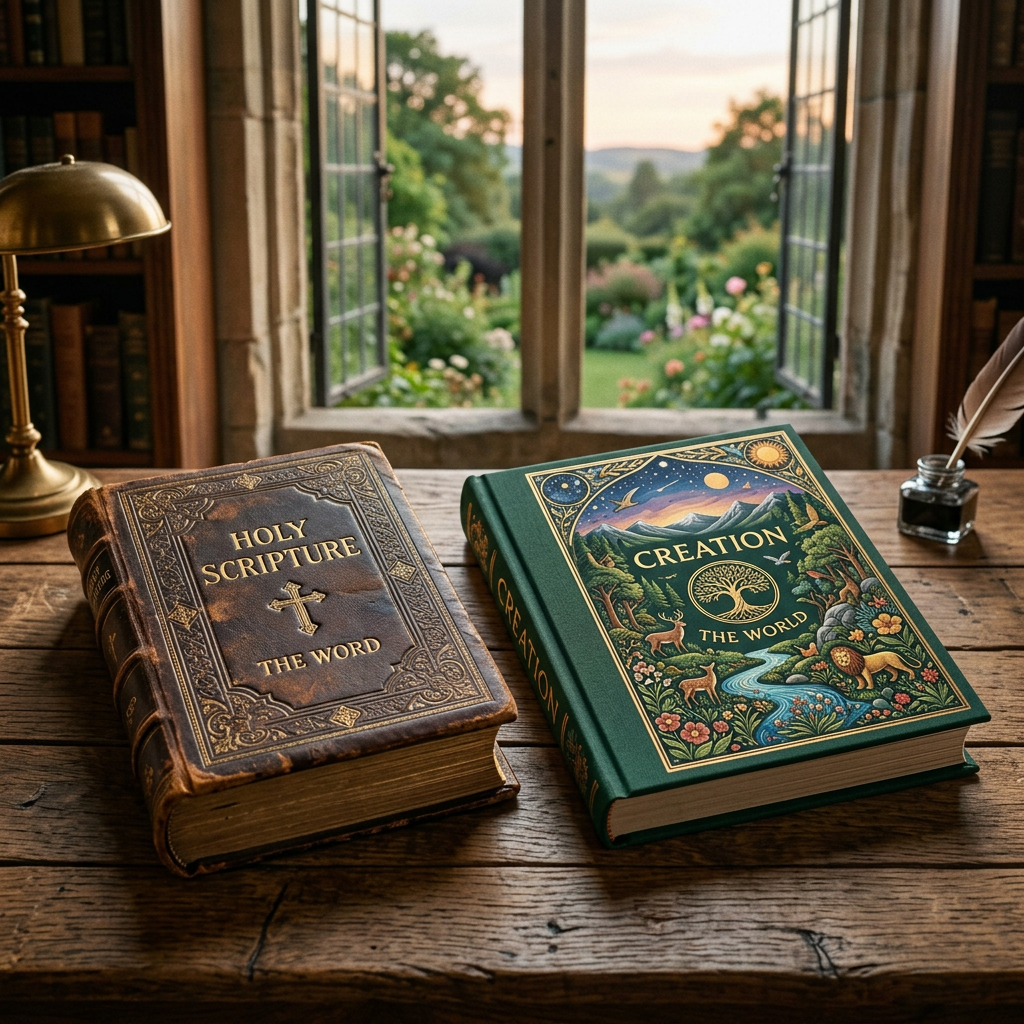

Scripture and creation are two books written by the same Author. The Logos who spoke the worlds into being also spoke through the prophets and became flesh, embedding His image in both the visible order of nature and the written Word. When the two books are read together—shadows in creation interpreted by the light of Scripture—they lead the heart to the incarnate Christ, the Book of Life in whom we know God face to face.

The Holy Scriptures speak of musing on the works of God as well as the Word (Psalm 77:12; 119:27; 143:5; Job 12:8), so that the book of creation and the book of Scripture are heard as one Author.
The word author comes from the Old French word ‘auctor’/’autor’ which means “originator, creator,” which traces back to the Latin ‘auctor’ which comes from ‘augēre’ which “to increase, enlarge, cause to grow.”
Christ is the Author, the Creator who causes us to grow in Him. Jesus is THE image of God (Hebrews 1:3; 2 Corinthians 4:4-6; Colossians 1:15-16) who is love (1 John 4:8).
Heb 12:2 Looking unto Jesus the author and finisher of our faith; who for the joy that was set before him endured the cross, despising the shame, and is set down at the right hand of the throne of God.
2Pe 3:18 But grow in grace, and in the knowledge of our Lord and Saviour Jesus Christ. To him be glory both now and for ever. Amen.
Col 1:27 To whom God would make known what is the riches of the glory of this mystery among the Gentiles; which is Christ in you, the hope of glory:
Col 1:28 Whom we preach, warning every man, and teaching every man in all wisdom; that we may present every man perfect in Christ Jesus:
Christ in us (Colossians 1:27) is His Word in us (Psalm 119:49-50, 81, 144; 52:9; Colossians 3:16; 1 John 2:14; Hebrews 8:10;), His Spirit in us (Ezekiel 36:26; Romans 8:9-11; John 15:26; 14:16-18).
All things were created by, through, and for Christ (the Word), who is the exact Image of the invisible God. Creation embeds His image like an artist’s work or an author’s writings, so that studying the universe, nature, science, or everyday experiences reveals Him and draws people into relationship with the Creator.
Col 1:15 Who is the image of the invisible God, the firstborn of every creature:
Col 1:16 For by him were all things created, that are in heaven, and that are in earth, visible and invisible, whether they be thrones, or dominions, or principalities, or powers: all things were created by him, and for him:
Col 1:17 And he is before all things, and by him all things consist.
Col 1:18 And he is the head of the body, the church: who is the beginning, the firstborn from the dead; that in all things he might have the preeminence.
Heb 1:1 God, who at sundry times and in divers manners spake in time past unto the fathers by the prophets,
Heb 1:2 Hath in these last days spoken unto us by his Son, whom he hath appointed heir of all things, by whom also he made the worlds;
Heb 1:3 Who being the brightness of his glory, and the express image of his person, and upholding all things by the word of his power, when he had by himself purged our sins, sat down on the right hand of the Majesty on high;
“The whole earth is a living icon of the face of God.” – St. John of Damascus
“We must thank God for all created things, and show Him perpetual worship, as from Him and through Him all creation takes its being and subsists.” (St. John of Damascus – Three Treatises on the Divine Images: Apologia Against Those Who Decry Holy Images)
All that we experience in this life was created to lead us to our Creator (Romans 1:19-20; Psalm 33:6-9; 150:6; Isaiah 40:26; 41:20; 45:5-8). All that we see, hear, touch, taste and feel was created so that we might see the Most High and be drawn to Him. Just as the personality of an artist can be see through his paintings or the heart of an author can be seen through his writings, so too the creation allows us to see the Creator. All of His works are embedded with His image.
Jesus is THE image of God (Hebrews 1:3; 2 Corinthians 4:4-6; Colossians 1:15-16), who is displayed in shadows or parables throughout creation.
The Holy Scriptures state that Christ is all and in all (Colossians 3:11), this is because He is the Creator (Ephesians 3:9; 1 Corinthians 8:6; John 1:1-3; Colossians 1:12-17; Hebrews 1:1-12).
The purpose of studying “Shadows of Messiah” is to reveal Christ in His creation, to establish the foundation that all branches of science point to Him. In Hebrew, צל ‘tsel’ means shadow. צ ‘tsadi’ is a picture of a man on his side and ל ‘lamed’ is a picture of a shepherd’s staff. The picture here is a man’s shadow being cast to his side when standing with the shepherd’s staff representing authority, as the man is the ‘authority’ or body of the shadow. The shepherd’s staff also gives the sense of walking towards something. If one walks towards the direction of a shadow, one will end up at the source.
The purpose of Shadows of Messiah is to lead one to Messiah, the body or reality.
Col 2:9 For in him dwelleth all the fulness of the Godhead bodily.
Col 2:17 Which are a shadow of things to come; but the body is of Christ.
Not only did the Creator give His Word to mankind to lead them to the knowledge of salvation found in the Messiah, so too, He gave them shadows and parables in all of nature that lead them to Him as well.
Colossians 3:11 states that Christ Jesus is all and in all.
Col 3:11 Where there is neither Greek nor Jew, circumcision nor uncircumcision, Barbarian, Scythian, bond nor free: but Christ is all, and in all.
Heb 12:2 Looking unto Jesus the author (ἀρχηγός ‘archegos’) and finisher of our faith; who for the joy that was set before him endured the cross, despising the shame, and is set down at the right hand of the throne of God.
G747
ἀρχηγός
archēgos
Thayer Definition:
- the chief leader, prince
1a) of Christ - one that takes the lead in any thing and thus affords an example, a predecessor in a matter, pioneer
- the author
Part of Speech: adjective
A Related Word by Thayer’s/Strong’s Number: from G746 and G71
Jesus declares (leads before) the knowledge of God.
Joh 1:18 No man hath seen God at any time; the only begotten Son, which is in the bosom of the Father, he hath declared (ἐξηγέομαι ‘exegeomai’) him.
G1834
ἐξηγέομαι
exēgeomai
Thayer Definition:
- to lead out, be leader, go before
- metaphorically, to draw out in narrative, unfold a teaching
2a) to recount, rehearse
2b) to unfold, declare
2b1) the things relating to God
2b2) used in Greek writing of the interpretation of things sacred and divine, oracles, dreams, etc.
Part of Speech: verb
A Related Word by Thayer’s/Strong’s Number: from G1537 and G2233
Col 2:2 That their hearts might be comforted, being knit together in love, and unto all riches of the full assurance of understanding, to the acknowledgement of the mystery of God, and of the Father, and of Christ;
Col 2:3 In whom are hid all the treasures of wisdom and knowledge.
The Author entered the “story” to show us the way.
Heb 2:10 For it became him, for whom are all things, and by whom are all things, in bringing many sons unto glory, to make the captain (ἀρχηγός ‘archegos’) of their salvation perfect through sufferings.
Heb 2:11 For both he that sanctifieth and they who are sanctified are all of one: for which cause he is not ashamed to call them brethren,
Heb 2:12 Saying, I will declare thy name unto my brethren, in the midst of the church will I sing praise unto thee.
Heb 2:13 And again, I will put my trust in him. And again, Behold I and the children which God hath given me.
Heb 2:14 Forasmuch then as the children are partakers of flesh and blood, he also himself likewise took part of the same; that through death he might destroy him that had the power of death, that is, the devil;
Heb 2:15 And deliver them who through fear of death were all their lifetime subject to bondage.
The LORD is the Great Artist, the Maker of all things (Psalm 95:6). The English word ‘artist’ comes from the Hebrew word יצר ‘yatsar’ which means to create or form, as a potter molding clay. God is the former of all things (Jeremiah 10:16; 51:19). In Greek, the word for make or workmanship is ποίημα ‘poiēma’ which is the source of our English word ‘poem’ (Romans 1:20, 23; Ephesians 2:10). God is the Great Artist, He is the Great Poet. He is the source of all beauty (Psalm 27:4; 90:17; 45:2; Zechariah 9:17). He is the Author of beauty (Wisdom 13:3).
Wis_13:3 With whose beauty if they being delighted took them to be gods; let them know how much better the Lord of them is: for the first author (γενεσιάρχης ‘genesiarches’) of beauty hath created them.
γενεσιάρχης ‘genesiarches’ is a combination of γένεσις ‘genesis’ which means origin, beginning and άρχή ‘arche’ which means beginning, ruler, source.’
Two Books – Creation and the Word

The Church Fathers spoke of “two books” written by one Author. Creation is a “book” spread open before every man. The Holy Scriptures are written by the same Author, “interpreting the meaning” of the book of creation. Creation is the Word uttered in things. Scripture is the Word uttered in words.
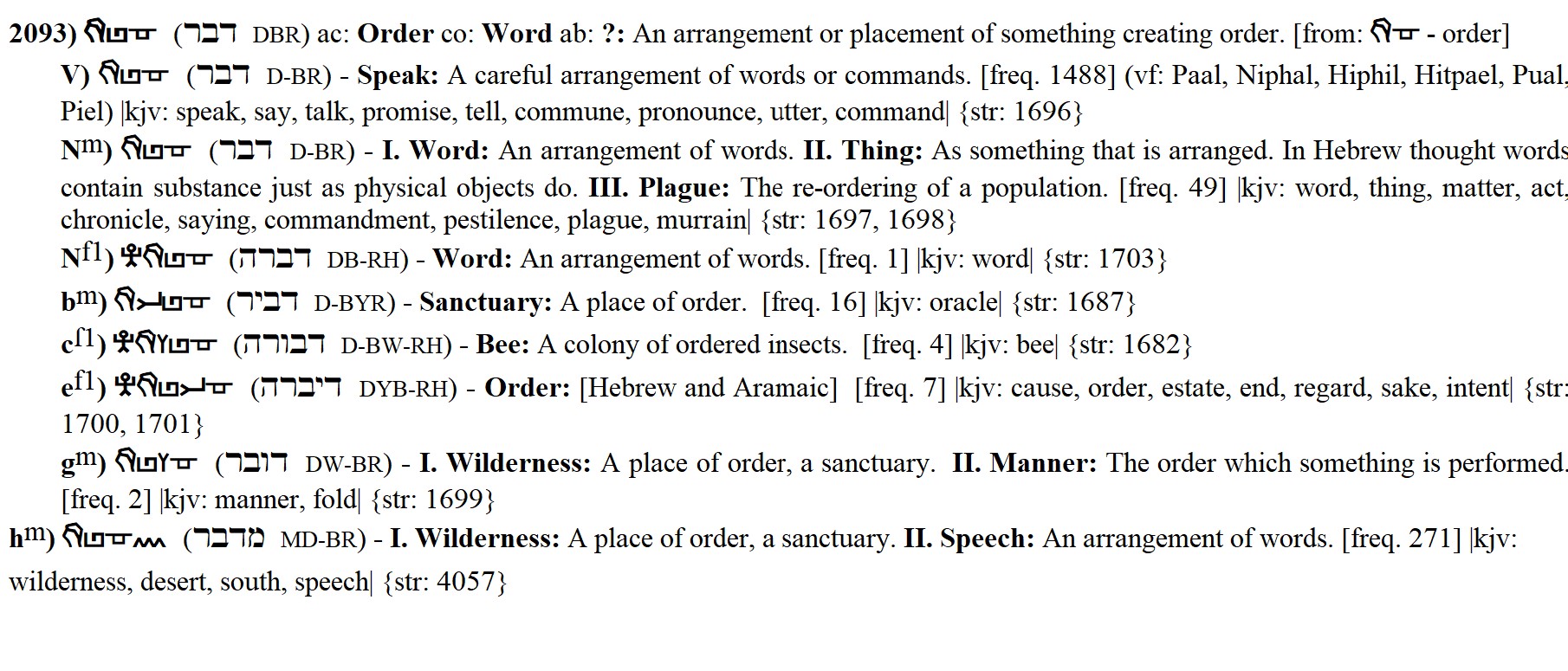
Interestingly, the Hebrew word for “word” is דבר ‘davar’ which means both words and things.
“The created world is like a book in which the creative Trinity shines forth, is represented, and is read.” (St. Bonaventure – Breviloquium, Part II, chapter 11)
“The First Principle made this sensible world to declare Himself, namely so that through it, as through a mirror and a vestige, man might be led back to loving and praising God the Artisan. And according to this there is a twofold book: one written within, which is the eternal Art and Wisdom of God; and the other written without, which is the sensible world.
Since there was one creature that had an interior sense for knowing the inner book, namely the angel, and another that had all its sense turned outward, namely any brute animal, for the perfection of the universe there had to be made a creature endowed with this double sense, so that it might know both the book written within and the book written without—that is, Wisdom and its work. And because in Christ eternal Wisdom and its work coincide in one person, he is called the book written within and without for the restoration of the world.” (St. Bonaventure – Breviloquium, Part II, chapter 11)
This concept of the two books is seen in Romans 1:19-20 and Psalm 19.
Rom 1:19 Because that which may be known of God is manifest in them; for God hath shewed it unto them.
Rom 1:20 For the invisible things of him from the creation of the world are clearly seen, being understood by the things that are made, even his eternal power and Godhead; so that they are without excuse:
Psalm 19:1-6 speaks of the “book” of creation, Psalm 19:7-9 speaks of the book of the Holy Scriptures. David ends the Psalm asking that meditation of his heart be acceptable to God.
Psa 19:1 To the chief Musician, A Psalm of David. The heavens declare the glory of God; and the firmament sheweth his handywork.
Psa 19:2 Day unto day uttereth speech, and night unto night sheweth knowledge.
Psa 19:3 There is no speech nor language, where their voice is not heard.
Psa 19:4 Their line is gone out through all the earth, and their words to the end of the world. In them hath he set a tabernacle for the sun,
Psa 19:5 Which is as a bridegroom coming out of his chamber, and rejoiceth as a strong man to run a race.
Psa 19:6 His going forth is from the end of the heaven, and his circuit unto the ends of it: and there is nothing hid from the heat thereof.
Psa 19:7 The law of the LORD is perfect, converting the soul: the testimony of the LORD is sure, making wise the simple.
Psa 19:8 The statutes of the LORD are right, rejoicing the heart: the commandment of the LORD is pure, enlightening the eyes.
Psa 19:9 The fear of the LORD is clean, enduring for ever: the judgments of the LORD are true and righteous altogether.
Psa 19:10 More to be desired are they than gold, yea, than much fine gold: sweeter also than honey and the honeycomb.
Psa 19:11 Moreover by them is thy servant warned: and in keeping of them there is great reward.
Psa 19:12 Who can understand his errors? cleanse thou me from secret faults.
Psa 19:13 Keep back thy servant also from presumptuous sins; let them not have dominion over me: then shall I be upright, and I shall be innocent from the great transgression.
Psa 19:14 Let the words of my mouth, and the meditation (הִגָּיוֹן ‘higgayon’) of my heart, be acceptable in thy sight, O LORD, my strength, and my redeemer.
הִגָּיוֹן
higgâyôn
hig-gaw-yone’
Intensive from H1897; a murmuring sound, that is, a musical notation (probably similar to the moder affettuoso to indicate solemnity of movement); by implication a machination: – device, Higgaion, meditation, solemn sound.
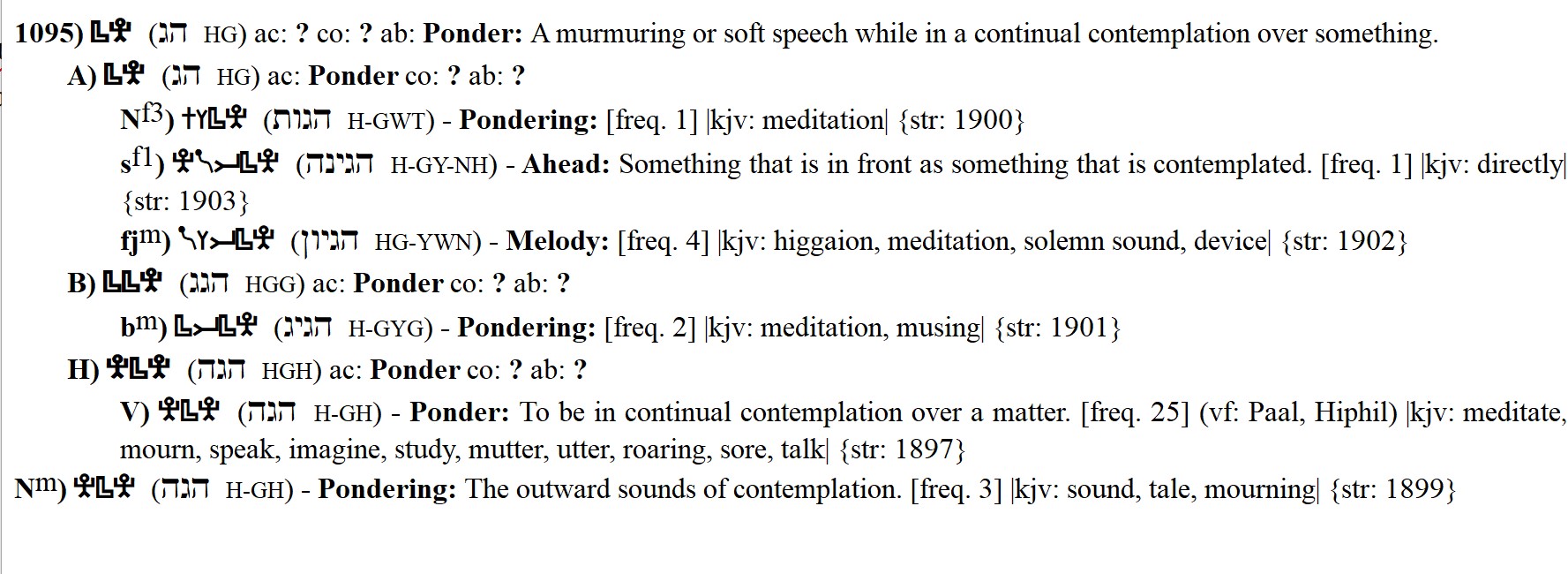
הִגָּיוֹן ‘higgayon’ (musing) also has the meaning of melody
Eph 5:19 Speaking to yourselves in psalms and hymns and spiritual songs, singing and making melody in your heart to the Lord;
Eph 5:20 Giving thanks always for all things unto God and the Father in the name of our Lord Jesus Christ;
Out of the heart, the mouth speaks
Luk 6:45 A good man out of the good treasure of his heart bringeth forth that which is good; and an evil man out of the evil treasure of his heart bringeth forth that which is evil: for of the abundance of the heart his mouth speaketh.
We are known by our fruit. In Hebrew the word for fruit is פְּרִי ‘priy’ which combines the letters פ ‘peh’ which means the mouth, י ‘yod’ which means the hand and ר ‘resh’ which means the head. The words and actions that come forth from our mind. That which is meditated upon in the mind, enters the heart and becomes our fruit.
Meditating on the Logos
Php 4:8 Finally, brethren, whatsoever things are true, whatsoever things are honest, whatsoever things are just, whatsoever things are pure, whatsoever things are lovely, whatsoever things are of good report; if there be any virtue, and if there be any praise, think on these things.
Php 4:8 Finally, brethren, whatsoever things are true, whatsoever things are honest, whatsoever things are just, whatsoever things are pure, whatsoever things are lovely, whatsoever things are of good report; if there be any virtue, and if there be any praise, think (λογίζομαι ‘logizomai’) on these things.
λογίζομαι ‘logizomai’ is the middle voice of the word λόγος ‘logos’ which means the Word. Man’s capacity to think/reason comes from the Word and points us to the Word
We become what we think
Pro 23:7 For as he thinketh in his heart, so is he: Eat and drink, saith he to thee; but his heart is not with thee.
Creation and the Word
Gen 1:1 In the beginning God created the heaven and the earth.
Gen 1:2 And the earth was without form, and void; and darkness was upon the face of the deep. And the Spirit of God moved upon the face of the waters.
Gen 1:3 And God said, Let there be light: and there was light.
Gen 1:4 And God saw the light, that it was good: and God divided the light from the darkness.
Creation came forth from the Word of God
Psa 33:6 By the word (דּבר ‘davar’) of the LORD were the heavens made; and all the host of them by the breath of his mouth.
Psa 33:7 He gathereth the waters of the sea together as an heap: he layeth up the depth in storehouses.
Psa 33:8 Let all the earth fear the LORD: let all the inhabitants of the world stand in awe of him.
Psa 33:9 For he spake (אמר ‘amar’), and it was done; he commanded (צוה ‘tsavah’), and it stood fast.
Psa 148:5 Let them praise the name of the LORD: for he commanded (צוה ‘tsavah’), and they were created.
צוה ‘tsavah’ means command, it points to the commandments of God. The commands of God are seen in both the laws of nature as well as the law of God revealed in the Bible.
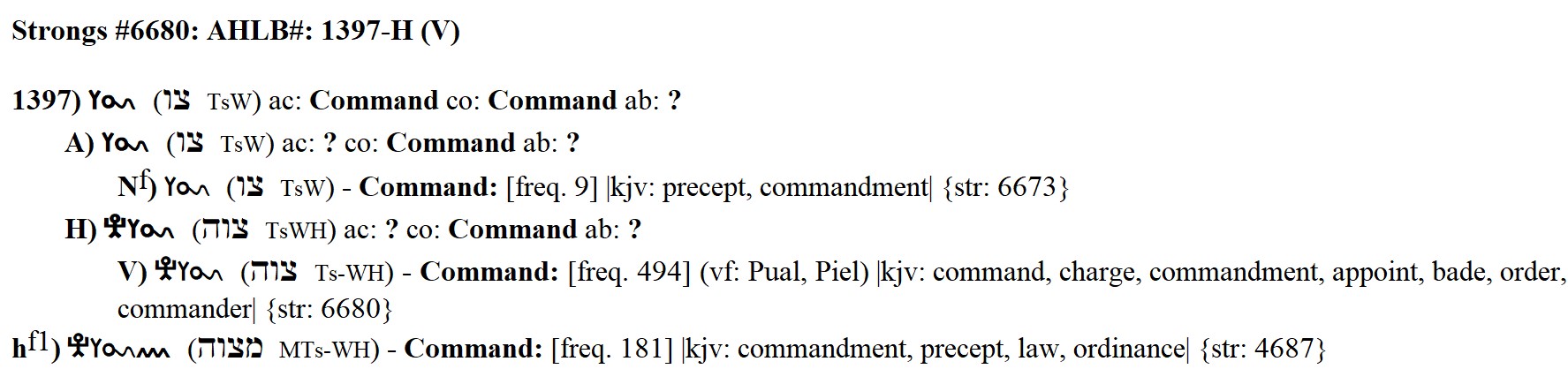
The word תורה ‘torah’ comes from the root word תר ‘tar’ which means an image or outline. The Torah/Word is the Image of the LORD (Hebrews 1:3; 2 Corinthians 4:4; Colossians 1:15).
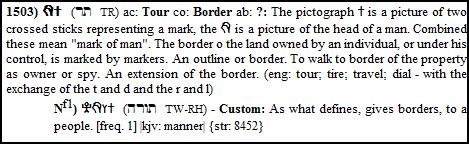
All things in His Word are a shadow pointing back to Messiah (Hebrews 8:5; 9:24; 10:1; Colossians 2:16-17) who is the Image of God (Hebrews 1:3; 2 Corinthians 4:4; Colossians 1:15-16).
The Torah = the Entire Bible. The Scriptures define the Prophets as the Torah (1 Corinthians 14:21) & the Psalms as Torah (John 10:34; 12:34; 15:25). Messiah further elaborates His Word as everything that comes out of His mouth (Matthew 4:4). This includes creation, as creation came forth from His Word (Psalm 33:6; Hebrews 11:3; John 1:1-3) who became flesh and dwelt among us (Colossians 1:12-17; Hebrews 1:1-3, 8-12).
It is interesting to note that the Greek word μορφή ‘morphe’ is used in the Septuagint to translate both the Hebrew words תואר which means image, that comes from the same root תר as תורה ‘torah.’ μορφή ‘morphe’ is also used to translate the Hebrew word צלם ‘tselem’ which means shadow.
Php 2:6 who subsisting in the form (μορφη ‘morphe’) of God, thought it not robbery to be equal with God,
The Hebrew word for word is דבר ‘davar’ which literally means order. This is the definition of ‘cosmos.’
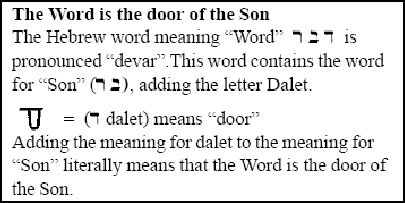
The Torah is an interesting word in that it comes from two roots. One is תר ‘tar,’ mentioned above which means an image or outline, and יר ‘yar’ which means to teach or pointing in the right direction.
Exo 24:12 And Jehovah said to Moses, Come up to Me to the mountain, and be there. And I will give to you the tablets of stone, and the Law, and the commandments which I have written, to teach them.
Wis 9:1 O God of my fathers, and Lord of mercy, who hast made all things with thy word (λόγῳ ‘logo’),
Wis 9:2 And ordained man through thy wisdom, that he should have dominion over the creatures which thou hast made,
Heb 11:3 Through faith we understand that the worlds were framed by the word of God, so that things which are seen were not made of things which do appear.
2Pe 3:5 For this they willingly are ignorant of, that by the word of God the heavens were of old, and the earth standing out of the water and in the water:
Christ is the Word
Rev 19:13 And he was clothed with a vesture dipped in blood: and his name is called The Word of God.
The Word that created all things was made flesh
Joh 1:1 In the beginning was the Word, and the Word was with God, and the Word was God.
Joh 1:2 The same was in the beginning with God.
Joh 1:3 All things were made by him; and without him was not any thing made that was made.
Joh 1:10 He was in the world, and the world was made by him, and the world knew him not.
Joh 1:14 And the Word was made flesh, and dwelt among us, (and we beheld his glory, the glory as of the only begotten of the Father,) full of grace and truth.
1Co 8:6 But to us there is but one God, the Father, of whom are all things, and we in him; and one Lord Jesus Christ, by whom are all things, and we by him.
Col 1:15 Who is the image of the invisible God, the firstborn of every creature:
Col 1:16 For by him were all things created, that are in heaven, and that are in earth, visible and invisible, whether they be thrones, or dominions, or principalities, or powers: all things were created by him, and for him:
Col 1:17 And he is before all things, and by him all things consist.
Col 1:18 And he is the head of the body, the church: who is the beginning, the firstborn from the dead; that in all things he might have the preeminence.
Col 1:19 For it pleased the Father that in him should all fulness dwell;
Heb 1:1 God, who at sundry times and in divers manners spake in time past unto the fathers by the prophets,
Heb 1:2 Hath in these last days spoken unto us by his Son, whom he hath appointed heir of all things, by whom also he made the worlds;
Heb 1:3 Who being the brightness of his glory, and the express image of his person, and upholding all things by the word of his power, when he had by himself purged our sins, sat down on the right hand of the Majesty on high;
The Holy Scriptures reveal the meaning of creation
Heb 4:12 For the word of God is quick, and powerful, and sharper than any twoedged sword, piercing even to the dividing asunder of soul and spirit, and of the joints and marrow, and is a discerner of the thoughts and intents of the heart.
Heb 4:13 Neither is there any creature that is not manifest in his sight: but all things are naked and opened unto the eyes of him with whom we have to do.
Jay P. Green Literal Version
Heb 4:13 and there is no creature unrevealed before Him; but all things are naked and laid open to His eyes, with whom is our account.
Heb 4:13 καὶ οὐκ ἔστι κτίσις ἀφανὴς ἐνώπιον αὐτοῦ, πάντα δὲ γυμνὰ καὶ τετραχηλισμένα τοῖς ὀφθαλμοῖς αὐτοῦ, πρὸς ὃν ἡμῖν ὁ λόγος.
πρὸς ὃν — “toward/with respect to whom”
ἡμῖν — “for us / to us” (dative)
ὁ λόγος — “the word / account / reckoning”
This phase (πρὸς ὃν ἡμῖν ὁ λόγος ‘pros on emin o logos’) could be translated “concerning whom the word [is spoken] to us,”
In other words, on a deeper typological view, by looking into the eyes of God we see the reflection of creation. All creatures are revealed in His eyes, including our innermost being, toward which we see the Logos.
Robertson Word Pictures
With whom we have to do (pros hon hēmin ho logos). “With whom the matter or account for us is.” There is a slight play here on logos of Heb_4:12. Surely every servant of Christ today needs to gaze into this revealing mirror and be honest with himself and God.
1Co 13:9 For we know in part, and we prophesy in part.
1Co 13:10 But when that which is perfect is come, then that which is in part shall be done away.
1Co 13:11 When I was a child, I spake as a child, I understood as a child, I thought as a child: but when I became a man, I put away childish things.
1Co 13:12 For now we see through a glass, darkly; but then face to face: now I know in part; but then shall I know even as also I am known.
1Co 13:13 And now abideth faith, hope, charity, these three; but the greatest of these is charity.
“All creatures confess that they are made by God… All natural things were produced by the divine art, and so may be called ‘God’s works of art.’… Every creature is for us like a certain mirror. Because from the order, goodness and magnitude which are caused by God in things, we come to a knowledge of the divine wisdom and goodness and eminence.” – St. Thomas Aquinas
“In things of beauty, he [St. Francis] contemplated the One who is supremely beautiful, and, led by the footprints he found in creatures, he followed the Beloved everywhere.” (St. Bonaventure – The Life of St. Francis)
The Word – the Bible
God spoke the Word into creation, God spoke the Word into the Bible through the prophets. Two Books, one Word.
Heb 1:1 God, who at sundry times and in divers manners spake in time past unto the fathers by the prophets,
Heb 1:2 Hath in these last days spoken unto us by his Son, whom he hath appointed heir of all things, by whom also he made the worlds;
Psa 33:6 By the word of the LORD were the heavens made; and all the host of them by the breath of his mouth.
Psa 33:9 For he spake, and it was done; he commanded, and it stood fast.
The Bible (the Volume of the Book) is a shadow of THE WORD made flesh
Heb 10:5 Wherefore when he cometh into the world, he saith, Sacrifice and offering thou wouldest not, but a body hast thou prepared me:
Heb 10:6 In burnt offerings and sacrifices for sin thou hast had no pleasure.
Heb 10:7 Then said I, Lo, I come (in the volume of the book it is written of me,) to do thy will, O God.
Psa 40:6 Sacrifice and offering thou didst not desire; mine ears hast thou opened: burnt offering and sin offering hast thou not required.
Psa 40:7 Then said I, Lo, I come: in the volume of the book it is written of me,
Septuagint
Psa 40:6 (39:6) Sacrifice and offering thou wouldest not; but a body hast thou prepared me: whole-burnt-offering and sacrifice for sin thou didst not require.
The Holy Scriptures testify of the Word from heaven who became flesh
Luk 24:27 And beginning at Moses and all the prophets, he expounded unto them in all the scriptures the things concerning himself.
Joh 5:39 Search the scriptures; for in them ye think ye have eternal life: and they are they which testify of me.
John Gill
it is said (s), all the whole law, that is, all Scripture, is called מגילה, “a volume”; accordingly there are things written of Christ in all the writings of the Old Testament, in the law, and in the prophets, and in the psalms.
(r) T. Hieros, Megilla, fol. 73. 4.
2Ti 3:14 But continue thou in the things which thou hast learned and hast been assured of, knowing of whom thou hast learned them;
God breathed out creation, so too the Bible is God breathed.
Psa 33:6 By the word of the LORD were the heavens made; and all the host of them by the breath of his mouth.
2Ti 3:15 And that from a child thou hast known the holy scriptures, which are able to make thee wise unto salvation through faith which is in Christ Jesus.
2Ti 3:16 All scripture is given by inspiration of God (θεόπνευστος ‘theopneustos’), and is profitable for doctrine, for reproof, for correction, for instruction in righteousness:
2Ti 3:17 That the man of God may be perfect, throughly furnished unto all good works.
God breathed
G2315
θεόπνευστος
theopneustos
theh-op’-nyoo-stos
From G2316 and a presumed derivative of G4154; divinely breathed in: – given by inspiration of God.
G2316
θεός
theos
theh’-os
Of uncertain affinity; a deity, especially (with G3588) the supreme Divinity; figuratively a magistrate; by Hebraism very: – X exceeding, God, god [-ly, -ward].
G4154
πνέω
pneō
Thayer Definition:
to breathe, to blow
1a) of the wind
Part of Speech: verb
A Related Word by Thayer’s/Strong’s Number: a root word
Joh 3:7 Marvel not that I said unto thee, Ye must be born again.
Joh 3:8 The wind bloweth (πνέω ‘pneo’) where it listeth, and thou hearest the sound thereof, but canst not tell whence it cometh, and whither it goeth: so is every one that is born of the Spirit.
His Word is Spirit
Joh 6:63 It is the spirit that quickeneth; the flesh profiteth nothing: the words that I speak unto you, they are spirit, and they are life.
The Holy Spirit breathed upon us
Joh 20:22 And when he had said this, he breathed (ἐμφυσάω ’emphusao’) on them, and saith unto them, Receive ye the Holy Ghost:
Born again/conceived from above by the Spirit/Word
Tit 3:5 Not by works of righteousness which we have done, but according to his mercy he saved us, by the washing of regeneration, and renewing of the Holy Ghost;
Tit 3:5 He saved us, not by works of righteousness which we have done but according to His compassion, through the washing of rebirth, and renewal by the Set-apart Spirit,
1Pe 1:23 Being born again, not of corruptible seed, but of incorruptible, by the word of God, which liveth and abideth for ever.
1Pe 1:24 For all flesh is as grass, and all the glory of man as the flower of grass. The grass withereth, and the flower thereof falleth away:
1Pe 1:25 But the word of the Lord endureth for ever. And this is the word which by the gospel is preached unto you.
1Jo 3:9 Whosoever is born of God doth not commit sin; for his seed remaineth in him: and he cannot sin, because he is born of God.
Jam 1:18 Of his own will begat he us with the word of truth, that we should be a kind of firstfruits of his creatures.
Jas 1:21 On account of this, putting away all filthiness and overflowing of evil, in meekness receive the implanted Word being able to save your souls.
The Scriptures were written by prophets moved by the Holy Spirit, testifying of the Word who would become flesh
2Pe 1:21 For the prophecy came not in old time by the will of man: but holy men of God spake as they were moved by the Holy Ghost.
Act 10:43 To him give all the prophets witness, that through his name whosoever believeth in him shall receive remission of sins.
Act 3:18 But those things, which God before had shewed by the mouth of all his prophets, that Christ should suffer, he hath so fulfilled.
1Pe 1:9 Receiving the end of your faith, even the salvation of your souls.
1Pe 1:10 Of which salvation the prophets have enquired and searched diligently, who prophesied of the grace that should come unto you:
1Pe 1:11 Searching what, or what manner of time the Spirit of Christ which was in them did signify, when it testified beforehand the sufferings of Christ, and the glory that should follow.
1Pe 1:12 Unto whom it was revealed, that not unto themselves, but unto us they did minister the things, which are now reported unto you by them that have preached the gospel unto you with the Holy Ghost sent down from heaven; which things the angels desire to look into.
Joh 5:39 Search the scriptures; for in them ye think ye have eternal life: and they are they which testify of me.
Joh 5:46 For had ye believed Moses, ye would have believed me: for he wrote of me.
Luk 24:27 And beginning at Moses and all the prophets, he expounded unto them in all the scriptures the things concerning himself.
Luk 24:45 Then opened he their understanding, that they might understand the scriptures,
Luk 24:46 And said unto them, Thus it is written, and thus it behoved Christ to suffer, and to rise from the dead the third day:
Luk 24:47 And that repentance and remission of sins should be preached in his name among all nations, beginning at Jerusalem.
The Holy Scriptures are prophecy of Christ
2Pe 1:19 We have also a more sure word of prophecy; whereunto ye do well that ye take heed, as unto a light that shineth in a dark place, until the day dawn, and the day star arise in your hearts:
2Pe 1:20 Knowing this first, that no prophecy of the scripture is of any private interpretation.
2Pe 1:21 For the prophecy came not in old time by the will of man: but holy men of God spake as they were moved by the Holy Ghost.
1Pe 1:9 Receiving the end of your faith, even the salvation of your souls.
1Pe 1:10 Of which salvation the prophets have enquired and searched diligently, who prophesied of the grace that should come unto you:
1Pe 1:11 Searching what, or what manner of time the Spirit of Christ which was in them did signify, when it testified beforehand the sufferings of Christ, and the glory that should follow.
1Pe 1:12 Unto whom it was revealed, that not unto themselves, but unto us they did minister the things, which are now reported unto you by them that have preached the gospel unto you with the Holy Ghost sent down from heaven; which things the angels desire to look into.
Rev 19:10 And I fell at his feet to worship him. And he said unto me, See thou do it not: I am thy fellowservant, and of thy brethren that have the testimony of Jesus: worship God: for the testimony of Jesus is the spirit of prophecy.
Luk 1:69 And hath raised up an horn of salvation for us in the house of his servant David;
Luk 1:70 As he spake by the mouth of his holy prophets, which have been since the world began:
Prophecy
Prophecy is the “seed inside.”
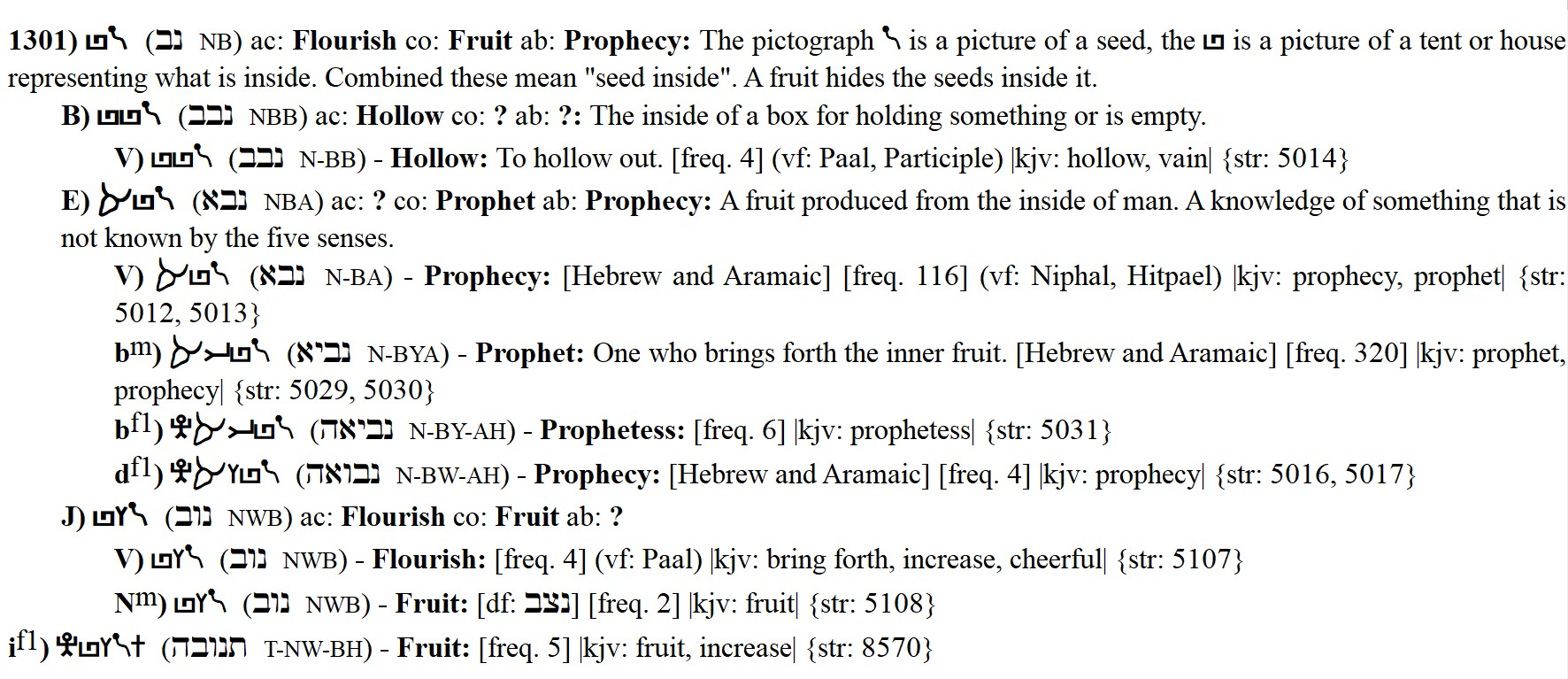
The Seed is the Word
Luk 8:11 Now the parable is this: The seed is the word of God.
1Pe 1:23 Being born again, not of corruptible seed, but of incorruptible, by the word of God, which liveth and abideth for ever.
1Pe 1:24 For all flesh is as grass, and all the glory of man as the flower of grass. The grass withereth, and the flower thereof falleth away:
1Pe 1:25 But the word of the Lord endureth for ever. And this is the word which by the gospel is preached unto you.
1Jn 3:9 Whosoever is born of God doth not commit sin; for his seed remaineth in him: and he cannot sin, because he is born of God.
The Book of Creation
“Every single creature is full of God and is a book about God.” – Meister Eckhart
Wis 13:5 For by the greatness and beauty of the creatures proportionably the maker of them is seen.
“He [Jesus] set before me the book of nature; I understood how all the flowers he has created are beautiful, how the splendor of the rose and the whiteness of the lily do not take away the perfume of the little violet or the delightful simplicity of the daisy… So it is in the world of souls, the living garden of the Lord.” (St. Thérèse of Lisieux – Story of a Soul, Manuscript A)
St. Basil the Great, Hexaemeron Homily 1 and Homily 3.10: “raise yourself from visible things to the invisible Being, that the grandeur and beauty of creatures may give you a just idea of the Creator.”
“Let the earth bring forth the living creature. Behold the word of God pervading creation, beginning even then the efficacy which is seen displayed to-day…” (St. Basil the Great – Hexaemeron, Homily IX)
“From the creation also, learn to admire your Lord! And if any of the things you see exceed your comprehension, and you are not able to find the reason thereof, yet for this glorify the Creator, that the wisdom of these works surpasses your understanding.” (St. John Chrysostom – Homilies on the Statues 12.7 (to the people of Antioch)
“The Word embodied in Jesus has also “hidden himself for us in the ‘words’ of existent things, so as to be spelled out by each visible thing as by letters,” and been “embodied” for our sake in the letters and syllables of Scripture.” (St. Maximus the Confessor – Ambigua 33 -Ambigua to John)
“In all creatures there is found the trace of the Trinity, inasmuch as in every creature are found some things which are necessarily reduced to the divine Persons as to their cause.” (St. Thomas Aquinas – Summa Theologiae I, q. 45, a. 7)
“God brought things into being in order that His goodness might be communicated to creatures, and be represented by them. And because His goodness could not be adequately represented by one creature alone, He produced many and diverse creatures, that what was wanting to one in the representation of the divine goodness might be supplied by another. … Hence the whole universe together participates in the divine goodness more perfectly, and represents it better, than any single creature whatever.” (St. Thomas Aquinas – Summa Theologiae I, q. 47, a. 1)
St. Augustine refers to the “book of creation/nature” numerous times in his writings.
“Others, in order to find God, will read a book. Well, as a matter of fact there is a certain great big book, the book of created nature (magnus liber ipsa species creaturae). Look carefully at it top and bottom, observe it, read it. God did not make letters of ink for you to recognize him in; he set before your eyes all these things he has made. Why look for a louder voice? Heaven and earth cries out to you, ‘God made me.’” (Augustine – Sermon 68 (on the New Testament)
“Let the divine page be a book for you, so that you may hear these things; let the whole world be a book for you, so that you may see these things. In those books only those who know letters read; in the whole world even the unlettered may read.” (St. Augustine – Expositions on the Psalms 45.7)
“But had you begun with looking on the book of nature as the production of the Creator of all, and had you believed that your own finite understanding might be at fault wherever anything seemed to be amiss, instead of venturing to find fault with the works of God, you would not have been led into these impious follies and blasphemous fancies with which, in your ignorance of what evil really is, you heap all evils upon God.” (St. Augustin – Contra Faustum, XXXII, 20)
“It is, then, proper for us to begin the treatment of this subject [the Incarnation] by speaking of the creation of the universe, and of God its Artificer, so that it may be duly perceived that the renewal of creation has been the work of the self-same Word that made it at the beginning. For it will appear not inconsonant for the Father to have wrought its salvation in Him by Whose means He made it.” (Athanasius – On the Incarnation, 1)
Creation reveals the Logos who formed it.
“The divine Word is every creature, because God speaks.” (St. Bonaventure – Collationes in Hexaemeron; Quaracchi Opera Omnia 6.16)
“For even creation reveals Him who formed it, and the very work made suggests Him who made it, and the world manifests Him who ordered it.” (St. Irenaeus of Lyons -Against Heresies, II.9.1)
“We believe that a logos of angels preceded their creation, a logos preceded the creation of each of the beings and powers that fill the upper world, a logos preceded the creation of human beings, a logos preceded everything that receives its becoming from God… The Logos, whose excellence is incomparable, ineffable and inconceivable in himself is exalted beyond all creation.” (St. Maximus the Confessor – On the Cosmic Mystery of Jesus Christ)
“For the Logos of God (who is God) wills always and in all things to accomplish the mystery of His embodiment.” – St. Maximus the Confessor – Ambigua to John (Ambiguum 7), Constas section 7.22)
“The Word is living, being, spirit, all verdant greening, all creativity. This Word manifests itself in every creature.” – St. Hildegard of Bingen (Hildegard of Bingen: A Saint for Our Times and Illuminations of Hildegard of Bingen – Matthew Fox)
Thick Logos
St. Maximus the Confessor spoke of God concealing Himself in the Logos of creation.
Or one could say that the Logos “becomes thick” in the sense that for our sake He ineffably concealed Himself in the logoi of beings, and is obliquely signified in proportion to each visible thing, as if through certain letters, being whole in whole things while simultaneously remaining utterly complete and fully present, whole, and without diminishment in each particular thing. Or one could say that the Logos “becomes thick” in the sense that, for the sake of our thick minds, He consented to be both embodied and expressed through letters, syllables, and sounds, so that from all these He might gradually gather those who follow Him to Himself…(St. Maximus the Confessor – Ambigua 33.2)
“The Logos becomes thick” is a phrase of St. Gregory Nazianzen that St. Maximus explains in Ambiguum 33. It is not a claim that the divine Word changes or becomes material in his own nature. “Thick” (παχύνεται ‘pachynetai’) means the simple, invisible Logos makes himself available to thick, limited minds by taking on a form we can grasp.
παχύνεται ‘pachynetai’ comes from παχύνω ‘pachyno’ which means “to make thick, to fatten, to condense. In the same passage of Ambigua, Maximus calls us τοὺς παχεῖς τὴν διάνοιαν — “those who are thick in mind,” dense or slow of understanding. The same root covers both: the Word condenses himself, and our minds are the thick ones he stoops to meet.
παχύνω ‘pachyno’ has the meaning of a body that is fat or solid, a liquid that has thickened, a voice that is deep, or a mind that is dull and slow.
Christ uses this imagery in reference to why He spoke in parables.
Mat 13:13 Therefore speak I to them in parables: because they seeing see not; and hearing they hear not, neither do they understand.
Mat 13:14 And in them is fulfilled the prophecy of Esaias, which saith, By hearing ye shall hear, and shall not understand; and seeing ye shall see, and shall not perceive:
Mat 13:15 For this people’s heart is waxed gross (παχύνω ‘pachyno’), and their ears are dull of hearing, and their eyes they have closed; lest at any time they should see with their eyes, and hear with their ears, and should understand with their heart, and should be converted, and I should heal them.
Mat 13:16 But blessed are your eyes, for they see: and your ears, for they hear.
Mat 13:17 For verily I say unto you, That many prophets and righteous men have desired to see those things which ye see, and have not seen them; and to hear those things which ye hear, and have not heard them.
Parables align with deeper interpretive layers (PaRDeS: literal, allegorical/homiletic, etc.), encompassing anagogical/spiritual meanings. Shadows of Messiah fit into this parable level.
The Gospel reveals the deeper levels of the meaning of Scripture through the working of the Holy Spirit in us.
Psa 119:130 The entrance of thy words giveth light; it giveth understanding unto the simple.
Rom 16:25 Now to him that is of power to stablish you according to my gospel, and the preaching of Jesus Christ, according to the revelation of the mystery, which was kept secret since the world began,
Eph 3:3 How that by revelation he made known unto me the mystery; (as I wrote afore in few words,
Eph 3:4 Whereby, when ye read, ye may understand my knowledge in the mystery of Christ)
Eph 3:5 Which in other ages was not made known unto the sons of men, as it is now revealed unto his holy apostles and prophets by the Spirit;
Rom 16:26 But now is made manifest, and by the scriptures of the prophets, according to the commandment of the everlasting God, made known to all nations for the obedience of faith:
Rom 16:27 To God only wise, be glory through Jesus Christ for ever. Amen.
1Co 2:5 That your faith should not stand in the wisdom of men, but in the power of God.
1Co 2:6 Howbeit we speak wisdom among them that are perfect: yet not the wisdom of this world, nor of the princes of this world, that come to nought:
1Co 2:7 But we speak the wisdom of God in a mystery, even the hidden wisdom, which God ordained before the world unto our glory:
1Co 2:8 Which none of the princes of this world knew: for had they known it, they would not have crucified the Lord of glory.
1Co 2:9 But as it is written, Eye hath not seen, nor ear heard, neither have entered into the heart of man, the things which God hath prepared for them that love him.
1Co 2:10 But God hath revealed them unto us by his Spirit: for the Spirit searcheth all things, yea, the deep things of God.
Eph 1:9 Having made known unto us the mystery of his will, according to his good pleasure which he hath purposed in himself:
Eph 1:10 That in the dispensation of the fulness of times he might gather together in one all things in Christ, both which are in heaven, and which are on earth; even in him:
Eph 1:11 In whom also we have obtained an inheritance, being predestinated according to the purpose of him who worketh all things after the counsel of his own will:
Eph 1:12 That we should be to the praise of his glory, who first trusted in Christ.
Eph 1:13 In whom ye also trusted, after that ye heard the word of truth, the gospel of your salvation: in whom also after that ye believed, ye were sealed with that holy Spirit of promise,
Eph 1:14 Which is the earnest of our inheritance until the redemption of the purchased possession, unto the praise of his glory.
Eph 1:15 Wherefore I also, after I heard of your faith in the Lord Jesus, and love unto all the saints,
Eph 1:16 Cease not to give thanks for you, making mention of you in my prayers;
Eph 1:17 That the God of our Lord Jesus Christ, the Father of glory, may give unto you the spirit of wisdom and revelation in the knowledge of him:
Eph 1:18 The eyes of your understanding being enlightened; that ye may know what is the hope of his calling, and what the riches of the glory of his inheritance in the saints,
Eph 1:19 And what is the exceeding greatness of his power to us-ward who believe, according to the working of his mighty power,
Eph 1:20 Which he wrought in Christ, when he raised him from the dead, and set him at his own right hand in the heavenly places,
Eph 1:21 Far above all principality, and power, and might, and dominion, and every name that is named, not only in this world, but also in that which is to come:
Eph 1:22 And hath put all things under his feet, and gave him to be the head over all things to the church,
Eph 1:23 Which is his body, the fulness of him that filleth all in all.
Col 1:26 Even the mystery which hath been hid from ages and from generations, but now is made manifest to his saints:
Col 1:27 To whom God would make known what is the riches of the glory of this mystery among the Gentiles; which is Christ in you, the hope of glory:
Fat & Oil
Isa 6:9 And he said, Go, and tell this people, Hear ye indeed, but understand not; and see ye indeed, but perceive not.
Isa 6:10 Make the heart of this people fat (שָׁמֵן ‘shamen’), and make their ears heavy, and shut their eyes; lest they see with their eyes, and hear with their ears, and understand with their heart, and convert, and be healed.
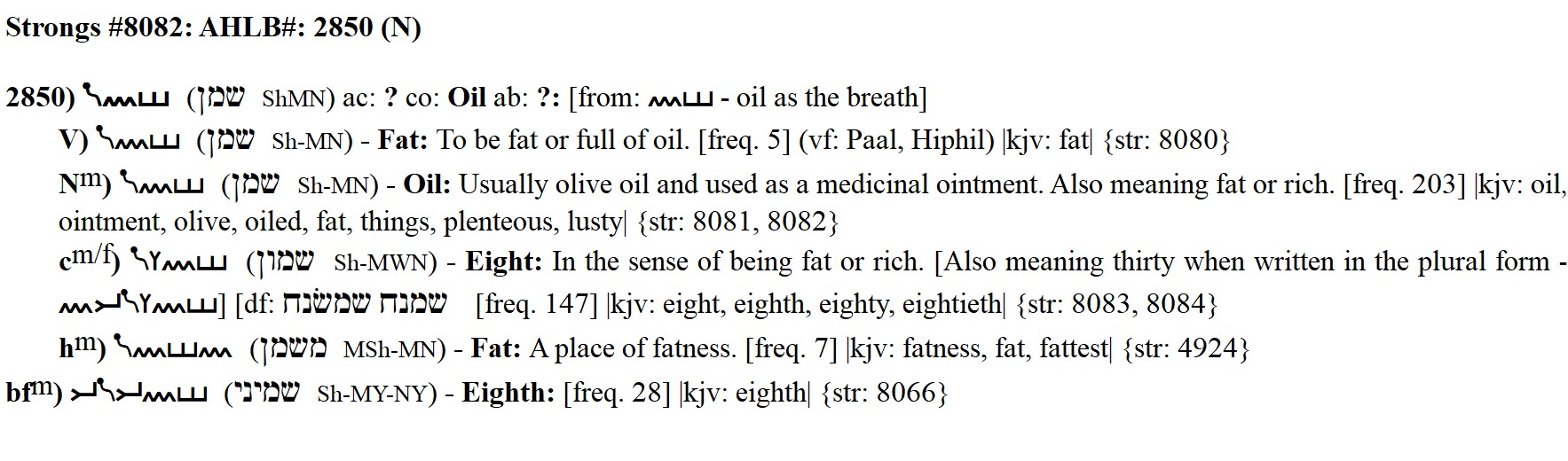
Fat hearts (שָׁמֵן ‘shamen’) that understand not (darkened) are opened (enlightented) through the Spirit which is pictured by שמן ‘shemen’ (oil) used to light the menorah in the Temple. A heart made fat (שָׁמֵן ‘shamen’) cannot see. The Anointed One (anointed with olive oil) becomes “thick” so hearts can see Him and turn to Him, being anointed by the Spirit which is likened to oil (1 Samuel 16:13; Zechariah 4:2-3; Revelation 4:5).
Zec 4:1 And the angel that talked with me came again, and waked me, as a man that is wakened out of his sleep,
Zec 4:2 And said unto me, What seest thou? And I said, I have looked, and behold a candlestick all of gold, with a bowl upon the top of it, and his seven lamps thereon, and seven pipes to the seven lamps, which are upon the top thereof:
Zec 4:3 And two olive trees by it, one upon the right side of the bowl, and the other upon the left side thereof.
Zec 4:10 For who hath despised the day of small things? for they shall rejoice, and shall see the plummet in the hand of Zerubbabel with those seven; they are the eyes of the LORD, which run to and fro through the whole earth.
Zec 4:11 Then answered I, and said unto him, What are these two olive trees upon the right side of the candlestick and upon the left side thereof?
Zec 4:12 And I answered again, and said unto him, What be these two olive branches which through the two golden pipes empty the golden oil out of themselves?
Zec 4:13 And he answered me and said, Knowest thou not what these be? And I said, No, my lord.
Zec 4:14 Then said he, These are the two anointed ones, that stand by the Lord of the whole earth.
Rev 4:5 And out of the throne proceeded lightnings and thunderings and voices: and there were seven lamps of fire burning before the throne, which are the seven Spirits of God.
“When men search for God with their bodily eyes they find Him nowhere, for He is invisible. But for those who ponder in the Spirit He is present everywhere. He is in all, yet beyond all.” – (St. Symeon the New Theologian – The Practical and Theological Chapters and the Three Theological Discourses)
God meets us
“The Logos becomes thick” is a phrase of St. Gregory Nazianzen that St. Maximus explains in Ambiguum 33. It is not a claim that the divine Word changes or becomes material in his own nature. “Thick” (παχύνεται ‘pachynetai’) means the simple, invisible Logos makes himself available to thick, limited minds by taking on a form we can grasp.
“The Savior deals differently with each individual according to his needs…He becomes all things for all people, while always remaining by nature what He is.” (St. Cyril of Jerusalem – Catechetical Lecture 10, section 5)
But the Saviour comes in various forms to each man for his profit. For to those who have need of gladness He becomes a Vine; and to those who want to enter in He stands as a Door; and to those who need to offer up their prayers He stands a mediating High Priest. Again, to those who have sins He becomes a Sheep, that He may be sacrificed for them. He is made all things to all men, remaining in His own nature what He is. For so remaining, and holding the dignity of His Sonship in reality unchangeable, He adapts Himself to our infirmities, just as some excellent physician or compassionate teacher… (St. Cyril of Jerusalem – Catechetical Lecture 10, section 5)
Paul, walking by the Spirit, became “all things to all men” (1 Corinthians 9:19-27; 10:31-33) and said Christ did not seek to please Himself, but to edify others (Romans 15:2-3). God has given mankind the “book of creation” and the book of the Holy Scriptures that we might came to salvation.
1Co 10:33 Even as I please all men in all things, not seeking mine own profit, but the profit of many, that they may be saved.
Rom 15:2 Let every one of us please his neighbour for his good to edification.
Rom 15:3 For even Christ pleased not himself; but, as it is written, The reproaches of them that reproached thee fell on me.
Php 2:5 Let this mind be in you, which was also in Christ Jesus:
Php 2:6 Who, being in the form of God, thought it not robbery to be equal with God:
Php 2:7 But made himself of no reputation, and took upon him the form of a servant, and was made in the likeness of men:
Php 2:8 And being found in fashion as a man, he humbled himself, and became obedient unto death, even the death of the cross.
Php 2:9 Wherefore God also hath highly exalted him, and given him a name which is above every name:
Php 2:10 That at the name of Jesus every knee should bow, of things in heaven, and things in earth, and things under the earth;
Php 2:11 And that every tongue should confess that Jesus Christ is Lord, to the glory of God the Father.
The Third Book – The Book of Life
“To understand this, we must note that, since that credible truth is the foundation of the whole Christian faith, in order that this foundation may remain unshaken it has a triple testimony, by which we are led by the hand to believing it, we are bound, and we are lifted up.
This triple testimony is considered according to a triple book, which is the book of the creature, the book of Scripture, and the book of life.
The first book gives an efficacious testimony, the second a more efficacious one, and the third a most efficacious one.”
“But because not all obey the Gospel, and because that truth is above reason, divine Wisdom has provided an eternal testimony, which is the book of life.
This book of life, in itself and through itself, gives explicit and express, irrefutable testimony to the eternal Trinity to those who, with unveiled face, see God in the homeland.
On the way, however, it gives testimony according to the inflow of light of which the soul is capable in the state of the way. For as it is said in the first chapter of John: “The life was the light of men,” because this book of life is the true light which enlightens every man coming into this world.” (St. Bonaventure – Disputed Questions on the Mystery of the Trinity – question 1, article 2)
Christ is the Book of Life. We must be written in Him. To know Him, and to be known.
Joh 17:3 And this is life eternal, that they might know thee the only true God, and Jesus Christ, whom thou hast sent.
1Jn 5:20 And we know that the Son of God is come, and hath given us an understanding, that we may know him that is true, and we are in him that is true, even in his Son Jesus Christ. This is the true God, and eternal life.
To know Him, face to face.
1Co 13:12 For now we see through a glass, darkly; but then face to face: now I know in part; but then shall I know even as also I am known.
1Co 13:13 And now abideth faith, hope, charity, these three; but the greatest of these is charity.
1Jn 3:1 Behold, what manner of love the Father hath bestowed upon us, that we should be called the sons of God: therefore the world knoweth us not, because it knew him not.
1Jn 3:2 Beloved, now are we the sons of God, and it doth not yet appear what we shall be: but we know that, when he shall appear, we shall be like him; for we shall see him as he is.
1Jn 3:3 And every man that hath this hope in him purifieth himself, even as he is pure.
Rev 22:4 And they shall see his face; and his name shall be in their foreheads.
Jesus is the Word made flesh (John 1:14). The Hebrew word for “name,” שם ‘shem,’ speaks of one’s breath or character. The character of the Almighty is love (1 John 4:8), revealed supremely at Calvary through the Son.
In Him the invisible God is made known. To know His Name is to know Him—to abide in His love and walk in His ways (John 17:3; 1 John 2:3-6).
Related Articles:
Daily Tidbits 7/8/26 – Shadows of Messiah
Daily Tidbits 7/7/26 – Beauty of the Lord
Daily Tidbits 6/26/26 – Eternity in their Hearts
Daily Tidbits 12/29/11 – Torah & Creation
Musings – Author & Finisher of Our Faith
littleguyintheeye@gmail.com