
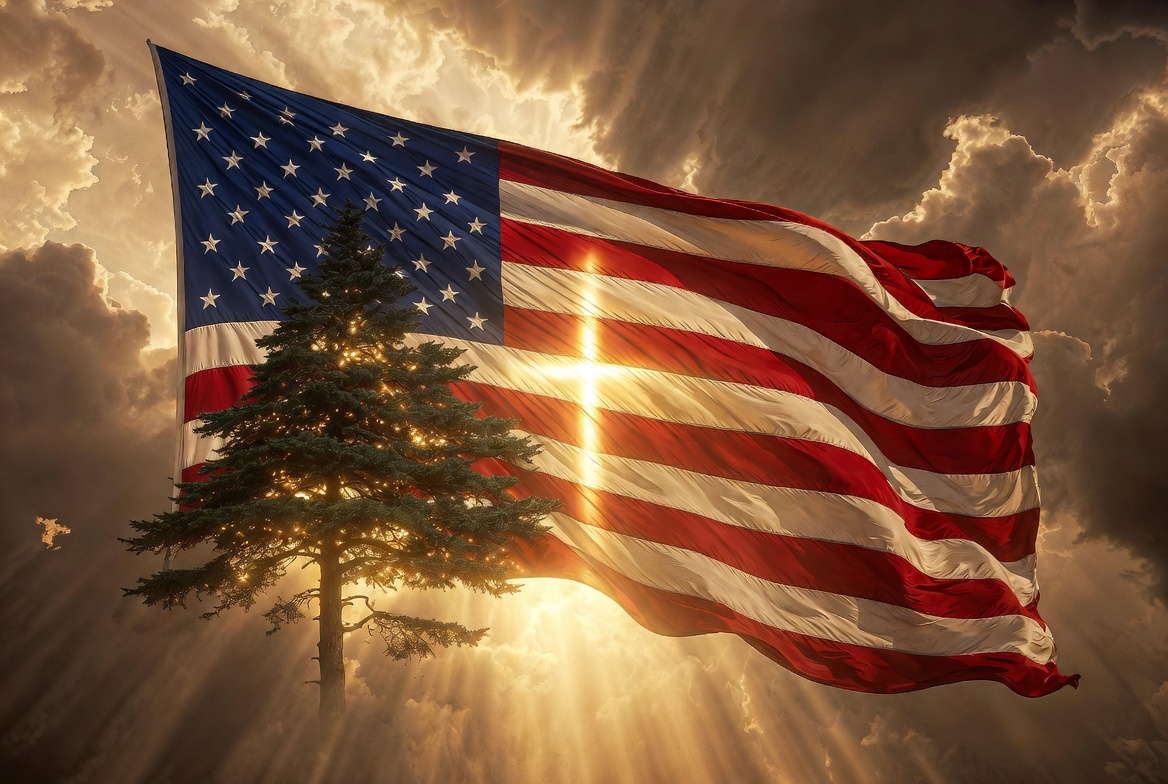
The American flag is more than a national symbol—it is a banner of covenant and liberty, echoing the biblical imagery of the Messiah as a lifted-up standard for the nations. From the “Appeal to Heaven” pine tree flag and Liberty Trees of the Revolution, to the stars representing a “new constellation” and the stripes evoking Israel’s tribal encampment, the flag’s history reveals a profound connection to Scripture: an appeal to the Creator for freedom, the Tree of Life triumphing over the tree of knowledge, and a nation founded under God as a beacon of gospel liberty.
A flag or banner is a mark or symbol which represents a family, or nation/brotherhood. The founding of the United States was based in liberty, with an appeal and reliance in God. The flag of the United States, and its history, depicts this relationship with God.
There are multiple words in Hebrew which have the meaning of a flag or banner, all of which associate flags with the symbology of a house. The Hebrew word for house is בת ‘bat’ which is a combination of the letter ב ‘bet’ which is a picture of a house and the letter ת ‘tav’ which is a picture of two crossed sticks representing a mark. The Hebrew word תא ‘ta’ further displays this concept as this word literally means the “two crossed sticks in the shape of cross were used to hang the family standard or flag.” This word also gives the sense of a room in a house or a boundary between two peoples.
The most common word in Hebrew for a mark or sign is אות ‘oht’ which literally means “a standard, or flag, with the family mark hanging as a sign.” This word is significant in that it also has the meaning of an agreement or covenant between two parties.
Mankind is restored to the House of God through covenant in the Messiah (Isaiah 53:11; 42:6; 49:8; Zechariah 9:11), who was lifted up like a flag/banner .
Joh 3:14 And as Moses lifted up the serpent in the wilderness, even so must the Son of man be lifted up:
Joh 3:15 That whosoever believeth in him should not perish, but have eternal life.
Joh 3:16 For God so loved the world, that he gave his only begotten Son, that whosoever believeth in him should not perish, but have everlasting life.
Joh 3:17 For God sent not his Son into the world to condemn the world; but that the world through him might be saved.
This Scripture is referring back to Numbers 21:8
Num 21:8 And Jehovah spoke to Moses, Make yourself a fiery serpent, and set it on a pole; and it shall be that when anyone is bitten, when he sees it, he shall live.
The word for pole here is נס ‘nes’ which is also translated as flag/banner.

In fact, Scripture speaks of the Messiah as our flag/banner (Isaiah 11:10).
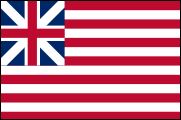
The original flag of the colonies was the “Grand Union Flag” which consisted of the symbols of Great Britain and the stripes of the 13 colonies. The cross symbology in the upper left hand corner combines St. Andrew’s cross (the White Cross) with St. George’s Cross (the Red Cross). Both of these crosses are based in the Christian faith.
The 13 original colonies correspond with ancient Israel in the wilderness who set up their flags for each tribe’s house.
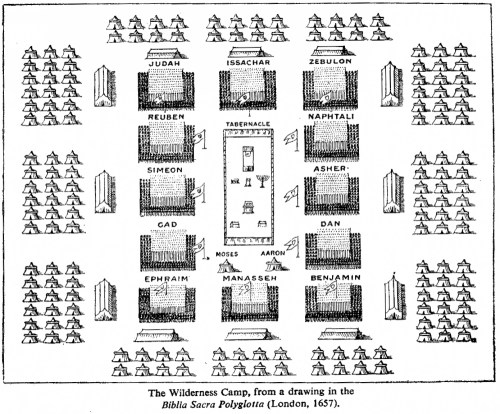
Num 2:2 The sons of Israel shall encamp by their fathers’ house, every man with his own standard, according to the standards. They shall encamp around the tabernacle of the congregation, afar off.
Num 2:3 And those who encamp on the east side, toward the sunrising, are of the standard of Judah’s camp, according to their armies, the ruler of the sons of Judah being Nahshon the son of Amminadab.
Num 2:9 All numbered of the camp of Judah were a hundred and eighty six thousand and four hundred, by their armies. They shall set forth first.
Num 2:10 On the south side shall be the standard of the camp of Reuben, according to their armies; the ruler of the sons of Reuben being Elizur the son of Shedeur.
Num 2:18 On the west side shall be the standard of the camp of Ephraim, according to their armies; the ruler of the sons of Ephraim being Elishama the son of Ammihud.
Num 2:25 On the north side shall be the standard of the camp of Dan, according to their armies; the ruler of the sons of Dan being Ahiezer the son of Ammishaddai.
The Camp of Israel was divided up as the 12 constellations:

Standards of the Tribes
“According to rabbinical tradition, the standard of Judah bore the figure of a lion, that of Reuben the likeness of a man, or of a man’s head, that of Ephraim the figure of an ox, and that of Dan the figure of an eagle; so that the four living creatures united in the cherubic forms described by Ezekiel were represented upon these four standards” (Keil and Delitzsch, Commentary on the Pentateuch, III, 17). A variant of this tradition gives as the standard of Reuben, “unstable as water” (Gen_49:4 the King James Version), a Man and a River, and of Dan, “Dan shall be a serpent in the way” (Gen_49:17), an Eagle and a Serpent. These four forms are also found in the constellations in the four quarters of the heavens. Aquarius, the man with a stream of water, and Leo were the original zodiacal constellations of the two solstices, Taurus was that of the spring equinox, and Aquila and Serpens were close to the autumnal equinox, the latter being actually upon the colure.”
This connection between Israel and the stars is significant as the original flag of the United States was made with 13 stars representing a “new constellation”.
“Resolved, That the flag of the thirteen United States be thirteen stripes, alternate red and white; that the union be thirteen stars, white in a blue field, representing a new constellation.”{The Flag Resolution of 6/14/1777}
Going back to the word אות ‘oht’ which means mark, sign or banner is another connection to the stars. In Genesis 1:14 speaks of the heavenly bodies as signs (אות ‘oht).
Gen 1:14 And God said, Let there be lights in the firmament of the heaven to divide the day from the night; and let them be for signs, and for seasons, and for days, and years:
The lifting up of the Messiah on the cross was a depiction of the tree of life in which the King from Heaven was showing the way to salvation from death and the gift of eternal life. For more on this see the following study: Daily Tidbits 2/4 – Flag
The first official flag of the United States was a depiction of this Tree of Life.
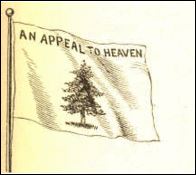
In October of 1775, George Washington commissioned the use of the “An Appeal to Heaven” flag. This phrase was popularized by John Locke, of whom many of the Patriots found inspiration for their endeavors to form a new nation.
The evergreen tree is a symbol of eternal life with Scripture likening these trees to the Messiah.
Isa 55:13 Instead of the thornbush, the fir tree shall come up; instead of the brier, the myrtle shall come up; and it shall be for a name to Jehovah, for an everlasting sign that shall not be cut off. {The fir and myrtle are both evergreen}
Throughout the War for Independence, Liberty Tree flags were used by the colonists. This imagery was used by the sons of Liberty as they met together to oppose the Stamp Act. They believed the “Stamp Act” was censorship or a ‘knowledge tax’ which prohibited colonists from reading and writing freely. The Sons of Liberty hung in effigy Andrew Oliver who was chosen by King George to impose this Stamp Act. It was here that a sign was hung declaring this the ‘Tree of Liberty.’ It was here that it is said that ‘America was born.’
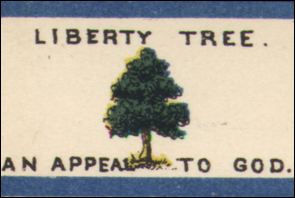
This connection between a “knowledge” tax and the Tree of Liberty has parallels to the two trees in the midst of the Garden of Eden.
Gen 2:9 And out of the ground made the LORD God to grow every tree that is pleasant to the sight, and good for food; the tree of life also in the midst of the garden, and the tree of knowledge of good and evil.
It was at the tree of knowledge which brought forth slavery to sin and death. The Messiah took upon Himself the curse of this tree that mankind might be set free.
Col 2:15 having stripped the rulers and the authorities, He made a show of them in public, triumphing over them in it.
2Co 5:21 For He made the One who knew no sin to be sin for us, that we might become the righteousness of God in Him.
Gal 5:1 Stand fast therefore in the liberty wherewith Christ hath made us free, and be not entangled again with the yoke of bondage.
The Declaration of Independence which followed was also an “appeal to heaven”.
“We therefore, the representatives of the United States of America, in General Congress, Assembled, appealing to the supreme judge of the world for the rectitude of our intentions…”
The Declaration of Independence is the foundation of the United States. The Declaration is a proclamation that this nation is founded upon the rights given by the Creator of Life, Liberty and the pursuit of Happiness. This document was written, at least in part, as a means to preserve religious liberty and continue the ability of the colonists to live in the Word of God.
“The measure was urged as necessary to insure permanency to the civil and religious institutions of the colonies, as essential to their material prosperity, in order to secure fair scope for the industrial energies of the land, as vital to the expansion of American ideas over the continent, and to the creation of an opening for the spread of the Gospel, as the only escape from tyranny, and the only guaranty of that government which is ‘an ordinance of Heaven to restrain the usurpation of wicked men, to secure to all the enjoyment of their natural rights, and to promote the highest political interests and happiness of society.’ It was urged that independence ‘was the path of empire, glory, liberty, and peace,’ and that labor in such a cause was labor on the side of Providence. ‘The Almighty’, said Chief Justice Dayton, of South Carolina, from the bench, ‘created America to be independent of Great Britain: to refuse our labors in this divine work is to refuse to be a great, a free, a pious, and a happy people.’” {Rise of the Republic – Richard Frothingham}
John Quincy Adams spoke in similar terms declaring that the most important work of the Founders was establishing a free country in which the Gospel could be propagated.
“Why is it that, next to the birthday of the Savior of the world, your most joyous and most venerated festival returns on this day [the Fourth of July]?” “Is it not that, in the chain of human events, the birthday of the nation is indissolubly linked with the birthday of the Savior? That it forms a leading event in the progress of the Gospel dispensation? Is it not that the Declaration of Independence first organized the social compact on the foundation of the Redeemer’s mission upon earth? That it laid the cornerstone of human government upon the first precepts of Christianity?” (John Quincy Adams – Fourth of July speech at Newburyport, Massachusetts 1837}
“The highest glory of the American Revolution was this; it connected in one indissoluble bond the principles of civil government with the principles of Christianity.” {John Quincy Adams on July 4, 1821}
The Founders believed they were the vine planted in the wilderness spoken of by the Prophet Isaiah (Isaiah 5:1-7). The Lord Jesus later applied this prophecy to a nation that would come forth bearing the fruits of Kingdom of God (Matthew 21:33-43). The men who founded this country believed they were, at least in part, a fulfillment of these words. Men such as Ezra Stiles, who was the most influential preacher during the time period of the Founders spoke of the United States as “God’s American Israel” and referred to them specifically as the vine which God’s right hand hath planted in direct reference back to Isaiah chapter 5. Stiles was reiterating the belief of earlier preachers such as John Cotton, Nathaniel Morton and Cotton Mather who referred to the men who left Europe to seek religious freedom in America as God’s vineyard in the wilderness.
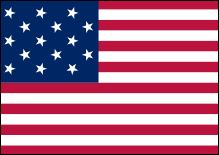
The national anthem of the United States is the Star Spangled Banner which was written by Francis Scott Key during the War of 1812. The Flag that he was inspired by is the 15 starred flag above.
Americans are familiar with the first stanza of the “Star Spangled Banner” as it is sung at many public gatherings. However, the fourth stanza is the most important as it encapsulates the foundation of the United States.
O thus be it ever, when freemen shall stand
Between their loved home and the war’s desolation.
Blest with vict’ry and peace, may the Heav’n rescued land
Praise the Power that hath made and preserved us a nation!
Then conquer we must, when our cause it is just,
And this be our motto: “In God is our trust.”
And the star-spangled banner in triumph shall wave
O’er the land of the free and the home of the brave!
The War of 1812 saw President Madison proclaim national days of prayer for the nation to “appeal to heaven” as Americans did during the War for Independence. As a result, heaven did preserve this nation and rescued its people from the hands of its enemy. For more see American Minute with Bill Federer: MAR. 16 – Madison and Prayer during War of 1812
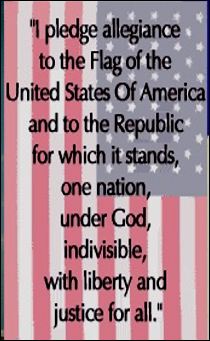
During the Presidency of Dwight D. Eisenhower, the phrase “under God” was added to the pledge of allegiance.
President Eisenhower spoke of the importance of this addition:
“From this day forward, the millions of our school children will daily proclaim in every city and town, every village and rural school house, the dedication of our nation and our people to the Almighty. To anyone who truly loves America, nothing could be more inspiring than to contemplate this rededication of our youth, on each school morning, to our country’s true meaning. . . . In this way we are reaffirming the transcendence of religious faith in America’s heritage and future; in this way we shall constantly strengthen those spiritual weapons which forever will be our country’s most powerful resource, in peace or in war.”
In the Presidents Code, Eisenhower‘s Presidency portrays the time period of Israel in the wilderness, in particular the time period in which they received the 10 Commandments at Mt. Sinai.
The pledge of allegiance declares that the United States is one nation under God. This portrays the unity of Israel which comes from the law given at Mt. Sinai (Exodus 19:5-6; 12:49; Deuteronomy 31:11-12; Numbers 15:15-16, 29; Leviticus 19:33-34; 24:22; Galatians 3:28). This unity of Israel is illustrated in the United States flag which is comprised of 13 red and white stripes which correspond with the camp of Israel which consisted of the 12 tribes of Israel and the tribe of Levi in their midst.
Charles W. Stewart, who was the superintendent of naval records and the library of the U.S. Navy Department made the same connection between Mt. Sinai, Israel and the flag of the United States.
“The flag may trace its ancestry back to Mount Sinai, whence the Lord gave to Moses the Ten Commandments and the Book of the Law, which testify of God’s will and man’s duty; and were deposited in the Ark of the Covenant within the Tabernacle, whose curtains were blue, purple, scarlet, and fine-twined linen.”
“Before the ark stood the table of shewbread, with its cloth of blue, scarlet and white. These colours of the Hebrew Tabernacle were taken over by the early Western Church for its own and given to all the nations of western Europe for their flags. When the United States chose their flag it was of the colours of old, but new in arrangement and design, and they called it ‘The Stars and Stripes.’
“Our flag is of the colours red, white and blue. Red is for courage, zeal, and fervency; white is for purity, cleanness of life and rectitude of conduct; blue is for loyalty, devotion, friendship, justice and truth. The star is an ancient symbol of India, Persia and Egypt, and signifies dominion and sovereignty.”
On Flag Day in 1917, Frederick C. Hicks, in the U.S. House of Representatives stated the following:
“The flag of America does more than proclaim mere power or acclaim a great and glorious history…Its stars and its stripes voice the spirit of America calling to a nation of indomitable courage and infinite possibilities to live the tenets of Christianity, to teach the gospel of work and usefulness, to advance education, to demand purity of thought and action in public life, and to protect the liberties of free government from the aggressions of despotic power. This is the call of the flag of the Union in this hour of crisis and turmoil, when civilization and the laws of nations and of humanity are being engulfed in the maelstrom of death and destruction.”
Hicks’ speech was given during the time period of World War I, but was just as appropriate during Eisenhower‘s days as President and today as well.
Further connecting this period of time in Scripture to the United States Flag is the war with Amalek (Exodus 17:8-16). It was after the war with Amalek, which is depicted in parable form in the Korean war of which Eisenhower ended, that Moses declared that the Lord is our flag or banner (Exodus 17:15). Scripture speaks of the Messiah as the banner of whom the nations gather unto (Isaiah 11:10). We rejoice in this banner (Psalm 20:5) which is set up by those who believe in Him, because of the truth (Psalm 60:4).
On the flag of the United States, pentagrams are used to represent each state. As with most symbols, the pentagram has both good and evil symbology. The good points to Messiah Jesus, the evil displays the antichrist, the counterfeit Messiah.
George Washington‘s blessing over each of the 13 states after the War for Independence links each state to the Messiah.
“I now make it my earnest prayer that God would have you, and the State over which you preside, in his holy protection; that he would incline the hearts of the citizens to cultivate a spirit of subordination and obedience to government, to entertain a brotherly affection and love for one another…and finally that he would most graciously be pleased to dispose us all to do justice, to love mercy, and to demean ourselves with that charity, humility, and pacific temper of mind, which were the characteristics of the Divine Author of our blessed religion, and without an humble imitation of whose example in these things, we can never hope to be a happy nation.”
Our bodies are His Temple (Ephesians 2:21-22; 5:30; 1 Corinthians 6:19) which are intimately linked to the Fibonacci sequence & the number 5 (the 5th day).
“The number 5 is intrinsically related to Phi and the Fibonacci series. Phi appears in the geometry of the 5-sided pentagon.”
Phi can be derived from several formulas based on the number 5. The most traditional, based on the geometric construction of phi is this:

This formula for phi can also be expressed all in fives as:
And, as pointed out by W. Nathan Saunders, the terms in above representation of phi can be expressed in yet another way that involves four 5′s:

Phi appears in the geometry of the 5-sided pentagon
Take a pentagon with 5 equal sides and connect all the points to form a 5-pointed star. The ratios of the lengths of the resulting line segments are all based on phi.

5 is the 5th Fibonacci number
5 is also the 5th of the Fibonacci numbers, including 0, 1, 2, 3, and 5.
5 appears in the human body, which has proportions based on phi
Another interesting aspect of phi and five is in relation to the design of the human body, which in addition to being based on phi relationships in its proportions, has:
* 5 appendages from the torso, in the two arms, two legs and a head,
* 5 appendages on each of legs and arms in the five fingers and five toes,
* 5 openings on the face, and
* 5 senses in sight, sound, touch, taste and smell.
The Divine Proportion in the Body
The white line is the body’s height.
The blue line, a golden section of the white line, defines the distance from the head to the finger tips.
The yellow line, a golden section of the blue line, defines the distance from the head to the navel and the elbows.
The green line, a golden section of the yellow line, defines the distance from the head to the pectorals and inside top of the arms, the width of the shoulders, the length of the forearm and the shin bone.
The magenta line, a golden section of the green line, defines the distance from the head to the base of the skull and the width of the abdomen. The sectioned portions of the magenta line determine the position of the nose and the hairline.
Although not shown, the golden section of the magenta line (also the short section of the green line) defines the width of the head and half the width of the chest and the hips.”
The Human face, ears, and teeth are based upon Phi
The human hand and foot are based on Phi
The human heartbeat is based upon Phi
The number 5 is also linked to warfare. The word for five in Hebrew is חמש ‘chamesh’ which means the hand, or arming for battle. The word for army, commonly translated as hosts, in Hebrew is צבא ‘tseva’ which connects to stars (Genesis 2:1; Psalm 33:6; Exodus 7:4; 12:51). The stars are described as hosts and are a picture of Israel, God’s army/host.
The Messiah has long been associated with the pentagram image.
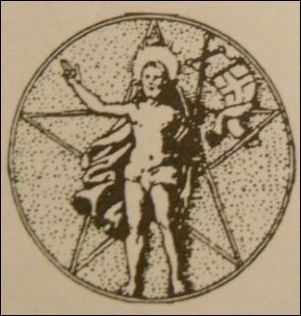
The usage of the pentagram on the American flag is an apt portrayal of the United States. The United States has always had two opposing forces working against each other. One side wishes to see this nation used as a beacon of light and liberty which comes from God. The other side wishes to see this nation used a harbinger of the false light of the adversary.
1776 is the value of the Hebrew letters in Genesis 1:4:
Gen 1:4 And God saw the light, that it was good: and God divided the light from the darkness.
To one side, 1776 represents liberty/freedom in Messiah who answered our “appeal to heaven”. To the other side, 1776 represents the birth of a new order which will culminate in a “New Atlantis”. The side we choose as a nation will determine the course of our future. We can be a shining city on a hill proclaiming the Gospel of Liberty or we can bring forth ‘hell on earth.’



