

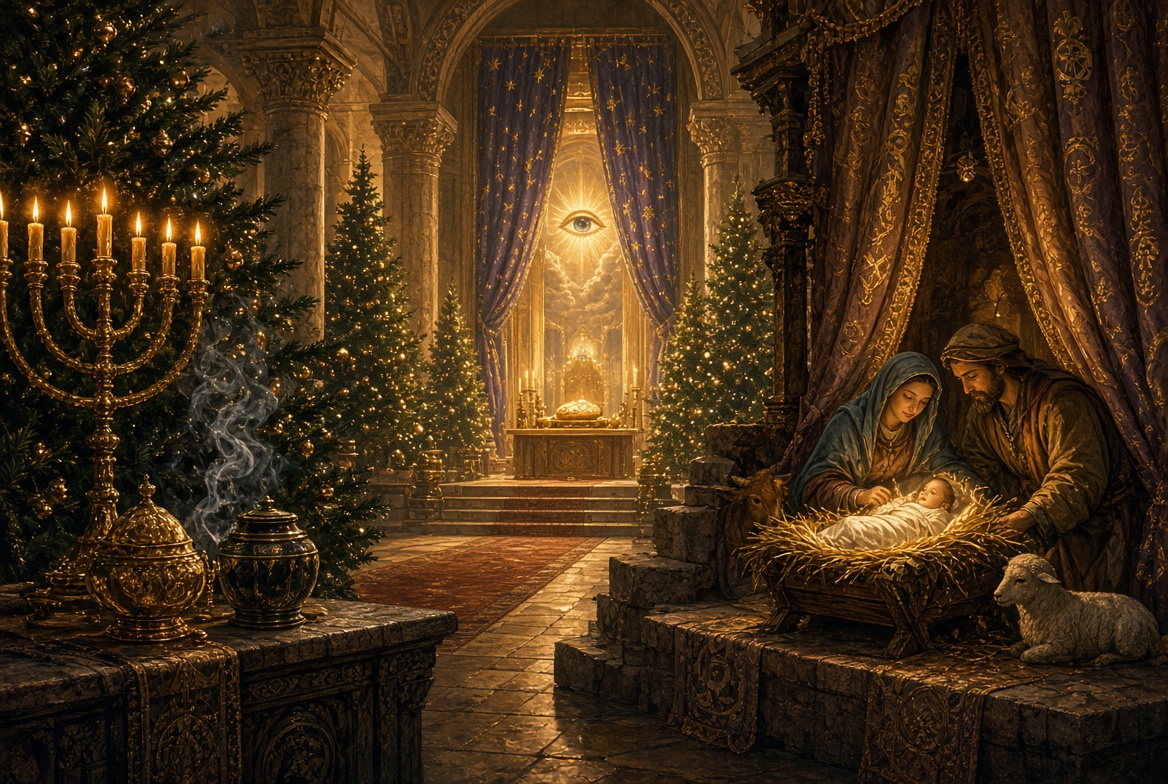
The modern custom of Christmas displays a kind of reenactment of worship in the house of the LORD. The Scriptures speak of His sanctuary being beautified with trees — the fir, the pine, and the box (Isa 60:13). The Hebrew פאר pa’ar means to decorate, to ornament, to go over the boughs. Those planted in the house of the LORD shall flourish in His courts (Psa 92:12-13).
Decorations trace to עדה edah, ornaments, from עד ed — a witness. It is also the word for the Tabernacle of Witness. Literally, ed is to see the door. Who is the Door? Messiah (Joh 10:9). Ed is the root of מועד moed — feast, holiday, a witness to others. Even the winter bauble traces to בבה babah, the pupil of the eye — the little guy in His Eye.
When the priest entered the tent there was no natural light. The menorah was the light. The Temple itself was of evergreen (1Ki 5:5-6). Frankincense and myrrh filled it (Son 4:6), as the wise men brought to the Child (Mat 2:11). Bells were on the hem of the priest’s garment (Exo 28:34). The fire on the altar did not go out (Lev 6:12). Opposite the menorah stood the table of shewbread — twelve loaves. Christmas traces to massa (bread) and missa (to send abroad). The holy days of Christmas last twelve days.
Bethlehem is the House of Bread. The crèche, the crib, traces to ערש eres — a bed, and in Numbers 15 a kneading trough. The manger is for eating. He is the Bread of Life (Joh 6:51), the Firstfruit (1Co 15:20). If the firstfruit is holy, so is the lump; if the root is holy, so are the branches (Rom 11:16).
The Apostle is the Sent One. He came with the gift of salvation, and sent His apostles with that gift to the world. The gospel is בשורה besorah — a feast prepared when good news arrives.
The modern custom of celebrating Christmas displays a type of “reinactment” of worship in God’s Temple.
To begin, the Scriptures speak of the LORD’s house being decorated with trees, in particular evergreens.
Isa 60:13 The glory of Lebanon shall come unto thee, the fir tree, the pine tree, and the box together, to beautify the place of my sanctuary; and I will make the place of my feet glorious.
Isa 61:3 To appoint unto them that mourn in Zion, to give unto them beauty for ashes, the oil of joy for mourning, the garment of praise for the spirit of heaviness; that they might be called trees of righteousness, the planting of the LORD, that he might be glorified.
Psa 92:12 The righteous shall flourish like the palm tree: he shall grow like a cedar in Lebanon.
Psa 92:13 Those that be planted in the house of the LORD shall flourish in the courts of our God.
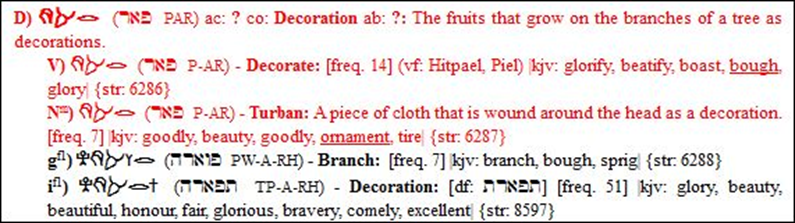
The Hebrew word for “beautify” in Isaiah 60:13 is פּאר pa’ar’ which literally means to decorate. In Isaiah 61:10, פּאר pa’ar’ is translated as “ornament”. Strong’s defines in part this word as “going over the boughs”.
In other words, decorating trees is the essence of this word.
Strongs
H6286
פּאר
pâ’ar
paw-ar’
A primitive root; to gleam, that is, (causatively) embellish; figuratively to boast; also to explain (that is, make clear) oneself; denominatively from H6288, to shake a tree: – beautify, boast self, go over the boughs, glorify (self), glory, vaunt self.
The the etymology of the word ‘decorations,’ links back to the Temple as well.
To decorate something comes the Hebrew word עדה ‘edah’ which is translated as ‘ornaments’ in Exodus 33:5.
עדה ‘edah’ comes from the root עד ‘ed’ which means a witness as ‘ornaments’ were used to witness to the rank of an individual. עדה ‘edah’ is also the word used for the Tabernacle of Witness (Numbers 17:7-8).
Literally, עד ‘ed’ means to ‘see the door.’ Who is the door? Messiah (John 10:9).
Joh 10:9 I am the door: by me if any man enter in, he shall be saved, and shall go in and out, and find pasture.
עד ‘ed’ is the root of the word מועד ‘moed’ which means feast or holiday which is witness to others.
Going further is the word ‘bauble’ which is a small decoration used during the winter holidays. This word traces back to the Hebrew word בבה ‘babah’ which means the pupil of the eye. The pupil of the eye is associated with a close relationship with another, as in being the ‘apple of God’s Eye’ or the ‘little guy in His Eye.’
Christmas displays the concept of “little guy in the Eye” of God. Christmas – Little Guy in the Eye.
The articles in the Tabernacle/Temple are portrayed in shadow picture form in the customs ofChristmas. This time of year is when people seek to escape the cold and darkness by congregating at a tent/home.
When a priest would enter God’s tabernacle, he would enter a tent without natural light, the menorah would be the only source of light. This is pictured in the Christmas tree. The temple itself was made of evergreen trees (1Kings 5:5-6; Zechariah 11:1) and the smell therein is linked to the smell of evergreens (Psalm 92:12-13; Hosea 14:6; Song of Songs 4:11; Psalm 45:8), frankincense and myrrh (Song of Songs 4:6) which are used traditionally during Christmas as a remembrance of the gifts brought to Christ by the wise men (Matthew 2:11).
The priest wore bells round about the hem of his garment so when he walked in the tabernacle ‘sleigh bells’ would have been heard (Exodus 28:34; 39:26).
The smell of an open fire would have been continuous at the tabernacle/temple (Leviticus 6:12) which is linked to the traditional setting of the fireplace warming the home during Christmas.
Opposite the menorah was the table of shewbread. The etymology of Christmas is linked to the twelve loaves of bread which sat upon this table. Is it any surprise that “holydays of Christmas” last twelve days?
The word Christmas traces back to the Latin word ‘massa’ which is speaking of bread and the Latin word ‘missa’ which means to ‘send abroad.’
Jesus sent His Apostles with the Gospel message of this gift of salvation to the world. In Hebrew, the word for gospel is בסורה ‘besorah’ which has the meaning of a feast which is prepared when good news is brought. The ‘food’ that the Apostles were to take to the world is the message that Jesus is the bread of life, whose flesh brings life (John 4:32-34; 6:51).
The Hebrew word for apostle is שוליח ‘sholiach’ which comes from the word שילוח ‘shiluach’ which means to send something as in a gift. Jesus was the ‘Sent One’ or ‘Apostle’ of the Father (Hebrews 3:1; John 6:29; 7:29; 8:42; 17:3, 18-21) who came with the gift of salvation.
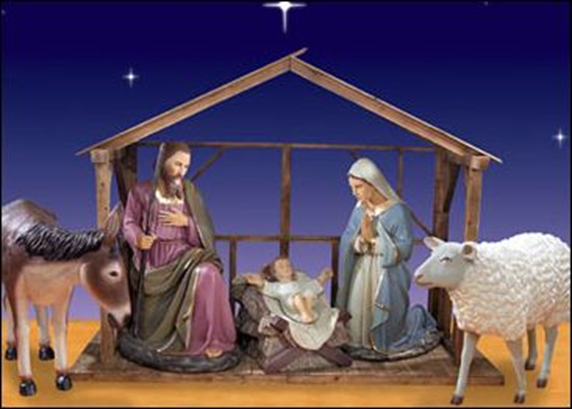
The word for a Christmas nativity display is ‘creche’ from the Old French word ‘cresche’ meaning a crib. This word traces back to the Hebrew word ערש ‘eres’ which means a crib or bed. In Numbers 15:20 it is speaking of a kneading trough which is interesting as Bethlehem, which means house of bread in Hebrew, is where Messiah, the Bread from Heaven (John 6) was born. עריסה ‘ariysah,’ which is a cognate of ערש ‘eres,’ means dough (Numbers 15:20-21) and is linked to firstfruits (Ezekiel 44:30).
Rom 8:29 because whom He foreknew, He also predestinated to be conformed to the image of His Son, for Him to be the First-born among many brothers.
1Co 15:20 But now Christ has been raised from the dead; He became the firstfruit of those having fallen asleep.
1Co 15:23 But each in his own order: Christ, the firstfruit; afterward those of Christ at His coming.
Rom 11:16 Now if the firstfruit is holy, so also the lump. And if the root is holy, so also the branches.
Notice the connection between the firstfruits, the lump (bread-dough) and the Olive of Israel (tree).
The English word ‘manger’ comes from the Old French word ‘mangeure’ which means ‘to eat,’ linking to Numbers 15:20 (kneading trough).
The Gospel being taken to the world by Apostles is likened unto taking the bread of life to the world. As mentioned before, the etymology of the word Christmas traces back to the Latin word ‘massa’ which is speaking of bread and the Latin word ‘missa’ which means to ‘send abroad.’ A missionary is one who is sent forth and comes from this word.
The word apostle comes from the Hebrew word שליח ‘sholiach’ which means the sent one. שלח ‘shalach’ also means to send as in a gift שילוח ‘shiluach’ by the hand of a messenger/apostle שוליח ‘sholiach.’ Jesus was the ‘Sent One’ or ‘Apostle’ of the Father (Hebrews 3:1; John 5:28; 6:29; 7:29; 8:42; 17:3, 18-21) who came with the gift of salvation.
Jesus would then send His Apostles with the message of this gift of salvation to the world. In Hebrew the word for gospel is בסורה ‘besorah’ which has the meaning of a feast which is prepared when good news is brought. The ‘food’ that the Apostles were to take to the world is the message that Jesus is the bread of life, whose flesh brings life (John 4:32-34; 6:51).
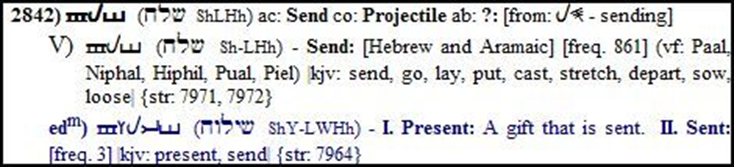
Who is THE Sent one/Apostle? Messiah (Hebrews 3:1; John 5:38; 6:29; 7:29; 8:42; 17:3, 18-21).
Eph 4:7 But to each one of us was given grace according to the measure of the gift of Christ.
Eph 4:8 Because of this, He says, “Having gone up on high, He led captivity captive,” and gave “gifts to men.” Psa. 68:18
The concept of the apostles bringing the gift of the message of the Gospel/Bread of Life is further seen in the word תנה ‘tanah’ which is translated as ‘rehearse’ in the English (Judges 5:10-11).
Joh 3:34 For the One whom God sent speaks the Words of God, for God does not give the Spirit by measure.
The link between gifts and eating is further seen in the Hebrew word ברה ‘barah’ which also traces back to the word for ‘my Son’ mentioned earlier: בר ‘bar.’ A related word is ברות ‘berot’ which means meat and ברית ‘briyt’ which means covenant.
Joh 6:48 I am the Bread of life.
Joh 6:49 Your fathers ate the manna in the wilderness and died.
Joh 6:50 This is the Bread coming down out of Heaven, that anyone may eat of it and not die.
Joh 6:51 I am the Living Bread that came down from Heaven. If anyone eats of this Bread, he will live forever. And indeed the bread which I will give is My flesh, which I will give for the life of the world.
Isa 42:6 I the LORD have called thee in righteousness, and will hold thine hand, and will keep thee, and give thee for a covenant of the people, for a light of the Gentiles;
Isa 49:8 Thus saith the LORD, In an acceptable time have I heard thee, and in a day of salvation have I helped thee: and I will preserve thee, and give thee for a covenant of the people, to establish the earth, to cause to inherit the desolate heritages;
Another word for give is הב ‘hav’ which is linked to the sacrifice of Messiah on the cross.
Joh 3:16 For God so loved the world that He gave His only begotten Son, that everyone believing into Him should not perish, but have everlasting life.
Joh 15:13 Greater love than this has no one, that anyone should lay down his soul for his friends.
The pictograph meaning of love:
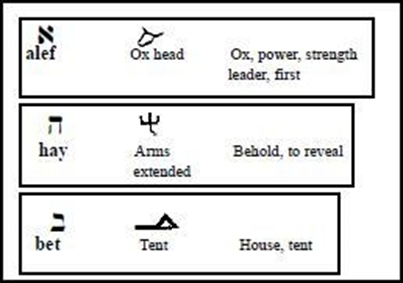
The first and last letters spell out the word for Father (אב ‘ab’) and the middle letter is a picture of a man with outstretched arms. The Love of the Father is revealed through the Messiah on the tree, gathering all mankind back to their Creator.
Further linking Messiah as the gift from the Father to mankind is the word נסאת ‘nasat’ which means a gift from the root נס which literally means a banner lifted up. Who is the Banner? Messiah. (John 3:14; 12:32; Isaiah 11:10-12)
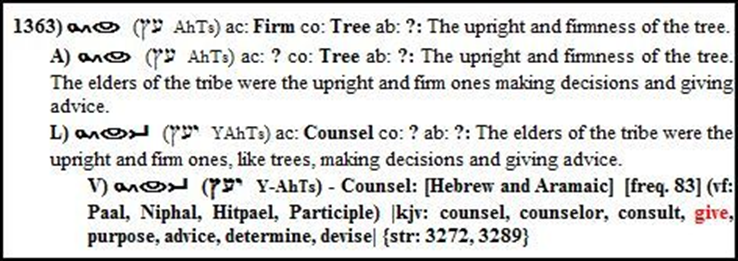
Giving is linked with trees. The Hebrew word for giving counsel is יעץ ‘ya’ats.’
The English word ‘gift’ comes from the Old Norse word ‘gift/gipt’ meaning gift or good luck and is linked to the Germanic word ‘mitgift’ meaning dowry. In the tidbit on the winter, it is seen that betrothal is linked to to the winter and is associated with the crucifixion of Messiah which is the gift of the Father to mankind of redemption. The Old English word ‘gift’ also meant bride price or marriage gift. Isaac Mozeson traces the English word ‘gift’ back to the Indo European root ‘ghabh’ which means to give or receive and the Anglo-Saxon word ‘gifan’ all the way back to the Hebrew word הב which was described above in reference to the love of the Father revealed in giving His Son as a propitiation for our sins.
Giving gifts to children is said to be done because the Magi gave gifts to the baby Jesus when they arrived in Bethlehem. This does have some connection.
In Matthew 25:31-46 Messiah states that when we give to the ‘least’ of our brethren, we are giving it to Him. The Greek word for least is ἐλάχιστος ‘elachistos’ which can also be translated as small children. The Hebrew word קטן ‘qatan’ means the least, small one, or child (Genesis 44:12, 20).
The Babylon Connection? pg 65
The Jerusalem Temple included a molten sea “ten cubits from brim to brim, round in compass…under it was the similitude of oxen (2 Chronicles 4:2,3). Had this been featured in a temple at Babylon, instead, Hislop would have undoubtedly condemned this “round” molten sea as being pagan. And the oxen beneath it, what could they be but symbols of Isiris, the Egyptian Nimrod!”
Oxen and garlands are mentioned in connection with the pagan worship of Jupiter (Acts 14:13). A “garland” or “wreath” is round. Augustine tells about a pagan ceremony in which a wreath was placed on a phallic replica: “During the festival of Liber, this obscene member…was carried with great honor…and brouth to rest in its own place; on which unseemly member it was necessary that the most honorable matron should place a wreath in the presence of all the people.” Based upon such things, some have supposed every use of a wreath is wrong. They especially target a “Christmas wreath” as being evil! But an idolatrous use of a wreath and a wreath used as a decoration, are two different things! The proof is simple – and Biblical! The two pillars in front of the Temple of God each had a “wreath” (2 Chronicles 4:12, 13), and were also decorated with round pomegranates (1 Kings 7:20)! These things were not displeasing to God, for when the Temple was dedicated, He chose to fil it with such glory that the priests could not stand to minister! (2 Chronicles 5:14). He did not consider the round wreaths, round pomegranates, and round molten sea as symbols of Baal!”

In the Bible, wreath and bulb imagery was on pillars at the Temple.
2Ch 3:15 Also he made before the house two pillars of thirty and five cubits high, and the chapiter that was on the top of each of them was five cubits.
2Ch 3:16 And he made chains, as in the oracle, and put them on the heads of the pillars; and made an hundred pomegranates, and put them on the chains {שׁרשׁרה ‘sharsherâh’}
H8333
שׁרשׁרה
sharsherâh
shar-sher-aw’
From H8327 (compare H8331); a chain; (architecturally) probably a garland: – chain..
Like the Christmas tree, wreaths are connected to the tree of life.
Pro 3:18 She is a tree of life to them that lay hold upon her: and happy is every one that retaineth her.
Pro 3:19 The LORD by wisdom hath founded the earth; by understanding hath he established the heavens.
Pro 3:20 By his knowledge the depths are broken up, and the clouds drop down the dew.
Pro 3:21 My son, let not them depart from thine eyes: keep sound wisdom and discretion:
Pro 3:22 So shall they be life unto thy soul, and grace to thy neck.
Proverbs 3:22 corresponds to Proverbs 1:9 & 4:9 which speaks of an ornament (wreath לויה ‘livyah’) of grace.
Pro 1:9 For they shall be an ornament {לויה ‘livyah’ – wreath} of grace unto thy head, and chains about thy neck.
Pro 4:8 Exalt her, and she shall promote thee: she shall bring thee to honour, when thou dost embrace her.
Pro 4:9 She shall give to thine head an ornament {לויה ‘livyah’ – wreath} of grace: a crown of glory shall she deliver to thee.
Wreaths (לויה ‘levyah’) were also designed into the bases of brazen lavers in Solomon’s temple (1 Kings 7:29-30, 36).
The word Christmas comes from the Old English word ‘Cristes mזsse’ which means “Christ’s Mass”. Mass comes from the Latin word ‘missa’ which means to “send abroad” as in the message of a missionary with the Gospel which makes Him known to the world. Believers are said to “make known the knowledge of Him” as a “sweet smell”.
2Co 2:14 But thanks be to God, the One always leading us in triumph in Christ, and the One revealing through us the odor of the knowledge of Him in every place.
2Co 2:15 For we are a sweet smell to God because of Christ in those being saved, and in those being lost;
2Co 2:16 to the one, an odor of death unto death, and to the other, an odor of life unto life. And who is sufficient for these things?
2Co 2:17 For we are not as the many, peddling the Word of God; but as of sincerity, but as of God. We speak in Christ, in the sight of God.
Christ comes from the Hebrew word meaning to anoint with oil. This anointing is related to the Hebrew word רקח ‘raqach’ which means to rub an ointment bringing forth a perfume. The “smell” of Christmas with the evergreen tree in the home points to the love of God in Christ.
Eph 5:2 and walk in love, even as Christ also loved us and gave Himself for us, an offering and a sacrifice to God for an odor of a sweet smell.
The Hebrew word for name is שם ‘shem’ which literally means the “breath” or “aroma” of a person, referring to the breath of man being is character, or what makes him what he is. The character of God is love, revealed in the work of Christ on the cross.
The Scriptures associate Messiah with the smell of the evergreens of Lebanon (Hosea 14:6; Song of Songs 5:15).
Hos 14:6 His branches shall spread, and his beauty shall be as the olive tree, and his smell as Lebanon.
Son 5:15 His legs are as pillars of marble, set upon sockets of fine gold: his countenance is as Lebanon, excellent as the cedars.
In Hosea 14:6 this association with the evergreen tree likens His beauty to the olive tree which further links to the menorah as olives were used to make the oil for the light (Exodus 25:6).
Exo 25:6 Oil for the light, spices for anointing oil, and for sweet incense,
Zec 4:2 And said unto me, What seest thou? And I said, I have looked, and behold a candlestick all of gold, with a bowl upon the top of it, and his seven lamps thereon, and seven pipes to the seven lamps, which are upon the top thereof:
Zec 4:3 And two olive trees by it, one upon the right side of the bowl, and the other upon the left side thereof.
Zec 4:11 Then answered I, and said unto him, What are these two olive trees upon the right side of the candlestick and upon the left side thereof?
Zec 4:12 And I answered again, and said unto him, What be these two olive branches which through the two golden pipes empty the golden oil out of themselves?
Zec 4:13 And he answered me and said, Knowest thou not what these be? And I said, No, my lord.
Zec 4:14 Then said he, These are the two anointed ones, that stand by the Lord of the whole earth.
Previous articles:
Christmas – Little Guy in the Eye
YES! Evidence Indicates Jesus Really Was Born December 25th – Kurt Simmons
“Unto You is Born this Day” – Kurt Simmons
John the Baptist Six Months Older than our Lord – Kurt Simmons
The Nativity of Christ & Death of Herod the Great – Kurt Simmons
Star of Bethlehem or Nazareth? – Kurt Simmons
Objections to Christmas and the Dec. 25th Birth of Christ Answered – Kurt Simmons
Refutation of Ernest Martin’s “The Star that Astonished the World” – Kurt Simmons
Dating the Birth of Jesus of Nazareth – Michal E. Hunt
How December 25 Became Christmas – Biblical Archaeology Society
Calculating Christmas: The Story Behind December 25 – William J. Tighe
Christmas – Throwback Christianity
Is Christmas Lawful, or Is It Pagan? – Kurt Simmons
Presbyterian & Puritanial Curmudeons and the War Against Christmas – Kurt Simmons
Christmas Was Never a Pagan Holiday – Marian T. Horvat
Is Christmas Really a Pagan Holiday? – Come Reason Ministries
Christmas: Pagan Festival or Christian Celebration? – Dr. Anthony McRoy
On Nimrod and Christmas Trees – “As Bereans Did”

 Little Guy in the Eye