
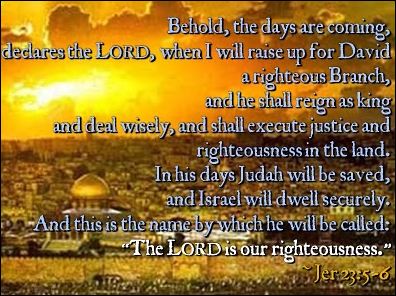
Jeremiah 23:6 declares that the coming Messiah, the Branch of David, will be called YHWH Tzidkenu — “The LORD our Righteousness.” Ancient and medieval Jewish sources, including the Targums, Midrashim, and commentaries by rabbis such as Radak and others, affirm this title belongs to the Messiah. This powerful name reveals that the expected Redeemer would not only bring righteousness but be the LORD’s righteousness for His people — a concept deeply embedded in Jewish expectation long before the New Testament.
Ancient Jewish sources admit that the Messiah would be named Yahweh our righteousness.
Jer 23:5 Behold, the days come, saith the LORD, that I will raise unto David a righteous Branch, and a King shall reign and prosper, and shall execute judgment and justice in the earth.
Jer 23:6 In his days Judah shall be saved, and Israel shall dwell safely: and this is his name whereby he shall be called, THE LORD OUR RIGHTEOUSNESS.
Rabbi David Kimchi wrote in reference to this verse, ‘By the righteous Branch is meant Messiah.’ The compilers of the Targum agreed with Kimchi since they introduced Messiah by name in this passage. {Rays of Messiah’s Glory: Christ in the Old Testament – David Baron pg 78}
David Kimchi (RaDaK) lived from 1160-1235 and became the most famous of the Kimchi family. Of this family it was said “were it not for the Kimchis, there would be no Torah.” Kimchi was a grammarian who later wrote commentaries on the TaNaKH, including “Teshuvoth Lanotzrim” (Refutation to the Christians) refuting doctrines of Christianity.
Alfred Edersheim quotes other Rabbinic writings in reference to this passage:
On Jer. xxiii, 5, 6 the Targum has it: ‘And I will raise up for David the Messiah the just.’ This is one of the passages from which, according to Rabbinic views, one of the names of the Messiah is derived, viz.: Jehovah our Righteousness. So in the Talmud (Babha Bathra 75b), in the Midrash on Ps. xxii.1, Prov.xix.21, and in that on Lamentations I 16. {Life and Times of Jesus the Messiah pg 731}
For those not familiar, Alfred Edersheim was a Jew who became a believer in Messiah. Edersheim was educated in the Talmud and Torah at a Hebrew school. Due to his education, he was able to write about the time period of the 2nd Temple and Jesus in light of Rabbinic writings.
Aramaic Targum “Behold the days come says the Lord that I will raise up unto David a righteous Messiah and he shall reign as King and understand.”
“What is the name of the King Messiah? Rabbi Abba Bar Kahana said, ‘His name is the Lord our Righteousness.’” [Midrash Lamentations Rabbah 1.16.51; Pesikta de Rab Kahana 22.5a; Midrash on Psalms 21.2; Baba Bathra 75b, Babylonian Talmud; Yalkut Shimoni, fol. 384: all referring to Yirmeyahu 23:6 in the Tanakh]
Abba Bar Kahana was a Jewish sage of the “Amora” era which went from 200-500 AD.
 Little Guy in the Eye