
In the Beginning was the Word
The equivalent of Genesis 1:1-5 is found in John 1:1
Joh 1:1 In the beginning was the Word, and the Word was with God, and the Word was God.
Joh 1:2 He was in the beginning with God.
Joh 1:3 All things came into being through Him, and without Him not even one thing came into being that has come into being.
Joh 1:4 In Him was life, and the life was the light of men;
Joh 1:5 and the light shines in the darkness, and the darkness did not overtake it.
Joh 1:6 There was a man sent from God; his name was John.
Joh 1:7 He came for a witness, that he might witness concerning the Light, that all might believe through Him.
Joh 1:8 He was not that Light, but that he might witness concerning the Light.
Joh 1:9 He was the true Light; He enlightens every man coming into the world.
Joh 1:10 He was in the world, and the world came into being through Him, yet the world did not know Him.
Joh 1:11 He came to His own, and His own did not receive Him.
Joh 1:12 But as many as received Him, to them He gave authority to become children of God, to the ones believing into His name,
Joh 1:13 who were born not of blood, nor of the will of the flesh, nor of the will of man, but were born of God.
Joh 1:14 And the Word became flesh and tabernacled among us. And we beheld His glory, glory as of an only begotten from the Father, full of grace and of truth.
Joh 1:15 John witnesses concerning Him, and has cried out, saying, This One was He of whom I said, He coming after me has been before me, for He was preceding me.
Joh 1:16 And out of His fullness we all received, and grace on top of grace.
Joh 1:17 For the Law was given through Moses, but grace and truth came through Jesus Christ.
Joh 1:18 No one has seen God at any time; the only begotten Son, who is in the bosom of the Father, that One declares* Him.
*ie manifests the image of the Most High
G1834
ἐξηγέομαι
exēgeomai
Thayer Definition:
1) to lead out, be leader, go before
2) metaphorically, to draw out in narrative, unfold a teaching
2a) to recount, rehearse
2b) to unfold, declare
2b1) the things relating to God
2b2) used in Greek writing of the interpretation of things sacred and divine, oracles, dreams, etc.
Part of Speech: verb
A Related Word by Thayer’s/Strong’s Number: from G1537 and G2233
This Greek word was used to translate the following Hebrew words in the Septuagint
G1834
ex egeomai H3034 yadah (to make known)
ex egeomai H3384 yarah hi. (to teach…root of the word torah)
ex egeomai H5608 saphar pi. (record/scroll)
Here it can be seen that Messiah, who comes from the bosom of the Father, declares Him. He makes Him known. He makes known His teaching, His Torah, when the Scroll of the Bible became flesh and walked among men. This is why Messiah declared to Thomas that when you are looking at Him you are seeing the Father.
Joh 14:6 Jesus said to him, I am the Way, and the Truth, and the Life. No one comes to the Father except through Me.
Joh 14:7 If you had known Me, you would have known My Father also; and from now on you do know Him, and have seen Him.
Joh 14:8 And Philip said to Him, Lord, show us the Father, and it is enough for us.
Joh 14:9 Jesus said to him, Am I so long a time with you, and you have not known Me, Philip? The one seeing Me has seen the Father! And how do you say, Show us the Father?
Joh 14:10 Do you not believe that I am in the Father and the Father is in Me? The Words which I speak to you I do not speak from Myself, but the Father who abides in Me, He does the works.
Joh 14:11 Believe Me that I am in the Father, and the Father is in Me; but if not, believe Me because of the works themselves.
His Body
Joh 14:18 I will not leave you orphans; I am coming to you.
Joh 14:19 Yet a little while and the world no longer sees Me, but you see Me. Because I live, you also shall live.
Joh 14:20 In that day you shall know that I am in My Father, and you are in Me, and I am in you.
Joh 14:21 He that has My commandments and keeps them, it is that one who loves Me; and the one that loves Me shall be loved by My Father, and I shall love him and will reveal Myself to him.
Verse 20 refers back to John 14:11 where Messiah tells Thomas that when we see Him we are seeing the image of the Father. The Body of Messiah is to be one with Him, He in us and we in Him in order to reveal His Image to the world. Ultimately this will be fully seen at the resurrection when Messiah returns and we are resurrected into the fullness of His Image (1John 3:2).
All of earth groans in travail awaiting this time when the Sons of God will be revealed (Romans 8:19). However, before that occurs the false messiah will come to earth and reveal his false body/bride who will be in his lawless image ie the mark of the beastclick here. It will be a false kingdom, a false Israelclick here.
In Hebrews 3:14, it states that we have become partakers of Messiah. Just as Messiah said above, we in Him and He in us. This word in Greek is ‘metochos’ which is translated from the following Hebrew words in the Septuagint
Bachar – which means chosen, elect
Damim – which means blood(s)
Chaver – united, associated, to bind together (as in the Tabernacle).
Here we see that the Body of Messiah are the chosen people, in His image (blood/DNA) are His Tabernacle. What does the counterfeiterclick here seek to do? Have a false chosen peopleclick here. A false body/DNA. A false Templeclick here. In 2Peter 1:3 the Scriptures speak of believers becoming partakers of His divine nature. This word nature in Greek is phusis. It means to grow (as in germination) or natural production (as in lineal descent from a parent) it means a genus or a sort. The Sons of Elohim/the Manchild who will rule and reign with Messiah are to be in His image, in His nature. What will the counterfeiter do? Seek to create a false kingdom with those ruling with him in his nature. The seed of the serpent. Those who take the mark of the beast in order to ‘be as gods’.
Yah willing, this will be discussed in more detail in a future study.
Miltha
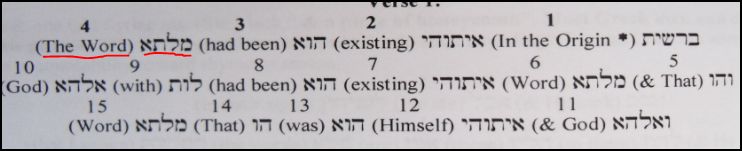
In the first verse of the Gospel of John, the word translated as ‘Word’ comes from the Aramaic ‘Miltha’.
Andrew Gabriel Roth – The Mystery of the Miltha
In the Beginning was the Miltha.
Now I suppose many of you reading this expected me to substitute “Word” for miltha in the English portion, even as many laymen and scholars alike have done so with logos in the Greek tradition. However, while miltha does mean “word”, its full depth cannot be adequately translated. As such, miltha is the first of what will be many Aramaic theological terms that can only be discussed through explanation and metaphor, as opposed to being given a strict dictionary definition. For now though, “Word” will do fine as a launching point while we sift through the poetic and grammatical challenges of the Sholiach/Apsotle Yochanan’s first statement. Put simply, every word in Hebrew, or Aramaic must be either masculine, or feminine, and this particular phrase reflects something very unusual that will become clear momentarily.
AYT HWT TAMIN ANTATHA DAYAT HWT LEH ROKHA DKORHHANA
There was a woman who was there who had a ruachof infirmity.
Luke 13:11
This is proper Aramaic grammar, with the female noun of woman (antatha) being joined with a female verb for was (hwt). So when it comes to nouns being linked to verbs, the gender for both parts of the sentence must match. Of course, this same principle works for the masculine gender as well:
HWA YOCHANAN BMADBARA MAIMAD WMKRAZ
Was Yochanan in the wilderness baptizing and preaching.
Mark 1:4 Again, the nouns and verbs match up, with the male noun (Yochanan) linked to the male verb form of was (hwa).
However, if we look again at the verse we are studying, an amazing pattern emerges as AYTOHI HWA MILTHA, or two masculine verbs linked to a feminine noun!
Therefore, Yochanan is breaking the rules of Aramaic grammar on purpose to make an extremely important poetic and spiritual point. Since there is no neuter like Greek (it, one) in either Hebrew, or Aramaic, there was no “official” way that Yochanan could express the totality of the gender of spirits from YHWH that rest on the Moshiach (Isaiah 11:1-3). Furthermore, the same is true of the fact that all aspects of Elohim were supposed to dwell bodily within him, as this verse from the apostle Paul shows.
Col 1:15 who is the image of the invisible God, the First-born of all creation.
Col 1:16 For all things were created in Him, the things in the heavens, and the things on the earth, the visible and the invisible; whether thrones, or lordships, or rulers, or authorities, all things have been created through Him and for Him.
Col 1:17 And He is before all things, and all things have subsisted in Him.
Col 1:18 And He is the Head of the body, the assembly, who is the Beginning, the First-born out of the dead, that He be preeminent in all things;
Col 1:19 because all the fullness was pleased to dwell in Him,
Subsequently, if Yochanan follows proper Aramaic grammar to depict either an all-male, or all-female construct, he will then leave out half of the powers and attributes that are supposed to dwell in Moshiach! As a result, Yochanan’s ultimate solution to this dilemma had to involve an “illegal” device that, while awkward, nonetheless
represents the only way to communicate this full unity by mating a female noun with two male verbs.
Another key reason why Yochanan chose miltha has to do with its unique root, which is amply demonstrated when Y’shua says:
Mat 13:35 so that was fulfilled that spoken through the prophet, saying: “I will open My mouth in parables; I will speak out things hidden from the foundation of the world.” Psa. 78:2
The near direct quotation of Psalm 78:2 in the above verse closely mirrors what is in the Masoretic Text, which uses the word mashal, for “parable”. However, a very good Aramaic equivalent of mashal is mithleh, and this is the word Y’shua uses in the Peshitta version of Matthew. So, as should be apparent by now, miltha and mithleh are nearly identical words derived from the same root, and where Matthew says secrets from before the creation of the world will be revealed by the Moshiach, Yochanan is making the exact same point here.
A last consideration in the mind of Yochanan must have been the depth of meaning in the word itself. Put simply, miltha is a term that has no direct equivalent in any other language, including Hebrew. Like the Tanakh usage of davar in Psalm 33:6 and the frequent targumic allusion to memra to avoid the anthropomorphizing of Deity, miltha has great power as a particle of divine speech. However, miltha has meanings not even hinted at in these other terms, and certainly not in the Greek logos. Over the centuries, miltha has been rendered as “force”, “manifestation”, “emanation”, “substance” as well as “word”, and even all these put together still don’t come close to approaching its totality, which is why its there in the first verse of this esoteric book!
Surely though it was also this very diversity that Yochanan wanted, since only a nearly infinite-meaning word can attempt to do justice to that which is infinite in the first place.”
The Word, Memra, Logos
The Scriptures, and ancient belief, indicate that the Word equates with the physical manifestation of the Most High in His creation. Whether it be the Torah, which is His “autobiography”, a physical manifestation of the Eternal or whether it be Jesus who is the Torah made flesh. The Word also refers to the voice of YHWH coming to the prophets as it is said numerous times in Scripture “the Word of the Lord” came to such and such a prophet and then they go and proclaim what He told them. Jesus said that no man has seen or heard the Father yet numerous times men and women saw and heard God in the Scriptures. The Word came to them. The Bible that we can open up and read is a gift that is beyond compare. It is the physical manifestation of the Most High…not literally, but the words themselves represent the heart of the Almighty. Everything in this universe is going to pass away but His Word will last forever. When we pick up a Bible, eternity is in our hands!
JESUS IS THE WORD MADE FLESH
Joh 1:1 In the beginning was the Word, and the Word was with God, and the Word was God.
Joh 1:2 The same was in the beginning with God.
Joh 1:3 All things were made by him; and without him was not any thing made that was made.
Joh 1:14 And the Word was made flesh, and dwelt among us, (and we beheld his glory, the glory as of the only begotten of the Father,) full of grace and truth.
Psa 33:6 By the word of the LORD were the heavens made; and all the host of them by the breath(Ruach) of his mouth.
1Jo 1:1 That which was from the beginning, which we have heard, which we have seen with our eyes, which we have looked upon, and our hands have handled, of the Word of life;
1Jo 1:2 (For the life was manifested, and we have seen it, and bear witness, and shew unto you that eternal life, which was with the Father, and was manifested unto us;)
Targum equates the Word with YHWH
Psa 84:5 Blessed is the man whose strength is in You; Your ways are in their hearts.
Targum 84:6. Happy the man who has his strength in your word; trust is in their hearts.
Psa 84:12 O YHWH of Hosts, blessed is the man who trusts in You!
Targum 84:13. O Lord Sabaoth, it is well for the son of man who trusts in your word
Psa 85:6 Will You give us life anew, so that Your people may rejoice in You?
Targum 85:7. Will you not again revive us? And your people will rejoice in your word.
Logos=Memra
Joh 1:1 In the beginning was the Word, and the Word was with God, and the Word was God.
G3056
λόγος
logos
λόγος=Memra in the Targum
Memra is used 596 times in reference to God. It is used throught the TaNaKH when the Scriptures refer to God revealing Himself in His creation or interacting with mankind.
Here are a few examples.
Genesis 1:27
And the Word of the Lord created man in His likeness, in the likeness of the presence of the Lord He created him, the male and his yoke-fellow He created them.
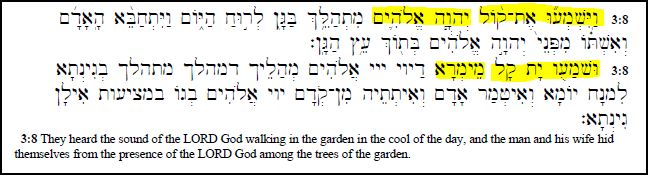
Genesis 3:8, “And they heard the voice of the LORD God walking in the garden”, the Targums replace the phrase “the LORD God” (יהוה אלהים-
YHWH Elohim) with מימרא (memra, spelled mymra or mimra).
Genesis 7:16
And they coming entered, male and female, of all flesh unto him, as the Lord had instructed him; and the Word of the Lord covered over the door of the ark upon the face thereof
Genesis 17:7…And I will establish my covenant between My Word and between you
Genesis 18:1-2
Therefore was there a word of prophecy from before the Lord unto Abraham the Just, and the Word of the Lord was revealed to him in the valley of vision; and he sat in the door of the tabernacle, comforting himself from his circumcision in the fervour (or strength) of the day.
Genesis 19:23-24
And the Word of YHWH caused to descend upon the peoples of Sodom and Gomorrah, brimstone and fire from the YHWH in heaven. (Targum Jonathan)
Exodus 3:14…And the Word of YHWH said to Moses: “I am He who said unto the world ‘Be!’ and it was: and who in the future shall say to it ‘Be!’ and it shall be.” And He said: “Thus you shall say to the children of Israel: ‘I Am’ has sent me to you.” (Jerusalem Targum)
Exodus 20
And the Lord spake all these words, saying: [JERUSALEM. And the Word of the Lord spake all the excellency of these words saying:]
Leviticus 26:12 And I will set the Shekinah of My Glory among you, and my Word shall not abhor you, but the Glory of My Shekinah shall dwell among you, and My Word shall be to you for a redeeming God, and you shall be unto My Name for a holy people (Targum Jonathan)
Numbers 10:35
JERUSALEM. It was when the ark went forward. Mosheh stood, with bands (outstretched) in prayer, and said, Arise now, O Word of the Lord, in the power of Thy might, and let the adversaries of Thy people be scattered, and make Thine enemies flee before Thee. But when the ark rested, Mosheh lifted his hands in prayer, and said, O Word of the Lord, turn from the strength of Thy anger, and return unto us in the goodness of Thy mercy, and bless the myriads and multiply the thousands of the children of Israel.
Isaiah 45:17, 25…But Israel shall be saved by the Word of YHWH with an everlasting salvation. By the Word of YHWH shall all the seed of Israel be justified. (Targum Jonathan)
Hosea 1:7…But I will have mercy upon the house of Judah, and I will save them by the Word of YHWH, their God. (Targum Jonathan)
Jewish teachers of the Apostle John’s era have ascribed six attributes to the memra. John assigned every attribute to Jesus in the first chapter of his gospel. The attributes are:
1. The memra is individual and yet the same as God (John 1:1-”and the Word was with God, and the Word was God”).
2. The memra was the instrument of creation (John 1:3-”All things were made by Him” and John 1:10-”the world was made by him”).
3. The memra was the instrument of salvation (John 1:12-”But as many as received him, to them gave he power to become the sons of God, even to them that believe on his name”).
4. The memra was the visible presence of God or Theophany (John 1:14-”And the Word was made flesh and dwelt among us”).
5. The memra was the covenant maker (John 1:17-”For the law was given by Moses, but grace and truth came by Jesus Christ”).
6. The memra was the revealer of God (John 1:18-”No man hath seen God at any time; the only begotten Son, which is in the bosom of the Father, he hath declared him”).
The early believers in Messiah understood this concept in the Targums.
“In the ancient Church liturgy, adopted from the Synagogue, it is especially interesting to notice how often the term Logos, (this is the Greek word for the memra) in the sense of ‘the Word by which God made the world, or made His Law or Himself known to man,’ was changed into ‘Christ.’ Possibly on account of the Christian dogma, rabbinic theology, outside of the Targum literature, made little use of the term ‘Memra.'”
The Jewish Encyclopedia, New York and London, 1904, p. 465.
the Catholic Encyclopedia:
“In Palestinian Rabbinism the Word (memra) is very often mentioned, at least in the Targums: it is the memra of Jahveh which lives, speaks, and acts, but, if one endeavour to determine precisely the meaning of the expression, it appears very often to be only a paraphrase substituted by the Targumist for the name of Jahveh. The memra resembles the Logos of Philo as little as the workings of the rabbinical mind in Palestine resembled the speculations of Alexandria: the rabbis are chiefiy concerned about ritual and observances; from religious scruples they dare not attribute to Jahveh actions such as the Sacred Books attribute to Him; it is enough for them to veil the Divine Majesty under an abstract paraphrase, the Word, the Glory, the Abode, and others. Philo’s problem was of the philosophic order; God and man are infinitely distant from each other, and it is necessary to establish between them relations of action and of prayer; the Logos is here the intermediary.”
Ancient Hebrew
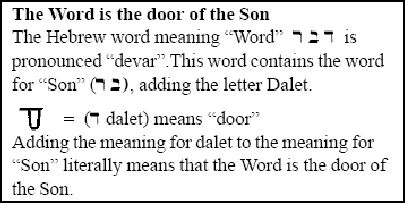
When looking at the ancient Hebrew pictographs for the word Davar which is translated as Word it points directly to Messiah Jesus .
Jewish Thought
Wisdom in Hebrew alphabet pg 47
The sum total of human knowledge derives from the Torah because the universe is a product of Torah which is the blueprint of the world, as the Midrash teaches: God looking into the Torah and created the world (Zohar, Ruth 88) When His Ineffable Word took physical form, heaven and earth became the clothing for the word of God which infuses Creation, and without which Creation would not continue to exist. The spiritual Torah which preceded the world became clothed in ink and parchment, and the Godly wisdom which is the essence of Torah remained hidden in its words and letters (Ramban)
With the advent of Creation, the wisdom of God took the form of the 613 commandments. But the precepts are not isolated phenomena; they are all interrelated aspects of a single Torah, like the organs and vessels of a single human body to which the totality of the commandments are likened. Indeed, the 613 commandments give spiritual life and nourishment to the organs and vessels of the individual human being just as they provide continued existence to all of Creation.
Even in Jewish thought the Torah is likened to the human body. The Word becoming flesh is not some mystical idea that the apostle John thought up but was something that Jewish people would have related to in his time.
Psa 138:2 I will worship toward thine holy Temple and praise thy Name, because of thy louing kindenesse and for thy trueth: for thou hast magnified thy Name aboue all things by thy word. (Geneva translation)
Messiah in the Torah – Genesis 1:1
click here
Messiah in the Torah – Genesis 1:2-5
click here
Messiah in the Torah – Genesis 1:6-8
click here
Messiah in the Torah – Genesis 1:9-13
click here
Messiah in the Torah – Genesis 1:14-19
click here
Messiah in the Torah – Genesis 1:20-23
click here
littleguyintheeye@gmail.com

 Little Guy in the Eye