

Aquila, the Eagle, is a powerful constellation that soars high across the heavens. In ancient star lore and Scripture, the eagle represents strength, swiftness, protection, and renewal — “they shall mount up with wings as eagles” (Isaiah 40:31).
In this tidbit we explore Aquila as part of the Gospel written in the stars: the eagle that bears up the wounded one (Altair), its connection to the four living creatures around God’s throne, and how it shadows Messiah — the One who was pierced yet rose exalted, carrying His people on eagles’ wings through the storms of life and into glory.
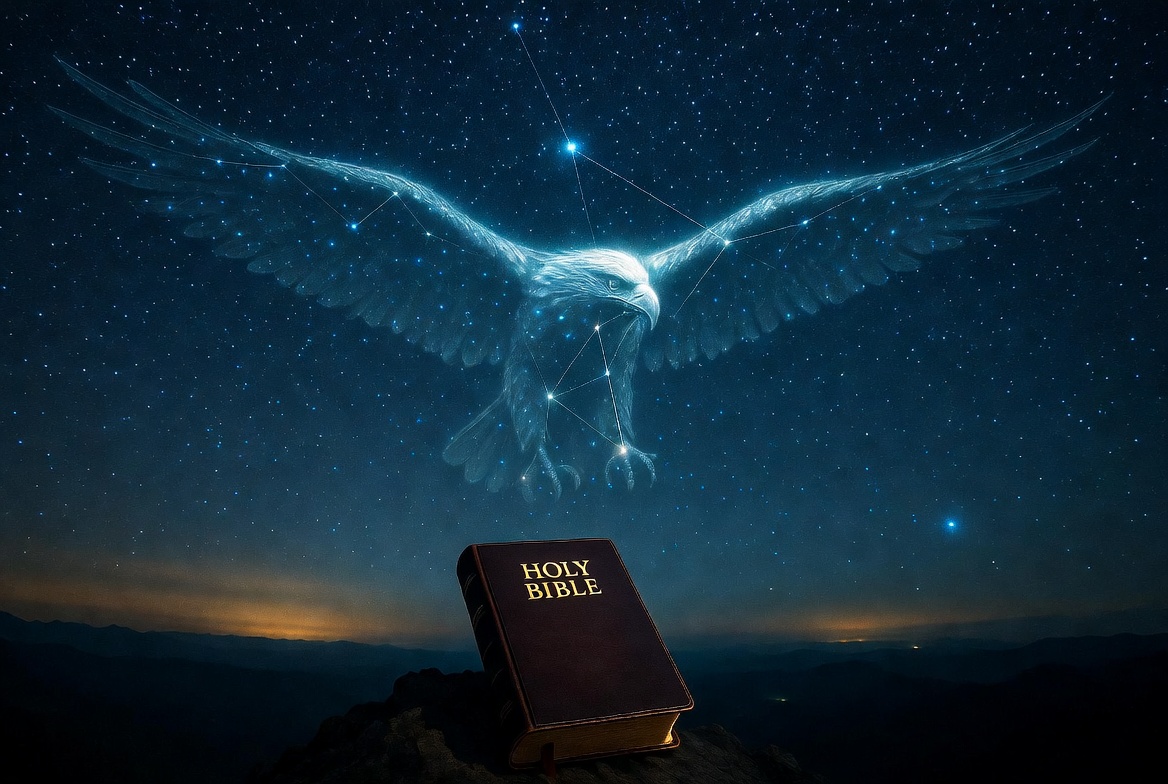
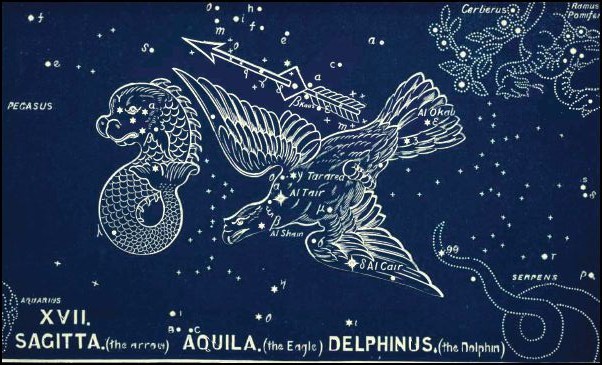
In the Biblical Mazzaroth the eagle is also seen in the decan constellation Aquila (Latin for eagle). Aquila represents the smitten one who is pierced with the arrow of God. Aquila is in the constellation of Capricornus, whose theme is about the sufferings of the Redeemer.
Psa 38:2 For Your arrows sink in me, and Your hand presses heavily on me.
The stars of Aquila tell the story of the wounded One.
The brighest star is in the neck of the eagle called ‘Al Tair’ which in Arabic means the wounding. Also in the throat is the star ‘Al Shain’ which in Arabic means ‘the bright’ tracing back to the Hebrew word שני ‘shani’ meaning ‘scarlet.’
Isa 1:18 Come now and let us reason together, says Jehovah: Though your sins are as scarlet, they shall be white as snow; though they are red as the crimson, they shall be like wool.
The ancient source of the color scarlet was from the תולע ‘tola’ worm. This word is used in reference to Messiah in the prophecy of His crucifixion in Psalm 22.
Psa 22:6 But I am a worm (תולע ‘tola’) , and no man; a reproach of mankind, and despised by the people.
In the back of the eagle is the star ‘Tarared’ which means wounded or torn.
Isa 53:5 But he was wounded for our transgressions, he was bruised for our iniquities: the chastisement of our peace was upon him; and with his stripes we are healed.
In the lower wing is the star ‘Alcair’ which means ‘the piercing’ and in the tail is the star ‘Al Okal’ which means ‘wounded in the heel.’
Psa 22:16 For dogs have compassed me: the assembly of the wicked have inclosed me: they pierced my hands and my feet.
Gen 3:15 And I will put enmity between you and the woman, and between your seed and her Seed; He will bruise your head, and you shall bruise His heel.
As seen in the previous tidbit on the eagle, the concept of abiding under the shadow of His Wings is associated with the eagle. The crucifixion of Messiah is also linked to this concept.
The Bosom, the Family and Gathering at the Cross
The word father in Hebrew is associated with love, so too is the word mother. אם ’em'(mother) is the source of the Latin ‘amare,’ the French ‘amitie’ and the English ‘amity’ which mean love. One of the Hebrew words for love is דד ‘dud/dad’ which means both love and breasts/bosom. Interestingly, the English word ‘baby’ comes from the Hebrew בבה ‘baba’ which is related to the word אבוב ‘aboob’ the root of which is אב ‘av’ which means father but also means a pipe, as in the breast of the mother whose milk flows to give sustenance to the baby. בבה ‘baba’ in Hebrew means the pupil, the apple of one’s eyes. As any parent has held their baby in their arms against their bosom they recognize this is the epitome of love and intimate relationship (apple of the eye/little guy in the eye).
The word family comes from משפחה ‘mispocha’ the same root as שפח ‘shapach’. שפח ‘shaphach’ is the source of the English word crucifixion which gathers all the family of the earth. The bosom, which represents the love of the family also links to the Messiah.
Messiah came from the bosom of the Father.
Joh 1:18 No one has seen God at any time; the only begotten Son, who is in the bosom of the Father, that One declares Him.
He gathers and then carries in His bosom His people, linking to the crucifixion. It is through the work of Messiah on the cross that mankind is brought into His family.
Isa 40:10 Behold, the Lord Jehovah will come with strength, and His arm rules for Him. Behold, His reward is with Him, and His wage before Him.
Isa 40:11 He shall feed His flock like a shepherd; He shall gather lambs with His arm; and carry them in His bosom; those with young He will lead;
Psa 89:50 Remember, O Lord, the reproach of Your servants, my bearing in my bosom the insults of the many peoples
Psa 89:51 with which Your enemies have cursed, O Jehovah; with which they have cursed the footsteps of Your anointed.
Eph 2:8 For by grace you are saved, through faith, and this not of yourselves; it is the gift (gift = love = bosom) of God;
Eph 2:9 not of works, that not anyone should boast;
Eph 2:10 for we are His workmanship, created in Christ Jesus unto good works, which God before prepared that we should walk in them.
Eph 2:11 Because of this, remember that you, the nations, were then in the flesh (those having been called Uncircumcision by those having been called Circumcision in the flesh made by hands)
Eph 2:12 that at that time you were without Christ, alienated from the commonwealth of Israel and strangers of the covenants of promise, having no hope and without God in the world.
Eph 2:13 But now, in Christ Jesus you who then were afar off, came to be near by the blood of Christ.
Eph 2:14 For He is our peace, He making us both one, and breaking down the middle wall of partition,
Eph 2:15 in His flesh causing to cease the enmity, the Law of the commandments in decrees, that He might in Himself create the two into one new man, making peace,
Eph 2:16 and might reconcile both in one body to God through the cross, slaying the enmity in Himself.
Eph 2:17 And coming, He proclaimed “peace to you, the ones afar off, and to the ones near.” Isa. 57:19
Eph 2:18 For through Him we both have access by one Spirit to the Father.
Eph 2:19 So, then, you are no longer strangers and tenants, but you are fellow citizens of the saints and of the family of God,
There are multiple words in Hebrew for love, all linking back to the bosom. The most common is אהב ‘ahav’ which has the meaning of a gift and the expressions and actions of one towards the family. The pictograph meaning displays the gift of the Father to mankind of His only begotten Son. Again linking the bosom, the family and the crucifixion.
Joh 3:16 For God so loved the world that He gave His only begotten Son, that everyone believing into Him should not perish, but have everlasting life.
Joh 15:13 Greater love than this has no one, that anyone should lay down his soul for his friends.

From the root:
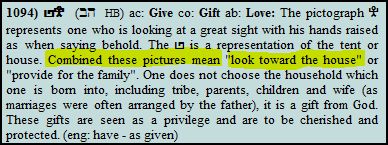
The Pictograph meaning of Love
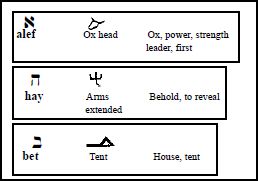
The first and last letters spell out the word for Father (אב ‘ab’) and the middle letter is a picture of a man with outstretched arms. The Love of the Father is revealed through the Messiah on the tree, gathering all mankind back to their Creator.
Recall that the word in Hebrew for pupil is בבה ‘baba’ which is the source of the English word ‘baby.’ Interestingly, the English word ‘shade’ comes from the Hebrew word שד ‘shad’ which means the breast/bosom. שד ‘shad’ is the root of the word שדי ‘shaddai’ which is translated as ‘the Almighty.’ שד ‘shad’ literally means to return to the door, again linking with the feasts and the Tabernacle mentioned above.
Finally, the word דוד ‘dod’ means love. דד ‘Dod’ literally means the breasts. The letter ‘dalet’ is the picture of a door, or flap of a tent which opens the way inside. The tabernacle consisted of two doors/veils which דד ‘dod’ displays. What is the veil of the Tabernacle a picture of? The body/flesh of Messiah.
Heb 10:20 which He consecrated for us, a new and living way through the veil; that is, His flesh;
The above portion of Scripture is in context of the New Covenant which was cut at Calvary where Messiah gathered mankind into His bosom (Isaiah 40:11; Psalm 89:50).
littleguyintheeye@gmail.com

 Little Guy in the Eye