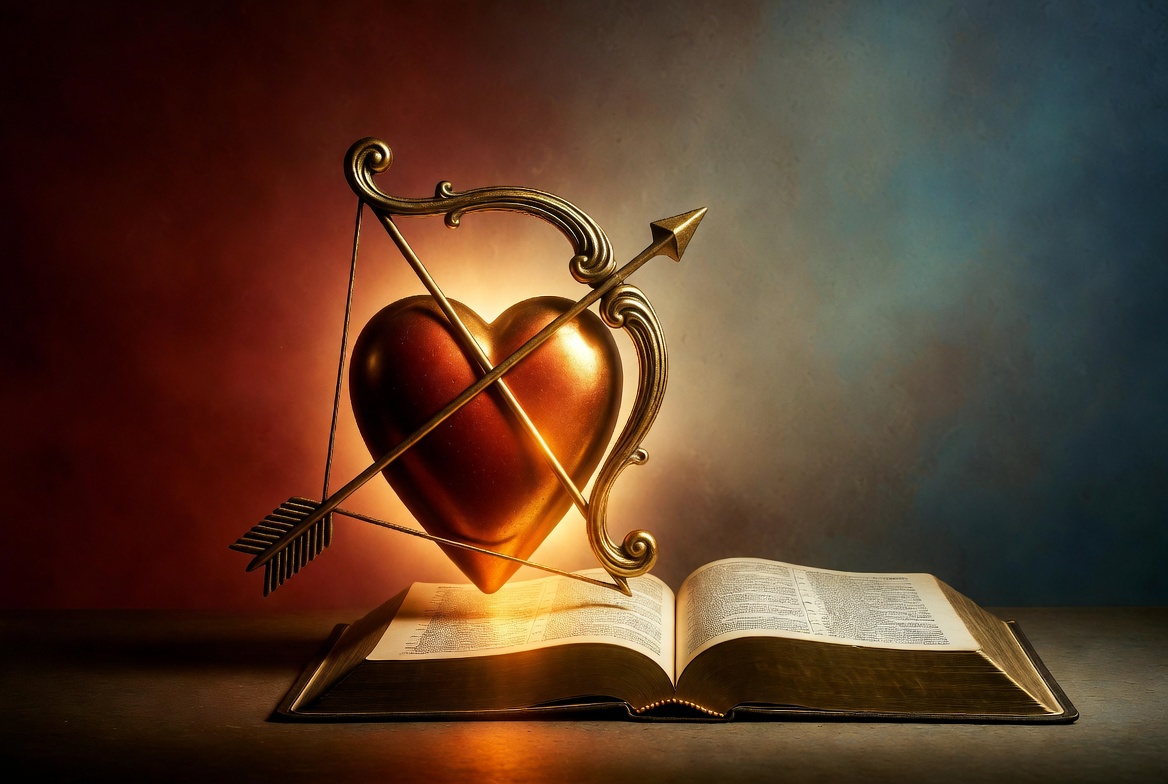

Cupid (from Latin cupido – desire) traces back to the Hebrew חפץ (chaphets) — the will and desire of God: that His Word (Messiah) would dwell in our hearts. The Greek Eros links to ארש (to betroth/seek a bride), pointing to the Messiah who seeks His Bride and delights to do the Father’s will. The true “Sacred Heart” is the throne of God within us — not pagan imitation, but the place where the Living Word reigns.
Cupid comes from the Latin word ‘cupido’ which means desire. ‘Cupido’ traces back further to the Hebrew word חפץ ‘chaphets’ which means will or desire. What is the will/desire of the Most High? For His Word to be in our hearts.
Psa 40:7 Then said I, Lo, I come: in the volume of the book it is written of me,
Psa 40:8 I delight to do thy will, O my God: yea, thy law is within my heart.
His Word is His Love. The counterfeit is the fleshly eroticism of cupid in the hearts of fleshly man. Interestingly, the root of the word תורה ‘torah’ is יר which has the meaning of an arrow being thrown.
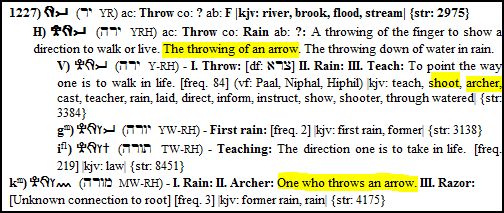
Cupid’s Greek name is Eros which means love. This word traces back to the Hebrew word ארש/ארס ‘eros’ which means to betroth, literally to request or seek a bride. This points to Messiah.
Psa 27:8 My heart said to You, Seek my face; Your face, O Jehovah, I will seek.
Eze 34:11 For so says the Lord Jehovah: Behold, I Myself will search for My sheep, and seek them out.
Desire – Heart connection
Another word for desire in Hebrew is אבה ‘aveh’ which comes from the root אב which means father.
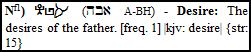
The English word desire, comes from the Old French ‘desirrer’, which means to wish, desire, long for. It’s original sense is linked to looking at the stars. Interestingly, this is also linked to אבה. As mentioned above, אב means father, and the letter ה means to behold or look at something. The pictograph of the letter ה is a man with outstretched arms, looking toward something. That thing, in ancient Hebrew culture, was the North star. This is what the nomads used for guidance and direction. When one looks at the North star what is seen?
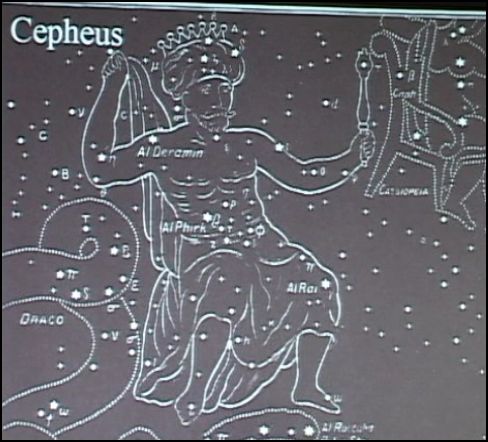
The constellation Cepheus (the enthroned king) is located directly above the North star in the night sky.
Desire is related to the English word ‘consider.’ Consider comes from the Old French ‘considerer’, which means to reflect on, study, consider. Literally, it is referring to ‘observing the stars.’
Connecting back to the book of Job. God asked the adversary if he had ‘considered’ Job.
Job 1:8 And Jehovah said to Satan, Have you set your heart (KJV consider) on My servant Job because there is none like him in the earth, a perfect and upright man, fearing God and turning away from evil?
This phrase in Hebrew is השמת לבך ‘hasamta leebcha.’ Consider is linked to the heart. Consider means to look upon, referring back to the throne seen above in the stars. The heart is also a picture of the throne of God. More on this below.
This is the desire of the Father
1Ti 2:3 For this is good and acceptable before God our Savior,
1Ti 2:4 who desires all men to be saved and to come to a full knowledge of truth.
Like Dionysusclick here , he was sometimes referred to as Eleutherios, “the liberator”. Again, this is a counterfeit of Messiah.
Joh 8:36 Therefore, if the Son sets you free, you are free indeed.
Cupid & the Heart
Two Babylons pg 169
In the Church of Rome a new kind of devotion has of late been largely introduced, in which the beads play an important part, and which shows what new and additional strides in the direction of the old Babylonian Paganism the Papacy every day is steadily making. I refer to the “Rosary of the Sacred Heart.” It is not very long since the worship of the “Sacred Heart” was first introduced; and now, everywhere it is the favourite worship. It was so in ancient Babylon, as is evident from the Babylonian system as it appeared in Egypt. There also a “Sacred Heart” was venerated. The “Heart” was one of the sacred symbols of Osiris when he was born again, and appeared as Harpocrates, or the infant divinity, * borne in the arms of his mother Isis.
* The name Harpocrates, as shown by Bunsen, signifies “Horus, the child.”
Therefore, the fruit of the Egyptian Persea was peculiarly sacred to him, from its resemblance to the “HUMAN HEART.” Hence this infant divinity was frequently represented with a heart, or the heart-shaped fruit of the Persea, in one of his hands (Fig. 40). The following extract, from John Bell’s criticism on the antiques in the Picture Gallery of Florence, will show that the boyish divinity had been represented elsewhere also in ancient times in the same manner. Speaking of a statue of Cupid, he says it is “a fair, full, fleshy, round boy, in fine and sportive action, tossing back a heart.” Thus the boy-god came to be regarded as the “god of the heart,” in other words, as Cupid, or the god of love. To identify this infant divinity, with his father “the mighty hunter,” he was equipped with “bow and arrows”; and in the hands of the poets, for the amusement of the profane vulgar, this sportive boy-god was celebrated as taking aim with his gold-tipped shafts at the hearts of mankind. His real character, however, as the above statement shows, and as we have seen reason already to conclude, was far higher and of a very different kind. He was the woman’s seed. Venus and her son Cupid, then, were none other than the Madonna and the child.
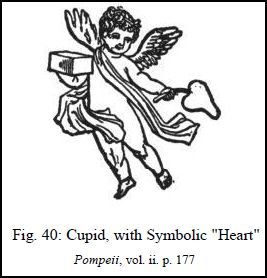
Looking at the subject in this light, the real force and meaning of the language will appear, which Virgil puts into the mouth of Venus, when addressing the youthful Cupid:–
“My son, my strength, whose mighty power alone
Controls the thunderer on his awful throne,
To thee thy much afflicted mother flies,
And on thy succour and thy faith relies.”
From what we have seen already as to the power and glory of the Goddess Mother being entirely built on the divine character attributed to her Son, the reader must see how exactly this is brought out, when the Son is called “THE STRENGTH” of his Mother. As the boy-god, whose symbol was the heart, was recognised as the god of childhood, this very satisfactorily accounts for one of the peculiar customs of the Romans. Kennett tells us, in his Antiquities, that the Roman youths, in their tender years, used to wear a golden ornament suspended from their necks, called bulla, which was hollow, and heart-shaped.
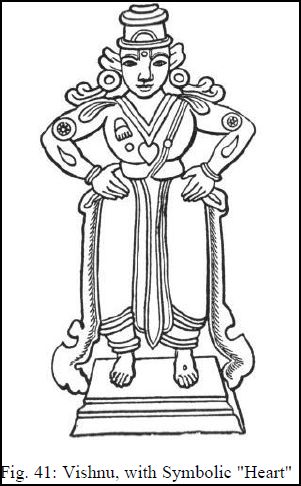
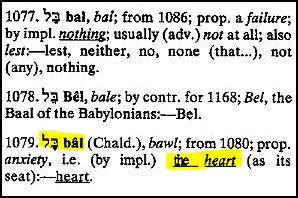
The veneration of the “sacred heart” seems also to have extended to India, for there Vishnu, the Mediatorial god, in one of his forms, with the mark of the wound in his foot, in consequence of which he died, and for which such lamentation is annually made, is represented as wearing a heart suspended on his breast (Fig. 41). It is asked, How came it that the “Heart” became the recognised symbol of the Child of the great Mother? The answer is, “The Heart” in Chaldee is “BEL”; and as, at first, after the check given to idolatry, almost all the most important elements of the Chaldean system were introduced under a veil, so under that veil they continued to be shrouded from the gaze of the uninitiated, after the first reason–the reason of fear–had long ceased to operate. Now, the worship of the “Sacred Heart” was just, under a symbol, the worship of the “Sacred Bel,” that mighty one of Babylon, who had died a martyr for idolatry; for Harpocrates, or Horus, the infant god, was regarded as Bel, born again.
That this was in very deed the case, the following extract from Taylor, in one of his notes to his translation of the Orphic Hymns, will show. “While Bacchus,” says he, was “beholding himself” with admiration “in a mirror, he was miserably torn to pieces by the Titans, who, not content with this cruelty, first boiled his members in water, and afterwards roasted them in the fire; but while they were tasting his flesh thus dressed, Jupiter, excited by the steam, and perceiving the cruelty of the deed, hurled his thunder at the Titans, but committed his members to Apollo, the brother of Bacchus, that they might be properly interred. And this being performed, Dionysius [i.e., Bacchus], (whose HEART, during his laceration, was snatched away by Minerva and preserved) by a new REGENERATION, again emerged, and he being eestored to his pristine life and integrity, afterwards filled up the number of the gods.” This surely shows, in a striking light, the peculiar sacredness of the heart of Bacchus; and that the regeneration of his heart has the very meaning I have attached to it–viz., the new birth or new incarnation of Nimrod or Bel*.
*The heart is another representation of the ivy leaf symbol of Bacchus which is connected to the mark of the beastclick here. Ultimately, regeneration without Messiah is what the mark of the beast is all about. Eating from the tree of knowledge in order to become like the gods.
When Bel, however was born again as a child, he was, as we have seen, represented as an incarnation of the sun. Therefore, to indicate his connection with the fiery and burning sun, the “sacred heart” was frequently represented as a “heart of flame.” So the “Sacred Heart” of Rome is actually worshipped as a flaming heart, as may be seen on the rosaries devoted to that worship. Of what use, then, is it to say that the “Sacred Heart” which Rome worships is called by the name of “Jesus,” when not only is the devotion given to a material image borrowed from the worship of the Babylonian Antichrist, but when the attributes ascribed to that “Jesus” are not the attributes of the living and loving Saviour, but the genuine attributes of the ancient Moloch or Bel?
Ivy & heart connection
Ivy & the heart are symbols which point to the mark of the beast click here.
Two Babylons pg 133
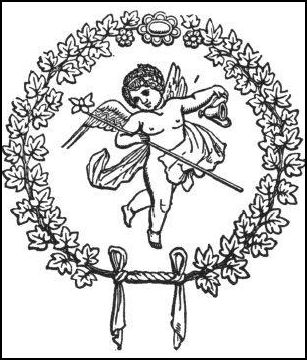
Fig. 35: Cupid with Wine-Cup and Ivy Garland of Bacchus
From Pompeii, vol. ii. p. 150.
The reader will remember that Jupiter, as “Jupiter puer,” or “Jupiter the boy,” was worshipped in the arms of the goddess Fortuna, just as Ninus was worshipped in the arms of the Babylonian goddess, or Horus in the arms of Isis (see Ch. II, Section II). Moreover, Cupid, who, as being the son of Jupiter, is Vejovis – that is, as we learn from Ovid (vol. iii. p. 179, in a Note to Fasti, lib. iii. v. 408), “Young Jupiter” – is represented, as in the above cut, not only with the wine-cup of Bacchus, but with the Ivy garland, the distinctive mark of the same divinity, around him.
The heart represents the throne of God. The Temple of God was a representation of the human body, where the human heart corresponds to the ark of the covenant.
In the book of Revelation (Chapter 4) John is shown a vision of the Throne of God. Around the throne and the 4 living creatures are 24 elders (Revelation 4:4) representing the 24 ribs surrounding the human heart. From the heart blood is pumped to the Lungs. As seen in Genesis 1:2-5click here , the etymology of the English word ‘Lung’ traces back to the meaning of Light. In our bodies our lungs have 7 vascular bundles called nodes. These represent the 7 Spirits of God (Revelation 4:5; Isaiah 11:1-3). These 7 Spirits/Ruach/Breathe are pictured in the earthly Tabernacle/Temple by the Menorah. The Menorah is a picture of the Tree of Life. The Light of the world.
Rev 4:5 And out of the throne come forth lightnings and thunders and voices. And seven lamps of fire are burning before the throne, which are the seven Spirits of God;
This is where the man of sin seeks to be enthroned (2 Thessalonians 2:4).
Tree of Life vs the Tree of knowledge
The ivy symbol points to the tree of knowledge which is a counterfeit of the tree of life. Messiah is the vine we are the branches…this points back to the Menorah, a picture of the body of Messiah. Hence, the ivy symbol is a picture of the antichrist and his body where he desires to sit in the temple of God (1 Corinthians 6:19).
Which mark will man take? Which arrow will he receive in his heart? It depends upon which fruit he desires, the fruit from the Tree of Life or the fruit from the tree of knowledge. The Will of the Father, or the will of manclick here.
littleguyintheeye@gmail.com

 Little Guy in the Eye