
Love is not a feeling we invented. The English word itself comes from לוה (lavah) — to join, to be attached. That is why Leah named her son Levi. “Now my husband will be joined to me.” Law comes from the same place. Levi handled the Law. The Law of truth was in his mouth. Obey is bound to אהבה ‘ahavah,’ the Hebrew word for love. Scripture declares “if you love Me, keep My commandments.”
God is love. Dad comes from דד — the bosom. The Father showed us what the word means when He gave His Son, who came from that bosom. אהבה means to give. Greater love has no man than this. Look at the letters of אהב. The first and the last spell Father. In the middle is a man with his arms stretched out. That is Calvary. That is how He joins us. חשק is the same story — knit together, the bands of the Tabernacle, nails holding one house. He writes the Word on the heart He has taken into His bosom.
The English word ‘love‘ comes from the Hebrew word לוה ‘lavah.’ לוה ‘lavah’ is the source of the name לוי Levi which can be seen in Genesis 29:34:
Gen 29:34 And she conceived again and bore a son. And she said, Now, this time my husband will be joined (לוה )to me, because I have borne to him three sons. So his name was called Levi (לוי ).
The English word ‘law‘ also traces back to this Hebrew word which is interesting to note as the tribe of Levi were the handlers of the law.
Mal 2:4 And you shall know that I have sent this command to you, to be My covenant with Levi, says Jehovah of Hosts.
Mal 2:5 My covenant with him was life and peace, and I gave them to him for fear; and he feared Me, and he is put in awe before My name.
Mal 2:6 The Law of truth was in his mouth, and iniquity was not found in his lips. In peace and in uprightness he walked with Me, and he turned many from iniquity.
Mal 2:7 For the lips of the priest should guard knowledge, and they should seek the Law from his mouth; for he is the messenger of Jehovah of Hosts.
Further linking the Law and Love is the English word ‘obey.’ ‘Obey’ comes from the Hebrew word אבה ‘avah’ which is linked to the Hebrew word for love, אהבה ‘ahavah.’ (Psalm 81:12)
The Scriptures define love as obeying His Law.
The Greatest Commandment
Mat 22:35 Then one of them, which was a lawyer, asked him a question, tempting him, and saying,
Mat 22:36 Master, which is the great commandment in the law?
Mat 22:37 Jesus said unto him, Thou shalt love the Lord thy God with all thy heart, and with all thy soul, and with all thy mind.
Mat 22:38 This is the first and great commandment.
Mat 22:39 And the second is like unto it, Thou shalt love thy neighbour as thyself.
Mat 22:40 On these two commandments hang all the law and the prophets.
Deu 6:4 Hear, O Israel: The LORD our God is one LORD:
Deu 6:5 And thou shalt love the LORD thy God with all thine heart, and with all thy soul, and with all thy might.
Lev 19:18 Thou shalt not avenge, nor bear any grudge against the children of thy people, but thou shalt love thy neighbour as thyself: I am the LORD.
Keeping the commandments is love
Exo 20:6 And shewing mercy unto thousands of them that love me, and keep my commandments.
Deu 5:10 And shewing mercy unto thousands of them that love me and keep my commandments.
Deu 7:9 Know therefore that the LORD thy God, he is God, the faithful God, which keepeth covenant and mercy with them that love him and keep his commandments to a thousand generations;
Dan 9:4 And I prayed unto the LORD my God, and made my confession, and said, O Lord, the great and dreadful God, keeping the covenant and mercy to them that love him, and to them that keep his commandments;
Joh 14:15 If ye love me, keep my commandments.
Joh 14:21 He that hath my commandments, and keepeth them, he it is that loveth me: and he that loveth me shall be loved of my Father, and I will love him, and will manifest myself to him.
Joh 15:10 If ye keep my commandments, ye shall abide in my love; even as I have kept my Father’s commandments, and abide in his love.
1Jo 2:4 He that saith, I know him, and keepeth not his commandments, is a liar, and the truth is not in him.
1Jo 5:2 By this we know that we love the children of God, when we love God, and keep his commandments.
1Jo 5:3 For this is the love of God, that we keep his commandments: and his commandments are not grievous.
2Jo 1:6 And this is love, that we walk after his commandments. This is the commandment, That, as ye have heard from the beginning, ye should walk in it.
God is Love/Word
1Jn 4:8 The one who does not love has not known God, because God is love.
1Jn 4:16 And we have known and have believed the love which God has in us. God is love, and the one abiding in love abides in God, and God in him.
Exo 34:6 And Jehovah passed by before his face and called out: Jehovah! Jehovah God! Merciful and gracious, slow to anger, and great in goodness and truth,
Exo 34:7 keeping mercy for thousands, forgiving iniquity and transgression and sin, and not leaving entirely unpunished, visiting the iniquity of fathers on sons, and on sons of sons, to the third and to the fourth generation.
1Jn 4:10 In this is love, not that we loved God, but that He loved us, and sent His Son to be a propitiation relating to our sins.
1Jn 4:11 Beloved, if God so loved us, we also ought to love one another.
1Jn 4:12 No one has seen God at any time. If we love one another, God abides in us, and His love having been perfected is in us.
1Jn 4:13 By this we know that we abide in Him, and He in us, because of His Spirit He has given to us.
1Jn 4:14 And we have beheld and bear witness that the Father has sent the Son as Savior of the world.
1Jn 4:15 Whoever confesses that Jesus is the Son of God, God abides in him, and he in God.
1Jn 4:16 And we have known and have believed the love which God has in us. God is love, and the one abiding in love abides in God, and God in him.
1Jn 4:17 By this, love has been perfected with us, that we have confidence in the day of judgment, that as He is, we are also in this world.
1Jn 4:18 There is no fear in love, but perfect love casts out fear, because fear has punishment; and the one fearing has not been perfected in love.
1Jn 4:19 We love Him because He first loved us.
1Jn 4:20 If anyone says, I love God, and hates his brother, he is a liar. For the one not loving his brother whom he has seen, how is he able to love God whom he has not seen?
1Jn 4:21 And we have this commandment from Him, that the one who loves God also loves his brother.
This is interesting to note as love is linked to the Father. The English word for ‘dad’ comes from the Hebrew word דד ‘dad’ which means beloved, literally the bosom.
The Father revealed what true love is when He gave His only begotten Son, who came from His bosom (John 1:18), as an atonement for the sins of mankind. The most common Hebrew word for love אהבה ‘ahavah,’ literally means to give.
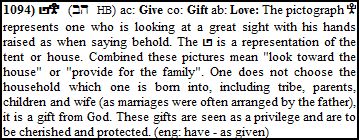

What is the ultimate definition of love? Giving one’s life for another
Joh 3:16 For God so loved the world that He gave His only begotten Son, that everyone believing into Him should not perish, but have everlasting life.
Joh 15:13 Greater love than this has no one, that anyone should lay down his soul for his friends.
The pictograph meaning of אהב ‘ahav’ displays this concept even further.
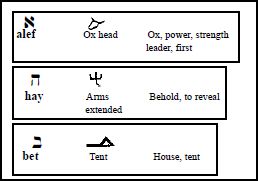
The first and last letters spell out the word for Father (אב ‘av’) and the middle letter is a picture of a man with outstretched arms. The Love of the Father is revealed through the Messiah on the tree, gathering all mankind back to their Creator.
As mentioned above, the English word for love traces back to the Hebrew word לוה ‘lavah’ which means to attach to something. Not surprisingly, a second Hebrew word for love, חשק ‘chashaq,’ means to be attached.
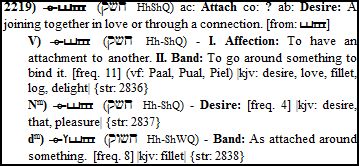
Exo 38:28 And the thousand, seven hundred and seventy five shekels he made into hooks for the pillars; and he overlaid their capitals and joined (חשק ‘chashaq‘) them.
Exo 38:17 And the sockets for the pillars were bronze, the hooks of the pillars and their bands of silver. And the overlaying of their capitals were silver; and all the pillars of the court were banded with silver.
Exo 38:28 And the thousand, seven hundred and seventy five shekels he made into hooks for the pillars; and he overlaid their capitals and joined them.
Deu 7:7 Jehovah did not set His love on you or choose you because you were more in number than any people, for you were the fewest of all peoples.
Psa 91:14 Because He has set His love on Me, therefore I will deliver Him; I will set Him on high because He has known My name.
Col 2:2 that their hearts may be comforted, being joined together in love, and to all riches of the full assurance of the understanding, to the full knowledge of the mystery of God, even of the Father and of Christ,
Col 2:19 and not holding fast the Head, from whom all the body having been supplied through the joints and bands, and being joined together, will grow with the growth of God.
חשק ‘chashaq’ comes from the root word חש ‘chash’ which points to the bosom, the breastplate in Hebrew is חשן ‘choshen.’ חשק ‘chashaq’ is the word used in reference to the joining together of the Tabernacle, which is a shadow picture of the body of Messiah. It is no surprise that this joining together involved nails, just as in the nails used in the crucifixion (Exodus 38:17, 28; Deuteronomy 7:7; Colossians 2:2, 19; Ephesians 4:15-16).
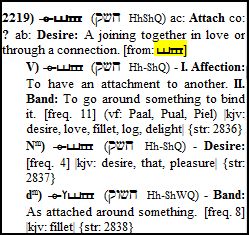
חשק ‘Chashaq’ also can be traced back to the word חק ‘choq’
H2436
חוק / חק / חיק
chêyq / chêq / chôq
BDB Definition:
1) bosom, hollow, bottom, midst
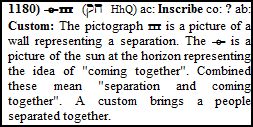
חק ‘chuq’ is the root of חקק ‘chaqaq’ and חקה ‘chuqah’ which means to inscribe a decree or custom. It is used in reference to the Torah. It is no surprise that the New Covenant, cut at Calvary is associated with the inscribing of the Word on our hearts which is contained in our bosoms (Jeremiah 31:31).
Related articles:
Daily Tidbits 2/18 – Love & the 4th Dimension
Hebrew Origins of English – Love
Hebrew Roots of Christian Holidays – Love Bears All Things
Related Studies:
Musings – The Father’s Love Letter
Daily Tidbits 2/18 – Love & the 4th Dimension
Hebrew Origins of English – Love
littleguyintheeye@gmail.com