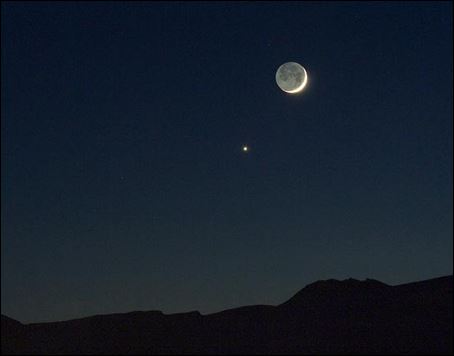
The Hebrew word for Venus is נגה ‘nagah ‘which means to shine and is the source of the Latin word ‘ignis’ which means to ignite or fire, which connects to the East. The word ‘East’ comes from the Hebrew word אש ‘esh’ which means fire. Venus is known as the morning star from its appearing in the eastern sky just before sunrise.
Each day when the sun rises it is a picture of the resurrection (Malachi 4:2). In Hebrew the word for dawn is שחר ‘shachar’ from the root שח ‘shach’ which means the pit. When the sun sets it is a picture of death/going into the pit, when it arises it is a picture of resurrection.
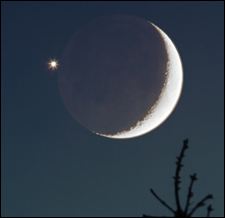
Venus is the bright and morning star.
Isaac Mozeson traces the Etymology of Venus back to the Hebrew word לבן ‘lavan’ which means white or shining. White is associated with beauty and pureness as well as the resurrection of the righteous. לבן ‘lavan’ is also the Hebrew word for the moon. It is no surprise then that Venus/Ishtar is pictured with moon iconography.
Who is the true bright and morning star? Jesus.
Rev 22:16 I, Jesus, sent My angel to testify these things to you over the assemblies. I am the Root and Offspring of David, the bright and morning Star.
The Greek word for morning is ὀρθρινός ‘orthrinos’ which is used in the Septuagint to translate the Hebrew word שכם ‘shakam’ which means the shoulder, but also to arise early (Genesis 22:3). This word is also linked to the resurrection.
Isa 22:22 And the key of the house of David I will lay on his shoulder, so that he opens, and no one shuts; and he shuts, and no one opens.
Rev 3:7 And to the angel of the assembly in Philadelphia, write: These things says the Holy One, the True One, the One having “the key of David,” “the One opening, and no one shuts; and shuts, and no one opens:” Isa. 22:22
Luk 1:78 Through the tender mercy of our God; whereby the dayspring from on high hath visited us,
Luk 1:79 To give light to them that sit in darkness and in the shadow of death, to guide our feet into the way of peace.
Luk 1:80 And the child grew, and waxed strong in spirit, and was in the deserts till the day of his shewing unto Israel.
In Luke 1:78 the dayspring/daystar is translated from the Greek word ἀνατολή ‘anatolē’which also is translated as East (Matthew 2:1-2,9; 8:11; 24:24; Luke 13:29; Revelation 7:2; 21:12-13)
ἀνατολή ‘anatolē’ is also used in the Septuagint to translate the Hebrew words מזרח ‘mizrach’ and קדם ‘qedem’ which mean the rising sun in the East as well as נגה ‘nogah’ which means shining and also is the Hebrew word for Venus. Interestingly, ἀνατολή ‘anatole’ is also used to translate the Hebrew word צמח ‘tsemach’ which means a branch, used specifically in reference to Messiah.
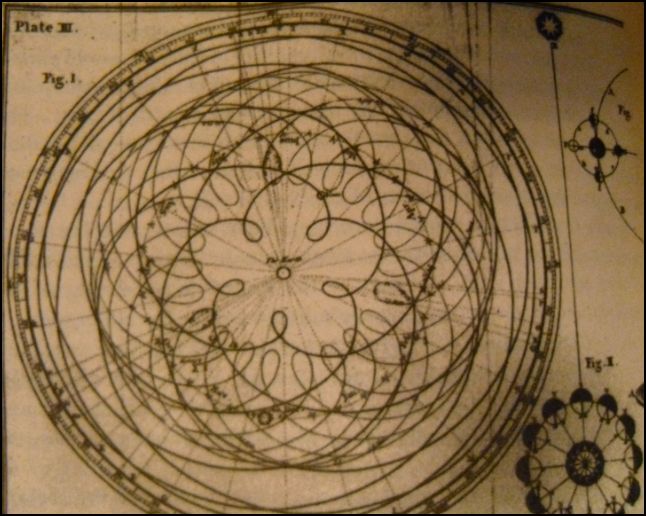
It is interesting to note that the BRANCH is used 5 times in Scripture {Isaiah 4:2; Jeremiah 23:5-6; 33:15-16; Zechariah 3:8-10; 6:12-13}. Venus is linked to the number five as its rotation through the skies makes a pentagon shape.
From a fixed location over an eight year period (8 is the number of resurrection), the planet Venus travels a unique celestial pathway that exactly portrays a pentagram.
“As the orbi of Venus is closer to the sun than the earth’s position, she is never seen more than 48 degrees from the sun. During a period of 247 days, Venus is visible as the Evening star that is, withing 48 degrees or less of the sun after the sun has set. Then Venus comes too close to the sun for us to see her. She remains invisible for 14 days, then reappears as the Morning star (or Eastern star) immediately before the sun rises in the east….Only Venus possesses the five-pointed star sign.” {Carl Ljungman- Dictionary of Symbols}
The Greek word for five is πέντε ‘pente’ from whence comes the word pentagram. The pentagram mathematically depicts the Fibonacci pattern.

http://goldennumber.net/five%285%29.htm
“The number 5 is intrinsically related to Phi and the Fibonacci series
Phi can be derived from several formulas based on the number 5. The most traditional, based on the geometric construction of phi is this:
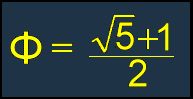
This formula for phi can also be expressed all in fives as:

And, as pointed out by W. Nathan Saunders, the terms in above representation of phi can be expressed in yet another way that involves four 5′s:

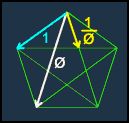
Phi appears in the geometry of the 5-sided pentagon
Take a pentagon with 5 equal sides and connect all the points to form a 5-pointed star. The ratios of the lengths of the resulting line segments are all based on phi.
5 is the 5th Fibonacci number
5 is also the 5th of the Fibonacci numbers, including 0, 1, 2, 3, and 5.
5 appears in the human body, which has proportions based on phi
Another interesting aspect of phi and five is in relation to the design of the human body, which in addition to being based on phi relationships in its proportions, has:
* 5 appendages from the torso, in the two arms, two legs and a head,
* 5 appendages on each of legs and arms in the five fingers and five toes,
* 5 openings on the face, and
* 5 senses in sight, sound, touch, taste and smell.
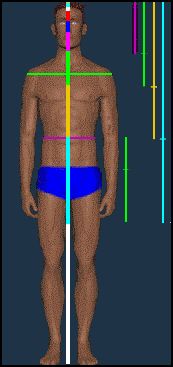
The Divine Proportion in the Body
The white line is the body’s height.
The blue line, a golden section of the white line, defines the distance from the head to the finger tips.
The yellow line, a golden section of the blue line, defines the distance from the head to the navel and the elbows.
The green line, a golden section of the yellow line, defines the distance from the head to the pectorals and inside top of the arms, the width of the shoulders, the length of the forearm and the shin bone.
The magenta line, a golden section of the green line, defines the distance from the head to the base of the skull and the width of the abdomen. The sectioned portions of the magenta line determine the position of the nose and the hairline.
Although not shown, the golden section of the magenta line (also the short section of the green line) defines the width of the head and half the width of the chest and the hips.”
The Human face, ears, and teeth are based upon Phi
The human hand and foot are based on Phi
The human heartbeat is based upon Phi
Gen 2:22 And YHWH God formed the rib which He had taken from the man into a woman, and brought her to the man.
Gen 2:23 And the man said, This now at last is bone from my bones, and flesh from my flesh. For this shall be called Woman, because this has been taken out of man.
Gen 2:24 Therefore, a man shall leave his father and his mother, and shall cleave to his wife and they shall become one flesh
Eph 5:31 “For this, a man shall leave his father and mother, and shall be joined to his wife, and the two shall be one flesh.” Gen. 2:24
Eph 5:32 The mystery is great, but I speak as to Christ and as to the assembly.
חמשׁ ‘chamesh’ is used to translate multiple terms in Hebrew. It is used for the number five/fifty, the hand, to be armed and the side of the body (fifth rib).
The ‘fifth rib’
H2570
חמשׁ
chômesh
This word is used in the following verses: 2Samuel 2:23; 3:27; 4:6; 20:10
Messiah was wounded in the side (‘the fifth rib’).
Joh 19:34 But one of the soldiers pierced His side with a lance, and at once blood and water came out.
Adam’s bride came forth from his rib/side (Genesis 2:22) which is a picture of Messiah’s bride ‘coming forth’ when He offered Himself as an atonement to bring us back to God. Interestingly, the year of Jubilee, which occurs every 50 (chamashim) years (Leviticus 25:10-13) began on the Day of Atonement. The great trumpet (Isaiah 27:13) will be blown and those resurrected in the 1st resurrection will receive their inheritance in the land. This is interesting because the shofar is in the Fibonacci sequence which the pattern the Most High uses in His creation of life. The Fibonacci sequence is encoded with the number 5.
Morning & Evening
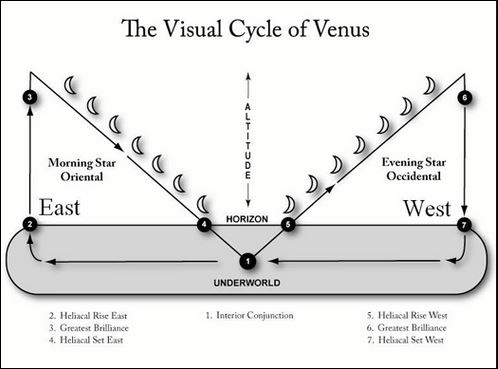
For millennia, people have enjoyed the sight of the “evening star” shining brightly in the western sky shortly after sunset. Outshining all other stars, this remarkable beacon seems to brighten to unbelievable glory as twilight fades to night. It rises higher night after night and then stops and begins to sink lower each evening until it vanishes below the horizon. Sometime later, it reappears just before sunrise in the eastern sky as the bright “morning star.” {The Solar System: Venus – Jason Lisle}
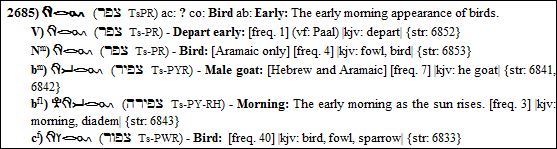
The word for ‘spiral’ (as in Fibonacci spiral) traces back to the Latin word ‘spira’ which means a spiral or coil which comes from the Greek word ‘speira’ which traces further back to the Hebrew word צפירה ‘tsephiyrah’ which has the meaning of the morning sunrise as well as the turning of a wreath. צפירה ‘tsephiyrah’ comes from the root word צפר ‘tsaphar’ which means a bird, in particular the song of the birds in the morning.
There are numerous words in Hebrew for birds and the different types thereof, the most common is צפר ‘tsaphar’ which is referring to the early morning appearance of birds.
Morning is a time of praise (הלל ‘halel’). This is interesting to note as Scripture speaks of Venus as Helel {הילל ‘Heylel’} the “son of the morning” {שחר ‘shachar’}.
This word הילל ‘Heylel’ is translated as Lucifer in the Latin Vulgate. The only other place Lucifer is seen in the Vulgate is in 2 Peter 1:19, speaking of the day star, the Messiah. Lucifer/satan is a counterfeiter which is seen in the Mystery religion symbology of the planet Venus and pentagram symbol.
2Pe_1:19 et habemus firmiorem propheticum sermonem cui bene facitis adtendentes quasi lucernae lucenti in caliginoso loco donec dies inlucescat et lucifer oriatur in cordibus vestris
בן שחר ‘ben shachar’ – son of the morning
Psa 108:2 Awake, harp and lyre! I will awake early {שחר ‘shachar’– dawn}
This is the period of time that the sun is at the horizon, the time when birds sing their songs of praise to their Creator. At evening, when the sun is at the horizon again, the birds sing their songs as well.
Psa 65:8 They also that dwell in the uttermost parts are afraid at thy tokens: thou makest the outgoings of the morning and evening to rejoice.
The morning and evening is a period of time when light and darkness are separating. This points back to Genesis 1:2-5. It is no surprise then that birds are intimately linked to this time. The Spirit of God hovering over the waters in the beginning is likened to a bird hovering over her brood. The Spirit of God hovering over the waters is also connected to the Voice of God over the waters which brought forth light from darkness. It is interesting to note that the numerical value of “voice of God” {קול יהוה ‘qol YHWH’} is 182, which is the mathematical value of the Fibonacci pattern.
The English word ‘sound,’ which began at this time, comes from the Old English word ‘swan’ meaning a sounding bird.
Morning and evening our Creator is calling us to Him. Calling us to the shadow of His wings. Calling us back to Him through the Messiah under His outstretched arms.
The meaning of ὁρίζω ‘horizo’ is linked with the above definition of ‘mark.’ It means to mark out a boundary. The English word horizon comes from this Greek word.

This word obviously links to the sun as it is the horizon where the sun rises and sets. It further linked to ‘predestination’ as we are chosen before the foundation of the world (Ephesians 1:4). In Hebrew this is the concept of עלם ‘olam’ which is usually translated as forever or eternity but in concrete thought means ‘beyond the horizon.’
The word for time in Hebrew, עת ‘et,’ means to ‘see the mark.’
What is this ‘mark’? It is the sun setting (death) and rising (resurrection) above the horizon.
It is no surprise then that the pentagram symbol is linked to the mark of the beast.
Beauty
Venus got its name from the Roman goddess of the same name, the goddess of love and beauty. It is interesting to note that the Fibonacci pattern is intimately linked to beauty.
“Beauty is in the phi of the beholder.”
“It has long been said that beauty is in the eye of the beholder and thought that beauty varies by race, culture or era. The evidence, however, shows that our perception of physical beauty is hard wired into our being and based on how closely one’s features reflect phi in their proportions. The Golden Ratio appears extensively in the human face, as demonstrated in a 2009 university study on attractiveness and as illustrated by the video below of Florence Colgate, Britain’s “Most Perfect Face” of 2012,”
“Dr. Stephen Marquardt has studied human beauty for years in his practice of oral and maxillofacial surgery. Dr. Marquardt performed cross-cultural surveys on beauty and found that all groups had the same perceptions of facial beauty. He also analyzed the human face from ancient times to the modern day. Through his research, he discovered that beauty is not only related to phi, but can be defined for both genders and for all races, cultures and eras with the beauty mask which he developed and patented. This mask uses the pentagon and decagon as its foundation, which embody phi in all their dimensions.”
Love, grace and beauty are linked to the Fibonacci pattern.
Psa 135:3 Praise the LORD; for the LORD is good: sing praises unto his name; for it is pleasant {נעים ‘naiym’ beautiful}.
5 is the number of grace, it is the 5th Fibonacci number.
The 6th Fibonacci number is 8 which links to the planet Venus which follows an 8 year cycle forming a pentagram.
13 is the numerical value of אהבה ‘ahavah’ (love), 13 is the 7th Fibonacci number.
The 8th Fibonacci number is 21 which is equal to the Hebrew word יטב ‘yatav’ which means good or beautiful.
נעים ‘naiym’ means sweet, pleasant or beautiful. נעים ‘naiym’ is used in reference to the name of God in Psalm 135:3. Scripture equates His Name with His Word (Revelation 19:13). God (and His Word which reveals His character) is love (1 John 4:8, 16). Creation is a reflection of God’s Word and His love. The beauty found in nature points to His Word/love.
The Oracles/Word of God is to be in our mouth (1 Peter 4:11) which are beautiful (Psalm 19:10; 119:103; 135:3).
YHWH is the Great Artist, the Maker of all things. The English word ‘artist’ comes form the Hebrew word יצר ‘yatsar’ which means to create or form, as a potter molding clay. YHWH is the Former/Maker of all things (Jeremiah 10:16; 51:19).
In Greek, the word for make or workmanship is ποίημα ‘poiēma’ which is the source of our English word ‘poem’ (Romans 1:20, 23; Ephesians 2:10). YHWH is the Great Artist, He is the Great Poet. He created man in His Image (Genesis 1:26-27)…could this be why we see art and poetry as beauty? He is the source of all beauty (Psalm 27:4; 90:17; 45:2; Zechariah 9:17).
The English word ‘beauty’ traces back to the Latin word ‘bellus’ which means beautiful of pretty. ‘Bellus’ connects back to two Hebrew words, יפה ‘yafa’ and צבי ‘tsevi,’ both of which means beautiful.
יפה ‘yafah’ consists of the letters י ‘yod’ which means a hand, פ ‘peh’ which means the mouth, and ה ‘heh’ which means something revealed. Here in this word is the natural inclination of man to cover his hand with his mouth in amazement at a beautiful or miraculous thing (Job 21:5). Covering the mouth is a sign of silence (Judges 18:19) which occurs when one sees something “breathtaking” (Psalm 33:8).
Scripture speaks of Christ Jesus as יפה ‘yafah.’
Psa 45:2 Thou art fairer {יפה ‘yafah’} than the children of men: grace is poured into thy lips: therefore God hath blessed thee for ever.
Zec 9:16 And the LORD their God shall save them in that day as the flock of his people: for they shall be as the stones of a crown, lifted up as an ensign upon his land.
Zec 9:17 For how great is his goodness, and how great is his beauty {יפה ‘yafah’} ! corn shall make the young men cheerful, and new wine the maids.
The second word for beauty is צבי ‘tsevi’ which literally means a deer or gazelle as the deer/gazelle personifies gracefulness and beauty. Scripture likens Messiah to a צבי ‘tsevi.’
Son 2:8 The voice of my beloved! behold, he cometh leaping upon the mountains, skipping upon the hills.
Son 2:9 My beloved is like a roe or a young hart: behold, he standeth behind our wall, he looketh forth at the windows, shewing himself through the lattice.
Isa 4:2 In that day shall the branch of the LORD be beautiful {צבי ‘tsevi’} and glorious, and the fruit of the earth shall be excellent and comely for them that are escaped of Israel.
Psa 50:2 Out of Zion {the glorious land צבי ‘tsevi’ Ezekiel 20:6; Jeremiah 3:9; Daniel 8:9; 11:16, 41, 45} , the perfection of beauty, God hath shined.
In that day, at the resurrection, we shall see His beauty when we will be resurrected into His Image (1 Corinthians 15:49; 2 Corinthians 3:18; Psalm 17:15; Romans 8:28-30; Galatians 3:26-29; Hebrews 13:21).
Isa 33:14 The sinners in Zion are afraid; fearfulness hath surprised the hypocrites. Who among us shall dwell with the devouring fire? who among us shall dwell with everlasting burnings?
Isa 33:15 He that walketh righteously, and speaketh uprightly; he that despiseth the gain of oppressions, that shaketh his hands from holding of bribes, that stoppeth his ears from hearing of blood, and shutteth his eyes from seeing evil;
Isa 33:16 He shall dwell on high: his place of defence shall be the munitions of rocks: bread shall be given him; his waters shall be sure.
Isa 33:17 Thine eyes shall see the king in his beauty: they shall behold the land that is very far off.
littleguyintheeye@gmail.com