
Jesus is the Word made flesh (John 1:14). The Hebrew word for “name,” שם ‘shem,’ speaks of one’s breath or character. The character of the Almighty is love (1 John 4:8), revealed supremely at Calvary through the Son.
In Him the invisible God is made known. To know His Name is to know Him—to abide in His love and walk in His ways (John 17:3; 1 John 2:3-6).
Rev 19:13 And he was clothed with a vesture dipped in blood: and his name is called The Word of God.
Mat 12:18 Behold my servant, whom I have chosen; my beloved, in whom my soul is well pleased: I will put my spirit upon him, and he shall shew judgment to the Gentiles.
Mat 12:19 He shall not strive, nor cry; neither shall any man hear his voice in the streets.
Mat 12:20 A bruised reed shall he not break, and smoking flax shall he not quench, till he send forth judgment unto victory.
Mat 12:21 And in his name shall the Gentiles trust.
Isa 42:1 Behold my servant, whom I uphold; mine elect, in whom my soul delighteth; I have put my spirit upon him: he shall bring forth judgment to the Gentiles.
Isa 42:2 He shall not cry, nor lift up, nor cause his voice to be heard in the street.
Isa 42:3 A bruised reed shall he not break, and the smoking flax shall he not quench: he shall bring forth judgment unto truth.
Isa 42:4 He shall not fail nor be discouraged, till he have set judgment in the earth: and the isles shall wait for his law.
Rev 19:13 And he was clothed with a vesture dipped in blood: and his name is called The Word of God.
Joh 1:14 And the Word was made flesh, and dwelt among us, (and we beheld his glory, the glory as of the only begotten of the Father,) full of grace and truth.
His Name is the Word…the Word is the Torah…His Name is the Torah…Jesus is the Word
Isa 5:24 Therefore as the fire devoureth the stubble, and the flame consumeth the chaff, so their root shall be as rottenness, and their blossom shall go up as dust: because they have cast away the law of the LORD of hosts, and despised the word of the Holy One of Israel.
The Hebrew word for name is שם ‘shem’ which literally means one’s breathe or character. What is the character of the Almighty? Love (1 John 4:8).
The Hebrew word for love is אהב ‘ahav’ which is consists of the letters אב ‘av’ which means father and the middle letter ה ‘heh’ which has the meaning of revelation. The Father revealed. In ancient Hebrew, the letter ה ‘heh’ was depicted as a man with outstretched arms, like unto Messiah on the cross. How was the love of the Father revealed? Through the giving of His only begotten Son on the cross as an atonement for the sins of mankind (John 3:16).
Further connecting the Name of God to His character of love and the revelation of this love at Calvary is seen in the ancient pictograph meanings of the Sacred Name.
The pictographs of יהוה ‘Yahweh’ speak of Him being revealed through the nails in His Hands.
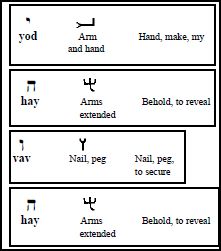
It is God’s name/character of love that is written in the heads of His redeemed people (Revelation 22:4). The prophet Ezekiel was shown that His mark is depicted in the letter ת ‘tav’ which was written in ancient times as the image of the cross (Ezekiel 9:4).
The word תורה ‘torah’ also pictographically displays Messiah on the cross, revealing the love of God.
ת – cross
ו – nail
ר – head, leader
ה – man with outstretched arms
Jesus’ declaration of God’s love was manifest on the cross.
Psa 22:22 I will declare thy name unto my brethren: in the midst of the congregation will I praise thee.
Heb 2:10 For it became him, for whom are all things, and by whom are all things, in bringing many sons unto glory, to make the captain of their salvation perfect through sufferings.
Heb 2:11 For both he that sanctifieth and they who are sanctified are all of one: for which cause he is not ashamed to call them brethren,
Heb 2:12 Saying, I will declare thy name unto my brethren, in the midst of the church will I sing praise unto thee.
The English word love is related Etymologically to the Hebrew word לב ‘lev’ which means the heart. Scripture declares that out of the abundance of the heart, the mouth speaks (Matthew 12:34-35). If one reads this portion of Scripture, it is seen that the subject of blasphemy is directly related to the words which one speaks dependent upon the state of their heart (Matthew 12:24-37). Messiah declares that the origin of blasphemy comes from the heart (Mark 7:20-23). What is the remedy to overcome this? The Love of God (Colossians 3:8-14). We are to sanctify the name of God in our hearts (1 Peter 3:15) by abiding in His love (Romans 11:16; John 15:1-10).
The Hebrew word תורה ‘torah’ is commonly translated as ‘law’ but is more properly defined as God’s will or heart/mind, His message to mankind…His ‘love letter.’
The first letter of the Torah is ב ‘bet,’ the last letter of the Torah is ל ‘lamed,’ the last letter of the TaNaKH is also ל ‘lamed.’ Both forwards בל ‘bal’ and in reverse לב ‘lev’ the word for heart is seen.
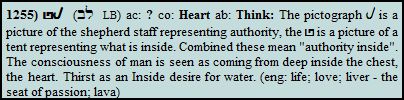
H1079
בּל (Aramaic)
bâl
BDB Definition:
1) mind, heart
The Torah/TaNaKH is the ‘heart’ of The Lord which He desires to form in our heart (Psalm 119:32; Isaiah 51:7; Philippians 2:8).
Psa 119:32 I will run the way of thy commandments, when thou shalt enlarge my heart.
Isa 51:7 Hearken unto me, ye that know righteousness, the people in whose heart is my law; fear ye not the reproach of men, neither be ye afraid of their revilings.
Php 2:5 Let this mind be in you, which was also in Christ Jesus:
Php 2:13 For it is God which worketh in you both to will and to do of his good pleasure.
This concept can be applied to the entire Scriptures as well. The first letter of the TaNaKH ב ‘bet’ and the last letter of the New Testament Scriptures ן ‘nun.’
בן ‘ben’ = Son

Reversed is נב ‘nav’ = Fruit/Prophecy

Here it can be seen that the Torah/TaNaKH is the heart/mind of God. When combined with the New Testament the Son/ Fruit /Prophecy of His Mind/Heart is brought forth.
The Word is likened to seed (Luke 8:11). The fruit is the actions and words that come forth from man who is born again by the Word (1Peter 1:23; 1John 3:0; James 1:18, 21).
The Fruit of the Spirit
Gal 5:22 But the fruit of the Spirit is love, joy, peace, longsuffering, gentleness, goodness, faith,
Gal 5:23 Meekness, temperance: against such there is no law.
There are 9 fruit of the Spirit, which correspond to 9 gifts of the Spirit
1Co 12:6 And there are diversities of operations, but it is the same God which worketh all in all.
1Co 12:7 But the manifestation of the Spirit is given to every man to profit withal.
1Co 12:8 For to one is given by the Spirit the word of wisdom (1); to another the word of knowledge (2) by the same Spirit;
1Co 12:9 To another faith (3) by the same Spirit; to another the gifts of healing (4) by the same Spirit;
1Co 12:10 To another the working of miracles (5); to another prophecy (6); to another discerning of spirits (7); to another divers kinds of tongues (8); to another the interpretation of tongues (9):
1Co 12:11 But all these worketh that one and the selfsame Spirit, dividing to every man severally as he will.
The Hebrew word for nine is תשע ‘tesha’ which comes from the root שע meaning the shepherd.

This is also the root of the word ישועה ‘yeshuah’ from whence comes the name of our Savior.
The numerical value of תורה ‘torah’ is 611 which is equivalent with יהוה אלהים צבאות ‘Yahweh Elohim Tsevaot’ (Lord God of Hosts). Scripture declares this is the ‘name’ of God.
Jer_15:16 Thy words were found, and I did eat them; and thy word was unto me the joy and rejoicing of mine heart: for I am called by thy name, O LORD God of hosts.
Jer_32:18 Thou shewest lovingkindness unto thousands, and recompensest the iniquity of the fathers into the bosom of their children after them: the Great, the Mighty God, the LORD of hosts, is his name,
Amo_4:13 For, lo, he that formeth the mountains, and createth the wind, and declareth unto man what is his thought, that maketh the morning darkness, and treadeth upon the high places of the earth, The LORD, The God of hosts, is his name.
The Torah is an interesting word in that it comes from two roots. One is תר ‘tar’ which means an image or outline, and the other is יר ‘yar’ which means to teach or pointing in the right direction.
Exo 24:12 And Jehovah said to Moses, Come up to Me to the mountain, and be there. And I will give to you the tablets of stone, and the Law, and the commandments which I have written, to teach them.
Both Law and Teach in the above verse come from the same root word
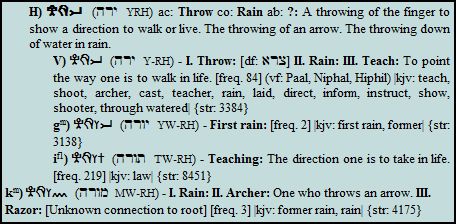
The other root is תר ‘tar.’

תר ‘tar’ is the root of the Hebrew words which mean to mark out תאר t’ar or a form תוא to’ar. The word תור tor/toor means a border or a circle and is the origin of the English word tour. Literally, the Torah is what defines, gives borders to a people. It is the finger of God pointing the direction in which we are to go and marking out the borders in which we should stay in order to walk in His camp.

The Torah = the Word
Num 15:29 Ye shall have one law for him that sinneth through ignorance, both for him that is born among the children of Israel, and for the stranger that sojourneth among them.
Num 15:30 But the soul that doeth ought presumptuously, whether he be born in the land, or a stranger, the same reproacheth the LORD; and that soul shall be cut off from among his people.
Num 15:31 Because he hath despised the word of the LORD, and hath broken his commandment, that soul shall utterly be cut off; his iniquity shall be upon him.
Deu 5:2 The LORD our God made a covenant with us in Horeb.
Deu 5:3 The LORD made not this covenant with our fathers, but with us, even us, who are all of us here alive this day.
Deu 5:4 The LORD talked with you face to face in the mount out of the midst of the fire,
Deu 5:5 (I stood between the LORD and you at that time, to shew you the word of the LORD: for ye were afraid by reason of the fire, and went not up into the mount;) saying,
Isa 1:10 Hear the word of the LORD, ye rulers of Sodom; give ear unto the law of our God, ye people of Gomorrah.
Isa 5:24 Therefore as the fire devoureth the stubble, and the flame consumeth the chaff, so their root shall be as rottenness, and their blossom shall go up as dust: because they have cast away the law of the LORD of hosts, and despised the word of the Holy One of Israel.
Isa 2:2 And it shall come to pass in the last days, that the mountain of the LORD’S house shall be established in the top of the mountains, and shall be exalted above the hills; and all nations shall flow unto it.
Isa 2:3 And many people shall go and say, Come ye, and let us go up to the mountain of the LORD, to the house of the God of Jacob; and he will teach us of his ways, and we will walk in his paths: for out of Zion shall go forth the law, and the word of the LORD from Jerusalem.
Mic 4:2 And many nations shall come, and say, Come, and let us go up to the mountain of the LORD, and to the house of the God of Jacob; and he will teach us of his ways, and we will walk in his paths: for the law shall go forth of Zion, and the word of the LORD from Jerusalem.
JESUS IS THE WORD MADE FLESH
Joh 1:1 In the beginning was the Word, and the Word was with God, and the Word was God.
Joh 1:2 The same was in the beginning with God.
Joh 1:3 All things were made by him; and without him was not any thing made that was made.
Joh 1:14 And the Word was made flesh, and dwelt among us, (and we beheld his glory, the glory as of the only begotten of the Father,) full of grace and truth.
Psa 33:6 By the word of the LORD were the heavens made; and all the host of them by the breath of his mouth.
1Jo 1:1 That which was from the beginning, which we have heard, which we have seen with our eyes, which we have looked upon, and our hands have handled, of the Word of life;
1Jo 1:2 (For the life was manifested, and we have seen it, and bear witness, and shew unto you that eternal life, which was with the Father, and was manifested unto us;)
The New Covenant is God’s law/Torah written upon our hearts (Jeremiah 31:31-34; Hebrews 8:8-13), His character of love (John 13:34-35; 15:10-12; 1 John 4:21; James 2:8; Romans 13:8-10; Galatians 5:14), His Spirit dwelling within us (John 14:15-18; 1 John 3:22-24), God working in us (Philippians 2:13), transforming us into the image of Jesus Christ (Hebrews 13:21; Ephesians 3:17-20; Colossians 3:10; Romans 8:29; 1 John 4:8).
One cannot believe/follow God’s Torah without believing in His Son.
Believing in the Messiah is the most important commandment in the Word. The Messiah said that the work of God is to believe on Him (John 6:29), the Apostle John later said His commandment is to believe in Messiah (1 John 3:23) for knowing the Father & the Son is eternal life (John 17:3). The greatest commandments in the Torah are love God and love our fellow man from which all the commandments hang (Matthew 22:35-40). When we believe in Messiah and know Him, we walk in this love (1 John 2:4; 5:2-3) for He is love (1 John 4:8-20). We can do nothing unless we abide in Him, hence belief in Him is indeed the most important command for it encompasses the two great commandments (John 15:1-10).
The Holy Scriptures equate Jesus with the Torah:
Deu 30:11 For this commandment which I command thee this day, it is not hidden from thee, neither is it far off.
Deu 30:12 It (הוא=he) is not in heaven, that thou shouldest say, Who shall go up for us to heaven, and bring it unto us, that we may hear it, and do it?
Deu 30:13 Neither is it beyond the sea, that thou shouldest say, Who shall go over the sea for us, and bring it unto us, that we may hear it, and do it?
Deu 30:14 But the word is very nigh unto thee, in thy mouth, and in thy heart, that thou mayest do it.
Deu 30:15 See, I have set before thee this day life and good, and death and evil;
Deu 30:16 In that I command thee this day to love the LORD thy God, to walk in his ways, and to keep his commandments and his statutes and his judgments, that thou mayest live and multiply: and the LORD thy God shall bless thee in the land whither thou goest to possess it.
Rom 10:6 But the righteousness which is of faith speaketh on this wise, Say not in thine heart, Who shall ascend into heaven? (that is, to bring Christ down from above:)
Rom 10:7 Or, Who shall descend into the deep? (that is, to bring up Christ again from the dead.)
Rom 10:8 But what saith it? The word is nigh thee, even in thy mouth, and in thy heart: that is, the word of faith, which we preach;
Psa 40:6 Sacrifice and offering thou didst not desire; mine ears hast thou opened: burnt offering and sin offering hast thou not required.
Psa 40:7 Then said I, Lo, I come: in the volume of the book it is written of me,
Psa 40:8 I delight to do thy will, O my God: yea, thy law is within my heart.
Heb 10:5 Wherefore when he cometh into the world, he saith, Sacrifice and offering thou wouldest not, but a body hast thou prepared me:
Heb 10:6 In burnt offerings and sacrifices for sin thou hast had no pleasure.
Heb 10:7 Then said I, Lo, I come (in the volume of the book it is written of me,) to do thy will, O God.
The Torah is all about Messiah.
Joh 1:45 Philip finds Nathanael and said to him, We have found the One of whom Moses wrote in the Law and the Prophets, Jesus the son of Joseph, from Nazareth.
Joh 5:39 You search the Scriptures, for you think in them you have everlasting life. And they are the ones witnessing concerning Me.
Joh 5:46 For if you were believing Moses, you would then believe Me; for that one wrote concerning Me.
Joh 5:47 But if you do not believe his writings, how will you believe My Words?
Psa 40:7 Then I said, Lo, I come, in the roll of the Book it is written of Me;
Jesus & the Apostles taught from the TaNaKH
Luk 24:27 And beginning from Moses, and from all the prophets, He explained to them the things about Himself in all the Scriptures.
Luk 24:44 And He said to them, These are the Words which I spoke to you yet being with you, that all the things must be fulfilled having been written in the Law of Moses, and the Prophets, and the Psalms, concerning Me.
Luk 24:45 Then He opened up their mind to understand the Scriptures,*
*Notice, the Scriptures are a sealed book (Isaiah 29:10-11), it is only through the Spirit of the Messiah that our eyes are opened, this is a concept seen where the Spirit of God hovers over the waters and commands Light to come forth out of darkness (Genesis 1:2-3; John 3:19; Colossians 1:13)
Act 26:22 Then obtaining help from God, I stand until this day, witnessing both to small and to great, saying nothing else than what the prophets and Moses also said was going to happen:
Act 28:23 And having appointed him a day, more came to him in the lodging, to whom he expounded, earnestly testifying the kingdom of God and persuading them the things concerning Jesus, both from the Law of Moses and the Prophets, from morning until evening.*
*At this point the New Testament Scriptures had not yet been completely compiled. Paul was teaching Messiah from the TaNaKH
1Co 15:3 For I delivered to you in the first place what I also received, that Christ died for our sins, according to the Scriptures,
1Co 15:4 and that He was buried, and that He was raised the third day, according to the Scriptures,*
*At the point of this Epistle, the New Testament Scriptures were not completely compiled. Paul was speaking of the TaNaKH
2Ti 3:15 and that from a babe you know the Holy Scriptures, those being able to make you wise to salvation through belief in Christ Jesus.
littleguyintheeye@gmail.com


