

Prophecies of Messiah – Numbers 21:9: Serpent on a Pole
Num 21:9 And Moses made a serpent of brass, and put it upon a pole, and it came to pass, that if a serpent had bitten any man, when he beheld the serpent of brass, he lived.
Messiah Jesus spoke of this serpent on a pole as a type/figure of Himself.
Joh 3:14 And as Moses lifted up the serpent in the wilderness, even so must the Son of man be lifted up:
Joh 3:15 That whosoever believeth in him should not perish, but have eternal life.
Joh 3:16 For God so loved the world, that he gave his only begotten Son, that whosoever believeth in him should not perish, but have everlasting life.
Joh 3:17 For God sent not his Son into the world to condemn the world; but that the world through him might be saved.
In the wilderness Israel was healed through looking upon the serpent on a pole. This was a figure of being saved through ‘looking’ upon the Messiah on the cross/tree.
Num 21:9 And Moses made a serpent of bronze and put it on a pole; and it happened, if a serpent had bitten any man, when he looked to the bronze serpent, he lived.
Joh 3:14 And even as Moses lifted up the serpent in the wilderness, so must the Son of Man be lifted up,
Joh 3:15 that everyone believing into Him should not perish, but have everlasting life.
Exo 14:13 And Moses said to the people, Do not be afraid. Take your stand and see the salvation of Jehovah, which He will prepare for you today. For as you see the Egyptians today, you shall not continue to see them again forever.
Luk 3:6 “and all flesh shall see the salvation of God.” Isaiah 40:3-5
Isa 52:10 Jehovah has bared His holy arm in the eyes of all the nations; and all the ends of the earth shall see the salvation of our God.
How was His arm revealed? On the cross.
Isa 53:1 Who has believed our report? And to whom is the arm of Jehovah revealed?
Gen 22:14 And Abraham called the name of that place Jehovah Will See; so that it is said until this day, In the mount of Jehovah it will be seen.
Gen 22:14 ויקרא אברהם שׁם־המקום ההוא יהוה יראה אשׁר יאמר היום בהר יהוה יראה*׃
*Literally, in/on the mountain Yahweh will be seen.
Joh 8:56 Your father Abraham leaped for joy that he should see My day, and he saw, and rejoiced.
Joh 8:57 Then the Jews said to Him, You do not yet have fifty years, and have You seen Abraham?
Joh 8:58 Jesus said to them, Truly, truly, I say to you, Before Abraham came to be, I AM!

On the mountain the LORD will be seen. Yerah’eh is in the Niphal stem 3rd person masculine singular future tense. Truly the LORD will provide HIMSELF as a lamb in the place of Isaac (mankind).
Gen 22:7 And Isaac spoke to his father Abraham and said, My father. And he said, Behold me. And he said, Behold, the fire and the wood! But where is the lamb for a burnt offering?
Gen 22:8 And Abraham said, My son, God will see to the lamb for Himself, for a burnt offering. And the two of them went together.
הר האלהים (the Mountain of God) has the numerical value of 296. This is equivalent to לאור גוים (For a light of the nations). This links the Messiah on the cross on the Mountain of God to Light which points to the Menorah. This will be seen in more detail below.
Isa 49:3 and said to Me, You are My servant, Israel, You in whom I shall be glorified. This verse is referring to Messiah as Israel, the Olive tree
Isa 49:6 And He said, It is too little that You should be My servant to raise up the tribes of Jacob, and to restore the preserved ones of Israel; I will also give You for a light of the nations, that You may be My salvation (Heb. Yeshuah) to the end of the earth.
Isa 42:6 I, Jehovah, have called You in righteousness, and will hold Your hand, and will keep You, and give You for a covenant of the people, for a Light of the nations;
Luk 2:32 a Light for revelation to the nations, and the Glory of Your people Israel.
Isa 40:5 And the glory of Jehovah shall be revealed, and all flesh shall see it together, for the mouth of Jehovah has spoken.
How was His Glory revealed?
Joh 8:28 Then Jesus said to them, When you lift up the Son of Man, then you will know that I AM; and from Myself I do nothing; but as My Father taught Me, these things I speak.
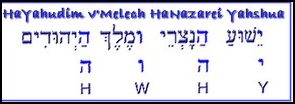
Joh 19:19 And Pilate also wrote a title and put it on the cross. And having been written, it was: JESUS THE NAZARENE, THE KING OF THE JEWS.
Joh 12:32 And I, if I be lifted up from the earth, I will draw all to Myself (John 8:28 Messiah states this is how they will know He is ‘I AM’).
Joh 12:33 But He said this, signifying by what kind of death He was about to die.
Joh 12:34 The crowd answered Him, We heard out of the Law that The Christ remains to the age. And how do You say that the Son of Man must be lifted up? Who is this Son of Man?
Joh 12:35 Then Jesus said to them, Yet a little while the Light is with you. Walk while you have the Light, that darkness not overtake you. And the one walking in the darkness does not know where he is going.
Joh 12:36 While you have the Light, believe into the Light, that you may become sons of Light. Jesus spoke these things, and going away He was hidden from them.
Joh 12:37 But though He had done so many miraculous signs before them, they did not believe into Him,
Joh 12:38 so that the Word of Isaiah the prophet might be fulfilled, which he said, “Lord, who has believed our report? And the arm of the Lord, to whom was it revealed?” Isa. 53:1
Joh 12:39 Because of this they could not believe, because Isaiah said again,
Joh 12:40 “He has blinded their eyes” and “has hardened their heart,” “that they might not see with the eyes” and “understand with the heart,” “and be converted,” “and I should heal them.” Isa. 6:10
Joh 12:41 Isaiah said these things when he saw His glory, and spoke about Him.
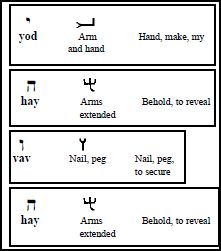
The pictographs of יהוה speak of Him being revealed through the nails in His Hands
Joh 20:27 Then He said to Thomas, Bring your finger here and see My hands, and bring your hand and thrust into My side, and be not unbelieving, but believing.
Joh 20:28 And Thomas answered and said to Him, My Lord and my God!
The Cross (ת ‘tav’) is linked with His Name
Eze 9:4 And Jehovah said to him, Pass through in the midst of the city, in the midst of Jerusalem, and mark (תוה ‘tavah’) a mark (תה ‘tav’) on the foreheads of the men who are groaning and are mourning over all the abominations that are done in her midst.
Rev 14:1 And I saw, and behold, the Lamb standing on Mount Zion! And with Him were a hundred and forty four thousands, with the name of His Father having been written on their foreheads.
Rev 22:4 And they will see His face; and His name will be on their foreheads.
His Name is the Word
Rev 19:13 and having been clothed in a garment which had been dipped in blood. And His name is called The Word of God.
We are marked by the Name/Jesus
Rev 7:3 Do not harm the earth, nor the sea, nor the trees, until we seal the slaves of our God on their foreheads.
Rev 7:4 And I heard the number of those having been sealed: one hundred forty four thousands, having been sealed out of every tribe of the sons of Israel:
Rev 14:1 And I saw, and behold, the Lamb standing on Mount Zion! And with Him were a hundred and forty four thousands, with the name of His Father having been written on their foreheads.
Today there are many who argue about how to pronounce the Sacred Name of the Almighty. What is the true pronunciation of His Name? Love. That’s right. LOVE. The Hebrew word for name is שם ‘shem’ which literally means one’s breathe or character. What is the character of the Almighty? Love (1 John 4:8).
The Hebrew word for love is אהב ‘ahav’ which is consists of the letters אב ‘av’ which means father and the middle letter ה ‘heh’ which has the meaning of revelation. The Father revealed. In ancient Hebrew, the letter ה ‘heh’ was depicted as a man with outstretched arms, like unto Messiah on the cross. How was the love of the Father revealed? Through the giving of His only begotten Son on the cross as an atonement for the sins of mankind (John 3:16).
Further connecting the Name of God to His character of love and the revelation of this love at Calvary is seen in the ancient pictograph meanings of the Sacred Name.
The pictographs of יהוה speak of Him being revealed through the nails in His Hands.
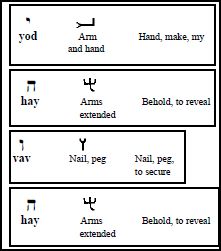
It is God’s name/character of love that is written in the heads of His redeemed people (Revelation 22:4). The prophet Ezekiel was shown that His mark is depicted in the letter ת ‘tav’ which was written in ancient times as the image of the cross (Ezekiel 9:4).
All those who call upon the name of the Lord shall be saved (Joel 2:32). Does this mean that one has to articulate the letters יהוה correctly to be saved? No. This means one needs to declare the name/character of love of God revealed in Jesus’ sacrifice on the cross (Romans 10:9-13).
The English word ‘pronounce’ traces back to the Latin word ‘pronunciare’ which is a combination of the Latin words ‘pro’ which means something brought forth in public and ‘nuntiare’ which means to announce. A public announcement or declaration. Scripture states that Jesus declared the name of God (John 17:26). Does it really matter if and how He articulated the letters יהוה ‘YHWH’ ? No. He declared His Name by walking in His character which is love.
Joh 17:26 And I have declared unto them thy name, and will declare it: that the love wherewith thou hast loved me may be in them, and I in them.
Jesus’ declaration of God’s love was manifest on the cross.
Psa 22:22 I will declare thy name unto my brethren: in the midst of the congregation will I praise thee.
Heb 2:10 For it became him, for whom are all things, and by whom are all things, in bringing many sons unto glory, to make the captain of their salvation perfect through sufferings.
Heb 2:11 For both he that sanctifieth and they who are sanctified are all of one: for which cause he is not ashamed to call them brethren,
Heb 2:12 Saying, I will declare thy name unto my brethren, in the midst of the church will I sing praise unto thee.
The English word love is related Etymologically to the Hebrew word לב ‘lev’ which means the heart. Scripture declares that out of the abundance of the heart, the mouth speaks (Matthew 12:34-35). If one reads this portion of Scripture, it is seen that the subject of blasphemy is directly related to the words which one speaks dependent upon the state of their heart (Matthew 12:24-37). Messiah declares that the origin of blasphemy comes from the heart (Mark 7:20-23). What is the remedy to overcome this? The Love of God (Colossians 3:8-14). We are to sanctify the name of God in our hearts (1 Peter 3:15) by abiding in His love (Romans 11:16; John 15:1-10).
The Almighty commanded us not to take His name in vain (Exodus 20:7). The word in Hebrew for vain is שוא ‘shav’ which literally means to make something empty or bring something to ‘nothingness.’ Taking His name in vain is making it empty, stripping the character and meaning of His Name which is love. When love is taken away, emptiness and nothingness ensues (1 Corinthians 13:1-3).
1Co 13:2 And though I have the gift of prophecy, and understand all mysteries, and all knowledge; and though I have all faith, so that I could remove mountains, and have not charity, I am nothing.
1Co 13:3 And though I bestow all my goods to feed the poor, and though I give my body to be burned, and have not charity, it profiteth me nothing.
The Sacred Name יהוה basically means the Eternal One. The Great I AM. What also is eternal? The love of God (John 17:24).
Joh 17:21 That they all may be one; as thou, Father, art in me, and I in thee, that they also may be one in us: that the world may believe that thou hast sent me.
Joh 17:22 And the glory which thou gavest me I have given them; that they may be one, even as we are one:
Joh 17:23 I in them, and thou in me, that they may be made perfect in one; and that the world may know that thou hast sent me, and hast loved them, as thou hast loved me.
Joh 17:24 Father, I will that they also, whom thou hast given me, be with me where I am; that they may behold my glory, which thou hast given me: for thou lovedst me before the foundation of the world.
Joh 17:25 O righteous Father, the world hath not known thee: but I have known thee, and these have known that thou hast sent me.
Joh 17:26 And I have declared unto them thy name, and will declare it: that the love wherewith thou hast loved me may be in them, and I in them.
Joh 13:35 By this shall all men know that ye are my disciples, if ye have love one to another.
The Banner of Love
Son 2:4 He brought me to the banqueting house, and his banner over me was love
Messiah is the manifestation of love Tit 3:4; 2 Tim 1:13-14; Eph 5:2=1 Joh 2:6; Eph 3:19; Rom 8:39
Serpent on a pole
Num 21:8 And Jehovah spoke to Moses, Make yourself a fiery serpent, and set it on a pole; and it shall be that when anyone is bitten, when he sees it, he shall live.
The word for pole here is נס ‘nes’ which is also translated as flag/banner.

Messiah on the tree is a picture of the Menorah, the Light of the World.
Above the head of Messiah, in acronym form, was the name Yahweh.
Joh 8:28 Then Jesus said to them, When you lift up the Son of Man, then you will know that I AM; and from Myself I do nothing; but as My Father taught Me, these things I speak.
Joh 19:19 And Pilate also wrote a title and put it on the cross. And having been written, it was: JESUS THE NAZARENE, THE KING OF THE JEWS.
Joh 12:32 And I, if I be lifted up from the earth, I will draw all to Myself (John 8:28 Messiah states this is how they will know He is ‘I AM’).
The Scriptures speak of the crucifixion being on a tree
Act 5:30 The God of our fathers raised up Jesus, whom you seized, hanging Him on a tree.
Act 10:39 And we are witnesses of all things which He did, both in the country of the Jews, and in Jerusalem. They did away with Him, hanging Him on a tree.
Act 13:29 And when they finished all the things having been written concerning Him, taking Him down from the tree, they laid Him in a tomb.
Gal 3:13 Christ redeemed us from the curse of the Law, having become a curse for us; for it has been written, “Cursed is everyone having been hung on a tree;” Deut. 21:23
1Pe 2:24 who “Himself carried up in His body our sins” onto the tree; that dying to sins, we might live to righteousness, of whom “by His wound you were healed.”
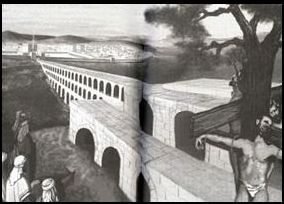
Jesus was crucified in the midst of two thieves
Joh 19:18 where they crucified Him, and two others with Him, on this side and on that side, and Jesus in the middle.
Traditionally this is the image that is portrayed of the crucifixion.
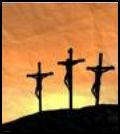
But if this were the case the following Scripture would make no sense.
Joh 19:31 Then, since it was Preparation, that the bodies not remain on the cross on the sabbath, for great was the day of that sabbath, the Jews asked Pilate that their legs might be broken and they be taken away.
Joh 19:32 Then the soldiers came and broke the legs of the first, and of the other crucified with Him.
Joh 19:33 But on coming to Jesus, when they saw He was dead already, they did not break His legs.
Why would the soldiers break the legs of the 1st and 3rd person and then go to Jesus last? If they were all crucified on one tree this would make perfect sense as they would make a circle starting from the 1st thief and working around to the Messiah. If Messiah and the two thieves were crucified on a single tree then the image that would have been formed would have been a menorah.
Another hint of this is seen in the following verse:
Joh 19:31 Then, since it was Preparation, that the bodies not remain on the cross on the sabbath, for great was the day of that sabbath, the Jews asked Pilate that their legs might be broken and they be taken away.
Notice it says bodies (plural) should not remain on the cross (singular). The text seems to indicate that all 3 bodies were on a single ‘cross’ which in Greek would be stauros (tree).
Ernest Martin
Since we are told by the apostle John (who was an eyewitness to the crucifixion) that all three were crucified on ONE stauros (i.e. a single tree), it is easy to see how the Roman soldiers broke the legs of the robber in the Messiah’s right side (who had his back to the Messiah and was located on the northeast side of him) and then they broke the legs of the robber on the Messiah’s left side (who also had his back to the Messiah but was located on the southeast side of him). So, proceeding from the northeast side of the tree of crucifixion, the soldiers killed the first robber, went to the southeast side and killed the second robber, but they then came to the Messiah who was facing (let us say) westward towards his Father’s Temple. When they reached Yeshua they found him dead already. (Secrets of Golgotha, pp. 176-177).
Tree of Life
The verses that speak of Messiah being crucified on a tree use the word ξύλον xulon for tree. This is the same word used for tree of life in the New Testament.
Rev 22:2 In the midst of its street and of the river, from here and from there, was a tree of life producing twelve fruits: according to one month each yielding its fruit. And the leaves of the tree were for healing of the nations.
Rev 22:14 Blessed are the ones doing His commands, that their authority will be over the Tree of Life, and by the gates they may enter into the city.
As mentioned above, the Menorah is a picture of the Tree of Life.
In Colossians 2:14, James Murdock translates the verse from the Aramaic Peshitta as such:
Col 2:14 and, by his mandates, he blotted out the handwriting of our debts, which [handwriting] existed against us, and took [it] from the midst, and affixed [it] to his cross.
Messiah Jesus paid the debt off our debts on the cross. Forgiving of debts is rendered in Hebrew as נסא ‘nasa’ which means to bear something or lift it up. The root of נסא ‘nasa’ is נס ‘nes’ which means the lifting up of a flag on a pole. Messiah took upon Himself the debt of sin which came about in the beginning due to a serpent in a tree by becoming a “serpent on a tree” (John 3:14-15).
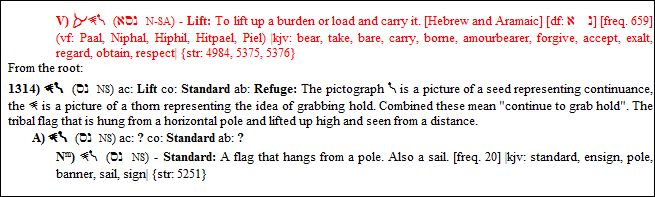
The Hebrew word for forgiveness {סלח ‘selach’} has this same meaning of “lifting one out of a debt”.
Mat 6:12 And forgive us our debts, as we forgive our debtors.
Messiah took upon Himself our debts on the cross and commanded us to take up the cross as well and follow Him (Matthew 10:21; Mark 8:34; Luke 9:23-25; 14:27). We are now to be dead to sin and the debt it holds to walk in the freedom of His Righteousness (Galatians 2:20; 5:5:22-25; Romans 6:6-18; 1 Corinthians 6:20; 7:22-23). As there is no longer any condemnation to those who have been forgiven their debt, we should no longer focus on condemning others (Romans 8:1-39). Our focus should be on the ministry of reconciliation (2 Corinthians 5:14-21) and forgiveness (Matthew 18:23-35).
Messiah Jesus knew no sin, yet He became sin that we might become His righteousness and declare the message of His forgiveness of the debt of sin and the reconciliation of mankind to the Father.
2Co 5:18 And all things are of God, who hath reconciled us to himself by Jesus Christ, and hath given to us the ministry of reconciliation;
2Co 5:19 To wit, that God was in Christ, reconciling the world unto himself, not imputing their trespasses unto them; and hath committed unto us the word of reconciliation.
2Co 5:20 Now then we are ambassadors for Christ, as though God did beseech you by us: we pray you in Christ’s stead, be ye reconciled to God.
2Co 5:21 For he hath made him to be sin for us, who knew no sin; that we might be made the righteousness of God in him.
Messiah on the cross reveals the love of the Father. Forgiveness of debts is a key part of this love.
Eph 4:32 And be kind to one another, tenderhearted, having forgiven one another, even as also God forgave you in Christ.
For more on the subject of the Messiah see:
littleguyintheeye@gmail.com


