
Most of the body of Messiah (and the world) is celebration/remembering the resurrection of Messiah today. I thought I would share some studies on the subject for those interested:
Daily Tidbits 4/11 – Wave Sheaf/Firstfruits
Daily Tidbits 4/12 – Resurrection
On Easter, Christians around the world celebrate the Resurrection of our “great God and Saviour, Jesus Christ” (Titus 2:13). For them, this is the most important holiday of the Christian calendar. The doctrine of the Resurrection of Christ is one of the most important doctrines of Christianity; without the Resurrection, we have no hope of salvation from our sins (1 Corinthians 15:12–18).
1Co 15:12 Now if Christ be preached that he rose from the dead, how say some among you that there is no resurrection of the dead?
1Co 15:13 But if there be no resurrection of the dead, then is Christ not risen:
1Co 15:14 And if Christ be not risen, then is our preaching vain, and your faith is also vain.
1Co 15:15 Yea, and we are found false witnesses of God; because we have testified of God that he raised up Christ: whom he raised not up, if so be that the dead rise not.
1Co 15:16 For if the dead rise not, then is not Christ raised:
1Co 15:17 And if Christ be not raised, your faith is vain; ye are yet in your sins.
1Co 15:18 Then they also which are fallen asleep in Christ are perished.
1Co 15:19 If in this life only we have hope in Christ, we are of all men most miserable.
1Co 15:20 But now is Christ risen from the dead, and become the firstfruits of them that slept.
1Co 15:21 For since by man came death, by man came also the resurrection of the dead.
1Co 15:22 For as in Adam all die, even so in Christ shall all be made alive.
1Co 15:23 But every man in his own order: Christ the firstfruits; afterward they that are Christ’s at his coming.
1Co 15:24 Then cometh the end, when he shall have delivered up the kingdom to God, even the Father; when he shall have put down all rule and all authority and power.
1Co 15:25 For he must reign, till he hath put all enemies under his feet.
1Co 15:26 The last enemy that shall be destroyed is death.
1Co 15:27 For he hath put all things under his feet. But when he saith all things are put under him, it is manifest that he is excepted, which did put all things under him.
1Co 15:28 And when all things shall be subdued unto him, then shall the Son also himself be subject unto him that put all things under him, that God may be all in all.
“Reflecting, the other day, on the sad state of the churches at the present time, I was led to look back to apostolic times and to consider where in the preaching of the present-day different from the preaching of the apostles. I remarked the vast difference in their style from the set and formal oratory of the present age. I remarked that the apostles did not take a text when they preached, nor did they confine themselves to one subject, much less to any place of worship. But I find that they stood up in any place and declared from the fullness of their hearts what they knew of Jesus Christ. But the main difference I observed was in the subject of their preaching. I was surprised when I discovered that the very staple of the preaching of the apostles was the resurrection of the dead! I found myself to have been… leading the people of God as well as I was in able, into the deep things of His Word. But I was surprised to find that I had not been copying the apostolic fashion half as nearly as I might have done. The apostles, when they preached, always testified concerning the resurrection of Jesus and the consequent resurrection of the dead. It appears that the Alpha and the Omega of their gospel was the testimony that Jesus Christ died and rose again from the dead according to the Scriptures.” – Charles Spurgeon
The Gospel is always those three things together. Paul continues, “And if Christ is not risen, your faith is futile; you are still in your sins!”
Other passages make it very clear that the resurrection is of utmost importance and always the central part of the Gospel. Matt Slick from CARM.org compliled this helpful list of resurrection passages.
Matthew
Matt. 12:39-40 – Sign of Jonah
Matt. 16:4 – Sign of Jonah
Matt. 16:21 – Killed and raised
Matt. 17:9 – Do not tell information until risen from the dead
Matt. 17:12 – Son to suffer
Matt. 17:22-23 – Delivered, killed and raised
Matt. 20:22 – Drink of cup and be baptized
Matt. 20:28 – Give life a ransom for many
Matt. 21:37-39 – Parable of the husbandman-gives son-killed by workers
Matt. 22:7 – Small correlation*
Matt. 23:34 – Vague correlation*
Matt. 26:2, 24 – To be crucified
Matt. 26:28 – Drink of blood shed
Matt. 26:54 – Scriptures must be fulfilled
Mark
Mark 8:31 – Suffer, die and arise
Mark 8:34-35 – Deny, take up cross and follow
Mark 9:9 – Don’t tell until Jesus arisen
Mark 9:30-32 – Son will be killed and arise from dead
Mark 10:32-34 – Same
Mark 10:38 – Drink of cup, be baptized
Mark 10:45 – Give life a ransom for many
Mark 12:6-8 – Son killed by vineyard workers
Mark 14:8 – Anoint body for burying
Mark 14:22-24 – This is my body
Luke
Lk. 9:22 – Rejected, killed and arise
Lk. 9:23 – Take up cross
Lk. 9:36 – Do not tell what was seen until after resurrection
Lk. 11:29-32 – Sign of Jonah
Lk. 12:50 – Baptism to be baptized with
Lk. 13:32 – Third day perfected
Lk. 16:30-31 – Not persuaded though one rise from the dead
Lk. 18:31-33 – Mocked, killed and rise again
Lk. 20:14-15 – Son killed by vineyard workers
Lk. 22:15 – Eat Passover before suffering
Lk. 22:19-20 – Bread and wine-body and blood symbolism
Lk. 22:37 – Allusion to death
Lk. 22:42 – Agony in Gethsemane-let cup pass
John
John 1:29, 36 – Lamb of God
John 2:18-22 – Destroy temple and raise it in three days
John 3:14 – Son must be lifted up
John 3:32 – Meat to eat that you know not of
John 6:27 – Labor for meat of life-son of man shall give
John 6:51-58 – Bread given-flesh of Jesus
John 8:28 – Lifted up the Son of man
John 10:15 – Lay down life for sheep
John 10:17-18 – Lay down life and take it
John 11:50-51 – Caiaphas prophesied Jesus’ death
John 12:7 – Ointment used for Jesus’ burying
John 12:23-25 – Son of man to be glorified-possibly means death
John 12:32-33 – Lifted up
John 13:11, 21 – Knew who would betray him*
John 13:33 – Only with them a little while
John 13:36 – Cannot follow now, but later
John 16:16 – Little while and will not see Jesus
John 16:32 – Disciples to forsake Jesus*
Acts
Acts 1:3 – Alive after passion
Acts 1 – Jesus’ words after the resurrection
Acts 1:22 – Witness of resurrection
Acts 1:16-22 – Peter’s statement
Acts 2:14 – Peter’s Pentecostal sermon
Acts 2:23-24 – Jesus crucified and raised
Acts 2:27 – Not leave soul in hell
Acts 2:31 – Resurrection of Christ
Acts 2:32 – Witnesses of the resurrection
Acts 2:36 – Jesus crucified: Lord and Christ
Acts 3:13-16, 18 – Jesus killed and raised
Acts 3:26 – God raised Jesus
Acts 4:2 – Through Jesus the resurrection of the dead
Acts 4:10 – Jesus crucified and raised
Acts 4:33 – Great power gave apostles witness of the resurrection
Acts 5:28 – Bring man’s blood upon us
Acts 5:30-32 – Death and resurrection-apostles and Holy Spirit are witnesses
Acts 7:52 – Murderers of Jesus
Acts 10:39-43 – Death and resurrection witnesses, commission to preach
Acts 13:29-31 – Paul preached: death, burial, empty tomb, appearances, witnesses
Acts 13:33-37 – Resurrection
Acts 17:3 – Suffer and rise again
Acts 17:18 – Jesus and resurrection
Acts 17:31-32 – Assurance by raising Jesus from the dead
Acts 20:28 – Flock purchased with Jesus’ blood
Acts 22:15 – Witness of Jesus-was the risen Lord-(also see Acts 9, 26)
Acts 23:6-8 – Resurrection of the dead-24:15, 21, 26:8
Acts 25:19 – Jesus dead-Paul said alive
Acts 26:14-18 – Appearance of Jesus
Acts 26:23 – Jesus suffer and rise first
Romans
Rom. 1:4 – Declared Son of God by resurrection from the dead
Rom. 3:24-25 – Faith in His blood
Rom. 4:24 – Jesus raised
Rom. 4:25 – Delivered and raised
Rom. 5:6-11 – Christ died for the ungodly-justified by His blood-saved by His life.
*Rom. 5:15 – Offense-death-free gift
Rom. 6:3-14 – Baptism: parallels death, burial and resurrection
Rom. 7:4 – Dead to Christ: married to Him who was raised
Rom. 8:11 – Spirit raised Jesus
*Rom. 8:17-18 – Suffered and glorified with Christ
Rom. 8:32 – God delivered Jesus for us all
Rom. 8:34 – Jesus died and arose
Rom. 10:6-7 – Jesus died and rose (implied)-up from the dead
Rom. 10:9 – God raised Jesus
Rom. 14:9 – Death, resurrection and revived-Lord of dead and living
Rom. 14:15 – Destroy not a person for whom Christ died
1 Corinthians
1 Cor. 1:13 – Paul crucified for you?
1 Cor. 1:17-18 – Cross of Christ
1 Cor. 1:23 – Christ crucified
1 Cor. 2:2 – Know Jesus Christ and Him crucified
1 Cor. 2:8 – Crucified Lord of glory
1 Cor. 5:7 – Christ Passover sacrificed for us
1 Cor. 6:14 – God raised up the Lord
*1 Cor. 6:19-20 – Bought with price
1 Cor. 8:11 – Weak brother perish for whom Christ died?
1 Cor. 10:16 – Body and blood-bread and wine
1 Cor. 11:23-29 – Received/delivered: body/blood
1 Cor. 15:1-8 – Creedal material on death and resurrection that Paul received
1 Cor. 15 – Resurrection – the importance of the resurrection
2 Corinthians
2 Cor. 1:9 – Trust God which raiseth the dead
*2 Cor. 2:12 – Preach Christ’s gospel-4:3-4, 10:14, 11:4
2 Cor. 4:10 – Dying of Lord Jesus
*2 Cor. 4:11 – Life of Jesus
2 Cor. 4:14 – Jesus raised: so will we
2 Cor. 5:14-15 – Jesus’ death and resurrection
*2 Cor. 5:21 – Jesus made sin for us
2 Cor. 13:4 – Crucified by weakness: lives by the power of God
Galatians
Gal. 1:1 – God raised Jesus
Gal. 1:4 – Jesus gave himself for our sins
Gal. 1:6-10 – Another gospel
Gal. 1:11-12 – Taught gospel by revelation
Gal. 1-2 – Conversion and gospel; Possible location where Paul received the 1 Cor. 15:3-8creed?
Gal. 2:2 – Communicated gospel-doubt in Paul’s mind?
Gal. 2:20 – Crucified with Christ-Christ gave Himself for me
Gal. 2:21 – Christ died to free us from the law
Gal. 3:1 – Jesus crucified among them
Gal. 3:13 – Christ redeemed us from the law by being hanged on a tree
Gal. 5:11 – Offense of the cross
Gal. 6:12 – Persecution for the cross of Christ
Gal. 6:14 – Glory only in the cross
*Gal. 6:17 – Marks of the Lord Jesus
Ephesians
Eph. 1:7 – Redemption through blood
Eph. 1:20 – Christ raised and set in heavenly places-above all-Jesus exalted
Eph. 2:6 – Raised us up to sit with Christ
Eph. 2:13 – Made nigh by blood of Christ
Eph. 2:16 – Reconcile by cross
Eph. 5:25 – Christ gave Himself for the Church
Philippians
*Phil. 1:7 – Defense and confirmation of the gospel (cf. 1:17)
*Phil. 1:29 – Suffer for His sake
Phil. 2:5-11 – Jesus humbled, died, exalted and glorified. This is considered a hymn by many scholars which has an early date.
Phil. 2:10-11 – Know Him and the power of His resurrection-conformed to his death and sufferings
Phil. 3:18 – Enemies of the cross of Christ
Colossians
Col. 1:14 – Redemption though blood
Col. 1:20 – Peace through blood of cross
Col. 1:21-22 – Reconciled through His death
Col. 2:11-13 – Put off sins by circumcision of Christ-buried and raised by baptism
Col. 2:14 – Nailed it to the cross
Col. 2:20 – Dead with Christ
Col. 3:1 – Risen with Christ
Col. 3:3 – Dead: life hid with Christ
1 Thessalonians
1 Thess. 1:10 – Jesus raised from the dead
1 Thess. 2:15 – Killed Jesus
1 Thess. 4:14 – Believe Jesus died and rose again
1 Thess. 5:10 – Jesus died for us
2 Thessalonians
1 Timothy
1 Tim. 2:6 – Gave Himself a ransom for all
1 Tim. 3:16 – Manifested in the flesh, justified in the Spirit
2 Timothy
2 Tim. 1:10 – Jesus abolished death: brought life and immortality to light through gospel
2 Tim. 2:8 – Jesus raised from dead according to the gospel
2 Tim. 2:11-12 – Suffer and live with Christ
2 Tim. 2:18 – Resurrection past – claim of heretics
Hebrews
Heb. 1:3 – Purged sins-set down in heaven
Heb. 2:9 – Jesus made lower for suffering of death
Heb. 2:14 – Death-destroyed him who had power over death
Heb. 5:3 – Offer for sins
Heb. 6:2 – Resurrection of dead
Heb. 6:6 – Crucify Son of God afresh
Heb. 7:16 – Power of an endless life
Heb. 9:7-28 – Blood, death
Heb. 9-10 – Blood and death
Heb. 10:12 – Blood
Heb. 10:28 – Sacrifice for sins
Heb. 10:29 – Blood of [New] Covenant
Heb. 11:35 – Better resurrection
Heb. 12:2 – Endured cross-throne of God now
Heb. 12:24 – Jesus mediator of New Covenant with blood
Heb. 13:12 – Jesus suffered, blood sanctifies us
Heb. 13:20 – God brought Jesus back from dead, blood of covenant
James
1 Peter
1 Pet. 1:2 – Sprinkling of blood of Jesus Christ
1 Pet. 1:3 – Resurrection of Jesus from dead
1 Pet. 1:19 – Redeemed with blood of Christ
1 Pet. 1:21 – God raised Jesus
1 Pet. 2:21 – Christ suffered for us leaving an example
1 Pet. 2:24 – Bore sins, tree, healed
1 Pet. 3:18 – Put to death in the flesh, quickened by Spirit
1 Pet. 3:18-20 – Death, hell, resurrection, exalted
1 Pet. 4:1 – Suffered in flesh
1 Pet. 4:13 – Christ’s sufferings
1 Pet. 5:1 – Witness of Jesus’ suffering
2 Peter
*2 Pet. 1:16 – Witnesses of His majesty-transfiguration
1 John
*1 John 1:2-3 – Witnesses
1 John 1:7 – Blood of Jesus cleanses us from all sin
1 John 2:2 – Jesus is the propitiation for our sins
1 John 3:16 – Jesus laid down His life for us
1 John 4:10 – Son payment for our sins
1 John 5:6, 8 – Came by water and blood-bears witness
2 John
3 John
Jude
Revelation
Rev. 1:5 – First begotten of dead, washed us in His blood
Rev. 1:7 – Pierced-Zech 12:10
Rev. 1:18 – Lived, died and arose
Rev. 5:6 – Lamb slain
Rev. 5:9 – Redeemed by blood
Rev. 5:12 – Lamb slain
Rev. 7:14 – Washed robes, white by blood of Lamb
Rev. 11:8 – Lord crucified
*Rev. 11 – Witnesses raised
Rev. 12:11 – Overcame by blood of Lamb
Rev. 13:8 – Book of Lamb slain from foundation of the world-Lamb reference
*Rev. 16:6 – Blood to drink
Rev. 19:13 – Vesture dipped in blood-Jesus
*Rev. 20:5-6 – First resurrection
The Resurrection of Christ – The Best-Proved Fact in History
“The bodily resurrection of Jesus Christ from the dead is the crowning proof of Christianity. Everything else that was said or done by Christ and the apostles is secondary in importance to the resurrection. If the resurrection did not take place then Christianity is a false religion. If it did take place, then Christ is God and the Christian faith is absolute truth.”
Another article worth reading:
Defending Christ’s Resurrection
In the 40 days between his resurrection and Ascension, Christ made several appearances, providing many convincing proofs and expounding Old Testament prophecies concerning Himself:
He appeared first to Mary Magdalene [Mark 16:9-11; John 20-11-18]
Then to the women who had seen the Empty Tomb [Matt 28:9-10]
Then to Simon Peter, called Cephas, as related by Cleopas and another disciple [Luke 24:33-35; I Cor.15:5]
Then to Cleopas and another disciple on the road to Emmaus. [Mark 16:12-13; Luke 24:13-32]
Then to 10 disciples [Thomas absent] [John 20:19-23]
Then to all 11 disciples [Mark 16:14;Luke 24:36-43;John 20:24-31; 1 Cor 15:5]
Then to 7 disciples by the Sea of Galilee as they were fishing [John 21]
Then to His brother, James [1 Cor. 15:7]
Then to about above 500 on an appointed mountain in Galilee. [Mark 16:15-20; Matthew 28:16-20; Luke 24:44-53; Acts 1:3-12; 1 Cor. 15:6-7
Then the appearance to Paul “as one born out of time,” which explains his sudden conversion from a determined persecutor of Christians to spreading the gospel of Jesus’ resurrection throughout the Roman Empire. [Acts 7:58; 8:1-3; 9:1-22; 22:1-21; 26:8-23; 1 Cor 15:8]
One a deeper level..
Light Emitting Resurrected Bodies and the Science of Bio-photons – Douglas Hamp
The Resurrection & the Mark
Rom 1:1 Paul, a slave of Jesus Christ, a called apostle, separated to the gospel of God,
Rom 1:2 which He promised before through His prophets in the holy Scriptures,
Rom 1:3 concerning His Son who came of the seed of David according to flesh,
Rom 1:4 who was marked out {ὁρίζω ‘horizō’} the Son of God in power, according to the Spirit of holiness, by the resurrection of the dead, Jesus Christ our Lord;
G3724
ὁρίζω
horizō
Thayer Definition:
1) to define
1a) to mark out the boundaries or limits (of any place or thing)
1b1) that which has been determined, acc. to appointment, decree
1b2) to ordain, determine, appoint
Part of Speech: verb
A Related Word by Thayer’s/Strong’s Number: from G3725
The Mark of YHWH
The Mark of YHWH & the Resurrection
The word mark comes from the Hebrew word תו ‘tav.’

Eze 9:3 And the glory of the God of Israel had gone on, from on the cherub where it was on it, to the threshold of the house. And He called to the man clothed in linen with the ink horn of a scribe at his loins.
Eze 9:4 And YHWH said to him, Pass through in the midst of the city, in the midst of Jerusalem, and mark (תוה ‘tavah’) a mark (תו ‘tav’) on the foreheads of the men who are groaning and are mourning over all the abominations that are done in her midst.
In ancient Hebrew the letter tav looked just like 2 crossed sticks.

The above verse is speaking of the mark of YHWH which is put on the righteous. The mark of the beast is a direct counterfeit of this mark.
In the Book of Revelation it is seen that the sacred Name is marked in the foreheads of the righteous.
Rev 14:1 And I saw, and behold, the Lamb standing on Mount Zion! And with Him were a hundred and forty four thousands, with the name of His Father having been written on their foreheads.
Rev 22:4 And they will see His face; and His name will be on their foreheads.
His Name is the Word
Rev 19:13 and having been clothed in a garment which had been dipped in blood. And His name is called The Word of God.
The Hebrew letter ת ‘tav’ is a picture of two crossed sticks:

The meaning of the letter ת ‘tav’ is covenant. The mark of YHWH is His covenant which is His Word (Isaiah 42:6; 49:8; Zechariah 9:11; Jeremiah 31:31; Matthew 26:28). The mark of the beast is a counterfeit, the covenant with death (Isaiah 28:15).
The root word for mark is a picture of an ox plowing toward a mark. In ancient Hebrew thought, God was seen as the strong ox that we are yoked with in covenant relationship. The word for mark is a picture of walking with your God toward your mark/goal (Philippians 3:14). Walking with Messiah (Matthew 11:29) towards the Kingdom of Heaven or walking with the adversary towards hell. This is what Paul was alluding to in his letter to the Corinthians.
2Co 6:14 Do not be unequally yoked with unbelievers. For what partnership does righteousness have with lawlessness? And what fellowship does light have with darkness?
2Co 6:15 And what agreement does Christ have with Belial? Or what part does a believer have with an unbeliever?
2Co 6:16 And what agreement does a temple of God have with idols? For you are a temple of the living God, even as God said, “I will” dwell in them and “walk among them, and I will be their God, and they shall be My people.” Lev. 26:12; Ezek. 37:27
2Co 6:17 Because of this, “come out from among them” “and be separated,” says the Lord, “and do not touch the unclean thing,” and I will receive you. Isa. 52:11
2Co 6:18 “And I will be a Father to you, and you will be sons” and daughters to Me, says the Lord Almighty. 2 Sam. 7:8, 14; Isa. 43:6
The letter ת ‘tav’ in pictograph form is two crossed sticks which has the meaning of a covenant. We can choose the covenant of Life in Messiah Yahshua/Jesus (Isaiah 42:6; 49:8; Zechariah 9:11; Jeremiah 31:31; Matthew 26:28) or we can choose the covenant of death (Isaiah 28:15) which promises deliverance from death (ie the tree of life) but in reality leads to hell.
This root is related to את & תא
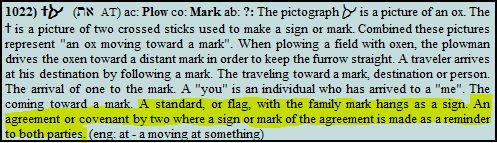
This is the root for the word sign. This is significant because the Torah is a sign on the hand and the forehead (Deuteronomy 6:8). The mark of YHWH is His Torah. The mark of the beast is lawlessness for the beast is the man of sin (2 Thessalonians 2:3; Psalm 130:3; Jeremiah 2:22; Job 10:14) . Again, the mark of the beast is a direct counterfeit of YHWH’s mark/signs.
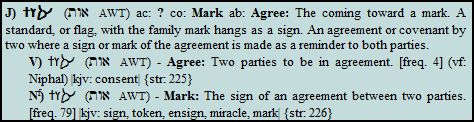
תא is related to the word תו ‘tav’ and את and means a mark/boundary.

תא relates to the word תר ‘tar’ which means the ‘mark of man’ or the border/outline.
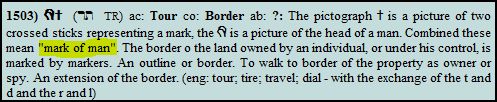
From this root we get תאר ‘ta’ar’ and תואר ‘to’ar.’ These words mean form, outline or border. This is an important connection to see in that the mark of the beast versus the mark of YHWH ultimately reflects whose image/form you are in.

This connection between the mark and the image/form/outline/shadow picture of YHWH versus the antichrist is further seen in that the word Torah comes from this same root.

We can have the mark of YHWH and be in His image by walking in His Torah and letting Messiah live through us (Galatians 2:20), or we can have the mark of the beast and be in the image of satan by walking in his ‘torah’ which is lawlessness (Ephesians 2:2-3Isaiah 30:8-11; 1 Peter 2:8) .
We can choose the tree of life or the tree of knowledge. The Light of the Word or the false light which is in reality darkness (Matthew 6:23).
Connection to the resurrection
Rom 1:1 Paul, a slave of Jesus Christ, a called apostle, separated to the gospel of God,
Rom 1:2 which He promised before through His prophets in the holy Scriptures,
Rom 1:3 concerning His Son who came of the seed of David according to flesh,
Rom 1:4 who was marked out the Son of God in power, according to the Spirit of holiness, by the resurrection of the dead, Jesus Christ our Lord;
G3724
ὁρίζω
horizō
Thayer Definition:
1) to define
1a) to mark out the boundaries or limits (of any place or thing)
1b1) that which has been determined, acc. to appointment, decree
1b2) to ordain, determine, appoint
Part of Speech: verb
A Related Word by Thayer’s/Strong’s Number: from G3725
This connection to the horizon is seen in the equinox/’tequfah’ of the Spring which displays the image of the cross.
The meaning of this word corresponds to the Hebrew word תור ‘tor.’ It is only through the resurrection that we will be formed into His image.
1Jn 3:1 See what manner of love the Father has given us, that we may be called children of God. For this reason the world does not know us, because it did not know Him.
1Jn 3:2 Beloved, now we are the children of God, and it was not yet revealed what we shall be. But we know that if He is revealed, we shall be like Him, because we shall see Him as He is.1Co 1:18 For the Word of the cross is foolishness to those being lost, but to us being saved, it is the power of God.
Believers look to the Word of the cross. The Word of the covenant. Faith comes by hearing, and hearing by the Word of God (Romans 10:17). Not by vision, not of images & symbols (2 Corinthians 5:7).
The covenant with YHWH is His Word which was cut with Abraham at Passover (Genesis 15) and eternally solidified at Passover when Messiah hung on the tree. The ‘covenant’ with the adversary was ‘cut’ in Genesis 3 at the tree of knowledge of good and evil and the ‘agreement’ of ‘ye shall not die’ was passed down through the ages via the mystery religions and was represented by the image of the cross.
The English word ‘resurrection’ comes from the Latin ‘resurrectionem’ which means a rising again from the dead from the root ‘resurgere’ which means to rise again.
Resurgere’ is the source of the English word ‘resurgent’ which means to ‘rise again’ from the root ‘surgere’ which means to rise as in a rising stream or fountain. As mentioned previously, a fountain or spring is linked to the resurrection and is also the source of a thing in Hebrew thought. The English word for ‘source’ comes from the Hebrew word שרש ‘sheresh’ which means the root of a plant. According to Isaac Mozeson, שרש ‘sheresh’ is also the source of the Latin word ‘surgere’ which means to rise, as in a plant rising out of the ground. Interestingly, the Hebrew word for rise is קם ‘qum’ which is speaking of a plant rising out of the ground. A related word is כן ‘kun’ which is speaking of a seed planted in the ground which dies then ‘resurrects.’ When the seed opens the roots begin to form the base of the plant by going down into the soil. The plant rises out of the ground forming the stalk of the plant.
The word resurrect is not seen in the TaNaKH. The two words just mentioned, קם & כן have the sense of rising but are not translated as resurrect in the Scriptures. The first mention of the word resurrection is found in the book of Matthew.
Mat 22:23 On that day, Sadducees, who say there is no resurrection, came to Him. And they questioned Him,
Mat 22:24 saying, Teacher, Moses said, If any should die not having children, his brother shall marry his wife, and shall raise up seed to his brother. Deut. 25:5
Mat 22:25 And seven brothers were with us. And having married, the first expired, and not having seed left his wife to his brother.
Mat 22:26 In the same way also the second, and the third, until the seven.
Mat 22:27 And last of all, the woman also died.
Mat 22:28 Then in the resurrection, of which of the seven will she be wife? For all had her.
Mat 22:29 And answering, Jesus said to them, You err, not knowing the Scriptures nor the power of God.
Mat 22:30 For in the resurrection they neither marry nor are given in marriage, but they are as the angels of God in Heaven.
Mat 22:31 But concerning the resurrection of the dead, have you not read that spoken to you by God, saying:
Mat 22:32 “I am the God of Abraham, and the God of Isaac, and the God of Jacob?” God is not God of the dead, but of the living. Ex. 3:6
This portion of Scripture is found in Exodus 3 where YHWH declares His Name to Moses. His Name is His Word/Mark.
Rom 1:1 Paul, a slave of Jesus Christ, a called apostle, separated to the gospel of God,
Rom 1:2 which He promised before through His prophets in the holy Scriptures,
Rom 1:3 concerning His Son who came of the seed of David according to flesh,
Rom 1:4 who was marked out the Son of God in power, according to the Spirit of holiness, by the resurrection of the dead, Jesus Christ our Lord;
G3724
ὁρίζω
horizō
Thayer Definition:
1) to define
1a) to mark out the boundaries or limits (of any place or thing)
1b1) that which has been determined, acc. to appointment, decree
1b2) to ordain, determine, appoint
Part of Speech: verb
A Related Word by Thayer’s/Strong’s Number: from G3725
It is only through the resurrection that we will be formed into His image.
1Jn 3:1 See what manner of love the Father has given us, that we may be called children of God. For this reason the world does not know us, because it did not know Him.
1Jn 3:2 Beloved, now we are the children of God, and it was not yet revealed what we shall be. But we know that if He is revealed, we shall be like Him, because we shall see Him as He is.
ὁρίζω ‘horizō’ is the source of the English word ‘horizon.’
The mark of the beast being the antithesis to the mark of YHWH (the Torah) is further emphasized by delving into the meaning and usage of the Aramaic word for mark (ruoshma).

2Co 3:7 Now if the ministration of death was engraved (‘aetrashmat’)* upon stones in writing, and was so glorious that the children of Israel could not look on the face of Moses, on account of the glory upon his face which vanished away;
*Here we see this word being linked to the Torah which was engraved on stone. In the human body the ‘word’ is engraved on stone (DNA)…
Rom 8:29 He knew them in advance and he marked (Greek predestined) them with the likeness of the image of his Son that he might be the first-born among many brethren.
Again the connection to the mark and the image. The image of the Son vs. the image of the beast.
Eph 1:4 according as he had previously chosen us in him, before the foundation of the world, that we might be holy and without blame before him; and, in love, predestinated (Aramaic – chosen) us for himself;
The chosen people are marked with the mark of YHWH…those who keep the Torah and the testimony (belief in Messiah Jesus Revelation 12:17). Those with the mark of the beast are those who reject Messiah Jesus and according to the Scriptures are already antichrists (1Joh 2:18).
Eph 1:11 By whom we have been chosen, as he had marked (Greek. predestinated) us from the beginning so he wanted to carry out everything according to the good judgment of his will:
This connection of predestination and being marked is connected by the heavenly books.
Psa 56:8 You have counted my wandering; O put my tear in Your bottle; are they not in Your Book?
Psa 139:16 Your eyes saw my embryo; and in Your book all my members were written the days they were formed, and not one was yet among them. *
Mal 3:16 Then those fearing YHWH spoke together, each man to his neighbor. And YHWH gave attention and heard. And a Book of Remembrance was written before Him for those who feared YHWH, and for those esteeming His name.
The word ‘Ruoshma’ in the Aramaic Peshitta = the Greek word προορίζω ‘proorizo.’
G4309
προορίζω
proorizō
Thayer Definition:
1) to predetermine, decide beforehand
2) in the NT of God decreeing from eternity
3) to foreordain, appoint beforehand
Part of Speech: verb
A Related Word by Thayer’s/Strong’s Number: from G4253 (pro – before) and G3724 (horizo mark out)
G3724
ὁρίζω
horizō
Thayer Definition:
1) to define
1a) to mark out the boundaries or limits (of any place or thing)
1b1) that which has been determined, acc. to appointment, decree
1b2) to ordain, determine, appoint
Part of Speech: verb
A Related Word by Thayer’s/Strong’s Number: from G3725
The meaning of ὁρίζω ‘horizo’ is linked with the above definition of ‘mark.’ It means to mark out a boundary. The English word horizon comes from this Greek word.

This word obviously links to the sun as it is the horizon where the sun rises and sets. It further linked to ‘predestination’ as we are chosen before the foundation of the world (Ephesians 1:4). In Hebrew this is the concept of עלם ‘olam’ which is usually translated as forever or eternity but in concrete thought means ‘beyond the horizon.’ In part 2 of the series on the mark of the beast, more details are given on the sun as it is strongly linked with the mark of the beast. The word for time in Hebrew, עת, means to ‘see the mark.’
What is this ‘mark’? It is the sun setting (death) and rising (resurrection) above the horizon.
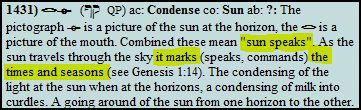
Rom 1:1 Paul, a slave of Jesus Christ, a called apostle, separated to the gospel of God,
Rom 1:2 which He promised before through His prophets in the holy Scriptures,
Rom 1:3 concerning His Son who came of the seed of David according to flesh,
Rom 1:4 who was marked out the Son of God in power, according to the Spirit of holiness, by the resurrection of the dead, Jesus Christ our Lord;
Murdock Aramaic Translation
Rom 1:4 and was made known as the Son of God, by power, and by the Holy Spirit,) who arose from the dead, Jesus Messiah, our Lord,
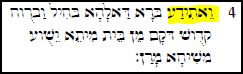
ואתידע ‘vayteedah’ corresponds to the Hebrew ידע ‘yada’ – to make known. The literally meaning of ידע ‘yada,’ is when man and woman come together and become one. When the seed is planted in the womb. This leads to a child being born, bursting forth from the womb. Resurrection from the dead is the same concept. The seed of the Word is planted in our hearts, this is the literally meaning of ‘born again’. It literally means to be conceived from above. We die, just as the seed must die in the earth. We are then resurrected by the power of the Holy Spirit as new creatures, just as the plant springs forth from the earth.
It was declared that He is the Son by the resurrection
Rom 1:4 who was marked out the Son of God in power, according to the Spirit of holiness, by the resurrection of the dead, Jesus Christ our Lord;
Related Studies:
littleguyintheeye@gmail.com


