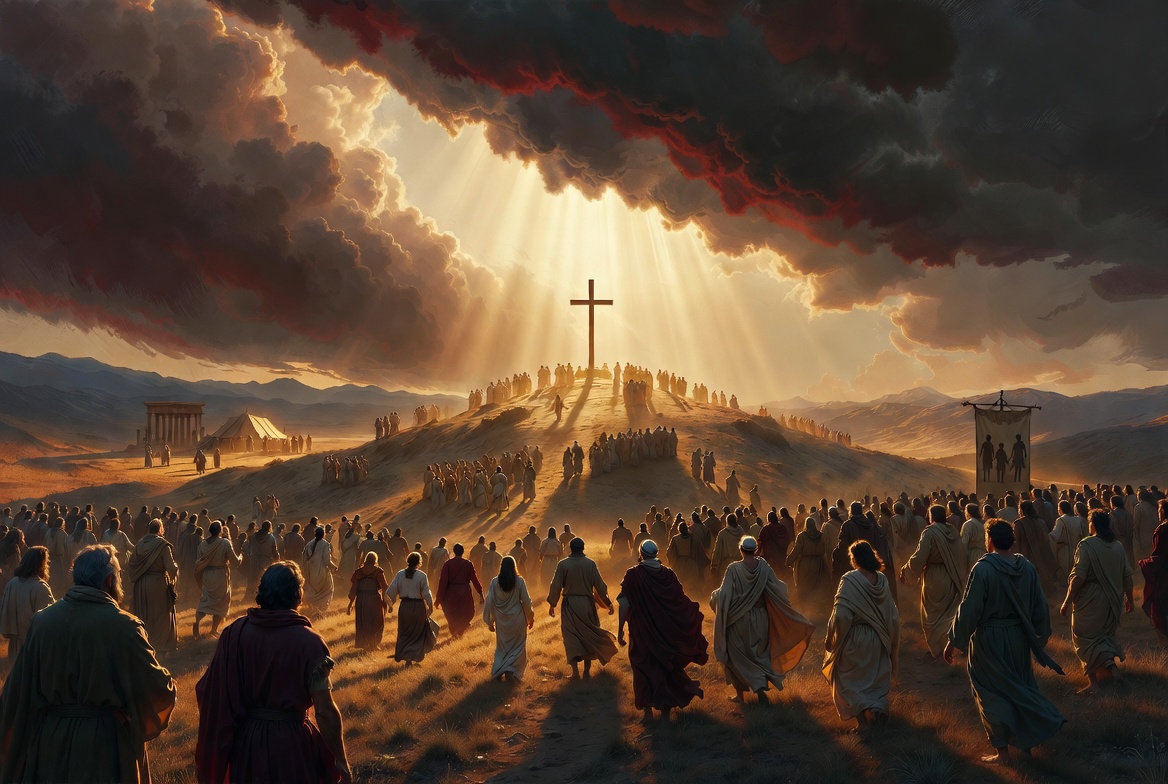

The crucifixion of Christ is more than His suffering and our forgivness—it is the ultimate act of gathering. From the Hebrew root saphach (to gather/cleave, source of “crucifixion”), Messiah draws all peoples into one new family through His blood (Ephesians 2). This tidbit explores how the cross fulfills the Father’s desire for a dwelling place, unites Jew and Gentile as one new man, and reveals the patterns (tabniyt from ben = son) woven throughout Scripture pointing to the Son who builds the true house of God.
Joh 12:32 And I, if I be lifted up from the earth, I will draw all to Myself.
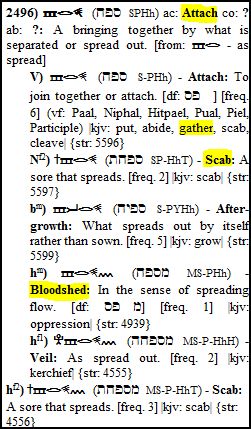
The word crucifixion comes from the Hebrew ספח ‘saphach’ which means to gather and bloodshed.
Messiah gathers His people through the cross.
Joh 10:11 I am the Good Shepherd! The Good Shepherd lays down His life on behalf of the sheep.
Joh 10:14 I am the Good Shepherd, and I know those that are Mine, and I am known by the ones that are Mine.
Joh 10:15 Even as the Father knows Me, I also know the Father; and I lay down My life for the sheep.
Joh 10:16 And I have other sheep which are not of this fold. I must also lead those, and they will hear My voice; and there will be one flock, one Shepherd.
Joh 10:17 For this reason My Father loves Me, because I lay down My life, that I may take it again.
Eph 2:11 Because of this, remember that you, the nations, were then in the flesh (those having been called Uncircumcision by those having been called Circumcision in the flesh made by hands)
Eph 2:12 that at that time you were without Christ, alienated from the commonwealth of Israel and strangers of the covenants of promise, having no hope and without God in the world.
Eph 2:13 But now, in Christ Jesus you who then were afar off, came to be near by the blood of Christ.
Eph 2:14 For He is our peace, He making us both one, and breaking down the middle wall of partition,
Eph 2:15 in His flesh causing to cease the enmity, the Law of the commandments in decrees, that He might in Himself create the two into one new man, making peace,
Eph 2:16 and might reconcile both in one body to God through the cross, slaying the enmity in Himself.
Eph 2:17 And coming, He proclaimed “peace to you, the ones afar off, and to the ones near.” Isa. 57:19
Eph 2:18 For through Him we both have access by one Spirit to the Father.
Eph 2:19 So, then, you are no longer strangers and tenants, but you are fellow citizens of the saints and of the family of God,
Eph 2:20 being built up on the foundation of the apostles and prophets, Jesus Christ Himself being the cornerstone,
Eph 2:21 in whom all the building being fitted together grows into a holy temple in the Lord,
Eph 2:22 in whom you also are being built together into a dwelling place of God in the Spirit.
Isaiah prophesies of this exact occurrence which comes forth from the crucifixion of Messiah. Amazingly, the word for ‘cleave’ is Isaiah 14 where this is prophesied of is ספח ‘saphach’ which is the origin of the word crucifixion.
Isa 14:1 For the LORD will have mercy on Jacob, and will yet choose Israel, and set them in their own land: and the strangers shall be joined with them, and they shall cleave to the house of Jacob.
The end of the exile is likened to wounds being bound up.
Psa 147:2 The LORD doth build up Jerusalem: he gathereth together the outcasts of Israel.
Psa 147:3 He healeth the broken in heart, and bindeth up their wounds.
The word for wounds here is עצבת ‘atstsebet’ which is what is used in reference to the punishment of Adam and Eve in Genesis 3. The word for bind is חבש ‘chavash ‘which comes from the root חב ‘chav’ which means to bind or join together. It is also the root of the word ‘stripes’ which the Messiah received so that mankind may be healed.
Isa 53:5 But He was wounded for our transgressions; He was bruised for our iniquities; the chastisement of our peace was upon Him; and with His wounds we ourselves are healed.
1Pe 2:24 who “Himself carried up in His body our sins” onto the tree; that dying to sins, we might live to righteousness, of whom “by His wound you were healed.”
1Pe 2:25 For you were “as sheep going astray,” but now you turned back to the Shepherd and Overseer of your souls. Isa. 53:4-6
The Family
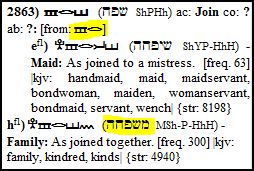
It is amazing to note that the Hebrew word for family משפחה ‘mishpochah’ comes from the same root as ספח ‘saphach’ mentioned above as the origin of the word crucifixion. The Greek word for family is πατρια ‘patria’ which comes from the word πατηρ ‘patēr’ which means father. The Hebrew word for father is אב ‘av’ which is spelled ‘aleph’ ‘bet’…
Father
אב ‘av’ has the meaning of a pole:
In English, the word ‘pole’ comes from the Old English pal which traces back to the Latin palus, which literally means a stake. The English word ‘pale’ derives from this word. ‘Pale’ means to fix or fasten and is related to the English word ‘pact.’ A pact is an agreement, treaty, compact which comes from the Latin word pactum which means a contract/covenant. A covenant through a pole/stake… Here we see אב ‘av,’ the first word alphabetically of the Hebrew language pointing to the most important event in human history. The crucifixion of Messiah Jesus , and the New Covenant (Isaiah 42:6; Matthew 26:28) in His blood which restores mankind back to the Father.
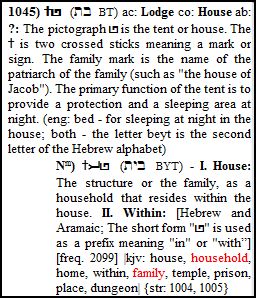
The concrete meaning of the word אב ‘av’ is the pole/pillar of the house/tent. This traces back to another Hebrew word for family בת ‘bet.’
Literally, the word בת ‘bet’ means the ‘mark of the house.’ This was seen in ancient times in the flag or banner placed in front of the tent with the name or symbol of the family.
Isa 11:10 And it shall be in that day, the Root of Jesse stands as a banner of peoples; nations shall seek to Him; and His resting place shall be glory.
Psa 20:5 We will rejoice (רנן ‘ranan’ shout for joy, sing, triumph) in thy salvation(ישׁוּעה ‘yeshu‛ah’), and in the name of our God we will set up our banner (דּגל ‘dagal’ raise a flag, conspicuously)
Ps 60:4: “Thou hast given a banner to them that fear thee, that it may be displayed (נוּס ‘nus’ lift up a standard) because of the truth. Selah.”
Joh 3:14 And even as Moses lifted up the serpent in the wilderness, so must the Son of Man be lifted up,
Joh 3:15 that everyone believing into Him should not perish, but have everlasting life.
The word father is a great example of all languages tracing back to Edenic Hebrew. Father in Hebrew is אב ‘av’ aleph bet.
א aleph ב bet are the first two letters of the ‘aleph-bet’ from whence comes the English alpha-bet.
All of creation comes forth from the Word according to Psalm 33:6. Words are made up of letters (the Aleph-Betclick here) which points to Messiah who is the Alpha & Omega/Aleph-Tav which is a term meaning totality, as in the complete Alpha-Beta of the Greek or Aleph-Bet of the Hebrew.
Interestingly, the word ‘Bible’ in English comes from the Hebrew word אבוב which means a pipe and is also the source of the word papyrus which ancient Bibles were written upon. The word for booby and baba comes from אבוב as well. Again this traces back to אב who is the source of the milk of the Word (1Peter 2:2). Peter was quoting from Psalm 34:8 which speaks of ‘tasting’ and seeing that God is good and blessed are those who ‘trust’ in Him. The word ‘trust’ comes from ‘chasah’ which means a firm support, again tracing back to the meaning of אב father which literally means the strong one/support of the house.
The father is the strength of the house. The teacher, the guide of the family. The letter ב bet represents the house/family consisting of male and female as the ancient nomadic tent was made of two parts, one for the male and the other for the female. Man was made in the image of God, male and female (Genesis 1:27). אב ‘AB’ is the word for the source. This passes into Latin as ‘ab’ and Greek as απο ‘apo’ which is portrayed in the Hebrew as מ mem. The letter Mem is a pictograph for water and the womb. The waters in the beginning and the womb of the mother. Again the Father’s character consists of both ‘male’ and ‘female.’ This is further seen in that father means one who provides food, which is seen in the female breasts. This word in Hebrew is דוד dod which is the source of the English word dad.
Fruit on a pole is another translation of אב. This again points to the source of the next generation. The word fruit comes from the Old English meaning a brook which links again to water. The Old English word for fruit also means joy, eat, and cohabit, again tracing back to אב. Joy links to love who is God (1 John 4:16). This is seen in the tent in the Hebrew word חשק chashaq. ‘Chashaq’ has the meaning of being knit together in love (Deuteronomy 7:7; Psalm 91:14) and is used in Exodus 38:17, 28 for the joining together of the Tabernacle.
The English word father comes from πατηρ ‘pater’ in Greek which traces back to פטר ‘pater’ in Hebrew which means the breaking forth of something such as a child being born, or the seed in fruit to continue the next generation. פר ‘par’ means fruit, and the breaking open of the heads of grain to reveal the seed inside.
נב ‘nav’ is another word for fruit and carries this same meaning, the fruit inside. It is no surprise that the first and last letters of the Bible (Genesis-Revelation) consist of these two letters. The reverse is בן ‘ben’ which means son. The son is the seed of the father that continues the house.
The father is the protector of the family and is seen in איב ‘oyev’ the point of a tent pole used to protect the family against enemies. This can also be seen in the spear which is used to protect, defend or to kill and eat.
Dad comes from דוד ‘dod’ which means the breasts, the source of food, life – milk. Interestingly, milk contains protein which comes forth from 22 amino acids linking to the 22 letters of the Hebrew aleph-bet…taste and see that He is good (Psalm 34:8).
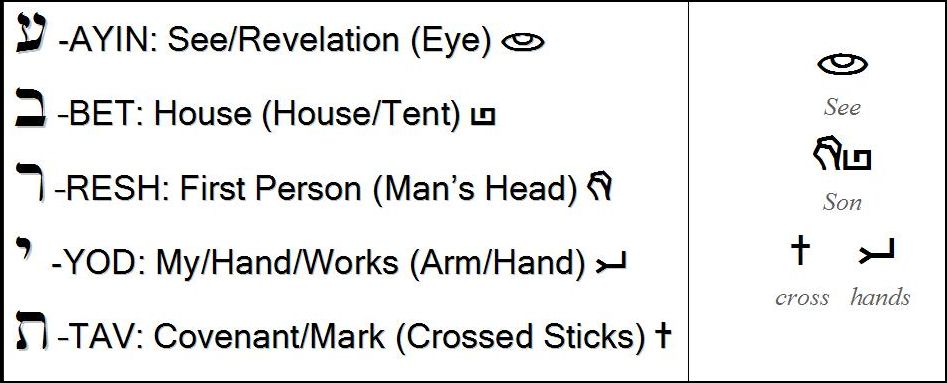
The Hebrew word for the Hebrew language is עברית ‘ivrit.’ עברית ‘ivrit’ comes from the root בר ‘bar’ which means ‘pure.’ Hebrew breaks down pictographically as thus:
ע ayin means to see
בר bet-resh is pure, but translated as son in Psalm 2. It used for son in the Aramaic portions of the Tanakh
י yod is a hand
ת tav is a cross
The pictographs of the word עברית ‘ivrit’ (Hebrew) means to ‘see the pure Son with hands on the cross.’ The Hebrew language was designed to reveal the Gospel. It is through the work of Messiah on the cross that all mankind is brought back to the Father.
Joh 12:32 And I, if I be lifted up from the earth, I will draw all to Myself.
The Lamb Slain from the Foundation of the World
Gen 1:1 In the beginning God created the heavens and the earth

The first word of the Scriptures is בְּרֵאשִׁ֖ית ‘bereshiyt’ (In the Beginning). It has the numerical value of 913. God the Father in Greek has an exact numerical equivalent. In Hebrew the first word of the language is father אב.
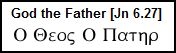
Interestingly, 913 also is associated with His House. The first letter of the Scriptures is an enlarged bet. The bet in Hebrew means the house.
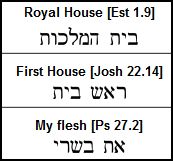
Messiah Jesus connects the house to His flesh.
Joh 2:19 Jesus said to them, Destroy this sanctuary, and in three days I will raise it up.
Joh 2:20 Then the Jews said, This sanctuary was forty six years being built, and do You raise it up in three days?
Joh 2:21 But He spoke about the sanctuary of His body.
The Enlarged Bet
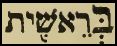
This first letter of the Scriptures is enlarged. This is one of the peculiar letters in the Scriptures which is not the normal size. Messiah Jesus referred to these as ‘jots and tittles’ in Matthew 5:18. The letter Bet means a house.
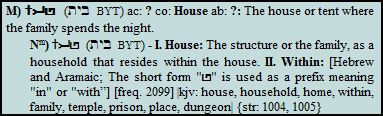
This is the primary purpose of Creation. The Almighty desired to have a physical dwelling. To build a house, a man takes a bride who establishes the home where children are born and raised. This is the desire of our Creator. To have a physical dwelling with His bride where many sons will be brought to glory (Hebrews 2:10).
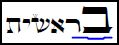
Taking the first two letters gives the word ‘bar’, which means son in Aramaic
A House for His Son
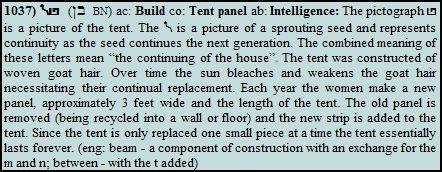
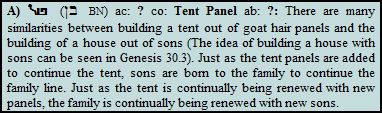
Notice the connection between the tent/house and a son.

‘Bar’ – Son
Psa 2:12 Kiss the Son (בר ‘bar’), lest He be angry, and you perish from the way, when His wrath is kindled but a little. Oh the blessings of all those who flee to Him for refuge!
“Rabbi Johanan said, ‘The world was created for the sake of the Messiah, what is this Messiah’s name?’ The school of Rabbi Shila said, ‘his name is Shiloh, for it is written, until Shiloh comes. (Genesis 49:10)’” [Babylonian Talmud, Sanhedrin 98b]
This word בן ‘ben’ teaches of the Messiah in another fashion as well. The word for pattern in Hebrew is תבנית ‘tabniyt’ which comes from the root בן ‘ben.’

The patterns, types, and shadows in the Scriptures point to the SON.
Heb 9:24 For Christ did not enter into the Holy of Holies made by hands, types of the true things, but into Heaven itself, now to appear in the presence of God on our behalf,
Heb 10:1 For the Law had a shadow of the coming good things, not the image itself of those things. Appearing year by year with the same sacrifices, which they offer continually, they never are able to perfect the ones drawing near.
Heb 8:5 who serve the pattern of and shadow of heavenly things, even as Moses was divinely warned, being about to make the tabernacle: For He says, “See that you make all things according to the pattern being shown to you in the mount.” Exodus 25:40
Rom 5:14 but death reigned from Adam until Moses, even on those who had not sinned in the likeness of Adam’s transgression, who is a type of the coming One.
1Co 10:6 But these things became examples for us, so that we may not be lusters after evil, even as those indeed lusted.
Torah is a shadow picture of Messiah
H8452
tôrâh
Total KJV Occurrences: 1
manner, 1
תּורה
2Sa 7:19 And this was yet a small thing in thy sight, O Lord GOD; but thou hast spoken also of thy servant’s house for a great while to come. And is this the manner (תּורה ‘torah’) of man, O Lord GOD?
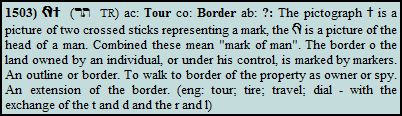



The Torah is a shadow of the Messiah. It is the form of His ‘image’. He is the reality of that image.
Col 2:16 Then do not let anyone judge you in eating, or in drinking, or in part of a feast, or of a new moon, or of sabbaths,
Col 2:17 which are a shadow of coming things, but the body is of Christ.
The Tabernacle/the Tent/House is a shadow of Messiah. The earthly Tabernacle was to be in the pattern of the Heavenly.
Exo 25:9 According to all that I shew thee, after the pattern of the tabernacle, and the pattern of all the instruments thereof, even so shall ye make it.
Exo 25:40 And see that they are made by their patterns which you were caused to see in the mountain.
Heb 8:5 who serve the pattern of and shadow of heavenly things, even as Moses was divinely warned, being about to make the tabernacle: For He says, “See that you make all things according to the pattern being shown to you in the mount.”
the word for pattern is:
H8403
תּבנית
tabnîyth
BDB Definition:
1) pattern, plan, form, construction, figure
The root of tabniyth is ben (tent panel/son).
The sages speak of this pattern as the Torah
Beresheti Rabba:

Back to the letter, bet…
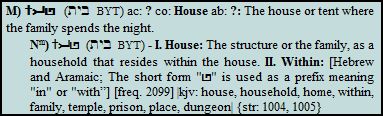
This word comes from the root:

Again this word connects to Messiah.
This idea of a family mark is seen in the banners that were set up for each house of the children of Israel in the wilderness (Numbers 2). Who is our banner? It is Messiah (Psalm 20:5; 60:4; Isaiah 11:10-12; 62:10-11).
The Lamb slain from the foundation of the world found in the pictographic meaning of ‘bereshit’.
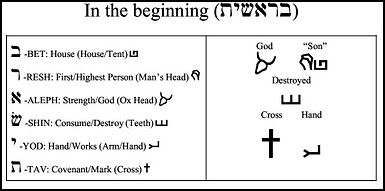
Rev 13:8 And all those dwelling in the earth will worship it, those of whom the names had not been written in the Book of Life of the Lamb having been slain from the foundation of the world.
Num 21:8 And Jehovah spoke to Moses, Make yourself a fiery serpent, and set it on a pole; and it shall be that when anyone is bitten, when he sees it, he shall live.
The word for pole here is נס ‘nes’ which is also translated as flag/banner
littleguyintheeye@gmail.com

 Little Guy in the Eye