
The word mother is a good place to look for the tongue behind the tongues. In Hebrew the mother is אם — strong waters, the glue of the house. מ is water, and also “from”: the source. Eve is called the mother of all living. Peoples, עם, sits next to אם. Father is source too. Scripture says mankind was made in His image, male and female; He Himself is Spirit.Latin ab means “from,” and its first use in the Vulgate is the dividing of the waters. Mem is a picture of those waters. Its number is forty: the Flood, the weeks of the womb, the days before the Jordan. Baptism is a womb and a tomb. There is an open mem and a closed mem. Once in the Hebrew text the closed form appears where it should not — a sign that the Prince of Peace would come from a closed womb. The Spirit hovered over the waters like a bird over a nest. Dry land rose on the third day. A man must be born of water and of the Spirit. The Word is the incorruptible seed.
Two days ago was ‘Mother Language Day’ so it would be a good time to share a tidbit on the word ‘mother’ and how it displays the true ‘Mother Language’ of all tongues, Hebrew/Edenics.
Mother
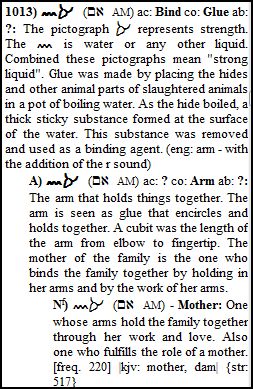
The mother is the אם ‘strong waters’ or glue that holds the house/family together. מ ‘mem’ means waters and also the source or origin as it is affixed to Hebrew words as a prefix meaning ‘from’ or ‘out from’ indicating a source. This is no surprise as it is the mother from whence all mankind comes, as is spoken of in Scripture.
Gen 3:20 And the man called the name of his wife, Eve; because she became the mother of all living.
It is also no surprise then that the word for peoples עם ‘am’ is related to the word for mother אם ’em’ as א & ע “sound a like” and have similar meanings in words. The Hebrew word for father also means the source. In Proto-Japanese the word for mother is ‘papa.’ This is because our Heavenly Father is both ‘male and female.’ Not literally as He is Spirit (John 4:24), but Scripture speaks of ‘adam’ or mankind being created in His Image, both male and female (Genesis 1:27).
This is further seen in the Latin word ‘ab’ which means source or origin.
The Latin word ‘ab’ which ultimately means ‘from the source’ comes from the Hebrew word ‘min’ and then traces back and links to the Hebrew word אב ‘ab’ which means ‘Father’ who is the source of all.

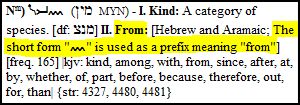

Ancient Hebrew Lexicon of the Bible pg 27
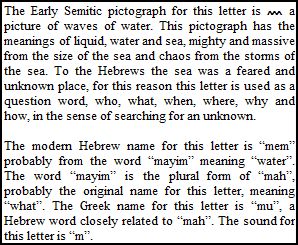
Gen 1:2 and the earth being without form and empty, and darkness on the face of the deep, and the Spirit of God moving gently on the face of the waters,
Gen 1:3 then God said, Let light be! And there was light.
A Womb and a Tomb
“Mem is already associated with water and cleansing, but the depth of symbolism goes even further. In both Jewish and Christian understanding, immersion/baptism is a place of death and rebirth. Our old self dies, and our we are born again, clean and renewed. As if this simple symbolism were not enough, the letter Mem literally illustrates this concept.
There are two forms of the letter Mem, one used at the beginning or middle of words (open), and one only used to end a word (closed).
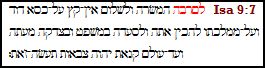
In the Hebrew text an amazing mystery is revealed showing that the Prince of peace will come from the closed womb. The closed mem should only occur at the end of a word, but in the text it occurs in the middle. This is the only time in Scripture that this happens.
In Genesis 8, Noah sends forth a dove to when the waters had subsided enough for the earth to be seen. This too, is a symbol of rebirth. All throughout Scripture, the number 3 is associated with resurrection as can be seen in the Book of Jonah and the resurrection of Messiah for examples. On the third day, the earth came forth out of the waters and brought forth life.
Gen 1:9 And God said, Let the waters under the heavens be collected to one place, and let the dry land appear. And it was so.
The Spirit is linked with rebirth
1Pe 3:18 Because even Christ once suffered concerning sins, the just for the unjust, that He might bring us to God; indeed being put to death in the flesh, but made alive in the Spirit;
Rom 8:11 But if the Spirit of the One having raised Jesus from the dead dwells in you, the One having raised the Christ from the dead will also make your mortal bodies live through the indwelling of His Spirit in you.
Born Again from Above click here by the Spirit/Word
Joh 3:3 “Yes, indeed,” Yeshua answered him, “I tell you that unless a person is born again from above, he cannot see the Kingdom of God.”
Joh 3:5 Jesus answered, Verily, verily, I say unto thee, Except a man be born of water and of the Spirit, he cannot enter into the kingdom of God.
Tit 3:5 He saved us, not by works of righteousness which we have done but according to His compassion, through the washing of rebirth, and renewal by the Set-apart Spirit,
1Pe 1:23 Being born again, not of corruptible seed, but of incorruptible, by the word of God, which liveth and abideth for ever.
1Jo 3:9 Whosoever is born of God doth not commit sin; for his seed remaineth in him: and he cannot sin, because he is born of God.
Jam 1:18 Of his own will begat he us with the word of truth, that we should be a kind of firstfruits of his creatures.
Jas 1:21 On account of this, putting away all filthiness and overflowing of evil, in meekness receive the implanted Word being able to save your souls.
Jonah’s name, who was ‘resurrected’ after 3 days and nights in the belly of the fish, means a dove. Again the link between the Spirit and rebirth.
H3124
Gen 1:2 and the earth being without form and empty, and darkness on the face of the deep, and the Spirit of God moving gently on the face of the waters,

‘The Spirit of God hovered over/moving over the waters’

A replay of this was seen when the virgin Mary conceived and brought forth the Messiah…the Light of the world. The Spirit hovered over her ‘waters/womb’, the Seed (the Word) was implanted and she brought forth the Tree of Life.
Luk 1:35 And answering, the angel said to her, The Holy Spirit will come upon you, and the power of the Most High will overshadow you, and for this reason that Holy One being born of you will be called Son of God.
Mic 5:2 et tu Bethleem Ephrata parvulus es in milibus Iuda ex te mihi egredietur qui sit dominator in Israhel et egressus eius

Jer 17:13 O LORD, the hope
אביב
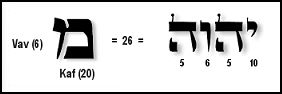
Kaf is the picture of a hand. Vav is a picture of a nail. A nail in the hand. This connects to the name Yahweh even further:
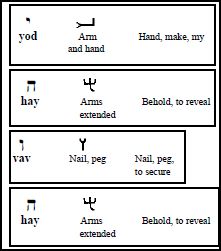
‘Min’ comes from the following root:
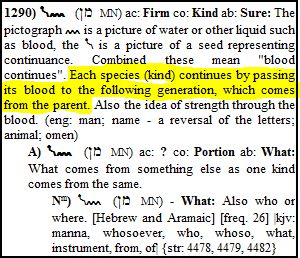
Notice that this word traces back to the blood/kind that is inherited from the father (
The English word ‘from’ comes from the Gothic ‘fram’ which corresponds to the Proto-Indo-European ‘pr’ which traces back to the Greek word ‘pro.’ ‘Pro’ means ‘before, forward, in place of’ which again traces back to the Hebrew word ‘min.’Messiah came from the Father
All things come forth FROM Messiah
Matter
The English word matter comes from the Latin ‘materia’ which means the inner wood of a tree. As seen in Genesis 1:9-13
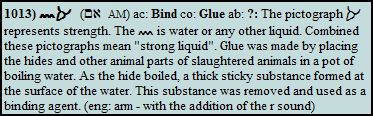
‘Mater’ in Latin also means the source/mother. In Hebrew, the word for mother is
A Dictionary of Word Origins pg 341 “Matter”
Matter
Matrix of water
Biblical Basis of Modern Science pg 217
“It is significant that, long before men realized this universality of material structure, the bible had indicated that all things, including even human bodies, were made of the dust of the earth.
These basic elements were originally created (Gen. 1:1) as the fundamental components of matter in the space-matter-time cosmos (‘heavens’ – ‘earth’ – ‘beginning’) called into existence by the omnipotent Word of God (John 1:1-3). This basic ‘unformed’ earth material (Gen. 1:2) was then ‘made ‘ or ‘formed’ by God into complex systems. Originally suspended and dispersed in a
It is interesting that in Maidu Indian the word ‘mom’ means water. In Chinese, ‘mu yu’ means bath. In Japanese ‘umi’ means sea. In Ancient Egyptian water was ‘aman’ and ‘nun.’ The relation between ‘mom’ and water is also seen in Hebrew through the word
The origin of the word matrix, comes from ‘madrigal.’
Dictionary of Word Origins pg 332 ‘Madrigal’
“Etymologically,
Amazingly, all matter comes forth from a matrix of water in the beginning and was manifested through sound/a song.
Elegant Universe pg 14
“Matter is composed of atoms, which in turn are made from quarks and electrons. According to string theory, all such particles are actually tiny loops of vibrating string.”
Elegant Universe pg 15
“String theory proclaims, for instance, that the observed particle properties, are a reflection of the various ways in which a string can vibrate. Just as the strings on a violin or on a piano have resonant frequencies at which they prefer to vibrate – patterns that our ears sense as various musical notes and their higher harmonics – the same holds true for the loops of string theory….each of the preferred patterns of vibration of a string in string theory appears as a particle whose mass and force changes are determined by the string’s oscillatory pattern.”
It is no surprise that pipe, as in a musical instrument, comes from
Going back to the etymology of mom/mother it is seen that numerous languages display this
http://www.wikihow.com/Say-Mother-in-Different-Languages
Catalan mamà / mama
Portuguese mãe / mamãe
French maman
Italian mamma
Polish mama
Romanian mama / mamă
Spanish mamá
Swedish mamma
Norwegian mamma
English mama/mom,
Dutch mama
German Mama
Russian мама (mama)
Greek μήτηρ (meter)
μαμα (mama)
In Hungarian anυα
Kutenai Ma
In Vietnamese, mẹ. Má and ba respectively in Southern Vietnamese.
Korean, eomma [ʌmma]
Tagalog nánay or ináy (diminutives of iná “mother”)
Afrikaans Moeder, Ma
Albanian Nënë, Mëmë
Arabic Ahm
Aragones Mai
Asturian Ma
Aymara Taica
Azeri Ana (Latin Script)
Basque Ama
Belarusan Matka
Bergamasco Màder
Bolognese Mèder
Bosnian Majka
Brazilian Portuguese Mãe
Bresciano Madèr
Breton Mamm
Bulgarian Majka
Byelorussian Macii
Calabrese Matre, Mamma
Caló Bata, Dai
Catalan Mare
Cebuano Inahan, Nanay
Chechen Nana
Croatian Mati, Majka
Czech Abatyse
Danish Mor
Dutch Moeder, Moer
Dzoratâi Mére
Esperanto Patrino, Panjo
Estonian Ema
Faeroese Móðir
Finnish Äiti
Flemish Moeder
French Mère, Maman
Frisian Emo, Emä, Kantaäiti, Äiti
Furlan Mari
Galician Nai
German Mutter
Greek Màna
Griko Salentino, Mána
Hawaiian Makuahine
Hindi – Ma, Maji
Hungarian Anya, Fu
Icelandic Móðir
Ilongo Iloy, Nanay, Nay
Indonesian Induk, Ibu, Biang, Nyokap
Irish Máthair
Italian Madre, Mamma
Japanese Okaasan, Haha
Kannada Amma
Kurdish Kurmanji – Daya
Ladino Uma
Latin Mater
Leonese Mai
Ligurian Maire
Limburgian Moder, Mojer, Mam
Lingala Mama
Lithuanian Motina
Lombardo Occidentale Madar
Macedonian Majka
Malay Emak
Maltese Omm
Mantuan Madar
Maori Ewe, Haakui
Mapunzugun Ñuke, Ñuque
Marathi Aayi
Mongolian `eh
Mudnés Medra, mama
Neapolitan Mamma
Norwegian Madre
Occitan Maire
Old Greek Mytyr
Parmigiano Mädra
Persian Madr, Maman
Piemontese Mare
Polish Matka, Mama
Portuguese Mãe
Punjabi Mai, Mataji, Pabo
Quechua Mama
Rapanui Matu’a Vahine
Reggiano Mèdra
Romagnolo Mèder
Romanian Mama, Maica
Romansh Mamma
Russian Mat’
Saami Eadni
Samoan Tina
Sardinian (Limba Sarda Unificada) Mama
Sardinian Campidanesu mamai
Sardinian Logudoresu Madre, Mamma
Serbian Majka
Shona Amai
Sicilian Matri
Slovak Mama, Matka
Slovenian Máti
Spanish Madre, Mamá, Mami
Swahili Mama, Mzazi, Mzaa
Swedish Mamma, Mor, Morsa
Swiss German Mueter
Telegu Amma
Triestino Mare
Turkish Anne, Ana, Valide
Turkmen Eje
Ukrainian Mati
Urdu Ammee
Valencian Mare
Venetian Mare
Viestano Mamm’
Vietnamese me
Wallon Mére
Welsh Mam
Yiddish Muter
Zeneize Moæ
The English word ‘mother’ traces back to the Hebrew word
The word for rib/side in Hebrew is
Another connection between father and mother is the word
In Amazonian the word for vessel ‘datip’, pot is ‘titute’, basket of provision is ‘tetun,’ a basket for domestic us is ‘tsota,’ and an earthenware jar is ‘totopu.’ In Dravidian, a language of India, the word for small box is ‘tati,’ hollow bamboo tube ‘tota,’ water trough ‘totti,’ and a pit is ‘doddo.’ In Japanese the word for tube/pipe is ‘tsutsu.’ In Magyar a bagpipe is ‘duda’ which is another fascinating connection between a bag, mother/matter/matrix and music. In Turkish a pipe or whistle is ‘duduk.’

