

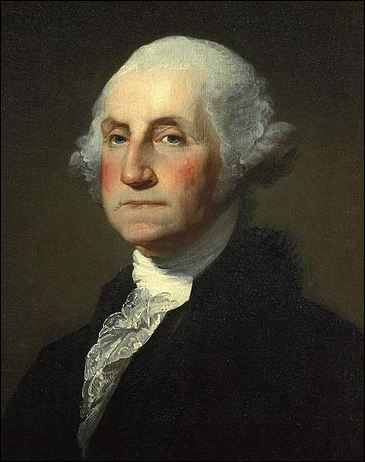
As seen in the previous tidbit on the Presidents, George Washington‘s name is linked to the beginning of creation, just as he is linked to the beginning of the United States of America.
George comes from the Greek word Γεωργιος ‘Georgios’ which means a farmer, one who works the earth.
Washington means a people on a hill by a river. It is interesting to note that the United States was referred to as a ‘city on a hill’ by the Founders, referring back to the words of Messiah (Matthew 5:14). America is also a place of many rivers (Isaiah 18:7).
“Liberty, when it begins to take root, is a plant of rapid growth.” – Letter to James Madison, March 2, 1788
Washington is known as the Father of the country. In Hebrew, the word for father, אב ‘av,’ is speaking of a strong leader, the root of the tree, the pillar of the house. Almighty YHWH, in His wisdom, ordained that George Washington be established as the ‘father’ of this country. Society, in particular government, has strayed from the character of Washington so I thought it prudent to share a tidbit on this man and his faith and fruits unto the Most High.
“The views of men can only be known, or guessed at, by their words or actions.”
Mat 7:16 Ye shall know them by their fruits. Do men gather grapes of thorns, or figs of thistles?
Mat 7:17 Even so every good tree bringeth forth good fruit; but a corrupt tree bringeth forth evil fruit.
Mat 7:18 A good tree cannot bring forth evil fruit, neither can a corrupt tree bring forth good fruit.
Mat 7:19 Every tree that bringeth not forth good fruit is hewn down, and cast into the fire.
Mat 7:20 Wherefore by their fruits ye shall know them.
“I hope I shall always possess firmness and virtue enough to maintain, what I consider the most enviable of all titles, the character of an honest man.” – Letter to Alexander Hamilton, August 28, 1788
1Ti 2:1 I exhort therefore, that, first of all, supplications, prayers, intercessions, and giving of thanks, be made for all men;
1Ti 2:2 For kings, and for all that are in authority; that we may lead a quiet and peaceable life in all godliness and honesty.
1Ti 2:3 For this is good and acceptable in the sight of God our Saviour;
1Ti 2:4 Who will have all men to be saved, and to come unto the knowledge of the truth.
Pro 2:6 For the LORD giveth wisdom: out of his mouth cometh knowledge and understanding.
Pro 2:7 He layeth up sound wisdom for the righteous: he is a buckler to them that walk uprightly.
Pro 2:8 He keepeth the paths of judgment, and preserveth the way of his saints.
Pro 2:9 Then shalt thou understand righteousness, and judgment, and equity; yea, every good path.
“While I reiterate the professions of my dependence upon Heaven as the source of all public and private blessings; I will observe that the general prevalence of piety, philanthropy, honesty, industry, and economy seems, in the ordinary course of human affairs, particularly necessary for advancing and conforming the happiness of our country. While all men within our territories are protected in worshipping the Deity according to the dictates of their consciences; it is rationally to be expected from them in return, that they will be emulous of evincing the sanctity of their professions by the innocence of their lives and the beneficence of their actions; for no man, who is profligate in his morals, or a bad member of the civil community, can possibly be a true Christian, or a credit to his own religious society.“ -Letter to the Presbyterian General Assembly, May, 1789
“Your love of liberty – your respect for the laws – your habits of industry – and your practice of the moral and religious obligations, are the strongest claims to national and individual happiness.” – Letter to the Residents of Boston, October 27, 1789
“While we are zealously performing the duties of good citizens and soldiers, we certainly ought not to be inattentive to the higher duties of religion. To the distinguished character of Patriot, it should be our highest glory to add the more distinguished character of Christian.“ – General Orders – May 2, 1778
Washington had a strong faith in the Most High, and attributed to Him the success of the War for Independence and the establishment of the Republic form of government the Founders created.
“We may, with a kind of grateful and pious exultation, trace the finger of Providence through those dark and mysterious events, which first induced the States to appoint a general Convention and then led them one after another into an adoption of the system recommended by that general Convention; thereby in all human probability, laying a lasting foundation for tranquility and happiness.” – Letter to Jonathan Trumbull, July 20, 1788
“The felicitations you offer on the present prospect of our public affairs are highly acceptable to me, and I entreat you to receive a reciprocation from my part. I can never trace the concatenation of causes, which led to these events, without acknowledging the mystery and admiring the goodness of Providence. To that superintending Power alone is our retraction from the brink of ruin to be attributed.” – Letter to Annis Boudinot Stockton, August 31, 1788
“May the same wonder-working Deity, who long since delivered the Hebrews from their Egyptian oppressors, planted them in a promised land, whose providential agency has lately been conspicuous in establishing these United States as an independent nation, still continue to water them with the dews of heaven and make the inhabitants of every denomination participate in the temporal and spiritual blessings of that people whose God is Jehovah.“ – Letter to the Hebrew Congregations of the City of Savannah, Georgia, May, 1789
“I am sure that never was a people, who had more reason to acknowledge a Divine interposition in their affairs, than those of the United States; and I should be pained to believe that they have forgotten that agency, which was so often manifested during our Revolution, or that they failed to consider the omnipotence of that God who is alone able to protect them.” – Letter to John Armstrong, March 11, 1792
Washington warned that without morality, i.e. Biblical faith, no government could succeed.
“The blessed Religion revealed in the word of God will remain an eternal and awful monument to prove that the best Institution may be abused by human depravity; and that they may even, in some instances be made subservient to the vilest purposes. Should, hereafter, those incited by the lust of power and prompted by the Supineness or venality of their Constituents, overleap the known barriers of this Constitution and violate the unalienable rights of humanity: it will only serve to shew, that no compact among men (however provident in its construction and sacred in its ratification) can be pronounced everlasting an inviolable, and if I may so express myself, that no Wall of words, that no mound of parchment can be so formed as to stand against the sweeping torrent of boundless ambition on the side, aided by the sapping current of corrupted morals on the other.” – Draft of First Inaugural Address, April, 1789
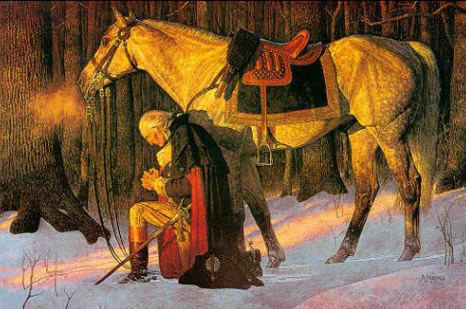 Painting by Arnold Friberg, a reflection of a testimony from a Valley Forge Quaker named Isaac Potts and recorded in “Diary and Remembrances” of Rev. Nathaniel Randolph Snowden, a Presbyterian minister
“I was riding with him (Mr. Potts) near Valley Forge, where the army lay during the war of the Revolution. Mr. Potts was a Senator in our state and a Whig. I told him I was agreeably surprised to find him a friend to his country as the Quakers were mostly Tories. He said, “It was so and I was a rank Tory once, for I never believed that America could proceed against Great Britain whose fleets and armies covered the land and ocean. But something very extraordinary converted me to the good faith.”
“What was that?” I inquired. “Do you see that woods, and that plain?” It was about a quarter of a mile from the place we were riding. “There,” said he, “laid the army of Washington. It was a most distressing time of ye war, and all were for giving up the ship but that one good man. In that woods,” pointing to a close in view, “I heard a plaintive sound, as of a man at prayer. I tied my horse to a sapling and went quietly into the woods and to my astonishment I saw the great George Washington on his knees alone, with his sword on one side and his cocked hat on the other. He was at Prayer to the God of the Armies, beseeching to interpose with his Divine aid, as it was ye Crisis and the cause of the country, of humanity, and of the world.
“Such a prayer I never heard from the lips of man. I left him alone praying. I went home and told my wife, ‘I saw a sight and heard today what I never saw or heard before’, and just related to her what I had seen and heard and observed. We never thought a man could be a soldier and a Christian, but if there is one in the world, it is Washington. We thought it was the cause of God, and America could prevail.”
Wikipedia.org
“Eyewitness accounts exist of Washington engaging in morning devotions. Biographer Jared Sparks recorded the following account from Washington’s nephew George W. Lewis: “Mr. Lewis said he had accidentally witnessed [Washington’s] private devotions in his library both morning and evening; that on those occasions he had seen him in a kneeling position with a Bible open before him and that he believed such to have been his daily practice.” {The Life of George Washington – Jared Sparks pg 522-523}
“During the Revolutionary war, General Robert Porterfield stated he “found him on his knees, engaged in his morning’s devotions.” Alexander Hamilton corroborated Porterfield’s account, stating “such was his most constant habit.” A French citizen who knew Washington well during the Revolutionary War and the presidency stated “Every day of the year, he rises at five in the morning; as soon as he is up, he dresses, then prays reverently to God.”
The following are few quotes from Washington showing his faith in the Most High.
“Oh, eternal and everlasting God, direct my thoughts, words and work. Wash away my sins in the immaculate blood of the Lamb and purge my heart by Thy Holy Spirit. Daily, frame me more and more in the likeness of Thy son, Jesus Christ, that living in Thy fear, and dying in Thy favor, I may in thy appointed time obtain the resurrection of the justified unto eternal life. Bless, O Lord, the whole race of mankind and let the world be filled with the knowledge of Thee and Thy son, Jesus Christ.”
“Most Glorious God, in Jesus Christ, my merciful and loving Father; I acknowledge and confess my guilt in the weak and imperfect performance of the duties of this day. I have called on Thee for pardon and forgiveness of my sins, but so coldly and carelessly that my prayers are become my sin, and they stand in need of pardon. I have sinned against heaven and before Thee in thought, word, and deed. I have contemned Thy majesty and holy laws. I have likewise sinned by omitting what I ought to have done and committing what I ought not. I have rebelled against the light, despising Thy mercies and judgment, and broken my vows and promise. I have neglected the better things. My iniquities are multiplied and my sins are very great. I confess them, O Lord, with shame and sorrow, detestation and loathing and desire to be vile in my own eyes as I have rendered myself vile in Thine. I humbly beseech Thee to be merciful to me in the free pardon of my sins for the sake of Thy dear Son and only Savior Jesus Christ who came to call not the righteous, but sinners to repentance. Thou gavest Thy Son to die for me. Make me to know what is acceptable in Thy sight, and therein to delight, open the eyes of my understanding, and help me thoroughly to examine myself concerning my knowledge, faith, and repentance, increase my faith, and direct me to the true object, Jesus Christ the Way, the Truth, and the Life.” – Authentic handwritten manuscript book, April 23, 1752
“It is the duty of all nations to acknowledge the providence of Almighty God, to obey His will, to be grateful for His benefits, and humbly to implore His protection and favor.”
“Of all the dispositions and habits which lead to political prosperity, religion and morality are indispensable.”
“While just government protects all in their religious rights, true religion affords to government its surest support.” – Address to the Synod of the Dutch Reformed Church in North America, October 9, 1789
“It is impossible to rightly govern the world without God and the Bible.”
“What students would learn in American schools above all is the religion of Jesus Christ.” – Speech to the Delaware Indian Chiefs, May 12, 1779
“The ways of Providence being inscrutable, and the justice of it not to be scanned by the shallow eye of humanity, nor to be counteracted by the utmost efforts of human power or wisdom, resignation, and as far as the strength of our reason and religion can carry us, a cheerful acquiescence to the Divine Will, is what we are to aim.” – Letter to Col. Burwell Bassett, April 25, 1773
Washington’s Benediction for the 13 states after the war for Independence.
“I now make it my earnest prayer that God would have you, and the State over which you preside, in his holy protection; that he would incline the hearts of the citizens to cultivate a spirit of subordination and obedience to government, to entertain a brotherly affection and love for one another…and finally that he would most graciously be pleased to dispose us all to do justice, to love mercy, and to demean ourselves with that charity, humility, and pacific temper of mind, which were the characteristics of the Divine Author of our blessed religion, and without an humble imitation of whose example in these things, we can never hope to be a happy nation.”
First Inaugural Address:
“The mind is so formed in different persons as to contemplate the same object in different points of view. Hence originates the difference on questions of the greatest import, both human & divine. In all Institutions of the former kind, great allowances are doubtless to be made for the fallibility & imperfection of their authors. Although the agency I had in forming this system, and the high opinion I entertained of my Colleagues for their ability & integrity may have tended to warp my judgment in its favour; yet I will not pretend to say that it appears absolutely perfect to me, or that there may not be many faults which have escaped my discernment. I will only say, that, during and since the Session of the Convention, I have attentively heard and read every every oral & printed information on both sides of the question that could be procured. This long & laborious investigation, in which I endeavoured as far as the frailty of nature would permit to act with candour has resulted in a fixed belief that this Constitution, is really in its formation a government of the people; that is to say, a government in which all power is derived from, and at stated periods reverts to them–and that, in its operation, it is purely, a government of Laws made & executed by the fair substitutes of the people alone.” – Draft of First Inaugural Address, April, 1789
Fellow-Citizens of the Senate and of the House of Representatives:
“Among the vicissitudes incident to life no event could have filled me with greater anxieties than that of which the notification was transmitted by your order, and received on the 14th day of the present month. On the one hand, I was summoned by my Country, whose voice I can never hear but with veneration and love, from a retreat which I had chosen with the fondest predilection, and, in my flattering hopes, with an immutable decision, as the asylum of my declining years–a retreat which was rendered every day more necessary as well as more dear to me by the addition of habit to inclination, and of frequent interruptions in my health to the gradual waste committed on it by time. On the other hand, the magnitude and difficulty of the trust to which the voice of my country called me, being sufficient to awaken in the wisest and most experienced of her citizens a distrustful scrutiny into his qualifications, could not but overwhelm with despondence one who (inheriting inferior endowments from nature and unpracticed in the duties of civil administration) ought to be peculiarly conscious of his own deficiencies. In this conflict of emotions all I dare aver is that it has been my faithful study to collect my duty from a just appreciation of every circumstance by which it might be affected. All I dare hope is that if, in executing this task, I have been too much swayed by a grateful remembrance of former instances, or by an affectionate sensibility to this transcendent proof of the confidence of my fellow-citizens, and have thence too little consulted my incapacity as well as disinclination for the weighty and untried cares before me, my error will be palliated by the motives which mislead me, and its consequences be judged by my country with some share of the partiality in which they originated.
Such being the impressions under which I have, in obedience to the public summons, repaired to the present station, it would be peculiarly improper to omit in this first official act my fervent supplications to that Almighty Being who rules over the universe, who presides in the councils of nations, and whose providential aids can supply every human defect, that His benediction may consecrate to the liberties and happiness of the people of the United States a Government instituted by themselves for these essential purposes, and may enable every instrument employed in its administration to execute with success the functions allotted to his charge. In tendering this homage to the Great Author of every public and private good, I assure myself that it expresses your sentiments not less than my own, nor those of my fellow- citizens at large less than either. No people can be bound to acknowledge and adore the Invisible Hand which conducts the affairs of men more than those of the United States. Every step by which they have advanced to the character of an independent nation seems to have been distinguished by some token of providential agency; and in the important revolution just accomplished in the system of their united government the tranquil deliberations and voluntary consent of so many distinct communities from which the event has resulted can not be compared with the means by which most governments have been established without some return of pious gratitude, along with an humble anticipation of the future blessings which the past seem to presage. These reflections, arising out of the present crisis, have forced themselves too strongly on my mind to be suppressed. You will join with me, I trust, in thinking that there are none under the influence of which the proceedings of a new and free government can more auspiciously commence.
By the article establishing the executive department it is made the duty of the President “to recommend to your consideration such measures as he shall judge necessary and expedient.” The circumstances under which I now meet you will acquit me from entering into that subject further than to refer to the great constitutional charter under which you are assembled, and which, in defining your powers, designates the objects to which your attention is to be given. It will be more consistent with those circumstances, and far more congenial with the feelings which actuate me, to substitute, in place of a recommendation of particular measures, the tribute that is due to the talents, the rectitude, and the patriotism which adorn the characters selected to devise and adopt them. In these honorable qualifications I behold the surest pledges that as on one side no local prejudices or attachments, no separate views nor party animosities, will misdirect the comprehensive and equal eye which ought to watch over this great assemblage of communities and interests, so, on another, that the foundation of our national policy will be laid in the pure and immutable principles of private morality, and the preeminence of free government be exemplified by all the attributes which can win the affections of its citizens and command the respect of the world. I dwell on this prospect with every satisfaction which an ardent love for my country can inspire, since there is no truth more thoroughly established than that there exists in the economy and course of nature an indissoluble union between virtue and happiness; between duty and advantage; between the genuine maxims of an honest and magnanimous policy and the solid rewards of public prosperity and felicity; since we ought to be no less persuaded that the propitious smiles of Heaven can never be expected on a nation that disregards the eternal rules of order and right which Heaven itself has ordained; and since the preservation of the sacred fire of liberty and the destiny of the republican model of government are justly considered, perhaps, as deeply, as finally, staked on the experiment entrusted to the hands of the American people.
Besides the ordinary objects submitted to your care, it will remain with your judgment to decide how far an exercise of the occasional power delegated by the fifth article of the Constitution is rendered expedient at the present juncture by the nature of objections which have been urged against the system, or by the degree of inquietude which has given birth to them. Instead of undertaking particular recommendations on this subject, in which I could be guided by no lights derived from official opportunities, I shall again give way to my entire confidence in your discernment and pursuit of the public good; for I assure myself that whilst you carefully avoid every alteration which might endanger the benefits of an united and effective government, or which ought to await the future lessons of experience, a reverence for the characteristic rights of freemen and a regard for the public harmony will sufficiently influence your deliberations on the question how far the former can be impregnably fortified or the latter be safely and advantageously promoted.
To the foregoing observations I have one to add, which will be most properly addressed to the House of Representatives. It concerns myself, and will therefore be as brief as possible. When I was first honored with a call into the service of my country, then on the eve of an arduous struggle for its liberties, the light in which I contemplated my duty required that I should renounce every pecuniary compensation. From this resolution I have in no instance departed; and being still under the impressions which produced it, I must decline as inapplicable to myself any share in the personal emoluments which may be indispensably included in a permanent provision for the executive department, and must accordingly pray that the pecuniary estimates for the station in which I am placed may during my continuance in it be limited to such actual expenditures as the public good may be thought to require.
Having thus imparted to you my sentiments as they have been awakened by the occasion which brings us together, I shall take my present leave; but not without resorting once more to the benign Parent of the Human Race in humble supplication that, since He has been pleased to favor the American people with opportunities for deliberating in perfect tranquillity, and dispositions for deciding with unparalleled unanimity on a form of government for the security of their union and the advancement of their happiness, so His divine blessing may be equally conspicuous in the enlarged views, the temperate consultations, and the wise measures on which the success of this Government must depend.”
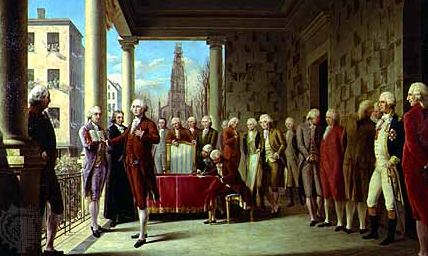
In a low voice Washington solemnly swore to execute the office of the President of the United States and, to the best of his ability, to “preserve, protect, and defend the Constitution of the United States.” Then, as not specified in the Constitution, he added, “So help me God”, and kissed the Bible, thereby establishing his own first presidential tradition.
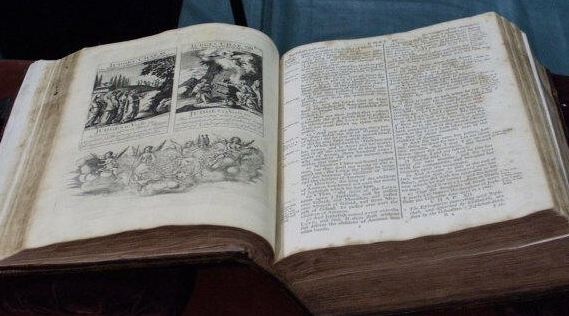
This Bible was opened to Genesis 49–50 when George Washington took his oath of office on it. This is the portion of Scripture speaking to what would befall Jacob’s sons in the last days.
George Washington, delivered his inaugural message to the United States Congress on April 30, 1789. He delivered the message in the Senate Chamber at Federal Hall in New York City. After the message, Washington and the entire Congress went down the street to St. Paul’s cathedral for a church service to pray for the new nation. Washington and all of the nation’s leaders went into St. Paul’s cathedral and spent two hours in prayer dedicating America in prayer to the Most High.
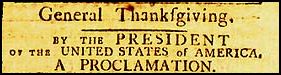
Thanksgiving Proclamation:
Washington further dedicated this country to the Most High by issuing a Thanksgiving proclamation.
“WHEREAS it is the duty of all nations to acknowledge the providence of Almighty God, to obey His will, to be grateful for His benefits, and humbly to implore His protection and favour; and Whereas both Houses of Congress have, by their joint committee, requested me “to recommend to the people of the United States a DAY OF PUBLICK THANSGIVING and PRAYER, to be observed by acknowledging with grateful hearts the many and signal favors of Almighty God, especially by affording them an opportunity peaceably to establish a form of government for their safety and happiness:
NOW THEREFORE, I do recommend and assign THURSDAY, the TWENTY-SIXTH DAY of NOVEMBER next, to be devoted by the people of these States to the service of that great and glorious Being who is the beneficent author of all the good that was, that is, or that will be; that we may then all unite in rendering unto Him our sincere and humble thanks for His kind care and protection of the people of his country previous to their becoming a nation; for the signal and manifold mercies and the favorable interpositions of His providence in the course and conclusion of the late war; for the great degree of tranquility, union, and plenty which we have since enjoyed; — for the peaceable and rational manner in which we have been enable to establish Constitutions of government for our safety and happiness, and particularly the national one now lately instituted; — for the civil and religious liberty with which we are blessed, and the means we have of acquiring and diffusing useful knowledge; — and, in general, for all the great and various favours which He has been pleased to confer upon us.
And also, that we may then unite in most humbly offering our prayers and supplications to the great Lord and Ruler of Nations and beseech Him to pardon our national and other transgressions; — to enable us all, whether in publick or private stations, to perform our several and relative duties properly and punctually; to render our National Government a blessing to all the people by constantly being a Government of wise, just, and constitutional laws, discreetly and faithfully executed and obeyed; to protect and guide all sovereigns and nations (especially such as have shews kindness unto us); and to bless them with good governments, peace, and concord; to promote the knowledge and practice of true religion and virtue, and the increase of science among them and us; and, generally to grant unto all mankind such a degree of temporal prosperity as he alone knows to be best.
GIVEN under my hand, at the city of New-York, the third day of October, in the year of our Lord, one thousand seven hundred and eighty-nine.” Go: Washington {First Thanksgiving Proclamation, October 3, 1789}
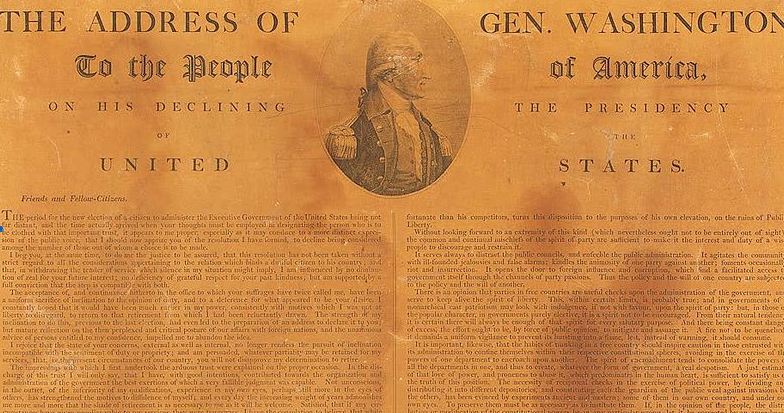
Farewell address
Washington’s Farewell Address (issued as a public letter in 1796) was one of the most influential statements of republicanism. Drafted primarily by Washington himself, with help from Hamilton, it gives advice on the necessity and importance of national union, the value of the Constitution and the rule of law, the evils of political parties, and the proper virtues of a republican people. He called morality “a necessary spring of popular government”. He said, “Whatever may be conceded to the influence of refined education on minds of peculiar structure, reason and experience both forbid us to expect that national morality can prevail in exclusion of religious principle.”
Washington’s public political address warned against foreign influence in domestic affairs and American meddling in European affairs. He warned against bitter partisanship in domestic politics and called for men to move beyond partisanship and serve the common good. He warned against “permanent alliances with any portion of the foreign world”, saying the United States must concentrate primarily on American interests. He counseled friendship and commerce with all nations, but warned against involvement in European wars and entering into long-term “entangling” alliances. The address quickly set American values regarding foreign affairs.
September 17, 1796 is when he delivered his farewell address.
“In offering to you, my countrymen, these counsels of an old and affectionate friend, I dare not hope they will make the strong and lasting impression I could wish; that they will control the usual current of the passions, or prevent our nation from running the course, which has hitherto marked the destiny of nations. But, if I may even flatter myself, that they may be productive of some partial benefit, some occasional good; that they may now and then recur to moderate the fury of party spirit, to warn against the mischiefs of foreign intrigue, to guard against the impostures of pretended patriotism; this hope will be a full recompense for the solicitude for your welfare, by which they have been dictated.” – Farewell Address, September 19, 1796
Washington said America should avoid ‘entangling alliances.’ On April 22nd 1793, Washington even issued the ‘Proclamation of Neutrality’ which was designed to keep America out of further wars.
“It is our true policy to steer clear of permanent alliance with any portion of the foreign world.” – Farewell Address, September 19, 1796
“‘Tis folly in one Nation to look for disinterested favors from another; that it must pay with a portion of its Independence for whatever it may accept under that character; that by such acceptance, it may place itself in the condition of having given equivalents for nominal favours and yet of being reproached with ingratitude for not giving more. There can be no greater error than to expect, or calculate upon real favours from Nation to Nation. ‘Tis an illusion which experience must cure, which a just pride ought to discard.” – Farewell Address, September 19, 1796
“Observe good faith and justice towards all nations; cultivate peace and harmony with all… In the execution of such a plan, nothing is more essential than that permanent, inveterate antipathies against particular nations, and passionate attachments for others, should be excluded; and that, in place of them, just and amicable feelings towards all should be cultivated. The nation which indulges towards another a habitual hatred or a habitual fondness is in some degree a slave…
The nation, prompted by ill-will and resentment, sometimes impels to war the government, contrary to the best calculations of policy. The government sometimes participates in the national propensity, and adopts through passion what reason would reject; at other times it makes the animosity of the nation subservient to projects of hostility instigated by pride, ambition, and other sinister and pernicious motives…
The great rule of conduct for us in regard to foreign nations is in extending our commercial relations, to have with them as little political connection as possible. So far as we have already formed engagements, let them be fulfilled with perfect good faith. Here let us stop…
Our detached and distant situation invites and enables us to pursue a different course. If we remain one people under an efficient government. the period is not far off when we may defy material injury from external annoyance; when we may take such an attitude as will cause the neutrality we may at any time resolve upon to be scrupulously respected; when belligerent nations, under the impossibility of making acquisitions upon us, will not lightly hazard the giving us provocation; when we may choose peace or war, as our interest, guided by justice, shall counsel…
It is our true policy to steer clear of permanent alliances with any portion of the foreign world… to warn against the mischiefs of foreign intrigue, to guard against the impostures of pretended patriotism…
“Against the insidious wiles of foreign influence, (I conjure you to believe me fellow citizens) the jealousy of a free people ought to be constantly awake; since history and experience prove that foreign influence is one of the most baneful foes of Republican Government.” – Farewell Address, September 19, 1796
Washington warned of the party system.
“I have already intimated to you the danger of parties in the state, with particular reference to the founding of them on geographical discriminations. Let me now take a more comprehensive view, and warn you in the most solemn manner against the baneful effects of the Spirit of Party generally… A fire not to be quenched, it demands a uniform vigilance to prevent its bursting into a flame, lest, instead of warming, it should consume.” – Farewell Address, September 19, 1796
“The alternate domination of one faction over another, sharpened by the spirit of revenge, natural to party dissension, which in different ages and countries has perpetrated the most horrid enormities, is itself a frightful despotism. But this leads at length to a more formal and permanent despotism. The disorders and miseries, which result, gradually incline the minds of men to seek security and repose in the absolute power of an individual; and sooner or later the chief of some prevailing faction, more able or more fortunate than his competitors, turns this disposition to the purposes of his own elevation, on the ruins of Public Liberty.” – Farewell Address, September 19, 1796
“The common and continual mischiefs of the spirit of party are sufficient to make it the interest and duty of a wise people to discourage and restrain it.” – Farewell Address, September 19, 1796
Washington also warned of the dangers of government getting too powerful and expanding beyond the limits of the Constitution:
“It is important, likewise, that the habits of thinking in a free country should inspire caution in those entrusted with its administration, to confine themselves within their respective constitutional spheres, avoiding in the exercise of the powers of one department to encroach upon another. The spirit of encroachment tends to consolidate the powers of all the departments in one, and thus to create, whatever the form of government, a real despotism. A just estimate of that love of power, and proneness to abuse it, which predominates in the human heart, is sufficient to satisfy us of the truth of this position. The necessity of reciprocal checks in the exercise of political power, by dividing and distributing it into different depositaries, and constituting each the guardian of the public weal against invasions by the others, has been evinced by experiments ancient and modern; some of them in our country and under our own eyes. To preserve them must be as necessary as to institute them. If, in the opinion of the people, the distribution or modification of the constitutional powers be in any particular wrong, let it be corrected by an amendment in the way which the Constitution designates. But let there be no change by usurpation; for though this, in one instance, may be the instrument of good, it is the customary weapon by which free governments are destroyed. The precedent must always greatly overbalance in permanent evil any partial or transient benefit, which the use can at any time yield.” – Farewell Address, September 19, 1796
Washington admonished that the country must be guided from above.
“Of all the dispositions and habits which lead to political prosperity, religion and morality are indispensable supports. In vain would that man claim the tribute of patriotism who should labor to subvert these great pillars of human happiness, these firmest props of the duties of man and citizens. The mere politician, equally with the pious man, ought to respect and to cherish them. A volume could not trace all their connexions with private and public felicity. Let it simply be asked, Where is the security for property, for reputation, for life, if the sense of religious obligation desert the oaths, which are the instruments of investigation in Courts of Justice? And let us with caution indulge the supposition that morality can be maintained without religion. Whatever may be conceded to the influence of refined education on minds of peculiar structure, reason and experience both forbid us to expect that national morality can prevail in exclusion of religious principle. It is substantially true, that virtue or morality is a necessary spring of popular government. The rule, indeed, extends with more or less force to every species of free government. Who, that is a sincere friend to it, can look with indifference upon attempts to shake the foundation of the fabric?” – Farewell Address, September 19, 1796
“Tis substantially true, that virtue or morality is a necessary spring of popular government. The rule indeed extends with more or less force to every species of free Government.” – Farewell Address, September 19, 1796
“It will be worthy of a free, enlightened, and, at no distant period, a great Nation, to give to mankind the magnanimous and too novel example of a People always guided by an exalted justice and benevolence.” – Farewell Address, September 19, 1796
“Let us with caution indulge the supposition, that morality can be maintained without religion. Whatever may be conceded to the influence of refined education on minds of peculiar structure, reason and experience both forbid us to expect, that national morality can prevail in exclusion of religious principle.” – Farewell Address, September 19, 1796
“Observe good faith and justice towards all Nations; cultivate peace and harmony with all. Religion and Morality enjoin this conduct; and can it be, that good policy does not equally enjoin it? It will be worthy of a free, enlightened, and, at no distant period, a great Nation, to give to mankind the magnanimous and too novel example of a people always guided by an exalted justice and benevolence. Who can doubt, that, in the course of time and things, the fruits of such a plan would richly repay any temporary advantages, which might be lost by a steady adherence to it? Can it be, that Providence has not connected the permanent felicity of a Nation with its Virtue?” – Farewell Address, September 19, 1796
“How pitiful, in the eye of reason and religion, is that false ambition which desolates the world with fire and sword for the purposes of conquest and fame; when compared to the milder virtues of making our neighbours and our fellow men as happy as their frail conditions and perishable natures will permit them to be.” – Letter to Rev. John Lathrop, June 22, 1788
Washington had the respect of his peers. After the war for Independence, Washington retired to Mount Vernon but it was short lived. He made an exploratory trip to the western frontier in 1784 and was persuaded to attend the Constitutional Convention in Philadelphia in the summer of 1787. There he was unanimously elected president of the Convention. He participated little in the debates (though he did vote for or against the various articles), but his high prestige maintained collegiality and kept the delegates at their labors. The delegates designed the presidency with Washington in mind, and allowed him to define the office once elected. He was unanimously elected to the office receiving 100% of the electoral votes.
“Our Washington is no more! The Hero, the Sage and Patriot of America – the man on whom in times of danger, every eye was turned, and all hopes were placed – lives now, only in his own great actions, and in the hearts of an affectionate and afflicted people.” – Representative John Marshall, 1799, Marshall became Chief Justice of the Supreme Court in 1801
Daniel Webster’s Address on the Completion of Bunker Hill Monument 1843
“America has furnished to the world the character of Washington! And if our American institutions had done nothing else, that alone would have entitled them to the respect of mankind.
‘Washington! ‘First in war, first in peace, and first in the hearts of his countrymen!’ Washington is all our own!
Born upon our soil, of parents also born upon it; never for a moment having had sight of the Old World; instructed according to the modes of his time, only in the spare, plain but wholesome elementary knowledge which our institutions provide for the children of the people; growing up beneath and penetrated by the genuine influences of American society; living from infancy to manhood and age amidst our expanding, but not luxurious civilization; partaking in our great destiny of labor, our long contest with unreclaimed nature and uncivilized man, our agony of glory, the war of Independence, our great victory of peace; the formation of the Union, and the establishment of the Constitution; he is all, all our own! Washington is ours…”
“I claim him for America…To him who denies or doubts whether our fervid liberty can be combined with law, with order, with the security of property, with the pursuits and advancement of happiness; to him who denies that our forms of government are capable of producing exaltation of soul, and the passion of true glory; to him who denies that we have contributed anything to the stock of great lessons and great examples; – to all these I reply by pointing to Washington!”
“But let us remember that we have duties and obligations to perform, corresponding to the blessings which we enjoy. Let us remember the trust, the sacred trust, attaching to the rich inheritance which we have received from our fathers. Let us feel our personal responsibility, to the full extent of our power and influence, for the preservation of the principles of civil and religious liberty. And let us remember that it is only religion; and morals, and knowledge, that can make men respectable and happy, under any form of government. Let us hold fast the great truth, that communities are responsible, as well as individuals, that no government is respectable, which is not just; that without unspotted purity of public faith, without sacred public principle, fidelity, and honor, no mere forms of government, no machinery of laws, can give dignity to political society.”
Related Studies:
The Presidents Code – George Washington
Thanksgiving Proclamations – George Washington
littleguyintheeye@gmail.com

 Little Guy in the Eye