
Ancient rabbis declare that Daniel 9 fixes the time of the Messiah’s coming and identifies Him as the Holy of Holies whose appearing and death fulfill the prophecy.
Daniel 9 is one of the most precise Messianic prophecies in the Tanakh: the “70 weeks” (490 years) that point to the coming of the Anointed One (Messiah) and His sacrificial death. Ancient and medieval rabbinic sources recognized the Messianic significance of this timeline, providing evidence that the expectation of the Messiah’s arrival and atoning work was rooted in Jewish tradition.
Rabbi Moses Abraham Levi stated: “I have examined the Holy Scriptures, and have not found the time for the coming of the Messiah, clearly fixed, except in the words of Gabriel to the prophet Daniel, which are written in the ninth chapter of the prophecy of Daniel.” Rabbi Azariah speaks of the purpose “to seal the vision and prophecy, and to bring in Messiah our righteousness.” Rabbi Nachmonides declares: “This Holy of Holies is the Messiah who is sanctified more than the sons of David.” Jonathan ben Uzziel renders the prophecy: “That the ‘vision and prophecy’ may be fulfilled even unto Messiah, the Holy of the Holies.” The Talmud records that around the time of the Temple’s destruction (70 A.D.), the Messiah was believed to have already come. These sources affirm that Daniel 9 points to the Messiah’s appearing and death.
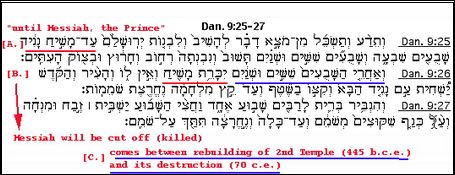
Daniel 9 contains one of the most precise Messianic prophecies in the Tanakh: the “70 weeks” (490 years) that point to the coming of the Anointed One (Messiah) and His sacrificial death. Ancient and medieval rabbinic sources, including commentaries by Saadia Gaon, Ibn Ezra, and others, recognized the Messianic significance of this timeline. These Jewish interpretations provide powerful evidence that the expectation of the Messiah’s arrival and atoning work was deeply rooted in rabbinic tradition.
Ancient Jewish Sources admit the prophecy of Daniel 9 would be fulfilled in the days of Jesus:
“In Daniel is delivered to us the end [‘the time of His appearance and death’ – Rabbi Jarchi] of the Messiah.” The Talmud also records that about the time of the Roman general Titus’ destruction of the Temple (70 A. D.), the Messiah was believed to have already come, yet His identity was concealed from the Jews until they were rendered more worthy of His appearance!”{The Messiahship of Christ/The Messianic Prophecies of Christ – Frank Delitzch and Paton Gloag pg 226}
Rabbi Moses Abraham Levi stated: “I have examined the Holy Scriptures, and have not found the time for the coming of the Messiah, clearly fixed, except in the words of Gabriel to the prophet Daniel, which are written in the ninth chapter of the prophecy of Daniel.”
Rabbi Azariah states in the words of Daniel: “To seal the vision and prophecy, and to bring in Messiah our righteousness.”
Rabbi Nachmonides claims: “This Holy of Holies is the Messiah who is sanctified more than the sons of David.”
Finally, in the words of Jonathan ben Uzziel: “That the ‘vision and prophecy’ may be fulfilled even unto Messiah, the Holy of the Holies.”
Jesus is the only one that can fit into Daniel’s prophecy of the Suffering Messiah who was to die before the year 70 AD.
In fact Rabbi Nehumias, who lived 50 years before Christ, is cited as saying that the time given by Daniel for the Messiah’s appearance could not go beyond fifty years! {The Messiahship of Christ/The Messianic Prophecies of Christ – Frank Delitzch and Paton Gloag pg 226}
littleguyintheeye@gmail.com
Jesus from Rabbinic Sources – Rosh Hashana Machzor
Jesus from Rabbinic Sources – Messiah the LORD
Jesus from Rabbinic Sources – The LORD our Righteousness
Jesus from Rabbinic Sources – The Son of God
Jesus from Rabbinic Sources – Messiah born in Bethlehem
Jesus from Rabbinic Sources – King & Priest
Jesus from Rabbinic Sources – Suffering Servant
Jesus from Rabbinic Sources – Suffering Servant 2
Jesus from Rabbinic Sources – Suffering Servant: The Messiah Texts – Raphael Patai
Jesus from Rabbinic Sources – Suffering Servant: Sanhedrin 98b
Jesus from Rabbinic Sources – Suffering Servant: Midrash Rabbah
Jesus from Rabbinic Sources – Suffering Servant: Jewish Sources
Jesus from Rabbinic Sources – Suffering Servant: Rays of the Messiah’s Glory
Jesus from Rabbinic Sources – Suffering Servant: More Jewish Sources
Jesus from Rabbinic Sources – The Pierced One
Jesus from Rabbinic Sources – The Pierced One: Rabbi Abraham Ben Ezra
Jesus from Rabbinic Sources – Pesikta Rabbati & Psalm 22
Jesus from Rabbinic Sources – Daniel 9
Jesus from Rabbinic Sources – Pidyon haben
Jesus from Rabbinic Sources -Yeshua=Messiah in the Talmud
Jesus from Rabbinic Sources – Son of Joseph, Son of David