

Nachmanides, Yefeth ben Ali, and other Jewish sources declare that the Suffering Servant of Isaiah 53 is the Messiah who bears the iniquities of Israel.
Ancient and medieval Jewish voices identify the Suffering Servant of Isaiah 53 with the Messiah. These sources describe a Messiah who suffers, is rejected, wounded, and bears the sins of Israel for the sake of ultimate redemption. The collection demonstrates that the concept of a suffering Messiah was deeply rooted in rabbinic tradition long before the first century.
Nachmanides notes that while some apply the passage to Israel, the Midrash refers it to the Messiah, the son of David, declaring that “by his stripes we are healed” because God pardons for his righteousness. The Karaite Yefeth ben Ali interprets the chapter as describing the Messiah from birth through exile to the throne, explaining that God caused the Servant’s sicknesses to attach to the Messiah for Israel’s sake so the nation would not be completely exterminated. A Midrash on Exodus 35:4 further states that God would take a righteous man from among Israel and make him a pledge on their account to atone for their iniquities. These interpreters affirm that the Servant of Isaiah 53 is the Messiah who bears the sins of His people.
Jewish sources agree that the Suffering Servant of Isaiah 53 is Messiah.
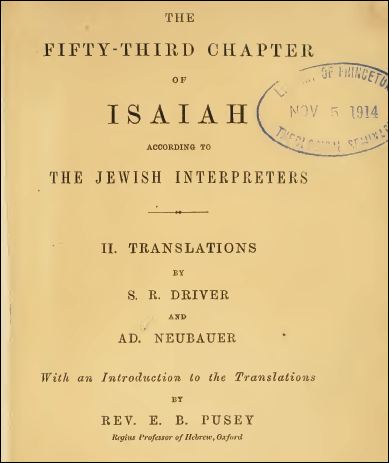
Nachmanides (R. Moshe ben Nachman) (13th c.) notes: “The right view respecting this Parasha is to suppose that by the phrase ‘my servant’ the whole of Israel is meant… As a different opinion, however, is adopted by the Midrash which refers to the Messiah, it is necessary for us to explain it in conformity with the view there maintained. The prophet says, The Messiah, the son of David of whom the text speaks, will never be conquered or perish by the hands of his enemies. And, in fact the text teaches this clearly… And by his stripes we are healed – because the stripes by which he is vexed and distressed will heal us; God will pardon us for his righteousness, and we shall be healed both from our own transgressions and from the iniquities of our fathers.” {The Fifty-third Chapter of Isaiah According to the Jewish Interpreters – Samuel Rolles Driver and Adolf Newbauer pg 78}
The Karaite Yefeth ben Ali (10th c.) states: As to myself, I am inclined, with Benjamin of Newahend to regard it as alluding to the Messiah, and as opening with a description of his condition in exile, from the time of his birth to his ascension to the throne: For the prophet begins by speaking of his being seated in a position of great honour, and then goes back to relate all that will happen to him during the captivity. He thus gives us to understand two things: In the first instance, that the Messiah will only reach his highest degree of honour after long and severe trials; and secondly, that these trials will be sent upon him as a kind of sign, so that, if he finds himself under the yoke of misfortunes whilst remaining pure in his actions, he may know that he is the desired one… {The Fifty-third Chapter of Isaiah According to the Jewish Interpreters – Samuel Rolles Driver and Adolf Newbauer pg 19-20}
Again from Ali: By the words “surely he hath carried our sicknesses,” they mean that the pain and sickness which he fell into were merited by them, but that he bore them instead… And here I think it necessary to pause for a few moments, in order to explain why God caused these sicknesses to attach themselves to the Messiah for the sake of Israel… The nation deserved from God greater punishment than that which actually came upon them, but not being strong enough to bear it…God appoints his servant to carry their sins, and by doing so lighten their punishment in order that Israel might not be completely exterminated. {The Fifty-third Chapter of Isaiah According to the Jewish Interpreters – Samuel Rolles Driver and Adolf Newbauer pg 23}
And, “And the Lord laid on him the iniquity of us all.” The prophet does not say avon meaning iniquity, but punishment from iniquity, as in the passage, “Be sure your sin will find you out.” (Num. Xxxii. 23) {The Fifty-third Chapter of Isaiah According to the Jewish Interpreters – Samuel Rolles Driver and Adolf Newbauer pg 26}
Maimonides affirmed the Messianic interpretation of Isaiah 53.
“Finally, the idea that God would place the sins of Israel upon an innocent man is alluded to in this Midrash: Moses spake before the Holy One, blessed be he, ‘Will not a time come upon when Israel will have neither Tabernacle nor Temple? What will happen to them (as regards atonement)?’ He replied, ‘I will take a righteous man from amongst them and make him a pledge on their account, and I will atone for their iniquities.’” (Midrash on Exodus 35:4) {The Fifty-third Chapter of Isaiah According to the Jewish Interpreters – Samuel Rolles Driver and Adolf Newbauer Volume 1 pg 322}
Jesus from Rabbinic Sources – Rosh Hashana Machzor
Jesus from Rabbinic Sources – Messiah the LORD
Jesus from Rabbinic Sources – The LORD our Righteousness
Jesus from Rabbinic Sources – The Son of God
Jesus from Rabbinic Sources – Messiah born in Bethlehem
Jesus from Rabbinic Sources – King & Priest
Jesus from Rabbinic Sources – Suffering Servant
Jesus from Rabbinic Sources – Suffering Servant 2
Jesus from Rabbinic Sources – Suffering Servant: The Messiah Texts – Raphael Patai
Jesus from Rabbinic Sources – Suffering Servant: Sanhedrin 98b
Jesus from Rabbinic Sources – Suffering Servant: Midrash Rabbah
Jesus from Rabbinic Sources – Suffering Servant: Jewish Sources
Jesus from Rabbinic Sources – Suffering Servant: Rays of the Messiah’s Glory
Jesus from Rabbinic Sources – Suffering Servant: More Jewish Sources
Jesus from Rabbinic Sources – The Pierced One
Jesus from Rabbinic Sources – The Pierced One: Rabbi Abraham Ben Ezra
Jesus from Rabbinic Sources – Pesikta Rabbati & Psalm 22
Jesus from Rabbinic Sources – Daniel 9
Jesus from Rabbinic Sources – Pidyon haben
Jesus from Rabbinic Sources -Yeshua=Messiah in the Talmud
Jesus from Rabbinic Sources – Son of Joseph, Son of David