

Biblical Love (Ahav) is the very essence and character of God Himself. This study explores how Scripture defines love not as mere emotion, but as the heart of the Father revealed through Jesus the Messiah — especially at the cross. True love is the fulfillment of the Word, shown in keeping God’s commandments, loving Him fully, and loving our neighbor (even our enemies) as ourselves. God is Love, and abiding in His love transforms us into His image.
The Hebrew word תורה ‘torah’ is commonly translated as ‘law’ but is more properly defined as God’s will or heart/mind, His message to mankind…His ‘love letter.’
Jesus is THE image of God (Hebrews 1:3; 2 Corinthians 4:4-6; Colossians 1:15-16) who is love (1 John 4:8).
Messiah came to earth in the very image of Almighty God (2 Corinthians 4:4; Colossians 1:15; Hebrews 1:3), who is love. His life displayed that love and He calls all those who believe in Him to display that love as well. This is the essence of the concept of ‘Christ in us.’ It is through His love that man is formed into His image (Colossians 3:10; Romans 8:29) where there is no longer Jew or Greek, Barbarian or Scythian but Messiah is all and in all (Colossians 3:11).
This is the message of the Gospel. Love. Love that breaks down the barriers and walls which man has set up to divide (Ephesians 2:1-22; 1 Corinthians 12:13). Love that breaks down the wall of sin which has separated man from God (Isaiah 59:2; John 3:16; 12:32; Isaiah 49:6; Revelation 5:9). This love is revealed in our actions towards our fellow man, not in our intellectual proclamations.
All of us see through a glass darkly which keeps us from seeing eye to eye (1 Corinthians 13:12). The only remedy for this is love (1 Corinthians 13:1-13; 1 John 4:7-21). Love and patience towards one another until the Lord returns and His salvation is fully revealed (Isaiah 52:7-10). Love allows man to understand that we can have differences of opinions but ultimately if we abide in love we can dwell in peace and unity (Ephesians 4:2-16, 32; 5:1-2; Colossians 3:9-17).
The true intent of the law/Word of God is not to make men religious but to reform men into the image of their God who is love (1 John 4:8). It is this love that unites us and perfects us. It is the bond of perfection (Colossians 3:14) which sets man free (Galatians 5:13-14). This love is not intended only for a certain group of religious people, but for all mankind. Scripture declares that in the Messiah shall the ‘gentiles trust’ (Matthew 12:21; Romans 15:8-12; Isaiah 11:10). For Jesus is the true Light which enlightens every man (John 1:9; 12:44-46; Isaiah 49:6), sent to restore all of mankind back to God (Isaiah 45:22; Romans 3:29; John 1:12; 3:15-17).
The message of Jesus is universal. It transcends religions, ethnic or cultural barriers. It is a message of love and reconciliation back to God. The message of victory over death which entered into the world when Adam and Eve partook of the fruit of the tree of knowledge (Romans 5:12-21; 1 Corinthians 15:45-48; 55-56. This message of forgiveness and restoration is not just for Israel, but whosoever shall believe in the Lord Jesus.
The Hebrew word for name is שם ‘shem’ which literally means one’s breathe or character. What is the character of the Almighty? Love (1 John 4:8).
The Hebrew word for love is אהב ‘ahav’ which is consists of the letters אב ‘av’ which means father and the middle letter ה ‘heh’ which has the meaning of revelation. The Father revealed. In ancient Hebrew, the letter ה ‘heh’ was depicted as a man with outstretched arms, like unto Messiah on the cross. How was the love of the Father revealed? Through the giving of His only begotten Son on the cross as an atonement for the sins of mankind (John 3:16).
Further connecting the Name of God to His character of love and the revelation of this love at Calvary is seen in the ancient pictograph meanings of the Sacred Name.
The pictographs of יהוה (yod heh vav heh) speak of Him being revealed through the nails in His Hands.

It is God’s name/character of love that is written in the heads of His redeemed people (Revelation 22:4). The prophet Ezekiel was shown that His mark is depicted in the letter ת ‘tav’ which was written in ancient times as the image of the cross (Ezekiel 9:4).
The word תורה ‘torah’ also pictographically displays Messiah on the cross, revealing the love of God.
ת – cross
ו – nail
ר – head, leader
ה – man with outstretched arms
Jesus’ declaration of God’s love was manifest on the cross.
Psa 22:22 I will declare thy name unto my brethren: in the midst of the congregation will I praise thee.
Heb 2:10 For it became him, for whom are all things, and by whom are all things, in bringing many sons unto glory, to make the captain of their salvation perfect through sufferings.
Heb 2:11 For both he that sanctifieth and they who are sanctified are all of one: for which cause he is not ashamed to call them brethren,
Heb 2:12 Saying, I will declare thy name unto my brethren, in the midst of the church will I sing praise unto thee.
The English word love is related Etymologically to the Hebrew word לב ‘lev’ which means the heart. Scripture declares that out of the abundance of the heart, the mouth speaks (Matthew 12:34-35). If one reads this portion of Scripture, it is seen that the subject of blasphemy is directly related to the words which one speaks dependent upon the state of their heart (Matthew 12:24-37). Messiah declares that the origin of blasphemy comes from the heart (Mark 7:20-23). What is the remedy to overcome this? The Love of God (Colossians 3:8-14). We are to sanctify the name of God in our hearts (1 Peter 3:15) by abiding in His love (Romans 11:16; John 15:1-10).
Believing in the Messiah is the most important commandment in the Word. The Messiah said that the work of God is to believe on Him (John 6:29), the Apostle John later said His commandment is to believe in Messiah (1 John 3:23) for knowing the Father & the Son is eternal life (John 17:3). The greatest commandments in the Torah are love the Lord and love our fellow man from which all the commandments hang (Matthew 22:35-40). When we believe in Messiah and know Him, we walk in this love (1 John 2:4; 5:2-3) for He is love (1 John 4:8-20). We can do nothing unless we abide in Him, hence belief in Him is indeed the most important command for it encompasses the two great commandments (John 15:1-10).
Scripture declares that love of one’s fellow man is equated with love of God (1 John 4:11-12, 20-21) and is the fulfillment and purpose of His Word (Matthew 22:39-40; Romans 13:8-10; Galatians 6:2). It does not say love of one’s fellow religious counterpart, but of one’s fellow MAN (Galatians 6:10; 1 Thessalonians 5:15; 3 John 1:11), even our enemies (Luke 6:35).
The Holy Scriptures admonish us to seek the Face of God at all times (1 Chronicles 16:11). Seeking His Face will cause us to love others as He loves them…
This is the essence of being a “little guy in the Eye”. Love. Walking in close relationship with God who is love (1 John 4:8) and extending that love to our fellow man (1 John 4:12). Its not about religion or doctrine, its about relationship with the Most High. Each one of us must work out our own salvation with fear and trembling as God works through us according to His good pleasure (Philippians 2:12-13). If we keep focused on Him and not on religion He will be able to transform us from glory to glory (2 Corinthians 3:18) until we are formed into the image of His Son (Romans 8:29).
LOVE is the fulfilling of the law
Joh 13:34 A new commandment I give unto you, That ye love one another; as I have loved you, that ye also love one another.
Joh 13:35 By this shall all men know that ye are my disciples, if ye have love one to another.
Joh 14:15 If ye love me, keep my commandments.
Joh 14:21 He that hath my commandments, and keepeth them, he it is that loveth me:
1Jo 5:3 For this is the love of God, that we keep his commandments: and his commandments are not grievous.
2Jo 1:6 And this is love, that we walk after his commandments.
1Jo 2:3 And hereby we do know that we know him, if we keep his commandments.
1Jo 2:4 He that saith, I know him, and keepeth not his commandments, is a liar, and the truth is not in him.
1Jo 2:5 But whoso keepeth his word, in him verily is the love of God perfected: hereby know we that we are in him.
1Jo 2:6 He that saith he abideth in him ought himself also so to walk, even as he walked.
Rom 13:10 Love worketh no ill to his neighbour: therefore love is the fulfilling of the law.
Love is the greatest commandment
Mat 22:35 Then one of them, which was a lawyer, asked him a question, tempting him, and saying,
Mat 22:36 Master, which is the great commandment in the law?
Mat 22:37 Jesus said unto him, Thou shalt love the Lord thy God with all thy heart, and with all thy soul, and with all thy mind.
Mat 22:38 This is the first and great commandment.
Mat 22:39 And the second is like unto it, Thou shalt love thy neighbour as thyself.
Mat 22:40 On these two commandments hang all the law and the prophets.
Deu 6:4 Hear, O Israel: The LORD our God is one LORD:
Deu 6:5 And thou shalt love the LORD thy God with all thine heart, and with all thy soul, and with all thy might.
Lev 19:18 Thou shalt not avenge, nor bear any grudge against the children of thy people, but thou shalt love thy neighbour as thyself: I am the LORD.
Keeping His commandments are love
Exo 20:6 And shewing mercy unto thousands of them that love me, and keep my commandments.
Deu 5:10 And shewing mercy unto thousands of them that love me and keep my commandments.
Deu 7:9 Know therefore that the LORD thy God, he is God, the faithful God, which keepeth covenant and mercy with them that love him and keep his commandments to a thousand generations;
Dan 9:4 And I prayed unto the LORD my God, and made my confession, and said, O Lord, the great and dreadful God, keeping the covenant and mercy to them that love him, and to them that keep his commandments;
Wis 6:17 For the very true beginning of her (Wisdom) is the desire of discipline; and the care of discipline is love;
Wis 6:18 And love is the keeping of her laws; and the giving heed unto her laws is the assurance of incorruption;
Wis 6:19 And incorruption maketh us near unto God:
Wis 6:20 Therefore the desire of wisdom bringeth to a kingdom.
Joh 14:15 If ye love me, keep my commandments.
Joh 14:21 He that hath my commandments, and keepeth them, he it is that loveth me: and he that loveth me shall be loved of my Father, and I will love him, and will manifest myself to him.
Joh 15:10 If ye keep my commandments, ye shall abide in my love; even as I have kept my Father’s commandments, and abide in his love.
1Jo 2:4 He that saith, I know him, and keepeth not his commandments, is a liar, and the truth is not in him.
1Jo 5:2 By this we know that we love the children of God, when we love God, and keep his commandments.
1Jo 5:3 For this is the love of God, that we keep his commandments: and his commandments are not grievous.
2Jo 1:6 And this is love, that we walk after his commandments. This is the commandment, That, as ye have heard from the beginning, ye should walk in it.
Jubilees 20: 7 I (Abraham) implore you, my sons, love the God of heaven, and cleave ye to all His commandments.
Without love we are nothing
1Co 13:1 Though I speak with the tongues of men and of angels, and have not love, I am become as sounding brass, or a tinkling cymbal.
1Co 13:2 And though I have the gift of prophecy, and understand all mysteries, and all knowledge; and though I have all faith, so that I could remove mountains, and have not love, I am nothing.
1Co 13:3 And though I bestow all my goods to feed the poor, and though I give my body to be burned, and have not love, it profiteth me nothing.
The New Covenant is His law written in our hearts which manifests His love
Jer 31:31 Behold, the days come, saith the LORD, that I will make a new covenant with the house of Israel, and with the house of Judah:
Jer 31:32 Not according to the covenant that I made with their fathers in the day that I took them by the hand to bring them out of the land of Egypt; which my covenant they brake, although I was an husband unto them, saith the LORD:
Jer 31:33 But this shall be the covenant that I will make with the house of Israel; After those days, saith the LORD, I will put my law in their inward parts, and write it in their hearts; and will be their God, and they shall be my people.
Eze 36:26 A new heart also will I give you, and a new spirit will I put within you: and I will take away the stony heart out of your flesh, and I will give you an heart of flesh.
Eze 36:27 And I will put my spirit within you, and cause you to walk in my statutes, and ye shall keep my judgments, and do them.
Eze 11:19 And I will give them one heart, and I will put a new spirit within you; and I will take the stony heart out of their flesh, and will give them an heart of flesh:
Eze 11:20 That they may walk in my statutes, and keep mine ordinances, and do them: and they shall be my people, and I will be their God.
1Pe 1:22 Seeing ye have purified your souls in obeying the truth through the Spirit unto unfeigned love of the brethren, see that ye love one another with a pure heart fervently:
1Pe 1:23 Being born again, not of corruptible seed, but of incorruptible, by the word of God, which liveth and abideth for ever.
1Pe 1:24 For all flesh is as grass, and all the glory of man as the flower of grass. The grass withereth, and the flower thereof falleth away:
1Pe 1:25 But the word of the Lord endureth for ever. And this is the word which by the gospel is preached unto you.
1Jn 3:14 We know that we have passed from death unto life, because we love the brethren. He that loveth not his brother abideth in death.
1Jn 3:15 Whosoever hateth his brother is a murderer: and ye know that no murderer hath eternal life abiding in him.
1Jn 3:16 Hereby perceive we the love of God, because he laid down his life for us: and we ought to lay down our lives for the brethren.
1Jn 3:17 But whoso hath this world’s good, and seeth his brother have need, and shutteth up his bowels of compassion from him, how dwelleth the love of God in him?
1Jn 3:18 My little children, let us not love in word, neither in tongue; but in deed and in truth.
1Jn 3:19 And hereby we know that we are of the truth, and shall assure our hearts before him.
1Jn 3:20 For if our heart condemn us, God is greater than our heart, and knoweth all things.
1Jn 3:21 Beloved, if our heart condemn us not, then have we confidence toward God.
1Jn 3:22 And whatsoever we ask, we receive of him, because we keep his commandments, and do those things that are pleasing in his sight.
1Jn 3:23 And this is his commandment, That we should believe on the name of his Son Jesus Christ, and love one another, as he gave us commandment.
1Jn 3:24 And he that keepeth his commandments dwelleth in him, and he in him. And hereby we know that he abideth in us, by the Spirit which he hath given us.
1Jn 4:20 If a man say, I love God, and hateth his brother, he is a liar: for he that loveth not his brother whom he hath seen, how can he love God whom he hath not seen?
1Jn 4:21 And this commandment have we from him, That he who loveth God love his brother also.
What is a stony heart?
Zec 7:12 Yea, they made their hearts as an adamant stone, lest they should hear the law, and the words which the LORD of hosts hath sent in his spirit by the former prophets: therefore came a great wrath from the LORD of hosts.
What does the Lord desire?
Deu 5:29 O that there were such an heart in them, that they would fear me, and keep all my commandments always, that it might be well with them, and with their children for ever!
Wis 7:28 For God loveth none but him that dwelleth with wisdom.
Sir 25:11 But the love of the Lord passeth all things for illumination: he that holdeth it, whereto shall he be likened?
Sir 25:12 The fear of the Lord is the beginning of his love: and faith is the beginning of cleaving unto him.
God is Love
1Jn 4:8 The one who does not love has not known God, because God is love.
1Jn 4:16 And we have known and have believed the love which God has in us. God is love, and the one abiding in love abides in God, and God in him.
Exo 34:6 And Jehovah passed by before his face and called out: Jehovah! Jehovah God! Merciful and gracious, slow to anger, and great in goodness and truth,
Exo 34:7 keeping mercy for thousands, forgiving iniquity and transgression and sin, and not leaving entirely unpunished, visiting the iniquity of fathers on sons, and on sons of sons, to the third and to the fourth generation.
1Jn 4:10 In this is love, not that we loved God, but that He loved us, and sent His Son to be a propitiation relating to our sins.
1Jn 4:11 Beloved, if God so loved us, we also ought to love one another.
1Jn 4:12 No one has seen God at any time. If we love one another, God abides in us, and His love having been perfected is in us.
1Jn 4:13 By this we know that we abide in Him, and He in us, because of His Spirit He has given to us.
1Jn 4:14 And we have beheld and bear witness that the Father has sent the Son as Savior of the world.
1Jn 4:15 Whoever confesses that Jesus is the Son of God, God abides in him, and he in God.
1Jn 4:16 And we have known and have believed the love which God has in us. God is love, and the one abiding in love abides in God, and God in him.
1Jn 4:17 By this, love has been perfected with us, that we have confidence in the day of judgment, that as He is, we are also in this world.
1Jn 4:18 There is no fear in love, but perfect love casts out fear, because fear has punishment; and the one fearing has not been perfected in love.
1Jn 4:19 We love Him because He first loved us.
1Jn 4:20 If anyone says, I love God, and hates his brother, he is a liar. For the one not loving his brother whom he has seen, how is he able to love God whom he has not seen?
1Jn 4:21 And we have this commandment from Him, that the one who loves God also loves his brother.
If we abide in God we will bear the fruits of God
Gal 5:22 But the fruit of the Spirit is: love, joy, peace, long-suffering, kindness, goodness, faith,
Gal 5:23 meekness, self-control. Against such things there is not a law.
Gal 5:24 But the ones belonging to Christ crucified the flesh with its passions and lusts.
Gal 5:25 If we live in the Spirit, let us also walk in the Spirit.
2Pe 1:3 As His divine power has given to us all things pertaining to life and godliness through the full knowledge of the One calling us through glory and virtue,
2Pe 1:4 by which means He has given to us the very great and precious promises, so that through these you might be partakers of the divine nature, escaping from the corruption in the world by lust.
2Pe 1:5 But also in this very thing, having brought in all diligence, having fully supplied in your faith virtue, and with virtue knowledge,
2Pe 1:6 and with the knowledge self-control, and with the self-control patience, and with the patience godliness,
2Pe 1:7 and with the godliness brotherly love, and with brotherly love, love.
2Pe 1:8 For these things being in you, and abounding, they will make you not idle, not unfruitful in the full knowledge of our Lord Jesus Christ.
2Pe 1:9 For the one in whom these things are not present is blind, being shortsighted, taking on forgetfulness of the cleansing of his sins in time past.
2Pe 1:10 Therefore, brothers, rather be diligent to make sure of your calling and election; for doing these things, you will not ever fall.
Joh 15:1 I am the True Vine, and My Father is the Vinedresser.
Joh 15:2 Every branch in Me not bearing fruit, He takes it away; and each one bearing fruit, He prunes, so that it may bear more fruit.
Joh 15:3 You are already pruned because of the Word which I have spoken to you.
Joh 15:4 Remain in Me, and I in you. As the branch is not able to bear fruit of itself, unless it remain in the vine, so neither can you unless you remain in Me.
Joh 15:5 I am the Vine; you are the branches. The one abiding in Me, and I in him, this one bears much fruit, because apart from Me you are not able to execute, nothing.
Joh 15:6 Unless one remains in Me, he is cast out as the branch and is dried up; and they gather and throw them into a fire, and they are burned.
Joh 15:7 If you remain in Me, and My Words remain in you, whatever you desire you will ask, and it shall happen to you.
Joh 15:8 In this My Father is glorified, that you should bear much fruit; and you will be disciples to Me.
Joh 15:9 As the Father loved Me, I also loved you; continue in My love.
Joh 15:10 If you keep My commandments you will continue in My love, as I have kept My Father’s commandments and continue in His love.
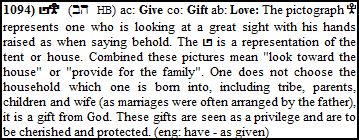
The most common Hebrew word translated as love is אהב ‘ahav’ which comes from the following root:

What is the ultimate definition of love? Giving one’s life for another
Joh 3:16 For God so loved the world that He gave His only begotten Son, that everyone believing into Him should not perish, but have everlasting life.
Joh 15:13 Greater love than this has no one, that anyone should lay down his soul for his friends.
Offering/giving sacrifices is love
Hos 8:13 They sacrifice flesh for the sacrifices of My offerings (הבהב ‘havhav’), and they eat. Jehovah did not accept them. Now He will remember their iniquity and punish their sins. They shall return to Egypt.
Connection…being knit together
Exo 38:28 And the thousand, seven hundred and seventy five shekels he made into hooks for the pillars; and he overlaid their capitals and joined* them.
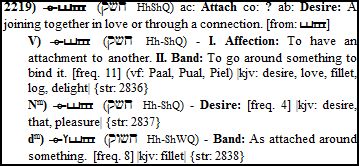
Exo 38:17 And the sockets for the pillars were bronze, the hooks of the pillars and their bands of silver. And the overlaying of their capitals were silver; and all the pillars of the court were banded with silver.
Exo 38:28 And the thousand, seven hundred and seventy five shekels he made into hooks for the pillars; and he overlaid their capitals and joined them.
Deu 7:7 Jehovah did not set His love on you or choose you because you were more in number than any people, for you were the fewest of all peoples.
Psa 91:14 Because He has set His love on Me, therefore I will deliver Him; I will set Him on high because He has known My name.
Col 2:2 that their hearts may be comforted, being joined together in love, and to all riches of the full assurance of the understanding, to the full knowledge of the mystery of God, even of the Father and of Christ,
Col 2:19 and not holding fast the Head, from whom all the body having been supplied through the joints and bands, and being joined together, will grow with the growth of God.
Conclusion
Ecc 12:13 Let us hear the conclusion of the whole matter: Fear God, and keep his commandments: for this is the whole duty of man.
The following is an excerpt from Shadows of Messiah – Etymology
The Bosom, the Family and Gathering at the Cross
Just as the word father in Hebrew is associated with love, so too is the word mother. אם ‘em’ (mother) is the source of the Latin ‘amare,’ the French ‘amitie’ and the English ‘amity’ which mean love. One of the Hebrew words for love is דד ‘dud/dad’ which means both love and breasts/bosom. Interestingly, the English word ‘baby’ comes from the Hebrew בבה ‘baba’ which is related to the word אבוב ‘aboob’ the root of which is אב ‘av’ which means father but also means a pipe, as in the breast of the mother whose milk flows to give sustenance to the baby. בבה ‘baba’ in Hebrew means the pupil, the apple of one’s eyes. As any parent has held their baby in their arms against their bosom they recognize this is the epitome of love and intimate relationship (apple of the eye/little guy in the eye).
As mentioned above, family comes from משפחה ‘mispocha’ the same root as שפח ‘shapach’. שפח ‘shaphach’ is the root of the word crucifixion which gathers all the family of the earth. The bosom, which represents the love of the family also links to the bosom.
Messiah came from the bosom of the Father.
Joh 1:18 No one has seen God at any time; the only begotten Son, who is in the bosom of the Father, that One declares Him.
He gathers and then carries in His bosom His people, linking to the crucifixion. It is through the work of Messiah on the cross that mankind is brought into His family.
Isa 40:10 Behold, the Lord Jehovah will come with strength, and His arm rules for Him. Behold, His reward is with Him, and His wage before Him.
Isa 40:11 He shall feed His flock like a shepherd; He shall gather lambs with His arm; and carry them in His bosom; those with young He will lead;
Psa 89:50 Remember, O Lord, the reproach of Your servants, my bearing in my bosom the insults of the many peoples
Psa 89:51 with which Your enemies have cursed, O Jehovah; with which they have cursed the footsteps of Your anointed.
Eph 2:8 For by grace you are saved, through faith, and this not of yourselves; it is the gift of God;
Eph 2:9 not of works, that not anyone should boast;
Eph 2:10 for we are His workmanship, created in Christ Jesus unto good works, which God before prepared that we should walk in them.
Eph 2:11 Because of this, remember that you, the nations, were then in the flesh (those having been called Uncircumcision by those having been called Circumcision in the flesh made by hands)
Eph 2:12 that at that time you were without Christ, alienated from the commonwealth of Israel and strangers of the covenants of promise, having no hope and without God in the world.
Eph 2:13 But now, in Christ Jesus you who then were afar off, came to be near by the blood of Christ.
Eph 2:14 For He is our peace, He making us both one, and breaking down the middle wall of partition,
Eph 2:15 in His flesh causing to cease the enmity, the Law of the commandments in decrees, that He might in Himself create the two into one new man, making peace,
Eph 2:16 and might reconcile both in one body to God through the cross, slaying the enmity in Himself.
Eph 2:17 And coming, He proclaimed “peace to you, the ones afar off, and to the ones near.” Isa. 57:19
Eph 2:18 For through Him we both have access by one Spirit to the Father.
Eph 2:19 So, then, you are no longer strangers and tenants, but you are fellow citizens of the saints and of the family of God,
There are multiple words in Hebrew for love, all linking back to the bosom. The most common is אהב ‘ahav’ which has the meaning of a gift and the expressions and actions of one towards the family. The pictograph meaning displays the gift of the Father to mankind of His only begotten Son. Again linking the bosom, the family and the crucifixion.
Joh 3:16 For God so loved the world that He gave His only begotten Son, that everyone believing into Him should not perish, but have everlasting life.
Joh 15:13 Greater love than this has no one, that anyone should lay down his soul for his friends.

From the root:

The Pictograph meaning of Love

The first and last letters spell out the word for Father (אב ‘ab’) and the middle letter is a picture of a man with outstretched arms. The Love of the Father is revealed through the Messiah on the tree, gathering all mankind back to their Creator.
Another word for love is חשק ‘chashaq’ which has the meaning of being knit together in love. חשק ‘chashaq’ is the word used in reference to the joining together of the Tabernacle, which is a shadow picture of the body of Messiah. It is no surprise that this joining together involved nails, just as in the nails used in the crucifixion (Exodus 38:17, 28; Deuteronomy 7:7; Colossians 2:2, 19; Ephesians 4:15-16).

חשק ‘chashaq’ also can be traced back to the word חק ‘choq’
H2436
חוק / חק / חיק
chêyq / chêq / chôq
BDB Definition:
1) bosom, hollow, bottom, midst

חק ‘choq’ is the root of חקק ‘chaqaq’ and חקה ‘chuqah’ which means to inscribe a decree or custom. It is used in reference to the Torah. The New Covenant, cut at Calvary is associated with the inscribing of the Word on our hearts which is contained in our bosoms (Jeremiah 31:31).
The feasts/appointed times, at which the people of the Lord gathered, are linked to this word חק ‘choq.’

It is no surprise then that the English word hug traces back to the Hebrew word חג ‘chag’ which means feast.

The feasts revolved around the gathering together of the people to the Tabernacle or tent. The Tabernacle itself was called the אהל מועד ‘ohel mo’ed’ which means tent of meeting/gathering or tabernacle of congregation. מועד ‘moed’ comes from עד ‘ad’ which means to see the door, as in meeting as the door of the Tabernacle.
There are two more words in Hebrew which are translated as bosom. It is חצן ‘chatsan’ which comes from חץ ‘chets’ which literally means a tent wall, as in an enclosing. Finally, the word צלחת ‘tsalachat’ which also means a bowl, as in the bowls used in the Tabernacle. צלחת ‘tsalachat’ comes from צלח ‘tsalach’ which traces back further to צל ‘tsel’ which means a shadow…as under the shadow of His wings, the little guy in His Eye.
Recall that the word in Hebrew for pupil is בבה ‘baba’ which is the source of the English word ‘baby.’ Interestingly, the English word ‘shade’ comes from the Hebrew word שד ‘shad’ which means the breast/bosom. שד ‘shad’ is the root of the word שדי ‘shaddai’ which is translated as ‘the Almighty.’ שד ‘shad’ literally means to return to the door, again linking with the feasts and the Tabernacle mentioned above.
Finally, the word דוד ‘dod’ means love. דד ‘dod’ literally means the breasts. The letter ‘dalet’ is the picture of a door, or flap of a tent which opens the way inside. The tabernacle consisted of two doors/veils which דד ‘dod’ displays. What is the veil of the Tabernacle a picture of? The body/flesh of Messiah.
Heb 10:20 which He consecrated for us, a new and living way through the veil; that is, His flesh;
The above portion of Scripture is in context of the New Covenant which was cut at Calvary where Messiah gathered mankind into His bosom (Isaiah 40:11; Psalm 89:50).
Bosom & Faith
Num 11:12 I, have I conceived all this people? I, have I begotten it, that You say to me, Carry it in your bosom as the foster father (אמן ‘aman’) bears the suckling, to the land which You have sworn to its fathers?
The word used above for foster father/nursing father is אמן ‘aman’ which means faith. Faith comes from the same root as truth (etymology) in Hebrew מן ‘man.’
Faith and Truth are synonymous
Faith (אמונה ‘emunah’) and Truth (אמת ‘emet’) come from the same root and as seen above are interchangeable when translating the text.
Ancient Hebrew Definition

אמונה ‘emunah’comes from the 3 letter root ‘aman’

אמן ‘aman’ means truly, a sure foundation and support. This is why Messiah is spoken of as the אמן ‘Amen’ (Revelation 3:14). He is the firm foundation represented by the Tree of Life/the Word. The other tree in midst the Garden was the tree of knowledge which represents unfaithfulness/lawlessness. Man must choose between the two. The choice that one makes determines which seed/tree he will be a part of. Interestingly, the parent root for the word אמונה ‘emunah’ is מן which means ‘the blood continues.’ It is the word used in Genesis 1 for ‘kind’ or species. Recall that this is the origin of the word ‘etymology’ as well.

Faith is Biblically defined as walking in Truth who is the Word/Messiah. Faith traces back to the Garden of Eden and the two trees in the midst of the Garden. The Tree of Life which represents truth/faith and the tree of knowledge which represents unfaithfulness/lawlessness and man’s own will as to what is good or evil.
The English word faith comes from the Old French word ‘foi’ which means faith, belief, trust which traces back further to the Latin word ‘fides’ which has the same meaning. ‘Fides’ traces back to the Hebrew word בטח ’batach.’ בטח ‘batach’ is also the source for the English word ‘trust.’ בטח ‘batach’ means to cling to someone or something. It is pictured in the natural realm in a melon which clings to the vine. Here again the picture of the Tree of Life and the tree of knowledge is seen. Man can have faith in the Lord and cling to Him or man can choose his own way and cling to the tree of knowledge. This concept of clinging to the vine is discussed in more detail in the Biblical definition of the Olive tree and the word אב ‘av’ (Father).
Related Studies:
Musings – The Father’s Love Letter
Daily Tidbits 2/18 – Love & the 4th Dimension
Daily Tidbits 5/17 – The Bosom
Hebrew Origins of English – Love
littleguyintheeye@gmail.com

 Little Guy in the Eye