

There are various thoughts on the date of the birth and final year of Messiah’s life. From my studies, I have come to the conclusion that 30 A.D. Best fits the year of His crucifixion and resurrection.
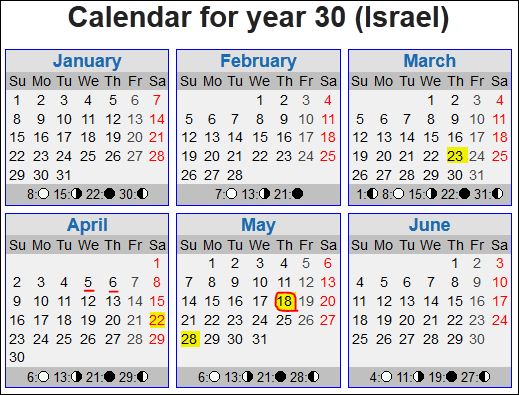
Only in 30 AD do we have a Wednesday Pesach with the 40th day of the Omer count, when Messiah Jesus ascended to Heaven lining up with Noah’s leaving the ark (Gen 9:14). This occurred on the 27th day of the second month (Iyyar) which is shown in the above picture as May 18th.
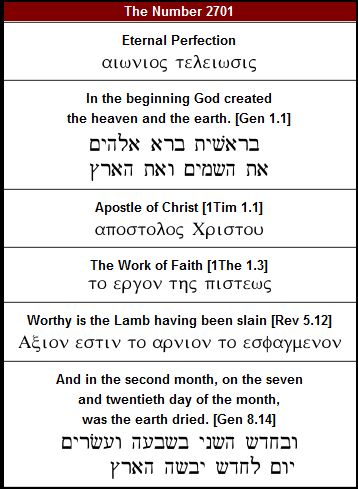
Genesis 8:14 – The 27th day of the 2nd month corresponds to Iyarr 27, this is is the day that Messiah Yahshua ascended (Acts 1:1-3) to Heaven where it was proclaimed ‘Worthy is the Lamb having been slain’.
The Sum of Genesis 1:1 = 2701
March 23, 30 AD = Nisan/Aviv 1
March 29 John 12:1 six days before Pesach Jesus comes to Bethany to have supper
March 30 John 12:12 Jesus makes His triumphal entry
March 31 Mark 11:12-17 Jesus curses the fig tree, casts out the money changers
April 2 Olivet discourse
April 4th sunset Pesach (last supper) Mtt 26:17; Mk 14:12; Lk 22:7
April 5th Preparation day for High Sabbath
April 6th 1st day of Unleavened Bread High Sabbath
April 7th Preparation of spices
April 8th Sabbath, at sunset Messiah arises
April 9th Messiah appears to disciples
The only way of getting a Wednesday crucifixion is by counting the from the conjunction. Scripture & history show that Messiah was crucified on Wednesday.
“For they began to hold a council against the Lord on the second day of the week, in the first month, which is Xanthicus; and the deliberation continued on the third day of the week; but on the fourth day (Wednesday) they determined to take away His life by crucifixion” (Apostolic Constitutions-Didascalia Apostolorum, book V, section 1, paragraph xiv).
“Jesus’ Passion began on a Wednesday”
Hans Lietzmann. A History of the Early Church. The World Publishing Company:Cleveland, 1963
It is interesting that the tradition of a Wednesday crucifixion has an ancient origin. Philip Schaff, in his monumental History of the Christian Church, reports that a number of the early Christian congregations observed “the weekly commemoration of the sufferings and death of the Lord” on Wednesdays — even while others observed Fridays. Gradually, however, the Wednesday tradition disappeared.
The Didascalia, an early Christian work, also supports the Wednesday commemoration of the Messiah’s death. In this work the apostles are quoted as saying that it was on Tuesday that they ate the final supper with the Messiah, and that on Wednesday he was taken captive and held in custody in the house of Caiaphas.
Also, Epiphanius, a post-Nicene writer, protests that Yeshua could not have been arrested on the night of Thursday-Friday; the false tradition for him is that which puts the Last Supper on Thursday evening. The correct one, according to Epiphanius, is that which places it on Tuesday. Moreover, an early chronology worked out by Victorinus of Pettau came to the conclusion that Yeshua must have been put to death on a Wednesday.
Finally, there is a certain amount of evidence found in the writings of the early church fathers for the Last Supper having taken place on Tuesday. And, according to the way the Jews reckoned time, Nisan 14 began at sundown that day — supposedly falling on a Wednesday that year.
Wednesday April 5th….Preparation Day…Passover… Abib 14…Lev 23:5
Messiah died at 3 pm
Mar 15:34 And at the ninth hour Jesus cried with a loud voice, saying, Eloi, Eloi, lama sabachthani? which is, being interpreted, My God, my God, why hast thou forsaken me?
Mar 15:35 And some of them that stood by, when they heard it, said, Behold, he calleth Elias.
Mar 15:36 And one ran and filled a spunge full of vinegar, and put it on a reed, and gave him to drink, saying, Let alone; let us see whether Elias will come to take him down.
Mar 15:37 And Jesus cried with a loud voice, and gave up the ghost.
Mar 15:38 And the veil of the temple was rent in twain from the top to the bottom.
Mar 15:39 And when the centurion, which stood over against him, saw that he so cried out, and gave up the ghost, he said, Truly this man was the Son of God.
He was placed in a tomb before the first day of Unleavened bread (a High Sabbath)
Mat 27:57 When the even was come, there came a rich man of Arimathaea, named Joseph, who also himself was Jesus’ disciple:
Mat 27:58 He went to Pilate, and begged the body of Jesus. Then Pilate commanded the body to be delivered.
Mat 27:59 And when Joseph had taken the body, he wrapped it in a clean linen cloth,
Mat 27:60 And laid it in his own new tomb, which he had hewn out in the rock: and he rolled a great stone to the door of the sepulchre, and departed.
Mat 27:61 And there was Mary Magdalene, and the other Mary, sitting over against the sepulchre.
Joh 19:40 Then took they the body of Jesus, and wound it in linen clothes with the spices, as the manner of the Jews is to bury.
Joh 19:41 Now in the place where he was crucified there was a garden; and in the garden a new sepulchre, wherein was never man yet laid.
Joh 19:42 There laid they Jesus therefore because of the Jews’ preparation day; for the sepulchre was nigh at hand.
Thursday April 6th…. Abib 15 High Sabbath Lev 23:6-7; John 19:31
Joh 19:31 The Jews therefore, because it was the preparation, that the bodies should not remain upon the cross on the sabbath day, (for that sabbath day was an high day,) besought Pilate that their legs might be broken, and that they might be taken away.
Mat 27:62 And on the morrow, which is after the Preparation, the chief priests and the Pharisees were assembled to Pilate,
Mat 27:63 saying, Sir, we have recalled that that deceiver while living said, After three days I will rise.
Mat 27:64 Therefore, command that the grave be secured until the third day, that His disciples may not come by night and steal Him away, and may say to the people, He is raised from the dead. And the last deception will be worse than the first.
Mat 27:65 And Pilate said to them, You have a guard, go away, make it as secure as you know how.
Mat 27:66 And going along with the guard, they made the grave secure, sealing the stone
Friday April 7th…. Abib 16
Luk 23:56 And they returned, and prepared spices and ointments; and rested the sabbath day according to the commandment. mk 16:1
Saturday Sabbath April 8th…Abib 17 Exo 20:8-11
Luk 23:56 And they returned, and prepared spices and ointments; and rested the sabbath day according to the commandment.
End of the sabbath “dawning/beginning”{Lk 23:54} of 1st day
Mat 28:1 In the end of the sabbath, as it began to dawn toward the first day of the week, came Mary Magdalene and the other Mary to see the sepulchre.
The word for dawn here is G2020 ἐπιφώσκω epiphōskō which means dawn. However, this word is also used for the beginning of Shabbat.
Luk 23:54 And that day was the preparation, and the sabbath drew on.
John Gill commentary
and the sabbath drew on, or “shone out”; which is so said, though it was evening, on account of the lights, which were every where, in every house, lighted up at this time, and which they were, by their traditions, obliged to: for so run their canons (c);
“three things a man is obliged to say in the midst of his house on the evening of the sabbath, when it is near dark, have ye tithed? have ye mixed? (i.e. the borders of the sabbath, the courts and food) הדליקו הנר, “light the lamp”.”
This was what could by no means be dispensed with; for so they say (d),
“the lighting of the lamp on the sabbath is not in a man’s power, (or at his liberty,) if he pleases he may light, and if not, he may not light.—-But it is what he is obliged to, and every man and woman are bound to have in their houses a lamp lighted up on the sabbath; and though he has nothing to eat, he must beg, and get oil, and light a lamp; for this is included in the delight of the sabbath.—-And he that lights, ought to light within the day, before the setting of the sun.”
So that when these lamps were every where lighting, before the sun was set, and the sabbath properly come, it might be said to draw on, or to be shining forth. Besides, it was usual to call the evening of any day by the name of “light”: thus it is said (e),
אור לארבע עשר, on the light (i.e. the night) of the fourteenth (of the month “Nisan”), they search for leaven, &c.”
So that the evangelist might, very agreeably to the way of speaking with the Jews, say, that the sabbath was enlightening, or growing light, though the evening was coming on.
(c) Misn. Sabbat, c. 2. sect. 7. (d) Maimon. Hilch. Sabbat, c. 5. sect. 1, 3. (e) Misn. Pesachim, c. 1. sect. 1.
Late Saturday-Sunday Abib 18
Early yet dark
Joh 20:1 The first day of the week cometh Mary Magdalene early, when it was yet dark, unto the sepulchre, and seeth the stone taken away from the sepulchre.
Sunday April 9th…Abib 18
Mar 16:2 And very early in the morning **** the first day of the week, they came unto the sepulchre at the rising of the sun.
Mar 16:3 And they said among themselves, Who shall roll us away the stone from the door of the sepulchre?
Mar 16:4 And when they looked, they saw that the stone was rolled away: for it was very great.
Mar 16:5 And entering into the sepulchre, they saw a young man sitting on the right side, clothed in a long white garment; and they were affrighted.
Mar 16:6 And he saith unto them, Be not affrighted: Ye seek Jesus of Nazareth, which was crucified: he is risen(He was already risen on Saturday afternoon); he is not here: behold the place where they laid him.
Luk 24:1 Now upon the first day of the week, very early in the morning, they came unto the sepulchre, bringing the spices which they had prepared, and certain others with them.
Luk 24:2 And they found the stone rolled away from the sepulchre.
Luk 24:3 And they entered in, and found not the body of the Lord Jesus.
Luk 24:4 And it came to pass, as they were much perplexed thereabout, behold, two men stood by them in shining garments:
Luk 24:5 And as they were afraid, and bowed down their faces to the earth, they said unto them, Why seek ye the living among the dead?
Luk 24:6 He is not here, but is risen: remember how he spake unto you when he was yet in Galilee,
Mar 16:9 Now when Jesus was risen early the first day of the week, he appeared first to Mary Magdalene, out of whom he had cast seven devils.
Mar 16:10 And she went and told them that had been with him, as they mourned and wept.
Mar 16:11 And they, when they had heard that he was alive, and had been seen of her, believed not.
Mar 16:12 After that he appeared in another form unto two of them, as they walked, and went into the country.
Mar 16:13 And they went and told it unto the residue: neither believed they them.
Mar 16:14 Afterward he appeared unto the eleven as they sat at meat, and upbraided them with their unbelief and hardness of heart, because they believed not them which had seen him after he was risen.
*****λίαν πρωῒ The phrase used here in Mk 16:2 for very early is similar to Mark 1:35 πρωΐ ἔννυχα λίαν
Mar 1:35 And in the morning, rising up a great while before day, he went out, and departed into a solitary place, and there prayed.
Jesus the Messiah died on Wednesday April 5 AD 30 and arose Saturday April 8 AD 30
Messiah said He would be in the heart of the earth 3 days and 3 nights. It was the only sign He would give that proved He was the Messiah
Mat 12:38 Then certain of the scribes and of the Pharisees answered, saying, Master, we would see a sign from thee.
Mat 12:39 But he answered and said unto them, An evil and adulterous generation seeketh after a sign; and there shall no sign be given to it, but the sign of the prophet Jonas:
Mat 12:40 For as Jonas was three days and three nights in the whale’s belly; so shall the Son of man be three days and three nights in the heart of the earth.
Daniel’s prophecy lines up with 30 AD
A day of prophetic fulfillment is a year in actual time (Ezek 4.4-6) & (Num 14.34). The total number of years from the decree to restore Jerusalem until the ministry of Messiah is figured this way: 69 (weeks) X 7 (days a week) equals 483 prophetic days, or 483 years of actual time.
The decree was issued to Ezra by King Artaxerxes of Persia (Ezra 7.8 -11). This decree officially established Jerusalem as a provincial capital city, under its own governor, within the Persian Realm. The seventh year of Artaxerxes was the calendar year from September 458 BC to September 457 BC.
The 483 years of the 69 week prophecy extended from that time forward to AD 27. That was the time Jesus the Messiah began His ministry. 69 X 7 = 483 years – 457 BC the year the decree was issued This leaves a subtotal of 26 years, or AD 26 The prophecy of Daniel 9 contains another prophetic week, making a total of 70 weeks.
Since AD 26 -adding 3 1/2 half years of the ministry of Jesus would bring us to the Spring AD 30, the time of His death. Jesus was about 30 in the Autumn of AD 26.
Three decrees concerning Jerusalem are recorded, that of Cyrus, B.C. 536 (Ussher), for the restoration of the “house of the Lord God of Israel” (2Chr. 36.22.23; Ezra 1.1-3); that of Darius (Ez. 6.3-8, B.C. 521-486), and that of Artaxerxes in his seventh year (Ez. 7.7, say, B.C. 458). Artaxerxes in his twentieth year, B.C. 444 (Hales, Jahn), 446 (A.V.), 454 (Ussher, Hengstenberg), gave permission for the rebuilding of the “city,” i.e., “Jerusalem” (Neh. 2.1-8). The latter decree is obviously, that from which the “seven weeks” (49 years) run, unless by “the commandment to restore,” etc. is meant the divine decree (Dan. 9.23).
In the present state of biblical chronology the date of the decree of Artaxerxes cannot be unanswerably fixed farther than to say that it was issued between 454 and 444 B.C. In either case we are brought to the time of Christ. Prophetic time is invariably so near as to give full warning, so indeterminate as to give no satisfaction to mere curiosity (cf. Mat. 24.36; Acts 1.7). The 434 years reckon, of course, from the end of the seven weeks so that the whole time from “the going forth of the commandment to restore,” etc., “unto the Messiah” is sixty-nine weeks of years, or 483 years.
Miracles that happened in 30 AD
“Forty years before the destruction of the Temple, the western light went out, the crimson thread remained crimson, and the lot for the Lord always came up in the left hand. They would close the gates of the Temple by night and get up in the morning and find them wide open” (Jacob Neusner, The Yerushalmi, p.156-157). [the Temple was destroyed in 70 CE]
“Our rabbis taught: During the last forty years before the destruction of the Temple the lot [‘For the Lord’] did not come up in the right hand; nor did the crimson-colored strap become white; nor did the western most light shine; and the doors of the Hekel [Temple] would open by themselves” (Soncino version, Yoma 39b).
The Jerusalem Talmud states:
”Said Rabban Yohanan Ben Zakkai to the Temple, ‘O Temple, why do you frighten us? We know that you will end up destroyed. For it has been said, ‘Open your doors, O Lebanon, that the fire may devour your cedars’ ” (Zechariah 11:1)’ (Sota 6:3).
littleguyintheeye@gmail.com

 Little Guy in the Eye