

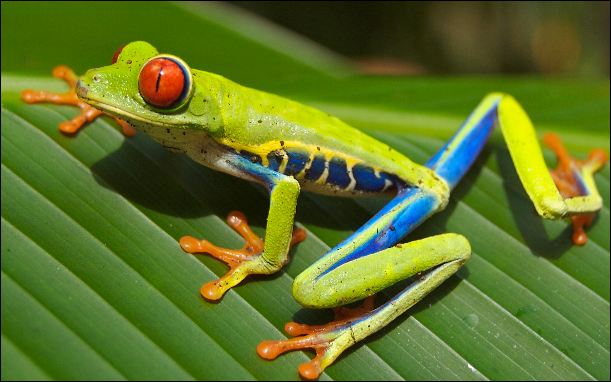
The Hebrew word for frog is צפרדע ‘tsefardeah’ is a combination of two Hebrew words. צפר ‘tsaphar’ which is speaking of the singing of birds at the dawn of the morning and דע ‘dah’ which means knowledge. This is speaking of the singing or croaking of frogs in the wee hours of the morning that is heard by man when he arises.
The singing of birds {צפר ‘tsaphar’} is associated with the second day of creation, so too is the frog. This division of water and earth is linked to the frog as it is amphibious, living on land and sea.
Amphibian is derived from the Ancient Greek term ἀμφίβιος ‘amphíbios’, which means “both kinds of life”, ‘amphi’ meaning “of both kinds” and bio meaning “life”.
Isaac Mozeson traces the word ‘amphibian’ back to the Hebrew word אביב ‘aviv’ which means spring, literally the springing forth of life during the Spring season. Amphibians are cold blooded so many will hibernate during winter until the warmth of the spring sun ‘resurrects’ them. אביב ‘aviv’ also means green, the primary color of frogs.
The going down of the sun and the rising of the sun is when the birds are heard singing and the frogs are heard croaking.
Psa 65:8 And those living in the uttermost parts are afraid of Your signs; You make the outgoings of the morning and the evening to rejoice.
Morning and evening our Creator is calling us to Him. Calling us to the shadow of His wings. Calling us back to Him through the Messiah under His outstretched arms.
This is also seen in the Temple/Tabernacles services.
Every morning and every evening (Exodus 29:38-42), they would sacrifice a lamb, with its compliment oblation (grain offering), and libation (wine offering). These sacrifices allowed them twice a day to remember or to ‘re-experience’ the salvation of YHWH. At the ‘Last Supper’ Messiah brought forth the bread & the wine and then offered Himself as the lamb of the New Covenant. This has been passed down through tradition as the ‘eucharist’ which literally means to ‘give thanks.’ This is the word תודה ‘todah’ in Hebrew and is the origin of the English word ‘toad.’
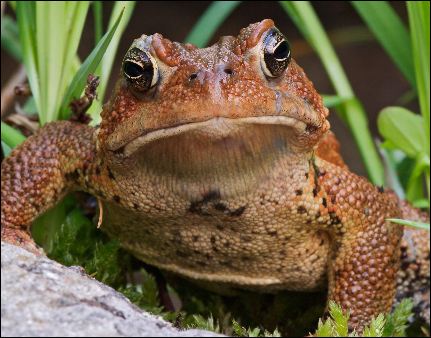 Toad comes from the Hebrew word תודה ‘todah’ which means to give thanks.
Passover occurs at the beginning of the year (אביב ‘aviv’), it is a picture of being reborn in Messiah, pointing back to the beginning/creation of the world. The Flood of Noah was a type of rebirth (1 Peter 3:20) where the dry land appeared in the first month (Genesis 8:13). So too, at the Passover in Egypt during the Exodus, Israel passed through the Red Sea and were baptized (1 Corinthians 10:2) Baptism is a picture of being born again, into the body of Messiah (1 Corinthians 12:13; Colossians 3:11; Galatians 3:27-28). Amazingly, the Hebrew word פסח ‘pasach’ which is translated as ‘passover’ literally means to hop. This is another meaning of the word ‘frog.’ Baptism occurs ‘down by the riverside’ where the frogs dwell.
Down by the riverside
‘Gonna lay down my sword and shield.’ Another meaning of the English word ‘frog’ is a fastening for clothing, originally a belt loop made for carrying a weapon. This version of the word ‘frog’ comes from the Portuguese word ‘froco’ which traces back to the Latin word ‘floccus’ which means a ‘flock of wool.’ Notice the sheep/lamb/passover connection.
Further connecting these concepts is the lamb slain from the foundation of the world (Revelation 13:8), who is Messiah, the Lamb of God. His sacrifice was foreshadowed in the Garden of Eden when Adam and Eve sinned by partaking of the tree of knowledge of good and evil.
Gen 3:21 And YHWH God made coats of skin for the man and his wife, and clothed them.
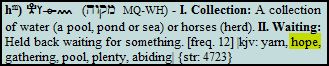
The English word hope comes from the Old English ‘hopian’ which means to wish, expect or look forward to something. It is related to the word ‘hop’ as in one who leaps for expectation. This is related to the Hebrew word פסח ‘pasach’ which means to hop or limp. Isaac Mozeson associates the etymology of hope with the hip. In Hebrew this is the word כפוף ‘kaphoph’ which literally means to bow down. This is pointing to the wrestling match between Jacob and the Man who touched his hip and caused him to hop/limp the rest of his days (Genesis 32:31-32).
Connecting to Jacob’s wrestlings is the Hebrew word צלע translated as ‘limp.’ This word is also translated as rib, as in the rib which YHWH took from Adam to form his wife.
Interestingly, this word is also connected to the number 5 (five fingers on the hand) through Adam as well.
Gen 2:21 And YHWH God caused a deep sleep to fall on the man, and he slept. And He took one of his ribs, and closed up the flesh underneath.
Gen 2:22 And YHWH God formed the rib which He had taken from the man into a woman, and brought her to the man.
Gen 2:23 And the man said, This now at last is bone from my bones, and flesh from my flesh. For this shall be called Woman, because this has been taken out of man.
Gen 2:24 Therefore, a man shall leave his father and his mother, and shall cleave to his wife and they shall become one flesh
Eph 5:30 For we are members of His body, of His flesh, and of His bones.
Eph 5:31 “For this, a man shall leave his father and mother, and shall be joined to his wife, and the two shall be one flesh.” Gen. 2:24
Eph 5:32 The mystery is great, but I speak as to Christ and as to the assembly.
The rib of Adam from whence his bride came out is linked to the number 5 which connects to the 5th day of creation.
חמש ‘chamesh’ is used to translate multiple terms in Hebrew. It is used for the number five/fifty, the hand, to be armed and the side of the body (fifth rib).
The ‘fifth rib’
H2570
חמשׁ
chômesh
This word is used in the following verses: 2Samuel 2:23,3:27, 4:6, 20:10
Messiah was wounded in the side (‘the fifth rib’).
Joh 19:34 But one of the soldiers pierced His side with a lance, and at once blood and water came out.
This connects to another word for hope in Hebrew מקוה ‘miqvah’ which also means to baptize.
The Hebrew word for grapevine גפן ‘gephen’ also comes from the root כף ‘kaph.’ This is interesting to note at the Hebrew word for trust, בטח ‘batach,’ is speaking of clinging to a vine. The Greek word for frog is βάτραχος ‘batrachos.’ Could בטח ‘batach’ be the origin of this word?
Another Hebrew word for hope is יחר ‘yachar’ which comes from the root חר which is speaking of the heat of the sun. Here the meaning is one who waits until the cool of the day to leave the tent in order to avoid the intense heat of the sun.
It is interesting to note that the ‘cool’ of the days is the רוח ‘ruach’ which means spirit. The English word ‘aspire’ which means to hope, traces back to this concept. This is also connected to the frog as the word ‘spirit’ comes from צפר ‘tsaphar’ which, as seen above, is speaking of the ‘singing’ aspect of the frog.
Our Hope is Messiah Jesus
1Ti 1:1 Paul an apostle of Jesus Christ according to a command of God our Savior, even the Lord Jesus Christ, our Hope,
Hope is linked with the resurrection
1Pe 1:3 Blessed be the God and Father of our Lord Jesus Christ, He according to His great mercy having regenerated us to a living hope through the resurrection of Jesus Christ from the dead,
Hope is linked with His return
Tit 2:13 looking for the blessed hope and appearance of the glory of our great God and Savior Jesus Christ,
Amazingly, the word צפרדע ‘tsaphardea’ (frog) can be broken down into צף ‘tsaph’ meaning the north, in particular the North star which is where the constellation ‘Cepheus’ is located, a picture of the enthroned King and רדע ‘rada’ which means to descend…The King who sits upon the throne who descends to earth…
War, the taking up of arms, began when Adam and Eve sinned.
The Hebrew word for war is speaking of the process of making bread.
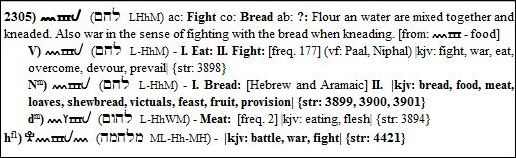
Is it any surprise that during the plague in Egypt, the frogs came up into the kneading bowls of the Egyptians?
Exo 8:1 And YHWH said to Moses, Go to Pharaoh, and say to him, So says YHWH, Send away My people that they may serve Me.
Exo 8:2 And if you refuse to send them away, behold, I am about to smite all your territory with frogs.
Exo 8:3 And the river will swarm with frogs. And they shall go up and enter into your house, and into your bedroom, and on your couch, and into your servants’ house, and on your people, and into your ovens and into your kneading troughs.
Exo 8:4 And the frogs will come up on you, and on your people, and on all your servants.
The Latin word for frog is ‘rana’ which is named for its croaking. ‘Rana’ traces back to the Hebrew word רנה ‘ranah’ which means to rejoice or sing for joy.
Psa 57:7 My heart is fixed, O God, my heart is fixed; I will sing and give praise.
Psa 57:8 Wake up my glory! Wake up, harp and lyre! I will stir the morning dawn with praise.
It is interesting to note that the word ‘frog’ in English also has another meaning of a fastening for clothing, originally a belt loop made for carrying a weapon as mentioned above. This version of the word ‘frog’ comes from the Portuguese word ‘froco’ which traces back to the Latin word ‘floccus’ which means a ‘flock of wool.’ This is a fascinating connection as to Passover (פסח ‘pasach’ in Hebrew which literally means to hop) where the lamb was slain. Further connecting these concepts is the ‘new song’ that is sung because of the salvation given to mankind through THE Lamb of God who was slain for the redemption of mankind.
Rev 5:9 And they sing a new song, saying, Worthy are You to receive the scroll, and to open its seals, because You were slain, and by Your blood purchased us to God out of every tribe and tongue and people and nation,
Rev 5:10 and made us kings and priests to our God; and we shall reign over the earth.
Rev 14:3 And they sing as a new song before the throne, and before the four living creatures and the elders. And no one was able to learn the song except the hundred and forty four thousands, those having been redeemed from the earth.
Further linking the hopping and songmaking of the frog is the origin of the word ‘exult’ in English. Exult comes from the Latin word ‘saltare’ which means to leap up. Saltare traces back to the Hebrew word סלד ‘salad’ which means to spring up. The English word ‘salute’ comes from this Hebrew word as well as it has the sense of ‘leaping to attention.’ Saluting is also related to wishing one health and safety, or ‘salvation.’ A salute is done with the hand (consisting of 5 fingers – recall the connection above) which is associated with wishing one health or completeness. This concept of wishing one health is associated with the Hebrew word שלוה ‘shalvah’ which is the origin of the English word ‘salvation.’
Croaking
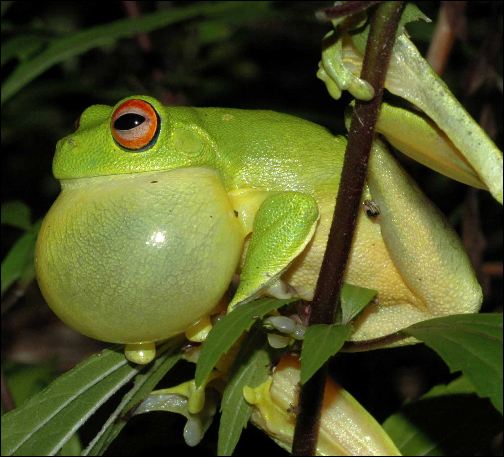
The Hebrew word for the croaking that a frog makes is קוה ‘qva/kwa.’ This word means ‘hope’ which links to hopping as mentioned above but also means to be gathered together. When Messiah descends, His people are resurrected and gathered together.
Psa 30:5 For His anger is only a moment; in His favor is life. Weeping may endure in the evening, but joy comes in the morning.
The Hebrew word for joy in the above verse is רנה ‘rinah’ which is associated with the frog through Etymology as mentioned above. The morning is also associated with the frog through the word צפר ‘tsaphar’ and the singing of birds and frogs at this time.
In English, the croaking of the frog is displayed in the word ‘ribbit’ which is an onamonapia of the sound the frog makes. In Hebrew this could be written as the word רבץ ‘ribatz.’ רבץ ‘ribatz’ means to lie down or crouch.
Lying down or crouching which is related to the word רבע ‘reva’ which means ‘four.’ Interestingly, the word frog is used 14 (4 +10) times in Scripture (13x in the TaNaKH and 1x in the New Testament). The number four is linked to the resurrection and regathering of Yah’s people in Messiah when He returns.
Mat 24:31 And He will send His angels with a great sound of a trumpet, and they will gather His elect from the four winds, from the ends of the heavens to their ends.
The Hebrew word דוד ‘david’ has the numerical equivalent to 14. The warrior poet, both themes of the frog…
The English word ‘croak’ traces back to two Hebrew words. חרק ‘charaq’ which has the meaning of ‘gnashing of teeth’ and also is translated as ‘insect,’ in specific crickets and locusts, referring to the creaking noises and chomping of vegetation they make.
Mat 24:42 Watch, then, for you do not know in what hour your Lord comes.
Mat 24:43 But know this, that if the housemaster had known in what watch the thief comes, he would have watched and not have allowed his house to be dug through.
Mat 24:44 Because of this, you also be ready, for in that hour you think not, the Son of Man comes.
Mat 24:45 Who then is the faithful and wise servant whom his Lord has set over His household, to give to them the food in season?
Mat 24:46 Blessed is that servant whom his Lord shall find so doing when He comes.
Mat 24:47 Truly I say to you, He will set him over all His substance.
Mat 24:48 But if that wicked slave says in his heart, My Lord delays to come,
Mat 24:49 and begins to beat his fellow servants, and to eat and to drink with the ones drinking,
Mat 24:50 the Lord of that slave will come in a day in which he does not expect and in an hour which he does not know,
Mat 24:51 and will cut him in two, and will appoint his portion with the hypocrites. There will be weeping and gnashing of the teeth.
The other English word ‘croak’ traces back to is קרא ‘qara’ which means to call out.
Joe 2:32 For it shall be, all who shall call on the name of YHWH shall be saved. For salvation shall be in Mount Zion, and in Jerusalem, as YHWH has said, and among the survivors whom YHWH shall call.
Act 2:19 “And I will give wonders in the heaven above,” and miraculous signs “on the earth below, blood and fire and vapor of smoke.
Act 2:20 The sun will be turned into darkness, and the moon into blood, before the” “coming of the great and glorious” “day of the Lord.”
Act 2:21 “And it shall be that everyone who shall call on the name of the Lord will be saved.” Joel 2:28-32
Here we see a positive and negative side to the word ‘croak.’ Some will hear the call of the Most High and be saved, others will reject Him and weep and gnash their teeth. The main reason for calling is to allow males to attract a mate. Here is another shadow picture of the bridegroom calling out to His bride.
Mat 25:1 Then the kingdom of Heaven shall be compared to ten virgins who taking their lamps, went out to a meeting of the bridegroom.
Mat 25:2 And five of them were wise, and five foolish.
Mat 25:3 Those being foolish, taking their lamps, did not take oil with them.
Mat 25:4 But the wise took oil in their vessels with their lamps.
Mat 25:5 But the bridegroom delaying, all nodded and slept.
Mat 25:6 And at midnight, a cry occurred: Behold, the bridegroom comes! Go out to meet him.
Mat 25:7 Then all those virgins were aroused and prepared their lamps.
Mat 25:8 And the foolish said to the wise, Give us some of your oil, for our lamps are going out.
Mat 25:9 But the wise answered, saying, No, lest there not be enough for us and you. But rather, go to those who sell and buy for yourselves.
Mat 25:10 But they going away to buy, the bridegroom came. And those ready went in with him to the wedding feast, and the door was shut.
Mat 25:11 And afterwards, the rest of the virgins also came, saying, Lord, Lord, open to us.
Mat 25:12 But answering, he said, Truly I say to you, I do not know you.
Mat 25:13 Therefore, watch, for you do not know the day nor the hour in which the Son of Man comes.
Those who are not prepared to come to Him when He calls to them will weep and gnash their teeth.
Mat 24:42 Watch, then, for you do not know in what hour your Lord comes.
Mat 24:43 But know this, that if the housemaster had known in what watch the thief comes, he would have watched and not have allowed his house to be dug through.
Mat 24:44 Because of this, you also be ready, for in that hour you think not, the Son of Man comes.
Mat 24:45 Who then is the faithful and wise servant whom his Lord has set over His household, to give to them the food in season?
Mat 24:46 Blessed is that servant whom his Lord shall find so doing when He comes.
Mat 24:47 Truly I say to you, He will set him over all His substance.
Mat 24:48 But if that wicked slave says in his heart, My Lord delays to come,
Mat 24:49 and begins to beat his fellow servants, and to eat and to drink with the ones drinking,
Mat 24:50 the Lord of that slave will come in a day in which he does not expect and in an hour which he does not know,
Mat 24:51 and will cut him in two, and will appoint his portion with the hypocrites. There will be weeping and gnashing of the teeth.
Going back to the word צפרדע ‘tsphardea,’ which means frog in Hebrew, is the root of the word צפר ‘tsaphar’ which is צף ‘tsaph.’ This word has the meaning of one who watches.
Frogs croak more before storms. Frogs croak more before a storm because it means it is going to rain and they ponds will fill more and there will be more ponds made etc… and so they croak to attract their mates because now that there is more water there is more oxygen in the water and more space for their little tadpoles to develop in.
Also, a storm is preceded by humid air. Frogs have to keep their skins wet to be comfortable, and moist air allows them to stay out of the water and croak longer.
A storm is a parable displaying the coming of the Lord.
The English word ‘hop’ also links back to the Hebrew word קפץ ‘qafats’ which means to draw close.
Son 2:8 The voice of my Beloved! Behold, He comes leaping on the mountains, skipping {קפץ ‘qafats’} on the hills.
קפץ ‘qafats’ comes from the root קף ‘qaf.’ קף ‘qaf’ literally means the sun at the horizon, which occurs at evening and morning when the birds and frogs sing their songs of praise unto the Most High.
littleguyintheeye@gmail.com


