
Isaiah says He measured the waters in His hand and weighed the dust. Chemistry is the study of that dust. The Wisdom of Solomon says the knowledge of how the world was made, and the operation of the elements, is given by Wisdom — Messiah.Matter comes from Latin materia: the inner wood of a tree, the mother from which new growth comes. Mater is mother. In Hebrew the mother is אם, the glue. Compounds are elements glued. דבר means both matter and Word. Trees, books, scrolls — the same family. Messiah is the Word by whom the things that appear were framed.Peter says the elements will melt. The Greek is στοιχεῖον: a letter in a row, the building-blocks of speech and the building-blocks of the world. Greene says electrons and quarks are the letters of all matter. There are ninety-two naturally occurring elements and ninety-two unique words in Genesis 1:1–2:3.
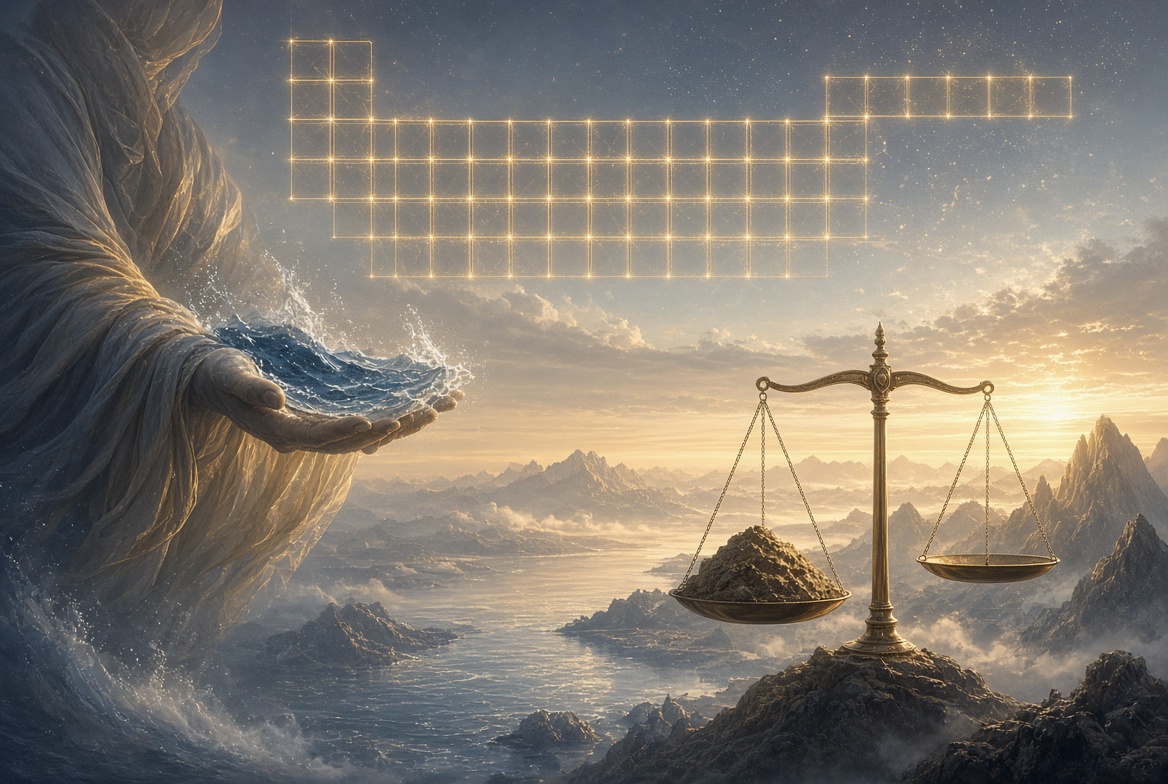
Isa 40:12 He who has measured in His hand the waters and the heavens by a span meted out; and enclosed in the measure the dust of the earth, and weighed in the balance the mountains, and the hills in the scales,
Chemistry
The Apocryphal book of Wisdom claims that the origin of Chemistry is from Wisdom/Messiah
Wis 7:17 For he hath given me certain knowledge of the things that are, namely, to know how the world was made, and the operation of the elements: {Chemistry}
Chemistry is all about ‘matter.’
Chemistry for Dummies pg 9
“Simply put, this whole branch of science is all about matter, which is anything that has mass and occupies space. Chemistry is the study of the composition and properties of matter and the changes it undergoes.”

The English word ‘matter’ comes from the Latin ‘materia’ which means the inner wood of a tree. As seen in Genesis 1:9-13, the Word{דבר ‘davar’} is linked to trees. Bible, codex, liber, scroll etc all trace back to trees. In Hebrew, one of the words for matter is דבר ‘davar’ which means Word.
‘Materia’ is related to the word ‘mater’ in Latin which means the source/mother. In Hebrew, the word for mother is אם ‘em’ which means ‘glue’. This is what physical matter is, elements that are ‘glued’ together to form compounds.
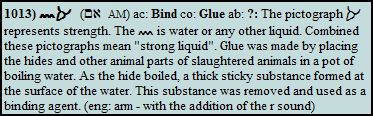
“Matter comes via Anglo-Norman matere from Latin materia ‘matter.’ This was originally applied to the ‘hard inner wood of a tree,’ and etymologically denoted the ‘matrix’ or ‘mother’ from which the tree’s new growth came (it was derived of Latin mater ‘mother’).” {A Dictionary of Word Origins pg 341 “Matter”}
2Pe 3:10 But the day of the Lord will come as a thief in the night, in which the heavens will pass away with rushing sound, and having burned the elements will be dissolved, and earth and the works in it will be burned up.
2Pe 3:11 Then all these being about to be dissolved, of what sort ought you to be in holy behavior and godliness,
2Pe 3:12 looking for and hastening the coming of the Day of God, through which the heavens having been set afire will be dissolved; and burning, the elements will melt?
The elements here mentioned are linked to the Hebrew Aleph-Bet
The Greek word translated as elements in 2 Peter 3:10 is στοιχεῖον ‘stoicheion‘ which means “letters.”
G4747
στοιχεῖον
stoicheion
Thayer Definition:
1) any first thing, from which the others belonging to some series or composite whole take their rise, an element, first principal
1a) the letters of the alphabet as the elements of speech, not however the written characters, but the spoken sounds
1b) the elements from which all things have come, the material causes of the universe
1c) the heavenly bodies, either as parts of the heavens or (as others think) because in them the elements of man, life and destiny were supposed to reside
1d) the elements, rudiments, primary and fundamental principles of any art, science, or discipline
1d1) i.e. of mathematics, Euclid’s geometry
Part of Speech: noun neuter
A Related Word by Thayer’s/Strong’s Number: from a presumed derivative of the base of G4748
“The fundamental particles of the universe that physicists have identified- electrons-neutrinos, quarks, and so on- are the ‘letters’ of all matter.” {The Elegant Universe by Brian Greene pg 13}
Vincent Word Studies – 2 Peter 3:10
The elements (στοιχεῖα)
Derived from στοῖχος, a row, and meaning originally one of a row or series; hence a component or element. The name for the letters of the alphabet, as being set in rows. Applied to the four elements – fire, air, earth, water; and in later times to the planets and signs of the zodiac…The kindred verb στοιχέω, to walk, carries the idea of keeping in line, according to the radical sense. Thus, walk according to rule (Gal_6:16); walkest orderly (Act_21:24). So, too, the compound συστοιχέω, only in Gal_4:25, answereth to, lit., belongs to the same row or column with. The Greek grammarians called the categories of letters arranged according to the organs of speech συστοιχίαι. Here the word is of course used in a physical sense, meaning the parts of which this system of things is composed.
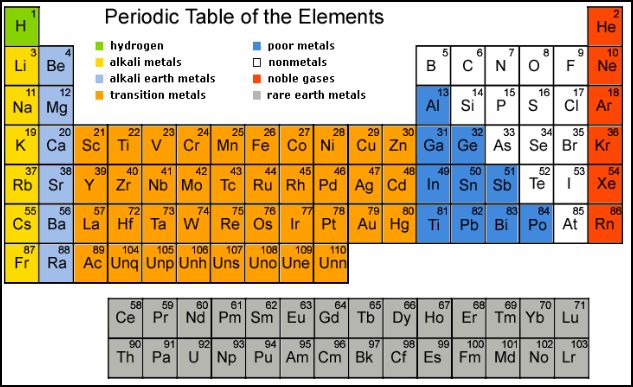
92 Elements
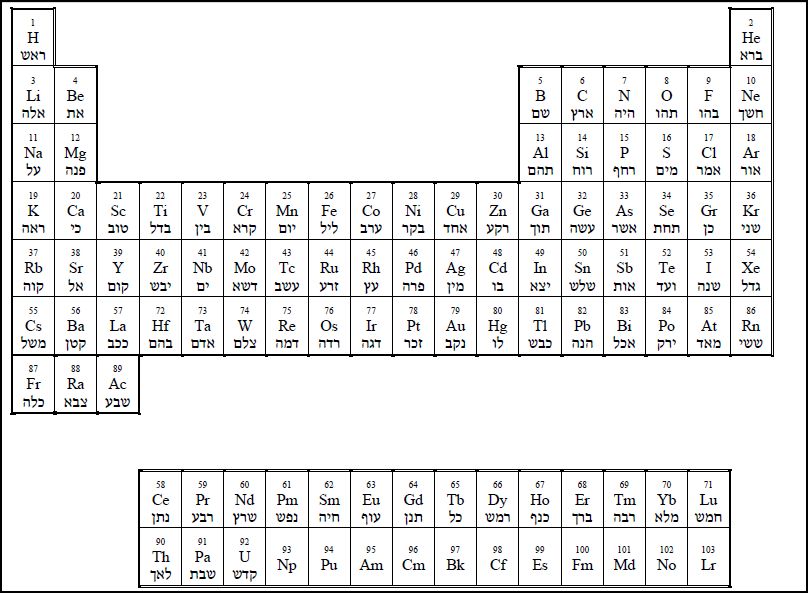
There are 92 naturally occurring elements which correspond to the 92 unique words used in the Torah describing creation (Genesis 1:1 – 2:3)
Periodicity of the Periodic Table of Elements – Yitzhak Ginsburgh
Click to access periodictable.pdf
“From the early rudimentary groupings of chemical compounds to our modern classification that recognizes the periodicity of atomic elements together, chemical tables are usually based on an implicit theory of the composition of matter. These theories have shared a common axiom: that all of the matter in the Universe is composed of finite variety of basic building blocks: These building blocks have been known from the ancient Greeks to the present as atoms.”
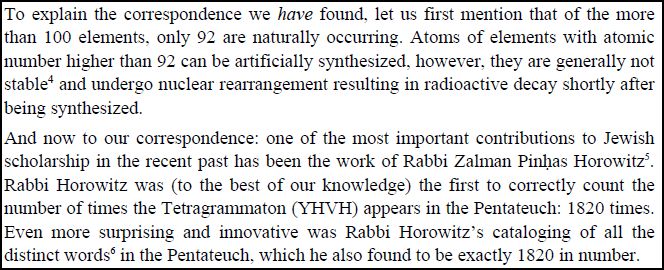
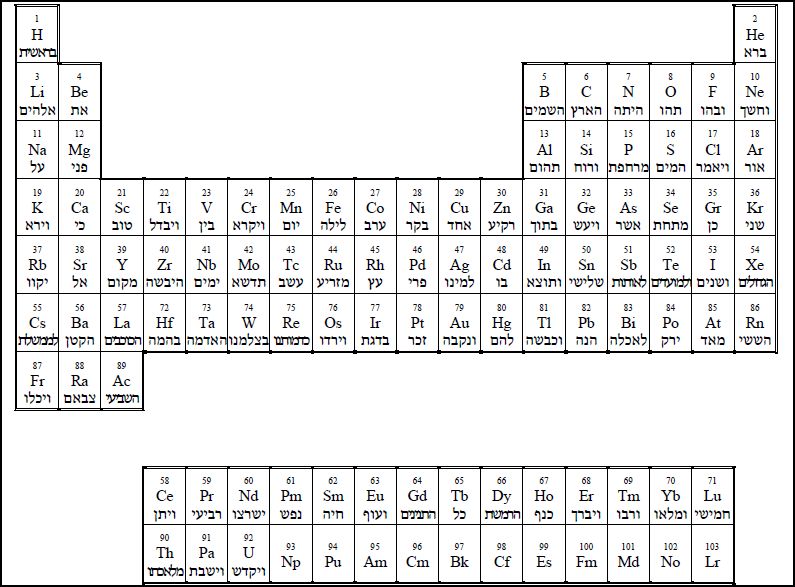
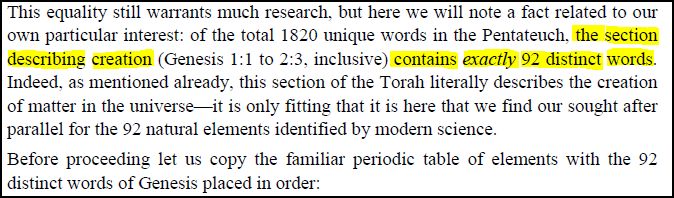
92 naturally occurring elements. The first possibility would be to map each element to its corresponding Hebrew root, simply based on order of appearance. Further reflection though reveals an alternative. The 92 distinct roots of the story of creation are divided such that the first 86 appear in the verses relating the first six days of creation (Genesis 1:1 through 1:31), while the last 6 are found in the verses relating the Sabbath (ibid 2:1 through 2:3). This motivates us to correspond the 6 noble gases with the 6 distinct roots found in the Sabbath section in Genesis, while the remaining 86 elements will be corresponded in order to the distinct roots found in the 6 Days section of Genesis. The 6 ‘noble gases’ do not form compounds, while the other 86 do form compounds with other elements.
This basic division into 6 and 86 observed in the naturally occurring elements is to be found (again, using a non-literal analysis of the Torah text) in the very first verse of Torah:
בראשׁית ברא אלהים את השׁמים ואת הארץ
“It is important to note that G-d here is referred to as Elokim alone (and not by His other names), thus leading to the association of this name with ‘nature’.”


littleguyintheeye@gmail.com