

The Hebrew language was designed to reveal Jesus the Messiah. He is the Alpha & the Omega (Revelation 1:8, 11; 21:6; 22:13), which in Hebrew would be depicted as the ‘Aleph & Tav.’ The phrase Aleph & Tav/Alpha & Omega is a way of depicting completion (Isaiah 41:4; 44:6; 48:12-13), as these are the first and last letters of the Hebrew/Greek alphabets. Messiah is the totality of the alpha-bet, He is the Word made flesh.
“He that would understand a book written in a strange language must first learn the language…Such a language was that wherein the Prophets wrote, and the want of sufficient skill in that language is the main reason why they are so little understood. John did not write in one language, Daniel in another, Isaiah in a third and the rest in others peculiar themselves, but they all write in one and the same mystical language…For the language of the Prophets, being Hieroglyphical, had affinity with that of the Egyptian priest and Eastern wise men, and therefore was anciently much better understood in the East than it is now in the West. I received also much light in this search by the analogy between the world natural and the world polictic. For the mystical language was founded in this analogy, and will be best understood by considering its original.” {Isaac Newton – The Language of the Prophets pg 14}
Hebrew is a pictograph language, with each letter representing a physical object. The following chart depicts this:
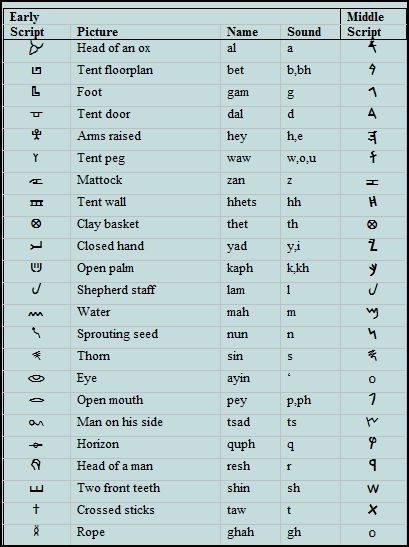
In Hebrew, Letters are combined together to form words, similar to atoms being combined together to form molecules chemistry. For example, the Hebrew word for father is אב ‘av’ which literally means ‘authority of the house.’ א ‘aleph’ means strength and ב ‘bet’ means house.
The connection between the Alpha-Bet and atoms is further seen in 2 Peter 3:10, 12 where the word element is used which in Greek {στοιχεῖον ‘stoicheion’} also means letters.
The word στοιχεῖα ‘stoicheia’ (element), in Greek means ‘orderly, in a row’ which is precisely what scientists have found when studying the elements of the universe {Periodic Table of Elements}.
Uri Harel – Making the Case for Hebrew
“Hebrew, as a conceptual language, operates on a different principal altogether. A quick study of how words are formed in Hebrew reveals a stunning resemblance between the structure of the language, where its letters combine to form words with an inherent meaning; and the structure of the physical universe, where atoms combine into molecules to form various substances.
In the material world, each atom expresses an inherent unique property. When a combination of several atoms occurs, it becomes a molecule, which is the smallest expression of a particular material. Each of the Hebrew letters, in exactly the same way, expresses a concept. When put together in combinations with other letters (typically sets of three letters) they form the equivalent of a molecule: a Hebrew root. And from this root many words spring out, all carrying within them the three letters of the root and some of the original meaning of the concept of the root.”
As mentioned before, The Hebrew language was designed to reveal Jesus the Messiah. The word Hebrew literally depicts this.
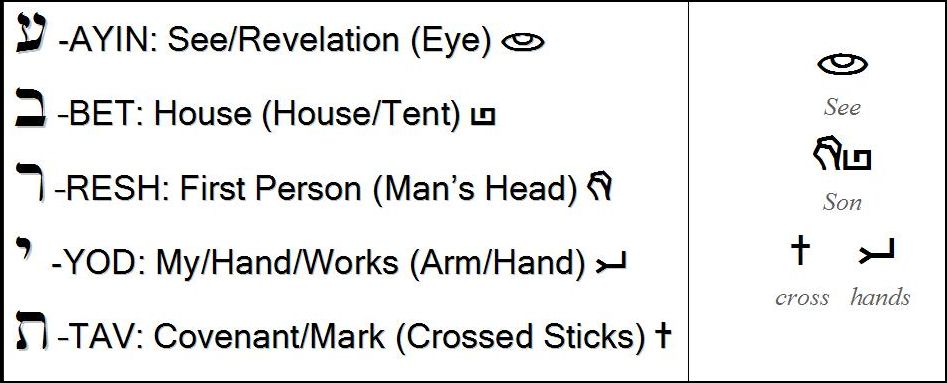
Here we see the Hebrew word for the Hebrew language is עברית ‘ivrit.’ עברית comes from the root בר which means ‘pure’ (Zephaniah 3:9).
Hebrew breaks down pictographically as thus:
ע ayin means to see
בר bet-resh is the word for Son
י yod is a hand
ת tav is a cross
The pictographs of the word עברית ‘ivrit’ means to ‘see the Son with hands on the cross.’ The Hebrew language was designed to reveal the Gospel. It is through the work of Messiah on the cross that all mankind is brought back to the Father (Zephaniah 3:9).
א – Aleph
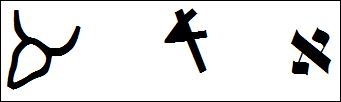
The Hebrew letter א ‘aleph’ {spelled אלף ‘aleph’} is a picture of an ox. This word אלף ‘aleph’ is translated in the Scriptures as ‘oxen’ (Psalm 8:7; Proverbs 14:4; Isaiah 30:24), ‘kine’ (Deuteronomy 7:13; 28:4, 18, 51). אלף ‘aleph’ is also translated as ‘learn’ (Proverbs 22:25) and ‘teach’ (Job 33:33). This is because one form of learning is done by following a more experienced individual such as two oxen being yoked together, the younger learning from the older.
The picture of oxen being yoked together in connection with learning points to Messiah Jesus.
Mat 11:28 Come unto me, all ye that labour and are heavy laden, and I will give you rest.
Mat 11:29 Take my yoke upon you, and learn of me; for I am meek and lowly in heart: and ye shall find rest unto your souls.
Mat 11:30 For my yoke is easy, and my burden is light.
The root of אלף ‘aleph’ is אל ‘el’ which is commonly translated as God but literally means power and strength as in the strenth of an ox. Literally, אל ‘el’ means strong authority as א ‘aleph’ means strength or power and ל ‘lamed’ is the picture of a shepherd’s staff which represents authority. Scripture declares that Jesus is אל ‘el’ (Psalm 45:6-7; Hebrews 1:1-9; Isaiah 7:14; 9:6; Matthew 1:23; John 1:1; 20:28; Titus 2:13; Philippians 2:5-8; 2 Corinthians 4:4; Colossians 1:15-17; Romans 9:5).
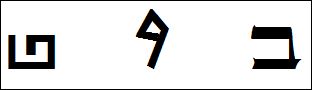
The Hebrew letter ב ‘bet’ {spelled בית} is a picture of a house, specifically a nomadic tent. This word is translated in Scripture house, family and temple. The house/family/temple of God is His people, the body of Messiah (2 Corinthians 6:16-18; Hebrews 3:6; 1 Peter 2:5; Ephesians 2:11-22).
When one breaks down the word בית ‘bayit’ a further connection to the Messiah is seen. The letter ב ‘bet’ is a house/family. The letter י ‘yod’ is a hand. The letter ת ‘tav’ is a cross. Here in this letter is found a prophecy of believers becoming the house/family of God through the crucifixion of Messiah Jesus.
Eph 2:11 Wherefore remember, that ye being in time past Gentiles in the flesh, who are called Uncircumcision by that which is called the Circumcision in the flesh made by hands;
Eph 2:12 That at that time ye were without Christ, being aliens from the commonwealth of Israel, and strangers from the covenants of promise, having no hope, and without God in the world:
Eph 2:13 But now in Christ Jesus ye who sometimes were far off are made nigh by the blood of Christ.
Eph 2:14 For he is our peace, who hath made both one, and hath broken down the middle wall of partition between us;
Eph 2:15 Having abolished in his flesh the enmity, even the law of commandments contained in ordinances; for to make in himself of twain one new man, so making peace;
Eph 2:16 And that he might reconcile both unto God in one body by the cross, having slain the enmity thereby:
Eph 2:17 And came and preached peace to you which were afar off, and to them that were nigh.
Eph 2:18 For through him we both have access by one Spirit unto the Father.
Eph 2:19 Now therefore ye are no more strangers and foreigners, but fellowcitizens with the saints, and of the household of God;
Eph 2:20 And are built upon the foundation of the apostles and prophets, Jesus Christ himself being the chief corner stone;
Eph 2:21 In whom all the building fitly framed together groweth unto an holy temple in the Lord:
Eph 2:22 In whom ye also are builded together for an habitation of God through the Spirit.
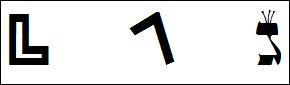
The Hebrew letter ג ‘gimmel’ {spelled גמל } is a picture of a foot meaning to travel. The combination of the letters brings forth the meaning of “walking to water”. ג ‘gimmel’ is a foot, ל ‘lamed is a shepherd staff and מ ‘mem’ is water. The word is translated as wean, reward, camel, yield. At a watering hole plants grow in abundance bringing forth a great yield. Traveling to this waterhole would be done on a camel. When a child is weaned they are now able to work, or “yield”.
This imagery of a shepherd walking to water points to Messiah Jesus, the Good Shepherd (Psalm 23:1-2; John 10:11-14). It is through Him that maturity, or being “weaned” comes (Colossians 2:10; Psalm 138:8; 1 Corinthians 13:9-13; Ephesians 4:13). It is through Him that we are able to yield fruit (John 15:1-7).
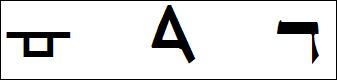
The Hebrew letter ד ‘dalet’ {spelled דלת} is a picture of a tent door. The word is translated as door or gate in the Scriptures. Messiah Jesus is the door/gate from whence man can enter into the garden of the Lord (John 10:7-14). This entrance was made available through His death on the cross (John 10:15-18; Hebrews 10:20). דלת ‘dalet’ comes from the root דל ‘dal’ which means to be poor or low as in the tent door which hung down as a curtain.
Php 2:5 Let this mind be in you, which was also in Christ Jesus:
Php 2:6 Who, being in the form of God, thought it not robbery to be equal with God:
Php 2:7 But made himself of no reputation, and took upon him the form of a servant, and was made in the likeness of men:
Php 2:8 And being found in fashion as a man, he humbled himself, and became obedient unto death, even the death of the cross.
Php 2:9 Wherefore God also hath highly exalted him, and given him a name which is above every name:
Php 2:10 That at the name of Jesus every knee should bow, of things in heaven, and things in earth, and things under the earth;
Php 2:11 And that every tongue should confess that Jesus Christ is Lord, to the glory of God the Father.
Further displaying this connection between דלת ‘dalet’ and Messiah’s sacrifice is the meaning of the letters which spell דלת ‘dalet.’ ד ‘dalet’ is a door, ל ‘lamed’ displays the shepherd and ת ‘tav’ is a picture of a cross. The Good Shepherd died on a cross that the door to heaven might be opened to whosoever would believe in Him.
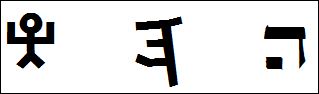
The Hebrew letter ה ‘heh’ {spelled הה} is the picture of a person looking at a great sight causing that person to take a deep breath. This word is used in Ezekiel 30:2 translated as ‘woe.’ היה ‘hayah’ which means to exist comes from this root word as our existence is dependent upon our breath. היה ‘hayah’ is the Hebrew source for “I AM” or “I Exist” (Exodus 3:14). Messiah Jesus is “I AM” (John 8:24, 28, 56-58; 13:18-19; 18:7-9; Mark 14:61-62).
The Letter ‘heh’ is linked to breath, and therefore to life. The pronunciation of the letter heh is the exhaling of breath. This is where life comes from (Genesis 2:7; 7:22). This breath comes from Messiah (Psalm 33:6; John 1:2-4; Lamentations 4:20).
The pictograph of the letter ה ‘heh’ is of a man with his arms stretched out. It was through the cross, where Messiah had is arms stretched out, that He revealed that He is “I AM”. In Genesis 22:7, YHWH God literally told Abraham that He would provide Himself as the lamb for sacrifice. In John 8:28, Jesus declared that we would see that He is the “I AM” on the cross.
Joh 8:28 Then Jesus said to them, When you lift up the Son of Man, then you will know that I AM; and from Myself I do nothing; but as My Father taught Me, these things I speak.
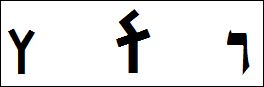
The Hebrew letter ו ‘vav’ {spelled וו} is the picture of a tent peg, nail or hook (Exodus 26:32, 37; 27:10-11, 27 etc). Messiah Jesus is likened to a tent peg/nail who holds the key of David (Isaiah 22:22-23; Revelation 3:7).
The letter ו ‘vav’ is also used as a conjunction (“and”) in the Hebrew language, connecting one thing to another as a tent peg is used to connect or attach the tent to the ground. Messiah Jesus is the one who connects mankind together (John 12:32), and most importantly connects mankind to God (1 Timothy 2:5).
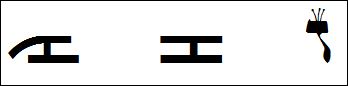
The Hebrew letter ז ‘zayin’ {spelled זין} is the picture of a mattock/pickaxe used to cut the stalks of plants in order to harvest them. This tool can be also used as a weapon and also as a digging tool. All of these concepts point to Messiah Jesus.
The mattock/pickaxe is used to plow hard, rocky soil that seed might be sown. Scripture speaks of Messiah, as a planter (Matthew 13:37-43) and farmer (Genesis 2:8, 15; Isaiah 28:23-29). The mattock being used as a plowing instrument is seen in the Hebrew word מחרשה ‘machareshah’ which literally means to scratch or plow the soil. A related word is חריש ‘chariysh’ which means to plow (Genesis 45:6; Exodus 34:21) as well as harvest (1 Samuel 8:12) the field.
It is Messiah who reaps the harvest at the end of the age (Revelation 14:15; Mark 4:26-29; Matthew 13:36-43; Joel 3:13). He discerns and divides the good from the bad at this time (Matthew 13:41-43, 47-49). One of the Hebrew words for ‘discern’ is שמע ‘shema’ which means to hear (2 Samuel 14:17; 1 Kings 3:11). The Hebrew word for ear is אזן ‘ozen’ which comes from the root זן ‘zan’ which means the mattock/harvest. The ear comes from this root because the ear is the part of the body which “harvests” sounds and is used to discern these sounds for understanding. The Hebrew word for balance is מואזן ‘mo’ezan’ which is a cognate of אזן ‘ozen’ as the ears are the place from which man gets his balance. Balances are also used in the harvest (Amos 8:5) as well as in judgment (Daniel 5:27).
The mattock can also be used a weapon and is related to the sword in the Hebrew language as both are used for the purpose of cutting. The Hebrew word חרב ‘charav’ is most commonly translated as sword but is also translated as mattock as well (2 Chronicles 34:6). At the end of the age, at “harvest” time (Matthew 13:39-43), Messiah returns with sword in Hand (Isaiah 66:16; Revelation 1:16; 2:16; 19:15, 21) to judge the earth, dividing the sheep from the goats (Matthew 25:32). It is interesting to note that the Hebrew word מעדר ‘ma’der’ is translated as mattock in Scripture (Isaiah 7:25). This word literally means to dig a field, clearing debris such as rocks and thorns creating order. מעדר ‘ma’der’ is a cognate of the word עדר ‘adar’ which has the meaning of a shepherd ordering his flock.
 Little Guy in the Eye
How lovely to hear from you after very many years. I hope you and your family are well Levi? I’d like to say a huge thank you to you. You will not know that it was your teachings that lead me into a wonderful place of revelation and understanding. I have spend the last 7 years in deeper study learning how to be one of the evrit. Thank you and bless you.
Sent from Outlook for iOShttps://aka.ms/o0ukef
All praise and glory goes to God. Believe me, I took about a decade away from studies like this, and now I go back and see what I wrote and I’m pretty sure it was God working through me cause I’m not anything special when it comes to knowledge for sure.
God bless you,
Levi